Trump Is Moving Relentlessly Toward Illegal War in Venezuela

The lawful procedure would have been to arrest people if there was probable cause they were involved in drug trafficking and bring them to justice in accordance with due process.
Venezuela isn’t even mentioned in the U.S. Drug Enforcement Administration’s National Drug Threat Assessment 2024.
The Trump administration’s murderous strikes on small boats at sea constitute unlawful extrajudicial killings.
By Marjorie Cohn , Truthout, October 30, 2025
s the Trump administration continues to murder people in small boats on the high seas and mounts the largest U.S. military buildup in decades in the Caribbean, it is moving inexorably toward an all-out, illegal attack and forcible regime change in Venezuela.
Despite Team Trump’s feeble attempts to legally justify its ocean strikes, which have now killed 57 people since early September, those extrajudicial killings are also unlawful.
Donald Trump’s murderous campaign came into focus on February 20, when the State Department designated eight drug trafficking organizations, including Tren de Aragua, as foreign terrorist organizations. Although the administration has attempted — so far unsuccessfully — to use that designation to justify sending immigrants to a notorious prison in El Salvador, Trump is now invoking it in an effort to validate his illegal strikes at sea.
Moreover, on March 15, Trump issued “A Proclamation,” alleging that Tren de Aragua has been engaged, in association with Venezuelan President Nicolás Maduro, in “irregular warfare” in the United States, with no explanation of what is meant by irregular warfare. But on February 26, most U.S. intelligence agencies had made a finding that Tren de Aragua was neither controlled by the Venezuelan government, nor was it committing crimes in the United States on its orders.
On September 2, Trump announced that the U.S. had conducted a “kinetic strike” against an alleged drug smuggling vessel in the Caribbean, even though Secretary of State Marco Rubio said the U.S. military could have interdicted the vessel rather than killing all of those on board. Trump wanted to “send a message,” hardly an excuse for premeditated murder.
The lawful procedure would have been to arrest people if there was probable cause they were involved in drug trafficking and bring them to justice in accordance with due process. Both U.S. and international law provide for the arrest of alleged drug traffickers or individuals suspected of acts of terrorism, both on the high seas and in U.S. territorial waters.
In a post on social media accompanied by a video clip of the strike, Trump declared that the attack was “against positively identified Tren de Aragua Narcoterrorists” and referred to the February 20 foreign terrorist organization designation. This did not provide a lawful basis for murdering alleged drug dealers.
Although Trump’s stated rationale is preventing drugs from Venezuela entering the United States, Venezuela isn’t even mentioned in the U.S. Drug Enforcement Administration’s National Drug Threat Assessment 2024.
No State of Armed Conflict, No Unlawful Combatants, No Self-Defense
It was reported in early October that Trump had notified several congressional committees that the U.S. is engaged in a formal “armed conflict” with drug cartels that his administration has branded terrorist organizations, and that suspected drug smugglers are “unlawful combatants” in order to justify the strikes as self-defense………………………………………………………………………………………………………………………………………………………………………………………..
There is no current state of armed conflict, there is no evidence that the people on the boats were combatants, and it is illegal to deliberately attack civilians. “This is not stretching the envelope,” Geoffrey Corn, a retired judge advocate general lawyer who was formerly the Army’s senior adviser for law-of-war issues, told The New York Times. “This is shredding it. This is tearing it apart.”
The strikes on boats also violate the right to life enshrined in the International Covenant on Civil and Political Rights, which the U.S. has ratified, making it part of U.S. law under the Supremacy Clause of the Constitution. The covenant says that “no one shall be arbitrarily deprived of his life.” It outlaws extrajudicial killing outside the context of armed conflict or by law enforcement when necessary to protect against an imminent threat to life.
An Attack on Venezuela Would Be an Unlawful Act of Aggression
In addition to its increasing numbers of murders of alleged drug smugglers at sea, the Trump administration is positioning tremendous military firepower for what appears to be an imminent attack on Venezuela.
Hegseth ordered the USS Gerald R. Ford aircraft-carrier strike group with five destroyers to deploy to the region to “bolster U.S. capacity to detect, monitor, and disrupt illicit actors and activities that compromise the safety and prosperity of the United States,” according to a Pentagon spokesperson.
“The only thing you could use the carrier for is attacking targets ashore, because they are not going to be as effective at targeting small boats at sea,”……………………………………………………………………………………………………………..
Forcible Regime Change Violates Venezuela’s Right to Self-Determination
During his first term, Trump repeatedly voiced his desire to invade Venezuela and change its regime. He was preoccupied with the idea of an invasion, the AP reported.
In 2019, the Trump administration orchestrated an unsuccessful strategy led by Rubio to carry out a coup d’état, seize power from Maduro, and install Juan Guaidó as “interim president” of Venezuela…………………………………………………………………………………………………………..
National courts around the world should investigate and charge U.S. officials, including Trump, Rubio, and Hegseth, with murder under well-established principles of universal jurisdiction.
And we must mobilize a powerful antiwar movement to demand that the U.S. government stop the illegal boat murders and stay out of Venezuela. https://truthout.org/articles/trump-is-gunning-to-illegally-attack-venezuela-and-change-its-regime/?utm_source=Truthout&utm_campaign=33e1b56faa-EMAIL_CAMPAIGN_2025_10_30_09_26&utm_medium=email&utm_term=0_bbb541a1db-33e1b56faa-650192793
If the US resumes nuclear weapons testing, this would be extremely dangerous for humanity
Tilman Ruff, Honorary Principal Fellow, School of Population and Global Health, The University of Melbourne, October 30, 2025, https://theconversation.com/if-the-us-resumes-nuclear-weapons-testing-this-would-be-extremely-dangerous-for-humanity-268661?utm_medium=email&utm_campaign=Latest%20from%20The%20Conversation%20for%20October%2031%202025%20-%203566936381&utm_content=Latest%20from%20The%20Conversation%20for%20October%2031%202025%20-%203566936381+CID_7ad11048cc6a12b2fcdd641252fbcae9&utm_source=campaign_monitor&utm_term=If%20the%20US%20resumes%20nuclear%20weapons%20testing%20this%20would%20be%20extremely%20dangerous%20for%20humanity
US President Donald Trump has instructed the Pentagon to resume nuclear weapons testing immediately, “on an equal basis” with other countries’ testing programs.
If Trump is referring to the resumption of explosive nuclear testing, this would be an extremely unfortunate, regrettable step by the United States.
It would almost inevitably be followed by tit-for-tat reciprocal announcements by other nuclear-armed states, particularly Russia and China, and cement an accelerating arms race that puts us all in great jeopardy.
It would also create profound risks of radioactive fallout globally. Even if such nuclear tests are conducted underground, this poses a risk in terms of the possible release and venting of radioactive materials, as well as the potential leakage into groundwater.
The Comprehensive Nuclear Test Ban Treaty has been signed by 187 states – it’s one of the most widely supported disarmament treaties in the world.
The US signed the treaty decades ago, but has yet to ratify it. Nonetheless, it is actually legally bound not to violate the spirit and purpose of the treaty while it’s a signatory.
What testing is used for, and why it stopped
In earlier years, the purpose of testing was to understand the effects of nuclear weapons – for example, the blast damage at different distances, which provides confidence around destroying a given military target.
Understanding the consequences of nuclear weapons helps militaries plan their use, and to some extent, protect their own military equipment and people from the possible use of nuclear weapons by adversaries.
But since the end of the second world war, states have mostly used testing as part of the development of new weapons designs. There have been a very large number of tests, more than 2,000, mostly seeking to understand how these new weapons work.
The huge environmental and health problems caused by nuclear testing prompted nations to agree a moratorium on atmospheric testing for a couple of years in the early 1960s. In 1963, the Partial Test Ban Treaty banned nuclear tests in all environments except underground.
Since then, nuclear-armed states have stopped explosively testing at different times. The US stopped in 1992, while France stopped in 1996. China and Russia also aren’t known to have conducted any tests since the 1990s. North Korea is the only state to have openly tested a nuclear weapon this century, most recently in 2017.
These stoppages came in the 1990s for a reason: by that time, it became possible to test new nuclear weapon designs reliably through technical and computer developments, without having to actually explode them.
So, essentially, the nuclear states, particularly the more advanced ones, stopped when they no longer needed to explosively test new weapon designs to keep modernising their stocks, as they’re still doing.
Worrying levels of nuclear proliferation
There is some good news on the nuclear weapons front. The Treaty on the Prohibition of Nuclear Weapons has now been signed by half the world’s nations. This is a historic treaty that, for the first time, bans nuclear weapons and provides the only internationally agreed framework for their eventual elimination.
With the exception of this significant development, however, everything else has been going badly.
All nine nuclear-armed states (the US, China, Russia, France, the United Kingdom, India, Pakistan, North Korea and Israel) are investing unprecedented sums in developing more accurate, stealthier, longer-range, faster, more concealable nuclear weapons.
This potentially lowers the threshold for their use. And it certainly gives no indication these powers are serious about fulfilling their legally binding obligations to disarm under the Nuclear Non-Proliferation Treaty.
Moreover, multiple nuclear-armed states have been involved in recent conflicts in which nuclear threats have been made, most notably Russia and Israel.
Worryingly, we have also seen the numbers of nuclear weapons “available for use” actually start to climb again.
This includes those in military stockpiles, those that have been deployed (linked to delivery systems such as missiles), and those on high alert, which are the ones most prone to accidental use because they can be launched within minutes of a decision to do so. All of these categories are on the increase.
Russia, in particular, has weapons we haven’t seen before, such as a nuclear-powered, nuclear-armed cruise missile that President Vladimir Putin said on Sunday his country has successfully tested. China, too, is embarking on a rapid build-up of nuclear weapons.
And the US has just completed assembling a new nuclear gravity bomb.
A new START treaty also not moving forward
Nearly all of the hard-won treaties that constrained nuclear weapons since the end of the Cold War have been abrogated.
There’s now just one remaining treaty constraining 90% of the world’s nuclear weapons, which are in the hands of the US and Russia. This is the New START Treaty, which is set to expire in February next year.
Putin offered to extend that treaty informally for another year, and Trump has said this is a good idea. But its official end is just four months away, and no actual negotiations on a successor treaty have begun.
The US has also said China needs to be involved in the successor treaty, which would make it enormously more complicated. China has not expressed a willingness to be part of the process.
Whether anything will be negotiated to maintain these restraints beyond February is unclear. None of the nuclear-armed states are negotiating any other new treaties, either.
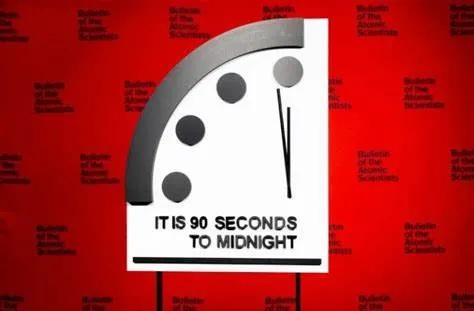
All of this means the Doomsday Clock – one of the most authoritative and best-known assessments of the existential threats facing the world – has moved forward this year further than it has ever done before.
It’s really an extraordinarily dangerous time in history.
‘Groundhog Day’: Israel Breaks Ceasefire to Attack Gaza, Killing 104 People, Including 46 Children.
Democracy Now, October 30, 2025
Israel launched major airstrikes on Gaza, killing at least 104 people, including 46 children, in the deadliest attacks since the U.S.-brokered ceasefire was announced. Israeli Prime Minister Benjamin Netanyahu ordered “powerful strikes” on Gaza Tuesday after Israeli officials accused Hamas of killing an Israeli soldier in Rafah — which Hamas has denied. Netanyahu is trying “everything possible to resume the genocide in Gaza,” says Muhammad Shehada, a writer and analyst from Gaza. “The only condition is that he needs to maintain the facade of the ceasefire.”
Transcript
AMY GOODMAN: Israel launched major airstrikes on Gaza beginning Tuesday night, killing at least 104 people, including at least 35 children — about a third of the dead — in the most lethal attacks since a U.S.-brokered ceasefire began on October 10th.
Israeli Prime Minister Benjamin Netanyahu ordered what he called “powerful strikes,” unquote, on Gaza after Israeli officials accused Hamas of killing an Israeli soldier in Rafah. Hamas denied involvement in the soldier’s death.
President Trump defended Israel’s attacks while also saying nothing is going to jeopardize the ceasefire……………………………………………………………………………………………………………………………………………………………….. https://www.democracynow.org/2025/10/29/gaza_israel_strikes_muhammad_shehada
It’s Just Wall-To-Wall News Stories About The US And Its Allies Abusing The World.
Caitlin Johnstone, Oct 29, 2025, https://www.caitlinjohnst.one/p/its-just-wall-to-wall-news-stories?utm_source=post-email-title&publication_id=82124&post_id=177462655&utm_campaign=email-post-title&isFreemail=true&r=1ise1&triedRedirect=true&utm_medium=email
It’s just news story after news story about the US and its allies terrorizing the world today.
The Rapid Support Forces (RSF) have been filming themselves committing horrific massacres in Sudan over the last couple of days, reportedly murdering some two thousand civilians. You can see the bloodstains on the ground in satellite images. As we discussed the other day, the RSF and its atrocities are backed by the UAE, a close partner of the United States.
Meanwhile Israel has committed another wave of massacres of its own throughout the Gaza Strip, reportedly killing 104 people in a single day, including 46 children. This is as many Palestinians as would typically be killed on any given day in Gaza prior to the so-called “ceasefire”.
CBS News’ 60 Minutes has released a cartoonishly blatant war propaganda piece on “Nicolas Maduro, Venezuela’s dictator” about how poor and unhappy the people of Venezuela are under their current government. The piece featured an interview with Republican Senator Rick Scott, who said that “If I was Maduro I’d head to Russia or China right now; his days are numbered.”
The US can make threats, impose sanctions and amass war machinery, but you don’t truly know they’re serious about attacking a country until they start churning out Pentagon propaganda in the mainstream press.
In the same interview, Scott also said that if Maduro is successfully ousted, “it’ll be the end of Cuba.”
“America is gonna take care of the southern hemisphere and make sure there’s freedom and democracy,” he added.
The senator’s statements suggest that the US is preparing a push in Latin America similar to what it has been executing with Israel in the middle east, eliminating any powers which refuse to bend the knee. South of the US border the top two disobedient governments are the socialist states of Venezuela and Cuba. In the middle east the US and Israel have spent the last two years bombing Iran and Yemen, securing a regime change in Syria, and doing everything they can to eliminate Hamas and Hezbollah in order to rule the region uncontested.
And of course we’ve still got the horrifying US proxy war in Ukraine, where men continue to be dragged off against their will to fight in a nightmarish conflict that most Ukrainians now oppose, but which Zelensky is saying he intends to keep fighting for years against the will of the public. This whole miserable ordeal could have been avoided with a little diplomacy and a few low-cost concessions, but the western power alliance avoided off-ramp after off-ramp in order to ensure that Russia would get sucked into another costly military quagmire.
All over the world the US and its allies are murdering and abusing people in order to dominate the planet and ensure the survival of the capitalist system with which its power is intertwined. It is a giant murder machine feeding on human blood and the life force of our biosphere while providing nothing but obstacles to a healthy world.
The US-centralized empire is a disease that affects our entire species. We had better find a cure, and fast.
Donald Trump says South Korea can build nuclear-powered submarines in US
Donald Trump has said he has given South Korea permission to build
nuclear-powered submarines in Philadelphia, in an announcement that could rattle China as the US president prepares to meet Xi Jinping. “South
Korea will be building its Nuclear Powered Submarine in the Philadelphia
Shipyards, right here in the good ol’ U.S.A.,” Trump wrote on the Truth
Social platform on Thursday during his visit to the US ally and ahead of a
summit with President Xi. Trump said the US-South Korea military alliance
was “stronger than ever” so he had “given them approval to build a
Nuclear Powered Submarine”.
FT 30th Oct 2025,
https://www.ft.com/content/a6ee6741-5a66-41b1-80b6-5e01e4a823a5
Trump a shameful Double Ace in obliterating small, unarmed boats on the high seas
Walt Zlotow, West Suburban Peace Coalition, Glen Ellyn IL,30 Oct 25
WWI saw the elevation of intrepid fighter pilots to heroic heights as they fought for the skies in flimsy, wood and canvas death traps over the Front. Average life span about 3 weeks. To celebrate their status cheating death while bringing death to the enemy, they were exalted as an Ace if they downed 5 enemy planes. Achieving 10 kills made them a Double Ace.
A century plus later Donald J. Trump has forever besmirched the honored designation of Ace with his 10th kill of small unarmed boats on the high seas in the Caribbean and Pacific, sending several dozen unknown innocents to Davey Jones locker. Eddie Rickenbacker received the Congressional Medal of Honor as America’s Ace of Aces with 26 kills in WWI. Richard Bong received the Congressional Medal of Honor as America’s Ace of Aces with 40 kills in WWII.
Gleefully celebrating each of his first 10 kills on the high seas, Double Ace Donald J. Trump will only receive the everlasting condemnation of history for his ongoing, senseless destruction of human life from the safety of the now Trump desecrated Peoples House.
UN Human Rights Office Warns Israeli Settler Violence in West Bank Is “Surging”
The Trump administration insisted last week that it would not allow Israel to annex the occupied West Bank.
By Sharon Zhang , Truthout, October 27, 2025, https://truthout.org/articles/un-human-rights-office-warns-israeli-settler-violence-in-west-bank-is-surging/
he UN Human Rights office for Palestine has warned that Israel is rapidly accelerating its campaign to annex the occupied West Bank, with settlers adding outposts at a pace 10 times higher than the previous average rate just in the past year.
Recent settler attacks on the olive harvest have underscored the danger faced by Palestinian communities, the office noted, with this season alone seeing 150 settler attacks so far.
This includes an attack caught on camera by a journalist last week, when a 53-year-old woman was beaten by settlers and sent to the hospital during the olive harvest; as well as an attack on a 58-year-old olive farmer in Nahalin, west of Bethlehem, on Thursday, the office said.
These attacks represent just a fraction of the settler violence faced by Palestinians as Israel escalates its annexation campaign amid its genocide in Gaza, the office said. UN officials, citing Israeli group Peace Now, said that there have been 757 settler attacks in the West Bank just in the first half of 2025, marking a 13 percent increase over the previous year.
Meanwhile, Israeli settlers have created 84 new illegal outposts in the West Bank, marking a “rapid escalation” of the previous pace of eight new settlements per year on average, the office said.
The violence is “making life impossible for Palestinians in many communities across the occupied West Bank and leaving them with no genuine choice but to leave their homes.”
“These actions advance Israel’s stated policy to consolidate annexation in clear violation of international law,” the office said.
The UN statement comes just days after the Trump administration repeated its supposed opposition to annexation.
“It won’t happen,” said President Donald Trump last week when asked about annexation. “Israel would lose all of its support from the United States if that happened.”
But as the UN statement and that of other experts has underscored, Israel is already in the process of annexing the West Bank, both in policy and in practice. Top Israeli ministers have spent recent months formalizing plans for annexation, vowing to annex the West Bank in all but name or, in some cases, outright calling for the illegal policy.
The experts respond to Trump’s proposal to “start testing our Nuclear Weapons on an equal basis”

even if China was to up the number of its warheads dramatically, that would still amount to less than a third of what the United States and Russia each already have.
By Dan Drollette Jr | October 30, 2025, https://thebulletin.org/2025/10/the-experts-respond-to-trumps-proposal-to-start-testing-our-nuclear-weapons-on-an-equal-basis/
President Donald Trump wrote on Truth Social, his social media site, that he had instructed the Department of War (formerly the Defense Department) to return to “nuclear testing” — although it’s unclear whether he was referring to testing a nuclear delivery system or testing a nuclear explosive device. Those are two very different things that Trump seems to be confused about.
In the words of prominent nuclear weapons expert Hans Kristensen of the Federation of American Scientists (who is one of the lead authors of the “Nuclear Notebook” column, published regularly in the Bulletin of the Atomic Scientists): “It’s hard to know what he means. As usual, he’s unclear, all over the map, and wrong.” Kristensen then goes into detail, debunking a series of Trump’s assertions in his social media post. For instance, Trump’s initial claim that “[t]he United States has more Nuclear Weapons than any other country. This was accomplished, including a complete update and renovation of existing weapons, during my First Term in office…” is simply false.
As Kristensen points out, Russia has more nuclear weapons than the United States. And Trump’s assertion about a “a complete update and renovation of existing weapons” is also flatly wrong. In Kristensen’s words, “The nuke modernization program currently underway was initiated by Obama, Trump didn’t finish it, and it will continue for another two decades.”
Kristensen then proceeds for eight linked posts to correct or clarify the many other misstatements made by the president in Trump’s Truth Social post. For example, even if China was to up the number of its warheads dramatically, that would still amount to less than a third of what the United States and Russia each already have.
And as Kristensen notes, the US already tests its missiles (without nuclear payloads) to ensure that they can launch safely and correctly: “If by testing he [Trump] means nuclear explosive testing, that would be reckless, probably not possible for 18 months, would cost money that Congress would have to approve, and it would certainly trigger Russian and Chinese and likely also India/Pakistan nuclear tests. Unlike the US, all these countries would have much to gain by restarting test testing. There have been occasional rumors that Russia/China may have conducted very small-yield tests, I’m not aware of any reports that they have conducted significant nuclear test explosions.”
The process of resuming testing would be nowhere near as swift as Trump suggests; the White House would have to direct the US Energy Department to order our national nuclear laboratories to start preparing for a nuclear warhead test. And since the United States doesn’t currently have a nuclear weapons test explosion program, Congress would have to appropriate the money.
Furthermore, Kristensen notes “[i]t would be expensive and take time: a simple explosion is 6-10 months, a fully instrumented test in 24-36 months, and a test to develop a new nuclear warhead is about 60 months.”
Just in case Trump is indeed talking about testing a nuclear explosive device, it’s probably a good time to look back at the Bulletin’s March 2024 issue, “A return to nuclear testing?”, which lays out the many negative impacts of nuclear testing. In that issue, veteran national security reporter Walter Pincus explains exactly what those who live in a place chosen for testing experience in “The horrors of nuclear weapons testing.” People today seem to have forgotten—if they ever knew—what a single nuclear weapon can do. The inhabitants of the Marshall Islands, whose home was turned into a nuclear proving ground, have certainly never forgotten.
Beyond that, the reasons for preserving a ban on nuclear tests are many—even though Russia, China, and the United States have been keeping their test sites ready for a potential resumption of full-scale tests of explosive devices, just in case. Eminent researcher Pavel Podvig delves into this in detail in his Bulletin essay, “Preserving the nuclear test ban after Russia revoked its CTBT ratification.”
And one thing that seems to get overlooked is that the United States has benefited from a test ban as much as anyone else. Consequently, bringing the Comprehensive Nuclear Test Ban Treaty into force would lock in an American advantage in nuclear knowledge and expertise and hinder other states from developing more sophisticated nuclear arms, as Stanford University expert Steven Pifer notes in “The logic for US ratification of the Comprehensive Nuclear Test Ban Treaty.”
Trump to reduce tariffs on Beijing amid resumed US nuclear weapons testing order
ABC News. 30 Oct 25
In short:
Donald Trump says he has struck a deal with China’s Xi Jinping to reduce tariffs on Beijing in exchange for resumed US soybean purchases.
The meeting came shortly after Mr Trump ordered the Department of Defense to immediately resume testing nuclear weapons.
US President Donald Trump says he has struck a deal with China’s Xi Jinping to reduce tariffs on Beijing in exchange for resumed US soybean purchases, shortly after saying he would order the resumption of US nuclear weapons testing.
His remarks after the face-to-face talks with Mr Xi in the South Korean city of Busan — their first since 2019 — marked the finale of Mr Trump’s whirlwind Asia trip on which he also touted trade breakthroughs with South Korea, Japan and South-East Asia nations.
“I thought it was an amazing meeting,” Trump told reporters aboard Air Force One shortly after he departed Busan, adding that tariffs imposed on Chinese imports would be cut to 47 per cent from 57 per cent.
Mr Trump also told reporters the pair would work to keep rare earths exports flowing and crack down on the illicit trade of fentanyl………………………………………………………..
Ahead of the meeting, Mr Trump ordered the Department of Defense to immediately resume testing nuclear weapons on an “equal basis” with other nuclear powers.
“Because of other countries testing programs, I have instructed the Department of War to start testing our Nuclear Weapons on an equal basis. That process will begin immediately,” Mr Trump said on Truth Social.
President Vladimir Putin said on Wednesday Russia had successfully tested a Poseidon nuclear-powered super torpedo that military analysts say is capable of devastating coastal regions by triggering vast radioactive ocean swells.
As Mr Trump has toughened both his rhetoric and his stance on Russia, Mr Putin has publicly flexed his nuclear muscles with the test of a new Burevestnik cruise missile on October 21 and nuclear launch drills on October 22.
The US last tested a nuclear weapon in 1992.
It was not immediately clear whether Mr Trump was referring to nuclear-explosive testing, which would be carried out by the National Nuclear Safety Administration, or flight testing of nuclear-capable missiles……………………………………………….. https://www.abc.net.au/news/2025-10-30/trump-orders-resumption-of-nuclear-weapons-testing/105951930
US President Donald Trump says South Korea has approval to build nuclear-powered submarine
30 Oct 25, https://www.abc.net.au/news/2025-10-30/south-korea-permission-to-build-nuclear-submarines/105951210
In short:
Korea has been given permission by Donald Trump to build a nuclear powered submarine.
The permission is a dramatic move that would admit South Korea to a small group of nations that possess this type of vessel.
The US president met with leader on his ongoing tour of Asia.
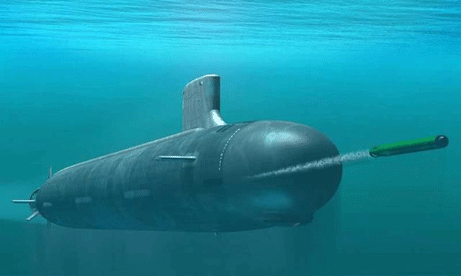
US President Donald Trump says he has given South Korea approval to build a nuclear-powered submarine, a dramatic move that would admit Seoul to a small club of nations possessing such vessels.
Mr Trump, who has been meeting with South Korean President Lee Jae Myung and other regional leaders during his visit, also said Seoul had agreed to buy vast quantities of US oil and gas.
The submarine will be built in a Philadelphia shipyard, where South Korean firms have increased investment, Mr Trump wrote on social media.
Mr Trump and Mr Lee finalised details of a fraught trade deal at a summit in South Korea on Wednesday.
Mr Lee had also been seeking US permission for South Korea to reprocess nuclear fuel.
Nuclear restrictions easing?
Seoul is barred from reprocessing without US consent, under a pact between the countries.
“I have given them approval to build a nuclear-powered submarine, rather than the old-fashioned and far less nimble, diesel-powered submarines that they have now,” Mr Trump wrote on his Truth Social platform.
South Korea’s Industry Ministry said its officials had not been involved in any detailed discussions about building the submarines in Philadelphia.
While South Korea has a sophisticated shipbuilding industry, Mr Trump did not spell out where the propulsion technology would come from for a nuclear-powered submarine, which only a handful of countries possess.
The US has been working with Australia and Britain on a project for Australia to acquire nuclear-powered submarines, involving technology transfers from the United States.
The US has so far only shared that technology with Britain, back in the 1950s.
Mr Lee said when he met Mr Trump on Wednesday that allowing South Korea to build several nuclear-powered submarines equipped with conventional weapons would significantly reduce the burden on the US military.
He also asked for Mr Trump’s support to make substantial progress on South Korea being allowed to reprocess spent nuclear fuel, or on uranium enrichment.
This is not allowed under the nuclear agreement between the two countries, even though South Korea possesses nuclear reactors to generate power.
Approval raises questions
Mr Lee’s predecessors had wanted to build nuclear-powered submarines, but the US had opposed this idea for decades.
Daryl Kimball, executive director of the Washington-based Arms Control Association, said the issue of South Korea acquiring such submarines “raises all sorts of questions.”
“As with the AUKUS deal, (South Korea) is probably looking for nuclear propulsion services suitable for subs, including the fuel, from the US,” he said.
Mr Kimball said such submarines usually involved the use of highly-enriched uranium and would “require a very complex new regime of safeguards” by the International Atomic Energy Agency, which has a key role in implementing the Treaty on the Non-Proliferation of Nuclear Weapons (NPT).
“It remains technically and militarily unnecessary for South Korea to acquire the technology to extract weapons-usable plutonium from spent fuel or to acquire uranium enrichment capabilities, which can also be used to produce nuclear weapons,” he said.
“If the United States seeks to prevent the proliferation of nuclear weapons worldwide, the Trump administration should resist such overtures from allies as strongly as it works to deny adversary access to these dual-use technologies.”
Jenny Town, who heads 38 North, a Korea-focused research group in Washington, said it was inevitable that South Korean demands for US cooperation on nuclear issues would grow, given recent allegations about Russian technical cooperation to help nuclear-armed North Korea make progress towards acquiring nuclear-powered submarines.
Kim Dong-yup, a North Korea studies professor at Kyungnam University, said the Lee-Trump summit had formalised a “transaction scheme of security guarantees and economic contributions” for maintaining the extended deterrence and alliance in exchange for South Korea’s increased defence spending and nuclear-powered subs and US investments.
“In the end, this South Korea-US summit can be summarised in one word: the commercialisation of the alliance and the commodification of peace,” he said.
“The problem is that the balance of that deal was to maximise American interests rather than the autonomy of the Korean Peninsula.”
Trump backs renewed Israeli strikes in Gaza
The US president denied that the resumption of hostilities was “jeopardizing” the ceasefire
US and China to ‘work together’ on Ukraine settlement – Trump
29 Oct, 2025
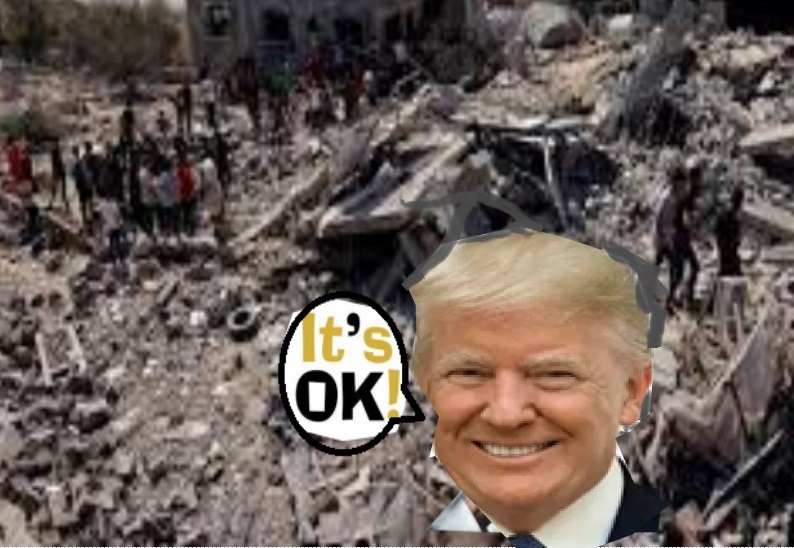
US President Donald Trump has defended Israel’s renewed strikes in Gaza nearly three weeks into a ceasefire he helped broker.
Israeli Prime Minister Benjamin Netanyahu ordered “immediate and powerful strikes” on Tuesday evening, citing Hamas attacks on Israeli soldiers still holding parts of the Palestinian enclave. At least 30 Palestinians were killed in the action, according to Gaza’s Hamas-run government.
“As I understand it, they took out an Israeli soldier,” Trump told reporters aboard Air Force One on Wednesday en route from Japan to South Korea. “They killed an Israeli soldier. So the Israelis hit back – and they should hit back. When that happens, they should hit back,” he added.
US Vice President J.D. Vance earlier said the ceasefire was holding despite “little skirmishes here and there.” Axios cited unnamed senior US officials as saying the White House had urged Israel not to take “radical measures” that could collapse the truce.
According to the Israel Defense Forces (IDF), last week two of its soldiers were attacked and killed by Hamas in Rafah, southern Gaza, and more soldiers came under fire in the same area on Tuesday. Hamas denied involvement in both incidents, accusing Israel of “a blatant ceasefire violation.”
The Palestinian armed group warned that the escalation “will lead to a delay” in recovering and returning the bodies of the 13 remaining Israeli hostages in Gaza. Israeli officials earlier accused Hamas of dragging its feet in handing over all the remains, as agreed under the ceasefire mediated by the US, Egypt, Qatar, and Türkiye, which took effect on October 10.
The anti-Russia, pre-SMO, Timeline of Which Legacy Media Won’t Speak
timeline of events leading up to the commencement in February 2022 of Russia’s Special Military Operation
Eva Karene Bartlett, Oct 28, 2025, https://evakarenebartlett.substack.com/p/the-anti-russia-pre-smo-timeline?utm_source=post-email-title&publication_id=3046064&post_id=177345476&utm_campaign=email-post-title&isFreemail=true&r=1ise1&triedRedirect=true&utm_medium=email
Very useful written timeline of events leading up to the commencement in February 2022 of Russia’s Special Military Operation.
Jacques Baud discussed much of this (see bottom of this post), but this written account is worth bookmarking.
Alan Watson:
“Vladimir Putin did not wake up on 24 February 2022 and decide, “I think I’ll invade eastern Ukraine today,” nor was the US campaign to expand NATO into Ukraine a last-minute maneuver. (US State Department documents show Ukraine’s future membership was discussed as early as 1994.)
9 Feb 1990: In a deal approved by Mikhail Gorbachev, the last leader of the Soviet Union, as a quid pro quo for accepting German reunification within NATO, Secretary of State James Baker pledged that NATO would not expand “one inch to the east.”
US, European and German leaders made explicit assurances to Gorbachev against any future eastward NATO expansion. Gorbachev understood the assurances as a “binding agreement.” Subsequently, Soviet leaders made decisions on that basis and acted on them – withdrawing the Red Army from Germany and dissolving the Warsaw Pact.
12 March 1999: Clinton is president. The Czech Republic, Hungary and Poland became members of NATO. A weakened post-Soviet Russia, led by Boris Yeltsin, controlled by a cabal of Oligarchs, could do nothing to prevent it. Powerless, Yeltsin was said to be “infuriated” with “his friend Bill Clinton…”
29 March 2004: George W. Bush is president. Seven more Eastern European countries join NATO: Bulgaria, Estonia, Latvia, Lithuania, Romania, Slovakia and Slovenia – largest wave of NATO enlargement ever.
April 2008: At the Bucharest NATO summit, George W. Bush announced that Ukraine and Georgia are on an “immediate path to NATO.” Bill Burns, ambassador to Russia, sent a memo to Secretary of State Condoleezza Rice. “Across the board,” he wrote, the Russian political class told him, “Ukraine is the reddest of red lines” – “Nyet means nyet.”
22 Feb 2014: Just as the Sochi Winter Olympics were underway, Kiev erupted in violence. State Department official Virginia Nuland boasted that since the 2004-2005 “Orange Revolution,” the US had spent $5 billion on regime change in Ukraine. NATO rooftop snipers killed both protestors and police, forcing Ukraine’s democratically elected president Viktor Yanukovych to flee the country.
2 May 2014: Bussed to Odessa from Kiev, Right Sector thugs carrying baseball bats confront ethnic Russians protesting the coup. When protestors fled into the city’s Trade Unions House, the building was set on fire. Forty-eight people were burned or bludgeoned to death – the Donbass civil war point of no return.
11 Feb 2015: Putin and Ukrainian President Poroshenko meet with French President Francois Hollande and German Chancellor Angela Merkel in Belarus to negotiate the Minsk ceasefire accords. The leaders agreed to a deal that would have ended the fighting – granting autonomy to the Russian-speaking Donbass, but successive Ukrainian governments refused to implement the accord.
German Chancellor Merkel later admitted that Minsk was a stall tactic to allow the West to build Ukraine’s army up to NATO standards. [Ed. note – Zelensky also admitted that he lied in his campaign for President, in pledging to uphold the Minsk agreement]
17 Dec 2021: Team Biden rejects Putin’s proposed mutual security accords that would have left a “neutral” Ukraine intact. For years, Russia had tried to convince US administrations that Ukraine was off-limits to NATO membership, but Russian concerns were brushed aside. December 2021, Team Biden insisted, “Russia doesn’t say who can join NATO.”
18 Feb 2022: During the Winter Olympics in China, the Organization for Security and Co-operation in Europe (OSCE) documented that Ukraine had ramped up artillery attacks along the Line of Contact.
(Since the 2014 coup in Kiev, the Armed forces of Ukraine, including the Neo-Nazi Banderites, had killed thousands of ethnic Russians in the Donbass.
19 Feb 2022: Invited to speak at the Munich Security Conference, Ukrainian President Zelensky said, “Ukraine will get and deploy nuclear missiles.”
20 Feb 2022: On CBS 60 Minutes, Ukraine’s Minister of Foreign Affairs Dmytro Kuleba said, “Ukraine will never honor the Minsk cease fire.”
21 Feb 2022: Russia captured a Ukrainian soldier, killed five others as they crossed over the border into Rostov. Russia learned the invasion of Donetsk city was imminent and recognized the breakaway Donbass and Luhansk oblasts as independent republics.
24 Feb 2022: With about 90,000 troops, Russia launched its “Special Military Operation” – not a “full scale invasion.” Citing the UN principle, “Responsibility to Protect,” Russia intervened in the eight-year Donbass civil war after all prospects for diplomacy had failed.
April 2022, week six of the war, Russian and Ukrainian negotiators convened peace talks in Istanbul. Later, Ukrainian diplomat Oleksandr Chalyi recalled, “Putin tried to do everything possible to conclude an agreement…” [The tentative accord would have left a “neutral” #Ukraine intact.]
On 1 April, USAID revealed photographic evidence of a “massacre” in Bucha and financed a press tour featuring US public figures. Problem: Four days earlier at a press conference, the mayor had announced that the Russians had retreated from the city [and he did not report there had been a massacre].
After the Russians voluntarily retreated, the regime scattered bodies in the streets that included both actors in body bags and recently killed “Russian collaborators” from around Bucha – giving an “outraged” Joe Biden and Boris Johnson, who flew unannounced to Kiev, the justification to order Zelensky to “keep fighting.”
If the US, UK and EU continue rejecting Russian proposals for a long term, European wide peace accord – as Putin proposed in December 2021 – the Russian army will continue advancing toward Kharkiv in the north and Odessa on the Black Sea. As Putin and Foreign Minister Sergei Lavrov emphasized: There will be no Minsk III.”
From a September 2024 interview I did with Jacques Baud (former Swiss intelligence & author). In this clip, Jacques lays out the history of events related to Ukraine prior to 2022, prior even to the 2014 coup which brought fascism to power in Ukraine, & how it was the NATO-Ukraine alliance which brought war, not Russia.
Full interview: https://rumble.com/v5fjhrh-jacques-baud-nato-threatened-russia-decades-before-2022.html https://odysee.com/@EvaKareneBartlett:9/JacquesBaudNATOThreatenedRussia:5
The UK is at risk of a nuclear attack as the US is set to house nuclear weapons in Suffolk, England, which would make the country a target in a US and Russia war
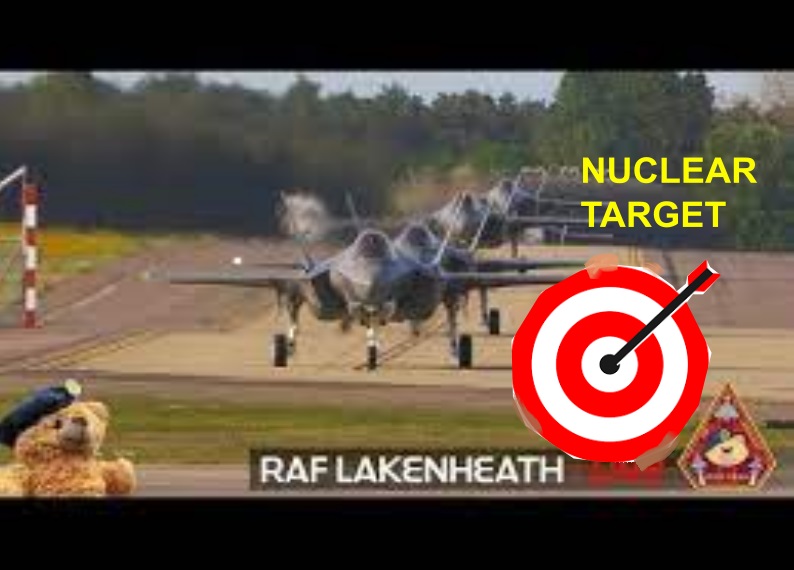
Emily Malia Mirror UK, GAU Writer, 27 Oct 2025
RAF Lakenheath in Suffolk, operated by the United States, is expected to house US/ NATO nuclear weapons in the near future. This development places the UK on the frontline of potential conflict between America and Russia.
The presence of American nuclear weapons on British soil significantly increases the nation’s risk of becoming a target. Military analysts suggest that in the event of war, Lakenheath would likely face strikes before attacks spread to other parts of the country.
Whilst experts acknowledge that nuclear conflict between the US, NATO and Russia would prove devastating globally, it’s crucial to grasp the direct consequences for British towns and cities. The Campaign for Nuclear Disarmament warns: “A single nuclear strike on any town or city would be catastrophic for the local community and environment, and the radioactive impact would spread much further.
“But a nuclear war would be catastrophic for all humanity, forms of life, and the entire planet. Yet the possibility of nuclear war is the greatest for many decades.”
Casualties
Their report reveals if a Russian warhead, such as an SS-25 or SS-27, were to strike the heart of London, nearly a million people would die. Similarly, a hit on Glasgow could result in 326,000 casualties, while in Cardiff, 196,000 lives would be lost.
The epicentre of the nuclear explosion is believed to reach a staggering temperature of several million degrees centigrade. Consequently, a heat flash would obliterate all human tissue within a 1.5 square mile radius.
Back in 1945, when the United States unleashed two atomic bombs over Hiroshima in Japan, all that was left within a half-mile radius were shadows seared into stone. The aerial bombings claimed up to 200,000 lives, most of whom were civilians………………………………………..
Further afield from the zone of instant devastation, there would be a gradual rise in fatalities among those who endured the initial explosion. Approximately seven miles from the blast site, individuals would sustain lethal burns or even require amputations, while others would be blinded or suffer internal injuries.
Unlike a typical disaster, the mortality rate would be shockingly high as most emergency services would be unable to respond due to their own personnel being killed and equipment destroyed. The sheer number of casualties would simply swamp the UK’s medical resources, with people as far as 11 miles away potentially suffering injuries from shattered windows or structural damage.
The long-term impact
In the ensuing days, even those fortunate enough to survive would now be impacted by the radioactive fallout, with the majority succumbing within a week. This would manifest in various ways, from hair loss to bleeding gums, fever, vomiting, delirium and even internal bleeding.
Those with lower levels of exposure would still face complications, including pregnant women who are at a high risk of miscarriage and birth complications. In addition, long-term effects could include radiation-induced cancers affecting many civilians, up to two decades after the event.
It’s believed that children of those exposed to radiation are statistically more likely to be born with abnormalities and suffer from leukaemia. Aside from public health, nuclear weapons are known to cause severe damage to the environment and climate on an unprecedented scale.
Predictions suggest that in the aftermath of a nuclear war, two billion people could face starvation due to climate disruption and its impact on food production. https://www.mirror.co.uk/news/world-news/horrifying-number-people-who-could-36139768
A Torturous Sanitation Disaster Is Unfolding in Gaza’s Displacement Camps
Every morning we wake to disease, dust, and the unbearable stench of open sewage.
By Sara Awad , Truthout, October 25, 2025
Ceasefire is a relief. After two years of surviving war, we can finally breathe — but that doesn’t mean our suffering is over. For many of us, it’s only just begun. The tents, and the people still living in them, stand as a heavy reminder that our struggles are far from over. After two years of immense destruction by the Israeli military, most families in Gaza are now living in tents — nylons and fabric that don’t protect them either from summer or winter.
In tent life, there is an unlivable war — a war that doesn’t begin with bombs, but with the absence of everything that makes life human. It is a war whose weapons are the denial of clean water, the lack of hygiene, the absence of toilets, dignity, and safety. I am not writing this as a distant witness. No — I am writing this from within it. From the ground. From inside the tent. These are not stories I’ve heard; these are the sensations I experience.
One month living in a tent was enough for me to understand the immense sanitation disaster and horrific conditions that make displaced people feel suffocated by everything around them. This kind of news doesn’t make headlines, and you might not have heard about it. But it is a silent kind of violence — one that kills us every day.
I am here to tell you how my people — including my family — are facing the devastating consequences of the sanitation crisis in these tents.
Thousands of makeshift tents at displacement camps all across Gaza are full of families seeking refuge.
A lack of sufficient toilets, access to clean water, and the presence of open sewage are catastrophic consequences faced by displaced Palestinians — conditions that have persisted since the early months of Gaza’s displacement crisis.
After spending over a month in Gaza City under Israeli occupation, 39-year-old Asma Mohammad and her family fled to the central Gaza Strip, seeking refuge in Al-Nuseirat Camp to escape the ongoing Israeli offensive. Speaking to me via WhatsApp, she described the daily struggle to access basic sanitation. “I have to walk nearly half an hour just to reach the bathroom,” Asma said. “I stopped drinking coffee or tea so I wouldn’t have to walk so far to use a filthy toilet that’s shared by hundreds of people.”
This is something that touches our dignity. I know what she meant because I am experiencing the same thing. Here where I am in az-Zawayda, in central Gaza, men spend a whole week building a bathroom — a toilet. It takes so long because there is no sewage system anywhere anymore. Israel has destroyed the vast majority of sewage facilities in every part of Gaza……………………………………………………………………………………………………………………………………………………………………………. https://truthout.org/articles/a-torturous-sanitation-disaster-is-unfolding-in-gazas-displacement-camps/?utm_source=Truthout&utm_campaign=ec58022e30-EMAIL_CAMPAIGN_2025_10_25_06_42&utm_medium=email&utm_term=0_bbb541a1db-ec58022e30-650192793
Are Our Priorities Wrong? Defence Spending vs Real Needs

the greatest threat to Australia’s security is subservience to U.S. militarism.
Politics for the people, 30 Oct 25
Introduction: A Nation Out of Balance
The latest Ipsos Issues Monitor shows that cost of living, housing, crime, and healthcare matter most to Australians. Yet fewer than 8 per cent name defence as a concern. Despite this, defence spending in Australia now stands at about A$59 billion for 2025-26, a record amount.
While households struggle with rent hikes, soaring groceries, and lengthy hospital waits, government priorities tell a different story. If our leaders can mobilise billions for submarines and foreign military bases, why not for homes, hospitals, and community safety?
The government’s growing defence spending shows how far priorities have shifted from citizens’ needs.
The Problem: Spending That Ignores Public Needs
1. Australians Struggle While Defence Budgets Soar
According to SBS’s “If the Budget Were $100”, defence receives $6.60, health $15.90, and welfare $37.00. The government insists on “fiscal responsibility” when it comes to families, but not when signing billion-dollar arms contracts.
This surge in defence spending contrasts sharply with the lack of targeted cost-of-living support.
The mismatch is stark: Australians cite the cost of living in Australia as their top issue, yet policies focus on militarisation. A nation cannot claim security when its citizens cannot afford food, rent, or electricity.
Internal link: Inflation in Australia: How It’s Reshaping Everyday Life
2. Housing and Healthcare Left Behind
The 2025-26 Budget allocates A$9.3 billion to social housing and homelessness, barely a sixth of defence spending. Hospitals receive about A$33.9 billion in Commonwealth funding, far short of what’s needed to end long emergency queues and staff shortages.
Using public money productively, Australia could expand housing supply and modernise hospitals without “finding” tax revenue. As a sovereign currency issuer, the Commonwealth can fund whatever domestic resources are available.
Internal link: Social Justice in Australia: Its Meaning and Path to Equality
The Impact: What Australians Are Experiencing
3. Everyday Australians Feel Forgotten
Workers juggle multiple jobs. Families spend over 30 per cent of their income on rent. Hospitals cancel surgeries due to staff burnout. Meanwhile, record military budgets create jobs, but not the kind that house or heal people.
This deepens inequality and fuels public frustration. Cost of living in Australia headlines dominate the news, yet solutions are still tokenistic while weapons programs thrive.
Internal link: Why It Feels So Hard to Get Ahead in Australia Today
4. Who Benefits from the Defence Boom – and Who Are We Really Defending Against?
Arms corporations and political donors benefit most. AUKUS contracts flow to foreign firms. U.S. forces rotate through Darwin, and Pine Gap stays a key U.S. intelligence hub.
So, who is Australia defending against? Officially, the government cites a “deteriorating Indo-Pacific environment.” Australia faces no imminent invasion. The real risk lies in our alliance obligations. Much of this defence spending directly supports U.S. strategic goals, not Australian security.
When Washington pursues containment of China, Australia follows, even if it damages trade and peace. This dependence undermines sovereignty and raises the uncomfortable truth: the greatest threat to Australia’s security is subservience to U.S. militarism.
Economic insecurity, environmental decline, and eroded independence are the dangers we should fear. As a nation with dollar sovereignty, Australia can defend its people through prosperity, not through weapons for U.S. wars.
The Solution: What Must Be Done
5. Use Dollar Sovereignty for People, Not War
Australia issues its own currency. It cannot “run out” of money but can run out of political will. By embracing Modern Monetary Theory principles, the government could fund full employment, universal healthcare, and green infrastructure before military expansion.
Internal link: Investing in Peace: Rethinking Australia’s Defence Strategy
6. Re-prioritise the Budget for National Wellbeing
Australia can realign its priorities by:
- Expanding public housing nationwide.
- Investing heavily in healthcare staffing and preventive care.
- Addressing crime through community programs, not incarceration.
- Keeping defence strictly for territorial protection, not for U.S. wars.
Redirecting even 10 per cent of Australia’s defence spending toward housing and health would transform lives and strengthen genuine security.
Frequently Asked Questions
- Why does Australia spend so much on defence?
Defence growth is politically tied to the U.S. alliance and AUKUS, not citizen demand. - Who are we really defending against?
Australia’s rising defence spending is driven more by alliance politics than genuine threats. No nation threatens Australia. The real danger is being drawn into conflicts created by foreign powers. - Can public money fund housing and health without cuts elsewhere?
Yes, as the currency issuer, Australia can fund both. The constraint is resources, not revenue. - What would happen if 10 per cent of defence spending were redirected?
Billions would build thousands of homes, hire nurses and teachers, and ease cost-of-living pressure.
Final Thoughts: Time to Fund What Matters…………………………………………………… https://socialjusticeaustralia.com.au/defence-spending-vs-real-needs/
1 This Month

of the week – Shut Down Drone Warfare!


Tell the Ukrainian Government to Drop Prosecution of Peace Activist Yurii Sheliazhenko

Petition to revoke the licensing of the Near Surface Nuclear Disposal Facility (NSDF) at Chalk River. https://www.ourcommons.ca/petitions/en/Petition/Details?Petition=e-7247
To see nuclear-related stories in greater depth and intensity – go to https://nuclearinformation.wordpress.com
-
Archives
- March 2026 (230)
- February 2026 (268)
- January 2026 (308)
- December 2025 (358)
- November 2025 (359)
- October 2025 (376)
- September 2025 (257)
- August 2025 (319)
- July 2025 (230)
- June 2025 (348)
- May 2025 (261)
- April 2025 (305)
-
Categories
- 1
- 1 NUCLEAR ISSUES
- business and costs
- climate change
- culture and arts
- ENERGY
- environment
- health
- history
- indigenous issues
- Legal
- marketing of nuclear
- media
- opposition to nuclear
- PERSONAL STORIES
- politics
- politics international
- Religion and ethics
- safety
- secrets,lies and civil liberties
- spinbuster
- technology
- Uranium
- wastes
- weapons and war
- Women
- 2 WORLD
- ACTION
- AFRICA
- Atrocities
- AUSTRALIA
- Christina's notes
- Christina's themes
- culture and arts
- Events
- Fuk 2022
- Fuk 2023
- Fukushima 2017
- Fukushima 2018
- fukushima 2019
- Fukushima 2020
- Fukushima 2021
- general
- global warming
- Humour (God we need it)
- Nuclear
- RARE EARTHS
- Reference
- resources – print
- Resources -audiovicual
- Weekly Newsletter
- World
- World Nuclear
- YouTube
-
RSS
Entries RSS
Comments RSS
 nuclear-news