The Horrifying Endgame in Ukraine

This entire scenario is a long slow march toward nuclear war or the complete disintegration of Ukraine.
The U.S. won’t end the weapons deliveries because Joe Biden is afraid of losing face and his closest advisors such as Victoria Nuland have an irrational hatred for Russia and are total warmongers.
BY JAMES RICKARDS, 14 Feb 23, https://dailyreckoning.com/the-horrifying-endgame-in-ukraine/—
In yesterday’s issue, I addressed the biggest and most complex topic on the geopolitical landscape today — China.
But today I’m discussing what is by far the most alarming topic on the geopolitical landscape today. That’s the war in Ukraine and the dangers of escalation.
I’ve written extensively about two facets of the war in Ukraine that you don’t hear from legacy media in the United States or U.K. The first is that Russia is actually winning the war.
U.S. outlets such as The New York Times (a channel for the State Department) and The Washington Post (a channel for the CIA) report endlessly about how Russian plans have failed, about how incompetent they are about how the Armed Forces of Ukraine (AFU) have pushed back Russians in the Donbass, and how NATO weapons such as U.S. Abrams tanks, U.K. Challenger tanks and German Leopard tanks will turn the tide against Russia soon.
This is all nonsense. None of it is true.
Reality Check
First off, the Ukrainian advances that took place in late summer were against lightly defended positions that the Russians quickly conceded to conserve forces. The Russians were willing to give up the land so that they wouldn’t lose valuable men and materiel.
The Russians withdrew to more defensible positions and have been badly mauling Ukrainian attacking forces ever since. Ukraine has wasted incredibly large amounts of men and equipment in these futile and ill-advised attacks.
In all, credible reports indicate that AFU casualties are nearing 500,000 and are increasing at an unsustainable rate. On the other hand, reports of 100,000 Russian dead are almost certainly wild exaggerations put out by Ukraine. The BBC attempted to verify these numbers and could only find about 20,000 confirmed Russian dead based on extensive searches on funeral notices, public records, etc.
Send in the Tanks — Eventually!
What about the tanks NATO is supposedly sending? Well, the tanks have not been delivered yet and most won’t be for months or longer. Our own M1 Abrams tanks might not even arrive for a year or more.
We actually have to custom build these tanks so that they don’t have the special armor and other advanced systems that our own M1s have. The Pentagon doesn’t want them falling into Russian hands if they’re destroyed or captured. Besides, we’re only sending 31 tanks anyway.
When the NATO tanks do arrive, they’ll likely quickly be destroyed by Russian artillery, anti-tank weapons and precision missiles. They’re good tanks, but far from invincible. For decades, the Russians have been developing powerful weapons specifically designed to destroy these NATO tank models. The Russians aren’t particularly worried about them.
Aside from that, tanks rely on effective air cover for protection, which Ukraine lacks. They’ll be sitting ducks on the battlefield. It doesn’t really make sense to send tanks to Ukraine unless you send combat aircraft to give them cover (more on that below).
Russia’s Winning on the Battlefield
Meanwhile, Russian forces have nearly encircled the city of Bakhmut, which is a major transportation and logistics hub, with several key roads and rail lines passing through it. It’ll probably fall to the Russians within weeks.
Losing Bakhmut will be a major blow to Ukraine, despite claims in the western media that it really isn’t very important. Ukraine’s entire 800-mile defensive line would probably begin to crumble, and they don’t have heavily fortified positions to fall back on. Ukrainian troops, while brave and competent soldiers, are exhausted and running out of supplies as it is.
On top of that, it appears likely that Russia is preparing a devastating offensive with massive amounts of men, tanks, armored personnel carriers, artillery, helicopters, drones and fixed-wing aircraft.
This Russian army is not the same army that invaded Ukraine a year ago. It’s much better trained, led and equipped. It’s learned from the mistakes it made during its initial invasion last February. Ukraine shouldn’t expect them to repeat those mistakes.
Does all this mean I’m cheering on a Russian victory in Ukraine? No, I’m just observing the facts on the ground and consolidating them to perform an objective analysis.
That analysis leads me to believe that Russia will win the war militarily. Western military assistance may prolong the fighting but won’t affect the ultimate outcome. It’ll just delay the inevitable and get a lot more people needlessly killed.
The Much Greater Risk
The second facet of this war not reported in the media, or at least downplayed, is the growing risk of nuclear war.
This risk increases with every escalatory step by both sides. The U.S. is the leader in reckless escalation by supplying long-range artillery, Patriot anti-missile batteries, intelligence, surveillance, and now the tanks. Russia responds at each step.
There’s a number of steps before the two sides arrive at the nuclear level, but neither shows a willingness to step back.
By the way, Russia has every legal right to attack those NATO countries supplying arms to Ukraine. By supplying arms to a party to the conflict, they’ve given up their neutrality and have become, in effect, combatants. Russia hasn’t done this because it doesn’t want to bring NATO directly into the fight. But legally, it can.
Gimme, Gimme, Gimme
Ukraine’s demands on the U.S., UK and the rest of NATO for advanced weapons to fight Russians know no limits. The West began by supplying Ukraine with cash, intelligence and anti-tank weapons such as the Javelin missile. Soon we were supplying long-range artillery, drones, and more cash.
As Russian advances continued, Zelensky demanded and got Patriot anti-missile batteries that can destroy incoming Russian missiles. The U.S. artillery was aimed at Russian Crimea. Several drones struck inside Russia at sensitive air bases with nuclear weapons nearby.
Gimme, Gimme, Gimme
Ukraine’s demands on the U.S., UK and the rest of NATO for advanced weapons to fight Russians know no limits. The West began by supplying Ukraine with cash, intelligence and anti-tank weapons such as the Javelin missile. Soon we were supplying long-range artillery, drones, and more cash.
As Russian advances continued, Zelensky demanded and got Patriot anti-missile batteries that can destroy incoming Russian missiles. The U.S. artillery was aimed at Russian Crimea. Several drones struck inside Russia at sensitive air bases with nuclear weapons nearby.
Once these advanced systems show they can’t help, what’s the Ukrainian’s next demand? Russia can escalate just as quickly and lethally as the U.S.
This entire scenario is a long slow march toward nuclear war or the complete disintegration of Ukraine.
Is Anyone Really Prepared for This?
The U.S. won’t end the weapons deliveries because Joe Biden is afraid of losing face and his closest advisors such as Victoria Nuland have an irrational hatred for Russia and are total warmongers.
Now, we can add a new danger, resulting from desperation. This is the fact that the U.S. itself may be the biggest loser in the war.
As Ukraine disappears under a massive Russian onslaught, the U.S. will grow increasingly desperate. Its credibility is on the line after committing so much money, materiel and moral weight to Ukraine’s defense.
The Biden administration has essentially turned the war in Ukraine into an existential crisis for the U.S. and NATO, when it never should have been. Ukraine has never been a vital U.S. interest. But the war is existential for Russia, and Russia won’t give up.
Is the U.S. just going to throw up its hands and concede Russian victory? NATO may actually disintegrate in the face of such spectacular failure. So, we’ll probably double down.
Maybe a desperate Biden orders troops into western Ukraine as a buffer against a complete Russian takeover of the country. You can imagine what could go wrong. That situation may quickly devolve into a direct war between the U.S. and Russia rather than the proxy war that it is now.
The American people and investors in particular are not prepared for any of this. They should be. It’s becoming increasingly likely.
Pentagon-Funded Plymouth University Cancels Anti-War Academic: the militarization of higher education.

Pentagon-Funded Plymouth University Cancels Anti-War Academic: Reflections on How the US Empire Conquered Higher Education, CouterPunch BY T.J. COLES 17 Feb 23,
The US Empire is in the final and most dangerous stages of its quest for what the Pentagon calls “full spectrum dominance.” Having invaded and fought proxy wars in the oil-rich Middle East, it is now trying to break nuclear-armed Russia in another proxy war before attempting “regime change” in nuclear-armed China. We need not tarry on the potential consequences. Professor Noam Chomsky called it 20 years ago: this is hegemony or survival. Which one do you choose?
As the Empire races towards its biggest bet, using humanity and all other species on the planet as gambling chips, anti-war comment is tolerated less and less. For those who want to know what happened to me, see the Annex of this article for the leaked emails and background. Meanwhile, consider what is taking shape.
DELETING THE ENEMY
Critics of Western imperialism are silenced by the Empire’s witting and unwitting minions in increasingly knee-jerk ways. Google, which was developed with CIA money, has de-ranked anti-war websites, driving traffic to state-corporate outlets that promote imperialism. After buying YouTube, it then went on a de-platforming spree, banning and de-monetizing “conspiracy theorists,” left and right, who dare deviate from the increasingly narrow orthodoxy of acceptable thought.
Under the new McCarthyism of RussiaGate, the US Federal Bureau of Investigation has used the pretext of countering foreign disinformation to suspend and terminate political accounts. In 2020, following an evidence-free CNN report alleging that it was a front for the sanctioned nation of Iran, the FBI and Department of Justice seized the US domain for the website of the American Herald Tribune, founded by Dr. Anthony James Hall, who retired from his Canadian university, Lethbridge, following pressure from the Zionist Lobby and from individuals who accused him of being a “conspiracy theorist”—a cheap smear tactic employed against me by a cabal of staff at Plymouth University.
Meanwhile, the Twitter Files have exploded the myth that “social media” are independent corporate actors. Likewise, journalist Dr. Alan Macleod has documented the dozens of former spies now employed to police content at Facebook.
SHAME IS THE GAME
The opinions of self-described fact-checkers—like the Poynter Institute—are amplified by state-corporate media which engage in public humiliation rituals in the hope that retailers will pull magazines, academic institutions will fire staff, digital providers will demonetize accounts, and web hosts will drop entire sites and/or content……….
As governments contract out censorship to “fact-checkers,” critics of Empire are demonetized. Consortium News and Mint Press have seen their PayPal accounts frozen. PayPal’s pro-Trump co-founder, Peter Thiel, has made many millions of dollars from Pentagon contracts. Between 2007 and ’19, US taxpayers gave his Palantir Technologies $1.5 billion via the Department of Defense, particularly to spy on Afghans and Iraqis.
ACADEMIC OBLIVION
The above examples show how the US military and intelligence continue to influence the infrastructure through which much of today’s information travels. Another target is academia. But how serious is the problem?……………………………………………………..
THE MILITARIZATION OF HIGHER EDUCATION
Universities serve a variety of purposes, one of which is the development of new weapons for the US military. In the past, white voices critical of Empire would be tolerated as long as their non-university work did not grind the gears of Empire. That’s how Professor Chomsky, for instance, was able to get arrested protesting mass murder in Vietnam while receiving Pentagon money to undertake his linguistics research.
The technological origins of “full spectrum dominance” can perhaps be traced back to the outgoing Reagan and incoming George H.W. Bush administrations, under whom the Pentagon founded the Multidisciplinary University Research Initiative to further integrate with education and develop tools for things like the so-called Star Wars program (Strategic Defense Initiative). One consequence is that higher education became significantly influenced—maybe not full-spectrum dominated—by the eternal war machine.
By 2015, the Department of Defense (DoD), which in more honest times was called the Department of War, was investing $250 million of taxpayer money in universities. In that year, the DoD decided to look for international partners, of which the Britain was a natural first-choice. The Pentagon’s Basic Research Office Director, Robin Staffin, said: “we decided it was time to formalize cooperation between the U.S. and the U.K.”
DARPA is the Pentagon’s taxpayer-funded innovation arm. It used to stand for the Advanced Projects Research Agency, but PR experts realized that they’d better prefix it with the word “Defense.” In 2016, venture capitalist-turned-DARPA Director, Arati Prabhakar, said: “DARPA is reliant on research universities as one part of this huge ecosystem … [We] draw from the deep foundational research, almost always at places like great universities.”
For instance, the DoD recently said that the universities of Alabama-Huntsville, Florida International, Texas A&M Engineering Experiment Station, and others, have received funding to develop solutions for—are you ready?—“monitoring the health and status of hypersonic aeroshells” (heat shields for space systems, which are core elements of “full spectrum dominance.” The “health and status” of ordinary Americans, who still don’t have free coverage, is less important). Other projects include thermodynamic ducts for hypersonic vehicles sponsored by the usual suspects, like Boeing and Lockheed Martin.
FUNDING PLYMOUTH UNIVERSITY: DARPA’S DRIVE…………………………………………………
CONCLUSION
As universities continue designing weapons of mass murder, thought criminals in Western countries continue to face deplatforming and public shaming. Are their personal fates as severe as those of dissident academics in US-UK-supported regimes, like Saudi Arabia? Of course not. But that is not the point. An obvious chilling effect is created in which scholars striving for social justice and indeed the survival of the planet are silenced. The witting an unwitting minions of Empire are too obtuse to realize that by issuing penalties for expressing opinions, those penalties may one day be imposed upon them.
ANNEX (HISTORY, EMAIL EVIDENCE, REBUTTAL):
MY STORY……………………………………………………………………………….as I have lost my University position as a result of my political views, it is worth considering exactly what I write for Nexus (article by article) and that my articles give a left-wing voice to the so-called conspiracy research community, which is often dominated by right-wingers and apolitical people.
As one can see below, the bulk of my work for Nexus consists of critiques and exposés of US military and intelligence agencies. …………………………………………………………
T. J. Coles is director of the Plymouth Institute for Peace Research and the author of several books, including Voices for Peace (with Noam Chomsky and others) and Fire and Fury: How the US Isolates North Korea, Encircles China and Risks Nuclear War in Asia (both Clairview Books). https://www.counterpunch.org/2023/02/17/pentagon-funded-plymouth-university-cancels-anti-war-academic-reflections-on-how-the-us-empire-conquered-higher-education/
Betting on Ukraine victory was ‘suicidal’ – Seymour Hersh
https://www.rt.com/russia/571690-hersh-ukraine-nato-corruption/ 18 Feb 23
The West didn’t even want Kiev in NATO because of corruption concerns, the Pulitzer Prize-winning journalist says.
The US and its allies should have attempted to reach an agreement with Moscow as their belief that Ukraine can win a conflict against Russia is “suicidal,” iconic American investigative journalist Seymour Hersh has argued.
Speaking in a YouTube interview with the Consortium News outlet on Friday, Hersh accused the Biden administration of making “so many bad mistakes,” adding that “it’s impossible to believe just how dumb this leadership was.”
“It was suicidal to think you can win that war, that Ukraine can win the war [against Russia]. There’s just too much corruption. That was a very, very bad decision. We should have been pushing for peace, we should have made an agreement,” the former Pulitzer Prize winner insisted.
US President Joe Biden basically “blew off NATO in Europe” by telling allies that he is backing Ukraine with its “totally corrupt government,” Hersh added. The journalist also pointed out how Kiev glorifies Stepan Bandera, “the great pro-Nazi who killed Jews like crazy during World War II.”
It’s just silly not to right away assure the Russian government that we weren’t interested in making Ukraine a member of NATO,” Hersh stated, referring to long-standing concerns in Moscow. “NATO didn’t want Ukraine anyway because of the corruption.”
Hersh recently published a bombshell report which accused the US of sabotaging the Nord Stream pipelines last year. He cited an informed source as explaining that explosives were planted on the bottom of the Baltic Sea by US Navy divers under the guise of a NATO exercise back in June 2022. They were detonated in late September, rendering the pipelines, which were built to deliver Russian gas to Europe through Germany, inoperable.
US Secretary of State Antony Blinken, as well as Under Secretary for Political Affairs Victoria Nuland and National Security Advisor Jake Sullivan, are all “very hawkish,” according to the journalist. The trio “pushed Biden very hard” to go ahead with the sabotage because “they have long-standing incredible hatred for [Russian President Vladimir] Putin. It’s almost personal, I would guess,” Hersh claimed.
READ MORE: More Nord Stream ‘bombshells’ to come – Seymour Hersh
US National Security Council spokeswoman Adrienne Watson branded Hersh’s bombshell report “utterly false and complete fiction.” The journalist has promised even more revelations on how the pipelines were blown up.
NATO to participate in Ukraine war “for as long as it takes”
‘NATO is determined to make sure that Ukraine wins this war’ NATO Deputy Secretary General Mircea Geoana told DW that the alliance is determined to continue supporting Ukraine for as long as it takes. DW:..Will the alliance support Ukraine as long as Russian troops are controlling parts of the country, including […]
Author: Rick Rozoff1 Comment, Deutsche Welle, February 18, 2023
‘NATO is determined to make sure that Ukraine wins this war’
NATO Deputy Secretary General Mircea Geoana told DW that the alliance is determined to continue supporting Ukraine for as long as it takes.
DW:..Will the alliance support Ukraine as long as Russian troops are controlling parts of the country, including Crimea?
Mircea Geoana: We are determined to continue supporting Ukraine for as long as it takes and also make sure that Ukraine wins this war….
[W]we are helping Ukraine, and by helping Ukraine we help ourselves. And we are here to stay for the long run with the Ukrainians.
DW: NATO has significantly boosted its presence on its eastern flank. What will the alliance do to protect the Black Sea region (including your home country, Romania) and why is this region so important in the context of Russia’s war in Ukraine?
[In] the strategic concept of NATO that our leaders approved in Madrid, we consider and we recognize the Black Sea as a strategic region, of strategic relevance to us. Not the only one: the Baltic Sea is important, the Adriatic Sea is important, the North Sea is important, the North Atlantic is important. But the Black Sea has a specificity with so much Russian presence, with so much pressure that they’re putting on Ukraine. And also we have Ukraine and Georgia and the Republic of Moldova, who are partners of NATO’s.
***
So the Black Sea is very important. And we take specific steps. In my home country, Romania, France is leading the battle group. In the neighboring country, Bulgaria, Italy is leading the battle group….
[W]e see an intensification of the partnership between the Republic of Moldova and NATO….
***
NATO Deputy Secretary General Mircea Geoana, a former head of the Social Democratic Party in Romania, has served as Romanian minister of foreign affairs (2000–2004) and president of the Romanian Senate (2008–2011).
Cities must not be targets — Beyond Nuclear International

Bombarding civilians violates international humanitarian law
Cities must not be targets — Beyond Nuclear International
Using nuclear weapons on populations is inherently racist and xenophobic
By Carlos Umaña, MD
The following was a live presentation made by Dr. Umaña inside the basement of the St. Nikolai Church, destroyed during the firebombing of Hamburg during World War II but now housing a museum commemorating the horrors of targeting cities during war.
I am honored speak on such a special occasion, to such a special crowd, and humbled to do so in such a special place. Here, the name of my presentation, “Cities are not targets” takes a special meaning, as in the basement of St. Nikolai’s Memorial Church one cannot help but marvel at the grandeur of human enterprise, while at the same time be appalled by the reaches of human destruction.
“Cities are not targets,” the title of my presentation, is also the name of a campaign launched in 2006 by Mayors for Peace, an organization founded in 1982 by the mayor of Hiroshima with the aim of producing nuclear abolition, an organization that currently has over 8,200 member cities.
Now, when we talk about cities, urban centers of civilian population being targets, we are not talking about peace, we are talking about war, and the bare minimum of humanity that must be followed during war. We are talking about the rules of war, for civilians ‐ innocent noncombatants ‐ must not be a part of war.
During World War II, attacks on civilian structures were justified by “othering”, that is, by objectifying populations, making not the government or the army the enemy, but the people. In popular culture nowadays we see how nuclear weapons are used to fight off evil aliens in scientific action movies. Entire races of evil, ugly aliens who want to destroy humanity are killed off and humanity is saved by the atomic bomb.
In the 1940s, the aliens, in the public eye of many people in the United States, were the Japanese. The Japanese people themselves, who looked and acted so differently, were somehow evil. In the collective mind of many in the United States, all Japanese people were accomplices to their army’s misdeeds. Hence, they deserved the atomic bomb. They had it coming.
Nuclear weapons are inherently racist and xenophobic: they were created and used with the idea of killing off a population of people who are “not like us”. This “othering”, this extreme indifference towards the horrible suffering of those who are somehow different is the reason for being of these weapons and why they are the epitome of cruelty. In this sense, the words of our dear and renowned Hiroshima survivor Setsuko Thurlow resonate loudly: “nuclear weapons are not a necessary evil, but the ultimate evil”.
Now, since World War II, International law has evolved. International Humanitarian Law, the law of war, condemns any attack on civilians and thus condemns the use of explosive weapons in urban centers, as it is disproportionate and indiscriminate and harms civilians directly.
Weapons of mass destruction: chemical, biological, and nuclear weapons, landmines, and cluster munitions, contravene International Humanitarian Law because they do not distinguish between military and civilian targets and attack everything and everyone indiscriminately.
Explosive weapons in cities not only kill and harm innocent people directly ‐ who may require long‐term assistance ‐ they also cause other problems. They cause displacement, the damage and destruction of housing, schools, hospitals, water and sanitation systems, and this worsens the suffering of innocent people in a conflict.
With nuclear weapons, by far the most destructive of all weapons, and the ones that cause the most suffering, civilians are the targets. Cities are the targets. They go beyond affecting the housing, schools, communication and healthcare infrastructure, or the water and sanitation systems. They destroy and contaminate. The city becomes uninhabitable. The food systems of the city ‐ any farming on which the population depends ‐ become unusable. The city’s historical and environmental patrimony are destroyed beyond repair.
In Hiroshima and Nagasaki, over 200,000 people died in the first few days and many more have suffered and died insidiously over the years. Many of the injured suffered horribly from the blast and the heat, and more so by the effects of radiation, something most people were unaware of at the time. The mysterious disease that people knew nothing about caused many to die and suffer atrociously: their abdomens exploded, their faces melted, they bled to death. Their wounds would not heal. And those apparently healthy would get sick and die years later.
Most of the people who suffered these horrors were noncombatant people: elderly people, women and children. Children. And these people suffered further the stigmatization by other people in Japan. The children were kept apart from other children, for fear of contagion. They would have difficulty finding work, as they were perceived as sickly, or finding partners, as it was feared that they would bear defective children. Therefore, many learned to keep their origins to themselves and lie about where they were from. What was once a source of pride, their city, had become a source of scorn and shame……………………………………
more https://beyondnuclearinternational.org/2023/02/19/cities-must-not-be-targets/
N Korea confirms ICBM test, touts nuclear counterattack ability
Pyongyang says its latest ICBM test was meant to bolster its ‘fatal nuclear counterattack’ capabilities.
North Korea has said it fired an intercontinental ballistic missile (ICBM) as a warning to the United States and South Korea, claiming the drill successfully demonstrated its capacity to launch a “fatal nuclear counterattack”.
The North Korean statement on Sunday came a day after it launched the Hwasong-15 into the sea off Japan’s west coast after warning of a strong response to upcoming military drills by the US and South Korea……………………………………………………………………….
Analysts say North Korea is likely to conduct more weapons tests, including a possible new solid-fuel missile which could help Pyongyang deploy its missiles faster in the event of a war.
North Korea’s ballistic missile and nuclear weapons programmes are banned under UN Security Council resolutions, but Pyongyang says its weapons development is necessary to counter “hostile policies” by Washington and its allies. https://www.aljazeera.com/news/2023/2/19/n-korea-confirms-icbm-test-touts-nuclear-counterattack-ability
Ukraine ‘peace petition’ backed by nearly half a million Germans
“Are we then inexorably sliding down a chute leading to a world war and nuclear war?” the petition asks
https://www.rt.com/news/571648-half-million-germans-peace-ukraine-petition/ 18 Feb 23
The document co-authored by prominent left-wing politician Sahra Wagenknecht suggests weapons deliveries should stop
Almost 500,000 Germans have supported a petition urging Chancellor Olaf Scholz to spearhead efforts for peace negotiations in Ukraine. The appeal is authored by journalist Alice Schwarzer and Sahra Wagenknecht, a prominent member of Germany’s Left Party (Die Linke), and implores officials in Berlin not to provide Kiev with more weapons.
The document, which was published last Friday and has since gathered an increasing number of supporters, claims that the conflict in Ukraine has already cost the lives of more than 200,000 military personnel and 50,000 civilians.
“If the fighting goes on like this, Ukraine will soon be a depopulated, destroyed country,” the authors warn. Wagenknecht and Schwarzer also argue that “a lot of people in Europe fear an expansion of the war.”
The petition asserts that Ukrainians need solidarity from Germany, but questions whether Berlin’s current policies truly reflect the support they require.
“What is now, one year on, the actual goal of this war?” the authors ask, citing German Foreign Minister Annalena Baerbock’s recent comment about Europe being at war with Russia.
The petition expresses skepticism over whether Scholz’s government will keep its word and not provide Ukraine with fighter jets. According to Wagenknecht and Schwarzer, the German chancellor has already crossed multiple “red lines” in recent months.
The pair also warn that Russian President Vladimir Putin could unleash a “maximum counterstrike,” should Ukraine retake Crimea – which is among the goals set by senior officials in Kiev.
“Are we then inexorably sliding down a chute leading to a world war and nuclear war?” the petition asks, adding that numerous major conflicts have begun this way, and that another could end up being the last for mankind.
The petition stresses that “to negotiate doesn’t mean to capitulate,” but rather to “make compromises on both sides.” The authors claim that half of the German population wants immediate peace talks, and suggest that the government should heed their calls.
“We demand that the federal chancellor stop the escalation of weapons deliveries,” the document states, urging officials in Berlin to focus on peace efforts and form an international alliance to this end.
The petition had received 496,008 signatures at the time of writing.
Moscow has repeatedly signaled it is open to talks with Kiev, provided that Ukrainian leaders accept Russia’s conditions and recognize what the Kremlin calls the “reality on the ground.”
In early October 2022, Ukrainian President Vladimir Zelensky ruled out negotiations with his Russian counterpart. Kiev is insisting on a military victory over Russia, and refuses to make any territorial concessions to its neighbor.
Ukraine Presses US Congress Members for F-16 Jetfighters
Sunday, 19 February, 2023 -Asharq Al-Awsat
Ukrainian officials have urged US Congress members to press President Joe Biden’s administration to send F-16 jetfighters to Kyiv, saying the aircraft would boost Ukraine’s ability to hit Russian missile units with US-made rockets, lawmakers said.
The lobbying came over the weekend on the sidelines of the Munich Security Conference in talks between Ukrainian officials, including Foreign Minister Dmytro Kuleba, and Democrats and Republicans from the Senate and House of Representatives.
“They told us that they want (F-16s) to suppress enemy air defenses so they could get their drones” beyond Russian front lines, Senator Mark Kelly, a former astronaut who flew US Navy fighters in combat, told Reuters on Saturday evening.
Biden last month said “no” when asked if he would approve Ukraine’s request for Lockheed-Martin-made F-16s.
Four delegations from the Senate and House combined in what members called the largest number of US lawmakers to attend Europe’s premier security gathering since it started in 1963, demonstrating clear bipartisan support for Ukraine…………………………
Calls to supply Ukraine with advanced jetfighters follow agreements last month by France, Britain, the United States and Germany to supply Kyiv with modern battle tanks…….. https://english.aawsat.com/home/article/4167481/ukraine-presses-us-congress-members-f-16-jetfighters
Saudi Arabia says nuclear arms race in the Middle East ‘cannot be ruled out’
Kingdom wants to be involved in global negotiations with Iran
N UK, 19 Feb 23,
Saudi Arabia’s Minister of Foreign Affairs, Prince Faisal bin Farhan Al Saud, has said he “cannot rule out” a nuclear arms race in the region.
Speaking at the Munich Security Conference, he said the kingdom was concerned about Iran’s nuclear programme and wanted negotiations between Tehran and world powers to resume.
At a session titled Middle Men: The Geostrategic Role of Middle Eastern Countries, Prince Faisal said: “If one state gets nuclear weapons, especially one that has expressed aggression towards its neighbours, I think everyone will start thinking about how to protect themselves.
“I hope that never happens. If it is a genie that gets out, it will be very hard to put back into the bottle…………………………………………………….. more https://www.thenationalnews.com/world/uk-news/2023/02/18/saudi-arabia-says-nuclear-arms-race-in-the-middle-east-cannot-be-ruled-out/
NATO reveals new space fleet
The US-led military bloc will use commercial satellites to improve intelligence gathering.
NATO has announced a new space project that aims to create a fleet of spy satellites. The initiative, which includes NATO applicants Sweden and Finland, involves not only national but commercial assets.
The project, which is called ‘Alliance Persistent Surveillance from Space’ (APSS), was unveiled on Wednesday, with a total of 16 current member states expected to chip in. According to a statement published on NATO’s website, the project will “help streamline data collection, sharing and analysis among NATO Allies and with the NATO command structure.”
Sweden and Finland applied for NATO membership in May of 2022, though their bids have yet to be approved by Hungary and Türkiye. However, despite not being formally admitted into the military bloc, both Stockholm and Helsinki are already participating in joint projects.
APSS will entail the creation of a “constellation,” named ‘Aquila’, of national as well as commercial satellites. It is expected to “provide essential support to NATO’s military missions and operations.”
The military bloc explained that APSS comes as part of NATO’s Overarching Space Policy adopted back in 2019………………………………… https://www.rt.com/news/571561-nato-space-surveillance-project/
With weasel words, Australia’s top military brass, and sycophant Richard Marles, justify allowing U.S. nuclear weapons in Australia

US nuclear-armed bomber visits allowed under Australian treaty obligations The Age, Matthew Knott, February 15, 2023
American B-52 bombers armed with nuclear warheads could rotate through Australia without breaching treaty obligations, the nation’s most senior defence public servant has indicated.
The Australian public would never be informed whether such aircraft are carrying nuclear weapons under the so-called US policy of “warhead ambiguity” in which it neither confirms nor denies if particular forms of military equipment are nuclear-armed.
While adamantly refusing to address hypothetical scenarios, Foreign Minister Penny Wong said: “The responsible way of handling this is to recognise that the US has a ‘neither confirm nor deny position’ which we understand and respect.”
It was revealed last year that the United States is preparing to build dedicated facilities for up to six B-52 bombers at Tindal air base, south of Darwin, for use in the Northern Territory dry season.
Nuclear weapons opponents and the Chinese government blasted the plan on the basis it could escalate tensions in the Asia-Pacific and accelerate an arms race in the region………………….
Australia is prohibited from permanently housing nuclear weapons in the country under its treaty obligations. But Moriarty, speaking in general terms, suggested US nuclear-armed bombers could temporarily pass through Australia without breaching international law.
“The stationing of nuclear weapons in Australia is prohibited by the South Pacific Nuclear-free Zone Treaty to which Australia is fully committed,” Moriarty said.
“There is no impediment under this treaty or the Nuclear Non-proliferation Treaty to the visit of foreign aircraft to Australian airfields or transit of Australia’s airspace, including in the context of our training and exercise programs and Australia’s force posture co-operation program with the United States.”
The B-52 is a long-range, heavy bomber that can carry out ocean surveillance and anti-ship operations and “can carry nuclear or precision guided conventional ordnance”, according to the US government……………
Greens defence spokesman David Shoebridge said: “It is highly alarming that Australian military facilities are being made available for the US to launch its nuclear-capable bombers.
“This decision not only makes us a nuclear target – it further erodes our sovereignty.
“The US has made it clear it won’t tell anyone when their B-52’s are nuclear armed or not. This leaves Australia in the dark about our role in the USA’s global nuclear strategy.”
Defence Minister Richard Marles said that while Australia had agreed to an increased tempo of American rotations in northern Australia, there had been no change in policy regarding the presence of nuclear-armed weapons.
“America maintains a policy of ambiguity in terms of the nature of assets that are on their platforms and they do that so as to amplify their extended nuclear deterrence,” he told the ABC.
Asked whether US nuclear-armed bombers should be allowed in Australia, opposition defence spokesman Andrew Hastie said: “Of course, we want to see a greater presence of the American military in the Indo-Pacific.”……………………………………………
When the ABC’s Four Corners revealed the plan to build dedicated facilities for the B-52s in October, Chinese Foreign Ministry spokesman Zhao Lijian said: “Such a move by the US and Australia escalates regional tensions, gravely undermines regional peace and stability, and may trigger an arms race in the region.”
Greens foreign affairs spokesman Jordan Steele-John said: “Nuclear-capable B-52 bombers have no place on Australian bases, on Australian shores or in Australian airspace. They are an offensive weapon that will destabilise our region.” https://www.theage.com.au/politics/federal/us-nuclear-armed-bomber-visits-allowed-under-australian-treaty-obligations-20230215-p5ckrs.html—
Why the US seeks War with China by 2025
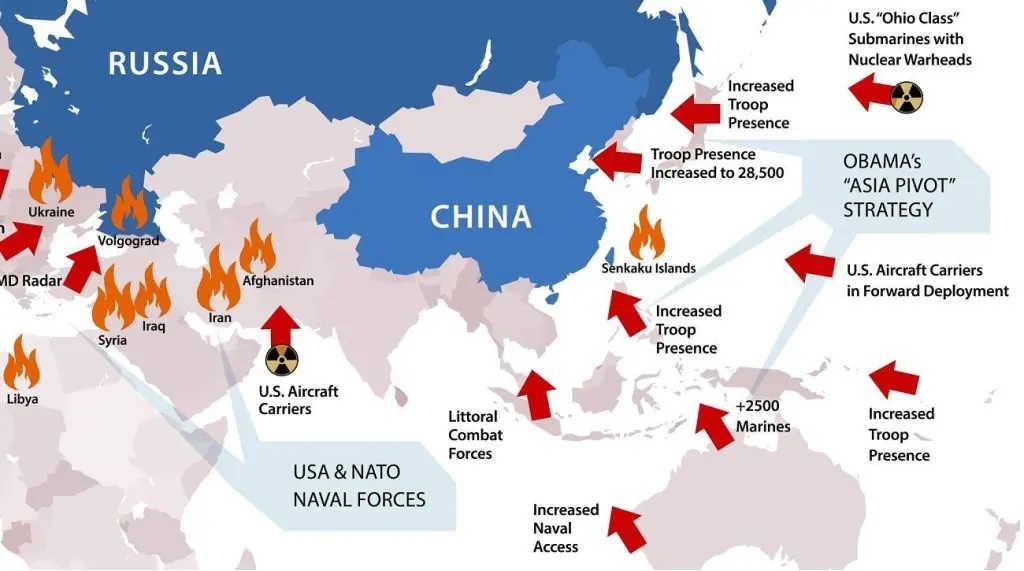
A clash between the United States and China over Taiwan would be the result of the United States willfully going to war with China over a matter the United States officially recognizes as China’s internal political affairs.
The current US State Department’s website regarding “U.S. Relations With Taiwan” admits that officially, “we do not support Taiwan independence.”

The US has also poured billions of dollars’ worth of weapons into Taiwan, just as the US did in Ukraine from 2014 onward. The weapons are clearly intended for a Ukraine-style proxy war with China
.
New Eastern Outlook, : Brian Berletic 8 Feb 23
In recent weeks there has been a build-up of talk regarding a US war with China. Not because of any actual provocation from Beijing, but instead because of a collective resignation to its supposed inevitability.
This is best illustrated by comments made by US Air Force General Michael Minihan. In TIME Magazine’s article, “U.S. General’s Prediction of War With China ‘in 2025’ Risks Turning Worst Fears Into Reality,” General Minihan is quoted as saying:
Worst of all is the small but growing presence of US military activity on Taiwan itself.
Even as the US State Department claims it does not support Taiwan independence, in 2021 Voice of America in its article, “US Nearly Doubled Military Personnel Stationed in Taiwan This Year,” admits that not only are there US troops on Taiwan, the number is increasing.
The article explains:……………………………
“My gut tells me we will fight in 2025.”
The article goes on to claim:
“I hope I am wrong,” Minihan, who heads the Air Force’s Air Mobility Command, wrote in an internal memo, which circulated on social media, to the leadership of its 110,000 members. Chinese President Xi Jinping, he explains, “secured his third term and set his war council in October 2022. Taiwan’s presidential elections are in 2024 and will offer Xi a reason. United States’ presidential elections are in 2024 and will offer Xi a distracted America. Xi’s team, reason, and opportunity are all aligned for 2025.”
Yet nothing General Minihan says explains why the United States itself would conceivably find itself at war with the United States. Instead, General Minihan is more or less admitting that the US will go to war with China over Chinese actions regarding Taiwan. In fact, the article goes on to admit:
Minihan’s comments are merely the most immediate of a worrying, emerging consensus that the U.S. and China are destined to clash over Taiwan, the self-ruling island of 23 million that Beijing claims as its sovereign territory.
A clash between the United States and China over Taiwan would be the result of the United States willfully going to war with China over a matter the United States officially recognizes as China’s internal political affairs.
The current US State Department’s website regarding “U.S. Relations With Taiwan” admits that officially, “we do not support Taiwan independence.”
If the US does not support Taiwan independence then by extension the US acknowledges Taiwan is not independent and therefore Washington, officially, recognizes Beijing’s sovereignty over Taiwan. This is what defines the “One China” policy Washington and virtually every other nation on Earth has agreed to in order to establish diplomatic relations with the People’s Republic of China in Beijing.
At a time when Washington regularly lectures Moscow about “violating sovereignty,” Washington’s stance toward Beijing and Taiwan should be a simple matter of respecting Chinese sovereignty. Yet it is not because of the double-game the United States plays both internationally and with China specifically.
Washington’s Deliberate Provocations
TIME Magazine and other Western media publications attempt to depict Beijing as the aggressor, omitting any discussion of either the “One China” policy or the US State Department’s own official declaration of supposedly upholding it.
Instead, Western audiences are led to believe that Taiwan somehow is independent and that Beijing is “bullying” it. The inevitable clash between the US and China is supposedly driven by America’s desire to “stand up” for Taiwan and its inferred sovereignty. In reality, a potential clash between the US and China would be the result of Washington once again violating the sovereignty of another nation thousands of miles from its own shores.
Washington’s double game of officially recognizing Chinese sovereignty over Taiwan while openly and deliberately trampling that sovereignty is best illustrated by former US Speaker of the House Nancy Pelosi’s visit to Taiwan utilizing an official US Air Force aircraft against the protests of Beijing. Pelosi’s trip to Taiwan is only one of many made by US representatives who openly use visits like this in an attempt to goad Beijing……….
Looking at any map of US military deployments in the “Indo-Pacific” region reveals China as virtually surrounded by the US military by way of South Korea, mainland Japan, Okinawa, and with new basing agreements in the works with Manila, potentially the Philippines as well.
This puts US troops, naval assets, and hundreds of warplanes within striking distance of China, including Taiwan from north, east, and potentially the south.
The US has also poured billions of dollars’ worth of weapons into Taiwan, just as the US did in Ukraine from 2014 onward. The weapons are clearly intended for a Ukraine-style proxy war with China.
Worst of all is the small but growing presence of US military activity on Taiwan itself.
Even as the US State Department claims it does not support Taiwan independence, in 2021 Voice of America in its article, “US Nearly Doubled Military Personnel Stationed in Taiwan This Year,” admits that not only are there US troops on Taiwan, the number is increasing.
The article explains:………………………………….
One could only imagine the reaction in Washington if Beijing and a government in, say San Juan, revealed the presence of Chinese forces in Puerto Rico. Yet as is the case in many instances regarding international relations, American “exceptionalism” not only absolves the US from any penalty for blatant violations of another nation’s sovereignty, it transfers the blame to the nation being targeted itself, in this case, China.
Why US War with China by 2025?
Despite serial provocations, Beijing has exercised exemplary patience and restraint. China has invested heavily in its military and is indeed preparing for conflict with the United States, not because it seeks to wage war with the United States but because the United States has placed its military on China’s doorstep, very clearly seeking war with China.
Taiwan’s full reintegration with the rest of China is inevitable. Already its economy is heavily dependent on access to markets across the rest of China. Harvard University’s Atlas of Economic Complexity reveals that nearly 50% of all exports from Taiwan go to the rest of China. The rest of China also accounts for the largest amount of imports to the island. Many of these imports are crucial inputs for Taiwan’s semiconductor and electronic component production which constitutes, by far, Taiwan’s largest industry.
Only through Washington’s persistent and extensive interference in Taiwan’s local political affairs has gradual reintegration been suspended. Before the US-backed Democratic Progressive Party (DPP) came to power in 2016, the incumbent Kuomintang (KMT) party was on track to sign a trade agreement with the mainland that would have increased already extensive economic integration even further.
Ironically, as the US captured Ukraine politically in 2014, it was also backing opposition protests in Taiwan dubbed the “Sunflower Movement,” paving the way for the DPP’s ascent into power 2 years later. Just like the US-installed client regime in Kiev, the DPP immediately set a course for self-destruction, irrationally rolling back ties with the mainland at the expense of the people living on Taiwan.
More recently, local elections in Taiwan saw the DPP fare poorly, serving as an unofficial referendum rejecting the DPP’s separatist platform, the damage it has consistently done to the local economy, and the instability it has created across the strait with the mainland. However, just as was the case in Ukraine where public sentiment sought peace, Washington and its client regime have every intention of overriding that sentiment in Taiwan, and pushing the island closer still to yet another US-engineered proxy war.
It is clear that it is not China rushing for war with the United States, but precisely the other way around. Time, economics, and proximity favor China. In 10 years, China will be economically and militarily stronger while the US will continue its slow decline. At that point the window of opportunity will have closed for the United States to wage any type of military conflict with China and obtain anything close to resembling “victory.”
Some could argue that the window has already closed.
The Center for Strategic and International Studies (CSIS) recently published the outcome of “wargames” regarding a theoretical Chinese “invasion” of Taiwan in a paper titled, “The First Battle of the Next War: Wargaming a Chinese Invasion of Taiwan.”The paper concludes:
In most scenarios, the United States/Taiwan/Japan defeated a conventional amphibious invasion by China and maintained an autonomous Taiwan. However, this defense came at high cost. The United States and its allies lost dozens of ships, hundreds of aircraft, and tens of thousands of servicemembers. Taiwan saw its economy devastated. Further, the high losses damaged the U.S. global position for many years.
Regarding China, it says:
China also lost heavily, and failure to occupy Taiwan might destabilize Chinese Communist Party rule. Victory is therefore not enough. The United States needs to strengthen deterrence immediately.
In essence, the US will suffer unprecedented military losses and Taiwan itself will be scoured clean of its industry and infrastructure. While CSIS claims that the Chinese amphibious landing was successfully foiled in its wargames thus preserving Taiwan’s political existence, the cost is Taiwan’s physical existence.
Both the CSIS paper together with public comments made by the Pentagon about their own classified wargames indicate disparity between the US and China militarily is narrowing quickly. If there is to be a conflict between the US and China, the sooner it takes place the better chance the US has of achieving a favorable outcome. It is therefore the US racing eagerly toward war, not China. China’s military posture reflects the close proximity of US forces to Chinese territory and their obvious intent to menace China in its own territory, not a China expanding its military capabilities to threaten the United States. In fact, the CSIS paper made a specific note about China’s ability to attack the US “homeland.”
The paper claims:
Because the United States will be striking the Chinese homeland, the base case assumes that the U.S. homeland is not a sanctuary. However, the ability of the Chinese to conduct strikes against the U.S. homeland and thereby affect operations in the Western Pacific is extremely limited. A few special forces might infiltrate and attack a small number of high-value targets but not enough to materially affect military operations in the Western Pacific.
Thus, even in a war between the US and China where the US is conducting strikes on Chinese territory, CSIS admits that China has very limited means to likewise strike at the US. This reveals that US policymakers are not concerned about any real threat China poses to the US, but instead to US “interests” thousands of miles from its own shores and, in fact, within the sovereign territory of China itself.
Potential war between the US and China, if it takes place, will merely be the most recent example of US military aggression in pursuit of global hegemony targeting and attempting to undermine another nation’s sovereignty in violation of international law, not as a means to uphold it. As the US often does, the lead up to this potential war sees the US projecting its own menace toward international law, peace and stability onto the very target of US military aggression, in this case China.
Brian Berletic is a Bangkok-based geopolitical researcher and writer, especially for the online magazine “New Eastern Outlook”.
Richard Marles and Jonathan Mead babble on about nuclear submarines, (adding to the confusion)

Australia will have ‘unequivocal’ control over nuclear-powered submarines, insists chief adviser
‘When we take command of our first boat, we will have sovereign capability’, says Vice Admiral Jonathan Mead,
Daniel Hurst Guardian, 14 Feb 23,
The head of Australia’s nuclear-powered submarine taskforce insists Australia will retain full operational control over the submarines, while potentially having US or British engineers on board to provide technical advice.
The comments follow renewed debate in recent weeks over whether the flagship project of the Aukus pact – which relies on support from the US and the UK – will lead to an erosion of Australian sovereignty.
The former prime minister Malcolm Turnbull has been calling on the government to answer whether the submarines could be “operated, sustained and maintained by Australia without the support or supervision of the US navy”, and whether that effectively meant “sovereignty would be shared with the US”.
But the head of the taskforce advising the Australian government on the acquisition of at least eight submarines, Vice Admiral Jonathan Mead, used an interview with ABC TV on Monday evening to assert Australian control.
“When we take command of our first boat, we will have sovereign capability,” he told the 7.30 program.
“We will be commanding and controlling, under the Australian government direction, that nuclear-powered submarine.”…………………………….
Like the defence minister, Richard Marles, Mead expressed confidence that the plan to be announced soon would ensure there was no capability gap between the retirement of Australia’s existing Collins class diesel-electric submarines and the entry into service of nuclear-powered boats. But he did not provide specifics.
Mead also described the purpose of nuclear-powered submarines as being to “put the greatest question of doubt in the enemy’s mind” and “if necessary, respond with massive firepower”.
Marles used a speech to parliament last week to declare that acquiring nuclear-powered submarines would “dramatically enhance” Australia’s sovereignty, rather than undermine it………
Marles said Australia would “always make sovereign, independent decisions on how our capabilities are employed”.
In the wake of that speech, Turnbull tweeted that it was “quite a different thing to have a major platform that cannot be operated without the supervision/support of another country”
Turnbull said on Monday evening: “I think the question which has not been answered is: could the submarines be operated if US technical advice/support were withdrawn? The entire resources of the Australian news media have been unable to pin the government or the navy down on that.”
Paul Keating, the former Labor prime minister has previously raised concerns about increased reliance on US support and suggested Australia’s sovereignty was being “wilfully suborned”. https://www.theguardian.com/australia-news/2023/feb/13/australia-will-have-unequivocal-control-over-nuclear-powered-submarines-insists-chief-advisor
NewsReal: Alien Balloon Malarkey! Setting The Stage For Proxy War Against China?
What in the name of God is going on in America?
Following last week’s comically bizarre ‘Chinese Spy Balloon Shoot-down’, this weekend the Pentagon declared that it shot down two MORE ‘Chinese balloons’ over Alaska and Canada, and that it scrambled fighter jets to investigate a ‘radar anomaly’ over Montana. (And, since airing, a FOURTH balloon has been downed by the US Air Force over Lake Huron.)
What’s different this week is that the Pentagon isn’t exactly confirming that these latest ‘objects’ are balloons, much less Chinese ‘spy’ ones. In fact, the media and govt spokespeople seem to be deliberately insinuating that these ‘unidentified objects’ are… extraterrestrial in origin!
Nuclear zealot Jonathan Mead touts nuclear-powered submarines- Australia to have “full control” – (oh yeah?)

Australian commanders to have complete control over nuclear-powered submarines and reactors
ABC 7.30 / By Sarah Ferguson and James Elton, 13 Feb 23
Australian Navy commanders will have full operational control over their submarines and the powerful nuclear reactors onboard, despite the potential presence of US or UK engineers.
Key points:
- US or UK personnel may go to sea on Australian nuclear submarines
- Australian technicians will understand “every detail” of how the reactors work
- Construction in Adelaide shipyards may begin by end of 2020s
Vice Admiral Jonathan Mead, chief of the AUKUS submarine taskforce, has rejected criticisms that the nuclear propulsion program, based on US technology, would undermine Australian sovereignty.
“When we take command of our first boat, we will have sovereign capability,” he told 7.30‘s Sarah Ferguson in an exclusive interview.
Details of extensive plans to build a fleet of eight boats powered with weapons-grade uranium will be revealed next month.
Vice Admiral Mead was asked what would happen onboard in the event of any dispute over the nuclear reactor, including following an accident, between a US or UK engineer and the boat’s Australian commander.
“We would expect anyone, be it a foreign engineer or an Australian engineer, to provide advice,” he said.
But the commanding officer of that submarine, the Australian, would have “command and control over the reactor, over the submarine – unequivocal”.
Australians will understand ‘every detail’ of welded-shut nuclear reactors
The defining feature of the submarine deal is that the highly enriched uranium reactors that power the boats will be supplied by either the US or UK, and “welded shut”.
The use of weapons-grade fuel means the reactors do not need to be opened for refuelling over the 30-plus-year life of the boat. Reactors that run on low-enriched uranium, like those used by the French and Chinese navies, do require refuelling.
This also means Australia will not need to manufacture nuclear fuel – one of the commitments the country has made to the International Atomic Energy Agency.
Vice Admiral Mead said Australia would, however, be sending people to US “design facilities” so we would understand “every element of detail of that reactor”.
No Australian reactors … for now
Asked if Australia is considering building its own nuclear reactors in the future, Vice Admiral Mead said: “We are not envisioning that at the moment, we haven’t gone into that at the moment.”
The senior Navy official has spoken previously about the need for the AUKUS program to have public support.
Asked what would happen to an Australian nuclear-propelled submarine that was hit by a missile, Vice Admiral Mead said he could not reveal the technical details but that “nuclear-powered submarines are designed for exacting standards”.
He also said that submariners receive only minimal doses of radiation onboard – less than an ordinary person walking the streets of a capital city.
UK or US-designed boat, and when will we see them?
Addressing the scale of the program, Vice Admiral Mead said if Australia wanted to begin construction of new boats in Adelaide “towards the end of this decade” the government would need to quickly finalise the construction of a revamped shipyard.
He also described the extraordinary staffing requirements of the project, requiring nuclear physicists, chemists and engineers, as well as specialist tradesmen.
One of the biggest questions around AUKUS is whether Australia would be left without a functioning submarine force before the new boats are launched, as the ageing Collins fleet approaches retirement.
Vice Admiral Mead said unequivocally there would be no gap, but would not be drawn on the Navy’s specific plans.
The UK defence secretary, Ben Wallace, recently suggested a new submarine design the three countries could share was under consideration.
Asked whether that strategy would further delay the delivery of new submarines, Vice Admiral Mead reaffirmed there would be no gap in Australia’s capability.
China is the motivation
Vice Admiral Mead said rapid changes in the Indo Pacific had sharpened strategic competition.
“We’ve also seen in recent years a significant modernisation in the Chinese military, particularly the Navy,” he said.
Australia’s current fleet of Collins class submarines run on diesel-electric engines that are extremely quiet when running off the battery.
Nuclear submarines have massive range and the stealth advantage of not needing to resurface, but they do have reactor components that can’t be easily switched off to “go quiet”.
The pros and cons of nuclear and conventional submarines have led defence analysts to suggest a new generation of diesel submarines should be considered as well, particularly to operate closer to the Australian coastline – while the nuclear boats could be prioritised for operations further away from the mainland.
But Vice Admiral Mead said the nuclear submarines would be a good option in both theatres.
“Nuclear-powered submarines provide a capability to deploy away from the home shore, or to deploy close to home shore,” he said.
Pressed on whether conventional submarines would be quieter for closer operations, Vice Admiral Mead said under some circumstances nuclear submarines could be “just as quiet”.
“It’s often more to do with the age and the technology of the submarine that we are dealing with,” he said.
Vice Admiral Mead said the purpose of nuclear-powered submarines was to “put the greatest question of doubt in the enemy’s mind” and “if necessary, respond with massive firepower”.
This type of game-changing capability, he said, would change Australia’s “strategic personality”. https://www.abc.net.au/news/2023-02-13/australian-commanders-complete-control-over-nuclear-submarines/101965182
1 This Month




PLEASE OPPOSE HR 8255 AND S.3639 – bills would accelerate satellite deployment, with no environmental review or safeguards – https://ncstd5li.quorum.us/campaign/169331/
To see nuclear-related stories in greater depth and intensity – go to https://nuclearinformation.wordpress.com
-
Archives
- September 2026 (330)
- August 2026 (330)
- July 2026 (355)
- June 2026 (287)
- May 2026 (306)
- April 2026 (356)
- March 2026 (251)
- February 2026 (267)
- January 2026 (308)
- December 2025 (358)
- November 2025 (359)
- October 2025 (375)
-
Categories
- 1
- 1 NUCLEAR ISSUES
- business and costs
- climate change
- culture and arts
- ENERGY
- environment
- health
- history
- indigenous issues
- Legal
- marketing of nuclear
- media
- opposition to nuclear
- PERSONAL STORIES
- politics
- politics international
- Religion and ethics
- safety
- secrets,lies and civil liberties
- spinbuster
- technology
- Uranium
- wastes
- weapons and war
- Women
- 2 WORLD
- ACTION
- AFRICA
- Atrocities
- AUSTRALIA
- Christina's notes
- Christina's themes
- culture and arts
- Events
- Fuk 2022
- Fuk 2023
- Fukushima 2017
- Fukushima 2018
- fukushima 2019
- Fukushima 2020
- Fukushima 2021
- general
- global warming
- Humour (God we need it)
- Nuclear
- RARE EARTHS
- Reference
- resources – print
- Resources -audiovicual
- Weekly Newsletter
- World
- World Nuclear
- YouTube
-
RSS
Entries RSS
Comments RSS

