The risk that nuclear weapons could be used is tremendous – Finnish President on war in Ukraine
He also spoke in favour of cautious policy of such states as the US and Germany concerning supplying Ukraine with some kinds of armament, mainly for the attacks on Russia-occupied Crimea.
Yahoo News Ukrainska Pravda, Mon, September 18, 2023
Finnish President Sauli Niinistö warns Europe to be cautious concerning the risk of escalation of the full-scale Russian war against Ukraine.
Source: Niinistö expressed this opinion in an interview for The New York Times, as reported by European Pravda
Niinistö thinks that the war against Ukraine will last a long time and even though Russia’s invasion of Ukraine in February 2022 was a “wake-up call” for Europe and NATO, now this fact is being gradually forgotten.
“We’re in a very sensitive situation. Even small things can change matters a great deal and unfortunately for the worse. That is the risk of such large-scale warfare. The risk that nuclear weapons could be used is tremendous,” Niinistö said.
He also spoke in favour of cautious policy of such states as the US and Germany concerning supplying Ukraine with some kinds of armament, mainly for the attacks on Russia-occupied Crimea………………………….. more https://news.yahoo.com/risk-nuclear-weapons-could-used-144000584.html?guccounter=1&guce_referrer=aHR0cHM6Ly9uZXdzLmdvb2dsZS5jb20v&guce_referrer_sig=AQAAAExkFb73zWCbee9AK_vuFm2BTmp0kiQDmDUXiBzV6qklzWqYIFsX_LXu9LAxNrBCYBq1jiKFYYNtTql41UYxMkGOceFZGslm7ZB2DP56ACiY6zTGQry2jsKbYix7589Hu54kZpAcm6jfdeJQDJs1JEs77sAiMK0vhn8GH6AyXa6s
Pentagon blames Russian e-warfare for failed Ukraine counteroffensive
By Al Mayadeen English, Source: Agencies, 15 Sep 23 https://english.almayadeen.net/news/politics/pentagon-blames-russian-e-warfare-for-failed-ukraine-counter
The US Military Commander Josh Kozlov reveals that the Pentagon is “taking notes” on the Russian tactics to prepare for future direct hostilities.
The failure of Ukraine’s counteroffensive for the past three months has been blamed on Russia’s advanced electronic warfare (EW) capabilities, according to the British Royal United Services Institute and other military expert organizations. However, as revealed by US Military Commander Josh Kozlov, the Pentagon is “taking notes” on the Russian tactics to prepare for any future direct hostilities.
A report by the Financial Times published on Monday said that the NATO member nations are gearing up for what is being billed as the largest military exercises since the Cold War. The drills set for spring, titled “Steadfast Defender,” will involve the participation of the organization’s joint command, alongside approximately 41,000 military personnel. The primary focus of these exercises is to simulate the defense against a hypothetical Russian attack on a NATO member state
A military-focused US media outlet quoted Koslov as saying that during the Air, Space, and Cyber Conference in Maryland.
Koslov, the head of the US Army 350th Spectrum Warfare Wing established two years ago to match rival electronic warfare, stated that both Russia and Ukraine have shown impressive abilities on the ground.
He said: “The agility being displayed by both parties, in the way that they’re executing operations in the spectrum, is awesome,” adding that “Both sides are doing the cat-and-mouse game very, very well… In the future, for us, if we do confront a peer, being agile and being rapid is the key to success in the spectrum”.
Failed Western testing
Russian EW tactics have previously intercepted drones from attacking Russian territory, affected Western targeting systems, and disrupted communications between Ukrainian forces.
Ukraine has been trying to up its game by resorting to desperate measures such as repeatedly asking the West to provide it with weapons while offering its land as a testing range for weapons.
Former Ukrainian Defense Minister Oleksiy Reznikov said in June that “for the military industry of the world, you can’t invent a better testing ground,” than the battlefield in Ukraine.
Ukraine’s not even handling either the weapons or the Western-provided funds correctly, as Ukrainian authorities have embezzled over 100 billion hryvnias ($2.7 billion) from the state budget through the procurement of overpriced and subpar ammunition, equipment, and air defense weapons, former Ukrainian Prime Minister Mykola Azarov said last week.
“According to the most conservative estimates, more than 100 billion budget hryvnias were misappropriated,” Azarob said on his official Telegram channel.
U.S. HELPED PAKISTAN GET IMF BAILOUT WITH SECRET ARMS DEAL FOR UKRAINE, LEAKED DOCUMENTS REVEAL
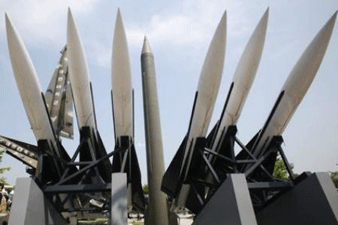
Pakistan’s embattled military regime further dependent on the IMF, the U.S., and the production of munitions for the war in Ukraine to sustain itself through a crisis that shows no sign of resolution.
The U.S.-brokered loan let Pakistan’s military postpone elections, deepen a brutal crackdown, and jail former Prime Minister Imran Khan.
The Intercept, Ryan Grim, Murtaza Hussain, September 17 2023
SECRET PAKISTANI ARMS sales to the U.S. helped to facilitate a controversial bailout from the International Monetary Fund earlier this year, according to two sources with knowledge of the arrangement, with confirmation from internal Pakistani and American government documents. The arms sales were made for the purpose of supplying the Ukrainian military — marking Pakistani involvement in a conflict it had faced U.S. pressure to take sides on.
The revelation is a window into the kind of behind-the-scenes maneuvering between financial and political elites that rarely is exposed to the public, even as the public pays the price. Harsh structural policy reforms demanded by the IMF as terms for its recent bailout kicked off an ongoing round of protests in the country. Major strikes have taken place throughout Pakistan in recent weeks in response to the measures.
The protests are the latest chapter in a year-and-a-half-long political crisis roiling the country. In April 2022, the Pakistani military, with the encouragement of the U.S., helped organize a no-confidence vote to remove Prime Minister Imran Khan. Ahead of the ouster, State Department diplomats privately expressed anger to their Pakistani counterparts over what they called Pakistan’s “aggressively neutral” stance on the Ukraine war under Khan. They warned of dire consequences if Khan remained in power and promised “all would be forgiven” if he were removed.
Since Khan’s ouster, Pakistan has emerged as a useful supporter of the U.S. and its allies in the war, assistance that has now been repaid with an IMF loan. The emergency loan allowed the new Pakistani government to put off a looming economic catastrophe and indefinitely postpone elections — time it used to launch a nationwide crackdown on civil society and jail Khan.
“Pakistani democracy may ultimately be a casualty of Ukraine’s counteroffensive,” Arif Rafiq, a nonresident scholar at the Middle East Institute and specialist on Pakistan, told The Intercept.
Pakistan is known as a production hub for the types of basic munitions needed for grinding warfare. As Ukraine grappled with chronic shortages of munitions and hardware, the presence of Pakistani-produced shells and other ordinances by the Ukrainian military has surfaced in open-source news reports about the conflict, though neither the U.S. nor Pakistan has acknowledged the arrangement.
Records detailing the arms transactions were leaked to The Intercept earlier this year by a source within the Pakistani military. The documents describe munitions sales agreed to between the U.S. and Pakistan from the summer of 2022 to the spring of 2023. Some of the documents were authenticated by matching the signature of an American brigadier general with his signature on publicly available mortgage records in the United States; by matching the Pakistani documents with corresponding American documents; and by reviewing publicly available but previously unreported Pakistani disclosures of arms sales to the U.S. posted by the State Bank of Pakistan.
The weapons deals were brokered, according to the documents, by Global Military Products, a subsidiary of Global Ordnance, a controversial arms dealer whose entanglements with less-than-reputable figures in Ukraine were the subject of a recent New York Times article.
Documents outlining the money trail and talks with U.S. officials include American and Pakistani contracts, licensing, and requisition documents related to U.S.-brokered deals to buy Pakistani military weapons for Ukraine.
The economic capital and political goodwill from the arms sales played a key role in helping secure the bailout from the IMF, with the State Department agreeing to take the IMF into confidence regarding the undisclosed weapons deal, according to sources with knowledge of the arrangement, and confirmed by a related document.
To win the loan, Pakistan had been told by the IMF it had to meet certain financing and refinancing targets related to its debt and foreign investment — targets that the country was struggling to meet. The weapons sales came to the rescue, with the funds garnered from the sale of munitions for Ukraine going a long way to cover the gap.
Securing the loan eased economic pressure, enabling the military government to delay elections — a potential reckoning in the long aftermath of Khan’s removal — and deepen the crackdown against Khan’s supporters and other dissenters. The U.S. remained largely silent about the extraordinary scale of the human rights violations that pushed the future of Pakistan’s embattled democracy into doubt………………………………………..
Bombs for Bailouts
On May 23, 2023, according to The Intercept’s investigation, Pakistani Ambassador to the U.S. Masood Khan sat down with Assistant Secretary of State Donald Lu at the State Department in Washington, D.C., for a meeting about how Pakistani arms sales to Ukraine could shore up its financial position in the eyes of the IMF.
……………………………………………………………………………………………………………………………………………… In an interview with The Intercept at the Capitol on Tuesday, Van Hollen said that his knowledge of the U.S. role in facilitating the IMF loan came directly from the Biden administration………………………………………………………..
Eleventh-Hour IMF Deal
…………………………………………………………………….. The secret arms deal for Ukraine would allow Pakistan to add nearly another billion dollars to its balance sheet ………………………………………………………………………………..
As The Intercept previously reported, Lu, the senior State Department official, said in a meeting with then-Pakistani Ambassador Asad Majeed Khan two weeks after the invasion that it was the belief of the U.S. that Pakistan had taken a neutral position solely at Khan’s direction, adding that “all would be forgiven” if Khan was removed in the no-confidence vote. Since his ouster, Pakistan has firmly taken the side of the U.S. and Ukraine in the war.
……………………………………………………………………………..After orchestrating Khan’s removal, the military embarked on a campaign to eradicate his political party through a wave of killings and mass detentions. Khan himself is currently imprisoned on charges of mishandling a classified document and facing some 150 additional charges — allegations widely viewed as a pretext to stop him from contesting future elections.
………………………………………………………..The absence of other foreign support left Pakistan’s embattled military regime further dependent on the IMF, the U.S., and the production of munitions for the war in Ukraine to sustain itself through a crisis that shows no sign of resolution. https://theintercept.com/2023/09/17/pakistan-ukraine-arms-imf/
Ukraine could get long-range missiles armed with U.S. cluster bombs.

WASHINGTON, Sept 11 (Reuters)
The Biden administration is close to approving the shipment of longer-range missiles packed with cluster bombs to Ukraine, giving Kyiv the ability to cause significant damage deeper within Russian-occupied territory, according to four U.S. officials.After seeing the success of cluster munitions delivered <https://www.reuters.com/world/us-cluster-munitions-ukraine-expected-fridays-800m-aid-package-2023-07-07/> in 155 mm artillery rounds in recent months, the U.S. is considering shipping either or both Army Tactical Missile Systems (ATACMS) that can fly up to 190 miles (306 km), or Guided Multiple Launch Rocket System (GMLRS) missiles with a 45-mile range packed with cluster bombs, three U.S. officials said.
If approved, either option would be available for rapid shipment to Kyiv.
Ukraine is currently equipped with 155 mm artillery with a maximum range of 18 miles carrying up to 48 bomblets. The ATACMS under consideration would propel around 300 or more bomblets. The GMLRS rocket system, a version of which Ukraine has had in its arsenal for months, would be able to disperse up to 404 cluster munitions.
With Ukraine’s push against Russian forces showing signs of progress, the administration is keen to boost the Ukrainian military at a vital moment, two of the sources said.
The White House declined to comment on the Reuters report.
The decision to send ATACMS or GMLRS, or both, is not final and could still fall through, the four sources said. The Biden administration has for months struggled with a decision on ATACMS, fearing their shipment would be perceived as an overly aggressive move against Russia.
Kyiv has repeatedly asked the Biden administration for ATACMS to help attack and disrupt supply lines, air bases, and rail networks in Russian occupied territory.
Last week Ukraine’s Foreign Minister Dmytro Kuleba said he and Secretary of State Antony Blinken had discussed the U.S. providing the long-range missiles and he hoped for a positive decision.
“Now is the time,” one of the U.S. officials said as Ukraine’s forces are attempting to pierce Russian lines just south of the city of Orikhiv in an attempt to divide Russian forces and put its main supply lines under threat. ATACMS or GMLRS with this capability would not only boost Ukrainian morale but deliver a needed tactical punch to the fight, the official said.
The U.S. plan is to include the grenade-packed weapons in an upcoming draw from U.S. stockpiles of munitions, according to the four U.S. officials, who spoke on condition of anonymity because of the sensitive nature of the plan.
At present Ukraine has only one U.S.-furnished cluster munitions, the 155 mm rounds that were announced in July.
The new weapons would augment Ukraine’s current 45-mile range GMLRS rounds, a version that blasts out more than 100,000 sharp tungsten fragments, but not bomblets.
Made by Lockheed Martin (LMT.N), ATACMS come in several versions some of which can fly four times GMLRS’ range, and their use could reset battlefield calculus……………………………………………..
President Joe Biden may ultimately decide against, or delay a decision on the transfer.
Cluster munitions are prohibited by more than 100 countries. Russia, Ukraine and the United States have not signed onto the Convention on Cluster Munitions, which bans production, stockpiling, use and transfer of the weapons.
They typically release large numbers of smaller bomblets that can kill indiscriminately over a wide area. Those that fail to explode pose a danger for decades after a conflict ends.
Washington has committed more than $40 billion in military assistance to Kyiv since Russia launched its full-scale invasion of its neighbor on Feb. 24, 2022.
Reporting by Mike Stone in Washington; Editing by Chris Sanders and Lisa Shumaker https://www.reuters.com/world/us-eyes-long-range-missiles-armed-with-cluster-bombs-ukraine-officials-2023-09-11
Russia shows N Korea’s Kim hypersonic missiles, nuclear-capable bombers

North Korean leader continues tour of Russia with visit to airbase where he inspected latest Russian missiles, bombers.
Aljazeera 16 Sept 23
North Korean leader Kim Jong Un has inspected Russia’s hypersonic “Kinzhal” missiles as well as strategic, nuclear-capable bombers in the latest stop on his tour of Russian space, military and other technological facilities in the country’s Far East, according to Russian-language news media reports…………………………..
After arriving in Artyom, Kim then travelled to the Vladivostok airport just outside the city where he was shown Russia’s nuclear-capable strategic bombers and other warplanes by Russian Defence Minister Sergei Shoigu and other senior military officials.
Shoigu introduced Kim to Russia’s latest missile, the hypersonic Kinzhal – which means “dagger” in Russian – an air-launched ballistic missile capable of carrying nuclear or conventional warheads.
The Kinzhal has a reported range of 1,500 to 2,000 km (930-1,240 miles) while carrying a payload of 480kg (1,100 pounds). It may travel at up to 10 times the speed of sound (12,000 kph or 7,700 mph)…………………………………………
Experts have said that potential military cooperation between Russia and North Korea following Kim’s visit could include efforts to modernise North Korea’s outdated air force, which relies on warplanes sent from the Soviet Union in the 1980s………….
Putin and Kim discussed military matters, the war in Ukraine, and deepening cooperation when they met on Wednesday, but the Russian leader told reporters that Moscow was “not going to violate anything”, referring to longstanding sanctions imposed on North Korea by the United Nations. https://www.aljazeera.com/news/2023/9/16/russia-shows-n-koreas-kim-hypersonic-missiles-nuclear-capable-bombers
‘War Is Good for Business,’ Declares Executive at London’s Global Arms Fair

16 Sept 23 By Brett Wilkins / Common Dreams
“Deals done at DSEI will cause misery across the world, causing global instability, and devastate people’s lives,” one peace activist lamented.
Military-industrial complex players big and small gathered in London this week, hawking everything from long-range missiles to gold-plated pistols to arms fair attendees—including representatives of horrific human rights violators—as weapon-makers and other merchants of the machinery of death reap record profits.
“War is good for business,” one defense executive attending the biennial Defense and Security Equipment International (DSEI) conference at ExCel London flat-out told Reuters. “We are extremely busy,” Michael Elmore, head of sales at the U.K.-based armored steelmaker MTL Advanced, told the media agency.
Russia’s ongoing invasion of Ukraine and the West’s scramble to arm Ukrainian homeland defenders have been a bonanza for arms-makers.
“Ukraine is a very interesting combination of First and Second World War technologies and very modern technology,” Kuldar Vaarsi, CEO of the Estonian unmanned ground vehicle firm MILREM, told Reuters.
Saber-rattling and fearmongering by government, media, and business figures amid rising tensions between the U.S. and its allies on one side, and a fast-rising China on the other, have also spurred military spending, including Japan’s $320 billion buildup announced last December.
“We think this is a longer-term essentially ‘sea change’ in national defense strategy for the U.S. and for our Western allies,” Jim Taiclet, CEO of U.S. arms giant Lockheed Martin, told investors during a call earlier this summer announcing higher-than-expected sales and profit outlooks.
According to the Stockholm International Peace Research Institute, the United States, Russia, France, China, and Germany were the world’s top arms exporters from 2018-22, with the five nations accounting for 76% of all weapons exports during that period. The U.S. accounted for nearly 40% of such exports during those five years, while increasing its dominance in the arms trade. The U.S. also remains by far the world’s biggest military spender.
In addition to major corporations, middlemen like Marc Morales have also been profiting handsomely from wars in countries including Ukraine. Morales happened to have a warehouse full of ammunition in Bulgaria that the Pentagon originally intended for Afghanistan when Russia invaded its neighbor, and he has been richly rewarded as the U.S. spends tens of billions of dollars arming Ukrainian forces. He named his new $10 million yacht Trigger Happy.
Outside the sprawling ExCel convention center in London’s Docklands, anti-war protesters rallied against the global arms trade and the death and destruction it fuels. The Guardianreported that at least a dozen demonstrators were arrested during the course of the conference, including nine on Thursday for blocking a road outside the venue.
Sam Perlo-Freeman, a researcher at the Campaign Against Arms Trade (CAAT), told The Guardian that “a lot of countries that are being talked about as new arms export markets are ones we would be concerned about.”…………………………………
“Deals done at DSEI will cause misery across the world, causing global instability, and devastate people’s lives,” Apple added.
Inside ExCel, it was business as usual. Pressed by Declassified U.K. chief reporter Phil Miller on why Britain’s right-wing government supports “selling arms to the Saudi dictatorship that sentences someone to death for tweeting,” Minister of State for the Armed Forces James Heappey deflected.
Private sector leaders, however, have been more forthcoming. As Raytheon CEO Greg Hayes opined during a 2021 investor call touting the company’s “solid” growth: “Peace is not going to break out in the Middle East anytime soon.” https://scheerpost.com/2023/09/16/war-is-good-for-business-declares-executive-at-londons-global-arms-fair/
US to Shift Some Military Aid from Egypt to Taiwan
By Dave DeCamp / Antiwar.com https://scheerpost.com/2023/09/17/us-to-shift-some-military-aid-from-egypt-to-taiwan/
The US will withhold $85 million in annual military aid to Egypt and redirect some of the funds to Taiwan, The Wall Street Journal reported on Wednesday.
The $85 million the US is withholding over human rights abuses is just a small portion of the $1.3 billion in military aid Egypt receives from the US each year.
The $85 million is in the form of Foreign Military Financing, a State Department program that gives foreign governments money to purchase US arms. According to CNN, Egypt receives $1 billion in FMF annually, and $320 million of those funds is conditional and tied to human rights issues.
Some members of Congress want President Biden to withhold the full $320 million, but for now, the administration has only announced its intention to transfer $85 million. Of that amount, $55 million will be redirected to Taiwan, and $30 million will go to Lebanon.
The US began providing Taiwan with military aid this year, an unprecedented form of support in the era of normalized US-China relations. Since Washington severed diplomatic relations with Taipei in 1979 to open up with Beijing, the US has sold weapons to Taiwan but never financed the purchases or provided arms free of charge until this year.
Last month, the US approved the first-ever FMF military aid package for Taiwan worth $80 million. In July, the Biden administration provided Taiwan with a weapons package using the Presidential Drawdown Authority (PDA) for the first time.
PDA allows President Biden to send weapons directly from US military stockpiles and is the primary way he’s been arming Ukraine. The PDA package for Taiwan was worth $345 million. The contents of the military aid packages for Taiwan have not been disclosed.
The US military aid for Taiwan has enraged China as Beijing opposes all forms of US military support for the island, especially new kinds of assistance. The US is arming Taiwan in the name of deterrence, but the policy is making war more likely as China has responded to the growing diplomatic and military ties between Washington and Taipei by putting the island under increasing military pressure.
Making Britain a target for nuclear retaliation
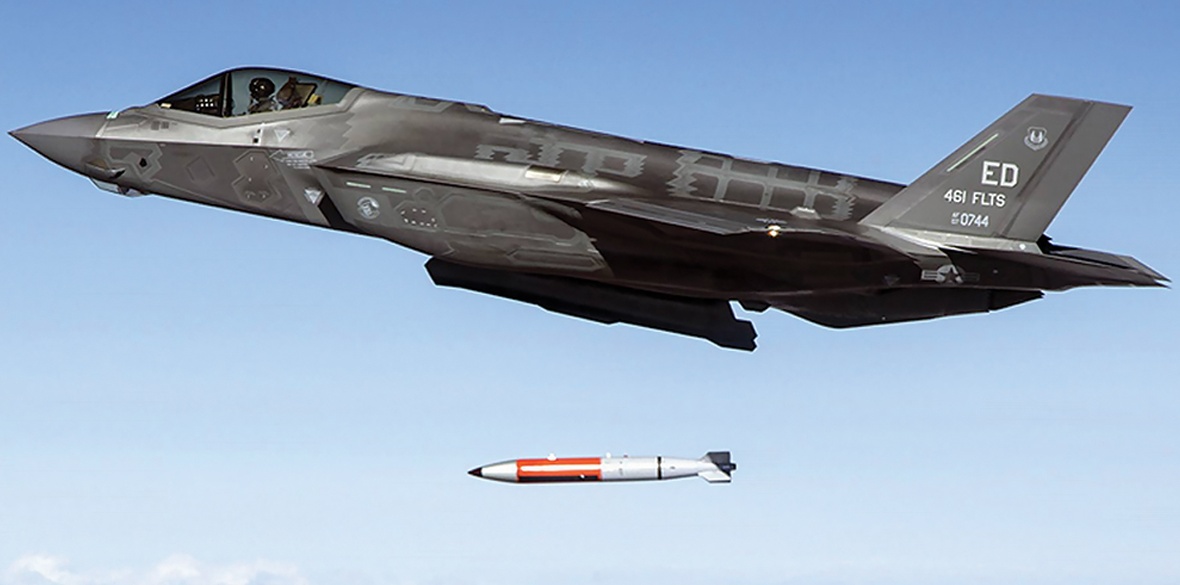
The new bomb will also be located in five other European countries and assigned to Nato. The presence of these US nuclear weapons in Europe has already been used by Putin to justify his recent movement of Russian nukes to Belarus. Their return to Britain has led to promises of Russian countermeasures.
It’s beyond irresponsible that the UK government is allowing the deployment of the US new B61-12 guided nuclear bomb, writes KATE HUDSON
16 Sept 23 https://morningstaronline.co.uk/article/f/making-britain-a-target-for-nuclear-retaliation—
ABOUT £9 billion of this year’s massive expansion in military spending is earmarked for nuclear weapons — that’s on top of over £205bn already being shelled out on replacing Britain’s Trident nuclear weapons system.
The deployment of the new B61-12 to Europe undermines prospects for global peace and ensures Britain will be a target in a nuclear conflict between the US/Nato and Russia.
Everyone needs to know that this is not a local or regional problem confined to East Anglia. In the event of a war, certainly Lakenheath will be targeted. But so will Britain’s other nuclear facilities, as well as major cities. The fact is, we are all at greater risk than ever if these weapons come back to Britain.
And no doubt there’ll be plenty extra spent on increasing the nuclear arsenal, announced in 2021, in spite of it being a breach of international law.
So you’d think there was already enough nuclear weaponry in Britain. But no. We’re having US nuclear weapons foisted on us too, without any public or parliamentary discussion.
As Diane Abbott wrote in these pages last weekend, the United States Congress has been informed of this development, but no such information has been provided to the British Parliament.
Repeated questions put in the House of Commons usually result in the non-information that “the Ministry of Defence is unable to comment on US spending decisions and capabilities, which are a matter for the US government. It remains long-standing UK and Nato policy to neither confirm nor deny the presence of nuclear weapons at a given location.”
Is this obfuscation, or can the US really put nuclear weapons here without our government’s say-so? Is this the much-vaunted “special relationship” — that the US can make us a nuclear target without our government even being allowed to comment?
One thing’s for certain: next year when the US-UK Mutual Defence Agreement comes up for renewal in Parliament, we can’t allow it to be the same old rubber stamp. It’s time to put paid to UK subordination to US nuclear, military and foreign policy.
But Lakenheath is our most immediate challenge. There’s been clear evidence for over a year that the US is planning to return its nuclear weapons to the base in Suffolk — a base often dubbed USAF Lakenheath because it is, in fact, wholly run and controlled by the US.
It’s time for our government to rethink its supine position, because even if it thinks that’s OK, the majority of the population doesn’t: 59 per cent of respondents to a recent Yougov poll opposed US nukes coming back to Britain, with only 23 per cent supporting.
CND has been active in protesting to stop the weapons coming here since the news first emerged last year. Despite the huge risks that are now facing all of us as a result of these weapons, getting widespread coverage of this issue has not been easy. The honourable exception has, of course, been the Morning Star.
But the tide has now turned. With the latest news from the Federation of American Scientists, we have managed to break through into the mainstream, with coverage on major national broadcasting and most national newspapers, not to mention a good range of local coverage.
The next step in our protests is coming up next weekend, with a “Stop US nukes coming to Britain” national day of action on Saturday September 23.
Events are happening across the country, and at Lakenheath itself, CND will visit to conduct a citizens’ weapons Inspection.
If the government refuses to confirm or deny the presence of nuclear weapons at the base, then citizens need to take matters into their own hands to ensure we have the information we need. And if we are going to be on the nuclear front line, then we certainly need to know that!
So far, the information we have is that US Air Force documents dated March this year strongly indicate that Washington is in the process of re-establishing its nuclear weapons presence in Britain, with the new B61-12 guided nuclear bomb.
Massive building works are under way at Lakenheath, including construction work on new facilities to house the anticipated influx of air crew. The work is expected to last from June 2024 to February 2026.
The new bomb will also be located in five other European countries and assigned to Nato. The presence of these US nuclear weapons in Europe has already been used by Putin to justify his recent movement of Russian nukes to Belarus. Their return to Britain has led to promises of Russian countermeasures.
It’s clear that Lakenheath is once again a vital cog in Washington’s overseas nuclear machine — despite refusals from the British government to acknowledge this reality.
It’s beyond irresponsible that the UK government is allowing this deployment. It’s time for us to step up our mobilisation. Over the decades, from Lakenheath to Greenham Common, persistent popular protest has been vital in getting US nuclear weapons removed from Britain. Now we must stop them coming back.
Kate Hudson is general secretary of the Campaign for Nuclear Disarmament.
Pakistan has 170 nuclear warheads, and may increase it to 200 by 2025, say American atomic scientists
LiveMint. 15 Sep 2023
Top American nuclear scientists have estimated that Pakistan currently possesses roughly 170 nuclear warheads, and this number could potentially increase to approximately 200 by the year 2025, based on the current rate of expansion.
As reported by PTI citing the Nuclear Notebook column published in the Bulletin of the Atomic Scientists on September 11, “We estimate that Pakistan now has a nuclear weapons stockpile of approximately 170 warheads. The US Defense Intelligence Agency projected in 1999 that Pakistan would have 60 to 80 warheads by 2020, but several new weapon systems have been fielded and developed since then, which leads us to a higher estimate.”……………………………………………………………………………………………………………………
Even when the document listed fissile materials production and inventory from available sources in the public domain, the scientists put out a disclaimer: “Calculating stockpile size based solely on fissile material inventory is an incomplete methodology that tends to overestimate the likely number of nuclear warheads.”
“We estimate that Pakistan currently is producing sufficient fissile material to build 14 to 27 new warheads per year, although we estimate that the actual warhead increase in the stockpile probably averages around 5 to 10 warheads per year,” they further said………………………………………………………………………
Commenting on the 2017’s medium-range ballistic missile called Ababeel that Pakistan said is “capable of carrying multiple warheads, using multiple independent reentry vehicle (MIRV) technology,” the Nuclear Notebook observed, “Development of multiple-warhead capability appears to be intended as a countermeasure against India’s planned ballistic missile defense system. Its status remains unclear as of July 2023.”
Pointing out that the total number and location of Pakistan’s nuclear-capable missile bases and facilities remains unknown, the document said, “Analysis of commercial satellite imagery suggests that Pakistan maintains at least five missile bases that could serve a role in Pakistan’s nuclear forces.”………………………………….
Admitting that little is publicly known about warhead production, the scientists said: “But experts have suspected for many years that the Pakistan Ordnance Factories near Wah, northwest of Islamabad, serve a role. One of the Wah factories is located near a unique facility with six earth-covered bunkers (igloos) inside a multi-layered safety perimeter with armed guards.” https://www.livemint.com/news/world/pakistan-has-170-nuclear-warheads-and-may-increase-it-to-200-by-2025-says-american-atomic-scientists-11694753125105.html
Banish Nuclear Weapons ‘to History Books, Once and for All’, Urges Secretary-General, Marking International Day
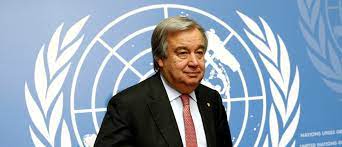
https://press.un.org/en/2023/sgsm21936.doc.htm 13 Sept 23
Following is UN Secretary-General António Guterres’ message on the International Day for the Total Elimination of Nuclear Weapons, observed on 26 September:
The International Day for the Total Elimination of Nuclear Weapons reminds us that a peaceful future depends on ending the nuclear threat.
Geopolitical mistrust and competition have spiked the nuclear risk to cold war levels. Meanwhile, hard-won progress over many decades to prevent the use, spread and testing of nuclear weapons is being undone.
On this important Day, we reaffirm our commitment to a world free of nuclear weapons and the humanitarian catastrophe their use would unleash.
This means nuclear-weapon States leading the way by meeting their disarmament obligations, and committing to never use nuclear weapons under any circumstances.
It means strengthening the nuclear disarmament and non-proliferation regime, including through the Treaties on Non-Proliferation of Nuclear Weapons and the Prohibition of Nuclear Weapons.
It means all countries that have not yet ratified the Comprehensive Nuclear-Test-Ban Treaty to do so without delay, and for those States that possess nuclear weapons to ensure a moratorium on all nuclear testing.
It means taking into account the evolving nuclear order, and addressing the blurring lines between strategic and conventional weapons and the nexus with new and emerging technologies.
Above all, it means deploying the timeless tools of dialogue, diplomacy and negotiation to ease tensions and end the nuclear threat. The recently launched policy brief on a New Agenda for Peace calls on Member States to urgently recommit to this important cause.
The only way to eliminate the nuclear risk is to eliminate nuclear weapons. Let’s work together to banish these devices of destruction to the history books, once and for all.
NATO’s Steadfast Defender Drills Near Russia Signal Bloc’s Shift to ‘War Footing’
Ilya Tsukanov, Sputnik News 11 Sept 23
All thirty-one NATO countries plus Sweden are reportedly gearing up to conduct the bloc’s biggest military drills since the Cold War in early 2024. Sputnik reached out to Michael Maloof, a former security policy analyst with the Office of the Secretary of Defense, to get a sense of the risks posed by the exercises.
British business media reported Monday that NATO plans to hold large-scale exercises across Germany, Poland and the Baltic countries between February and March of 2024, with the drills’ pretext being to practice “repelling Russian aggression” against allies. The drills, dubbed Steadfast Defender 24, are set to involve up to 41,000 troops, 50 warships, and to feature between 500-700 air combat missions, according to sources familiar with the plans.
The exercises are the first of their kind since 2021, with the alliance previously mostly avoiding large-scale exercises in Russia’s direct vicinity amid concerns about Moscow’s possible reaction amid repeated warnings by Russian Foreign Intelligence that some NATO countries may be preparing to transform the Ukrainian proxy conflict into a direct shooting war with Russia.
The drills are “designed to put Russia and allies in the most unfavorable position,” former Pentagon analyst Michael Maloof told Sputnik.
Pointing to the exercises’ expected heavy focus on air power, something Ukraine has lacked utterly throughout its three-month long counteroffensive this summer, Maloof emphasized that the drills appear aimed at going “from being reactionary in terms of reacting to a crisis, to actually going on a war footing” on NATO’s part, “assuming that there’s an invasion, and that Russia has allies participating.”
The exercises will be meant to “show coordination on a wartime footing,” the observer said, and NATO will likely use experience gained by observing fighting in Ukraine to “coordinate their air, sea, land, but also their space and cyber capabilities together.”
“That said,” Maloof noted, “the reality is” that much of NATO’s stocks of war materiel “have been depleted because of Ukraine,” with Europe and the United States each running low on weapons and ammunition after sending nearly $100 billion in arms assistance to Kiev over the past 18 months.
“If, in fact, there was a war, Russia would certainly activate ships and other aircraft and what have you in international waters and perhaps off the coast of the United States to deal with” US attempts to set up a logistical supply train across the Atlantic.
The observer doesn’t believe that the alliance is “really ready for a real confrontation and real head-on war” with Russia, with any conflagration certain to result in “tremendous losses.”…………………. more https://sputnikglobe.com/20230911/natos-steadfast-defender-drills-near-russia-signal-blocs-shift-to-war-footing-1113292863.html
Zelensky Issues Veiled Threat To Destabilize Europe If Weapons Flow Curtailed
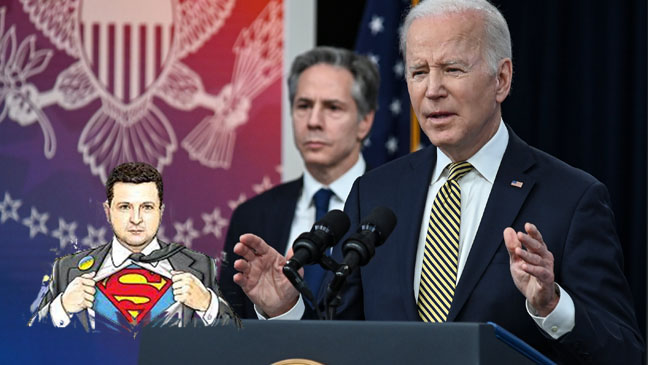
Zero Hedge, TYLER DURDEN, WEDNESDAY, SEP 13, 2023 –
As predicted by a number of independent geopolitical commentators, including ourselves, the emerging official narrative on why Ukraine’s counteroffensive ended in failure will be to falsely claim the West didn’t provide “enough” weapons in a timely fashion. Despite the literally tens of billions of US taxpayer dollars sunk into Kiev’s war effort at record-breaking pace and scale, it will be the “fault” of the United States and its allies—or at least this will be solidified as the Ukrainian government’s perspective and narrative (and then will be parroted among Zelensky’s most diehard hawkish supporters).
Ukrainian President Volodymyr Zelensky has this week been busy advancing this as a key talking point, first telling CNN’s Fareed Zakaria on Sunday his country “waited too long” to start counteroffensive. The reason? He blames the West for forcing his military leaders to wait so long for the necessary weaponry and equipment.
“We — look, we waited too long. It’s true. No, I’m thankful to partners, to the United States, EU, other partners,” Zelensky said. “I’m thankful very much to President Biden and to Congress, but we have to understand: We waited too long, they put mines.”
“Then when we been ready from the point of view of our partners because the decision to give us, for example, Bradley [Fighting Vehicles] and other kind of weapons, the decision, it doesn’t mean the result.” And The Hill underscores of his remarks, “Zelensky noted that Ukraine does not get the weapons promised to it immediately after they are announced by allies.” This is not the first time Zelensky has blamed slowness in supplies and training from his Western sponsors. But behind the scenes, his Western patrons have criticized him for being “ungrateful”.
In late March, Zelensky when asked about why the counteroffensive was being delayed said that he can’t “start yet” as he’s unable to “send our brave soldiers to the front line without tanks, artillery and long-range rockets.” And then in May he reasserted that “We can advance with what we’ve got and I think we can be successful but we will lose a lot of people, I think that is unacceptable.” He had added at the time, “We need to wait, we need a bit more time.” The offensive later belatedly kicked off in full force in June.
In another interview freshly published this week with US media, Zelensky took this theme of “blame the West” even further. In remarks to the Economist, he issued a thinly veiled threat to those countries thinking about curtailing aid in any way, warning that “millions of Ukrainian refugees in European countries” are capable of destabilizing the West.
Here’s what Zelensky said as captured by the Economist interview published this week:
Curtailing aid to Ukraine will only prolong the war, Mr Zelensky argues. And it would create risks for the West in its own backyard. There is no way of predicting how the millions of Ukrainian refugees in European countries would react to their country being abandoned.
Ukrainians have generally “behaved well” and are “very grateful” to those who sheltered them. They will not forget that generosity. But it would not be a “good story” for Europe if it were to “drive these people into a corner”.
A number of online commentators took note of his surprisingly open and aggressively accusatory rhetoric, saying he seems to be threatening Europe with terrorism if Ukraine doesn’t get its way.
“Am I misreading this or is Zelenskyy actually threatening European countries with terrorism if they don’t send the weapons he wants to Ukraine?” Arnaud Bertrand reacted. And Max Abrahms, a counterterrorism expert and professor of international relations had this to say…
Zelensky is now threatening that Ukrainian refugees will attack Europe if it doesn’t keep the gravy train running.
In the same interview Zelensky tripled down on prior repeat vows to never negotiate with Putin or to contemplate ceding territory. …………………………………………………..
When will US, UK, and European leaders begin to say “enough is enough” when it comes to Zelensky’s chastising, humiliating and threatening them?https://www.zerohedge.com/geopolitical/zelensky-issues-veiled-threat-destabilize-europe-if-weapons-flow-curtailed
IAEA sees no problem with depleted uranium weaponry – Grossi

The US and UK have sent the toxic ammunition to Ukraine
Rt.com 12 Sept 23
There are “no significant radiological consequences” to the use of depleted uranium ammunition, International Atomic Energy Agency (IAEA) Director General Rafael Grossi has declared. Russia insists that Grossi is “not telling the whole story.”
“From a nuclear safety point of view there are no significant radiological consequences” to the use of this ammunition, Grossi told reporters during a briefing on Monday.
“Maybe in some very specific cases, people near a place that was hit with this kind of ammunition, there could be contamination,” he continued, adding that “this is more of a health issue of a normal nature than a potential radiological crisis.”
Depleted uranium is used to make the hardened cores of certain armor-piercing tank and autocannon rounds. Although it is not highly radioactive, uranium is still a toxic metal, and this metal is turned into a potentially hazardous aerosol when a depleted uranium round strikes its target.
US forces utilized depleted uranium tank shells during the 1991 Gulf War, reportedly causing a spike in birth defects, autoimmune disorders, and cancer cases in Iraq over the following decades. NATO also used depleted uranium in its 1999 air campaign against Yugoslavia. Earlier this year, Serbian Health Minister Danica Grujicic described the carcinogenic consequences of this ammunition on the Serb population a “horrible and inhumane experiment.”
The UK began supplying Ukraine with depleted uranium tank shells in March, while the US announced last week that it would send depleted uranium ammunition for its M1 Abrams tanks, which are expected to arrive in Ukraine in the coming weeks.
By focusing on the issue from a nuclear safety point of view, Grossi was being deliberately disingenuous, Russian Foreign Ministry spokeswoman Maria Zakharova wrote on Telegram on Monday.
“Mr. Grossi is, of course, right in saying that there are no significant radiological consequences from the standpoint of ‘nuclear safety,” she wrote. “It’s likewise obvious, though, that he is not telling the whole story.”
Zakharova pointed out that depleted uranium releases “extremely toxic aerosols” when ignited and vaporized. “Perhaps this is beyond Mr. Grossi’s expertise as head of the IAEA,” she concluded. “This question should be addressed to chemists, who will tell us about the harmful effects of heavy metal accumulation on the environment and human health.”
Russian forces claim to have destroyed at least one warehouse in Ukraine containing British depleted uranium shells. Kremlin spokesman Dmitry Peskov warned last week that the West will ultimately be responsible when this ammunition “inevitably” contaminates Ukrainian land………………. https://www.rt.com/news/582793-iaea-depleted-uranium-grossi/
Pentagon’s new plan to counter China includes swarms of smart satellites

Deputy Secretary Kathleen Hicks: DoD wants to “leverage platforms that are small, smart, cheap, and many”
Space News, Sandra Erwin, September 6, 2023
ARLINGTON, Va. — Under a new strategy to counter China’s military buildup, the Pentagon is advocating the use of low-cost autonomous platforms that can be mass produced and deployed at sea, on land, in the air and in space.
“This is about driving culture change just as much as technology change — so we can gain military advantage faster,” Deputy Defense Secretary Kathleen Hicks, said Sept. 6 at the DefenseNews annual conference.
Hicks discussed DoD’s plan to field thousands of autonomous systems across all domains within the next 18 to 24 months. China’s advantage is “mass,” said Hicks. DoD will continue to invest in its traditional platforms but will counter with “mass of our own,” or large numbers of autonomous systems.
DoD would field fleets of tiny drones and swarms of satellites that would be inexpensive to replace.
“Imagine constellations of autonomous, attritable systems on orbit, flung into space scores at a time, numbering so many that it becomes impossible to eliminate or degrade them all,” she said.
The strategy is to “leverage platforms that are small, smart, cheap, and many,” Hicks said. …………………………………………………….
The U.S. military’s Space Development Agency is building a government-owned proliferated constellation. DoD is also a major customer of Starlink, SpaceX’s massive internet in space. ……………….. https://spacenews.com/pentagons-new-plan-to-counter-china-includes-swarms-of-smart-satellites/?utm_medium=email
How the ‘nuclear football’ remains a potent symbol of the unthinkable

CYISRNET, By Georgina DiNardo, Sep 12, 2023
The nuclear threat has been dormant in the public’s mind since the end the Cold War. But renewed attention due to the wild success of the film “Oppenheimer’’ and rising tensions with Russia and China has brought the so-called nuclear football, the activation device for the U.S. arsenal, back into view.
The sighting of a military aide handling the football, closely following President Joe Biden as he exited a meeting with the United Kingdom’s prime minister on July 10, the day before the NATO summit during which the war in Ukraine was discussed, heightened already building tensions between NATO members and Russia.
…………………………………………………..The nuclear football was not always what is today. Over time, the briefcase has had drastic changes to its contents, causing speculation to arise over its morality.
A history of the nuclear football
Following the creation and use of the atomic bomb in the 1940s, a story that “Oppenheimer” deeply explored, then President Dwight D. Eisenhower feared the U.S. would be helpless against a nuclear assault. In the late 1950s, he directed a military aide to carry a bag containing documents that would allow the president to communicate an action plan with military headquarters across the country whenever he left Washington.
Eisenhower’s initial satchel included emergency action documents which would help the president regain control of United States actions if a nuclear attack was launched by another country………………………………………………………………………..
Eisenhower transferred the satchel to his successor, President John F. Kennedy, who changed it over time, as he wanted blueprints for an alternative solution to the all-or-nothing nuclear war strategy of the time…………………………………………………….
Common misconceptions
Russia and Pakistan both have similar nuclear briefcases. Unlike the U.S., which clouds the nuclear football with mystery, Russia unveiled the contents of that country’s nuclear briefcase on television in 2019 ……………………………………………………………………………………………….
The U.S. actually has two footballs — one for the president and one for the vice president……………………………………………………………………………….
The satchel is not all that is required to trigger nuclear weapons in times of crisis. A card with authentication codes, dubbed the “biscuit” which doesn’t have real launch codes but can verify the president’s identity, is supposed to be always carried by the president. Military Times could not confirm the origin of the term.
“The president does not have the launch codes,” Schwartz said. “No president has had launch codes. So, the president can’t physically turn keys or push buttons to do anything, he’s relying on a whole chain of people, hundreds of people down the chain of command to transmit the orders and do all of that.”………………………………………………………………….
Ethical ramifications
The job of carrying the nuclear football can be burdensome, and not only because it weighs about 45 pounds. Patterson says that the psychological impact of holding such monumental power influences the handler……………………………………………………………………………..
While the president has the power to activate it, the military aide is tasked with ensuring that the president is of sound mind before they were to activate the nuclear football……………………………..
1 This Month

petition to oppose the rapid increase of space-military industry threatening Jeju Island and the region.
[Petition by April 19th (KST)] Stop the joint military-Hanwha Systems-Jeju Provincial Government Sea Launch!

Chernobyl: The Lost Tapes – A good documentary on Chernobyl on SBS available On Demand for the next 3 weeks– https://www.sbs.com.au/ondemand/tv-program/chernobyl-the-lost-tapes/2352741955560

of the week–London Campaign for Nuclear Disarmament

Tell the Ukrainian Government to Drop Prosecution of Peace Activist Yurii Sheliazhenko
To see nuclear-related stories in greater depth and intensity – go to https://nuclearinformation.wordpress.com
-
Archives
- April 2026 (194)
- March 2026 (251)
- February 2026 (268)
- January 2026 (308)
- December 2025 (358)
- November 2025 (359)
- October 2025 (376)
- September 2025 (257)
- August 2025 (319)
- July 2025 (230)
- June 2025 (348)
- May 2025 (261)
-
Categories
- 1
- 1 NUCLEAR ISSUES
- business and costs
- climate change
- culture and arts
- ENERGY
- environment
- health
- history
- indigenous issues
- Legal
- marketing of nuclear
- media
- opposition to nuclear
- PERSONAL STORIES
- politics
- politics international
- Religion and ethics
- safety
- secrets,lies and civil liberties
- spinbuster
- technology
- Uranium
- wastes
- weapons and war
- Women
- 2 WORLD
- ACTION
- AFRICA
- Atrocities
- AUSTRALIA
- Christina's notes
- Christina's themes
- culture and arts
- Events
- Fuk 2022
- Fuk 2023
- Fukushima 2017
- Fukushima 2018
- fukushima 2019
- Fukushima 2020
- Fukushima 2021
- general
- global warming
- Humour (God we need it)
- Nuclear
- RARE EARTHS
- Reference
- resources – print
- Resources -audiovicual
- Weekly Newsletter
- World
- World Nuclear
- YouTube
-
RSS
Entries RSS
Comments RSS
 nuclear-news