NOWHERE TO HIDE – How a nuclear war would kill you — and almost everyone else.

Bulletin of the Atomic Scientists OCTOBER 20, 2022, By François Diaz-Maurin
This summer, the New York City Emergency Management department released a new public service announcement on nuclear preparedness, instructing New Yorkers about what to do during a nuclear attack. The 90-second video starts with a woman nonchalantly announcing the catastrophic news: “So there’s been a nuclear attack. Don’t ask me how or why, just know that the big one has hit.” Then the PSA video advises New Yorkers on what to do in case of a nuclear attack: Get inside, stay inside, and stay tuned to media and governmental updates.
But nuclear preparedness works better if you are not in the blast radius of a nuclear attack. Otherwise, there’s no going into your house and closing your doors because the house will be gone. Now imagine there have been hundreds of those “big ones.” That’s what even a “small” nuclear war would include. If you are lucky not to be within the blast radius of one of those, it may not ruin your day, but soon enough, it will ruin your whole life.
Effects of a single nuclear explosion
Any nuclear explosion creates radiation, heat, and blast effects that will result in many quick fatalities.
Direct radiation is the most immediate effect of the detonation of a nuclear weapon. It is produced by the nuclear reactions inside the bomb and comes mainly in the form of gamma rays and neutrons.
Direct radiation lasts less than a second, but its lethal level can extend over a mile in all directions from the detonation point of a modern-day nuclear weapon with an explosive yield equal to the effect of several hundred kilotons of TNT.
Microseconds into the explosion of a nuclear weapon, energy released in the form of X-rays heats the surrounding environment, forming a fireball of superheated air. Inside the fireball, the temperature and pressure are so extreme that all matter is rendered into a hot plasma of bare nuclei and subatomic particles, as is the case in the Sun’s multi-million-degree core.
The fireball following the airburst explosion of a 300-kiloton nuclear weapon—like the W87 thermonuclear warhead deployed on the Minuteman III missiles currently in service in the US nuclear arsenal—can grow to more than 600 meters (2,000 feet) in diameter and stays blindingly luminous for several seconds, before its surface cools.
The light radiated by the fireball’s heat—accounting for more than one-third of the thermonuclear weapon’s explosive energy—will be so intense that it ignites fires and causes severe burns at great distances. The thermal flash from a 300-kiloton nuclear weapon could cause first-degree burns as far as 13 kilometers (8 miles) from ground zero.
Then comes the blast wave.
The blast wave—which accounts for about half the bomb’s explosive energy—travels initially faster than the speed of sound but slows rapidly as it loses energy by passing through the atmosphere
Because the radiation superheats the atmosphere around the fireball, air in the surroundings expands and is pushed rapidly outward, creating a shockwave that pushes against anything along its path and has great destructive power.
The destructive power of the blast wave depends on the weapon’s explosive yield and the burst altitude.
An airburst of a 300-kiloton explosion would produce a blast with an overpressure of over 5 pounds per square inch (or 0.3 atmospheres) up to 4.7 kilometers (2.9 miles) from the target. This is enough pressure to destroy most houses, gut skyscrapers, and cause widespread fatalities less than 10 seconds after the explosion.
Radioactive fallout
Shortly after the nuclear detonation has released most of its energy in the direct radiation, heat, and blast, the fireball begins to cool and rise, becoming the head of the familiar mushroom cloud. Within it is a highly-radioactive brew of split atoms, which will eventually begin to drop out of the cloud as it is blown by the wind. Radioactive fallout, a form of delayed radioactivity, will expose post-war survivors to near-lethal doses of ionizing radiation.
As for the blast, the severity of the fallout contamination depends on the fission yield of the bomb and its height of burst. For weapons in the hundreds of kilotons, the area of immediate danger can encompass thousands of square kilometers downwind of the detonation site. Radiation levels will be initially dominated by isotopes of short half-lives, which are the most energetic and so most dangerous to biological systems. The acutely lethal effects from the fallout will last from days to weeks, which is why authorities recommend staying inside for at least 48 hours, to allow radiation levels to decrease.
Because its effects are relatively delayed, estimating casualties from the fallout is difficult; the number of deaths and injuries will depend very much on what actions people take after an explosion. But in the vicinity of an explosion, buildings will be completely collapsed, and survivors will not be able to shelter. Survivors finding themselves less than 460 meters (1,500 feet) from a 300-kiloton nuclear explosion will receive an ionizing radiation dose of 500 Roentgen equivalent man (rem). “It is generally believed that humans exposed to about 500 rem of radiation all at once will likely die without medical treatment,” the US Nuclear Regulatory Commission says.
But at a distance so close to ground zero, a 300-kiloton nuclear explosion would almost certainly burn and crush to death any human being. The higher the nuclear weapon’s yield, the smaller the acute radiation zone is relative to its other immediate effects.
One detonation of a modern-day, 300-kiloton nuclear warhead—that is, a warhead nearly 10 times the power of the atomic bombs detonated at Hiroshima and Nagasaki combined—on a city like New York would lead to over one million people dead and about twice as many people with serious injuries in the first 24 hours after the explosion. There would be almost no survivors within a radius of several kilometers from the explosion site.
1,000,000 deaths after 24 hours
Immediate effects of nuclear war
In a nuclear war, hundreds or thousands of detonations would occur within minutes of each other.
Regional nuclear war between India and Pakistan that involved about 100 15-kiloton nuclear weapons launched at urban areas would result in 27 million direct deaths.
27,000,000 deaths from regional war
A global all-out nuclear war between the United States and Russia with over four thousand 100-kiloton nuclear warheads would lead, at minimum, to 360 million quick deaths.* That’s about 30 million people more than the entire US population.
360,000,000 deaths from global war
This estimate is based on a scenario of an all-out nuclear war between Russia and the United States involving 4,400 100-kiloton weapons under the 2002 Strategic Offensive Reductions Treaty (SORT) limits, where each country can deploy up to 2,200 strategic warheads. The 2010 New START Treaty further limits the US- and Russian-deployed long-range nuclear forces down to 1,550 warheads. But as the average yield of today’s strategic nuclear forces of Russia and the United States far exceeds 100 kilotons, a full nuclear exchange between the two countries involving around 3,000 weapons likely would result in similar direct casualties and soot emissions.
In an all-out nuclear war between Russia and the United States, the two countries would not limit to shooting nuclear missiles at each other’s homeland but would target some of their weapons at other countries, including ones with nuclear weapons. These countries could launch some or all their weapons in retaliation.
Together, the United Kingdom, China, France, Israel, India, Pakistan, and North Korea currently have an estimated total of over 1,200 nuclear warheads.
As horrific as those statistics are, the tens to hundreds of millions of people dead and injured within the first few days of a nuclear conflict would only be the beginnings of a catastrophe that eventually will encompass the whole world.
Global climatic changes, widespread radioactive contamination, and societal collapse virtually everywhere could be the reality that survivors of a nuclear war would contend with for many decades.
Two years after any nuclear war—small or large—famine alone could be more than 10 times as deadly as the hundreds of bomb blasts involved in the war itself…………………………………….more https://thebulletin.org/2022/10/nowhere-to-hide-how-a-nuclear-war-would-kill-you-and-almost-everyone-else/#post-heading
Italy’s Foreign Minister reveals country ceased arms shipments to Israel starting October 7 over ‘war crime’ concerns
The Times of Israel, Mon, 22 Jan 2024, https://www.sott.net/article/488099-Italys-FM-reveals-country-ceased-arms-shipments-to-Israel-starting-October-7-over-war-crime-concerns
Italian Foreign Minister and Deputy Prime Minister Antonio Tajani told local media Saturday that his country had halted all arms shipments to Israel since Hamas’s brutal October 7 onslaught.
The minister’s comments, made in an interview with Italian newspapers Nazione, Giorno, and Resto del Carlino, were a response to a demand by opposition leader Elly Schlein that the Italian government stop weapons exports to the Middle East. Tajani accused her of being “misinformed.”
“Since October 7, we have decided not to send any more arms to Israel, so there is no need to discuss this point,” said Tajani, according to a report from Italian news agency ANSA.
Speaking at a Friday meeting of the center-left Democratic Party, which she heads, Schlein said that “we must face the issue of avoiding fueling these conflicts, of avoiding sending arms and exporting arms to conflicts, to the conflict in the Middle East, in this case particularly to Israel,” according to ANSA.
“We cannot risk weapons being used to commit what could be construed as war crimes,” added the opposition lawmaker.
According to Israeli news site Walla, some five percent of Israeli arms purchases over the past decade have come from Italy, which include helicopters and naval artillery.
Comment: At irregular intervals over the past few years Italy’s dockworkers and border staff have protested and taken strike action against supplying Israel with arms.
In separate news, Tajani said in an interview with Italian radio Friday that his country would be willing to send troops to a peacekeeping mission in Gaza, ANSA reported.
On Sunday, following Prime Minister Benjamin Netanyahu’s stated refusal to accept a two-state formula for peace, Tajani told reporters that President Isaac Herzog is nonetheless open to such a solution, according to a report in Italian daily Il Tempo.
Tajani, a former air force officer who has led the conservative Forza Italia party since the death of its chairman Silvio Berlusconi in July, made an early solidarity visit to Israel at the start of the war on Hamas, and in November reaffirmed with other G7 nations his belief in Israel’s right to defend itself, within the bounds of international law, against Hamas aggression.
Comment: Key point: within the bounds of international law; although numerous experts have pointed out that, as an occupying force, Israel isn’t ‘defending itself’, these are acts of aggression, and criminal.
By December, the Italian foreign minister struck a more critical tone, condemning Israel for shooting inside a Gaza church. In January, as president of the G7, Tajani explored with other foreign ministers in the group the possibility of applying pressure on Israel to bring the war to a “rapid” end.
On the subject of South Africa’s ongoing claim at the International Court of Justice that Israel is committing “genocide” against Gazans, Tajani has said that although Israel has hit civilians in Gaza, it is not committing genocide.
Berlusconi, the erstwhile leader of Tajani’s party, and a colorful, scandal-ridden, media mogul who served as Italy’s prime minister for a cumulative nine years, was known to be a strong supporter of Israel, even raising the possibility that the Jewish state join the European Union. It was under Berlusconi that Italy sold 30 jet trainers to Israel, in a billion-dollar deal. Though critical of Israel’s West Bank settlements, Berlusconi at one time stated that the West should support Israel in the Israeli-Palestinian conflict.
Comment: Notably Italy, and Spain, despite pressure from the US, refused to send support to the US-UK for their naval campaign against Yemen: Iran warns it could cut off Mediterranean Sea as France, Spain and Italy pull out of Red Sea Op – Israeli vessel hit off India’s coast
Netanyahu Rebuffs Biden, Says Israel ‘Will Not Compromise on Full Israeli Control’ Over Gaza
The Israeli PM’s statement contradicts messaging from President Joe Biden and the White House
01/21/24 Zachary Rogers, https://themessenger.com/news/netanyahu-rebuffs-biden-says-israel-will-not-compromise-full-israeli-control-gaza
sraeli Prime Minister Benjamin Netanyahu said Saturday that he “will not compromise on full Israeli control” over Gaza and that “this is contrary to a Palestinian state.”
Netanyahu released the statement in a social media post. The statement comes just a day after President Joe Biden spoke with Netanyahu for the first time in nearly a month and directly contradicts messaging from the White House that creative solutions could bridge wide gaps between the leaders’ views on Palestinian statehood.
“The President discussed Israel’s responsibility even as it maintains military pressure on Hamas and its leaders to reduce civilian harm and protect the innocent,” the White House said of the conversation between national leaders.
“The President also discussed his vision for a more durable peace and security for Israel fully integrated within the region and a two-state solution with Israel’s security guaranteed,” it added.
The conflicting messaging is a sign of the pressures Netanyahu’s government faces at home. Thousands of Israelis have been protesting in Tel Aviv calling for new elections and for their nation to ensure the safe return of the remaining hostages of Hamas, but Netanyahu is also under heat to appease members of his right-wing ruling coalition by intensifying the conflict.
Netanyahu has said Israel must fight until it achieves “complete victory” and Hamas no longer poses a threat but has not outlined how this will be accomplished.
But a member of Israel’s War Cabinet, former Israeli army chief Gadi Eisenkot, has called a cease-fire the only way to secure the hostages’ release, a comment that implied criticism of Israel’s current strategy.
Are Nuclear-Armed Nations Entering a New Arms Race in 2024? Experts Weigh In.
Experts worry about a possible nuclear arms race as global instability and the threat of mass destruction loom large., By Jon Letman , TRUTHOUT.22 Jan 24
ike waking up with a bad hangover, 2024 began with geopolitical headaches and pains from the previous year’s conflicts, chaos and instability. Multiple wars in Africa, Europe and the Middle East; human-caused climate and environmental crises; and concerns about democratic backsliding, economic stress and social unrest marked the beginning of the new year.
In 2024, a record number of national and parliamentary elections portends a consequential, but uncertain year. Amidst compounding crises, the existential threat of nuclear weapons hangs over humanity, like a silent, menacing smog that won’t go away. Currently, five nuclear-armed nations (Russia, Israel, Pakistan, the United Kingdom and the United States) are actively involved in military hostilities with another country.
Today the world’s nine nuclear-armed nations have roughly 12,500 nuclear weapons (including those awaiting dismantlement) and while the overall number has been cut sharply since peaking at more than 70,000 warheads in the mid-1980s, all nine nations are upgrading or modernizing their arsenals. In 2022, they spent nearly $83 billion on nuclear weapons.
As the arsenals of nuclear-armed nations age, if they aren’t being retired and dismantled, they are being replaced, redesigned or otherwise modernized to remain usable. The United States is poised to spend possibly as much as $2 trillion in the next 30 years to modernize its nuclear triad (bombers, submarines, long-range ballistic missiles). All nine nuclear-armed nations are currently expanding or modernizing their arsenal.
With roughly 500 warheads, China’s nuclear stockpile, while still a fraction of the United States or Russia’s, is rapidly growing. Meanwhile, ongoing tensions between nuclear neighbors India and Pakistan, North Korea and South Korea, and China and Taiwan underscore the risk of a nuclear confrontation.
Despite this, John Erath, senior policy director for the Center for Arms Control and Non-Proliferation, says “the possibility of nuclear war is very small,” but hastened to add that the catastrophic dangers and potential consequences of even “limited use” of nuclear weapons cannot be ignored………………………………………………………………………………………………………………..
Beyond these challenges, Kimball says there’s growing concern about the ways in which artificial intelligence (AI) is being applied to military technology and how it could affect nuclear command and control. Kimball told Truthout that AI algorithms are likely to play a growing role in providing information that could influence nuclear decisions made by military and political leaders to assess multiple events and data inputs during a crisis. Kimball says it’s important that the U.S., Russia and China discuss the potential consequences of AI before a crisis emerges.
As concerned nations take preliminary steps toward UN negotiations on the question of a legally binding instrument to regulate AI to ensure humans remain in control of decisions regarding the use of lethal force, discussions have begun in a limited forum called the P5 Process, as the issue grows in importance in the year ahead.
Deterrence Deters Disarmament
Amid an international security environment rife with conflict and uncertainty, Seth Shelden, UN liaison for the International Campaign to Abolish Nuclear Weapons, told Truthout that in an atmosphere of deteriorating multilateralism and strained cooperation, the UN Treaty on the Prohibition of Nuclear Weapons (TPNW) stands out as a bright spot in which countries around the world are committed to building something that can reduce the risks of nuclear weapons.
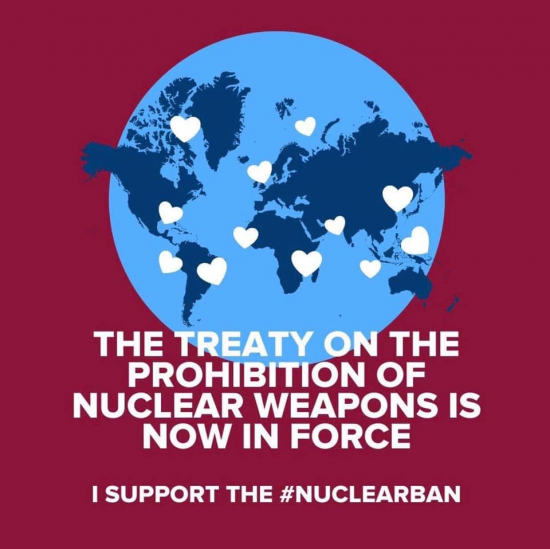
With widespread disappointment in recent Nuclear Non-Proliferation Treaty (NPT) conferences which failed to produce the customary summary or outcome document, the TPNW (also called the “ban treaty”) has gained widespread support from the majority of nonnuclear countries. Entering into force in January 2021, the TPNW prohibits all aspects of development, testing, production, possession, transfer, use or threat to use nuclear weapons. To date, 70 countries have ratified the treaty, including South Africa, Austria, Thailand, New Zealand, Ireland, Fiji, Kazakhstan, Mexico and the Philippines. Additionally, Indonesia, Brazil, and more than 20 other nations around the world are in the process of ratifying the treaty.
In late 2023, at the Second Meeting of States Parties to the TPNW, nonnuclear states challenged the theory of nuclear deterrence, rejecting the framing of security policies based on the threat to destroy humanity. Nuclear-armed nations and their client states dismiss this idea, arguing that the TPNW is counter to their security interests. In response, Shelden said ban treaty proponents ask, “What about our security interests?”
Shelden says the vast majority of the world does not believe that nuclear weapons ensure security, and that wars in Ukraine, Gaza, and elsewhere actually demonstrate that the notion of nuclear weapons preventing conflict is a “fallacious idea.” Rather, they embolden nuclear armed states to proceed with conflicts and violence, said Shelden. “The only thing that deterrence really deters is disarmament.”…………………………………………………………………… more https://truthout.org/articles/are-nuclear-armed-nations-entering-a-new-arms-race-in-2024-experts-weigh-in/
‘Operation Al-Aqsa Flood’ Day 108: Israel is systematically obliterating Gaza, section by section
As Israeli forces surround yet another hospital in Gaza, Hamas releases a letter clarifying its motives behind the October 7 attack, reiterating the Palestinian demand for the right to self-determination.
Mondoweiss, BY LEILA WARAH ,
Casualties
- 25,295+ killed* and at least 63,000 wounded in the Gaza Strip.
- 387+ Palestinians killed in the occupied West Bank and East Jerusalem.
- Israel revises its estimated October 7 death toll down from 1,400 to 1,147.
- 532 Israeli soldiers killed since October 7, and at least 3,221 injured.**
*This figure was confirmed by Gaza’s Ministry of Health on January 22. Some rights groups put the death toll number higher than 32,000 when accounting for those presumed dead.
Key Developments
- UNOCHA: Only 15 bakeries still operational across Gaza, none in north.
- UNOCHA: Approximately 1.7 million internally displaced people in Gaza.
- Euro-Mediterranean Human Rights Monitor: Israel killed 94 professors in Gaza since October 7.
- Palestine Red Crescent Society: Israeli tanks near al-Amal City Hospital in Khan Younis, all contact with PRCS team in area lost.
- Palestine Red Crescent Society: Israel besieges ambulance center in Khan Younis, prevents lifesaving movement.
- Israeli forces destroy entire neighborhood in Khan Younis via demolition, after soldier takes selfie with explosives.
- Two Hezbollah fighters killed in Lebanon by Israeli drone strike.
- Palestinian Ministry of Health: 190 Palestinians killed and 34 injured in the last 48 hours.
- Hamas publishes 16-page report to “clarify” background and dynamics of October 7 surprise attack.
- Israelis protest outside Netanyahu home, demand return of Israeli captives.
Hospitals under attack in southern Gaza
The Israeli army is systematically destroying Gaza as its genocidal war on the beleaguered strip enters its 108th day. The Israeli army, after having almost completely decimated northern Gaza, continues to move further south, setting its sights on Khan Younis, the second-largest district in the besieged enclave.
The area was initially designated a safe zone by Israel, leading hundreds of thousands of residents from the north to seek refugee in the city. Yet Khan Younis has now already become a shadow of itself after extensive damage and destruction wrought by the relentless Israeli airstrikes.
The ground invasion continues the campaign of obliteration, as Israeli soldiers filmed themselves blowing up 40 residential buildings at once with the use of explosives. Earlier, soldier Itamar Bello shared a selfie of himself posing with the mines used for the demolition.
Meanwhile, Israeli tanks and military vehicles are approaching al-Amal Hospital in the center of Khan Younis, the Palestine Red Crescent Society (PRCS) reported on Monday morning.
As a result, PRCS has lost all contact with its crews in the area.
PRCS later added that the Israeli military was preventing first responders from reaching the wounded in Khan Younis as it intensified the ground assault and attacked the PRCS ambulance center.
Meanwhile, about 1 kilometer away, the Nasser Medical Complex was surrounded on three sides by the military in conjunction with the ongoing Israeli artillery bombardment in the vicinity of Nasser Hospital, Wafa reported……………………………………………………………………………………………………………………………………………..more https://mondoweiss.net/2024/01/operation-al-aqsa-flood-day-108-israel-is-systematically-obliterating-gaza-section-by-section/
Biden Has Started Another US War
CAITLIN JOHNSTONE, Jan 22 2024, https://www.caitlinjohnst.one/p/biden-has-started-another-us-war?utm_source=post-email-title&publication_id=82124&post_id=140915473&utm_campaign=email-post-title&isFreemail=true&r=1ise1&utm_medium=email
The Washington Post has an article out titled “As Houthis vow to fight on, U.S. prepares for sustained campaign,” with “sustained campaign” being empire-speak for a new American war.
“The Biden administration is crafting plans for a sustained military campaign targeting the Houthis in Yemen after 10 days of strikes failed to halt the group’s attacks on maritime commerce, stoking concern among some officials that an open-ended operation could derail the war-ravaged country’s fragile peace and pull Washington into another unpredictable Middle Eastern conflict,” the Post reports.
The Post acknowledges that “sustained military campaign” means “war” in the ninth paragraph of the article, saying the anonymous US officials cited in the report “don’t expect that the operation will stretch on for years like previous U.S. wars in Iraq, Afghanistan or Syria.” Which is about as reassuring as a pyromaniac saying he doesn’t expect he’ll be burning down any more houses like all those other houses he’s burned down.
This bizarre refusal to just call a war a war also appeared in a recent press conference with Pentagon spokesperson Sabrina Singh, who acted shocked and aghast that reporters would even ask if repeatedly bombing a country would qualify as being at war with them.
“Is it now fair to say that the U.S. is at war in Yemen?” Singh was asked by a Reuters reporter on Thursday.
“No, we don’t seek war,” Singh replied. “We don’t think that we are at war. We don’t want to see a regional war. The Houthis are the ones that continue to launch cruise missiles, antiship missiles at innocent mariners, at commercial vessels that are just transiting an area that sees, you know, 10 to 15 percent of world’s commerce.”
In a follow-up several questions later, Singh was asked by a reporter from Politico, “You said that we are not at war with the Houthis, but if — you know, this tit-for-tat bombing — we’ve bombed them five times now. So if this isn’t war, can you just explain this a little — a little bit more to us? If this isn’t war, what is war?”
“Sure, Lara, sure, great question, I just wasn’t expecting it phrased exactly that way,” Singh replied with a laugh and a smirk. “Look, we are — we do not seek war. We are — we do not — we are not at war with the Houthis. In terms of a definition, I think that would be more of a clear declaration from the United States. But again, what we are doing and the actions that we are taking are defensive in nature.”
It is worth noting that since that Thursday press conference the number of US strikes on Yemen has increased from five to seven as of this writing.
It is also worth noting here that, per Singh’s absurd definition, the US has not been at war since the end of WWII, as there has not been a “clear declaration of war” since June 5, 1942. The only wars the US has officially declared through congress in accordance with its own constitution have been the War of 1812, the Mexican-American War, the Spanish-American War, and the two world wars.
If you go by this definition the US is among the more peaceful nations in the world, since it hasn’t been at war in eight decades. In reality the US is the single most warlike and murderous nation of modern times with wars of aggression that have killed millions and displaced tens of millions just in the 21st century alone, and plays some role in most of the world’s major international conflicts.
Singh’s claim that the US attacks on Yemen are “defensive in nature” is also self-evidently absurd; Yemeni forces weren’t even attacking American commercial vessels until the US began attacking them. Only the US could launch unprovoked attacks on a foreign nation on the other side of the planet and call it self-defense.
Antiwar’s Dave DeCamp explains:
Indeed, the only reason Houthi forces began attacking ships in the Red Sea was to pressure Israel and its allies into ceasing the ongoing massacre that has been taking place in Gaza since October 7. As usual the world’s most murderous and powerful government is framing its horrifying acts of extreme aggression as innocent defensive responses to unprovoked attacks, when in reality the US empire is bombing Yemen in order to facilitate the genocide of Palestinians.
And while we’re on the subject of Gaza and Yemen it’s probably worth pointing out that according to US empire managers the stated goals of both campaigns have been completely unsuccessful. A new report by The Wall Street Journal says that according to US intelligence Israel is nowhere remotely close to eliminating Hamas, with only 20 to 30 percent of the group having been killed since October. Asked by the press on Thursday if the strikes against the Houthis are working, Biden replied “Well, when you say ‘working’ — are they stopping the Houthis? No. Are they going to continue? Yes.”
“Before the US began bombing the Houthis, Ansar Allah officials made clear they would only stop attacking Israeli-linked commercial shipping if the onslaught on Gaza ended. Instead of pressuring Israel to end the slaughter in Gaza, President Biden chose escalation, and now the Houthis are targeting US commercial shipping, and several US merchant vessels have been hit with missiles.”
So they’re raining military explosives on impoverished middle easterners to maintain their status quo domination, under the pretense of goals which they themselves admit are not being achieved. Just another day in the empire, I guess.
German defense chief against going ‘all in’ on Ukraine
23 Jan 24, https://www.rt.com/news/590954-germany-defense-minister-pistorius-no-ukraine-all-in/
Boris Pistorius says donating too many weapons to Kiev would weaken Berlin’s own forces
Germany should exercise some caution in its support for Ukraine, Defense Minister Boris Pistorius has told the newspaper Der Tagesspiegel. He also revealed that Berlin is considering reverting to a compulsory military service system.
The defense chief warned last month that European nations have less than a decade to ramp up their military capabilities in anticipation of a potential armed confrontation with Russia, and predicted that the US would shift its focus to the Asia-Pacific region.
In an interview published on Friday, Pistorius dismissed criticisms that Germany is not sending enough weaponry to Ukraine, pointing out that Berlin is the second largest contributor to Kiev after the US. However, he stressed that shipping German-made long-range Taurus cruise missiles, which Kiev has been requesting for months, is currently out of the question.
“We have so far delivered everything that is possible,” he said, adding that Germany carefully weighs up the potential impact of each new shipment to Ukraine.
Pistorius cautioned that Berlin must also “keep an eye on its own defense capabilities” meaning that it can’t go “all in” for Ukraine as some are demanding.
“Otherwise we would be defenseless ourselves,” he warned, while calling on other European nations to ramp up their defense production, to become more independent of the US.
The German minister suggested that Russian President Vladimir Putin could eventually “attack a NATO country,” while acknowledging that such a scenario was unlikely at present. Germany must thoroughly upgrade its armed forces and civil defense, he concluded.
As part of these efforts, the Bundeswehr will simplify its recruitment policies and loosen its enlistment criteria, he noted, while mentioning the current debate on reintroducing compulsory military service.
A survey last month revealed that only 17% of German adults would be prepared to defend their country without question in case of a military conflict.
Earlier this week, Chancellor Olaf Scholz confirmed that Berlin would shell out more than €7 billion ($7.6 billion) on military aid for Ukraine this year.
Berlin provided Kiev with nearly $23 billion in aid between February 2022 and November 2023, according to the Kiel Institute for World Economy (IfW).
Since Kiev’s summer counteroffensive fizzled out with no major gains and heavy losses, top Ukrainian officials have increasingly been pressuring their Western backers for more weaponry.
Mexico and Chile Call on International Criminal Court to Investigate Crimes in Gaza
byEDITORJanuary 21, 2024
Mexico and Chile have joined South Africa, Bolivia, Djibouti, Bangladesh, and the Comoros in calling on the ICC to investigate Israel for its crimes in Gaza, including war crimes and genocide.
By Tanupriya Singh / Peoples Dispatch
Chile and Mexico have called upon the International Criminal Court (ICC) to investigate the crimes being committed amid Israel’s ongoing war on Gaza. In the past 105 days, Israel has killed over 24,600 Palestinians in Gaza, with more than 7,000 people missing and presumed dead under the rubble.
In a statement released on January 18, Mexico and Chile stated that their referral to the ICC was “due to growing concern about the latest escalation of violence, particularly against civilian targets, and the alleged continued commission of crimes under the jurisdiction of the Court, specifically since the attack on October 7, 2023, carried out by Hamas militants and the subsequent hostilities in Gaza.”……………………………………………………………………………………………… more https://scheerpost.com/2024/01/21/mexico-and-chile-call-on-international-criminal-court-to-investigate-crimes-in-gaza/
Western mercenaries used to fill Kiev’s expertise gaps, ex-CIA man tells RT
French fighters killed in Ukraine could have been clandestine weapons specialists, Larry Johnson has said…05
Ukraine is likely experiencing a shortage of soldiers capable of operating complex Western weapons systems, former CIA analyst Larry Johnson has told RT. A Russian report this week about a strike on “French mercenaries” in Kharkov may be a warning to would-be clandestine arms technicians that Paris plans to supply, he believes.
In response to the Russian Defense Ministry’s statement, France has denied having mercenaries in Ukraineor any other part of the world. Moscow claimed that approximately 60 foreign fighters, mostly French, were killed in the long-range attack. Meanwhile, President Emmanuel Macron has announced plans to supply additional air-launched SCALP cruise missiles to assist Kiev in its fight.
“I strongly suspect that many of those French ‘mercenaries’ – and I wouldn’t be surprised to see Brits and Americans scattered in there as well – are being brought in to help operate systems that they’ve been trained on previously in prior military careers.”
He named the US-made long-range Patriot anti-aircraft missile and the Storm Shadow, the British counterpart to SCALP, as examples of donated arms that may require competent foreign staff to deploy.
France is making itself a target by openly arming Kiev, Johnson told the broadcaster, contrasting current events with how the US acted in the past, when it sought to undermine the USSR:
“When the US ran covert operations through the CIA to fund the mujahideen in Afghanistan against the Soviets, it was done with some measure of secrecy and at least keeping up a pretense that we were not directly in conflict.
“I think Russia sent a very clear message in killing these mercenaries: If you are going to send them over here, if you are going to send that materiel, we’re gonna kill you.”
Johnson believes that Moscow could have acted in a far bolder manner in targeting Ukraine’s foreign donors, and that its reluctance to do so has been taken in the West as a sign of weakness.
“It’s not that, but the West has a track record of misinterpreting Russia on many points.”
Comment: Kiev is in critical manpower crisis as Zelensky pressures anyone semi-upright to take up arms and pretend they are soldiers…women, elderly, the infirm. French mercenaries? In a minute.
The following information is in regard to French PMCs (Private Military Company):
Site: Ministry of Foreign Affairs of the Russian Federation
With the ongoing developments in Ukraine, French PMCs offer their services to train Ukrainian forces in Eastern European countries. Since June 2022, they have been bringing onboard volunteers to participate in hostilities on Kiev’s side. Former members of the armed forces of EU countries and nationals of African countries are their first choice. French nationals taking part in the hostilities in Ukraine often get there via foreign PMCs or the Ukrainian International Legion.
Under French law, most of them do not fall under the Criminal Code article on mercenarism, because their remuneration for taking part in combat operations does not exceed the salary paid under a corresponding position in the French armed forces. Ukrainians that go to Ukraine from France in order to participate in the conflict, including the ones who are “on leave” from the French Foreign Legion are not qualified as mercenaries even if they hold French citizenship, since the people who are originally from a country participating in an armed conflict cannot be considered as such.
Military support functions are often delegated to “expendable” PMCs which recruit low-level personnel on the ground. A similar arrangement is used in Ukraine as well. Former French Foreign Legion members hailing from the countries in question often act as instructors. Ample supply of personnel from the ranks of former legionnaires makes it simple to create and use expendable PMCs for missions where use of force and/or participation in hostilities is likely.
About 100 French PMCs operate internationally. They are usually headed by former gendarmerie officers, and sometimes by retired security service officers. Mostly, these firms are mission-specific outfits and are put together for limited periods (for example, Lyon-based Byblos provided evacuation of French citizens from combat zones early on during the special military operation in Ukraine).
The most prominent French PMCs are as follows:
Aeneas Groupe, founded in 2004, provides consulting, security, and defence services, and trains personnel in France and abroad.
Anticip performs a variety of missions in war zones, such as crisis management, physical protection, armed escort, and site protection. It has worked in Iraq and Afghanistan and has subsidiaries in Nigeria and the UAE.
Chiron participates in the training of Ukrainian special forces. The instructors are former military members and French special service employees.
Défense Conseil International (DCI) is one of the leading companies of that kind and is unofficially used by the French Defence Ministry to perform a wide range of missions in the interests of friendly countries where, for some reasons, the use the French Armed Forces is impractical. It operates through 23 training centres in France and branches in 50 countries, such as Brunei, India, Kuwait, Malaysia, Saudi Arabia, Singapore, Qatar, and the UAE, to name a few. It provides combat training for ground, air and naval forces, special forces, advanced training in cybersecurity and radio electronic warfare, as well as interaction between different branches of the military. DCI operates through six subsidiary PMCs, the most famous of which – La Cofras – was hired by international organisations for demining in the Gulf area, Angola and Mozambique.
Gallice Défense is a group based in France, Europe and Africa that was founded in 2007. Its employees work under short-term contracts in the Sahel, LAC, Europe, Southeast Asia and the Middle East.
Geos was founded in 1998 by Stephane Gerardin, a former employee of the Main Directorate of Foreign Security (foreign intelligence), to address specific tasks abroad. It is staffed mostly by former employees of special services, the Defence Ministry and the Interior Ministry. It specialises in providing government customers with consulting services, economic intelligence, risk assessment-based analytical materials for major projects in various regions of the world, but also offers physical security and protection services. Operating in 80-plus countries, Geos has offices in Algeria, Argentina, Belgium, Brazil, Chile, China, Colombia, Germany, Libya, Mexico, Nigeria, Panama, Saudi Arabia, the UK, Ukraine and Venezuela,. The company is actively involved in training AFU personnel. Since June 2022, it has been recruiting volunteers to participate in combat operations on Kiev’s side. In total, at least 2,000 people have been recruited. The European Peace Foundation provides the funding. Candidates are trained in Eastern Europe.
Groupe Corpguard was founded in 2006. In 2016, it concluded a contract with the Government of Côte d’Ivoire as part of the operation to maintain peace and stability in the country.
Salamandre was founded in 1996. It brings together intelligence, counterintelligence and nuclear specialists. It has close ties with the French Directorate General for External Security and often acts on its behalf.
KBS Sécurité was founded in Lyon in 2007 as a company specialising in arms and military equipment sales. Currently, it offers security services and operates in Europe, the Middle East and North Africa.
A new ‘Cold War’ on a deadly hot planet?
China and the US must cut war-like posturing and face a world in desperate danger
By Tom Engelhardt, Tom Dispatch/Common Dreams
Tell me, what planet are we actually on? All these decades later, are we really involved in a “second” or “new” Cold War? It’s certainly true that, as late as the 1980s, the superpowers (or so they then liked to think of themselves), the United States and the Soviet Union, were still engaged in just such a Cold War, something that might have seemed almost positive at the time. After all, a “hot” one could have involved the use of the planet’s two great nuclear arsenals and the potential obliteration of just about everything.
But today? In case you haven’t noticed, the phrase “new Cold War” or “second Cold War” has indeed crept into our media vocabulary. (Check it out at Wikipedia.) Admittedly, unlike John F. Kennedy, Joe Biden has not actually spoken about bearing “the burden of a long, twilight struggle.” Still, the actions of his foreign policy crew — in spirit, like the president, distinctly old Cold Warriors — have helped make the very idea that we’re in a new version of just such a conflict part of everyday media chatter.
And yet, let’s stop and think about just what planet we’re actually on. In the wake of August 6 and August 9, 1945, when two atomic bombs destroyed the Japanese cities of Hiroshima and Nagasaki, there was little doubt about how “hot” a war between future nuclear-armed powers might get. And today, of course, we know that, if such a word can even be used in this context, a relatively modest nuclear conflict between, say, India and Pakistan might actually obliterate billions of us, in part by creating a — yes, brrr — “nuclear winter,” that would give the very phrase “cold” war a distinctly new meaning.
These days, despite an all too “hot” war in Ukraine in which the U.S. has, at least indirectly, faced off against the crew that replaced those Soviet cold warriors of yore, the new Cold War references are largely aimed at this country’s increasingly tense, ever more militarized relationship with China. Its focus is both the island of Taiwan and much of the rest of Asia. Worse yet, both countries seem driven to intensify that struggle.
In case you hadn’t noticed, Joe Biden made a symbolic and much-publicized stop in Vietnam (yes, Vietnam!) while returning from the September G20 summit meeting in India. There, he insisted that he didn’t “want to contain China” or halt its rise. He also demanded that it play by “the rules of the game” (and you know just whose rules and game that was). In the process, he functionally publicized his administration’s ongoing attempt to create an anti-China coalition extending from Japan and South Korea (only recently absorbed into a far deeper military relationship with this country), all the way to, yes, India itself.
And (yes, as well!) the Biden administration has upped military aid to Japan, Taiwan (including $85 million previously meant for Egypt), Australia (including a promise to supply it with its own nuclear attack submarines), and beyond. In the process, it’s also been reinforcing the American military position in the Pacific from Okinawa, Guam, and the Philippines to — yes again — Australia. Meanwhile, one four-star American general has even quite publicly predicted that a war between the U.S. and China is likely to break out by 2025, while urging his commanders to prepare for “the China fight”! Similarly, Director of National Intelligence Avril Haines has called China the “leading and most consequential threat to U.S. national security” and the Biden foreign policy team has been hard at work encircling — the Cold War phrase would have been “containing” — China, both diplomatically and militarily.
On the Chinese side, that country’s military has been similarly ramping up its air and naval activities around and ever closer to the island of Taiwan in an ominous fashion, even as it increases its military presence in places like the South China Sea (as has the U.S.). Oh, and just in case you hadn’t noticed, with a helping hand from Russia, Beijing is also putting more money and effort into expanding its already sizable nuclear arsenal.
Yes, this latest version of a Cold War is (to my mind at least) already a little too hot to handle. And yet, despite that reality, it couldn’t be more inappropriate to use the term “new Cold War” right now on a globe where a previously unimagined version of a hot war is staring us all, including most distinctly the United States and China, in the face.
As a start, keep in mind that the two great powers facing off so ominously against each other have long faced off no less ominously against the planet itself. After all, the United States remains the historically greatest greenhouse gas emitter of all time, while China is the greatest of the present moment (with the U.S. still in second place and Americans individually responsible for significantly more emissions than their Chinese counterparts). The results have been telling in both countries…………………………………………………………… more https://beyondnuclearinternational.org/2024/01/21/a-new-cold-war-on-a-deadly-hot-planet/
Military interests are pushing new nuclear power – and the UK government has finally admitted it

……………… the latest announcement, Civil Nuclear: Roadmap to 2050, - in this supposedly “civil” strategy – are multiple statements about addressing “civil and military nuclear ambitions” together to “identify opportunities to align the two across government”.
French president Emmanuel Macron summarises: “without civil nuclear power, no military nuclear power, without military nuclear, no civil nuclear”.
Andy Stirling Professor of Science & Technology Policy in the Science Policy Research Unit, University of Sussex, Philip JohnstoneResearch Fellow, SPRU, University of Sussex, January 19, 2024 https://theconversation.com/military-interests-are-pushing-new-nuclear-power-and-the-uk-government-has-finally-admitted-it-216118
The UK government has announced the “biggest expansion of the [nuclear] sector in 70 years”. This follows years of extraordinarily expensive support.
Why is this? Official assessments acknowledge nuclear performs poorly compared to alternatives. With renewables and storage significantly cheaper, climate goals are achieved faster, more affordably and reliably by diverse other means. The only new power station under construction is still not finished, running ten years late and many times over budget.
So again: why does this ailing technology enjoy such intense and persistent generosity?
…………………………………………………………………………….. A document published with the latest announcement, Civil Nuclear: Roadmap to 2050, is also more about affirming official support than substantively justifying it. More significant – in this supposedly “civil” strategy – are multiple statements about addressing “civil and military nuclear ambitions” together to “identify opportunities to align the two across government”.
These pressures are acknowledged by other states with nuclear weapons, but were until now treated like a secret in the UK: civil nuclear energy maintains the skills and supply chains needed for military nuclear programmes.
The military has consistently called for civil nuclear
Official UK energy policy documents fail substantively to justify nuclear power, but on the military side the picture is clear.
For instance, in 2006 then prime minister Tony Blair performed a U-turn to ignore his own white paper and pledge nuclear power would be “back with a vengeance”. Widely criticised for resting on a “secret” process, this followed a major three volume study by the military-linked RAND Corporation for the Ministry of Defence (MoD) effectively warning that the UK “industrial base” for design, manufacture and maintenance of nuclear submarines would become unaffordable if the country phased out civil nuclear power.
A 2007 report by an executive from submarine-makers BAE Systems called for these military costs to be “masked” behind civil programmes. A secret MoD report in 2014 (later released by freedom of information) showed starkly how declining nuclear power erodes military nuclear skills.
In repeated parliamentary hearings, academics, engineering organisations, research centres, industry bodies and trade unions urged continuing civil nuclear as a means to support military capabilities.
In 2017, submarine reactor manufacturer Rolls Royce even issued a dedicated report, marshalling the case for expensive “small modular reactors” to “relieve the Ministry of Defence of the burden of developing and retaining skills and capability”.
The government itself has remained coy about acknowledging this pressure to “mask” military costs behind civilian programmes. Yet the logic is clear in repeated emphasis on the supposedly self-evident imperative to “keep the nuclear option open” – as if this were an end in itself, no matter what the cost. Energy ministers are occasionally more candid, with one calling civil-military distinctions “artifical” and quietly saying: “I want to include the MoD more in everything we do”……………………………………………………………………………………..
This is even more evident in actions than words. For instance hundreds of millions of pounds have been prioritised for a nuclear innovation programme and a nuclear sector deal which is “committed to increasing the opportunities for transferability between civil and defense industries”.
An open secret
Despite all this, military pressures for nuclear power are not widely recognised in the UK. On the few occasions when it receives media attention, the link has been officially denied.
Other nuclear-armed states are also striving to maintain expensive military infrastructures (especially around submarine reactors) just when the civilian industry is obsolescing. This is true in the US, France, Russia and China.
Other countries tend to be more open about it, with the interdependence acknowledged at presidential level in the US for instance. French president Emmanuel Macron summarises: “without civil nuclear power, no military nuclear power, without military nuclear, no civil nuclear”.
This is largely why nuclear-armed France is pressing the European Union to support nuclear power. This is why non-nuclear-armed Germany has phased out the nuclear technologies it once lead the world in. This is why other nuclear-armed states are so disproportionately fixated by nuclear power.
These military pressures help explain why the UK is in denial about poor nuclear performance, yet so supportive of general nuclear skills. Powerful military interests – with characteristic secrecy and active PR – are driving this persistence.
Neglect of this picture makes it all the more disturbing. Outside defence budgets, off the public books and away from due scrutiny, expensive support is being lavished on a joint civil-military nuclear industrial base largely to help fund military needs. These concealed subsidies make nuclear submarines look affordable, but electricity and climate action more costly.
The conclusions are not self-evident. Some might argue military rationales justify excessive nuclear costs. But history teaches that policies are more likely to go awry if reasons are concealed. In the UK – where nuclear realities have been strongly officially denied – the issues are not just about energy, or climate, but democracy.
The Conversation asked the UK Department for Energy Security and Net Zero to comment but did not receive a reply before the publication deadline. https://theconversation.com/military-interests-are-pushing-new-nuclear-power-and-the-uk-government-has-finally-admitted-it-216118
Weatherwatch: UK push for civil atomic power highlights link with nuclear weapons

Government previously denied evidence countries with nuclear weapons favour atomic power over renewables
Paul Brown, Fri 19 Jan 2024, https://www.theguardian.com/news/2024/jan/19/weatherwatch-uk-push-civil-atomic-power-highlights-link-nuclear-weapons
There is long running debate about whether nuclear power has a role in combatting the climate crisis. The UK government decided last week it was vital and is planning a vast expansion. Most environmental groups remain sceptical, preferring quicker and cheaper renewables.
Whatever the merits of the case there was, buried deep in the government’s nuclear roadmap, a complete somersault on the relationship between civil and military nuclear power. Back in the 1980s and 1990s when the Guardian carried reports from Sussex University’s Science Policy Research Unit (SPRU), among others, showing there was a link between the two, the government continuously denied it.
SPRU persevered with its work and noted that despite the UK’s denials, across the world it has become more obvious that states with nuclear weapons remain keen on atomic power while those without them put renewables centre stage.
Last week the government’s arguments in favour of new civil nuclear power swept aside any lingering doubt its predecessors had been covering up the link. The roadmap policy document mentioned 14 times in different sections the need to continue to strengthen the existing cooperation and tie-ups between the civil and military industries to the benefit of both. The logic is to keep to a minimum the training and development costs for both the weapons and power sectors.
Germany plans to supply Israel with tanks shells as Gaza death toll nears 25,000
Berlin has also announced its intention to ‘intervene’ on behalf of Israel in the genocide case at the International Court of Justice (ICJ)
The Cradle, News Desk, JAN 17, 2024
German government officials have “fundamentally agreed behind the scenes” to supply Israel with thousands of rounds of 120-millimeter precision ammunition to fuel the war in Gaza, according to a report by Der Spiegel.
Since receiving an Israeli request for the tank shells in November, the Chancellery, the Defense Department, the Foreign Office, and the Ministry of Economic Affairs have been holding talks to fulfill the request.
“German defense companies were not in a position to deliver the requested ammunition in a short period of time, and the ministries have started on a plan to provide this ammunition from the German army’s own stocks,” the German daily reported on 16 January.
Once completed, the deal would mark the first public arms delivery from Berlin to Tel Aviv since the start of Israel’s ethnic cleansing campaign in Gaza. Der Spiegel reports that Germany has so far mainly supplied Israel with “medical supplies and protective equipment.”
“Both sides have agreed to keep quiet about the request to send lethal weapons because Israel does not want to allow any conclusions to be drawn about its military capabilities,” the report highlights………………………………………………. more https://new.thecradle.co/articles/germany-plans-to-supply-israel-with-tanks-shells-as-gaza-death-toll-nears-25000
US urges discussions with China on practical nuclear risk reduction steps
Reuters, January 19, 2024
WASHINGTON, Jan 18 (Reuters) – The United States does not expect formal nuclear arms-control negotiations with China anytime soon, but does want to see a start of discussions on practical risk-reduction measures, a senior White House official said on Thursday.
Pranay Vaddi, the senior White House official for arms control and non proliferation, told a Washington think tank it had been important to have initial arms-control talks in November with China, but stressed the need for them to involve key Chinese decision makers or influencers on the country’s nuclear posture………………………..
The U.S. and China held their first talks on nuclear arms control in nearly five years on Nov. 6, amid growing U.S. concerns about China’s nuclear build up, but the meeting produced no specific results…………………………………………..
The U.S. and China held two days of military talks in Washington last week, their latest engagement since agreeing to resume military-to-military ties.
In its annual report on the Chinese military in October, the Pentagon said China has more than 500 operational nuclear warheads and will probably have over 1,000 warheads by 2030.
The U.S. has a stockpile of about 3,700 nuclear warheads, of which roughly 1,419 strategic nuclear warheads were deployed.
Reporting by David Brunnstrom; Editing by Sandra Maler, https://www.reuters.com/world/us-urges-discussions-with-china-practical-nuclear-risk-reduction-steps-2024-01-18/
North Korea says it tested underwater nuclear attack drone in response to rivals’ naval drills
By Associated Press Jan 19, 24, https://www.9news.com.au/national/north-korea-says-it-tested-underwater-nuclear-attack-drone-in-response-to-rivals-naval-drills/c2549630-f1b1-47f9-a510-0c1352a6ca97
North Korea vows to back Russia after meeting between leaders
North Korea said on Friday it had tested a purported underwater nuclear attack drone in response to a combined naval exercise between South Korea, the United States and Japan this week, as it continues to blame its rivals for raising tensions in the region.
The alleged drone test came days after North Korean leader Kim Jong Un declared he would scrap his country’s long-standing goal of a peaceful unification with South Korea and that his country would rewrite its constitution to define South Korea as its most hostile foreign adversary.
Tensions on the Korean Peninsula have risen to their highest point in years, with Kim accelerating his weapons testing activity and threatening nuclear conflict.
The United States and its Asian allies have responded by strengthening their combined military exercises, which Kim calls rehearsals for invasion.
North Korea’s alleged nuclear attack drone, which the North first tested last year, is among a broad range of weapon systems demonstrated in recent years as Kim expands his arsenal of nuclear-capable weapons.
South Korea’s military has insisted the North has exaggerated the capabilities of the drone, which is supposedly designed to carry out strikes on enemy vessels and ports.
The North’s military said it conducted the test in the country’s eastern waters in response to the US, South Korean and Japanese joint naval drill, which ended on Wednesday in waters south of Jeju island.
“Our army’s underwater nuke-based countering posture is being further rounded off and its various maritime and underwater responsive actions will continue to deter the hostile military maneuvers of the navies of the US and its allies,” the North’s Defence Ministry said in a statement.
“We strongly denounce the US and its followers for their reckless acts of seriously threatening the security of the DPRK from the outset of the year and sternly warn them of the catastrophic consequences to be entailed by them,” it said, using the initials of North Korea’s formal name, the Democratic People’s Republic of Korea.
The North in recent months has also tested various missile systems designed to target the United States and its Asian allies, and announced an escalatory nuclear doctrine that authorises the military to conduct preemptive nuclear strikes if the leadership in Pyongyang is under threat.
The North conducted its first ballistic missile test of 2024 on Sunday, which state media described as a new solid-fuel, intermediate-range missile tipped with a hypersonic warhead, likely intended to target US military bases in Guam and Japan.
At an emergency meeting of the UN Security Council on Thursday, South Korea called on the council “to break the silence” over North Korea’s escalating missile tests and threats. Two of the council’s permanent members, Russia and China, have blocked US-led efforts to increase sanctions on Pyongyang over its recent testing activity, underscoring a divide deepened over Russia’s war on Ukraine. South Korea is serving a two-year term on the council
1 This Month
26 September – International Day for the Total Elimination of Nuclear Weapons





PLEASE OPPOSE HR 8255 AND S.3639 – bills would accelerate satellite deployment, with no environmental review or safeguards – https://ncstd5li.quorum.us/campaign/169331/
To see nuclear-related stories in greater depth and intensity – go to https://nuclearinformation.wordpress.com
-
Archives
- September 2026 (313)
- August 2026 (330)
- July 2026 (355)
- June 2026 (287)
- May 2026 (306)
- April 2026 (356)
- March 2026 (251)
- February 2026 (267)
- January 2026 (308)
- December 2025 (358)
- November 2025 (359)
- October 2025 (375)
-
Categories
- 1
- 1 NUCLEAR ISSUES
- business and costs
- climate change
- culture and arts
- ENERGY
- environment
- health
- history
- indigenous issues
- Legal
- marketing of nuclear
- media
- opposition to nuclear
- PERSONAL STORIES
- politics
- politics international
- Religion and ethics
- safety
- secrets,lies and civil liberties
- spinbuster
- technology
- Uranium
- wastes
- weapons and war
- Women
- 2 WORLD
- ACTION
- AFRICA
- Atrocities
- AUSTRALIA
- Christina's notes
- Christina's themes
- culture and arts
- Events
- Fuk 2022
- Fuk 2023
- Fukushima 2017
- Fukushima 2018
- fukushima 2019
- Fukushima 2020
- Fukushima 2021
- general
- global warming
- Humour (God we need it)
- Nuclear
- RARE EARTHS
- Reference
- resources – print
- Resources -audiovicual
- Weekly Newsletter
- World
- World Nuclear
- YouTube
-
RSS
Entries RSS
Comments RSS

