Militarism will inevitably lead America to bankruptcy

Drago Bosnic, independent geopolitical and military analyst, , October 16, 2023 https://infobrics.org/post/39611
The United States likes to boast about its much-touted industrial might and how it’s still “the world’s largest and most advanced economy”. Indeed, Washington DC holds several absolute world records when it comes to the economy. Namely, it has the highest national debt in the history of mankind, incurred by going all over the world, burning, pillaging, murdering and generally destroying the lives of hundreds of millions. Back in mid-September, the US national debt topped $33 trillion for the first time. Worse yet, by October 12 (just a bit more than 20 days later) it already grew another $520 billion. In August, it was estimated that the US budget deficit will be $1.7 trillion by year’s end, although experts now believe it’s extremely likely to go past that and reach around $2 trillion. If true, this means the deficit will grow by over 40% in comparison to last year when it stood at around $1.4 trillion.
The US debt-to-GDP ratio is nearly 130%, but Washington DC keeps raising the debt ceiling. Namely, in January 2023, the belligerent thalassocracy hit its debt limit and by June 2023, it was forced to suspend it to avoid default. We all remember last year and how the political West kept patting itself on the back for effectively stealing hundreds of billions in Russian foreign reserves and denying Moscow the ability to service its debt. The mainstream propaganda was maliciously overjoyed with the prospect of Russia’s artificially induced default. And yet, this never happened, while the US is the one that found itself in a near-default situation. What’s more, the only way to avoid it was to use a perpetual “cheat code” that simply enables it to incur more debt. A responsible government would do something to prevent the escalation of the crisis, but Washington DC has other plans.
Apart from making sure that its economic issues spill over to the rest of the world, where impoverished and heavily exploited countries pay the price of US imperialism, the belligerent thalassocracy keeps militarizing and creating enemies in order to feed the monstrosity called the American Military Industrial Complex (MIC). Back in late March, as the debt ceiling crisis was unfolding, General Mark Milley, Chairman of the Joint Chiefs of Staff, stated that the Pentagon would be doubling its military budget. At the time, Milley kept parroting about “a looming global conflict”, but clearly “forgot” to explain that if there were to ever be one, its sole cause would be the US itself, as it’s the only country on the planet with an openly stated strategy of “full spectrum dominance”. However, the only way to accomplish this is to keep spending funds that Washington DC simply doesn’t have.
Global military spending for 2022 was around $2.1 trillion, meaning that the US is already at over 40% of the world’s total with its current budget. Doubling it, even over the next several years (also taking into account that other superpowers would certainly respond to it), could push that figure close to 60%. In terms of the US federal budget, it would also require further cuts to investment in healthcare, infrastructure, education, etc. As the military currently spends approximately 15% of the entire US federal budget, obviously, doubling it would mean the percentage would go up to (or even over) 30%. Such figures are quite close to what the former Soviet Union was spending, which was one of the major factors that contributed to its unfortunate dismantlement and the later crisis in all post-Soviet countries that needed approximately a decade to recover.
As previously mentioned, such a move would also force others to drastically increase their own military spending in response to US belligerence. If China were to follow suit, its military budget would then rise to approximately $500 billion, while Russia’s military budget would be close to $200 billion. In fact, Moscow is already in the process of doing this, as it recently increased its defense spending by 70% in 2024 alone in order to tackle NATO aggression in Europe. As we can see, this is causing a military spending “death spiral” that’s extremely difficult to control and is leading the world into an unprecedented arms race. However, it seems that’s exactly what Washington DC wants. On October 12, the US Congress Strategic Posture Commission issued its final report and called for further expansion of America’s already massive arsenal of thermonuclear weapons.
It should be noted that the reasoning (although there’s hardly anything reasonable in it) behind such a decision is a simultaneous confrontation with both Russia and China. This includes massive investment into new weapons systems such as the B-21 “Raider” strategic bomber/missile carrier and Columbia-class SSBN (nuclear-powered ballistic missile submarine), as well as the replacement of the heavily outdated “Minuteman 3” ICBMs (intercontinental ballistic missiles) with new LGM-35 “Sentinel” missiles. All three types are in different stages of development and are expected to be fully operational by the early 2030s. However, with the US debt projected to reach over $50 trillion in less than ten years (the best-case scenario), the viability of such a massive expansion in American military spending is highly questionable (if possible at all).
By 2027, interest payments alone are expected to surpass the Pentagon’s entire budget. What’s more, America’s ability to keep up with the technological advances of its geopolitical adversaries is also falling short, particularly in the development of hypersonic weapons, a field in which Russia has an absolute advantage, despite spending approximately 20-25 times less on its armed forces. The only way for the US to avoid bankrupting itself is to finally leave the world alone and focus on the mountain of domestic issues that keep piling up.
Source: InfoBrics
A New Russian Offensive Stretches Ukrainian Forces. Possibly To The Breaking Point.
Just as important an explanation for Ukraine’s struggles is the lack of men. Ukrainian troops are outmanned and exhausted, and casualty rates are soaring.
Radio Free Europe, By Mike Eckel , May 17, 2024
Ukrainian civilians evacuated from border regions with Russia. An important east-west highway in the eastern Donetsk region threatened by encroaching Russian forces. A village captured by Ukraine during last year’s counteroffensive about to return to Russian control. Ukraine’s president cancels all foreign trips.
The news from Ukraine’s battlefield these days is grim: Russia is advancing. Ukraine is struggling to hold its positions, if not outright retreating.
Still, there’s little doubt that Ukraine’s exhausted, outmanned, and possibly still-outgunned forces are struggling in a way not seen possibly since the opening days of the invasion.
“By stretching Ukrainian forces along a wide front, Russia is overcoming the limitations of its undertrained army,” Jack Watling, a senior research fellow at the Royal United Services Institute, said in a report released this week. “Russia has now started the early phases of its anticipated summer offensive with renewed attacks on Kharkiv.”
Here’s where things stand at present on Ukraine’s battlefield.
Ukrainian forces were already under severe pressure in several locations along the 1,100-kilometer front line even before Russia launched a localized offensive north of Ukraine’s second largest city, Kharkiv, last week. Troops moved into a “gray zone” — Ukrainian territory that’s not fully controlled by either Ukrainian or Russian forces. On May 16, Russian units appeared to have entered the town of Vovchansk, about 5 kilometers from the border, and the site of the fiercest fighting in the north.
By some estimates, the amount of territory Ukrainian troops have ceded in recent months is greater than the earliest months after the full Russian invasion in February 2022.
Western military officials, however, downplay Russian chances for a wider breakthrough.
“They don’t have the skill and the capability to do it, to operate at the scale necessary to exploit any breakthrough to strategic advantage,” U.S. Army General Christopher Cavoli said on May 17. “They do have the ability to make local advances and they have done some of that.”
Still, there’s little doubt that Ukraine’s exhausted, outmanned, and possibly still-outgunned forces are struggling in a way not seen possibly since the opening days of the invasion.
“By stretching Ukrainian forces along a wide front, Russia is overcoming the limitations of its undertrained army,” Jack Watling, a senior research fellow at the Royal United Services Institute, said in a report released this week. “Russia has now started the early phases of its anticipated summer offensive with renewed attacks on Kharkiv.”
Here’s where things stand at present on Ukraine’s battlefield.
What’s Happening On The Ground?
After Ukraine’s much-hyped counteroffensive fizzled late last year both sides began retooling and resupply, girding for the next major clashes. Russia, however, seized the initiative to push into the industrial city of Avdiyivka, where Ukraine was able to threaten the Russian-controlled regional administrative center of Donetsk to the southeast. The city fell to Russian forces in February.
Last month, Russian troops took advantage of a Ukrainian troop rotation — some reports say botched — and pushed northwest of Avdiyivka to take control of the village of Ocheretyne. Creeping north and northwest, Russian forces have moved closer to threatening the N32 highway, which runs from Pokrovsk, northeast to the railway town of Kostyantynivka.
Just east of Kostyantynivka is Chasiv Yar, a village on high ground that Russia is hellbent on capturing.
Ukrainian forces have repelled the effort so far, in part by using a water canal that runs through its eastern district as a holding line. Captain Oleh Kalashnikov, a spokesman for the 26th Separate Mechanized Brigade, told Current Time that Russia had fielded as many as 25,000 troops, including elite paratroop units, in their push to take the city.
Seizing Chasiv Yar would allow Russia to threaten Kostyantynivka and its rail and roadway used by Ukraine to resupply its forces. It would crack the door toward Kramatorsk to the north, and Slovyansk, both large population centers and redoubts of Ukrainian troops and supplies.
On May 10, meanwhile, Russian infantry crossed the border north and northeast of Kharkiv, attacking in two different locations, seizing a handful of small settlements, and opening a new front The village of Vovchansk came under some of the worst shelling, forcing rescuers to rush to evacuate civilians………………………………………………
Hundreds of kilometers to the southwest, in the Zaporizhzhya region, Russian forces claimed to have retaken Robotyne, one of a handful of villages that Ukraine succeeded in capturing in its counteroffensive — their biggest to date. Ukrainian officials denied the claim, but if the village does fall, its loss would be a symbolic blow.
“It’s a challenging situation on the battlefield right now in Ukraine,” U.S. Major General Pat Ryder, a Pentagon spokesman, said this week.
“The Russians have exploited the situation on the battlefield, and are attempting to make advances,” he said. “Incremental as they may be, it’s certainly concerning.”
Why Is It Happening?
Continue readingBlinken to Zelensky: ‘Here’s another $2 billion to get thousands more Ukraine troops killed for nothing

There is something demented in America’s foreign policy toward Ukraine. President Biden just sent his Secretary of War…make that State, Antony Blinken, all the way to Kyiv to demand Ukraine keep America’s proxy war against Russia raging in Ukraine till the eastern quarter of Ukraine becomes part of Russia, and all Ukrainian soldiers are dead.
Blinken touted how this new $2 billion will be a gift for Ukraine to buy US weapons, further enriching US arms makers while Ukraine is collapsing as a functioning state. Blinken further heralded how some of that weapons largess will be used to purchase weapons from US allies, enriching their weapons makers as well.
Besides furthering Ukraine’s ruin, Blinken essentially greenlighted Ukraine using new US weapons to attack the Russian mainland if they so wish. Such Ukraine attacks risk serious escalation that could easily spin out of control. Russia has already warned the UK that it could hit British military sites if Ukraine uses British-provided weapons to attack targets in Russia. When asked about dangerous escalation, Blinken channeled Mad Magazine’s Alfred E. Newman muttering ‘What, me worry?’
If Hollywood ever remakes the series ‘Mad Men’, it should not be about the 1950’s advertising executives of Madison Avenue. It should chronicle the 2020’s Mad Men of Pennsylvania Avenue, Biden and Blinken, leading America and the world to ruin destroying countries in Europe and the Middle East.
450,000 Palestinians flee Rafah as Israeli tanks move in

“Nowhere is safe” in Gaza, the UN’s agency for Palestinian refugees has warned
https://www.rt.com/news/597596-palestinians-flee-rafah-tanks/ 19 May 24
Some 450,000 Palestinians have fled Rafah since Israel ordered more of the city evacuated on Saturday, the UN’s agency for Palestinian refugees said on Tuesday. Reports from the city suggest that Israeli forces are closing in on its densely-populated urban core.
The Israel Defense Forces (IDF) ordered people in the southeastern neighborhoods of Rafah to leave “immediately” on Saturday, with IDF spokesman Avichai Adraee warning that Israeli forces were preparing to strike Hamas targets there “with great force.” The IDF has now evacuated the entire eastern third of the city following a similar order given earlier this month.
In a statement on Tuesday, the UN Relief and Works Agency for Palestine Refugees in the Near East (UNRWA) said that 450,000 people had heeded the orders. “People face constant exhaustion, hunger and fear. Nowhere is safe,” the statement read. “An immediate cease-fire is the only hope.”
Prior to the evacuation, Rafah hosted around 1.4 million Palestinians fleeing Israeli operations in northern and central Gaza. Despite condemnation from the US, UN, and other countries and international organizations, Israeli Prime Minister Benjamin Netanyahu ordered airstrikes on Rafah at the beginning of May, followed by a limited ground offensive near the city’s southern border checkpoint with Egypt.
IDF tanks entered the Brazil and al-Jnaina neighborhoods of eastern Rafah on Tuesday, Palestinian sources told Reuters, with one source describing “clashes” in built-up areas. The IDF said that its troops had “eliminated several armed terrorist cells in close-quarters encounters on the Gazan side of the Rafah crossing” and “eliminated a number of terrorists and located weapons” in eastern areas of the city.
Hamas said on Tuesday that its fighters had killed and wounded several Israeli troops with missiles and mines in Brazil and al-Jnaina.
It is unclear whether Netanyahu intends to press ahead with a full-scale invasion of Rafah. The US State Department has expressed doubt that the IDF is capable of completely eradicating Hamas in Gaza, and US President Joe Biden has warned that he will halt some military aid to Israel if Netanyahu carries out such an operation.
Some 35,901 Palestinians have been killed in the seven months since Israel began striking Gaza, according to the territory’s health ministry. Of that number, 24,686 have been identified, 60% of whom were women, children, and the elderly, according to the UN.
Hamas fighters killed around 1,200 Israelis during their October 7 assault on the Jewish state. Meanwhile, 272 Israeli soldiers have been killed fighting in Gaza, while another 1,674 have been injured, according to Israeli officials and media outlets.
U.S. conducted first subcritical nuclear test since September 2021

At left – underground test craters -Nevada
COMMENT. Alice Slater. We stopped nuclear testing in 1992 and Clinton promptly created a mew weapons program under the euphemism “stockpile stewardship” which incuded blowing up plutonium with explosives 1,000 ft below the desert floor on Western Shoshone holyland in Nevada which didn’t go critical so Clinton said it wasn’t a nuclear test!!!
Totally going backwards into WWIII and nuclear armageddon!! How could we!!??!!
KYODO NEWS – May 18, 2024 –
The United States conducted a subcritical nuclear test on Tuesday, the first since September 2021, a government agency said, in an apparent effort to bolster deterrence against countries such as China and Russia.
The experiment, the third under the administration of President Joe Biden, was carried out in Nevada to collect “essential data” regarding the country’s nuclear warheads, according to the National Nuclear Security Administration.
Although China and Russia, as well as Iran and North Korea, continue to expand their nuclear capabilities, the test is likely to trigger criticism as running counter to disarmament hopes in places such as Hiroshima, a Japanese city that was devastated by a U.S. atomic bomb during World War II…………………………
The United States suspended underground nuclear tests in 1992 and began subcritical nuclear tests five years later.
As subcritical nuclear tests do not result in a nuclear explosion, the United States has asserted that they are not prohibited under the Comprehensive Nuclear Test Ban Treaty, which the country has signed but not ratified……………
Tuesday’s test was the first in the “Nimble series,” carried out with Lawrence Livermore National Laboratory, the NNSA said, adding it will continue the new cycle of experiments also with support from Los Alamos National Laboratory…………………… https://english.kyodonews.net/news/2024/05/7483d70178a7-update2-us-conducted-1st-subcritical-nuclear-test-since-sept-2021.html
US Senators Threaten Criminal Court & Advise Israel to Nuke Gaza

By Thalif Deen, https://www.ipsnews.net/2024/05/us-senators-threaten-criminal-court-advice-israel-nuke-gaza/?utm_source=rss&utm_medium=rss&utm_campaign=us-senators-threaten-criminal-court-advice-israel-nuke-gaza
UNITED NATIONS, May 16 2024 (IPS) – As the ancient Greek saying goes: those whom the Gods wish to destroy, they first drive them mad. Perhaps destruction is too far-fetched here, but madness is closer home—in Washington DC
With the 7-month-old Israeli-Gaza conflict showing no positive signs of a permanent solution, there is a lingering sense of growing political craziness in Capitol Hill, the seat of the US government, once described as Israeli-occupied territory.
Last week Lindsey Graham, a senior Republican senator from South Carolina, who once chaired the Senate Committee on the Judiciary, implicitly advised Israel it should drop nuclear bombs over Gaza—perhaps ignorant of the fact that a nuclear fallout will also destroy parts of Israel.
In a TV interview, Graham advised Israel: “Do whatever you have to do to survive as a Jewish state”—as he compared Israel’s war on Gaza to the US war with Japan during World War II.
“When we were faced with destruction as a nation after Pearl Harbor, fighting the Germans and the Japanese, we decided to end the war by bombing Hiroshima and Nagasaki with nuclear weapons,” Graham said in an interview with NBC News’ Meet the Press.
Meanwhile, Tim Walberg, a Republican House member said wiping out Gaza “should be like Hiroshima and Nagasaki” “Get it over quick”, he advised Israel.
Ramzy Baroud, a journalist and Editor of The Palestine Chronicle told IPS: “Sure, Israel is yet to drop a nuclear bomb, but it has dropped enough US bombs over the besieged Strip to create the impact of nuclear weapons.”
He pointed out that 75 percent of Gaza has been destroyed, and about 5 percent of the population have been killed or wounded. This was done by Biden and his supposedly softer approach, if compared to Graham, to the war.
“This is indeed madness, but, in a sense, it also reflects a degree of desperation,” said Baroud.
Meanwhile, 12 US Republican senators, including Senate Minority Leader Mitch McConnell, have openly threatened the International Criminal Court (ICC) with sanctions if they target Israeli officials.
The threat is directed at both ICC officials and their family members — if and when, the Court moves forward with international arrest warrants against Israeli leaders over the war in Gaza.
“Target Israel and we will target you. If you move forward with the measures indicated in the report, we will move to end all American support for the ICC, sanction your employees and associates, and bar you and your families from the United States,” read the April 24 letter.
“You have been warned,” the letter added.
Norman Solomon, executive director, Institute for Public Accuracy, told IPS the goal posts on the USA’s political field have been dragged rightward since last autumn by the combined forces of standard militarism, craven political jockeying, biased mass-media coverage and ferocious pro-Israel messaging.
The countervailing force in the United States is coming from grassroots opposition to Israel’s mass murder and rejection of its support provided by the U.S. political establishment.
Often led by activists in such organizations as Jewish Voice for Peace and If Not Now, the highly visible protests last fall and winter seeded the ground for the upsurge in student-led protests in recent weeks on U.S. college campuses, he said.
This nonviolent grassroots resistance to Israeli genocide and oppression of Palestinian people has shocked the traditional American Zionist establishment and its allies in the leadership of the Democratic Party.
“The growing resistance has also provoked an extreme reactionary response from right-wing media outlets such as Fox News and many dozens of Republicans in Congress who have vocally and mendaciously denounced efforts to end the slaughter, which is subsidized by U.S. taxpayers to the benefit of both the fascistic Israeli government and military contractors based in the United States”, he argued.
“The flagrantly racist and ethnocentric reactions of Republican leaders, combined with the rhetorical Democratic vacillation that continues to support the Israeli-inflicted carnage in Gaza, comprise the two wings of U.S. governance. Most young Americans, in particular, are now emphatically opposed to both wings enabling the genocide,” he noted.
This is an ongoing political struggle over whether the U.S. government will continue to support Israel as it pursues its systematic slaughter of civilians in Gaza, declared Solomon, national director, RootsAction.org and author of, “War Made Invisible: How America Hides the Human Toll of Its Military Machine.”
https://www.commondreams.org/opinion/campus-protests-gaza
In their letter to Karim A. Khan, ICC Prosecutor, the 12 Senators say: “We write regarding reports that the International Criminal Court (ICC) may be considering issuing international arrest warrants against Prime Minister Benjamin Netanyahu and other Israeli officials. Such actions are illegitimate and lack legal basis, and if carried out will result in severe sanctions against you and your institution.
By issuing warrants, you would be calling into question the legitimacy of Israel’s laws, legal system, and democratic form of government. Issuing arrest warrants for the leaders of Israel would not only be unjustified, it would expose your organization’s hypocrisy and double standards.
“Neither Israel nor the United States are members of the ICC and are therefore outside of your organization’s supposed jurisdiction. If you issue a warrant for the arrest of the Israeli leadership, we will interpret this not only as a threat to Israel’s sovereignty but to the sovereignty of the United States.”
IPS UN Bureau Report
The US a Direct Partner in the Israeli War

By Ramzy Baroud, https://www.ipsnews.net/2024/05/us-direct-partner-israeli-war/?utm_source=rss&utm_medium=rss&utm_campaign=us-direct-partner-israeli-war
SEATTLE, Washington, May 16 2024 (IPS) – A major mistake we often commit in our analysis of the US political discourse on the Gaza war is that we assume that the US and Israel behave as if they are two political entities with separate agendas and sets of priorities.
Nothing could be further from the truth. From the start of the war, top US officials including President Joe Biden and Secretary of State Antony Blinken saw themselves as the guardians of Israeli interests. Blinken attended Israel’s first War Council meeting as if an Israel official, and Biden carried on reiterating that he is a Zionist.
Despite purported difference on various matters between Tel Aviv and Washington, for example, the nature and size of Israel’s military operation in Rafah, their interests remain identical: defeating Palestinians, restoring Israeli so-called deterrence, returning to the status quo in the region, and reigning in Israel’s enemies, including Iran, Hezbollah and Yemen’s Ansarullah.
The US is a direct partner in the Israeli war: defeating any UN attempt at calling for immediate, unconditional, and binding ceasefire, arming Israel with billions of dollars of the deadliest weapons and fighting, directly – as in the case of Yemen – or indirectly against Israel’s regional enemies who are showing solidarity with the Palestinians.
That context in mind, the dangerous comments by Senator Graham are consistent with the Biden’s administration actions regarding Gaza.
Sure, Israel is yet to drop a nuclear bomb, but it has dropped enough US bombs over the besieged Strip to create the impact of nuclear weapons. 75 percent of Gaza has been destroyed, and about 5 percent of the population have been killed or wounded. This was done by Biden and his supposedly softer approach, if compared to Graham, to the war.
This is indeed madness, but, in a sense, it also reflects a degree of desperation.
Israel is losing in Gaza. Not ‘losing’ as in failing to achieve its objectives, but losing militarily against Palestinian groups who are employing successful guerrilla warfare tactics.
After over 7 months of war, the fighting is back exactly where it started; and while Palestinians are perfecting their resistance craft, Israel is losing more soldiers at a much higher rate.
Comments about nuclear bombing Gaza comes within this context, that of Israel’s failure, if not desperation. US and Israeli officials know well that the war has been lost, or, at best, cannot be won.
But also losing the war means a fundamental shift in the power paradigm in the Middle East, the kind of change that neither Netanyahu, Graham nor their ilk can afford.
On November 5, Israel’s minister of heritage also spoke about the possibility of nuking Gaza, using Israeli mainstream media to communicate his ideas. Graham is now saying the same thing, using US mainstream media as an outlet to convey the same notion.
There is much to learn here about the nature of the relationship between both countries, but also this language teaches us that top politicians in Tel Aviv and Washington realize that the limits of traditional warfare have been reached yet failed to alter the reality on the ground in any way, aside from massacring tens of thousands of innocent civilians.
Dr Ramzy Baroud is a journalist and Editor of The Palestine Chronicle. He is the author of six books. His latest book, co-edited with Ilan Pappé, is “Our Vision for Liberation: Engaged Palestinian Leaders and Intellectuals Speak out”. Dr. Baroud is a Non-resident Senior Research Fellow at the Center for Islam and Global Affairs (CIGA). The link to his website follows: www.ramzybaroud.net
IPS UN Bureaur
U.S. rejects China’s proposal to ban first use of nuclear weapons.

People’s World May 16, 2024 BY JOHN WOJCIK, MARK GRUENBERG AND BEN CHACKO
The U.S. has dismissed Chinese calls for a no-first-use treaty between nuclear weapons states, saying it has questions about China’s “sincerity.”
The outright dismissal of China’s proposal followed a major speech in which Biden announced radical tariffs of up to 100 percent, on steel imports from China. That speech follows months of U.S. military buildup in the waters off the coast of China, including the placement of additional nuclear submarines around the Korean peninsula, all in the name of “protecting” Taiwan, which is, of course, a part of China itself.
Undersecretary of State Bonnie Jenkins, the country’s top arms control official, told the Senate Foreign Relations Committee last night that the U.S. worried China had increased its number of nuclear warheads to over 500, might have 1,000 by 2030, and that this was proof that the country was not “sincere” about its proposal to ban first use of the apocalypse-engendering weapons.
The Biden administration’s claim that China had increased the number of its warheads to 500 is just that – an unverified claim. In addition, the U.S. has 12 times that number with an admitted 3,700 of such warheads.
The U.S. says China refuses to engage in nuclear disarmament talks with it. China actually has engaged in talks, first by discussing with the U.S. the need for the U.S. to reduce its outrageously large number of missiles, as compared to China’s number, to show it is serious about fairness. And now it has added to those talks with its proposal to ban the first use of the weapons.
China’s position is that it has an arsenal that is tiny in comparison with that of the United States and that the size of the arsenals has to be part of serious talks. China has also gotten India to sign a no-first-use deal between those two countries. While all these initiatives by China were underway the U.S. was busy unilaterally canceling nuclear arms deals between the U.S. and Russia and continuing to push expansion of NATO not just up to the borders of Russia but into the Pacific regions near China.
China also stores its warheads and delivery systems separately, to avoid the risk of launches by accident or misunderstanding, as almost happened in 1983, when Soviet lieutenant Stanislav Petrov recognized reports of incoming U.S. missiles as a system malfunction and prevented a retaliatory strike which could have begun World War III.
The new, highest-ever U.S. tariffs on Chinese products were announced by President Biden shortly before the Chinese peace initiatives were rejected by his administration. The tariffs would apply to government-subsidized Chinese steel, aluminum, solar cells, electric vehicles—rising to 100% tariffs this year—and their batteries, semiconductors, and some raw materials.
The Biden tariffs are much higher than the Trump tariffs that Biden opposed when Trump was president……………………………… more https://peoplesworld.org/article/u-s-rejects-chinas-proposal-to-ban-first-use-of-nuclear-weapons/—
The Arsenal of Genocide: the U.S. Weapons That Are Destroying Gaza

the Biden administration has given itself a green light to keep sending weapons and Israel a flashing one to keep committing war crimes with them.
During the Second World War, the United States proudly called itself the “Arsenal of Democracy,” as its munitions factories and shipyards produced an endless supply of weapons to fight the genocidal government of Germany. Today, the United States is instead, shamefully, the Arsenal of Genocide, providing 70% of the imported weapons Israel is using to obliterate Gaza and massacre its people.
By Medea Benjamin, Nicolas J.S. Davies May 14, 2024, https://znetwork.org/znetarticle/the-arsenal-of-genocide-the-u-s-weapons-that-are-destroying-gaza/—
On May 8, 2024, as Israel escalated its brutal assault on Rafah, President Biden announced that he had “paused” a delivery of 1,700 500-pound and 1,800 2,000-pound bombs, and threatened to withhold more shipments if Israel went ahead with its full-scale invasion of Rafah.
The move elicited an outcry from Israeli officials (National Security Minister Itamar Ben-Gvir tweeted “Hamas loves Biden”), as well as Republicans, staunch anti-Palestinian Democrats and pro-Israel donors. Republicans immediately prepared a bill entitled the Israel Security Assistance Support Act to prohibit the administration from withholding military aid to Israel.
Many people have been asking the U.S. to halt weapons to Israel for seven months, and of course Biden’s move comes too late for 35,000 Palestinians who have been killed in Gaza, mainly by American weapons.
Lest one think the administration is truly changing its position, two days after announcing the pause, the State Department released a convoluted report saying that, although it is reasonable to “assess” that U.S. weapons have been used by Israeli forces in Gaza in ways that are “inconsistent” with international humanitarian law, and although Israel has indeed delayed or had a negative effect on the delivery of aid to Gaza (which is illegal under U.S. law), Israel’s assurances regarding humanitarian aid and compliance with international humanitarian law are “credible and reliable.”
By this absurd conclusion, the Biden administration has given itself a green light to keep sending weapons and Israel a flashing one to keep committing war crimes with them.
In any event, as Colonel Joe Bicino, a retired U.S. artillery officer, told the BBC, Israel can “level” Rafah with the weapons it already has. The paused shipment is “somewhat inconsequential,” Bicino said, “a little bit of a political play for people in the United States who are… concerned about this.” A U.S. official confirmed to the Washington Post that Israel has enough weapons already supplied by the U.S. and other allies to go ahead with the Rafah operation if it chooses to ignore U.S. qualms.
The paused shipment really has to be seen in the context of the arsenal with which the U.S. has equipped its Middle Eastern proxy over many decades.
A Deluge of American Bombs
During the Second World War, the United States proudly called itself the “Arsenal of Democracy,” as its munitions factories and shipyards produced an endless supply of weapons to fight the genocidal government of Germany. Today, the United States is instead, shamefully, the Arsenal of Genocide, providing 70% of the imported weapons Israel is using to obliterate Gaza and massacre its people.
As Israel assaults Rafah, home to 1.4 million displaced people, including at least 600,000 children, most of the warplanes dropping bombs on them are F-16s, originally designed and manufactured by General Dynamics, but now produced by Lockheed Martin in Greenville, South Carolina. Israel’s 224 F-16s have long been its weapon of choice for bombing militants and civilians in Gaza, Lebanon and Syria.
Israel also has 86 Boeing F-15s, which can drop heavier bombs, and 39 of the latest, most wastefully expensive fighter-bombers ever, Lockheed Martin’s nuclear-capable F-35s, with another 36 on order. The F-35 is built in Fort Worth, Texas, but components are manufactured all over the U.S. and in allied countries, including Israel. Israel was the first country to attack other countries with F-35s, in violation of U.S. arms export control laws, reportedly using them to bomb Syria, Egypt and Sudan.
As these fleets of U.S.-made warplanes began bombing Gaza in October 2023, their fifth major assault since 2008, the U.S. began rushing in new weapons. By December 1, 2023, it had delivered 15,000 bombs and 57,000 artillery shells.
The U.S. supplies Israel with all sizes and types of bombs, including 285-pound GBU-39 small diameter glide bombs, 500-pound Mk 82s, 2,000-pound Mk 84s and BLU-109 “bunker busters,” and even massive 5,000-pound GBU-28 bunker-busters, which Israel reportedly used in Gaza in 2009.
General Dynamics is the largest U.S. bomb manufacturer, making all these models of bombs. Most of them can be used as “precision” guided bombs by attaching Raytheon and Lockheed Martin’s Paveway laser guidance system or Boeing’s JDAM (Joint Direct Attack Munitions) GPS-based targeting system.
Little more than half of the bombs Israel has dropped on Gaza have been “precision” ones, because, as targeting officers explained to +972 magazine, their Lavender AI system generates thousands of targets who are just suspected rank-and-file militants, not senior commanders. Israel does not consider it worth “wasting” expensive precision munitions to kill these people, so it uses only “dumb” bombs to kill them in their homes—obliterating their families and neighbors in the process.
In order to threaten and bomb its more distant neighbors, such as Iran, Israel depends on its seven Lockheed Martin KC-130H and seven Boeing 707 in-air refueling tankers, with four new, state-of-the-art Boeing KC46A tankers to be delivered in late 2025 for over $220 million each.
Ground force weapons
Another weapon of choice for killing Palestinians are Israel’s 48 Boeing Apache AH64 attack helicopters, armed with Lockheed Martin’s infamous Hellfire missiles, General Dynamics’ Hydra 70 rockets and Northrop Grumman’s 30 mm machine guns. Israel also used its Apaches to kill and incinerate a still unknown number of Israelis on October 7, 2023—a tragic day that Israel and the U.S. continue to exploit as a false pretext for their own violations of international humanitarian law and of the Genocide Convention.
Israel’s main artillery weapons are its 600 Paladin M109A5 155 mm self-propelled howitzers, which are manufactured by BAE Systems in Chambersburg, Pennsylvania. To the layman, a self-propelled howitzer looks like a tank, but it has a bigger, 155 mm gun to fire at longer range.
Israel assembles its 155 mm artillery shells from U.S.-made components. One of the first two U.S. arms shipments that the administration notified Congress about after October 7 was to resupply Israel with artillery shell components valued at $147.5 million.
Israel also has 48 M270 multiple rocket launchers. They are a tracked version of the HIMARS rocket launchers the U.S. has sent to Ukraine, and they fire the same rockets, made by Lockheed Martin. U.S. Marines used the same rockets in coordination with U.S. airstrikes to devastate Mosul, the second largest city in Iraq, in 2017. M270 launchers are no longer in production, but BEA Systems still has the facilities to produce them.
Israel makes its own Merkava tanks, which fire U.S.-made tank shells, and the State Department announced on December 9, 2023, that it had notified Congress of an “emergency” shipment of 14,000 120 mm tank shells worth $106 million to Israel.
U.S. shipments of artillery and tank shells, and dozens of smaller shipments that it did not report to Congress (because each shipment was carefully calibrated to fall below the statutory reporting limit of $100 million), were paid for out of the $3.8 billion in military aid that the United States gives Israel each year.
In April, Congress passed a new war-funding bill that includes about $14 billion for additional weapons. Israel could afford to pay for these weapons itself, but then it could shop around for them, which might erode the U.S. monopoly on supplying so much of its war machine. That lucrative monopoly for U.S. merchants of death is clearly more important to Members of Congress than fully funding Head Start or other domestic anti-poverty programs, which they routinely underfund to pay for weapons and wars.
The move elicited an outcry from Israeli officials (National Security Minister Itamar Ben-Gvir tweeted “Hamas loves Biden”), as well as Republicans, staunch anti-Palestinian Democrats and pro-Israel donors. Republicans immediately prepared a bill entitled the Israel Security Assistance Support Act to prohibit the administration from withholding military aid to Israel.
Israel has 500 FMC-built M113 armored personnel carriers and over 2,000 Humvees, manufactured by AM General in Mishawaka, Indiana. Its ground forces are armed with several different types of U.S. grenade launchers, Browning machine-guns, AR-15 assault rifles, and SR-25 and M24 SWS sniper rifles, all made in the USA, as is the ammunition for them.
For many years, Israel’s three Sa’ar 5 corvettes were its largest warships, about the size of frigates. They were built in the 1990s by Ingalls Shipbuilding in Pascagoula, Mississippi, but Israel has recently taken delivery of four larger, more heavily-armed, German-built Sa’ar 6 corvettes, with 76 mm main guns and new surface-to-surface missiles.
Gaza Encampments Take On the Merchants of Death
The United States has a long and horrific record of providing weapons to repressive regimes that use them to kill their own people or attack their neighbors. Martin Luther King called the U.S. government “the greatest purveyor of violence in the world,” and that has not changed since he said it in 1967, a year to the day before his assassination.
Many of the huge U.S. factories that produce all these weapons are the largest employers in their regions or even their states. As President Eisenhower warned the public in his farewell address in 1960, “This conjunction of an immense military establishment and a large arms industry” has led to “the acquisition of unwarranted influence, whether sought or unsought, by the military-industrial complex.”
So, in addition to demanding a ceasefire, an end to U.S. military aid and weapons sales to Israel, and a restoration of humanitarian aid to Gaza, the students occupying college campuses across our country are right to call on their institutions to divest from these merchants of death, as well as from Israeli companies.
The corporate media has adopted the line that divestment would be too complicated and costly for the universities to do. But when students set up an encampment at Trinity College in Dublin, in Ireland, and called on it to divest from Israeli companies, the college quickly agreed to their demands. Problem solved, without police violence or trying to muzzle free speech. Students have also won commitments to consider divestment from U.S. institutions, including Brown, Northwestern, Evergreen State, Rutgers and the Universities of Minnesota and Wisconsin.
While decades of even deadlier U.S. war-making in the greater Middle East failed to provoke a sustained mass protest movement, the genocide in Gaza has opened the eyes of many thousands of young people to the need to rise up against the U.S. war machine.
The gradual expulsion and emigration of Palestinians from their homeland has created a huge diaspora of young Palestinians who have played a leading role in organizing solidarity campaigns on college campuses through groups like Students for Justice in Palestine (SJP). Their close links with extended families in Palestine have given them a visceral grasp of the U.S. role in this genocide and an authentic voice that is persuasive and inspiring to other young Americans.
Now it is up to Americans of all ages to follow our young leaders and demand not just an end to the genocide in Palestine, but also a path out of our country’s military madness and the clutches of its deeply entrenched MICIMATT (military-industrial-congressional-intelligence-media- academia-think-tank) complex, which has inflicted so much death, pain and desolation on so many of our neighbors for so long, from Palestine, Iraq and Afghanistan to Vietnam and Latin America.
Medea Benjamin and Nicolas J. S. Davies are the authors of War in Ukraine: Making Sense of a Senseless Conflict, published by OR Books in November 2022.
Medea Benjamin is the cofounder of CODEPINK for Peace, and the author of several books, including Inside Iran: The Real History and Politics of the Islamic Republic of Iran.
Nicolas J. S. Davies is an independent journalist, a researcher for CODEPINK and the author of Blood on Our Hands: The American Invasion and Destruction of Iraq.
Germany admits to expelling Ukrainian soldiers over Nazi symbols
https://www.sott.net/article/491499-Germany-admits-to-expelling-Ukrainian-soldiers-over-Nazi-symbols 17 May 24v
The German government revealed on Wednesday that it has expelled seven Ukrainian troops undergoing military training in the country for sporting Nazi symbols. Berlin, however, attempted to downplay the potential threat posed by Ukrainian far-right nationalists to any future peace process between Kiev and Moscow.
According to the German military’s estimates, “around 10,000 Ukrainian soldiers were trained by German and multinational units on German soil in 2023.” Under the European Union Military Assistance Mission Ukraine (EUMAM UA) established in November 2022, German instructors and those from several other member states have trained Ukrainian military personnel.
In a reply to an inquiry made by the right-wing Alternative for Germany Party (AFD), the German government wrote that “within the framework of training for the Ukrainian armed forces conducted by the Bundeswehr, seven cases have been established where soldiers were wearing far-right extremist symbols.”
The document further revealed that these troops had been removed from the course and sent home.
Incoming Ukrainian military personnel are warned against the use of Nazi insignias on arrival, the German government said.
The reply noted that Berlin “sees no threat to a possible peace process in Ukraine [posed] by Ukrainian extremist nationalists.”
“It is Russia’s imperialism that underlies the illegal Russian war of aggression against Ukraine, and that threatens security in Europe,” the document said.
Upon the launch of Russia’s military operation against the neighboring state in February 2022, President Vladimir Putin listed the “denazification” of Ukraine as one of Moscow’s main goals. Russian officials have for years expressed concern over the growing role of far-right elements within the Ukrainian government and military.
Moscow has also claimed that some units within Kiev’s army are made up almost exclusively of neo-Nazis.
Ukraine’s glorification of WWII-era nationalist partisans who collaborated with Nazi Germany, as well as Ukrainian SS units, has also been condemned not only by Russia, but also neighboring Poland.
Despite these criticisms, monuments to honor these figures continue to be erected across Ukraine, with streets renamed after them in some cases as well.
Comment: What with Germany’s unwavering support for the war on Russia, as well as Israel’s genocide in Gaza, one can imagine that Berlin must have been rather reluctant to do the above:
NATO Spreads Nuclear Weapons, Energy, and Risk
By David Swanson, World BEYOND War, May 15, 2024, https://worldbeyondwar.org/nato-spreads-nuclear-weapons-energy-and-risk/
Article 5 of the North Atlantic Treaty declares that NATO members will assist another member if attacked by “taking action as it deems necessary, including the use of armed force.” But the UN Charter does not say anywhere that warmaking is authorized for whoever jumps in on the appropriate side.
The North Atlantic Treaty’s authors may have been aware that they were on dubious legal ground because they went on twice to claim otherwise, first adding the words “Any such armed attack and all measures taken as a result thereof shall immediately be reported to the Security Council. Such measures shall be terminated when the Security Council has taken the measures necessary to restore and maintain international peace and security.” But shouldn’t the United Nations be the one to decide when it has taken necessary measures and when it has not?
The North Atlantic Treaty adds a second bit of sham obsequiousness with the words “This Treaty does not affect, and shall not be interpreted as affecting in any way the rights and obligations under the Charter of the Parties which are members of the United Nations, or the primary responsibility of the Security Council for the maintenance of international peace and security.” So the treaty that created NATO seeks to obscure the fact that it is, indeed, authorizing warmaking outside of the United Nations — as has now played out in Yugoslavia, Afghanistan, and Libya.
While the UN Charter itself replaced the blanket ban on all warmaking that had existed in the Kellogg-Briand Pact with a porous ban plagued by loopholes imagined to apply far more than they actually do — in particular that of “defensive” war — it is NATO that creates, in violation of the UN Charter, the idea of numerous nations going to war together of their own initiative and by prior agreement to all join in any other member’s war. Because NATO has numerous members, as does also your typical street gang, there is a tendency to imagine NATO not as an illegal enterprise but rather as just the reverse, as a legitimizer and sanctioner of warmaking.
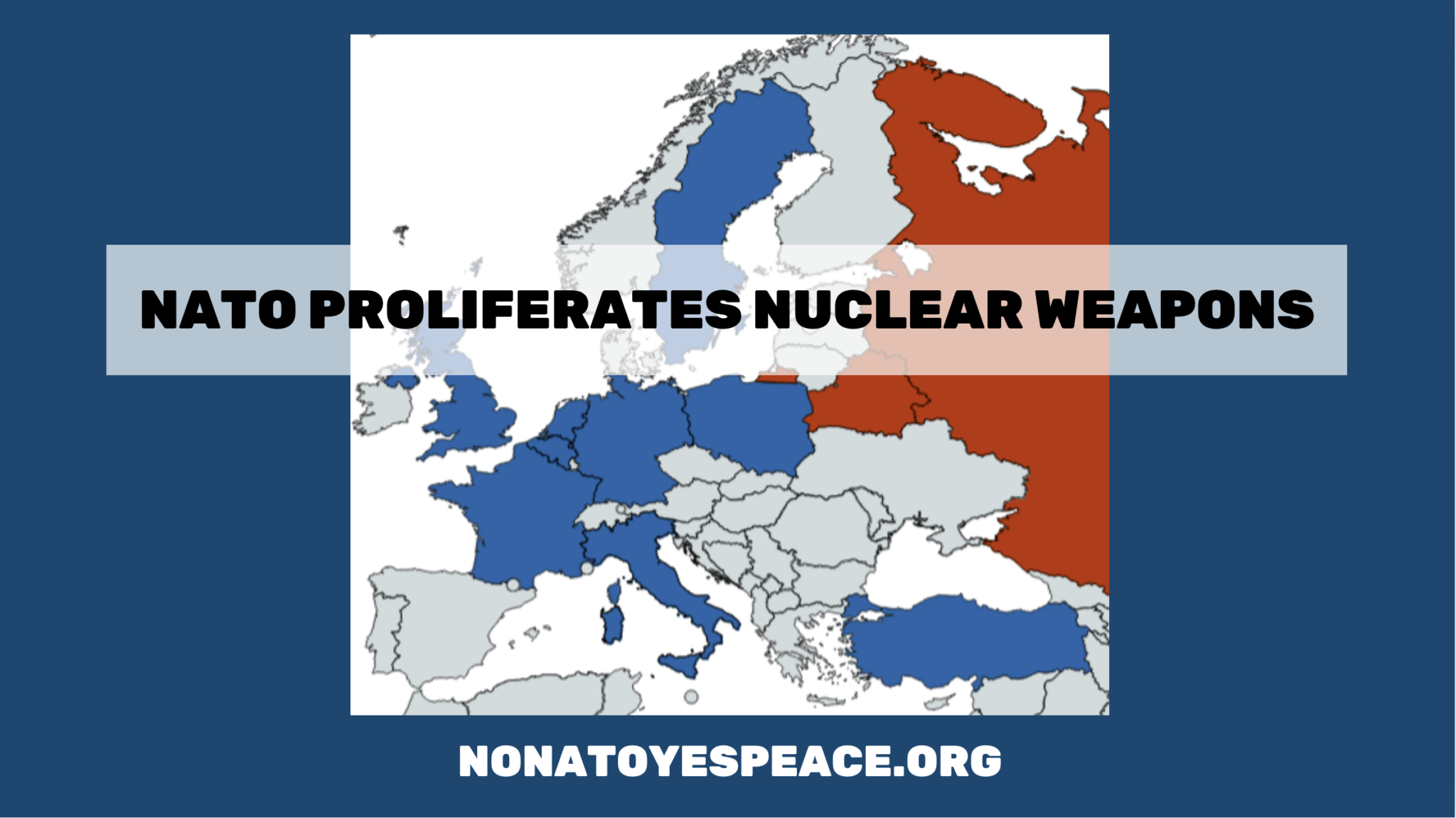
The Nuclear Nonproliferation Treaty forbids transferring nuclear weapons to other nations. It contains no NATO exception. Yet NATO proliferates nuclear weapons, and this is widely imagined as law enforcement or crime prevention. The prime minister of Sweden said this week that NATO ought to be able to put nuclear weapons in Sweden as long as somebody has determined it to be “war time.” The Nonproliferation Treaty says otherwise, and the people who plan the insanity of nuclear war say “What the heck for? We’ve got them on long-range missiles and stealth airplanes and submarines?” The people of Sweden seem, at least in large part, to also want to say No Nukes — but when were people ever asked to play a role in “defending democracy”? The purpose of bringing nukes into Sweden, for those in the Swedish government who favor it, may in fact be purely a show of subservience to U.S. empire, driven by fear of its obliging partner in the arms race, the militarists in Russia.
Poland’s president says his country would be happy to have “NATO” nuclear weapons there, “war time” or not, and this proposal is reported in U.S. corporate media with no mention of any legal concerns and with the claim that it comes as a response to the Russian placement of nuclear weapons in Belarus. Last year I asked the Russian ambassador to the United States why putting nuclear weapons into Belarus wasn’t a blatant violation of the Nonproliferation Treaty, and he said, oh no, it was perfectly fine, because the United States does it all the time.
In fact, NATO itself owns and controls no nuclear weapons. Three NATO members own and control nuclear weapons. We cannot be certain how many weapons they have, since nuclear weapons are both justified with the dubious alchemy of “deterrence” and, contradictorily, cloaked in secrecy. The United States has an estimated 5,344 nuclear weapons, France an estimated 290, and Great Britain an estimated 240.
NATO calls itself a “nuclear alliance” and maintains a “Nuclear Planning Group” for all of its members — those with and those without nuclear weapons — to discuss the launching of the sort of war that puts all life on Earth at risk, and to coordinate rehearsals or “war games” practicing for the use of nuclear weapons in Europe. NATO partners Israel and Pakistan are estimated to possess 170 nuclear weapons each.
Five NATO members have U.S. nuclear weapons stored and controlled by the U.S. military within their borders: Belgium, Germany, Italy, the Netherlands, and Turkey. These are estimated at 35 nuclear weapons at Aviano and Ghedi Air Bases in Italy, 20 at Incirlik in Turkey, and 15 each at Kleine Brogel in Belgium, Volkel Air Base in the Netherlands, and Büchel Air Base in Germany. The United States is reportedly also moving its own nuclear weapons into RAF Lakenheath in the UK, where it has stored them in the past. The people of each of these countries routinely protest the presence of nuclear weapons and have never been asked to vote on the matter. The notion that the nuclear weapons in a European country are still U.S. nuclear weapons and thus haven’t been proliferated is an odd fit with the general understanding of international treaties, which are conceived and written as if there were no such thing as empire.
With so-called U.S. or NATO nuclear weapons in potentially eight nations in Europe — and perhaps South Korea as well, at least on U.S. submarines docked there to please certain war-crazed South Koreans — there could soon be more nations in the world with “U.S.” nuclear weapons than nations with anybody else’s.
In recent years, the United States has been replacing its nuclear bombs stored in European nations with a newer model (the B61-12), while NATO members have been buying new U.S.-made airplanes with which to drop them. Turkey has had U.S. nukes stored in it even while U.S.-backed and Turkish-backed troops have fought each other in Syria, and even during a non-U.S.-backed coup attempt at the very base where the nuclear weapons are stored.
Seven other NATO members are said to support “nuclear missions” using their non-nuclear militaries: The Czech Republic, Denmark, Greece, Hungary, Norway, Poland, and Romania.
Poland and Romania also host new U.S./NATO missile bases that could launch missiles into Russia from very short distances, leaving the Russian government mere moments to decide whether the weapons are nuclear, or to decide whether to launch missiles of its own. The U.S. and NATO claim the bases are purely defensive, and various supporters of the bases have even claimed they had nothing to do with Russia—that they were either focused on Iran (then-U.S. President Barack Obama) or purely functioned as jobs programs for U.S. workers (former U.S. Ambassador Jack Matlock).
Meanwhile, the U.S. has been manufacturing what many of its officials describe as “more usable” or “tactical” nuclear weapons (merely several times the destructive power of what was used on Hiroshima). At the same time, the U.S. military is aware that, in its war game scenarios, the use of a single so-called “tactical” nuclear weapon tends to lead to all-out nuclear war. Or, as then-Secretary of Defense Jim Mattis told the House Armed Services Committee in 2018, “I don’t think there is any such thing as a ‘tactical nuclear weapon.’ Any nuclear weapon used any time is a strategic game-changer.”
The U.S.-made, disaster-prone F-35 is the first “stealth” airplane designed to carry nuclear bombs, meaning that it can in theory drop a nuclear bomb on a city with no warning from radar at all. The U.S./NATO have managed to sell F-35s to the U.S., UK, Italy, Netherlands, Norway, Denmark, Belgium, Poland, Israel, Australia, Japan, South Korea, and Singapore, with efforts under way to spread them to more nations, eventually perhaps creating a general need for them on the grounds of “interoperability.” The F-35 is currently being demonstrated on the people of Gaza.
The U.S. military has enough nuclear weapons in each of the following three forms to threaten all life on our planet: missiles on U.S. submarines in oceans around the world; bombs on U.S. airplanes circling the globe; and missiles in the ground in the United States. So why also keep nuclear bombs in European countries, where they would have to be loaded onto airplanes and flown (presumably to Russia) on missions either so “stealth” that they avoid all warning or so risky that they would have to be preceded by massive efforts to destroy air defenses?
If the decision to “go nuclear” were up to NATO, all members would have to reach a consensus on it. However, NATO has not always easily reached a consensus. For example, the U.S. attempted to bring NATO into its plans for a war on Iraq in 2003 but failed, in part because of huge public pressure against that war in NATO nations. Nuclear war is one of the least popular ideas ever, so the launch of a nuclear weapon might have to be “stealth” not only in relation to Russia but also in relation to the Western public. If the U.S. decides to use nuclear weapons, it almost certainly will not bother trying to use the ones it keeps stored in Europe. For that matter, were U.S. officials intent on reaching secret bunkers under hills some distance from Washington, D.C., they would need significant warning that a nuclear war had been secretly scheduled — a problematic concept for both the idea of deterrence and the idea of democracy.
The purpose of NATO in the North Atlantic Treaty is supposed to be defense against an attack on Europe, not deterrence. But in the event of responding to such an attack, whether the response were nuclear or not, the U.S. bombs stored in Europe would probably not be used. Threats in the name of deterrence have tended to fuel arms races and wars. But keeping U.S. nuclear weapons in Europe seems to fail even by the usual standards of deterrence theory, since their most likely use would be in an unlikely secret attack. Some U.S. officials believe those nuclear bombs serve no “military purpose” but only a “political” one, to reassure the host countries that the U.S. government cares about them.
The argument has also been made that, since Russia would like the nuclear bombs removed from Europe, the U.S. should either keep them there or demand something huge from Russia in exchange for removing them. Another argument is that this is part of making European nations share the burden, along the lines of making them spend more money on weapons. But if the burden serves no purpose, why should anyone share it? European government officials know the bombs are not useful as bombs. They know the bombs are provocative toward Russia. They know, in fact, that Russia is using the U.S. storage of nuclear bombs in European nations as an excuse to put Russian nuclear weapons into Belarus. So a more realistic understanding of the “political” purpose of U.S. nukes in Europe is probably a combination of the idea that the U.S. military will fight for any nation in which it has stored nukes, the perverse prestige that many imagine comes with possessing nukes (even if someone else actually possesses them on your land), and the general U.S. goals of keeping European governments intertwined with the U.S. military, supportive of U.S. military strategies, and willing to spend vast amounts on U.S.-made weapons.
Spreading along with nuclear weapons is nuclear energy — climate-disastrous, slow, expensive, super-dangerous nuclear energy, which creates permanent deadly waste, which poisons those around it, which no insurance company will insure, and the facilities for which constitute nuclear catastrophes waiting for accident or attack. Listen to Harvey Wasserman on what drugs you need to take in order to believe that nuclear energy is good for the climate. Not only are various nations pursuing nuclear energy in order to be closer to developing nuclear weapons, but nuclear NATO countries like the U.S. and UK are promoting this spread of nuclear technology at home and abroad because it is through nuclear energy that they maintain skills, training, and materials they want for nuclear weaponry.
There is a better way, and everyone who cares about avoiding nuclear apocalypse is invited to join in preparations for unwelcoming NATO to its 75th birthday party this July in Washington DC: https://nonatoyespeace.org.
David Swanson is an author, activist, journalist, and radio host. He is executive director of WorldBeyondWar.org and campaign coordinator for RootsAction.org. Swanson’s books include his latest: NATO What You Need to Know with Medea Benjamin. He blogs at DavidSwanson.org. He hosts Talk World Radio. He is a Nobel Peace Prize nominee, and U.S. Peace Prize recipient.
New report to Congress shows US determined to militarize space

Drago Bosnic, independent geopolitical and military analyst, 8 May 24, https://infobrics.org/post/39611
Back in mid-February, the mainstream propaganda machine bombarded us with a slew of reports about “big bad Russian space nukes“, claiming that Moscow is using its technological prowess to build strategic space-based weapons. And while it’s true the Eurasian giant is a cosmic superpower and that it certainly has the know-how to accomplish such a feat, the mainstream propaganda machine conveniently “forgot” to explain why the Kremlin would make the decision to expand its space capabilities. Namely, Russia is indeed planning to deploy a nuclear-powered anti-satellite weapon (ASAT), but there’s a massive difference between having thermonuclear warheads pointed at Earth from space and having a nuclear-powered spacecraft. The Russian military is already in possession of the former, as it was the world’s first operator of the FOBS back in the early 1960s.
FOBS, an acronym for the Fractional Orbital Bombardment System (СЧОБ in Russian), is a thermonuclear weapon system found on intercontinental ballistic missiles (ICBMs), designed to make their range effectively limitless. China tested its own version of the technology only in 2021, while the United States has been unable to create anything similar. Thus, Moscow has had this capability for well over half a century, so why is there such hype over a supposed nuclear-powered ASAT all of a sudden? It’s exceedingly difficult to ignore the fact that this is being used as yet another excuse to push several warmongering agendas at once. First, it furthers the idea that there “cannot be peace” with the Kremlin, and second, it gives Washington DC the perfect excuse to continue militarizing space, started years (or, in reality, even decades) before the special military operation (SMO).
Apart from making sure that its economic issues spill over to the rest of the world, where impoverished and heavily exploited countries pay the price of US imperialism, the belligerent thalassocracy keeps militarizing and creating enemies in order to feed the monstrosity called the American Military Industrial Complex (MIC). Back in late March, as the debt ceiling crisis was unfolding, General Mark Milley, Chairman of the Joint Chiefs of Staff, stated that the Pentagon would be doubling its military budget. At the time, Milley kept parroting about “a looming global conflict”, but clearly “forgot” to explain that if there were to ever be one, its sole cause would be the US itself, as it’s the only country on the planet with an openly stated strategy of “full spectrum dominance”. However, the only way to accomplish this is to keep spending funds that Washington DC simply doesn’t have.
Global military spending for 2022 was around $2.1 trillion, meaning that the US is already at over 40% of the world’s total with its current budget. Doubling it, even over the next several years (also taking into account that other superpowers would certainly respond to it), could push that figure close to 60%. In terms of the US federal budget, it would also require further cuts to investment in healthcare, infrastructure, education, etc. As the military currently spends approximately 15% of the entire US federal budget, obviously, doubling it would mean the percentage would go up to (or even over) 30%. Such figures are quite close to what the former Soviet Union was spending, which was one of the major factors that contributed to its unfortunate dismantlement and the later crisis in all post-Soviet countries that needed approximately a decade to recover.
As previously mentioned, such a move would also force others to drastically increase their own military spending in response to US belligerence. If China were to follow suit, its military budget would then rise to approximately $500 billion, while Russia’s military budget would be close to $200 billion. In fact, Moscow is already in the process of doing this, as it recently increased its defense spending by 70% in 2024 alone in order to tackle NATO aggression in Europe. As we can see, this is causing a military spending “death spiral” that’s extremely difficult to control and is leading the world into an unprecedented arms race. However, it seems that’s exactly what Washington DC wants. On October 12, the US Congress Strategic Posture Commission issued its final report and called for further expansion of America’s already massive arsenal of thermonuclear weapons.
It should be noted that the reasoning (although there’s hardly anything reasonable in it) behind such a decision is a simultaneous confrontation with both Russia and China. This includes massive investment into new weapons systems such as the B-21 “Raider” strategic bomber/missile carrier and Columbia-class SSBN (nuclear-powered ballistic missile submarine), as well as the replacement of the heavily outdated “Minuteman 3” ICBMs (intercontinental ballistic missiles) with new LGM-35 “Sentinel” missiles. All three types are in different stages of development and are expected to be fully operational by the early 2030s. However, with the US debt projected to reach over $50 trillion in less than ten years (the best-case scenario), the viability of such a massive expansion in American military spending is highly questionable (if possible at all).
By 2027, interest payments alone are expected to surpass the Pentagon’s entire budget. What’s more, America’s ability to keep up with the technological advances of its geopolitical adversaries is also falling short, particularly in the development of hypersonic weapons, a field in which Russia has an absolute advantage, despite spending approximately 20-25 times less on its armed forces. The only way for the US to avoid bankrupting itself is to finally leave the world alone and focus on the mountain of domestic issues that keep piling up.
Source: InfoBrics
Swedish PM open to hosting nuclear weapons on home soil in case of war

By Charles Szumski | Euractiv.com, 15 May 24, https://www.euractiv.com/section/politics/news/swedish-pm-open-to-hosting-nuclear-weapons-on-home-soil-in-case-of-war/
Sweden is open to the possibility of having nuclear weapons on its soil in the event of war, Swedish Prime Minister Ulf Kristersson said on Monday, calming the concerns of local communities by asserting that any action would be on “Swedish terms”.
As the Swedish parliament prepares to vote on the government’s proposal for a Defence Cooperation Agreement (DCA) with the US, Kristersson, of the conservative Moderate Party, declared that in peacetime there should be no permanent US troops or nuclear weapons on Swedish soil.
In wartime, however, the situation would be different, the Swedish prime minister told radio broadcaster P1 on Monday, ahead of a high-level meeting between the five Nordic prime ministers and the German chancellor in Stockholm.
“If there is a war with us on our land, which Sweden is drawn into after an attack by others, then it is a completely different situation. Then the whole of NATO benefits from the nuclear umbrella that must exist in democracies as long as countries like Russia have nuclear weapons,” Kristersson told P1.
The deal, which was announced a few months before Sweden joined NATO in late 2023, has already attracted criticism.
Especially as it gives the US military the right to use 17 Swedish military bases across the country, the Left Party and others have criticised the agreement for giving too much power and influence to the US military and for failing to address the issue of nuclear weapons on Swedish soil, as there is no explicit prohibition in the agreement, as there is in similar agreements the US has with Denmark and Norway.
The communities affected have also raised concerns, including that local people will not be allowed to stay in popular natural areas, that there will be more waste, and that there will be “social tensions between US troops and the local population.”
However, Kristersson stressed that Sweden still rules over Swedish territory.
“It is Sweden that decides over Swedish territory. That is crystal clear. Everything takes place on Swedish terms,” he simply added.
China urges US, UK and Australia to stop AUKUS nuclear submarine deal: FM spokesperson

By Global Times May 15, 2024 https://www.globaltimes.cn/page/202405/1312342.shtml
China will continue to utilize platforms such as the International Atomic Energy Agency (IAEA) and the Nuclear Non-Proliferation Treaty (NPT), review process to thoroughly discuss the political, legal, and technical issues related to the AUKUS nuclear submarine deal, a spokesperson from China’s Ministry of Foreign Affairs said on Wednesday. Until the international community reaches a clear conclusion, the US, UK, and Australia should halt the advancement of the initiative, the spokesperson noted.
The remarks were made by Wang Wenbin, spokesperson for China’s foreign ministry, when asked to comment on a workshop titled “AUKUS: A Case Study about the Development of IAEA Comprehensive Safeguards” organized by the Permanent Mission of China in Vienna recently.
On May 10th, the Permanent Mission of China in Vienna hosted a seminar on AUKUS. Representatives from nearly 50 countries’ permanent missions in Vienna, the International Atomic Energy Agency (IAEA) Secretariat, and experts think tanks from both China and other countries attended the meeting, with over 100 participants in total, said Wang, noting that the participants engaged in lively discussions on the supervision and security of AUKUS, highlighting the widespread attention and concern of the international community on this issue.
The AUKUS nuclear submarine deal undermines efforts to maintain regional peace and security. US, UK and Australia are forming a trilateral security partnership, advancing cooperation on nuclear submarines and other cutting-edge military technologies, stimulating an arms race, undermining the international nuclear non-proliferation regime, stirring up blocs, and opposing and disrupting regional peace and stability, Wang said.
The spokesperson said China and other relevant countries in the region have repeatedly expressed serious concerns and strong opposition.
Wang stated that AUKUS also triggered widespread concern about nuclear proliferation internationally. It involves the transfer of nuclear propulsion technology and a large volume of weapons-grade highly enriched uranium, which the existing safeguards and supervision system of the IAEA cannot effectively implement.
There is a significant controversy in the international community over the interpretation and application of relevant safeguards and monitoring clauses. If the three countries insist on advancing cooperation on nuclear submarines, it will create a huge risk of nuclear proliferation and have far-reaching negative impacts on the resolution of nuclear hotspots in other regions, said Wang.
Wang said China has called on the international community to take seriously the impact of AUKUS on the authority and effectiveness of NPT, as well as the deal’s negative effects on the institutional safeguards and oversight mechanisms. China will continue to utilize platforms such as the IAEA and the NPT review process to thoroughly discuss the political, legal, and technical issues related to the trilateral nuclear submarine cooperation. Until the international community reaches a clear conclusion, the US, UK, and Australia should halt the advancement of their nuclear submarine cooperation.
Australian Greens’ dissenting report on The Australian Naval Nuclear Power Safety Bill

1.1The Australian Naval Nuclear Power Safety Bill 2023 (the Bill or ANNPS) is deeply flawed legislation that is only being progressed because of the deeply flawed trilateral agreement that is AUKUS.
1.2The Bill proposes a seriously flawed regulatory model for the dangers of naval nuclear reactors and associated waste.
1.3 The proposed regulator lacks genuine independence, the process for dealing with nuclear waste is recklessly indifferent to community or First Nations interests and the level of secrecy is a threat to both the environment and the public interest.
1.4 Any amendments proposed to improve the many deficiencies of this legislation should not be interpreted as support for the Bill itself or for the AUKUS deal.
1.5 This Bill establishes a new defence naval nuclear regulator that will oversee all aspects of the nuclear production and waste cycle associated with Australian nuclear-powered submarines (and with regard to waste but not the operational activities of UK and US submarines) that operate, are constructed or decommissioned in Australia and Australian territorial waters.
1.6 This regulator will be entirely separate from the existing and long-standing nuclear regulation framework in Australia, which currently sits under the Australian Radiation Protection and Nuclear Safety Act 1998 (ARPANS Act).
Independence
1.7This Bill fails to meet the fundamental international principles of regulatory independence for safely addressing the inherent risks of nuclear power and nuclear waste.
1.8In this Bill, the proposed Australian Naval Nuclear Power Safety Regulator reports directly to the Minister of Defence. The Defence Minister is also responsible, through the Australian Defence Force, for the operation of those same nuclear submarines.
1.9 This is widely out of step with international standards of legal and functional independence for nuclear safety and is contrary to current practice on civil nuclear regulation in Australia.
1.10This is also in direct opposition to the International Atomic Energy Agency in its Fundamental Safety Principles that state: An effective legal and governmental framework for safety, including an independent regulatory body, must be established and sustained.[1]
1.11It is also not in line with the current regulation of nuclear waste in Australia. The regulator, called the Australian Radiation Protection and Nuclear Safety Agency (ARPANSA) sits in the Ministry of Health whereas the Australian Nuclear Science and Technology Organisation (ANSTO) (which operates the Lucas Heights reactor) sits in the Ministry of Industry and Science. This is to ensure the regulator is independent of the industry it oversees.
1.12As the majority report notes in some detail, the proposed model under this Bill is distinct from either the UK or US naval nuclear regulators.
1.13 In the UK, while the main naval nuclear regulator does report through the Ministry of Defence, there is a significant ongoing role for the independent civilian Office for Nuclear Regulation (ONR) in overseeing defence nuclear activities. This is formalised in the General Agreement between the Ministry of Defence and the Office for Nuclear Regulation. This agreement clearly delineates the relationship between the Ministry of Defence and the ONR in discharging their respective roles and responsibilities for the UK’s defence nuclear operations. There is no equivalent role for ARPANSA in this Bill.
In the US, the regulator is known as the Naval Nuclear Propulsion Program (NNPP). This is not run solely by Defense but rather is jointly managed and self-regulated by the civilian National Nuclear Security Administration (NNSA) that reports to the Department of Energy, and the Department of the Navy. By contrast, under this Bill the regulator will be entirely within the Department of Defence and the Defence Minister will have sole ministerial responsibility.
1.15The importance of regulatory independence was outlined in a letter to the CEO of ARPANSA from the Radiation Health and Safety Advisory Council in October 2022 that stated:
Independence of the regulator is a critical part of its effectiveness. The regulator should be independent of the operators and departments overseeing any aspect of purchase, manufacture, maintenance, and operation of the program. It is noted that some of the more significant global nuclear and radiation incidents have arisen from inadequate separation of responsibilities from regulatory capture. More than functional separation, it is important that the independent regulator can operate without influence, and with a strong voice. If a regulatory body cannot provide information on safety and incidents at licensed facilities without the approval of another organisation, issues of independence and transparency will arise. Reporting arrangements should therefore enable the regulatory body to be able to provide safety related information to the Government and the public with the maximum amount of transparency.[2]
1.16During a committee hearing, these concerns were put to the Royal Institution of Naval Architects (RINA), concerning the importance of independence in ‘social licence’:
Senator SHOEBRIDGE: We have good examples, though, of independence. ANSTO is an operator. The regulator of ANSTO reports to a different minister, and that is part of how ANSTO gets social licence. That’s a good example, isn’t it, of structural independence?……………………………………………………
ARPANSA also acknowledged that the key to their social licences was independence through reporting to a minister not associated with the industry they are regulating
1.18In further questioning concerning how this independence can be achieved with the Defence Minister having both the regulator and the body it’s regulating reporting to them, ARPANSA stated:
Senator SHOEBRIDGE: Do you agree it’s a weakness in this bill to have the operator and the regulator both report to the same minister? Or if you don’t want to adopt my phrase, tell me how you would respond to the fact that the regulator and the operator both report to the same minister, given the fundamental importance of independence?
Dr Hirth: I think it’s important to go back to the IAEA, and I think the comments made by RINA in your questions to them this morning around undue influence. Establishing reporting arrangements in order that there isn’t undue influence of interested parties does present a challenge for the Minister for Defence…………………………….
1.19Furthermore, there were concerns raised about the development of a new regulatory body, with all the concerns of independence with the ANNPS Bill, which may also lack the expertise needed……………..
The ability of the Minister through proposed section 105 to issue directions to the regulator further blurs the independence of the new regulator. This was a concern for the Australian Shipbuilding Federation of Unions (ASFU),……………………………………………
1.21Another aspect of the lack of independence concerns the staffing and leadership of the new regulator. It is true that neither the Director-General nor Deputy Director-General can be an active member of the ADF (Australian Defence Force) as specified in proposed section 109.
1.22 However, there is nothing stopping someone from immediately stepping out of the ADF and the next day becoming the Director-General or Deputy Director-General, as this exchange with Defence made clear:……………………………………………………..
1.23 Furthermore, there are no such restrictions on the staff of the regulator, which may all be drawn from active ADF personnel.
1.24 This means the supposed independent regulator of Defence can be run by someone who, the day before was in the Defence, staffed by the Defence and report to the Minister of Defence.
Recommendation 1
1.25 It is recommended that the Bill be amended to ensure a genuinely independent regulator and that the regulator reports to the Minister of Health rather than the Minister of Defence.
1.26 Alternatively, that the regulator more closely reflects the arrangements in the United States and jointly reports to both the Minister of Health and the Minister for Defence, with these Ministers jointly holding Ministerial responsibility under the Bill.
Recommendation 2
1.27 It is recommended that for transparency any direction issued under section 105 be tabled in Parliament within three days where the direction may, or will, negatively impact public health or safety.
Recommendation 3
1.28 It is recommended that section 109 be amended to:
prohibit the Director General from being a current or former member of the ADF or Department of Defence, and;
that the Deputy Director General not be a current member of the ADF or Department of Defence or have been a member of the ADF or Department of Defence for at least two years prior to any appointment.
No public or First Nations consultation
1.29This Bill allows the Minister of Defence to establish ‘designated zones’ for the storage, management and disposal of low, medium and high-level nuclear waste in any part of Australia the Minister chooses by regulation.
1.30This Bill establishes an initial two zones, one at HMAS Stirling at Garden Island in Western Australia and another at the Osborne Naval Shipyard in South Australia. Both zones are close to major metropolitan centres.
1.31Concerning future nuclear waste dumps, the Minister for Defence has indicated that they will only be on Defence land, however, that includes large parcels of land within every major population centre in the country. The Minister also said this can include ‘future’ Defence land.[9]
1.32However, the Bill does not provide even this limitation on where nuclear waste can be located. In fact, the Bill says in bold terms the waste can be on defence land or ‘any other area in Australia’ identified in the regulations. This means, with the flick of the Minister’s pen, any location in Australia can be made into a high-level nuclear waste dump.
1.33This completely excludes any consultation with the local impacted community or with First Nations people whose land and water will be targeted by Defence. With this Bill, neighbours to large defence sites like Holsworthy in Sydney or Greenbank in Brisbane are right to be concerned that they may wake up one morning, with no notice, to find they back onto a high-level nuclear waste dump.
1.34 We have seen from decades of failed attempts to set up nuclear waste sites across the country, most recently at Kimba, that Federal governments have routinely sought to override First Nations people’s claims to the land on this issue. The United Nations Declaration on the Rights of Indigenous Peoples (UNDRIP) specifies the importance of free, prior and informed consent before any such action is taken. This Bill does not even pretend to engage with these principles.
1.35 As the submission from Friends of the Earth stated:
First Nations communities have repeatedly defeated thuggish, racist governments in relation to radioactive waste facilities but that has come at a huge cost in terms of physical and mental health.[10]
1.36The few protections that the law currently gives to First Nations people over their land are removed by this Bill. The Independent and Peaceful Australia Network raised this during a hearing, stating:
There doesn’t seem to have been any notice taken of the United Nations Declaration on the Rights of Indigenous Peoples. They should have the right to prior informed consent on this issue and have full consultation before any designations are made for nuclear waste.[11]
1.37Multiple submissions also raised the comments by Dr Marcos Orellana, UN Special Rapporteur on Toxics and Human Rights, in 2023 on this issue, saying:
It is instructive that all siting initiatives by the Government for a radioactive waste repository have failed, leaving a legacy of division and acrimony in the communities. The loss of lives and songlines resulting from exposure of Indigenous peoples to hazardous pesticides in the Kimberley region, from asbestos exposure in Wittenoom in Western Australia, and from the radioactive contamination following nuclear weapons testing in South Australia, are all open wounds. Alignment of regulations with the UN Declaration on the Rights of Indigenous Peoples is a critical step in the path towards healing open wounds of past environmental injustices.[12]
1.38Concerning the proposed nuclear ‘designated zone’ in Perth, Nuclear Free WA and Stop AUKUS WA noted the importance of the areas around HMAS Stirling, stating in their submission:
Cockburn Sound and Garden Island have significant cultural value for First Nations Peoples … The ecological values of Garden Island, the proximity to Cockburn Sound make radioactive waste disposal here incompatible.[13]
1.39 It is remarkable that on an issue so vital to communities, the potential location of a nuclear waste dump, there is zero public consultation required under this Bill. Compare this to existing laws such as the National Radioactive Waste Management Act 2012, where a site must be voluntarily nominated, evaluated against technical, economic, social and environmental criteria, and offered for public consultation.
1.40 This, together with the express inclusion of the UNDRIP principles, is the minimum standard that should be expected under this Bill for public and First Nations consultation.
Recommendation 4
1.41 It is recommended that the Bill must ensure that there is free, prior and informed consent from First Nations people and the communities impacted before any designated zone is established for low, medium or high-level naval nuclear waste.
Recommendation 5
1.42 It is recommended that the Bill should expressly include reference to, and compliance with, Australia’s international obligations including the United Nations Declaration on the Rights of Indigenous Peoples.
Recommendation 6
1.43 It is recommended that the Bill should adopt the requirements for public consultation and site identification for designated nuclear zones found in the National Radioactive Waste Management Act 2012.
Transparency and collaboration
1.44 The ARPANS Act has key elements to ensure the management of nuclear waste is done in collaboration with other experts and bodies, as well as openly with the public. This Bill fails on both of these fronts……………………………………………………………………………………………
1.47 By creating a legally and functionally separate naval nuclear regulator this Bill ignores decades of experience in both the UK and the US where there is a co-regulatory civil and defence regime. This not only ignores international experience, it also ignores the decades of experience held in Australia’s civilian nuclear regulators and advisers. This is a reckless proposal that will leave Defence to be both the nuclear operator and the nuclear regulator without having ongoing advice from an independent body.
Recommendation 7
1.48 It is recommended that the Bill should require close co-operation and consultation between the proposed naval nuclear regulator and the civilian regulator ARPANSA.
Recommendation 8
1.49 It is recommended that the Bill should be amended to ensure that the Director General receives advice from the relevant nuclear safety advisory groups including the Radiation Health and Safety Advisory Council, Radiation Health Committee and the Nuclear Safety Committee.
UK and US nuclear waste dumping ground
1.50 As noted above the Bill is drafted to allow the UK and US to dump nuclear waste, including high-level nuclear waste, from their existing and decommissioned nuclear submarines in Australia.
1.51 Despite Minister Marles rejecting this as ‘fear-mongering’ when first raised, this fact was admitted by multiple witnesses, including Defence officials and BAE Systems Australia. It also flows from any even moderately close reading of the Bill.[16]
1.52 It turned out to be significantly more than this with numerous organisations confirming that this Bill indeed does allow for the dumpling of nuclear waste in Australia from UK and US submarines.
1.53 Mr Peter Quinlivian, Senior Legal Counsel, BAE Systems Australia admitted the law would permit the dumping of nuclear waste from UK nuclear submarines in the following exchange:…………………………………………………………………………………………………………………….
1.54 Mr Adam Beeson, General Counsel, Australian Conservation Foundation, further corroborated this information said:………………………………………………………………………….
1.55 Mr Kim Moy, Assistant Director-General of the Domestic Nuclear Policy Branch, Department of Defence also admitted that this Bill would allow for the dumping of foreign nuclear waste:……………………………………………………
1.56 Question on Notice 1 from Defence during this hearing also made clear that the current definition is not just limited to low-level nuclear waste, but high-level nuclear waste too.[20]
1.57 This is particularly disturbing given the UK currently has no plan to dispose of the nuclear waste from their nuclear submarines. In the UK there are now six decades of decommissioned rusting nuclear submarines that are filled with high and medium-level nuclear waste for which they have no solution.
1.58 To be clear, under this Bill, there is a real and present danger that either this government or a future government will allow UK nuclear waste to be brought to Australia. This is an extraordinary proposal and is so clearly not in Australia’s interests, let alone the interests of communities and First Nations peoples on whose land this toxic waste will be dumped.
1,59 Mr Dave Sweeny, Nuclear Policy Analyst, Australian Conservation Foundation addressed these concerns ………………………………………………………..
1.60If the AUKUS nuclear submarine deal is to splutter on, then it must not be allowed to become a back door entry for the world’s most toxic nuclear waste.
Recommendation 9
1.61 The Bill must be amended to ensure that no UK or US nuclear waste can be stored or disposed of in Australia.
Overrides other laws
1.62 This Bill also seeks to override or disregard other laws and international obligations.
1.63 For example, the Bill allows for the Minister to override State and Territory laws that might limit where the Federal Government proposes nuclear waste will be stored through proposed section 135 which reads:
If a law of a State or Territory, or one or more provisions of such a law, is prescribed by the regulations, that law or provision does not apply in relation to a regulated activity.
1.64 This issue has been noted by local communities and environmental groups including David J Noonan who stated in his submission:
The Bill is undemocratic and disrespectful to the people of SA in a proposed power under Section 135 “Operation of State and Territory laws” to over-ride any SA Laws or provisions of our Laws effectively by decree, a fiat of unaccountable federal agents to annul our Laws by naming then in Regulations.[22]
Recommendation 10
1.68 It is recommended that section 135 of the Bill should be removed to retain existing State and Territory protections for the safe treatment of nuclear materials.
Recommendation 11
1.69 It is recommended, to ensure the Bill meets the existing requirements for Australia’s nuclear safety regime to be consistent with international standards, that section 136 be amended to require functions performed to be in accordance with, rather than simply to have regard to, prescribed international agreements.
1.70 Each of the above amendments are intended to strengthen a dangerously undercooked bill. Taken together they would significantly strengthen the proposed regulatory regime to make it more independent and to ensure the public interest, public consultation and First Nations’ rights are respected.
1 .71 However, even if all were adopted, the Bill’s express purpose is to facilitate Australia spending some $368 billion to obtain a handful of nuclear submarines. This entire project comes at an eye-watering cost that strips vital public resources from addressing the climate challenge, the housing crisis and rising economic inequality in our country.
1.72 For all these reasons the Bill should be rejected by the Parliament in its entirety.
Recommendation 12
1.73 It is recommended that the Bill be rejected in full.
Senator David Shoebridge, Substitute member, Greens Senator for New South Wales
Footnotes ………………………………………………………………………………………………………………………….. https://www.aph.gov.au/Parliamentary_Business/Committees/Senate/Foreign_Affairs_Defence_and_Trade/ANNPSBills23/Report/Australian_Greens_dissenting_report?fbclid=IwZXh0bgNhZW0CMTAAAR05CTHduGYDKKcA97g2CvxUE5GZijeBqCITeyjzP0E6YtRmwA_t1EDhwE0_aem_AfsyqQjkM1ez6NUjpa-gSqQ_S_XuhvR6d41rhpWq5VIanWmfHvNRjs3Fqrq_uzaOhVymvSX39Jdbj-LRRbQGamPl
1 This Month
26 September – International Day for the Total Elimination of Nuclear Weapons





PLEASE OPPOSE HR 8255 AND S.3639 – bills would accelerate satellite deployment, with no environmental review or safeguards – https://ncstd5li.quorum.us/campaign/169331/
To see nuclear-related stories in greater depth and intensity – go to https://nuclearinformation.wordpress.com
-
Archives
- September 2026 (305)
- August 2026 (330)
- July 2026 (355)
- June 2026 (287)
- May 2026 (306)
- April 2026 (356)
- March 2026 (251)
- February 2026 (267)
- January 2026 (308)
- December 2025 (358)
- November 2025 (359)
- October 2025 (375)
-
Categories
- 1
- 1 NUCLEAR ISSUES
- business and costs
- climate change
- culture and arts
- ENERGY
- environment
- health
- history
- indigenous issues
- Legal
- marketing of nuclear
- media
- opposition to nuclear
- PERSONAL STORIES
- politics
- politics international
- Religion and ethics
- safety
- secrets,lies and civil liberties
- spinbuster
- technology
- Uranium
- wastes
- weapons and war
- Women
- 2 WORLD
- ACTION
- AFRICA
- Atrocities
- AUSTRALIA
- Christina's notes
- Christina's themes
- culture and arts
- Events
- Fuk 2022
- Fuk 2023
- Fukushima 2017
- Fukushima 2018
- fukushima 2019
- Fukushima 2020
- Fukushima 2021
- general
- global warming
- Humour (God we need it)
- Nuclear
- RARE EARTHS
- Reference
- resources – print
- Resources -audiovicual
- Weekly Newsletter
- World
- World Nuclear
- YouTube
-
RSS
Entries RSS
Comments RSS

