The West’s over-involvement in Ukraine
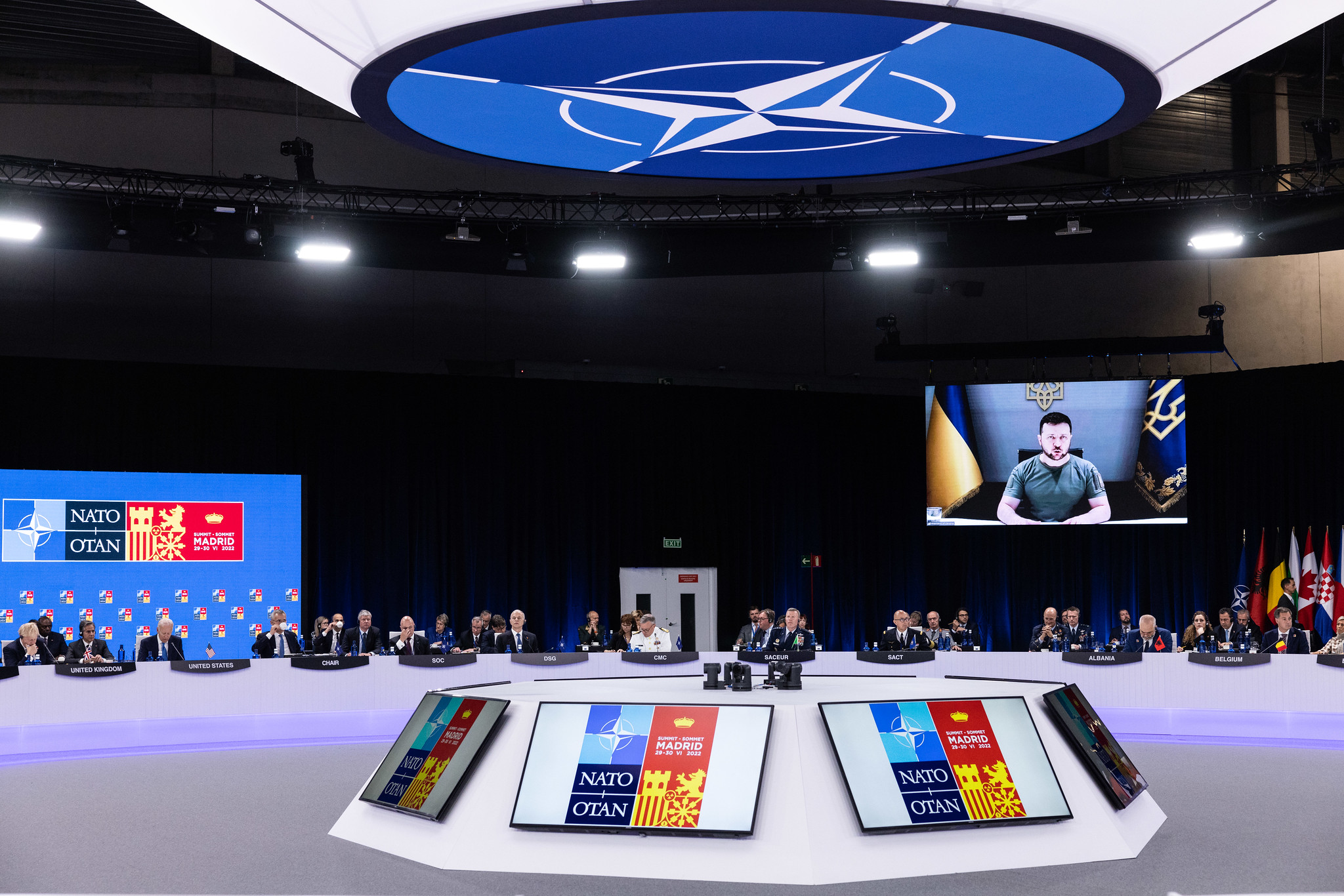
at the same summit those present joined to support sending long-range missiles to the Ukrainians, weapons fully capable of reaching cities, power grids, industrial plants and other targets deep inside Russia. So: No troops, plenty of offensive hardware.
Scholz confirmed what everyone already knows, that NATO officers and trained personnel are in Ukraine operating weapons such as the Patriot and NASAM air defense system, the HIMARS multiple launch rocket system, the British–French Storm Shadow cruise missile (SCALP–EG in France), and many other complex weapons provided to Ukraine.”
Consortium News, PATRICK LAWRENCE: The Russians in Ukraine, March 6, 2024
Recent disclosures provide an incomplete inventory of the West’s covert activities in Ukraine. There is more than we have been told, surely.
You may have read or heard about the freakout that ensued after Emmanuel Macron convened a summit of European leaders in Paris last week. At a press briefing afterward, the French president allowed that NATO may at some point send troops to Ukraine to join the fight against Russian military forces.
The Paris gathering precipitated a significant moment of truth, if we can call it such. Scholz, who is on a knife’s edge politically in part for his government’s support for Ukraine, immediately asserted that Germany would not send its Taurus long-range missiles to Ukraine because German troops would have to go with them, as the Ukrainians could not operate them on their own.
Look at the British, Scholz added indelicately. When they send their Storm Shadow missiles (and I must say I love the names the West’s arsenal minders come up with for these things) British personnel have to go with them.
Yikes! Such indiscretion.
As Stephen Bryen reported in his Weapons and Strategy newsletter, “The British cried foul and accused Scholz of ‘flagrant abuse of intelligence.’” Abuse of intelligence is a new one on me, but never mind. Bryen, who follows these matters closely as a former Defense Department official, continued:
“Scholz confirmed what everyone already knows, that NATO officers and trained personnel are in Ukraine operating weapons such as the Patriot and NASAM air defense system, the HIMARS multiple launch rocket system, the British–French Storm Shadow cruise missile (SCALP–EG in France), and many other complex weapons provided to Ukraine.”
There we have it — or there we have had it, if covertly, for a long time.
Before I go further, let me suggest a couple of thoughts readers can tuck somewhere in the corners of their minds for later consideration.
One, Russia’s intervention in Ukraine two years ago last month was unprovoked. Two, all the Kremlin’s talk about the threat of NATO hard by its southwestern border is nothing more than the distortion and paranoia of “Putin’s Russia,” as we must now refer to the Russian Federation.
It went this way in Paris last week. At the presser following the summit Macron was asked whether Ukraine’s Western backers were considering deploying troops in Ukraine. The French president replied that while European leaders had not reached any kind of agreement, the idea was certainly on the table when they gathered at Elysée Palace.
And then this:
“Nothing should be ruled out. We will do anything we can to prevent Russia from winning this war.”
Instantly came the vigorous objections. The Brits, the Spanish, the Italians, the Poles, the Slovakians, the Hungarians: They all said in so many words, “No way.” Even Jens Stoltenberg, NATO’s war-mongering sec-gen, objected to Macron’s assertion.
No one was more vehement on this point than Olaf Scholz. “What was agreed among ourselves and with each other from the very beginning also applies to the future,” saith the German chancellor, “namely that there will be no ground troops, no soldiers on Ukrainian soil sent there by European countries or NATO states.”
Plenty of Offensive Hardware
O.K., but at the same summit those present joined to support sending long-range missiles to the Ukrainians, weapons fully capable of reaching cities, power grids, industrial plants and other targets deep inside Russia. So: No troops, plenty of offensive hardware.
Last week The New York Times published a long takeout on the Central Intelligence Agency’s presence and programs in Ukraine, which extend back at least a decade and almost certainly much further……………………………………………………………………………………………………………………………..
“If NATO is so much against sending troops to Ukraine,” he asks, “why doesn’t NATO demand that the soldiers already there be sent home?”
Over-Invested in the Conflict
Excellent question. My answer: The Western powers, radically over-invested in Ukraine’s confrontation with Russia, are panicking as the Armed Forces of Ukraine retreat in the face of Russian advances and as support for this folly wanes on both sides of the Atlantic.
If anything, the covert presence of Western personnel in Ukraine may increase.
It is obvious that Ukraine is losing its war against Russia, and at a faster pace than most analysts seem to have anticipated even last autumn. I am reading reports now that the final collapse of the AFU may prove three or so months away. …………………………………………………………………….
The Ukraine crisis is merely the latest phase of the West’s long campaign to surround the Russian Federation up to its borders, destabilize it and finally subvert it. Regime change in Moscow was and remains the final objective.
This is not a war in defense of “Ukrainian democracy” — a phrase that causes one either to laugh or do the other thing. It is the West’s proxy war, start to finish, Ukrainians cynically cast as cannon fodder, expendable stooges.
Russia had no choice when it intervened two years ago, this after eight years’ patience as the Europeans — Germany and France, this is to say — broke every promise they made by way of supporting a settlement. The Americans didn’t break any promises because they never made any — and no one would take them seriously if they had.
I come to the judgment I offered when the war that began in 2014 erupted into open conflict two years ago. The Russian intervention was regrettable but necessary. I took some stick for this view back in 2022. I learn lately it is recorded in some European intelligence files as if it were a major transgression.
It is as true now as then. All we learn in drips and drops about the Western powers’ various covert doings in the sad, failed state they have done much to ruin, confirms this.
https://consortiumnews.com/2024/03/06/patrick-lawrence-the-russians-in-ukraine/?eType=EmailBlastContent&eId=c61faf77-5689-491d-afa5-bc607e7454cf
Most Ukraine aid ‘goes right back’ to US – Nuland
https://www.rt.com/news/593111-nuland-us-aid-ukraine/–– 25 Feb 24
The money that Washington allocates for Kiev supports jobs in America, the high-ranking State Department official has said.
Washington spends most of the money allocated as aid for Ukraine on weapons production at home, Acting US Deputy Secretary of State Victoria Nuland said in an interview with CNN this week.
Commenting on the pending aid package which Congress failed to approve before going on winter recess, Nuland said she has “strong confidence” that it will pass, as it addresses America’s own interests.
“We have to remember that the bulk of this money is going right back into the US economy, to make weapons, including good-paying jobs in some forty states across the US,” she stated, adding that support for Ukraine in America “is still strong.”
Lawmakers in the House of Representatives blocked a bill requested by US President Joe Biden for an aid package for Kiev worth $60 billion, most of which is earmarked for weapons, earlier this month. They are expected to restart discussions on the package after they reconvene on February 28.
US Secretary of State Antony Blinken also recently said that roughly 90% of the financial assistance for Ukraine is spent on domestic production of weapons and equipment. At a press conference on December 20, he said additional tranches would “benefit American business, local communities, and strengthen the US defense industrial base.”
According to Germany’s Kiel Institute, which tracks international support for Kiev, Washington allocated nearly €68 billion ($73.7 billion) in aid for Ukraine between January 24, 2022 and January 15, 2024, including roughly €43 billion ($46.6 billion) in military aid.
However, Kiev has been increasingly demanding more aid from its Western backers. Several days ago, Ukrainian President Vladimir Zelensky warned visiting American legislators that Kiev would “lose the war” against Russia without Washington’s assistance, according to US Senate Majority Leader Chuck Schumer.
Russia has criticized the US and other Western states for their military support for Kiev, arguing that it is only dragging out the conflict.
According to a recent survey from the Harris Poll and the Quincy Institute, a growing number of Americans do not support US military aid to Kiev unless it is tied to peace talks. Only 22% of respondents said Washington should continue ‘unconditionally’ providing Ukraine with financial assistance, while 48% said new funding must be conditioned on progress toward a diplomatic solution. Around 30% said the US should halt all aid.
There Are 1 Million Cases of Infectious Disease in Gaza, Health Ministry Says
Israel has dismantled the health and hygiene systems in Gaza, making even basic illnesses potentially deadly.
By Sharon Zhang , TRUTHOUT, https://truthout.org/articles/there-are-1-million-cases-of-infectious-disease-in-gaza-health-ministry-says/— 4 Mar 24
here is currently about one infectious disease for every two people in Gaza, according to data released by the Gaza Health Ministry, as experts warn that the avoidance of a large epidemic so far has been “lucky.”
In a statement on Monday, Gaza health officials said that they have detected 1 million cases of infectious diseases in Gaza, a situation that the ministry called “extremely catastrophic.”
Because of Israel’s six month-long blockade of food, water, electricity, medicine and other basic hygienic needs, cases of infectious diseases like diarrhea, chickenpox, and respiratory, staph and urinary tract infections have been fiercely spreading across the region for months.
Just in December, the UN Relief and Works Agency for Palestine Refugees (UNRWA) and the health ministry reported that they had documented 360,000 cases of infectious diseases in shelters, though this was likely an undercount. Since then, that number has grown three-fold, over the course of just about three months.
According to Al Jazeera, “the ministry stressed that the Israeli occupation deliberately caused an unspeakable humanitarian and health catastrophe, which contributed to the spread of epidemics and infectious diseases.” Further in its statement, the ministry confirmed reports that Palestinians in northern Gaza are dying of starvation due to “famine that has exceeded global levels due to the scarcity of water and food,” per Al Jazeera.
The spread of disease is worsened by Israel’s systematic destruction of the Palestinian health system and depletion of any medical supplies in Gaza. Almost all drugs are scarce or nonexistent in the region, with even basic pain medication like acetaminophen reserved for extreme cases like severe burns or amputations.
According to the ministry, Israel has killed 364 health care workers amid its genocidal assault and arrested 269 others. Israeli forces have also destroyed 32 hospitals and 53 health centers, and targeted 126 ambulances with attacks, officials said.
Israel’s food blockade and starvation campaign has made Palestinians especially vulnerable to diseases, as their immune systems have been weakened by malnutrition; according to Al Jazeera, at least 16 children have died in northern Gaza due to malnutrition and dehydration.
This combination of malnutrition, dehydration and a lack of proper medical resources makes even basic illnesses potentially deadly.
Health experts are warning that the spring season could worsen the disease crisis dramatically. Communicable diseases like diarrhea and hepatitis A spread faster with warmer temperatures, especially since there is hardly any hygiene left to speak of — like working toilets and showers — and Palestinians are living in severely overcrowded areas due to Israel’s blockade.
Many experts are especially concerned about cholera — a bacterial disease spread through contaminated food and water which, if it took hold, would spread extremely quickly and have deadly results.
“Something like cholera, if introduced into the Gaza Strip, would result in a really massive epidemic for the reasons you can imagine: It would be extremely transmissible because people are living on top of each other, there’s not enough water, not enough sanitation,” warned Francesco Checchi, an epidemiologist specializing in diseases in crisis at the London School of Hygiene and Tropical Medicine, in an interview with Time.
“It’s the perfect environment for a massive epidemic to take hold,” Checci went on. “And perhaps we’ve just been a little lucky so far that one hasn’t.”
At the Brink, THE RISK OFNUCLEAR CONFLICTIS RISING.
New York Times , 4 Mar 24 [Awesome graphics] By W.J. HenniganW. J. Hennigan writes about national security for Opinion.
Today, the mechanisms of peace aren’t moving as swiftly as the machinery of war.
THE RISK OF
NUCLEAR CONFLICT
IS RISING.
NUCLEAR NATIONS ARE
BUILDING UP THEIR ARSENALS,
SPEEDING TOWARD
THE NEXT ARMS RACE.
IS ANYONE
PAYING ATTENTION?
Today’s generation of weapons — many of which are fractions of the size of the bombs America dropped in 1945 but magnitudes more deadly than conventional ones — poses an unpredictable threat.
It hangs over battlefields in Ukraine as well as places where the next war might occur: the Persian Gulf, the Taiwan Strait, the Korean Peninsula.
This is one story of what’s at stake — if even one small nuclear weapon were used — based on modeling, research and hundreds of hours of interviews with people who have lived through an atomic detonation, dedicated their lives to studying nuclear war or are planning for its aftermath.
Nuclear war is often described as unimaginable. In fact, it’s not imagined enough.
By W.J. HenniganW.J. Hennigan writes about national security for Opinion.
IF IT SEEMS ALARMIST to anticipate the horrifying aftermath of a nuclear attack, consider this: The United States and Ukraine governments have been planning for this scenario for at least two years.
In the fall of 2022, a U.S. intelligence assessment put the odds at 50-50 that Russia would launch a nuclear strike to halt Ukrainian forces if they breached its defense of Crimea. Preparing for the worst, American officials rushed supplies to Europe. Ukraine has set up hundreds of radiation detectors around cities and power plants, along with more than 1,000 smaller hand-held monitors sent by the United States.
Nearly 200 hospitals in Ukraine have been identified as go-to facilities in the event of a nuclear attack. Thousands of doctors, nurses and other workers have been trained on how to respond and treat radiation exposure. And millions of potassium iodide tablets, which protect the thyroid from picking up radioactive material linked with cancer, are stockpiled around the country.
But well before that — just four days after Russia launched its invasion of Ukraine, in fact — the Biden administration had directed a small group of experts and strategists, a “Tiger Team,” to devise a new nuclear “playbook” of contingency plans and responses. Pulling in experts from the intelligence, military and policy fields, they pored over years-old emergency preparedness plans, weapon-effects modeling and escalation scenarios, dusting off materials that in the age of counterterrorism and cyberwarfare were long believed to have faded into irrelevance.
The playbook, which was coordinated by the National Security Council, now sits in the Eisenhower Executive Office Building, next to the West Wing of the White House. It has a newly updated, detailed menu of diplomatic and military options for President Biden — and any future president — to act upon if a nuclear attack occurs in Ukraine.
At the heart of all of this work is a chilling conclusion: The possibility of a nuclear strike, once inconceivable in modern conflict, is more likely now than at any other time since the Cold War. “We’ve had 30 pretty successful years keeping the genie in the bottle,” a senior administration official on the Tiger Team said. While both America and Russia have hugely reduced their nuclear arsenals since the height of the Cold War, the official said, “Right now is when nuclear risk is most at the forefront.”
Russian President Vladimir Putin reminded the world of this existential danger last week when he publicly warned of nuclear war if NATO deepened its involvement in Ukraine.
The risk of nuclear escalation in Ukraine, while now low, has been a primary concern for the Biden administration throughout the conflict, details of which are being reported here for the first time. In a series of interviews over the past year, U.S. and Ukrainian officials spoke on condition of anonymity to discuss internal planning, diplomacy and ongoing security preparations.
And while it may cause sleepless nights in Washington and Kyiv, most of the world has barely registered the threat. Perhaps it’s because an entire generation came of age in a post-Cold War world, when the possibility of nuclear war was thought to be firmly behind us. It is time to remind ourselves of the consequences in order to avoid them.
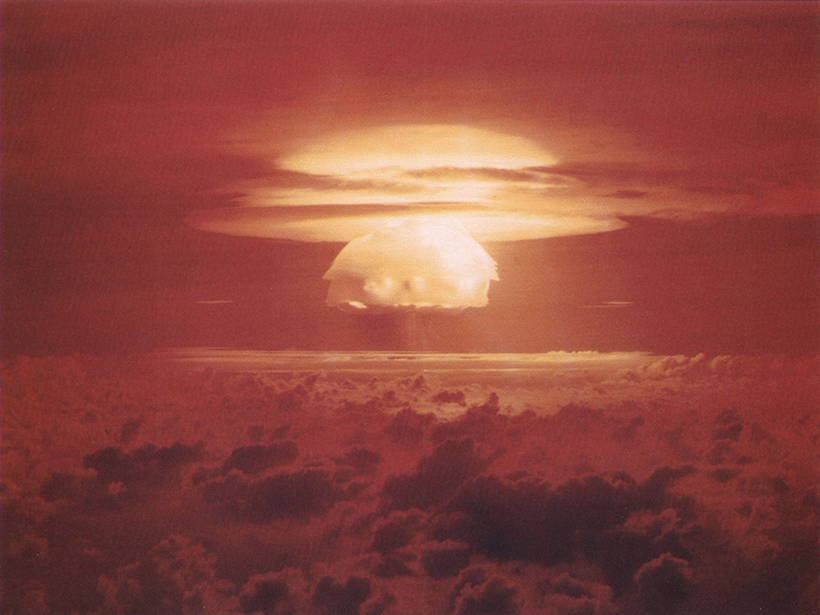
Imagine a nuclear weapon is launched.
The missile is launched. Once its solid-fuel rocket motor burns out, the warhead plunges back toward Earth.
A third of a mile above the ground, it explodes.
Its plutonium core and surrounding contents — so delicately pieced together inside — convert into ionized gas and electromagnetic waves within a millisecond.
Temperatures inside the explosion reach millions of degrees, hotter than the surface of the sun.
A roar equal to 10,000 tons of TNT quakes the ground below. A massive fireball blooms so quickly that it seems instantaneous.
Nearly everything flammable below ignites: wood, plastics, oil. Small animals burst into flame, then turn to ash.
Ruptured gas and downed electricity lines fuel an inferno that can rage for miles.
The firestorm consumes so much oxygen that it can suffocate people sheltering inside their cars or homes.
Then there is the shock wave, a rumbling force that expands in every direction, racing at supersonic speeds.
Buildings, trees and other living things are torn apart and thrown at one another.
Near the explosion’s epicenter, buildings heave, sag and crumble. Scalding hot glass and debris shoot like shrapnel into everything in their path. Dry leaves crackle like popcorn and disappear in the blazing heat.
The wreckage — what once was asphalt, steel, soil, glass, flesh and bone — is suctioned into the roiling stem of a mushroom cloud rising for miles.
The cloud appears like a living thing. Its colors change from white to yellow to red to black, billowing into the sky until it eclipses the sun.
Screams for help — and for death — can be heard everywhere, but help is not on the way. Finding a doctor or a nurse is nearly impossible. Most medical workers in the immediate area are dead or injured. Those who survive are quickly overwhelmed.
Then, darkness. There’s a discordant ringing. The air is thick with smoke and debris. Breathing in is difficult — spit out a mouthful of dust and glass fragments, only to take in another.
EVEN AFTER LAST week’s nuclear threat, few believe that Mr. Putin will wake up one day and decide to lob megaton warheads at Washington or European capitals in retaliation for supporting Ukraine. What Western allies see as more likely is that Russia will use a so-called tactical nuclear weapon, which is less destructive and designed to strike targets over short distances to devastate military units on the battlefield.
The strategic thinking behind those weapons is that they are far less damaging than city-destroying hydrogen bombs and therefore more “usable” in warfare. The United States estimates Russia has a stockpile of up to 2,000 tactical nuclear warheads, some small enough they fit in an artillery shell.
But the detonation of any tactical nuclear weapon would be an unprecedented test of the dogma of deterrence, a theory that has underwritten America’s military policy for the past 70 years. The idea stipulates that adversaries are deterred from launching a nuclear attack against the United States — or more than 30 of its treaty-covered allies — because by doing so they risk an overwhelming counterattack.
Possessing nuclear weapons isn’t about winning a nuclear war, the theory goes; it’s about preventing one. It hinges upon a carefully calibrated balance of terror among nuclear states.
After the nuclear age began in 1945, the United States and the Soviet Union were locked in an arms race. Each side amassed tens of thousands of nuclear arms.
Over time, nuclear weapons became symbols of national power and prestige. Other nations in Europe and Asia developed their own arsenals.
The dangerous, costly arms buildup pushed Washington and Moscow to the brink of confrontation, before a gradual warming in relations led to mutual reductions.
In the decades since, overall nuclear stockpiles have shrunk, but the number of nuclear powers has increased to nine
…………………………………………… Moscow has made implicit and explicit nuclear threats throughout the war to scare off Western intervention. Around this time, however, a series of frightening episodes took place.
On Oct. 23, Defense Minister Sergei Shoigu of Russia made a flurry of phone calls to the defense chiefs of four NATO nations, including Defense Secretary Lloyd Austin, to say Russia had indications that Ukrainian fighters could detonate a dirty bomb — a conventional explosive wrapped in radioactive material — on their own territory to frame Moscow.
……………………………………………………… If the Russian leader was indeed inching toward the brink, he stepped back.
…………………………………….. IMAGINE THE DAMAGE THE WEAPON WOULD WREAK ON PEOPLE AND
THE ENVIRONMENT………………………………………………………………………………………………………………………………..
India, which has continuing tensions over its borders with China and Pakistan, is fielding longer-range weapons.
Pakistan is developing new ballistic missiles and expanding nuclear production facilities.
North Korea, which has an arsenal of several hundred missiles and dozens of nuclear warheads, regularly threatens to attack South Korea, where the U.S. keeps about 28,500 troops.
China, which has publicly expressed its desire to control the U.S.-allied island of Taiwan by force if necessary, is increasing its nuclear arsenal at a “scale and pace unseen since the U.S.-Soviet nuclear arms race that ended in the late 1980s,” the Congressional Commission on the Strategic Posture of the United States concluded in October.
So while Washington has been helping Ukraine prepare for a nuclear attack, Taiwan or South Korea could be next. The National Security Council has already coordinated contingency playbooks for possible conflicts that could turn nuclear in Taiwan, the Korean Peninsula and the Middle East. Iran, which has continued its nuclear program amid Israel’s war on Hamas in Gaza, has amassed enough enriched uranium to build several weapons if and when it chooses.
During this time of widening conflict, the rising nuclear threat is especially destabilizing: A nuclear explosion in Ukraine or Gaza, where tens of thousands of civilians have already been killed or injured, would sizeably escalate either conflict and its humanitarian toll………………………………………………………………………………………………………………………………………………………………………………..
THIS ISN’T AN easy time for adversaries to be making big leaps of faith, but history shows it’s not impossible to forge deals amid international crises.
The Limited Test Ban Treaty, which prohibits nuclear tests in the atmosphere, in space and underwater, was signed by the United States, Britain and the former Soviet Union in 1963, less than a year after the Cuban missile crisis. Negotiations over the first Strategic Arms Limitation Talks, which froze the number of American and Soviet long-range, nuclear-capable missiles, were concluded less than two months after the United States bombed Haiphong Harbor in Vietnam in 1972, damaging some Soviet ships. Several close calls in Europe during the Cold War contributed to a sweeping collection of agreements between Washington and Moscow that capped the number of each nation’s strategic weapons, opened communication channels and amplified monitoring and verification measures.
…………………………………………………………………………………… The United States is now preparing to build new nuclear warheads for the first time since 1991, part of a decades-long program to overhaul its nuclear forces that’s estimated to cost up to $2 trillion. The outline of that plan was drawn up in 2010 — in a much different security environment than what the country faces today. This administration, or the next one, could make the political case that even more weapons need to be built in response to the expansion and modernization of other nations’ arsenals, particularly Russia’s and China’s.
BEHIND A NONDESCRIPT door on the fifth floor of the State Department building in Washington, down the hall from the former offices of the director of the Manhattan Project, a windowless control room provides a direct channel between the world’s two biggest nuclear powers.
The National and Nuclear Risk Reduction Center was established in 1988 as a 24-hour watch station to facilitate the information exchange required by various arms control treaties and security-building agreements, mostly between the United States and Russia…………………………………
Today, the mechanisms of peace aren’t moving as swiftly as the machinery of war.
………………….. The National and Nuclear Risk Reduction Center is adding translating services for Persian, Mandarin, Korean and other languages in case more nuclear nations express an interest in sharing information to reduce the risk of an inadvertent conflict.
But for now, those ambitions are unrealized, and the communication lines remain quiet. https://www.nytimes.com/interactive/2024/03/04/opinion/nuclear-war-prevention.html
GLOBAL WARFARE “Summit” “16th Annual Nuclear Deterrence Summit”

The only real and proven tool we have, the hard work of diplomacy, is nowhere to be found.
Instead of creating alliances with China and Russia to solve our dire mutual challenges, this rapid warring footing is being touted here as the only real option for our security.
There’s been a shift at these conferences away from facts and towards ideology. “We’ve moved from Civil Service to profit”
02.03.24 – New York City – Anthony Donovan, https://www.pressenza.com/2024/03/global-warfare-summit-summons-national-priority/
Outraged about all the innocents being slaughtered in Russia/Ukraine, Israel/Palestine, and the build-up for war in China/Taiwan? Thank you. Most of these below represent the armaments, bombs, guidance systems, and “intelligence” skill sets being sent to these regions. It is one industry, clamoring for global dominance.
Ten feet tall, high above our heads, as the escalator descends deep below ground to the conference rooms for the 3-day “16th Annual Nuclear Deterrence Summit” in Washington DC is a brightly lit welcoming. It reads:
Securing Our World,
Ensuring Our Future
In reality, nothing could be further from the truth.
Deterrence need only fail once. Once.
It will. What gives anyone the right to threaten all our grandchildren’s existence? Nothing and no one. Our leaders have exceeded the banal mindset of the Cold War, without the public knowing it. The ominous and wrong presumption of leading a nuclear arms race to win a nuclear war has crept back in.
Hundreds of contractors, corporations, the Pentagon, Government agencies, and universities fill the rooms to solidify contracts, and encourage each other to continue building more facilities for more nuclear devices, and much faster. Why? The constant shout here: “Evil.” The enemies Russia and China are fast upon us. The “Summit” echoes their call for a national mobilization to move immediately and fully to deter these two “expansionist” fronts.
The only real and proven tool we have, the hard work of diplomacy, is nowhere to be found. Only a handful have heard of the Treaty on The Prohibition of Nuclear Weapons, and those misperceive it as naive. The trillions $ funneled quietly for this “enterprise” are flowing, unaudited, and without any media discussion, oversight or democratic process.
Jim Carrier, a discerning journalist reporting on the Summit, “I’m coming at this from the viewpoint of a journalist, not as an activist. Although… it’s very eye-opening. When I was covering this industry in 1995 everything seemed to be shutting down…. I’m shocked really. Remarkably, it has all come back to life. The vibe last year was that we couldn’t find enough people… this year it is the opposite tone. [The industry] is underway and we’ve hired many thousands of new workers. The big news announced is they will have the first new plutonium pit and it will be “war ready”.
It is frightening to see the inside of the sausage, the enthusiasm these folks are bringing to it, and the power they wield. What we have is a huge lobbying machine of contractors, … We are in a new arms race, a new war going on. The American public is wholly ignorant of it.”
“Enemies” remain the reason for maintaining a secret world of nuclear weapons and warfare. The three days of drumming to build faster was eased by finding a knowledgeable, brave soul.
Greg Mello, Executive Director of Los Alamos Study Group, “This is a real mental health challenge….. There’s been a shift at these conferences away from facts and towards ideology. …I’m going to be very blunt here. This conference is very Sino and Russophobic, … completely ignorant of aspects of foreign policy and history. I spoke to someone on our U.S. Strategic Nuclear Posture Committee, and he did not know anything about US-Russia relations. I was very shocked. It is the acquired stupidity and incompetence in the highest parts of our government, which we did not have in the past, even under Reagan. We don’t understand our “adversaries”. There were hawks back then, but there were a lot of realists who had respect for their counterparties in the Soviet Union. Now that is gone. Now we have arrogance. It has all been politicized. … We’ve moved from Civil Service to profit.”
Mello wisely addressed the NNSA (National Nuclear Security Administration) and State Department during their presentation, “How can we bring in more of the dissident voices to make the discourse in your offices richer and more critical? Can we get back to a more rational approach to the world? And a little less righteous? We need to do more to create channels, find a way to move forward.”
Mello confides later, “Back in the Obama years, on the policy side, it was clear, they could not hate Russia enough! I felt this was going to go to a very dark place.” Indeed, it has.
Hidden deeply on this Ground Hog Day of 2024, General Anthony Cotton, Commander of U.S. Strategic Command (STRATCOM, all nuclear weapons of land, sea, air, space, and related facilities), addresses the Summit talking of the new “business model” of partnership with civilian industry and academia to give our nuclear weapon industry greater agility and speed. “The tables have turned, the advancements of the civilian sector are being introduced to the DOD (Dept. of Defense), … incorporating these new technologies …. to make sure the Labs and the NNSA (National Nuclear Security Administration) have all they need” He talks of modernizing facilities and tech systems “to move fast”, “sustain that flow, the tempo of a constant production line.”
The military-industrial complex we were warned of in 1959 is extolled at the “Summit” to be a national priority, hiring the young, luring in, and incorporating the ingenuity and wisdom long developed by our civilian sector, from Apple, Microsoft, Google, Amazon, Tesla, AI developers, Boeing, Harvard, MIT, and hundreds of other entities.
Instead of creating alliances with China and Russia to solve our dire mutual challenges, this rapid warring footing is being touted here as the only real option for our security.
General Cotton shares the blinders of this “integrated battle space”. “…Platforms, weapons, they all have to be in alignment, in synch. … Analytically driven data, that informs the senior decision maker [the President] of what the picture truly is. The confidence in the decision that you make will be incredible. …A digitalized enterprise is what we are looking at, the tools and state of the art capabilities… the incredible efficiencies we are seeing in the cloud-based environments….”
Harvey Bennett, a Vietnam Veteran, and member of Veterans for Peace reporting for Pacifica Radio, stood up for the final comment facing squarely General Cotton’s presentation. “General, I think the military has been doing the job they’ve been tasked with. But those missing in action, are the diplomats. When I think about what an acceptable risk in strategic deterrence is, if it is not zero, then it is not acceptable because we are talking about annihilation, not just of our country, but worldwide.
Our successes in modernization and technology are laudable, but in the big picture, do they make us safer? Or do they increase our adversary’s sense of vulnerability, and reduce their decision time when there is a question about whether they are under attack with nuclear weapons?
I want to mention the UN Treaty on the Prohibition of Nuclear Weapons (TPNW) which entered into force January 2021. None of the nuclear weapon states are signatories, but we are a signatory to the Non-Proliferation Treaty, and Article 6 of that treaty mandates that nuclear states to pursue in good faith to negotiate with other states to reduce the nuclear arsenals with a view to disarmament.
We have a treaty now to globally eliminate nuclear weapons. I don’t want anyone to be out of a job, but I think the world wants peace, the world wants security. I don’t think that is a zero-sum game. We can’t be secure if the rest of the world isn’t secure. Relying on nuclear weapons is not going to make us safe.
I was alarmed reading a report by General John Hyten in 2018, who had your job (Cmdr. of STRATCOM), speaking to the Arms Control Association. He was describing the Global Thunder War Games of Strategic Deterrence. He was blunt and said
“I hate to tell you but (nuclear war games) ENDS THE SAME WAY EVERY TIME. IT ENDS BAD.”
Bennett said, “Even if it is not “every time”, that’s too many.”
The moderator quickly jumped in thanking the General, not allowing a response, and calling for a lunch break. Silence is not an option, and neither is “Russia, China, Iran”. Thank you, Mr. Bennett, perfectly put.
We know the solution: Shame our Representatives, and companies. Stop our unlimited funding to warfare, and re-direct it to the jobs we need for life and civilization to move forward.
The Dangers of the Nuclear Industrial Complex
The Summit on Nuclear Deterrence was just last week and “WE” were there to witness the insanity and the "evil." Harvey Bennett joined Greg Mello, Executive Director of the Los Alamos Study Group, and journalist Jim Carrier, who attended the three-day "summit" to hear members of the nuclear industrial complex and the Federal Government talk about nuclear war and deterrence. Can you imagine that they actually believe that we need to be ready to fight a nuclear war and win it? Hear that and a few voices of reason on what our country is doing in your name and with your tax dollars.
AUKUS: Are nuclear-powered submarines a good idea for Australia?
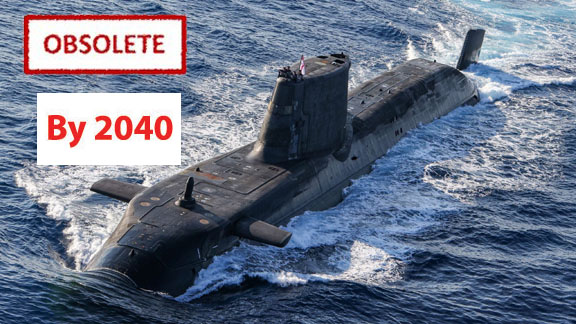
“[So] the question for us is, is it sensible for Australia to commit itself to go to war with the US against China — a war we have no reason to believe the US can win, in order to acquire submarines that we don’t need?”
ABC RN / By Nick Baker and Taryn Priadko for Global Roaming 5 Mar 24
There were always going to be questions about a nuclear-powered submarine deal with a (stated) price tag of up to $368 billion.
But, as the dust settles on the AUKUS security pact and Australians patiently wait for the subs that come with it, some defence experts are warning that the deal could fall apart.
“I think the chance of the plan unfolding effectively is extremely low,” Hugh White, an emeritus professor of strategic studies at the Australian National University, tells ABC RN’s Global Roaming.
Professor White was a defence adviser to the Hawke government and worked as a deputy secretary for strategy and intelligence in the Department of Defence. He’s also been a big critic of AUKUS.
So could AUKUS sink? And what would that mean for Australia’s defence plans?
What is AUKUS?
On September 15, 2021, a new trilateral security partnership between Australia, the UK and the US was announced, called AUKUS (A-UK-US).
Australia was scrapping its earlier $90 billion deal with France for 12 conventional-powered submarines and instead securing nuclear-powered submarines through AUKUS.
More details were announced on March 13 last year, including around the two so-called “pillars” of AUKUS.
Pillar One, which has received the most attention, is the submarines.
The plan is for Australia to buy at least three nuclear-powered Virginia class submarines from the US in the early 2030s.
We will then build at least five of a new, nuclear-powered submarine class dubbed the SSN-AUKUS, likely in Adelaide, in the 2030s, 2040s and beyond.
Pillar Two involves the sharing of technology, in areas like quantum computing, artificial intelligence and hypersonic missiles.
Former prime minister Scott Morrison called AUKUS “the best” decision of his government, while current Prime Minister Anthony Albanese has said it would “strengthen Australia’s national security and stability in our region”.
AUKUS worries
Professor White has two main worries around AUKUS.
“We do need submarines. I think submarines are a very important part of a defensive posture for Australia … [But] I don’t think we need nuclear-powered submarines,” he says.
“They’re so much more expensive. They’re so much more difficult to make. They’re so much more difficult to operate. We’ll end up with far fewer of them in our fleet.”
He says his second concern is far bigger: “I don’t think we’re going to get [the submarines].”
He claims the plan is overly reliant on future decisions and assistance from the US and UK governments, and also full of near-insurmountable technical tasks for Australia.
“I think what’s going to happen … is within the next few years, the whole thing will just come apart in our hands. And we’ll be back to square one trying to work out how to get some more conventional [submarines].”
Allan Behm, the director of the international and security affairs program at the Australia Institute, also doubts the likelihood of the AUKUS deal going ahead as planned.
One reason, he says, is that the technologies, skills and workforce that are required from a country like Australia to build and maintain nuclear-powered subs is pushing our limits, even with the involvement of the US and UK.
“We’re going into a technological domain with which we are totally unfamiliar,” says Mr Behm, who has a 30-year career in the Australian public service and was senior advisor to then-shadow minister for foreign affairs Penny Wong.
“We’re talking about a number of submarines with nuclear propulsion systems in them. And we’ve only got one nuclear reactor in Australia, which is nothing like the very, very highly enriched uranium reactors, the pressure water reactors that exist in nuclear-powered submarines,” he says.
“I think the best parallel would be, how would Australia imagine that it would undertake, conduct and retrieve a moon launch?”
US versus China
If AUKUS goes ahead as planned, is it the best way to keep Australia safe?
It’s been framed as a massive deterrent to China, which keeps building up its military.
Mr Morrison told the ABC last year, AUKUS helps to “change the calculus for any potential aggressors in our region”.
But Professor White says there are pitfalls with this strategy too.
He claims AUKUS could pull Australia into a future US-China conflict over Taiwan, which he contends the US may not win.
“China has focused so strongly and so effectively on building precisely the kinds of forces it needs to prevent the US projecting power by sea and air into the Western Pacific,” he says.
“[So] the question for us is, is it sensible for Australia to commit itself to go to war with the US against China — a war we have no reason to believe the US can win, in order to acquire submarines that we don’t need?”
While Australia has made clear it will have full control over the nuclear-powered submarines under the deal, Professor White says the US may still expect us to support them in a future war.
Cost concerns
The estimated cost of the submarine program will be up to $368 billion over the next 30 years. It’s a figure that has attracted no shortage of criticism.
“It puts so many of our defence eggs in one super expensive basket,” Mr Behm says.
“Short of expanding our defence budget by a considerable amount … we would find ourselves with very constrained capabilities in other fields in order to meet the expenditure targets of this project.”
And, based on other defence projects, he contends there will be cost blowouts.
“Whenever [the Department of] Defence says it’s going to cost you $1, always multiply it by three. And so your $368 billion is, in effect, a lifetime cost of $1 trillion,” he says.
“And you can do a hell of a lot with $1 trillion.”
A safer Australia?
The AUKUS critics have their critics too.
Peter Dean, the director of foreign policy and defence at the University of Sydney’s US Studies Centre, says he has a “diametrically opposed” outlook to Professor White and Mr Behm………………………………………………
Scrap AUKUS, totally rethink defence?
Meanwhile, Professor White, from the anti-AUKUS camp, is advocating a totally different approach to AUKUS.
He says Australia should pivot away from the US and think about “how we can develop our national capability to defend ourselves independently against a major Asian power?”
“Traditionally, Australians have believed that as a very big continent with a relatively small population … we couldn’t possibly defend ourselves. But I don’t think that’s right.”
But he says this would need a change in priorities…………………………………………………
A missing part of the discussion
Mr Behm, also from the anti-AUKUS camp, says there’s an element sometimes missing in discussions about defence.
Diplomacy has got to be central to the way in which you think about your long-term national security,” he says.
“You get much more return on your investment in diplomacy than you ever get out of defence systems, which in the life of almost all of them you never use.”………………………………….
Mr Behm advocates for more emphasis on “how you use the intellectual and cultural resources of the nation to both protect and to promote its deep and long-term security”.
“[So] I would be prepared to argue that the pivot on which our national security rests is the foreign minister.” https://www.abc.net.au/news/2024-03-05/aukus-set-to-sink/103534664
The lesson from the criminal H Bomb Bravo “test”- Hibakusha remind us
Race was, of course, a factor. During the Pacific War, The New York Times quoted a U.S. general as saying that he and his troops saw Japanese as “vermin” to be eradicated. The implicit assumption was that Marshallese were darker skinned primitives who could be sacrificed, ostensibly in the pursuit of world peace. In both cases, Japanese and Rongelap Hibakusha claimed that they were used as human “guinea pigs,” monitored by doctors and other scientists but not given medicine.
Bikini Day will be little remarked here in the United States: Cowboys and Indians all over again, and quite literally a case of nuclear colonialism. But those who gather in the Marshall Islands and Yaizu City in Japan will not only be marking the 70th anniversary of the devastating Bravo test and honoring those victimized and lost. We will also be reminding the world of the Hibakusha truth that “human beings and nuclear weapons cannot coexist.”
Hibakusha remind us just why a nuclear-free world is needed
By Joseph Gerson, 4 Mar 24, https://beyondnuclearinternational.org/2024/03/04/the-lesson-from-the-criminal-bravo-test/
Later this month I will return to Japan for the annual Bikini commemoration and the Gensuikyō, or Japan Council Against Atomic and Hydrogen Bombs, annual conference. There won’t be a bikini fashion show.
The commemoration of what can only be called the criminal U.S. Bravo H-bomb test on March 1, 1954, is one of two annual anchor events of the Japanese peace movement. Although Covid-19 is still with us, these events will play important roles in revitalizing the Japanese peace movement; one of the most effective in the world.
Over the years, this movement has played a major role in preventing Japan from becoming a nuclear weapons state, and the testimonies of Hibakusha (victims and witnesses of the A-bombings) have played critical roles in inspiring the nuclear disarmament diplomacy and the international negotiations that resulted in the 2017 United Nations Treaty on the Prohibition of Nuclear Weapons.
Although I initially met several Hiroshima and Nagasaki A-bomb survivors as early as the 1978 U.N. Second Session of Nuclear Disarmament, it wasn’t until I first traveled to Hiroshima in 1984 that I began what became a 40-year engagement with Hibakusha and the Japanese movement.
In an effort to compensate for his earlier support for the Nuclear Weapons Freeze campaign and to bring nonexistent jobs bacon to Boston, Senator Ted Kennedy (D-Mass.) and, following him, the Massachusetts congressional delegation and the city’s business establishment were suckered into Reagan-administration planning to transform Boston Harbor into a nuclear weapons base.
Knowing the Navy’s record of nuclear weapons accidents, the ways that the base would ratchet up tensions with Moscow and violate the freeze, and with knowledge of better economic and social uses for the waterfront property, several of us organized at the grassroots level to prevent construction of the base. We prevailed, and I was invited to give a brief inspirational speech at the World Conference against A- and H- Bombs. Needless to say, my first trip to Hiroshima was a transformative experience.
Not long thereafter, I returned to Japan for the Bikini Day commemorations and was shocked by what I learned from the testimonies of Rongelap and Japanese survivors of the March 1, 1954, Bravo “test.” Bravo was by far the most devastating of the United States’ nuclear weapons explosions that pulverized Bikini between 1946 and 1958. It was detonated a year after the Soviets tested their first H-bomb and two years before a culturally explosive women’s two-piece swimsuit was first marketed in Paris.
Washington responded to the Soviet Union’s first H-bomb with a bomb 1,000 times more powerful than the Hiroshima A-bomb that destroyed an entire city, initially killed 100,000 people—almost all civilians—and poisoned survivors, the environment, and future generations. Ninety-eight miles away from the Bikini H-bomb test site, inhabitants of tropical Rongelap Atoll were showered by and played with radioactive ash that they first thought was snow. Just 500 miles from the equator, they had never seen snow. Japanese fishing boats hundreds of miles from Bikini Atoll and fish that comprised a major portion of Japan’s ocean-based food supply were also irradiated.
Before the year was out, natives of Rongelap and Japanese fishermen began to die from radiation diseases and cancer. Still births and numerous birth defects including jellyfish babies (transparent skin and no bones), anencephaly (infants born without portions of their brain or skull), and other mutations followed.
Secrecy was immediately imposed by both the U.S. and Japanese governments. But as word got out following the return of the Lucky Dragon V tuna fishing boat’s sickened crew to Yaizu City, women with memories of Hiroshima launched a petition campaign for the abolition of nuclear weapons. It garnered 25 million Japanese signatures, leading to the convening of the first World Conference against A- and H- Bombs, which attracted delegates from across Japan and around the world.
Hiroshima and Nagasaki A-bomb victims, many of whom had hidden themselves from the world due to their disfigurements, excruciating physical and emotional pains, and popular fears that their radiation diseases were contagious began to tell their stories. What became the world’s most powerful and long enduring nuclear disarmament social movement was born.
Two years after Bravo, in 1956, the first Godzilla film (released in Japan in 1954) was distributed in the United States. The original Japanese version, unlike the deracinated version shown in the US, was not the compelling story of a love triangle. It was a powerful expression of rage against the A-and H- bombs, a cry for the elimination of nuclear weapons. Watching it now, the desperate fear of nuclear weapons in the aftermath of the Hiroshima, Nagasaki, and Bikini bombs—fears blunted over the decades—remains palpable.
Race was, of course, a factor. During the Pacific War, The New York Times quoted a U.S. general as saying that he and his troops saw Japanese as “vermin” to be eradicated. The implicit assumption was that Marshallese were darker skinned primitives who could be sacrificed, ostensibly in the pursuit of world peace. In both cases, Japanese and Rongelap Hibakusha claimed that they were used as human “guinea pigs,” monitored by doctors and other scientists but not given medicine.
This outrageous charge was difficult and painful to believe, bringing to mind as it did Dr. Josef Mengele’s murderous experiments at the Auschwitz death camp. But in 2000, in the course of hosting a “Global Hibakusha delegation” for a conference at the United Nations, several of us met with the senior Department of Energy (DOE) official who was responsible for studies of the impacts of radiation on people. I explained that in Japan I had heard Hibakusha cry out that they had been used as “guinea pigs” in experiments conducted by the Atomic Bomb Casualty Commission. I said that I could understand victims thinking the worst of their tormentors, but expressed some doubt and asked if he could say it wasn’t so.
“No,” he responded. The experiments had indeed been conducted. And an Utah downwinder who was with us raged in response that the same was secretly being done across the western United States. She was a woman who had lost her father and father-in-law to uranium mining, her sister and daughter to Nevada test fallout, and who consumed a daily meal of pills simply to stay alive.
Some years later I experienced an equally sobering reverberation from the Bikini H-bomb. It came during a lunch break in a well-appointed conference site during another annual Bikini commemoration. A descendant of Rongelap Hibakusha was given a book about the Bikini H-bomb and its devastations. It included a list of the names of each of Rongelap’s inhabitants on that 1954 March 1 morning. One by one this young man placed a check mark next to the name of each person who had died of cancer and other radiation diseases from the Bravo “test.” I watched amidst very painful silence as he methodically checked off the names of nearly every person on the list. Some were women and men I had met along our ways
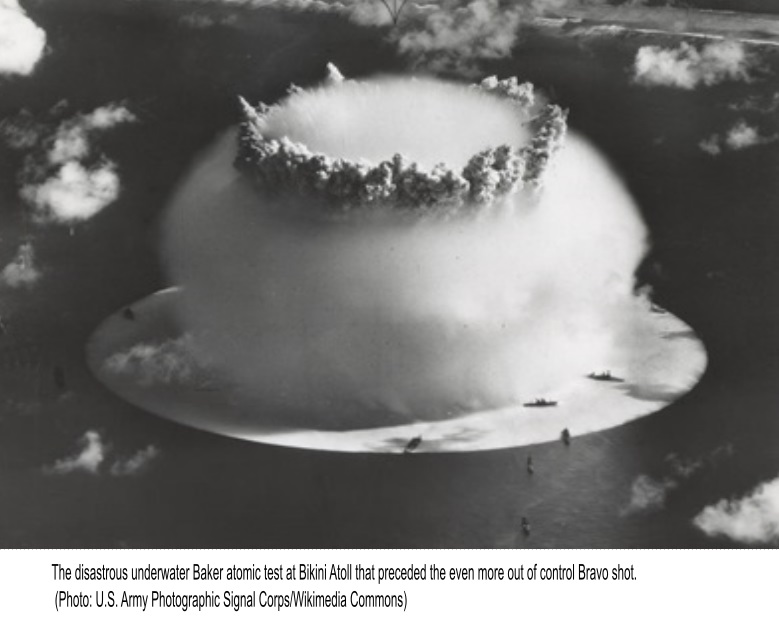
The disastrous underwater Baker atomic test at Bikini Atoll that preceded the even more out of control Bravo shot. (Photo: U.S. Army Photographic Signal Corps/Wikimedia Commons)
Bikini Day will be little remarked here in the United States: Cowboys and Indians all over again, and quite literally a case of nuclear colonialism. But those who gather in the Marshall Islands and Yaizu City in Japan will not only be marking the 70th anniversary of the devastating Bravo test and honoring those victimized and lost. We will also be reminding the world of the Hibakusha truth that “human beings and nuclear weapons cannot coexist.”
The hands of the Bulletin of the Atomic Scientists’ Doomsday Clock are now set at 90 seconds to midnight. We face the risks of possible nuclear escalation in Ukraine, the Middle East, and over Taiwan tensions. With the post-Cold War order in free fall, all nine nuclear weapons states are escalating their arms racing, “modernizing” or expanding their nuclear arsenals. In these critical movements the messages from the Marshall Islands, Yaizu City, and nearby Shizuoka will be clear: The U.N. Treaty on Prohibition of Nuclear Weapons must be universally signed and ratified to make way for a nuclear weapons-free world. And here in the United States, campaigns like Back from the Brink provide paths and hope for human survival.
What must be found is the will!
Dr. Joseph Gerson is the President of the Campaign for Peace, Disarmament and Common Security.
Wargame simulated a conflict between Israel and Iran: It quickly went nuclear
The Bulletin By Henry Sokolski | February 27, 2024
With the Gaza crisis, a nuclear Rubicon of sorts has been crossed: Elected Israeli officials—a deputy minister and a ruling party member of Parliament—not only publicly referenced Israeli possession of nuclear weapons, but suggested how such weapons might be used to target Gaza. This is unprecedented.[1]
More recently, Iran directly attacked an Israeli-manned intelligence outpost in Iraq. Iran also has inched within weeks of making several nuclear weapons and has made its military ever more immune to first strikes against its key missile and nuclear facilities. Iran and its proxies also now have long-range, high-precision missiles that could easily reach key Israeli targets.[2]
None of these developments is positive. For decades, most security analysts assumed Israel’s undeclared nuclear weapons were only deployed to deter attacks and that Iran would not dare to attack Israel directly. This after-action report describes a war game originally designed nearly two years ago. It directly challenges these assumptions and suggests that military strikes between Israel and Iran—including nuclear ones—are possible.
The Nonproliferation Policy Education Center held the game and its preparatory meetings—five separate sessions—in November and December of 2023. The 35 participants included Republican and Democratic Hill staff; US Executive Branch officials and analysts; leading academic scholars; national security and Middle Eastern think tank experts; and US military personnel.
The game consisted of three moves. After receiving a war brief and instructions from the Israeli prime minister, teams representing the Israeli Ministry of Defense, the Ministry of Foreign Affairs, and intelligence community formulated their preferred options for launching nuclear strikes against Iran. The prime minister selected one. Move two begins after the Israeli military carries out this strike. In move two, the teams were reconstituted to represent Israel, friendly Arab nations, and the United States and its European allies. Control played Iran, Russia, and China. Each team responded diplomatically and militarily to Israel’s initial nuclear strike against Iran. The game’s third and final move was a “hot wash” where participants discussed their insights……………………………………………………………………………………………………
Many critical questions remain unanswered. Would Israel or Iran conduct further nuclear strikes? Would Israel target Tehran with nuclear weapons? And vice versa, would Iran target Tel Aviv with nuclear arms? Would Russia or the United States be drawn into the war? These many basic unknowns helped inform each of the game’s four major takeaways:
The strategic uncertainties generated after an Israeli-Iranian nuclear exchange are likely to be at least as fraught as any that might arise before such a clash. An unspoken hope among security experts is that nuclear deterrence can work between Israel and Iran. Such optimism, however, discourages clear thinking about what might happen if deterrence fails and both countries use nuclear weapons……………………………………………………………………………………………
Although Israel and Iran might initially seek to avoid the nuclear targeting of population, such self-restraint is tenuous. …………………………………………………………………………………………
Multilateral support for Israeli security may be essential to deter Israeli nuclear use but will likely hinge on Israeli willingness to discuss regional denuclearization.An isolated and desperate Israel is far more likely to use nuclear weapons than an Israel surrounded by friendly, supportive neighbors………………………………………………………………………..
Little progress is likely in reducing Middle Eastern nuclear threats as long as the United States continues its public policy of denying knowledge of Israeli nuclear weapons. The current US policy is of not admitting that Israel possesses nuclear weapons……………………………………………….
…………………….Considering the strategic risks and uncertainties that a possible nuclear exchange between Israel and Iran revealed in this game, the formulation of proportionate military, political, and economic policies to deter nuclear use appears crucial. This requires gaming and careful planning—both efforts that the United States’ outdated policy toward Israel nuclear-related classification all but precludes.
Notes: …………………………………………….. https://thebulletin.org/2024/02/wargame-simulated-a-conflict-between-israel-and-iran-it-quickly-went-nuclear/
The Ukrainian Intelligence Committee Is Preparing For The Worst-Case Scenario
ANDREW KORYBKO, FEB 28, 2024, https://korybko.substack.com/p/the-ukrainian-intelligence-committee—
What’s regarded as the worst-case scenario from the perspective of the ruling Ukrainian elite and their Western masters is the best-case scenario for the rest of the world. In the event that Zelensky is deposed and peace talks immediately resume right as Russia breaks through the Line of Contact, then NATO might not feel as pressured by its security dilemma with Russia to conventionally intervene in Ukraine, thus reducing the risk of World War III by miscalculation.
The Ukrainian Intelligence Committee warned in a Telegram post about the worst-case scenario that could happen by June whereby a Russian breakthrough across the Line of Contact (LOC) merges with protests over conscription and Zelensky’s illegitimacy to deal a deathblow to the state. They predictably claimed that those protests, along with claims of growing fatigue inside Western and Ukrainian societies plus civil-military tensions in Kiev, are just “Russian disinformation” even though they all veritably exist.
“Zelensky Is Desperate To Preemptively Discredit Potentially Forthcoming Protests Against Him” and that’s why he claimed in late November that Russia is conspiring to orchestrate a so-called “Maidan 3” against him, which is what the Intelligence Committee explicitly referred to in their post. Their warning also came as Ukrainian media reported that Zelensky plans to ask the Constitutional Court to rule on holding elections during martial law in order to retain legitimacy after his term expires on 20 May.
The preceding hyperlinked report from Turkish media also mentions how “opposition party leaders Petro Poroshenko and Yulia Tymoshenko proposed forming a coalition government to avoid a crisis of legitimacy” but were rebuked by National Security Council chief Danilov. What’s so interesting about this proposal is that it was first tabled by an expert from the powerful Atlantic Council think tank in an article that they published in Politico in mid-December in order to serve that exact same purpose.
This reminder and the subsequent proposal by those two opposition party leaders debunks the notion that questions about Zelensky’s legitimacy are solely the result of “Russian disinformation” just like a top European think tank’s latest poll from January debunks the same about fatigue over this conflict. The European Council on Foreign Relations, which can’t credibly be described as “pro-Russian”, found that only 10% of Europeans think that Ukraine will defeat Russia.
On the other side of the Atlantic, the Congressional deadlock over more Ukraine aid proves that such sentiments are shared in the halls of power, and those who hold these views understandably don’t want to continue throwing hard-earn taxpayer funds into a doomed-to-fail proxy war. Western leaders as a whole, however, are clearly panicking over the latest military-strategic dynamics that followed the failure of Kiev’s counteroffensive last summer and Russia’s recent victory in Avdeevka.
That’s why many of them debated whether to conventionally intervene in Ukraine during Monday’s meeting in Paris that was attended by over 20 European leaders. French President Macron said that this can’t be ruled out despite there being no consensus on the issue, which his Polish counterpart confirmed was the most heated part of their discussions that day. This prompted strong denials from all other Western leaders who claimed that they’ll never authorize this, but their words can’t be taken seriously.
After all, the worst-case scenario that the Ukrainian Intelligence Committee warned about and is actively trying to discredit as supposedly being driven solely by “Russian disinformation” could push them to conventionally intervene in order to avert the state’s collapse and an Afghan-like disaster in Europe. NATO is unlikely to sit idly on the sidelines if Russia steamrolls through the ruins after breaking through the LOC by sometime this summer, hence why a conventional intervention truly can’t be ruled out.
It would be very unpopular in the West as proven by the previously mentioned think tank’s latest poll and the ongoing Congressional deadlock over Ukraine aid, but that doesn’t mean that the elite won’t do it since they don’t take public opinion into consideration when formulating foreign and military policy. Even so, the large-scale protests that could follow in Europe are something that the elite want to avoid, but they might still risk them in order for their geopolitical project in Ukraine not to be totally for naught.
After all, the worst-case scenario that the Ukrainian Intelligence Committee warned about and is actively trying to discredit as supposedly being driven solely by “Russian disinformation” could push them to conventionally intervene in order to avert the state’s collapse and an Afghan-like disaster in Europe. NATO is unlikely to sit idly on the sidelines if Russia steamrolls through the ruins after breaking through the LOC by sometime this summer, hence why a conventional intervention truly can’t be ruled out.
It would be very unpopular in the West as proven by the previously mentioned think tank’s latest poll and the ongoing Congressional deadlock over Ukraine aid, but that doesn’t mean that the elite won’t do it since they don’t take public opinion into consideration when formulating foreign and military policy. Even so, the large-scale protests that could follow in Europe are something that the elite want to avoid, but they might still risk them in order for their geopolitical project in Ukraine not to be totally for naught.
Considering the global significance of this conflict, what’s regarded as the worst-case scenario from the perspective of the ruling Ukrainian elite and their Western masters is therefore the best-case scenario for the rest of the world. In the event that Zelensky is deposed and peace talks immediately resume right as Russia breaks through the LOC, then NATO might not feel as pressured by its security dilemma with Russia to conventionally intervene in Ukraine, thus reducing the risk of World War III by miscalculation.
The reawakening of America’s nuclear dinosaurs

“The issue of plutonium pit aging is a Trojan horse for the nuclear weaponeers enriching themselves through a dangerous new arms race,” said Jay Coghlan, executive director of Nuclear Watch New Mexico, an anti-nuclear group based in Santa Fe. “Future pit production is not about maintaining the existing, extensively tested stockpile. Instead, it’s for deploying multiple new warheads on new intercontinental ballistic missiles.”
The risk of a false alarm is enough reason to “do away with the ICBMs altogether,……. “An accidental launch is a major contributor to the overall probability of an all out nuclear war.”
Are America’s plutonium pits too old to perform in the new Cold War? Or are new ones necessary?
by Alicia Inez Guzmán February 28, 2024
Sprinkled across five western states, in silos buried deep underground and protected by reinforced concrete, sit 400 intercontinental ballistic missiles. Each of those missiles is equipped with a single nuclear warhead. And each of those warheads is itself equipped with one hollow, grapefruit-sized plutonium pit, designed to trigger a string of deadly reactions.
All of those missiles are on “hair-trigger alert,” poised for hundreds of targets in Russia — any one of which could raze all of downtown Moscow and cause hundreds of thousands of casualties.
Except — what if it doesn’t? What if, in a nuclear exchange, the pit fizzles because it’s just too old? In that case, would the weapon be a total dud or simply yield but a fraction of its latent power?
Outwardly, at least, that’s the question driving a whole new era of plutonium pit production at Los Alamos National Laboratory (LANL) and the Savannah River Plutonium Processing Facility in South Carolina.
Plutonium is widely known as one the most exotic elements in the periodic table. Trace amounts of it have been identified in the earth’s crust, though all of what’s now used for America’s nuclear weapons is manmade. For decades, these pits were cast with plutonium and other materials at a breakneck pace, installed in warheads and strapped into missiles that were regularly upgraded and modernized in an escalating arms race with the Soviet Union. Plutonium pits were never intended to grow old and senescent.
“We never worried about aging,” said Siegfried Hecker, former director of LANL and one of the world’s leading plutonium experts. “Because bombs were supposed to be out there for a dozen years or so.”
It’s been almost 40 years since America’s Cold War pit factory at Rocky Flats near Denver was raided by FBI agents and closed due to environmental crimes — among them, releases of radioactive effluent into nearby waterways. In that time, pit production went largely dormant, the USSR collapsed, arms reductions treaties were signed, stockpiles reduced and underground testing ceased.
Now, as the nuclear industrial complex awakens from its long slumber, the resumption of plutonium pit production has emerged as a deeply polarizing and political act. Anti-nuclear activists have accused the federal government of exploiting the uncertainty around aging to jumpstart a nearly $60 billion dollar manufacturing program. They assert that the real reason America has resumed the production of pits is for the purpose of introducing a new generation of warheads for a new generation of missiles — the first of which is the Sentinel, one of the most complex and expensive programs in the history of the U.S. Air Force.
The Sentinel ICBM has the capability to carry three separate warheads, each with its own target. Earlier versions of America’s missiles could and did have such capabilities and the option has remained available, but with post-Cold War weapons reductions, the number of warheads per missile was also reduced — one warhead, one intercontinental ballistic missile. As the U.S., Russia and China barrel toward a new Cold War, the U.S. will likely eschew such a convention in a matter of years.
“The issue of plutonium pit aging is a Trojan horse for the nuclear weaponeers enriching themselves through a dangerous new arms race,” said Jay Coghlan, executive director of Nuclear Watch New Mexico, an anti-nuclear group based in Santa Fe. “Future pit production is not about maintaining the existing, extensively tested stockpile. Instead, it’s for deploying multiple new warheads on new intercontinental ballistic missiles.”
But to hear Hecker and his colleagues tell it, the question of pit aging is as scientifically vexing as it is political. Plutonium, to its most studied acolytes, borders almost on the mystical, its properties as capricious as the human body. It can be brittle or soft under some circumstances or turn to powder when heated in air. It can disintegrate at room temperature. It can bombard itself with radiation and mar its own internal lattice structure. It can even heal that damage within fractions of a second, if not over the course of several decades.
According to Glenn Seaborg, former chair of the Atomic Energy Commission and the chemist credited with first synthesizing the element for use in weapons, plutonium is “so unusual as to approach the unbelievable.”
This quality means that even the most knowledgeable experts are reluctant to commit themselves to anything definitive when it comes to a plutonium pit’s long-term prospects. Does it last 50 years? One hundred? Is it comparable to a human body, whose bones weaken and whose mind is vulnerable to dementia? Or is it actually impervious to entropy?
“It is difficult to quantify how much the properties of a plutonium pit will change over time,”…………………………………………………………………………………………..
Too big to fail”
The political machinations actually go back even further — to the 2010 concession that President Barack Obama made to a largely Republican bloc of Senators: arms control in exchange for a revival of the nuclear weapons complex.
………………….
the beginning of a new era, a tectonic modernization of America’s nuclear triad — land, sea and air — now projected to cost close to $2 trillion over the next 30 years. That’s roughly the GDP of Canada.
Plutonium pits, of course, represent only a small fraction of the cost. That mind-boggling figure reflects a total reimagining of the nation’s entire nuclear program, complete with brand new ballistic missile submarines, 400 new Sentinel intercontinental ballistic missiles, tactical aircrafts, underground silos and 800 nuclear warheads.
The Sentinel program alone — cost, $131 billion — is a juggernaut. “I think this program has become too big to fail for an entrenched part of the military-industrial-congressional complex,” said Geoff Wilson, an expert on federal defense spending at the Independent watchdog, Project on Government Oversight.
…………………………………………………………. America’s warheads have also been regularly surveilled since the late 1990s, leading even the most cautious scientists to vouch for their reliability. In 2000, Raymond Jeanloz — a professor of earth and planetary science and astronomy at University of California, Berkeley— found little evidence that defects in those warheads increased significantly with age. His statistical models, based on data culled from LANL and LLNL, showed that such defects, if any, accumulate at the glacial rate of one percent per quarter century…………………….
A new Cold War
In the unthinkable scenario that a Sentinel is deployed, it would propel like a rocket beyond earth’s atmosphere and into space. As it reached its apogee, the missile would shed all its pieces and the warheads would descend toward their intended targets, half a world away.
For now, though, the Sentinel is barely a reality. The program is so complex and vastly over budget that some in the arms control community are calling for its complete cancellation. Experts question such a missile’s ability to deter China without provoking Russia. Other critics consider the plan to build new weapons as a dangerous return to the policies of the Cold War.
As for the plutonium pits, LANL is behind by at least four years; Savannah River by at least six. Indeed, to meet the projected quota demanded for future weapons could take decades.
But even if all the timetables are met, intercontinental ballistic missiles will always be a “danger to the world as long as they are on launch-on-warning alert,” according to Frank N. von Hippel, senior research physicist and professor of public and international affairs emeritus with Princeton University’s Program on Science and Global Security.
The risk of a false alarm is enough reason to “do away with the ICBMs altogether,” as he and others — presidents, retired commanders, and at least one secretary of defense, alike — have long campaigned to do. “An accidental launch is a major contributor to the overall probability of an all out nuclear war.”…………………………. And once an ICBM is launched, there would be no way to stop it
After Macron touted troops to Ukraine, Putin warns West of nuclear war risk
The Russian president, in a state of the nation address, upped the ante on Thursday. Should the world be worried about his threat?
Aljazeera, By Mansur Mirovalev, 1 Mar 2024
President Vladimir Putin has threatened to use nuclear weapons if Western powers send soldiers to within striking distance of Russia.
His comments on Thursday, in a state of the nation address, were the kind of remarks usually uttered by Dmitry Medvedev, a Putin ally who served as Russia’s president from 2008-2012 and prime minister until becoming a top security official in 2020………………….
Putin has now upped the ante, responding to French President Emmanuel Macron’s assumption on Monday that a deployment of European troops to Ukraine cannot be “ruled out”………………..
The West has “announced the possibility of sending Western military contingents to Ukraine,” Putin said on Thursday. “The consequences for possible interventionists will be way more tragic.
“They should eventually realise that we also have weapons that can hit targets on their territory. Everything that the West comes up with creates the real threat of a conflict with the use of nuclear weapons, and thus the destruction of civilisation,” he said.
Moscow has the world’s largest nuclear arsenal including a new generation of hypersonic missiles and several times more tactical nuclear weapons than the collective West.
“Now it is Putin who clearly draws a red line about using the nukes,” Kushch said, adding that Macron had probed Putin’s reaction on when Moscow would be ready to launch the nukes…………………………………………………………………………………………………………………………… more https://www.aljazeera.com/news/2024/3/1/how-real-is-putins-threat-to-nuke-the-west
Setting the record straight on Canada’s arms exports to Israel
Canadian officials, including the Minister of Foreign Affairs, have recently claimed that Canada does not export weapons to Israel, and instead has only exported “non-lethal” equipment to that country. Moreover, the Prime Minister stated before Parliament on February 14, 2024, that no export permits have been issued for Canadian arms transfers to Israel since October 7, 2023.
The Foreign Minister’s statement is misleading. The Prime Minister’s is patently false.
Documents recently released by Global Affairs Canada show that Canadian officials authorized nearly $30-million in military goods to Israel since October 7, 2023. These recent arms export authorizations are in addition to the more than $140-million (constant CAD) in military goods Canada has transferred to Israel over the last decade.
Under Canada’s export control regime, there exists no category for “non-lethal” arms exports. The relevant question is whether Canada has authorized the export of controlled military goods to Israel – and it has.
Given that the Government of Canada recognizes all these proposed exports as military goods, the claim that Canada only exports “non-lethal” equipment to Israel is misleading. Technology does not need be lethal itself to otherwise enable lethal operations.
We urge the Government of Canada to clarify and rectify its messaging on this matter.
Project Ploughshares also reiterates its call for Canada to end the supply of military goods to Israel, as per its obligations under the Export and Import Permits Act and the United Nations Arms Trade Treaty.
South Korea (and U.S.) has a permanent war economy.
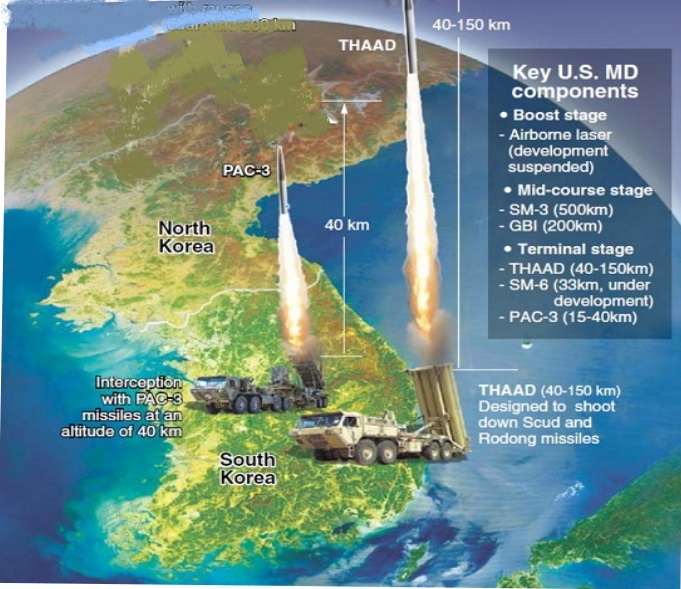
The only real jobs investment by Washington these days is going toward weapons of war.
South Korea is now being flooded with so-called ‘missile defense’ systems.
Bruce Gagnon – coordinator of the Global Network Against Weapons & Nuclear Power in Space
https://space4peace.blogspot.com/2024/03/south-korea-and-us-has-permanent-war.html
Yesterday was the last day of my space issues speaking tour across South Korea.
I had two meetings in the afternoon before my final talk in the evening in Seoul.
The first was a meeting with two representatives from SPARK (Solidarity for Peace and Reunification of Korea) which was formed to organize for national self-determination, peace and disarmament, and the reunification of the two East Asian Korean nations.
SPARK is now working on holding an ‘International People’s Tribunal to hold the U.S. accountable for dropping Atomic bombs’ in New York City in 2026 (date not yet set). The event aims to highlight the bombing of Hiroshima and Nagasaki in 1945 from the perspective of Korean A-bomb victims (an oppressed ethnic group) in Japan who are usually the forgotten victims. The goal of the tribunal will be to contribute to the realization of a nuclear-free Korean Peninsula and world, free from the threat and use of nuclear weapons.
I agreed that the Global Network would help in every way possible to make the event a success. (Let me know if your group would be interested in co-sponsoring this tribunal.)
Next on the schedule was a dinner meeting with Dr. Kang-Ho Song and other members of the organization called The Frontiers. Dr. Song was a major supporting activist in Gangjeong on Jeju Island during the long campaign to oppose the Navy base that was forced upon the 500 year old fishing/farming village by the United States. Dr. Song went to jail three times (the longest sentence was more than a year) for his non-violent protests against the base.
The Frontiers recently has become quite active supporting Japanese controlled islanders who are opposing the deployment of offensive missiles being aimed at China. They have made sailboat trips to the string of islands (including Okinawa and Taiwan) to build inter-island solidarity. In their literature The Frontiers states: ‘We sail with the hope of driving out war, military training, and bases from this sea and creating a sea of co-existence and peace where humanity and all sea creatures can live together.’
Last presentation
My last talk was attended by 55 people. I’m told that even for Seoul that is a good turnout as similar peace talks these days are lucky to draw 30 people.
It was fun to see several old friends show up who I know from my many visits to Jeju Island since 2009. The talk went well (my voice which these days occasionally gets shaky has held up throughout this trip) and there was a healthy question and answer period.
One woman approached me after the talk and said that ‘South Korea’s economy is not good for the people, we are becoming a permanent war economy’. I responded that it is the same in the United States these days as well.
In fact just this morning I received an email that in my home state of Maine Governor Mills, U.S. Senators Susan Collins and Angus King, and U.S. Representative Chellie Pingree will participate in the unveiling of the Maine Defense Industry Alliance (MDIA) at the York County Community College (YCCC) Instructional Site in Sanford. The MDIA is a newly established non-profit coalition of Maine defense companies, state agencies, community colleges and universities, and other vocational training organizations. The partnership was created to attract and train thousands of new employees for critical jobs in Maine’s defense industrial base.
This is a perfect example of what a permanent war economy looks like. The only real jobs investment by Washington these days is going toward weapons of war. In the case of Maine, the so-called leaders want expanded Pentagon funding for more Aegis destroyers at Bath Iron Works shipyard. They also want hypersonics testing at a former US air base in the northern part of the state (Loring). And they want a rocket launch center near Acadia national park that would hoist mini-satellites for the US Space Force to help fill up Lower Earth Orbit (LEO) before China and Russia can put significant numbers of satellites there.
South Korea is now being flooded with so-called ‘missile defense’ systems. They are on-board Navy Aegis destroyers which are consistently ported on Jeju Island. They are the THAAD and PAC-3 systems deployed at several bases throughout the ROK. And the US is deploying these same ‘shields’ in Guam, Japan/Okinawa, Taiwan, Philippines, and other locations in the region.
U.S. bases in the ROK are expanding and held more than 200 days last year of US-ROK war games right along the border of North Korea.
Alternative media
As a result of my talks during this tour there are already articles and interviews by people who came to hear me speak and quickly moved to share what they learned. Here are three examples and I am told there will be more to come.
- A woman named Oh Hyun-hwa in Daejeong gave a local radio interview. https://www.youtube.com/watch?v=iJfcAvmL8uo
- Anti-War Peace Activist Concerned Jeju seems to be turning into a big South Korea-U.S. military base. Article by Kim Soon-ae. https://www.ohmynews.com/NWS_Web/View/at_pg.aspx?CNTN_CD=A0003004637
- Space industry erodes the space, the commons, and destroys the future.Article by Kim Na-hee. https://www.ohmynews.com/NWS_Web/View/at_pg.aspx?CNTN_CD=A0003005816
1 This Month
Chernobyl: The Lost Tapes – A good documentary on Chernobyl on SBS available On Demand for the next 3 weeks– https://www.sbs.com.au/ondemand/tv-program/chernobyl-the-lost-tapes/2352741955560

of the week–London Campaign for Nuclear Disarmament

Tell the Ukrainian Government to Drop Prosecution of Peace Activist Yurii Sheliazhenko
To see nuclear-related stories in greater depth and intensity – go to https://nuclearinformation.wordpress.com
-
Archives
- April 2026 (152)
- March 2026 (251)
- February 2026 (268)
- January 2026 (308)
- December 2025 (358)
- November 2025 (359)
- October 2025 (376)
- September 2025 (257)
- August 2025 (319)
- July 2025 (230)
- June 2025 (348)
- May 2025 (261)
-
Categories
- 1
- 1 NUCLEAR ISSUES
- business and costs
- climate change
- culture and arts
- ENERGY
- environment
- health
- history
- indigenous issues
- Legal
- marketing of nuclear
- media
- opposition to nuclear
- PERSONAL STORIES
- politics
- politics international
- Religion and ethics
- safety
- secrets,lies and civil liberties
- spinbuster
- technology
- Uranium
- wastes
- weapons and war
- Women
- 2 WORLD
- ACTION
- AFRICA
- Atrocities
- AUSTRALIA
- Christina's notes
- Christina's themes
- culture and arts
- Events
- Fuk 2022
- Fuk 2023
- Fukushima 2017
- Fukushima 2018
- fukushima 2019
- Fukushima 2020
- Fukushima 2021
- general
- global warming
- Humour (God we need it)
- Nuclear
- RARE EARTHS
- Reference
- resources – print
- Resources -audiovicual
- Weekly Newsletter
- World
- World Nuclear
- YouTube
-
RSS
Entries RSS
Comments RSS
 nuclear-news