Europe’s challenge in decommissioning 150 nuclear reactors
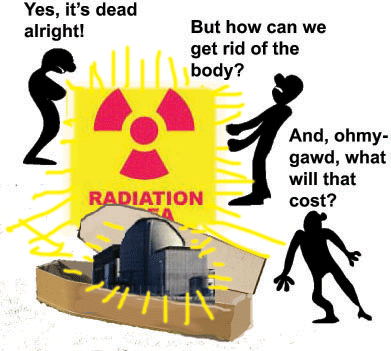 How hard is it to dismantle 150 nuclear reactors? Europe is about to find out http://www.washingtonpost.com/blogs/ezra-klein/post/how-hard-is-it-to-dismantle-150-nuclear-reactors-europes-about-to-find-out/2012/06/09/gJQA2EH0PV_blog.html
Brad Plumer, 06/09/2012 Last year, after the tsunami and reactor meltdown in Fukushima, Japan, many European nations decided to phase out their existing fleets of nuclear power plants. Germany and Belgium are aiming to end all atomic generation by 2030. Switzerland is shooting for 2035.
Not so easy to get rid of. Yet the mere act of shutting down those reactors is going to pose a huge challenge in the years ahead. Continue reading
France’s nuclear dilemma – costs of shutting aged reactors
Nuclear Europe: a dream unwinding, China Dialogue, Steve Thomas June 06, 2012“…… the real challenge – regardless of whether Hollande or Sarkozy had won the election – was always going to be what to do about France’s existing plants when they reach the end of their lives. Under present plans, these ageing reactors will be retired at a rate of five to six per year from 2017 onwards. The cheaper option for the country’s power giant EDF would be to do as the Americans and extend the plants’ lifespans from 40 to 60 years, though thanks to post-Fukushima regulatory requirements that existing plants be made more robust for “extreme situations” this is not such a cheap option as it once was.
On the other hand, if France takes the route of replacing old reactors with EPRs, assuming problems around cost, licensing and construction can be solved, and the EPR remains a viable option, then the cost to EDF of replacing old capacity would be astronomical – far higher than first time around. It is doubtful that France could sustain the logistical and financial challenge of ordering and building four or five EPRs a year for a decade. It would also have to start paying huge sums for decommissioning existing reactors. That leaves France facing some tough choices…. http://www.chinadialogue.net/article/show/single/en/4956
The eternal cost of dealing with dead, but radioactive, nuclear reactors
Turkish nuclear power – an unwarranted venture, Hurriyet Daily News, ERHUN KULA, 12 April 12 “……Studies in France (available from the author), the most nuclear dependent nation, reveal that nuclear energy is more expensive then hydro and fossil fuel powered units, even when the end cost of nuclear power plants – which is decommissioning and storing highly dangerous nuclear wastes in repositories for thousands of years – is ignored. The most expensive and risky problem with nuclear energy is the safe disposal of the radioactive waste. It has to be transported over long distances, stored and monitored over a very long period of time.
A few months ago the Mersin Akkuyu Nuclear Electricity Production Corporation commissioned an “independent” engineering company, DOKAY, to carry out an environmental impact assessment of the proposed nuclear power unit. In its over 100 page report, DOKAY provided a “pleasing” document to its sponsor. As for nuclear wastes – the end product – only a few sentences are reserved, which is quite outrageous.
There are more than 400 nuclear reactors operating in various countries. A nuclear power station has 35-40 years of operating life. After that it must be dismantled and the area must be cleaned up (the decommissioning process). But so far, no nuclear power station has been completely decommissioned in the world. It has been estimated that decommissioning could last about 50 years and it would cost more than the construction cost.
One of the earliest decommissioning efforts is taking place at Dounrey plant, on the northern tip of Scotland. It started more than 15 years ago and we need at least 30 years more to finish the job. After that, waste must be stored in nuclear graves (waste repositories) for thousands of years. United States regulations require the storage period to be at least 10,000 years.
The cost of decommissioning and waste storage will fall upon future generations at huge costs. My American colleague, Prof. S. Frachette, argues that large quantities of nuclear waste is likely to endanger the health, safety and civil liberties of generations yet to be born.
Professor Erhun Kula, from Istanbul’s Bahçesehir University, researched economic and moral aspects of nuclear power in the U.K., the United States and Sweden, and has published widely in this field. http://www.hurriyetdailynews.com/turkish-nuclear-power–an-unwarranted-venture.aspx?pageID=238&nID=18223&NewsCatID=396
Germany needs to make sure that nuclear companies pay for nuclear decommissioning
Germany open to nuclear shutdown fund – minister Greenpeace calls for state to run nuclear dismantling fund
* Environment minister says Greenpeace proposal can be examined
* Major utilities reject idea
DUESSELDORF, Germany, April 11 (Reuters) – Germany would consider ringfencing billions of euros to be put aside by utilities for disposing of radioactive waste, the environment minister said, to ensure decommissioning of the country’s nuclear power plants is completed decades from now. He was speaking on Wednesday in response to a call from environmental group Greenpeace that wants the government to administer some of the money earmarked for nuclear decommissioning.
German Chancellor Angela Merkel’s decision last year, following Japan’s nuclear plant disaster, to phase out nuclear power by 2022 has thrown big utilities on the defensive, weakening their finances and forcing them to rethink their business models.
Germany’s top four nuclear operators – E.ON, RWE , EnBW and Swedish’s Vattenfall – are footing the bill to dismantle the plants and dispose of radioactive waste. They have already made provisions of more than 30 billion euros ($39.3 billion).
Managing the disposal of waste will take decades after the last nuclear plant is due to shut in 2022 and Greenpeace fears that the companies may not be able to honour their obligations in the future or could try to wriggle out of them.
Parking the companies’ money in a separate state-run fund would protect German taxpayers should one or more of the firms become insolvent, Greenpeace said. “This is an idea that can be examined,” Environment Minister Norbert Roettgen told Reuters on Wednesday, adding it was clear that the operators of nuclear plants were responsible for dismantling them. ”We need to look at whether a combined fund is a better solution than relying on individual responsibility,” he added.
Greenpeace has also called for provisions to be raised to 44 billion euros. http://www.reuters.com/article/2012/04/11/germany-nuclear-idUSL6E8FB2XT20120411
There’s gold in them thar dead nuclear reactors

Christina Macpherson's websites & blogs
And some of us thought that the nuclear industry wasn’t profitable any more!
Well, after ripping off the taxpayer all these years they will now be back in business with a vengeance. The almost eternal task of buryng dead nuclear reactors could turn out to be even more profitable than ever
UK in nuclear decommissioning deal with Japan http://www.reuters.com/article/2012/04/10/japan-britain-nuclear-idUSL6E8FA3JP20120410 by Oleg
Vukmanovic; Edited by David Holmes LONDON, April 10 Apr 10, 2012 (Reuters) – Britain and Japan signed a framework civil nuclear co-operation pact opening up Japan’s multi-billion pound decommissioning sector to UK companies, the UK energy ministry said.
The announcement on Tuesday came as UK Prime Minister David Cameron kicked off his tour of Asia in Japan. The tour is aimed at boosting trade and investment ties, while the nuclear pact follows the devastating Fukushima nuclear plant meltdown in March last year. Continue reading
USA in a pickle – can’t afford to bury its dead nuclear reactors
Decommissioning a reactor is a painstaking and expensive process that
involves taking down huge structures and transporting the radioactive
materials to the few sites around the country that can bury them.
The cost is projected at $400 million to $1 billion per reactor, which in some cases is more than what it cost to build the plants in the 1960s and ’70s.
As Reactors Age, the Money to Close Them Lags NYT, By MATTHEW L. WALD March 20, 2012 WASHINGTON — The operators of 20 of the nation’s aging nuclear reactors, including some whose licenses expire soon, have not saved nearly enough money for prompt and proper dismantling. Continue reading
140 nuclear reactors now dead, but only 17 buried!
Intermediate-level waste, contrary to its name, is even more of a problem because it may require deep ground burial alongside the high-level spent fuel
In 1976, a British Royal Commission said no more nuclear power plants should be built until the waste disposal problems were resolved. Thirty-five years on, nothing much has changed.
How to dismantle a nuclear reactor, New Scientist, 15 March 2012 by Fred Pearce By the start of 2012, according to the International Atomic Energy Agency, 138 commercial power reactors had been permanently shut down. At least 80 are expected to join the queue for decommissioning in the coming decade – more if other governments join Germany in deciding to phase out nuclear power following the Fukushima disaster in Japan last year.
And yet, so far, only 17 of these have been dismantled and made permanently safe. That’s because decommissioning is difficult, time-consuming and expensive. Continue reading
Nuclear plant 45 years working, 100 years++ to get rid of it
 Oldbury nuclear power station shutdown: What next? By Chris Kelly BBC News, 29 Feb 12, “…….the beginning of the end for Oldbury. The end, though, will extend many more years into the future than Oldbury’s 45-year history.
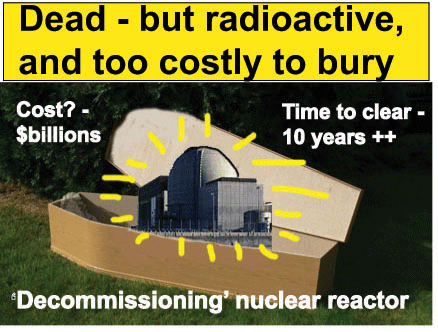
Over the next three years, all 52,000 fuel elements inside the station’s nuclear reactor will be gradually removed which will mean no more heat is generated by the reactor. The fuel is then taken away – by road from Oldbury to nearby Berkeley, site of another inactive nuclear power station – and then by rail to Sellafield where it is reprocessed.
Once the fuel has gone, other hazards and chemicals on the site such as carbon dioxide, hydrogen and acids are taken away and some of the buildings on the site will be demolished. “That will probably take about 15 years from now – so in the 2020s,” said Mr Sprauge. “What we will be left with then is the two reactor buildings and the centre block and pretty much nothing else.”
The longest job of the entire operation, though, will then begin. Leaving the station to slowly lose its radioactivity. And that job – which requires little human intervention – will take some 80 long years while the radioactivity from components in the reactor slowly fades.
The final bow for Oldbury’s mysterious looking reactor buildings will then come in 2109 when work can begin to pull them down. By then, the Oldbury reactor buildings may have a new neighbour. Horizon Nuclear Power – a conglomerate formed by E.On and RWE – hope to build a new power station, next to the existing reactor building, by 2019.
But one resident of nearby Sheperdine – Reg Illingworth – is less than pleased about the idea of a new reactor there.
Mr Illingworth, originally from Liverpool, moved to the nearby village of Shepperdine when plans were afoot to decommission Oldbury in 2007. But the life of the station was extended until 2012 before plans for the the Oldbury B station were announced.
“I’m hyper, hyper worried,” said Mr Illingworth, who is a member of a local anti-nuclear campaign group. He added he was “glad to see it’s closing”……http://www.bbc.co.uk/news/uk-england-bristol-17131988
Europe’s costly mess about burying the dead nuclear reactors
Auditors criticise decommissioning of nuclear reactors in Eastern Europe European Energy Review, By Hughes Belin, 24 Feb 12 The European Court of Auditors (ECA), which checks the management of EU money, has published a highly critical report on the management of the EU’s financial assistance for the decommissioning of eight nuclear reactors in Bulgaria (Kozloduy), Lithuania (Ignalina) and Slovakia (Bohunice).
As one “Green” member of the European Parliament puts it, the ECA’s report shows ‘the enormous hidden costs of nuclear energy’. Continue reading
Global problem of burying dead nuclear reactors
 Abandon nuclear energy programme, Unep boss urges Kenya , Standard, BY PETER ORENGO, 13 Feb 12 “……..According to the United Nations Environment Programme’s (UNEP) Year Book 2012, one of United Nations Environment Program (UNEP) ‘s emerging global concerns is the challenge of decommissioning the growing number of end-of-life nuclear power reactors….
The UNEP Year Book says the cost of decommissioning varies greatly, depending on the reactor type and size, its location, the proximity and availability of waste disposal facilities and the condition of both the reactor and the site at the time of decommissioning….. Continue reading
“Decommissioning” Fukushima nukes to take a very long time
Freezing Fukushima Nuclear Plant Leaks Water TOKYO, Japan, January 30, 2012 (ENS)“…..Decommissioning is expected to take 40 years and require the use of robots and new technologies to remove the melted nuclear fuel, the Japanese government said in December. Continue reading
UK’s Dounreay nuclear site still radioactive
Contamination found at nuclear site, Google News, (UKPA) 27 Jan 12, Traces of radioactive contamination have been found on the shoes of workers demolishing a former nuclear power station. It was detected on around a dozen people on Thursday as they prepared to leave a building which they were preparing for demolition.
Dounreay Site Restoration Limited (DSRL), which is overseeing the decommissioning of the site in Caithness, has launched an investigation.
It said that the building is in a “controlled” area, where contamination is possible, and controls are in place to manage it.
Dounreay’s nuclear reactor was shut down in 1994 and work to decommission the site has been under way since then as part of a £2.6 billion project. It was the only plant in Britain to use liquid metal instead of gas or water in the cooling circuits.
http://www.google.com/hostednews/ukpress/article/ALeqM5gVcbsn-jVhJMOoqqQOYXqz-NAfaA?docId=N0166121327661398947A
Slovakia wrestles with nuclear question, and costs of “decommissioning”
amidst the country’s nuclear quandary, one state agency seems poised for growth. Jadrova a vyradovacia spolocnost, a.s., Slovakia’s nuclear decommissioning company,
Slovakia’s Nuclear Schizophrenia: Shut Down, Continue As Usual, or Boldly Go — Where? Minyanville, by John C.K. Daly of Oilprice.com.Jan 06, 2012 The answer is anything but clear. “…….the last two decades have devolved into a series of unseemly squabbles between Brussels and new Eastern European members, with the EU demanding the prompt shutdown of Soviet-era nuclear power plants, while governments east of Berlin plead understanding and extended timelines to shut down the facilities that provide major electrical input as they search for alternatives.
The latest post-Cold War post-Soviet space energy front line is Slovakia. What to do in Bratislava on the way to becoming good, clean, green members of the European Union? “……Slovakia currently has four operational nuclear reactors at complexes in Jaslovske Bohunice and Mochovce, commissioned between 1984 and 1999. The facilities’ threeoldest reactors have been shut down in accordance with EU mandates….. Continue reading
UK Ministry of Defence doesn’t know what to do with outdated nuclear test site
Nuclear reactor test site may close, Google News, (UKPA) –3 Nov 11 A nuclear submarine reactor test site could be decommissioned after 2015, the Ministry of Defence has said. The Vulcan Naval Reactor Test Establishment (NRTE) site at Dounreay, in Caithness, has historically been used for the development of new reactor core designs.
However, the MoD said confidence in the technology and computational modelling meant “prototyping activities” were no longer needed. It is now considering what will become of the site after the current series of reactor core prototype tests are completed in 2015. Possibilities include decommissioning it or putting it into “care and maintenance”.
In a statement, the MoD said: “Options for the future of the site are currently being assessed; these range from placing the prototype facilities into care and maintenance while retaining the site’s strategic capabilities, to decommissioning the site and returning it to Nuclear Decommissioning Authority ownership…. http://www.google.com/hostednews/ukpress/article/ALeqM5gIZLQQYe2lNLK4dKWPBN-LFRWCVQ?docId=N0428681320269334933A
The danger of dismantling nuclear submarines in a city
It is the magnitude of the consequences of a nuclear accident that make it unacceptable to locate such a facility in the middle of a city of 250,000 people….
Devonport is not immune from accidents. There have been nine radioactive leaks since 1997. The impact of a significant accident in the dockyard would be devastating. It would not remain confined behind its walls but would affect a much wider area.
 Should N-subs be dismantled in city? Plymouth Herald, October 28, 2011 ONE of the most controversial proposals to affect Plymouth in generations is set to be thrust firmly into the public domain from today.
The Ministry of Defence has today begun a 16-week consultation exercise exploring the options for dismantling decommissioned nuclear-powered submarines. The consultation aims to find a permanent home for The Submarine Dismantling Project (SDP) – either in Plymouth, or Scotland. Continue reading
1 This Month

29 Jan. Thursday 7-8 p.m. Webinar – World’s Largest Nuclear Station in Port Hope, ON?


31st January – Challenging the War Machine – a DECLASSIFIED UK SUMMIT



Website of the Week
Now until to February 10, 2026 Radioactive waste storage in France: the debate is finally open! How to participate?
-
Archives
- January 2026 (246)
- December 2025 (358)
- November 2025 (359)
- October 2025 (376)
- September 2025 (258)
- August 2025 (319)
- July 2025 (230)
- June 2025 (348)
- May 2025 (261)
- April 2025 (305)
- March 2025 (319)
- February 2025 (234)
-
Categories
- 1
- 1 NUCLEAR ISSUES
- business and costs
- climate change
- culture and arts
- ENERGY
- environment
- health
- history
- indigenous issues
- Legal
- marketing of nuclear
- media
- opposition to nuclear
- PERSONAL STORIES
- politics
- politics international
- Religion and ethics
- safety
- secrets,lies and civil liberties
- spinbuster
- technology
- Uranium
- wastes
- weapons and war
- Women
- 2 WORLD
- ACTION
- AFRICA
- Atrocities
- AUSTRALIA
- Christina's notes
- Christina's themes
- culture and arts
- Events
- Fuk 2022
- Fuk 2023
- Fukushima 2017
- Fukushima 2018
- fukushima 2019
- Fukushima 2020
- Fukushima 2021
- general
- global warming
- Humour (God we need it)
- Nuclear
- RARE EARTHS
- Reference
- resources – print
- Resources -audiovicual
- Weekly Newsletter
- World
- World Nuclear
- YouTube
-
RSS
Entries RSS
Comments RSS
 nuclear-news