Nuclear decommissioning costs shooting up in Sweden
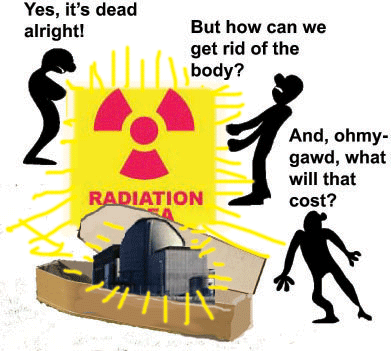 Sweden plans big rise in fees to nuclear decommissioning fund http://economictimes.indiatimes.com/news/international/business/sweden-plans-big-rise-in-fees-to-nuclear-decommissioning-fund/articleshow/37335517.cms By Reuters | 27 Jun, 2014 OSLO: Sweden on Friday proposed a sharp rise in fees nuclear power producers have to pay the country’s nuclear decommissioning fund, saying previous cost estimates were too low.
Sweden has three nuclear power plants with ten reactors in operation, generating about 40 per cent of the country’s electricity needs. The oldest reactors are expected to be shut at the beginning of the next decade.
OSLO: Sweden on Friday proposed a sharp rise in fees nuclear power producers have to pay the country’s nuclear decommissioning fund, saying previous cost estimates were too low. The Swedish Radiation Safety Authority (SSM) said it has proposed raising fees by 73 per cent to 0.038 crowns ($0.01) per kilowatt-hour from 0.022 crowns for 2015.
It said the Swedish Nuclear Fuel and Waste Management Company (SKB) had to recalculate fees to the nuclear decommissioning fund for the period of 2016-2017.
“The SSM has assessed that the costs for decommissioning and final disposal for the Swedish nuclear power industry may be underestimated by SKB by at least 11 billion Swedish crowns ($1.63 billion),” the authority said in a statement.
Sweden’s state-owned utility Vattenfall operates seven reactors and Germany’s E.ON three. Finnish utility Fortum has stakes in six Swedish nuclear reactors.
Problems in nuclear reactor decommissioning thrashed out in US Senate hearing
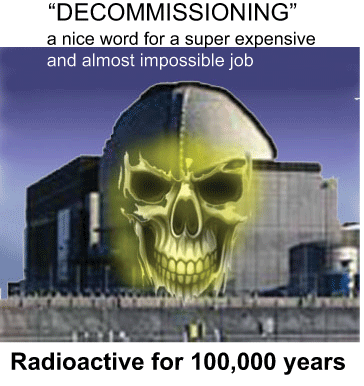 Senate Hearing on Nuclear Reactor Decommissioning Challenges Energy Collective May 22, 2014 Bemnet Alemayehu, Project Scientist, Nuclear Program, Washington, D.C.
U.S. Senator Barbara Boxer’s Environment & Public Works Committee held a hearing on Wednesday, May 14th, 2014 to assess the challenges of nuclear reactor decommissioning nationwide. Panelists called to testify at Wednesday’s senate hearing included Christopher Recchia, Public Service Department Commissioner of Vermont, Geoffrey Fettus, Senior attorney of NRDC, Donald Mosier, Council Member of the City of Del Mar, Michael Weber, Deputy Executive Director for Compliance Programs of NRC and Marvin Fertel, President & Chief Executive Officer of NEI.
Christopher Recchia’s testimony to the senate opposed a request by operators of the Vermont Yankee nuclear power plant to discontinue off-site emergency planning after the reactor shuts down. He argued that the off-site emergency planning should continue after the reactor shuts down until all of the plant’s spent fuel rods are removed from pools and placed in dry cask storage. ……… Continue reading
German government will not pay costs of burying dead reactors
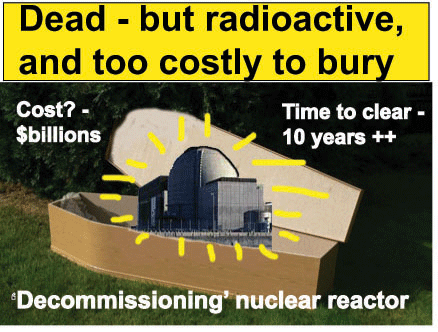 Germany’s Gabriel says state won’t pay for nuclear decommissioning http://uk.reuters.com/article/2014/05/18/uk-germany-energy-nuclear-idUKKBN0DY0EM20140518 BERLIN Sun May 18, (Reuters) – Germany‘s economy minister has joined Angela Merkel in rejecting talk that utilities might hand over responsibility for decommissioning Germany’s nuclear powerplants to a new public entity, as the projected costs of decommissioning rise.
“It should not be tax payers who pay for the clean-up of atomic waste but rather those who made money for decades through running nuclear power stations,” Sigmar Gabriel told the newspaper Bild am Sonntag in an interview published on Sunday.
Two sources told Reuters last weekend that utilities were in talks with the government about setting up a “bad bank” for nuclear plants, in response to Chancellor Angela Merkel’s decision to close them all by 2022 after the Fukushima disaster.
The foundation would use provisions earmarked by the nuclear plant operators but would also take on the risk of unforeseen extra costs, effectively capping the utilities’ liability.
The Environment Ministry said last week the utilities bore full responsibility for safely decommissioning and dismantling the nine nuclear power plants still on the grid.
One of the sources had told Reuters that if the state takes over responsibility for the decommissioning, the utilities might be willing to drop their legal claims against the government for compensation for having to shut the plants. The four operators of nuclear plants in Germany – the German companies E.ON (EONGn.DE), RWE (RWEG.DE) and EnBW (EBKG.DE) and Sweden’s Vattenfall VATN.UL – have set aside total provisions of around 36 billion euros (29.3 billion pounds) for dismantling the plants and disposing of nuclear waste.
Germany’s Spiegel magazine reported on Sunday that government experts predicted a possible shortfall of 3.5 billion euros for the clean up, as costs had risen sharply. (Reporting by Alexandra Hudson; Editing by Larry King)
Complex arrangements – a “bad bank” for Germany’s dead nuclear reactors
A bad bank for nuclear, as public assumes risk for closure costs http://reneweconomy.com.au/2014/a-bad-bank-for-nuclear-as-public-assumes-risk-for-closure-costs-39365 By Craig Morris on 16 May 2014 Energy Transition Over the weekend, there were reports of talks about the creation of a “bad bank” for German nuclear plants, which are to be shut down successively by the end of 2022.
Critics charge that the proposal is yet another attempt to privatize profits and nationalize losses. But Craig Morris has a bit more understanding for the firms’ position. At the end of February, the German hard coal sector made a proposal that revealed the sector’s actual situation: a bad bank. We continue to hear many reports about coal making a comeback in Germany, but in reality the uptick in 2013 will prove to be short-lived; coal power is already dramatically down in Q1 2014. And going forwards, hard coal in particular will be squeezed out even during the nuclear phaseout.
Now, the firms that run coal and nuclear plants think the idea might be useful to them during the nuclear phaseout. A quick glance at the idea is enough to make your hair stand on end, and the comments on German news websites (such as here – in German) are filled with outrage:
- The provisions set aside for the dismantling of the nuclear plants would be transferred to a state-owned foundation (the bad bank), which would then use the money for the phaseout.
- The government – meaning “the public” – would then run the risks, specifically if the costs exceed the provisions.
- In return, the power firms would drop their lawsuits against the German government with the ICSID (International Centre for Settlement and Disputes) settlements court in DC. Sweden’s Vattenfall has a minority holding in the Brokdorf nuclear plant in Germany along with Eon and is suing the German government in DC.
- Surprisingly, while Eon and EnBW (Vattenfall is apparently not involved in the negotiations for a bad bank) would be able to hand over their provisions, RWE would reportedly need a capital increase – has the firm spent its nuclear provisions on something else?
The case of Vattenfall is especially interesting. In the fall of 2010, the German government reneged on the original nuclear phaseout agreement of 2002 and extended the service lives of nuclear plants by 8 to 14 years, depending on the plant. In return, the government imposed a tax on the nuclear fuel rods to be consumed – allegedly to prevent windfall profits. But after Fukushima – only a few months later – those power plant extensions were revoked, but the tax remained.
In all likelihood, the four utilities agreed that the foreigner – Vattenfall, the one with the smallest nuclear assets – would “test the waters” and see whether a court case against the nuclear tax could be won. Last month, a German court ruled that the nuclear tax was illegal, so the current negotiations may be taking place against that backdrop.
There are, however, different readings of who wants what now. German economics daily Handelsblatt writes in its newsletter on Monday that “the government in Berlin wants to have the roughly 35 billion euros in nuclear provisions from Eon, RWE, EnBW, and Vattenfall,” the four utilities that run nuclear plants and Germany. This report in English at the Financial Times also makes it sound like the German government has plans of its own.
Technically, of course, the public already runs the risks. If anything goes wrong, the liability of these firms is limited. And while this limited liability has often been decried as unfair, we should keep in mind that the power firms themselves – from the US to Germany – never wanted to build nuclear plants. The nuclear power sector was originally an attempt to make the production of nuclear weapons more palatable to the public. The power sector wanted nothing to do with the technology, which they did not understand and did not trust. Once the government had limited their liability, they essentially began building the kind of power plants they understood but merely boiled the water with nuclear fuel rods instead of coal. Some 50 years ago, RWE in particular felt that nuclear would conflict with its fleet of coal plants. The result is hundreds of nuclear plants of crappy design, with numerous design options having barely been investigated.
The German government thus forced these companies into nuclear decades ago and now it is forcing them out. All of this is unfair to these firms. It’s also unfair to the German public, which never asked for nuclear power but has to pay for the entire mess. Whatever the outcome, perhaps the main argument against nuclear is that it’s hard to do it fairly.
Huge and worrying task of cleaning up Zion Nuclear Plant
 Decommissioning Of Zion Nuclear Plant Raises Safety Concerns ZION, Ill. (CBS) 15 May 14. — It’s the largest closing of a nuclear plant in the United States, and it’s right in our backyard. The most critical and dangerous part of the process at Zion is underway right now with the transfer of used nuclear fuel. CBS 2’s Jim Williams is the only local TV reporter allowed inside to see firsthand what’s going on and to get answers to concerns about safety in this original report. For us, it was a first: an interview right next to a worker holding a radiation detector………….
The plant stopped operating 16 years ago, but what was left behind is so toxic robots were brought in.
“You don’t want men in there using hand tools and torches,” said Sauger.
By train and truck, they’re shipping the less hazardous material to Texas, Tennessee and Utah where it will be buried.
Dan Pryor is the project manager. He described the less hazardous material as “filters, rags, mops; things that might have been in contact with radiated material and might be contaminated.”
But spent nuclear fuel that had been in this cooling pool is being placed in steel cylinders called casks and then encased in concrete. Dave Kraft of the Nuclear Energy Information Service said, “We call this the nuclear bowling alley,” because all 65 casks will end up together above ground next to the old plant.
Kraft fears they could be a prime target for terrorists in a plane.
“If you have a huge fire from a burning airliner for example, It’s going to affect everything around,” said Kraft.
Kraft and Paul Kakuris, of the Dunesland Preservation Society worry the casks could break open, releasing radiation across the Chicago area and poisoning the Lake.
“We are at risk here. This is the water supply for 20 million people,” said Kakuris………Today, the casks are surrounded by high fences and razor wire. Heavily armed security guards are everywhere there. Still, it’s not enough to satisfy the critics.
“You only get one chance to be wrong,” said Kraft.
Another safety concern is how will those steel and concrete casks hold up over time before a permanent storage site is created? The nuclear regulatory commission expects them to be replaced in 100 years. But, environmentalists fear those casks may wind up sitting there next to Lake Michigan for much longer than that. http://chicago.cbslocal.com/2014/05/14/decommissioning-of-zion-nuclear-plant-raises-safety-concerns/
Concern about oversight of San Onofre Nuclear Decommissioning
 Del Mar Councilman To Testify At Senate Hearing On Nuclear Power Plant Decommissioning http://www.kpbs.org/news/2014/may/12/del-mar-councilman-testifies-senate-hearing-decomm/, May 12, 2014 By Alison St John U.S. Sen. Barbara Boxer, chairwoman of the Committee on Environment and Public Works, will convene a hearing Wednesday morning in Washington D.C., to look at the challenges of decommissioning nuclear reactors nationwide.
One of the five panelists called to testify is Del Mar City Councilman Don Mosier. Mosier, a biologist at the Scripps Research Institute, said he has concerns about continuing to store 4,000 tons of radioactive waste at San Onofre. The plant, 50 miles north of San Diego, was shut down in 2013 after a small radioactive leak was discovered in the steam generators in 2012.
“When the reactors were closed, we hoped that some of the safety concerns about San Onofre would be diminished,” Mosier said, “but I actually think they’re increased because of the lack of planning for storing all this radioactivity.“
Mosier said he has questions about the spent fuel pools and dry cask storage at San Onofre that were not designed for the kind of “high burn-up” fuel that will be stored there. High burn-up fuel (HBF ) is hotter and more radioactive than previously used fuel rods.
Mosier said the Nuclear Regulatory Commission that oversaw San Onofre when it was in operation, does not have the same level of regulatory authority over the decommissioning process.
“I feel in the absence of federal oversight, one of the things I am going to argue for is more state and local control of the decommissioning process,” Mosier said.
A Citizens’ Engagement Committee set up by Edison, the company that operates San Onofre, is not the independent oversight Mosier hopes to see.
Other panel members at Wednesday’s Senate hearing include Michael Weber, NRC deputy director for waste compliance programs, and Geoffrey Fettus of the Natural Resources Defense Council.
High Burnup nuclear fuel , San Onofre, – Storage and Transportation issues
ISSUES INVOLVING STORAGE AND TRANSPORTATION OF HIGH BURNUP NUCLEAR FUEL DECOMMISSION SAN ONOFRE By Marvin Resnikoff, Ph.D.SCE Community Engagement Panel (CEP) San Juan Capistrano Community Center May 6, 2014 “……… I’m going to briefly discuss transportation and storage of nuclear fuel, and I’m going to focus on high burnup nuclear fuel (HBF). What and why is HBF? NRC has not fully investigated the technical issues and implications, which in my view, are major and should have required careful study and an EIS. This is work that should have been done before the NRC allowed utilities to go to high burnup, not after. By high burnup, I mean fuel greater than 45 GWD/MTU, but in clearer terms, allowing each assembly to remain in the reactor longer. The implications are the radioactive inventory in HBF is greater.
NRC staff have focused on the heat in HBF, which is greater. But heat will decline over time. One implication is decommissioning will take longer. Fuel will sit in fuel pool for 20 years or more. San Onofre has high burnup fuel. The implication of a longer decay time is that the workers at the site will not be available for the decom process. Putting more fuel into the same space, moving from 24 fuel assemblies to 32, as Southern California Edison intends to do, will further the cooling off period. However, while heat is an important consideration, but perhaps of greater import is the impact on fuel cladding. It may surprise you to know that the NRC does not know how much HBF exists across the country. While the NRC has the power and the ability to identify how much HBF is at each reactor. The NRC has inspectors at each reactor. They simply have not made the effort. The Department of Energy (DOE) is conducting a survey which should be released in September. HBF has major implications for decommissioning, storage, transportation and disposal.
• Little technical support for NRC approval of high burnup fuel (HBF). Experiment taking place in the field.
• Total amount of HBF unknown. At a minimum, the NRC should survey utilities.
• HBF will postpone storage up to 20 years; 32 PWR canister extends cooldown period.
• Cladding defects are a major problem for HBF; HBF may not be retrievable. HBF should be canned.
• Because of corrosion, long-term storage may not be possible in a salt environment.
• Side impact rail accidents may shatter HBF cladding.
• Long duration, high temperature fires may involve oil tankers that travel the same tracks. NRC has not properly quantified the statistical likelihood.
Dead nuclear reactors mean increasingly costly funerals
The rising cost of decommissioning a nuclear power plant Bulletin of the Atomic Scientists, Dan Drollette Jr 30 April 14“……. The Yankee Nuclear Power Station in Rowe, Massachusetts, took 15 years to decommission—or five times longer than was needed to build it. And decommissioning the plant—constructed early in the 1960s for $39 million—cost $608 million. The plant’s spent fuel rods are still stored in a facility on-site, because there is no permanent disposal repository to put them in. To monitor them and make sure the material does not fall into the hands of terrorists or spill into the nearby river costs $8 million per year. That cost will continue for an unknown number of years. David Lochbaum of the Union of Concerned Scientists estimates that even without the ongoing costs of monitoring and security, the average reactor now costs about $500 million to deactivate……..
Westinghouse to go IN to lucrative nuclear decommissioning, OUT of Small Modular reactors (SMRs)
Westinghouse backs out of Small Modular Reactor market Enformable Nuclear News Lucas W Hixson http://enformable.com/2014/02/westinghouse-backs-small-modular-reactor-market/Danny Roderick, President and CEO of Westinghouse announced that the nuclear firm is backing off of research and development of their Small Modular Reactor design. The Westinghouse design is a scaled down version of the AP1000 reactor, designed to produce 225 MWe, which could power 45,000 residential houses.
In December, the firm was passed over for a second time by the United States Department of Energy’s SMR commercialization program. Roderick clarified the issue and noted that it was not the deployment of the technology that posed the biggest problem – it was that there were no customers. “The worst thing to do is get ahead of the market,” he added

According to Roderick, unless Westinghouse was capable of producing 30 to 50 small modular reactors, there was no way that the firm would return its investment in the development project. In the end, given the lack of market, and the similar lack of federal funding, Westinghouse was unable to justify the economics of small modular reactors at this point.
Westinghouse was working with St. Louis-based Ameren, which had indicated its desire to build a new reactor near the State’s only existing nuclear reactor – the Calloway nuclear power plant, if a federal investment could be secured.
Westinghouse will focus its attentions on its decommissioning business, which is a $1 billion dollar per year business for the firm – which is equivalent to Westinghouse’s new reactor construction business, and rededicate its staff to the AP1000 reactor design.
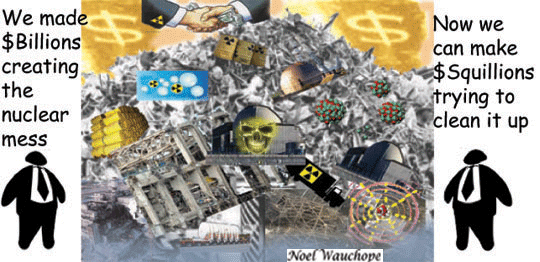
Analysts are monitoring how the companies who did receive funding from the Department of Energy perform as they evolve. Source: The Pittsburgh Post-Gazett
Britain now facing a horror cost in burying its dead nuclear reactors
 Nuclear decommissioning A glowing review Britain is paying dearly for neglecting its nuclear waste, The Economist, Apr 5th 2014 SWILLING around murky ponds in the oldest part of Sellafield, a nuclear research and reprocessing centre in Cumbria, is a soupy, radioactive sludge. For years boffins working on Britain’s first military and civil nuclear programmes abandoned spent fuel and other nastiness into the pools and tanks, which now grow decrepit. Though perhaps not the “slow-motion Chernobyl” which some environmental campaigners make out, the site is subject to one of the most complex nuclear clean-ups in the world.
Sellafield is the trickiest of several challenges facing the Nuclear Decommissioning Authority (NDA), a government body that manages the contractors who swab out Britain’s defunct facilities. Their projects swallow up about two-thirds of the budget of the Department of Energy and Climate Change; Sellafield alone costs £1.7 billion ($2.8 billion) a year, almost as much as the roughly £2 billion spent subsidising renewable energy in 2013. On March 31st NDA awarded a £7 billion contract to decommission 12 more of Britain’s oldest reactor sites over 14 years to a consortium including Babcock, a British engineering firm, and Fluor, an American one.These big sums reflect problems peculiar to Britain. It ploughed into nuclear bomb-making in the 1940s, and nuclear power in the 1950s, with little plan for how contaminated structures would be dealt with. …….
Entergy’s dilemma – can’t afford to decommission uneconomic Vermont Nuclear Plant
Vermont Nuclear Plant Seeks Decommission But Lacks Funds, Clean Technica 3 April 14, On Friday, the Vermont Public Service Board voted to authorize Entergy Nuclear Operations, Inc., the operators of the Vermont Yankee electricity generating station at 546 Governor Hunt Rd. in Vernon, to close down their nuclear power plant by the end of this year. Because Entergy planned to shut the Vermont nuclear plant down prior to its licensed end-term, the board was required to approve the shutdown……..
Another remaining issue is a 12-year-old National Pollutant Discharge Elimination Systempermit that has been under review by the Vermont Agency of Natural Resources for the past eight years. Continued discharges of warm water into the Connecticut River appear to have adversely affected water quality downstream and altered ecological systems in the watershed.
Entergy has reserved just over $600 million to date for decommissioning the Vermont nuclear plant, according to the Department of Public Service. This amount will not be adequate to meet the costs of full deconstruction, estimated at more than $1 billion according to the company’s 2012 Decommissioning Cost Analysis report.
The company has pledged to put $25 million toward site restoration after decommissioning the plant. However, presumably, the pledge would be moot if Entergy cannot totally decommission the plant.
“That $400 million gap raises issues about where the money will come from to dismantle the plant safely,” MassLive editorializes. http://cleantechnica.com/2014/04/02/vermont-nuclear-plant-seeks-decommission-lacks-funds/
UK awards lucrative nuclear clean-up job to Babcock and Fluor
Babcock wins UK nuclear clean-up deal, Guardian UK, British engineering contractors and US group Fluor given £7bn contract covering sites such as Hinkley, Sizewell and Dungeness Britain has awarded a 14-year, £7bn contract to manage the decommissioning of its nuclear sites to engineering contractors Babcock and US group Fluor. The deal covers some of Britain’s oldest nuclear power sites, including Hinkley, Sizewell and Dungeness, and is one of the largest contracts the country has put out to tender.,,,,,,,,
Aside from EnergySolutions and Bechtel, Babcock beat two other consortiums: Serco, Areva and CH2M Hill; and Amec, Atkins and Rolls-Royce in a two-year-long bidding process.
Cavendish Fluor, the joint venture between Babcock-owned subsidiary Cavendish Nuclear and Fluor, will be formally awarded the contract – pending legal approval – on 1 September , after a ten-day mandatory standstill and a five-month transition period.
“Cavendish Fluor Partnership bring a successful track record and extensive nuclear experience that will bring enormous benefits to the decommissioning and clean-up programme,” NDA chief executive John Clarke said………http://www.theguardian.com/business/2014/mar/31/babcock-uk-nuclear-clean-up-contract
Decommissioning – a bonanza for nuclear firms
Government set to award £7bn nuclear decommissioning contract http://www.ft.com/intl/cms/s/0/7a4ee910-b7fa-11e3-92f9-00144feabdc0.html By Gill Plimmer 31 March 14, A private sector consortium will be told on Monday it has won the £7bn job of decommissioning Britain’s oldest nuclear power plants.
The work is one of the largest and most sensitive public sector contracts to be awarded in the UK so far. The reactors, built in the 1960s originally to produce plutonium to make nuclear weapons, include those at Sizewell, Hinkley and Dungeness. They are now at the end of their lives and the government is preparing to decommission them this year. The overall contract is worth about £7bn over 14 years.
The Nuclear Decommissioning Authority, the government-funded body responsible for Britain’s state-owned nuclear sites, started the competition two years ago, and work is expected to start in September.
Currently the sites are being run by Magnox, a company owned by Salt Lake City-based EnergySolutions. It is bidding for the new work in partnership with Bechtel. The only Magnox station still in use is in Wylfa in Anglesey, though this is due to stop producing electricity in the next two years.
The contract covers Britain’s 10 reactors as well two old nuclear research sites in Oxfordshire and Dorset. The oldest nuclear power plant, Calder Hall in Cumbria, was the world’s first commercial scale nuclear reactor and was opened by the Queen in 1959 before it closed a decade ago.
The incumbent Magnox is competing against consortiums made up of Amec, Atkins and Rolls-Royce; CH2M Hill, Areva and Serco; and Babcock and Fluor. The clean-up contract that the companies hope to take over employs about 3,000 workers on the 12 ageing nuclear sites across the country.
Unions are concerned that awarding the company to an overseas consortium willerode Britain’s nuclear expertise.
“The reality is the way we are breaking up our nuclear industry will go down as another Great British missed opportunity,” Gary Smith, a GMB spokesman said. “Britain was a world leader in nuclear. Successive governments have hived off our nuclear industry piecemeal. There is absolutely no strategy around nuclear which reflects the fact that wider energy policy is a mess.”
Vermont nuclear decommissioning may be a model for other States
State Involvement Key for Decommissioning Old Nuclear Plants, Nasdaq, By Oilprice.com, January 03, 2014 The beginning of 2014 marks the final year of operation for the Vermont Yankee Nuclear Power Plant, ending a contentious battle between the state and the plant’s owner. On December 23, Entergy (ETR) and the state of Vermont announced a deal that will end all litigation surrounding the plant’s operation, shut down the plant at the end of 2014, and lead to a compressed schedule to study decommissioning.
The conflict started when Entergy sought a 20-year license renewal to keep the Yankee plant operating into the 2030’s. Vermont, however, requires approval from the state legislature for license renewal, the only state in the country that does so. Yet Entergy sued the state, arguing that authority over nuclear license renewals rests only with the Nuclear Regulatory Commission (NRC), and that federal authority trumps state authority.
Although a series of court decisions affirmed Entergy’s position, the company ultimately decided to close the plant anyway, largely due the inability to compete with cheap natural gas. In August 2013 it announced that it would cease operations at the end of 2014…….
The deal to close Vermont Yankee does offer a useful model for decommissioning as it tackles some of the key areas of conflict between the industry and the areas in which it operates. Entergy agreed to complete adecommissioning study in one year, much quicker than the four years allotted for by the NRC. It also agreed to move nuclear waste from onsite pool storage into dry casks within seven years, even though the NRC allows the company to keep waste in pools for sixty years. The deal also calls for Entergy to pay millions of dollars to the state for economic development for the county in which Vermont Yankee is located.
One of the interesting features of the deal is that it allowed for active involvement of the state in shaping the path towards decommissioning and waste disposal, which is often absent elsewhere. To be sure, huge question marks remain, including how the state will make up for the shortfall in electricity generation, and where funding for decommissioning will come from. But, the U.S. has thus far failed to implement a strategy to decommission old nuclear power plants. And with most of the 100 or so nuclear power plants obtaining 20-year license renewals, that conversation has been pushed off into the future. The Vermont Yankee deal, while incomplete, does offer lessons for decommissioning. http://www.nasdaq.com/article/state-involvement-key-for-decommissioning-old-nuclear-plants-cm315680#ixzz2pRYlLxGz
Decommissioning problems with Vermont Yankee Nuclear reactor
RECAP 2013: VERMONT YANKEE, RENEWABLE ENERGY CAPS AND WIND PROJECTS STIR CONTROVERSY HTTP://VTDIGGER.ORG/2013/12/29/RECAP-2013-VERMONT-YANKEE-RENEWABLE-ENERGY-CAPS-WIND-PROJECTS-STIR-CONTROVERSY/ JOHN HERRICK DEC. 29, 2013 VERMONT YANKEE, THE STATE’S ONLY NUCLEAR REACTOR, DOMINATED HEADLINES THIS YEAR.
Entergy Corp., the company that runs the reactor, is plagued by financial problems, and operating the Vermont plant was an expense it could no longer afford. In late August, Entergy announced it would close the plant, ironically just days after the Louisiana corporation won a long-running court battle with the state over the right continue operating the Vernon facility for an additional 20 years.
Entergy amended its application with the Public Service Board and is now seeking a one year license to operate the plant through the end of 2014, when Vermont Yankee is slated to close.
The board held off from ruling on the relicensure case at the request of the Shumlin administration while state officials settled differences over decommissioning, the economic impact of the plant closure, hot water discharges into the Connecticut River and a generation tax.
Many of those issues were resolved when the state and Entergy reached an agreement last week that sets a decommissioning completion date of 10 to 15 years, decades sooner than required by the federal Nuclear Regulatory Commission’s 60-year timeframe. Entergy also agreed to pay millions of dollars in payments to the state in tax revenues and in support for regional economic development efforts. In addition, the agreement settled all pending federal litigation.
The settlement is contingent on the Public Service Board approving the plant’s certificate of public good before March 31, 2014.
There are other outstanding issues that have yet to be resolved. The two parties disagree over whether Entergy’s Decommissioning Trust Fund is sufficient to support decommissioning. In addition, the state and the company do not yet have a common understanding of how the site will be restored. Entergy must file a decommissioning plan with the NRC after the plant is closed.
The state is concerned that the 42-year old merchant plant’s worsening financial foundation could compromise the operational safety of the facility in the near term and the decommissioning process over the long haul.
It is unclear what the plant will do with 530 tons of radioactive waste stored on the premises. Vermont Yankee has 3,879 fuel rod assemblies submerged in a spent fuel pool that was originally designed to hold about 350. Spent fuel rods must be kept under water to prevent them from igniting, but once they are cooled, they can be transferred into long-term cement “dry casks.” Vermont Yankee will need 58 casks in all. Right now, the facility has 13. Each cask costs about $1 million.
The agreement requires that all the spent nuclear fuel stored on site pools be placed in dry cask storage, which Gov. Peter Shumlin said could take up to seven years.
Entergy’s decision to close Vermont Yankee was the result of declining wholesale market prices and competition with natural gas. Merchant plants are investor-funded; early this year a Swiss financial services firm UBS Securities downgraded Entergy Corp.’s stock and urged investors to sell.
The downgrade came on the heels of a report by UBS Securities that found Entergy “is unlikely to generate any meaningful cash” from wholesale commodities in 2013 and 2014.
Entergy’s nuclear fleet includes the Pilgrim Nuclear Power Station in Massachusetts, Vermont Yankee in Vermont, Indian Point Energy Center and the James A. Fitzpatrick Nuclear Power Plant in New York, and the Palisades Power Plant in Michigan.
1 This Month





PLEASE OPPOSE HR 8255 AND S.3639 – bills would accelerate satellite deployment, with no environmental review or safeguards – https://ncstd5li.quorum.us/campaign/169331/
To see nuclear-related stories in greater depth and intensity – go to https://nuclearinformation.wordpress.com
-
Archives
- October 2026 (49)
- September 2026 (339)
- August 2026 (330)
- July 2026 (355)
- June 2026 (287)
- May 2026 (306)
- April 2026 (356)
- March 2026 (251)
- February 2026 (267)
- January 2026 (308)
- December 2025 (358)
- November 2025 (359)
-
Categories
- 1
- 1 NUCLEAR ISSUES
- business and costs
- climate change
- culture and arts
- ENERGY
- environment
- health
- history
- indigenous issues
- Legal
- marketing of nuclear
- media
- opposition to nuclear
- PERSONAL STORIES
- politics
- politics international
- Religion and ethics
- safety
- secrets,lies and civil liberties
- spinbuster
- technology
- Uranium
- wastes
- weapons and war
- Women
- 2 WORLD
- ACTION
- AFRICA
- Atrocities
- AUSTRALIA
- Christina's notes
- Christina's themes
- culture and arts
- Events
- Fuk 2022
- Fuk 2023
- Fukushima 2017
- Fukushima 2018
- fukushima 2019
- Fukushima 2020
- Fukushima 2021
- general
- global warming
- Humour (God we need it)
- Nuclear
- RARE EARTHS
- Reference
- resources – print
- Resources -audiovicual
- Weekly Newsletter
- World
- World Nuclear
- YouTube
-
RSS
Entries RSS
Comments RSS

