|
Nuclear Plants Go Belly Up in Democratic Districts. Then What?, ROLL CALL, Jeremy Dillon, 22 Oct 18 Most declining plants are in blue areas, and Congress is taking notice In Vermont, the relationship between the town of Vernon and its nuclear power plant, known as the Vermont Yankee Nuclear Power Station, had always been contentious.From 1970s-era antinuclear protests to more recent legal battles over a proposal to extend the plant’s license, Vermont residents and their state legislature kept a skeptical eye on the power source, which at one point provided some 70 percent of the state’s electricity.
Still, when New Orleans-based Entergy announced in 2014 that it would close the plant by the end of the year and ahead of its intended closure in the 2030s, there wasn’t much celebration. Instead the community’s focus turned almost immediately to ensuring the plant was decommissioned as quickly and as safely as possible.
But as folks in Vernon and other communities across the country have learned as more nuclear plants reach the end of their operating lives, state and local governments have little legal or regulatory say over how companies approach the cleanup and radioactive legacy of their local nuclear power plants.
Adding to the tensions, federal regulators at the Nuclear Regulatory Commission are perceived in some of these communities as overly deferential to plant operators, though those decisions are backed by risk analysis.
“You have no control,” said Chris Campany, executive director of the Windham Regional Commission in Brattleboro, Vermont. “There’s an illusion of engagement, but it’s really only between the operator and the NRC.”
In the case of Vermont, which passed a state law requiring a citizen’s advisory panel, Entergy and citizens engaged in a public dialogue that did introduce more transparency into the process but ultimately resulted in little say for the community, according to the former chairwoman of the panel, Brattleboro resident Kate O’Connor.
“It was really frustrating,” O’Connor said. “You come to the realization that there really are no rules for decommissioning.”
Those complaints have registered with Vermont’s congressional delegation. “The people of Vernon, Vermont, have been knocking on the NRC’s doors trying to make sure they have a seat at the table,” said Rep. Peter Welch, a Democrat from the state. Communities should have a right to that input, he said. “Every community going through this is facing these concerns.”
The concerns — including how quickly plants are required to be torn down, how the owners pay for the cleanup and even enforcement of safety regulations — have lawmakers in Congress increasingly paying attention to the decommissioning process and the NRC’s role in it as the number of communities hosting shuttered or shuttering plants grows……..
The act of decommissioning a nuclear plant carries its own issues, such as the fact that almost every part of the plant has some level of radiological exposure that can harm humans. That means materials like cement and steel must be handled cautiously and go to landfills set aside for radioactive waste.
“Decommissioning is a gigantic industrial cleanup of huge industrial facilities that have a singular item, nuclear waste, that makes it more complicated and challenging than almost any other industrial cleanup,” said Geoffrey Fettus, a senior attorney with the Natural Resources Defense Council, at a congressional briefing this summer.
But radiation in concrete or worker clothing has a shorter half-life than the spent nuclear fuel sitting in pools on the site. For some of the isotopes in steel and concrete, the radioactivity decreases significantly after 50 years compared to the tens of thousands of years for the spent fuel……. https://www.rollcall.com/news/policy/nuclear-plants-democratic-districts-then-what
|
|
October 23, 2018
Posted by Christina Macpherson |
decommission reactor, politics, USA |
Leave a comment

 Shikoku outlines plans for decommissioning Ikata 2, WNN, 17 October 2018
A decommissioning plan for unit 2 of the Ikata nuclear power plant in Japan’s Ehime prefecture has been submitted to the country’s nuclear regulator by plant owner Shikoku Electric Power Company………
According to the plan, decommissioning of Ikata 2 will take about 40 years and will be carried out in four stages. The first stage, lasting about ten years, will involve preparing the reactor for dismantling (including the removal of all fuel and surveying radioactive contamination), while the second, lasting 15 years, will be to dismantle peripheral equipment from the reactor and other major equipment. The third stage, taking about eight years, will involve the demolition of the reactor itself, while the fourth stage, taking about seven years, will see the demolition of all remaining buildings and the release of land for other uses.
During the first stage, all fuel is to be removed from the unit. This includes 316 used fuel assemblies that will be sent for reprocessing and 102 fresh fuel assemblies that will be returned to the fuel fabricator.
Ikata 2 became the ninth operable Japanese reactor to be declared for decommissioning since the Fukushima Daiichi accident.
In mid-March 2015, the Ministry of Economy, Trade and Industry’s Agency for Natural Resources and Energy revised the accounting provisions in the Electricity Business Act, whereby electric power companies can now calculate decommissioning costs in instalments of up to ten years, instead of one-time as previously. This enhanced cost recovery provision was to encourage the decommissioning of older and smaller units.
Shikoku decided in March 2016 to decommission unit 1 of the Ikata plant, also a 538 MWe PWR, which began commercial operation in September 1977. That unit had been taken offline in September 2011 for periodic inspections. Upgrades costing more than JPY170 billion (USD1.5 billion) would have been needed at the unit in order for it to operate beyond 40 years.
The NRA approved Shikoku’s decommissioning plan for Ikata 1 in June 2017. That plan also sees the unit being decommissioned in four stages over a 40-year period.
Unit 3 at the Ikata plant was given approval by the NRA to resume operation in April 2016, having been idle since being taken offline for a periodic inspection in April 2011. Shikoku declared the 846 MWe pressurised water reactor back in commercial operation on 7 September 2016. However, in December 2017, a Japanese high court ordered the suspension of the unit’s operation. The injunction was effective until the end of last month. The Hiroshima High Court in late September accepted Shikoku’s appeal and cancelled the injunction, allowing the utility to begin the process of restarting the reactor. http://world-nuclear-news.org/Articles/Shikoku-outlines-plans-for-decommissioning-Ikata-2
October 18, 2018
Posted by Christina Macpherson |
decommission reactor, Japan |
Leave a comment
The Sandpaper.net, Gina G. Scala, ggscala@thesandpaper.net, Oct 17, 2018 Less than a month after submitting a license renewal application to the Nuclear Regulatory Commission, Holtec International Inc., a New Jersey-based company known globally for its used nuke fuel management technologies and interested in purchasing the Oyster Creek Nuclear Generating Station from its current owners, submitted a revised report outlining its decommissioning plans for the plant.The Holtec Post-Shutdown Decommissioning Activities Report will be reviewed separately from the license transfer application, according to Neil Sheehan, public information officer for the NRC Region 1 office. The license transfer provides information on how and why the company is financially and technically capable of handling the Oyster Creek decommissioning as well as managing the spent nuclear fuel storage onsite for the foreseeable future, he said. In their joint license renewal application, the two companies requested that the NRC adhere to a schedule to help meet a May 1, 2019, deadline for its decision on ownership……..
The revised PSDAR, submitted Sept. 28, highlights the accelerated schedule for the prompt decommissioning of Oyster Creek and the unrestricted release of the site, with the exclusion of the Independent Spent Fuel Storage Installation, or spent fuel pad, on site.
“This DECON PSDAR is contingent upon NRC approval of the LTA (license transfer application), completion of transfer of the licenses and asset sale closure. If the licenses are not transferred, this DECON PSDAR will be ineffective, and the May 21, 2018 PSDAR submitted by Exelon Generation will remain in effect,” according to the revised PSDAR. “Exelon Generation has reviewed the contents of this letter and is aligned.”
The Master Summary Schedule is based on the assumptions that the licenses are transferred to Holtec in July 2019, according to the report.
From the beginning, Holtec officials have said the company’s preferred method for decommissioning Oyster Creek was a DECON, or decontamination, method, in which equipment, structures and portions of the facility and site that contain radioactive contaminants are promptly removed and decontaminated to a level that permits termination of the license shortly after cessation of operations.
The one timeline change from an Aug. 15 meeting with the NRC and Exelon Generation is the transfer of spent nuclear fuel to the ISFSI. Under the revised PSDAR report, that activity is slated to be finalized in 2023, providing for the complete dismantlement of the reactor and turbine buildings. Radiological decommissioning, according to the revised plan, is expected to be completed by 2024. That would allow full release of the Route 9 site, located on 779 acres of land in the Forked River section of Lacey Township, with the except of the spent fuel pad.
In August, Holtec’s expedited timeline called for this process to begin with still-hot spent fuel being moved sometime next year and a 2021 completion date, with a full removal from the site by 2034 and full license termination by 2035.
“The Oyster Creek spent fuel is projected to be accepted by the DOE (Department of Energy) for shipment away from the Oyster Creek site in the years 2034 and 2035,” according to the revised report. “Spent fuel storage operations continue at the site, independent of decommissioning operations, until the transfer of the fuel to the DOE is complete. At that time, the ISFSI is decommissioned and the site released for unrestricted use.”
The NRC is currently reviewing applications for two potential interim sites to house spent nuclear fuel, one in Texas and the other in New Mexico. In the meantime, the only option for U.S. nuclear power plants is to store spent fuel from the reactor vessel on site.
Just last month, the deadline to request a public hearing on Holtec International’s interim repository in New Mexico closed. However, there is still time to request a public hearing for a similar spent fuel facility in West Texas. That window closes Oct. 29. The federal agency resumed reviewing the application after it received two letters, dated June 8 and July 19, from Interim Storage Partners, a joint venture between Waste Control Specialists and Orano CIS LLC. ……. https://thesandpaper.villagesoup.com/p/would-be-nuclear-plant-owner-submits-revised-decommissioning-plan-for-oyster-creek/1784585
October 18, 2018
Posted by Christina Macpherson |
decommission reactor, USA |
Leave a comment
Shutdown of N.J. power plant continues with removal of nuclear fuel https://www.nj.com/ocean/index.ssf/2018/09/shutdown_of_nj_nuclear_plant_continues_with_remova.html Sep 27 The Associated Press
The owner of what was considered to be America’s oldest nuclear power plant until its shutdown last week says it has removed the nuclear fuel from the reactor.
Chicago-based Exelon Corp. has notified the U.S. Nuclear Regulatory Commission that it removed the last of the fuel rods from the Oyster Creek Nuclear Generating Station on Tuesday.
The material was placed into a spent fuel pool where it will cool down for at least two years.
The fuel eventually will be placed into sealed concrete casks for longer-term storage on the grounds of the former plant in Lacey Township in New Jersey.
A Jupiter, Florida company, Holtec International, plans to buy the plant and move the fuel to an interim disposal site it is proposing in New Mexico.
September 28, 2018
Posted by Christina Macpherson |
decommission reactor, USA |
Leave a comment
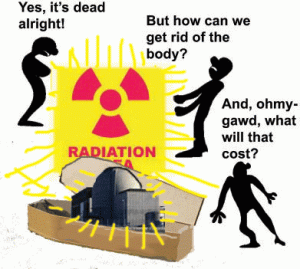 Congress looking for money for cities hit by nuclear plant closures — including Diablo Canyon,The Tribune BY KAYTLYN LESLIE, kleslie@thetribunenews.com, September 17, 2018
Congress wants to find money to support communities where nuclear power plants are being decommissioned — which could mean some funding for San Luis Obispo County once Diablo Canyon starts the process itself in the coming years.
Congressman Salud Carbajal announced Monday that Congress directed the U.S. Department of Energy to study public and private funding sources available to help those communities, as part of its Fiscal Year 2019 Energy and Water, Legislative Branch and Military Construction and Veterans Affairs Appropriations Act (HR 5895).
“With the impending Diablo Canyon Power Plant closure, I am working to secure all available federal resources to help offset the economic impact of this decommissioning,” Carbajal said in a news release. Carbajal, a Democrat, represents California’s 24th Congressional District, which spans between San Luis Obispo and Ventura counties.
The Department of Energy study will focus on identifying public and private funds to support municipalities where a nuclear power plant is decommissioned, in the process of decommissioning or plans to shut down within three years of the act’s enactment, and contains nuclear waste within its boundaries, according to the news release.
The bill passed both the House of Representatives and the Senate and is set to be signed into law by President Donald Trump sometime before the end of the fiscal year, Sept. 30……. https://www.sanluisobispo.com/news/local/article218563600.html
September 18, 2018
Posted by Christina Macpherson |
decommission reactor, USA |
Leave a comment
Army Corps of Engineers Dismantles Former Floating Nuclear Plant in Galveston https://www.houstonpublicmedia.org/articles/news/2018/09/18/304524/corps-of-engineers-dismantles-former-floating-nuclear-plant-in-galveston/More than 1.5 million pounds of radioactive waste have been safely removed from the USS Sturgis’ nuclear reactor
SEPTEMBER 18, 2018, HE
U.S. ARMY CORPS OF ENGINEERS HAS ANNOUNCED THAT A FORMER FLOATING NUCLEAR PLANT IN GALVESTON HAS BEEN DISMANTLED.
More than 1.5 million pounds of radioactive waste have been safely removed from the USS Sturgis’ nuclear reactor. Additionally, more than 600,000 pounds of lead from the vessel have been recycled.
The removal process has taken three years and the Corps said decommissioning the Army’s first and only floating nuclear reactor prototype is now complete.
The World War II vessel was converted into a barge-mounted nuclear reactor in the 1960s.
The Galveston Daily News reported the ship will be towed to Brownsville later this month, where it will be scrapped.
September 18, 2018
Posted by Christina Macpherson |
decommission reactor |
Leave a comment
 America’s Oldest Operating Nuclear Power Plant to Retire on Monday OilVoice Press – OilVoice 14-Sep-2018 The Oyster Creek Nuclear Generating Station, located 50 miles east of Philadelphia in Forked River, New Jersey, is scheduled to retire on Monday, September 17. The plant first came online on December 1, 1969, making it the oldest commercially operated nuclear power plant in the United States. Oyster Creek was previously expected to retire on December 31, 2019, but its retirement was accelerated by more than a year to coincide with the plant’s fuel and maintenance cycle…………
Oyster Creek will be the sixth nuclear power plant to retire in the past five years. After Oyster Creek’s retirement, the United States will have 98 operating nuclear reactors at 59 plants. Twelve of these reactors, with a combined capacity of 11.7 gigawatts, are scheduled to retire within the next seven years.
Oyster Creek is one of four nuclear power plants—along with Palisades Power Plant, Pilgrim Nuclear Power Station, and Three Mile Island Nuclear Generating Station—that have planned retirement dates more than a decade before their operating licenses expire. Economic factors have played a significant role in decisions to continue operating or to retire nuclear power plants, as increased competition from natural gas and renewables has made it increasingly difficult for nuclear generators to compete in electricity markets……..
According to Exelon, Oyster Creek will undergo a six-step decommissioning process. The typical decommissioning period for a nuclear power plant is about 60 years, so parts of the Oyster Creek plant structure could remain in place until 2075. …..https://oilvoice.com/Opinion/22263/Americas-Oldest-Operating-Nuclear-Power-Plant-to-Retire-on-Monday
September 14, 2018
Posted by Christina Macpherson |
decommission reactor, USA |
Leave a comment

 Eureka 10th Sept 2018 , The cover story of Eureka’s September issue looks at the programme to
decommission the UK’s legacy nuclear power plant, with particular
emphasis on the opportunities this creates for engineering innovation. The
reasons for this are clear: radioactive environments represent some of the
most challenging engineering scenarios possible, with extended human
presence in them simply not feasible. This means that robotics have a
massive role to play and it is these solutions that are attracting much
investment.
What many may not understand is just how massive an undertaking
this decommissioning programme is. Decommissioning across 17 nuclear sites
will take more than a century and involve the expenditure of an estimated
£118 billion pounds over that period. Clearly this offers considerable
scope for investment in and applications of new technologies. The Nuclear
Decommissioning Authority currently offers significant funding for the
right solutions. With that in mind, it would seem a good time for the
UK’s design engineers to step up.
http://www.eurekamagazine.co.uk/design-engineering-blogs/the-decommissioning-dividend-1/182843/
September 12, 2018
Posted by Christina Macpherson |
decommission reactor, UK |
Leave a comment
Nuclear fuel removal to start at Monju reactor NHK, 28 Aug 18 The operator of Japan’s Monju prototype fast-breeder reactor plans to soon start removing its nuclear fuel from a storage container as part of the plant’s decommissioning.
The Japan Atomic Energy Agency plans to scrap the reactor in Tsuruga City in Fukui Prefecture, central Japan, over 30 years.
Work to move the fuel to a detached storage pool was to start in late July. But it was postponed due to equipment trouble including fogging up of monitoring camera lenses during trials.
The work is now to start on Thursday……..https://www3.nhk.or.jp/nhkworld/en/news/20180828_33/
August 29, 2018
Posted by Christina Macpherson |
decommission reactor, Japan |
Leave a comment
Energy Voice 20th Aug 2018, The site of Britain’s worst nuclear accident is to be dismantled as part
of the wider decommissioning of the Sellafield nuclear plant. The planned
demolition of the 360 foot structure will begin later this year. A giant
crane has been constructed to bring it down. The 152m crane is the tallest
structure ever built at Sellafield, just six metres shorter than the
Blackpool Tower. It will begin work this autumn, removing and lowering
chunks of the chimney cut out using diamond wire saws. Duncan Thompson, the
Nuclear Decommissioning Authority’s Sellafield Programme director, said:
“The complex task of decommissioning and demolishing the Windscale Pile
One Stack has reached an important stage. It is another example of the
ingenuity that goes into solving the UK’s decommissioning problems.
https://www.energyvoice.com/otherenergy/nuclear/179544/watch-sellafield-nuclear-chimney-to-be-demolished/
August 24, 2018
Posted by Christina Macpherson |
decommission reactor, UK |
Leave a comment
The JAEA will launch actual fuel removal operations this month if it finds the work can be conducted safely. It was initially planned to begin late last month but was postponed after problems plagued the equipment test.
In the final exercise, control rods instead of real fuel assemblies will be removed from a container filled with sodium coolant by using the aforementioned equipment. The rods will be then packed in cans after the sodium is rinsed off and transported to a water-filled pool.
It has not been decided when the exercise will end, the agency said.
The decommissioning process for the glitch-riddled Monju is slated to take 30 years.
In the first phase, 530 assemblies in the reactor and a storage container outside the reactor will be moved to the water pool by December 2022. The JAEA has so far transferred only two fuel assemblies to the pool — one in 2008 and the other in 2009.
August 20, 2018
Posted by Christina Macpherson |
decommission reactor, Japan, reprocessing |
Leave a comment
 FirstEnergy takes “unwelcome” step towards plant closures, WNN, 16 August 2018
FirstEnergy Solutions Inc (FES) has taken its next step towards the closure of three nuclear power plants, filing plans related to the decommissioning with the US Nuclear Regulatory Commission (NRC). The Beaver Valley, Davis-Besse and Perry plants are scheduled to close during the next three years unless legislative policy solutions can be found to keep them operating.
The company on 15 August said it had filed with the NRC details of the training programme for the professionals who will supervise the removal and on-site storage of fuel from the plants after their shut-down.
“Today’s NRC submission is a necessary milestone for us but not a welcome one,” Don Moul, FES president and chief nuclear officer, said………. A solution must be reached by mid-2019, when FES must either purchase the fuel required for Davis-Besse’s next refuelling or proceed with the shutdown. http://www.world-nuclear-news.org/Articles/FirstEnergy-takes-unwelcome-step-towards-plant-clo
August 17, 2018
Posted by Christina Macpherson |
decommission reactor, USA |
Leave a comment

Courthouse News 8th Aug 2018 , Southern California residents packed a California State Lands Commission
meeting Tuesday night to protest the plan to demolish the shuttered San
Onofre Nuclear Generating Station.
The SONGS nuclear power plant closed in
2012 after reactor coolant leaked from an 11-month-old steam generator,
leaking 82 gallons of radioactive coolant a day. Edison alerted the public
to a “possible leak” on Jan. 31, 2012, and on Feb. 17, 2012, responded
to a Nuclear Regulatory Commission report about the leak with confirmation
a “barely measurable” amount of radioactivity was released into the
atmosphere.
The California Coastal Commission issued a permit to SONGS
operator Southern California Edison to store spent nuclear waste in
canisters buried under the beach next to the shuttered power plant. This
year, Edison began burying the spent nuclear waste on the beach and is a
third of the way through burying the 70-plus canisters.
But to complete the entire decommissioning process – including tearing down the twin
buildings which used to house energy operations – the California Coastal
Commission needs to approve a final permit. That permit will not be taken
up by the Coastal Commission until a recently released 706-page
environmental impact report by the California State Lands Commission –
which assesses the environmental impacts of tearing down SONGS – gets
approved.
It outlines the components and structures proposed to be taken
down in a way to reduce radioactivity and impacts on the environment. Among
significant “unavoidable impacts” outlined in the EIR, however, are
potential release of radiological materials and impacts on air quality. The
majority of speakers from a group of more than 100 people at Tuesday’s
meeting said those “unavoidable impacts” are unacceptable.
https://www.courthousenews.com/southern-california-residents-protest-nuclear-plant-demolition-plans/
August 11, 2018
Posted by Christina Macpherson |
decommission reactor, USA |
Leave a comment
The U.S. Navy Is Having a Hell of a Time Dismantling the USS Enterprise https://www.popularmechanics.com/military/navy-ships/a22690208/us-navy-dismantling-uss-enterprise-nuclear-disposal/
Nobody has ever disposed of a nuclear-powered aircraft carrier before. Turns out it’s not easy. By Kyle Mizokami Aug 10, 2018
Six years after decommissioning USS Enterprise, the world’s first nuclear-powered aircraft carrier, the U.S. Navy is still figuring out how to safely dismantle the ship. The General Accounting Office estimates the cost of taking apart the vessel and sending the reactors to a nuclear waste storage facility at up to $1.5 billion, or about one-eighth the cost of a brand-new aircraft carrier.
The USS Enterprise was commissioned in 1961 to be the centerpiece of a nuclear-powered carrier task force, Task Force One, that could sail around the world without refueling. The fleet was a symbol of the Navy’s global reach and its nuclear future. During its 51 years in operation, the Enterprise served in the Cuban Missile Crisis blockade, the Vietnam War, and the wars in Afghanistan and Iraq.
The Navy decommissioned Enterprise in 2012 (don’t worry, the third carrier of the new Gerald R. Ford class will be named Enterprise, so the name will live on) and removed the fuel from the eight Westinghouse A2W nuclear reactors in 2013. The plan was to scrap the ship and remove the reactors, transporting them by barge from Puget Sound Naval Base down the Washington Coast and up the Columbia River, then trucking them to the Department of Energy’s Hanford Site for permanent storage.
However, after decommissioning the cost of disposing of the 93,000-ton ship soared from an estimated $500-$750 million to more than a billion dollars. This caused the Navy to put a pause on disposal while it sought out cheaper options. Today the stripped-down hull of the Enterprise sits in Newport News, Virginia awaiting its fate.
Now, according to a new General Accounting Office report (PDF), the Navy has two options. The first is to have the Navy manage the job but let the commercial industry do the non-nuclear work. The Navy would allow industry to scrap the non-nuclear parts of the ship but preserve a 27,000-ton propulsion space containing the reactors. The propulsion space would then be transported to Puget Sound Naval Base, where the reactors would be removed and sent to Hanford. This is the most expensive option, costing a minimum of $1.05 billion up to $1.55 billion and taking 10 years to complete, starting in 2034.
The second option: let commercial industry do everything, with a reactor storage location to be determined. This would cost $750 million to $1.4 billion and would take 5 years to complete, starting in 2024. In either event, most of the ship gets turned into razor blades and flatware. (By comparison, a squadron of 10 F-35C Joint Strike Fighters costs $1.22 billion, and a brand new Burke-class guided missile destroyer costs $1.7 billion.)
The GAO report paints the commercial option as faster and cheaper, though there are a number of unknowns. Nobody knows where the hull will be dismantled under the commercial plan, nor where the reactors would be sent. Although the Navy believes disposing of the reactors will be fairly straightforward, no one has dismantled a nuclear-powered carrier before.
Compounding the issue is a “not my problem” intergovernmental dispute. The Naval Nuclear Propulsion Program, the arm of the Navy concerned with nuclear power, says the federal Nuclear Regulatory Commission could oversee a commercial effort. But the NRC says Navy nuclear reactors are not its job. It’s not clear exactly why NNPP doesn’t want the job, although it currently has a backlog of 10 submarine reactors and two cruiser reactor to deal with (which is probably why a Navy effort won’t start until 2034). Ultimately, according to the GAO, it may take Congress to make a decision.
Whatever the Navy ends up doing, this will only be the first of many nuclear-powered carrier disposals. USS Nimitz is set to retire within the next ten years, and there are ten ships in the class. These will age out every four or five years for the next forty years, and each has two reactors. The Navy must get Enterprise’s teardown right, because the orders are going to start stacking up.
Via The Daily Press
August 11, 2018
Posted by Christina Macpherson |
decommission reactor, USA, weapons and war |
Leave a comment

 Maldon & Burnham Standard 23rd July 2018 , BRADWELL Power Station has finished treating radioactive waste as it makes another big step towards being decommissioned. Site operator Magnox is now
preparing the site for the 80 year care and maintenance process. The power
station stopped generating electricity in March 2002, after running for 40
years. In a programme spanning seven years, hundreds of thousands of litres
of radioactive resin and sludge has been made ready for interim storage.
The radioactive sludge was collected from the ponds which stored the
site’s spent nuclear fuel during operation. The resins helped with
removing the radioactive content from site’s discharges – making sure
they were kept within safe and permitted levels. Once it had been
retrieved, the waste was treated and packaged in self-shielding ductile
cast iron containers known as yellow boxes, making it suitable for interim
storage in the site’s purpose-built facility.
http://www.maldonandburnhamstandard.co.uk/news/16371458.bradwell-power-station-finishes-treating-radioactive-waste/
July 27, 2018
Posted by Christina Macpherson |
decommission reactor, UK |
Leave a comment