The JAEA will launch actual fuel removal operations this month if it finds the work can be conducted safely. It was initially planned to begin late last month but was postponed after problems plagued the equipment test.
In the final exercise, control rods instead of real fuel assemblies will be removed from a container filled with sodium coolant by using the aforementioned equipment. The rods will be then packed in cans after the sodium is rinsed off and transported to a water-filled pool.
It has not been decided when the exercise will end, the agency said.
The decommissioning process for the glitch-riddled Monju is slated to take 30 years.
In the first phase, 530 assemblies in the reactor and a storage container outside the reactor will be moved to the water pool by December 2022. The JAEA has so far transferred only two fuel assemblies to the pool — one in 2008 and the other in 2009.
FirstEnergy takes “unwelcome” step towards plant closures, WNN, 16 August 2018
FirstEnergy Solutions Inc (FES) has taken its next step towards the closure of three nuclear power plants, filing plans related to the decommissioning with the US Nuclear Regulatory Commission (NRC). The Beaver Valley, Davis-Besse and Perry plants are scheduled to close during the next three years unless legislative policy solutions can be found to keep them operating.
The company on 15 August said it had filed with the NRC details of the training programme for the professionals who will supervise the removal and on-site storage of fuel from the plants after their shut-down.
“Today’s NRC submission is a necessary milestone for us but not a welcome one,” Don Moul, FES president and chief nuclear officer, said………. A solution must be reached by mid-2019, when FES must either purchase the fuel required for Davis-Besse’s next refuelling or proceed with the shutdown. http://www.world-nuclear-news.org/Articles/FirstEnergy-takes-unwelcome-step-towards-plant-clo
Courthouse News 8th Aug 2018 , Southern California residents packed a California State Lands Commission
meeting Tuesday night to protest the plan to demolish the shuttered San
Onofre Nuclear Generating Station.
The SONGS nuclear power plant closed in
2012 after reactor coolant leaked from an 11-month-old steam generator,
leaking 82 gallons of radioactive coolant a day. Edison alerted the public
to a “possible leak” on Jan. 31, 2012, and on Feb. 17, 2012, responded
to a Nuclear Regulatory Commission report about the leak with confirmation
a “barely measurable” amount of radioactivity was released into the
atmosphere.
The California Coastal Commission issued a permit to SONGS
operator Southern California Edison to store spent nuclear waste in
canisters buried under the beach next to the shuttered power plant. This
year, Edison began burying the spent nuclear waste on the beach and is a
third of the way through burying the 70-plus canisters.
But to complete the entire decommissioning process – including tearing down the twin
buildings which used to house energy operations – the California Coastal
Commission needs to approve a final permit. That permit will not be taken
up by the Coastal Commission until a recently released 706-page
environmental impact report by the California State Lands Commission –
which assesses the environmental impacts of tearing down SONGS – gets
approved.
It outlines the components and structures proposed to be taken
down in a way to reduce radioactivity and impacts on the environment. Among
significant “unavoidable impacts” outlined in the EIR, however, are
potential release of radiological materials and impacts on air quality. The
majority of speakers from a group of more than 100 people at Tuesday’s
meeting said those “unavoidable impacts” are unacceptable. https://www.courthousenews.com/southern-california-residents-protest-nuclear-plant-demolition-plans/
Nobody has ever disposed of a nuclear-powered aircraft carrier before. Turns out it’s not easy. By Kyle Mizokami Aug 10, 2018
Six years after decommissioning USS Enterprise, the world’s first nuclear-powered aircraft carrier, the U.S. Navy is still figuring out how to safely dismantle the ship. The General Accounting Office estimates the cost of taking apart the vessel and sending the reactors to a nuclear waste storage facility at up to $1.5 billion, or about one-eighth the cost of a brand-new aircraft carrier.
The USS Enterprise was commissioned in 1961 to be the centerpiece of a nuclear-powered carrier task force, Task Force One, that could sail around the world without refueling. The fleet was a symbol of the Navy’s global reach and its nuclear future. During its 51 years in operation, the Enterprise served in the Cuban Missile Crisis blockade, the Vietnam War, and the wars in Afghanistan and Iraq.
The Navy decommissioned Enterprise in 2012 (don’t worry, the third carrier of the new Gerald R. Ford class will be named Enterprise, so the name will live on) and removed the fuel from the eight Westinghouse A2W nuclear reactors in 2013. The plan was to scrap the ship and remove the reactors, transporting them by barge from Puget Sound Naval Base down the Washington Coast and up the Columbia River, then trucking them to the Department of Energy’s Hanford Site for permanent storage.
However, after decommissioning the cost of disposing of the 93,000-ton ship soared from an estimated $500-$750 million to more than a billion dollars. This caused the Navy to put a pause on disposal while it sought out cheaper options. Today the stripped-down hull of the Enterprisesits in Newport News, Virginia awaiting its fate.
Now, according to a new General Accounting Office report (PDF), the Navy has two options. The first is to have the Navy manage the job but let the commercial industry do the non-nuclear work. The Navy would allow industry to scrap the non-nuclear parts of the ship but preserve a 27,000-ton propulsion space containing the reactors. The propulsion space would then be transported to Puget Sound Naval Base, where the reactors would be removed and sent to Hanford. This is the most expensive option, costing a minimum of $1.05 billion up to $1.55 billion and taking 10 years to complete, starting in 2034.
The second option: let commercial industry do everything, with a reactor storage location to be determined. This would cost $750 million to $1.4 billion and would take 5 years to complete, starting in 2024. In either event, most of the ship gets turned into razor blades and flatware. (By comparison, a squadron of 10 F-35C Joint Strike Fighters costs $1.22 billion, and a brand new Burke-class guided missile destroyer costs $1.7 billion.)
The GAO report paints the commercial option as faster and cheaper, though there are a number of unknowns. Nobody knows where the hull will be dismantled under the commercial plan, nor where the reactors would be sent. Although the Navy believes disposing of the reactors will be fairly straightforward, no one has dismantled a nuclear-powered carrier before.
Compounding the issue is a “not my problem” intergovernmental dispute. The Naval Nuclear Propulsion Program, the arm of the Navy concerned with nuclear power, says the federal Nuclear Regulatory Commission could oversee a commercial effort. But the NRC says Navy nuclear reactors are not its job. It’s not clear exactly why NNPP doesn’t want the job, although it currently has a backlog of 10 submarine reactors and two cruiser reactor to deal with (which is probably why a Navy effort won’t start until 2034). Ultimately, according to the GAO, it may take Congress to make a decision.
Whatever the Navy ends up doing, this will only be the first of many nuclear-powered carrier disposals. USS Nimitz is set to retire within the next ten years, and there are ten ships in the class. These will age out every four or five years for the next forty years, and each has two reactors. The Navy must get Enterprise’s teardown right, because the orders are going to start stacking up.
Maldon & Burnham Standard 23rd July 2018 , BRADWELL Power Station has finished treating radioactive waste as it makes another big step towards being decommissioned. Site operator Magnox is now
preparing the site for the 80 year care and maintenance process. The power
station stopped generating electricity in March 2002, after running for 40
years. In a programme spanning seven years, hundreds of thousands of litres
of radioactive resin and sludge has been made ready for interim storage.
The radioactive sludge was collected from the ponds which stored the
site’s spent nuclear fuel during operation. The resins helped with
removing the radioactive content from site’s discharges – making sure
they were kept within safe and permitted levels. Once it had been
retrieved, the waste was treated and packaged in self-shielding ductile
cast iron containers known as yellow boxes, making it suitable for interim
storage in the site’s purpose-built facility. http://www.maldonandburnhamstandard.co.uk/news/16371458.bradwell-power-station-finishes-treating-radioactive-waste/
Decommissioning nuclear power stations need an “autopsy” to verify and validate safety margins projected for operating reactor license extensions
Summary
The Issue
The Nuclear Energy Institute (NEI), the lead organization for the U.S. commercial nuclear power industry, envisions the industry’s “Bridge to the Future” through a series of reactor license renewals from the original 40-year operating license; first by a 40 to 60-year extension and then a subsequent 60 to 80-year extension. Most U.S. reactors are already operating in their first 20-year license extension and the first application for the second 20-year extension (known as the “Subsequent License Renewal”) is before the U.S. Nuclear Regulatory Commission (NRC) for review and approval. NEI claims that there are no technical “show stoppers” to these license extensions. However, as aging nuclear power stations seek to extend their operations longer and longer, there are still many identified knowledge gaps for at least 16 known age-related material degradation mechanisms (embrittlement, cracking, corrosion, fatigue, etc.) attacking irreplaceable safety-related systems including miles of electrical cable, structures such as the concrete containment and components like the reactor pressure vessel. For example, the national labs have identified that it is not known how radiation damage will interact with thermal aging. Material deterioration has already been responsible for near miss nuclear accidents. As such, permanently closed and decommissioning nuclear power stations have a unique and increasingly vital role to play in providing access to still missing data on the impacts and potential hazards of aging for the future safety of dramatic operating license extensions.
The NRC and national laboratories document that a post-shutdown autopsy of sorts to harvest, archive and test actual aged material samples (metal, concrete, electrical insulation and jacketing, etc.) during decommissioning provides unique and critical access to obtain the scientific data for safety reviews of the requested license extensions. A Pacific Northwest National Laboratory (PNNL) 2017 report concludes, post-shutdown autopsies are necessary for “reasonable assurance that systems, structures, and components (SSCs) are able to meet their safety functions. Many of the remaining questions regarding degradation of materials will likely require[emphasis added]a combination of laboratory studies as well as other research conducted on materials sampled from plants (decommissioned or operating).” PNNL reiterates, “Where available, benchmarking can be performed using surveillance specimens. In most cases, however, benchmarking of laboratory tests will require(emphasis added)harvesting materials from reactors.” In the absence of “reasonable assurance,” it is premature for licensees to complete applications without adequate verification and validation of projected safety margins for the 60 to 80-year extension period.
Decommissioning is not just the process for dismantling nuclear reactors and remediating radioactive contamination for site restoration. Decommissioning has an increasingly important role at the end-of-reactor-life-cycle for the scientific scrutiny of projected safety margins and potential hazards at operating reactors seeking longer and longer license extensions.
The Problem
After decades of commercial power operation,the nuclear industry and the NRC have done surprisingly little to strategically harvest, archive and scientifically analyze actual aged materials. Relatively few samples of real time aged materials have been shared with the NRC. The NRC attributes the present dearth of real time aged samples to “harvesting opportunities have been limited due to few decommissioning plants.” However, ten U.S. reactors have completed decommissioning operations to date and 20 units are in the decommissioning process. More closures are scheduled to begin in Fall 2018. A closer look raises significant concern that the nuclear industry is reluctant to provide access to decommissioning units for sampling or collectively share this cost of doing business to extend their operating licenses.Key components including severely embrittled reactor pressure vessels were promptly dismantled by utilities and buried whole without autopsy. Many permanently closed reactors have been placed in “SAFSTOR,” defueled and mothballed “cold and dark” for up to 50 years without the material sampling to determine their extent of condition and the impacts of aging. Moreover, the NRC is shying away from taking reasonable regulatory and enforcement action to acquire the requested samples for laboratory analysis after prioritizing the need for a viable license extension safety review prior to approval. Meanwhile, the nuclear industry license extension process is pressing forward.
David Lochbaum, a recognized nuclear safety engineer in the public interest with the Union of Concerned Scientists, identifies that nuclear research on the impacts and hazards of age degradation in nuclear power stations presently relies heavily on laboratory accelerated aging—often of fresh materials—and computer simulation to predict future aging performance and potential consequences during license extension. Lochbaum explains that “Nuclear autopsies yield insights that cannot be obtained by other means.” Researchers need to compare the results from their time-compression studies with results from tests on materials actually aged for various time periods to calibrate their analytical models.According to Lochbaum, “Predicting aging effects is like a connect-the-dots drawing. Insights from materials harvested during reactor decommissioning provide many additional dots to the dots provided from accelerated aging studies. As the number of dots increases, the clearer the true picture can be seen. The fewer the dots, the harder it is to see the true picture.”
The Path Forward
1) Congress, the Department of Energy (DOE) and the NRC need to determine the nuclear industry’s fair share of autopsy costs levied through collective licensing fees for strategic harvesting during decommissioning and laboratory analysis of real time aged material samples as intended to benefit the material performance and safety margins of operating reactors seeking license extensions, and;
2) As NRC and the national laboratories define the autopsy’s stated goal as providing “reasonable assurance that systems, structures, and components (SSCs) are able to meet their safety functions” for the relicensing of other reactors, the NRC approval process for Subsequent License Renewal extensions should be held in abeyance pending completion of comprehensive strategic harvesting and conclusive analysis as requested by the agency and national laboratories, and;
3) Civil society can play a more active role in the independent oversight and public transparency of autopsies at decommissioning reactor sites such as through state legislated and authorized nuclear decommissioning citizen advisory panels.
EDF and VEOLIA Conclude a Partnership Agreement on Nuclear Plant Decommissioning and Radioactive Waste Processing, Business Wire June 26, 2018
“We are proud to have signed this agreement with VEOLIA, which underscores EDF’s determination to become a key player in decommissioning and radioactive waste management. This partnership is also tangible evidence of EDF and VEOLIA’s desire to pool their know-how in the interest of developing successful industrial sectors.”
On 26 June 2018, EDF and VEOLIA (Paris:VIE) entered a partnership agreement to co-develop remote control solutions for dismantling gas-cooled reactors (natural uranium graphite gas or UNGG in French) and for vitrifying radioactive waste, in France and worldwide.
EDF is currently decommissioning 6 gas-cooled reactors reactors at Bugey (Ain department in France), Chinon (Indre-et-Loire department) and Saint-Laurent-des-Eaux (Loir-et-Cher). Key milestones have already been secured on all these complex projects, and EDF confirms its objective to dismantle these nuclear facilities in the shortest timeframe possible. Veolia will thus provide EDF with its experience in remote handling technologies (robotics) with a view to designing and delivering innovative solutions to access the cores of gas-cooled reactors and to cut up and extract components under optimum safety and security conditions……..https://www.businesswire.com/news/home/20180626005932/en/EDF-VEOLIA-Conclude-Partnership-Agreement-Nuclear-Plant
Decommissioning NO2Nuclear Power. Safe Energy Journal 78 The UK government has launched a consultation on the future regulation of nuclear sites in the final stages of decommissioning and clean-up. The Department for Business, Energy and Industrial Strategy (BEIS) said the consultation seeks to enable a “more flexible approach that can optimise waste management, thereby realising environmental benefits and reducing costs”.
Of the 36 nuclear sites located across England, Wales and Scotland, the Nuclear Decommissioning Authority (NDA) is responsible for the decommissioning and clean-up of 17. Other sites to be decommissioned in the future include the operational nuclear power stations owned by EDF Energy, and other nuclear sites in the nuclear fuel cycle, reprocessing, waste management, pharmaceutical and research sectors.
In the UK, the Nuclear Installations Act 1965 (NIA65) provides the legal framework for nuclear safety and nuclear third-party liability and sets out a system of regulatory control based on a robust licensing process administered by the Office for Nuclear Regulation (ONR). Under this regime, a site operator is required to have a licence to use a site for specified activities such as the operation of nuclear power stations. In addition to the nuclear site licensing regime, the NIA65 requires that financial provision is in place to meet claims in the event of a nuclear incident, as required under international law on nuclear third-party liability.
The consultation proposals include changing the NIA65 to allow licensees to exit the licensing regime once the site has reached internationally agreed standards and nuclear safety and security matters have been fully resolved. After the licence has been ended, the site would be regulated by the relevant environment agency and the Health and Safety Executive, in the same way that non-nuclear industrial sites undergoing clean-up for radioactive or other contamination are regulated.
Proposals for further clean-up would be assessed by the relevant environment agency under the Radioactive Substances Regulations. BEIS said this process would enable the site operator to work with the community to establish the “most appropriate” end-state for the site and would result in improved waste management and other environmental benefits.
BEIS proposes to implement two recent decisions by the OECD Steering Committee for Nuclear Energy concerning the exclusion of certain sites from the nuclear third-party regime when the main nuclear hazards have been removed and the risks to the public are small. It also proposes to tighten the licence surrender process to require a licensee to apply to ONR to surrender the licence, and to strengthen requirements for ONR to consult with HSE when the licence is surrendered or varied. (1)
The Government says the main reasons for change are:
nuclear third party liability currently continues beyond the point at which it is no longer required. The UK has not yet implemented the decisions of the OECD Steering Committee for Nuclear Energy concerning the exclusion of certain sites from the nuclear liability regime;
site operators wishing to exit the NIA65 licensing regime are required to clean-up the site in a way that does not allow them to balance the overall safety and environmental risks and this may result in unnecessary costs; and
· disposal facilities for radioactive waste located on nuclear licensed sites remain subject to nuclear licensing. Such sites are also regulated by the environment agencies. This is considered dual regulation which is unnecessary after nuclear safety matters have been resolved.
The UK Government Department for Business, Energy and Industrial Strategy (BEIS) published a discussion paper on the regulation of nuclear sites in the final stages of decommissioning and cleanup in November 2016. The NFLA responded here:
There is a danger that what is being proposed will simply be seen as turning nuclear sites into nuclear dumps as a way of saving money.
The concept of “optimisation” which is decided by the operator and regulators making value judgements needs to be replaced with the concept of the Best Practicable Environmental Option which uses a systematic consultative and decision making procedure.
Any part of a nuclear site upon which it is proposed to allow unrestricted use must be able to show that doses to members of the public will be of the order of 0.01mSv or less per year. Using a risk factor in conjunction with probability of receiving a dose is too flexible and unacceptable.
Any waste left on-site much be concentrated and contained in a monitorable, retrievable store.
Former nuclear operators should remain liable for any future unexpected events and should also be liable to pay for any regulatory effort in perpetuity.
These earlier proposals appear to allow for the unrestricted use of sites which may have nuclear waste buried and which could be capable of administering doses of up to 20mSv/yr if human intrusion occurs.
The HSE Criterion for De-Licensing Nuclear Sites (2005) says the Basic Safety Standards Directive (Euratom 96/29) allows member states to exempt a practice where appropriate and without further consideration if doses to members of the public are of the order of 0.01mSv or less per year. HSE is of the view that this dose limit broadly equates to a risk of 10-6 ‘as well as being consistent with other legislation and international advice relating to the radiological protection of the public. The environment agencies Guidance on Requirements for Authorisation (GRA) on Near Surface Disposal Facilities for Solid Radioactive Waste (Near Surface GRA) says that a risk level of 10-6 per year is equivalent to a calculated dose of around 0.02mSv/yr, where the probability of receiving the dose is one.
The consultation is open until 3rd July, and is available here:
FES nuclear decommissioning funds inadequate, consumer groups tell NRC, Cleveland Business, When FirstEnergy Solutions closes the Perry nuclear power plant east of Cleveland, the Davis-Besse nuclear plant near Toledo and the Beaver Valley nuclear plant near Pittsburgh it will have up to 60 years to decommission the reactors and clean up the land at a cost of billions of dollars. A coalition of consumer and environment groups is arguing that the decommissioning trust funds are inadequate, that FES will not be able to begin decommissioning for years after the plants are closed and that parent company FirstEnergy Cop. must be held responsible to make up the funding deficit.(Plain Dealer file)
CLEVELAND, Ohio — The trust funds that FirstEnergy created years ago to pay for the demolition of its nuclear power plants and clean-up are no longer adequate, a coalition of consumer and environmental groups is arguing today at the Nuclear Regulatory Commission.
The report lays out for the public complex issues regarding spent fuel management, current U.S. Nuclear Regulatory Commission regulations, the radiological contamination of the site, effects on communities and workers, and useful references regarding other reactors that have closed. It also clarifies that replacement energy is already available even without new gas power plants.
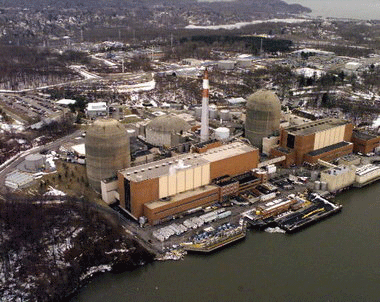
However, on site reuse, the task force report fails to examine one of the best options, which would be to decommission and clean up the whole Indian Point site within a reasonable period, such as 20 years. Instead, the task force goes into details on options for the reuse of small parcels that are highly constrained and that Entergy has said it will not make available until the site is decommissioned.
The task force took this limited approach because the the NRC, which oversees decommissioning, allows nuclear power plants up to 60 years to decommission. However, the NRC is focused on the interests of nuclear licensees, not the local community. It is therefore necessary and appropriate for the state and its task force to act as a champion of local concerns and interests during the forthcoming Indian Point decommissioning process. Experience with decommissioning so far shows that it can be done within 20 years or even faster if the will is there.
Oyster Creek, the oldest of New Jersey’s four nuclear power plants, will shut down Sept. 17, but some of its main buildings will remain standing for nearly six decades at the Ocean County site.
The company also said it had chosen a method that will span 60 years to complete the dismantling of the plant, versus beginning immediately.
Exelon had originally planned to shutter Oyster Creek in 2019 then, this past February, moved the date up to this October. That’s now going to be mid-September at the end of the station’s current fuel cycle, according to Suzanne D’Ambrosio, spokeswoman for Oyster Creek said Tuesday.
According to the report Exelon filed with the NRC, it has chosen to put the plant into long-term storage — a method known as SAFSTOR — and take advantage of the NRC’s rules on decommissioning plants which allow a company up to 60 years to raze a facility. “The SAFSTOR option is the most economical and radiologically safe plan for decommissioning,” D’Ambrosio said. “It allows for normal radioactive decay, produces less waste and exposes our workers to lower levels of radiation.”
Once it stops producing electricity Sept. 17, the process of moving the radioactive fuel from the reactor core to a spent fuel storage pool begins, something Exelon says should be done by Sept. 30.
In the coming years work will begin to remove some smaller buildings at the site, according to the report. The radioactive spent fuel rods will eventually be removed from the fuel pool and be placed in dry storage casks, a task Exelon says will be done by 2024.
The site will be maintained for 50-plus years until Exelon begins removing the larger components at the site beginning in June 2075 and wrapping up by December 2077, according to its report.
Some of the larger sections of the plant may actually be barged from near the site, according to the report.
The decommissioning is expected to cost the utility about $1.4 billion, Exelon says.
Environmentalists who have long been critical of the 620-megawatt plant, said they are glad to see it close.
“Oyster Creek has been a safety threat to Ocean County, polluting Barnegat Bay, and killing thousands of fish over the years,” said Jeff Tittel, director of the New Jersey Sierra Club. “Shutting down the Oyster Creek plant will reduce the algae blooms, improve fish populations and help restore the overall ecosystem of the Barnegat Bay.”
FAIRBANKS — An Army Corp of Engineers team is planning the formal decommissioning of the only nuclear power plant ever built in Alaska, Fort Greely’s SM-1A plant.
The SM-1A plant provided steam and electricity to the Army post near Delta Junction off and on between 1962 and 1972. It was one of eight experimental projects to test the use of small nuclear power plants at remote installations.
It’s expected to take about 10 years to plan, contract out and complete the SM-1A cleanup, according to a Baltimore-based team from the Army Corps of Engineers that came to Fort Greely for meetings last month……….
When SM-1A shut down in 1972, the Army chose to place the facility into a safe storage status instead of formally decommissioning it. The highly enriched uranium fuel and waste were shipped out of Alaska and radioactive components of the reactor were encased in cement.
The Army chose this temporary method of mothballing the facility out of hope that within a relatively short amount of time significant quantities of radioactive waste would decay to a safer nonradioactive state, according to an Army Corps of Engineers website about the SM-1A at bit.ly/2G7TjVH.
Later studies showed that the volume of radioactive waste wasn’t decreasing as expected and that a more hands-on approach was needed to clean up the plant. The increasing costs of nuclear waste disposal also motivated the Army to begin cleaning up the site.
There’s no estimate yet for the cost of decomissioning SM-1A, but such a project for a similar power plant has a budget of $66.4 million.
Lincoln University 4th May 2018 , Researchers have secured £1.1 million in grant funding to develop
artificial intelligence systems to enable self-learning robots to be
deployed in place of humans to hazardous nuclear sites.
It is estimated that up to £200 billion will be spent on the clean-up and decommissioning
of nuclear waste over the next 100 years.
Now, a team of computer scientists from the University of Lincoln will create machine learning
algorithms to increase capabilities in several crucial areas of nuclear
robotics, including waste handling, cell decommissioning and site
monitoring with mobile robots.
Machine learning is an application of artificial intelligence (AI) which enables systems to collect data and use
it to inform automated decision-making and make improvements based on
experience without being explicitly programmed.
The Lincoln team will create algorithms for vision-guided robot grasping, manipulation and
cutting, mobile robot navigation, and outdoor mapping and navigation. The
aim is to build systems which can use machine learning to adapt to the
unique conditions of nuclear sites, including locations contaminated by
radiation.
The Lincoln project is part of the National Centre for Nuclear
Robotics (NCNR), a multi-disciplinary EPSRC RAI (Robotics and Artificial
Intelligence) Hub led by the University of Birmingham, and also involves
Queen Mary University of London, the University of West England, University
of Bristol, University of Edinburgh, and Lancaster University.
The global nuclear decommissioning services market size is expected to be valued at USD 8.90 billion by 2025
Nuclear Decommissioning Services Market Size, Share & Trends Analysis Report By Reactor Type (PWR, BWR, PHWR, GCR), By Strategy (Immediate and Deferred Dismantling, Entombment), And Segment Forecasts, 2018 – 2025 BY Sarah Smith Research Advisor at Reportbuyer.com Email: sarah@reportbuyer.comReportBuyer LONDON, April 3, 2018 /PRNewswire/ –According to a new report by Grand View Research, Inc., exhibiting a 6.8% CAGR during the forecast period. Global nuclear phase out and rising support from governments post nuclear accidents are among major factors expected to fuel market growth over the years to come.
Rise in public safety concerns due to hazardous consequences of nuclear accidents is set to actuate market demand over the coming years.In addition, increasing sustainability concerns are likely to positively impact market growth.
The transitioning trend toward renewable energy thanks to various government initiatives and regulations is also projected to promote nuclear decommissioning services over the forecast period.
With extensive research and development underway, various novel decommissioning technologies to enable efficient dismantling of nuclear facilities have been developed. Furthermore, in order to enable sustainable development, government authorities are providing various incentives and support schemes for efficient dismantling of nuclear plants. …….
The global nuclear decommissioning services market size is expected to be valued at USD 8.90 billion by 2025, according to a new report by Grand View Research, Inc., exhibiting a 6.8% CAGR during the forecast period. Global nuclear phase out and rising support from governments post nuclear accidents are among major factors expected to fuel market growth over the years to come.
Rise in public safety concerns due to hazardous consequences of nuclear accidents is set to actuate market demand over the coming years.In addition, increasing sustainability concerns are likely to positively impact market growth.
The transitioning trend toward renewable energy thanks to various government initiatives and regulations is also projected to promote nuclear decommissioning services over the forecast period.
With extensive research and development underway, various novel decommissioning technologies to enable efficient dismantling of nuclear facilities have been developed. Furthermore, in order to enable sustainable development, government authorities are providing various incentives and support schemes for efficient dismantling of nuclear plants.
Key market players include Orano Group; Babcock International Group PLC; Westinghouse Electric Company LLC; AECOM Group; Studsvik AB; Bechtel Group Inc.; GE Hitachi Nuclear Energy; and Magnox Ltd. These companies mainly focus on innovation to improve service quality and meet global demand.
Le Monde 1st April 2018, [Machine Translation]By validating, on Wednesday 28 March, the project to
dismantle the Monju breeder reactor, the Nuclear Regulatory Authority (ARN)
thwarting Japan’s ambition to control the fuel cycle and adds a new nuclear
bill in the archipelago. The project involves a dismantling over thirty
years of the facility built in Tsuruga in the department of Fukui (center).
It should cost 375 billion yen (2.86 billion euros). The operation will
start as soon as July by the removal of the fuel. Then the sodium –
liquid delicate cooling to handle because flammable on contact with air –
will be removed. Disassembly will follow, with an end scheduled for 2048. http://www.lemonde.fr/energies/article/2018/04/01/nucleaire-les-ambitions-contrariees-du-japon_5279295_1653054.html










 nuclear-news