A warning on Mixed-Oxide Fuel (MOX) nuclear fuel plan
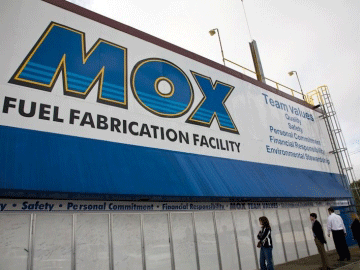 MOX stands for “Mixed-Oxide Fuel.” It is a nuclear power reactor fuel made from plutonium mixed with uranium. The U.S. Department of Energy (DOE) wants to make experimental MOX fuel using plutonium from dismantled nuclear weapons.
Use of MOX fuel fails as a means of getting rid of plutonium. Instead, the plutonium just becomes part of the lethal soup of ingredients termed “high-level nuclear waste”
What is MOX? http://www.nirs.org/factsheets/basicmoxinfo.htm The giant French nuclear firm Cogema, Duke Power and Virginia Power have formed a consortium to create and use plutonium MOX fuel in civilian atomic reactors in North and South Carolina and Virginia.
If their effort is successful, plutonium would be trucked from nuclear weapons depots in the west to the Savannah River Plant on the South Carolina/Georgia border, where new plutonium processing plants would be built. This new MOX fuel would then be trucked to commercial reactors in the Southeast, in order to turn this plutonium into high-level radioactive waste.
The MOX program is dangerous and unnecessary. More than 200 environmental and other organizations across the world have signed an International NIX MOX statement and have pledged to work to stop this program in the U.S. and similar programs in Russia, France and England.
What is MOX? Continue reading
Plutonium a nuclear servant that will become a nuclear killer
 five years of meetings between Soviet and American scientists from the Federation of American Scientists about what to do with the separated plutonium. There is a tremendous pressure to use it. . . . It is as if we don’t know what to do with this unless we make it serve us, and that is exactly what I am beginning to think, that we cannot ask of the poison fire. If we want to make it serve us, it will kill us
Nuclear Guardianship The Search for New Perspectives Lecture by Joanna Macy reprinted with permission from Poison Fire, Sacred Earth, TESTIMONIES, LECTURES, CONCLUSIONS, THE WORLD URANIUM HEARING, SALZBURG 1992 pages 256-258
To call this stuff “waste” is a misnomer, it is hardly an accurate term, because the strange and almost mythic character of the poison fire — uranium — and our processing of it has been that at every stage of the fuel cycle, everything that we have employed, every glove, every boot, every truck, every reactor, every facility, every mine, every heap of mill tailings, everything becomes not only contaminated, but contaminating.

And governments and industry and scientists themselves don’t know what on earth to do with it. They don’t know what to do with this stuff, and it is our most enduring legacy. They say they have a final solution to bury it in the ground in deep geological disposal, hiding it out of sight and out of mind, as if the earth were dead, as if the earth were not a living being, shifting with underground waters and seismic activities, as if the containers themselves could outlast a generation, which they cannot!
For nothing lasts as long, no container lasts as long as the poison fire itself. And it will leak out and out to contaminate. Continue reading
Plutonium left Livermore – (but where did it go?)
 High-Security Nuclear Material Leaves Livermore
http://www.kolotv.com/news/californianews/headlines/High-Security-Nuclear-Material-Leaves-Livermore-170905161.html KOLO8 News 23 Sept 12, LIVERMORE, Calif. (AP) – Federal officials say Lawrence Livermore Laboratory is no longer home to some high-security, special nuclear weapons materials.
The National Nuclear Security Administration say the lab will still focus on the safety, security and reliability of the nation’s nuclear weapons stockpile, but just with a reduced amount of nuclear material that does not require as much as security as was needed in the past.
The agency says that decision will save about $40 million in taxpayer funds.
NNSA Administrator Thomas D’Agostino says taking the materials out of Livermore is part of a national plan to consolidate special nuclear materials in as few places as possible.
The Oakland Tribune reports (http://bit.ly/OQD1PT) the materials were
removed from the lab’s Plutonium Facility, which is located in an area known as the “Superblock.”
Plutonium for space travel?
Nuclear waste set to power spacecraft By Andrew Bounds, North of England Correspondent, Ft.com, September 9, 2012 Britain’s nuclear waste could be used to power spacecraft as part of government attempts to offset the huge cost of the atomic clean-up by finding commercial uses for the world’s largest stock of civil plutonium.
A £1m pilot programme by the European Space Agency has shown that nuclear batteries for use on deep space missions could be made from an isotope found in decaying plutonium at the Sellafield waste storage site in Cumbria.
Britain’s National Nuclear Laboratory has harvested americium-241 from the plutonium, produced from reprocessing fuel.
The ESA believes this could replace plutonium-238, only available from Russia and the US, and provide an independent source of energy for planned deep space missions to Jupiter and other distant planets.
Tim Tinsley, who manages the programme for the NNL, said the space battery was an unforeseen benefit of past inaction, which has left 100 tonnes of plutonium in ponds at Sellafield.
“It is available due to a twist of fate,” he said. “We have been able to extract that americium and prove that it works.”
Full-scale battery production would be “worth hundreds of millions of euros” and provide skilled jobs in west Cumbria, an area of high unemployment, he said.
Nuclear batteries – each containing about 5kg of nuclear material – have been around since the 1950s and are used in Nasa’s Cassini and Voyager probes as well as Curiosity, which landed on Mars in August…..
The US may also need a fresh supply. Plutonium-238 can be made only in reactors dedicated to weapons, now shut down, and Nasa’s stocks could run out in 2018, according to the US National Research Council. ….
The clean-up costs of Britain’s nuclear programme are estimated at up to £100bn, with £3bn spent annually, while the plutonium alone is a £4bn liability.
NNL, a government agency run under contract, has joined Systems Engineering & Assessment, a specialist engineering group active in the space sector, and the University of Leicester, which has a large space department, to run the programme…. http://www.ft.com/intl/cms/s/0/2ea069f2-f830-11e1-828f-00144feabdc0.html#axzz266DLJEno
Danger of MOX nuclear reprocessing: it’s the plutonium, stupid
From Plutonium to Power, Spiegal Online 09/07/2012 Russia To Produce Electricity with Former Nukes By Kerstin Brandt “…….What makes the new reactor a particularly delicate case, though, is its fuel.
Of all the bequests of the atomic age, the heavy metal that takes its name from Pluto, god of the underworld, is considered the most dangerous. A nuclear chain reaction initiated with six kilograms (13 pounds) of the material over Nagasaki, Japan, on Aug. 9, 1945, immediately killed 80,000 people. Breathing in just a few milligrams of plutonium dust is fatal to humans.
Vast amounts of this element, which almost never occurs naturally, now exist on Earth. Well more than 1,000 tons of the plutonium, which is one component of spent fuel from nuclear reactors, now sits in spent fuel pools and interim storage facilities, awaiting an indeterminate fate.
Then there are a further estimated 250 tons of weapons-grade plutonium, which consists of the fissile isotope Pu-239 at its highest possible concentration. This is a material produced for a single, military purpose: to trigger the most devastating detonations possible, as reliably as possible.
But what meant power during the arms race has since become a curse. Plutonium is enormously expensive to secure — and completely useless for civilian purposes.
For many years, permanent storage facilities for nuclear waste were the solution of choice among experts in the field. Melted down in a glass matrix and mixed with other highly radioactive nuclear waste, plutonium could be made to disappear deep into the Earth, protected from the elements and from the reach of untrustworthy militaries.
These days, though, that method is essentially off the table, because tough disarmament negotiations reach their goals more quickly when the end result is profit rather than unpredictable storage facility costs. The world’s military superpowers have done this once before: In 1993, as part of the “Megatons to Megawatts” nonproliferation program, the US pledged to buy 500 tons of weapons-grade uranium from Russia. Diluted down to a level suitable for use in a nuclear plant, fuel obtained from Soviet nuclear bombs currently generates one tenth of the United States’ electricity……http://www.spiegel.de/international/world/energy-from-the-bomb-russia-to-produce-electricity-with-former-nukes-a-854318.html
Confusion in Aomori Prefecture about importing radioactive waste
 Aomori Pref. mulling rejecting nuclear waste The Yomiuri Shimbun , 6 Sept 12, AOMORI—The Aomori prefectural government is considering refusing to accept highly radioactive
  waste scheduled to be returned from reprocessing overseas if the central government abolishes its nuclear fuel cycle policy.
The prefectural government was likely prompted to act by recent moves by the central government toward abandoning nuclear power generation.
The village of Rokkasho in the prefecture is home to a spent nuclear fuel reprocessing plant that is considered to be the foundation of the nuclear fuel cycle, in which plutonium and uranium are extracted from spent fuel to be reused.
The plant has yet to begin operating, and spent nuclear fuel from the nation’s nuclear reactors are currently stored at nuclear power plants or at the Rokkasho facility. Some spent nuclear fuel is reprocessed in France and Britain. Vitrified radioactive waste, the highly radioactive waste that is produced in the reprocessing process, has been shipped from Europe to the Vitrified Waste Storage Center at the Rokkasho facility. So far, the plant has received 1,414 containers of vitrified waste, and 28 more are scheduled to be shipped from Britain in October at the earliest. Continue reading
Costs of USA’s MOX nuclear plant spinning out of control
Supporters, opponents of MOX facility speak out at hearing Augusta Chronicle, By Rob Pavey Sept. 4, 2012 “…..The government has not altered its mission to dispose of the plutonium, but has amended its original plan to build a freestanding plant to process plutonium “pits” from dismantled warheads into powder for use at the MOX plant. Instead, the new plan will use multiple existing facilities, including the H Canyon facilities at Savannah River Site, to accomplish the same mission without building a new plant. Plutonium not suitable for MOX will be disposed of at a site in New Mexico.
Critics of the program, however, raised continuing concerns about escalating costs and suggested the plutonium could simply be processed as nuclear waste and immobilized.
Tom Clements, the non-proliferation policy director for the Alliance for Nuclear Accountability, also noted that there are currently no clients willing to use MOX fuel in commercial reactors….. A cheaper alternative, he suggested, would be to immobilize plutonium at the SRS Defense Waste Processing Facility or a similar project that would
prevent any future use of the material for weapons.
“The costs are just spiraling out of control, Clements said……
Space exploration’s radioactive mess
 In Russia, the situation is even grimmer. In true Soviet fashion, the bomb makers secretly dumped unknown quantities of liquid waste into giant reservoirs around the plant. Nobody knows how much radioactive contamination is out there, but a single accident – the explosion of a waste tank in 1957 – is thought to have been Chernobyl-like in scale.
remember this, too: That little rover on Mars has left a big mess back here on Earth.
Curiosity’s dirty little secret http://www.theage.com.au/technology/technology-news/curiositys-dirty-little-secret-20120828-24xvn.html#ixzz255PEGe79 August 29, 2012 I’m as happy as anyone that the Curiosity rover got to Mars; it’s hard not to barrack for all those NASA geeks in their blue polo shirts. But before you get all apple pie about the achievement, there’s something you should know: Curiosity runs on plutonium from a Soviet-era nuclear weapons plant.
Take a look at the back of Curiosity. Other rovers have solar panels, but Curiosity doesn’t. Instead, there’s a little white thing that looks cute, almost like a tail. Inside are eight boxes filled with pellets of nuclear fuel. This stuff is hot, so hot that the boxes glow bright red, and will glow for years to come. Think of it as nuclear charcoal. The fuel will keep the rover toasty on cold Martian nights and supply it with electricity.
It’s a neat trick, and one that NASA has used before. Since the 1960s, the US has been launching nuclear-powered spacecraft. The first were military satellites. That worked swell, except that when the mission ended, you had a radioactive pile of junk orbiting the planet. And every now and then, one would fail to launch or fall back to Earth. That was bad for PR.
Opposition to USA plan to commercialise plutonium wastes at Savannah
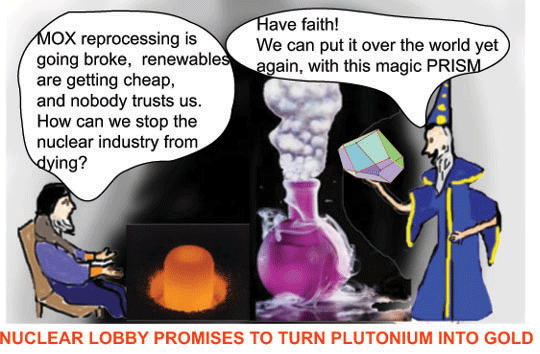 The preferred plan under consideration calls for the shipment of 7.1 metric tons of so-called pits — or cores — of an undisclosed number of nuclear warheads now stored at the Pantex plant in West Texas to Los Alamos National Laboratory in New Mexico and the Savannah River Site for disarmament and processing into fuel for commercial nuclear reactors.
Anti-nuclear activists question plan for shipping plutonium from warheads to New Mexico By Associated Press, August 22 LOS ALAMOS, N.M. — Nuclear watchdogs are fighting a proposal to ship tons of plutonium to New Mexico, including the cores of nuclear warheads that would be dismantled at an aging and structurally questionable lab atop an earthquake fault zone.
Opponents voiced their opposition at a series of public hearings that opened this week on the best way to dispose of the radioactive material as the federal government works to reduce the nation’s nuclear arsenal.
The Department of Energy is studying alternatives for disposing of plutonium in light of federal budget cuts that have derailed plans for new multi-billion-dollar facilities at the Savannah River Site in South Carolina. Continue reading
Los Alamos National Laboratory – plutonium facility not safe
The plutonium facility was designed and built in the 1970s and lacks the earthquake resistance required by modern building codes
 Safety Board Calls Nuclear Lab’s Earthquake Resistance Analysis ‘Technically Inadequate’ HUFFINGTON POST, Mia SteinleInvestigator, Project On Government Oversight, 30 july 12, An ongoing government analysis of an important nuclear weapons laboratory’s ability to withstand earthquakes may be flawed, according to a federal oversight panel. Continue reading
Britain looks at dubious technical “fixes” for its radioactive pile at Sellafield
It is the task of the Nuclear Decommissioning Authority (NDA) to clean all this up. The plans are to pay the French company Areva, who have proved their technology works, to build a new mixed oxide fuel (MOX) plant.
The other option is to let the US-Japanese GE-Hitachi build a new fast PRISM reactor on the site to burn the plutonium and produce electricity. This is a more elegant engineering option but the reactor is totally unproven and is decades away from completion.
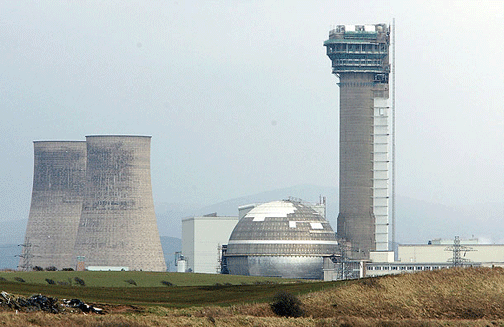 Sellafield: The dangers of Britain’s nuclear dustbin RT, 10 July, 2012“…….Cold war legacy Behind the razor wire, security guards and public relations campaigns,
Sellafield is home to some of the most radioactive buildings in Europe.
The UK has the largest stockpile of Plutonium anywhere in the world and it’s all stored at Sellafield. Plutonium is used for the manufacture of nuclear weapons and is extremely radioactive with a half-life of 25,000 years. Continue reading
Btitain’s dilemma of its massive stockpile of plutonium at Sellafield
Sellafield is where all storage of radioactive materials and nuclear reprocessing in the UK takes place. It was once at the heart of plutonium manufacturing for the British atomic weapons program. Despite the controversy that surrounds the plant, there are plans to build new reactors at Sellafield. The government has approved initial plans to build a fast PRISM reactor on the site. Most locals are against it. They want the UK government to commission a safety study into Sellafield’s effects on the health of the local population.
A study in the 1980’s found that over ten times the national average of childhood Leukaemia’s occurred near Sellafield. Thirty families tried to take the company who then ran the site to court and lost. “There has never been a proper investigation into the environmental impact of the plant and there should be.”
Sellafield: The dangers of Britain’s nuclear dustbin RT, 10 July, 2012 Britain’s nuclear industry is again the center of controversy. The UK has the biggest stockpile of Plutonium in the world, but there are no definite plans for how to get rid of it – and the delays are costing the UK taxpayer billions.
A record number of radioactive particles have been found on beaches near the Sellafield nuclear plant, in North West England. The authorities who run it admit it’s the most radioactive place in Western Europe but insist it’s safe. Continue reading
Tri-Valley Care fights the good fight to save Livermore valley from plutonium wastes
Tri-Valley CAREs has had many successes throughout the years…. the first group in the western US to receive an EPA grant to monitor the Superfund cleanup at Lawrence Livermore National Lab and the first community-based group in the country to win a recognition award from EPA for its effectiveness
For decades, a toxic groundwater plume has flowed westward from Lawrence Livermore National Lab in the Livermore community aquifer towards Dublin.

 Living with the Legacy of the Nuclear Stockpile Next Door in Livermore, CA http://www.arounddublinblog.com/2012/07/livermore-ca-nuclear-stockpile-next-door/ by Around Dublin Team Tri-Valley CAREs was founded in 1983 in Livermore, CA by concerned neighbors living around Lawrence Livermore National Lab , one of two locations where all US nuclear weapons are designed. This grassroots organization works to strengthen global security by stopping the development of new nuclear weapons in the US and by promoting the elimination of nuclear weapons globally.
It monitors nuclear weapons and environmental clean-up activities throughout the US nuclear
weapons complex, with a special focus on Lawrence Livermore National Lab and the surrounding Tri-Valley communities. Continue reading
New book on the plutonium scandal at Rocky Flats
 Under The ‘Nuclear Shadow’ Of Colorado’s Rocky Flats 88.7 kuhf.fm June 12, 2012 Kristen Iversen spent her childhood in the 1960s in Colorado near the Rocky Flats nuclear weapons factory, playing in fields that now appear to have been contaminated with plutonium.
In Full Body Burden, she investigates the environmental scandal involving nuclear contamination around her childhood home. Continue reading
Japan – 37 tons of deadly plutonium, and planning to produce more
Other countries, including the United States, have scaled back the separation of plutonium because it is a proliferation concern and is more expensive than other alternatives, including long-term storage of spent fuel.
Fuel reprocessing remains unreliable and it is questionable whether it is a viable way of reducing Japan’s massive amounts of spent fuel rods
Japan’s plutonium stockpile — most of which is stored in France and Britain — has swelled despite Tokyo’s promise to international regulators not to produce a plutonium surplus.
 Japan to make more plutonium despite big stockpile, Fox News June 01, 2012 Associated Press TOKYO – Last year’s tsunami disaster in Japan clouded the nation’s nuclear future, idled its reactors and rendered its huge stockpile of plutonium useless for now. So, the industry’s plan to produce even more has raised a red flag.
Nuclear industry officials say they hope to start producing a half-ton of plutonium within months, in addition to the more than 35 tons Japan already has stored around the world. That’s even though all the reactors that might use it are either inoperable or offline while the country rethinks its nuclear policy after the tsunami-generated Fukushima crisis. Continue reading
1 This Month

of the week – Shut Down Drone Warfare!


Tell the Ukrainian Government to Drop Prosecution of Peace Activist Yurii Sheliazhenko

Petition to revoke the licensing of the Near Surface Nuclear Disposal Facility (NSDF) at Chalk River. https://www.ourcommons.ca/petitions/en/Petition/Details?Petition=e-7247
To see nuclear-related stories in greater depth and intensity – go to https://nuclearinformation.wordpress.com
-
Archives
- April 2026 (68)
- March 2026 (251)
- February 2026 (268)
- January 2026 (308)
- December 2025 (358)
- November 2025 (359)
- October 2025 (376)
- September 2025 (257)
- August 2025 (319)
- July 2025 (230)
- June 2025 (348)
- May 2025 (261)
-
Categories
- 1
- 1 NUCLEAR ISSUES
- business and costs
- climate change
- culture and arts
- ENERGY
- environment
- health
- history
- indigenous issues
- Legal
- marketing of nuclear
- media
- opposition to nuclear
- PERSONAL STORIES
- politics
- politics international
- Religion and ethics
- safety
- secrets,lies and civil liberties
- spinbuster
- technology
- Uranium
- wastes
- weapons and war
- Women
- 2 WORLD
- ACTION
- AFRICA
- Atrocities
- AUSTRALIA
- Christina's notes
- Christina's themes
- culture and arts
- Events
- Fuk 2022
- Fuk 2023
- Fukushima 2017
- Fukushima 2018
- fukushima 2019
- Fukushima 2020
- Fukushima 2021
- general
- global warming
- Humour (God we need it)
- Nuclear
- RARE EARTHS
- Reference
- resources – print
- Resources -audiovicual
- Weekly Newsletter
- World
- World Nuclear
- YouTube
-
RSS
Entries RSS
Comments RSS
 nuclear-news