The Mixed Oxide (MOX) nuclear fuel stuff-up
 A Botched Plan to Turn Nuclear Warheads Into Fuel Bloomberg, By Matthew Philips April 24, 2014 As the Soviet Union was unraveling and the Cold War was winding down in the early 1990s, negotiators in Washington and Moscow began talking about how best to dispose of the plutonium inside thousands of nuclear warheads the two nations had agreed to dismantle. The cheapest and easiest method was to immobilize the radioactive material by encasing it in molten glass and burying it. But the Russians balked at that, likening it to flushing gold down the toilet. Ultimately, it was decided that the plutonium would be converted into fuel for nuclear power plants. In September 2000, the U.S. and Russia signed an agreement under which each side would turn 34 tons of weapons-grade plutonium into mixed-oxide fuel, or MOX, that could be combined with uranium for use in commercial reactors.
In the U.S., that huge task would take place at an aging plutonium factory in South Carolina called the Savannah River Site. From the 1950s to the 1980s, the 310-square-mile facility had churned out about 36 tons of weapons-grade plutonium for nuclear warheads. Now, the plant would turn those same warheads into fuel rods. The Department of Energy initially estimated it would cost about $1 billion to convert the plant. Construction began in August 2007, with an expected completion date of 2016.
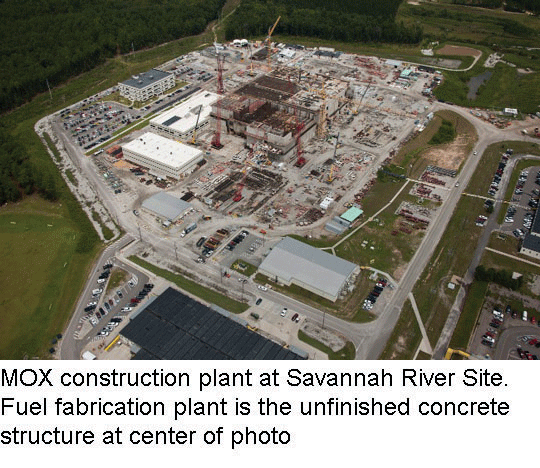
The U.S. government even had a ready customer for the rods. Charlotte-based Duke Energy (DUK), one of the largest nuclear power companies in the U.S., signed on as a buyer. From 2005 to 2008, the company ran tests of MOX fuel the Department of Energy got from France. The fuel worked fine. Everything was going according to plan.
Almost seven years after construction began, the MOX plant is now 60 percent built. But it’s looking increasingly likely that it won’t ever be completed….The MOX plant in South Carolina requires 85 miles of pipe, 23,000 instruments, and 3.6 million linear feet of power cables. The project is vastly over budget: The Department of Energy has sunk about $5 billion into it so far and estimates it will cost an additional $6 billion to $7 billion to finish the plant, plus an additional $20 billion or so to turn the plutonium into fuel over 15 years. In its 2015 budget request released in March, the Department of Energy announced it will place the MOX project on “cold standby,” effectively mothballing the project for the foreseeable future. “It’s a major fiasco,” says Edwin Lyman, a senior scientist at the Union of Concerned Scientists. “Billions of taxpayer dollars have been wasted. It’s a classic boondoggle.”
The MOX plant is the latest blunder for the Department of Energy, which has a reputation for mismanaging big, complicated projects, particularly those related to nuclear energy. Costs for a nuclear waste treatment plant in Washington State have nearly tripled to $13 billion. A uranium processing facility in Tennessee once estimated to cost around $1 billion is now tipping the scales at around $11 billion, according to an Army Corps of Engineers study. It’s also running about 20 years behind schedule. A Department of Energy spokesman declined to comment for this article…….http://www.businessweek.com/articles/2014-04-24/u-dot-s-dot-botches-plan-to-turn-nuclear-warheads-into-fuel
Iran reduces capacity at Arak nuclear recator
 Arak nuclear reactor resolved says Iran http://www.skynews.com.au/world/article.aspx?id=969168 April 20, 2014 Iran and six world powers have resolved their differences over the country’s plutonium-producing Arak reactor, Iranian nuclear chief Ali Akbar Salehi says.
The reactor, which has yet to be completed, has been a main point of contention at the ongoing talks aimed at ending the stand-off over Tehran’s nuclear program.
The governments of Britain, China, France, Russia, the United States and Germany – the so-called P5+1 – have expressed concern that Iran could use the plutonium produced at the facility in the western city of Arak to build nuclear weapons.
‘We have suggested that we will produce only one-fifth of the originally planned plutonium, and this was welcomed by the P5+1,’ said Salehi.
The world powers have called for Arak’s closure or for technical changes so that it no longer turns out plutonium.
Salehi said Arak would not be shuttered because Iran needs it to produce medical isotopes for civilian use, but that reducing its plutonium production capacity alleviates negotiators’ concerns.
The heavy water reactor uses natural uranium as its fuel and will generate plutonium as a by-product.
Iran and the sextet agreed in an interim deal in November on a limited suspension of sanctions in return for some nuclear concessions from Tehran, including suspending construction of the Arak reactor and scaling back uranium enrichment.
Under the broader agreement that both sides are aiming to conclude by July, Iran is expected to accept additional nuclear curbs while the world powers have promised to permanently lift all sanctions and to help Iran build new reactors.
Tehran insists that it has no plans to build nuclear weapons.
Iran and the P5+1 will hold expert-level nuclear talks May 5-9 in New York, said Iran’s Deputy Foreign Minister Abbas Araqchi, according to Press TV.
Terrorism risk ignored, as Japan plans to produce plutonium
Japan reaffirms its plan to produce plutonium, Center for Public Integrity
The Abe government’s new energy plan calls for completing the Rokkasho plutonium fuel factory despite U.S. concern it poses terrorism risks By Douglas BirchemailJake Adelstein 12 April 14
Just weeks after Japan pledged to return hundreds of pounds of plutonium to the United States for disposal, the Japanese government on April 11 formally endorsed the completion of a factory designed to produce as much as eight tons of the nuclear explosive annually.
The plant is among the key elements of a long-range energy plan approved by Prime Minister Shinzo Abe’s cabinet, reversing the previous government’s efforts to phase out nuclear power in the wake of the March 2011 Fukushima disaster. The move is generally viewed in Japan as unpopular with the public but has been welcomed by Japan’s utilities, which are struggling with massive debts.
 The mammoth plant in the village of Rokkasho, scheduled to be completed in October, is meant to extract plutonium from spent commercial reactor fuel so it can be used in fresh fuel to be burned in the country’s reactors. “With safety first in mind always, Japan will promote…the completion of Rokkasho,” the energy plan states.
Publicly, the Obama administration has said little about Rokkasho, located on the Pacific Coast about 1,000 miles north of Tokyo. But privately, U.S. officials and experts say they are worried that Japan’s operation of the $22 billion facility – in the wake of the country’s closure of most of its nuclear power plants — will add unnecessarily to its existing stockpile of 44 tons of plutonium, some of which is stored in Japan and some in Europe.
U.S. officials have complained to their Japanese counterparts that the plant lacks an adequate security force, making it a potential target for terrorists. They have also urged Japan to subject the plants’ workers to stringent background checks, a move the Japanese see as being at odds with privacy traditions. U.S. experts also have expressed concern that the plant’s operation will encourage other countries, including South Korea, to constructsimilar plutonium factories.
Japan’s stockpile of plutonium today ranks fifth in the world, behind four nuclear-weapons states. The Chinese government in recent weeks has repeatedly expressed concern about Japan’s plans to produce plutonium “far exceeding its normal needs.”
Tokyo’s decision to proceed follows a joint announcement on March 24 by Abe and President Obama and Abe, at the Nuclear Security Summit in the Netherlands, that Japan would return hundreds of pounds of plutonium and weapons-grade uranium it received under the U.S. Atoms for Peace program in the 1960s and 1970s.
The two leaders said the transfer would further “our mutual goal” of keeping global stocks of nuclear explosive materials to a minimum, to keep them out of the hands of terrorists.
But critics say Rokkasho’s operation would violate that goal……..
Many communities in Japan are dependent on a stream of payments by the federal government to promote the siting of nuclear power plants, but a few have recently expressed concerns about the burning of plutonium-laced reactor fuels.
In early April, the city of Hakodate sued to halt work on a reactor that would be the first to burn such fuel. Hakodate’s Mayor Toshiki Kudo told reporters in Tokyo Thursday that the government and utility had ignored a plea from the municipality to suspend work on the Ohma plant and made “a unilateral announcement that it would go ahead with construction.”
Kudo called the plant “a terrorist target,” and said it could pose a greater safety risk than reactors fueled in other ways.
Angela Erika Kubo contributed to this article from Tokyo. http://www.publicintegrity.org/2014/04/11/14582/japan-reaffirms-its-plan-produce-plutonium
PRISM an ugly magic trick from the nuclear lobby
http://www.no2nuclearpower.org.uk/nuclearnews/NuClearNewsNo61.pdf
 The U.S. corporation GE Hitachi (GEH) is promoting a reactor design called the PRISM (Power Reactor Innovative Small Modular) that its chief consulting engineer and fast-breeder guru, Eric Loewen, says is a safe and secure way to power the world using yesterday’s nuclear waste – he means plutonium which hasn’t officially been classified as waste in the UK. The Nuclear Decommissioning Authority has declared PRISM to be a “credible option” for managing the UK’s plutonium stockpile.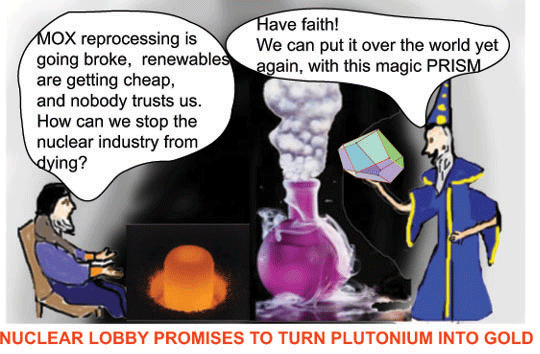
Rokkasho a big-box store for nuclear terrorists.
After spending tens of billions of dollars and decades on breeder-related programs, Tom Cochran said, countries find it hard to pull the plug.
“You have an entrenched bureaucracy and an entrenched research and development community and commercial interests invested in breeder technology, and these guys don’t go away,” Cochran said. “They’re believers … and they’re not going to give up. The really true believers don’t give up.”……..
“Stealing a weapon is too hard,” Cochran said. “But there is no big risk in fuel assemblies, or in taking things from a bulk handling facility that can be used to make weapons.” In this view, Rokkasho is a kind of big-box store for would-be nuclear terrorists.
A Washington-based physicist and nuclear contrarian, Cochran helped kill a vast plutonium-based nuclear industrial complex back in the 1970s, and now he’s at it again — lecturing at symposia, standing up at official meetings, and confronting nuclear industry representatives with warnings about how commercializing plutonium will put the public at enormous risk.
Where the story ends isn’t clear. But the stakes are large. Continue reading
Why plutonium is so dangerous
 A World Awash in a Nuclear Explosive? TruthOut, 19 March 2014 12:24 By Douglas Birch and R. Jeffrey Smith, Center for Public Integrity | Report Washington “……..Just a Few Pounds Worth of Plutonium? There’s been a ghoulish debate between officials and independent scientists about how much plutonium is needed to fuel a clandestine bomb. But both agree it’s not much.
The U.S. bomb that destroyed half of Nagasaki in 1945 had 6.2 kilograms of plutonium in it, or 13.6 pounds. But experts say it was over-engineered — only one kilogram fissioned, they concluded later.
The International Atomic Energy Agency nonetheless decided years ago that eight kilograms of plutonium, or 17.6 pounds, are needed to make a bomb and so that’s the quantity its monitoring is geared to stop from getting loose.
Cochran and his NRDC colleague Christopher Paine challenged the IAEA standard in 1995 with a study concluding that only 3 kilograms — 6.6 pounds — would be needed to fashion a “very respectable” bomb with the explosive power of a kiloton, or 1,000 tons of TNT. But no matter who is right, Rokkasho’s annual plutonium production would be enough for 1,000 weapons or more. Continue reading
The Coke Can Plutonium Experiment
On arrival at lecture halls, he would push his stand-in for plutonium into an empty Coke can he had sawn in half. During his talks, he would hold the can up so his audience could see it, and say the contents could incinerate a city. “A six-pack of these is a nuclear arsenal,” he would say.
 A World Awash in a Nuclear Explosive? TruthOut, 19 March 2014 12:24 By Douglas Birch and R. Jeffrey Smith, Center for Public Integrity | Report Washington #……..The Coke Can Experiment In the abstract, there’s plenty of alarm in official circles. “Just one nuclear weapon exploded in a city — be it New York or Moscow; Tokyo or Beijing; London or Paris — could kill hundreds of thousands of people,” President Barack Obama told the United Nations Security Council in September 2009. “And it would badly destabilize our security, our economies, and our very way of life.”
But Cochran has long criticized the effectiveness of one of Washington’s most costly and elaborate strategies to prevent such a catastrophe — a global effort to detect and capture illicit fissile materials at border crossings and major world ports.
Since 2003 the United States has spent more than $850 million on equipment and training for customs officials at 45 foreign ports so they can scan shipping containers to detect nuclear materials. It’s a daunting assignment. About 432 million shipping containers crisscrossed the oceans in 2009 alone. U.S. ports accept 15 million containers every year. Continue reading
China’s concern over Japan’s plutonium and enriched uranium

 Japan and China’s Dispute Goes Nuclear, The Diplomat, Japan and China’s bitter PR campaign has now entered the nuclear realm. By Zachary Keck March 18, 2014 Japan and China appear to be trading nuclear barbs with one another.
For some weeks now, China has been raising concerns about the amount of enriched uranium and weapons-grade plutonium Japan currently stockpiles. “We continue to urge the Japanese government to take a responsible attitude and explain itself to international community,” a Chinese Foreign Ministry spokesperson said at the end of last month.
The following week, the same spokesperson asked: “Has Japan kept an excessive amount of sensitive nuclear material that is beyond its actual needs? Does one need so much sensitive nuclear material for peaceful use? Should one keep excessive weapons-grade nuclear material?” He added: “More importantly, does Japan have higher-enriched and weapons-grade uranium, and how much does it have? What are those used for? How can Japan ensure a balance between the demand and supply of nuclear materials? These are the real concerns and questions of the international community.”
Japan has one of the most advanced civilian nuclear programs of any country without nuclear weapons.According to NBC News, Tokyo has 9 tons of plutonium stockpiled in different places throughout Japan, while 35 tons of Japanese plutonium is stockpiled in different countries in Europe. Only about 5 to 10 kilograms is needed to produce a nuclear weapon. Japan also has an additional 1.2 tons of enriched uranium. It is also building a fast-breeder plutonium reactor in Rokkasho that will produce 8 tons of plutonium annually.
Many experts believe that Japan could produce nuclear weapons within 6 months of deciding to do so, and some believe that Tokyo is pursuing a “nuclear hedging” strategy. Japan has done little to mollify these concerns. In fact, it has often encouraged them, with a Japanese official recently saying off the record that “Japan already has the technical capability [to build a nuclear bomb], and has had it since the 1980s.”
Having a “bomb in the basement” largely suits Japan’s interests in its competition with China. …….http://thediplomat.com/2014/03/japan-and-chinas-dispute-goes-nuclear/
USA secretly building two underground plutonium production labs
US to build two secret underground plutonium production labs: Analyst Press TV, 24 Dec 13 The United States is planning to build two new underground plutonium production labs that will expand plutonium production for the next decades, an analyst says.
“The Senate two days ago voted to authorize the creation of two new huge secret underground plutonium production labs that will expand plutonium production for the next 150 years,” Brian Becker, national coordinator of the A.N.S.W.E.R Coalition, told Press TV on Saturday.
“That is a very important fact and I think the world is not yet learning about it or just learning about it,” he added.
Becker also said the location of the new labs is in Los Alamos. “This was going to be in Los Alamos, the nuclear facility in New Mexico and the US government has just announced in spite of environmental impact statements, in spite of everything, to rush forward for the creation of two new plutonium factories, modules that will be producing plutonium for as decades and decades to come,” the analyst said.
“That is to enrich and enhance nuclear weapons. The United States is moving nuclear weapons into outer space that is one of the big projects. They see nuclear weapons and nuclear weapons possession as a form of creating dominance. It is not keeping the world safe,” he explained.
Becker pointed out to President Barack Obama’s plans for the US nuclear weapons complex that will cost the country about $355 billion over the next decade….http://www.presstv.ir/detail/2013/12/22/341316/us-building-secret-labs-to-enhance-nukes/
Anxiety surrounds plan to clean up Hanford’s radioactive trash
serious questions were raised last year after Walter Tamosaitis, one of the scientific chiefs of the project, disclosed that the innovative technology for mixing the waste in processing tanks could cause dangerous buildups of explosive hydrogen gas and might allow plutonium clumps to form.
Doubts grow about plan to dispose of Hanford’s radioactive waste, LA Times 28 Nov 13 Experts raise concerns about the complex technology intended to turn 56 million gallons of radioactive sludge at the former Hanford nuclear facility into glass and prepare it for safe burial. By Ralph Vartabedian November 29, 2013, RICHLAND, Wash. — On a wind-swept plateau, underground steel tanks that hold the nation’s most deadly radioactive waste are slowly rotting. The soil deep under the desert brush is being fouled with plutonium, cesium and other material so toxic that it could deliver a lethal dose of radiation to a nearby person in minutes.
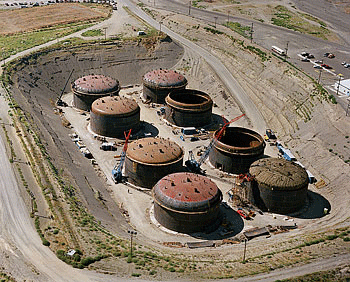
The aging tanks at the former Hanford nuclear weapons complex contain 56 million gallons of sludge, the byproduct of several decades of nuclear weapons production, and they represent one of the nation’s most treacherous environmental threats.
Energy Department officials have repeatedly assured the public that they have the advanced technology needed to safely dispose of the waste. An industrial city has been under development here for 24 years, designed to transform the sludge into solid glass and prepare it for permanent burial.
But with $13 billion already spent, there are serious doubts that the highly complex technology will even work or that the current plan can clean up all the waste. Alarmed at warnings raised by outside experts and some of the project’s own engineers, Department of Energy officials last year ordered a halt to construction on the most important parts of the waste treatment plant.
“They are missing one important target after another,” said Sen. Ron Wyden (D-Ore.), chairman of the Energy and Natural Resources Committee. “It feels like we are going around in circles.”……….
Many of the problems stem from the decision to launch construction of the plant even before engineers had completed the design. The job of turning waste as thick as peanut butter into glass is at the leading edge of nuclear chemistry, a job made difficult by the complex mixture of wastes that were fed into the underground tanks by some of the nation’s largest industrial corporations under a cloak of government secrecy.
The basic plan is to pump the waste into a pre-treatment plant, a factory larger than a football field and 12 stories tall, that would filter and chemically separate the waste into two streams of high- and low-level radioactivity. Then, two other plants would “vitrify,” or glassify, the waste. One would produce highly radioactive glass destined for a future geological repository, and the other a lower radioactive glass that could be buried at Hanford.
But serious questions were raised last year after Walter Tamosaitis, one of the scientific chiefs of the project, disclosed that the innovative technology for mixing the waste in processing tanks could cause dangerous buildups of explosive hydrogen gas and might allow plutonium clumps to form……. http://www.latimes.com/nation/la-na-hanford-nuclear-risks-20131130,0,5013027.story#axzz2m8Dynzbj
Fukushima radiation leaks an international crisis
 The water flowing through the site is also undermining the remnant structures at Fukushima, including the one supporting the fuel pool at Unit Four.
The immediate bottom line is that those fuel rods must somehow come safely out of the Unit Four fuel pool as soon as possible.
Spent fuel must somehow be kept under water. It’s clad in zirconium alloy which will spontaneously ignite when exposed to air.
Each uncovered rod emits enough radiation to kill someone standing nearby in a matter of minutes. A conflagration could force all personnel to flee the site and render electronic machinery unworkable.
Fukushima Radiation Leaks Totally Out of Control – Threatening Human Survival http://www.marketoracle.co.uk/Article42434.html Harvey Wasserman writes: We are now within two months of what may be humankind’s most dangerous moment since the Cuban Missile Crisis. 25 Sept 13
There is no excuse for not acting. All the resources our species can muster must be focussed on the fuel pool at Fukushima Unit 4. Fukushima’s owner, Tokyo Electric (Tepco), says that within as few as 60 days it may begin trying to remove more than 1300 spent fuel rods from a badly damaged pool perched 100 feet in the air. The pool rests on a badly damaged building that is tilting, sinking and could easily come down in the next earthquake, if not on its own.
Some 400 tons of fuel in that pool could spew out more than 15,000 times as much radiation as was released at Hiroshima.
The one thing certain about this crisis is that Tepco does not have the scientific, engineering or financial resources to handle it. Nor does the Japanese government. The situation demands a coordinated worldwide effort of the best scientists and engineers our species can muster.
Why is this so serious? Continue reading
Kazakhstan’s idea to grow food on plutonium contaminated land
“Opening the land for grazing and other land use will be an unforgiveable mistake,” said Leonid Rikhvanov, a professor at Russia’s Tomsk Polytechnic University, in a 2010 interview with the Telegraph. “If the plutonium gets into the biological chain it could cause a cytogenetic catastrophe that will backfire on the health of our children and grandchildren.” Many people living near Semipalatinsk feel similarly
But in this poisoned place, on a small patch of land near a few downtrodden trailers, there’s an unexpected hint of vitality: bright yellow sunflowers, clustered together near rows of corn, and a barn full of plump sheep. Here, scientists from Kazakhstan’s Institute of Radiation Safety and Ecology, a governmental organization that studies the medical and biological interaction between radioactivity and the environment, have developed an experimental farm. Their goal is to measure the transference of radioactivity from contaminated soil into edible crops, and from those crops into the meat, milk, and eggs of the animals that eat them. Continue reading
Russia’s secret maze of underground radioactive trash tunnels
 A Secret Race for Abandoned Nuclear Material http://www.nytimes.com/2013/08/18/world/asia/a-secret-race-for-abandoned-nuclear-material.html?_r=0 By ELLEN BARRY August 17, 2013 Working in top secret over a period of 17 years, Russian and American scientists collaborated to remove hundreds of pounds of plutonium and highly enriched uranium — enough to construct at least a dozen nuclear weapons — from a remote Soviet-era nuclear test site in Kazakhstan that had been overrun by impoverished metal scavengers, according to a report released last week by the Belfer Center for Science and International Affairs at Harvard.
The report sheds light on a mysterious $150 million cleanup operation paid for in large part by the United States, whose nuclear scientists feared that terrorists would discover the fissile material and use it to build a dirty bomb.
Over the years, hints emerged that something extraordinarily dangerous had been left behind in a warren of underground tunnels — like the American aerial drones that circled over the site, looking for intruders, or the steel-reinforced concrete that was poured into tunnels and over stretches of earth.
Among the report’s new revelations is that the Soviet testers left behind components, including high-purity plutonium, that could have been used to build not just a dirty bomb but a “relatively sophisticated nuclear device,” an American official told the report’s authors. Continue reading
All British children have plutonium in their teeth, from Sellafield nuclear plant
 Plutonium from Sellafield in all children’s teeth Antony Barnett, public affairs editor The Guardian 30 November 2003 Government admits plant is the source of contamination but says risk is ‘minute’ Radioactive pollution from the Sellafield nuclear plant in Cumbria has led to children’s teeth across Britain being contaminated with plutonium.
The Government has admitted for the first time that Sellafield ‘is a source of plutonium contamination’ across the country. Public Health Minister Melanie Johnson has revealed that a study funded by the Department of Health discovered that the closer a child lived to Sellafield, the higher the levels of plutonium found in their teeth. Continue reading
Hinkley nuclear site’s history of weapons deals with USA
Hinkley’s hidden history Morning Star UK 21 July 2013 by David Lowry With the coalition government’s decision to back a third nuclear reactor at Hinkley Point on Somerset’s coast and the ongoing debate over Trident replacement, it’s interesting to take a look back at the origins of Britain’s nuclear programme.
When the British nuclear power and weapons programmes were born, a different foreign power, the United States, was intimately involved in the planning.
The first public hint came with an MoD announcement in June 1958 on “the production of plutonium suitable for weapons in the new [nuclear] power stations programme as an insurance against future defence needs” at Britain’s first-generation Magnox reactor (named after the fuel type, magnesium oxide).
A week later in Parliament, Labour’s Roy Mason asked why the government had “decided to modify atomic power stations, primarily planned for peaceful purposes, to produce high-grade plutonium for war weapons.”
He was informed by paymaster general Reginald Maudling: “At the request of the government, the Central Electricity Generating Board has agreed to a small modification in the design of Hinkley Point and of the next two stations in its programme so as to enable plutonium suitable for military purposes to be extracted should the need arise.
“The modifications will not in any way impair the efficiency of the stations. As the initial capital cost and any additional operating costs that may be incurred will be borne by the government, the price of electricity will not be affected……….
the following month, the US and British governments signed a mutual defense – spelt with an “s” even in the official British version, so you can guess where it was authored – co-operation agreement on atomic energy matters.
The agreement was intended to circumvent the draconian restrictions of the 1954 Atomic Energy Act, which sought to retain all nuclear secrets within the US, even though many foreign nationals had worked collaboratively with US counterparts for six or more years on nuclear R&D.
The deal was reached after several months of congressional hearings in Washington DC, but no oversight whatsoever in the British Parliament.
As this formed the basis, within a mere five years, for Britain obtaining the Polaris nuclear WMD system from the US, and some 20-odd years later for Britain to buy US Trident nuclear WMD, the failure of Parliament to at least appraise the security merits of this key bilateral atomic arrangement was unconscionable…….
And so it may be seen that the Britain’s first civil nuclear programme was used as a source of nuclear explosive plutonium for the US military, with Hinkley Point A the prime provider.
The reason there was a swap between Britain and the US of weapons-suitable highly enriched uranium and plutonium was the US had huge surpluses of uranium, but wanted more plutonium than its nuclear production complex at Hanford could deliver, while the British first-generation “commercial” Magnoxes, which were scaled-up plutonium production factories, were perfect for producing military-suitable plutonium as they had online refuelling systems to optimise plutonium over electricity production.
They produced perfect plutonium in surplus, but Britain lacked sufficient highly enriched uranium, so an exchange deal was mutually beneficial.
Two decades later in 1984 Wales national daily the Western Mail reported that the largest Magnox reactor in Britain, at Wylfa on Anglesey, had also been used to provide plutonium for the military.
Plutonium from both reactors went into the British military stockpile of nuclear explosives, and could well still be part of the British Trident warhead stockpile today.
Subsequent research by the Scientists Against Nuclear Arms, published in the prestigious science weekly journal Nature and presented to the Sizewell B and Hinkley C public inquiries in the ’80s, has demonstrated that around 6,700kg of plutonium was shipped to the US under the military exchange agreement, which stipulates explicitly that the material must be used for military purposes by the recipient country.
To put this quantity into context, a nuclear warhead contains around 5kg of plutonium.
Is it any wonder the Atoms for Peace movement began to demand “safeguards” to deter diversion of civilian nuclear plants to military misuse?
After all, the US and Britain knew that such deadly diversion was possible – they had demonstrated it themselves.
The trouble is that safeguards are misleading. They are neither safe, nor do they guard. And what would Iran or North Korea make of this deliberate intermixing of civil and military nuclear programmes by one of the nuclear weapons superpowers – one which leads the criticisms of them for allegedly doing this very thing today. http://www.morningstaronline.co.uk/news/content/view/full/135635
-
Archives
- February 2026 (211)
- January 2026 (308)
- December 2025 (358)
- November 2025 (359)
- October 2025 (376)
- September 2025 (258)
- August 2025 (319)
- July 2025 (230)
- June 2025 (348)
- May 2025 (261)
- April 2025 (305)
- March 2025 (319)
-
Categories
- 1
- 1 NUCLEAR ISSUES
- business and costs
- climate change
- culture and arts
- ENERGY
- environment
- health
- history
- indigenous issues
- Legal
- marketing of nuclear
- media
- opposition to nuclear
- PERSONAL STORIES
- politics
- politics international
- Religion and ethics
- safety
- secrets,lies and civil liberties
- spinbuster
- technology
- Uranium
- wastes
- weapons and war
- Women
- 2 WORLD
- ACTION
- AFRICA
- Atrocities
- AUSTRALIA
- Christina's notes
- Christina's themes
- culture and arts
- Events
- Fuk 2022
- Fuk 2023
- Fukushima 2017
- Fukushima 2018
- fukushima 2019
- Fukushima 2020
- Fukushima 2021
- general
- global warming
- Humour (God we need it)
- Nuclear
- RARE EARTHS
- Reference
- resources – print
- Resources -audiovicual
- Weekly Newsletter
- World
- World Nuclear
- YouTube
-
RSS
Entries RSS
Comments RSS
 nuclear-news