Plutonium shipped from Japan to go to Waste Isolation Pilot Plant (WIPP), New Mexico
 Plutonium from Japan to be disposed of underground in New Mexico, Japan
  Times, KYODO APR 2, 2016 U.S.-bound plutonium that has recently been shipped out of Japan will be disposed of at a nuclear waste repository in New Mexico after being processed at the Savannah River Site facility in South Carolina, according to an official of the National Nuclear Security Administration.
“The plutonium will be diluted into a less sensitive form at the SRS and then transported to the Waste Isolation Pilot Plant (WIPP) for permanent disposal deep underground,” said Ross Matzkin-Bridger, who is in charge of the operation at the NNSA, a nuclear wing of the Department of Energy.
“The dilution process involves mixing the plutonium with inert materials that reduce the concentration of plutonium and make it practically impossible to ever purify again,” he said in a recent phone interview.
The official made the remarks ahead of the latest Nuclear Security Summit, sponsored by President Barack Obama, which began Thursday in Washington.
On Friday, Prime Minister Shinzo Abe said Japan will give up more highly enriched uranium (HEU) as part of what Obama hailed as an unprecedented bid to tighten control over unused nuclear material…..
Japan received the plutonium and HEU fuels from the U.S, Britain and France from the late 1960s to early 1970s for research purposes in the name of “Atoms for Peace.” The nuclear fuel delivery, however, has generated controversy in South Carolina since it was reported that it was en route to the U.S. government-run SRS facility in the state.
South Carolina is “at risk of becoming a permanent dumping ground for nuclear materials,” Gov. Nikki Haley said in a recent letter to Energy Secretary Ernest Moniz, calling for the shipment to be stopped or rerouted…….
In the statement, the Japanese government made a new pledge to remove and transfer HEU fuels from the Kyoto University Critical Assembly (KUCA), another Japanese research institute, to the United States for down-blending and “permanent threat reduction.”…….
the materials recently transferred from Japan are only the tip of the iceberg. Currently, Japanese utilities possess over 47 metric tons of separated plutonium, which is equivalent to about 6,000 nuclear bombs http://www.japantimes.co.jp/news/2016/04/02/national/politics-diplomacy/plutonium-japan-disposed-underground-new-mexico/#.VwGXrZx97Gj
US govt no longer worried about Japan’s plutonium stockpiling as weapons proliferation risk?
U.S. official changes stance on Japan’s nuclear policy http://the-japan-news.com/news/article/0002840098 By Seima Oki / Yomiuri Shimbun Correspondent , 29 Mar 16, WASHINGTON — U.S. Assistant Secretary of State Thomas Countryman said in a press conference by telephone on Monday that Japan’s nuclear fuel cycle project, which reuses spent nuclear fuel from nuclear power plants to extract plutonium, does not raise concerns about nuclear nonproliferation, effectively changing his earlier position on the matter.
At a hearing of the U.S. Senate’s Foreign Relations Committee on March 17, the assistant secretary in charge of international security and nuclear nonproliferation had voiced his concerns about Japan’s nuclear policy and said that it would be desirable for Japan to halt its nuclear fuel reprocessing project.
In the press conference, Countryman said that Japan was a pioneer in the civilian use of nuclear energy and that no other country was closer or more important as a partner to the United States than Japan.
Japan’s stockpiling of plutonium has been criticized by China at U.N. meetings and on other occasions. To this, Countryman said that Japan has been proceeding in a transparent manner, which was understandable to the rest of the world.
He also expressed his stance that the U.S. government will cooperate with Japan as an ally to wipe out anxiety in the international community.Speech
Armed UK vessels secretly take weapons grade plutonium from Japan to USA
The Pacific Egret and its escort ship Pacific Heron are reportedly lightly armed UK flagged vessels and arrived in Kobe port from Barrow-in-Furness, England on March 4th. The Egret docked in Tokai for pre-transport logistics last week. Both ships after departing Tokai port will sail together most likely through the South Pacific to the east coast of the United States.
NPT and Nuclear Security Risks’ Exposed by Secret Plutonium Shipment: NGOs, March 18, 2016 Tokyo- (PanOrient News) A coalition of five non-governmental organizations warned today that a shipment of weapons-grade plutonium scheduled to
depart the port of the Japanese Tokai nuclear station in Ibaraki prefecture this coming weekend highlights the failure, but also the proliferation risks, of the current Japanese nuclear policy.
A cargo of 331kg of plutonium will be loaded on to the Pacific Egret, an armed British nuclear transport ship, prior to departure under armed escort to the United States. It will be the largest shipment of separated plutonium since 1.8 tons of plutonium was delivered to Japan by controversial Akatsuki-maru in 1992. The two month voyage to the Joint Base Charleston-Weapons Station will then see the plutonium dumped at the Department of Energy Savannah River Site (SRS) in South Carolina. The U.S. National Nuclear Security Administration, which is responsible for the shipment, has identified that storage in Japan poses a security risk justifying its removal.
The organizations, Citizen Nuclear Information Center (Japan); Green Action (Japan); Savannah River Site Watch (U.S.); CORE (England), and Greenpeace, said in a statement they condemn the shipment as a dangerous distraction from the major problem in Japan which is its overall nuclear energy policy, where over 9 tons of plutonium remains stockpiled and there are plans to produce many tons more during the coming decade. The representatives of the five organizations have worked together over the past quarter century against Japan`s plutonium and nuclear fuel cycle program.
For the U.S. and Japanese government, the Tokai shipment will be mistakenly hailed as demonstrating their commitment to reducing the threat from fissile materials, the statement noted. Both Prime Minister Abe and President Obama plan to announce the ‘success’ of the removal from Japan, at the fourth Nuclear Security Summit from March 31st -April 1st in Washington, D.C., while Japan will be desperate to avoid any discussion of the proliferation and security threat posed by its plutonium fuel cycle program.
“If 331 kg of plutonium warrants removal from Japan on the grounds of its vulnerability and in the interests of securing nuclear weapons material, then there is no credible justification for Japan’s current program and future plans to increase its plutonium stockpiling. Hailing a shipment of hundreds of kilograms of plutonium as a triumph for nuclear security, while ignoring over 9 tons of the weapons material stockpiled in Japan and in a region of rising tensions, is not just a failure of nuclear non proliferation and security policy but a dangerous delusion,” said Shaun Burnie, senior nuclear specialist at Greenpeace Germany, who is currently in Japan. ……..
Failure of Japanese nuclear reprocessing plan. What to do with all that plutonium?
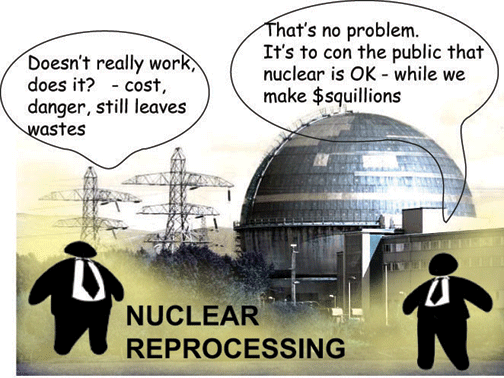 Two reactors, Takahama 3 and 4, owned by Kansai Electric, began operation in January and February 2016 loaded with plutonium MOX fuel, with unit 3 operating with 24 assemblies containing 1,088kg of plutonium and unit 4 with 4 assemblies containing 184kg of plutonium. Unit 4 shutdown due to an electrical failure three days after start up, while unit 3 was forced to shutdown on March 10th following a court order. Both reactors remain shutdown and are subject of a court injunction preventing operation issued by the Otsu district court, Shiga prefecture on March 9th. They are expected to be non operational for many months. Of the 26 reactors under review by the Nuclear Regulation Authority (NRA), Ikata-3, Genkai-3 and Tomari-3 are all intended to operate with plutonium MOX fuel.
“On current plans, and if ever the Rokkasho-mura reprocessing plant begins operation, Japan`s program could yield as much as 93,000kg by 2025 – most of which will remain unused. The reactor program in Japan is in crisis with no credible program for either restarting most reactors or using large amounts of this plutonium. If ever there was a time to abandon its current doomed nuclear energy policy, it is now. The Obama administration in its last year has an opportunity to step up and actively reduce the spiraling proliferation dynamic in East Asia – this should be top of the agenda in Washington instead of being ignored. The next step is to challenge the basis of the U.S.-Japan nuclear cooperation agreement which runs to 2018 – approval for Japan to continue acquiring plutonium must be reversed,” said Burnie.
Plutonium and ” fourth generation nuclear power”
Bill Gates’ Nuclear Pipe Dream: Convert Depleted Uranium to Plutonium to Power Earth for Centuries, Truth Out Tuesday, 15 March 2016 By Josh Cunnings and Emerson Urry, EnviroNews | Video Report Cunnings: “………..EnviroNews Editor-in-Chief Emerson Urry chatted with the esteemed nuclear industry expert and whistleblower Arnie Gundersen to explore whether Gates’ plan is a good idea or not.
 Emerson Urry: Let’s go back to Bill Gates again, [and] the fourth generation nuclear power. I’ve heard him out there speaking about this, and essentially his ambition to, let’s say, convert Paducah, Kentucky [to plutonium]. What can you tell us about Paducah, Kentucky? We understand it went bankrupt a couple years back, and I think there is quite a bit of radioactive material still there. We’ve heard at one point in time it was also one of the world’s largest greenhouse gas emitters from the Freon — not to mention having four allocated coal-fired power plants. What can you tell us about Paducah, Kentucky? What does the situation on the ground look like there, and how do you think they will deal with all that?
Arnie Gundersen: Paducah didn’t have centrifuges, it had gaseous diffusion, and there’s no need for the plant anymore, so the plant has to be decommissioned and destroyed. What’s happened is, the way they shut the plant down was, to be nice, sub-optimal. And what they allowed it to do was for all that uranium to cake inside the pipes. So, had they done it in a more orderly fashion, the plant could have been much cleaner when they went to shut it down — but they didn’t. So, the Paducah site is a very expensive cleanup that is going to take 20 or 30 years to decontaminate. You know, it’s like all of these bomb legacy sites — Hanford in Washington State…
Urry: … that has the plutonium leak in AY-102 correct? Which has that been ratcheted down? Have they been able to ratchet down AY-102?
Gundersen: No. Hanford is going to take 70 years and cost 110 billion dollars to clean up. So, here we are paying over half of a century for the legacy of building bombs for five years in 1940. And so, Paducah is another one of those sites. It was built to enrich uranium. Why did we do that? Because we had a bomb program. And now we’re stuck with these huge costs that are underfunded or unfunded by Congress. That plant is going to sit there for 30 years. It will create a lot of employment for a lot of people knocking it down, but it also is highly radioactive, and it’s got to be done so cautiously, and it’s a really difficult problem.
Cunnings: There’s no known disintegration of plutonium small enough that doesn’t possess the ability to cause cancer. To be clear, there is no safe amount to be exposed to whatsoever.
Plutonium, though a naturally occurring element was virtually non-existent on planet earth before the dawn of the nuclear age. Now, each of the roughly 400 uranium-powered nuclear reactors in the world create approximately 500 pounds of plutonium each year — or enough to create about 100 nuclear warheads each.
Coming from a “humanitarian” concerned with curing diseases, the notion that plutonium is the way to save ourselves from a runaway climate catastrophe seems the epitome of oxymoronic — utterly and woefully contradictory. But stay tuned for more on that topic, as in episode 14 of this series we examine whether or not we really need nuclear to solve the climate quandary.
But, in the meanwhile, let’s just say that Bill Gates’ nuclear ambitions go beyond mere ideas. He actually possesses financial holdings in one very dangerous situation indeed — a situation that is presently causing residents around St. Louis, Missouri to live under an all-out nuclear nightmare. And that scenario will be the topic of discussion in the next episode of our short series.
So please, tune in tomorrow for part three, where we explore the scary situation at hand in the Westlake Landfill in St. Louis, Missouri. Signing off for now, this is Josh Cunnings…… http://www.truth-out.org/news/item/35229-bill-gates-nuclear-pipe-dream-convert-mountains-of-depleted-uranium-to-plutonium-to-power-earth-for-centuries
Armed transport ships spotted in Panama Canal, headed for secret mission to later transport plutonium
UK-Flagged Ships Set to Transport Plutonium from Japan to US Located in Panama Canal http://www.srswatch.org/uploads/2/7/5/8/27584045/srsw_news_on_plutonim_ships_in_canal_feb_6_2016.pdf Ships on Secret Mission to Carry 331 Kilograms of Plutonium to US DOE’s Savannah River Site in South Carolina as Part of Nuclear Security Summit Preparation; Plutonium to be Stranded at SRS
Risky Plutonium-Mixed Fuel used in Japan’s new nuclear reactor restart
Japan Restarts Nuclear Reactor Using Plutonium-Mixed Fuel http://abcnews.go.com/International/wireStory/japan-restarts-nuclear-reactor-plutonium-mixed-fuel-36593509, By MARI YAMAGUCHI, ASSOCIATED PRESS, 29 Jan 16, Japan on Friday restarted a nuclear reactor that uses riskier plutonium-based MOX fuel, the first of that type to resume operations under stricter safety rules introduced after the 2011 Fukushima disaster.
Japan’s large stockpile of plutonium has raised international nuclear security concerns, and the government has come up with the idea of burning it in reactors to reduce the amount.
The No. 3 reactor at Takahama nuclear plant in western Japan, operated by Kansai Electric Power Co., went back online Friday. Dozens of people protested outside the plant in Fukui prefecture, where preparations for a restart of another reactor, No. 4, are also underway.
Fukui has more than a dozen reactors, the biggest concentration in one prefecture, causing safety concerns for neighbors including Kyoto and Shiga, whose Lake Biwa is a major source of drinking water for western Japan.
Two reactors that use conventional uranium fuel were restarted last year in southern Japan. Japan started burning MOX, a plutonium-uranium hybrid fuel, in some of its conventional reactors in 2009. Experts say conventional reactors can safely burn MOX for up to one-third of their fuel, but it emits more radiation and could interfere with control rods when they are needed to suppress the nuclear chain reaction.
Japan has enough plutonium, mostly from reprocessed spent fuel, to make 6,000 bombs.
Nearly five years since a massive earthquake and tsunami caused meltdowns at the Fukushima Dai-ichi nuclear plant, about 100,000 people still cannot return to nearby areas. Workers at the plant continue to struggle with its decommissioning, which will take decades.
Aiming to help business by generating energy, Japan’s government is pushing to restart as many reactors as possible after they are deemed safe. Forty remaining workable reactors are still offline for safety checks.
Follow Mari Yamaguchi on Twitter at twitter.com/mariyamaguchi
Her work can be found at http://bigstory.ap.org/content/mari-yamaguchi
The danger of transporting plutonium
Too much of a bad thing? World awash with waste plutonium http://www.theecologist.org/News/news_round_up/2986959/too_much_of_a_bad_thing_world_awash_with_waste_plutonium.html Paul Brown 24th January 2016
As worldwide stocks of plutonium increase, lightly-armed British ships are about to carry an initial 330kg of the nuclear bomb metal for ‘safekeeping’ in the US, writes Paul Brown. But it’s only the tip of a global ‘plutonium mountain’ of hundreds of tonnes nuclear power’s most hazardous waste product.
Two armed ships set off from the northwest of England this week to sail round the world to Japan on a secretive and controversial mission to collect a consignment of plutonium and transport it to the US.
The cargo of plutonium, once the most sought-after and valuable substance in the world, is one of a number of ever-growing stockpiles that are becoming an increasing financial and security embarrassment to the countries that own them.
So far, there is no commercially viable use for this toxic metal, and there is increasing fear that plutonium could fall into the hands of terrorists, or that governments could be tempted to use it to join the nuclear arms race.
All the plans to use plutonium for peaceful purposes in fast breeder and commercial reactors have so far failed to keep pace with the amounts of this highly dangerous radioactive metal being produced by the countries that run uranium-fulled nuclear power stations.
The small amounts of plutonium that have been used in conventional and fast breeder reactors have produced very little electricity – at startlingly high costs.
Japan, with its 47-ton stockpile, is among the countries that once hoped to turn their plutonium into a power source, but various attempts have failed. The government, which has a firm policy of using it only for peaceful purposes, has nonetheless come under pressure to keep it out of harm’s way. Hence, the current plan to ship it to the US.
Altogether, 15 countries across the world have stockpiles. They include North Korea, which intends to turn it into nuclear weapons.
UK’s Plutonium represents a massive cost – but no balance sheet liability recorded
The UK has the largest pile, with 140 tons held at Sellafield in north-west England, whereplutonium has been produced at the site’s nuclear power plant since the 1950s, also using spent fuel from civilian nuclear plants such as Hinkley Point and Calder Hall. The government has yet to come up with a policy on what to do with it – and, meanwhile, the costs of keeping it under armed guard continue to rise.
Like most countries, the UK cannot decide whether it has an asset or a liability. The plutonium does not appear on any balance sheet, and the huge costs of storing it safely – to avoid it going critical and causing a meltdown – and guarding it against terrorists are not shown as a cost of nuclear power.
This enables the industry to claim that nuclear is an attractive and clean energy-producing option to help combat climate change.
The two ships that set off from the English port of Barrow-in-Furness this week are the Pacific Egret and Pacific Heron, nuclear fuel carriers fitted with naval cannon on deck. They are operated by Pacific Nuclear Transport Ltd, which ultimately is owned by the British government.
The presence on both ships of a heavily-armed security squad – provided by the Civil Nuclear Constabulary’s Strategic Escort Group – and the earlier loading of stores and the craning on board of live ammunition point to a long, security-conscious voyage ahead.
Sent to the US for safekeeping
The shipment of plutonium from Japan to the US falls under the US-led Global Threat Reduction Initiative (GTRI), or Material Management & Minimisation (M3) programme, whereby weapons-useable material such as plutonium and highly-enriched uranium (HEU) is removed from facilities worldwide for safekeeping in the US.
The cargo to be loaded onto the two UK ships in Japan consists of some 331kg of plutonium from Japan’s Tokai Research Establishment.
This plutonium – a substantial fraction of which was supplied to Japan by the UK decades ago for ‘experimental purposes’ in Tokai’s Fast Critical Assembly (FCA) facility – is described by the US Department of Energy (DOE) as “posing a potential threat to national security, being susceptible to use in an improvised nuclear device, and presenting a high risk of theft or diversion”. Or, as another US expert put it, “sufficient to make up to 40 nuclear bombs”.
Under the US-led programme, the plutonium will be transported from Japan to the US port of Charleston and onwards to the Savannah River site in South Carolina.
Tom Clements, director of the public interest group Savannah River Site Watch, has condemned this import of plutonium as a material that will simply be stranded at the site, with no clear disposition path out of South Carolina. He sees it as further evidence that Savannah River is being used as a dumping ground for an extensive range of international nuclear waste.
Prime terrorist material’ at risk
The British group Cumbrians Opposed to a Radioactive Environment (CORE) has for decades tracked the transport of nuclear materials round the world.
Their spokesman, Martin Forwood, said: “The practice of shipping this plutonium to the US as a safeguard is completely undermined by deliberately exposing this prime terrorist material to a lengthy sea transport, during which it will face everyday maritime risks and targeting by those with hostile intentions.
“We see this as wholly unnecessary and a significant security threat in today’s volatile and unpredictable world.” The best option, CORE believes, would have been to leave it where it was, under guard.
From DOE documents, this shipment will be the first of a number of planned shipments for what is referred to as ‘Gap Material Plutonium‘ – weapons-useable materials that are not covered under other US or Russian programmes.
In total, the DOE plans to import up to 900kg of ‘at risk’ plutonium – currently held in seven countries – via 12 shipments over seven years. Other materials include stocks of HEU – the most highly enriched plutonium (to 93%), also being supplied to Japan by the UK.
The voyage from Barrow to Japan takes about six weeks, and a further seven weeks from Japan to Savannah River – use of the Panama Canal having been ruled out by the DOE in its documents on the shipment. Previously, the countries near the canal have objected to nuclear transport in their territorial waters.
Nuclear Waste Isolation Pilot Plant (WIPP)- what needs to be done?
Analyses of the accidents by the DOE have documented a lack of a ‘safety culture’ at WIPP.
The current regulatory period of 10,000 years is short relative to the 24,100-year half-life of plutonium-239, let alone that of uranium-235, which has a half-life of 700 million years.
Policy: Reassess New Mexico’s nuclear-waste repository, Nature Cameron L. Tracy, Megan K. Dustin & Rodney C. Ewing 13 January 2016
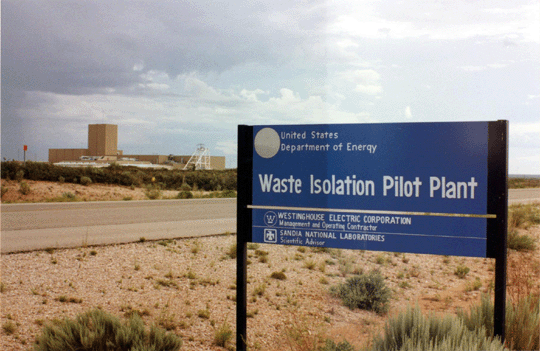
Proposals to bury plutonium from nuclear weapons must address chemical interactions and intrusion risks. More than 600 metres below ground near Carlsbad, New Mexico, is the world’s only operating deep geological repository currently accepting transuranic nuclear waste: that contaminated by elements heavier than uranium. The Waste Isolation Pilot Plant (WIPP), run by the US Department of Energy (DOE), is used to dispose of laboratory equipment, clothing and residues from the nation’s nuclear-defence programme. In the past 15 years, around 91,000 cubic metres (equivalent to covering a soccer field to a depth of about 13 metres) of such transuranic waste, mostly of relatively low radiation levels, has been placed there.
The main contaminants are long-lived isotopes of plutonium (mainly plutonium-239, with a half-life of 24,100 years, and plutonium-240, with a half-life of 6,560 years) and shorter-lived isotopes of americium and curium. In rooms carved out of a 250-million-year-old salt bed, the waste is stored in hundreds of thousands of plastic-lined steel drums. The repository is now at about half of its planned capacity and is to be sealed in 2033.
The DOE is responsible for performing safety assessments to ensure that WIPP will not exceed limits on exposure to radioactivity, as set by the US Environmental Protection Agency (EPA), for 10,000 years.
But new demands are emerging. An arms-control agreement with Russia made in 2000 obliges the United States to dispose of 34 tonnes of plutonium from dismantled nuclear weapons1. Following the terms of the agreement, the United States planned to convert the material into a fuel — mixed (uranium and plutonium) oxide, or MOX — to burn in commercial nuclear-power plants. But faced with soaring construction costs for a MOX fabrication facility at the Savannah River Site in South Carolina, the DOE has commissioned evaluations of alternatives2.
The most recent report3, published in August 2015, recommends burying the weapons’ plutonium at WIPP. Judging the repository’s performance to have been “successfully demonstrated”, the DOE’s Red Team expert panel proposes that the 34 tonnes of weapons plutonium can be added to WIPP once it has been diluted to low concentrations comparable to that of the transuranic waste at WIPP.
In fact, WIPP’s safety record is mixed. Continue reading
Large shipment of plutonium to travel from Japan to South Carolina
Japan to send huge cache of plutonium to South Carolina under nuclear deal: report RAW STORY AGENCE FRANCE-PRESSE 05 JAN 2016 Japan will send a huge cache of plutonium — enough to produce 50 nuclear bombs — to the United States as part of a deal to return the material that was used for research, reports and officials said Tuesday.
The plutonium stockpile, provided by the US, Britain and France decades ago, has caused some disquiet given that Japan has said it has the ability to produce a nuclear weapon even if it chooses not to.
The shipment, which comes ahead of a nuclear security summit in Washington in March, is meant to underscore both countries’ commitment to nuclear non-proliferation and is part of a deal they made in 2014.
It will be one of Japan’s most significant overseas movements of plutonium since it transported one tonne from France in 1993 to be used in nuclear reactor experiments.
That shipment triggered an outcry at the time from countries citing environmental and security concerns.
A Japanese official confirmed the amount of plutonium to be sent to the US and said that preparations for the shipment are under way. “But we can’t comment on further details, including the departure date and route, for security reasons,” the official in the nuclear technology section at the education ministry told AFP Tuesday.
The material has been stored at the Nuclear Science Research Institute northeast of Tokyo, he added…….https://www.rawstory.com/2016/01/japan-to-send-huge-cache-of-plutonium-to-south-carolina-under-nuclear-deal-report/
Disposal of plutonium; burial is cheaper than MOX processing
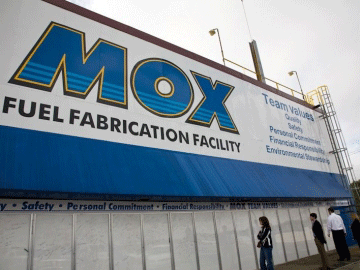

 nuClear news No.77, September 20156. Plutonium Conundrum A US Energy Department-commissioned study, which has been leaked to the Union of Concerned Scientists, concludes that it would be cheaper and far less risky to dispose of 34 metric tons of U.S. surplus plutonium at a federal nuclear waste repository in New Mexico than convert it into mixed-oxide (MOX) fuel for commercial nuclear power plants at the MOX Fuel Fabrication Facility in South Carolina.
The unreleased report describes in detail the delays and massive cost overruns at the half-built MOX facility, located at the federal Savannah River Site. High staff turnover, the need to replace improperly installed equipment, and an antagonistic relationship between the local federal project director and the contractor are only some of the factors undermining the project. The new report also notes that there are “no obvious silver bullets” to reduce the life-cycle cost of the MOX approach.
According to UCS, a better alternative to turning the surplus plutonium into commercial nuclear fuel would be to “downblend” it, a method the Energy Department has already used to dispose of several metric tons of plutonium. It involves diluting the plutonium with an inert, nonradioactive material and then sending it to the nuclear waste site in New Mexico, the Waste Isolation Pilot Plant (WIPP), for burial. The new report’s analysis supports that assessment. …….
Japan’s highly dangerous plutonium stockpile
Japan’s plutonium stockpile worries Oxford specialist, Global Post, Xinhua News Agency Aug 17, 2015 NEW YORK, — The handling of Japan’s huge plutonium stockpile remains a challenge for the whole world, an Oxford environmental expert has warned.
When Japan marked the 70th anniversary of Nagasaki’s obliteration by a plutonium bomb on Aug. 9, its own cache of weapons-usable plutonium was more than 47 metric tons, enough to make nearly 6,000 warheads like the one that flattened the Japanese city, Dr. Peter Wynn Kirby of University of Oxford wrote in an op-ed on Monday’s New York Times……..
Japan’s 48 standard reactors burn uranium fuel, a process that yields plutonium, a highly radioactive and extremely toxic substance.
Although these reactors were shut down after the Fukushima tragedy, Japan still stores nearly 11 tons of plutonium on its territory, with the rest in Britain and France. Stockpiling plutonium in Japan remains hazardous given seismic instability in the country and the risk of theft by terrorists, warned Kirby…..
As a byproduct of burning uranium, plutonium itself can be processed in so-called fast-breeder reactors to produce more energy. That step also yields more plutonium, and so in theory this production chain is self-sustaining — a kind of virtuous nuclear-energy cycle, noted Kirby.
“In practice, however, fast-breeder technology has been extremely difficult to implement. It is notoriously faulty and astronomically expensive, and it creates more hazardous waste,” wrote Kirby.
Many other countries that experimented with fast-breeder reactors, including the United States, had phased them out by the 1990s. But Japan continued to invest heavily in the technology, noted Kirby.
While Japan’s record with nuclear waste is abysmal, no other country has found a safe or economically sustainable way to reuse such substances, especially not plutonium, he noted. Given Japan’s many vulnerabilities, particularly seismic activity, nuclear waste should no longer be stored in the country, he argued. “The Japanese government should pay its closest allies to take its plutonium away, permanently.”
Britain and France respectively holds 20 tons and 16 tons of Japan’s plutonium under contracts to reprocess it into usable fuel. Under current arrangements, this fuel, plus all byproducts, including plutonium, are to be sent back to Japan by 2020.
“Japan should pay, and generously, for that plutonium to stay where it is, in secure interim storage. And it should help fund the construction of secure permanent storage in Britain and France,” he said.
The Japanese government should also pay the United States to remove the nearly 11 tons of plutonium currently in Japan, he argued.
“Handling Japan’s plutonium would be a great burden for receiver countries, and Japan should pay heftily for the service. But even then the expense would likely amount to a fraction of what Japan spends on its ineffectual plutonium-energy infrastructure,” wrote the specialist.
Making Japan free of plutonium stockpile, thus preventing nuclear catastrophe as a result of earthquakes, would be in the whole world’s interest, he concluded.http://www.globalpost.com/article/6632161/2015/08/17/japans-plutonium-stockpile-worries-oxford-specialist
UK’s Slow Progress on Plutonium Stockpiles.
 NuClear news August 2015 Since the Government confirmed in December 2011 that its preferred management option for the UK’s plutonium stockpile was to convert the ‘asset of zero value’ into Mixed Oxide (MOX) fuel, further progress on the option has been conspicuous by its absence, says Cumbrians Opposed to a Radioactive Environment (CORE). (1)
Multiple dangers of MOX fuel used in Fukushima’s No 3 nuclear reactor
MOX fuel rods used in Japanese Nuclear Reactor present multiple dangers, DC Bureau By Joseph TrentoMarch 15th, 2011 The mixed oxide fuel rods used in the compromised number three reactor at the Fukushima Daiichi complex contain enough plutonium to threaten public health with the possibility of inhalation of airborne plutonium particles. The compromised fuel rods supplied to the Tokyo Electric Company by the French firm AREVA.
Plutonium is at its most dangerous when it is inhaled and gets into the lungs. The effect on the human body is to vastly increase the chance of developing fatal cancers.

Masashi Goto, a reactor researcher and designer for Toshiba, told the Foreign Correspondents Club in Toyko the mixed oxide (MOX) fuel used in unit 3 of the Fukushima Daiichi nuclear facility uses plutonium, which is “much more toxic than the fuel used in the other reactors.”
Goto said that the MOX also has a lower melting point than the other reactor fuels. The Fukushima facility began using MOX fuel in September 2010, becoming the third plant in Japan to do so, according to MOX supplier AREVA.
Part of the process of making MOX fuel is to grind plutonium into a fine power before it is robotically inserted into fuel rods. Experts agree these tiny plutonium particles once airborne are extremely dangerous to human health. One of the unique characteristics of mixed oxide fuel is that relatively little of the plutonium in the fuel rods is used up in the fuel cycle in a reactor. “When the plutonium in the fuel rods goes into a reactor for commercial power, a very little of it is going to be consumed. I don’t know what percentage, maybe half percentage or something like that, but it’s going to generate an extraordinary amount of contamination throughout the fuel rods…,” says William Lawler, an expert on radioactive waste…….
Mixed oxide fuel is a combination of finely ground up plutonium particles and uranium oxide fabricated into fuel rods at an AREVA subsidiary in La Hague, France. The fuel is made from reprocessing old reactor fuel. Reprocessing was abandoned by the United States in the 1970s because of the dangers of weapons proliferation.
The CIA has reported that Japan’s nuclear power program was not limited to the peaceful production of electrical power. The program had its roots in a secret weapons program that caused the CIA to conclude as far back as 1964 that Japan could assemble within months a nuclear weapon.
Because of the Japanese public’s fear of nuclear weapons, the various subsequent Japanese governments have kept the program secret and have repeatedly denied its existence when news organizations made inquiries. http://www.dcbureau.org/20110315782/natural-resources-news-service/mox-fuel-rods-used-in-japanese-nuclear-reactor-present-multiple-dangers.html#sthash.NydPfWmn.dpuf
New report indicates that deep burial of plutonium better and cheaper than MOX reprocessing
 NuClear News, April 15 Alternatives to MOX A new report by Frank von Hippel and Gordon MacKerron reviews programs in France, Japan, the UK and the US to dispose of large stocks of separated plutonium in nuclear power reactor mixed-oxide (MOX) fuel. Most of these efforts have suffered long delays and large cost increases and all have failed to reduce plutonium stockpiles. This has led some of these countries to consider alternatives.
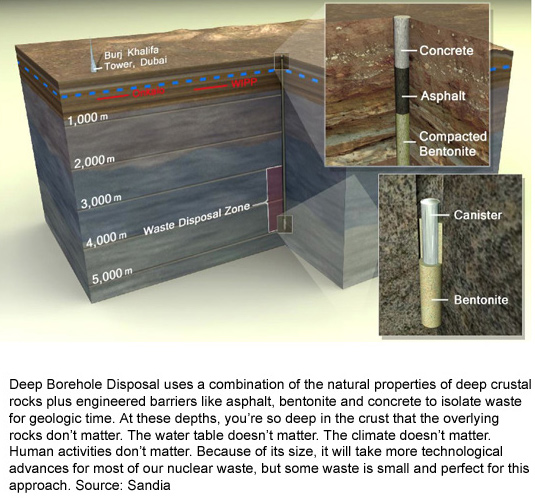
A less costly and more effective approach may be to treat plutonium as a waste to be processed into a stable form and deeply buried. These alternative approaches include disposal with radioactive waste or spent fuel or disposal down a 3-mile (5-kilometer) deep borehole. The report recommends that more than one direct-disposal approach be pursued. It also recommends that the countries that share the problem of plutonium disposal collaborate on exploring direct-disposal options.
Finally, it recommends that the quantities of plutonium disposed by the weapon states be verified by the IAEA. The huge cost overruns in the under-construction MOX plant at the DOE’s Savannah River Site in South Carolina led the Obama Administration to conclude in 2013 that plutonium disposal via MOX “may be unaffordable.”
This has revived policy interest in the U.S. in the possibilities of direct disposal of plutonium as a waste. Efforts to convert foreign separated plutonium into MOX fuel encountered technical problems in the UK, forcing the abandonment of the Sellafield MOX Plant. The UK has therefore looked, in at least a pro forma way, at direct-disposal alternatives.
In the late 1990s, the U.S. studied in considerable depth a “can-in-canister” option in which immobilized plutonium would be embedded in some of the high-level reprocessing waste from which it had been originally separated. This was a way to create a radiation barrier around the plutonium like that around the plutonium in spent fuel, which makes plutonium inaccessible except via chemical and mechanical operations controlled remotely from behind thick radiation shields.
The can-in-canister approach also shares the merit with MOX that it just adds marginally to the quantity of an already existing waste form for which a geological repository has to be found in any case. This option may still be of particular interest in the US, which will be disposing of reprocessing waste for several decades into the future.
In France and the UK, where high-level waste vitrification has been ongoing in parallel with reprocessing, it may be impossible to pursue the “can-in-canister” option unless it is planned well before reprocessing ends. There are other options, however. One that appears increasingly attractive is deep borehole disposal. It does not involve a radiation barrier, but retrieval would be much more difficult than from a closed geological repository.http://www.no2nuclearpower.org.uk/nuclearnews/NuClearNewsNo73.pdf
1 This Month
23-25 October – on Zoom – World BEYOND War’s annual global conferenc


Shut down the radiation-damaged Heysham nuclear reactors now
To see nuclear-related stories in greater depth and intensity – go to https://nuclearinformation.wordpress.com

Say No to NASA’s Reckless Nuclear Reactor on the Moon
Say No to NASA’s Reckless Nuclear Reactor on the Moon

-
Archives
- October 2026 (243)
- September 2026 (339)
- August 2026 (330)
- July 2026 (355)
- June 2026 (287)
- May 2026 (306)
- April 2026 (356)
- March 2026 (251)
- February 2026 (267)
- January 2026 (308)
- December 2025 (358)
- November 2025 (359)
-
Categories
- 1
- 1 NUCLEAR ISSUES
- business and costs
- climate change
- culture and arts
- ENERGY
- environment
- health
- history
- indigenous issues
- Legal
- marketing of nuclear
- media
- opposition to nuclear
- PERSONAL STORIES
- politics
- politics international
- Religion and ethics
- safety
- secrets,lies and civil liberties
- spinbuster
- technology
- Uranium
- wastes
- weapons and war
- Women
- 2 WORLD
- ACTION
- AFRICA
- Atrocities
- AUSTRALIA
- Christina's notes
- Christina's themes
- culture and arts
- Events
- Fuk 2022
- Fuk 2023
- Fukushima 2017
- Fukushima 2018
- fukushima 2019
- Fukushima 2020
- Fukushima 2021
- general
- global warming
- Humour (God we need it)
- Nuclear
- RARE EARTHS
- Reference
- resources – print
- Resources -audiovicual
- Weekly Newsletter
- World
- World Nuclear
- YouTube
-
RSS
Entries RSS
Comments RSS

