Plutonium remains in the ground below proposed Rocky Flats national wildlife refuge

 Guardian 22nd Aug 2018 The nation’s newest national wildlife refuge, filled with swaying prairie
grass and home to a herd of elk, is slated to open next month just outside
Colorado’s largest city.
But seven Denver metro area school districts
have already barred school-sanctioned field trips to the preserve. A top
local health official says he would probably never hike there.
And a town is suing over what the soil might contain. “The threat posed by
contamination at Rocky Flats and its effect on visiting children appears to
be an issue of dispute amongst experts,” Lisa Flores, a Denver public
schools board of education member, told the Guardian.
“Until we have definitive assurances of child safety, we will exercise an abundance of
caution.” The 2,119-hectare (5,237-acre) Rocky Flats national wildlife
refuge, due to open this autumn, sits on land surrounding what once was a
nuclear weapons production facility. From 1951 to 1989, the Rocky Flats
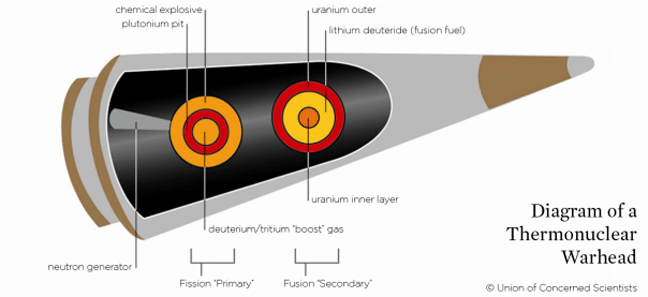
Plant manufactured plutonium triggers – grapefruit-size spheres that,
when compressed by explosives, catalyze a nuclear reaction. Though the
area, about 20 miles north-west of Denver, has been cleaned up and declared
safe by the government, plutonium remains in the ground where the facility
once stood.
https://www.theguardian.com/environment/2018/aug/22/new-us-refuge-rocky-flats-plutonium-toxic
Japan plans to reduce its 47.3 tons of stockpiled plutonium
IPFM 20th Aug 2018 , On 31 July 2018, Japan’s Atomic Energy Commission (JAEC) issued a newpolicy paper, The Basic Principles on Japan’s Utilization of Plutonium,
which for the first time, stated that “Japan will reduce the size of its
plutonium stockpile.”
Energy Plan (in Japanese) by the Ministry of Economy, Trade and Industry
(METI) that was adopted on 3 July by the Cabinet of the Japanese
government. Japan’s plutonium stockpile, according to the data released by
the JAEC at the same time as the new policy, is about 47.3 tons of
plutonium (as of the end of 2017), of which 36.7 tons is overseas (21.2
tons in UK and 15.5 tons in France) and 10.5 tons in Japan. The Rokkasho
reprocessing plant, with a design separation capacity of 8 tons of
plutonium per year, on which stated construction in 1993, is currently
planned to be completed in 2021. Plans call for the J-MOX plant to be
completed in 2022 to turn this plutonium into MOX fuel for light water
(LWR) nuclear power reactors.
http://fissilematerials.org/blog/2018/08/japans_new_policy_on_its_.html
Hanford Plutonium Finishing Plant clean-up to be restarted
 Daily Mail 27th July 2018 , Work to demolish a former nuclear weapons production factory in Washington
state may resume in September, about six months after it was halted when
workers were exposed to radioactive particles, the U.S. Department oEnergy said Thursday.
workers demolishing the Plutonium Finishing Plant on the Hanford Nuclear
Reservation, which is near Richland. The plant was involved in producing
much of the plutonium for the nation’s nuclear arsenal.
issued a report in late March that said a total of 42 Hanford workers
inhaled or ingested radioactive particles when they were exposed during
contamination events in June and December of last year. Radioactive
contamination was also found outside plant offices and inside two dozen
vehicles, the report said.
http://www.dailymail.co.uk/wires/ap/article-5997239/Work-demolish-nuke-weapons-plant-resume-September.html
Japan has amassed enough plutonium to make 6,000 nuclear bombs
 Economist 25th July 2018 Japan has now amassed 47 tonnes of plutonium, enough to make 6,000 bombs.
What is Japan doing with so much plutonium? Plutonium is at the heart of
Japan’s tarnished dream of energy independence. Spent fuel from nuclear
reactors can be reprocessed to extract plutonium, which is then recycled
into mixed oxide, or MOX, fuel. This was intended for use in Japan’s
reactors but most of its nuclear power plants have been offline since the
2011 Fukushima disaster.
Tougher safety checks have failed to reassure the
nuclear-phobic public that the reactors can be restarted. And Japan’s
nuclear-energy fleet is ageing. Taro Kono, Japan’s foreign minister, has
admitted that this situation is “extremely unstable”.
Japan’s status as a plutonium superpower is increasingly under scrutiny. The government
says it has no intention of building a bomb. But China and other countries
question how long it can be allowed to stockpile plutonium. Analysts worry
about a competitive build-up of plutonium in Asia.
Moreover Japan’s stock, which is weapons-grade, is reprocessed and stored in France and
Britain. It is moved across the world in heavily armed convoys. America
says those shipments and the storage of plutonium in civilian sites present
a potential threat to non-proliferation goals: they could be redirected to
make weapons, or targeted by terrorists. It is nudging its ally to start
reducing the hoard.
https://www.economist.com/the-economist-explains/2018/07/25/why-does-japan-have-so-much-plutonium
Japan, U.S. extend nuclear pact amid concern about plutonium stockpile
KYODO NEWS 17 July 18 Japan and the United States extended on Tuesday a bilateral nuclear agreement that has served as the basis for Tokyo’s push for a nuclear fuel recycle policy.
The pact, which entered into force in July 1988, has authorized Japan to reprocess spent fuel, extract plutonium and enrich uranium for 30 years. As neither side sought to review it before the end of the term, it will remain effective, leaving Japan the only country without nuclear arms that is allowed to reprocess spent nuclear fuel.
But the passing of the initial 30-year period raises uncertainty over the future of the pact, now that it can be terminated anytime six months after either party notifies the other.
The United States is seen as concerned about Japan’s stockpiles of plutonium
………Japan has around 47 tons of plutonium, which is enough to produce about 6,000 nuclear warheads.
Of the 47 tons, around 10 tons were stored in Japan and the reminder in Britain and France as of the end of 2016, according to government data.
In early July, Japan clearly stated for the first time in its basic energy plan that it will trim the amount.
Spent fuel from nuclear reactors is reprocessed to extract uranium and plutonium, which is then recycled into fuel called mixed oxide, or MOX, for use in fast-breeder reactors or conventional nuclear reactors.
But following the 2011 Fukushima nuclear disaster, most of Japan’s nuclear power plants remain offline as they are required to pass newly established safety regulations……..
The Rokkasho plant, a key pillar of the country’s nuclear fuel recycling policy, will be able to produce around 8 tons of plutonium a year when fully operational. https://english.kyodonews.net/news/2018/07/d0e37985dc1c-japan-us-extend-nuclear-pact-amid-concern-about-plutonium-stockpile.html
Questions: why does USA allow only Japan to reprocess plutonium?
Japan’s ‘plutonium exception’ under fire as nuclear pact extended https://asia.nikkei.com/Politics/International-Relations/Japan-s-plutonium-exception-under-fire-as-nuclear-pact-extended Beijing and Seoul question why US allows only Tokyo to reprocess, TOKYO — Japan’s nuclear cooperation agreement with the U.S. — the pillar of Tokyo’s nuclear energy policy — renews automatically on Monday after the current pact, which took effect in 1988, expires.
The agreement allows Japan to be the sole non-nuclear-weapons state to use plutonium for peaceful purposes and underlies the country’s policy of recycling spent nuclear fuel.
But the renewal comes at a time when Japan’s “plutonium exception” is increasingly under scrutiny. Instead of negotiating a new pact that could last several decades, Washington and Tokyo chose an automatic extension of the current agreement.
The agreement signed three decades ago stated that after the 30-year period expired, the terms would remain in force but could be terminated by either side with a six months’ notice. Japan worries that without a new long-term agreement, the country enters an “extremely unstable situation,” Foreign Minister Taro Kono has said.
Japan’s neighbors have cried foul over Japan’s plutonium exception. China has said it creates a path for Japan to obtain nuclear weapons. South Korea, which also has a nuclear cooperation agreement with the U.S., has pressed Washington hard to be granted similar freedom on fuel reprocessing.
Countries such as Saudi Arabia that are looking to develop their own nuclear programs have also protested.
Under President Barack Obama, Japan’s plutonium stockpiles — much of which is stored in the U.K. — drew uncomfortable attention in Washington. In March 2016, Thomas Countryman, the then-assistant secretary of state for nonproliferation, told a Senate hearing that he “would be very happy to see all countries get out of the plutonium reprocessing business.”
President Donald Trump has shown less interest in preventing nuclear proliferation, but is committed to dismantling North Korea’s nuclear facilities and materials. Resolving the inconsistent treatment afforded Japan’s plutonium stockpile would make it easier to convince Pyongyang to give up reprocessing capabilities as part of its denuclearization, Countryman told Nikkei recently.
The Trump administration appears aware of these arguments. The National Security Council and State Department have requested that Japan reduce its stockpile and otherwise ensure its plutonium is used and managed appropriately. On July 3, Japan’s cabinet approved a new basic energy plan that includes reducing plutonium holdings, aiming to assuage American concerns.
But Japan’s mostly idled nuclear power industry makes working through the stockpile a challenge.At one point after the 2011 Fukushima nuclear disaster, all of the country’s reactors were offline. Nine have managed to restart under stricter safety standards adopted in the wake of the meltdowns, but only a few Japanese reactors can run on so-called mixed-oxide fuel containing plutonium.
Regulators have asked utilities such as Shikoku Electric Power and Kyushu Electric Power that are working to restart nuclear reactors to look into consuming plutonium fuel held by other power companies. But this would require potentially difficult negotiations with local governments.
One other option is to pay overseas countries that store plutonium on Japan’s behalf to dispose of them, but that would involve discussion on the international level.
“The only viable option is to explain to the world the steady efforts we are making toward reduction,” said an official at the Ministry of Economy, Trade and Industry, which is responsible for Japan’s energy policy.
So far, the U.S. has not called on Japan to abandon its plutonium entirely, or to speed up its reduction. And there is little chance the U.S. will end the cooperation agreement, as “Japan’s nuclear technology is indispensable to the American nuclear industry,” according to a Japanese government source.
But Tokyo worries that the Trump administration may apply the same transactional approach it has to other foreign policy issues to the question of Japan’s plutonium.
Japan-US nuclear energy pact set to renew automatically in July 2018
https://mainichi.jp/english/articles/20180116/p2a/00m/0na/005000c (Mainichi Japan)
A nuclear energy cooperation agreement between Japan and the U.S. will renew automatically in July 2018, it is expected to be confirmed on Jan. 16.
The existing accord, officially called the Agreement for Cooperation Between the Government of the United States of America and the Government of Japan Concerning Peaceful Uses of Nuclear Energy, recognizes Japan’s extraction of plutonium from spent nuclear fuel and use of mixed oxide (MOX) fuel as part of its “nuclear fuel cycle.” Renewing the pact will enable Japan to continue with its nuclear fuel cycle policy.
However, after the pact is renewed, if either Japan or the U.S. gives notice, then the agreement will be halted after six months — which would mean that Japan’s nuclear policy would be more easily affected by the will of the U.S.
The nuclear energy agreements that the U.S. has in place with other countries control the handling of nuclear materials and related equipment — from the standpoint of non-proliferation — whenever the U.S. provides nuclear technology to those other nations.
Under the existing agreement between Japan, a non-nuclear nation, and the U.S., nuclear fuel cycle operations such as the reprocessing of spent nuclear fuel and also uranium enrichment are recognized, in what is considered an exceptional case.
With the pact coming into effect in July 1988, the 30-year deadline of the current agreement will be reached on July 16, 2018. As long as neither Japan nor the U.S. give notice to withdraw six months prior to the deadline, the pact will be automatically renewed.
The Japanese government did try to negotiate with the U.S. about maintaining the agreement as it is. However, the administration under U.S. President Donald Trump has not been in a position to negotiate, and so the pact looks set to renew automatically, without any serious negotiations taking place.
Japan nuclear agency urges measures to cut plutonium stocks
http://www.sandiegouniontribune.com/business/sns-bc-as–japan-nuclear-20180705-story.html MARI YAMAGUCHIAssociated Press
The annual “nuclear white paper” approved by the Atomic Energy Commission is an apparent response to intensifying pressure from Washington as it pursues denuclearization in North Korea. It says Japan’s fuel recycling program should continue, but minimize the amount of plutonium extracted from spent fuel for reuse in power generation to eventually reduce the stockpile.
Japan has pledged to not possess plutonium that does not have a planned use, but the promise increasingly sounds empty because of the slow restarts of Japanese power-generating reactors that can burn plutonium amid setbacks from the 2011 Fukushima disaster.
Though Japanese officials deny any possible misuse of the material and reprocessing technology, the large stockpile of plutonium that can make atomic bombs also raises security concerns as the U.S. wants North Korea to get rid of its nuclear weapons.
Commission chairman Yoshiaki Oka said the effort to tackle the stockpile is Japan’s own initiative underscoring its commitment to a peaceful nuclear program, and not because of the U.S. Oka said he was not aware of any outstanding problem between the two countries over the plutonium issue, but that Japan is taking into consideration the importance of maintaining “relationship of trust with the U.S.”
The commission is compiling guidelines to better manage and reduce the plutonium stockpile. Measures would include some government oversight in setting a cap on plutonium reprocessing and a study into how to steadily reduce the plutonium processed abroad.
Oka declined to cite a numerical target, but he said reducing the stockpile is a “must.”
Japan has nearly 47 tons of plutonium — 10 tons at home and the rest in France and Britain, where spent fuel from Japanese nuclear plants has been reprocessed because Japan is not able to reprocess it into plutonium-based MOX fuel at home.
The amount is enough to make 6,000 atomic bombs, but at Japan’s Rokkasho reprocessing plant denies any risk of proliferation, citing its safeguards and close monitoring by the International Atomic Energy Agency .
After years of delay due to technical issues, the Rokkasho plant is in the final stages of safety approvals by the regulators ahead of its planned launch in 2021. Critics, however, say that starting up the plant only adds to the stockpile.
The plant at full capacity can annually produce 8 tons of plutonium, and burning that would require 16-18 reactors — a long shot given the slow pace of restarts and public resistance. Japanese utility operators are also opting to decommission aged reactors rather than making costly safety upgrades to meet the post-Fukushima standards.
Only four reactors have restarted since the Fukushima crisis, using stricter safety requirements and despite resistance of neighbors.
Another setback for Japan’s plutonium balance is a failure of Monju, a plutonium-burning reactor built as the centerpiece of Japan’s fuel recycling program. Monju had been suspended after a major accident in 1995 and is now being scrapped.
Follow Mari Yamaguchi on Twitter at www.twitter.com/mariyamaguchi
Find her work at https://www.apnews.com/search/mari%20yamaguchi
A glut of plutonium pits. Oh great! USA can make more nuclear weapons
DOE considering new locations, weapons uses for some SRS plutonium https://www.aikenstandard.com/news/doe-considering-new-locations-weapons-uses-for-some-srs-plutonium/article_8707c68c-7aeb-11e8-be43-ff26df8805d9.html By Colin Demarest cdemarest@aikenstandard.com
UK’s Nuclear Decommissioning Authority (NDA) to spend billions stabilising plutonium canisters
 Power Technology 21st June 2018 , NDA to spend billions stabilising plutonium canisters. The National Audit Office (NAO) has released a report detailing the unstable condition of highly dangerous plutonium canisters at the Sellafield nuclear plant, said to be “decaying faster than anticipated”.
The report, titled ‘Progress with reducing risk at Sellafield’ warns that if these canisters were to leak it would prove an “intolerable risk” – a label defined by the Nuclear Decommissioning Authority (NDA) as a situation where reducing the risk “becomes the overriding factor”, taking precedence over matters of cost and requiring immediate action.
The NDA has refused to comment on the number of canisters affected, though it has said it is only a “small proportion” of their total number. The UK houses 40% of global civil plutonium, the majority of which is stored at the Sellafield site in Cumbria, itself overseen by the NDA. The substance is a by-product of nuclear fuel reprocessing and the site’s abundant stock has led the NDA to label Sellafield its most hazardous facility.
The new report shows Sellafield, which opened in 2012, to have ‘unsuitable’ containers for storing plutonium. The NAO has proposed the canisters be repackaged through the store retreatment plant (SRP) facility, though until this facility is ready the NDA is recommended to place the more unstable canisters in extra layers of packaging. In response to these measures, the NDA has announced its decision to pledge a further £1bn on these packaging canisters, and £1.5bn on building a new facility to house the plutonium.
https://www.power-technology.com/news/nda-spend-billions-stabilising-plutonium-canisters/
Japan commits to reducing its excess of plutonium
Japan to cap plutonium stockpile to allay U.S. concerns, THE ASAHI SHIMBUN, June 17, 2018
Japan plans to boost measures to curb surplus plutonium extracted from the reprocessing of spent fuel at nuclear power plants, including capping the country’s stockpile of the highly toxic material.
The move followed the U.S. and other countries’ calls for Japan to reduce excess plutonium in light of nuclear nonproliferation and the threat of terrorist attacks involving nuclear materials.
The Cabinet Office’s Japan Atomic Energy Commission will incorporate the measures in the five-point basic nuclear policy expected at the end of this month, the first revision in 15 years.
A reduction in the volume of plutonium held by Japan will also be specified in the government’s basic energy plan, which will be revised next month.
Japan possesses about 10 tons of plutonium inside the country and about 37 tons in Britain and France, the two countries contracted to reprocess spent nuclear fuel. The total amount is equivalent to 6,000 of the atomic bomb that devastated Nagasaki in 1945.
In the policy, announced in 2003, the government vowed not to possess plutonium that has no useful purpose. The government has pledged not to have surplus plutonium to the International Atomic Energy Agency………
Japan can reprocess spent nuclear fuel under the Japan-U.S. Nuclear Cooperation Agreement.
The 30-year pact is expected to be automatically extended beyond its expiration on July 16.
After the expiration, however, the pact will be scrapped six months after either Japan or the United States notifies the other side of its intention to do so.
Foreign Minister Taro Kono has expressed concern about the “unstable” future of the agreement after July, and Japan has worked to meet a request from Washington to clearly spell out steps to reduce Japan’s plutonium stocks.
The government’s draft policy calls for allowing retrieval of plutonium strictly based on the projected amount to be used at conventional nuclear reactors as mixed plutonium-uranium oxide fuel, commonly known as MOX fuel.
It will also step up oversight on utilities with the aim of reducing the amount of plutonium to a level allowing the nuclear reprocessing plant under construction in Rokkasho, Aomori Prefecture, and other facilities to operate properly.
In addition, electric power companies will cooperate with each other in the use of MOX fuel, so that the amount of Japan’s surplus plutonium that is now overseas will be reduced.
For example, Kyushu Electric Power Co. and Kansai Electric Power Co., two utilities that began using MOX fuel ahead of other utilities, will consider using more MOX fuel at their nuclear plants for the benefit of Tokyo Electric Power Co., whose prospect of bringing its Kashiwazaki-Kariwa nuclear power plant in Niigata Prefecture back on line remains uncertain.
When the 2.9 trillion yen ($26.37 billion) reprocessing plant in Rokkasho goes into full operation, about eight tons of new plutonium will be added annually as Japan’s surplus plutonium…..
of nine reactors that have resumed operations following the introduction of more stringent safety standards after the Fukushima No. 1 nuclear disaster in 2011, only four can use MOX fuel.
The operation of the Rokkasho plant will likely be significantly curtailed even if it is completed amid that environment.
(This article was written by Yusuke Ogawa, Rintaro Sakurai and Shinichi Sekine.) http://www.asahi.com/ajw/articles/AJ201806170027.html
US demands Japan reduce its plutonium stockpiles
Nikkei Asian Review 10th June 2018 , US demands Japan reduce its plutonium stockpiles. Trump-Kim summit raises
questions about Tokyo’s nuclear exemption. The U.S. has called on Japan to
reduce its high levels of stockpiled plutonium, a move that comes as the
Trump administration seeks to convince North Korea to abandon its nuclear
weapons, Nikkei has learned.
https://asia.nikkei.com/Politics/International-Relations/US-demands-Japan-reduce-its-plutonium-stockpiles
The global problem of poisonous plutonium: Japan looks at its options
 a minimum requirement for any form of political consent to onsite storage would be a clear commitment by the government to phase out all nuclear power by a fixed date, so that the final amount of waste can be determined and will not just keep growing, along with the burden on local people.
 CNIC Seminar report: The problems with Japan’s Plutonium: What are they and how do we deal with them? http://www.cnic.jp/english/?p=4135 Caitlin Stronell, CNIC BY CNIC_ENGLISH · JUNE 4, 2018 On April 20, CNIC organized a seminar with guest speaker Prof. Frank von Hippel, a nuclear physicist from Princeton University’s Program on Science and Global Security, presenting alternative ways to dispose of spent fuel instead of reprocessing, as well as options for disposal of separated plutonium. After this presentation of technical solutions, a panel discussion took place. Prof. Eiji Oguma, a historical sociologist from Keio University’s Faculty of Policy Management and a well-known commentator on the post-Fukushima anti-nuclear movement in Japan, pointed out the political barriers that must be overcome if any of these technical solutions were to be actually implemented, no matter how much more reasonable they may seem from economic and safety perspectives. CNIC’s General Secretary, Hajime Matsukubo was also on the panel and brought into the discussion the international implications of Japan’s plutonium policy including the US-Japan Nuclear Agreement.
America wasting $billions on unnecessary and dangerous plutonium pits for nuclear weapons
Editorial: Wasting billions in federal tax dollars just the pits https://www.abqjournal.com/1180661/wasting-billions-in-federal-tax-dollars-just-the-pits.html,By Albuquerque Journal Editorial BoardJune 5th, 2018
Groups Release Key DOE Documents on Expanded Plutonium Pit Production, DOE Nuclear Weapons Plan Not Supported by Recent Congressional Actions
https://nukewatch.org/pressreleases/PR-Pit-Production-Docs-5-31-18.pdf May 31, 2018 Contact Tom Clements, SRS Watch, 803.240.7268, tomclements329@cs.com Jay Coghlan, Nuclear Watch NM, 505.989.7342, c. 505.470.3154, jay@nukewatch.org
Santa Fe, NM & Columbia, SC – Two key U.S. Department of Energy documents on future production of plutonium “pits” for nuclear weapons, not previously released to the public, fail to justify new and upgraded production facilities at both the Los Alamos National Laboratory (LANL) in New Mexico and the Savannah River Site (SRS) in South Carolina.
The report reveals that the initial cost estimate for these new and upgraded facilities at both sites is $10 billion by 2030, and around $46 billion in total life cycle costs. Plutonium pits are the fissile cores of nuclear weapons. Cost overruns are the rule for major projects undertaken by the National Security Administration (NNSA), the semi-autonomous nuclear weapons agency within DOE, so the costs are likely to rise yet more, according to Nuclear Watch New Mexico and Savannah River Site Watch.
NNSA’s Pu Pit Production Engineering Assessment, originally marked Unclassified Controlled Nuclear Information, was finalized on April 20, 2018. The 293-page document was obtained by Nuclear Watch and is being released so that the public may be fully informed about the agency’s misguided pursuit of new plutonium pit production facilities for future new-design nuclear weapons. The new NNSA Administrator has called future plutonium pit production her highest priority. But the Engineering Assessment fails to answer the most crucial question: why are at least 80 plutonium pits per year needed to begin with?
As background, on May 10, 2018, NNSA announced in a one-page statement:
To achieve DoD’s [Department of Defense] 80 pits per year requirement by 2030, NNSA’s recommended alternative repurposes the Mixed Oxide Fuel Fabrication Facility at the Savannah River Site in South Carolina to produce plutonium pits while also maximizing pit production activities at Los Alamos National Laboratory in New Mexico. This two-prong approach – with at least 50 pits per year produced at Savannah River and at least 30 pits per year at Los Alamos – is the best way to manage the cost, schedule, and risk of such a vital undertaking.
Nuclear Watch also obtained NNSA’s 14-page Plutonium Pit Production Engineering Assessment (EA) Results. That summary document, dated May 2018, relied on the Trump Administration’s 2018 Nuclear Posture Review for claiming the need for expanded plutonium pit production. However, that high-level review failed to state any concrete justification for the alleged pit need. Moreover, Congress is balking at funding any new pit production facilities at SRS, primarily because Sen Lindsey Graham (R-SC) vociferously opposes repurposing the MOX facility, now undergoing termination, and the New Mexico congressional delegation opposes any pit production outside of the Los Alamos Lab.
The Engineering Assessment details that NNSA analyzed four pit production options, one in the Mixed Oxide (MOX) Fuel Fabrication Facility at SRS and three options at Los Alamos. NNSA chose the most expensive combination, repurposing the MOX facility and increasing pit production at LANL to 30 pits per year. Los Alamos is currently authorized to produce 20 pits per year, but has failed to achieve even that because of ongoing nuclear criticality safety issues (moreover, LANL proposed to produce all 80 pits per year, which NNSA rejected). SRS has never produced pits, raising new nuclear risks at that site and concern about new waste streams.
The Engineering Assessment makes clear that “moderate risks” in the option of repurposing the MOX plant at SRS includes any failure to quickly terminate the MOX project, due to subsequent delays in closing out the project and terminating contracts. Likewise, the report affirms a longheld concern that there is a “very high probability for incomplete construction records/as-built drawings” for the MOX project. On May 10, DOE began congressionally sanctioned termination of the bungled MOX project, but it is being opposed in last-ditch, desperate attempts by Senator Lindsey Graham and the State of South Carolina. The Engineering Assessment makes explicitly clear that terminating the MOX program is the crucial prerequisite for plutonium pit production at SRS and that “some work [on repurposing the MOX plant] can be completed during MOX closeout,” contrary to both the wishes of Congress and requirements of the National Environmental Policy Act.
Expanded plutonium pit production is NOT needed to maintain the safety and reliability of the existing nuclear weapons stockpile, according to Nuclear Watch. In fact, no pit production for the existing nuclear weapons stockpile has been scheduled since 2011, and none is scheduled for the future. Up to 15,000 “excess” pits and another 5,000 in “strategic reserve” are already stored at DOE’s Pantex Plant near Amarillo, TX. In 2006 independent experts found that pits last a least a century1 (they currently average 40 years old). A 2012 follow-on study by the Livermore Lab found that the “graceful aging of plutonium also reduces the immediate need for a modern highcapacity manufacturing facility to replace pits in the stockpile.” 2
Future pit production is for speculative future new designs being pushed by the nuclear weapons labs, so-called Interoperable Warheads for both land- and sub-launched missiles that the Navy does not support. 3 Moreover, as the Engineering Assessment makes clear, future pits will NOT be exact replicas of existing pits. This could have serious potential consequences because heavily modified plutonium pits cannot be full-scale tested, or alternatively could prompt the U.S. to return to nuclear weapons testing, which would have severe international proliferation consequences.
The Engineering Assessment also explicitly links raising the administrative limit on plutonium at LANL’s “Rad Lab” to expanded pit production. This contradicts a recent draft environmental assessment in which NNSA claimed that re-categorizing the Rad Lab as a Hazard Category-3 nuclear facility was necessary only to maintain basic analytical chemistry capabilities, while omitting any reference whatsoever to expanded plutonium pit production.
The Engineering Assessment briefly outlines what could be a major vulnerability to NNSA’s pit production plans, that is the agency’s future compliance (or not) with the National Environmental Policy Act (NEPA). The Assessment states that if “compliance is delayed, [this] extends the schedule, increases costs, and/or delays production.” Both Nuclear Watch and SRS Watch assert that the law requires that major federal proposals be subject to public review and comment before a formal decision is made. Arguably, a formal decision to raise production to 80 pits or more per year necessitates a new or supplemental nation-wide programmatic environmental impact statement (PEIS), which the new dual-site decision strongly buttresses. Follow-on site-specific NEPA documents will then be necessary, with full public participation and hearings. All of this could introduce substantial delays to NNSA’s plutonium pit production plans.
“While it’s clear that the bungled MOX project is unworkable from technical and cost perspectives and must rapidly be terminated, there is no justification to convert the abandoned facility to a nuclear bomb production plant,” said Tom Clements, director of SRS Watch. “We agree that money must now be spent closing and securing the MOX building, but not on the new, unauthorized pit mission. Spending taxpayer funds to now begin conversion of the MOX plant to pit production, as is indicated in the pit report, is premature and can’t even be considered until Congress approves the NNSA approach for new facilities and an environmental impact review with public participation takes place,” added Clements.
Jay Coghlan, Nuclear Watch Director, commented, “NNSA has already tried four times to expand plutonium pit production, only to be defeated by citizen opposition and its own cost overruns and incompetence. We realize that this fifth attempt at a new pit plant is the most serious yet, but we remain confident it too will fall apart. The enormous financial and environmental costs of new nuclear bomb factories and the fact that expanded plutonium pit production is simply not needed for the existing nuclear weapons stockpile will doom this effort. We think the American public will reject new-design nuclear weapons, which is what this expanded pit production decision is really all about.”
1 This Month
23-25 October – on Zoom – World BEYOND War’s annual global conferenc


Shut down the radiation-damaged Heysham nuclear reactors now
To see nuclear-related stories in greater depth and intensity – go to https://nuclearinformation.wordpress.com

Say No to NASA’s Reckless Nuclear Reactor on the Moon
Say No to NASA’s Reckless Nuclear Reactor on the Moon

-
Archives
- October 2026 (231)
- September 2026 (339)
- August 2026 (330)
- July 2026 (355)
- June 2026 (287)
- May 2026 (306)
- April 2026 (356)
- March 2026 (251)
- February 2026 (267)
- January 2026 (308)
- December 2025 (358)
- November 2025 (359)
-
Categories
- 1
- 1 NUCLEAR ISSUES
- business and costs
- climate change
- culture and arts
- ENERGY
- environment
- health
- history
- indigenous issues
- Legal
- marketing of nuclear
- media
- opposition to nuclear
- PERSONAL STORIES
- politics
- politics international
- Religion and ethics
- safety
- secrets,lies and civil liberties
- spinbuster
- technology
- Uranium
- wastes
- weapons and war
- Women
- 2 WORLD
- ACTION
- AFRICA
- Atrocities
- AUSTRALIA
- Christina's notes
- Christina's themes
- culture and arts
- Events
- Fuk 2022
- Fuk 2023
- Fukushima 2017
- Fukushima 2018
- fukushima 2019
- Fukushima 2020
- Fukushima 2021
- general
- global warming
- Humour (God we need it)
- Nuclear
- RARE EARTHS
- Reference
- resources – print
- Resources -audiovicual
- Weekly Newsletter
- World
- World Nuclear
- YouTube
-
RSS
Entries RSS
Comments RSS

