US demands Japan reduce its plutonium stockpiles
Nikkei Asian Review 10th June 2018 , US demands Japan reduce its plutonium stockpiles. Trump-Kim summit raises
questions about Tokyo’s nuclear exemption. The U.S. has called on Japan to
reduce its high levels of stockpiled plutonium, a move that comes as the
Trump administration seeks to convince North Korea to abandon its nuclear
weapons, Nikkei has learned.
https://asia.nikkei.com/Politics/International-Relations/US-demands-Japan-reduce-its-plutonium-stockpiles
The global problem of poisonous plutonium: Japan looks at its options
 a minimum requirement for any form of political consent to onsite storage would be a clear commitment by the government to phase out all nuclear power by a fixed date, so that the final amount of waste can be determined and will not just keep growing, along with the burden on local people.

 CNIC Seminar report: The problems with Japan’s Plutonium: What are they and how do we deal with them? http://www.cnic.jp/english/?p=4135 Caitlin Stronell, CNIC BY CNIC_ENGLISH · JUNE 4, 2018 On April 20, CNIC organized a seminar with guest speaker Prof. Frank von Hippel, a nuclear physicist from Princeton University’s Program on Science and Global Security, presenting alternative ways to dispose of spent fuel instead of reprocessing, as well as options for disposal of separated plutonium. After this presentation of technical solutions, a panel discussion took place. Prof. Eiji Oguma, a historical sociologist from Keio University’s Faculty of Policy Management and a well-known commentator on the post-Fukushima anti-nuclear movement in Japan, pointed out the political barriers that must be overcome if any of these technical solutions were to be actually implemented, no matter how much more reasonable they may seem from economic and safety perspectives. CNIC’s General Secretary, Hajime Matsukubo was also on the panel and brought into the discussion the international implications of Japan’s plutonium policy including the US-Japan Nuclear Agreement.
America wasting $billions on unnecessary and dangerous plutonium pits for nuclear weapons
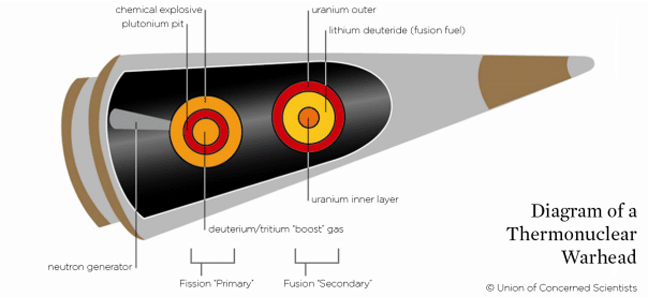 Editorial: Wasting billions in federal tax dollars just the pits https://www.abqjournal.com/1180661/wasting-billions-in-federal-tax-dollars-just-the-pits.html,By Albuquerque Journal Editorial BoardJune 5th, 2018
Groups Release Key DOE Documents on Expanded Plutonium Pit Production, DOE Nuclear Weapons Plan Not Supported by Recent Congressional Actions
https://nukewatch.org/pressreleases/PR-Pit-Production-Docs-5-31-18.pdf May 31, 2018 Contact Tom Clements, SRS Watch, 803.240.7268, tomclements329@cs.com Jay Coghlan, Nuclear Watch NM, 505.989.7342, c. 505.470.3154, jay@nukewatch.org
Santa Fe, NM & Columbia, SC – Two key U.S. Department of Energy documents on future production of plutonium “pits” for nuclear weapons, not previously released to the public, fail to justify new and upgraded production facilities at both the Los Alamos National Laboratory (LANL) in New Mexico and the Savannah River Site (SRS) in South Carolina.
The report reveals that the initial cost estimate for these new and upgraded facilities at both sites is $10 billion by 2030, and around $46 billion in total life cycle costs. Plutonium pits are the fissile cores of nuclear weapons. Cost overruns are the rule for major projects undertaken by the National Security Administration (NNSA), the semi-autonomous nuclear weapons agency within DOE, so the costs are likely to rise yet more, according to Nuclear Watch New Mexico and Savannah River Site Watch.
NNSA’s Pu Pit Production Engineering Assessment, originally marked Unclassified Controlled Nuclear Information, was finalized on April 20, 2018. The 293-page document was obtained by Nuclear Watch and is being released so that the public may be fully informed about the agency’s misguided pursuit of new plutonium pit production facilities for future new-design nuclear weapons. The new NNSA Administrator has called future plutonium pit production her highest priority. But the Engineering Assessment fails to answer the most crucial question: why are at least 80 plutonium pits per year needed to begin with?
As background, on May 10, 2018, NNSA announced in a one-page statement:
To achieve DoD’s [Department of Defense] 80 pits per year requirement by 2030, NNSA’s recommended alternative repurposes the Mixed Oxide Fuel Fabrication Facility at the Savannah River Site in South Carolina to produce plutonium pits while also maximizing pit production activities at Los Alamos National Laboratory in New Mexico. This two-prong approach – with at least 50 pits per year produced at Savannah River and at least 30 pits per year at Los Alamos – is the best way to manage the cost, schedule, and risk of such a vital undertaking.
Nuclear Watch also obtained NNSA’s 14-page Plutonium Pit Production Engineering Assessment (EA) Results. That summary document, dated May 2018, relied on the Trump Administration’s 2018 Nuclear Posture Review for claiming the need for expanded plutonium pit production. However, that high-level review failed to state any concrete justification for the alleged pit need. Moreover, Congress is balking at funding any new pit production facilities at SRS, primarily because Sen Lindsey Graham (R-SC) vociferously opposes repurposing the MOX facility, now undergoing termination, and the New Mexico congressional delegation opposes any pit production outside of the Los Alamos Lab.
The Engineering Assessment details that NNSA analyzed four pit production options, one in the Mixed Oxide (MOX) Fuel Fabrication Facility at SRS and three options at Los Alamos. NNSA chose the most expensive combination, repurposing the MOX facility and increasing pit production at LANL to 30 pits per year. Los Alamos is currently authorized to produce 20 pits per year, but has failed to achieve even that because of ongoing nuclear criticality safety issues (moreover, LANL proposed to produce all 80 pits per year, which NNSA rejected). SRS has never produced pits, raising new nuclear risks at that site and concern about new waste streams.
The Engineering Assessment makes clear that “moderate risks” in the option of repurposing the MOX plant at SRS includes any failure to quickly terminate the MOX project, due to subsequent delays in closing out the project and terminating contracts. Likewise, the report affirms a longheld concern that there is a “very high probability for incomplete construction records/as-built drawings” for the MOX project. On May 10, DOE began congressionally sanctioned termination of the bungled MOX project, but it is being opposed in last-ditch, desperate attempts by Senator Lindsey Graham and the State of South Carolina. The Engineering Assessment makes explicitly clear that terminating the MOX program is the crucial prerequisite for plutonium pit production at SRS and that “some work [on repurposing the MOX plant] can be completed during MOX closeout,” contrary to both the wishes of Congress and requirements of the National Environmental Policy Act.
Expanded plutonium pit production is NOT needed to maintain the safety and reliability of the existing nuclear weapons stockpile, according to Nuclear Watch. In fact, no pit production for the existing nuclear weapons stockpile has been scheduled since 2011, and none is scheduled for the future. Up to 15,000 “excess” pits and another 5,000 in “strategic reserve” are already stored at DOE’s Pantex Plant near Amarillo, TX. In 2006 independent experts found that pits last a least a century1 (they currently average 40 years old). A 2012 follow-on study by the Livermore Lab found that the “graceful aging of plutonium also reduces the immediate need for a modern highcapacity manufacturing facility to replace pits in the stockpile.” 2
Future pit production is for speculative future new designs being pushed by the nuclear weapons labs, so-called Interoperable Warheads for both land- and sub-launched missiles that the Navy does not support. 3 Moreover, as the Engineering Assessment makes clear, future pits will NOT be exact replicas of existing pits. This could have serious potential consequences because heavily modified plutonium pits cannot be full-scale tested, or alternatively could prompt the U.S. to return to nuclear weapons testing, which would have severe international proliferation consequences.
The Engineering Assessment also explicitly links raising the administrative limit on plutonium at LANL’s “Rad Lab” to expanded pit production. This contradicts a recent draft environmental assessment in which NNSA claimed that re-categorizing the Rad Lab as a Hazard Category-3 nuclear facility was necessary only to maintain basic analytical chemistry capabilities, while omitting any reference whatsoever to expanded plutonium pit production.
The Engineering Assessment briefly outlines what could be a major vulnerability to NNSA’s pit production plans, that is the agency’s future compliance (or not) with the National Environmental Policy Act (NEPA). The Assessment states that if “compliance is delayed, [this] extends the schedule, increases costs, and/or delays production.” Both Nuclear Watch and SRS Watch assert that the law requires that major federal proposals be subject to public review and comment before a formal decision is made. Arguably, a formal decision to raise production to 80 pits or more per year necessitates a new or supplemental nation-wide programmatic environmental impact statement (PEIS), which the new dual-site decision strongly buttresses. Follow-on site-specific NEPA documents will then be necessary, with full public participation and hearings. All of this could introduce substantial delays to NNSA’s plutonium pit production plans.
“While it’s clear that the bungled MOX project is unworkable from technical and cost perspectives and must rapidly be terminated, there is no justification to convert the abandoned facility to a nuclear bomb production plant,” said Tom Clements, director of SRS Watch. “We agree that money must now be spent closing and securing the MOX building, but not on the new, unauthorized pit mission. Spending taxpayer funds to now begin conversion of the MOX plant to pit production, as is indicated in the pit report, is premature and can’t even be considered until Congress approves the NNSA approach for new facilities and an environmental impact review with public participation takes place,” added Clements.
Jay Coghlan, Nuclear Watch Director, commented, “NNSA has already tried four times to expand plutonium pit production, only to be defeated by citizen opposition and its own cost overruns and incompetence. We realize that this fifth attempt at a new pit plant is the most serious yet, but we remain confident it too will fall apart. The enormous financial and environmental costs of new nuclear bomb factories and the fact that expanded plutonium pit production is simply not needed for the existing nuclear weapons stockpile will doom this effort. We think the American public will reject new-design nuclear weapons, which is what this expanded pit production decision is really all about.”
Trump administration scraps MOX project to generate power from plutonium

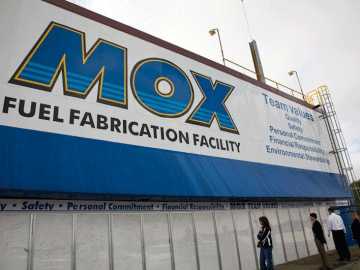 Trump administration axes project to generate power from plutonium, Timothy Gardner, WASHINGTON (Reuters) 13 May 18 – The Trump administration plans to kill a project it says would have cost tens of billions of dollars to convert plutonium from Cold War-era nuclear bombs and burn it to generate electricity, according to a document it sent to Congress last week.
The Department of Energy submitted a document on May 10 to Senate and House of Representative committees saying that the Mixed Oxide (MOX) project at the Savannah River Site in South Carolina would cost about $48 billion more than $7.6 billion already spent on it. The United States has never built a MOX plant.
Instead of completing MOX, the administration, like the Obama administration before it, wants to blend the 34 tonnes of deadly plutonium – enough to make about 8,000 nuclear weapons – with an inert substance and bury it underground in a New Mexico’s Waste Isolation Pilot Plant (WIPP). Burying the plutonium would cost about $19.9 billion, according to the document, a copy of which was seen by Reuters.
“We are currently processing plutonium in South Carolina for shipment (to WIPP) … and intend to continue to do so,” Energy Secretary Rick Perry said in a letter sent to committee leaders.
Legislation passed in February allows the Energy Department to advance burying the plutonium if it showed that the cost would be less than half of completing MOX……..
Edwin Lyman, a physicist at science advisory group the Union of Concerned Scientists concerned about plutonium getting into the wrong hands, said Perry had made a sensible decision. “MOX was a slow-motion train wreck, and throwing good money after bad simply wasn’t an option.”
Reporting by Timothy Gardner; Editing by Lisa Shumaker https://www.reuters.com/article/us-usa-plutonium-mox/trump-administration-axes-project-to-generate-power-from-plutonium-idUSKCN1IE0LH
USA National Nuclear Security Administration (NNSA) plan for unnecessary production of plutonium pits
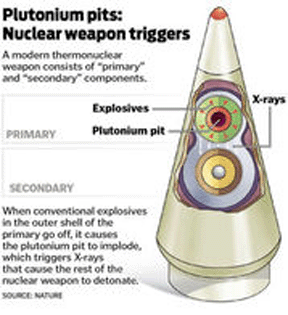
 What’s Not in NNSA’s Plutonium Pit Production Decision, Santa Fe, NM –May 10, 2018 Contact Jay Coghlan, Nuclear Watch NM, 505.989.7342, c. 505.470.3154, jay@nukewatch.org Scott Kovac, Nuclear Watch NM, 505.989.7342, scott@nukewatch.org
Jay Coghlan, Nuclear Watch Director, commented, “NNSA has already tried four times to expand plutonium pit production, only to be defeated by citizen opposition and its own cost overruns and incompetence. But we realize that this fifth attempt is the most serious. However, we remain confident it too will fall apart, because of its enormous financial and environmental costs and the fact that expanded plutonium pit production is simply not needed for the existing nuclear weapons stockpile. We think the American public will reject new-design nuclear weapons, which is what this expanded pit production decision is really all about.
1 See 2012 Navy memo demonstrating its lack of support for the Interoperable Warhead athttps://www.nukewatch.org/importantdocs/resources/Navy-Memo-W87W88. 2 For example, see Safety concerns plague key sites proposed for nuclear bomb production, Patrick Malone, Center for Public Integrity, May 2, 2108,https://www.usatoday.com/story/news/nation/2018/05/02/safety-concerns-nuclear-bomb-manufacturesites/572697002/
Los Alamos National Laboratory will share production of plutonium pits with the Savannah River Site in South Carolina
NNSA announces decision on pit production, L A Monitor, May 11, 2018, Los Alamos National Laboratory will share production of plutonium pits with the Savannah River Site in South Carolina, the Nuclear Weapons Council and National Nuclear Security Administration announced Thursday.
LANL will maintain production of 30 plutonium pits per year, while the Savannah River Site will produce 50 pits per year.
“To achieve DoD’s 80 pits per year requirement by 2030, NNSA’s recommended alternative repurposes the Mixed Oxide Fuel Fabrication Facility at the Savannah River Site in South Carolina to produce plutonium pits while also maximizing pit production activities at Los Alamos National Laboratory in New Mexico,” according to Thursday’s release.
……. Plutonium pits are the size of a softball and are used as trigger mechanisms for nuclear weapons…..
“First, in Nuclear Watch’s view, this decision is in large part a political decision, designed to keep the congressional delegations of both New Mexico and South Carolina happy,” said Nuclear Watch Executive Director Jay Coghlan. “New Mexico Senators Tom Udall and Martin Heinrich are adamantly against relocating plutonium pit production to South Carolina. On the other hand, South Carolina Senator Lindsay Graham was keeping the boondoggle Mixed Oxide (MOX) program on life support, and this pit production decision may help to mollify him.
Coghlan said he believes the split plan will ultimately fail.
“NNSA has already tried four times to expand plutonium pit production, only to be defeated by citizen opposition and its own cost overruns and incompetence,” Coghlan said. “But we realize that this fifth attempt is the most serious.
“However, we remain confident it too will fall apart, because of its enormous financial and environmental costs and the fact that expanded plutonium pit production is simply not needed for the existing nuclear weapons stockpile. We think the American public will reject new-design nuclear weapons, which is what this expanded pit production decision is really all about.”
Greg Mello, executive director of the Los Alamos Study Group, took a more pragmatic view. ……
“Pit production isn’t needed for decades, even for a large arsenal, but Congress has demanded it, so the bulk of the work will leave LANL. The R and D (research and development) work will stay behind. This transition is many years down the road. Pit production will always be difficult, expensive and dangerous wherever it’s done.”
A fact sheet about the decision can be found here. http://www.lamonitor.com/content/nnsa-announces-decision-pit-production
Idaho State University Lost Enough Weapons-Grade Plutonium to Make a Dirty Bomb.

 Motherboard 8th May 2018.On Friday, the Nuclear Regulatory Commission announced that Idaho
State University may face an $8,500 fine after losing one gram of
weapons-grade plutonium. Although this quarter-sized amount of plutonium is
nowhere near enough to make a nuclear weapon, it is enough to make a dirty
bomb that spreads radiation, according to the Associated Press.
https://motherboard.vice.com/en_us/article/evqjp4/idaho-state-university-lost-enough-weapons-grade-plutonium-to-make-a-dirty-bomb
Continued safety concerns about production of “plutonium pits” for nuclear bombs
Safety concerns plague key sites proposed for nuclear bomb production, USA Today ,
Decision due soon on where plutonium parts for the next generation of nuclear weapons are to be made
The Department of Energy is scheduled to decide within days where plutonium parts for the next generation of nuclear weapons are to be made, but recent internal government reports indicate serious and persistent safety issues plague both of the two candidate sites.
Some experts are worried about the safety records of either choice: Los Alamos National Laboratory in New Mexico, where plutonium parts have historically been assembled, and the Savannah River Site in South Carolina, where other nuclear materials for America’s bombs have been made since in the 1950s.
An announcement by the Trump administration about the location is expected by May 11 in preparation for the ramped-up production of nuclear warheads called for by the Defense Department’s recent review of America’s nuclear weapons policy.
Recent internal government reports obtained by the Center for Public Integrity have warned that workers at these plants have been handling nuclear materials sloppily or have failed to monitor safety issues aggressively.
America’s over-loaded plutonium waste sites pose a serious danger
Science Recorder 27th April 2018 , The U.S. Energy Department has 54 metric tons of surplus plutonium at sites
across the country and cannot decide what to do with it, according to department officials. Nuclear researchers warn that many of these sites are
storing more of the radioactive substance than is safe and that a mishap at any one of them could lead to full-blown disaster.
https://sciencerecorder.com/article.php?n=united-states-has-too-much-deadly-plutonium-on-its-hands&id=144178
The under-rated risks from plutonium
Homeland Preparedness News 27th April 2018 , A new paper from the Nuclear Threat Initiative (NTI) providedrecommendations for mitigating risks related to separated plutonium. As compared to highly enriched uranium (HEU), separated plutonium has not
received enough attention as a security risk, NTI Counselor John Carlson said in the paper, titled “Mitigating Security Risks from Separated Plutonium: Some Near-Term Steps.”
https://homelandprepnews.com/stories/28131-nuclear-threat-initiative-highlights-separated-plutonium-security-risks/
How can USA and Russia’s Plutonium Disposition Program finally become effective?
Bulletin of Atomic Scientists 24th April 2018 , During the Cold War, the United States and the Soviet Union manufactured
enormous quantities of plutonium for use in nuclear weapons. When that era
ended, the United States and the newly formed Russian Federation began to
reduce their nuclear arsenals. Both nations possessed large stockpiles of
plutonium—a problem that posed both a sustained threat to the environment
and a risk of future nuclear weapons proliferation.
In 2000, the United States and Russia pledged to dispose of their excess plutonium in order to
mitigate the security concerns, safety risks, and storage costs. They
signed the Plutonium Management and Disposition Agreement, which requires
each country to dispose of at least 34 metric tons of weapons plutonium.
Unfortunately, the agreement failed to solve the excess plutonium problem.
Eighteen years later, the United States has been unable to develop a
successful strategy to safely, affordably, and permanently dispose of
plutonium from dismantled nuclear weapons, despite a high degree of
industrial capability and technical expertise. Why has the United States
been unable to either implement its obligations under the disposition
agreement or execute its own policy? And how can the Plutonium Disposition
Program finally become effective?
https://thebulletin.org/what-went-wrong-us-plutonium-disposition11733
Who is responsible for plutonium contamination at Washinton nuclear cleanup site?
LA Times 23rd April 2018, As crews demolished a shuttered nuclear weapons plant during 2017 in
central Washington, specks of plutonium were swept up in high gusts and
blown miles across a desert plateau above the Columbia River.
The releases at the Department of Energy cleanup site spewed unknown amounts of
plutonium dust into the environment, coated private automobiles with the
toxic heavy metal and dispensed lifetime internal radioactive doses to 42
workers.
The contamination events went on for nearly 12 months, getting
progressively worse before the project was halted in mid-December. Now,
state health and environmental regulators, Department of Energy officials
and federal safety investigators are trying to figure out what went wrong
and who is responsible.
http://www.oregonlive.com/pacific-northwest-news/index.ssf/2018/04/why_was_plutonium_dust_left_to.html
How the diabolically dangerous plutonium cores killed two nuclear scientists
The Nuclear ‘Demon Core’ That Killed Two Scientists https://www.atlasobscura.com/articles/demon-core-that-killed-two-scientistsAfter World War II ended, physicists kept pushing a plutonium core to its edge. BY SARAH LASKOW
APRIL 23, 2018
Since the United States dropped two atomic bombs on Japan, the world has been in a state of readiness for nuclear combat. In this secretive domain, mistakes and mishaps are often hidden: This week we’re telling the stories of five nuclear accidents that burst into public view.
THE WAR WAS OVER—JAPAN HAD surrendered. The third plutonium core created by the United States, which scientists at Los Alamos National Lab had been preparing for another attack, was no longer needed as a weapon. For the moment, the lab’s nuclear scientists were allowed to keep the sphere, an alloy of plutonium and gallium that would become known as the demon core.
In a nuclear explosion, a bomb’s radioactive core goes critical: A nuclear chain reaction starts and continues with no additional intervention. When nuclear material goes supercritical, that reaction speeds up. American scientists knew enough about the radioactive materials they were working with to be able to set off these reactions in a bomb, but they wanted a better understanding of the edge where subcritical material tipped into the dangerous, intensely radioactive critical state.
The first time someone died performing one of these experiments, Japan had yet to formally sign the terms of surrender. On the evening of August 21, 1945, the physicist Harry Daghlian was alone in the lab, building a shield of tungsten carbide bricks around the core. Ping-ponging neutrons back the core, the bricks had brought the plutonium close to the threshold of criticality, when Daghlian dropped a brick on top. Instantly, the core reacted, going supercritical and Daghlian was doused in a lethal dose of radiation. He died 25 days later.
His death did not dissuade his colleagues, though. Nine months later, they had developed another way to bring the core close to that critical edge, by lowering a dome of beryllium over the core. Louis Slotin, another physicist, had performed this move in many previous experiments: He would hold the dome with one hand, and with the other use a screwdriver to keep a small gap open, just barely limiting the flow of neutrons back to the bomb. On a May day in 1946, his hand slipped, and the gap closed. Again, the core went supercritical and dosed Slotin, along with seven other scientists in the room, with gamma radiation.
In each instance, when the core slipped over that threshold and started spewing radiation, a bright blue light flashed in the room—the result of highly energized particles hitting air molecules, which released that bolt of energy as streams of light.
The other scientists survived their radiation bath, but Slotin, closest to the core, died of radiation sickness nine days later. The experiments stopped. After a cooling-off period, the demon core was recast into a different weapon, eventually destroyed in a nuclear test.
America’s mounting piles of plutonium cores – to be removed, perilously, by contract workers
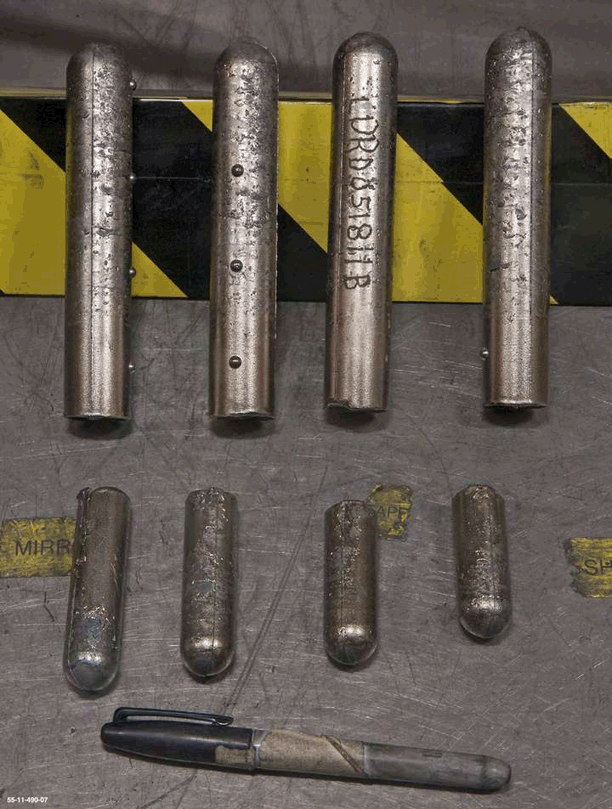 Reuters 20th April 2018 , In a sprawling plant near Amarillo, Texas, rows of workers perform by hand
one of the most dangerous jobs in American industry. Contract workers at
the U.S. Department of Energy’s Pantex facility gingerly remove the
plutonium cores from retired nuclear warheads. Although many safety rules
are in place, a slip of the hand could mean disaster.
In Energy Department facilities around the country, there are 54 metric tons of surplus
plutonium. Pantex, the plant near Amarillo, holds so much plutonium that it
has exceeded the 20,000 cores, called “pits,” regulations allow it to
hold in its temporary storage facility. There are enough cores there to
cause thousands of megatons of nuclear explosions. More are added each day.
https://www.reuters.com/article/us-usa-nukes-plutonium-specialreport/americas-nuclear-headache-old-plutonium-with-nowhere-to-go-idUSKBN1HR1KC
1 This Month

of the week – Shut Down Drone Warfare!


Tell the Ukrainian Government to Drop Prosecution of Peace Activist Yurii Sheliazhenko

Petition to revoke the licensing of the Near Surface Nuclear Disposal Facility (NSDF) at Chalk River. https://www.ourcommons.ca/petitions/en/Petition/Details?Petition=e-7247
To see nuclear-related stories in greater depth and intensity – go to https://nuclearinformation.wordpress.com
-
Archives
- April 2026 (57)
- March 2026 (251)
- February 2026 (268)
- January 2026 (308)
- December 2025 (358)
- November 2025 (359)
- October 2025 (376)
- September 2025 (257)
- August 2025 (319)
- July 2025 (230)
- June 2025 (348)
- May 2025 (261)
-
Categories
- 1
- 1 NUCLEAR ISSUES
- business and costs
- climate change
- culture and arts
- ENERGY
- environment
- health
- history
- indigenous issues
- Legal
- marketing of nuclear
- media
- opposition to nuclear
- PERSONAL STORIES
- politics
- politics international
- Religion and ethics
- safety
- secrets,lies and civil liberties
- spinbuster
- technology
- Uranium
- wastes
- weapons and war
- Women
- 2 WORLD
- ACTION
- AFRICA
- Atrocities
- AUSTRALIA
- Christina's notes
- Christina's themes
- culture and arts
- Events
- Fuk 2022
- Fuk 2023
- Fukushima 2017
- Fukushima 2018
- fukushima 2019
- Fukushima 2020
- Fukushima 2021
- general
- global warming
- Humour (God we need it)
- Nuclear
- RARE EARTHS
- Reference
- resources – print
- Resources -audiovicual
- Weekly Newsletter
- World
- World Nuclear
- YouTube
-
RSS
Entries RSS
Comments RSS
 nuclear-news