Anti–nuclear resistance in Russia: problems, protests, reprisals

Produced by RSEU’s program “Against nuclear and radioaсtive threats”
Report “Anti–nuclear resistance in Russia: problems, protests, reprisals” Produced by RSEU’s program “Against nuclear and radioaсtive threats”
Editor and translator: Vitaly Servetnik
English editor: Anna WhiteCover
illustration: Anastasia Semenova
Layout: Sergey Fedulov
Saitnt Petersburg 2020
Nuclear energy: failures and lies…….5
Expired reactors……………………………6
Decommissioning problems…………..7
Uranium mining protest………………..8
The Mayak plant: Rosatom’s dirty face………10
Struggle against nuclear repository……………11
A road through a radioactive graveyard……..14
Conclusion: nuclear power is a problem, not a solution….14
Nuclear energy: failures and lies
4 https://7×7–journal.ru/articles/2019/08/09/admin-istraciya–severodvinska–udalila–s–oficialnogo–saj-ta–reliz–o–skachke–radiacii–v–gorode–posle–vzry-va–pri–ispytanii–reaktivnoj–ustanovki–baza–soobshi-la–o–shesti–postradavshih–ot–oblucheniya
8 https://www.tol.org/client/article/23174-nucle-ar-strength-kola.html
9 https://barentsobserver.com/en/sections/nature/ kola-reactor-3-runs-overtime (Eng.)
10 https://barentsobserver.com/en/nature/ ice-cold-swimming-nuclear-protest (Eng.)
11 http://pim.org.ru/old/2005–04–28–answer–mur-manproc.pdf (Rus.)
12 https://profile.ru/society/ekolog–znachit–vrag–13271/
13 https://kec.org.ru/organisation/histrory/
14 http://rusecounion.ru/eng/nuclearstatusre-port2019 (Eng.)
15 http://rusecounion.ru/eng/node/2994 (Eng.),http://rusecounion.ru/eng/node/2991 (Eng.)
16 https://www.rbc.ru/spb_sz/29/12/2018/ 5c2633749a7947f8833fc99817 http://decommission.ru/2019/06/14/laes_sos-nobyl/
18 http://decommission.ru/2017/12/21/yad-news_1_201217/
19 http://rusecounion.ru/eng/node/2993 (Eng.)
20 http://rusecounion.ru/eng/node/2992 (Eng.)
21 http://greenworld.org.ru/?q=human_right_21111622 https://shtab.navalny.com/hq/kurgan/3687/
23 https://novayagazeta.ru/arti-cles/2019/11/08/82647–strana–uraniya
24 https://youtu.be/irqY75jSnA8
25 https://vk.com/wall–141292704_3351
26 https://45.ru/text/gorod/53533571/
27 https://ovdinfo.org/express–news/2020/04/15/v–kurgane–fsb–vozbudilo–ugolovnoe–delo–protiv–ekoaktivistki
28 http://chng.it/xHgMmwkPq5
29 http://rusecounion.ru/ru/no–uf6
30 http://activatica.org/blogs/view/id/8619/title/ pochemu–nuzhno–ostanovit–uranovyy poezd
31 https://www.zaks.ru/new/archive/view/195957
32 http://rusecounion.ru/ru/decomatom_19320
33 https://66.ru/news/society/226814/
34 https://greenpeace.ru/blogs/2019/12/17/peter-burg–ne–hochet–radioaktivnyh–podarkov/
35 https://foeasiapacific.org/2019/07/01/ russia-must-stop-criminal-persecu-tion-of-ecodefense-director-alexandra-koroly-ova-repeal-the-foreign-agent-law-and-promote-envi-ronmental-justice/ (Eng.)
36 https://ecodefense.ru/2019/12/30/alexandra–koroleva–political–refuge/
37 http://rusecounion.ru/ru/decom_mayak_2018
38 http://nuclear.tatar.mtss.ru/fa230907.htm
39 http://chel–portal.ru/enc/dvizhenie_za_yader-nuyu_bezopasnost
40 http://hudoc.echr.coe.int/eng?i=001-103084(Eng.), http://hudoc.echr.coe.int/eng?i=001-158136(Eng.)
41 https://www.vesti.ru/doc.html?id=949087
42 https://theins.ru/confession/81445
43 https://www.kommersant.ru/doc/941081
44 https://www.rbc.ru/poli-tics/18/03/2015/550812909a79475f79d367cc
45 https://novayagazeta.ru/ news/2016/12/13/127413–sud–v–chelyabinske–likvid-iroval–priznannyy–inostrannyym–agentom–fond–za–prirodu
46 https://za–prirodu.ru/page/ekspansija–neve-zhestva
47 http://babr24.com/kras/?IDE=198678
48 http://www.change.org/mogilnik
49 https://youtu.be/WTKfCnXt58Q?t=1729
50 https://meduza.io/news/2016/08/25/krasnoyarsk-ogo–aktivista–obvinili–v–razzhiganii–nenavisti–k–at-omschikam
51 http://greenworld.org.ru/sites/default/greenfiles/ Mariasov_doklad_int.pdf
52 https://vk.com/@pitsunova–filkina–gramota–ros-rao
53 https://news.sarbc.ru/main/2019/07/25/235566.html
54 https://regnum.ru/news/polit/2867802.html
55 http://chng.it/5RsJDQfkxq
56 https://ovdinfo.org/express–news/2020/03/11/ kirovskie–vlasti–ne–soglasovali–miting–ni–na–odnoy–iz–31–ploshchadok–no
57 http://rusecounion.ru/ru/horda_msk
58 https://youtu.be/R9_9phYaWBE
59 https://youtu.be/bMKfYD1SLdc
60 https://youtu.be/l5K8agywCNw
61 https://youtu.be/iXOyT0qPUi0
62 http://activatica.org/blogs/view/id/9759/title/ na–sklon–v–moskvoreche–vernulsya–simvol–obo-rony–sob
Beyond Nuclear Files Federal Lawsuit Challenging High-Level Radioactive Waste Dump
 Beyond Nuclear Files Federal Lawsuit Challenging High-Level Radioactive Waste Dump for Entire Inventory of U.S. “Spent” Reactor Fuel, Common Dreams, 5 June 20 Beyond Nuclear Files Federal Lawsuit Challenging High-Level Radioactive Waste Dump for Entire Inventory of U.S. “Spent” Reactor Fuel, Common Dreams, 5 June 20
Petitioner charges the Nuclear Regulatory Commission knowingly violated U.S. Nuclear Waste Policy Act and up-ended settled law prohibiting transfer of ownership of spent fuel to the federal government until a permanent underground repository is ready to receive it. WASHINGTON – Today the non-profit organization Beyond Nuclear filed an appeal with the U.S. Court of Appeals for the District of Columbia Circuit requesting review of an April 23, 2020 order and an October 29, 2018 order by the U.S. Nuclear Regulatory Commission (NRC), rejecting challenges to Holtec International/Eddy-Lea Energy Alliance’s application to build a massive “consolidated interim storage facility” (CISF) for nuclear waste in southeastern New Mexico. Holtec proposes to store as much as 173,000 metric tons of highly radioactive irradiated or “spent” nuclear fuel – more than twice the amount of spent fuel currently stored at U.S. nuclear power reactors – in shallowly buried containers on the site. But according to Beyond Nuclear’s petition, the NRC’s orders “violated the Nuclear Waste Policy Act and the Administrative Procedure Act by refusing to dismiss an administrative proceeding that contemplated issuance of a license permitting federal ownership of used reactor fuel at a commercial fuel storage facility.” Since it contemplates that the federal government would become the owner of the spent fuel during transportation to and storage at its CISF, Holtec’s license application should have been dismissed at the outset, Beyond Nuclear’s appeal argues. Holtec has made no secret of the fact that it expects the federal government will take title to the waste, which would clear the way for it to be stored at its CISF, and this is indeed the point of building the facility. But that would directly violate the 1982 Nuclear Waste Policy Act (NWPA), which prohibits federal government ownership of spent fuel unless and until a permanent underground repository is up and running. No such repository has been licensed in the U.S. The U.S. Department of Energy’s (DOE) most recent estimate for the opening of a geologic repository is the year 2048 at the earliest. In its April 23 decision, in which the NRC rejected challenges to the license application, the four NRC Commissioners admitted that the NWPA would indeed be violated if title to spent fuel were transferred to the federal government so it could be stored at the Holtec facility. But they refused to remove the license provision in the application which contemplates federal ownership of the spent fuel. Instead, they ruled that approving Holtec’s application in itself would not involve NRC in a violation of federal law, and that therefore they could go forward with approving the application, despite its illegal provision. According to the NRC’s decision, “the license itself would not violate the NWPA by transferring the title to the fuel, nor would it authorize Holtec or [the U.S. Department of Energy] to enter into storage contracts.” (page 7). The NRC Commissioners also noted with approval that “Holtec hopes that Congress will amend the law in the future.” (page 7). “This NRC decision flagrantly violates the federal Administrative Procedure Act (APA), which prohibits an agency from acting contrary to the law as issued by Congress and signed by the President,” said Mindy Goldstein, an attorney for Beyond Nuclear. “The Commission lacks a legal or logical basis for its rationale that it may issue a license with an illegal provision, in the hopes that Holtec or the Department of Energy won’t complete the illegal activity it authorized. The buck must stop with the NRC.” “Our claim is simple,” said attorney Diane Curran, another member of Beyond Nuclear’s legal team. “The NRC is not above the law, nor does it stand apart from it.”……… “When Congress passed the Nuclear Waste Policy Act and refused to allow nuclear reactor licensees to transfer ownership of their irradiated reactor fuel to the DOE until a permanent repository was up and running, it acted wisely,” said Kevin Kamps, radioactive waste specialist for Beyond Nuclear. “It understood that spent fuel remains hazardous for millions of years, and that the only safe long-term strategy for safeguarding irradiated reactor fuel is to place it in a permanent repository for deep geologic isolation from the living environment. Today, the NWPA remains the public’s best protection against a so-called ‘interim’ storage facility becoming a de facto permanent, national, surface dump for radioactive waste. But if we ignore it or jettison the law, communities like southeastern New Mexico can be railroaded by the nuclear industry and its friends in government, and forced to accept mountains of forever deadly high-level radioactive waste other states are eager to offload.” In addition to impacting New Mexico, shipping the waste to the CISF site would also endanger 43 other states plus the District of Columbia, because it would entail hauling 10,000 high risk, high-level radioactive waste shipments on their roads, rails, and waterways, posing risks of radioactive release all along the way………. “When Congress passed the Nuclear Waste Policy Act and refused to allow nuclear reactor licensees to transfer ownership of their irradiated reactor fuel to the DOE until a permanent repository was up and running, it acted wisely,” said Kevin Kamps, radioactive waste specialist for Beyond Nuclear. “It understood that spent fuel remains hazardous for millions of years, and that the only safe long-term strategy for safeguarding irradiated reactor fuel is to place it in a permanent repository for deep geologic isolation from the living environment. Today, the NWPA remains the public’s best protection against a so-called ‘interim’ storage facility becoming a de facto permanent, national, surface dump for radioactive waste. But if we ignore it or jettison the law, communities like southeastern New Mexico can be railroaded by the nuclear industry and its friends in government, and forced to accept mountains of forever deadly high-level radioactive waste other states are eager to offload.” In addition to impacting New Mexico, shipping the waste to the CISF site would also endanger 43 other states plus the District of Columbia, because it would entail hauling 10,000 high risk, high-level radioactive waste shipments on their roads, rails, and waterways, posing risks of radioactive release all along the way. Besides threatening public health and safety, evading federal law to license CISF facilities would also impact the public financially. Transferring title and liability for spent fuel from the nuclear utilities that generated it to DOE would mean that federal taxpayers would have to pay for its so-called “interim” storage, to the tune of many billions of dollars. That’s on top of the many billions ratepayers and taxpayers have already paid to fund a permanent geologic repository that hasn’t yet materialized. https://www.commondreams.org/newswire/2020/06/04/beyond-nuclear-files-federal-lawsuit-challenging-high-level-radioactive-waste?utm_campaign=shareaholic&utm_medium=referral&utm_source=twitter |
|
Radioactive waste imported from Estonia for iconic Bears Ears, Utah?

Radioactive Waste May Be Dumped Near Bears Ears—Public Comments Requested https://www.adventure-journal.com/2020/06/radioactive-waste-may-be-dumped-near-bears-ears-public-comments-requested/ BY JUSTIN HOUSMAN | JUNE 3, 2020
|
There is a metals plant in the Eastern European nation of Estonia that generates a surplus of uranium-laced waste, as much as 660 tons per year. A uranium mill near Bears Ears National Monument, in southeastern Utah, has applied to the state of Utah to accept the waste which they can process for the uranium. The waste that process generates will be stored on-site at the White Mesa facility, which is about five miles from the Ute Mountain Ute Tribe’s White Mesa reservation. Locals are concerned. Groundwater accessed by the reservation has been contaminated for years. The tribe worries it’s because of the uranium mill, the state argues it has nothing to do with it. “I think it would be the tribe’s preference that the facility shut down,” said Scott Clow, environmental programs director for the tribe. “But that’s a big ask there. “The mill has been there for 38 years now, and that’s a pretty short window of time compared to how long the tribe was there before and how long the tribe is going to be there after the mill, and all of that contamination. “The mill has already become the cheapest alternative for disposal of low-level radioactive waste in North America. Now, it appears that it may become a destination for the materials from around the globe. That is disconcerting and dangerous,” he said. A company called Energy Fuels Resources owns the White Mesa Mill. Andrew Wheeler, currently the head of the EPA, worked as a lobbyist for Energy Fuels Resources in years past, and helped successfully lobby the Trump administration to shrink the size of the Bears Ears monument to allow for more uranium mining possibilities, arguing it was in the national interest to do so. Estonia limits how much of the radioactive material the metals processing plant can store, out of safety concerns, which is why the plant is looking for a place to ship the waste tailings. The White Mesa Mill is the only mill in the country capable of extracting the uranium from the Estonian tailings. The Utah Department of Environmental Quality has asked for public comment before final approval of the shipments can proceed. The original deadline for comment was June 5, but it has recently been extended until July 10. You can email your comment to this address: dwmrcpublic@utah.gov. Instructions for commenting can be found here, in the public notice about the project. |
|
Activists, despite government oppression, campaign for decommissioning of Russia’s aging nuclear reactors
 Anti–nuclear resistance in Russia: problems, protests, reprisals [Full Report 2020] Report “Anti–nuclear resistance in Russia: problems, protests, reprisals” Produced by RSEU’s program “Against nuclear and radioaсtive threats”
“………..For many years, Murmansk regional environmental groups have opposed the ageing Kola NPP reactor’s lifetime extension. They have participated in public hearings, have organised many demonstrations (8-9-10), appealed to and received support from the prosecutor’s office(11), but this was all ignored by Rosatom. Activists also called on the governor to shut down the old NPP, but environmental organisations were shutdown instead. One such organisation is Kola Environmental Center (KEC) – listed as a Foreign Agent in 2017– and was subject to two trials and fined 150,000 rubles (12). KEC was forced to close down as a legal entity in2018, but has continued its environmental work as a public movement(13). Another organisation in the region –Nature and Youth – made the decision to close down in order to avoid prosecution, but continues its work as an unregistered initiative
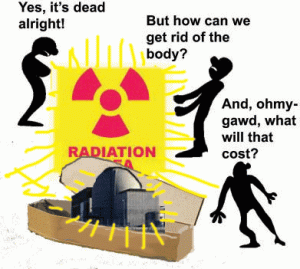
• In 2018, after 45 years of operation, the first power unit of the Leningrad NPP was finally shut down.The second one scheduled for shutdown is in 2020, the third in 2025 and the fourth in 2026. However,decommissioning projects have not yet been clearly developed for the reactors.
• The public organisation, Green World, has worked for many years in Sosnovy Bor, Leningrad Region, a city dominated by the nuclear industry and closed to outsiders. Since 1988, activists of the organisation have opposed dangerous nuclear projects in the Baltic Sea region(17) and have provided the public with independent information on the environmental situation. (18)
In its place, another organisation was opened – the Public Council of the South Coast of the Gulf of Finland. Activists have continued their work as before under this new name…….”
U.S. taxpayers bearing the crushing cost of nuclear waste
 The Crushing Cost Of Nuclear Waste Is Weighing On Taxpayers, Oil
  Price,
 By Haley Zaremba – Jun 19, 2019 The Maine Yankee nuclear power plant hasn’t produced a single watt of energy in more than two decades, but it cost U.S. taxpayers about $35 million this year.” So begins a powerful report this week about the crushing cost of nuclear waste storage by the Los Angeles Times……..In the United States, where the nuclear industry is ailing, this is particularly bad news. More plants are shutting down than are going online, and many of the nuclear plants that are continuing to function are able to do so in large part thanks to government subsidies at the state level, which is to say, even more taxpayer dollars.
The Trump administration, for its part, has made efforts to combat the rising prices of nuclear waste storage–albeit extremely controversial ones. Just this month, “in a move that will roll back safety standards that have been observed for decades” says not-for-profit news organization Truthout, “the Trump administration reportedly has plans to reclassify nuclear waste previously listed as “high-level” radioactive to a lower level, in the interest of saving money and time when disposing of the material.”
While this may be a quick fix for the massive amounts of money flowing out of taxpayer pockets and into the nuclear energy industry, it’s certainly not a sustainable solution for what could easily become a national health crisis if mismanaged. ……https://oilprice.com/Alternative-Energy/Nuclear-Power/The-Crushing-Cost-Of-Nuclear-Waste-Is-Weighing-On-Taxpayers.html
Latina plant, the last of Italy’s 4 nuclear power stations to be dismantled
 Italy approves dismantling of Latina plant https://www.world-nuclear-news.org/Articles/Dismantling-of-Italys-Latina-plant-to-begin 02 June 2020
The main activities envisaged during this initial phase of decommissioning concern the dismantling of the six boilers, with a total weight of over 3600 tonnes, and the lowering of the reactor building height from 53 to 38 metres. Buildings and auxiliary systems will also be dismantled. These operations are in addition to those already carried out or in progress at the plant.
By the end of this phase, all previous radioactive wastes generated through the operation of the plant or those produced by the dismantling of structures, systems and plant components will be stored safely at the site. These wastes will be stored both in a new temporary storage facility and in some specifically adapted reactor building premises. This initial phase of decommissioning the Latina plant is expected to be completed in 2027 and to cost EUR270 million (USD302 million).
With the availability of a planned national repository, it will be possible to start the second and final phase of the decommissioning of the plant with the dismantling of the graphite gas reactor. Once all the radioactive waste has been transferred to the repository and the temporary storage facilities demolished, the site will be released, without radiological restrictions, and returned to the community for its reuse.
“We are pleased with the issuance of this decree, the fifth after those obtained for the Bosco Marengo [fuel fabrication] plant and the Trino, Garigliano and Caorso [nuclear power] plants,” said Sogin CEO Emanuele Fontani. “This is a crucial step for the closure of the Italian nuclear cycle, which allows us to get to the heart of the decommissioning of the Latina plant. This measure confirms the fruitful collaboration between the various institutional subjects involved in the dismantling of nuclear plants.”
The Latina plant, comprising a single 210 MWe Magnox graphite gas-cooled reactor, began operating in January 1964. It was permanently shut in December 1987 as a result of the Italian referendum on nuclear power that followed the April 1986 Chernobyl disaster. Sogin took over ownership of the site in November 1999.
Anxieties over the risks of spent nuclear fuel storage at San Onofre
|
Used Nuclear Fuel Storage at San Onofre Raises Concerns Over Plant’s Vulnerability, Voice of OC By HOSAM ELATTAR 3 June 20 The Orange County Board of Supervisors Tuesday approved a memorandum of understanding with Southern California Edison to provide the county over $10 million in financial support for emergency preparedness at the San Onofre Nuclear Generating station.Supervisor Lisa Bartlett, who made the motion in support of approving the memorandum, said if there is an incident at the plant it could cost the county a lot of money to address the emergency and the sum agreed to would only cover notifying communities of an incident.
Donna Boston, Orange County director of emergency management, said there is a provision in the agreement that would allow the county to bill Southern California Edison for any excess spending if an emergency response is needed. “We’re not getting but a pittance when you consider what it’s going to take on an emergency preparedness basis, whether it’s evacuation of cities, or if we’ve got nuclear fuel that’s leaking out into the atmosphere or the communities,” Bartlett said. The supervisors’ action comes on the heels of a virtual meeting held last week by the San Onofre Community Engagement Panel about the plant’s vulnerability. The panel made up of local officials and community members advises the plant’s operators on the dismantling of the plant and meets at least four times a year. The plant at San Onofre was retired in June 2013 after uproar from the public and local officials over a radiation leak in 2012. Since then the used nuclear fuel that’s been cooling in wet pools is being converted to dried storage and is kept at the plant. About nine of the 73 canisters of used fuel have yet to be transferred to dry storage but the process is expected to be completed by mid-summer. “We’re moving the spent fuel rods out of the cooling pools and into the dry cask storage, which is safer, but you’re still going to have all of those spent fuel rods in the dry cask storage that are above ground, which concerns me,” said Bartlett……… Some members of the public felt the virtual meeting had an inadequate discussion of the worst case scenario at San Onofre. “There is no plan for when one of these canisters does fail,” said Kalene Walker during the public comment portion of the presentation at last week’s virtual meeting. “There’s so many issues regarding this system. I’m into prevention. Emergency response is super important and appreciated. But I don’t want to be anywhere near when one of these canisters goes off.” Bartlett said Tuesday that canisters have cracked before. “If we have a terrorist attack or something else occurs, we could be in a world of hurt until we get those canisters completely moved off site somewhere else,” Bartlett said…….. https://voiceofoc.org/2020/06/used-nuclear-fuel-storage-at-san-onofre-raises-concerns-over-plants-vulnerability/ |
|
|
Deep boreholes for nuclear waste disposal?
 I’d find this more convincing if it were not so closely tied to the push for “new nukes” I’d find this more convincing if it were not so closely tied to the push for “new nukes”
Industry to Explore Decentralized Nuclear Waste Disposal. Power Mag
May 31, 2020 by Sonal Patel Efforts to explore whether it is feasible to permanently dispose of high-level nuclear waste in deep horizontal boreholes under next-generation nuclear reactor sites got a boost in late April as nuclear waste technology firm Deep Isolation signed its first contract with industry. Under the contract with independent nonprofit organization Electric Power Research Institute (EPRI), the Berkeley, California–based company will team with EPRI researchers, Southern Co., the Nuclear Energy Institute (NEI), Auburn University, and nuclear waste management consultancy J Kessler and Associates to assess how Deep Isolation’s horizontal borehole disposal solution could contribute to siting of advanced nuclear energy systems. Specifically, the team plans to explore physical site characteristics, disposal operations, safety performance analysis, and regulatory and licensing considerations. …….https://www.powermag.com/industry-to-explore-decentralized-nuclear-waste-disposal/ |
|
Resistance developing to EDF’s plan to store nuclear waste at Belleville-sur-Loire
Nuclear: EDF plans Belleville-sur-Loire to store nuclear waste, resistance is getting organized https://france3-regions.francetvinfo.fr/centre-val-de-loire/cher/nucleaire-edf-envisage-belleville-loire-stocker-dechets-nucleaires-resistance-s-organise-1835296.html EDF has not yet chosen the site that will host the project for a national radioactive waste storage center, but the Belleville-sur-Loire plant is expected. The project will be formalized before the end of 2020. The mobilization is organized.
n 2018, the Reporterre information site revealed that EDF plans to create a radioactive waste storage pool in Belleville-sur-Loire (Cher) to relay the center of La Hague which will soon reach saturation. The affair had then aroused the hostile reaction of the regional council whose president François Bonneau (PS) declared: “the Center-Loire Valley does not have vocation to become the nuclear dustbin of France! ”
Geographically, the Cher is located in the center of France and several major roads are connected near Belleville. The site also has large land reserves allowing the construction of other nuclear installations since only two reactors out of four possible have been built there. It could therefore easily welcome this vast project which, according to Sortir du nuclear, plans to store 10,000 tonnes of used fuel, including MOX, a highly radioactive product in which uranium and plutonium mix. This pool would be installed on the banks of the Loire for about a century before its hypothetical and distant dismantling.
Nationally important – to stop the dumping of radioactive mud off Cardiff coast
 Western Mail 28th May 2020, A COALITION of high-profile environmental groups has urged First Minister Mark Drakeford to insist on the further testing of mud from a nuclear power
station in Somerset before it is dumped in the Severn Estuary off Cardiff.
station were dumped in the face of significant public opposition amid
concerns that it could be radioactive and pose a threat to health. This was
denied by Natural Resources Wales, which licensed the dumping, the Welsh
Government and EDF, the French company which owns the power station.
location. A letter signed by 34 NGOs, policy analysts, experts and
campaigners, including Greenpeace UK, the leading environmentalist Sir
Jonathon Porritt, the Welsh Anti-Nuclear Alliance, the Low Level Radiation
Campaign, Nuclear Free Local Authorities and the Nuclear Consulting Group,
was yesterday delivered to First Minister Mark Drakeford.
(Wales) Act 2016, ensure that the mud sampling programme aimed at
establishing whether there are radioactive substances present is expanded,
and appoint an expert group which includes members nominated by
environmental groups when conducting the assessment of the mud.
Natural Resources Wales and the Welsh Government to take full account of
uncertainties. There is abundant evidence in the scientific literature that
uranium and plutonium particles are blown ashore and cause cancer,
leukaemia and birth defects, yet Westminster’s advisory committee COMARE
refuses to address them and EDF’s tests can’t detect them.
Level Radiation Campaign and chair of Together Against Sizewell C, said:
“The number and diversity of those who have been willing to put their
name to this letter indicates that this issue is of national importance.
The evidence points to the fact that the relationship between radioactive
dose and risk is not necessarily linear and this letter seeks recognition
of that uncertainty and a considered, science-based approach to the EDF
application.” A Welsh Government spokesman responded: “We have received
the letter and will respond in due course.”
https://www.pressreader.com/uk/western-mail/20200528/281767041433492
Huge dead nuclear reactor is a tough haul on Nevada’s roads
Decommissioned nuclear reactor heavy haul for Nevada roads, https://www.thenewstribune.com/news/business/article243115931.html, BY MARVIN CLEMONS LAS VEGAS REVIEW-JOURNAL MAY 30, 2020 A nuclear reactor vessel from Southern California’s decommissioned San Onofre Nuclear Generating Station made its way through Las Vegas by rail this week, headed to a transfer site and placement on a truck to become the heaviest object ever moved on a Nevada highway.
“By far, the biggest object ever moved on a road in the state,” Nevada Department of Transportation spokesman Tony Illia told the Las Vegas Review-Journal . “Our people have been scratching their heads for months to figure out a route that could work.”
The vessel is bound for burial at Clive, Utah, a remote site about 75 miles (121 kilometers) west of Salt Lake City. Movers and Nevada transportation crews were working to ensure it won’t damage state roads on the way.
The 770-ton nuclear reactor vessel was at the Apex Industrial Park in North Las Vegas, a transportation department heavy transport site adjacent to Interstate 15, where Illia said it will take a couple of weeks for cranes to lift it from the train car and deposit it on a 45-axle, 180-tire trailer for the trip toward Wendover, Utah.
The 300-foot-long (91.4-meter) shipment will also consist of two tractors to pull and another two tractors to push the more than 1.5-million pound load some 400 miles (643.7 kilometers) at no more than 10 mph (16.1 kph) .
It won’t move until the transportation department issues a permit 24 hours before hitting the highway, Illia said.
Opposition in Canada to nuclear waste dump on agricultural land
Opposition gathering to nuclear fuel disposal vault in South Bruce, The Sun Times, 29 May 20
|
NWMO’s other preferred site is also in Ontario, in the Ignace area, northwest of Lake Superior, and feasibility studies are underway for both sites.It would take 10 years to undertake the environmental regulatory approval process. Plans call for construction to begin in 2033 and take about 10 years, with operation starting in 2043, according to the NWMO. South Bruce Mayor Bob Buckle said in January it seemed to him there was little opposition to the project, but that has changed. At an online South Bruce council meeting Tuesday, Teeswater-area beef and sheep farmer Michelle Stein spoke on behalf of a citizen’s group, Nuclear Tanks, No Thanks, which loosely formed in February. Her farm is next to one purchased by NWMO for the project northwest of Teeswater, part of the parcel of land where metal-encased spent fuel rods could be buried for thousands of years. She told council “there’s way too many risks involved with this project and they need to have a referendum to let the community decide. Like we have over 1,500 signatures that were collected before COVID,” before the virus stopped door-knocking, she said by phone Thursday. “Council just it seemed turned to ignore us and do their own thing.” She noted Buckle was elected with 1,380 votes. The group has an information website www.protectsouthbruce-nodgr.org, which includes an online petition with some 1,800 signatures, which prior to the pandemic was intended for people who aren’t local to sign……. Becky Smith, a NWMO spokeswoman said “We’re a farming community. I don’t understand why they’d want to turn us into a mining community, and then bury the world’s most radioactive waste underneath our water table,” A four-week comment period opened Wednesday and ends June 30 about whether a draft report accurately summarizes public concerns and wishes expressed during workshops held between December and February…….. n January, SON held a community vote which turned down a separate nuclear waste vault proposal, for lower- and mid-level nuclear waste, championed by Ontario Power Generation. It was to be built in Bruce County too, near the Bruce Power nuclear plant close to Kincardine. Saugeen First Nation Chief Lester Anoquot said Wednesday he has a letter from NWMO confirming the high-level nuclear waste vault requires First Nation consent. “We’re continuing dialogue. It’s kind of difficult right now, working remotely,” given the COVID-19 pandemic, he said. “It will probably go to a community vote again for acceptance or not. I think the process will mirror the one that was just conducted with the last DGR (deep geological repository) proposal.” The site falls within Saugeen Ojibway Nation’s traditional territory and its support is required for the project to proceed, Belfadhel has said.https://www.owensoundsuntimes.com/news/local-news/opposition-gathering-to-nuclear-fuel-disposal-vault-in-south-bruce |
|
Canadian farming community not happy about taking on nuclear wastes

Teeswater area debating taking on ‘forever’ nuclear waste project, Scott Miller CTV News London 25 May 20, WINGHAM, ONT. — Anja van der Vlies is worried about the future of her 1200 dairy goat operation, if Canada’s most radioactive nuclear waste is buried a couple side roads away from her family’s farm.
“It’s fairly close to where we farm. If I just look at the radius of 10 kilometres from the proposed site, so much food is being prepared here. What’s going to happen to that?”she says.
Right next door, dairy farmer Ron Groen has posted signs around his property sharing his concerns about the proposed project, just north of Teeswater.
“The waste is going to be radioactive for a million years, so basically the waste will be eternally radioactive and our kids, grandkids, 33,000 generations after us living in and around town will have to worry about this problem,” he says.
About 1200 acres of farmland north of Teeswater has been optioned by the Nuclear Waste Management Organization to potentially build Canada’s first permanent nuclear waste facility.
Over five million used nuclear fuel bundles, would be buried 500 metres under these Bruce County farms, if the community agrees to it.
Darren Ireland is one the landowners, whose agreed to option his land for the project.
“For me, it’s about five generations. This area has struggled for years to keep things going. I look at this as something, that we could be looking at for five generations, that’s huge,” he says.
The mayor of the municipality of South Bruce, Robert Buckle, also sees upside to the project…….
Signs opposing the project starting going up around the area around March. A local group has formed to keep nuclear waste out of South Bruce’s soil.
“The sooner we can stop this, the better for our community,” says van der Vlies…….
Two communities remain in the running to house Canada’s most radioactive waste. Ignace, in Northern Ontario, and the Municipality of South Bruce, north of Teeswater. One site will selected, no later, than 2023. https://london.ctvnews.ca/teeswater-area-debating-taking-on-forever-nuclear-waste-project-1.4953737
South Korea risk of power disruption, as nuclear spent fuel builds up, with storage shortage
 Wolseong reactors at risk of shutdown due to spent nuclear fuel storage shortage, Pulse News, By Oh Chan-jong and Choi Mira 2020.05.22 South Korean nuclear reactors responsible for nearly a quarter of the country’s power supply at cheap price could undergo disruption due to shortage of space to store spent nuclear fuel.
Failure to begin construction to add storage facilities within 100 days would lead to total shutdown of the Wolseong 2, 3 and 4 reactors that each can generate 700 megawatts of power, equivalent to the anticipated capacity of a solar farm that the government plans to build in Saemangeum with an investment of 10 trillion won ($8.09 billion). The Wolseong 1 reactor was already unplugged last year…….. https://pulsenews.co.kr/view.php?year=2020&no=525749
President Donald Trump and his administration have no plans to use Yucca Mountain as a nuclear waste repository
 Nuclear waste disposal at Yucca Mountain a no-go for Trump, Energy exec affirms,
- May 21, 2020
President Donald Trump and his administration have no plans to use Yucca Mountain as a nuclear waste repository, according to Mark Menezes, the current under secretary of energy and the president’s pick to be the next No. 2 at the U.S. Department of Energy.
“Let me be very clear about this,” Menezes said Wednesday during his U.S. Senate Energy and Natural Resources Committee nomination hearing. “The president has been very clear on this.”
The under secretary in his remarks applauded and supported Trump – who has vacillated on the matter in the past – “for taking action when so many others have failed to do so.”
The president’s fiscal year 2021 budget blueprint, trillions of dollars, included no money for Yucca Mountain and, instead, emphasized alternative, innovative approaches for the long-term, safe storage of nuclear waste and spent fuel. Previous Trump budget requests included $120 million and $116 million for the mothballed Nevada repository.
Yucca Mountain, relatively near Las Vegas, was identified decades ago as the nation’s potential nuclear storehouse. Congress in 2002 approved of the remote locale. But the project soured under President Barack Obama and has failed to gain significant traction since, much to the disappointment of some South Carolina lawmakers.
U.S. Rep. Jeff Duncan, R-S.C., has described Yucca Mountain as a national solution to a national problem; U.S. Sen. Lindsey Graham, R-S.C., has described it as a “world-class repository.”
Menezes’ Wednesday comments – at the behest of Sen. Catherine Cortez Masto, a Nevada Democrat and staunch opponent of Yucca Mountain – are a dramatic pivot away from comments he made in February before a House energy subcommittee.
What we’re trying to do is to put together a process that will give us a path to permanent storage at Yucca,” Menezes said at the time, describing the president as “frustrated” that “we have not been able to get the resources or the authorization that we need to be able to license Yucca.”
Trump that same month – days prior to the House hearing, in fact – wrote on Twitter: “Nevada, I hear you on Yucca Mountain and my Administration will RESPECT you!”
Cortez Masto on Wednesday said she wanted “to put this to bed” and give Menezes an opportunity to set things straight.
1 This Month

of the week – Shut Down Drone Warfare!


Tell the Ukrainian Government to Drop Prosecution of Peace Activist Yurii Sheliazhenko

Petition to revoke the licensing of the Near Surface Nuclear Disposal Facility (NSDF) at Chalk River. https://www.ourcommons.ca/petitions/en/Petition/Details?Petition=e-7247
To see nuclear-related stories in greater depth and intensity – go to https://nuclearinformation.wordpress.com
-
Archives
- April 2026 (103)
- March 2026 (251)
- February 2026 (268)
- January 2026 (308)
- December 2025 (358)
- November 2025 (359)
- October 2025 (376)
- September 2025 (257)
- August 2025 (319)
- July 2025 (230)
- June 2025 (348)
- May 2025 (261)
-
Categories
- 1
- 1 NUCLEAR ISSUES
- business and costs
- climate change
- culture and arts
- ENERGY
- environment
- health
- history
- indigenous issues
- Legal
- marketing of nuclear
- media
- opposition to nuclear
- PERSONAL STORIES
- politics
- politics international
- Religion and ethics
- safety
- secrets,lies and civil liberties
- spinbuster
- technology
- Uranium
- wastes
- weapons and war
- Women
- 2 WORLD
- ACTION
- AFRICA
- Atrocities
- AUSTRALIA
- Christina's notes
- Christina's themes
- culture and arts
- Events
- Fuk 2022
- Fuk 2023
- Fukushima 2017
- Fukushima 2018
- fukushima 2019
- Fukushima 2020
- Fukushima 2021
- general
- global warming
- Humour (God we need it)
- Nuclear
- RARE EARTHS
- Reference
- resources – print
- Resources -audiovicual
- Weekly Newsletter
- World
- World Nuclear
- YouTube
-
RSS
Entries RSS
Comments RSS
 nuclear-news