US military waste contractor with flawed safety record backing Australian N-waste dump

Declassified Australia can report that over a 10-year period from 2012 to 2022, during which Amentum managed the WIPP facility, multiple highly hazardous incidents occurred.
Amidst allegations of “gross mismanagement”, the dangerous incidents at the WIPP facility cost US taxpayers at least US$2 billion, and caused a three-year closure of the nuclear waste plant while redesign, repair, and remediation efforts were undertaken.
Jorgen Doyle, June 7, 2025 https://johnmenadue.com/post/2025/06/us-military-waste-contractor-with-flawed-safety-record-backing-australian-n-waste-dump/
A US military mega-contractor assisting an Australian company to develop a proposal for a nuclear waste dump in Central Australia has a flawed safety record in handling nuclear waste storage.
A DECLASSIFIED AUSTRALIA SPECIAL INVESTIGATION
In Alice Springs, Central Arrernte Country, the giant American military contractor, Amentum Holdings, is responsible for the day-to-day running of facilities for the secretive US-Australian Pine Gap satellite surveillance base. Now it’s involved in developing a proposed nuclear waste dump in Central Australia.
Declassified Australia can reveal that Amentum’s Alice Springs-based workforce of 400 people provides a myriad of support services to keep the ever-expanding base functioning, including infrastructure management, facilities operations, and maintenance services.
The proposal for the low-level nuclear waste dump comes as the Australian Government is seeking ways to manage and ultimately dispose of high-level nuclear waste from nuclear reactors in the proposed AUKUS submarines, as well as from other defence-related nuclear and hazardous waste, including visiting US and UK nuclear-powered submarines and warships.
As Declassified Australia exclusively reports, despite Amentum having a problematic record of nuclear waste management overseas, it is now involved in the nuclear waste disposal business in Australia.
Proposed Chandler waste facility
Amentum has been contracted to advise Australian hazardous waste company, Tellus Holdings, on the Chandler nuclear waste dump in Central Australia.
The Chandler nuclear waste dump is proposed to be constructed within a salt formation on Southern Arrernte country, 15km from the Aboriginal community of Titjikala and 120km south of Alice Springs.
The Northern Territory Environmental Protection Authority’s assessment report for the Chandler dump describes the project components as including construction of an underground salt mine at a depth of up to 860 metres, permanent hazardous waste disposal vaults within mined-out salt caverns, temporary above-ground storage facilities for hazardous waste, and associated infrastructure like haul roads, access roads, and salt stockpiles.
In August 2024, Tellus announced that the company had contracted Amentum to conduct a Strategic Review of the project to assess timelines, feasibility and potential international waste streams to be disposed of at the facility.
Sydney-based Tellus Holdings was founded in 2009 and describes its mission as “providing advance[d] end-to-end solutions for managing the world’s most challenging hazardous materials”. The company operates Australia’s first geological repository for low-level nuclear waste which started in 2021 at Sandy Ridge, 240km northwest of Kalgoorlie.
When Tellus’ American-born chief executive Nate Smith, a former attorney at powerful Wall Street law firm Sullivan & Cromwell, was interviewed on ABC Radio last August, he cited the proximity of Amentum’s workforce based in Alice Springs as a strong reason for selecting Amentum to carry out the strategic review of the proposed nuclear waste dump.
Declassified Australia can exclusively reveal that at an NT Defence Week presentation held in Alice Springs in May 2024, an Amentum speaker stated that the company is contracted directly by the US Government, and “employs roughly 400 people” providing services to the Pine Gap base.
According to an attendee at the event, the speaker said Amentum provides the operation services and maintenance of facilities, utilities management, renovation, security, environmental health and safety, catering, and housing services.
The company regularly posts ads for the employment of new contractors to provide services like cleaning, gardening and even swimming pool repair. On some days, the speaker said, there have been as many as 200 contractors for Amentum working on site at the spy base, 15km south of Alice Springs.
Amentum and the US military
Based in Virginia, Amentum is one of the US’s largest military contractors. The company employs 53,000 people across 80 countries, and provides services as diverse as chemical and biological weapons decommissioning, US army helicopter training, to running the Nevada Bombing Range and the Kennedy Space Centre.
As well as supporting the US’s most important satellite surveillance base outside the US at Pine Gap, Amentum also works extensively in managing and maintaining US military facilities, primarily in West Asia and sub-Saharan Africa.
The company operates in Bahrain, Jordan, Kuwait, Saudi Arabia, Qatar and the United Arab Emirates, where it provides operations and maintenance services on US military installations.
In Iraq, it manages and maintains US air force bases; and has previously operated in Afghanistan, where it maintained helicopters for the Afghan Air Force, and serviced airfields and trained Afghan police, until US forces evacuated the country.
In Somalia, Amentum is assisting in the construction of six new military bases, while in Ethiopia it is working to “enhance biosafety and biosecurity” at a vaccine lab and training facility.
Amentum is also involved more directly in training armed militias and military forces. In western Africa, the company operates in Benin, where it trains the country’s armed forces for “counter-terrorism” operations.
However, Amentum’s activities have been subject to controversy, even by the standards of a global military contractor.
Amentum is providing training to three of Libya’s armed groups as part of attempts to unify major armed factions in Tripoli to “counter Russian influence” within the country and across the African continent.
The company is currently defending a case before a US court on charges of human trafficking in Kuwait, through its predecessor companies AECOM and DynCorp. The companies allegedly participated in abusive practices against 29 interpreters working under US Army contracts during the US-led invasion of Iraq, “Operation Iraqi Freedom”. The abusive practices included forced labour under threat of deportation and arrest.
Amentum’s nuclear activities
In addition to its military contracts, Amentum has been working to support the development of nuclear reactors and facilities across a number of countries.
In the UK, Amentum has recently been selected as project manager for the proposed Sizewell C nuclear power plant on the Suffolk coast.
In South Africa, the company is working on extending the life of the country’s only nuclear reactor by 20 years. In the Netherlands, Amentum has been commissioned to undertake technical feasibility studies for two proposed new nuclear reactors.
It is on the American continent that Amentum’s reputation for managing nuclear facilities has suffered serious blows.
In 2012, Amentum formed the Nuclear Waste Partnership, a limited liability company, with BWX Technologies, in order to bid on a US Department of Energy contract to operate and manage a US nuclear weapons waste disposal facility in New Mexico, known as the Waste Isolation Pilot Plant.
Amentum’s experience managing the WIPP nuclear weapons waste disposal facility is cited as one of the reasons Tellus selected Amentum as its partner to carry out the strategic review of the planned Chandler project.
However, Declassified Australia can report that over a 10-year period from 2012 to 2022, during which Amentum managed the WIPP facility, multiple highly hazardous incidents occurred.
The incidents, described by an expert on the WIPP as a “horrific comedy of errors”, transformed a facility once regarded as “the flagship of the [US] Energy Department” into an object of serious concern.
Amidst allegations of “gross mismanagement”, the dangerous incidents at the WIPP facility cost US taxpayers at least US$2 billion, and caused a three-year closure of the nuclear waste plant while redesign, repair, and remediation efforts were undertaken.
Nuclear weapons waste disposal
The WIPP is, like Tellus’ proposed Chandler Project in Central Australia, located within a salt formation. Salt formations are generally considered ideal for the storage of nuclear waste because of their geological stability, capacity to dissipate heat generated by waste, low permeability to water and gasses, and self-sealing properties.
The WIPP site is massive. Its underground footprint currently includes 10 excavated “panels”, each consisting of seven rooms, totalling 100 acres. An 11th panel is under construction, and the US Department of Energy intends to expand the site to eventually consist of nineteen panels.
The facility has received more than 14,000 shipments of military nuclear waste since becoming operational in 1999. Its 800-strong workforce transfers transuranic waste received in drums to storage rooms 655 metres underground for permanent disposal.
The WIPP facility exclusively receives waste from the US’s nuclear weapons program, including tonnes of excess plutonium. Waste originating from 22 Department of Energy facilities, including the infamous Los Alamos National Laboratory (birthplace of the atomic bomb) is transferred to the WIPP facility for long-term storage.
There are proposals for the WIPP to take waste now classified as “high-level” once that waste has been ‘reclassified’ as transuranic (non-uranium) waste. This would pave the way for its storage at WIPP.
“Reclassification of nuclear waste could make disposal simpler and cheaper” is the breezy conclusion of one such proposal written by the editorial staff of Nature journal.
The site is legislated to receive 175,564 cubic metres of waste, and as of 2021, had reached 56.7% of its capacity.
Originally slated to begin closure in 2024, expansion plans and permit modifications have led nuclear watchdog groups to warn that what was only intended as a pilot plant is morphing into “Forever WIPP”.
The US Department of Energy itself now admits that “ final facility closure could begin no earlier than 2083”.
Faulty design and handling at the Waste Isolation Pilot Plant
On 5 February 2014, less than 18 months into the Nuclear Waste Partnership’s management of the WIPP site, a truck caught fire within the facility, and six workers were hospitalised with smoke inhalation.
A subcontractor under the Nuclear Waste Partnership subsequently sued the company for “gross mismanagement of a major construction contract” involving reconstruction of an underground air-monitoring system that failed during the truck fire.
The subcontractor alleged that the Nuclear Waste Partnership, run by Amentum and BWX Technologies, “was such a disorganised project manager that it caused repeated delays and cost overruns, resulting in multiple breaches of contract”.
The subcontractor claimed that NWP “used faulty designs that caused chronic problems and forced crews to redo large and expensive parts of the project”.
The faulty problems cited by the subcontractor included “a flawed design in hollow-roof panels requir[ing] an extensive redesign that dragged on for almost a year and at times forced work to shut down in other areas”.
Further, “[t]he building’s foundation had to be redesigned, requiring crews to move underground pipes they had already installed; and [a] defective design plagu[ed] the building’s control system”.
Less than a fortnight after the truck fire, on 14 February 2014, a barrel containing americium, plutonium, nitrate salts and organic kitty litter ruptured at the facility.
The rupture quickly spread contaminants “through about one-third of the underground caverns and tunnels, up the exhaust shaft, and into the outside environment”, exposing 22 workers at the WIPP facility to low levels of radioactive contamination.
Following the incident, the site was shuttered for three years. Clean-up efforts cost US$640 million, and a further US$600 million in operational costs were accrued during the years 2014-2017 while the site was being remediated and not accepting new waste.
In addition, the US Government paid US$74 million to New Mexico to settle permit violations involving the radiation release and the truck fire two weeks earlier.
Once costs associated with temporarily storing the nuclear waste that had been destined for WIPP are taken into account ( “hotel costs”, including the weekly inspection of more than 24,000 barrels of nuclear waste for leaks), the long-term cost of the incidents to US taxpayers is likely in excess of US$2 billion.
The WIPP site finally reopened in 2017 after three years of remediation efforts. The installation of a new ventilation system to replace the previous one contaminated in the incident of February 14, 2014 cost an additional US$486 million, and was only completed in March 2025.
A safety analysis conducted prior to the WIPP facility becoming operational reassured regulators that the likely frequency of accidents involving the release of radioactive material at the facility would be once every 200,000 years.
However the two serious incidents of February 2014, resulting in a three-year closure of the WIPP facility, occurred just 15 years into the site’s operation.
The US Department of Energy faced years of pressure from nuclear watchdog groups to end the Amentum and BWX partnership responsible for running the WIPP from 2012.
The Department finally decided not to renew Amentum and BWX partnership’s decade-long contract managing the WIPP nuclear weapons waste disposal facility. They exited in 2022.
The proposed Australian project
Back in Central Australia, Amentum’s strategic review of the Chandler Project is due to be completed soon.
Neither Tellus nor Amentum responded to a series of questions put to them about aspects of the nuclear waste dump project.
With Tellus eager to push on, the massive international nuclear waste dump proposed for Southern Arrernte country 120km south of Alice Springs could commence as early as 2028.
They Dumped 200,000 Radioactive Barrels Into the Atlantic: 35 Years Later, French Scientists Are Going After Them.

For decades, radioactive barrels have sat hidden beneath the Atlantic, untouched and untracked. Now, French scientists are setting out on a mission unlike any before.
Arezki Amiri, May 29, 2025, https://indiandefencereview.com/they-dumped-200000-radioactive-barrels-into-the-atlantic-35-years-later-french-scientists-are-going-after-them/
For decades, they lay untouched and largely forgotten—hundreds of thousands of barrels filled with radioactive waste, scattered across the abyssal plains of the Atlantic Ocean. Now, more than 30 years after the last were submerged, a French scientific mission is preparing to search for them, raising fresh questions about the long-term impact of nuclear dumping at sea.
Decades-Old Barrels, Deep-Sea Mysteries
Between 1946 and 1990, over 200,000 barrels of radioactive waste were deliberately sunk into the Atlantic by various nations, including France. Packed in bitumen or cement, the containers were lowered into what scientists at the time considered to be lifeless zones, thousands of meters below the ocean surface and far from any coastline.
The practice was permitted until 1990, when it was banned under the London Convention following growing awareness of deep-sea ecosystems and the potential environmental risks of radioactive leakage. The barrels were never retrieved, and no comprehensive effort has since been made to assess their state—or their potential impact on marine life.
An Ambitious Mission Beneath 4,000 Meters
This summer, a group of French researchers will head into the Atlantic to do just that. The mission, called Nodssum, is a collaboration involving CNRS, Ifremer, and the French Oceanographic Fleet. Their immediate goal is to map a 6,000-square-kilometer section of the seafloor where a significant number of barrels are believed to be resting.
To locate them, the team will deploy a high-resolution sonar system and the autonomous submersible UlyX, one of the few underwater vehicles capable of operating at depths greater than 4,000 meters. UlyX will scan the ocean bottom, helping to establish the precise location of the containers and assess their current condition.
Questions of Leakage and Contamination
So far, the environmental effects of the submerged barrels remain unknown. As the article notes, “no one knows what impact the dumping of these barrels may have had on deep-sea ecosystems, or whether they still represent a radiological risk.” Part of the challenge lies in the vastness and inaccessibility of the ocean floor where the barrels were dropped.
Once the mapping phase is complete, a second campaign will be launched to collect samples of sediments, seawater, and marine organisms near the barrels. These samples will help determine whether radioactive materials have begun to escape their containers and what effect, if any, that may be having on surrounding ecosystems.
Unknowns Beneath the Surface
The mission represents one of the first large-scale scientific efforts to investigate this Cold War-era dumping ground. While scientists long assumed that the deep sea was barren and isolated, more recent research has shown that it is home to complex ecosystems, many of which remain poorly understood.
The researchers hope that the project will provide new insights into the long-term stability of radioactive waste in deep-sea environments and offer a clearer understanding of how past nuclear policies continue to shape today’s oceans.
Sellafield nuclear clean-up too slow and too costly, say MPs

Alex Lawson, 4 June 25 https://www.theguardian.com/business/2025/jun/04/sellafield-nuclear-clean-up-mps-public-accounts-committee
Parliamentary committee raises concerns over ‘suboptimal’ workplace culture at ageing waste dump.
MPs have warned about the speed and cost of cleaning up the Sellafield nuclear waste dump and raised concerns over a “suboptimal” workplace culture at the site.
Members of parliament’s public accounts committee (PAC) urged the government and bosses at the sprawling collection of crumbling buildings in Cumbria to get a grasp on the “intolerable risks” presented by its ageing infrastructure.
In a detailed report into the site, the PAC said Sellafield was not moving quickly enough to tackle its biggest hazards; raised the alarm over its culture; and said the government was not ensuring value for money was being achieved from taxpayer funds.
In 2023, the Guardian’s Nuclear Leaks investigation revealed a string of safety concerns at the site – including escalating fears over a leak of radioactive liquid from a decaying building known as the Magnox swarf storage silo (MSSS) – as well as cybersecurity failings and allegations of a poor workplace culture.
The PAC – which heard evidence in March from Sellafield and its oversight body, the Nuclear Decommissioning Authority (NDA) – found that the state-owned company had missed most of its annual targets to retrieve waste from several buildings, including the MSSS.
“As a result of Sellafield’s underperformance [the MSSS] will likely remain extremely hazardous for longer,” the MPs said.
The ultimate cost of cleaning up Sellafield, which contains waste from weapons programmes and atomic power generation, has been estimated at £136bn and could take more than 100 years.
Geoffrey Clifton-Brown, the chair of the PAC, said: “Unfortunately, our latest report is interleaved with a number of examples of failure, cost overruns, and continuing safety concerns. Given the tens of billions at stake, and the dangers on site to both the environment and human life, this is simply not good enough.”
He added: “As with the fight against climate change, the sheer scale of the hundred-year timeframe of the decommissioning project makes it hard to grasp the immediacy of safety hazards and cost overruns that delays can have.
“Every day at Sellafield is a race against time to complete works before buildings reach the end of their life. Our report contains too many signs that this is a race that Sellafield risks losing.”
MPs noted that one project, a now-paused replacement of an on-site lab, had resulted in “£127m wasted”.
The cost of cleaning up Sellafield has caused tensions with the Treasury as the chancellor, Rachel Reeves, attempts to tighten public spending and spur growth. Sellafield, which is home to the world’s largest store of plutonium, said in February that nearly £3bn in new funding was “not enough”.
Last year, Sellafield apologised and was fined £332,500 after it pleaded guilty to criminal charges over years of cybersecurity failings.
The PAC noted that the timeline for a government project to create a long-term deep underground store for nuclear waste, including that held at Sellafield, had slipped from 2040 to the late 2050s. The government is considering sites in Cumbria and Lincolnshire, although Lincolnshire county council is expected to withdraw the latter from the process after vocal local opposition.
The MPs said they had found “indications of a suboptimal culture” at Sellafield, and noted that the NDA paid £377,200 in 2023-24 to settle employment-related claims. Alison McDermott, a former HR consultant who raised concerns over bullying and a “toxic culture” at the site, said she felt “vindicated” by the report.
The PAC urged the government to set out how it would hold the NDA and Sellafield to account over its performance. It said Sellafield should report annually on progress against targets and explain how it is addressing the deteriorating condition of its assets. The NDA should publish data on the prevalence of bullying and harassment at nuclear sites, it said.
Clifton-Brown said there were “early indications of some improvements in Sellafield’s delivery” but said the government needed to do “far more” to ensure bosses safeguard the public and taxpayer funds.
The NDA’s chief executive, David Peattie, responding on behalf of Sellafield, said: “We welcome the scrutiny of the committee and their report. We will now look in more detail at the recommendations and consider how best to address them.
“We take the findings seriously, and the safety of the site and the wellbeing of our people will always be our highest priorities.”
A spokesperson for the Department for Energy Security and Net Zero said: “We expect the highest standards of safety and security as former nuclear sites are dismantled, and the regulator is clear that public safety is not compromised at Sellafield.
“We continue to support the Nuclear Decommissioning Authority in its oversight of Sellafield, while driving value for money. This is underpinned by monthly performance reviews and increased responsibility for overseeing major project performance, enabling more direct scrutiny and intervention.
“We have zero-tolerance of bullying, harassment and offensive behaviour in the workplace – we expect Sellafield and the NDA to operate on this basis, investigate allegations and take robust action when needed.”
Sellafield’s race against time: nuclear waste clean-up not going quickly enough, Public Accounts Committee (PAC) warns

Sir Geoffrey Clifton-Brown MP, Chair of the Committee, said: “The intolerable risks presented by Sellafield’s ageing infrastructure are truly world-class. When visiting the site, it is impossible not to be struck by the fact that one can be standing in what is surely one of the most hazardous places in the world.
“Our report contains too many signs that this is a race that Sellafield risks losing.”
Report highlights latest picture on delays and cost rises in c.£136bn 100-year nuclear decommissioning project.
The retrieval of waste from ageing buildings at the most hazardous nuclear site in the UK is not happening quickly enough. In its report on decommissioning Sellafield, the Public Accounts Committee (PAC) warns that the estimated £136bn cost of the project would rise even more if work is further delayed, while expressing scepticism as to whether or not recent signs of improvement in performance could represent another false dawn.
The PAC found in 2018 that government needed a firmer grip on Sellafield’s nuclear challenges, and now warns that not enough progress has been made in addressing its most significant hazards. One building, the Magnox Swarf Storage Silo (MSSS), has been leaking radioactive water into the ground since 2018 – the PAC calculates, at current rates, enough to fill an Olympic swimming pool roughly every three years. The Nuclear Decommissioning Authority (NDA) accepts this leak is its “single biggest environmental issue”, but that the radioactive particles are “contained” in the soil and do not pose a risk to the public.
The PAC’s report finds that Sellafield Ltd has missed most of its annual targets for retrieving waste from several buildings on the site, including the MSSS. The PAC’s inquiry heard that the MSSS is the most hazardous building in the UK, and as a result of Sellafield Ltd’s underperformance will likely remain extremely hazardous for longer. The report seeks answers from Government on how it will hold the NDA and Sellafield Ltd to account in ameliorating the site’s greatest hazards.
As well as safety concerns, the PAC further warns of the impact that delays in the programme have on costs. In the long-term, waste will need to be stored in an underground Geological Disposal Facility (GDF) capable of storing it for thousands of years. The PAC finds that the date for the GDF has slipped from 2040 to the late 2050s, with every decade of delay meaning Sellafield could need to construct another storage building, each costing £500m-£760m. The GDF project is still at an early stage, with sites considered in Cumbria and Lincolnshire – though the PAC understands that Lincolnshire County Council has recently announced it is likely to withdraw.
The report highlights some recent signs of improvement in Sellafield’s delivery, with more emphasis put on planning in how it works with contractors and most recently-started projects being delivered in line with their business cases as a result. However, the report highlights the example of one of Sellafield’s project to refurbish an onsite lab so it could continue analysing waste samples – essential for safety.
The report finds that this very poorly managed and now-paused project has seen £127m wasted. Its failure, which resulted from a lack of understanding of what physical state its labs were in, and from not doing the right remedial work to address their deterioration, illustrates the need to improve asset management at Sellafield. The report urges Sellafield Ltd to explain how it is addressing the deteriorating condition of its assets, which its safety experts have warned is making the site increasingly unsafe.
The PAC’s report also finds indications of a sub-optimal culture at the site, with concerns raised in the report given that the exceptionally hazardous nature of many of Sellafield’s activities means that it is imperative that all employees and contractors on the site feel able to raise any concerns that they have without fear of consequences. The PAC is aware that the NDA paid £377,200 in 2023-24 to settle employment-related claims.
Further, the PAC previously noted that non-disclosure agreements have been used elsewhere in the public sector to cover up failure. The report finds that Sellafield Ltd has signed 16 non-disclosure agreements in the last three years. It further seeks publication from the NDA of information around the prevalence and perception of bullying and harassment in its annual report.
Chair comment
Sir Geoffrey Clifton-Brown MP, Chair of the Committee, said: “The intolerable risks presented by Sellafield’s ageing infrastructure are truly world-class. When visiting the site, it is impossible not to be struck by the fact that one can be standing in what is surely one of the most hazardous places in the world. This is why we expect Sellafield’s management of its assets, and the delivery of the project to decommission it, to be similarly world-class. Unfortunately, our latest report is interleaved with a number of examples of failure, cost overruns, and continuing safety concerns. Given the tens of billions at stake, and the dangers onsite to both the environment and human life, this is simply not good enough.
“As with the fight against climate change, the sheer scale of the hundred-year timeframe of the decommissioning project makes it hard to grasp the immediacy of safety hazards and cost overruns that delays can have. Every day at Sellafield is a race against time to complete works before buildings reach the end of their life. Our report contains too many signs that this is a race that Sellafield risks losing. It is of vital importance that the Government grasp the daily urgency of the work taking place at Sellafield, and shed any sense of a far-off date of completion for which no-one currently living is responsible. Sellafield’s risks and challenges are those of the present day. There are some early indications of some improvement in Sellafield’s delivery which our report notes. Government must do far more to hold all involved immediately accountable to ensure these do not represent a false dawn, and to better safeguard both the public purse and the public itself.”
Lincolnshire will not be used to store nuclear waste after the county council voted to withdraw from the process.
BBC 3rd June 2025

“People haven’t been able to sell their houses, to do whatever they want to do, to move on with their lives, so we are delighted they now can.”
Nuclear Waste Services (NWS), a government body, had earmarked an area near Louth, in East Lindsey, as a possible site for a Geological Disposal Facility (GDF).
Speaking after the vote to end the talks, council leader Sean Matthews said communities had been subjected to years of “distress and uncertainty”.
NWS said it would take “immediate steps” to close down the consultation.
NWS originally earmarked the former Theddlethorpe gas terminal site, near Mablethorpe, for a storage facility.
A community partnership group was formed to open talks with local communities and councils.
The government body later announced it had moved the proposed location to land between Gayton le Marsh and Great Carlton.
Lincolnshire County Council today voted to follow East Lindsey District Council’s decision to quit the partnership group.
It means that the project cannot progress in Lincolnshire because it does not have the required “community consent”.
‘Treated appallingly’
Matthews, who represents Reform UK, said the authority’s former Conservative administration should “hang its head in shame” for allowing the process to continue for four years.
“I would like to apologise to the communities who have been treated appallingly,” he said.
However, Conservative opposition leader Richard Davies said his party had “always listened to the community” and “led the charge to say no”.
Mike Crooks, from the Guardians of the East Coast pressure group, which was set up to oppose the project, said the wait for a decision had left people “unable to go on with their lives”.
“People haven’t been able to sell their houses, to do whatever they want to do, to move on with their lives, so we are delighted they now can.”
In a statement, Simon Hughes, NWS siting and communities director, said it had granted £2m to support local community projects which had “left a lasting positive legacy”.
Analysis by Paul Murphy, BBC East Yorkshire and Lincolnshire Environment Correspondent.
For the sleepy coastal village of Theddlethorpe, the four year-long “conversation” about the disposal of radioactive material has been a source of anger, distress and bewilderment…………………………………………………………..
That strong opposition grew, despite the promise from NWS of millions of pounds of investment, skilled jobs and transformative road and rail infrastructure.
Questions are being asked about how and why it took the county and district councils so long to reject the proposals when public opposition was being so powerfully expressed.
A similar nuclear disposal plan for East Yorkshire provoked similar furore and was kicked out by the local authority after just 28 days of public consultation.
The prospect of an underground nuclear disposal site in Lincolnshire appears to be dead and buried – unlike the UK’s growing pile of toxic waste from nuclear power stations.
The problem of finding a permanent and safe home for this deadly material is no longer Lincolnshire’s issue, but it hasn’t gone away. https://www.bbc.com/news/articles/ce81471p313o
Lincolnshire County Councillors move to pull the plug on nuclear waste site talks
Councillors have moved to pull the plug on talks to bury nuclear waste in
open countryside near the coast. Members of Lincolnshire County Council’s
Overview and Scrutiny Management Board have recommended the council’s
Executive withdraw from a community partnership it joined with Nuclear
Waste Services (NWS) in 2021, ending Lincolnshire’s involvement in the
Geological Disposal Facility (GDF) siting process.
Lincolnshire Live 30th May 2025, https://www.lincolnshirelive.co.uk/news/lincoln-news/lincolnshire-county-councillors-move-pull-10225069
Councillors move to end nuclear waste talks
James Turner, Local Democracy Reporting Service, BBC 29th May 2025
Councillors have moved to end talks to bury nuclear waste close to the Lincolnshire coast.
Nuclear Waste Services (NWS), a government body, had earmarked an area near Louth, in East Lindsey, as a possible site for a Geological Disposal Facility (GDF).
At a meeting earlier, members of Lincolnshire County Council’s overview and scrutiny management board recommended the authority’s executive withdraws its involvement in the process.
A final decision is due to be made at the next executive meeting on 3 June……………………………………………………………………….. https://www.bbc.co.uk/news/articles/czdyg8365llo
Dysfunctional: review reveals South Copeland GDF partnership at war
The NFLA has highlighted trouble on the South Copeland GDF Community
Partnership, which appears to be in disarray, with members in conflict with
an overbearing Nuclear Waste Services (NWS), and increasing opposition
within the local community. NWS has commissioned an ‘external review of
the South Copeland Partnership and suspended meetings during a critical
period when the Area of Focus in South Copeland was announced.
29th May 2025, https://www.nuclearpolicy.info/news/dysfunctional-review-reveals-south-copeland-gdf-partnership-at-war/
UK government’s Spending Review needs to allocate nuclear clean-up funds
Letter David Lowry: Julia Pyke, joint managing director of the planned
giant new nuclear power plant at Sizewell C in Suffolk (news, May 26)
asserts that the nuclear industry “prices decommissioning and waste
disposal into the price of its electricity”.
This is misleading. It is true that ministers have established a Nuclear Liabilities Fund, which aims to cover the future costs of dealing with the stewardship of radioactive
waste created from nuclear generation and with defunct contaminated
buildings at closed nuclear plants.
However, resources recovered from the
electricity bill payer, included in the cost of nuclear-generated
electricity, may not foot the full bill. The problem is that cleaning up
the radioactive residue from nuclear power is not a decades-long task, but
one that will last centuries. Nobody yet knows the final bill, but
experience tells us that it is likely to be higher than projected.
The top-up costs will fall to future taxpayers, even though Sizewell C will be
majority privately-owned. When the chancellor is considering allocating
billions of pounds in construction funds for Sizewell C in next month’s
spending review, she will need to allocate nuclear clean-up funds too.
Times 29th May 2025, https://www.thetimes.com/comment/letters-to-editor/article/times-letters-no-benefit-child-payment-cap-rc8xnsrn3
Govt Eyes Reuse of Fukushima Soil at PM’s Office

Tokyo, May 23 (Jiji Press) https://jen.jiji.com/jc/eng?g=eco&k=2025052300665
–The Japanese government is considering reusing soil removed from the ground during radiation decontamination work after the 2011 nuclear reactor meltdowns in Fukushima Prefecture in the grounds of the prime minister’s office in Tokyo, informed sources have said.
The government hopes to promote public understanding over the reuse of the soil from the decontamination work in the northeastern Japan prefecture, home to Tokyo Electric Power Company Holdings Inc.’s disaster-stricken Fukushima No. 1 nuclear power plant.
The move came after planned pilot projects for using the soil in Tokyo and its northern neighbor, Saitama Prefecture, have stalled due to opposition from local residents.
The government plans to compile a basic policy on the recycling and final disposal of the soil shortly, including its use at the prime minister’s office. It also plans to draw up a specific road map by around this summer.
Some 14 million cubic meters of the soil from the decontamination work is currently stored at interim facilities in the Fukushima towns of Okuma and Futaba, where the TEPCO plant is located.
The media, scientific consensus, and toxic nuclear waste
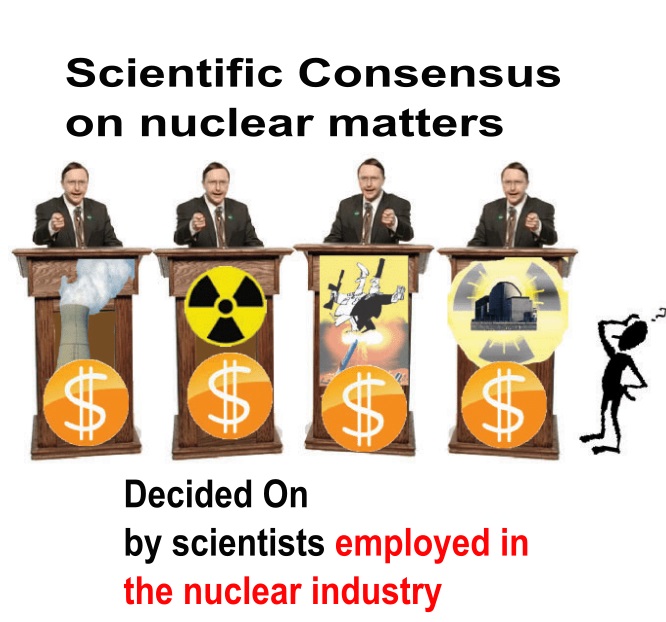
Not to be outdone by more modern means of propaganda, Nuclear Waste Services has continued the tradition of only providing the audience with the information that suits their argument.
The only way to reduce waste is to reduce the activities that cause it.
There is no other logical way.
News media tends to use ‘scientific consensus’ as if it is the end point of the discussion.
The implication that ‘this is the only way’ serves to quash dissenting voices and validate the overall message of the article.
When government agencies are hard to trust, who do we look to? Scientists. But what job is the concept of scientific consensus doing in the marketing of the GDF?
A Quiet Resistance, 8 May 2025
‘Scientific consensus’ carries a lot of weight in news media discussing the proposed Geological Disposal Facilities (GDFs) (nuclear waste dumps) in West Cumbria.
This consensus is also being used as a persuasion tool in the official literature handed out to communities by Nuclear Waste Services (NWS).
Since most of us aren’t scientists in either the nuclear industry or geodisposal, we have to turn to those who are if we’re to understand what’s going to happen to our community. Alongside the regular newsletters and other marketing from NWS, we usually access those people through articles in the news and on the internet.
But it’s important to keep asking questions about what we’re reading.
‘Scientific consensus’ doesn’t mean the science is settled; articles can contain facts and still be biased.
Biases in news media
The news media are paid for by advertisers. If they publish articles that make arguments against their advertisers’ interests, they lose advertising money. Their advertisers’ interests may not be clear. For example, they may be companies that have money invested in hedge funds, which in turn invest in nuclear power.
News media also come up against political pressure, as The Guardian found out a few years ago, to its long-term detriment.
There’s also the question of audience. News media write to a specific audience, one already sold on the ideas they are promoting, or at the very least, suggestible. Most people are aware of ‘climate change’. If someone authoritative tells them it’s important for us to have a GDF because nuclear energy will help us ‘beat climate change’, they are likely to accept that, unless they have some wider knowledge.
Bias can be edited into an article by keeping the facts, but leaving out certain contexts. They can also cherry pick facts, so that the only ones they use are those which suit their argument.
Biases and misinformation across the internet
Misinformation across the web is an endemic problem now, brought on by too little regulatory oversight, too late. A bitter combination of an advertising free-for-all, empty content for the sake of it, and algorithmic twists that feed on themselves has come together to make an internet that doesn’t run the kind of useful searches it did just 12 years ago.
On top of this, a type of information warfare has been raging, hidden in plain sight from the eyes of everyday people, and the proliferation of GenAI has made the situation much worse. Social media, news media, every place we get our information from has been seeded with doubt.
All of this means that when we read information anywhere, from both respectable and dubious sources, we have to take time to process what we’ve read before we lead with our emotions.
Bias and messaging in public information
Not to be outdone by more modern means of propaganda, Nuclear Waste Services has continued the tradition of only providing the audience with the information that suits their argument.
In the case of the Community Partnership newsletter this month, this includes a soothing word salad introduction from the outgoing Community Partnership Chair explaining that he has resigned, and our local Town Council has withdrawn from the group. There are then several pages on how the Community Investment Fund money has been spent recently.
From that messaging, it is clear they’re seeking to reassure the community – talk quietly, you don’t want them to startle – and remind us that we’re getting plenty of money for the deal.
So, what’s the problem with the scientific consensus on the idea of a geological disposal facility (GDF), more prosaically known as a nuclear waste dump?
What is ‘scientific consensus’?
Scientific consensus refers to an agreement amongst scientists in a specific, very narrow field of study.
In the consideration of a GDF, that field would be geology, and most likely a particular area of geology, such as geodisposal.
Why do we need ‘scientific consensus’?
For most of us, despite our education and our wide understanding of the world, we don’t have intensive scientific training. Even if we do, it may not be in the narrow field in question.
Ethan Siegel at Forbes.com explained this really clearly:
… Unlike in most cases, unless you are a scientist working in the particular field in question, you are probably not even capable of discerning between a conclusion that’s scientifically valid and viable and one that isn’t. Even if you’re a scientist in a somewhat related field! Why? This is mostly due to the fact that a non-expert cannot tell the difference between a robust scientific idea and a caricature of that idea.
Why should we believe ‘scientific consensus’?
Although a consensus is an impossible number to quantify, the argument for a consensus is that a lot of related research is borne out by the agreement, so if it isn’t correct – e.g. if a GDF isn’t a safe and complete solution for nuclear waste – then a lot of other research is also wrong.
That sounds reassuring, but there’s more to it.
What do we have to consider behind the messaging of ‘scientific consensus’?
News media tends to use ‘scientific consensus’ as if it is the end point of the discussion.
The implication that ‘this is the only way’ serves to quash dissenting voices and validate the overall message of the article.
This is also how Nuclear Waste Services is using ‘scientific consensus’. The inference is that there is only one solution, and a GDF is it.
But scientific consensus is not the end position of the science. It’s the starting position from which further investigation can arise.
While that future studying may not set out to prove early scientific reasoning wrong, it should seek to improve or refine our understanding of the science.
And the main problem with scientific investigation?
Take a look at this quote. It’s from the article Development in Progress, from the Consilience Project.
It is also important to consider how existing biases and values ‘prime’ us towards certain starting points when we seek to understand the world through science. Before we formulate questions of design experiments, we often have preconceived notions as to what we imagine as likely to be important to the question at hand.
You’ve got to ask what their starting point is, before you can evaluate the idea.
Or, to put it another way: if you ask a geodisposal specialist what the best way is to deal with a higher activity nuclear waste problem, they’re going to tell you to bury it underground.
What’s the motivation for a GDF? Why the bias? Where’s the starting point of the plan?
Waste is a massive issue for modern Western societies. Everything we do, everything we buy creates waste. The only way to reduce waste is to reduce the activities that cause it.
There is no other logical way.
Government and the nuclear industry are motivated towards using a geological disposal facility to store higher activity nuclear waste because:
- There’s almost seventy years’ worth of higher activity nuclear waste to store
- Nuclear appears to offer a solution to the legal requirements of Net Zero.
The more we use nuclear technology, the more toxic waste we will produce. It’s inevitable without social, political, and industrial change.
The nuclear industry
The nuclear industry’s back is against the wall. It urgently has to put the accruing waste somewhere permanently safe.
Nuclear waste is produced in solid, aqueous, and gaseous forms. If the industry reduces some of the gaseous waste, that means that it increases it in another form, e.g. aqueous. There is no escaping the waste issue without stopping the industry.
There’s a lot of money in nuclear.
The UK Government
The government has to enable the production of electricity, but having effectively phased out coal-fired power stations, it has brought in gas-fuelled hydrogen plants which are arguably just as greenhouse-gas-intensive as coal. Natural gas is still a fossil fuel, it still causes huge emissions, and it still presents supply problems.
For the government, nuclear represents a lower carbon option, with political expediencies, such as being free of Russian fossil fuel pressures (Russian uranium is still unsanctioned and likely part of the ‘diversified’ fuel mixes used in the UK).
There is also a disturbing link between civil nuclear skills and military nuclear skills which doesn’t get much media time:
Other countries tend to be more open about it, with the interdependence acknowledged at presidential level in the US for instance. French president Emmanuel Macron summarises: “without civil nuclear power, no military nuclear power, without military nuclear, no civil nuclear”.
This is largely why nuclear-armed France is pressing the European Union to support nuclear power. This is why non-nuclear-armed Germany has phased out the nuclear technologies it once lead the world in. This is why other nuclear-armed states are so disproportionately fixated by nuclear power.
In 2022, the Nuclear Decommissioning Authority (NDA) published a Radioactivity Waste Inventory with a timeline for the phasing out of nuclear power by 2136. But in early 2025, the Labour government announced it was keen to rapidly start up the building of Small Modular Reactors (SMRs) across the UK. Going forward from this year, nuclear waste will continue to be produced in the UK beyond the 100-year lifetime of the current GDF project. Waste is inevitable.
Waste isn’t the only issue for nuclear power, either. There is the question of what happens to nuclear power plants in the face of climate catastrophe. Fukushima wasn’t an anomaly, and it wasn’t avoidable. It could be seen as a foreshadowing of future possibilities.
Back to scientific consensus
So, when Nuclear Waste Services and other media proponents talk about scientific consensus being in agreement that a GDF is the best solution available for toxic nuclear waste, what they mean is:
- there is an inexorable accumulation of nuclear waste, both historical and into the future
- there are going to be more GDFs in the future
- they aren’t looking for other methods of storage
- they absolutely will not consider a non-nuclear future
- and they don’t want to argue about it.
And, for some reason, despite a GDF apparently being the safest possible housing for nuclear waste – and despite there being many geologically suitable locations – they don’t want to locate it under Westminster.
Ultimately, despite the focus given to the science, this isn’t about the science.
It’s about burying a waste product that they have no other solution for. Sweeping it under the carpet. And calling it common sense!
Common sense as a message, in an area of study called Semiotics, is a problematic idea. Although it is dressed up as the common, standard, everyday way of thinking, it is often used in marketing and media to promote the ideas of those in power.
As the future beckons, common sense should be saying no to nuclear. Just like with plastic, nuclear has no end and no sure way of getting rid of its byproducts.
For communities that ‘host’ a nuclear waste dump, the GDF solution represents a forever risk with inter-generational risks and costs along the way.
Somehow, West Cumbria always seems to be saddled with nuclear detritus.
The potential collateral damage, seen already across the United States and South America, is similar to that experienced around mining and climate solution industries.
It starts with
- environmental destruction,
- contamination of water sources and land,
- loss of biodiversity,
- loss of human rights,
- loss of health, and
- upheaval of established communities.
These may be experienced just in the construction of a GDF.
Who knows where it ends?
Further information on the proposed GDFs in West Cumbria:
Sellafield Plutonium treatment plant moves a step closer to completion

COMMENT. So now they think they can make more of the toxic stuff?
And provide more dirty dangerous jobs for the boys?
Sellafield Ltd and Nuclear Decommissioning Authority 15 May 2025
The Sellafield Product and Residue Store Retreatment Plant (SRP) is one of our largest and most complex construction projects.
When finished it will play an essential role in managing the UK’s plutonium stockpile.
The project celebrated an important milestone this week as its roof was sealed with a final concrete pour, making the main building watertight and ready for internal fit-out.
Once operational, the plant will retreat and repackage existing material into more durable, long-term storage packages, ensuring they can be safely stored into the next century and beyond.
The project is being delivered under Sellafield’s Programme and Project Partners (PPP) infrastructure delivery model which brings together KBR, Amentum, Morgan Sindall Infrastructure, Altrad Babcock, and a wider supply chain, to deliver a 20-year pipeline of major infrastructure projects.
Completing the vast roof slab required 12 weeks of work and over 2,700 cubic metres of concrete to be poured and pumped to heights up to 30 metres.
The achievement moves the project closer to active commissioning and operations in support of the government’s plutonium disposition strategy announced earlier this year……… https://www.gov.uk/government/news/flagship-sellafield-project-seals-major-milestone
The US buried millions of gallons of wartime nuclear waste – Doge cuts could wreck the cleanup

Guardian, Andrew Buncombe in Richland, Washington. 16 May 25
Hanford made the plutonium for US atomic bombs, and its radioactive waste must be dealt with. Enter Elon Musk
Andrew Buncombe in Richland, WashingtonThu 15 May 2025 23.00 AESTShare
In the bustling rural city of Richland, in south-eastern Washington, the signs of a nuclear past are all around.
A small museum explains its role in the Manhattan Project and its “singular mission – [to] develop the world’s first atomic bomb before the enemy might do the same”. The city’s high school sports team is still known as the Bombers, with a logo that consists of the letter R set with a mushroom cloud.
Richland lies just 30 miles from the Hanford nuclear site, a sprawling plant that produced the plutonium for America’s atomic weapons during the second world war – and later the bomb dropped over Nagasaki. Over the decades, thousands of people in the Tri-Cities area of southern Washington worked at the plant, which shuttered in 1989.
Residents have long spearheaded an operation to deal with 56m gallons of nuclear waste left behind in dozens of underground tanks – a cleanup that is expected to cost half a trillion dollars and may not be completed until 2100. The government has called it “one of the largest and most expensive environmental cleanup projects worldwide”.
In recent weeks, what has already been a costly and painstakingly slow process has come under renewed scrutiny, following an exodus of experts from the Department of Energy (DoE) that is overseeing the cleanup being executed by thousands of contract workers.
According to local media, several dozen staff, who reportedly include managers, scientists and safety experts, have taken early retirement or been fired as part of a broader government reduction overseen by Elon Musk and his “department of government efficiency”. The government has refused to provide a specific figure for how many people involved with cleanup efforts have left. The top DoE manager at the Hanford site, Brian Vance, who had many years of experience, resigned at the end of March without giving a reason.
The changes have thrown the communities around the Hanford plant into limbo. And while the Department of Energy has said that only six staff have been fired, and reiterated its commitment to the cleanup, that hasn’t managed to assuage locals’ concerns.
Those raising the alarm include politicians from both parties, environmental activists, and Indigenous communities who have historically owned the land on which the 560 sq mile (1,450 sq km) site sits.
The US senator for Washington Patty Murray said workers were already understaffed, and that cutting further positions was “reckless”.
“There is nothing ‘efficient’ about indiscriminately firing thousands upon thousands of workers in red and blue states whose work is badly needed,” the Democrat said.
Dan Newhouse, the local Republican congressman is similarly concerned. “A strong, well trained federal workforce is essential,” he wrote in a weekly newsletter to constituents.
Concerns have also been raised by some over the difficulty former workers face in making medical compensation claims to the government for everything from cancer to acute pulmonary disease linked to their time at the plant.
Taken together, there is fresh anxiety in a community, where many are still living with the health and environmental effects of Hanford.
Richland, part of the Tri-Cities, was obtained by the army in 1943 to house workers engaged in top-secret efforts to produce plutonium used in the world’s first nuclear explosion – the-so-called “Trinity” device tested near Los Alamos, New Mexico, in 1945. Though the city was returned to the public a decade later, it can still feel like a company town.
To get anywhere near what is known as Hanford’s B-reactor, the world’s first full-scale plutonium production reactor, you need to sign up for an official tour. Yet a view of its grey, single tower, looming from the hillside, can be seen from state route 24, close to the Columbia River.
Those expressing concern about the federal government downsizing include local Indigenous groups who historically owned the land where the site is located and were pushed off it by the government. The Hanford plant area contains the location of several sacred sites, among them Gable Mountain, which were used for ceremonies, and the area of Rattlesnake Mountain, or Lalíik, which has for centuries been used to hunt elk.
The site is also located close to the Yakama Indian Reservation, home to 11,000 people, and the tribe has long pushed to be central to decisions about the cleanup and what it is eventually used for. The tribe recently signed a deal to carry out their first elk hunt in the area for seven decades.
“One of the biggest fears is that without proper manpower, there might not be a very good crew for the cleanup of the property,” says Gerald Lewis, chairman of the Confederated Tribes and Bands of the Yakama Nation. “Without this cleanup, that’s been happening for a number of years, we’re afraid of a nuclear mishap.”
Dr Elizabeth McClure, a health data specialist with the Union of Concerned Scientists, is currently conducting research in the communities around Hanford. She says there is a history of government-led cover-ups over the years at the site, including what is known as “the Green Run”, the intentional release of 8,000 so-called curies of iodine-1 into the atmosphere in 1949……………………………………………………………………………………………………………….. https://www.theguardian.com/us-news/2025/may/15/us-government-nuclear-waste-doge
Andra updates French repository cost estimate
Tuesday, 13 May 2025,
https://www.world-nuclear-news.org/articles/andra-updates-french-repository-cost-estimate
French radioactive waste management agency Andra has estimated the overall cost of constructing, operating and closing France’s planned deep geological repository for the disposal of high- and intermediate-level radioactive waste at between EUR26.1 billion (USD29.1 billion) and EUR37.5 billion (at 2012 prices).
France plans to construct the Centre Industriel de Stockage Géologique (Cigéo) repository – an underground system of disposal tunnels – in a natural layer of clay near Bure, to the east of Paris in the Meuse/Haute Marne area. The facility is to be financed by radioactive waste generators – EDF, Orano and the French Alternative Energies and Atomic Energy Commission – and managed by Andra.
Andra said the costing file is one of the key inputs for determining the cost of Cigéo, which will be finalised by the Minister of Industry and Energy by the end of 2025, after gathering comments from the main waste producers and the opinion of the French Nuclear Safety and Radiation Protection Authority (ASNR).
“This decree provides waste producers with a reference allowing them to establish the provisions they are required to make for the management of their waste,” Andra said. “The overall cost estimate for Cigéo is an iterative process carried out by Andra. This assessment will be revised at key stages of the project.”
In 2005, Andra estimated the cost of the facility at between EUR13.5 and EUR16.5 billion. However, in 2009 it re-estimated the cost at around EUR36 billion. In October 2014, Andra gave a revised cost estimate for Cigéo of EUR34.4 billion, based on 2012 prices. This estimate included EUR19.8 billion for the facility’s construction, EUR8.8 billion for operational costs over 100 years, EUR4.1 billion in taxes and EUR1.7 billion in miscellaneous expenses.
Andra has now issued an updated estimate for the cost of Cigéo. It says the cost of constructing and commissioning the repository will be between EUR7.9 billion and EUR9.6 billion, which includes design (excluding R&D), construction of surface infrastructure and the first storage areas, taxes, and insurance. From its commissioning in 2050, the average annual cost of Cigéo is estimated at between EUR140 million and EUR220 million per year, including operation, progressive construction, maintenance, and refurbishment over a period of about a century, followed by decommissioning and closure over about 20 years, or between EUR16.5 billion and EUR25.9 billion in total, including taxes and insurance. The R&D cost identified to date, including the operation and closure of the underground laboratory, is estimated at between EUR1.7 billion and EUR2 billion.
Andra said the 2025 costing file is consistent with Cigéo’s updated provisional schedule. “This schedule takes into account the additional time required to complete the detailed preliminary design studies (including the optimisations identified in 2016 following the first cost decision), the preparation of the support file for Cigéo’s creation permit application, and its review.”
Subject to the issuance of the creation authorisation decree in late 2027/early 2028, the receipt of the first waste packages is currently planned for 2050.
The cost decree to be set by the Minister of Industry and Energy – expected by the end of 2025 – “will serve as a reference for the project’s continuation until its next assessment,” Andra said. It also “provides waste producers with a reference allowing them to establish the provisions they are required to make for the management of their waste.”
Lawsuit Compels Nationwide Public Review of Plutonium Bomb Core Production

9 May 25, https://nukewatch.org/lawsuit-compels-nationwide-public-review-of-plutonium-bomb-core-production

AIKEN, S.C. — Today the National Nuclear Security Administration (NNSA), the semi-autonomous nuclear weapons agency within the Department of Energy, published a formal Notice of Intent in the Federal Register to complete a nationwide “programmatic environmental impact statement” on the expanded production of plutonium “pit” bomb cores. Pits are the essential radioactive triggers of modern nuclear weapons. The NNSA is aggressively seeking their expanded production for new-design nuclear weapons for the new nuclear arms race.
The South Carolina Environmental Law Project (SCELP) successfully represented the Gullah/Geechee Sea Island Coalition and Nuclear Watch New Mexico, Savannah River Site Watch and Tri-Valley Communities Against a Radioactive Environment in a legal challenge to NNSA’s attempt to improperly jump start dual site pit production. On September 30, 2024, United States District Court Judge Mary Geiger Lewis ruled that the NNSA had violated the National Environmental Policy Act (NEPA) by failing to properly consider alternatives before proceeding with its plan to produce at least 30 pits per year at the Los Alamos National Laboratory (LANL) in New Mexico and at least 50 pits per year at the Savannah River Site (SRS) in South Carolina.
The Court found that NNSA’s plans for pit production had fundamentally changed from its earlier analyses which had not considered simultaneous pit production at two sites. Co-plaintiffs argued that these changes required a reevaluation of alternatives under NEPA, which Defendants failed to undertake prior to moving forward and spending tens of billions of taxpayers’ dollars.
As a result of this ruling and a subsequent settlement, the Defendants are now required to newly analyze pit production at a nationwide programmatic level. This means undertaking a thorough analysis of the impacts of pit production at NNSA sites throughout the United States, including the generation of new radioactive wastes and their uncertain future disposal. Under NEPA, this will provide the opportunity for public scrutiny on NNSA’s aggressive production plans. In addition, NNSA is enjoined from building certain facilities and introducing nuclear materials to the plutonium pit plant at SRS until it completes the PEIS.
Virtual public hearings to determine the needed scope of the programmatic environmental impact statement are scheduled for May 27 and 28. The public comment period for scoping ends July 14 and can be emailed to PitPEIS@nnsa.doe.gov. NNSA expects to complete its draft PEIS within a year, after which in-person public hearings will be held in Livermore, CA; Santa Fe, NM; Kansas City, MO; Aiken, SC; and Washington, DC.
As an indicator of the potential importance of this PEIS process, SCELP and co-plaintiffs have been asked by the Nobel Peace Prize Center in Oslo, Norway, to present (by video) on “how it is possible to do activism inside the court room” on August 6, the 80th anniversary of the Hiroshima atomic bombing. Also, in recognition of its astute legal strategy, SCELP will be receiving an award from the Alliance for Nuclear Accountability comprised of some three dozen public interest organizations (including three of the lawsuit’s co-plaintiff) at a ceremony in Washington, DC, on June 10th.
As background, plutonium pits are the fissile cores of nuclear weapons. The Los Alamos Lab was assigned a mission of limited pit production after a 1989 FBI raid investigating environmental crimes abruptly stopped production at the notorious Rocky Flats Plant near Denver, CO. In 2018 the NNSA decided to pursue pit production at both LANL and SRS. The agency erroneously claimed that an outdated 2008 programmatic environmental impact statement that did not consider simultaneous production was sufficient legal justification under the National Environmental Policy Act.
No future pit production is to maintain the safety and reliability of the existing, extensively tested nuclear weapons stockpile. Instead, future production is only for speculative new-design nuclear weapons that can’t be tested because of an international testing moratorium, thereby perhaps eroding confidence in stockpile reliability. Or, instead, the first new design nuclear weapons since the end of the Cold War could prompt the U.S. to return to full-scale testing, which would have severe national and international consequences.
Independent experts have found that plutonium pits have reliable lifetimes of at least 100 years (their average age is now around 42). Moreover, at least 15,000 pits are already stored at the NNSA’s Pantex Plant near Amarillo, TX. Expanded plutonium pit production will cost taxpayers more than $60 billion over the next thirty years.
The independent Government Accountability Office (GAO) has repeatedly pointed that the NNSA has no credible cost estimates for its largest and most complex program ever, nor an “Integrated Master Schedule” between the two production sites. Further, the Department of Energy and the NNSA have been on the GAO’s “High Risk List” for project mismanagement and waste of taxpayers’ money since 1991. All of these issues and the basic need or not for expanded plutonium pit production are ripe for analysis and public comment in the now required programmatic environmental impact statement.
Ben Cunningham, SCELP’s lead attorney in this case, declared the following: “We implore the public to participate fully in the PEIS process—from attending the scoping hearings to commenting on the draft PEIS. The vast expansion of the nuclear arsenal that is facilitated by the increase in pit production will be exorbitantly expensive, will create radioactive wastes that can last for thousands of years, and the new weapons produced by this expansion could ultimately endanger hundreds of millions of lives. Please weigh in and express your concerns to the decisionmakers.”
Queen Quet, elected Chieftess of the Gullah/Geechee Nation, said: “I am thankful to SCELP and the rest of our national team that stood together to ensure that we protect our communities not only today but also for future generations. The type of compliance that we have fought for is even more crucial given the current environmental and political climate. I am looking forward to us being able to engage in the next phase of this process so that we can ensure that the waters that reach the Sea Islands will be safe.”
Tom Clements, director of Savannah River Site Watch, noted, “Given that we are armed with a decisive federal court ruling that requires the preparation of the PEIS by NNSA, we expect a thorough examination of all environmental and health impacts of pit production at all impacted sites. The draft PEIS must include an analysis of plutonium aging and pit reuse, the proliferation risks of new U.S. warheads, plans for plutonium transportation and the uncertain future disposal of plutonium wastes in the Waste Isolation Pilot Plant in southern New Mexico.”
“Prior to our lawsuit, the agency failed to include other sites involved in future plutonium pit production in its required analyses, chief among them the Lawrence Livermore Lab in California, the Kansas City Plant in Missouri, and the Waste Isolation Pilot Plant. The judge clearly saw these violations and ordered the NNSA to complete the programmatic nationwide analysis which should have been done from the outset. This is a victory for public involvement. It will hopefully result in credible alternatives that are more protective of the environment and the impacted communities,” said Scott Yundt, Executive Director at Tri-Valley CAREs, in Livermore, CA.
Jay Coghlan of Nuclear Watch New Mexico commented, “This programmatic environmental impact statement that we fought long and hard for empowers citizens to tell policy makers what they think about decisions being made in their name. Let them know what you think about the $2 trillion ‘modernization’ program to keep nuclear weapons forever while domestic programs are gutted to pay for tax cuts for the rich. We should demand that this required process under the National Environmental Policy Act becomes a public referendum on the new nuclear arms race and the hollowing out of our society.”
1 This Month

of the week – Shut Down Drone Warfare!


Tell the Ukrainian Government to Drop Prosecution of Peace Activist Yurii Sheliazhenko

Petition to revoke the licensing of the Near Surface Nuclear Disposal Facility (NSDF) at Chalk River. https://www.ourcommons.ca/petitions/en/Petition/Details?Petition=e-7247
To see nuclear-related stories in greater depth and intensity – go to https://nuclearinformation.wordpress.com
-
Archives
- March 2026 (244)
- February 2026 (268)
- January 2026 (308)
- December 2025 (358)
- November 2025 (359)
- October 2025 (376)
- September 2025 (257)
- August 2025 (319)
- July 2025 (230)
- June 2025 (348)
- May 2025 (261)
- April 2025 (305)
-
Categories
- 1
- 1 NUCLEAR ISSUES
- business and costs
- climate change
- culture and arts
- ENERGY
- environment
- health
- history
- indigenous issues
- Legal
- marketing of nuclear
- media
- opposition to nuclear
- PERSONAL STORIES
- politics
- politics international
- Religion and ethics
- safety
- secrets,lies and civil liberties
- spinbuster
- technology
- Uranium
- wastes
- weapons and war
- Women
- 2 WORLD
- ACTION
- AFRICA
- Atrocities
- AUSTRALIA
- Christina's notes
- Christina's themes
- culture and arts
- Events
- Fuk 2022
- Fuk 2023
- Fukushima 2017
- Fukushima 2018
- fukushima 2019
- Fukushima 2020
- Fukushima 2021
- general
- global warming
- Humour (God we need it)
- Nuclear
- RARE EARTHS
- Reference
- resources – print
- Resources -audiovicual
- Weekly Newsletter
- World
- World Nuclear
- YouTube
-
RSS
Entries RSS
Comments RSS
 nuclear-news