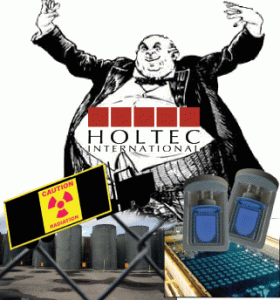
 Public comments are due by Sept. 22, and can be made at the online meetings; by email to Holtec-CISFEIS@nrc.gov; at the federal rule-making website (www.regulations.gov, Docket ID NRC-2018-0052); or by mail (Office of Administration, Mail Stop: TWFN-7-A60M, ATTN: Program Management, Announcements and Editing Staff, U.S. NRC, Washington, DC 20555-0001).
Licensing of temporary storage for nuclear waste in New Mexico inching forward
Nuclear regulator poised to OK move of spent fuel from reactors like San Onofre to temporary storage in New Mexico, but locals are opposed, By TERI SFORZA | tsforza@scng.com | Orange County Registerl August 26, 2020
The quickest way to get nuclear waste off Southern California’s quake-prone coast? Temporary storage sites in sparsely populated corners of the nation, experts say.
After years of processing, the Nuclear Regulatory Commission’s preliminary recommendation is that Holtec International be granted a license to build and operate such an interim storage site in New Mexico — which would first accept “stranded waste” from shuttered plants like the San Onofre Nuclear Generating Station.
“Hopeful,” said David Victor, an international law professor at UC San Diego and chair of San Onofre’s volunteer Community Engagement Panel. “But the regulatory process and the political process for the New Mexico site are moving in opposite directions.”
The NRC is hosting online meetings to present the project’s draft environmental impact report and gather public comment. The next virtual meetings are slated for 3 p.m. Wednesday, Aug. 26, and 8 a.m. Tuesday, Sept. 2. Public comments must be submitted to the NRC by Sept. 22.
Holtec hopes to build the first of a 20-phase project that eventually would cover 330 acres. It would be located in southeast New Mexico, about halfway between the cities of Carlsbad and Hobbs, and would look quite familiar to Southern Californians: Waste, potentially from all over the nation, would be stored in a Holtec HI-STORM UMAX in-ground system like the one at San Onofre.
But anyone familiar with the saga of Yucca Mountain — as well as the controversy surrounding waste storage here at San Onofre — won’t be surprised to find that the underlying issues are universal: Many locals adamantly oppose storing nuclear waste in their backyards.
Though the license period for Holtec’s New Mexico proposal would be 40 years, people fear nuclear waste would remain there forever
“Establishing an interim storage facility in this region would be economic malpractice,” wrote New Mexico’s governor, Michelle Lujan Grisham, in a letter asking President Donald Trump to oppose Holtec’s project. “Accidents are possible and unacceptably detrimental to the safety of New Mexicans, our economy and our state.”
The governor argued that the site is geologically unsuitable, would place a financial burden on the state and local communities and poses a danger as spent nuclear fuel is shipped into New Mexico from around the nation.
Many New Mexicans, however, say that’s not enough. Speaking “under protest” at virtual meetings they believe may be unlawful, critics said the NRC must present its findings in state and in person. Since in-person gatherings can’t happen during the pandemic, deadlines should be postponed until after the pandemic is over, they argued.
Speakers also attacked Holtec’s crediblilty. The company is currently embroiled in conflict in New Jersey, where it sued the New Jersey Economic Development Authority in March for holding up a $26 million payment that was part of a tax incentive program to build a facility in Camden.
The authority asserts that Holtec failed to mention that it had run into hot water with the Tennessee Valley Authority on its tax credit application in 2014.
The Southern California News Group reported that the U.S. Attorney’s Office looked into bribery allegations and asserted that a subcontractor manufacturing Holtec’s casks — U.S. Tool & Die — wrote checks totaling $54,212 to the account of a TVA manager. That money, the U.S. Attorney’s Office said, originated with Holtec.
The TVA manager pleaded guilty to falsifying financial statements by not disclosing those payments. Holtec said it wasn’t privy to any of this, and was not charged. But in 2010, the company paid a $2 million “administrative fee” to the TVA and became the first contractor in TVA history to be debarred. Its contract was suspended for 60 days, and it submitted to a yearlong monitoring program of its operations, according to the TVA’s inspector general.
Holtec continued supplying waste storage casks to the TVA, as well as to other nuclear plants in America and overseas.
At San Onofre, Holtec has had other bumps, including a surprise redesign of the canisters that hold nuclear waste and a snippy war of words with members of the San Onofre Community Engagement Panel. Errors loading spent fuel into the UMAX stopped operations for nearly a year, but were laid at the feet of operator Southern California Edison.……..
Public comments are due by Sept. 22, and can be made at the online meetings; by email to Holtec-CISFEIS@nrc.gov; at the federal rule-making website (www.regulations.gov, Docket ID NRC-2018-0052); or by mail (Office of Administration, Mail Stop: TWFN-7-A60M, ATTN: Program Management, Announcements and Editing Staff, U.S. NRC, Washington, DC 20555-0001). https://www.ocregister.com/2020/08/25/licensing-of-temporary-storage-for-nuclear-waste-in-new-mexico-inching-forward/
August 27, 2020
Posted by Christina Macpherson |
USA, wastes |
Leave a comment
Hokkaido town becomes flashpoint in Japan’s nuclear waste debate, Mayor and governor clash over ethics and risks of potential disposal site, Nikkei Asian Review, TORU TAKAHASHI, Nikkei staff writer, August 27, 2020
TOKYO — An idyllic town on the northern Japanese island of Hokkaido is embroiled in a hot debate over nuclear waste, as its mayor weighs building a disposal facility there over the opposition of the governor as well as surrounding towns………
Hokkaido Gov. Naomichi Suzuki has swiftly mobilized opponents. “Hokkaido has no intention of taking on nuclear waste,” he said on Aug. 13, shortly after Kataoka’s announcement. “The national government is basically shoving wads of cash in our face,” he also said on Aug. 18, criticizing the cash offer. ……..
several local industry groups oppose the idea. Fishermen in particular worry that a local nuclear facility could tarnish the reputation of their catch.
Nearby towns and villages also feel they could face all of the risks of the nuclear waste disposal site without any payout from the national government…… https://asia.nikkei.com/Politics/Hokkaido-town-becomes-flashpoint-in-Japan-s-nuclear-waste-debate
August 27, 2020
Posted by Christina Macpherson |
Japan, wastes |
Leave a comment
 If Trump and Biden agree there shouldn’t be a nuclear waste site at Yucca Mountain, can’t we all? Bulletin of the Atomic Scientists, By David Klaus, August 26, 2020 Believe it or not, there is an issue on which Donald Trump and Joe Biden agree: Both have announced their opposition to building an underground repository to permanently store nuclear waste at Yucca Mountain in Nevada. With the presidential candidates on record, it is time for everyone else to accept that Yucca Mountain is finally off the table, and for the United States to begin to seriously consider realistic alternatives for safely managing the more than 80,000 tons of spent nuclear fuel currently sitting at 72 operating and shut-down commercial nuclear reactor sites across the country. If Trump and Biden agree there shouldn’t be a nuclear waste site at Yucca Mountain, can’t we all? Bulletin of the Atomic Scientists, By David Klaus, August 26, 2020 Believe it or not, there is an issue on which Donald Trump and Joe Biden agree: Both have announced their opposition to building an underground repository to permanently store nuclear waste at Yucca Mountain in Nevada. With the presidential candidates on record, it is time for everyone else to accept that Yucca Mountain is finally off the table, and for the United States to begin to seriously consider realistic alternatives for safely managing the more than 80,000 tons of spent nuclear fuel currently sitting at 72 operating and shut-down commercial nuclear reactor sites across the country.
US policy regarding spent fuel disposal has been hung up for decades on whether to build a repository at Yucca Mountain. The site has been controversial since 1987, when Congress designated it as the future home for high-level radioactive waste – provided, of course, that it meets all technical requirements and is licensed by the Nuclear Regulatory Commission. Thirty-plus years and more than $15 billion later, all technical work to assess the site’s suitability has stopped and the licensing review is dead in the water. The US Congress has refused to appropriate funds to the project for years. And because the government has not met its commitment to begin accepting waste for disposal in 1998, it is forced to pay utilities more than $600 million every year to store their spent fuel on site. Moreover, the most realistic approach for managing the tons of spent fuel—an interim storage facility—is held hostage to progress on Yucca Mountain. Current law requires that the NRC issue a license for Yucca Mountain before a consolidated interim storage could begin to accept spent fuel.
The sooner everyone agrees to pull the plug on Yucca Mountain, the sooner the United States can move forward on consolidated storage for the next 40 to 50 years, since this is likely the amount of time it will take to bring a long-term repository into operation. This will give the government time to find a new site using a consent-based process………..https://thebulletin.org/2020/08/if-trump-and-biden-agree-there-shouldnt-be-a-nuclear-waste-site-at-yucca-mountain-cant-we-all/#
|
|
|
August 27, 2020
Posted by Christina Macpherson |
USA, wastes |
Leave a comment
National resistance builds against nuclear waste facility near Carlsbad
Nationwide opposition of a nuclear waste storage facility proposed to be built near Carlsbad and Hobbs continued its call for the licensing process for the project to be suspended during the COVID-19 pandemic and that the federal Nuclear Regulatory Commission deny the application altogether.
Holtec International proposed to build the site to store high-level spent nuclear fuel rods transported to southeast New Mexico from generator sites across the county.
Many of the rods are already stored in cooling pools near the generator sites, which supporters of the project said were unsafe as many are located near large bodies of water or densely populated areas.
The concept of Holtec’s consolidated interim storage facility (CISF) was to temporarily store the spent fuel in a remote location while a permanent repository was developed.
Such a facility to permanently store the waste does not exist in the U.S.
The idea faced opposition from New Mexico Gov. Michelle Lujan Grisham and State Land Commissioner Stephanie Garcia Richard along with other state lawmakers.
And during a Thursday public hearing held by the NRC, numerous nuclear watchdog groups from around the country voiced their opposition.
The NRC announced last week it would hold four such online hearings including Thursday’s with others scheduled for Aug. 25, 26 and Sept. 2 to solicit public comments on the Commission’s recently released environmental impact statement (EIS).
The EIS released earlier this year found the project would have minimal environmental impacts during the construction, operation and decommissioning of the facility.
The EIS was required for the first phase of Holtec’s plan for 500 cannisters to be stored, but the NRC also considered the company’s expressed intention to apply for future permits for 19 additional phases for a total of 10,000 cannisters of nuclear waste.
Leona Morgan of the Nuclear Issues Study Group based in Albuquerque said the online hearing process was unjust as many New Mexicans live without adequate internet or phone service to participate in electronic hearings.
While she called for the NRC to reject Holtec’s application, citing safety and environmental risks to the region of the facility and communities along the transportation routes, Morgan also questioned the hearing process itself as it continued during the global pandemic.
Leona Morgan of the Nuclear Issues Study Group based in Albuquerque said the online hearing process was unjust as many New Mexicans live without adequate internet or phone service to participate in electronic hearings.
While she called for the NRC to reject Holtec’s application, citing safety and environmental risks to the region of the facility and communities along the transportation routes, Morgan also questioned the hearing process itself as it continued during the global pandemic.
The Nuclear Issues Study Group, which held a continued presence during the past three public hearings held this year, and NRC’s scoping meetings held in 2018, would boycott the rest of the proceedings, Morgan said.
“There are a large portion of our state that lives without phone or internet service. Our organization is boycotting the rest of these proceedings. It is a sham. There is no reason to rush this process except to line the pockets of shareholders,” she said.
“We see this as a violation of our rights to submit our public comments under the National Environmental Policy Act. And it violates environmental justice. We can’t even verify that the NRC is sitting before us.”
More:Nuclear waste site near Carlsbad opposed by indigenous groups during public hearing
John LaForge, of nuclear watchdog group Nukewatch of Wisconsin also voiced his opposition to the project and ongoing proceedings, pointing to widespread opposition in New Mexico and among Tribal nations.
He demanded public hearings be held in up to 40 states other than New Mexico that could be impacted by the transportation of waste.
“There is no compelling reason at this time for these meetings to be rushed. I opposed this plan due to the governors of New Mexico and of 20 tribal nations,” LaForge said. “With these online meetings, it is apparent to me that the NRC has no interest in the public’s concerns. The people of New Mexico have said no.”
He also criticized the EIS as the NRC noted in the report it would expect no radiation release should there be an accident at the facility.
“In its review, the NRC said it assume in an accident there would be no release of radiation,” LaForge said. “That is alarming and preposterous.”
Petuuche Gilbert of the Acoma Coalition for a Safe Environment based in the Acoma Pueblo near Albuquerque also questioned the EIS as it only considered the environmental impacts of the project for 40 years and only within a 50 mile radius.
“We believe the analysis needs to go beyond the 40 year possibility of storing the waste. We all know the nuclear waste and radioactivity extends beyond that limited timeframe. It really needs to go on for hundreds or thousands of years,” Gilbert said.
“You have the possibility of accidents that could occur along the transportation corridors. The cumulative analysis is limited only to a 50 mile radius. It really needs to be more.”
August 22, 2020
Posted by Christina Macpherson |
opposition to nuclear, USA, wastes |
Leave a comment
Hokkaido town may delay bid for nuclear waste survey amid pushback, Japan Times , JIJI, Aug 21, 2020
SAPPORO – The mayor of Suttsu in Hokkaido, which is considering applying for a survey to host a final disposal site for high-level radioactive waste, said Friday that it might be difficult to make the decision by September as planned.
“It is difficult to make the decision after listening to many voices,” Suttsu Mayor Haruo Kataoka told reporters after meeting with the nine members of the town’s assembly. “It would not be appropriate to rush the decision by our own judgment. Our plan to decide in September might be postponed.”
Kataoka’s remarks came a day after the mayors of three municipalities neighboring Suttsu said Thursday they will urge the town to make a careful decision.
The mayors of the three municipalities unveiled the plan at a meeting with Hokkaido Gov. Naomichi Suzuki.
Of the three, Rankoshi Mayor Hideyuki Kon and Kuromatsunai Mayor Mitsuru Kamada expressed opposition to Suttsu’s move, which involves applying for a literary survey, the first stage of the process for choosing a disposal site.
Kon, Kamada and Shimamaki Mayor Masaru Fujisawa told Suzuki that they will ask Suttsu as early as this month to make a careful decision on the application. ……..
Seven other municipalities, including the town of Niseko, an internationally known ski resort, are planning to oppose the plan, sources said Friday.
Also on Friday, members of the association of fisheries cooperatives made up of nine co-ops around Suttsu, submitted to Kataoka a protest letter expressing strong opposition to the town’s plan.
Referring to the fact that the fisheries industry suffered harmful rumors following the 2011 triple core meltdown at the Fukushima No. 1 power plant, the letter said: “It is utterly unacceptable for those in the fisheries industry. It will have an immeasurable adverse impact not only on the region but also on the fisheries industry as a whole.”
Katsuo Hamano, head of the association, criticized the mayor for making an announcement on the plan even before obtaining the municipal assembly’s approval.
“It goes against the rules of parliamentary democracy,” Hamano told reporters…….
The central government offers up to ¥2 billion in subsidies to any municipality that undergoes the literary survey https://www.japantimes.co.jp/news/2020/08/21/national/hokkaido-suttsu-nuclear-waste-survey-delay/
August 22, 2020
Posted by Christina Macpherson |
Japan, opposition to nuclear, politics, wastes |
Leave a comment

BBC 20th Aug 2020, The site of a Scottish nuclear power facility should be available for other

uses in 313 years’ time, according to a new report. Dounreay, near Thurso,
was the UK site for the development of fast reactor research from 1955 to
1994. The facility on the north Caithness coast is in the process of being
closed down, demolished and cleaned up. However, the Nuclear
Decommissioning Authority said it would be 2333 before the 148-acre site is
safe for reuse. The date forms part of the authority’s newly-published
draft strategy. Waste is to be removed from the Shaft by 2029, according to
the NDA report.
https://www.bbc.co.uk/news/uk-scotland-highlands-islands-53848766
Independent 20th Aug 2020, In 313 years’ time, 378 years after it first opened in 1955, and 339
years after it ceased operations in 1994, the 178-acre nuclear power
facility site at Dounreay will be safe for other uses, a new report has
stated. Though the site on the north coast of Scotland was only home to
functioning nuclear reactors for 39 years, the clean-up will take roughly
ten times as long, with efforts already underway to clean up hazardous
radioactive material. Part of the demolition process has involved the use
of a remote controlled robot nicknamed the “Reactosaurus”, a 75-tonne
device with radiation-proof cameras, and robotic arms which are able to
reach 12 metres into the reactors where they can operate an array of
size-reduction and handling tools, including diamond wire and disks and
hydraulic shears. One of the areas targeted for waste removal is a highly
contaminated area called the Shaft. In 1977, a catastrophic leak allowed
seawater to flood a 65-metre-deep shaft which was packed full of
radioactive waste as well as more than 2kg or sodium and potassium.
https://www.independent.co.uk/environment/nuclear-power-dounreay-scotland-thurso-decommissioning-radiation-a9680611.html
August 22, 2020
Posted by Christina Macpherson |
decommission reactor, UK |
Leave a comment
|
Residents discuss opposition to South Bruce Nuclear Waste Repository, Blackburn News, By Janice MacKayAugust 21, 2020 About 100 South Bruce Residents who oppose an underground repository for used nuclear fuel gathered recently at a fundraiser for the Protect Our Waterways – No Nuclear Waste organization.Residents also had a chance to talk about mobilization efforts against the establishment of the Deep Geological Repository in South Bruce. Ignace is the only other community under consideration for the facility by the Nuclear Waste Management Organization.
Board members of Protect Our Waterways – No Nuclear Waste also spent time updating participants on efforts so far…….. https://blackburnnews.com/midwestern-ontario/midwestern-ontario-news/2020/08/21/residents-gather-discuss-opposition-south-bruce-nuclear-waste-repository/
|
|
August 22, 2020
Posted by Christina Macpherson |
opposition to nuclear, wastes |
Leave a comment
|
Debate rages on for nuclear waste facility proposed near Carlsbad, more hearings scheduled
Adrian Hedden, Carlsbad Current-Argus, 20 Aug 20, A project to build a temporary storage facility for high-level nuclear waste in southeast New Mexico will continue to be debated as the federal Nuclear Regulatory Commission scheduled four more public hearings to solicit public feedback on the proposal.Holtec International’s proposed consolidated interim storage facility (CISF) would temporarily hold spent nuclear fuel rods at the surface in an area near the Eddy-Lea county line…….. opponents continued to question the safety of the project and its plan to transport spent nuclear fuel from generators across the county and the legality of opening a temporary storage facility when the U.S. lacks a permanent repository for high-level nuclear waste……
The hearings were planned to be held online on Aug. 20 from 4 to 7 p.m., Aug. 25 from noon to 3 p.m., Aug. 26 from 4 to 7 p.m. and Sept. 2 from 9 a.m. to noon.
Previously, the NRC held public meetings on the EIS on June 23 and July 9.
Written comments were to be accepted until Sept. 22 via email to Holtec-CISFEIS@nrc.gov, via mail to the Office of Administration, Mail Stop: TWFN-7-A60M, ATTN: Program Management, Announcements and Editing Staff, U.S. Nuclear Regulatory Commission, Washington, DC or online to the federal government’s rulemaking page at regulations.gov using docket ID NRC-2018-0052…………
Project debated by New Mexico officials, nuclear industry leaders
New Mexico Gov. Michelle Lujan Grisham and state officials voiced continued disapproval of the project, with Lujan Grisham writing a letter to President Donald Trump to voice her opposition last month.
Lujan Grisham cited concerns the project could imperil the environment in New Mexico and threaten to disrupt local agriculture and extraction industries in the southeast region of the state…….. https://www.currentargus.com/story/news/local/2020/08/20/debate-rages-nuclear-waste-facility-proposed-near-carlsbad/5604978002/
|
|
August 22, 2020
Posted by Christina Macpherson |
politics, USA, wastes |
Leave a comment
 How Bedrock Environmental Law Can Break the Nuclear Waste
  Logjam, https://news.bloomberglaw.com/environment-and-energy/insight-how-bedrock-environmental-law-can-break-the-nuclear-waste-logjam Geoffrey Fettus, NRDC 17 Aug 20
The 30-year battle over nuclear waste disposal at Yucca Mountain in Nevada shows it’s time for the Atomic Energy Act to be amended. Geoffrey Fettus, senior attorney for the Natural Resources Defense Council, says Congress should pass legislation to end the exemption of nuclear waste from hazardous waste and other bedrock environmental laws.
For more than 30 years, Congress and the federal government have tried again and again to shove our nation’s spent nuclear fuel down a hole at Yucca Mountain, Nev. It’s time to use our foundational environmental laws get out of this seemingly impenetrable maze.
Congress should amend the Atomic Energy Act to remove exemptions from environmental laws for radioactive waste, a proposal that got an important boost from the House Select Committee on Climate Crisis as it called for a task force of federal, state, local, and tribal officials to study the implications of this idea.
Earlier this year, President Trump bowed to reality and abandoned efforts to force the radioactive waste on Nevada, the Yucca mirage finally dissipated. What’s clear now is that trying to force Nevada, or Utah, or New Mexico, or Tennessee (or any other state) to take the entirety of the nation’s most toxic nuclear waste won’t work. Continuing down that path will get us nowhere.
Instead of seeing recalcitrant states as the problem, what if we acknowledge the reality that they must be a key part of the solution for nuclear waste?
Feds Have Exclusive Jurisdiction Over Radioactive Materials
Remarkably, our bedrock environmental laws don’t cover nuclear waste, and they should. The Atomic Energy Act started the nuclear industry and was enacted years before our key pollution safeguards were established.
Crucially, and mostly for nuclear weapons reasons, the AEA gave the federal government exclusive jurisdiction over all radioactive materials, including radioactive waste. When Congress enacted our foundational environmental laws decades later, each of them included an exemption that excludes radioactive waste except in limited or marginal ways.
This is the original sin that must be rectified.
To explain this pernicious problem, when Congress considered nuclear waste in its precedent setting 1982 Nuclear Waste Policy Act, it just accepted the AEA’s sole federal authority and nuclear waste’s exclusion from environmental law as the way of the world. Only a few years later, for the sake of political expedience, Congress cut short a well thought out siting process and required the Yucca Mountain repository as the only option.
This was supposed to expedite the process, but not surprisingly, it exploded in controversy and eventually ground to a halt. And now it has finally, truly, died. But nuclear waste remains just as toxic and problematic as ever.
If nuclear waste were covered by environmental laws, i.e., without the current exemptions that limit EPA and state authority, protective federal health and welfare standards can combine with state-level decision-making over where and how the waste could be stored within its borders.
Amending the AEA and removing the provisions that exempt nuclear waste from our hazardous waste and water laws would give us our best chance to garner public acceptance for a process to find safe, technically sound storage sites for toxic nuclear waste—waste that will remain dangerous to human health for hundreds of thousands of years.
Why This Can Work
Consider how things could change if environmental laws could operate as intended.
Under regular environmental law (that covers pollution of air, water, land), the EPA sets strong standards commensurate to the harm of the pollutant. States can then assume the management of that program (or leave it to the EPA) and set additional, stricter standards if they wish.
A state can have strong regulatory authority to set terms for how much waste it might dispose of, how the facility will operate, and the requisite power to enforce those protective standards and protect its citizens—all things it cannot do now for radioactive waste.
To be clear, the standards for high-level radioactive waste will need to be special and extraordinarily protective, and the rulemaking for those standards will be quite a technical ordeal. But, there’s no getting around doing that hard work; Congress tried to take a short cut and it failed.
Once those standards are in place, the EPA and the states can, as in other instances, share the necessary roles of guarding public safety and welfare from radioactive waste. This institutional framework allows for both scientific defensibility of potential sites and, importantly, public acceptance of the process.
The Task Falls to Congress
For far too long many members of Congress and officials in Washington fought any efforts like this as they sought the quick fix of Yucca. Now there’s evidence of change. The ambitious report from the House Select Committee on Climate Crisis included this key recommendation:
Congress should establish a task force comprised of federal, state, local, and tribal officials to study the implications of amending the Atomic Energy Act to remove exemptions from environmental laws for spent fuel and high-level waste, while maintaining federal minimum standards.
Lawmakers should pick up this recommendation, create just such a task force, and move forward with this plan. Will this work? Yes—but it will take both hard work and time.
One thing I can guarantee is that the current approach isn’t working and won’t ever work. No single state is going to willingly accept the entirety of the nation’s nuclear burden without any way to protect their citizens; we have decades of evidence for this proposition. No amount of stomping of feet in the halls of Congress can change that.
Author Information
Geoffrey Fettus is a senior attorney for the Natural Resources Defense Council’s climate and clean energy program in Washington, D.C. He litigates in federal courts and testifies before Congress on the beginning and end of the nuclear fuel cycle. Prior to joining the NRDC, he was a staff attorney at the New Mexico Environmental Law Center and an assistant attorney general in New Mexico’s Office of the Attorney General.
August 18, 2020
Posted by Christina Macpherson |
environment, politics, USA, wastes |
Leave a comment
 In deft, distressing ‘Apocalypse Factory,’ Seattle author details Hanford’s role in the dawn of the nuclear age, Aug. 5, 2020 By Michael Upchurch, The Seattle Times
Book review
On the list of self-inflicted threats to humanity that we shove to the side in order to preserve our sanity, nuclear disaster — along with climate change — ranks at the top. And in Washington state, the toxic legacy of the Hanford nuclear reservation is the chief reminder of that threat.
Hanford produced the plutonium used in the atomic bomb dropped on Nagasaki on Aug. 9, 1945 — 75 years ago this Sunday. It also supplied the plutonium for most of the thousands of American nuclear weapons manufactured since then. But in the popular imagination, Hanford looms less prominently than Los Alamos when it comes to stories about the dawn of the nuclear age.
In “The Apocalypse Factory: Plutonium and the Making of the Atomic Age,” Seattle writer Steve Olson — who grew up in the small town of Othello, roughly 25 miles northeast of Hanford — capably fills in the gap.
As a young writer, Olson studied with John Hersey — the author of the 1946 book “Hiroshima” — so it’s fitting that “The Apocalypse Factory” includes an expansive, Hersey-like chapter on the horrific consequences of the Nagasaki bombing, drawn from Japanese eyewitness accounts. Nagasaki residents, of course, didn’t know what had hit them and were confounded by the “atomic bomb sickness” that killed people who initially appeared to be uninjured.
The book also encompasses the political and military strategies of the period, along with the “fiendishly difficult” challenges of producing plutonium in a way that wouldn’t kill its makers. Olson writes lucidly, making even the most recondite details of the science involved clear to a nonscientist. And he’s eloquent in his chronicling of the lives affected — and sometimes destroyed — by the invention and use of the world’s most deadly weapon.
“Hanford,” he acknowledges, “represents one of humanity’s greatest intellectual achievements; it also embodies a moral blindness that could destroy us all.”………
The secrecy surrounding the bomb didn’t end with World War II. Censorship of details about Nagasaki’s destruction and vital info on what radiation sickness could do to humans continued for years. A story by one Chicago Tribune reporter who wangled his way to Nagasaki wasn’t just censored but destroyed. The carbon copy he kept only came to light 60 years later.
Initial jubilation at Japanese surrender was soon tempered by a realization among scientists of just how nightmarish the bombs’ effects were. Decades later, the radioactive pollution at Hanford likewise became impossible to ignore.
“The leaders of the Manhattan Project,” Olson concludes, “did not devote much thought to the mess they were creating.”
In this deft, informative, sometimes terrifying book, that sentence reads like a stinging understatement.
_____
“The Apocalypse Factory: Plutonium and the Making of the Atomic Age” by Steve Olson, Norton, 336 pp., $27.95
August 17, 2020
Posted by Christina Macpherson |
- plutonium, weapons and war |
Leave a comment
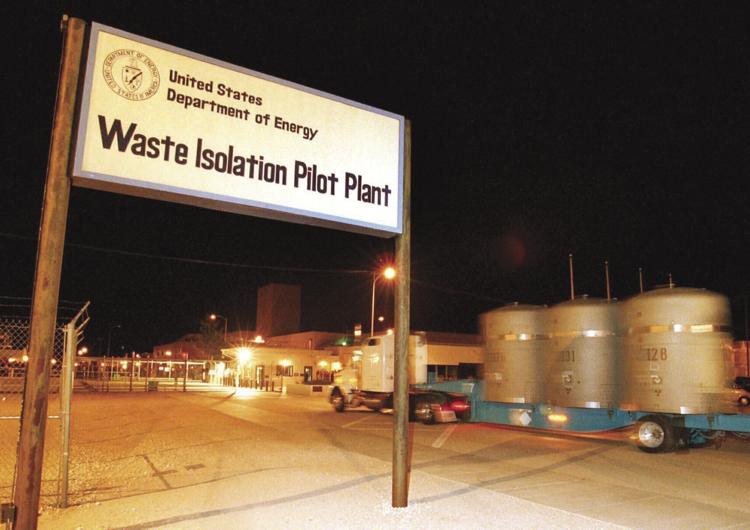
Work ongoing at US nuclear repository despite virus cases, AntelopeValley Press, 16 Aug 20, CARLSBAD, N.M. (AP) — Managers of the federal government’s underground nuclear waste repository in southern New Mexico say operations are ongoing despite a recent increase in COVID-19 cases among workers.
The Waste Isolation Pilot Plant has seen cases among workers more than double in the last week, the Carlsbad Current-Argus reported.
The plant last Monday announced four new cases among employees of Nuclear Waste Partnership, the contractor that oversees daily operations at the facility. In all, the plant has reported at least 14 positive cases among employees and subcontractors.
The plant is in the second phase of resuming normal operations after having slowed the emplacement of waste this spring when the pandemic began, said spokesperson Bobby St. John. ……….
|
The Waste Isolation Pilot Plant is the nation’s only location for disposing of tons of Cold War-era waste generated over years of bomb-making and nuclear weapons research. That includes gloves, clothing, tools and other debris contaminated by plutonium and other radioactive elements.
The waste is placed into vaults carved out of an ancient salt formation about a half-mile below the surface.
In January, two dozen shipments were accepted by the facility. Records show that was followed by 10 shipments in February, six in March and seven in April. May saw an increase to 20 shipments when the state of New Mexico began easing some restrictions related to the statewide public health order that had been enacted to slow the spread of the Coronavirus……..
The facility also marked a milestone in July, when it received the first shipments of waste from Sandia National Laboratories in Albuquerque since 2012. The shipments included waste that has to be handled remotely due to higher levels of radiation.
The shipments were packaged in lead-lined shielded containers that weigh about 1,700 pounds when empty. https://www.avpress.com/business/work-ongoing-at-us-nuclear-repository-despite-virus-cases/article_7821a9e6-df69-11ea-9eea-5f2008c15c73.html
|
|
August 17, 2020
Posted by Christina Macpherson |
health, wastes |
Leave a comment
|
 No Japan prefectures positive about hosting nuclear waste site https://www.japantimes.co.jp/news/2020/08/14/national/prefectures-nuclear-waste-site/ –14 Aug 20, KYODO Nearly half of Japan’s 47 prefectures said they are opposed to or held negative views about hosting a deep-underground disposal site for high-level radioactive nuclear waste, a Kyodo News survey showed Friday. No Japan prefectures positive about hosting nuclear waste site https://www.japantimes.co.jp/news/2020/08/14/national/prefectures-nuclear-waste-site/ –14 Aug 20, KYODO Nearly half of Japan’s 47 prefectures said they are opposed to or held negative views about hosting a deep-underground disposal site for high-level radioactive nuclear waste, a Kyodo News survey showed Friday.
None expressed a favorable stance. The result signals further woes for the central government in its attempt to find a permanent geological disposal repository.
Little progress has been made since the process to find local governments willing to host one started in 2002, due mainly to opposition from local residents.
The survey was sent to all prefectures in July, with additional interviews conducted depending on their answers.
While 16 prefectures such as Fukushima, Kanagawa and Okinawa clearly opposed hosting a site, seven others including Hokkaido, Kyoto and Nagasaki also expressed negative views.
Most of the others did not make their positions clear.
 Of the total 23 prefectures that opposed or showed negative views, seven host nuclear power plants. Of the total 23 prefectures that opposed or showed negative views, seven host nuclear power plants.
“We are already undertaking a certain amount of social responsibility by hosting nuclear plants and providing energy,” Niigata Prefecture said in its response.
Fukui Prefecture said, “We are generating power. Nuclear waste disposal should be handled by others.”
Meanwhile, Hokkaido mentioned its existing ordinance to prevent nuclear waste from being brought into the northernmost main island, a view that contradicts the relatively positive stance held by one of its municipalities. The town of Suttsu said Thursday it is considering signing up for preliminary research into its land to gauge its suitability for hosting a disposal site.
On Friday, however, its mayor, Haruo Kataoka, said the town has been asked by the prefecture not to apply for the preliminary study.
Before Suttsu, the town of Toyo in Kochi Prefecture applied for the study in 2007, but it later withdrew the application following strong protests by local residents.
In the Kyodo News poll, the western prefecture expressed opposition to hosting a disposal site, saying it faces the need to take measures against a possible major earthquake in the region.
For permanent disposal, high-level radioactive waste, produced as a result of the process of extracting uranium and plutonium from spent fuel, must be stored more than 300 meters underground so that it cannot impact human lives or the environment.
Elsewhere in the world, Finland and Sweden are the only countries to have decided on final disposal sites.
|
|
August 15, 2020
Posted by Christina Macpherson |
Japan, politics, wastes |
Leave a comment
BBC 13th Aug 2020, Scientists are looking at ways to make greater use of robots in cleaning up
and taking apart the most highly radioactive areas of Dounreay. The nuclear
power complex on the Caithness coast near Thurso is being decommissioned.
Robots have been used previously to reach contaminated parts of the site.
Dounreay’s operator said they were working with Robotics and Artificial
Intelligence in Nuclear (Rain), a consortium of universities. Led by the
University of Manchester, they are exploring the potential for using robots
in the Fuel Cycle Area (FCA), which has the most contaminated parts of the
site.
Dounreay said the most contaminated areas were “generally also the
most inaccessible”. A group of scientists from Rain carried out trials
earlier this year in the FCA laboratories of a small remotely operated
vehicle equipped with sensors, cameras and a manipulator “arm”.
https://www.bbc.co.uk/news/uk-scotland-highlands-islands-53763880
August 15, 2020
Posted by Christina Macpherson |
UK, wastes |
Leave a comment

Feds Propose More Sites For Nuke Waste Storage (Not Disposal) Forbes , Ed Hirs 12 Aug 20,
The Nuclear Regulatory Commission (NRC) is proposing that more locations around the country be used to dispose of very low level radioactive waste. This proposal has raised the ire of environmentalists and nuclear waste storage proponents alike…….
One intractable problem has been what to do with spent fuel rods, which generate very significant levels of radiation for a long time. They come only from nuclear power plants, for the most part, these spent rods are stored onsite while the reactors operate and even after decommissioning.
The very low level radioactive waste is at the heart of the NRC’s current proposal. Under current regulations, the user is required to store the contaminated materials onsite until “either until it has decayed away and can be disposed of as ordinary trash” or until it can be safely contained and shipped to one of four active NRC or state licensed storage
facilities. For many of these items—medical waste, syringes, gloves, clothing—the half-life of material is numbered in days, with a rapid decline to levels that are considered safe for disposal as ordinary trash. However,
radioactive waste from the decommissioning of nuclear reactors, coal ash, construction debris, and oilfield drilling remains radioactive above normal background levels for hundreds of years. Carelessly concentrating this material in landfills can create hazards, as can careless security.
Bad actors can make a considerable profit at the expense of public health. As the United Steelworkers union noted in their public comment urging the NRC against the ruling: “[the ruling]…requires workers with little to no training to handle contaminated material leading to a greater probability of mishandling or improper disposal; and the proposed rule lack[s] requirements to monitor surrounding soil and ground water from any exempt waste location to ensure there is no increase of radiological contamination outside of the potential dumping sites.”
Safe disposal does not equal safety when materials remain active for generations. To improve safety landfills need to keep records for generations, and to deal with low-level contamination appropriately. Over time landfills become golf courses, sources of methane for electricity generation, and mines for reclaiming metal. These activities result in exposure to radiation that future generations must be prepared for. This means meticulous record keeping, which is unlikely to be present across multiple changes of ownership and decades of time.
What the NRC proposes is an expansion of opportunities for things to go wrong. In the past this approach has given us names that remain infamous today: think Love Canal. Brio Refinery. Savannah River and DuPont. It gave us the remains of leaded gasoline.
Water supplies are particularly vulnerable. Historically, the dictum of chemists has been “dilution is the solution.” That works for chemicals. It does not work for radiation, which is being generated continuously.
The current system is better than what is being proposed. Expanding the opportunities for things to go wrong is a step backwards. If the proposal is adopted, today’s laxity and profits will become tomorrow’s health problems and remediation expenses. If we care about coming generations we should leave well enough alone. https://www.forbes.com/sites/edhirs/2020/08/11/hazardous-nuclear-waste-storage-its-not-disposal/#2086a6624ad3
August 13, 2020
Posted by Christina Macpherson |
USA, wastes |
Leave a comment





 nuclear-news