America’s nuclear waste crisis doesn’t get a mention in Democrats’ or Republicans’ platform


|
Four powerful players want a nuclear waste solution. What’s stopping them? Bulletin of the Atomic Scientists By David Klaus, September 29, 2020 The 92-page platform adopted at the Democratic National Convention does not include a single sentence on the issue of how to manage the more than 80,000 tons of spent nuclear fuel sitting at 70 sites in communities across the country. The Republicans adjourned without adopting any new platform for 2020, leaving their 2016 platform in place—but it also did not address the nuclear waste issue.
Ironically, political interest in addressing the spent fuel issue is decreasing at a time when the number of closed nuclear plants in the United States is increasing—and it is common practice to level the plant and leave the spent fuel behind. If the issue had been as significant a political priority today as it was in the past, it would have been included in one or both of the platforms. In its 2004 and 2008 platforms, the Democratic Party committed to “protect Nevada and its communities from the high-level nuclear waste dump at Yucca Mountain, which has not been proven to be safe by sound science.” Republicans, in their 2012 platform, focused on how “[t]he federal government’s failure to address the storage and disposal of spent nuclear fuel has left huge bills for States and taxpayers.” with the 2020 elections around the corner and Congress winding down, it is clear that is nothing is going to happen anytime soon. Why? Because none of the organizations claiming they want a permanent waste disposal facility is actually serious about a solution. The missing coalition. There should be a powerful coalition of diverse interests working to find a permanent disposal path for the thousands of tons of spent nuclear fuel held in temporary storage facilities at commercial nuclear plants across the country. That coalition would include:
Such a coalition of diverse interests should be an effective political force. Why hasn’t it produced any results? The answer is that, notwithstanding their public statements, none of these potential interests really supports addressing the spent fuel issue or is willing to make it a political priority. Economic disincentives. For the nuclear utility companies, nuclear waste management is a matter of simple economics. Under current court orders, the US government covers the utilities’ cost for storing spent nuclear fuel. In addition, the courts have put a freeze on utility payments to the Nuclear Waste Fund. Every legislative proposal to address the spent fuel issue reinstates utility payments to the fund and potentially shifts short-term storage costs back to the utilities. For Congress and the White House, enthusiasm for ending the current $600 million per year payments to the utilities is complicated by budget scoring rules. Today, payments to utilities are made out of the federal government’s Judgment Fund, because they are required by court order rather than statute. The Judgment Fund is an indefinite appropriation and is considered to be off-budget, which means payments from the fund are not counted in the budget scoring system or allocated against specific accounts. Legislation to address the spent fuel issue would change that, forcing appropriators to find $600 million in savings from other programs or to identify new revenue sources to offset the expenditure. It’s easier for Congress and the administration to keep their heads in the sand. The nuclear industry’s position in support of spent fuel legislation is tempered by a combination of reality and priorities. While the industry regularly testifies in favor of finding a long-term solution to the spent fuel problem, the reality is that state legislative prohibitions on the construction of new nuclear reactors are meaningless, given that no new reactors are planned in the foreseeable future. It is uneconomic and/or not politically viable to build a new reactor in the United States—even one of the small modular reactors under development. The nuclear industry has other significant political issues related to its existing fleet of reactors, and these have pushed the spent fuel issue toward the bottom of the priority list. ………. Ultimately, leadership on the issue is going to have to come from a president and congressional leaders who take seriously the US government’s legal obligation to accept commercial spent fuel and build a long-term repository to hold it. This obligation is grounded in nonproliferation policy and was established by statute in the Nuclear Waste Policy Act of 1982. ……. https://thebulletin.org/2020/09/four-powerful-players-want-a-nuclear-waste-solution-whats-stopping-them/ |
|
|
USA Dept of Energy unsafely disposing of useless MOX plutonium weapons grade nuclear fuel?
 DOE Activities Raise Safety Concerns about Plutonium at Three Facilities http://nuclearactive.org/ According to the Department of Energy (DOE), plans are under way to remove unused plutonium fuel from the Los Alamos National Laboratory (LANL). The uranium-plutonium fuel, containing around 26.4 kilograms (58.2 pounds) of weapon-grade plutonium, is called “mixed-oxide,” or MOX. In a late-August document, DOE stated that the MOX fuel, produced in France for a program at the Savannah River Site (SRS), would be disposed of as transuranic waste and therefore go to the Waste Isolation Pilot Plant (WIPP). DOE Activities Raise Safety Concerns about Plutonium at Three Facilities http://nuclearactive.org/ According to the Department of Energy (DOE), plans are under way to remove unused plutonium fuel from the Los Alamos National Laboratory (LANL). The uranium-plutonium fuel, containing around 26.4 kilograms (58.2 pounds) of weapon-grade plutonium, is called “mixed-oxide,” or MOX. In a late-August document, DOE stated that the MOX fuel, produced in France for a program at the Savannah River Site (SRS), would be disposed of as transuranic waste and therefore go to the Waste Isolation Pilot Plant (WIPP).
At present the MOX fuel, in the form of pellets, is stored at LANL’s PF-4 plutonium facility. DOE needs to empty PF-4 to have space for its planned annual production of up to eighty plutonium “pits”, or triggers, for nuclear weapons.
The DOE proposal to dispose of the useless MOX fuel pellets is unprecedented, but has been subjected to only a brief mention in an environmental analysis on pit production. Tom Clements, director of SRS Watch, says, “The analysis conducted on the disposal of the plutonium fuel is totally inadequate and a full Environmental Impact Statement (EIS) must be conducted before any repackaging and shipment to WIPP. ” One of Clements’ concerns about security of the disposal of MOX fuel pellets at WIPP is that safeguards on the material would be terminated and the weapon-grade plutonium would receive less monitoring. Clements says, “As the MOX pellets contain enough purified plutonium for perhaps 10 nuclear weapons, steps must be taken to prevent access to the material during both repackaging and disposal.” Clements believes the material must remain in secure storage at LANL’s PF-4 until a full EIS is prepared by DOE and the proposal is finalized. Please see https://srswatch.org/wp-content/uploads/2020/09/SRS-Watch-news-on-MOX-LTAs-to-WIPP-September-23-2020.pdf for additional information and references. Clements also reports a second new development relating to plutonium. In a DOE fact sheet obtained on September 22, 2020, via the Freedom of Information Act, DOE revealed that 11.5 metric tons (25,353 pounds) of plutonium are stored at SRS. DOE stated in a February 2020 letter to the SRS Citizens Advisory Board that the stored plutonium “is not posing any additional risks to communities surrounding the SRS.” Clements concurs with that assessment but says, “It appears DOE has plans to bring an additional 35 metric tons (77,162 pounds) of plutonium into South Carolina for processing, some of which could end up being stranded here as we saw with the failed MOX project.” Clements observes that plutonium waste disposal activities are less safe than storage. He says, “Those that claim imaginary risks of plutonium storage appear to be silent on the real long-term risks of nuclear processing and radioactive waste disposal activities at SRS.” Please see https://srswatch.org/wp-content/uploads/2020/09/SRSW-news-on-SRS-plutonium-inventory-Sep-29-2020.pdf for additional information and references. |
D
|
90 areas in Germany identified as potentially suitable for nuclear waste burial
Agency report identifies 90 areas in Germany suitable as nuclear waste repository, https://www.thestar.com.my/news/world/2020/09/29/agency-report-identifies-90-areas-in-germany-suitable-as-nuclear-waste-repository By M OritzRommerskirchen and Zhang Yirong, BERLIN, Sept. 28 (Xinhua) — Germany had 90 areas with favorable geological conditions to facilitate the final storage of nuclear waste, the federal agency for radioactive waste disposal (BGE) announced on Monday.According to the interim report of the BGE, around 54 percent of Germany’s total territory, or about 194,000 square kms, were classified as potential sites for nuclear waste repository.
“The geology in Germany is so favorable that we can say with conviction that the one site with the best possible safety for the repository of high-level radioactive waste can be found,” said BGE managing director Stefan Studt during a press conference.
However, identifying a potential area is “still a long way off” from becoming a repository site in Germany, said Studt but stressed the chances of finding a site in Germany that offers safety for a million years are “very good.”
The German government is scheduled to close all of its nuclear power plants by 2022. The process of looking for a repository site for nuclear waste in Germany has been ongoing since 2017. The BGE interim report started the first of the three phases and would also serve as a basis to involve the public.
“We have achieved the first widely visible progress in the search for a repository,” said Environment Minister Svenja Schulze, adding that “this is a good news. Because it is a task for society as a whole.”
In the coming months and years, the list of potential locations would be gradually narrowed down further. According to BGE, after the completion of the underground exploration, the final recommendation of a site is expected in 2031.
UK to return high-level nuclear waste to Germany
|
UK to return high-level nuclear waste to Germany https://www.energylivenews.com/2020/09/28/uk-to-return-high-level-nuclear-waste-to-germany/
28 Sept 20, Preparations are underway for the first of the three shipments in late 2020, The UK will be returning high-level nuclear waste in the form of vitrified residues to Germany over the coming years.The waste results from the reprocessing and recycling of spent nuclear fuel at the Sellafield site in West Cumbria, which had previously been used to produce electricity by utilities in Germany. Preparations are underway for the first shipment in late 2020 under the Vitrified Residue Returns programme, which is a key component of the UK’s Nuclear Decommissioning Authority (NDA) strategy to repatriate high-level waste from the UK. A total of three shipments will be made to storage facilities in Germany, with the returns involving Sellafield Ltd working with International Nuclear Services (INS), a subsidiary of the NDA. INS will transport the waste by sea on a specialised vessel to a German port, followed by rail to the final destinations. Daher Nuclear Technologies has been contracted to safely manage the overland transport in Germany. |
|
Germany launches new search for permanent nuclear waste disposal site
|
Germany has named 90 locations that could safely house containers of radioactive nuclear waste permanently. The controversy over what to do with waste from the country’s nuclear power plants has been long and divisive. Germany formally launched its new search for a permanent nuclear waste disposal site on Monday. BGE, the nation’s waste management organization, named 90 areas around the country as possible candidates for the permanent waste disposal. It said in a long-awaited report that a location needs to be found by 2031. The aim is to start storing containers of radioactive waste at the site by 2050. Germany is seeking a safe place to store 1,900 containers of waste. The containers make up only 5% of the country’s nuclear waste but 99% of its radioactivity, according to BGE chairman Stefan Studt. Regions in Bavaria and Baden-Württemberg in southern Germany, as well as Lower Saxony and states in eastern Germany, are among the potential waste disposal sites. The locations suggested “favorable geological conditions for the safe disposal of radioactive waste,” the BGE said. The sites will now be vetted to account for other factors, including population density. Gorleben ruled outNot on the list of possible storage sites is Gorleben, a small settlement in Lower Saxony of 650 residents, and the location of a salt mine which had been earmarked as a site for nuclear waste disposal almost forty years ago. The dispute that led to so much bitterness in Germany over the years began on 22 February 1977: the State Premier of Lower Saxony, the conservative Ernst Albrecht, father of the current European Commission President Ursula von der Leyen, made an announcement: Gorleben, near the border to what was then East Germany, was to be the site of Germany’s facility for permanent nuclear waste storage. Locals never accepted the decision, arguing that the salt in the ground cold weaken containment structures and cause radioactive leaks. Gorleben became the focus of Germany’s anti-nuclear movement. Protestors staged sit-ins at the building site and rallied round the farming community in the region. In subsequent years, every transport of nuclear waste to Gorleben was accompanied by major demonstrations. Despite these massive protests, construction work on a new mine began there, in which the salt dome’s geological characteristics were to be explored. This mine alone, which never produced a grain of salt or any other natural resource, has already cost the German tax-payer 1.6 billion euros ($1.9 bn.) So much money has been spent conducting research there that the announcement by Kanitz that the salt dome’s surface cover is not intact and that the chemical composition of the ground water is unsuitable, amounts to a political bombshell. This is exactly what opponents of nuclear power have been saying for years. The debate is almost certain to keep reverberating. But Monday’s announcement in Berlin by Stefan Kanitz, managing director of the state “Federal Society for Permanent Nuclear Waste Storage” still marks a milestone: “Gorleben is not the best possible location,” he said. Following decades of debate which, above all, fueled the rise of the anti-nuclear Green Party, the German government decided after the reactor disaster at Fukushima in Japan in 2011 to permanently phase out nuclear power. Of the roughly 20 nuclear power plants once built, many have already been disconnected from the grid. Currently, six are still in use. They are all scheduled to be decommissioned by the end of 2022. Germany is likely to run into resistance from local politicians at whichever waste disposal site it chooses. Bavaria’s state government has already insisted that it is unsuited for permanent waste disposal. The plan now is to discuss things step by step with the local communities in the 90 regions shortlisted. That is one reason why the process is scheduled to take so long. Construction is to begin on a new permanent storage facility for nuclear waste in 2031. ……… https://www.dw.com/en/germany-launches-new-search-for-permanent-nuclear-waste-disposal-site/a-55077967 |
|
Importing of increased amounts of uranium hexafluoride to Russia – illegal and dangerous
 Moscow Times 23rd Sept 2020, A series of toxic radioactive waste shipments to Russia from Germany is likely importing more waste than officially declared, Greenpeace Russia said Tuesday. European enrichment firm Urenco resumed exports of uranium
hexafluoride, a waste product known as “tails,” last year after a 10-year pause initiated by Russia’s state nuclear agency Rosatom due to storage safety concerns. The shipments have sparked outcry from environmental activists, who say importing nuclear waste is illegal and threatens human and environmental safety.
Transport of nuclear wastes – a Pandora’s Box of problems for North Texans
Transporting the waste to the New Mexico and West Texas facilities by rail car and through major cities, including those in the Dallas-Fort Worth region, could be a Pandora’s Box of problems for North Texans
|
High-level nuclear waste refers to spent, or used, reactor fuel and waste materials that exist after the used fuel is reprocessed for disposal. The radioactive waste poses potentially harmful effects to humans and only decreases in radioactivity through decay, which can take hundreds of thousands of years, according to the Nuclear Regulatory Commission, the federal agency that regulates nuclear power plants and the storage and disposal of waste. Activists who oppose the West Texas plan say the impact will not be limited to residents of Andrews County, where the toxic waste site owned by Waste Control Specialists already sits near the Texas-New Mexico border. The commission is considering a similar plan for a high-level waste storage facility in southeastern New Mexico, brought forward by the nuclear company Holtec. Transporting the waste to the New Mexico and West Texas facilities by rail car and through major cities, including those in the Dallas-Fort Worth region, could be a Pandora’s Box of problems for North Texans, said Lon Burnam, a former state representative and the chair of the Tarrant Coalition for Environmental Awareness. “We’ve created all this waste, there’s no good way to handle it, and the question is: What is the least objectionable way to handle it?” Burnam said. “But carting it all through Dallas-Fort Worth, from my perspective, is one of the worst ways to handle it. Why should we be the community that 90% of this stuff goes through on its way to either West Texas or the New Mexico side?” For years, the U.S. Department of Energy has struggled to find a long-term storage solution for the country’s growing stockpile of radioactive waste. With no permanent destination for safe disposal, more than 80,000 metric tons of highly radioactive nuclear waste sit at the country’s commercial nuclear plants, according to the U.S. Government Accountability Office. …… Texans have until Nov. 3 to submit online public comments on the report, which may be the last chance that the public has to voice opposition or support for the application…… https://www.star-telegram.com/news/state/texas/article245941215.html |
|

Iowa’s last nuclear power station to close – 60 years at least to decommission it
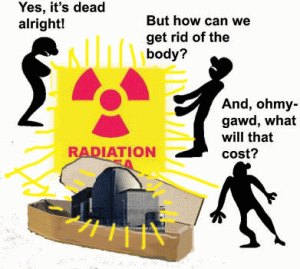 What’s next for Duane Arnold nuclear plant?, THe Gazette, 25 Sep 20, What’s next for Duane Arnold nuclear plant?, THe Gazette, 25 Sep 20,
Derecho damage prompts nuclear plant not to restart, Duane Arnold Energy Center near Palo did not restart after the Aug. 10 derecho caused “extensive” damage to its cooling towers…….. Why is it being decommissioned?
Dean Curtland, plant director, told The Gazette in 2018 Iowa’s changing energy landscape has overshadowed and outpriced Duane Arnold. Closing the facility could save NextEra about $300 million over 21 years, with cost savings coming as early as 2021. That translates to about $42 per residential customer. What impact did the derecho have on its decommissioning? NextEra Energy already was planning on decommissioning Duane Arnold this year. When the derecho caused “extensive” damage to the facility’s cooling towers, NextEra opted against restarting the plant so close to the Oct. 30 decommissioning date. Replacing the cooling towers with fewer than three months until decommissioning was “not feasible,” Robbins said last month. What is happening now that the plant is shut down? The decommissioning process is underway as employees remove nuclear material from the facility “There’s the nuclear fuel that was in the reactor and then nuclear fuel that was in a pool — what is called the spent fuel pool,” Robbins said. “We’ve been moving a lot of the fuel out of that pool and putting it in a storage facility on the site.” How long will the decommissioning process take? The process involves several steps, starting with removing nuclear material from the site. After nuclear material goes into the spent fuel pool, it can go into dry storage. After all the fuel is removed, officials have 60 years to decommission the facility………. Are there any other nuclear power plants in Iowa? Duane Arnold was the last nuclear power plant in the state. The closest nuclear power plant is in Cordova, Ill., about 20 miles northeast of Moline along the Mississippi River. Comments: (319) 398-8394; john.steppe@thegazette.com https://www.thegazette.com/subject/news/business/duane-arnold-energy-center-nuclear-plant-iowa-palo-ia-decommission-20200925 |
|
Small modular nuclear reactors for Canada? – useless, expensive, untested, and a wasteful distraction
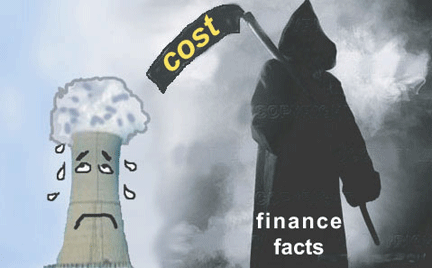 NB Media Co-op 22nd Sept 2020,Premier Blaine Higgs has endorsed so-called “small modular nuclear reactors” or SMRs. SMRs represent an untested technology but what we know on the basis of technical characteristics and historical precedent is that they will be expensive and any electricity they generate will not be economical. The nuclear industry is pushing small reactors because large reactors are simply not economical. Constructing nuclear plants is just too expensive—as Ontario’s government found out after its call in 2008 for bids to build two more reactors at the Darlington site.
https://nbmediacoop.org/2020/09/22/no-business-case-for-new-nuclear-reactors-in-new-brunswick/
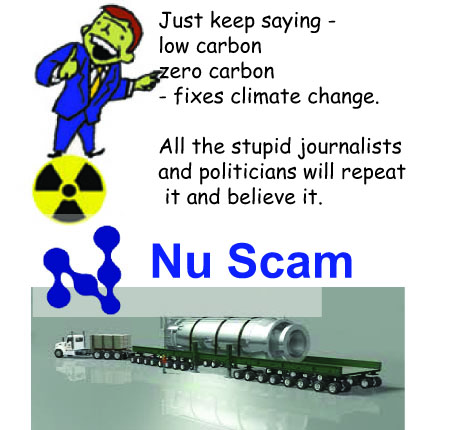 Sierra Club Canada (accessed) 23rd Sept 2020, No plan that gets us to net zero in a reasonable time frame includes new nuclear reactors. Nuclear is far too slow and expensive to deal with the climate emergency. Just like fossil fuel energy, nuclear produces wastes that pose unacceptable health hazards and economic costs.
Will Bears Ears Become the World’s Radioactive Waste Dump?
First, it was a multinational corporation with a factory in the Baltic nation of Estonia that sought to send its unwanted radioactive waste to southeast Utah. Now, another overseas entity, the Japan Atomic Energy Agency (JAEA), has its sights set on the White Mesa uranium mill for new radioactive waste shipments as well.
Is the White Mesa Mill, on the doorstep of the White Mesa Ute community and just outside the original boundaries of Bears Ears National Monument, on a fast track to become a dumping ground for foreign industrial polluters and distant government entities? Not if we have anything to say about it.
Why White Mesa?
Why, you may ask, is the White Mesa Mill so attractive for those in faraway lands who want to dispose of their radioactive waste? It’s simple, really. Sending the material to a uranium mill halfway around the world is expedient when compared to other options. It’s likely the cheapest option for the waste generator.
And this waste-processing business helps keep the struggling uranium mill afloat amid market downturns, too. Usually, the mill would pay miners for the uranium ore they deliver. In this case, it’s likely that the party sending the waste will pay the mill. On a recent investor call, the mill owner’s CEO admitted that accepting, processing, and disposing of these kinds of wastes earns the company $5-15 million a year.
What is this stuff?
In late May, the mill’s owner, Energy Fuels Resources, notified the state of Utah’s Division of Waste Management and Radiation Control that the company plans to receive 136 tons (about 10 dump trucks full) of radioactive waste from two Japan Atomic Energy Agency research facilities: the Ningyo Center and the Tono Center.
The material includes natural uranium ores from mines in Japan and other mines around the world that the Japanese agency tested, as well as uranium-loaded resins, filter-bed sands, and uranium-loaded carbon — materials that concentrate uranium during water cleanup at the two facilities.
The waste contains very little uranium. According to the mill owner, the company would produce less than 0.6 tons of yellowcake from the waste; the rest of the 136 tons would be dumped in massive waste pits at the mill that sit above the White Mesa Ute community’s drinking-water supply. The company likes to claim that it’s “recycling.” But charging millions to accept waste and ultimately dumping more than 99 percent of it into waste pits sounds like a radioactive waste dump, not a recycling operation.
When is the Japanese waste coming?
Energy Fuels Resources’ letter gives no dates as to when it plans to accept this waste, to be shipped from Japan across the Pacific Ocean, likely to ports in Washington state, then transferred to White Mesa by rail and truck across the Western United States. Utah regulators have evaluated the company’s proposal, and on July 28, 2020, they issued a letter concurring with the company’s plans.
This means you, the public, had no formal opportunity to weigh in. That’s why letting regulators know that you object to the Japanese waste is so important now.
No import license, no public involvement
Energy Fuels Resources claims, and the state of Utah agrees, that it doesn’t need an individual import license issued by the U.S. Nuclear Regulatory Commission to accept the Japanese radioactive waste. Nor, the company claims, does it need an amendment to its state-issued license, which would trigger a public comment period.
These claims are based on regulatory alchemy. Though the material is radioactive and is viewed as waste in Japan, the mill owner prefers to call the material “natural ores and equivalent feed materials” because those are the materials the company is licensed to accept for processing and permanent disposal at the mill. But we disagree.
We object to more international radioactive waste being shipped to the White Mesa Mill near the Ute Mountain Ute Tribe’s White Mesa Community. We also believe the public should be heard on this matter. That’s why we’re asking you to take action.
Act now. Let Utah regulators know that the White Mesa Mill is no place for foreign waste ›
History repeats itself
This isn’t the first time the Japanese government has shipped radioactive waste to the White Mesa Mill. In 2004, the Japanese Supreme Court ordered the removal of contaminated soils from the Ningyo-Toge area (one of the two sites that could ship waste now) based on pressure and litigation from those living nearby. Hefty fines were levied against the Japan Atomic Energy Agency for each day the waste remained on site past a court-imposed deadline. In 2005, the agency paid the then-owners of the White Mesa Mill $5.8 million to process uranium from and permanently dispose of 500 tons of contaminated soils.
The Salt Lake Tribune covered the story then, and it sounds much like the situation today. The Tribune noted that “reports from Japan often describe the contaminated soil as waste headed to Utah for disposal.” In 2005, as now, the owners of the mill claim the material is “ore,” not “waste,” and that no special licenses are required.
What’s changed since then? In 2010, the Nuclear Regulatory Commission clarified that an import license is required unless the “materials [are] imported solely for the purposes of recycling and not for waste management or disposal…” A 2003 paper on Ningyo and Tono cleanup plans states repeatedly that: “reclamation of uranium mining and milling facilities is necessary to reduce the burden of the waste management on future generations.”
Then, as now, shipping the waste to White Mesa shifts the burden to the White Mesa Ute community. These materials are clearly treated as waste in Japan, just as the Estonian material is treated as undesirable waste in Estonia. In Japan as in Estonia, the goal is disposal — far away. For that reason, we believe the mill’s owners need an import license from the Nuclear Regulatory Commission for this waste, and for the Estonian waste.
Join us in letting the state of Utah know you agree. White Mesa, the White Mesa Ute community, and Bears Ears cannot become the world’s radioactive dumping ground.
Bosnia and Herzegovina call for a safer location for Croatia’s nuclear waste dump plan
|
Turkovic in Vienna asks from Croatia to find a new Location for Nuclear Waste Disposal http://www.sarajevotimes.com/turkovic-in-vienna-asks-from-croatia-to-find-a-new-location-for-nuclear-waste-disposal/
SEPTEMBER 21, 2020 The Minister of Foreign Affairs of Bosnia and Herzegovina, Bisera Turkovic, spoke today in Vienna at the 64th General Assembly of the International Atomic Energy Agency (IAEA). She also spoke about Croatia’s plan to build nuclear waste dumps on Trgovska Gora.
“Due to the proposed nuclear waste in Trgovska Gora, in the neighboring state of Croatia, the lives of those living near the Una River are endangered. The location in Trgovska Gora is less than one kilometer from the border with BiH. Therefore, we are asking for the help of the European Union and the IAEA, in order to help our neighbor find a safe and suitable place for his nuclear waste, “said Turkovic. During his five-day visit to the Republic of Austria, Turkovic will hold a series of meetings with the country’s officials and representatives of several UN agencies based in Vienna and the OSCE, Report.ba reports. |
|
New Mexico is strongly objecting to licensing of Holtec’s multibillion-dollar nuclear waste dump plan
New Mexico objects to license for nuclear fuel storage plan, Madison.com , By SUSAN MONTOYA BRYAN Associated Press, 23 Sept 20
-
- ALBUQUERQUE, N.M. (AP) — The state of New Mexico is strongly objecting to federal nuclear regulators’ preliminary recommendation that a license be granted to build a multibillion-dollar storage facility for spent nuclear fuel from commercial power plants around the U.S.
State officials, in a letter submitted Tuesday to the Nuclear Regulatory Commission, said the site is geologically unsuitable and technical analysis has been inadequate so far. They also say regulators have failed to consider environmental justice concerns and have therefore fallen short of requirements spelled out by federal environmental laws.
The officials pointed to a legacy of contamination in New Mexico that includes uranium mining and milling and decades of nuclear research and bomb-making at national laboratories, saying minority and low-income populations already have suffered disproportionate health and environmental effects as a result.
A group of Democratic state lawmakers also raised concerns, sending separate comments to the commission that pointed to resolutions passed by a number of cities and counties in New Mexico and Texas that are opposed to building the facility.
Elected leaders in southeastern New Mexico support the project, saying it would bring jobs and revenue to the region and provide a temporary option for dealing with the spent fuel.
The deadline to comment on draft environmental review was Tuesday. A study on the project’s impact on human safety is pending and will require another round of public comment.
New Jersey-based Holtec is seeking a 40-year license to build what it has described as a state-of-the-art complex near Carlsbad. The first phase calls for storing up to 8,680 metric tons of uranium, which would be packed into 500 canisters. Future expansion could make room for as many as 10,000 canisters of spent nuclear fuel……. https://madison.com/news/national/govt-and-politics/new-mexico-objects-to-license-for-nuclear-fuel-storage-plan/article_f13be5d3-9381-57dd-aa21-b83915cb57c0.html
Japanese government dangles financial carrot to persuade reluctant communities to take nuclear wastess
 But there is no prospect for the establishment of such a recycling system which would allow for disposing only of the
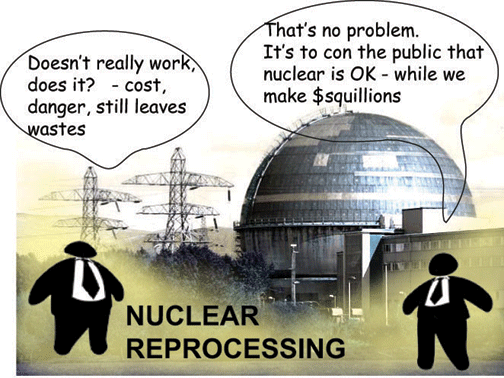 waste from reprocessing and recycling.
Eventually, Japan, like most other countries with nuclear power plants, will be forced to map out plans for “direct disposal,” or disposing of spent fuel from nuclear reactors in underground repositories.
Hokkaido Governor Suzuki has taken a dim view of the financial incentive offered to encourage local governments to apply for the first stage of the selection process, criticizing the proposed subsidies as “a wad of cash used as a powerful carrot.”
|
EDITORIAL: Much at stake in picking a final nuclear waste disposal site, http://www.asahi.com/ajw/articles/13749856 21 Sept 20, Two local communities in Hokkaido are considering pitching themselves as candidates for the site for final disposal of highly radioactive waste from nuclear power plants.Last month, the mayor of Suttsu in the northernmost main island said the municipal government is thinking to apply for the first stage of the three-stage process of selecting the site for the nation’s final repository for nuclear waste. During this period, past records about natural disasters and geological conditions for the candidate area are examined. Town authorities are holding meetings with local residents to explain its intentions. In Kamoenai, a village also in Hokkaido, the local chamber of commerce and industry submitted a petition to the local assembly to consider an application for the process. The issue was discussed at an assembly committee. However, the assembly decided to postpone making a decision after further discussion. Both communities are located close to the Tomari nuclear power plant operated by Hokkaido Electric Power Co. and struggling with common rural problems such as a dwindling population and industrial and economic stagnation. The law decrees that when the first stage of the selection process starts, the municipality that is picked will receive up to 2 billion yen ($19.1 million) in state subsidies for two years. But the Ministry of Economy, Trade and Industry and the Nuclear Waste Management Organization of Japan (NUMO), which are in charge of the selection process, have promised it will not move to the second stage if the prefectural governor or local mayor voices an objection. Hokkaido Governor Naomichi Suzuki has already expressed his opposition. A huge amount of spent nuclear fuel has been produced by nuclear plants in Japan, and it needs to be stored and disposed of somewhere in this country. This policy challenge requires a solid consensus among a broad range of people, including residents of cities who have been beneficiaries of electricity generated at nuclear plants. The two Hokkaido municipalities’ moves to consider applying for the first stage of the selection process should be taken as an opportunity for national debate on the issue. The first step should be to establish a system for local communities to discuss the issue thoroughly from a broad perspective. It is crucial to prevent bitter, acrimonious divisions in local communities between supporters and opponents. The central government and other parties involved need to provide whatever information is needed from a fair and neutral position to help create an environment for healthy, in-depth debate. There is also a crucial need to fix the problems with the current plan to build a final repository for radioactive waste. Under the plan, which is based on the assumption that a nuclear fuel recycling system will eventually be established, the repository will be used to store waste to be left after spent nuclear fuel is reprocessed to recover and recycle plutonium and uranium. But there is no prospect for the establishment of such a recycling system which would allow for disposing only of the waste from reprocessing and recycling. Eventually, Japan, like most other countries with nuclear power plants, will be forced to map out plans for “direct disposal,” or disposing of spent fuel from nuclear reactors in underground repositories. The central government has not changed its policy of maintaining nuclear power generation as a major power source. If nuclear reactors keep operating, they will continue producing spent fuel. The government will find it difficult to win local support for the planned repository unless it makes clear what kind of and how much radioactive material will be stored at the site. Many local governments are facing a fiscal crunch partly because of the impact of the COVID-19 pandemic. Hokkaido Governor Suzuki has taken a dim view of the financial incentive offered to encourage local governments to apply for the first stage of the selection process, criticizing the proposed subsidies as “a wad of cash used as a powerful carrot.” It takes tens of thousands of years for the radioactivity of spent nuclear fuel to decline to sufficiently safe levels. Trying to stem local opposition by dangling temporary subsidies could create a serious problem for the future in the communities. It is vital to ensure that the repository plan will secure a long-term policy commitment to the development of the local communities and ensure benefits for the entire areas. September 22, 2020 |
|
Inadequate testing of Hinkley mud being dumped off Cardiff
testing of the sediment from the construction of Somerset’s Hinkley C
nuclear power station. EDF Energy has applied to dispose of the sediment in
the sea two miles from the South Wales coast.
without an agreed sample plan between them and NRW. But the Welsh
Government’s environmental watchdog has now backed those proposals.
and organisations opposing the dump had informed NRW that EDF’s sampling
plan does not meet international requirements set by OSPAR (Oslo-Paris
Convention for the Protection of the Marine Environment of the North-East
Atlantic), that there are too few samples in the cores collected by EDF and
the testing does not use procedures to detect the nuclear fuel
microparticles uranium and plutonium.
sampling is insufficient to meet the prerequisites of the Environment
(Wales) Act, 2016 and the Well-being of Future Generations Act, 2015. The
Environment (Wales) Act stipulates that wide consultation is always
required in light of uncertainties.
https://nation.cymru/news/national-resources-wales-under-fire-over-hinkley-point-mud-sampling-plan/
 |
ReplyForward
|
Nuclear waste transport , and legal action – UK
Due to numerous safety issues with storage of high-level waste at Biblis, the BUND Hessen has filed a lawsuit saying it will take legal action against the now reinstated transport licence. With last Sunday’s local German elections in North Rhine-Westphalia, the Greens achieved a record result with 20% and there will be green mayors in the former capital Bonn, Münster and the anti-nuclear stronghold Aachen.
http://www.no2nuclearpower.org.uk/wp/wp-content/uploads/2020/09/Plain-sailing.docx
1 This Month

of the week – Shut Down Drone Warfare!


Tell the Ukrainian Government to Drop Prosecution of Peace Activist Yurii Sheliazhenko

Petition to revoke the licensing of the Near Surface Nuclear Disposal Facility (NSDF) at Chalk River. https://www.ourcommons.ca/petitions/en/Petition/Details?Petition=e-7247
To see nuclear-related stories in greater depth and intensity – go to https://nuclearinformation.wordpress.com
-
Archives
- April 2026 (103)
- March 2026 (251)
- February 2026 (268)
- January 2026 (308)
- December 2025 (358)
- November 2025 (359)
- October 2025 (376)
- September 2025 (257)
- August 2025 (319)
- July 2025 (230)
- June 2025 (348)
- May 2025 (261)
-
Categories
- 1
- 1 NUCLEAR ISSUES
- business and costs
- climate change
- culture and arts
- ENERGY
- environment
- health
- history
- indigenous issues
- Legal
- marketing of nuclear
- media
- opposition to nuclear
- PERSONAL STORIES
- politics
- politics international
- Religion and ethics
- safety
- secrets,lies and civil liberties
- spinbuster
- technology
- Uranium
- wastes
- weapons and war
- Women
- 2 WORLD
- ACTION
- AFRICA
- Atrocities
- AUSTRALIA
- Christina's notes
- Christina's themes
- culture and arts
- Events
- Fuk 2022
- Fuk 2023
- Fukushima 2017
- Fukushima 2018
- fukushima 2019
- Fukushima 2020
- Fukushima 2021
- general
- global warming
- Humour (God we need it)
- Nuclear
- RARE EARTHS
- Reference
- resources – print
- Resources -audiovicual
- Weekly Newsletter
- World
- World Nuclear
- YouTube
-
RSS
Entries RSS
Comments RSS
 nuclear-news