The danger of Japan dumping Fukushima wastewater into the ocean
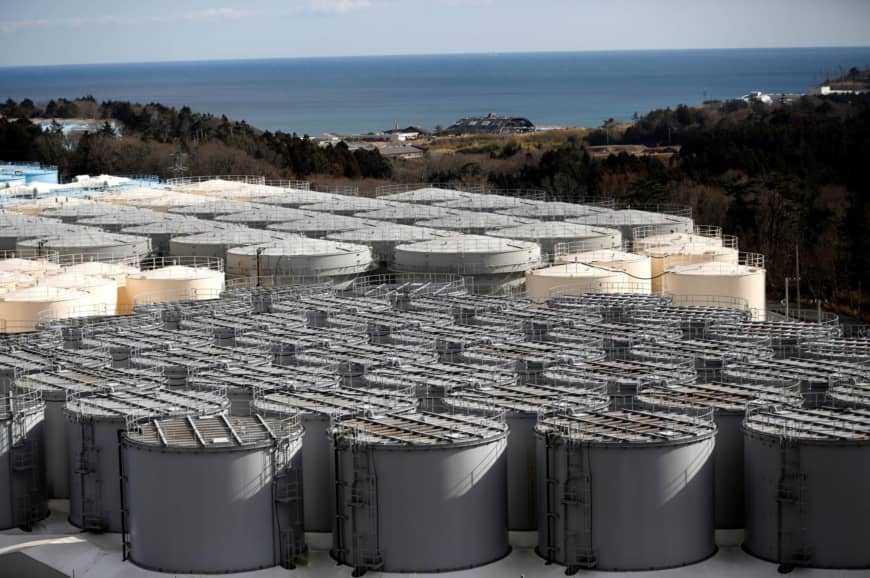
The danger of Japan dumping Fukushima wastewater into the ocean, https://thehill.com/opinion/energy-environment/548726-the-danger-of-japan-dumping-fukushima-wastewater-into-the-ocean
BY RICK STEINER,— 04/17/21 The Japanese government just announced that it intends to release over 1.2 million tons of radioactive wastewater from the Fukushima Nuclear Power Plant into the North Pacific. This would result in dangerous radionuclides flowing across the ocean to Russia, Alaska, Canada, Hawaii and the U.S. West Coast. The release of this material — which is strongly opposed by local scientists and residents in Japan — would begin in two years and continue for another 40 years.
The Biden administration must urge Japan to abandon this unnecessary and dangerous plan.
The 2011 Fukushima nuclear disaster was caused by the 9.1 magnitude Tohoku earthquake and a 14-meter-high tsunami. The tsunami flooded and disabled emergency generators needed to pump cooling water into the nuclear reactor cores, causing three reactor core meltdowns and hydrogen explosions. Radionuclides flowed eastward across the Pacific and were eventually found in waters off California, Hawaii, Oregon, Washington, British Columbia and Alaska. We all live downstream.
The storage tanks now hold seawater that has been used to continue cooling the reactor cores, and this water is contaminated with such radionuclides as Cesium-137, Carbon-14, tritium (including the more dangerous “Organically Bound Tritium”), Strontium-90, Cobalt-60, Iodine-129, Plutonium-239 — and over 50 other radionuclides. Some of this has reportedly been removed, but some has not (e.g. radioactive tritium and C-14).
The Tokyo Electric Power Company (TEPCO) that owns Fukushima, and is now responsible for the cleanup (that is likely to last the remainder of this century), didn’t admit until recently that the wastewater contains significant amounts of radioactive Carbon-14. As C-14 has a half-life of 5,730 years, and is known to bio-accumulate in marine ecosystems and cause cellular and genetic impairment. This is a very serious concern.
Fukushima C-14 will be added to the already elevated radioactive C-14 load in the oceans from nuclear weapons tests — or “bomb carbon” — last century. It’s now found in organisms even in the deepest part of the ocean, the Marianas Trench. It is easy to imagine the impact this new, intentional Fukushima release could have, rightly or not, on the public image of clean marine seafood and tourism along the Pacific coast.
TEPCO claims the water has been sufficiently treated and is OK to release, but the treatment system they are using is reported to be substandard and not up to the job. Communities across the Pacific deserve an independent scientific assessment of TEPCO’s claims, by an Independent Scientific and Technical Commission. Remember, TEPCO and the Japanese government approved locating the nuclear power plant’s emergency generators in a tsunami flood zone. Their assurances now that there is no risk in releasing this radioactive water are neither credible nor scientifically defensible.
China and South Korea have registered objections to the release plan with Japan, but other downstream nations — the U.S., Russia and Canada — have stayed quiet. It isn’t often that China expresses more concern for the environment than the U.S., but this is one such time.
And even if the ecological and public health risk from the planned release is indeed low, as claimed (this is highly doubtful), the risk is entirely unnecessary and avoidable.
Beyond marine discharge, several other disposal options have been considered, including evaporating the water, or injecting it into deep geologic formations.
But by far the best solution is for TEPCO to build more storage tanks and continue holding all contaminated water for another 15 years or so, during which time the radioactive tritium level will decay by half, and simultaneously treat it with best available technology (such as ion exchange systems and modular “detritiation” systems in the U.S.) to remove all radionuclides possible.
Japan and TEPCO considered this long-term storage option, but opted instead for the cheapest choice — simply dumping the wastewater into the Pacific.
The era of intentionally dumping toxic waste in our one global ocean is, or should be, over.
Fukushima was, and continues to be, a nuclear nightmare, and all nations should join together in a collaborative effort to resolve this mess. This effort will take hundreds of billions of dollars, over many decades, and the U.S. and other G20 nations must step up and help both financially and technically.
Unless and until this wastewater is independently certified as effectively free of radionuclides and safe, not one drop should be released into the beautiful deep blue Pacific.
Finally, Fukushima should be the last nail in the coffin for the notion that nuclear fission power could be a realistic solution to our climate crisis.
Rick Steiner is a marine conservation biologist in Anchorage and former professor of marine conservation with the University of Alaska from 1980-2010. He now consults for the U.N., governments and NGOs on marine environmental issues. He is author of “Oasis Earth: Planet in Peril.”
In Ontario, opponents of nuclear waste disposal join forces
Opponents of nuclear waste disposal join forces https://www.tbnewswatch.com/local-news/opponents-of-nuclear-waste-disposal-join-forces-3644864 ‘Ignace should not get to decide’ whether to accept a storage site, a spokesperson says.
By: Gary Rinne 19 Apr 21, KENORA, Ont. — Thirty thousand households and businesses in Northwestern Ontario are receiving postcards from a group of organizations opposed to nuclear waste disposal in Northwestern Ontario.
We the Nuclear Free North calls itself an alliance of Indigenous and non-Indigenous volunteers and organizations who believe the risks of transporting and burying nuclear waste are too high.
It’s delivering information cards outlining its concerns to residents living between Upsala and the Manitoba border.
The Nuclear Waste Management Organization has identified the Revell Lake area, about 35 kilometres from Ignace, as a candidate site for an underground repository, and is continuing to conduct studies in the area.
NWMO is also still looking at a site in Bruce County in southern Ontario.
We the Nuclear Free North says it has launched a website to provide information about the project from sources that are independent of the nuclear power companies that generate and own Canada’s nuclear waste.
It says NWMO is proposing to send multiple truckloads of highly radioactive waste to its selected site “every day for at least 40 years.”
Spokesperson Fred Melanson, who served on Ear Falls council when that community was being studied for nuclear waste disposal, said “This is not the kind of development the people of Northwestern Ontario want. Burying nuclear waste is a high-risk experiment.”
Although NWMO has developed a working relationship with the Township of Ignace during the study process, Environment North representative Dodie LeGassick said “This is not an issue for one community. It is an issue for the entire region.”
LeGassick said “Ignace should not get to decide whether 22,000 trucks hauling radioactive waste drive through Nipigon and through Shuniah Township and all of the other many communities along the route.”
On its website, the alliance – which includes Environment North and Northwatch – also notes that the United Nations Declaration on the Rights of Indigenous Peoples requires that states “take effective measures to ensure that no storage or disposal of hazardous materials shall take place in the lands or territories of indigenous peoples without their free, prior and informed consent.”
Peter White, an elder with Grand Council Treaty # 3’s Ki’ieshgitabaaning Cultural and Healing Lodge said “The lives of our children and future generations are too precious to be used as a nuclear experiment and should not have this burden put on their shoulders.”
NWMO intends to make a final decision on the location of the underground storage site in 2023.
U.N. experts concerned at Japan’s decision to dump Fukushima nuclear waste-water into the Paific.

UN Experts Decry Japan’s Plan to Dump Radioactive Fukushima Wastewater Into Ocean, https://www.commondreams.org/news/2021/04/16/un-experts-decry-japans-plan-dump-radioactive-fukushima-wastewater-ocean?utm_campaign=shareaholic&utm_medium=Social&utm_source=facebook&fbclid=IwAR2W9TNN5pZWTgQjFhnnd_99e_F3cH4y7uPJggM1row-iqAzbRtoZvj2tvM
The decision is particularly disappointing as experts believe alternative solutions to the problem are available,” said the three special rapporteurs.by Brett Wilkins, staff writer 18 Apr 21, A trio of United Nations experts on Thursday added their voices to the chorus of concern over the Japanese government’s decision to dump hundreds of millions of gallons of radioactive wastewater from the Fukushima Daiichi Nuclear Power Plant into the Pacific Ocean, saying the move threatens not only the environment but also the human rights of people in and beyond Japan.
Japanese officials announced earlier this week that 1.25 million tonnes of treated radioactive water from the deactivated nuclear plant—which in March 2011 suffered major damage from a magnitude 9.0 earthquake and subsequent tsunami—would be discharged into the sea starting in about two years. Prime Minister Suga Yoshihide called the planned release “a realistic solution.”
However, anti-nuclear campaigners joined Japan’s neighbors China and South Korea in condemning the decision, with Greenpeace saying that it “completely disregards the human rights and interests of the people in Fukushima, wider Japan, and the Asia-Pacific region.”
Marcos Orellana, Michael Fakhri, and David Boyd—respectively the U.N.’s special rapporteurs on toxics and human rights, the right to food, and human rights and the environment—weighed in on the issue Thursday with a joint statement calling Tokyo’s decision “very concerning.”
“The release of one million tonnes of contaminated water into the marine environment imposes considerable risks to the full enjoyment of human rights of concerned populations in and beyond the borders of Japan,” they said, adding that “the decision is particularly disappointing as experts believe alternative solutions to the problem are available.”
Critics say other options for disposing of the the water, including evaporating and then releasing it into the air, were not fully considered, although nuclear experts stress that evaporation would not isolate radioactivity.
Japanese officials claim that levels of radioactive tritium are low enough to pose no threat to human health. However, scientists and other experts warn that the isotope bonds with other molecules in water and can make their way up the food chain to humans.
Cindy Folkers, radiation and health hazards specialist at the advocacy group Beyond Nuclear, said in a statement Wednesday that Fukushima Daiichi operator Tokyo Electric Power Company (TEPCO) “wants us to believe that the radioactive contamination in this water will be diluted in the ocean waters, but some of the radioactive isotopes will concentrate up the food chain in ocean life.”
“Some of the contamination may not travel out to sea and can double back on itself,” said Folkers. “Dilution doesn’t work for radioactive isotopes, particularly tritium, which research shows can travel upstream.”
“TEPCO data show that even twice-through filtration leaves the water 13.7 times more concentrated with hazardous tritium—radioactive hydrogen—than Japan’s allowable standard for ocean dumping, and about one million times higher than the concentration of natural tritium in Earth’s surface waters,” she added.
Japanese officials did reverse one highly controversial policy related to the wastewater dump this week. Amid intense public backlash, the government hastily retired Little Mr. Tritium, an animated radioactive mascot meant to promote and popularize the discharge.

“Some of the contamination may not travel out to sea and can double back on itself,” said Folkers. “Dilution doesn’t work for radioactive isotopes, particularly tritium, which research shows can travel upstream.”
“TEPCO data show that even twice-through filtration leaves the water 13.7 times more concentrated with hazardous tritium—radioactive hydrogen—than Japan’s allowable standard for ocean dumping, and about one million times higher than the concentration of natural tritium in Earth’s surface waters,” she added.
Japanese officials did reverse one highly controversial policy related to the wastewater dump this week. Amid intense public backlash, the government hastily retired Little Mr. Tritium, an animated radioactive mascot meant to promote and popularize the discharge.
“It seems the government’s desire to release the water into the sea takes priority over everything,” Katsuo Watanabe, an 82-year-old fisher from Fukushima, told Kyodo News. “We fisherman can’t understand it.”
South Korea raises with USA its worries about Fukushima water to be dumped into the Pacific Ocean

South Korea raises Fukushima concerns with U.S,
Yahoo News, April 18, 2021 As U.S. climate envoy John Kerry appeared in Seoul over the weekend to discuss global warming,
South Korea’s foreign ministry says it raised concerns to him over Japan’s plans to dump contaminated water from its defunct Fukushima nuclear plant into the sea…….
Under the plan, more than 1 million tonnes of water will be discharged from the plant, the site of the world’s worst nuclear disaster since Chernobyl.
Seoul has strongly rebuked the decision……
Kerry’s visit to Seoul precedes U.S. President Joe Biden’s virtual summit with world leaders on climate change, set for two days starting April 22. https://news.yahoo.com/south-korea-raises-fukushima-concerns-080908571.html
PNM Resources to replace its Palo Verde nuclear energy with 100% solar and battery
Sierra Club 16th April 2021, After announcing it would drop one of its leases in the Palo Verde Nuclear plant last year, this month PNM proposed replacing the energy with 100% solar and battery. In support of its proposal, PNM cited the Energy Transition Act’s requirements and the Public Regulation Commission’s decision last year to choose a 100% solar/storage proposalrather PNM’s favored gas-inclusive replacement scenario for San Juan Generating Station coal. The replacement proposal will need to be approved by the commission. In selecting carbon emission-free generation to replace Palo Verde, PNM states in testimony it has taken into consideration “the state’s energy transition policies and long-term mandate for a carbon emission-free generation portfolio.” While we have yet to delve into all of the details of PNM’s application, this is very encouraging and we look forward to supporting PNM’s request for prompt approval of replacement resources. https://www.krwg.org/post/pnm-cites-eta-proposing-100-solar-and-storage-replace-nuclear |
A new plan for disposing of nuclear waste at USA’s Waste Isolation Pilot Plant
Carlsbad Current Argus 14th April 2021, A plan to build two new areas to dispose of nuclear waste began taking
shape at the Waste Isolation Pilot Plant after the U.S. Department of Energy published a report on the feasibility of adding an 11th and 12th waste panel to the underground nuclear waste repository.
At WIPP, low-level transuranic (TRU) waste made up of equipment and materials radiated during nuclear activities is permanently emplaced in an underground salt deposit more than 2,000 feet underground. In its original design, WIPP was planned to have eight panels for such disposal, but much of that space wasrestricted and abandoned following an accidental radiological release in2014 that contaminated parts of the underground and led to a three-year
pause of WIPP’s emplacement operations.
Nuclear power combined with nuclear weapons – confronts Britain with an intractable problem.
Electrical Review 14th April 2021, Nuclear waste has been an intractable problem ever since nuclear power was
developed over 60 years ago. It has become a very expensive and politically embarrassing issue all around the world.
Not that the Johnson Government would admit this. Many in it still argue that nuclear power is the answer
to climate change, conveniently forgetting that they are passing the waste buck onto future generations. To those in power, the solution to the waste problem is always just around the corner, to be resolved just beyond their term of office.
But the history of nuclear over the last six decades, across the globe, is of dozens of failed schemes. Currently the UK is
undertaking its sixth search in 42 years for a nuclear waste dump site. Yet again wrestling with the problem of years of public consultations, planning inquiries and geological investigations, only to be finally rejected, even as scientists warn that continued neglect of the issue is placing citizens in increasing danger.
The problem is that civil nuclear industries, especially when, as in Britain, they are combined with a weapons programme, produce plutonium and other by-products in spent fuel that take as long as 100,000 years to decay. International law requires the country that produced the waste to dispose of it within its own boundaries. Identifying
somewhere to put this waste, where they could be safe for that length of time, requires stable geological formations that are very hard to find anywhere.
Nuclear power’s waste problem complicates it as a green energy solution
The US Energy Department’s renewed promotion of plutonium-fueled reactors.

Plutonium programs in East Asia and Idaho will challenge the Biden administration, Bulletin of the Atomic Scientists, By Frank N. von Hippel | April 12, 2021 ”’…………. The US Energy Department’s renewed promotion of plutonium-fueled reactors. The US plutonium breeder reactor development program was ended by Congress in 1983. A decade later, the Clinton Administration shut down the Idaho National Laboratory’s Experimental Breeder Reactor II for lack of mission. At the time, I was working in the White House and supported that decision.

The nuclear-energy divisions at the Energy Department’s Argonne and Idaho National Laboratories refused to give up, however. They continued to produce articles promoting sodium-cooled reactors and laboratory studies on “pyroprocessing,” a small-scale technology used to separate plutonium from the fuel of the Experimental Breeder Reactor II .
During the Trump administration, this low-level effort broke out. With the Energy Department’s Office of Nuclear Energy headed by a former Idaho National Lab staffer and help from Idaho’s two Senators, the Energy Department and Congress were persuaded to approve the first steps toward construction at the Idaho National Laboratory of a larger version of the decommissioned Experimental Breeder Reactor II.
The new reactor, misleadingly labeled the “Versatile Test Reactor,” would be built by Bechtel with design support by GE-Hitachi and Bill Gates’ Terrapower. The Energy Department awarded contracts to the Battelle Energy Alliance and to university nuclear-engineering departments in Indiana, Massachusetts, Michigan, and Oregon to develop proposals for how to use the Versatile Test Reactor.

The current estimated cost of the Versatile Test Reactor is $2.6-5.8 billion, and it is to be fueled with plutonium. The Idaho National Laboratory’s hope is to convince Congress to commit to funding its construction in 2021.
The Energy Department also committed $80 million to co-fund the construction of a 345-megawatt-electric (MWe) “Natrium” (Latin for sodium) demonstration liquid-sodium-cooled power reactor proposed by GE-Hitachi and Terrapower which it hopes Congress would increase to $1.6 billion. It also committed $25 million each to Advanced Reactor Concepts and General Atomics to design small sodium-cooled reactors. And it has subsidized Oklo, a $25-million startup company financed by the Koch family, to construct a 1.5 MWe “microreactor” on the Idaho National Laboratory’s site to demonstrate an extravagantly costly power source for remote regions.
In all these reactors, the chain reaction would be sustained by fast neutrons unlike the slow neutrons that sustain the chain reactions in water-cooled reactors. The Energy Department’s Office of Nuclear Energy has justified the need for the Versatile Test Reactor by the fast-neutron reactors whose construction it is supporting. In this way, it has “bootstraping” the Versatile Test Reactor by creating a need for it that would not otherwise exist.
This program also is undermining US nonproliferation policy..………..https://thebulletin.org/2021/04/plutonium-programs-in-east-asia-and-idaho-will-challenge-the-biden-administration/?utm_source=Newsletter&utm_medium=Email&utm_campaign=MondayNewsletter04122021&utm_content=NuclearRisk_EastAsia_04122021
Japan’s hugely costly nuclear reprocessing program.

Plutonium programs in East Asia and Idaho will challenge the Biden administration, Bulletin of the Atomic Scientists, By Frank N. von Hippel | April 12, 2021, ”………………Japan’s hugely costly reprocessing program. The United States has been trying to persuade Japan to abandon reprocessing ever since 1977. At the time, then prime minister Takeo Fukuda described plutonium breeder reactors as a matter of “life and death” for Japan’s energy future and steamrolled the Carter administration into accepting the startup of Japan’s pilot reprocessing plant. Today, Japan is the only non-nuclear-armed state that separates plutonium. Despite the absence of any economic or environmental justification, the policy grinds ahead due to a combination of bureaucratic commitments and the dependence of a rural region on the jobs and tax income associated with the hugely costly program. The dynamics are similar to those that have kept the three huge US nuclear-weapon laboratories flourishing despite the end of the Cold War.
For three decades, Japan has been building, fixing mistakes, and making safety upgrades on a large plutonium recycle complex in Rokkasho Village in the poor prefecture of Aomori on the northern tip of the main island, Honshu. The capital cost of the complex has climbed to $30 billion. Operation of the reprocessing plant is currently planned for 2023.
A facility for fabricating the recovered plutonium into mixed-oxide plutonium-uranium fuel for water-cooled power reactors is under construction on the same site (Figure 3 on original). The cost of operating the complex is projected to average about $3 billion per year. Over the 40-year design life of the plant, it is expected to process about 300 tons of plutonium—enough to make 40,000 Nagasaki bombs. What could possibly go wrong?
Japan’s Atomic Energy Commission reports that, because of the failures and delays of its plutonium useage programs, as of the end of 2019, Japan owned a stock of 45.5 tons of separated plutonium: 9.9 tons in Japan with the remainder in France and the United Kingdom where Japan sent thousands of tons of spent fuel during the 1990s to be reprocessed.
Both the Obama and Trump administrations pressed Tokyo to revise its reprocessing policy, especially after Japan’s decision to decommission its failed prototype breeder reactor in 2016.
Perhaps in response to this pressure, in 2018, Japan’s cabinet declared:
“The Japanese government remains committed to the policy of not possessing plutonium without specific purposes on the premise of peaceful use of plutonium and work[s] to reduce of the size of [its] plutonium stockpile.”
A step toward reductions that is being discussed would be for Japan to pay the United Kingdom to take title to and dispose of the 22 tons of Japanese plutonium stranded there after the UK mixed-oxide fuel fabrication plant was found to be inoperable. Japan’s separated plutonium in France is slowly being returned to Japan in mixed-oxide fuel for use in reactors licensed to use such fuel.
If, as currently planned, Japan operates the Rokkasho Reprocessing Plant at its design capacity of more than seven tons of plutonium separated per year, however, its rate of plutonium separation will greatly exceed Japan’s rate of plutonium use. Four of Japan’s currently operating reactors are licensed to use mixed-oxide fuel but loaded only 40 percent as much mixed-oxide fuel as planned in 2018-19 and none in 2020. Two more reactors that can use mixed-oxide are expected to receive permission to restart in the next few years. In 2010, Japan’s Federation of Electric Power Companies projected that the six reactors would use 2.6 tons of plutonium per year. If the much-delayed Ohma reactor, which is under construction and designed to be able to use a full core of mixed-oxide fuel, comes into operation in 2028 as currently planned, and all these reactors use as much mixed-oxide fuel as possible, Japan’s plutonium usage rate would still ramp up to only 4.3 tons per year in 2033. (At the end of 2020 the Federation of Electric Power Companies announced its hope to increase the number of mixed-oxide-using reactors to 12 by 2030 but did not list the five additional reactors, saying only, “we will release it as soon as it is ready.”)
As of June 2020, construction at Rokkasho on the mixed-oxide fuel fabrication facility that will process the plutonium separated by the Rokkasho Reprocessing Plant was only 12 percent complete. It was still just a hole in the ground containing some concrete work with its likely completion years behind the currently planned 2023 operation date of the reprocessing plant.
Thus, as happened in Russia and the United Kingdom, the Rokkasho Reprocessing Plant could operate indefinitely separating plutonium without the mixed-oxide plant operating. The reprocessing plant includes storage for “working stocks” containing up to 30 tons of unirradiated plutonium. If and when it begins operating, the mixed-oxide fuel fabrication plant will itself have additional working stocks of at least several tons of plutonium. Therefore, even if Japan transfers title to the plutonium it has stranded in the United Kingdom and manages to work down its stock in France, the growth of its stock in Japan could offset those reductions.
The Biden administration should urge Japan’s government to “bite the bullet” and begin the painful but necessary process of unwinding its costly and dangerous plutonium program. A first step would be to change Japan’s radioactive waste law to allow its nuclear utilities to use the planned national deep repository for direct disposal of their spent fuel.
In the meantime, most of Japan’s spent fuel will have to be stored on site in dry casks, as has become standard practice in the United States and most other countries with nuclear power reactors. Because of its safety advantages relative to storage in dense-packed pools, the communities that host Japan’s nuclear power plant are moving toward acceptance of dry-cask storage. During the 2011 Fukushima accident, the water in a dense-packed pool became dangerously low. Had the spent fuel been uncovered and caught on fire, the population requiring relocation could have been ten to hundreds of times larger ………….https://thebulletin.org/2021/04/plutonium-programs-in-east-asia-and-idaho-will-challenge-the-biden-administration/?utm_source=Newsletter&utm_medium=Email&utm_campaign=MondayNewsletter04122021&utm_content=NuclearRisk_EastAsia_04122021
The problem of plutonium programs
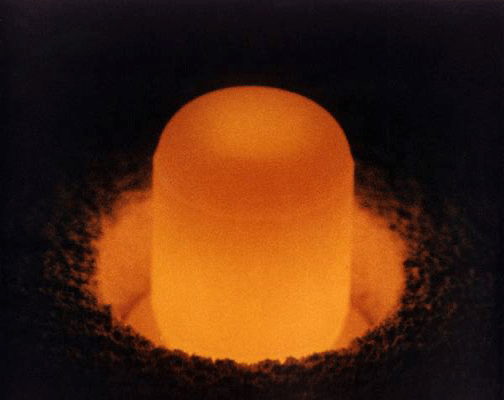
Plutonium programs in East Asia and Idaho will challenge the Biden administration, Bulletin of the Atomic Scientists, By Frank N. von Hippel | April 12, 2021 Among the Biden administration’s nuclear challenges are ongoing civilian plutonium programs in China and Japan. Also, South Korea’s nuclear-energy research and development establishment has been asserting that it should have the same “right” to have a plutonium program as Japan. These challenges have been compounded by a renewed push by the Energy Department’s Idaho National Laboratory to revive a plutonium program that was shut down in the 1980s. These foreign and domestic plutonium programs are all challenges because plutonium is a nuclear-weapon material.
Henry Kissinger’s State Department quickly discovered that the governments of Brazil, Pakistan, South Korea, and Taiwan—all under military control at the time—had contracted for French or German spent-fuel “reprocessing” plants. The United States intervened forcefully and none of these contracts were fully consummated…………………..
…………….A possible path forward. During the Trump administration, the Energy Department fell back into the never-never land of plutonium-fueled reactors from which the United States extracted itself in the 1980s. Fortunately, the big-dollar commitments to the Versatile Test Reactor and the Natrium Reactor have not yet been made, and the Biden administration could use the excuse of budget stringency not to make those commitments.
In South Korea, the Biden administration will have to deal with the completion of the Idaho National Lab–Korea Atomic Energy Research Institute Joint Fuel Cycle Study. Although there will no doubt be obfuscation in the report, the conclusions of the 10-year study should have been obvious from the beginning: reprocessing is hugely costly, creates proliferation risks, and complicates spent fuel disposal. Fortunately, the anti-nuclear-energy Moon administration is unlikely to push for reprocessing. It will be much more interested in the opportunities that the Biden administration can provide to advance the Korean Peninsula denuclearization agenda. It should therefore be politically relatively easy for the Biden Administration to terminate cooperation on pyroprocessing.
China’s reprocessing and fast-neutron reactor program may be driven in part by China’s interest in obtaining more weapon-grade plutonium to build up the size of its nuclear arsenal. If that is the case, China’s incentive to build up could be reduced through nuclear arms control. Specifically, if China is building up its nuclear arsenal out of concern about the adequacy of its nuclear deterrent in the face of an unconstrained US missile-defense buildup, then the United States could examine the possibility of an agreement to limit missile defenses as an alternative to an open-ended, offense-defense arms race. That was the path of wisdom that the United States and Soviet Union chose with their 1972 Anti-Ballistic Missile Treaty.
In Japan, the Biden administration will be faced with the continued unwillingness of the powerful Ministry of Economics, Trade, and Industry to wind down Japan’s dysfunctional plutonium program. But, if a linkage could be made between constraining China’s nuclear buildup and ending Japan’s hugely costly reprocessing program, that might help tip the balance in Japan’s internal debate over reprocessing. https://thebulletin.org/2021/04/plutonium-programs-in-east-asia-and-idaho-will-challenge-the-biden-administration/?utm_source=Newsletter&utm_medium=Email&utm_campaign=MondayNewsletter04122021&utm_content=NuclearRisk_EastAsia_04122021
The United States collaborates on nuclear pyroprocessing with South Korea.

Plutonium programs in East Asia and Idaho will challenge the Biden administration, Bulletin of the Atomic Scientists, By Frank N. von Hippel | April 12, 2021, ”…………………………………The United States collaborates on pyroprocessing with South Korea. The Idaho and Argonne National Laboratories also continue to promote the pyroprocessing of spent fuel. After the Clinton Administration shut down the Experimental Breeder Reactor II in 1994, the laboratory persuaded the Energy Department to continue to fund pyroprocessing as a way to process Experimental Breeder Reactor II spent fuel and blanket assemblies into stable waste forms for disposal in a deep underground repository. The proposal was to complete this effort in 2007. According to a review by Edwin Lyman of the Union of Concerned Scientists, however, as of the end of Fiscal Year 2016, only about 18 percent of the roughly 26 metric tons of assemblies had been processed at a cost of over $200 million into waste forms that are not stable. (Since then, an additional three percent has been processed.)
During the George W. Bush administration, Vice President Cheney accepted Argonne’s argument that pyroprocessing is “proliferation resistant” and the two US national laboratories were allowed to share the technology with the Korea Atomic Energy Research Institute.
At the beginning of the Obama administration, however, a group of safeguards experts from six Energy Department national laboratories, including Argonne and Idaho, concluded that pyroprocessing is not significantly more resistant to proliferation than PUREX, the standard reprocessing technology originally developed by the United States to extract plutonium for its weapons.

In 2014, the US-Republic of Korea Agreement for Cooperation on the Peaceful Uses of Atomic Energy was due to expire, but the negotiations on a successor agreement bogged down over Korea’s insistence that the new agreement include the same right to reprocess spent fuel as the 1988 US-Japan Agreement for Cooperation.
The compromise reached the following year was that the Korea Atomic Energy Research Institute and the Idaho National Laboratory would complete their Joint Fuel Cycle Study on “the technical, economic, and nonproliferation (including safeguards) aspects of spent fuel management and disposition technologies.” If the United States could be convinced that the proliferation risks of pyroprocessing were manageable, the secretary of energy would give consent for South Korea to use the technology on its territory. The final report from the joint study is due this year.
Meanwhile, in 2017, Moon Jae-in was elected president of the Republic of Korea on a platform that included not building any more nuclear power plants in South Korea. Fast-neutron reactors and pyroprocessing obviously do not fit with that policy. This gives the Biden administration an opportunity to end a cooperative nuclear-energy research and development program that is contrary to both US nuclear nonproliferation policy and South Korea’s energy policy. The United States could propose instead a joint collaborative program on safe spent fuel storage and deep underground disposal……………https://thebulletin.org/2021/04/plutonium-programs-in-east-asia-and-idaho-will-challenge-the-biden-administration/?utm_source=Newsletter&utm_medium=Email&utm_campaign=MondayNewsletter04122021&utm_content=NuclearRisk_EastAsia_04122021
China’s ambiguous plutonium policy.

Plutonium programs in East Asia and Idaho will challenge the Biden administration, Bulletin of the Atomic Scientists, By Frank N. von Hippel | April 12, 2021 ”…………………….China’s ambiguous plutonium policy. China is estimated to have produced between 2.3 and 3.5 tons of weapon-grade plutonium before it halted production in 1988. China is also estimated to have doubled the number of its nuclear warheads since the end of the Cold War to about 300, with a public call from one government-owned journal for a further increase to 1000.
That would require more weapon-grade plutonium.
China is, in fact, building a “demonstration” reprocessing plant and two plutonium breeder reactors. Breeder reactors produce weapon-grade plutonium in the uranium “blankets” surrounding their cores. This plutonium ordinarily would be mixed in with the non-weapon-grade plutonium recovered from the core and recycled into new fuel, but could be kept separate and used for weapons.
One troubling development that suggests that China may be reconsidering the civilian character of its plutonium program is that, since 2017, it has halted making the public annual declarations to the International Atomic Energy Agency of its civilian plutonium stocks required by the Guidelines for the Management of Plutonium. China was one of nine countries, including France and the United States, that committed to make those declarations starting in 1997. An International Atomic Energy Agency official has informed me that that the agency “does not request those member states to submit updates and has no role in connection with the implementation of these voluntary commitments.” One of the other states that are parties to the guidelines could, however, ask China why it has stopped submitting updates.
China’s National Nuclear Corporation has been negotiating since 2007 with France’s Orano to purchase technology for a large reprocessing plant like Japan’s that could separate up to eight tons of reactor-grade but weapon-usable plutonium per year. France’s finance minister said in 2018 that the sale could “save” France’s nuclear industry.
Unless the economic competitiveness of breeder reactors proves to be better in China than elsewhere, however, the rate of plutonium separation by the French plant would be vastly in excess of the amount that China could use to start a realistic number of breeder prototypes. Other countries, including France, Japan, Russia, and the United Kingdom, have been down this road before and ended up with huge stocks of reactor-grade plutonium (Figure 1 on original). One would hope that China would learn from rather than emulate their folly.
The Biden administration should engage France on the wisdom of Orano’s continued promotion of plutonium separation worldwide through offers of both reprocessing services and technology.
If China moves ahead with its own large-scale reprocessing program, it will make it more difficult to pressure Japan to end its plutonium program, which both countries clearly understand provides Japan with a nuclear-weapon option.
The Obama administration suggested to Beijing a bilateral multidisciplinary dialogue on pros and cons of civilian reprocessing. The Biden administration could press again for such a private discussion. Perhaps, backing away from reprocessing would become more attractive in both Beijing and Tokyo if they made their decisions in parallel…………..https://thebulletin.org/2021/04/plutonium-programs-in-east-asia-and-idaho-will-challenge-the-biden-administration/?utm_source=Newsletter&utm_medium=Email&utm_campaign=MondayNewsletter04122021&utm_content=NuclearRisk_EastAsia_04122021
There’s a long and devastating history behind the proposal for a nuclear waste dump in South Australia,

There’s a long and devastating history behind the proposal for a nuclear waste dump in South Australia, https://theconversation.com/theres-a-long-and-devastating-history-behind-the-proposal-for-a-nuclear-waste-dump-in-south-australia-158615,,,Katherine Aigner
PhD candidate Centre for Aboriginal Economic Policy, Australian National University On Saturday at the Adelaide Festival there will be a public showing of Australian Atomic Confessions, a documentary I co-directed about the tragic and long-lasting effects of the atomic weapons testing carried out by Britain in South Australia in the 1950s.
Amid works from 20 artists reflecting on nuclear trauma as experienced by Indigenous peoples, the discussion that follows will focus on the ways in which attempts at nuclear colonisation have continued in South Australia, and are continuing right now.
For the fourth time in 23 years South Australia is being targeted for a nuclear waste dump — this time at Napandee, a property near Kimba on the Eyre Peninsula.
The plan is likely to require the use of a port, most probably Whyalla, to receive reprocessed nuclear fuel waste by sea from France, the United Kingdom and the Lucas Heights reactor in NSW via Port Kembla.
The waste will be stored above ground in concrete vaults which will be filled for 100 years and monitored for a further 200-300 years.
Nuclear waste can remain hazardous for thousands of years.
The Barngarla people hold cultural rights and responsibilities for the region but were excluded from a government poll about the proposal because they were not deemed to be local residents.
The 734 locals who took part backed the proposal 61.6%
The Barngarla people are far from the first in South Australia to be excluded from a say about proposals to spread nuclear materials over their land.
It’s not the first such proposal
Australian Atomic Confessions explores the legacy of the nine British atomic bombs dropped on Maralinga and Emu Field in the 1950s, and the “minor trials” that continued into the 1960s.
After failed clean-ups by the British in the 1960s followed by a Royal Commission in the 1980s, the Australian Radiation Protection and Nuclear Safety Agency conducted a cleanup between 1995 and 2000 it assures us was successful to the point where most of the contaminated areas at Maralinga fall well within the clean-up standards applied for unrestricted land use.
But experts remain sceptical, given the near-surface burial of plutonium and contamination remaining across a wide area.
The Tjarutja people are allowed to move through and hunt at the Maralinga site with their radiation levels monitored but are not permitted to camp there permanently.
We are told that what happened in the 1950s wouldn’t happen today, in relation to the proposed nuclear waste dump. But it wasn’t our enemies who bombed us at Maralinga and Emu Field, it was an ally.
In exchange for allowing 12 British atomic bombs tests (including those at the Monte Bello Islands off the northern coast of Western Australia), the Australian government got access to nuclear technology which it used to build the Lucas Heights reactor.
It is primarily the nuclear waste produced from six decades of operations at Lucas Heights that would be dumped onto Barngarla country in South Australia, closing the links in this nuclear trauma chain.
Nuclear bombs and nuclear waste disproportionately impact Indigenous peoples, yet Australia still has not signed up to the United Nations Declaration on the Rights of Indigenous Peoples. The declaration requires states to ensure there is no storage or disposal of hazardous materials on the lands of Indigenous peoples without their free, prior and informed consent.
Nor has Australia shown any willingness to sign up to the Treaty on the Prohibition of Nuclear Weapons which came into force on January 22 this year after a lobbying campaign that began in Australia and was endorsed by Indigenous leaders worldwide.
Aboriginal people have long known the dangers of uranium on their country.
Water from the Great Artesian Basin has been extracted by the Olympic Dam copper-uranium mine for decades. Fragile mound springs of spiritual significance to the Arabunna People are disappearing, posing questions for the mining giant BHP to answer.
Australian uranium from BHP Olympic Dam and the now-closed Rio Tinto Ranger mine fuelled the 2011 Fukushima nuclear disaster.
Senior traditional custodian of the Mirrar people, Yvonne Margarula, wrote to the United Nations in 2013 saying her people feel responsible for what happened.
It is likely that the radiation problems at Fukushima are, at least in part, fuelled by uranium derived from our traditional lands. This makes us feel very sad.
The Irati Wanti (The Poison, Leave It!) campaign led by a council of senior Aboriginal women helped defeat earlier proposals for nuclear waste dumps between 1998 and 2004.
There remains strong Indigenous opposition to the current nuclear waste proposal.
Over the past five years, farmers have joined with the Barngarla People to protect their communities and the health of the land.
In 2020 the government introduced into the Senate a bill that would do away with traditional owners’ and farmers’ rights to judicial reviews and procedural fairness in regard to the use of land for the facility.
Resources Minister Keith Pitt is deciding how to proceed.
Uncertain future for EDF’s Dungeness nuclear power station. It may have to shut down early.
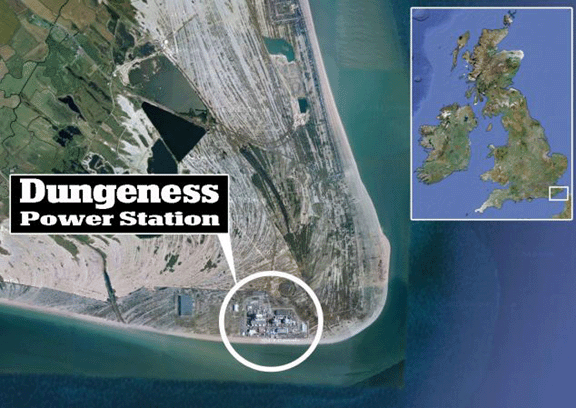
Reuters 8th April 2021, DF Energy, owned by French utility EDF, is exploring a range of scenarios for its Dungeness B nuclear plant in Britain, including bringing forward its decommissioning date of 2028, it said on Thursday. The 1.1 gigawatt Dungeness B plant, in Kent on the south coast of England, has been offline since 2018 as the company has been carrying out inspections and maintenance of pipes carrying steam to the turbine. EDF Energy has also been trying to complete repair work on corrosion identified during inspections of safety back-up systems.
The plant is currently forecast to return to service in August. It was designed in the 1960s and first started generating
electricity in 1983. EDF Energy said it has spent more than 100 million pounds ($138 million) on the plant during its current outage and it has a number of ongoing technical challenges that make its future uncertain.
Like the other nuclear powers, China wants to put a dirty great radioactive waste dump on indigenous land.
China’s $422m underground lab will probe massive national nuclear waste dump in remote Gansu, Global Construction Review,
9 April 2021 | By GCR Staff
China will spend $422m building an underground laboratory to find a way of storing high-level radioactive waste from the country’s growing fleet of nuclear power plants deep underground.
If successful, a repository that could store a hundred years worth of strontium-90, cesium-137 and plutonium-239 istopes will be built.
Building just the lab itself will be a feat. Wang Ju, vice-president of the Beijing Research Institute of Uranium Geology, told the China Daily newspaper that it would be sited in granite 560m below ground in the Beishan region of Gansu province, in China’s remote northwest . …………..
The offices and laboratories on the surface will have a floor area of 2.4ha within a 247ha site, however the underground complex will require the excavation of 514,200 cubic metres, along with 13.4km of tunnels. At present work is under way on supporting infrastructure, such as paved roads.
The lab, which was listed as a major scientific project in the 13th Five-Year Plan (2016-20), will take seven years to build. If its research proves successful, a long-term underground repository for high-level waste will be added nearby by 2050…….. https://www.globalconstructionreview.com/news/chinas-422m-underground-lab-will-probe-massive-nat/
1 This Month

of the week – Shut Down Drone Warfare!


Tell the Ukrainian Government to Drop Prosecution of Peace Activist Yurii Sheliazhenko

Petition to revoke the licensing of the Near Surface Nuclear Disposal Facility (NSDF) at Chalk River. https://www.ourcommons.ca/petitions/en/Petition/Details?Petition=e-7247
To see nuclear-related stories in greater depth and intensity – go to https://nuclearinformation.wordpress.com
-
Archives
- April 2026 (91)
- March 2026 (251)
- February 2026 (268)
- January 2026 (308)
- December 2025 (358)
- November 2025 (359)
- October 2025 (376)
- September 2025 (257)
- August 2025 (319)
- July 2025 (230)
- June 2025 (348)
- May 2025 (261)
-
Categories
- 1
- 1 NUCLEAR ISSUES
- business and costs
- climate change
- culture and arts
- ENERGY
- environment
- health
- history
- indigenous issues
- Legal
- marketing of nuclear
- media
- opposition to nuclear
- PERSONAL STORIES
- politics
- politics international
- Religion and ethics
- safety
- secrets,lies and civil liberties
- spinbuster
- technology
- Uranium
- wastes
- weapons and war
- Women
- 2 WORLD
- ACTION
- AFRICA
- Atrocities
- AUSTRALIA
- Christina's notes
- Christina's themes
- culture and arts
- Events
- Fuk 2022
- Fuk 2023
- Fukushima 2017
- Fukushima 2018
- fukushima 2019
- Fukushima 2020
- Fukushima 2021
- general
- global warming
- Humour (God we need it)
- Nuclear
- RARE EARTHS
- Reference
- resources – print
- Resources -audiovicual
- Weekly Newsletter
- World
- World Nuclear
- YouTube
-
RSS
Entries RSS
Comments RSS
 nuclear-news