How Chernobyl’s radioactive dust blanketed Europe in 1986

Radiation high over Europe after Chernobyl disaster – archive, 1986
3 May 1986: Mainland Europe experiences higher than normal radiation, with Poland, East Germany and Sweden bearing the brunt of contamination Michael SimmonsFrom the Guardian archive Mon 3 May 2021 By dusk last night, every country in mainland Europe had experienced higher than normal radiation as a result of the Chernobyl disaster. Only the Iberian peninsula was still clear, as governments in East and West, having recovered from the initial panic, started to count the medium-term costs.
Changes in wind direction from the epicentre at Kiev created fresh uncertainties throughout the day. The consensus among meteorologists was that the south-east wind which had done its worst earlier in the week in parts of Poland and Scandinavia was now veering towards due east, affecting Greece, Yugoslavia, and south-west Germany.
France reported “a minor increase” in atmospheric radioactivity, while Holland reported yesterday that, for the first time since the disaster, radiation levels were markedly higher than normal. In that country, government plans to air details of a proposed shift to nuclear power in the 1990s were shelved indefinitely.
The brunt of the contamination continued to be borne by the countries closest to the disaster area – notably Poland and East Germany – as well as Sweden, which has been seeking to take remedial measures since the beginning of the week.
The Swedish authorities ordered farmers to keep their cattle indoors – possibly for some weeks – and said people should not drink rainwater or eat wild vegetables or mushrooms. One fear in Stockholm is that the wind could veer back towards Sweden early next week……..
The brunt of the contamination continued to be borne by the countries closest to the disaster area – notably Poland and East Germany – as well as Sweden, which has been seeking to take remedial measures since the beginning of the week.
The Swedish authorities ordered farmers to keep their cattle indoors – possibly for some weeks – and said people should not drink rainwater or eat wild vegetables or mushrooms. One fear in Stockholm is that the wind could veer back towards Sweden early next week…….
Italy yesterday prohibited the sale of salad greens and barred a variety of imports from northern Europe. The Health Minister, Mr Costante Degan signed an order that forbade vendors from selling fresh leafy vegetables. https://www.theguardian.com/environment/2021/may/03/radiation-high-over-europe-after-chernobyl-disaster-1986
Steady growth of USA’s nuclear radioactive trash ( they prefer to call it ”spent fuel inventory”)

U.S. spent nuclear fuel inventory steadily increased from 2013 through 2017 https://www.eia.gov/todayinenergy/detail.php?id=47796 Principal contributor: Katherine Antonio, 3 May 21, The volume of spent nuclear fuel produced by nuclear power plants in the United States has steadily increased during the past few decades. The volume of spent nuclear fuel at the end of 2017 was 13.5% metric tons more than at the end of June 2013, according to newly released data from EIA’s Nuclear Fuel Data Survey. The survey data contain information on the quantity and characteristics of spent nuclear fuel at the time when a reactor discharges it.
The Nuclear Fuel Data Survey shows that between 1968 and 2017, more than 276,000 bundles of spent fuel rods (fuel rod assemblies), which contained a little less than 80,000 metric tons of uranium, were stored in the United States. The inventory of spent fuel assemblies has grown by about 13.2% from mid-2013 to the end of 2017.
The nuclear fuel used in nuclear reactors requires concentrated uranium (known as enriched uranium), which is further processed to create nuclear fuel. The enriched uranium is encased in fuel rods that go in a reactor’s fuel assembly to generate electric power. Each fuel assembly is typically used for a cycle of 18 to 24 months.
The discharged spent nuclear fuel rods are stored in one of two ways. The first approach stores spent fuel rods in pools of water that cool them and provide additional shielding from radiation. The pools of water resemble swimming pools. The second approach stores pre-cooled spent fuel rods in a container filled with inert gas. Each container is surrounded by steel, concrete, or other material to provide a stronger shield from radiation. In the United States, nearly all spent nuclear fuel is currently stored onsite at commercial nuclear power plants. A very small amount of spent nuclear fuel, less than 1%, is stored at offsite facilities.
We collect data on spent nuclear fuel from 119 commercial reactors in 33 U.S. states. The oldest reactor, now permanently shut down, is the Dresden 1, which started operating in Illinois in 1959. The newest reactor started operating in Tennessee in 2016. More than 17,500 metric tons of the cumulative spent nuclear fuel by uranium mass in the United States is stored in two states, Illinois and Pennsylvania. New York, North Carolina, and South Carolina have the next highest volumes of spent nuclear fuel in storage at more than 4,000 metric tons of uranium in each state.
We administer the Nuclear Fuel Data Survey for the U.S. Department of Energy’s Office of Standard Contract Management. You can learn more about nuclear energy in the United States on our website.
Malaysia needs to speak out on releasing nuclear waste into the sea
Malaysia needs to speak out on releasing nuclear waste into the sea https://www.theedgemarkets.com/article/malaysia-needs-speak-out-releasing-nuclear-waste-seaBernama/Bernama
May 02, 2021 KUALA LUMPUR : Malaysia needs to play its role as a member of the United Nations Environment Programme (UNEP) by speaking out on the long-term effect of releasing treated water from nuclear power plants into the ocean.
Co-founder of Project Ocean Hope, Mogesh Sababathy said actions need to be taken to ensure environmental sustainability, especially for marine life, is not threatened.
“Even though the nuclear waste will be diluted in water, its radioactive concentration should also be considered. And even when diluted, toxic is still toxic and it can still affect everyone.
“Hence, Malaysia needs to play its role and speak out on this issue at an international level, as this involves people’s security and health, as well as marine life in the region,” he told Bernama.
The Japanese government has recently approved a plan to release more than one million tonnes of treated water from the ruined Fukushima nuclear plant into the sea.
The plan also has the support of the International Atomic Energy Agency (IAEA), which says the release is comparable to the disposal of waste water from other nuclear plants globally.
Mogesh argued that this method will affect the world’s food chain security. “Nuclear radioactive is capable of affecting marine life and killing organisms, thus threatening the economic source of those who rely on it.
“It’s undeniable that Malaysia is far removed from Fukushima but we still share the same ocean. It is not impossible for the waste to drift to our country,” he said.
He hopes the relevant international bodies will study and develop safer alternative to dispose radioactive nuclear waste without harming the environment.
Texas legislators must reject proposal to lower human health and safety measures at nuclear waste dump
Texas legislators must reject proposal to lower human health and safety measures at nuclear waste dump , Record Star, 2 May 21, Texas legislators should reject proposed legislation that aims to remove environmental safeguards currently in place governing the disposal of nuclear waste in the state.
A bill that strips away the human health and safety precautions around the disposal of nuclear waste which have been in place since the state authorized nuclear waste dump sites nearly 20 years ago is headed to a vote in the Texas House of Representatives later this month or next. HB 2692, authored by Odessa Rep. Brooks Landgraf, would remove the provision mandating that all nuclear waste be containerized in steel- reinforced structures prior to being placed in a below-surface waste dump.
“Every environmental organization in the state of Texas has come out against this drastic rollback on protecting the citizens of this state, yet it sailed right out of committee and is headed to the full House and Senate” said Eric Holguin, executive director of Texas Environment First. “Texas is one of only a handful of states that even allows nuclear waste dumps to operate. There is absolutely no rational explanation for why the state should lower its regulatory standards in 2021.”
The Texas facility disposes of Class A, B, and C low level radioactive waste in Andrews, County, which is also home to the Ogallala Aquifer – a vital source of drinking water for much of the state. From the outset of operations, the state has mandated containerized disposal. ,,…… While the proposal purports to seek a ban on high level nuclear waste disposal in Texas, no federal license for high level waste storage or disposal has been issued in Texas.
“All of us are prepared to fight any federal efforts to bring high level nuclear waste to Texas,” Holguin said. “But right now, low level nuclear waste is being disposed of every day at the Andrews facility. De-regulating nuclear waste dumps is a colossally bad idea. The Texas Legislature must reject it.” https://www.recordstar.com/story/news/2021/04/29/texas-legislators-must-reject-proposal-lower-human-health-and-safety-measures-nuclear-waste-dump/7398882002/
South Korean fishermen protest against the dumping of Fukushima wastewater into the Pacific Ocean
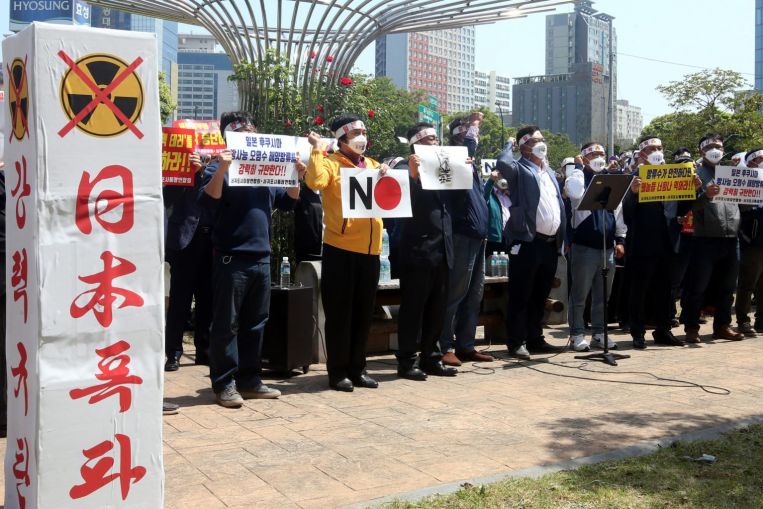
S.Korean fishermen hold boat protests against Japan nuclear plans, Reuters 30 Apr 21, Hundreds of South Korean fishermen across the country held protests on Friday calling on Japan to reverse its decision to release contaminated water from its crippled Fukushima nuclear plant into the sea.
About 800 fishermen participated in rallies at ports in nine cities, according to South Korea’s National Federation of Fisheries Cooperatives.
At one port, at Gungpyeong on the west coast, fishermen held anti-Japan banners and chanted slogans such as “Withdraw Japan’s decision” and “Condemn irresponsible nuclear attack”. Twenty fishing boats with banners denouncing Japan’s decision sailed near the port.
“My father bequeathed this sea to me and I’m going to pass it on to my son, who is also fishing,” said Park Re-seung, chief of Yongdu-ri fishing village, who has worked in the fishing industry for 38 years. “Why is Japan doing this? How could they do such a bad thing against the sea? Don’t they eat fish?”…….
“For us, this issue is about making our living,” Park added. “If the customers continue to see the news of the water release, they wouldn’t be even buying fishes that we caught here.” https://www.reuters.com/business/environment/skorean-fishermen-hold-boat-protests-against-japan-nuclear-plans-2021-04-30/
Double standards on radioactive waste disposal in Australia

This is very interesting. They say it’s ”low leve” – presumably ”safe”. Yet for the residents of a posh Sydney suburb, its worth a century-long fight to get it removed – and sent to America !! Makes you see why the residents of Lucas Heights , – now called Bardon Ridge – might be keen to have their much higher-level radioactive trash foisted on distant rural Kimba, South Australia
Hunters Hill radioactive waste to be removed sent to United States https://www.abc.net.au/news/2021-04-30/hunters-hill-radioactive-waste-to-be-removed-sent-to-us/1001
By Rani Hayman 1 May 21,
Key points:
- The land was the former site of the Radium Hill refinery, which closed in 1915
- The removal will begin in the coming weeks and take 12 months
- Melinda Pavey said the issue had taken a long time to resolve because it was “complicated”
Several properties on Nelson Parade at Hunters Hill were built on land contaminated by a former uranium processing site, which closed in 1915.
The area was also occupied by a carbolic acid plant until the early 1900s and a tin smelter until the 1960s.
Residents have spent decades fighting for the state government to remove the affected soil.
Finally, their calls have been heard, with the waste due to be excavated and sent to the United States.
Philippa Clark from the Nelson Parade Action Group said she was pleased the issued had finally been resolved.
“This is the way you deal with this kind of contamination and the best way possible for us and the environment and future generations,” she said.
The NSW government said the process would begin in the next few weeks and was expected to take 12 months.
The Minister for Water, Property and Housing Melinda Pavey said the health and safety of the community would be the main priority during site remediation works and the transportation of the material.
“The Australian Nuclear Science and Technology Organisation (ANSTO) will supervise the excavation and packing of the contaminated material into sealed bags and containers prior to transport to the USA,” she said.
While there is a sense of relief within the community, the decades-long battle has put strain on the affected residents.
When asked why it has taken so long to find a solution, Ms Pavey said: “Because it was complicated.”
A parliamentary committee in 2008 called for a comprehensive remediation plan for the site and in 2014 the Environmental Protection Agency (EPA) issued a management order to Property NSW to commence the works — although it said the development consent still had not been issued.
A plan to move the contaminated material to Kemps Creek in Sydney’s west was also abandoned in 2014 following community backlash.
The Mayor of Hunters Hill, Ross Williams, said the residents were looking forward to the area being rehabilitated.
“It’s been a health issue and a legacy issue for all that time.
It’s low-level radioactive material and it came from an industry that was essential [really?] back in those days,” he said.
“In modern times the environmental consequences wouldn’t have been tolerated.
“Once it’s totally cleaned up it will be available for any use.”
Ms Clark is pleased with the outcome despite how long it has taken.
“The government has listened to what we all wanted and what the parliamentary inquiry recommendation had been,” she said.
“We overwhelmingly just want to see ordinary houses and [go] back to [living in] an ordinary street, but without the stigma and without the constant anxiety that we’ve had to live with.”
Australian government plan for a nuclear waste dump tears apart a small country community

Kimba: A town torn apart by nuclear waste proposal https://independentaustralia.net/environment/environment-display/kimba-a-town-torn-apart-by-nuclear-waste-proposal-,15027 By Noel Wauchope | 28 April 2021
Bogged down in the Australian Senate is a Bill that selects a farming area, Napandee, near Kimba, South Australia, as Australia’s national radioactive waste dump. If that Bill becomes law, that matter will be settled, and there will be no possibility of legal appeal against it.
From a small close-knit community, in a top Australian wheat-growing area, Kimba has become a place of tension. In 2016, a farmer, Jeff Baldock, offered part of his land, Napandee, for the radioactive waste facility, and the offer was accepted by the Federal Government. From then on, the debate has raged in the area, and beyond it. It’s not always a reasonable discussion, and social media has made this worse. Now, years later, there’s no sign of a resolution to this matter. Residents try to get on with their lives, in this uneasy situation. Some people have left town, some are not speaking to former acquaintances. Opinions are black and white, or the subject is avoided completely – there’s no middle ground.
The Federal government’s plan for a nuclear waste facility at Kimba hit the Aboriginal community of the Eyre Peninsula hardest. The Barngarla people, Native Title holders, were excluded from the government’s ”community ballot” held in 2019. Voting was restricted to those living within the Kimba local council area . The Barngarla held their own ballot, resulting in a unanimous ”No” to the dump. Nevertheless, some Aboriginal people supported the plan, and this dispute has divided families.
”As an ally and advocate for Indigenous peoples for more than 30 years, I was appalled at the terrible toll fighting the nuclear waste facility took upon my friends. I watched one of my closest friends visibly age as she surrendered her art practice and her enjoyment of life to dedicate herself to challenging it. ”
– Felicity Wright – Submission to Senate Committee on National Radioactive Waste Management Amendment (Site Specification, Community Fund and Other Measures) Bill 2020 [Provisions] Submission 98
The non indigenous community has been equally affected. There were two community ballots held, 2017 and 2019. While in both cases the result favoured the nuclear waste facility, it was far from overwhelming support. At the final ballot, 824 people were eligible to vote: of 735 votes accepted, 452 said “Yes”.
The plan for the facility was pitched to the community as a medical necessity for Australia. It was an attractive idea. On the one hand Kimba could proudly provide a service to the nation. On the other hand, it was bringing a new industry, and new jobs, to a sometimes drought-stricken agricultural area. More immediate benefits: the farmer who volunteered land would be paid at 4 times the market value. A Community Benefits scheme brings up to $11 million to the town, over the next 4 years, and $20 million when the dump is up and running.
The plan was greeted with enthusiasm from some residents. They relied on the copious information provided by the the Department of Industry Innovation and Science, and by the former Resources Minister, Matt Canavan. When it was pointed out to Mr Canavan that some residents close to the selected site were ineligiblt to vote, he promised that their views would be included. But then he left that Ministry.
The Industry Department has controlled the information reaching the community, and has provided the visiting experts. There has not been any debate provided, with opposing views. Still, there is strong opposition, led by farmers. The group No Radioactive Waste on Agricultural Land in Kimba or SA, is optimistic thar Kimba, despite the prevailing mood of anxiety, can survive and go ahead, without the waste facility.

The group, of 5 years’ standing has researched the issue, and sent submissions to Parliament. Radioactive waste is not recommended for agricultural land. There are concerns about possibile environmental pollution, damage to groundwater. Perception of the area is important, and the presence of a radioactive waste dump could be very damaging to its clean, green image .
Community understanding is at the heart of this problem. The current Resources Minister, Keith Pitt, enthused about the facility, describing it to the Nationals Federal Conference on 27 March 2021 as “a low-level nuclear waste facility to house the by-products from cancer treatment.”
That’s a misleading statement. The waste proposed to be taken to the nuclear dump is waste generated from the industrial production of these isotopes. – not their usage!
There is uncertainty about the toxicity of the nuclear wastes to be placed in “interim storage” at Napandee, with the classification of these wastes as “intermediate level”, but the same wastes classified in Fance as “high level”.
The Kimba community remains troubled, as this nuclear waste problem remains paralysed in the Senate. Freedom of Information documents revealed that the government is well aware of mental health problems likely to be caused by the issue.
Minister Pitt has the option of clearly designating Napandee as the site for the nuclear waste dump. That could solve the problem, and certainly bring clarity to the Kimba community. But, the hitch for the government is that if he does this, it will be possible for opponents of the plan to take legal action against it.
Ukraine opens new nuclear waste site
On 35th anniversary of Chornobyl disaster, Ukraine opens new nuclear waste site,
Ukraine president vows to transform Chornobyl exclusion zone into a revival zone. Ukraine’s president on Monday unveiled a new nuclear waste repository at Chornobyl, the site of the world’s worst civilian nuclear disaster that unfolded exactly 35 years ago…….
Moving forward, the Ukrainian authorities announced they will use the deserted exclusion zone around the Chornobyl power plant to build a storage facility for Ukraine’s nuclear waste for the next 100 years.
The ex-Soviet nation currently has four nuclear power plants operating and has to transport its nuclear waste to Russia. The new repository will allow the government to save up to $200 million US a year…… https://www.cbc.ca/news/world/chornobyl-35th-anniversary-1.6002314
Getting the facts straight about Chernobyl, nuclear disasters, and ionising radiation
Fact check: 5 myths about the Chernobyl nuclear disaster
Monday marks the 35th anniversary of the Chernobyl nuclear disaster. What happened in the former Soviet Union on April 26, 1986, is no longer a secret. DW,
Is Chernobyl the biggest-ever nuclear disaster?
The 1986 nuclear disaster at the Chernobyl nuclear power plant near the city of Pripyat in northern Ukraine is often described as the worst nuclear accident in history. However, rarely is this sensational depiction clarified in more detail.
The International Nuclear and Radiological Event Scale (INES) does classify nuclear events on a scale of zero to seven, breaking them down into accidents, incidents and anomalies. It was introduced in 1990 after being developed by the International Atomic Energy Agency (IAEA) and the Nuclear Energy Agency of the Organization for Economic Cooperation and Development (NEA/OECD). Level seven denotes a “major accident,” which means “major release of radioactive material with widespread health and environmental effects requiring implementation of planned and extended countermeasures.”
Both the Chernobyl and 2011 Fukushima disaster have been categorized as such. But INES does not allow for nuclear events to be classified within a level.
If the term nuclear disaster is not only used to describe events, or accidents, in nuclear reactors but also radioactive emissions caused by humans then there are many occasions when human-caused nuclear contamination has been greater than that of the Chernobyl disaster, explained Kate Brown, professor of science, technology and society at the Massachusetts Institute of Technology.
“Let’s take the production of plutonium,” she told DW, referring to the American and Soviet plants that produced plutonium at the center of a nuclear bomb. “Those plants each issued as part of the normal working everyday order at least 350 million curies [a unit of radioactivity — Editor’s note] into the surrounding environment. And that was not an accident.
“Let’s look at, even more dire, the issuance of radioactive fallout in the detonation of nuclear bombs during the periods of nuclear testing ground, which were located throughout the world, ” she continued. “Those just take one isotope, one radioactive iodine, which is harmful to human health because it’s taken up by the human thyroid, causing thyroid cancer or thyroid disease.
“Chernobyl issued 45 million curies of radioactive iodine just in two years of testing, in 1961 and 1962. The Soviets and the Americans issued not 45 million curies, but 20 billion curies of radioactive iodine,” she said. And these tests, she added, were by design — not due to an accident or human error.
Are there mutants in the exclusion zone?
………….. “The influence of ionizing radiation may cause some restructuring in the body, but mostly it simply reduces an organism’s viability,” he explained, giving the example of high embryo fatalities in rodents due to genomic defects that prevented the organism from functioning. Those animals that survive the womb sometimes have disabilities that prevent them from staying alive in the wild. Vishnevsky and his colleagues have conducted research into thousands of animals in the exclusion zone, but have not found any unusual morphological alterations.
“Why? Because we were always dealing with animals that had survived and had won the fight for survival,” he said. He added that it was difficult to compare these animals with creatures that scientists had deliberately exposed to radiation in laboratories.
“That’s a very seductive idea, that human messed up nature and all they have to do is step away and nature rewrites itself,” she said. In reality, however, biologists say that there are fewer species of insects, birds and mammals than before the disaster. The fact that some endangered species can be found in the exclusion zone is not evidence of the area’s health and vitality.
Has nature reclaimed the site of the disaster?
Reports entitled “Life Flourishing Around Chernobyl” and photo series suggesting that the exclusion zone has become a “natural paradise” might give the impression that nature has recovered from the nuclear disaster. But Brown, who has been researching Chernobyl for 25 years, is adamant that this is “not true.”
“That’s a very seductive idea, that human messed up nature and all they have to do is step away and nature rewrites itself,” she said. In reality, however, biologists say that there are fewer species of insects, birds and mammals than before the disaster. The fact that some endangered species can be found in the exclusion zone is not evidence of the area’s health and vitality.
On the contrary: there has been a significant increase in the mortality rate and a lowered life expectancy in the animal population, with more tumors and immune defects, disorders of the blood and circulatory system and early ageing.
Scientists have attributed the apparent natural diversity to species migration and the vastness of the area. “The exclusion zone comprises 2,600 square kilometers [about 1,000 square miles]. And to the north are another 2,000 square kilometers to the north is Belarus’ exclusion zone,” said Vishnevsky. “There are also areas to the east and west where the human population density is extremely low. We have a huge potential for preserving local wild fauna.” That includes lynxes, bears and wolves which need a great deal of space.
But even 35 years after the disaster the land is still contaminated by radiation, a third of it by transuranium elements with a half-life of more than 24,000 years.
Is it safe for tourists to visit Chernobyl?
The exclusion zone was already a magnet for disaster tourists, but in 2019 annual numbers doubled to 124,000 after the success of the HBO miniseries Chernobyl. The State Agency of Ukraine on Exclusion Zone Management has set up a number of routes so tourists can visit the region by land, water or air. It has also drawn up a number of regulations to protect visitors, stipulating that people must be covered from head to toe. They shouldn’t eat any food or drink outside, and they should always follow official paths. It’s estimated that the radiation dose received over a one-day visit does not exceed 0.1 millisievert (mSv) — roughly the same dose that a passenger would be exposed to on a long-distance flight from Germany to Japan, according to Germany’s Federal Office for Radiation
Are there people living in the area?
Today, Pripyat, the closed city built to serve the nuclear plant and house its employees, is often described as a ghost town, as is the nearby city of Chernobyl.
However, neither has been entirely empty since 1986. Thousands of people, usually men, have stayed there, often working two-week shifts and ensuring that the crucial infrastructure in both cities continues to function. After the explosion in reactor No. 4, reactors 1, 2 and 3 continued to operate, closing down only in 1991, 1996 and 2000. Special units of the Ukrainian Interior Ministry police the zone. There are also stores and at least two hotels in Chernobyl, which are mainly for business visitors.
There are also a number of unofficial inhabitants, including people who used to live in the area and have chosen to return. They have settled in villages that were evacuated after the disaster. The exact number of people is unknown: when DW asked the State Agency of Ukraine on Exclusion Zone Management how many people lived in Chernobyl, the official answer was “nobody.”
In 2016, about 180 people were thought to be living in the entire exclusion zone. Because they tended to be older, this number may well have fallen. Even though these locals are officially only tolerated, the state does support them in their everyday lives. Their pensions are delivered once a month, and every two to three months they are supplied with food by a mobile store. https://www.dw.com/en/fact-check-5-myths-about-the-chernobyl-nuclear-disaster/a-57314231
Below – a video from past years tells the earlier story of the chernobyl disaster
Remarkable new photos inside the Chernobyl nuclear power station
PetraPixel.com, ARKADIUSZ PODNIESIŃSKI 25 Apr 21, ”/…………… The reason for my regular visits remains the same: the desire to document the changes taking place in the Chernobyl Exclusion Zone. And there’s been quite a few: from the construction of the New Safe Confinement (which I wrote about in more detail here), to the construction of several new industrial facilities that will make the decommissioning of the plant, including the damaged Reactor 4, possible and much safer. I hope that, under the influence of slow but systematic changes, eventually Chernobyl will not only be known as the site of the largest nuclear disaster in the world………
before we are allowed to enter the main part of the complex, aka the dirty zone, we have to change into protective gear and masks. We are also given a dosimeter that counts the dose of radiation absorbed. When we exit, the procedure is repeated in reverse order and so on in every complex we visit. Sometimes, the procedures take longer than our stay inside the facility.
…….. First, we got to the largest hall where there is a huge pool with more than 21,000 spent fuel assemblies from reactors 1-3. Depending on the location, radiation levels vary from 40 to 800 μSv/h, which is about 200-400 times higher than normal. The ISF-1 is a wet-type spent fuel storage facility, meaning that the fuel assemblies are stored in water. The huge pool consists of five reinforced concrete tanks covered by hundreds of steel plates. As I step on them, I feel rather strange and insecure because I know what lies beneath them. Additionally, every step I take causes the steel flaps to move, causing a sound that echoes throughout the hall. I’m only calmed by the sight of the engineer, who confidently steps on the plates, not looking at me at all. After a moment, the engineer bends down and opens one. The radiation increases, but only slightly. The lack of a cover doesn’t change all that much; the greatest barrier against the radiation is the water.

The fuel assemblies are pulled out in the hall next door. Now I can stay here freely, but the radiation levels during this procedure are very high – about 2 Sv/h. This is already a dose that can cause serious radiation sickness or even death. Due to this, the entire process is controlled remotely through a small window made of thick leaded glass or through a system of monitors and cameras from a small room located several meters above us…..
ISF-2 – the Interim Spent Nuclear Fuel Storage Facility 2
The ISF-2 complex serves as an interim storage facility for dry-type spent fuel assemblies. Before the spent fuel goes there, it is processed first in a building located on the premises.
Inside, my attention is drawn to the “hot chamber”, the heart of the entire building. A huge, hermetically sealed room, completely isolated from the external environment by thick concrete walls; you can look inside through small leaded glass windows located on both sides of the chamber. Cameras resistant to high levels of radiation and remote-controlled machinery and tools have been installed inside. It is here that the spent fuel assemblies from the defunct reactors will be cut in half, dried, and later packed into double-layered steel canisters.
The view of the hot chamber makes me realize how dangerous a task we have before us. And a long-term one, since the radioactive isotopes in the fuel will take thousands of years to decay. 100 years, the storage period for the processed fuel in ISF-2, is just a blink of an eye for radioactive isotopes. What’s next? ISF-3? We don’t know yet…….. This is the problem we will face – well, not us but future generations.
In December 2020, the “hot tests” for the whole complex concluded. At that time, 22 containers with 186 fuel assemblies had been processed for the first time and then packed into two steel canisters and stored in concrete modules behind the main building. It is estimated that the entire fuel processing process will take about 10 years, and the complex will become the world’s largest dry spent fuel storage facility.
ICSRM – the Industrial Complex for Solid Radwaste Management
In addition to the ISF-1 and ISF-2, which deal with spent nuclear fuel, another two facilities have been built on the site for the treatment of solid and liquid radioactive waste collected from the operation and decommissioning of the power plant and from the sarcophagus.
In addition to the ISF-1 and ISF-2, which deal with spent nuclear fuel, another two facilities have been built on the site for the treatment of solid and liquid radioactive waste collected from the operation and decommissioning of the power plant and from the sarcophagus. I visit the first, where low-, intermediate- and high-level waste is processed for temporary or final storage, including concrete, sand, and metal. The huge building contains a system of airtight caissons, hot chambers, and other areas where radioactive waste is cut, fragmented, shredded, sorted by radioactivity level, compressed, and incinerated. All of the work is done using remote-controlled machines to which interchangeable tools can be attached — including a jackhammer, concrete crusher, chainsaw, and hydraulic shears. The processed waste is then encapsulated and sealed in concrete containers before being sent to a radioactive waste repository. Like the ISF-2, the plant has already processed its first batch of radioactive waste and currently is in the final stages of hot testing and certification.
New Safe Confinement
The New Safe Confinement (NSC) is a huge 110-meter-high steel construction that was built to cover the old, worn-out sarcophagus. ………………..

In this labyrinth of near-identical corridors, I quickly lose my sense of direction and, after a while, I stop paying attention to the signs. I blindly follow the dosimetrist. Although the masks prevent us from breathing in radioactive dust, there is nothing we can do to protect ourselves from the gamma radiation penetrating our bodies. Unseen dangers may lurk around every corner. In such a situation, the dosimeters are our eyes; thanks to them we know how far we can go.

The thought that I’m moving through a mysterious labyrinth of radioactive corridors covered by two sarcophagi stresses me out and increases my feelings of uncertainty and confusion. …….
About the author: Arkadiusz Podniesiński is a Polish photographer and filmmaker, a technical diver, and a graduate of Oxford Brookes University in Great Britain. You can find more of his work on his website. This photo essay was also published here. https://petapixel.com/2021/04/24/exclusive-photos-inside-the-chernobyl-nuclear-power-plant/
The Chernobyl story continues
Chernobyl: The next phase https://www.ebrd.com/news/2021/chernobyl-the-next-phase.html By Axel Reiserer, 23 Apr 2021
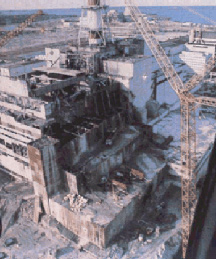
At 01:23:40 on 26 April 1986, the failure of a routine test at the Chernobyl Nuclear Power Plant in Ukraine, then part of the Soviet Union, caused reactor 4 to explode, releasing parts of its radioactive core. It was the worst nuclear accident the world had ever seen, with far-reaching political, economic and ecological consequences. Thirty-five years on, Chernobyl is still as well-known as it was a generation ago.
Fires broke out, causing the main release of radioactivity into the environment. Wind carried contaminated particles over Ukraine, Belarus and Russia, as well as parts of Scandinavia and wider Europe. The 50,000 inhabitants of the adjacent town of Pripyat were evacuated, never to return.
The accident destroyed reactor 4, killing 30 operators and firemen within three months and causing numerous other deaths in weeks and months that followed. To this day, it remains the only accident in the history of the civil use of nuclear power when radiation-related fatalities occurred. The precise number of short- and longer-term victims remains heavily disputed.
By 06:35 on 26 April, all fires at the power plant had been extinguished, apart from the fire inside reactor 4, which continued to burn for many days. Some 5,000 tonnes of boron, dolomite, sand, clay and lead were dropped from helicopters in a bid to extinguish the blaze. When the destroyed reactor was later enclosed in a provisional structure – the so-called sarcophagus – these fuel-containing materials were also walled in.
The sarcophagus was built under extremely hazardous conditions and unprecedented time pressure. By November 1986, a steel and concrete shelter was in place to lock away the radioactive substances inside the ruined reactor building and to act as a radiation shield. It was always intended as a temporary measure, with an estimated lifespan of 20-30 years
The search for a long-term solution started soon after, alongside the massive challenge of cleaning up the accident site. By the end of 1991, the Soviet Union had dissolved and newly independent Ukraine had been left with the Chernobyl legacy. Following a G7 Action Plan to improve nuclear safety in central and eastern Europe, the Nuclear Safety Account was set up at the European Bank for Reconstruction and Development (EBRD) in 1993. Two years later, the scope of the programme was extended to include Chernobyl.
A breakthrough came with the Shelter Implementation Plan in 1997, which provided a road map of how to the tackle the immediate and longer-term tasks. In the same year, the G7 officially invited the EBRD to set up and manage the Chernobyl Shelter Fund, which became the main vehicle for all efforts to ensure that the destroyed reactor 4 remained in an environmentally safe and secure state.
Emergency repairs in 1998 and 1999 prevented the imminent collapse of the sarcophagus, as well as a vent stack that was endangering the adjacent turbine hall over reactor 3, which was still in operation. It was only at the end of 2000 that all nuclear power generation in Chernobyl ceased. The following year saw a landmark decision to build an arch-shaped steel structure, called the New Safe Confinement (NSC), to seal off reactor 4.
In the subsequent years, several tasks were carried out simultaneously. Detailed technical work on the NSC started. The site had to be stabilised and prepared for the construction work. The first project the EBRD managed was the construction of a liquid radioactive waste treatment plant (LRTP) to handle some 35,000 cubic metres of low- and intermediate-level liquid waste at the site. Meanwhile, the safe storage of the spent fuel assemblies from reactors 1, 2 and 3 came into focus.
All this has been achieved. The LRTP has been operational since 2014. A new interim storage facility for the treatment and storage of spent fuel has been built and, after successful hot tests, is currently awaiting a permanent licence from the Ukrainian regulator. The NSC, the most visible Chernobyl project, was slid into position in late 2016 and then handed over to the Ukrainian authorities.
In total, the Bank has managed close to €2 billion in donor funds through the Chernobyl Shelter Fund and Nuclear Safety Account. Of this, the EBRD provided €715 million of its own resources to complete the Interim Storage Facility and New Safe Confinement.
Today, the New Safe Confinement dominates the skyline over Chernobyl, as the sarcophagus once did. The steel structure is 108 metres high and 162 metres long, with a span of 257 metres and a lifetime of at least 100 years. It was assembled in two stages in a cleaned area near the accident site and, despite its size and weight of 36,000 tonnes, was pushed 327 metres into position. It is the largest moveable structure ever built.

This is not where the story ends, however. The fact that the NSC has a lifespan of 100 years means that the next phase of work now has to be planned, agreed and implemented. The estimated 200 tonnes of radioactive nuclear fuel inside reactor 4 are now shielded by the New Safe Confinement. However, parts of the sarcophagus are becoming unstable and will have to be removed at some point. Once this is done, work will come closer to the reactor’s interior.
The EBRD remains a key partner in these efforts. Following a request by Ukraine, in November 2020, the Bank established the new International Chernobyl Co-Operation Account, aimed at creating an integrated plan for the site to serve as the basis for developing and implementing longer-term projects. The new fund will hold it first assembly meeting on Tuesday – fittingly one day after the 35th anniversary. The Chernobyl story continues.
Decision on Fukushima waste water should be in consultation with international agencies, not just a decision by Japan alone.
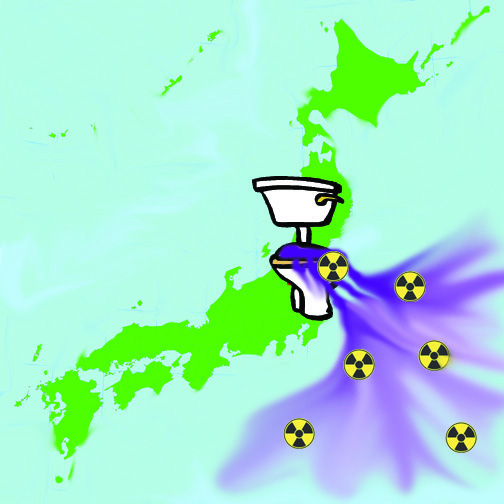
Disposal of Fukushima nuclear wastewater should be assessed under framework of intl agencies, not let world pay: FM, By Global Times, 21 Apr 21, China’s Foreign Ministry said on Wednesday the disposal of Fukushima nuclear wastewater should be assessed and discussed under the framework of international agencies including the UN, the WHO, and the IAEA, urging the Japanese government to correct its irresponsible decision to dump of the wastewater to the ocean and avoid involving people all around the world in paying for its wrongdoings.
The remarks came after South Korean Foreign Minister Chung Eui-yong expressed opposition to the move, and said on Tuesday that Seoul will work closely with international agencies to deal with Japan.
At a routine press conference, China’s Foreign Ministry spokesperson Wang Wenbin stressed that before dumping nuclear-contaminated water, there should be a discussion with neighboring countries and an evaluation within the framework of international agencies including the United Nations, the World Health Organization, and the International Atomic Energy Agency.
Wang added that Japan’s decision to dump the nuclear-contaminated water is not only opaque, unscientific, unlawful, irresponsible and unethical, but also at risk of being condemned by the world.
“A ban has been placed on black scorpionfish caught off Fukushima waters from entering markets due to the detection of excessive radioactive materials. And this is the second time that fish have been found with excessive radioactive materials in Fukushima waters since February,” said Wang.
All of these signs point to the fact that disposal of radionuclides is complicated and difficult, noted Wang, adding that the Fukushima nuclear power plant accident has been bringing harm to its surroundings for the past decade since it happened. ……..
Wang said that the methods of the wastewater disposal concern the safety of the Asia-Pacific region, the global ecological environment, and the lives and the health of people in all countries. The data should be evaluated and consultations held with all parties whose interests are bound to it.
“We noticed that Japan’s Tokyo Electric Power Company intends to submit a progress plan for wastewater disposal in May. We express strong opposition and serious concern to the matter as Japan unilaterally pushes forward the plan without consultation with the international community especially neighboring countries,” Wang said.
“Please don’t let people all over the world pay for Japan’s wrongdoings,” he added. https://www.globaltimes.cn/page/202104/1221712.shtml
Overdue Shutdown of the Indian Point Nuclear Plant
Overdue Shutdown of the Indian Point Nuclear Plant
Environmental groups write that gains in energy efficiency and renewable power exceed the plant’s annual output.
“Nuclear Plant’s Shutdown Means More Fossil Fuel in New York”(news article, April 13):
New York State is making good on its promise to replace the aging, unsafe Indian Point nuclear plant with clean energy. Gains in energy efficiency and renewable power over the last decade already exceed the plant’s total annual output, with much more to come.
We can expect year-to-year changes given fluctuations in energy demand and prices. But the overall trend in New York is clear: Clean energy is here to stay, and emissions reductions are on track to reach the state’s ambitious climate goals.
Closing this dangerous plant is overdue. Over the years Indian Point has experienced reactor structure problems with the potential for structural failure, as well as leaks, fires and unplanned shutdowns.
For the 20 million people who live within 50 miles of it, Indian Point’s long-planned closure ends a risky chapter. Paul GallayKit Kennedy
Mr. Gallay is president of Riverkeeper and Ms. Kennedy is senior director, climate and clean energy program, at the Natural Resources Defense Council. https://www.nytimes.com/2021/04/21/opinion/letters/indian-point-nuclear.html
The $2.5Billion-a-year effort to stabilise the Hanford reservation’s dangerous nuclear wastes

Nuclear waste structures in Washington state are stabilized, https://apnews.com/article/environment-and-nature-business-government-and-politics-washington-nuclear-waste-14e29e8923c62bf5835f33e1b649000c RICHLAND, Wash. (AP) — The U.S. Department of Energy has confirmed that two underground structures at the decommissioned Hanford nuclear reservation in Washington state have been stabilized after they were deemed at risk of collapsing and spreading radioactive contamination into the air.
“With this work completed, Hanford has ensured the stability of these structures and reduced risks to workers and the environment,” department spokesperson Geoff Tyree said.
The partial collapse of a tunnel storing nuclear waste the nuclear reservation in 2017 prompted a federal study which concluded last year that a large settling tank and two trenches where plutonium-contaminated liquids were poured into the ground for disposal posed a high risk of collapse and contamination, Tri-City Herald reported Tuesday.
The Hanford reservation produced plutonium for nuclear weapons during the Cold War and World War II, leaving 56 million gallons (212 million litres) of radioactive waste in underground tanks. The largest of the three underground structures, which operated from 1955 to 1962, was estimated to be contaminated with 105 pounds (48 kilograms) of plutonium.
Scott Sax, president of Hanford contractor Central Plateau Cleanup Co., told employees that the three underground structures identified in the study were filled with concrete-like grout to prevent them from collapsing.
The work was done by White Shield Inc. of Pasco under a contract originally valued at about $4 million.
Sax also said that at least one of the trenches was buried deep enough to prevent nuclear waste from releasing into the air in the event of a collapse.
“Routine monitoring will continue to ensure all three structures remain stable,” Sax said, at least until further environmental cleanup action is taken.
Final cleanup plans for the structures have not yet been made as the Energy Department focuses on other high-priority projects, including capsules of radioactive waste that are at risk of releasing contamination in the event of a severe earthquake.
About $2.5 billion a year is being spent to stabilize and clean up waste and contamination left at the 580-square-mile (1,500-square-kilometer) site in Richland, Washington about 200 miles (322 kilometers) southeast of Seattle, officials said.
S.Korean students shave heads in protest over Japan’s nuclear waste water plan
S.Korean students shave heads in protest over Japan’s nuclear waste water plan, Reuters, Hyun Yi 21 Apr 21, More than 30 South Korean college students shaved their heads in front of the Japanese embassy in Seoul on Tuesday to protest Japan’s decision to release water from its crippled Fukushima nuclear plant into the sea.
Police periodically dispersed crowds, who chanted and held placards, but did not stop the event from taking place, though there is an anti-pandemic ban on gatherings larger than 10 people.
The protesters who were shaved were draped in protective sheets emblazoned with messages condemning the Japanese plan and calling for it to be ditched.
One read: “The Japanese government should immediately cancel the plan to release the contaminated water.”…….. https://www.reuters.com/business/environment/skorean-students-shave-heads-protest-over-japans-nuclear-waste-water-plan-2021-04-20/
1 This Month

of the week – Shut Down Drone Warfare!


Tell the Ukrainian Government to Drop Prosecution of Peace Activist Yurii Sheliazhenko

Petition to revoke the licensing of the Near Surface Nuclear Disposal Facility (NSDF) at Chalk River. https://www.ourcommons.ca/petitions/en/Petition/Details?Petition=e-7247
To see nuclear-related stories in greater depth and intensity – go to https://nuclearinformation.wordpress.com
-
Archives
- April 2026 (91)
- March 2026 (251)
- February 2026 (268)
- January 2026 (308)
- December 2025 (358)
- November 2025 (359)
- October 2025 (376)
- September 2025 (257)
- August 2025 (319)
- July 2025 (230)
- June 2025 (348)
- May 2025 (261)
-
Categories
- 1
- 1 NUCLEAR ISSUES
- business and costs
- climate change
- culture and arts
- ENERGY
- environment
- health
- history
- indigenous issues
- Legal
- marketing of nuclear
- media
- opposition to nuclear
- PERSONAL STORIES
- politics
- politics international
- Religion and ethics
- safety
- secrets,lies and civil liberties
- spinbuster
- technology
- Uranium
- wastes
- weapons and war
- Women
- 2 WORLD
- ACTION
- AFRICA
- Atrocities
- AUSTRALIA
- Christina's notes
- Christina's themes
- culture and arts
- Events
- Fuk 2022
- Fuk 2023
- Fukushima 2017
- Fukushima 2018
- fukushima 2019
- Fukushima 2020
- Fukushima 2021
- general
- global warming
- Humour (God we need it)
- Nuclear
- RARE EARTHS
- Reference
- resources – print
- Resources -audiovicual
- Weekly Newsletter
- World
- World Nuclear
- YouTube
-
RSS
Entries RSS
Comments RSS
 nuclear-news