City of Aiken provides will receive more than $168M in plutonium storage settlement
by: Dixie Dawson, Joey Gill, Aug 30, 2022 “………………………………… The community also got an update on plutonium settlement money. Aiken County will reportedly receive more than $168 million, or 30% of $525 million, from the federal government’s settlement with the state over plutonium storage.
“They secured 168-million-850-thousand dollars for projects through Aiken County from the South Carolina plutonium settlement funds,” said David Jameson, President and CEO of the Aiken Chamber of Commerce, “Aiken County citizens will benefit from the catalytic impact of your efforts to many, many years.”……………………… https://www.wjbf.com/news/aiken-county/city-of-aiken-provides-updates-on-city-will-receive-more-than-168m-in-plutonium-storage-settlement/
The long process of shutting down Hunterston B nuclear power station
Experts say that the site of the current Hunterston B power station could
be available for use again in around 90 years. Details of the upcoming
decommissioning process for the nuclear site have been revealed as part of
a public consultation over the next stage of the power station site’s
life. Defuelling of the site is currently under way, with decommissioning
expected to start in 2025/26 and it will take around 12 years to demolish
the majority of buildings. A long period of inactivity, thought to be
around 70 years, will follow before the remaining site will be
decommissioned and potentially ready for reuse. Following defuelling,
operators EDF will hand over responsibility to the Nuclear Decommissioning
Authority. The authority’s subsidiary Magnox will deliver decommissioning
activities for the decades to come. A report drawn up for the consultation
reveals that a giant ‘safestore’ will be created from the existing
reactor building, which can shield decaying radioactive materials for up to
100 years. It says: “Buildings and structures will be demolished to ground
level, with basement areas and tunnels backfilled and regraded using
material produced from the decommissioning process.
Largs & Millport News 26th Aug 2022
https://www.largsandmillportnews.com/news/20777753.hunterston-b-site-available-use-90-years/
All About Groundwater – Hanford part 2
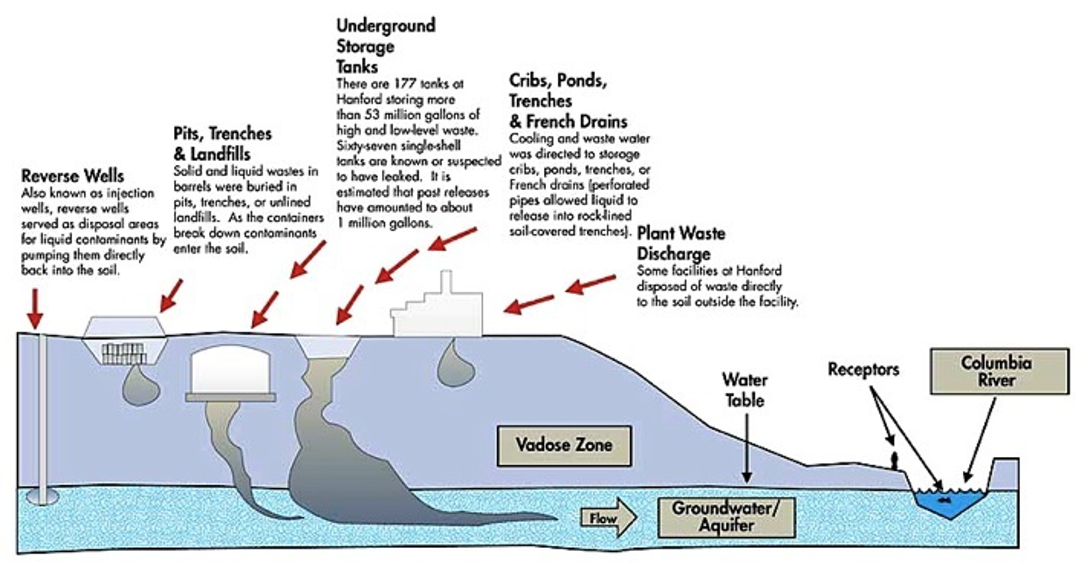
In Part 1 we covered the basics of the Pacific Northwest National Laboratory report, Adaptive Site Management Strategies for the Hanford Central Plateau Groundwater, that outlines an innovative strategy to tackle the challenge of groundwater cleanup. In Part 2 we’ll cover the history of Hanford’s soil and groundwater contamination, current cleanup strategies, and the various challenges to cleaning up the soil and groundwater.
Hanford’s history of soil contamination
The Hanford Site has a history of dumping radioactive and chemical waste directly into the ground on site. About 450 billion gallons of nuclear and chemical waste were dumped directly into the soil during the plutonium production years—the equivalent of more than 680,000 Olympic-size swimming pools. Manhattan Project workers dumped waste in unlined cribs, ponds, ditches, and trenches—four different types of holes in the ground used for disposing of waste. Injection wells pumped the toxic waste directly into the soil to dispose of it.
Workers constructed 177 underground tanks (149 single-shell tanks and 28 double-shell tanks) to hold the most dangerous, high-level waste. However, the soil contamination didn’t stop there. These enormous underground tanks were connected in a row of three or four tanks. The Manhattan Project workers used a process called cascading—which allowed them to fill up one tank with waste, and while the waste solids settled to the bottom, the liquids would flow from one tank to another. If too much waste was added to the final tank, it would overflow to the soil. “From 1944 through the late 1980s, Hanford generated nearly 2 million cubic meters (525 million gallons) of high-level tank waste. Liquid evaporation, discharge to the ground, chemical treatment, and tank leakage reduced this volume by 90%—to 204,000 cubic meters (54 million gallons).”[1]
Cascading wasn’t the only way that waste reached the soil from the tanks. The tank farms were backfilled under an 8-to-10-foot layer of soil before waste was added. Workers built the single-shell tanks between 1943 and 1964. As their name suggests, they only have one liner of carbon steel to contain the waste. Sixty-seven single-shell tanks are known or suspected to have leaked 1 million gallons of waste into the surrounding soil. Two single-shell tanks—B-109 and T-111—are currently leaking. The single-shell tanks were designed to contain the waste for 20-25 years, and they are now more than 40 years past their design life. As these tanks get older and older, they are more likely to fail—causing the waste to leak out into the soil. Once the waste gets into the soil it may remain there—making it very hard to remove—or it may travel with water through the soil and reach the groundwater.
Current cleanup of the groundwater
Today, the soil at the Hanford Site (particularly in the Central Plateau) remains heavily contaminated. Some radioactive and chemical contaminants are more mobile in water, which means a rainstorm may cause those contaminants to move with the water through the soil—reaching the groundwater and ultimately the Columbia River.
One of the cleanup methods to prevent contaminants from spreading and reaching the groundwater is to remove contaminated soil by digging it up and disposing of it in the Environmental Restoration Disposal Facility. Hanford Challenge is concerned that USDOE will decide that it doesn’t need to dig up all of the contaminated soil and will leave it in place—which would increase the risk of harm to future generations.
USDOE implements specific strategies for cleaning up the groundwater. One of those strategies is pump and treat. Pump and treat is the process of pumping contaminated water to the surface, filtering out some of the contaminants, and injecting the water back into the ground. Monitoring wells, extraction wells, and injection wells are interspersed throughout the Hanford Site to implement the pump and treat process. There are six pump and treat facilities on site.
Soil flushing is one strategy used to enhance the pump and treat process. Some contaminants remain in the soil and may take a long time to reach the groundwater. Until the contaminants hit the groundwater, they are impossible to capture with the pump and treat system. Soil flushing speeds up the process by using 225 gallons of water per minute to force—or flush—these hard-to-reach contaminants down to the groundwater where they can be brought up to the surface with the pump and treat system. USDOE has found success using soil flushing to push hexavalent chromium to the groundwater to treat it.
An additional strategy for meeting water quality standards is monitored natural attenuation. Contamination is left to naturally attenuate, which means letting the radiation decay over time. It sounds like a do-nothing approach, and it basically is.
Challenges to groundwater cleanup
USDOE faces many challenges when pursuing groundwater cleanup. As previously mentioned, there are hundreds of contaminated soil sites at Hanford due to past dumping practices and leaking underground tanks. The extent of groundwater contamination is vast.
- There are significant data gaps regarding the number of contaminants in the vadose zone (the area of soil between the ground surface and the water table), the depth and location of the contamination, and the risk the contamination poses to groundwater.
- Some hard-to-control, persistent contaminants, such as technetium-99, iodine-129, uranium, nitrate, and chromium, are located in the deep vadose zone and pose a long-term risk to the groundwater.
- There are extensive groundwater plumes with intermixed contaminants (or contaminants located together), making it difficult to accurately measure the total amount in the aquifer and the contaminant distribution.
Depending on the contaminant, one specific treatment may work better than another. When contaminants are intermixed, the treatment process becomes more complex. Multiple technologies used in tandem or various treatment methods may need to be used to effectively treat intermixed contaminants.- The soil underneath the tank farms is contaminated by tank leaks, accidental spills, and intentional releases, which creates an additional pathway for contaminants in the soil to reach groundwater. As tanks leak—potentially more frequently—they become an additional complexity in groundwater cleanup.
- A borehole is a circular hole drilled into soil or rock that draws samples from deep below ground. USDOE uses boreholes to characterize, or identify, the physical and chemical properties of the contaminants in the vadose zone. Unfortunately, deep borehole characterization is limited in certain areas due to the high price of drilling—contributing to the lack of information regarding the amount, location, and strength of contaminants in the soil.
Geological challenges to groundwater cleanup
Hanford’s geology poses unique challenges to groundwater cleanup. Manhattan Project managers chose the site partially for its geology and proximity to the Columbia River. The reprocessing facilities were sited in certain areas at Hanford because the gravelly soil allowed them to dump waste into the ground, where it percolated down and vanished without a trace. It was a handy way of disposing of the waste—it just disappeared—but the dumped waste now requires a complicated cleanup strategy.
The 200 Area in the Central Plateau contains a high hydraulic conductivity zone that consists of porous soils and rocks that allow contaminants to quickly move through the soil to groundwater and eventually to the Columbia River. USDOE doesn’t know the exact size and location of the hydraulic conductivity zone in the 200 Area, which means that the underground movement of liquids between the Central Plateau and the Columbia River is still an area of considerable uncertainty. On the other hand, some places at Hanford’s Central Plateau have less permeable soils that trap specific contaminants, making it difficult to separate the contaminants from the soil and treat them using the most common cleanup strategies.
Ancient lake beds are hidden underneath the surface and cause contaminants to move laterally (horizontally) instead of vertically down to the groundwater. Lake beds cause contaminants to take longer to reach the groundwater because they aren’t taking the most direct route straight down, and are instead moving sideways. USDOE uses models to predict when specific contaminants will reach groundwater. USDOE bases its models on the assumption that contaminants move vertically to the groundwater. However, ancient lake beds and the lateral flow of contaminants challenge that assumption and highlight the need for USDOE to update its models to better account for the geologic conditions underneath the site.
Perched water also complicates groundwater cleanup. Imagine a bird’s nest that is perched or sitting in a tree. Now, imagine that bird’s nest perched in a tree underground and filled with water. As contaminants move through the soil they can get caught and trapped in that underground bird’s nest. The underground nest creates a pocket of contaminants that is hidden and hard to reach. USDOE is aware of several contaminated perched water areas at Hanford, but lacks information about the size, what contaminants they hold, and how full the perched water areas are. USDOE must incorporate perched water areas into its strategies to ensure a comprehensive cleanup plan for groundwater.
Groundwater cleanup at Hanford is incredibly complex due to the history of waste disposal, the inherently dangerous nature of the contaminants, and the challenges created by the site’s geology. Hanford Challenge urges USDOE to update its groundwater models to include the intricacies of Hanford’s geology, such as ancient lake beds and perched water. Hanford Challenge also encourages USDOE to recognize, investigate, and resolve the uncertainties present in groundwater cleanup.
If you are interested in learning more about Hanford’s geology, check out Tim Connor’s presentation on the cataclysmic floods that shaped the Hanford Site and Vince Panesko’s presentation on the ancient lake beds that impact cleanup.
This blog post is funded through a Public Participation Grant from the Washington State Department of Ecology. The content was reviewed for grant consistency, but is not necessarily endorsed by the agency.
[1] Gephart, Roy. E. (2003). A Short History of Hanford Waste Generation, Storage, and Release. Pacific Northwest National Laboratory, PNNL-13605.
All About Groundwater- Hanford Part 1
https://www.hanfordchallenge.org/inheriting-hanford 9 Aug 22, [good diagrams]
Part 1
The Hanford Nuclear Site is one of the most complex and arduous cleanup efforts in the history of the United States. Hundreds of billions of gallons of radioactive and chemical waste were dumped into the ground on site. Pacific Northwest National Laboratory (PNNL) issued a report in September 2021, Adaptive Site Management Strategies for the Hanford Central Plateau Groundwater, that outlines an innovative strategy to tackle the challenge of groundwater cleanup. The report suggests adopting a new approach—Adaptive Site Management—to address groundwater cleanup in Hanford’s Central Plateau.
Adaptive Site Management is centered on thorough site planning and a robust understanding of site conditions and uncertainties. Large and complex hazardous waste sites often implement this approach. Adaptive Site Management would create a groundwater cleanup framework of planning, implementation, and assessment to nimbly adapt to new information and changing site conditions at Hanford. The goal would be to develop effective cleanup strategies that achieve the required outcomes while staying on schedule and budget.
The Adaptive Site Management approach attempts to reduce uncertainty by comprehensively characterizing the contaminants in the soil and groundwater. Characterization identifies the physical and chemical properties of the waste and the extent of contaminants in the vadose zone and groundwater. Characterization also identifies the geological makeup of the site, which can influence the movement of contaminants. The characterization process gathers information that then informs waste treatment and cleanup strategies.
An Adaptive Site Management approach for Hanford’s Central Plateau would include:
- Establishing site objectives or end goals that are consistent with the overall Hanford Site goals and that support the development of a long-term management approach;
- Developing interim objectives that provide step-by-step progress toward the overall site cleanup strategy; and
- Identifying key cleanup actions to reduce uncertainty, address site complexities, and analyze data gaps.
The report proposes various long-term site and interim objectives for the Central Plateau to provide examples for implementing the Adaptive Site Management approach at Hanford. These objectives are based on the primary goal of Hanford cleanup operations—protecting the Columbia River.
The objectives must also be consistent with the United States Department of Energy’s (USDOE) decision about future land use when cleanup finishes. For example, USDOE decided that the Central Plateau is designated exclusively for industrial use, meaning manufacturing, processing, or storing materials. The decision to have the Central Plateau remain solely for industrial use means that the cleanup strategy doesn’t have to be as protective as for other areas of the Hanford Site, such as the River Corridor. USDOE can leave some contamination in place because it’s assuming that the land won’t be openly accessible to the public. However, that is a big assumption considering that some radionuclides remain dangerous for hundreds of thousands of years. It’s impossible to know what the world will look like that far into the future, but USDOE probably won’t be around to prevent future generations from staying out of the Central Plateau.
In conclusion, the report makes the case that the Adaptive Site Management approach is an appropriate tool for a large and complex site, such as Hanford. Since many of the cleanup activities in the Central Plateau are still early in the decision process and not set in stone, the report states that now is an appropriate time to implement the Adaptive Site Management approach.
In addition to outlining the Adaptive Site Management approach, the report dives into the history of Hanford’s soil and groundwater contamination, current cleanup strategies, and the various challenges to cleaning up the soil and groundwater. Read on to Part 2 to learn more about soil and groundwater contamination at Hanford.
This material is funded through a Public Participation Grant from the Washington State Department of Ecology. The content was reviewed for grant consistency, but is not necessarily endorsed by the agency.
The US Navy is looking at scrapping the ‘Big E,’ the first nuclear-powered aircraft carrier, at a private shipyard
Jake Epstein , Insider 22 Aug 22,
- The US Navy is thinking about how best to scrap its first nuclear-powered aircraft carrier, USS Enterprise.
- It is looking at sending it to a private shipyard given existing maintenance demands and challenges, a new report shows.
- Washington state’s Puget Sound Naval Shipyard has historically handled disposing of nuclear-powered naval assets.
……………………………………….Washington state’s Puget Sound Naval Shipyard and Intermediate Maintenance Facility (PSNS & IMF) has historically managed the disposal of nuclear-powered ships, but a Naval Sea Systems Command spokesperson previously told Insider that other work could delay the process for years.
The Bremerton shipyard might not be able to even start work on scrapping the ex-Enterprise until sometime between 2030 and 2040, according to The Kitsap Sun, which first reported the plans.
…………………………… “The workforce of the public shipyards of the Navy has been under tremendous pressure to execute their primary mission of maintaining the operational fleet,” the report said, explaining that letting a private shipyard handle the scrapping work would keep the Navy yard “focused on high-priority fleet maintenance work and submarine inactivations.”…………………. https://www.businessinsider.com/us-navy-considers-scrapping-first-nuclear-powered-carrier-private-shipyard-2022-8
California nuclear power plant extension challenged in legislative proposal
“This is too little too late, a sham process designed to circumvent citizen enforcement of the National Environmental Policy Act,”
Watchdog groups contend that regardless of the review, the NNSA will march ahead with its production plans for plutonium cores at Los Alamos
S nuclear policy | US nuclear stockpile | Environment protection
AP | Albuquerquue (US) August 20, 2022
The US government is planning to review the environmental effects of operations at one of the nation’s prominent nuclear weapons laboratories, but its notice issued Friday leaves out federal goals to ramp up production of plutonium cores used in the nation’s nuclear arsenal.
The National Nuclear Security Administration said the review being done to comply with the National Environmental Policy Act will look at the potential environmental effects of alternatives for operations at Los Alamos National Laboratory for the next 15 years.
That work includes preventing the spread and use of nuclear weapons worldwide and other projects related to national security and global stability, the notice said.
Watchdog groups contend that regardless of the review, the NNSA will march ahead with its production plans for plutonium cores at Los Alamos.
The northern New Mexico lab part of the top secret Manhattan Project during World War II and the birthplace of the atomic bomb is one of two sites tapped for the lucrative mission of manufacturing the plutonium cores. The other is the Savannah River Site in South Carolina.
The US Energy Department had set deadlines for 2026 and 2030 for ramping up production of the plutonium cores, but it’s unclear whether those will be met given the billions of dollars in infrastructure improvements still needed.
Watchdog groups that have been critical of Los Alamos accused the NNSA of going through the motions rather than taking a hard look at the escalating costs of preparing for production, the future consequences to the federal budget and the potential environmental fallout for neighbouring communities and Native American tribes.
This is too little too late, a sham process designed to circumvent citizen enforcement of the National Environmental Policy Act,” said Jay Coghlan, executive director of Nuclear Watch New Mexico.
The Los Alamos Study Group, another New Mexico-based organisation that monitors lab activities, said there is no indication that NNSA will pause any preparations for the sake of complying with National Environmental Policy Act, which mandates some scrutiny before moving ahead with major federal projects.
The group pointed to more than $19 billion in new construction and operational costs for Los Alamos’ new plutonium core production mission through fiscal year 2033. They say the price tag is expected to grow.
According to planning documents related to the sprawling Los Alamos campus, lab officials have indicated that they need more than 4 million square feet (371,612 square metres) of new construction to bolster one of its main technical areas and the area where the lab’s plutonium operations are located. Several thousand new staff members also would be needed.
This is a completely bogus process in which NNSA seeks to create a veneer of legitimacy and public acceptance for its reckless plans,” said Greg Mello, director of the Los Alamos Study Group……….. more https://www.business-standard.com/article/international/plutonium-cores-review-at-us-nuclear-lab-sham-process-watchdog-groups-122082000062_1.html
Twelve months, one meeting – the complete lack of accountability on nuclear in Copeland

In fact, the Rolls-Royce fronted consortium developing a 470-MW so-called ‘Small’ Modular Nuclear Reactor still faces considerable challenges in bringing a design to market. The design still needs to be approved by the Office of Nuclear Regulation after a comprehensive Generic Design Assessment. If approved, the consortium would need to build and test an actual working prototype; establish facilities to fabricate the parts; master the fabrication and on-site assembly process; secure funding; navigate the siting, planning and Development Consent process; and actually build the first plant. So hardly a rose in fragrant bloom!
https://www.nuclearpolicy.info/news/twelve-months-one-meeting-the-complete-lack-of-accountability-on-nuclear-in-copeland/ 19 Aug 22, Despite Copeland Council being at the heart of plans to develop a new nuclear plant and a nuclear waste dump in the borough, the Nuclear Free Local Authorities were surprised to see that the Council’s Strategic Nuclear and Energy Board has only met once in the last twelve months.[1]
Only last month, Copeland Borough Council’s Portfolio Holder for Nuclear and Commercial Services Councillor David Moore described how “the future looks rosy” for new nuclear in Copeland as talks progress on Small Modular Nuclear Reactors.[2]
Unfortunately, for the members of the Board, there was no opportunity to explore how ‘rosy’ the future was as the scheduled 9 August meeting was subsequently cancelled. Since the last meeting of the Board on 6 October 2021, meetings have been cancelled on 9 December; 10 February; 28 April; 7 June; and latterly on 9 August 2022.
In fact, the Rolls-Royce fronted consortium developing a 470-MW so-called ‘Small’ Modular Nuclear Reactor still faces considerable challenges in bringing a design to market. The design still needs to be approved by the Office of Nuclear Regulation after a comprehensive Generic Design Assessment. If approved, the consortium would need to build and test an actual working prototype; establish facilities to fabricate the parts; master the fabrication and on-site assembly process; secure funding; navigate the siting, planning and Development Consent process; and actually build the first plant. So hardly a rose in fragrant bloom!
Perhaps the infrequency of the meetings of the Board can be related to the disquiet expressed by some members over the lack of accountability over plans for Copeland Borough Council to partner with Nuclear Waste Services to bring a nuclear waste dump (a so-called Geological Disposal Facility or GDF) to Copeland. The Board minutes for 9 October 2021 record that three Councillors wanted the final decision taken by a meeting of the Full Council rather than reserved to the Executive; with a tied vote, this proposal was defeated only on the Chair’s casting vote. To placate the objectors, Councillor Moore promised that ‘this committee and full Council would be updated on a regular basis’.[3] The Board has since never met.
Commenting, Councillor David Blackburn said: “At a cost of up to £53 billion, the GDF would be the biggest engineering undertaking to take place in Copeland, since the creation of the Sellafield complex. It would be a repository for Britain’s high-level nuclear waste from seven decades of civil nuclear operations, and also take waste from future generation. Taking up to 150 years to build, fill and seal, it would have massive implications for, and be completely disruptive to, any host community in Copeland for generations.
“The GDF process is fast moving on apace. Since October 2021, first a Working Group and then a Community Partnership have been formed with Copeland’s involvement. In the last month, seismic testing has been taking place off the coast of West Cumbria, an activity which has rightly been hugely controversial for its adverse impact on marine life. Yet during this whole time, this Board, the very body charged by Copeland Council to provide oversight on the GDF and nuclear projects, has not met; no reports on these and other important issues have been brought before this Board for debate; and there has been no opportunity for members of the public to sit in on deliberations. Hardly democracy at its finest.”
For more information, please contact NFLA Secretary Richard Outram by email on richard.outram@manchester.gov.uk or telephone 07583 097793
Commenting, Councillor David Blackburn said: “At a cost of up to £53 billion, the GDF would be the biggest engineering undertaking to take place in Copeland, since the creation of the Sellafield complex. It would be a repository for Britain’s high-level nuclear waste from seven decades of civil nuclear operations, and also take waste from future generation. Taking up to 150 years to build, fill and seal, it would have massive implications for, and be completely disruptive to, any host community in Copeland for generations.
“The GDF process is fast moving on apace. Since October 2021, first a Working Group and then a Community Partnership have been formed with Copeland’s involvement. In the last month, seismic testing has been taking place off the coast of West Cumbria, an activity which has rightly been hugely controversial for its adverse impact on marine life. Yet during this whole time, this Board, the very body charged by Copeland Council to provide oversight on the GDF and nuclear projects, has not met; no reports on these and other important issues have been brought before this Board for debate; and there has been no opportunity for members of the public to sit in on deliberations. Hardly democracy at its finest.”
For more information, please contact NFLA Secretary Richard Outram by email on richard.outram@manchester.gov.uk or telephone 07583 097793
“The New Space Race is Going Nuclear”
“The space nuclear industry is flying blind—blinded by its devotion to profit and power,” Gagnon declared. “Their hard hearts have no concern about the negative impacts they might create on Earth, to the people and environment, nor any long-term impacts their high-tech nuclear power ‘visions’ might have in space. Their vision is so myopic, so limited, so tunnel like, because their minds are closed to the idea that space is alive and is an environment that we humans who are on this tiny spinning orb called Earth live in. They are colonizers, much like the long-history of earth-bound colonizers, who have raped and pillaged our lovely planet home.“
https://www.thesentinel.com/communities/the-new-space-race-is-going-nuclear/article_3fc861da-1da5-11ed-b190-4ffd12c4bafa.html By Karl Grossman, Aug 16, 2022
“The New Space Race is Going Nuclear” was the title of a recent hour webinar presented by the American Nuclear Society. The U.S. government is pouring money into the development of space nuclear power—for commercial, exploratory and military purposes—as described in the panel discussion featuring five very enthusiastic advocates of using atomic energy in space.
“So, it’s really an exciting time,” said the moderator for the American Nuclear Society, Jeffrey King, a professor of nuclear engineering and director of the Nuclear Science and Engineering Center at the Colorado School of Mines, and also past chair of the society’s Aerospace Nuclear Science and Technology Division.
“It’s actually a time I didn’t expect that we’d end up seeing in my lifetime,” King said. “But we have now multiple companies—everything from government to the large contractors, small companies to start-up companies all interested in space nuclear power and different aspects of space nuclear power. It’s truly an exciting renaissance time for the field.”
As to the impacts of using nuclear power in space, comments made 44 minutes into the webinar were telling. King said “several people asked about,” in questions they sent in, “if anyone could comment on decommissioning plan or briefly what the plan is when we are done with these.”
Brad Rearden, director of the Government R&D Division of x-Energy, a company based in Rockville, Maryland and, previously, for 20 years, with the Reactor and Nuclear Systems
Division at Oak Ridge National Laboratory, said: “So, at this point, I mean, you’re going to have a reactor that’s potentially stationed on the moon and operating for a decade. You know there’s no [nuclear waste] repository in America. There’s also no repository on the moon. And, so, it’s certainly a policy that needs to be examined. There’s always the possibility of removing it from the Moon at some point for disposal and disposing of it or doing some sort of disposal in place. So, I think it’s a really relevant question and something that certainly needs to be decided on the policy level. We can provide technical answers for that.”
Moderator King followed declaring: “Certainly in lunar you don’t have water, you don’t have wind. You don’t have anything that drives the motion of material and you don’t have an ecosystem that we have to worry about protecting but it is going to be a long-term concern.”
Asked by me in a question about that statement, King wrote back: “Specifically, the moon does not have an ecosystem. While there are what we might consider concerns is terms of leaving things pristine and or long-term human habitat, the moon is sterile and the worry about damaging in ecosystem is largely non-existent.”
And, Sebastian Corbisiero, senior technical advisor in the Nuclear Science and Technology Directorate at Idaho National Laboratory and the leader of the laboratory’s “Fission Surface Power” program, added in the webinar: “I don’t think anything has been officially decided on that. However, I will say that having a reactor on the Moon is less risky than having spent fuel in the vicinity of large population.”
About the webinar, Bruce Gagnon, coordinator of the Global Network Against Weapons & Nuclear Power in Space, said: “I am reminded by the agents of nuclear power in space how the aerospace industry has viewed outer space during the 40 years I have been organizing on these issues. They’ve maintained that space is vast and limitless and has no real ecosystem or environment that we should be concerned about. So, their philosophy has essentially been ‘full speed ahead’.”
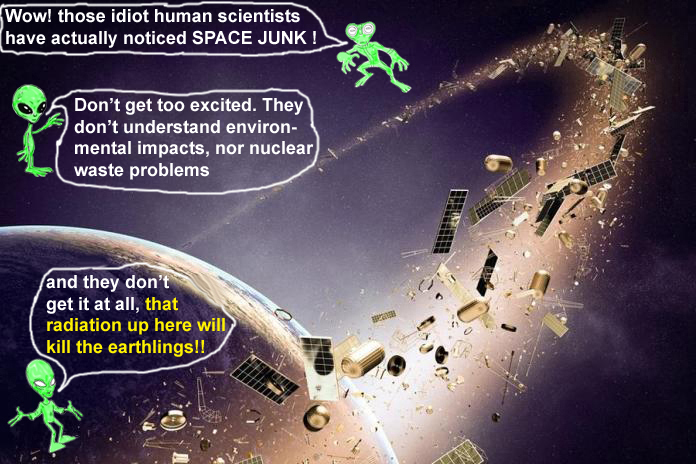
Now today,” Gagnon said, “NASA, the military, and some in the aerospace industry, are worriedly tracking the growing amount of space debris orbiting the Earth. They are beginning to talk about the ‘Kessler syndrome’ that predicts cascading collisions due to increasingly crowded orbits which could at some point make getting a rocket through the debris field encircling our planet nearly impossible.”
“So as the nuclear industry cavalierly undertakes their plan for nuclear-powered mining colonies on the Moon, Mars and other planetary bodies they easily brush off any concerns about impacts,” said Gagnon. “As they make plans to test nuclear reactor rocket engines just over our heads in Lower Earth Orbits (LEO) they discount any concerns of environmental impacts if the tests go wrong. They never talk about the Department of Energy laboratories where these nuclear devices are fabricated with a long history of radioactive contamination of workers, local water tables and air contamination.”
“The space nuclear industry is flying blind—blinded by its devotion to profit and power,” Gagnon declared. “Their hard hearts have no concern about the negative impacts they might create on Earth, to the people and environment, nor any long-term impacts their high-tech nuclear power ‘visions’ might have in space. Their vision is so myopic, so limited, so tunnel like, because their minds are closed to the idea that space is alive and is an environment that we humans who are on this tiny spinning orb called Earth live in. They are colonizers, much like the long-history of earth-bound colonizers, who have raped and pillaged our lovely planet home.”
The Global Network Against Weapons & Nuclear Power in Space (www.space4peace.org) founded 30 years ago, in 1992, at a conference in Washington, D.C. is the leading organization internationally challenging the weaponization and use of nuclear power in space. In its description of the August 4th webinar, the American Nuclear Society asserts: “For decades, nuclear energy has played a role, sometimes minor and sometimes major, in humanity’s exploration and research of outer space. Many space experts, scientists, astronauts, and researchers believe that nuclear energy can fundamentally change how we live and work in extraterrestrial environments and that some missions, projects, and endeavors are nearly impossible without the involvement of nuclear technologies. As federal funding is being applied to nuclear projects for various space-based applications and opportunities, an expert panel will discuss how nuclear companies and researchers are poised to capitalize.”
A video recording of the webinar can also be viewed at https://www.ans.org/webinars/view-space2022/
Among the panelists was Michael Anness who, as biographies on the webinar website described, “leads the development new nuclear fuel products and services at Westinghouse Electric Company.” He has been a licensed nuclear reactor operator, it says. Anness spoke of space nuclear projects of Westinghouse Electric, based in Pittsburgh, Pennsylvania, including “microreactors” that would provide “fission surface power.” Anness said: “I’m kind of a fuel guy so I believe fuel is an enabling platform for space nuclear.”
Also on the panel was Kate Kelly, director for Space and Emerging programs at Lynchburg, Virginia-based BWXT Advanced Technologies and, previously, at BWX was “the Advanced Nuclear Systems Program Manager focused on the development of nuclear project to promote the company’s R&D interests in advanced manufacturing and nuclear thermal propulsion technologies.” She spoke about an “inflection point” on the use of nuclear power in
space having arrived. Said Kelly: “Over the last several years there’s been this re-emerging interest and investment by the government in fission systems for in-space power and propulsion.”
The sixth participant in the webinar was Alex Gilbert who has “expertise in space mining, nuclear innovation, energy markets and climate policy,” says his biography on the webinar website. “As Director of Space & Planetary Regulation at Zeno Power [based in Washington, D.C.], Alex oversees regulatory approvals for space launch, maritime, and terrestrial applications of radioisotope power systems…He was lead author of the U.S. Advanced Nuclear Energy Strategy, which outlined how government and industry can establish U.S. leadership in next generation nuclear reactor markets.”
Gilbert said “we are at a unique moment. I call it a space opportunity.” “He said “we could actually see exponential growth. Right now the space economy is around $400 billion globally. By the middle of the century it could be $4 trillion.” This expansion is a result of factors including a “resurgence in science and exploration and defense activities…and commerce. That is what is driving the interest in space nuclear technologies.” The American Nuclear Society describes itself as comprised of 10,000 members dedicated to “exploring possibilities within the realm of nuclear science and technology.”
King recounted that “I’ve been in and around the space nuclear community for quite a while, ever since 1997, for about 25 years. I remember it was space nuclear that got me into nuclear,” and being told by a nuclear engineer advisor that “space nuclear is going to be the future.”
Nuclear Free Local Authorities support dry storage for safety at Hinkley plant
In a rare example of synergy, the Nuclear Free Local Authorities has
written in support of a proposal by the developer of Hinkley Point C, EDF
Energy, to change the storage of spent fuel at the new plant from wet to
dry.
The NFLA was responding to a consultation called by the Environment
Agency when EDF submitted a request to change one of its agreed operational
conditions relating to storage. The NFLA has always been concerned at the
dangers attendant to storing spent nuclear fuel in cooling ponds and feels
that dry storage is better.
Fuel stored in ponds at nuclear plants in
Ukraine have come under threat in recent months, with fears that
bombardment could release radioactivity. Speaking about the NFLA
submission, Chair Councillor David Blackburn said: “The NFLA remains
opposed to new civil nuclear plants, including Hinkley Point C, but the
reality is that nuclear plants produce waste, and our practical concern is
to ensure that this is stored as safely as possible.
“Our policy on the
storage of nuclear waste differs from that of the UK Government. We favour
the ongoing near-site, near-surface storage of waste, to eliminate the need
for rail transportation and to ensure that waste can be actively monitored,
rather than the government’s preferred ‘dispose and disregard’ approach
of depositing waste in an underground or undersea dump and forgetting about
it.
“The situation at Hinkley Point C may remain unclear for some time.
EDF Energy has announced that the plant will not now be completed until the
summer of 2027 at the earliest, and very possibly later, and the company
will now be required to carry out a redesign of its reactor for safety
reasons following the accident at Taishan-1 in China last year.”
NFLA 17th Aug 2022
Storage of nuclear wastes and of dead nuclear reactors is becoming a political nightmare

Beyond electricity production, the use of nuclear energy also creates
problems related to the storage of spent nuclear fuel and waste, which
brings an additional layer of complexity to the question. Storage of
nuclear fuel requires facilities in geological locations which must fulfil
demanding criteria.
There are only so many places which fulfil these
criteria. Furthermore, long-term fuel storage will create commitments (and
costs) for hundreds of years.
It is easy to imagine how nuclear waste
storage can easily turn into a political nightmare – one can look at the
options in Belgium where the neighboring Luxembourg quickly protested
against storage too close to the border between the two countries; or to
the United States where nuclear storage facilities are planned on
indigenous lands.
A new politics of waste is emerging – the power plants
themselves. As the IEA demands an urgent new round of investment in ageing
nuclear sites, what are we to do with the old ones? The UK newspaper the
Independent very recently ran a story about one such site, Douneray, in the
North of Scotland. It first opened in 1955 and ceased operations in 1994.
And yet, local campaign groups have never been as active. Why? As a 2020
report by the Nuclear Decommissioning Authority puts it, the Douneray site
will be ready for other purposes in the year…2333. As old sites come to
an end, new politics of decommissioning begin.
PACCS research (accessed) 13th Aug 2022
Ontario nuclear waste site selectors delay announcement until 2024
Nishnawbe Aski Nation chiefs opposed to storage site based on environmental grounds
Northern Ontario Business Staff, 15 Aug 22,
The site selectors for a proposed underground nuclear waste repository in Ontaro say they won’t make a decision on a preferred location until the fall of 2024.
The Nuclear Waste Management Organization (NWMO) is pushing back the naming of a site by one year, attributing it to a series of pandemic-related lockdowns that hampered their work in the selection process.
Wabigoon Lake Ojibway Nation-Ignace area, an hour’s drive east of Dryden, in northwestern Ontario and the Saugeen Ojibway Nation-South Bruce area in southern Ontario are the two communities on the short list to host the deep geological repository.
Last week, 49 chiefs of the Nishnawbe Aski Nation (NAN) passed a resolution at their annual conference in Timmins opposing plans to haul and store nuclear waste in the region. Though the potential site of the repository is not in NAN’s treaty area, leadership hold concerns about the downstream impact of such a facility in the waterways of their traditional territories……………………………………….
Since 2010, NWMO has been engaged in this process to find a permanent storage place for the long-term management of Canada’s used nuclear fuel……………..
The organization said the plan will only proceed in a host area with “informed and willing hosts, where the municipality, First Nation and Métis communities, and others in the area are working together to implement it.”………………
FOCUS: Respite for Japan as radioactive Fukushima water accumulation slows
https://english.kyodonews.net/news/2022/08/d10f63c6bde0-focus-respite-for-japan-as-radioactive-water-accumulation-slows-in-fukushima.html By Takaki Tominaga, KYODO NEWS – Aug 12, 2022 Tanks containing treated water at the crippled Fukushima nuclear power plant are likely to reach capacity around the fall of 2023, later than the initially predicted spring of next year, as the pace of the accumulation of radioactive water slowed in fiscal 2021
The slowdown, based on an estimate by operator Tokyo Electric Power Company Holdings Inc., gives some breathing space to Prime Minister Fumio Kishida’s government if any roadblocks are thrown up in the plan to discharge the treated water into the sea starting around spring next year.
China and South Korea as well as local fishing communities that fear reputational damage to their products remain concerned and have expressed opposition to the plan.
About 1.30 million tons of treated water has accumulated at the Fukushima Daiichi plant following the 2011 nuclear disaster, and it is inching closer to the capacity of 1.37 million tons.
The water became contaminated after being pumped in to cool melted reactor fuel at the plant and has been accumulating at the complex, also mixing with rainwater and groundwater.
According to the plan, the water — treated through an advanced liquid processing system, or ALPS, that removes radionuclides except for tritium — will be released 1-kilometer off the Pacific coast of the plant through an underwater pipe.
The International Atomic Energy Agency has been conducting safety reviews of the discharge plan and Director General Rafael Grossi says the U.N. nuclear watchdog will support Japan before, during and after the release of the water, based on science.
An IAEA task force, established last year, is made up of independent and highly regarded experts with diverse technical backgrounds from various countries including China and South Korea.
Japan’s new industry minister Yasutoshi Nishimura says the government and TEPCO will go ahead with the discharge plan around the spring of 2023 and stresses the two parties will strengthen communication with local residents and fishermen, as well as neighboring countries, to win their understanding.
Beijing and Seoul are among the 12 countries and regions that still have restrictions on food imports from Japan imposed in the wake of the massive earthquake and tsunami triggered nuclear meltdowns at the Fukushima plant in March 2011.
“We will improve our communication methods so we can convey information backed by scientific evidence to people both at home and abroad more effectively,” Nishimura said after taking up the current post in a Cabinet reshuffle Wednesday.
Kishida instructed Nishimura to focus on the planned discharge of ALPS-treated water that will be diluted with seawater to one-40th of the maximum concentration of tritium permitted under Japanese regulations, according to the chief of the Ministry of Economy, Trade and Industry.
The level is lower than the World Health Organization’s recommended maximum tritium limit for drinking water.
TEPCO will cap the total amount of tritium to be released into the sea as well.
Meanwhile, the Kishida government has decided to set up a 30 billion yen ($227 million) fund to support the fisheries industry and said it will buy seafood if demand dries up due to harmful rumors.
Fishing along the coast of Fukushima Prefecture, known for high-quality seafood, has been recovering from the reputational damage caused by the nuclear accident but the catch volume in 2021 was only about 5,000 tons, or about 20 percent of 2010 levels.
Construction of discharge facilities at the Fukushima plant started in August, while work to slow the infiltration of rain and groundwater was also conducted.
TEPCO said it was able to reduce the pace of accumulation of contaminated water by fixing the roof of a reactor building and cementing soil slopes around the facilities, among other measures, to prevent rainwater penetration.
The volume of radioactive water decreased some 20 tons a day from a year earlier to about 130 tons per day in fiscal 2021, according to the ministry.
The projected timeline to reach the tank capacity has been calculated based on the assumption that about 140 tons of contaminated water will be generated per day, according to METI.
However, storage tanks could still reach their capacity around the summer of next year if heavy precipitation or some unexpected events occur, the ministry said.
As part of preparations for the planned discharge, the Environment Ministry has started measuring tritium concentration at 30 locations on the surface of the sea and seabed around the Fukushima plant, four times a year.
Similarly, the Nuclear Regulation Authority has increased the number of locations it monitors tritium levels by eight to 20. The Fisheries Agency has started measuring tritium concentration in marine products caught along the Pacific coast stretching from Hokkaido to Chiba Prefecture.
Given that it is expected to take several decades to complete the release of treated water, NRA and METI officials urged TEPCO to further curb the generation of contaminated water at the plant.
“We want TEPCO to step up efforts so as to lower the volume of the daily generation of contaminated water to about 100 tons or lower by the end of 2025,” a METI official said.
Germany continues to close down its last remaining nuclear reactors
Germany’s nuclear power operators will continue to decommission the
country’s last three remaining plants, even as the government weighs
whether to keep the facilities running over the winter. E.ON, RWE and EnBW
confirmed they had not procured additional fuel to extend the life of the
Isar 2, Emsland and Neckarwestheim plants beyond the end of the year, when
they are legally-mandated to close.
FT 12th Aug 2022
https://www.ft.com/content/0257588e-0ebe-4696-8c4e-77f0a192b616
China also discharges triated water from its nuclear power stations
 | Bob commented on Japan extremely selfish to insist on discharging nuclear wastewater into sea August 8, 2022 TOKYO, Aug. 10 (Xinhua) — Japan’s Tokyo Electric Power Company Holdings Inc. (TEPCO) has recently started …Neither you, nor China, whose official viewpoint this is, ever admits that China discharges tritiated water into the sea from its own nuclear plants and that the amount of this discharge exceeds that proposed for the ALPS treated tritiated water which has then been mixed with sea water before discharge (otherwise, the water will be so pure that its purity will poison sea life) on an annual basis. They also deliberately omit the fact that the annual discharge rate will be less than that of the Fukushima Daiichi Nuclear Power Station during its 40 year operational lifetime. A much better assessment is discussed in this other recently posted article here https://english.kyodonews.net/news/2022/08/d10f63c6bde0-focus-respite-for-japan-as-radioactive-water-accumulation-slows-in-fukushima.html |
Elon Musk’s SpaceX now leaving junk in Australia’s backyard
Independent Australia, By Darren Crawford | 10 August 2022 After a SpaceX capsule crashed onto an Australian farm, we’re left wondering if Elon Musk will clean up his own mess, writes Darren Crawford.
ACCORDING TO the ABC, the Australian Space Agency (ASA) has confirmed that debris found in a sheep paddock in the Snowy Mountains region of New South Wales, Australia, belongs to Elon Musk’s SpaceX Dragon capsule, which was launched in November 2020.
Local authorities were alerted after nearby residents heard a loud bang earlier this year on 9 July. It is now thought the bang was the noise of the capsule re-entering the Earth’s atmosphere. New South Wales Police and the ASA visited one of the sites on Saturday 31 July and confirmed that two of the pieces are from a SpaceX mission.
According to the ABC, the ASA is continuing to engage with its counterparts in the U.S. as well as other parts of the Commonwealth and local authorities.
An ASA spokesperson said:
“The agency is operating under the Australian Government Space Re-entry Debris Plan which outlines roles and responsibilities for key Australian government agencies and committees in supporting the response to space re-entry debris.”
So who is responsible for the clean-up?
According to the ABC report, the space debris will remain in place for now. However, the pieces could eventually be returned to U.S. soil.
Australian National University’s Institute of Space deputy director Dr Cassandra Steer said there was an obligation under international space law to repatriate any debris to the country from where it originated.
Dr Steer went on to confirm that “Any space object, or part thereof, has to be repatriated” and should be sent back to the U.S. However, SpaceX has only confirmed that the debris is theirs and is yet to commit to the costs associated with returning it to the U.S.
Dr Steer added:
“We have clarity in terms of lines of responsibilities. The U.S. is liable for any damage that is caused by this space debris… and Australia could go to the U.S. and seek some form of compensation if there are any costs involved in cleaning it up.”
Elon Musk and SpaceX have a poor environmental record
As reported earlier this year, Elon Musk and fellow billionaires Richard Branson and Jeff Bezos are currently participating in a dick-swinging rocket contest to see who can get to Mars first. Suffering from massive rocket envy, these three men are speeding up the climate change process by increasing the amount of carbon dioxide and other gases in the Earth’s atmosphere with every launch.
The Guardian reports that one rocket launch alone can release up to 300 tons of carbon dioxide into the Earth’s upper atmosphere and it can stay there for years. This is in comparison to a standard long-haul flight which produces three tons of carbon dioxide per passenger/per flight, into the lower atmosphere.
These impacts do not include what happens on the ground during a launch, including the heat and noise pollution in the immediate area, or the impacts on local wildlife.
There appear to be few controls put in place to protect the planet and its inhabitants from falling space junk by Elon Musk and SpaceX. In March 2021, a SpaceX rocket blew up on launch and debris was scattered throughout the protected area. According to a local non-profit environmental group, it took three months to clean up the mess.
According to the report, launch site ditches on SpaceX land and public property in the U.S. have dumped runoff water directly into the tidal flats threatening local fish breeding grounds, and public beaches and roads have been closed for longer than the agreed times.
Finally, at an earlier launch in 2018, a jettisoned SpaceX booster rocket missed its target drone ship a few hundred kilometres out to sea and destroyed itself on impact slamming into the ocean at 500 km/hour.
So, will Elon Musk and SpaceX clean up their mess down under?
This is the great unknown, as Elon Musk’s environmental record in relation to his SpaceX program is extremely poor.
It is also clear, as can be seen by his recently abandoned Twitter purchase, that Elon Musk doesn’t care who he burns, or how hard he burns them, to get his own way.
It is apparent that Elon Musk sees the increasing amount of pollution produced by his SpaceX endeavours as little more than collateral damage and less of a threat to our civilisation. Similarly, he doesn’t care whose backyard he trashes (as long as it’s not his, obviously).
Instead of turning his immense intelligence (and wealth) to solving our current problems, Elon Musk (and his billionaire space mates) seek to exacerbate these problems by polluting the planet further.
It will be interesting to see whether he does the right thing by the Australian Government and its people and pays for the clean-up of his mess.
Update, 10 August 2022:
The ABC is reporting that SpaceX has confirmed that the space debris spread throughout an Australian sheep paddock is indeed remnants of their Dragon Capsule and is sending a team down under to investigate………………………….
What was not stated was whether any ASA or government agencies were aware of or engaged in any of SpaceX’s planning. Space Law Lecturer at UNSW Canberra, Duncan Blake, wondered if they had coordinated with Australian agencies prior to their risk assessment — “If they didn’t, then that seems somewhat arrogant to make a decision that affects Australia without consulting Australians,” he said.
There has been no mention of the cost of removal or the debris, or as to whether Elon Musk and SpaceX will be more honest and open in the future and advise all Australians about the potential damage falling SpaceX junk may cause in their country.
https://independentaustralia.net/environment/environment-display/elon-musks-spacex-now-leaving-junk-in-our-own-backyard,16650
-
Archives
- October 2026 (129)
- September 2026 (339)
- August 2026 (330)
- July 2026 (355)
- June 2026 (287)
- May 2026 (306)
- April 2026 (356)
- March 2026 (251)
- February 2026 (267)
- January 2026 (308)
- December 2025 (358)
- November 2025 (359)
-
Categories
- 1
- 1 NUCLEAR ISSUES
- business and costs
- climate change
- culture and arts
- ENERGY
- environment
- health
- history
- indigenous issues
- Legal
- marketing of nuclear
- media
- opposition to nuclear
- PERSONAL STORIES
- politics
- politics international
- Religion and ethics
- safety
- secrets,lies and civil liberties
- spinbuster
- technology
- Uranium
- wastes
- weapons and war
- Women
- 2 WORLD
- ACTION
- AFRICA
- Atrocities
- AUSTRALIA
- Christina's notes
- Christina's themes
- culture and arts
- Events
- Fuk 2022
- Fuk 2023
- Fukushima 2017
- Fukushima 2018
- fukushima 2019
- Fukushima 2020
- Fukushima 2021
- general
- global warming
- Humour (God we need it)
- Nuclear
- RARE EARTHS
- Reference
- resources – print
- Resources -audiovicual
- Weekly Newsletter
- World
- World Nuclear
- YouTube
-
RSS
Entries RSS
Comments RSS

