Judicial review on the dumping of Hinkley Point C radioactive mud
A group campaigning against the dumping of sediment from the site of a
decommissioned nuclear power station has succeeded in securing a judicial
review challenging the legality of a licence to dump waste into the River
Severn.
The Save the Severn Estuary / Cofiwch Môr Hafren campaign involves
the Geiger Bay coalition and groups from the English side of the estuary
and is seeking to halt the dumping of sediment from the construction of the
Hinkley C power station in the Marine Protected Area (MPA) near Portishead,
Bristol.
In 2018, EDF, which is building the plant, dumped mud and sediment
off the coast of Cardiff despite fierce objections. The Campaign group says
that millions of tonnes of contaminated mud and sediment will contaminate
the waters and beaches used by local communities, and that by choosing to
ignore legal safeguards, energy giant EDF is threatening the health of
families and animal life.
Save the Severn Estuary / Cofiwch Môr Hafren say
that EDF are now trying to avoid further opposition and negative media
attention by moving the operation to Portishead, Bristol as a ‘soft
touch’ location after initially applying for a new license to dump more
waste off the Cardiff coast. At the judicial review on 8 March the campaign
group will challenge the legality of the licence granted by the Marine
Management Organisation (MMO), stating that several important procedures
haven’t been met and that an alternative to dumping at Portishead should
be adopted.
Nation Cymru
Nation Cymru 12th Feb 2022
Hinkley nuclear mud

500 000 tonnes of Hinkley mud are now to be dumped at Portishead. Thisdumping was licensed by @The_MMO – the English Marine Management Organisation – on the basis of EDF’s skimped EIA that brushed over the key issues of *what* contaminants, and where they *go*.
@cianciaran 6th Feb 2022
The nuclear power dilemma: where to put the lethal waste?

The nuclear power dilemma: where to put the lethal waste
France is exploring new ways to dispose of radioactive materials but public opposition is as fierce as ever, Ft.com Anna Gross in Chooz and Sarah White in Bure 6 Feb 22,
Every morning, Benoit Gannaz places a small black device in his breast pocket to make sure his work is not killing him. Like every worker at the Chooz A nuclear power facility in northern France, he carries a detector that measures ionising radiation levels at all times. The reactor was turned off more than three decades ago and the most hazardous materials removed soon after, but nobody here is taking any chances — least of all the project manager overseeing the challenging and lengthy process of decommissioning Chooz A. Gannaz’s job is to ensure the remaining hazardous materials on site are removed and stored away safely now that the lifecycle of the reactor is at an end. ………….
…………….. as momentum grows for a new generation of nuclear power plants in Europe and elsewhere, there is little discussion of the huge costs and complexity of dismantling the plants at the end of their approximately 50-year lifespan. And nobody has yet given a satisfactory answer to the question of what to do with thousands of metric tonnes of high-level nuclear waste, some of which can remain radioactive, and thereby lethal, for up to 300,000 years.
A quarter-million metric tonnes of spent fuel rods are believed to be spread across 14 countries worldwide, mostly collected in cooling pools at closed-down nuclear plants, as engineers and waste specialists puzzle over how to dispose of them permanently. Many believe these are sitting ducks for terrorist organisations and that they could potentially cause catastrophic spills or fires. The cost of maintaining these sites can be extraordinary, and last for decades. Sellafield in the UK, for example, contains the largest stock of untreated nuclear waste on earth, including 140 tonnes of plutonium. Though the plant was shut down in 2003, it remains the biggest private employer in Cumbria. More than 10,000 people continue to undertake a colossally expensive clean-up that is expected to take more than 100 years and cost above £90bn.
“Nowhere in the world has anyone managed to create a place where we can bury extremely nasty nuclear waste forever,” says Denis Florin, partner at Lavoisier Conseil, an energy-focused management consultancy in Paris. “We cannot go on using nuclear without being adult about the waste, without accepting we need to find a permanent solution.” With the Chooz A reactor, France is attempting to do just that — and in the process create a prototype for how decommissioning could be done more efficiently. If it succeeds, it could help convince environmentalists that nuclear power has a part to play in creating a greener planet. But there is still a heavy dose of popular opposition to the best option there is on the table for the waste: burying it.
The legacy of a spent reactor The challenge with cleaning up Chooz A is not so much the site itself as the materials once contained within. The facility was shut in 1991, and within three years 99.9 per cent of the most highly radioactive materials had been evacuated to a specialist plant 620km away in La Hague, in the north-west of France. According to French law, the most highly radioactive elements of a plant, the fuel and the rods, should be removed as quickly as possible once the plant has been shut down — in stark contrast to policy in most other parts of the world, where the most hazardous products are handled last.
Decommissioning a reactor
Click on the numbers to see the process in sequence (Interactive graphic on original)
Some of these products have since been recycled. In a process pioneered by France, many of the uranium, plutonium and fission chemicals have been reprocessed into new fuel at the La Hague site, while waste chemicals that cannot be reused have been vitrified, or turned into glass, for short-term storage in shallow sites underground. Though EDF says the 23,000 tonnes of spent fuel it has reprocessed at La Hague are enough to power France’s nuclear fleet for 14 years, critics point to the fact that the fuel can only be reused once and the process itself creates yet more radioactive waste, without providing a long-term solution.
The dismantling of the rest of Chooz A began in 2007, after it received legal permission from the state, and is due to be completed by 2024, at a total cost of €500mn. But the most hazardous waste removed from the site will remain radioactive for centuries to come, and perhaps millennia. “Only a state or a religion will live as long as the waste, and maybe not even them,” says Florin. Countries have toyed with ejecting such waste into space or burying it deep under the seabed, but these ideas were eventually deemed either impossible or too dangerous. Only one long-term solution is broadly considered safe and feasible: deep geological repositories, where radioactive material can be stored several hundred metres below ground in formations of clay, rock salt and granite that have not moved for millions of years.
But no one has yet managed to do it. The US has come close; it pumped $15bn into a project to bury waste beneath Yucca Mountain in Nevada, but the initiative was eventually abandoned in the face of intense and sustained public backlash. Similar opposition from local communities has dogged attempts to find burial sites in Germany, the UK and Japan. Some countries have earmarked provisional sites to try again. After a decades-long planning and negotiation process with a remote island community, Finland will bury its radioactive waste in copper tubes in a tomb 1,400 feet below the granite bedrock in Olkiluoto island. The burial site is expected to begin operation in 2023.
France has identified its own site, just outside Bure, 300km east of Paris, in which radioactive waste might be entombed. Consisting of a research centre sitting above a web of tunnels and vaults almost 500 metres below ground, the Cigeo project has so far cost €2.5bn and involved 25 years of research.
The French government is due to decide this year whether to declare the site officially viable as a storage option, setting in motion another sequence of construction and authorisation stages that would lead to the first toxic samples being deposited between 2035 and 2040. The ambition is to seal all the tunnels irreversibly from 2150, with residues encased in blocks of cement or steel within the ultimate barrier — a subterranean layer of clay with the ideal properties to entrap any material that eventually seeps out. This seeping material should lose its radioactive qualities within the 100,000 years it would take them to permeate other strata,,,………………https://www.ft.com/content/246dad82-c107-4886-9be2-e3b3c4c4f315?segmentid=acee4131-99c2-09d3-a635-873e61754ec6
A big pile of Plutonium – UK reprocessing ceases, leaving deadly waste and no plan

in the end, reprocessing became a commercial venture rather than producing anything useful. Nine countries sent spent fuel to Sellafield to have plutonium and uranium extracted for reuse and paid a great deal of money to do so. In reality, very little of either metal has ever been used because mixed oxide fuels were too expensive, and fast breeder reactors could never be scaled up sufficiently to be economic.
UK reprocessing ceases, leaving deadly waste and no plan
A big pile of PU — Beyond Nuclear International https://beyondnuclearinternational.org/2022/02/06/a-big-pile-of-pu/120 tons of plutonium is legacy of Britain’s dirty decades of reprocessing, By Paul Brown, The Energy Mix
Seventy years after the United Kingdom first began extracting plutonium from spent uranium fuel to make nuclear weapons, the industry is finally calling a halt to reprocessing, leaving the country with 120 tons of the metal, the biggest stockpile in the world. However, the government has no idea what to do with it.
Having spent hundreds of billions of pounds producing plutonium in a series of plants at Sellafield in the Lake District, the UK policy is to store it indefinitely—or until it can come up with a better idea. There is also 90,000 tons of less dangerous depleted uranium in warehouses in the UK, also without an end use.
Plans to use plutonium in fast breeder reactors and then mixed with uranium as a fuel for existing fission reactors have long ago been abandoned as too expensive, unworkable, or sometimes both. Even burning plutonium as a fuel, while technically possible, is very costly.
The closing of the last reprocessing plant, as with all nuclear endeavours, does not mean the end of the industry, in fact it will take at least another century to dismantle the many buildings and clean up the waste. In the meantime, it is costing £3 billion a year to keep the site safe.
Perhaps one of the strangest aspects of this story to outside observers is that, apart from a minority of anti-nuclear campaigners, this plutonium factory in one of prettiest parts of England hardly ever gets discussed or mentioned by the UK’s two main political parties. Neither has ever objected to what seems on paper to be a colossal waste of money.
Continue readingFrance is exploring new ways to dispose of radioactive materials but public opposition is as fierce as ever

“There may be a price [communities] are willing to accept in order to stomach the waste and its risks, but we don’t know what that price is yet,” … “If it’s high enough, it will ultimately add to the cost of disposal.” Local authorities have poured millions of euros of subsidies and compensation into the area to support the project
The nuclear power dilemma: where to put the lethal waste
France is exploring new ways to dispose of radioactive materials but public opposition is as fierce as ever, Ft.com Anna Gross in Chooz and Sarah White in Bure 6 FEB 22,
”………………….Resistance is fissile Cigeo has attracted the same kind of vocal opposition found at other potential burial sites. And, as a result Bure, a village of fewer than 100 inhabitants, has become a battleground where protesters have regularly clashed with police over the future of the site. Demonstrators have set up a “house of resistance” in Bure that has become a magnet for anti-nuclear protesters around the country. The former barn is equipped with a projection room, mattresses to welcome guests and a cosy communal kitchen.
Campaigners say the Bure site has become representative of a broader cause. “Beyond the waste, it’s nuclear production above all else that worries us,” says a 29-year-old jurist who gave his name as Antoine, one of a handful of campaigners manning the fort on a snowy February morning. “It’s a supposedly low carbon source of energy, but you’ve got to build the reactors . . . it is such a dangerous and destructive solution.” Yet the state holds that the undeniable risks of nuclear energy are outweighed by its potential benefits as a cost-effective way of cutting CO2 emissions. According to a report last year from French grid operator RTE, France’s cheapest way to reach carbon neutrality by 2050 would involve building 14 new reactors. Under the scenarios RTE presented, if France built no new nuclear reactors and relied exclusively on expanding renewables and extending the lifespan of existing nuclear, this would cost €10bn more per year than other options including new reactors, with the cost of decommissioning factored into the final bill.
But that may not factor in the costs of convincing French citizens to host such facilities in their backyards. Bure resident Anne-Marie Henn, a retiree, says the project has forced her and her artist husband Jacques to give up on their dream of creating a painting atelier in an annex to their home. “We’d like to leave, but our house isn’t worth anything any more,” she says. Ed Lyman, senior global security scientist with the Union of Concerned Scientists, who has spent decades researching nuclear power safety, says the science behind burying waste is robust, and the dangers of corrosion or leakage minimal. But there remain real risks for the public, he says, such as accidents happening when materials are transported to the site.
“There may be a price [communities] are willing to accept in order to stomach the waste and its risks, but we don’t know what that price is yet,” he adds. “If it’s high enough, it will ultimately add to the cost of disposal.” Local authorities have poured millions of euros of subsidies and compensation into the area to support the project and residents. In Bure, that has translated into snazzy lampposts lining every street alongside the barns and stone houses; households have also got fibre optic internet connections and sanitation networks have been improved. “We’ve got to deal with this crap,” Henn says. “At the very least we can benefit a bit from [subsidies].”
But the concerns of many communities go way beyond immediate dangers to more existential questions: how can we ensure that not just our children and grandchildren, but people living thousands of years in the future have the knowledge and understanding to handle it responsibly? And how can we be sure that the storage containers we have developed now will stand the test of time? “What we’ll be getting here is the really dangerous core of the waste,” Henn says, adding that it was “the generations to come” that worried her.
Andra, the French state agency responsible for nuclear waste management, is considering ways to warn future generations of what lies below Bure — perhaps by inscribing microscopic information on a hard disk of sapphire, designed to withstand erosion, should the site be forgotten. “Even if we lose our collective memory, the storage site will be safe,” says spokesperson Audrey Guillemenet. If these kinds of innovations fail to impress French lawmakers and the site does not win approval, that leaves the government with a problem that goes far beyond the billions spent on construction. “Some 50 per cent of the [nuclear] waste destined to come here eventually already exists,” says Guillemenet. Forget the next generation of power plants; the decades-old materials Gannaz and his predecessors have removed from Chooz A are a problem that needs a solution. If it is not Bure, then what is it? https://www.ft.com/content/246dad82-c107-4886-9be2-e3b3c4c4f315?segmentid=acee4131-99c2-09d3-a635-873e61754ec6
In New Mexico, two Bills to block the storage of high level nuclear waste

Efforts by New Mexico lawmakers to block the storage of high-level nuclear
waste in the state built momentum this week as two bills in the House and
Senate advanced in legislative committees.
Senate Bill 54 and House Bill
127 contain identical language that would prohibit State agencies from
issuing permits for high-level nuclear waste storage facilities, introduced
in direct opposition to the project proposed by Holtec International in
southeast New Mexico near Carlsbad and Hobbs. The Holtec project would see
about 100,000 metric tons of spent nuclear fuel rods from generator sites
across the U.S. shipped via rail to the location on about 1,000 acres in a
remote area by the Eddy-Lea county line.
Carlsbad Current-Argus 5th Feb 2022
Nuclear waste host communities exploited – by blackmail, ”noble sacrifice” and greed
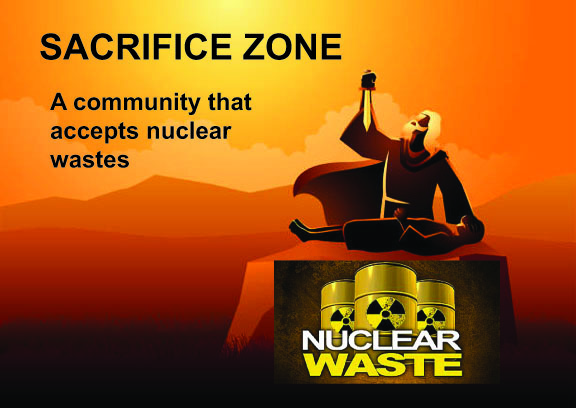
Governments prefer a distant disadvantaged, impoverished, preferably indigenous community to host nuclear wastes. Governments then promise the health, education etc services that they should be providing anyway.
Then there’s the noble goal of ”sarifice” – providing a benefit to the nation.
Then there’s greed, as selected local dignitaries and businesses get attractive bribes to promote the dump plan to the community.

Eventually, the community becomes dependent on the nuclear industry, – which happens also in other situations, such as in nuclear energy and nuclear weapons plants.
Decommissioning is just the beginning of the huge nuclear legacy problem

Nuclear power concerns outlast decommissioning, Great Lakes Echo, By Cameryn Cass 4 Feb 22,
Editor’s note: This is part of a package of two articles and a podcast about nuclear power in Michigan.
As Michigan and other states gradually move away from coal and other brown energy sources, there’s growing interest in carbon-free alternatives, including nuclear energy,
As Michigan and other states gradually move away from coal and other brown energy sources, there’s growing interest in carbon-free alternatives, including nuclear energy, which some advocates call a “clean alternative” that now fuels 30% of Michigan’s total electricity.
One nuclear plant in the state, Big Rock Point in Charlevoix closed in 1997 and has been fully decommissioned. In the spring of 2022, the Palisades Nuclear Plant in Southwest Michigan’s Van Buren County will close because of a “business decision.”
Michigan also has the Fermi Nuclear Power Plant in Newport, near Monroe, and the Donald C. Cook Nuclear Power Plant in Berrien County’s Bridgman, according to the Department of Environment, Great Lakes and Energy.
With Palisades and other plants in the Great Lakes region scheduled to shut down in the coming decades, more people are considering the long-term impacts of this energy source.
After decommissioning, radioactive waste remains on-site, said Susan Chiblow, an Indigenous environmental scholar in Ontario.
The waste stays in the environment for trillions of years, so calling nuclear power clean is propaganda, she said.
In short, risks don’t disappear when a plant is decommissioned, a process that can take up to 60 years, said Edwin Lyman, the nuclear safety project director at the Union of Concerned Scientists, a nonprofit science advocacy organization based in Massachusetts.
Although closed plants no longer have to worry about accidents post shut-down, their operators remain responsible for managing the radiated materials and spent nuclear waste, Lyman said.
He said waste now stored on-site is vulnerable to security threats and climate disasters.
For five years, the waste is kept in large swimming pool-like structures where it’s mixed with water to keep it cool. Then, it’s transferred to dry casks, he said.
The U.S. Department of Energy is technically responsible for removing the waste, but it has nowhere to bring it, Lyman said.
“It’s going to be a long-term storage problem for any nuclear plant that’s shut down,” Lyman said……………………………
Thirteen states have banned construction of new nuclear plants.
In the Great Lakes region, Minnesota adopted its ban in 1994. ……
Because the Great Lakes account for one-fifth of the world’s freshwater, Chiblow and other environmentalists are especially interested in protecting it……….c
Nuclear Free Local Authorities (NFLA) demands deadly plutonium stockpile be placed ‘out of use’

The Nuclear Free Local Authorities (NFLA) of the UK and Ireland has called for Britain’s deadly Plutonium stockpile to be placed ‘out of use’, for an early end to reprocessing, and for greater accountability and more transparency about the long-term management of radioactive materials arising from decommissioning operations at the UK’s former nuclear power plants.
The Nuclear Decommissioning Authority (NDA) is the agency charged with making safe and cleaning closed civil nuclear plants. It has just published a draft Business Plan for 2022-5 and invited comments.
In its response, the NFLA also expressed its disappointment that reprocessing at Sellafield did not end in 2020 as was originally promised and that there isstill no clear end date.
The NFLA also wants to see a comprehensive inventory of all radioactive materials created for each site, including those arising from decommissioning operations, and for local authorities to be consulted over arrangements for their transport and management.
NFLA 3rd Feb 2022
Bill To Ban Spent Nuclear Fuel Storage In New Mexico Passes House Committee

“It’s inconceivable why New Mexico has to be the dumping ground for the nation’s ill-advised investment in nuclear energy and nuclear weapons,” said Paul Gibson, co-founder of Retake Our Democracy. “The risk to our community is far greater than the benefit.”
Although the site is termed temporary, Holtec is seeking a 40-year license to operate there, which opponents say would make it permanent.
By SCOTT WYLAND, The Santa Fe New Mexican, 4 Feb 22, A bill clearly aimed at blocking Holtec International from building an underground storage site for spent nuclear fuel in southeastern New Mexico is moving forward.
The House Energy, Environment and Natural Resources Committee voted 5-4 to advance a bill that would ban the storage or disposal of spent nuclear fuel in the state — and would essentially kill Holtec’s plans to build a repository for this high-level radioactive waste in the Carlsbad area.
It now will go to the House Judiciary Committee.
A key point in the debate was whether the state has the authority to stop the federal government from approving what’s described as an interim storage site to keep the material until a permanent place is created.
Some lawmakers and regulators who back House Bill 127 say although the state can’t interfere with how the commission regulates the waste, it can block storage sites that could cause adverse environmental impacts.
The bill’s opponents argue the state still would be preempting the Nuclear Regulatory Commission’s authority in managing commercial nuclear waste. That simply is not allowed, no matter what criteria the state uses, they said.
But Sen. Jeff Steinborn, D-Las Cruces, who strongly supports the bill, said the state is well within its rights to say no to nuclear disposal sites that could contaminate vital resources, such as groundwater, and pose risks to communities when the waste is transported by rail across the country.
“Does New Mexico have the authority to do this? Yes, we do,” Steinborn said. “The Nuclear Regulatory Commission absolutely has primacy over regulating spent fuel. But what we’re talking here is the siting of this material, and our concerns on multiple grounds.”
Still, Rep. Larry Scott, R-Hobbs, contends the federal government’s power to regulate radioactive material overrides any state authority, including on environmental matters.
“I’m looking at your legislation, which seems to completely contradict that,” Scott said.
Last year, the state sued the federal government, contending the commission hadn’t done enough to ensure Holtec’s proposed site wouldn’t harm the environment, communities or the oil and gas industry in one of the nation’s richest fossil fuel regions.
Although the site is termed temporary, Holtec is seeking a 40-year license to operate there, which opponents say would make it permanent.
State Deputy Environment Secretary Rebecca Roose said no permanent disposal site has been established, so the waste has nowhere else to go.
“It’s more likely to stay there — the inertia will be to keep it there as opposed to move it someplace else permanent,” Roose said, “if and when a permanent facility is identified.”…………………
The bill’s proponents say it’s necessary to prevent a massive amount of high-level radioactive waste from coming to New Mexico and disproportionately affecting poor and minority communities.
“It’s inconceivable why New Mexico has to be the dumping ground for the nation’s ill-advised investment in nuclear energy and nuclear weapons,” said Paul Gibson, co-founder of Retake Our Democracy. “The risk to our community is far greater than the benefit.” https://ladailypost.com/bill-to-ban-spent-nuclear-fuel-storage-in-new-mexico-passes-house-committee/
No excuse. Australia’s nuclear regulator must not approve the government’s planned nuclear waste dump in a FLOOD-PRONE FARM.

Kimba flooding https://www.onlineopinion.com.au/view.asp?article=21824, By Peter Remta – 3 February 2022 The years of touting by the federal government and the responsible ministers of Kimba in South Australia as the perfect and inarguably superior location for the proposed national radioactive waste management facility have dramatically and quite suddenly disappeared. There is no doubt that the severe flooding caused by the recent heavy rains in South Australia which included the Kimba district is a serious and essential reason for immediately aborting the proposed management facility at Napandee farm near Kimba as the selected facility location |
From expert advice it is quite clear that Kimba as a whole – and not just Napandee – is far too dangerous to become the location for the holding of nuclear waste particularly as the results of the present flooding may take up to ten years to overcome without any further flooding
This is especially the case as nuclear isotopes are dispersed and travel freely in water which can affect and contaminate all the surrounding land for many centuries making it completely unusable
There cannot be any excuse by claiming that this flooding may be a once in a lifetime unexpected event as there had been extensive previous floods in the Eyre Peninsula over sixty years ago
More importantly the nature of the proposed facility is that it must be a completely safe and competent environment to hold nuclear waste for several centuries which the federal government claims to be the case as part of its planning
The government as the proponent of the Kimba nuclear waste facility cannot deny knowledge of floods – and also fires – as risks for the purposes of the safety requirements for management of nuclear waste in Australia
The advice by overseas experts is that these two major risks are far more pertinent to Australia than other countries with nuclear waste and consequently the regulatory bodies should or must include these risks within the Australian waste management framework and other applicable prescriptions and standards for the long-term management of Australia’s radioactive waste.
This must obviously include the storage or disposal of nuclear waste at suitably located and established facilities
l informed ARPANSA some eighteen months ago about the formal inclusion of these risks in its safety codes and the requirement for the long overdue start of the safety case for Kimba but the response was that it was not necessary at that stage
The prescriptive requirement is for a safety case for any nuclear installation be started at the very beginning as to why a specific site is considered worthy of investigation
The safety case is then updated as the site characterisation proceeds and if the site fails to live up to initial expectations then it should be abandoned.
This process is an important part of public engagement and if one waits until the end of the process then the argument for safety is less credible and the chance to generate public support has been lost (1)
It seems to be a case of falling asleep at the wheel as mentioned previously by the Hon. George Gear with regard to the regulatory role of ARPANSA (2)
Irrespective of the colourful presentations and nicely sounding spin by the Australian Nuclear Science and Technology Organisation (ANSTO) and even to some extent by ARPANSA there is no doubt that this is a serious breach of the safety requirements that should have been applied to Kimba at the outset
I think that ARPANSA will shortly hear from the UN Special Rapporteurs involved with this situation so that they can properly protect the human rights of the Kimba community.
It will be interesting to see how specifically ARPANSA and ANSTO will deal with the lack of a safety case from the beginning of the government’s proposals as this seems a major failing in proper and necessary safety regulation
As also previously pointed out the federal government should have given the Kimba community the opportunity and with the necessary funding for getting an independent assessment and review of the government’s proposals particularly as there had been so much vehement opposition to the proposed facility
I am not in any way suggesting that this would have stopped the flooding but there should have been proper and early regulation and oversight of the risks of floods and other calamities whether natural or man-made in a much stronger manner
It is now quite obvious that the Kimba region is completely unsuitable and inappropriate for the establishment of the national waste facility and ARPANSA as the regulator should immediately stop anything further being by or on behalf of the government to pursue the establishment of the facility
This should include the withdrawal and cancellation of ministerial declaration to select Napandee as the site for the proposed facility even if the necessary legislative changes may need to await the next parliament
At least this may give the community of Kimba and in fact the whole Eyre Peninsula some comfort and respite from their long-standing concerns.
Nuclear Free Local Authorities (NFLA) of the UK and Ireland call for clear commitment to employ LOCAL nuclear decommissioning workers.
The Nuclear Free Local Authorities (NFLA) of the UK and Ireland has called
for a clear commitment to offer work to local people on decommissioning
work when nuclear plants close.
In its response to the consultation just carried out by the Nuclear Decommissioning Authority (NDA), the agencycharged with making safe and clearing closed civil nuclear plants, on its
future Business Plan, the NFLA has called for support to be made available
to staff losing employment from a decommissioned plant to enable them to be
either reengaged in a role supporting the decommissioning process or find
alternate employment’. The NFLA also wants to see local contractors
continue to be hired to supply goods and services to the work.
NFLA 1st Feb 2022
Saving the world at plutonium mountain

Such hidden repositories might be found elsewhere, wherever nations have tested nuclear weapons or carried out other research on fissile materials such as plutonium. Will all that scientific collaboration and goodwill be readily available?
It is true, as the plaque at Degelen Mountain attests, that the world is safer thanks to this operation. But it is also true that the scars left by nuclear weapons testing during the Cold War will last for millennia.
Saving the world at plutonium mountain https://thepeninsulaqatar.com/article/18/08/2013/saving-the-world-at-plutonium-mountain Published: 18 Aug 2013 -Updated: 30 Jan 2022, By David E Hoffman and Eban Harrell Last October, at the foot of a rocky hillside near here, at a spot known as Degelen Mountain, several dozen Kazakh, Russian and American nuclear scientists and engineers gathered for a ceremony. After a few speeches, they unveiled a three-sided stone monument, etched in English, Russian and Kazakh, which declared:
“1996-2012. The world has become safer.”
The modest ribbon-cutting marked the conclusion of one of the largest and most complex nuclear security operations since the Cold War. The secret mission was to secure plutonium — enough to build a dozen or more nuclear weapons — that Soviet authorities had buried at the testing site years before and forgotten, leaving it vulnerable to terrorists and rogue states.
The effort spanned 17 years, cost $150m and involved a complex mix of intelligence, science, engineering, politics and sleuthing. This account is based on documents and interviews with Kazakh, Russian and US participants, and reveals the scope of the operation for the first time. The effort was almost entirely conceived and implemented by scientists and government officials operating without formal agreements among the nations involved. Many of these scientists were veterans of Cold War nuclear-testing programs, but they overcame their mistrust and joined forces to clean up and secure the Semipalatinsk testing site, a dangerous legacy of the nuclear arms race.
They succeeded, but what they accomplished here may have to be done all over again if the walls of secrecy ever come down and reveal security vulnerabilities in North Korea or Iran, or in other states that have developed the atomic bomb, including China, Pakistan, India and Israel.
During the Cold War, the Soviet Union carried out more than 450 nuclear explosive tests at the Semipalatinsk site, which sprawls over a portion of the Kazakh plains slightly larger than Connecticut. Most of the tests involved atomic explosions, while others were carried out to improve weapons safety, in part by examining the impact of conventional explosives on plutonium metal. A network of tunnels built under Degelen Mountain became the epicentre of these tests.
After the Soviet Union collapsed in 1991, the Russians gradually abandoned the site. Economic conditions in the main city near the testing grounds grew desperate, and residents began to search the tunnels for metal to sell. They used mining equipment to steal copper from the electrical wiring and to scavenge rails that once carried nuclear devices far underground for explosive testing.
Conceived in 2000, Operation Groundhog suffered repeated delays, including work stoppages during the frigid winters. But with the nuclear ambitions of Al Qaeda coming into clearer view in documents seized during the invasion of Afghanistan, US officials felt the urgency of preventing plutonium from falling into the wrong hands. The concrete dome over the holes at the Balapan was completed in August 2003.
Just a few miles away, however, Degelen Mountain was still unattended, and scavengers continued to burrow in close proximity to weapons-grade plutonium. When a senior Pentagon official, Andy Weber, met with Russian and Kazakh officials in mid-2003 to discuss extending projects to the mountain, the Russians were still ambivalent and did not reveal all they knew.
They offered the locations of three more experiments, at two sites. If work at these sample locales went well, and if the Russians felt confident that the Americans were not committing espionage, Minatom would consider sharing more information.
As it turned out, these sample locations weren’t in Degelen Mountain at all but in a nearby bunker. They involved three “kolbas” — large metal cylinders, insulated with Kevlar and fiberglass and designed to contain explosions equivalent to the force of 440 pounds of dynamite. They were most often placed deep within Degelen Mountain for plutonium tests, but three had been used above ground and were stored in the bunker.
The US Defence Threat Reduction Agency agreed to work on the three kolbas,one of which had been pried open by scavengers, and to defer action on Degelen Mountain. Operation Matchbox, begun in 2004, secured the kolbas by filling them with a concrete mixture.
In the spring of 2005, US scientists finally got the breakthrough they’d been waiting for when Russia released all the remaining information about Degelen Mountain. But it wasn’t pretty.
The mountain contained about 220 pounds of recoverable plutonium — enough for more than a dozen nuclear bombs. Even more surprising, Russia revealed that at one location, the Soviets had left behind some high-purity plutonium and equipment that could be used to build a nuclear weapon.
This disclosure alarmed US officials but the Russians were extremely cautious. In their reports to the US side, they used code names for 16 sites in and around Degelen Mountain, ranking them according to proliferation risk. Three of the sites were found to present the “maximum risk” if they fell into the wrong hands and were given the code names X, Y and Z.
One day, while crews were drilling a hole at the Y site, a concrete retaining wall collapsed, exposing the plutonium and equipment. Eventually, material from two of the sites was sent back to Russia, and the third was entombed in concrete.
Scavengers continued to raid the tunnels until 2008, when Kazakhstan finally declared Degelen Mountain an “exclusion zone” — which allowed US officials to erect warning signs — and when Kazakh security forces got the authority to expel the scavengers.
Still, the work remained slow. In a 2010 summit in Washington that included 47 nations, President Obama arranged a personal meeting with Nazarbayev. Officials of the two nations then met with their Russian counterparts. The United States, Russia and Kazakhstan agreed in confidence to complete the work at Semipalatinsk by the next summit, scheduled for March 2012 in Seoul.
This high-level commitment galvanised the operation. For the first time, Kazakh crews worked through the winters, and American officials stayed on site in Semipalatinsk with them, while increased US funding meant four crews could work simultaneously instead of one. Obama, Nazarbayev and Russian President Dmitri Medvedev announced the completion of the work in Seoul, though the news was overshadowed by Obama’s “open mike” incident with Medvedev.
Such hidden repositories might be found elsewhere, wherever nations have tested nuclear weapons or carried out other research on fissile materials such as plutonium. Will all that scientific collaboration and goodwill be readily available?
It is true, as the plaque at Degelen Mountain attests, that the world is safer thanks to this operation. But it is also true that the scars left by nuclear weapons testing during the Cold War will last for millennia.
New Mexico’s Bill to stop the State becoming a ‘sacrifice zone’ for nuclear wastes

“New Mexico, with less than one half of 1% of the nation’s population, should not continue to be the sacrifice zone because we can be exploited,”
New Mexico Debates Bill to Block Spent Nuclear Fuel Storage, Feb. 1, 2022, By SUSAN MONTOYA BRYAN, Associated PressALBUQUERQUE, N.M. (AP) — Gov. Michelle Lujan Grisham and members of New Mexico’s congressional delegation already have voiced strong opposition to building a multibillion-dollar facility along the state’s border with Texas that would store tons of spent nuclear fuel from commercial power plants around the U.S.
Top New Mexico officials contend the Nuclear Regulatory Commission hasn’t done enough to vet plans by Holtec International to build a facility to store thousands of tons of spent uranium in the state. They argue that without a plan by the federal government to deal with spent fuel, the material would remain in New Mexico indefinitely.
Texas Gov. Greg Abbott has also expressed his opposition to a similar storage facility in his state. Both states have sued the federal government over the issue.
Democratic Sen. Jeff Steinborn of Las Cruces, who is sponsoring the New Mexico legislation, said the federal government needs to address the problem and establish a policy for dealing with the spent fuel piling up at the nation’s nuclear power plants.
“New Mexico, with less than one half of 1% of the nation’s population, should not continue to be the sacrifice zone because we can be exploited,” he told fellow lawmakers, noting that many communities have passed resolutions opposed to bringing high-level nuclear waste to the state.
………………… The federal government is paying to house the fuel, and the cost is expected to stretch into the tens of billions over the next decade, according to a review by independent government auditors.
The fuel is sitting at temporary storage sites in nearly three dozen states, either enclosed in steel-lined concrete pools of water or in steel and concrete containers known as casks.
U.S. Energy Secretary Jennifer Granholm has talked about revisiting recommendations made a decade ago by a blue ribbon commission on America’s nuclear future. In November, her agency issued a request seeking input on a consent-based siting process to identify locations to store commercial spent nuclear
Japan to renew subsidies for plutonium nuclear recycling
Ministry to resume subsidies for stalled pluthermal plan https://www.asahi.com/ajw/articles/14526390
By JUNICHIRO NAGASAKI/ Staff Writer February 2, 2022 The economy ministry plans to bring back its subsidy program for areas that host pluthermal generation facilities in an attempt to break the logjam in the nuclear fuel recycling program.
The funds will be offered by the end of fiscal 2022.
The pluthermal program is part of the government’s nuclear fuel cycle policy, in which plutonium extracted from spent nuclear fuel produced at power plants in Japan is processed into plutonium-uranium mixed oxide (MOX) fuel and reused at reactors.
The Federation of Electric Power Companies of Japan plans to start pluthermal power production at 12 or more reactors by fiscal 2030.
But the technology has been in service at only four reactors: the No. 3 and No. 4 reactors in Kansai Electric Power Co.’s Takahama plant in Fukui Prefecture; the No. 3 reactor of Shikoku Electric Power Co.’s Ikata plant in Ehime Prefecture; and the No. 3 reactor of Kyushu Electric Power Co.’s Genkai plant in Saga Prefecture.
By distributing the local-revitalization subsidies, the ministry hopes to accelerate the formation of regional agreements on the fuel cycle project.
A reprocessing facility operated by Japan Nuclear Fuel Ltd. in Aomori Prefecture to recover plutonium is scheduled for completion in the first half of fiscal 2022, but the treatment plant cannot be put in full operation unless pluthermal generation spreads.
Unable to expand the use of MOX fuel, Japan now has 46 tons of plutonium stuck in storage, which has raised international concerns over its potential use in nuclear weapons.
Previously, prefectural governments that had agreed by fiscal 2008 to join the pluthermal circle could receive up to 6 billion yen ($52.4 million) in subsidies. Those that agreed by fiscal 2014 were eligible for a maximum of 3 billion yen in subsidies.
Eight prefectures, including Fukui, Ehime and Saga, have been receiving the subsidies. But currently there are no similar funding mechanisms for local governments under the pluthermal plan.
The economy ministry plans to incorporate a new system to finance prefectures with reactors that have not benefited from past subsidy programs.
Reactors at Japan Atomic Power Co.’s Tokai No. 2 nuclear power plant in Ibaraki Prefecture and elsewhere are expected to be eligible.
Although Chubu Electric Power Co.’s Hamaoka power plant in Shizuoka Prefecture and Chugoku Electric Power Co.’s Shimane plant in Shimane Prefecture are included on the list for past subsidies, it is unclear when they can restart operations because of difficulties in passing the Nuclear Regulation Authority’s screening and gaining consent from residents near the plants.
1 This Month


Website of the Week

New book – https://www.amazon.com/dp/1923372157?utm_source=substack&utm_medium=email
Now until to February 10, 2026 Radioactive waste storage in France: the debate is finally open! How to participate?
-
Archives
- January 2026 (138)
- December 2025 (358)
- November 2025 (359)
- October 2025 (377)
- September 2025 (258)
- August 2025 (319)
- July 2025 (230)
- June 2025 (348)
- May 2025 (261)
- April 2025 (305)
- March 2025 (319)
- February 2025 (234)
-
Categories
- 1
- 1 NUCLEAR ISSUES
- business and costs
- climate change
- culture and arts
- ENERGY
- environment
- health
- history
- indigenous issues
- Legal
- marketing of nuclear
- media
- opposition to nuclear
- PERSONAL STORIES
- politics
- politics international
- Religion and ethics
- safety
- secrets,lies and civil liberties
- spinbuster
- technology
- Uranium
- wastes
- weapons and war
- Women
- 2 WORLD
- ACTION
- AFRICA
- Atrocities
- AUSTRALIA
- Christina's notes
- Christina's themes
- culture and arts
- Events
- Fuk 2022
- Fuk 2023
- Fukushima 2017
- Fukushima 2018
- fukushima 2019
- Fukushima 2020
- Fukushima 2021
- general
- global warming
- Humour (God we need it)
- Nuclear
- RARE EARTHS
- Reference
- resources – print
- Resources -audiovicual
- Weekly Newsletter
- World
- World Nuclear
- YouTube
-
RSS
Entries RSS
Comments RSS
 nuclear-news