UK / ‘No Easy Options’ For Disposal Of Plutonium Stockpile, Says Report

“simpler and cheaper to consider it a waste material alongside the other legacies from the nuclear industry, and safely dispose of it.”
NUCNET, bBy David Dalton, 6 September 2023
There are no easy options when it comes to the “unavoidably complex” task of managing the UK’s plutonium stockpile, but more research, development and innovation is needed to underpin any decision, a report says.
The report, prepared by the Dalton Nuclear Institute at Manchester University, calls for a national dialogue led by “trusted voices” and based on a clear view of the government’s thinking of the role, if any, plutonium might play in meeting future UK energy needs.
The stockpile could be used as fuel for existing or future thermal reactors. It could also be combined with the UK’s 100,000 tonne supply of depleted, natural and low-enriched uranium to fuel new fast reactors, which has the potential to power the UK for centuries. Both options could lead to the reduction of the UK’s nuclear legacy burden.
Another option is to dispose of the stockpile in the planned UK deep geological repository.
Professor Clint Sharrad, acting director of the Dalton Nuclear Institute, said while this all sounds promising, successfully delivering such outcomes would take time, money, organisation, and commitment.
The Nuclear Decommissioning Authority, a government body, is in the process of repackaging the plutonium stocks, stored at Sellafield in northwest England, into more robust containment.
“Being wary of the current global political and economic climate, it may be that extracting the energy from UK plutonium in the not-too-distant future becomes unnecessarily expensive and political barriers may be too difficult to overcome,” Prof Sharrad said.
“Therefore, it might be simpler and cheaper to consider it a waste material alongside the other legacies from the nuclear industry, and safely dispose of it.”
The stockpile originates from reprocessing spent fuel from the UK’s reactor fleets, plus some material derived from outside the UK….. https://www.nucnet.org/news/no-easy-options-for-disposal-of-uranium-stockpile-says-report-9-3-2023
UK and Japan’s governments funding research on problem of nuclear waste
Two projects have been awarded a share of £1 million, delivered by the
Engineering and Physical Sciences Research Council (EPSRC), part of UK
Research and Innovation (UKRI), to address challenges in: radioactive waste
treatment, packaging, and storage; remote handling, robotic, and autonomous
systems in decommissioning; environmental behaviour of radionuclide release
and management of risk and degraded infrastructure.
The UK-Japan Civil Nuclear Research programme is a partnership between UKRI and the Ministry of Education, Culture, Sports, Science and Technology. The research
projects are being led by academics at the universities of Strathclyde and
Sheffield.
UK Research & Innovation 8th Sept 2023
https://www.ukri.org/news/uk-japan-partnership-to-develop-new-tech-for-nuclear-waste-disposal/
Biden’s horse-trading on nuclear technology and fuels is an unprecedented proliferation risk
he is funding not just prudent nuclear research, but also their boondoggles to expand use of plutonium and HEU fuel. To ensure US military support for the trilateral Australia-United Kingdom-United States (AUKUS) deal, he is acquiescing to Navy insistence on using weapons-grade uranium reactor fuel, even in exported submarines. However, recent spikes in demand for nuclear weapons, among friends and foes alike, suggests this is a dangerously short-sighted approach.
Bulletin, By Alan J. Kuperman | September 6, 2023
News media in the United States rarely report on nuclear proliferation until it reaches the crisis stage—as in North Korea and Iran. By then, however, it is typically too late to stop the spread of nuclear weapons. Effective nonproliferation must begin much earlier, not only by suppressing demand for nuclear weapons but also by restricting supplies of the fissionable materials necessary to build them in the first place. Sadly, the Biden administration is bungling this latter responsibility.
To acquire the bomb, nuclear aspirants must first obtain its key ingredient: plutonium or highly enriched uranium (HEU). So, as demand for nuclear weapons grows in Asia, the Middle East, and Europe, one would expect the US government to do everything it can to clamp down on supply. Instead, President Joe Biden is actually doing just the opposite, by promoting commerce in weapon-usable nuclear materials as a bargaining chip for other issues. Unless the president reverses course, one of his greatest foreign policy legacies could wind up being global nuclear proliferation.
The spike in demand for nuclear weapons has been driven by several key events over the past two decades………………………………………………………………………………………………………….
Considering this growing demand for nuclear weapons, an essential policy to avert proliferation is to block the supply of the necessary fissionable materials. Regrettably, the Biden administration instead has taken four steps that would foster proliferation of both plutonium and weapons-grade uranium.
First, President Biden is funding US companies like Oklo that want to reprocess used reactor fuel—how plutonium is obtained in the first place, by separating it from nuclear waste—and then deploy its fuel recycling technology “on a global scale.” This would reverse nearly half a century of bipartisan US policy opposing such activity at home and abroad, which has succeeded at restricting commercial reprocessing to only two countries, France and Russia, both of which already have nuclear weapons.

Second, the Biden administration is providing a $2 billion subsidy to Bill Gates (currently the fifth richest person in the world) to develop exotic “fast” nuclear reactors, which originally were designed explicitly to increase supplies of plutonium. Gates’s nuclear energy startup Terrapower promises not to use them this way, but the reactors are so expensive that countries importing them could cite economics to justify turning them into plutonium factories.

Third, the president is pursuing construction of a civilian US research reactor using weapons-grade HEU fuel for the first time since the 1960s, thereby threatening to undermine decades of progress in delegitimizing this dangerous fuel globally.

Fourth, the White House has agreed to export tons of weapons-grade uranium—an amount sufficient for hundreds of nuclear bombs—to fuel Australia’s forthcoming SSN-AUKUS nuclear-powered submarines. This announcement already has prompted at least one other country, Iran, to suggest that it too may produce HEU for naval fuel—a well-known back door to nuclear weapons. The good news is that Australia’s submarines likely could be redesigned to use low-enriched uranium that is unsuitable for nuclear weapons. Unfortunately, the Biden administration recently canceled funding for the eight-year-old program to develop such proliferation-resistant naval fuel.
Why is President Biden doing all this? The US president seems to think he can prevent proliferation solely by quashing demand—using carrots and sticks to persuade countries not to seek the bomb—despite evidence to the contrary. So, he feels free to relax supply restrictions in political horse-trades. For example, to persuade legislators to support solar and wind power, he is funding not just prudent nuclear research, but also their boondoggles to expand use of plutonium and HEU fuel. To ensure US military support for the trilateral Australia-United Kingdom-United States (AUKUS) deal, he is acquiescing to Navy insistence on using weapons-grade uranium reactor fuel, even in exported submarines. However, recent spikes in demand for nuclear weapons, among friends and foes alike, suggests this is a dangerously short-sighted approach.
Of course, the United States should continue trying to reduce demand for proliferation, including by avoiding attacking any more countries that have halted their nuclear weapons programs like Iraq and Libya. But if President Biden imagines that demand-suppression is a silver bullet that gives him license to expand civilian commerce in nuclear weapons-usable materials, he is deeply mistaken. Unless Biden changes course, his promotion of such dangerous nuclear technologies will enable supply to meet demand—in the market of mass destruction. https://thebulletin.org/2023/09/bidens-horse-trading-on-nuclear-technology-and-fuels-is-an-unprecedented-proliferation-risk/
Taiwan’s ‘clear and present’ spent nuclear fuel danger

Above-ground storage pools at Chinshan and Kuosheng nuclear power plants would be vulnerable to missiles in a Chinese attack
ASIA TIMES, By JORSHAN CHOI, SEPTEMBER 6, 2023
The war in Ukraine has drawn concerns that there is potential for a conflict to happen across the Taiwan Strait.
In Ukraine, the attack and occupation of nuclear facilities, including the Zaporizhzhia nuclear power plant by the Russian military, initiated a dangerous situation for the safe and secure operation of civilian nuclear power plants, including the spent fuel facilities. It also hindered the International Atomic Energy Agency’s effort to ensure the proper accounting and control of nuclear materials in these facilities.
If a military conflict were to happen across the Taiwan Strait, there would be similar concerns. There are six operating or shut-down nuclear reactors in Taiwan: two pressurized water reactors and four boiling water reactors in Taiwan. Of the six, the four BWRs situated on the northern tip of Taiwan pose the biggest safety, security, and safeguards concerns.
Taiwan’s first nuclear power plant, Chinshan 1 & 2, consisted of BWRs similar to Fukushima Daiichi 1, which was involved in the 2011 accident in Japan, with spent fuel pools that are high up above ground.
Taiwan’s second plant, Kuosheng 1 & 2, featured a later BWR design, with spent fuel pools at a lower elevation. The two pressurized water reactors have spent fuel pools at ground level.
When Chinshan 1 & 2 went offline in 2018-2019, more than 6,000 spent fuel assemblies were stored in the two elevated spent fuel pools. At Kuosheng 1 & 2, the capacities of both ground-level spent fuel pools have become insufficient to support reactor operation.
To free up space in the pools for newly discharged spent fuel, TAIPOWER, the utility company, moved those 15-year-old spent fuel assemblies for storage in the upper (refueling) pools, which are well above the ground level.
According to the US National Academies of Sciences, the vulnerability of a spent fuel pool depends in part on its location with respect to ground level as well as its construction. In a potential military conflict across the Taiwan Strait, the spent fuel pools built above ground in Chinshan and Kuosheng may thus be susceptible to accidental attacks from misfired or stray missiles.
Significantly, to protest the Pelosi visit to Taiwan in August 2022, two missiles fired by the Chinese military landed in water about 50 km north of the Chinshan plant.
The Fukushima accident highlighted the vulnerability of elevated spent fuel storage. The explosion that occurred in the reactor building of Fukushima Daiichi 4 destroyed the roof and most of the walls on the fourth and fifth (refueling) floors……………………………………………………………………..
A sense of urgency
Spent fuel has accumulated in the Chinshan and Kuosheng plants over the 40 years of their operating lives. Due to objections from the local public over moving the spent fuel to dry cask storage and the lack of suitable storage or disposal sites on the geographically limited island, spent fuel discharged from Chinshan 1 & 2 reactors has remained in the refueling-turned-into-storing pools adjacent to the reactor wells, high above ground……………………………………………..
The war in Ukraine and rockets/missiles landing in or around the Zaporizhzhia plant (with all six pressurized water reactors’ spent fuel pools situated at ground level) should have given TAIPOWER another warning that spent fuel in high-elevation pools should be moved to ground-level pools or dry cask storage.
TAIPOWER should have a sense of urgency for this “clear and present” danger in Taiwan, especially given that it has the technology and resources to accomplish the task. Taiwan’s internal politics and objection of the local public are the primary causes for the procrastination.
The longer-term problem with moving the spent fuel off the island centers around something called “consent rights,” which is complicated given US involvement in the installation of the nuclear power plants in Taiwan…………………………………………………………………….
The US rights over Taiwan’s nuclear activities are so extensive that Washington instructed the German government in the 1980s that any nuclear items supplied to Taiwan by a German exporter would be subject to US “control rights,” which included US “fallback safeguards rights” if deemed necessary.
Nowhere else does the United States have as much leverage over a foreign nuclear program. Yet whenever Taiwan has requested the United States to take back the spent fuel, Washington has declined…………………………………………….
Removing the spent fuel from Taiwan would eliminate its “clear and present” spent fuel danger, while fulfilling the goal of ensuring a “nuclear-free” Taiwan. This should be a priority. https://asiatimes.com/2023/09/taiwans-clear-and-present-spent-nuclear-fuel-danger/
The deep roots of the Yucca Mountain nuclear waste fight — and why it continues to this day

Sep 05, 2023, By: Paulina Bucka, https://www.ktnv.com/news/the-deep-roots-of-the-yucca-mountain-nuclear-waste-fight-and-why-it-continues-to-this-day?mibextid=2JQ9oc&fbclid=IwAR2n8wFDd8P4EIq0HqFMPy2ASLEGa_caRDfN8zyxddED3YKpB-bNpPAV8H4
YUCCA MOUNTAIN (KTNV) — For Nevada, it’s the question that doesn’t go away.
The fight to stop Yucca Mountain from becoming a nuclear waste repository has gone on for more than three decades now. Despite an official halt to the project in 2010, that fight continues for Nevada’s Congressional delegation and the Western Shoshone people.
For the Western Shoshone, it’s a cause large than themselves — a calling to preserve their identity for generations to come.
“For the Shoshone people, our identity is the land,” said Ian Zabarte, principal man of the Shoshone Nations. “We developed our language in relation to the land — to be able to talk about it, to be able to share it.”
For decades, those ties have been threatened by the radioactive fallout of nuclear testing.
“You used to be able to drink the water from any of the springs around you,” Zabarte said. “Now, you can’t do that any more because of the pollution.”
One hundred miles northwest of the bright lights of Las Vegas, miles past Mercury, Nevada, sits Yucca Mountain — a 60-million-acre formation made up of mostly fractured volcanic tuffs.
It’s almost home to the Western Shoshone Nation people — a home Zabarte says he hopes to see restored to its most natural form within his lifetime.
Some of the big pollution is radioactive fallout from the nuclear weapons testing,” Zabarte said. “We cannot just pick up and leave in the event of the radiation, the fallout — we lose our identity.”
Zabarte has spent his life on the front lines of the fight to keep nuclear waste out of his ancestral home.
“We would walk all the way across the valley to the main gate at the Nevada Test Site doors and have our protests there,” Zabarte said. “I received a letter in 2001 that said I’m at risk of developing silicosis because of the number of hours I spent underground at Yucca Mountain.”
While the U.S. no longer performs nuclear testing, nuclear advances continue, and questions about what happens to the nation’s nuclear waste remain.
“After testing, Nevada was angry enough about what had happened because of nuclear weapons testing that it said, ‘Never again. We’re not going to be the high-level waste dump for this country,'” said Kevin Kamps, a radioactive waste specialist.
Kamps has walked alongside the Shoshone Nation people for decades in protest of nuclear testing and the proposed repository that would have sat roughly 1,000 feet under Yucca Mountain.
“What happened in our state was Nevada never had consent, and in 1982, when the bill was passed that designated Nevada as the nation’s nuclear storage waste disposal area, that didn’t come with any of our consent,” said Rep. Susie Lee, a Democrat representing Nevada’s 3rd Congressional District.
The late U.S. Senate Majority Leader Harry Reid spent his career leading the battle against the project, which began in the 1980s, during President Ronald Reagan’s administration.
President Barack Obama called the Yucca Mountain project “unworkable” in 2010 and made good on his campaign promise to Nevadans to end it and cut funding for the project.
“This was a political cartoon that ran in the Las Vegas Review-Journal back in 2010, and it really celebrated the end of the Yucca Mountain Project, this attempt by the U.S. government to attempt to dump all the country’s high radioactive waste here in Nevada,” Kamps said.
Ten years later, President Donald Trump — a supporter of nuclear energy — initially called for the licensing process of Yucca Mountain to restart. But in 2020, Trump announced that he would reverse his policy and halted his support of the project.
Today, the question still remains: Where should the nation’s nuclear waste be stored? It’s a near-constant fight for members of Nevada’s congressional delegation to this day.
“The fact of the matter is, there are 27 states that have nuclear waste, spent fuel from nuclear reactors, and those states want a solution,” Lee said.
Lee says the bipartisan position from Nevada lawmakers is clear: Nevadans don’t want to see any funding go back into the Yucca Mountain project.
“There will need to be a long-term solution for this,” she said. “I’m working with my counterparts to try and come up with a solution, how we can reprocess that waste, but most importantly, how and where it can be put where there is consent.”
For the Shoshone Nation lineage, the Yucca Mountain fight goes beyond politics. Its members say it’s a race to preserve what’s left of the mountain to leave behind for future generations.
“They say that we are as naive as Native Americans because of our holistic conservation of the land for future generations,” Zabarte said. “They don’t see that as value, that the land is somehow being wasted.
“We’re trying to protect this land so our future generations can live a good quality of life,” he said.
Nuclear Waste Dump Threatens Kichi Sìbì (Ottawa River)
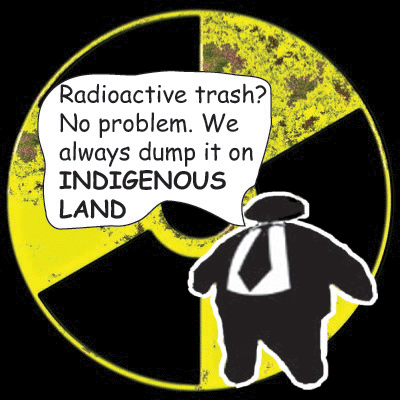
Indigenous Climate Action, August 23
Canadian Nuclear Laboratories (CNL) is pushing forward construction of a Near Surface Disposal Facility (NSDF), otherwise known as a nuclear waste dump, less than 1 kilometre away from the Kichi Sìbì (the Ottawa River) without the Free, Prior, and Informed Consent of the Algonquin Nations whose territory they are on.
On June 20, impacted nations spoke out against the project during a news conference where they also made public an Indigenous-led Assessment of the Canadian Nuclear Laboratories Near Surface Disposal Facility And Legacy Contamination Of Algonquin Aki Sibi.
The chiefs made it clear that this project is a direct threat to the rights of Indigenous peoples and the project would pose serious threats to culture, land, water and wildlife. It is important to understand that this is not just a risk to Indigenous communities; it is a risk to everyone who lives along the Ottawa River, including residents in Ottawa who rely on the river for their water and livelihood.
Nuclearization of Indigenous Land
Beginning nearly eighty years ago with the establishment of the Chalk River Laboratories along the Kichi Sìbì, sitting on unceded Algonquin territory, Indigenous nations have been facing the expansion of so-called Canada’s nuclear industry. The Chalk River Laboratories sits across the river from a noted community spiritual site, Oiseau Rock, near the lumbering town of Chalk River.
The Canadian Nuclear Laboratories (CNL) is a branch of the federal crown corporation, the Atomic Energy of Canada Limited (AECL). Chalk River Laboratories are owned by CNL, and operated by the Canadian National Energy Alliance, a private-sector holding company—that is not under direct control of the government—overseen by SNC-Lavalin.
“This nuclear site is already leeching radioactive pollution into the Ottawa River in the form of Tritium, which is radioactive hydrogen, and it’s only going to get progressively worse. And there’s no treatment for Tritium. So CNL and CNSC (Canadian Nuclear Safety Commission) will tell you that they are going to build a treatment plant, but you know in our world we know that you never build your treatment plant above where you collect your drinking water—and this is precisely what CNSC is going to do.” — Chief Lance Haymond (Kebaowek First Nation)
While CNSC claims that it had signed an agreement and received consent from the Algonquins of Pikwàkanagàn, in truth, they consulted only one voice of the Algonquin nation, the remaining ten communities oppose the project and have not given their consent.
“The Canadian government has failed its duty to consult with us. We also point out that approving this dump would violate UNDRIP… we do not consent with the construction of the NSDF in our territory. We believe that consultation has been inadequate, and our Indigenous rights are threatened by this proposal.”
— Chief Dylan Whiteduck (Kitigan Zibi Anishinabeg First Nation)…………………………………………………………………………………………………………………………………………………………………………………………………………………….. more https://www.indigenousclimateaction.com/entries/nuclear-dump-threatens-kichi-sibi
Germany facing up to its nuclear waste problem

German nuclear phaseout leaves radioactive waste problem
Klaus Deuse, August 30, 2023 https://www.dw.com/en/german-nuclear-phaseout-leaves-radioactive-waste-problem/a-66661614?maca=en-Facebook-sharing&mibextid=2JQ9oc&fbclid=IwAR1xPxzvz3kfLoNV1JbUx70rWCRa5tiML4tl2jffIm0ILDquq2-av2j7bxw
While Germany searches for a permanent storage facility for its nuclear waste, it risks sitting on piles of dangerous waste for decades. The problem drains public finances by hundreds of millions of euros every year.
Germany ended the era of nuclear energy in Europe’s biggest economy when it decommissioned the last three remaining nuclear power plants on April 15 this year. Decades of nuclear power generation, however, have left a legacy that is unlikely to go away as smoothly as the phaseout: nuclear waste.
Since a permanent German storage facility is out of sight in the near future, the spent fuel rods, packed into specialized containers called Casks for Storage and Transport of Nuclear Material (CASTOR), will likely remain in interim storage for decades.
About 1,200 CASTOR containers are currently stored at 17 interim sites in Germany. A state-owned company, the Bundeseigene Gesellschaft für Zwischenlagerung mbH (BGZ), is tasked with operating the sites.
BGZ spokesperson Janine Tokarski told DW that the company finally expects “about 1,800 containers from across Germany to be designated for final disposal.”
Another state company, the Federal Company for Radioactive Waste Disposal (BGE), is exploring sites in Germany for the final disposal of the dangerous waste. According to Tokarski of BGZ, experts plan to find a site and, more importantly, reach a political consensus on it “in the 2040s at the earliest.”
From then on, another 20 to 30 years are likely to be spent on planning and construction, said Tokarski. She anticipates the beginning of final storage “in the 2060s at the earliest.” The shipping of all the waste from the various interim sites will probably take another 30 years, she added.
The century-long operation is expected to cost hundreds of billions of euros. Last year alone, BGZ spent €271 million ($292 million) just to ensure Germany’s nuclear waste is safely stored — €191 million of the sum on operating the interim sites and €80 million on investments in them.
A nuclear fortress
In 1992, the first CASTOR containers with highly radioactive fuel rods were stored in the interim storage site of Ahaus in northwestern Germany.
The 200-meter-long (218-yard-long) central storage building towers 20 meters high above the flat landscape of the Münsterland region and is protected by a wire fence surrounding the sprawling 5,700-square-meter (61,354-square-feet) site.
Bisected by a reception and maintenance area, the building currently holds more than 300 yellow casks containing burned fuel rods. Additionally, six CASTOR containers, each 6 meters long and weighing 120 tons, are stored in one of the two halls, keeping the waste leak-tight for a calculated 40 years.
Leak tightness is achieved through a pressure switch installed in the double-wall sealing system of these containers, said David Knollmann from BGZ in Ahaus.
“A gas is inserted between the two walls, specifically helium gas, at a certain pressure. This switch ensures the pressure doesn’t fall below a certain level,” he told DW.
David Knollmann proudly added that in 30 years, there hasn’t been a single case of a container requiring repairs.
The nuclear safety at the Ahaus interim storage site is not only overseen by German nuclear authorities but also by Euratom, an independent nuclear energy organization run by European Union member states, and the International Atomic Energy Agency (IAEA). Their auditors inspect the site regularly but without advance notice.
Pressure of time
In addition to the two central interim storage facilities in Ahaus and Gorleben, Germany operates other decentralized temporary storage facilities at the sites of all former German nuclear power plants.
Moreover, additional waste, shipped for reprocessing to France and the UK, will eventually return to Germany. Knollmann said this will only happen “when all the necessary regulatory conditions are met.”
Much of the waste, he explained, comes from “dismantled nuclear power plants” and includes contaminated pumps and filters. Those would eventually be stored at the Schacht Konrad site near the town of Salzgitter, a former iron ore mine proposed as a deep geological repository for medium- and low-level radioactive waste.
The Schacht Konrad mine, said Tokarski, is expected to become operational as a nuclear waste storage “around the early 2030s.”
All German interim storage sites are subject to limited operating permits of 40 years. For example, the permit for the Ahaus site will be up for renewal by 2028 at the latest. As all experts agree that a final central repository for Germany’s nuclear waste won’t be fully operational before 2090 at the earliest, the country faces the problem of what to do with the radioactive material until then.
Without political consensus on the issue, Ahaus residents fear that their neighborhood’s storage facility might secretly become “a final repository solution.”
Federal appeals court blocks plan to ship nuclear waste to West Texas.

Marfa Public Radio | By Travis Bubenik, August 30, 2023 https://www.kut.org/energy-environment/2023-08-30/federal-appeals-court-blocks-plan-to-ship-nuclear-waste-to-west-texas
A federal appeals court last Friday blocked a company’s long simmering plan to ship highly radioactive nuclear waste to West Texas, a ruling that further complicates the country’s search for a long-term home for its growing stockpile of waste from nuclear power plants.
The company, Interim Storage Partners, has for years pursued the idea of using an existing site in Andrews County, on the Texas border with New Mexico, as a long-term home for much of the nation’s “high-level” nuclear waste.
In 2021, the Nuclear Regulatory Commission granted the company a license for the plan, despite a move by state lawmakers that same year to ban the proposal. The State of Texas responded with a lawsuit arguing that the NRC didn’t have authority to issue the license.
On Friday, a three-judge panel of the U.S. Fifth Circuit Court of Appeals agreed with the state, ruling that federal law does not give the commission the power to issue such licenses.
“The Atomic Energy Act doesn’t authorize the Commission to license a private, away-from-reactor storage facility for spent nuclear fuel,” U.S. Circuit Judge James Ho wrote for the majority. “And issuing such a license contradicts Congressional policy expressed in the Nuclear Waste Policy Act.”
“This is an important ruling for Texas against a federal agency attempting to overstep its authority,” said Paige Willey, a spokesperson for Texas Attorney General Ken Paxton.
Brink of catastrophe: Japan as Pacific polluter
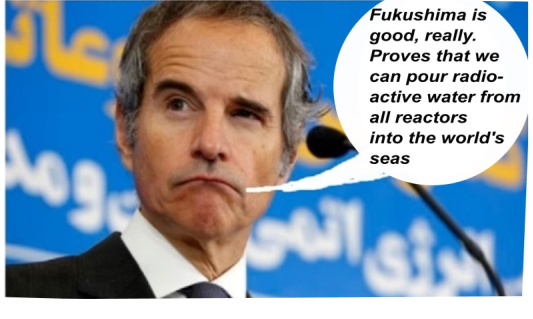
True, the IAEA (the UN’s International Atomic Energy Agency) has provided helpful cover for the Government of Japan (and the TEPCO power company) by taking the view that the environmental impact of discharge of polluted (but “processed” to remove most of the major radio-active materials) cooling water would be “negligible.” That, however, is neither surprising nor decisive.
The IAEA, founded in 1957, is an organisation devoted to the propagation of “safe” civil nuclear energy; the state of Japan is its third largest source of its funds; and the future of the global nuclear industry depends on there being seen to be a “final solution” to the problems posed by Fukushima.
https://johnmenadue.com/brink-of-catastrophe-japan-as-pacific-polluter/ By Gavan McCormack, Aug 30, 2023
In 2011, Fukushima Nuclear Power Plant, roughly 250 kilometres north of Tokyo, was hit by a magnitude 9.0 quake and tsunami. Three reactors stopped immediately but the loss of electricity supply led in the days and months that followed to breakdown of the cooling system and to a series of hydrogen explosions and meltdowns of the cores of Reactors 1 to 3.
Prime Minster Kan Naoto feared for the worst. He faced the possible need to evacuate the whole Kanto region, including the Tokyo metropolitan area. Japan itself, its state and society, stood on the brink of catastrophe. That fate was only narrowly averted.
To this day the flow of water to cool the debris polluted with various forms of radioactivity has had to be maintained. Over the past twelve years some 1.34 million tons of water has accumulated and is being held in a vast array of over 1000 tanks along the coast of Fukushima prefecture. Those tanks are about 98 per cent full, but the flow of contaminated water will have to be continued for at least the next three decades, or till such time as the site can be cleaned up. Nobody today can say with any confidence when that might be.
The polluted waters contain 64 radioactive elements, or radionuclides, of greatest concern being carbon-14, iodine-131, caesium-137, strontium-90, cobalt-60 and hydrogen-3, also known as tritium. Some have short life and might already have ended, but others take longer to decay, with a half-life of more than 5,000 years in the case of carbon-14 (Nature, 29 June 2023). Tritium, which focuses most attention, has a half-life of 12.3 years. Its concentrations may be low, but one hundred years will have to pass before its threat to humans and the ocean becomes truly negligible
The government has yet to find additional sites for expansion, and each day it has to put about 90 tons of newly polluted water somewhere. And, while the people of Japan remain steadfast in opposing any return to the pre-2011 vision of a nuclear-powered, energy self-reliant, superpower Japan future, government and bureaucracy are increasingly open about their determination to pursue just such a goal.
In 2016, the Japanese government considered multiple methods of treating the water. Ruling out simple continuation of the status quo – more and more tanks along an already crowded sea-front – there seemed to be three options: ocean discharge, atmospheric discharge, and underground burial. The cost differential was estimated at 34.9 billion yen to release the problem materials as gas into the atmosphere, 24.3 billion to dig a deep hole and bury it, but just 3.4 billion to pour it out gradually into the sea.
The logic of such math was inescapable. The chosen option was the one that was cheaper by a factor of 7 or more. Time, and the recuperative, regenerative powers of the sea, would come to humanity’s rescue. The materials would be released into the ocean (channelled by giant pipes to a point about one kilometre offshore). That process began on 24 August 2023.
Anxiety, alarm, and increasingly anger, spread, both within Japan (and especially in the Fukushima vicinity that bore the brunt of the initial 2011 disaster) and on the part of Japan’s Pacific neighbour states – China (including Hong Kong), Korea (north and south), Russia, Philippines, and the mini-states of the South Pacific (its 18 countries and regions). In Japan just 44 per cent of people said they had “no worries” over the release, but about 75 per cent said the government had not properly explained what it was doing.
The Japanese government, having promised it would take no step without duly consulting all concerned parties, proceeded to ignore that principle both in regard to its own citizenry (especially those employed in its once vibrant fishing industry) and its Pacific neighbours, whose shores are washed by the same Pacific waters.
True, the IAEA (the UN’s International Atomic Energy Agency) has provided helpful cover for the Government of Japan (and the TEPCO power company) by taking the view that the environmental impact of discharge of polluted (but “processed” to remove most of the major radio-active materials) cooling water would be “negligible.” That, however, is neither surprising nor decisive. The IAEA, founded in 1957, is an organisation devoted to the propagation of “safe” civil nuclear energy; the state of Japan is its third largest source of its funds; and the future of the global nuclear industry depends on there being seen to be a “final solution” to the problems posed by Fukushima.
Though given little attention in media coverage of the problem, a small but significant body of scientific opinion has begun to express severe criticism of IAEA for its failure to apply its own fundamental principles, being in some important respects “at least 10,000 times in error,” neglecting to give proper consideration to the non-dumping solutions, “grossly over-stating” well known facts in its “eagerness to assure the public that harm will be ‘negligible’.” (Arjun Makhijani, “TEPCO’s ALPS-treated Radioactive Water Dumping Plan Violates Essential Provisions of IAEA’s General Safety Guide No. 8 and Corresponding Requirements in Other IAEA Documents, Institute for Energy and Environmental Research [IEER], 28 June 2023.
In this view, the IAEA should, starting with Japan, provide assistance to nuclear-possessing countries to stop dumping so that the oceans that have been much abused in so many ways for so long can at least have a chance to begin recovering.
When then Prime Minster Abe Shinzo told the world in September 2013 that Fukushima was “under control,” he lied. Till 2018, all attempts to locate the missing reactor cores, let alone to place them “under control,” had failed. Only in 2021 did it become possible at least to locate the debris in one reactor. But knowing the location is but the start. Now we know where it is, we are no closer to knowing how to deal with it. The recovery effort for two of the reactors will not commence until 2024. If they succeed in locating the debris, estimated to be about 880 tons, it will then have to be extracted, gram-by-gram. Meanwhile, as of 2023, between 4,000 and 5,000 workers are mobilised each day to perform various (high-risk) tasks in the disaster zone.
To the peoples of the small states of the Pacific, serial victims of waves of nuclear testing, first American, then French, the blow coming from nuclear-victim country Japan was especially bitter. To the shock and harm caused by the initial massive radioactivity release of 2011 has now to be added that of the deliberate, premeditated dumping of nuclear wastes from 2023. The “great powers” in the past had given Island peoples repeated assurances that there would be no risk to health or environment from testing or dumping. Those peoples watch sadly now as nuclear victim country Japan does likewise, engaging in intense propaganda efforts to line up regional states to endorse its wastewater dumping campaign.
Japanese words today rings as hollow to Pacific Island peoples as did once American or French words. Even the Japanese people themselves, when it comes to Fukushima wastewater dumping “have little trust in TEPCO or the Japanese Government.” (Suzuki Tatsujiro, former Vice-Chairman of Japan’s Atomic Energy Commission, quoted in Makhijani, p. 3)
by the current administration and by the process launched on 24 August. The support given Japan’s ocean dumping by prominent Western industrial countries strikes Pacific Islanders as hypocritical (Kalinga Seneviratne, “To the Pacific islands, the West’s support for Japan’s Fukushima nuclear waste ocean dumping is hypocrisy,” South China Morning Post, 20 July 2023,) Motarilavoa Hilda Lini, chief of the Turaga nation of Pentacost Island, Vanuatu, and activist of the Nuclear Free and Independent Pacific (NFIP) movement, puts it this way, “We are people of the ocean. We must stand up and protect it.” She went on,
“We need to remind Japan and other nuclear states of our Nuclear Free and independent Pacific movement slogan: if it is safe, dump it in Tokyo, test it in Paris, and store it in Washington, but keep our Pacific nuclear-free.” (Guardian, 26 April 2023).
Brushing aside the pleas of neighbour states, especially those of the long-suffering peoples of the Pacific Islands, Japan has pressed ahead to dump its nuclear wastes into the ocean, ensuring that in due course a third wave of nuclear pollution will wash over Pacific shores.
More countries take actions to handle Japan’s nuclear-contaminated water dump, while US ‘double-standard exposed hypocrisy’
Global Times, By Yang Sheng Aug 27, 2023
In order to prevent any impact caused by Japan’s dumping of Fukushima nuclear-contaminated wastewater into the Pacific Ocean, more countries, especially those in the Asia-Pacific like China, Thailand and Russia, are taking actions, including strengthened testing of aquatic products imported from Japan, while more people and organizations from South Korea and the Pacific Island countries are voicing their opposition and concern over Tokyo’s decision.
Although the US said it is “satisfied” with Japan’s act, which has caused fury and concern worldwide, the US is in fact the country that has seen the greatest reduction in imports of Japanese seafood and rice wine, media reported, citing data published by Japan’s Ministry of Agriculture, Forestry and Fisheries………………………………………………………
In some other countries, concern and opposition against Japan’s actions have increased, despite their governments remaining silent or exhibiting tolerance toward Tokyo.
In the Pacific Island Country of Fiji, the Suva Fish Market Association came out strongly on Thursday and stated that it does not agree with the dumping of the Fukushima nuclear-contaminated wastewater into the Pacific Ocean, and they are also concerned over the Fijian government’s attitude that “the discharged water is safe,” according to Fiji media fijivillage.com.
Samu Maraiwai, president of the association, said the nuclear-contaminated wastewater to be dumped into the Pacific Ocean poses “a risk of massive destruction to our marine ecosystem and our source of livelihood.” Maraiwai said the nuclear-contaminated waste will be toxic to a certain level and it will affect the marine ecosystem including fish, seaweeds, corals and other sources of livelihood.
According to South Korean media Yonhap News, about 50,000 people rallied in Seoul on Saturday to “protest Japan’s release of radioactive water from the crippled Fukushima nuclear power plant,” with the participation of some 90 civic groups which have formed a coalition to protest the dumping of nuclear-contaminated water and members of four opposition parties, including the main opposition Democratic Party (DP). ………………………………………………………………………………………………………….. more https://www.globaltimes.cn/page/202308/1297053.shtml
Dismantling of deactivated Fort Greely nuclear power plant to resume.
Alaska Public Media By Tim Ellis, KUAC – Fairbanks, August 25, 2023
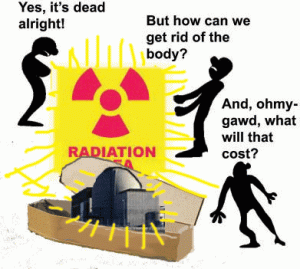
The decommissioning of an old nuclear power plant at Fort Greely can move forward now that the federal agency overseeing the project has resolved a contract dispute that delayed work for more than a year.
Work on the final phase of decommissioning and dismantling the long-mothballed SM-1A heat and power plant has been on hold since late last year, when a company that was competing for the contract began filing protests over how the Army Corps of Engineers handled the bid proposals…………………………………………………………………………………………
Barber said the year-long, back-and-forth process of reviewing and re-evaluating the proposals means the completion date of the project also will be pushed back by a year.
“So we’re looking at 2029, at this point,” she said, adding that it’ll take a while for A3D to begin work on the facility……………..
The SM-1A’s highly enriched uranium dioxide fuel and most highly radioactive components of the facility were removed after it was shut down in 1972. Remaining materials have been entombed in concrete or safely stored onsite. Much of that will be removed as part of the contract with A3D……
Barber says when the the remaining work is completed, the SM-1A, like two other prototype military nuclear power plants developed during the Cold War, will finally all be decommissioned and dismantled. https://alaskapublic.org/2023/08/25/dismantling-of-deactivated-fort-greely-nuclear-power-plant-to-resume/
.
At Fukushima Daiichi, decommissioning the nuclear plant is far more challenging than water release.
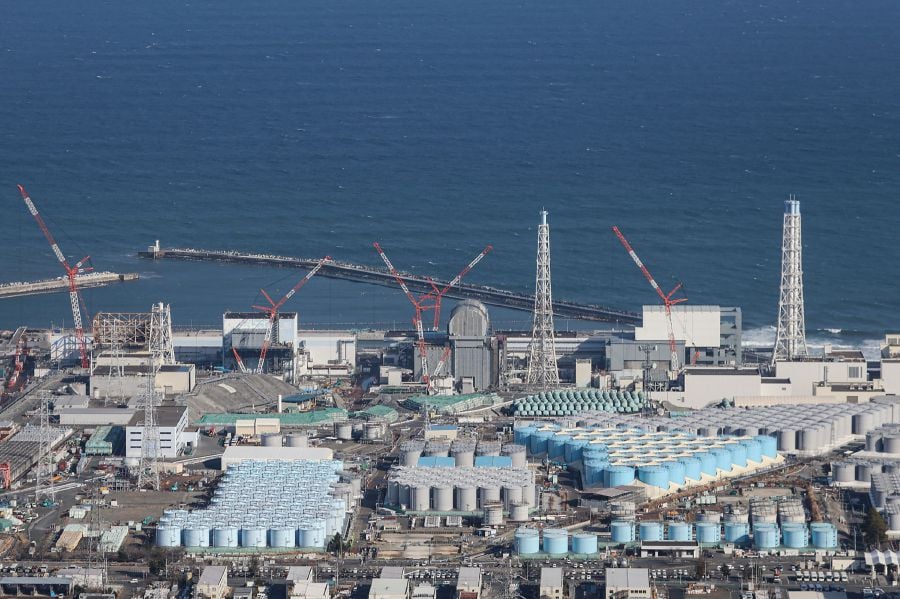
“technical difficulty involving the decommissioning is much higher” than the water release and involves higher risks of exposures by plant workers to remove spent fuel or melted fuel.
Some experts say it would be impossible to remove all the melted fuel debris by 2051 and would take 50-100 years, if achieved at all.
BY MARI YAMAGUCHI, August 27, 2023
FUTABA, Japan (AP) — For the wrecked Fukushima Daiichi nuclear plant, managing the ever-growing volume of radioactive wastewater held in more than 1,000 tanks has been a safety risk and a burden since the meltdown in March 2011. Its release marks a milestone for the decommissioning, which is expected to take decades.
But it’s just the beginning of the challenges ahead, such as the removal of the fatally radioactive melted fuel debris that remains in the three damaged reactors, a daunting task if ever accomplished.
Here’s a look at what’s going on with the plant’s decommissioning:
…………………………………………………… WILL THE WASTEWATER RELEASE PUSH DECOMMISSIONING FORWARD?
Not right away, because the water release is slow and the decommissioning is making little progress. TEPCO says it plans to release 31,200 tons of treated water by the end of March 2024, which would empty only 10 tanks out of 1,000 because of the continued production of wastewater at the plant.
The pace will later pick up, and about 1/3 of the tanks will be removed over the next 10 years, freeing up space for the plant’s decommissioning, said TEPCO executive Junichi Matsumoto, who is in charge of the treated water release. He says the water would be released gradually over the span of 30 years, but as long as the melted fuel stays in the reactors, it requires cooling water, which creates more wastewater.
Emptied tanks also need to be scrapped for storage. Highly radioactive sludge, a byproduct of filtering at the treatment machine, also is a concern.
WHAT CHALLENGES ARE AHEAD?
About 880 tons of fatally radioactive melted nuclear fuel remain inside the reactors. Robotic probes have provided some information but the status of the melted debris remains largely unknown.
Earlier this year, a remote-controlled underwater vehicle successfully collected a tiny sample from inside Unit 1’s reactor — only a spoonful of the melted fuel debris in the three reactors. That’s 10 times the amount of damaged fuel removed at the Three Mile Island cleanup following its 1979 partial core melt.
Trial removal of melted debris using a giant remote-controlled robotic arm will begin in Unit 2 later this year after a nearly two-year delay. Spent fuel removal from Unit 1 reactor’s cooling pool is set to start in 2027 after a 10-year delay. Once all the spent fuel is removed, the focus will turn in 2031 to taking melted debris out of the reactors. But debris removal methods for two other reactors have not been decided.
Matsumoto says “technical difficulty involving the decommissioning is much higher” than the water release and involves higher risks of exposures by plant workers to remove spent fuel or melted fuel.
“Measures to reduce radiation exposure risks by plant workers will be increasingly difficult,” Matsumoto said. “Reduction of exposure risks is the basis for achieving both Fukushima’s recovery and decommissioning.”
HOW BADLY WERE THE REACTORS DAMAGED?
Inside the worst-hit Unit 1, most of its reactor core melted and fell to the bottom of the primary containment chamber and possibly further into the concrete basement. A robotic probe sent inside the Unit 1 primary containment chamber found that its pedestal — the main supporting structure directly under its core — was extensively damaged.
Most of its thick concrete exterior was missing, exposing the internal steel reinforcement, and the nuclear regulators have requested TEPCO to make risk assessment.
CAN DECOMMISSIONING END BY 2051 AS PLANNED?
The government has stuck to its initial 30-to-40-year target for completing the decommissioning, without defining what that means.
An overly ambitious schedule could result in unnecessary radiation exposures for plant workers and excess environmental damage. Some experts say it would be impossible to remove all the melted fuel debris by 2051 and would take 50-100 years, if achieved at all.
Endless fallout: the Pacific idyll still facing nuclear blight 77 years on
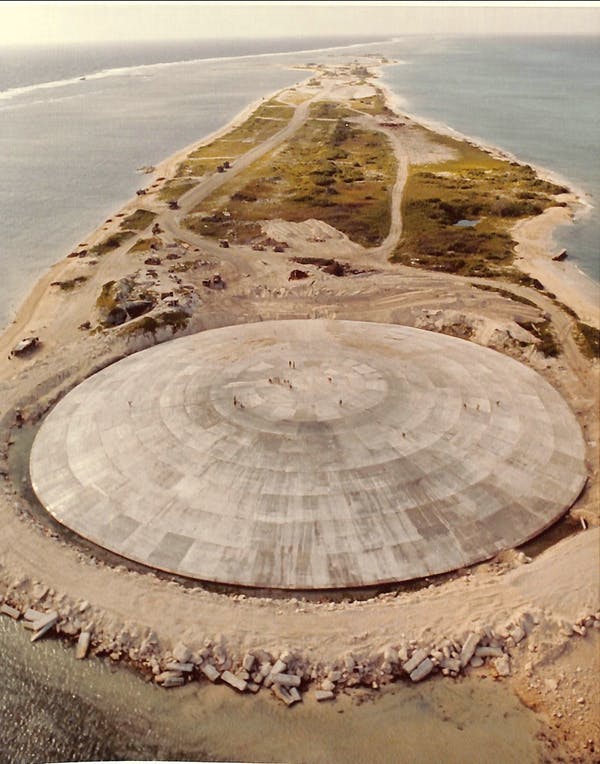
The film Oppenheimer has shone a global spotlight on the dawn of US nuclear weapons tests. In the Marshall Islands, where 23 of those earth-shattering blasts happened, people have never been able to forget
by Lucy Sherriff, 25 Aug 23, https://www.theguardian.com/environment/2023/aug/25/endless-fallout-marshall-islands-pacific-idyll-still-facing-nuclear-blight-77-years-on
t first glance, the aquamarine waters that surround the Marshall Islands seem like paradise. But this idyllic Pacific scene hides a dark secret: it was the location of 67 nuclear detonations as part of US military tests during the cold war between 1946 and 1958.
The bombs were exploded above ground and underwater on Bikini and Enewetak Atolls, including one device 1,100 times larger than the Hiroshima atom bomb. Chernobyl-like levels of radiation forced hundreds from their homes. Bikini Atoll remains deserted. At the US government’s urging, residents have begun returning slowly to Enewetak.
Today, there is little visible evidence of the tests on the islands except for a 115-metre (377ft)-wide cement dome that locals nickname the Tomb – for good reason.
Built in the late 1970s and now aged and cracking, the huge concrete lid on Runit Island covers more than 90,000 cubic metres (3.1m cubic ft) – or roughly 35 Olympic-sized swimming pools – of radioactive soil and nuclear waste. Unbeknown to the Marshallese people, the US shipped the waste from Nevada, where it was testing nuclear weapons on Native American land.
The legacy of America’s nuclear testing on Indigenous communities both on the US mainland and its territories has come under renewed scrutiny with the release of Oppenheimer, the blockbuster film about the physicist who led development of the atomic bomb.
Although his team tested the nuclear weapons on Native American land – there were 928 large-scale nuclear weapons tests in Nevada, Utah and Arizona during the cold war, dispersing huge clouds of radioactive material – the film never mentions the impact of the testing on the local Native Americans.
The legacy of America’s nuclear testing on Indigenous communities both on the US mainland and its territories has come under renewed scrutiny with the release of Oppenheimer, the blockbuster film about the physicist who led development of the atomic bomb.
Although his team tested the nuclear weapons on Native American land – there were 928 large-scale nuclear weapons tests in Nevada, Utah and Arizona during the cold war, dispersing huge clouds of radioactive material – the film never mentions the impact of the testing on the local Native Americans.
“The film completely ignores the experiences of our people,” says Ian Zabarte, principal man of the Western Bands of the Shoshone Nation – who have been described as “the most bombed nation on earth”
Zabarte is attempting to forge connections with those Pacific Islanders who were similarly affected by nuclear testing. Earlier this year, he met representatives from the Marshall Islands when they visited Nevada to discuss the effects on their health from nuclear weapons testing.
“The health impacts on our people have never been investigated,” Zabarte says. “We have never received an apology, let alone any kind of compensation.”
Separately, a band of Marshallese activists are now sailing around the country’s 29 atolls, along with artists and climate scientists, on a 12-day tour that aims to raise awareness of nuclear testing on the archipelago.
The 520-mile ocean voyage is being operated by Cape Farewell, a cultural programme founded by the British artist David Buckland and funded by the Waverley Street Foundation, Laurene Powell Jobs’s climate charity.
“Cancers continue from generation to generation,” says Alson Kelen, a master navigator and community elder who grew up on Bikini Atoll and is joining the expedition.
“If you ask anyone here if there’s a legacy of nuclear impact on their health, the answer would be yes. The Marshall Islands Nuclear Claim Tribunal has a list of cancers that are related to nuclear throughout our people. These cancers are hereditary.”
The US maintains that the Marshall Islands are safe. It seized them from Japan in 1944, and eventually granted the islands independence in 1979, but the fledgling nation remained in “free association” with the US. Under this system, along with Micronesia and Palau, the Marshall Islands are self-governing but economically remain largely dependent on Washington, which also retains a military presence. Today it continues to use the US dollar, and American aid still represents a large percentage of its GDP.
In 1988, an independent international tribunal was established to adjudicate between the two countries, and it later ordered the US to pay $2.3bn (£1.8bn) to the Marshall Islands in healthcare and resettlement costs.
The US government has refused, arguing that its liabilities ended when it paid $600m in the 1990s. In 1998, the US stopped providing medical care for cancer-stricken islanders, leaving many in financial hardship.
The agreement is up for renegotiation this year, and the Marshallese hope they will have stronger negotiating power with the US now that China is showing an interest in the islands due to their strategic location. The islanders are pushing for the $2.3bn they feel they are owed, and a cleanup of the Runit Dome, which is at risk of collapsing due to rising sea levels and the natural ageing of concrete structures.
“Of course it’s going to break,” says Stephen Palumbi, a Stanford University marine scientist who led a research trip to the islands in 2016. “What else can you expect? You can’t just build something like that and walk away from it and expect it to stay there. You wouldn’t do that with your patio.”
According to a 2019 investigation by the LA Times, many US military personnel present at the construction of Runit Dome realised that radioactive material was leaking from it, and would continue to do so – yet did not alert the Marshallese government.
The threat to the Tomb is particularly acute because the islands, which lie just 2 metres above sea level on average, are very vulnerable to rising sea levels. The country’s capital, Majuro, is highly likely to be at risk of frequent flooding, according to a World Bank study.
The US says it has discharged its responsibilities to the Marshall Islands, and because the dome is on Marshallese land, the onus is not on Washington to fix it.
It is not clear what will happen to the environment when the Tomb crumbles, and has also been hard to track how the ecosystem has behaved over time as “there’s just not many people” on Bikini Atoll to even casually monitor changes, Palumbi says.
But a 2012 United Nations report said the effects of radiation on the Marshall Islands are long-lasting and have caused “near-irreversible environmental contamination”.
On Palumbi’s visit, locals warned his team not to eat the coconuts – which are radioactive due to the contaminated groundwater – or the coconut crabs that feed on them. “You do not grow crops, you do not eat coconut, you do not drink the water,” Palumbi says.
In general, it has been shown that nuclear blasts represent an extreme threat to local biodiversity. A 1973 US government-funded study on nuclear testing in Alaska found both immediate harm and long-term damage to marine species: fish exploded when their gas-filled swim bladders reacted to the change in pressure underwater, and hundreds of sea otters were also killed instantly.
Researchers have recently found that sea turtle shells can be used to study nuclear contamination, with traces of uranium found in animals not born when testing in the Pacific Islands ended. The turtles are thought to accumulate human-made radionuclides in their bony outer shell, which is usually made of keratin, through the food chain by eating uranium-contaminated algae.
Japan recently announced it would start dumping waste from the Fukushima nuclear power plant, which had meltdowns in 2011, into the ocean. Although the UN’s nuclear watchdog says it is safe to do so, there are fears that there is still not enough understanding of how radioactive nuclear waste affects the ecosystem to be sure of this.
Palumbi notes that the resilience of the ocean is impressive, with corals regrowing on the Marshall Islands as soon as 10 years after the bombs were exploded. “This is the most destructive thing we have ever done to the ocean, dropping 23 atomic bombs on it, yet the ocean is really striving to come back to life.”
There are, however, eerie reminders of what happened decades ago, including a fine talcum powder-like sediment covering the reefs – and still-visible damage to the reef itself. “On the inside of the lagoon, where the actual bombs were, it’s still an amazing mess,” Palumbi says. “The reef has cracked in half, and you realise that it was the bomb.”
Kelen says he would not trust anyone who says releasing nuclear material into the water is safe. “Everybody who has talked to me about nuclear has been lying,” he says. This, he says, includes the US “who promised our islands were safe to live in. This continues. I do not trust politicians who say this will be OK.”
Zabarte, who has numerous family members who have died of cancer, is similarly concerned about the long-term impacts of radiation. “My people have nowhere to go,” he says. “We have to stay there, exposing ourselves on a daily basis. We have no choice.”
“We have to keep repeating this story,” says Kelen. “We have forever been moved around by people who make decisions over us, telling us our lives will be safe and how to live. But no matter what life has thrown at us, from nuclear testing to rising sea levels, our home and life are very much still here.
“We live this story, and it informs us culturally, but we do not let it define who we are.”
Fukushima waste-water decision disregards scientific evidence, violates the human rights of Pacific region communities

Japan announces date for Fukushima radioactive water release
Greenpeace International, 22 August 2023 https://www.greenpeace.org/international/press-release/61364/japan-announces-date-for-fukushima-radioactive-water-release/
Tokyo – Greenpeace Japan criticises the Japanese government’s announcement of the start date for radioactive water discharges from the Fukushima Daiichi nuclear station into the Pacific Ocean.
The decision disregards scientific evidence, violates the human rights of communities in Japan and the Pacific region, and is non-compliant with international maritime law. More importantly it ignores its people’s concerns, including fishermen. The Japanese government and Tokyo Electric Power Company (TEPCO) – the nuclear power plants’ operators – falsely assert that there is no alternative to the decision to discharge and that it is necessary to move towards final decommissioning. This further highlights the failure of the decommissioning plan for the nuclear plants destroyed in the 2011 earthquake, stating that tens of thousands of tons of contaminated water will continue to increase with no effective solution.
“We are deeply disappointed and outraged by the Japanese Government’s announcement to release water containing radioactive substances into the ocean. Despite concerns raised by fishermen, citizens, Fukushima residents, and the international community, especially in the Pacific region and neighboring countries, this decision has been made,” said Hisayo Takada, Project Manager at Greenpeace Japan.
The increasing volumes of and the pending release of the radioactive water demonstrate the failure of the decommissioning plan for the Fukushima Daiichi. The contaminated water will continue to accumulate for many years without effective measures to stop it. The Japanese Government and TEPCO falsely claim that discharge is the only viable option necessary for eventual decommissioning. Nuclear power generation, which experiences shutdowns due to accidents and natural disasters, and perpetually requires thermal power as a backup, cannot serve as a solution to global warming.
“The deliberate pollution of the Pacific Ocean through these radioactive waste discharges is a consequence of the 2011 nuclear disaster and Japan’s decades long nuclear power program. Instead of acknowledging the flaws in the current decommissioning plan, the ongoing nuclear crisis, and the massive amount of public funds required, the Japanese government intends to restart more nuclear reactors despite evidence of major earthquakes and safety risks. The current government energy plan fails to deliver secure and sustainable renewables such as wind and solar energy that the climate emergency demands,” said Takada.
As of 8 June 2023, there were 1,335,381 cubic meters of radioactive wastewater stored in tanks[1], but due to the failure of the ALPS (Advanced Liquid Processing System) processing technology, approximately 70% of this water will have to be processed again. Scientists have warned that the radiological risks from the discharges have not been fully assessed, and the biological impacts of tritium, carbon-14, strontium-90 and iodine-129, which will be released in the discharges, have been ignored.[2]
The International Atomic Energy Agency (IAEA) endorsed Japan’s plans for discharge. However, the IAEA has failed to investigate the operation of the ALPS, has completely ignored the highly radioactive fuel debris that melted down which continues every day to contaminate ground water – nearly 1000 cubic meters every ten days. Furthermore, the discharge plan has failed to conduct a comprehensive Environmental Impact Assessment, as required by its international legal obligations, given that there is a risk of significant transboundary harm to neighboring countries. The IAEA is not tasked with protecting the global marine environment but it should not encourage a state to violate it.
“The myth is being perpetuated that discharges are necessary for decommissioning. But the Japanese government itself admits that there is sufficient water storage space in Fukushima Daiichi.[3] Long-term storage would expose the current government decommissioning roadmap as flawed, but that is exactly what needs to happen. The Fukushima Daiichi nuclear station is still in crisis, posing unique and severe hazards, and there is no credible plan for its decommissioning,” emphasized Shaun Burnie, Senior Nuclear Specialist at Greenpeace East Asia.
Member states at the United Nations Human Rights Council in Geneva, as well as UN Special Rapporteurs, have opposed and criticized Japan’s discharge plans.[4] Japan’s discharge plans also disregard the groundbreaking Human Rights Council resolution 48/13, which in 2021 determined that it is a human right to have a clean, healthy and sustainable environment.[5] Furthermore, Japan has failed to comply with its legal obligations under the United Nations Convention for the Law of the Sea (UNCLOS), to protect the marine environment including its legal requirement to conduct a comprehensive Environmental Impact Assessment into the discharges into the Pacific Ocean, given the risk of significant transboundary harm to neighboring countries.[6]
“Instead of engaging in an honest debate about this reality, the Japanese government has opted for a false solution – decades of deliberate radioactive pollution of the marine environment – during a time when the world’s oceans are already facing immense stress and pressures. This is an outrage that violates the human rights of the people and communities of Fukushima, and other neighboring prefectures and the wider Asia-Pacific region,” said Burnie.
North County Report: What’s the Deal with San Onofre’s Nuclear Power Plant?
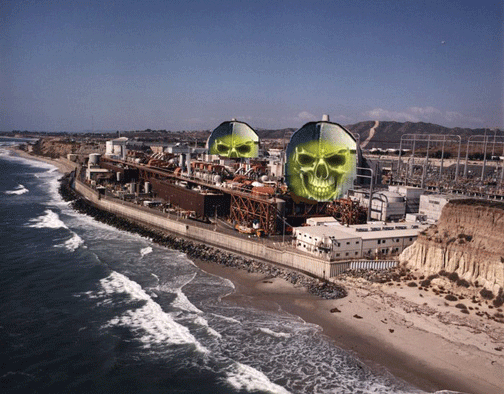
Federal and public officials have been working to dismantle the San Onofre nuclear power plant for about a decade, but there’s still a long way to go. Here are the latest developments.
Voice of San Diego, by Tigist Layne, 24 Aug 23
“………………………………………………………. For the past several years, SoCal Edison has been dismantling the plant, a process known as decommissioning. Once that process is complete, the land will go back to its owner, the U.S. Navy.
Before that can happen, though, there’s the issue of the 3.55 million pounds of nuclear waste currently sitting inside the facility.
The latest: Manuel Camargo, principal manager of the San Onofre Decommissioning Project, said 50 percent of the plant has been decommissioned so far. The San Onofre Decommissioning Project was created by SoCal Edison.
As for the nuclear waste, also known as spent nuclear fuel, the Department of Energy is moving forward with a plan to transport the fuel into a temporary storage facility. Once that happens, officials can complete the decommissioning process.
Decommissioning of the Plant Is Carried Out in Three Phases
- First, after allowing the spent nuclear fuel to cool for a few years, the decommissioning team packaged the spent fuel into seal-welded stainless-steel canisters and transferred it to an onsite storage system. That transfer was completed in 2020, Edison International spokesperson Jeff Monford wrote in an email.
- Next is the demolition of above-ground structures like pressure vessels, pumps, motors, fans, cables and structural steel, which are removed from the buildings, packaged and sent offsite for disposal. The rest of the concrete structures are then demolished and transported to a disposal facility in Utah.
- Remaining underground structures will be decontaminated according to federal guidelines for cleanup of the site. The team anticipates this to be completed by 2028, Camargo said.
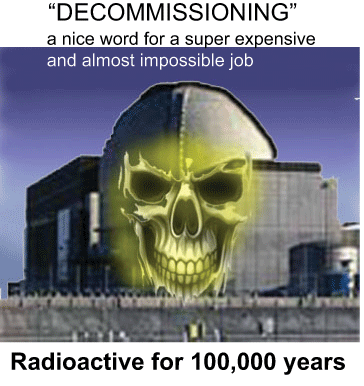
The final phase of decommissioning and site restoration will occur after the spent nuclear fuel is removed from the site.
The two containment domes are expected to come down sometime in 2025 or 2026.
The big storage issue: By now, you’ve probably gathered that without a place to store the spent nuclear fuel, the decommissioning can’t be completed. And there’s a reason it’s been so hard to find storage space: The federal government doesn’t have a single designated place in the United States to permanently store and/or dispose of spent nuclear fuel.
Let’s rewind to 1982 when the Nuclear Waste Policy Act became law. It established a national program for the disposal of highly radioactive waste and supports the use of deep geologic repositories to store and/or dispose of that waste.
A deep geologic repository is essentially a cavern a couple thousand feet below the Earth’s crust where the spent fuel would be placed, and it would stay there forever. It’s a way to store the waste while avoiding the contamination of the air, ground and underground water.
…………………………. until a permanent site is established by the federal government, the Department of Energy is stepping in.
……………………………………… ….Officials are planning to use consent-based siting to establish these storage facilities, meaning only cities and jurisdictions that are willing and able to store the spent nuclear fuel will be considered and chosen.
But these storage sites will be temporary. ……………………
The Department of Energy also needs approval from Congress to create these interim storage sites because the Nuclear Waste Policy Act would have to be modified to allow for it. It will also be up to lawmakers to eventually amend the act and establish another permanent deep geologic repository for spent fuel.
A few different groups are now working together to get this done: the Spent Nuclear Fuel Solutions Congressional Caucus established by Rep. Mike Levin; the Department of Energy; and the Spent Fuel Solutions coalition, which includes San Diego County, Orange County, Riverside County, SoCal Edison, San Diego Gas & Electric and the City of Riverside. https://voiceofsandiego.org/2023/08/23/north-county-report-whats-the-deal-with-san-onofres-nuclear-power-plant/
-
Archives
- October 2026 (120)
- September 2026 (339)
- August 2026 (330)
- July 2026 (355)
- June 2026 (287)
- May 2026 (306)
- April 2026 (356)
- March 2026 (251)
- February 2026 (267)
- January 2026 (308)
- December 2025 (358)
- November 2025 (359)
-
Categories
- 1
- 1 NUCLEAR ISSUES
- business and costs
- climate change
- culture and arts
- ENERGY
- environment
- health
- history
- indigenous issues
- Legal
- marketing of nuclear
- media
- opposition to nuclear
- PERSONAL STORIES
- politics
- politics international
- Religion and ethics
- safety
- secrets,lies and civil liberties
- spinbuster
- technology
- Uranium
- wastes
- weapons and war
- Women
- 2 WORLD
- ACTION
- AFRICA
- Atrocities
- AUSTRALIA
- Christina's notes
- Christina's themes
- culture and arts
- Events
- Fuk 2022
- Fuk 2023
- Fukushima 2017
- Fukushima 2018
- fukushima 2019
- Fukushima 2020
- Fukushima 2021
- general
- global warming
- Humour (God we need it)
- Nuclear
- RARE EARTHS
- Reference
- resources – print
- Resources -audiovicual
- Weekly Newsletter
- World
- World Nuclear
- YouTube
-
RSS
Entries RSS
Comments RSS

