‘It’ll be a shortlist of one!’ Villagers in England fear nuclear dump proposal

Plans for a new wave of atomic power have not factored in local concerns over the safety of the waste sites the schemes entail.
Alex Lawson, Sun 3 Mar 2024 , https://www.theguardian.com/business/2024/mar/03/itll-be-a-shortlist-of-one-villagers-in-england-fear-nuclear-dump-proposal
When Ian Harrison returned to the Lincolnshire coast to care for his parents a decade ago, he didn’t expect to spend his own retirement fighting plans to dig a £50bn nuclear waste dump near the beaches of his childhood.
Harrison, 67, lives a mile from the village of Theddlethorpe, one of three sites in England being examined for a possible geological disposal facility (GDF) to handle decades of nuclear waste from the power and defence industries. The cavernous dump will feature a series of tunnels and vaults dug 200-1,000 metres underground, capable of holding high-risk nuclear waste.
“It’s just a terrible idea to put a nuclear dump next to a seaside resort,” says Harrison, a retired warrant officer. “The safety concerns are real – look at Chernobyl – but people are more worried about the tourism that comes to Mablethorpe and the impact on local businesses.”Map showing proposed and withdrawn sites for GDFs
After several sites fell out of contention, the former gas terminal in Lincolnshire is one of just three which remain, with two on the Cumbrian coast – Mid Copeland and South Copeland. There is speculation about another site on the north-west coast.
The search for a home for Britain’s nuclear waste underlines a problem at the heart of its energy ambitions. Politicians have extolled the virtues of low-carbon nuclear power, but little attention has been given to the question of where to put the resulting waste.
Allerdale in Cumbria was ruled out last September after the government body behind the GDF project, Nuclear Waste Services (NWS), said there was “only a limited volume of suitable rock”, meaning it was not safe for storage. Last month, councillors in East Yorkshire withdrew from a process to consider hosting a GDF at South Holderness, east of Hull. In 2021, a council leader in Hartlepool resigned in a similar GDF row.
“At South Holderness, the local population complained and the council listened and stopped it,” says Harrison. “Here, people are worried, but they are sugarcoating it and not taking into account local concerns. Eventually, this will end up with a shortlist of one: us.”
The GDF is forecast to cost between £20bn and £53bn. Work on the project could take decades to begin, and high-risk waste will not enter it until at least 2075. The cost will be met by taxpayers, the existing nuclear plants’ operator EDF, and future power station operators.
Work on the GDF is expected to 4,000 jobs in its first 25 years. It is not an unprecedented move – Finland is nearing completion of a 450-metre-deep cavern to store its waste. France, Canada, Switzerland and Sweden are making progress on similar projects.
Britain’s nuclear waste is largely generated by its ageing power stations, as well as by industrial and defence sectors. It is housed in more than 20 ground-level sites which can hold the waste for up to 100 years, meaning a permanent store needs to be found. Even more waste is expected to be generated from a new era of reactors, despite lengthy delays,starting with Hinkley Point C in Somerset, currently the only new UK station under construction.
The handling of nuclear waste in Britain was put in the spotlight last year when the Guardian published Nuclear Leaks, a year-long investigation into problems with cybersecurity, safety and a “toxic” culture at Sellafield. Most of the waste now at the Cumbria site will be sent to a GDF, probably between 2050 and 2125.
While it can be argued that the Copeland sites have communities familiar with nuclear waste, it is an alien industry for Theddlethorpe, where geologists are studying the clay rock under the seabed.
Proponents of a GDF at Theddlethorpe, where a facility would be built onshore and the store tunnelled under the sea six miles off the coast, argue it will bring not only jobs but investment – in flood defences, road improvements and rail links. Detractors say its largely retired community will barely contribute to the workforce, and its holiday parks will play host only to construction workers while tourism slowly dies. A government gaffe in which Skegness was wrongly spelled as “Skegross” on a map did little to engender local support.
Ken Smith, a retired former lecturer and chair of the Guardians of the East Coast pressure group, says: “People call us nimbys and tell us that we’re only interested in the impact on house prices, but that’s a red herring. It’s about the people who live here and the way this could change their lives.”
A test of public support for the Theddlethorpe project is likely to be conducted in 2027. Jon Collins, the independent chair of the Theddlethorpe GDF Community Partnership, says only a small number of the 10,000 people who live in the search area have yet expressed an opinion. “There are a lot of people who have yet to engage. People deserve the opportunity to have a proper debate with all the facts before a decision is made.”
In Mid Copeland, David Moore, 70, a retired farmer, says local support for the project has increased in recent years. “Our community has been brought up handling radioactive waste,” says Moore, a representative on the Mid Copeland GDF community partnership. “We have a highly skilled workforce, and know it brings highly paid jobs.” Residents in nearby South Copeland are more circumspect, he claims.
A contentious element of the project has been the £1m a year in funds offered to prospective sites, handed out by NWS. Spending has included £382,067 for an adventure playground, garden and CCTV at the village halls; £49,981 on a project to reduce loneliness; and £26,102 to the Parrot Zoo Trust. Some locals see the taxpayer money as a “bribe”; others argue the money might as well be taken while the debate continues.
Collins says any final decision needs to take into account both local opinion and the best geological conditions for the site.
But Smith says: “A GDF is simply sweeping the problem under the carpet. My worry is that I want future generations to enjoy what I have I can take my grandchildren for a picnic on the beach: you can’t do that at Sellafield. I do not want the area to be torn apart. If they industrialise this coastline then all that enjoyment will be lost.”
NWS said: “A GDF will only be built where there is a suitable site and a willing community. This is a consent-based process and we are committed to giving local people all the information they need, listening to all voices and letting local people have their say on the topic.”
Could climate change release 35 swimming pools’ worth of nuclear waste? Or worse… unleash a world-ending pandemic? These are the terrifying unexpected consequences of melting ice
By ROB WAUGH FOR DAILYMAIL.COM, 2 March 2024 https://www.dailymail.co.uk/sciencetech/article-13135571/Could-climate-change-release-35-swimming-pools-worth-nuclear-waste-worse-unleash-world-ending-pandemic-terrifying-unexpected-consequences-melting-ice.html
- Buried ‘nuclear city’ and swimming pools’ worth of nuclear waste
- Frozen viruses have already begun to infect human beings
- READ MORE As melting ice exposes new oil reserves, oil giants move in
Around the world, glaciers and permafrost are melting, and in some places the retreating ice is releasing buried secrets people hoped would remain forgotten.
Rising waters have exposed a secret Greenland nuclear base that engineers thought would never resurface as well as a radioactive ‘Tomb’ at the site of American nuclear tests.
And while it sounds far-fetched, very credible experts have warned that the next pandemic may well come from ancient pathogens buried in the ice, or even from diseases harbored by frozen dead Neanderthals.
The ‘secret nuclear city’ under Greenland’s ice
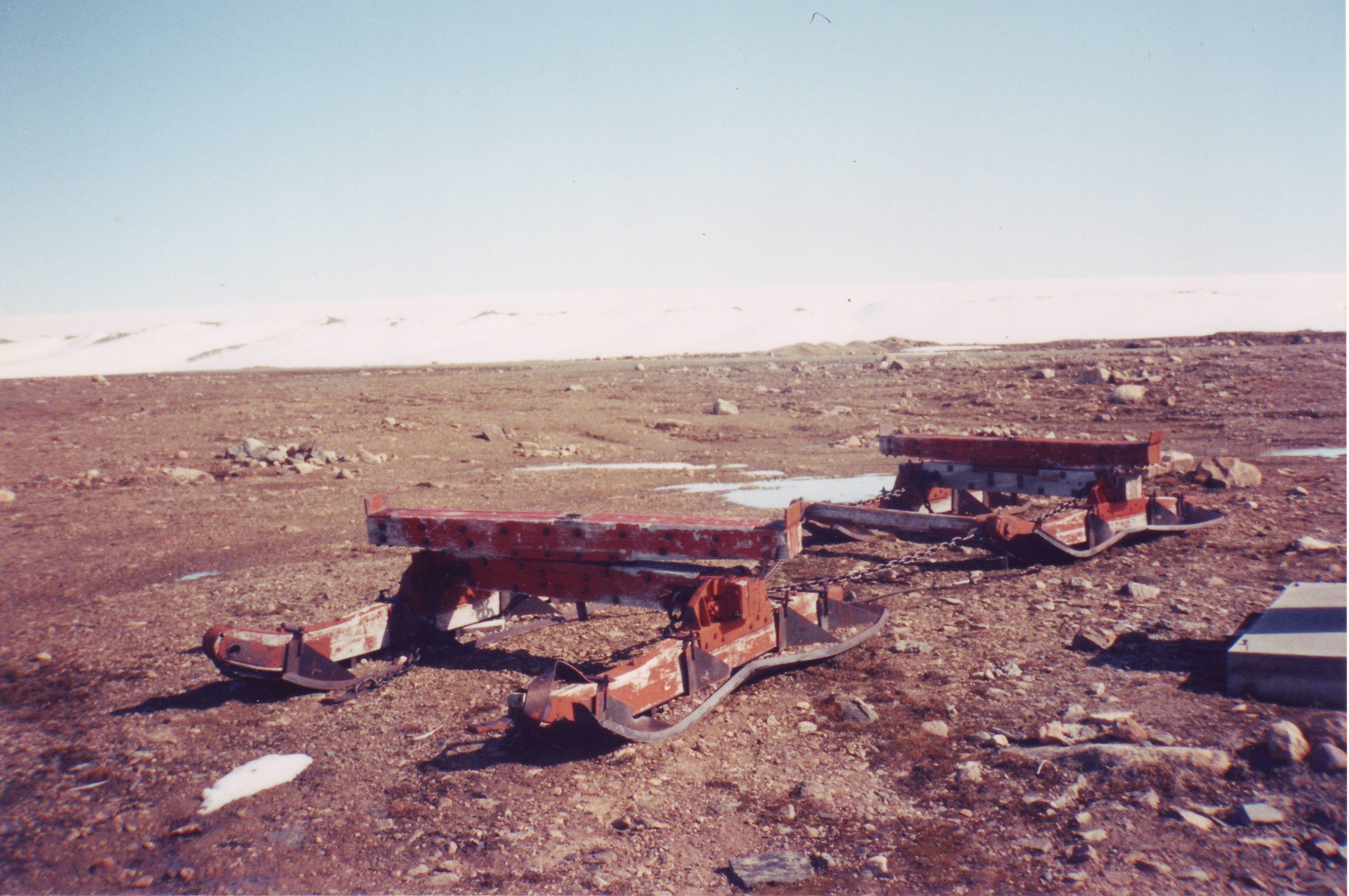
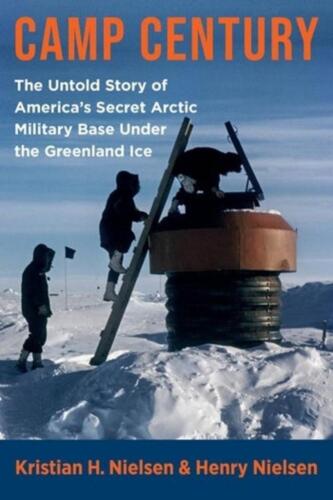
Camp Century in Greenland is a secret nuclear-powered ‘city under the ice’, where U.S. Army engineers carried out weapons research
The base has been abandoned for almost half a century, but now poses a serious concern over nuclear waste.
Powered by a portable nuclear generator, Camp Century was built in 1959, and was built to host 200 soldiers, with a plan to expand the base to hold 600 ballistic missiles.
‘Camp Century’ was abandoned in 1967, but the nuclear reactor at the base – which also had a hospital and a church in its tunnels – has long since been removed, but radioactive waste remains.
When the Army Corps of Engineers (ACE) left the base, they assumed that frigid temperatures and falling snow would keep the nuclear waste there forever.
In total, the waste is equivalent to the mass of 30 Airbus A320 airplanes – and researchers now fear that it could be released into the sea.
A 2016 study suggested that the nuclear waste could be released into the sea this century, but newer measurements at the base suggest that this will not happen until 2100.
‘Tomb’ of poison at nuclear test site
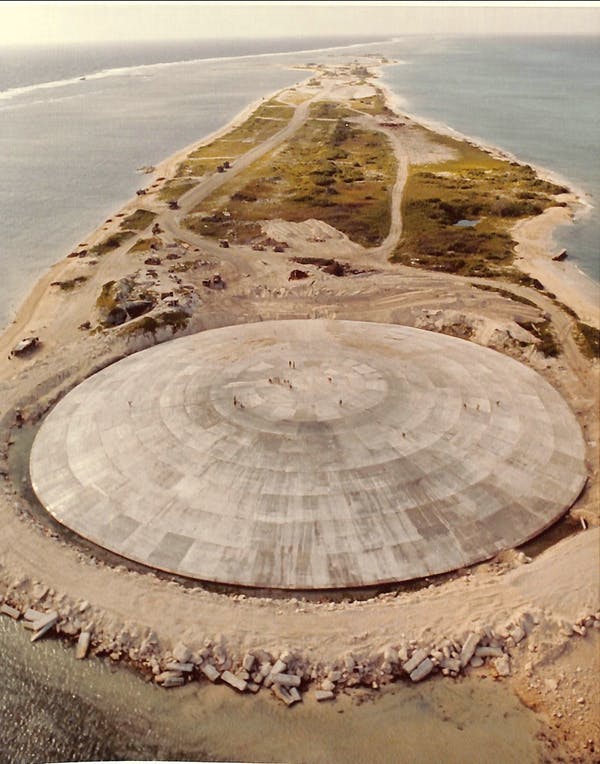
In the Marshall Islands, a huge ‘lid’ which locals know as ‘The Tomb’ covers 31 million cubic feet of nuclear waste – equivalent to the volume of 35 Olympic-sized swimming pools.
The islands were the site of American nuclear tests, but the U.S. military also shipped in waste from the mainland.
From 1946 to 1958, America conducted 67 nuclear tests in the South Pacific.
The concrete ‘lid’ officially known as the Runit Dome was built on Enewetak Atoll in the Marshall Islands to contain radioactive material from American nuclear tests in the 1950s.
Some studies have suggested that radiation levels near the site are similar to those near Chernobyl and the waters around the dome are rising every year.
Changing temperatures are causing the lid to crack, while rising waters are lapping at the atoll.
Plutonium – and a lost hydrogen bomb?
A 1968 plane crash scattered plutonium from American nuclear weapons over the ice in Greenland, which could be released by global warming.
The U.S. military assumed that the Thule air base in Greenland would be rapidly attacked in a nuclear war, so kept nuclear-armed bombers in the air to fly towards Russia in the event of an attack.
The Thule incident saw large amounts of radioactive plutonium dispersed onto the ice sheet, as a cabin fire in a B-52 bomber forced the crew to bail out.
Conventional explosives inside the four B28FI thermonuclear bombs detonated, spreading radioactive waste.
But the uranium-235 fissile core of one of the bombs was never found, despite a search with submarines.
Reports in the decades since have suggested that the lost bomb is lying under the seabed.
Frozen viruses and the next pandemic
Researchers have warned that the next pandemic could come from melting ice.
Genetic analysis of soil and lake sediment near the highest Arctic freshwater lake, Lake Hazen, suggests that the risk of ‘viral spillover’ may be high close to melting glaciers.
‘Spillover’ is where a virus infects a new host for the first time – and analysis of viruses and potential hosts in the lakebed suggests this risk may be higher near to melting glaciers.
Researchers at Ohio State University found genetic material from 33 viruses, 28 of which were unknown, in the Tibetan plateau in China, putting their age at 15,000 years old.
Viruses from Neanderthals
Other researchers have warned of viruses unleashed by melting permafrost: one-quarter of the northern hemisphere sits on top of permanently frozen ground – known as permafrost, but large areas are now melting as the world warms.
There are already examples of this – with a 2016 anthrax outbreak in Siberia attributed to melting permafrost exposing an infected reindeer carcass.
Previously researchers have warned that global warming and thawing ice might unearth diseases such as smallpox frozen into the corpses of victims, with a few infectious particles enough to revive the pathogen.
As permafrost thaws due to climate change, virologist Jean-Michel Claverie has warned that ancient viruses harbored in the long-frozen ground could be released.
Claverie explains that if an ancient pathogen eradicated Neanderthals, for instance, their frozen remains might still contain infectious viruses that could be unleashed as ice melts.
Claverie told Bloomberg News, “With climate change, we are used to thinking of dangers coming from the south.
“Now, we realize there might be some danger coming from the north as the permafrost thaws and frees microbes, bacteria and viruses.”
Claverie’s team previously revived giant viruses from up to 48,000 years ago – and the veteran scientist has warned that there could be even more ancient viruses in the ice, some of which could potentially infect humans.
Frozen poison in the ice
Polar regions have acted as a ‘chemical sink’ for the planet, locking away poisons in the ice – but melting ice could release this.
A study in Geophysical Research Letters found huge reserves of the toxic heavy metal mercury frozen in Arctic permafrost.
The amount may be 10 times higher than all the mercury pumped into the atmosphere from industry in three decades.
Paul Schuster, a U.S. Geological Survey hydrologist, “This is a complete game-changer for mercury. It’s a natural source, but some of it will be released through what we’re doing with climate change.”
Mercury is released by industry, volcanic eruptions and rock weathering – but what’s less clear is what will happen if the ‘pool’ in the Arctic is released.
The reawakening of America’s nuclear dinosaurs

“The issue of plutonium pit aging is a Trojan horse for the nuclear weaponeers enriching themselves through a dangerous new arms race,” said Jay Coghlan, executive director of Nuclear Watch New Mexico, an anti-nuclear group based in Santa Fe. “Future pit production is not about maintaining the existing, extensively tested stockpile. Instead, it’s for deploying multiple new warheads on new intercontinental ballistic missiles.”
The risk of a false alarm is enough reason to “do away with the ICBMs altogether,……. “An accidental launch is a major contributor to the overall probability of an all out nuclear war.”
Are America’s plutonium pits too old to perform in the new Cold War? Or are new ones necessary?
by Alicia Inez Guzmán February 28, 2024
Sprinkled across five western states, in silos buried deep underground and protected by reinforced concrete, sit 400 intercontinental ballistic missiles. Each of those missiles is equipped with a single nuclear warhead. And each of those warheads is itself equipped with one hollow, grapefruit-sized plutonium pit, designed to trigger a string of deadly reactions.
All of those missiles are on “hair-trigger alert,” poised for hundreds of targets in Russia — any one of which could raze all of downtown Moscow and cause hundreds of thousands of casualties.
Except — what if it doesn’t? What if, in a nuclear exchange, the pit fizzles because it’s just too old? In that case, would the weapon be a total dud or simply yield but a fraction of its latent power?
Outwardly, at least, that’s the question driving a whole new era of plutonium pit production at Los Alamos National Laboratory (LANL) and the Savannah River Plutonium Processing Facility in South Carolina.
Plutonium is widely known as one the most exotic elements in the periodic table. Trace amounts of it have been identified in the earth’s crust, though all of what’s now used for America’s nuclear weapons is manmade. For decades, these pits were cast with plutonium and other materials at a breakneck pace, installed in warheads and strapped into missiles that were regularly upgraded and modernized in an escalating arms race with the Soviet Union. Plutonium pits were never intended to grow old and senescent.
“We never worried about aging,” said Siegfried Hecker, former director of LANL and one of the world’s leading plutonium experts. “Because bombs were supposed to be out there for a dozen years or so.”
It’s been almost 40 years since America’s Cold War pit factory at Rocky Flats near Denver was raided by FBI agents and closed due to environmental crimes — among them, releases of radioactive effluent into nearby waterways. In that time, pit production went largely dormant, the USSR collapsed, arms reductions treaties were signed, stockpiles reduced and underground testing ceased.
Now, as the nuclear industrial complex awakens from its long slumber, the resumption of plutonium pit production has emerged as a deeply polarizing and political act. Anti-nuclear activists have accused the federal government of exploiting the uncertainty around aging to jumpstart a nearly $60 billion dollar manufacturing program. They assert that the real reason America has resumed the production of pits is for the purpose of introducing a new generation of warheads for a new generation of missiles — the first of which is the Sentinel, one of the most complex and expensive programs in the history of the U.S. Air Force.
The Sentinel ICBM has the capability to carry three separate warheads, each with its own target. Earlier versions of America’s missiles could and did have such capabilities and the option has remained available, but with post-Cold War weapons reductions, the number of warheads per missile was also reduced — one warhead, one intercontinental ballistic missile. As the U.S., Russia and China barrel toward a new Cold War, the U.S. will likely eschew such a convention in a matter of years.
“The issue of plutonium pit aging is a Trojan horse for the nuclear weaponeers enriching themselves through a dangerous new arms race,” said Jay Coghlan, executive director of Nuclear Watch New Mexico, an anti-nuclear group based in Santa Fe. “Future pit production is not about maintaining the existing, extensively tested stockpile. Instead, it’s for deploying multiple new warheads on new intercontinental ballistic missiles.”
But to hear Hecker and his colleagues tell it, the question of pit aging is as scientifically vexing as it is political. Plutonium, to its most studied acolytes, borders almost on the mystical, its properties as capricious as the human body. It can be brittle or soft under some circumstances or turn to powder when heated in air. It can disintegrate at room temperature. It can bombard itself with radiation and mar its own internal lattice structure. It can even heal that damage within fractions of a second, if not over the course of several decades.
According to Glenn Seaborg, former chair of the Atomic Energy Commission and the chemist credited with first synthesizing the element for use in weapons, plutonium is “so unusual as to approach the unbelievable.”
This quality means that even the most knowledgeable experts are reluctant to commit themselves to anything definitive when it comes to a plutonium pit’s long-term prospects. Does it last 50 years? One hundred? Is it comparable to a human body, whose bones weaken and whose mind is vulnerable to dementia? Or is it actually impervious to entropy?
“It is difficult to quantify how much the properties of a plutonium pit will change over time,”…………………………………………………………………………………………..
Too big to fail”
The political machinations actually go back even further — to the 2010 concession that President Barack Obama made to a largely Republican bloc of Senators: arms control in exchange for a revival of the nuclear weapons complex.
………………….
the beginning of a new era, a tectonic modernization of America’s nuclear triad — land, sea and air — now projected to cost close to $2 trillion over the next 30 years. That’s roughly the GDP of Canada.
Plutonium pits, of course, represent only a small fraction of the cost. That mind-boggling figure reflects a total reimagining of the nation’s entire nuclear program, complete with brand new ballistic missile submarines, 400 new Sentinel intercontinental ballistic missiles, tactical aircrafts, underground silos and 800 nuclear warheads.
The Sentinel program alone — cost, $131 billion — is a juggernaut. “I think this program has become too big to fail for an entrenched part of the military-industrial-congressional complex,” said Geoff Wilson, an expert on federal defense spending at the Independent watchdog, Project on Government Oversight.
…………………………………………………………. America’s warheads have also been regularly surveilled since the late 1990s, leading even the most cautious scientists to vouch for their reliability. In 2000, Raymond Jeanloz — a professor of earth and planetary science and astronomy at University of California, Berkeley— found little evidence that defects in those warheads increased significantly with age. His statistical models, based on data culled from LANL and LLNL, showed that such defects, if any, accumulate at the glacial rate of one percent per quarter century…………………….
A new Cold War
In the unthinkable scenario that a Sentinel is deployed, it would propel like a rocket beyond earth’s atmosphere and into space. As it reached its apogee, the missile would shed all its pieces and the warheads would descend toward their intended targets, half a world away.
For now, though, the Sentinel is barely a reality. The program is so complex and vastly over budget that some in the arms control community are calling for its complete cancellation. Experts question such a missile’s ability to deter China without provoking Russia. Other critics consider the plan to build new weapons as a dangerous return to the policies of the Cold War.
As for the plutonium pits, LANL is behind by at least four years; Savannah River by at least six. Indeed, to meet the projected quota demanded for future weapons could take decades.
But even if all the timetables are met, intercontinental ballistic missiles will always be a “danger to the world as long as they are on launch-on-warning alert,” according to Frank N. von Hippel, senior research physicist and professor of public and international affairs emeritus with Princeton University’s Program on Science and Global Security.
The risk of a false alarm is enough reason to “do away with the ICBMs altogether,” as he and others — presidents, retired commanders, and at least one secretary of defense, alike — have long campaigned to do. “An accidental launch is a major contributor to the overall probability of an all out nuclear war.”…………………………. And once an ICBM is launched, there would be no way to stop it
Holderness: Government guarantees plans for nuclear waste dump will be dropped for good
A Government minister has guaranteed that proposals for a nuclear waste dump in south Holderness will be dropped for good, the area’s MP has said.
By Joe Gerrard, 28th Feb 2024, https://www.yorkshirepost.co.uk/news/environment/holderness-government-guarantees-plans-for-nuclear-waste-dump-will-be-dropped-for-good-4536953
Beverley and Holderness MP Graham Stuart said he had secured a commitment from Nuclear Minister Andrew Bowie that a Geological Disposal Facility (GDF) will not come to south Holderness.
The Conservative MP said he was delighted with the confirmation after people from Holderness and local councillors managed to put a stop to the plans..
It comes after Nuclear Waste Services, the Government agency behind the proposals, said it would wind down the South Holderness Working Group after East Riding councillors voted to withdraw.
It followed pressure from local campaigners and South West Holderness ward’s Coun Sean McMaster and Coun Lyn Healing, backed by Mr Stuart, after GDF proposals were announced in January.
They would have seen radioactive nuclear waste transported to south Holderness and stored in a network of vaults and tunnels hundreds of metres underground for up to 175 years.
The establishment of the Working Group began a process that would have lasted at least a decade while also bringing between £1m and £2.5m-a-year in funding to the area.
Nuclear Waste Services said the international consensus was that GDFs were the best long-term solution for disposing of nuclear waste and it would have brought economic benefits to south Holderness
It comes after Nuclear Waste Services, the Government agency behind the proposals, said it would wind down the South Holderness Working Group after East Riding councillors voted to withdraw.
They would have seen radioactive nuclear waste transported to south Holderness and stored in a network of vaults and tunnels hundreds of metres underground for up to 175 years.
The establishment of the Working Group began a process that would have lasted at least a decade while also bringing between £1m and £2.5m-a-year in funding to the area.
Nuclear Waste Services said the international consensus was that GDFs were the best long-term solution for disposing of nuclear waste and it would have brought economic benefits to south Holderness.
But residents and councillors who spoke at East Riding Council’s full meeting on Wednesday, February 21, said it threatened tourism and farming and had caused house sales to fall through.
Former UK Government nuclear waste disposal adviser Paul Dorfman told LDRS putting a GDF in an area at risk of flooding such as south Holderness was ludicrous.
Mr Stuart said Nuclear Minister Mr Bowie had told him Nuclear Waste Services would fully respect the council’s decision to end discussions about the GDF
The Beverley and Holderness MP added the council vote reflected deep opposition in the local community to the plans.
Mr Stuart said: “Many people in Holderness didn’t want nuclear waste to come to the place they call home.
“I always want to see our communities strengthened, and Coun McMaster and Coun Healing did just that through their motion to have the council withdraw from discussions with Nuclear Waste Services.
“I’m delighted that the government minister responsible has confirmed that Nuclear Waste Services will now withdraw from Holderness, and leave us alone for good.”
“Tritium Removal”: A Report on the Proposed MCECE Facility at Chalk River.
Gordon Edwards, 2 Mar 24
As it happens, both heavy water (used in all Canadian CANDU reactors) and tritium (produced in great quantities as a radioactive pollutant from CANDU reactors) are sensitive materials from the point of view of nuclear weapons proliferation.
Heavy water can be used to produce nuclear-weapons usable plutonium without the need to buy enriched uranium, a carefully controlled material. And tritium, in a purified form, can be used to vastly increase the explosive yield of an atomic bomb by acting as a “booster”. As little as two grams of tritium can magnify the blast of an implosion-type nuclear bomb by a factor of ten.
These matters are briefly touched upon in this report, which is mainly focussed on the dangers of tritium as an environmental pollutant that can endanger the health and safety of humans and the environemnt, especially for pregnant women.
“Tritium Removal”: A Report on the Proposed MCECE Facility at Chalk River
Prepared for Keboawek First Nation by Gordon Edwards, Ph.D.
Executive Summary
In a letter to Keboawek First Nation dated February 2, 2024 (reference # 2), we read that “CNL is restoring and protecting Canada’s environment by reducing and effectively managing nuclear liabilities. Among these liabilities is Atomic Energy of Canada’s (AECL) large inventory of tritium- contaminated heavy water.” In an accompanying Fact Sheet (reference # 3) CNL states that “tritiated heavy water cannot be used, re-used or disposed of in its current form.”
The fact that tritium-contaminated heavy water cannot be used, re-used, or even disposed of in its present form is a testament to the considerable hazards posed by radioactive tritium. Nevertheless, tritiated heavy water can be safely stored, and kept out of the environment, as is being done at present. There is no reason given by CNL as to why such storage cannot be continued indefinitely, until the radioactive tritium has disintegrated to innocuous levels.
Instead, CNL plans to build a tritium removal facility called the Modernized Combined Electrolysis and Catalytic Exchange facility (MCECE) to extract the radioactive tritium in a gaseous form from the non-radioactive heavy water. In the above-mentioned letter from CNL, we learn that CNL expects tritium emissions into the environment from this facility. Some simple arithmetic reveals that up to 10.7 trillion becquerels of tritium will be dispersed into the environment per year from this facility. (In the letter, up to 2 curies per week of tritium gas (T2) and up to 5 curies per week of deuterium tritium (DT) will be released into the atmosphere, for a total of 259 billion becquerels of tritium per week. Assuming an 80 percent capacity factor, that’s 10.7 trillion becquerels of tritium released per year.)
It is concluded that there is no justification for the proposed facility in terms of “protecting the environment by reducing and effectively managing nuclear liabilities”. The proposed facility does nothing to reduce the amount of radioactive tritium, but it does provide a mechanism for dispersing trillions of becquerels of tritium into the environment every year. Tritium is not effectively managed to protect the environment. Evidently, indefinite safe storage of tritium- contaminated heavy water is the preferred option if protecting the environment is the goal.
New plans to dismantle Rosyth dead nuclear submarines left for decades
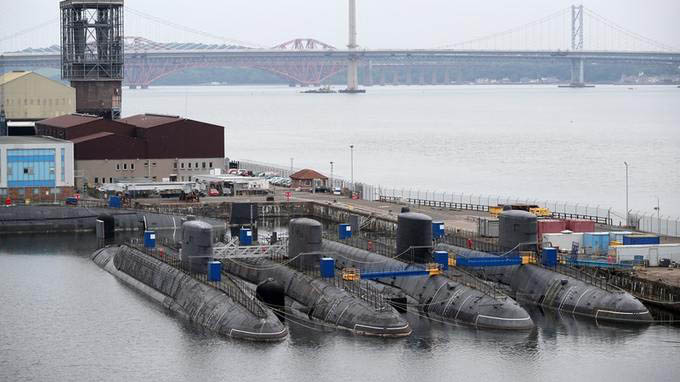
One of the old nuclear subs, Dreadnought, has been laid up at Rosyth for 44 years
By Ally McRoberts, Content Editor, https://www.thenational.scot/news/24154347.new-rosyth-dockyard-building-submarine-dismantling/ 1 Mar 24
THERE are plans for a new building at Rosyth Dockyard to dismantle the old nuclear submarines that are stored there.
Babcock International has applied to Fife Council for permission to construct a large steel shed at dry dock number two.
If approved it will be 70 metres long, 18m wide and 20m high and “aid dismantling operations” at the yard, where seven old subs have been laid up for decades.
A separate planning application related to the project, for a metal waste disposal facility at the corner of Wood Road and Caledonia Road, was submitted to the council late last year.
Blyth and Blyth, of Edinburgh, have been appointed by Babcock as civil and structural engineering consultants for the Rosyth Submarine Dismantling Project and are agents for both applications.
The last of the subs at the dockyard came out of service in 1996 and Dreadnought has been there the longest, coming up for 44 years.
Laid up in Rosyth since 1980, longer than it was in service, getting rid of it and the six other vessels is part of a pledge given in 2022 by the UK Government to Fife Council to “de-nuclearise Rosyth” by 2035.
Councillors were also told of a world first with plans to take out the reactor – “the most radioactive part” – before cutting up the ships with the overall ambition of turning them into “razor blades and tin cans”.
Most of the low-level radioactive waste should be gone from Rosyth by the end of this year.
Documents submitted with the latest planning application says that the new building would be 1162 square metres in size.
The site is currently an area of hardstanding, used for the external storage of materials and equipment associated with the refurbishment of vessels in the dry dock.
Waste produced from the dismantling process “shall be processed in other existing buildings within the dock facilities”.
In total, the UK has 27 old Royal Navy submarines to be scrapped – others are stored at Devonport – and the UK Government has been heavily criticised for delays in dealing with the nuclear legacy.
Maintaining the vessels costs £30m a year.
“Tritium Removal” A Report on the Proposed MCECE nuclear Facility at Chalk River
“Tritium Removal” A Report on the Proposed MCECE Facility at Chalk
River by Gordon Edwards, Ph.D. for the Keboawek First Nation. In a letter
to Keboawek First Nation dated February 2, 2024 (reference # 2), we read
that “CNL is restoring and protecting Canada’s environment by reducing
and effectively managing nuclear liabilities.
Among these liabilities is
Atomic Energy of Canada’s (AECL) large inventory of tritium contaminated
heavy water.” In an accompanying Fact Sheet (reference # 3) CNL states
that “tritiated heavy water cannot be used, re-used or disposed of in its
current form.”
The fact that tritium-contaminated heavy water cannot be
used, re-used, or even disposed of in its present form is a testament to
the considerable hazards posed by radioactive tritium. Nevertheless,
tritiated heavy water can be safely stored, and kept out of the
environment, as is being done at present. There is no reason given by CNL
as to why such storage cannot be continued indefinitely, until the
radioactive tritium has disintegrated to innocuous levels.
Canadian Coalition for Nuclear Responsibility 27th Feb 2024
Locals oppose nuclear waste plant – parish council
Bob Cooper, Political reporter, BBC Radio Cumbria, 28 Feb 24 https://www.bbc.com/news/articles/c0jvjx8kn5xo—
Opponents of plans to seal some of the UK’s most lethal nuclear waste underground have called for communities to have more of say.
Whicham Parish Council in west Cumbria held a postal survey, in which more than three quarters of those who responded opposed the idea.
It is part of an area in which officials are exploring the possibility of siting a Geological Disposal Facility (GDF).
Cumberland Council said there was “no reason” for parish councils to conduct ballots.
Nuclear Waste Services, the body that oversees the project, described a GDF as “a highly engineered structure consisting of multiple barriers that will provide protection over hundreds of thousands of years.”
High-level nuclear waste would be sealed up to 1km (0.62 mile) underground, or possibly under the seabed.
Searches for a potential place for the facility are taking place in three areas, including two in Cumbria and another in Lincolnshire.
‘Impact on communities’
The process of identifying a site is expected to take 10 to 15 years and it could be ready to start receiving waste in the 2050s.
The Whicham postal vote was carried out in 2023 and the parish council said 251 out of 400 parishioners replied, which was a 63% turnout.
The council said 77% were opposed to a GDF in the parish, 15% were in favour, 6% were neutral, while the rest of the forms were blank.
Richard Outram, from Nuclear Free Local Authorities, a group of councils opposed to nuclear developments, said other parish councils should follow Whicham and conduct polls.
“The geological disposal facility, or a nuclear waste dump, is a massive engineering project that’s going to impact on communities for tens of years,” he said.
“It’s important to regularly take the public temperature and one way of doing that is by each parish council holding a regular parish poll.”
‘Too early’
Cumberland Council is the authority with the power to withdraw local communities from the siting process, external.
It is also responsible for conducting a formal test of public support, external, such as a local referendum, before a site can be approved.
The Labour-led authority recently wrote to parish councils telling them they did not need to conduct polls because “detailed public opinion monitoring in the Search Areas is already carried out”.
It also said it was too early in the process to carry out an official test of public support.
Meanwhile, Nuclear Waste Services said surveys to monitor local opinion would be carried out by a professional polling company.
Burying nuclear waste the best of a bad bunch of options
A reader offers her opinion on what to do with nuclear waste as Saskatchewan considers small modular reactors for its future energy needs.
I share the concern that Dale Dewar expressed in the StarPhoenix of Feb. 20 about the long-term management of Canada’s used nuclear fuel.
However, my conclusion is that, while far from ideal, deep burial is the best of a bunch of bad available options. There are no good options. Even proposals to extract recyclable material from the used fuel will leave behind most of the waste to be somehow disposed of.
Dewar’s suggestion that the wastes should remain permanently on the surface, with a system of rolling stewardship that would be passed on from generation to generation, might work in a world that could be guaranteed to be permanently free of war, terrorism, natural disasters, negligence and political instability.
But that’s not the world we live in. We cannot assume that safe stewardship would be maintained in perpetuity. Leaving the wastes indefinitely on the surface would seem to create far greater risk than deep geological burial would.
Of course, it would have been nice if we had thought about this problem before we started creating these wastes.
China is ‘unlikely’ to lift import ban on Japanese seafood as dumping continues
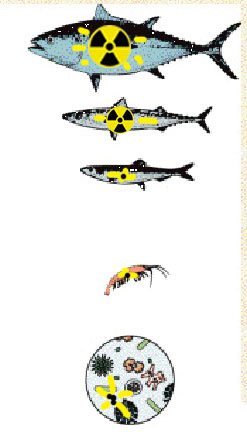
predatory species higher up in the food chain have a greater chance of experiencing bioaccumulation and biomagnification of radioactive substances. As time goes on and more nuclear-contaminated water is discharged, the negative effects will only increase
By GT staff Feb 25, 2024 , https://www.globaltimes.cn/page/202402/1307658.shtml
Half a year after Japan opened Pandora’s box by dumping nuclear-contaminated wastewater from the crippled Fukushima Daiichi nuclear power plant into the ocean, Japanese media are discussing the possibility of bilateral talks for getting China to revoke its import ban on Japanese marine products, in an apparent attempt to test the waters.
In response, Chinese experts told the Global Times on Sunday that, in the short term, it is unlikely that China will revoke the ban as there are currently no conditions for a withdrawal.
Meanwhile, a Kyodo News survey on Friday showed that most Japanese fishery groups have been affected by the discharge, with many feeling the impact through China’s import ban on Japanese seafood.
The survey found that 29 out of 36 respondents among the members of the National Federation of Fisheries Cooperative Associations said they “had felt” or “had somewhat felt” negative effects, including financial damage due to the contaminated water dumping, overwhelmingly due to the subsequent import ban by China.
Chinese Foreign Ministry spokesperson Mao Ning said at a regular press conference that the precautionary measures taken by China and some other countries in response to Japan’s move are aimed at protecting food safety and people’s health.
“These measures are entirely legitimate, reasonable and necessary,” Mao said.
Chang Yen-chiang, director of the Yellow Sea and Bohai Sea Research Institute of Dalian Maritime University, revealed several main factors why China is less likely to revoke the ban in the short run.
There is no halt in the ocean discharge, that is, the Japanese side has not withdrawn from their erroneous actions, he said.
Currently, half a year has passed since the dumping began, meaning that under the influence of ocean currents, the impact of Japan’s nuclear-contaminated water discharge on East Asia may just be starting, and further impacts need to be assessed, Chang said.
In addition, predatory species higher up in the food chain have a greater chance of experiencing bioaccumulation and biomagnification of radioactive substances. As time goes on and more nuclear-contaminated water is discharged, the negative effects will only increase, Chang said. “Under these circumstances, how could the ban be lifted?” the expert asked.
TEPCO – operator of the Daiichi plant – plans to release a total of about 54,600 tons of nuclear-contaminated water on seven occasions in the 2024 fiscal year, more than double the amount of 2023, according to media reports.
Chang called on Japan to consider solving the Fukushima nuclear power plant issue on a fundamental level, such as focusing on research on how to handle the burnt-out nuclear reactors. Otherwise, radioactive substances will continue to be produced endlessly, and the discharge of nuclear contamination could last for over 100 years, making the situation increasingly worse.
Japanese media have reported on a series of scandals concerning leaks occurring during the contaminated water discharge process, which led to soil contamination around the nuclear power plant.
Most recently, 1.5 metric tons of highly radioactive water escaped in early February during valve checks at a treatment machine designed to remove cesium and strontium from the contaminated water, according to TEPCO.
According to Japanese experts studying the soil, the radiation levels in Fukushima soil are much higher compared to other areas.
“We should be more vigilant toward crops and plants grown in this contaminated soil. China should increase radioactive testing of Japanese agricultural products and cosmetics imports,” Chang stated.

China is ‘unlikely’ to lift import ban on Japanese seafood as dumping continues
By GT staff reportersPublished: Feb 25, 2024 09:50 PM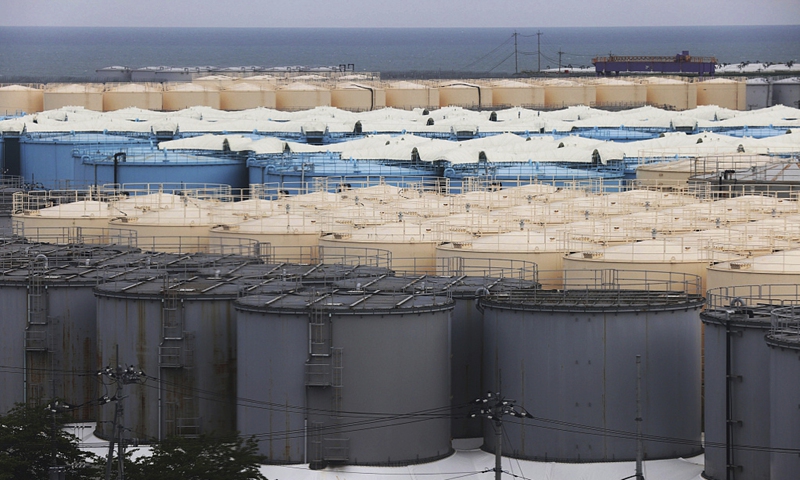
Water tanks near Fukushima Daiichi nuclear power plant in Okuma town of Fukushima prefecture on May 26, 2023 Photo: VCG
Half a year after Japan opened Pandora’s box by dumping nuclear-contaminated wastewater from the crippled Fukushima Daiichi nuclear power plant into the ocean, Japanese media are discussing the possibility of bilateral talks for getting China to revoke its import ban on Japanese marine products, in an apparent attempt to test the waters.
In response, Chinese experts told the Global Times on Sunday that, in the short term, it is unlikely that China will revoke the ban as there are currently no conditions for a withdrawal.
Meanwhile, a Kyodo News survey on Friday showed that most Japanese fishery groups have been affected by the discharge, with many feeling the impact through China’s import ban on Japanese seafood.
The survey found that 29 out of 36 respondents among the members of the National Federation of Fisheries Cooperative Associations said they “had felt” or “had somewhat felt” negative effects, including financial damage due to the contaminated water dumping, overwhelmingly due to the subsequent import ban by China.
Chinese Foreign Ministry spokesperson Mao Ning said at a regular press conference that the precautionary measures taken by China and some other countries in response to Japan’s move are aimed at protecting food safety and people’s health.
“These measures are entirely legitimate, reasonable and necessary,” Mao said.
Chang Yen-chiang, director of the Yellow Sea and Bohai Sea Research Institute of Dalian Maritime University, revealed several main factors why China is less likely to revoke the ban in the short run.
There is no halt in the ocean discharge, that is, the Japanese side has not withdrawn from their erroneous actions, he said.
Currently, half a year has passed since the dumping began, meaning that under the influence of ocean currents, the impact of Japan’s nuclear-contaminated water discharge on East Asia may just be starting, and further impacts need to be assessed, Chang said.
In addition, predatory species higher up in the food chain have a greater chance of experiencing bioaccumulation and biomagnification of radioactive substances. As time goes on and more nuclear-contaminated water is discharged, the negative effects will only increase, Chang said. “Under these circumstances, how could the ban be lifted?” the expert asked.
TEPCO – operator of the Daiichi plant – plans to release a total of about 54,600 tons of nuclear-contaminated water on seven occasions in the 2024 fiscal year, more than double the amount of 2023, according to media reports.
Chang called on Japan to consider solving the Fukushima nuclear power plant issue on a fundamental level, such as focusing on research on how to handle the burnt-out nuclear reactors. Otherwise, radioactive substances will continue to be produced endlessly, and the discharge of nuclear contamination could last for over 100 years, making the situation increasingly worse.
Japanese media have reported on a series of scandals concerning leaks occurring during the contaminated water discharge process, which led to soil contamination around the nuclear power plant.
Most recently, 1.5 metric tons of highly radioactive water escaped in early February during valve checks at a treatment machine designed to remove cesium and strontium from the contaminated water, according to TEPCO.
According to Japanese experts studying the soil, the radiation levels in Fukushima soil are much higher compared to other areas.
“We should be more vigilant toward crops and plants grown in this contaminated soil. China should increase radioactive testing of Japanese agricultural products and cosmetics imports,” Chang stated.
As Japanese industries, including fisheries and cosmetics, have been affected, Japanese media continues to report news about bilateral talks aimed at getting China to revoke its import ban on Japanese marine products, trying to test the reaction from China.
The Asahi Shimbun revealed Friday that nuclear experts from Japan and China started talks in January regarding contaminated water. The report noted that the Chinese side has still shown no signs of ending its import ban.
The Kyodo News reported on Thursday that when Chinese Ambassador to Japan Wu Jianghao met with the leader of the Social Democratic Party, Mizuho Fukushima, in January, China’s import suspension was also discussed, but there were no conditions for lifting the ban at present.
Iran Reduces Near-Weapons-Grade Stockpile, Defying Expectations
Move could signal an effort to de-escalate nuclear tensions with Washington
By Laurence Norman, Feb. 26, 2024
VIENNA—Iran reduced its stockpile of near-weapons-grade nuclear material even as it continued expanding its overall nuclear program, the United Nations’ atomic watchdog said Monday, marking a surprise step that could ease tensions with Washington.
The move comes at a moment when Iran and the U.S. have sought to avoid direct confrontation in the regional conflict that grew out of Hamas’s terrorist attack on Israel on Oct. 7 and Israel’s aggressive response………… (Subscribers only) more https://www.wsj.com/world/middle-east/iran-reduces-near-weapons-grade-stockpile-defying-expectations-ba384777
Buried Nuclear Waste From the Cold War Could Resurface as Ice Sheets Melt
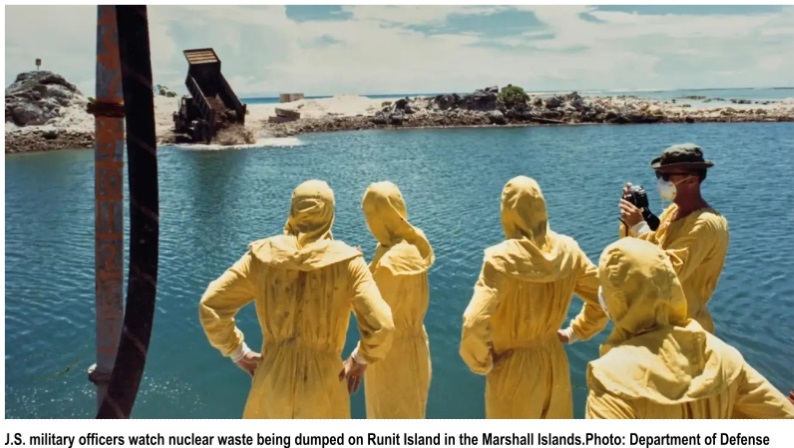
Decades after the U.S. buried nuclear waste abroad, climate change could unearth it.
By Anita Hofschneider, Grist, https://gizmodo.com/buried-nuclear-waste-from-the-cold-war-could-resurface-1851286777
Ariana Tibon was in college at the University of Hawaiʻi in 2017 when she saw the photo online: a black-and-white picture of a man holding a baby. The caption said: “Nelson Anjain getting his baby monitored on March 2, 1954, by an AEC RadSafe team member on Rongelap two days after ʻBravo.ʻ”
Tibon had never seen the man before. But she recognized the name as her great-grandfatherʻs. At the time, he was living on Rongelap in the Marshall Islands when the U.S. conducted Castle Bravo, the largest of 67 nuclear weapon tests there during the Cold War. The tests displaced and sickened Indigenous people, poisoned fish, upended traditional food practices, and wrought cancers and other negative health repercussions that continue to reverberate today.
A federal report by the Government Accountability Office published last month examines what’s left of that nuclear contamination, not only in the Pacific but also in Greenland and Spain. The authors conclude that climate change could disturb nuclear waste left in Greenland and the Marshall Islands. “Rising sea levels could spread contamination in RMI, and conflicting risk assessments cause residents to distrust radiological information from the U.S. Department of Energy,” the report says.
In Greenland, chemical pollution and radioactive liquid are frozen in ice sheets, left over from a nuclear power plant on a U.S. military research base where scientists studied the potential to install nuclear missiles. The report didn’t specify how or where nuclear contamination could migrate in the Pacific or Greenland, or what if any health risks that might pose to people living nearby. However, the authors did note that in Greenland, frozen waste could be exposed by 2100.
“The possibility to influence the environment is there, which could further affect the food chain and further affect the people living in the area as well,” said Hjalmar Dahl, president of Inuit Circumpolar Council Greenland. The country is about 90 percent Inuit. “I think it is important that the Greenland and U.S. governments have to communicate on this worrying issue and prepare what to do about it.”
The authors of the GAO study wrote that Greenland and Denmark haven’t proposed any cleanup plans, but also cited studies that say much of the nuclear waste has already decayed and will be diluted by melting ice. However, those studies do note that chemical waste such as polychlorinated biphenyls, man-made chemicals better known as PCBs that are carcinogenic, “may be the most consequential waste at Camp Century.”
The report summarizes disagreements between Marshall Islands officials and the U.S. Department of Energy regarding the risks posed by U.S. nuclear waste. The GAO recommends that the agency adopt a communications strategy for conveying information about the potential for pollution to the Marshallese people.
Nathan Anderson, a director at the Government Accountability Office, said that the United States’ responsibilities in the Marshall Islands “are defined by specific federal statutes and international agreements.” He noted that the government of the Marshall Islands previously agreed to settle claims related to damages from U.S. nuclear testing.
“It is the long-standing position of the U.S. government that, pursuant to that agreement, the Republic of the Marshall Islands bears full responsibility for its lands, including those used for the nuclear testing program.”
To Tibon, who is back home in the Marshall Islands and is currently chair of the National Nuclear Commission, the fact that the report’s only recommendation is a new communications strategy is mystifying. She’s not sure how that would help the Marshallese people.
“What we need now is action and implementation on environmental remediation. We don’t need a communication strategy,” she said. “If they know that it’s contaminated, why wasn’t the recommendation for next steps on environmental remediation, or what’s possible to return these lands to safe and habitable conditions for these communities?”
The Biden administration recently agreed to fund a new museum to commemorate those affected by nuclear testing as well as climate change initiatives in the Marshall Islands, but the initiatives have repeatedly failed to garner support from Congress, even though they’re part of an ongoing treaty with the Marshall Islands and a broader national security effort to shore up goodwill in the Pacific to counter China.
The San Onofre Briefing: The Latest on SoCal’s Shut Down Nuclear Power Plant
5 Feb 2024
What does it mean for a nuclear plant to be decommissioned? What’s the status of the nuclear waste currently stored on-site at San Onofre? What concerns does the public need to be aware of? Is San Onofre safe? As advocates for a safe and sustainable future for Southern California, SLF is thrilled to present the next edition of our First Fridays Series, “The San Onofre Briefing: The Latest on SoCal’s Shut Down Nuclear Power Plant.” This edition is a comprehensive exploration of the recent developments surrounding the decommissioning of the San Onofre Nuclear Generating Station. Our expert panel – including a retired Admiral of the US Navy and the Former Chair of the US Nuclear Regulatory Commission – delves into the current status, environmental impact, and public health implications of the shut-down nuclear site.
Waste issues need consideration in SMR deployment, says UK’s Committee on Radioactive Waste Management (CoRWM).

https://world-nuclear-news.org/Articles/Waste-issues-need-consideration-in-SMR-deployment 14 Feb 24
Waste management issues need to have a significantly greater prominence in the process of developing and deploying small modular reactor and advanced modular reactor designs, according to the UK’s Committee on Radioactive Waste Management (CoRWM).
There is considerable impetus for the development of small modular reactor (SMR) and advanced modular reactor (AMR) designs and their commercial deployment, both for energy security and for environmental reasons, particularly given the historic difficulties of deploying reactors at gigawatt scale,” CoRWM notes in a new position paper.
However, it says the issue of managing the used fuel and radioactive waste from these new reactors “appears, with some exceptions … to have been largely ignored or at least downplayed up to now”. It adds that the issue “must be considered when selecting technologies for investment, further development, construction and operation”.
The paper says: “This must involve addressing the uncertainties about such management at an early stage, to avoid costly mistakes which have been made in the past, by designing reactors without sufficient consideration of how spent fuel and wastes would be managed, and also to provide financial certainty for investors regarding lifetime costs of operation and decommissioning.”
CoRWM says it is essential to know: the nature and composition of the waste and, in particular, of the used fuel; its likely heat generation and activity levels; how it could feasibly be packaged and its volume; and when it is likely to arise.
“So far there is little published material from the promoters and developers of new reactor types to demonstrate that they are devoting the necessary level of attention to the waste prospectively arising from SMR/AMRs,” it notes.
The position paper provides recommendations to the UK government, Great British Nuclear (GBN), and Nuclear Waste Services and regulators to consider as SMR and AMR deployment is progressed.
“There are many questions to be answered concerning the radioactive waste and spent fuel management aspects of the design and operation of SMRs and AMRs,” CoRWM says. “This paper begins the process of raising them, with the caveat that our knowledge of the reactor designs and their fuel requirements is relatively immature compared with large GW reactors.”
CoRWM says there are various mechanisms by which these questions could be addressed in the process of obtaining approval for the new reactors. These are principally: the process of justification, which will be mandatory for all new reactor types; Generic Design Assessment which is optional and non-statutory; nuclear site licensing; and environmental permitting.
“The last two stages of control may in some cases come too late in the process to allow for effective optimisation of designs and the selection of materials that reduce waste,” CoRWM says. “It remains to be seen how effective these mechanisms will be and whether they will occur sufficiently early in the decision-making process to ensure that radioactive waste management is fully and responsibly addressed.”
CoRWM was established in 2003 as a non-statutory advisory committee and is classed as a non-departmental public body. Its purpose is to provide independent advice to the UK government, and the devolved administrations based on scrutiny of the available evidence on the long-term management of radioactive waste, arising from civil and, where relevant, defence nuclear programmes, including storage and disposal.
The UK government has plans to expand nuclear energy capacity to 24 GW by 2050, with a fleet of SMRs a key part of that strategy. Last year, the government and the new GBN arms-length body set up to help deliver that extra capacity began the selection process for which SMR technology to use. In October, EDF, GE Hitachi Nuclear Energy, Holtec, NuScale Power, Rolls Royce SMR and Westinghouse were invited to bid for UK government contracts in the next stage of the process.
Devonport Dockyard nuclear sub dismantling will be hit by delays, new report predicts
Nuclear Information Service expects no quick fix for removal of 15 decommissioned submarines laid up at Devonport
William Telford, Business Editor, 15 Feb 24 Plymouth Live
The dismantling of 15 decommissioned nuclear subs at Devonport Royal Dockyard is likely to hit delays, according to a new report. The briefing document published by the independent Nuclear Information Service says a history of infrastructure work at the Plymouth facility means “delays are more likely to materialise than not”.
The report said upgrades to 14 and 15 Docks and the Submarine Refit Complex at Devonport are overdue and progress on submarine dismantling is “on hold” while the Government focuses on its £298m “demonstrator” project to fully dismantle HMS Swiftsure at Rosyth, forecast to be complete at the end of 2026.
The Ministry of Defence told Plymouth Live it aims to dismantle the nuclear submarines at Devonport “as soon as practicably possible”. It said the Swiftsure project will “inform and refine” the dismantling process for subsequent submarines and provide more certainty on the dismantling schedule for future submarines and remains on schedule for completion by the original target date of 2026.
The Nuclear Information Service’s briefing report on Devonport Royal Dockyard gives an overview of the facility and its role in servicing the UK’s submarine fleet, including its nuclear-armed submarines. The report said: “The 15 out-of-service nuclear submarines stored at Devonport, and a further seven that are at Rosyth, together comprise every nuclear submarine the Navy has ever fielded.
“Aside from the long-overdue upgrades to 14 and 15 Docks, and the Submarine Refit Complex, progress on submarine dismantling is on hold while the Government focuses on its ‘demonstrator’ project to fully dismantle HMS Swiftsure. This work is being undertaken at Rosyth and is currently forecast to be complete at the end of 2026 at a cost of £298m.
“Three more submarines at Rosyth have had low-level waste removed from them, but it is not clear if work to defuel the nine submarines at Devonport that are still carrying nuclear fuel will begin before completion of the demonstrator project.
In 2016 the MoD estimated that fully dismantling 27 submarines would cost £2.4bn. Although the risk to in-service submarine availability from delays to submarine dismantling and defuelling is lower than from delays to the maintenance schedule, the history of problems with the project and with infrastructure work at Devonport suggests that delays are more likely to materialise than not.”…………………………..more https://www.plymouthherald.co.uk/news/plymouth-news/devonport-dockyard-nuclear-sub-dismantling-9098888—
-
Archives
- October 2026 (120)
- September 2026 (339)
- August 2026 (330)
- July 2026 (355)
- June 2026 (287)
- May 2026 (306)
- April 2026 (356)
- March 2026 (251)
- February 2026 (267)
- January 2026 (308)
- December 2025 (358)
- November 2025 (359)
-
Categories
- 1
- 1 NUCLEAR ISSUES
- business and costs
- climate change
- culture and arts
- ENERGY
- environment
- health
- history
- indigenous issues
- Legal
- marketing of nuclear
- media
- opposition to nuclear
- PERSONAL STORIES
- politics
- politics international
- Religion and ethics
- safety
- secrets,lies and civil liberties
- spinbuster
- technology
- Uranium
- wastes
- weapons and war
- Women
- 2 WORLD
- ACTION
- AFRICA
- Atrocities
- AUSTRALIA
- Christina's notes
- Christina's themes
- culture and arts
- Events
- Fuk 2022
- Fuk 2023
- Fukushima 2017
- Fukushima 2018
- fukushima 2019
- Fukushima 2020
- Fukushima 2021
- general
- global warming
- Humour (God we need it)
- Nuclear
- RARE EARTHS
- Reference
- resources – print
- Resources -audiovicual
- Weekly Newsletter
- World
- World Nuclear
- YouTube
-
RSS
Entries RSS
Comments RSS

