Buried Nuclear Waste From the Cold War Could Resurface as Ice Sheets Melt
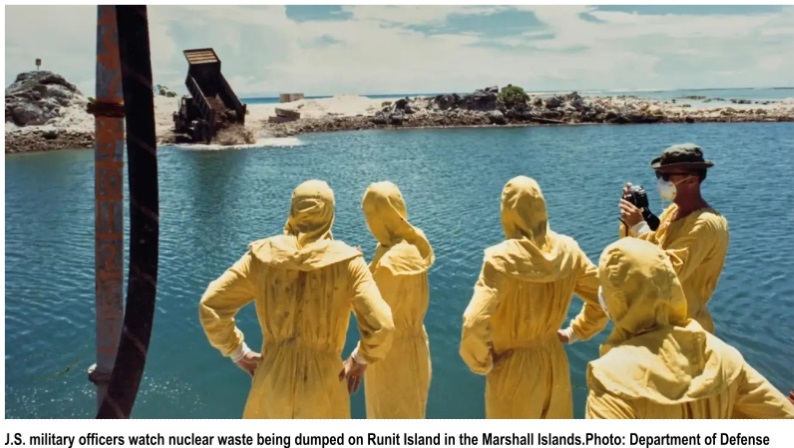
Decades after the U.S. buried nuclear waste abroad, climate change could unearth it.
By Anita Hofschneider, Grist, https://gizmodo.com/buried-nuclear-waste-from-the-cold-war-could-resurface-1851286777
Ariana Tibon was in college at the University of Hawaiʻi in 2017 when she saw the photo online: a black-and-white picture of a man holding a baby. The caption said: “Nelson Anjain getting his baby monitored on March 2, 1954, by an AEC RadSafe team member on Rongelap two days after ʻBravo.ʻ”
Tibon had never seen the man before. But she recognized the name as her great-grandfatherʻs. At the time, he was living on Rongelap in the Marshall Islands when the U.S. conducted Castle Bravo, the largest of 67 nuclear weapon tests there during the Cold War. The tests displaced and sickened Indigenous people, poisoned fish, upended traditional food practices, and wrought cancers and other negative health repercussions that continue to reverberate today.
A federal report by the Government Accountability Office published last month examines what’s left of that nuclear contamination, not only in the Pacific but also in Greenland and Spain. The authors conclude that climate change could disturb nuclear waste left in Greenland and the Marshall Islands. “Rising sea levels could spread contamination in RMI, and conflicting risk assessments cause residents to distrust radiological information from the U.S. Department of Energy,” the report says.
In Greenland, chemical pollution and radioactive liquid are frozen in ice sheets, left over from a nuclear power plant on a U.S. military research base where scientists studied the potential to install nuclear missiles. The report didn’t specify how or where nuclear contamination could migrate in the Pacific or Greenland, or what if any health risks that might pose to people living nearby. However, the authors did note that in Greenland, frozen waste could be exposed by 2100.
“The possibility to influence the environment is there, which could further affect the food chain and further affect the people living in the area as well,” said Hjalmar Dahl, president of Inuit Circumpolar Council Greenland. The country is about 90 percent Inuit. “I think it is important that the Greenland and U.S. governments have to communicate on this worrying issue and prepare what to do about it.”
The authors of the GAO study wrote that Greenland and Denmark haven’t proposed any cleanup plans, but also cited studies that say much of the nuclear waste has already decayed and will be diluted by melting ice. However, those studies do note that chemical waste such as polychlorinated biphenyls, man-made chemicals better known as PCBs that are carcinogenic, “may be the most consequential waste at Camp Century.”
The report summarizes disagreements between Marshall Islands officials and the U.S. Department of Energy regarding the risks posed by U.S. nuclear waste. The GAO recommends that the agency adopt a communications strategy for conveying information about the potential for pollution to the Marshallese people.
Nathan Anderson, a director at the Government Accountability Office, said that the United States’ responsibilities in the Marshall Islands “are defined by specific federal statutes and international agreements.” He noted that the government of the Marshall Islands previously agreed to settle claims related to damages from U.S. nuclear testing.
“It is the long-standing position of the U.S. government that, pursuant to that agreement, the Republic of the Marshall Islands bears full responsibility for its lands, including those used for the nuclear testing program.”
To Tibon, who is back home in the Marshall Islands and is currently chair of the National Nuclear Commission, the fact that the report’s only recommendation is a new communications strategy is mystifying. She’s not sure how that would help the Marshallese people.
“What we need now is action and implementation on environmental remediation. We don’t need a communication strategy,” she said. “If they know that it’s contaminated, why wasn’t the recommendation for next steps on environmental remediation, or what’s possible to return these lands to safe and habitable conditions for these communities?”
The Biden administration recently agreed to fund a new museum to commemorate those affected by nuclear testing as well as climate change initiatives in the Marshall Islands, but the initiatives have repeatedly failed to garner support from Congress, even though they’re part of an ongoing treaty with the Marshall Islands and a broader national security effort to shore up goodwill in the Pacific to counter China.
The San Onofre Briefing: The Latest on SoCal’s Shut Down Nuclear Power Plant
5 Feb 2024
What does it mean for a nuclear plant to be decommissioned? What’s the status of the nuclear waste currently stored on-site at San Onofre? What concerns does the public need to be aware of? Is San Onofre safe? As advocates for a safe and sustainable future for Southern California, SLF is thrilled to present the next edition of our First Fridays Series, “The San Onofre Briefing: The Latest on SoCal’s Shut Down Nuclear Power Plant.” This edition is a comprehensive exploration of the recent developments surrounding the decommissioning of the San Onofre Nuclear Generating Station. Our expert panel – including a retired Admiral of the US Navy and the Former Chair of the US Nuclear Regulatory Commission – delves into the current status, environmental impact, and public health implications of the shut-down nuclear site.
Waste issues need consideration in SMR deployment, says UK’s Committee on Radioactive Waste Management (CoRWM).

https://world-nuclear-news.org/Articles/Waste-issues-need-consideration-in-SMR-deployment 14 Feb 24
Waste management issues need to have a significantly greater prominence in the process of developing and deploying small modular reactor and advanced modular reactor designs, according to the UK’s Committee on Radioactive Waste Management (CoRWM).
There is considerable impetus for the development of small modular reactor (SMR) and advanced modular reactor (AMR) designs and their commercial deployment, both for energy security and for environmental reasons, particularly given the historic difficulties of deploying reactors at gigawatt scale,” CoRWM notes in a new position paper.
However, it says the issue of managing the used fuel and radioactive waste from these new reactors “appears, with some exceptions … to have been largely ignored or at least downplayed up to now”. It adds that the issue “must be considered when selecting technologies for investment, further development, construction and operation”.
The paper says: “This must involve addressing the uncertainties about such management at an early stage, to avoid costly mistakes which have been made in the past, by designing reactors without sufficient consideration of how spent fuel and wastes would be managed, and also to provide financial certainty for investors regarding lifetime costs of operation and decommissioning.”
CoRWM says it is essential to know: the nature and composition of the waste and, in particular, of the used fuel; its likely heat generation and activity levels; how it could feasibly be packaged and its volume; and when it is likely to arise.
“So far there is little published material from the promoters and developers of new reactor types to demonstrate that they are devoting the necessary level of attention to the waste prospectively arising from SMR/AMRs,” it notes.
The position paper provides recommendations to the UK government, Great British Nuclear (GBN), and Nuclear Waste Services and regulators to consider as SMR and AMR deployment is progressed.
“There are many questions to be answered concerning the radioactive waste and spent fuel management aspects of the design and operation of SMRs and AMRs,” CoRWM says. “This paper begins the process of raising them, with the caveat that our knowledge of the reactor designs and their fuel requirements is relatively immature compared with large GW reactors.”
CoRWM says there are various mechanisms by which these questions could be addressed in the process of obtaining approval for the new reactors. These are principally: the process of justification, which will be mandatory for all new reactor types; Generic Design Assessment which is optional and non-statutory; nuclear site licensing; and environmental permitting.
“The last two stages of control may in some cases come too late in the process to allow for effective optimisation of designs and the selection of materials that reduce waste,” CoRWM says. “It remains to be seen how effective these mechanisms will be and whether they will occur sufficiently early in the decision-making process to ensure that radioactive waste management is fully and responsibly addressed.”
CoRWM was established in 2003 as a non-statutory advisory committee and is classed as a non-departmental public body. Its purpose is to provide independent advice to the UK government, and the devolved administrations based on scrutiny of the available evidence on the long-term management of radioactive waste, arising from civil and, where relevant, defence nuclear programmes, including storage and disposal.
The UK government has plans to expand nuclear energy capacity to 24 GW by 2050, with a fleet of SMRs a key part of that strategy. Last year, the government and the new GBN arms-length body set up to help deliver that extra capacity began the selection process for which SMR technology to use. In October, EDF, GE Hitachi Nuclear Energy, Holtec, NuScale Power, Rolls Royce SMR and Westinghouse were invited to bid for UK government contracts in the next stage of the process.
Devonport Dockyard nuclear sub dismantling will be hit by delays, new report predicts
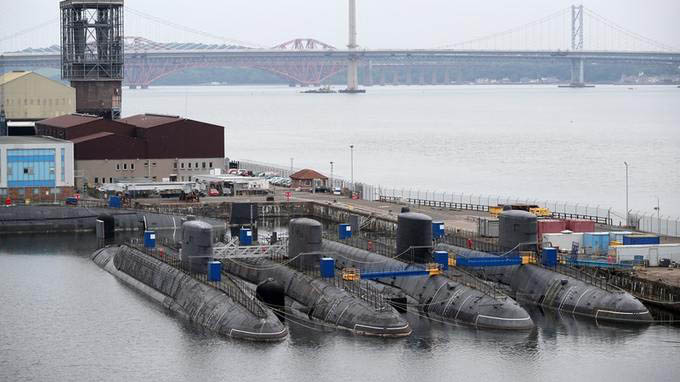
Nuclear Information Service expects no quick fix for removal of 15 decommissioned submarines laid up at Devonport
William Telford, Business Editor, 15 Feb 24 Plymouth Live
The dismantling of 15 decommissioned nuclear subs at Devonport Royal Dockyard is likely to hit delays, according to a new report. The briefing document published by the independent Nuclear Information Service says a history of infrastructure work at the Plymouth facility means “delays are more likely to materialise than not”.
The report said upgrades to 14 and 15 Docks and the Submarine Refit Complex at Devonport are overdue and progress on submarine dismantling is “on hold” while the Government focuses on its £298m “demonstrator” project to fully dismantle HMS Swiftsure at Rosyth, forecast to be complete at the end of 2026.
The Ministry of Defence told Plymouth Live it aims to dismantle the nuclear submarines at Devonport “as soon as practicably possible”. It said the Swiftsure project will “inform and refine” the dismantling process for subsequent submarines and provide more certainty on the dismantling schedule for future submarines and remains on schedule for completion by the original target date of 2026.
The Nuclear Information Service’s briefing report on Devonport Royal Dockyard gives an overview of the facility and its role in servicing the UK’s submarine fleet, including its nuclear-armed submarines. The report said: “The 15 out-of-service nuclear submarines stored at Devonport, and a further seven that are at Rosyth, together comprise every nuclear submarine the Navy has ever fielded.
“Aside from the long-overdue upgrades to 14 and 15 Docks, and the Submarine Refit Complex, progress on submarine dismantling is on hold while the Government focuses on its ‘demonstrator’ project to fully dismantle HMS Swiftsure. This work is being undertaken at Rosyth and is currently forecast to be complete at the end of 2026 at a cost of £298m.
“Three more submarines at Rosyth have had low-level waste removed from them, but it is not clear if work to defuel the nine submarines at Devonport that are still carrying nuclear fuel will begin before completion of the demonstrator project.
In 2016 the MoD estimated that fully dismantling 27 submarines would cost £2.4bn. Although the risk to in-service submarine availability from delays to submarine dismantling and defuelling is lower than from delays to the maintenance schedule, the history of problems with the project and with infrastructure work at Devonport suggests that delays are more likely to materialise than not.”…………………………..more https://www.plymouthherald.co.uk/news/plymouth-news/devonport-dockyard-nuclear-sub-dismantling-9098888—
‘Holderness nuclear waste site seems ludicrous’ – expert warns of ‘significant’ risks
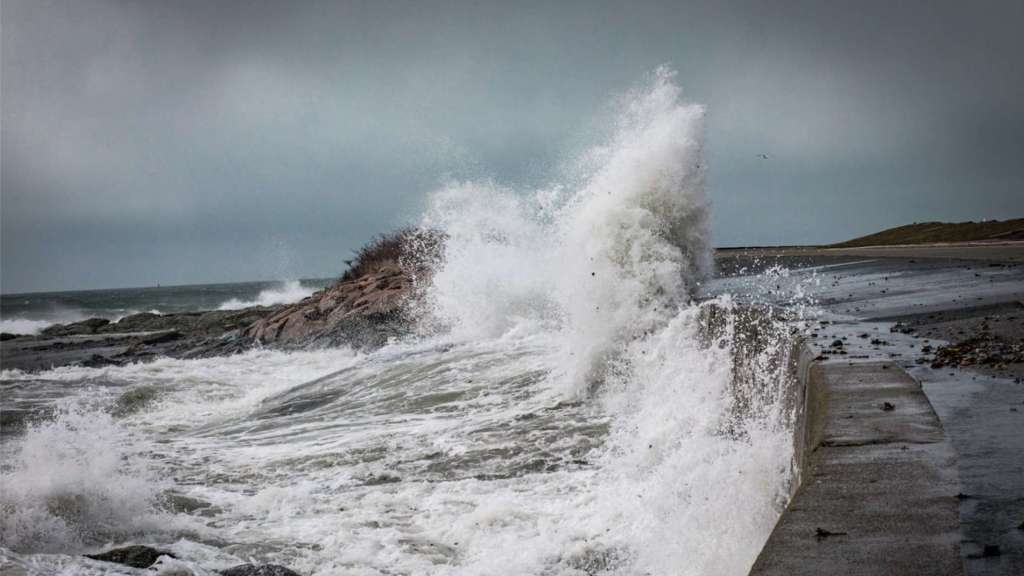
“Over the next 50 to 100 years the issue is sea level rise, but in the nearer term it’s storm surge risk. So why on earth are they looking at this location?
Dr Paul Dorfman is astonished that a Geological Disposal Facility is being considered for South Holderness
By Joseph Gerrard, Local Democracy Reporter 12 Feb 24
An expert has warned against proposals to build an underground radioactive nuclear waste site under Holderness.
Dr Paul Dorfman, an academic and former government adviser, told LDRS he was astonished that a Geological Disposal Facility (GDF) had been proposed for south Holderness. The researcher, who specialises in nuclear waste management, said the risks included flooding and rising sea levels. He also claimed that GDFs were decades away from being proven as a concept………………………………
Under the proposals, radioactive waste would be put into containers and stored hundreds of metres underground at a site which would operate for 175 years. The network of underground vaults and tunnels built within natural geological formations would then be back-filled and the surface site would be given over to other uses.
The establishment of the South Holderness Working Group, which includes East Riding Council, could see funding of up to £2.5m granted if the proposals progress. A facility would only be built if the majority of people in the affected area were shown to want it through a “Test of Support” – though the form that this would take has yet to be decided.
Since the announcement, opposition has been growing to the proposals including with the formation of a local GDF Action Group vowed to oppose it. Beverley and Holderness MP Graham Stuart has also backed a call from South East Holderness councillors Lyn Healing and Sean McMaster for the council to withdraw from the project.
‘Significant risks’
Dr Dorfman is a fellow of the University of Sussex’s Science Policy Research Unit and chairs the Greenpeace-backed Nuclear Consulting Group. His work has included advising the Government, including the Ministry of Defence, on nuclear waste management
Dr Dorfman said the proposals threw up problem after problem and the case for a GDF in south Holderness was knocked out of court when stacked against the evidence. The academic said: “There’s lots of discussions around nuclear energy, but that’s beside the point in this case, it’s about the site itself.
“This is an appalling site, it seems ludicrous, the area seems to have a socially disadvantaged community, and all that implies for why this location has been chosen. There’s lots of models, including the Environment Agency’s, which show this area is at risk of flooding.
“That’s because of sea levels and future sea level rises, there’s some uncertainty over how that will play out. But what there isn’t uncertainty over is the risk of storm surges.
“Over the next 50 to 100 years the issue is sea level rise, but in the nearer term it’s storm surge risk. So why on earth are they looking at this location?
“The other issue is that GDFs are largely conceptual. Yes, one’s been constructed in Sweden, but it’s still an ongoing experiment due to sets of ongoing questions around the containment, the backfill, and most importantly whether the highly radioactive waste can be securely isolated from the wider environment for tens of thousands of years.
“What would happen if there is an accident or incident at a GDF? Significant key underlying research hasn’t been completed, so the question remains, how you can start something like this before you know what you’re doing?
“The current European consensus supports the GDF concept. We have this shared problem of nuclear waste, and we must find a way of managing this extraordinarily toxic stuff. France has also been trying to build a GDF, but they’ve also had significant problems with community acceptance.
“It’s all very well saying let’s do this, but what if deep emplacement makes matters worse? The UK has an existential nuclear waste burden. What are we going to do with it? Well, at the end of the day, no one really knows.
“There may be no final solution, we may have to store it. With a GDF, there’s a huge amount of uncertainty around the underlying geology, would it remain stable for millennia? Then there’s a security issue. Once a GDF is operational, there’s still going to be an opening somewhere.
“And there’s going to be years of trying to emplace this highly radioactive stuff under the ground in containers. It has to be restated that high and mid-level radioactive waste is hugely toxic, and once emplaced, if something goes wrong, then we have a whole set of new problems.
“So, you’ve got problem after problem, and then on top of that you’ve got the issue in south Holderness of the significant risk of flooding. At that point we should just say forget it. This raises the question as to why this site was selected and all that implies for those who have been doing the site selection.
“As for me, I’m astonished the site is being considered. Clearly there will have been preliminary discussions on planning gain for the wider area, with the investment and jobs it would create.
“At a time when money is tight for local people and the local authority, any new money would be welcome. There’s always an upside to any new development, but this has to be weighed against the downside, which in this case is building a high-level nuclear waste site in an area of flooding risk, and the potential hazard to the local community over generations.
“I can’t put into words how amazed I am by this choice of location. As if there weren’t enough problems with a GDF already, south Holderness is a deeply problematic location.”……………………………………………………………………………… https://www.hulldailymail.co.uk/news/hull-east-yorkshire-news/holderness-nuclear-waste-site-seems-9090538
Final public meeting to discuss South Holderness nuclear waste plan
The final public meeting to discuss plans to bury nuclear waste in East
Yorkshire takes place later. The drop-in session at Burstwick Village Hall
is the last of five organised by Nuclear Waste Services (NWS).
The government agency has named South Holderness as having potential for a
Geological Disposal Facility (GDF). Chief executive Corhyn Parr previously
said the scheme would only go ahead with community support. The GDF would
see waste stored up to 3,280ft (1,000m) underground until its radioactivity
had naturally decayed. Officials from NWS said the project could create
thousands of jobs and investment in local infrastructure in the area. The
proposed South Holderness site is one of three areas in England being
considered.
However, the plan has attracted opposition, with two local
councillors calling on East Riding of Yorkshire Council to end talks with
NWS. Beverley and Holderness Conservative MP Graham Stuart, who is also the
Minister for Energy Security, has backed the councillors’ motion saying
“Our community says no”.
BBC 12th Feb 2024
Canada citizens challenge environmental safety of Canadian Nuclear Safety Commission waste facility near Ottawa River

Pitasanna Shanmugathas | Vermont Law & Graduate School, US, FEBRUARY 9, 2024 https://www.jurist.org/news/2024/02/canada-citizens-challenge-environmental-safety-of-canadian-nuclear-safety-commission-waste-facility-near-ottawa-river/
A group of Canadian citizens launched a legal challenge against the Canadian Nuclear Safety Commission (CNSC) on Thursday over the commission’s recent approval of the construction of a Near Surface Disposal Facility (NSDF) near the Ottawa River. Led by the Concerned Citizens of Renfrew County and Area, Ralliement contre la pollution radioactive, and the Canadian Coalition for Nuclear Responsibility, the challenge encompasses a broad array of environmental and public health concerns surrounding the NSDF’s potential impacts.
At the core of this legal action is an application for judicial review pursuant to section 18 of the Federal Courts Act. The challenge targets the CNSC’s decision, dated January 8, approving Canadian Nuclear Laboratories’ (CNL) application to amend the Nuclear Research and Test Establishment Operating License for the Chalk River Laboratories sites. This amendment would authorize the construction of the NSDF, classified as a Class IB Nuclear Facility—a project not previously sanctioned under the existing license.
Represented by Nicholas Pope, the applicants seek an order to quash the decision to amend the license for NSDF construction.
The NSDF is envisaged as a nuclear waste disposal facility designed to contain up to one million cubic meters of radioactive waste. Its anticipated lifespan comprises several phrases, including a construction phase, operation phase, closure phase, institutional control period, and post-institutional control period. Of potential concern to the applicants is the potential for rainwater infiltration during the operation phase, which could lead to the leaching of radioactive materials into the environment. Moreover, plans to mitigate this risk by discharging treated wastewater into Perch Lake, a tributary of the Ottawa River, have raised further alarm.
To secure the license amendment, CNL underwent a rigorous approval process, which required an environmental assessment under the Canadian Environmental Assessment Act, compliance with the Nuclear Safety and Control Act (NSCA), and consultation with Indigenous communities. However, the applicants raised concerns about the CNL’s fulfillment of these requirements.
Of particular contention is the inclusion of an override section within the Waste Acceptance Criteria documented submitted by CNL. This provision, if implemented, would ostensibly permit the disposal of waste that does not meet the established acceptance criteria, thereby eroding any assurances of stringent waste management standards and rendering the safety case effectively null and void. Moreover, concerns persist regarding the efficacy of waste verification processes to ensure compliance with the acceptance criteria.
Assertions have been made that the CNL failed to adequately consider the environmental impacts of alternative wastewater discharge methods, including the proposed pipeline to Perch Lake.
In a comment to JURIST, Pope asserted:
According to Canadian Nuclear Laboratories, the proponents of the project, even if all goes according to plan and there are no disruptive events, the public will still be subjected to radiation doses that are one and a half times the regulated standard for radioactive material that have been released from regulatory controls. And, if a disruptive event does occur, the public could receive up to fourteen times the legal limit of a radiation dose. So this surface level facility has been designed to only last for 550 years before it erodes and only be under institutional control for 300 years yet the materials they are planning on placing in this mound have half-lives of thousands of years and will remain radioactive for thousands of years—well beyond when it is no longer under governmental control and when the cover has eroded away so the materials will be free to be released into the environment.
The applicants also raised concerns about CNL’s compliance with consultation requirements with Indigenous nations, particularly Kebaowek First Nation, whose traditional territory encompasses the proposed NSDF site.
‘All we can do is hope for the best’: Concerns persist about Canada’s planned radioactive waste disposal site


dilution is not a solution to pollution. It just means that millions of people are going to be exposed to much smaller doses. When it comes to cancer-causing materials, the number of people exposed “is very important” because when even a small dose of tritium or any other radioactive material is allowed to enter the drinking water for millions of people, the number of expected cancers and genetic mutations is magnified by the size of the population”
By Natasha Bulowski | News, Ottawa Insider | February 6th 2024
Everyone agrees a safe solution is needed for Canada’s current and future radioactive waste. But whether a recently approved disposal facility in Deep River, Ont., is the answer is the subject of hot debate.
The “near-surface disposal facility” (NSDF) will see up to one million cubic metres of radioactive waste buried in a shallow mound at Chalk River Laboratories (CRL), about 190 kilometres northwest of Ottawa. Project proponents argue Canada must find a way to store low-level nuclear waste, some of which is currently not well-managed…….
Opponents argue the project, a kilometre from the Ottawa River, poses risks to the drinking water supply for millions, will not safely contain the waste and the company failed to adequately consult many Algonquin Nations. Representatives from six concerned groups recently wrote an open letter to the federal government urging it to halt the project. The waste contains long-lived radionuclides, which many experts say require far more robust containment than this facility will offer.
Radionuclides are unstable, radioactive atoms. Some will remain radioactive for thousands or millions of years, while others are short-lived and decay quickly. The Environmental Protection Agency and other health organizations classify all radionuclides as cancer-causing.
Of the radionuclides present in the waste destined for the NSDF, 19 of 29 listed by Canadian Nuclear Laboratories (CNL) have half-lives of more than a thousand years. This means they’ll be present for more than 10,000 years, said Gordon Edwards, president of the Canadian Coalition for Nuclear Responsibility, in his 2022 submission to the Canadian Nuclear Safety Commission (CNSC). Another 12 on the list have half-lives of more than 100,000 years, so they will remain in the NSDF for well over a million years, wrote Edwards, a retired professor of mathematics and science with over 45 years serving as a consultant on nuclear issues.
Several groups and many Algonquin Nations are worried about the radionuclides, particularly one called tritium. This radioactive form of hydrogen is a carcinogen most dangerous when ingested because it enters the waterways with ease and can’t be filtered out with water treatment methods either at CRL or at the municipal level, notes Edwards.
These long-lived radionuclides are in “limited” quantities and “intrinsically part of the radiological fingerprints of waste streams at CRL and other CNL sites,” reads CNL’s submission. “It is not practical, technical, or economical to separate the long-lived radionuclides” because much of the waste is in the form of soil and building debris, it says.
CNL is run by a consortium of private companies (including AtkinsRéalis, formerly known as SNC-Lavalin) and contracted by the federal government to operate its laboratories and deal with waste.
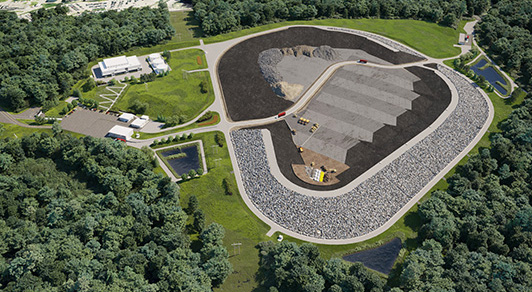
When completed, CNL says the facility will resemble a huge grassy mound the size of 10 soccer fields. The bottom and top of the mound will be lined with synthetic membranes to keep water from getting in, according to CNL.
Construction is expected to take three years and cost $475 million, along with an estimated $275 million in operating costs over 50 years. During that time, CNL will verify all waste placed in the hollowed-out depression in the hillside meets the waste acceptance criteria.
The loose soil and smaller building debris will be compacted into layers and larger debris and waste packaged in drums and containers will be placed in the mound. Water that contacts areas where waste is stored or handled will be routed through a wastewater treatment plant and discharged in nearby Perch Lake. Once all the waste is inside, the final cover of earthen materials and a synthetic membrane go on top to keep precipitation away from the mound.
According to CNL’s draft monitoring plan, wastewater treatment will continue for 30 years and after that, it will be up to the liner and facility design to contain the mound’s contents. Some surveillance will take place to verify the facility is meeting environmental requirements. The top and bottom liners — which are supposed to “remain functional” for 500 years — will eventually erode.
However, it is “a critical flaw” that CNL didn’t plan for waste to be retrieved if something goes wrong later, the Canadian Environmental Law Association argued at the 2022 licensing hearings.
A retrieval plan is important because it gives future generations access to the waste for monitoring, repairs, to move it to a safer location or take advantage of safer technologies in the future, said Tanya Markvart, the law association’s environmental consultant.
“We really don’t know what’s going to happen over the next 100 to 500 or 2,000 years,” said Markvart.
CNL says there’s no plan to retrieve the waste because the facility design will safely manage it long term, but notes nothing is stopping future generations from retrieving its contents. But the law association says it is “unjust to shift the burden” to future generations, who neither created nor benefited from activities that made the radioactive waste………………………………………………………………………………………………………………….
Water worries
The NSDF’s proximity to the Ottawa River concerns environmentalists, many Algonquin leaders and more than 140 municipalities downstream. CNL materials indicate the facility’s base will be 50 metres above the current water levels of the Ottawa River and on bedrock sloping away from the river.
“Any site anywhere in the Ottawa Valley eventually drains to the river. That’s just basic hydrogeology,” said Mayor D’Eon, a member of CNL’s environmental stewardship council, when asked about opponents’ concern for the river.
“So whether you put it on that military base, which some people have said, or five kilometres away, hydrogeology takes everything to the Ottawa River,” she said.
The bedrock slopes towards Perch Lake, which has a creek that feeds directly into the Ottawa River and in the event of an overflow or other design failure, it wouldn’t take long for contaminated water to reach the lake, according to the Ottawa Riverkeeper, a charity focused on the health of the river and its tributaries. Hydrologist Wilf Ruland reviewed the NSDF proposal for Ottawa Riverkeeper and noted the location has “unfavourable geology” and will rely entirely on the NSDF’s engineered features to contain, collect and treat contaminated water leaching from the mound and prevent it from contaminating groundwater and surface water flow systems. The Ottawa Riverkeeper is also concerned about the presence of chemical contaminants and heavy metals, not just radioactivity.
………………………………. Edwards doesn’t think the waste would cause “a huge kill-off,” after all, “the Ottawa River is huge and the stuff does get diluted,” he told Canada’s National Observer in an interview.
“But we’ve learned over the years that dilution is not a solution to pollution. It just means that millions of people are going to be exposed to much smaller doses.” When it comes to cancer-causing materials, the number of people exposed “is very important” because when even a small dose of tritium or any other radioactive material is allowed to enter the drinking water for millions of people, the number of expected cancers and genetic mutations is magnified by the size of the population, added Edwards.
Pontiac County, Que., made up of 18 municipalities, is right across the river from the facility. Unlike Deep River, which calls itself the “proud home of Canadian Nuclear Laboratories,” Pontiac has opposed the project location from the get-go, said Jane Toller, head of the county council, in an interview with Canada’s National Observer………………………………………………………………………………………….
Toller supports Kitigan Zibi and Kebaowek First Nations, which are currently pressuring the federal government to deny CNL permits required under the Species at Risk Act. Toller says the CNSC’s decision is a “cut-and-dry” violation of the United Nations Declaration on the Rights of Indigenous Peoples, which says no hazardous material can be stored on Indigenous land without prior, free and informed consent. While Pikwakanagan First Nation — the Algonquin nation closest to the facility — signed an agreement with CNL, Kitigan Zibi and Kebaowek say they were not adequately consulted and do not consent to the facility.
“I just don’t know why our federal government has not paid attention to that,” said Toller.
The CNSC’s recent decision only granted CNL a licence to construct the facility. The company still must apply for an operating licence.
Natasha Bulowski / Local Journalism Initiative / Canada’s National Observer
Energy Security Minister Graham Stuart opposes Holderness nuclear waste site
By Stuart Harratt, BBC News
A MP said he is supporting efforts to oppose plans to bury nuclear waste in East Yorkshire.
Beverley and Holderness Conservative MP Graham Stuart called on East Riding Council to withdraw from discussions with Nuclear Waste Services (NWS).
The government agency has named South Holderness as a potential site for a Geological Disposal Facility (GDF).
Mr Graham, who is also the Minister for Energy Security, had previously called for a public vote on the proposals.
He now says he is supporting a motion by two local Conservative councillors, Lyn Healing and Sean McMaster, asking that the local authority stop talks with NWS.
‘Community says no’
“South Holderness is a special place, and the news that the area was being considered as the site for the UK’s GDF shocked many in our community,” Mr Stuart said.
“It is the people of Holderness who should determine what happens in their area and they have made clear their opposition to these plans.”
He added: “Our community says ‘No’ and Lyn and Sean have my backing to seek our withdrawal.”
Ms Healing and Mr McMaster said their motion to withdraw from discussions would be submitted to a full council meeting on 21 February.
“Yes, investment in Holderness is badly required but is this the right investment? We now believe it isn’t,” the councillors said……………………………………………………………………………… more https://www.bbc.com/news/uk-england-humber-68233882
Nuclear industry veterans warn some radioactive waste destined for Ontario disposal facility should not be accepted
Observer, Natasha Bulowski • Feb 16, 2024 •
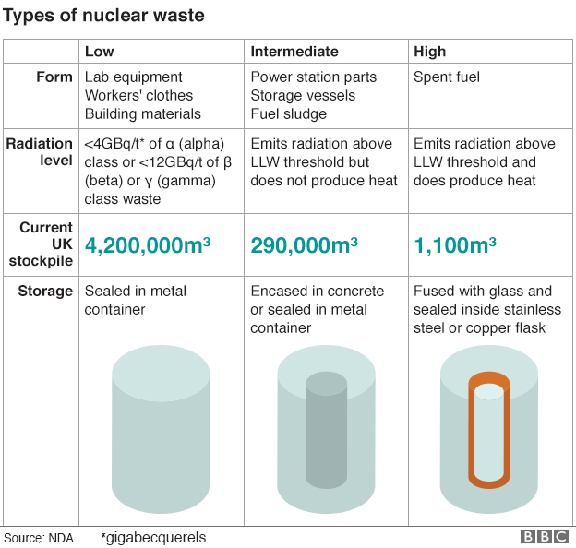
Approval of a nuclear waste disposal site near the Ottawa River hinged on a promise that only low-level radioactive waste would be accepted. But former nuclear industry employees and experts warn some waste slated for disposal contains unacceptably high levels of long-lived radioactive material.
The “near-surface disposal facility” at Chalk River Laboratories (CRL) will store up to one million cubic metres of current and future low-level radioactive waste inside a shallow mound about one kilometre from the river, which provides drinking water to millions of people in the region. But former employees who spent decades working at the labs in waste management and analysis say previous waste-handling practices were inadequate, imprecise and not up to modern standards. Different levels of radioactive material were mixed together, making it unacceptable to bury in the mound.
“Anything pre-2000 is anybody’s guess what the hell they have on their hands,” said Gregory Csullog, a retired waste inventory specialist and former longtime employee of Atomic Energy of Canada Limited (AECL), the Crown corporation that ran the federal government’s nuclear facilities before the Harper government privatized it in 2015.
Csullog described the waste during this earlier time as an unidentifiable “mishmash” of intermediate- and low-level radioactivity because there were inadequate systems to properly label, characterize, store and track what was produced at Chalk River or shipped there from other labs. “Literally, there were no rules,” said Csullog, who was hired in 1982 to develop waste identification and tracking systems.
International safety standards state low-level radioactive waste is suitable for disposal in various facilities, ranging from near the surface to 30 metres underground, depending primarily on how long it remains radioactive. High-level waste, like used fuel rods, must be buried hundreds to thousands of metres underground in stable rock formations and remain there, effectively forever. Intermediate-level waste is somewhere in the middle and should be buried tens to hundreds of metres underground, not in near-surface disposal facilities, according to the International Atomic Energy Agency (IAEA).
Radioactive waste is recognized by many health authorities as cancer-causing and its longevity makes disposal a thorny issue. Even short-lived radioactive waste typically takes hundreds of years to decay to extremely low levels and some radioactive isotopes like tritium found in the waste — a byproduct of nuclear reactors — are especially hard to remove from water.
Canadian Nuclear Laboratories (CNL) originally wanted its near-surface disposal facility to take intermediate- and low-level waste when it first proposed the project in 2016. Backlash was swift and concerned groups, including Deep River town council and multiple experts, argued it would transgress international standards to put intermediate-level waste in that type of facility. In 2017, CNL changed its proposal and promised to only accept low-level waste. The announcement quelled the Deep River town council’s concern, but some citizen groups, scientists, former employees and many Algonquin Nations aren’t buying it.
CNL says its waste acceptance criteria will ensure all the waste will be low-level and comply with international and Canadian standards. Eighty seven per cent of the waste will be loose soil and debris from environmental remediation and decommissioned buildings. The other 13 per cent “will have sufficiently high radionuclide content to require use of packaging” in containers, drums or steel boxes in the disposal facility, according to CNL.
However, project opponents note that between 2016 and 2019, about 90 per cent of the intermediate-level waste inventory at federal sites was reclassified as low-level, according to data from AECL and a statement from CNL. The timing of the reclassification raised the alarm for critics, who took it to mean intermediate-level waste was inappropriately categorized as low-level so it could be stored in the Chalk River disposal facility. CNL said the 2016 estimate was based on overly “conservative assumptions” and the waste was reclassified after some legacy waste was retrieved, examined and found to be low-level.
The disposal facility will also accept waste generated over the next two decades and some shipments from hospitals and universities.
The history of Chalk River Laboratories
To fully understand the nuclear waste problem, you first have to know the history of Chalk River Lab’s operations and accidents,…………………………………………………………………………………………………………………………………………………………………………………………………………… more https://www.pembrokeobserver.com/news/local-news/nuclear-industry-veterans-warn-some-radioactive-waste-destined-for-ontario-disposal-facility-should-not-be-accepted Natasha Bulowski is a Local Journalism Initiative reporter working out of Canada’s National Observer. LJI is funded by the Government of Canada.
Holtec International avoids criminal prosecution related to false documents, pays $5m fine.


Holtec International avoids criminal prosecution related to false documents
NJ Spotlight News, JEFF PILLETS | JANUARY 30, 2024
Holtec International, the Camden firm behind controversial nuclear power projects in New Jersey and four other states, has agreed to pay a $5 million penalty to avoid criminal prosecution connected to a state tax break scheme.
New Jersey Attorney General Matthew J. Platkin announced Tuesday that Holtec has been stripped of $1 million awarded by the state in 2018 under the Angel Investor Tax Break Program. Holtec will also submit to independent monitoring by the state for three years regarding any application for further state benefits, Platkin said.
The agreement, which also covers a real estate company owned by Holtec founder and CEO Krishna Singh, came after a lengthy criminal investigation that discovered Holtec had submitted false information to the state in seeking the Angel tax breaks.
Holtec’s use of misinformation for private gain, as detailed by the state attorney general, closely parallels allegations that have followed the company for years as it sought public subsidies to finance international ambitions in the nuclear field……………………………………..
Previously fined
In 2010, the Tennessee Valley Authority fined Holtec $2 million and ordered company executives to take ethics training after a bribery investigation involving Singh’s dealings with a key subcontractor.
The TVA also banned Holtec from federal work for 60 days, the first ever such debarment in the agency’s history.
In 2023, Holtec’s former chief financial officer filed a federal lawsuit claiming that he had been fired after refusing to sign off on false financial information the company was allegedly sending to potential investors. Kevin O’Rourke alleges that Holtec intentionally sought to inflate revenue projections and hide millions in expected losses.
Those allegations, which Holtec has denied, include the company’s effort to mask $750 million in potential losses for its controversial proposal to build a consolidated nuclear waste storage facility in southeast New Mexico. That project, which was approved by federal regulators last year, faces a federal court challenge lodged by private groups and New Mexico state officials, who say Holtec lied about key information on its applications to build the storage facility.
The alleged false information, New Mexico officials say, included Holtec’s representation that it had obtained property rights from mine owners and oil drillers who are active near the 1,000-acre plot of desert land where Holtec would eventually place up to 10,000 spent nuclear fuel canisters with some 120,000 metric tons of radioactive waste.
New Mexico lawsuit
New Mexico Land Commissioner Stephanie Garcia Richard, who is suing in federal court to stop the Holtec plan, told NJ Spotlight News in an earlier interview that Holtec’s “false claims” could have profound potential impact on her state. There are more than 50 oil, gas and mineral wells within a 10-mile radius of Holtec’s site, she said, and the potential for underground contamination is real.
“I understand we need to find a [nuclear waste] storage solution, but not in the middle of an active oil field, not from a company that is misrepresenting facts,” Garcia Richard said in an earlier statement.
New Mexico state Sen. Jeff Steinborn, whose law to ban the facility is now part of that federal lawsuit, told NJ Spotlight News that questions about Holtec’s character should be a deep concern for the public. Holtec, he pointed out, plans to transport dangerous spent fuel from retired power reactors across the nation to the site……………………………………………………………….
Decommissioning operations
Over the past half-decade, Holtec has moved aggressively forward from its manufacturing roots to take ownership of closed nuclear plants that are in the process of being retired. The company runs decommissioning operations at the retired Oyster Creek generating station along Barnegat Bay at Lacey Township, and three other sites, including New York’s Indian Point and the Pilgrim plant in Massachusetts.
The company has informally discussed starting up some of the new reactors at Oyster Creek and the Palisades site in Michigan, and is also pursuing plans to bring the next-gen nukes to Ukraine, Great Britain and other countries overseas.
Holtec now controls billions in public money that was set aside by utility users in each state for the safe decommissioning of nuclear reactors, a process that regulators have estimated could take 60 years for most reactors. Holtec, instead, has claimed it could dismantle the old plants and restore the land for public use in a fraction of that time.
Despite approval from the Nuclear Regulatory Commission, public interest groups worry that Holtec, a private limited liability company, may drain the decommissioning trust funds and go bankrupt in its effort to complete expedited closure of some of America’s oldest nuclear plants.
Legal settlements elsewhere
Attorneys general in Massachusetts and New York were so worried that taxpayers could be left high and dry, they filed lawsuit pointing out multiple inconsistencies in Holtec’s plans. Both states have won legal settlements designed to stop Holtec from depleting the trust funds.
In addition to controlling the public trust funds, Holtec has also received or applied for billions in taxpayer subsidies and federal grants and loans. Some of those subsidies would help the firm finance its proposed storage dump in the New Mexico desert, as well as construction of a new generation of so-called SMRs, or small modular reactors.
The company has informally discussed starting up some of the new reactors at Oyster Creek and the Palisades site in Michigan, and is also pursuing plans to bring the next-gen nukes to Ukraine, Great Britain and other countries overseas.No such small nuclear reactor has ever been brought online in the U.S., as they face significant costs and regulatory hurdles despite the support of some policymakers who argue that nuclear power can help reduce atmospheric carbon. A plan to build SMRs in Idaho collapsed last year after its cost more than doubled, to $9 billion.
It is unclear how the fine and criminal investigation announced Tuesday by New Jersey might affect Holtec’s plans to develop a new fleet of reactors.
The NJ case
According to the attorney general’s office, Holtec’s false tax break application concerned its partnership with a battery manufacturing firm named Eos Energy Storage. Holtec had planned on using Eos to help develop SMR technology at a manufacturing plant in western Pennsylvania.
Holtec and Singh Real Estate, a subsidiary owned by the company’s owner, invested $12 million in Eos in exchange for six million shares in the company. Holtec, however, manipulated its tax break application to hide information about the investment and double its tax award from $500,000 to $1 million, according to the attorney general
Investors in EOS have brought a class-action lawsuit against the battery manufacturer, citing unspecified financial fraud. Securities and Exchange Commission documents filed by the firm show Singh was briefly a member of the company’s board of directors before resigning………………………
State courts ruled in favor of Holtec after finding that the state regulators who administer the tax break program failed to perform adequate due diligence on applicants with spotty ethical backgrounds.
Public interest groups and nuclear safety experts who continue to oppose Holtec’s plans around the country, however, say the New Jersey fine is another warning sign. They said federal regulators, including the Department of Energy, must redouble scrutiny before awarding more public subsidies to the company.
“Clearly, Holtec lies habitually for fraudulent financial gain,” said Kevin Kamps, a radioactive waste specialist at Beyond Nuclear, a leading watchdog group that is suing to stop Holtec’s New Mexico plan, as well as efforts to collect billions in subsidies to restart the retired Palisades nuclear plant in Michigan.
“The State of Michigan, and U.S. Department of Energy, must… not hand over hundreds of millions of dollars in state, and multiple billions of dollars in federal, taxpayer money for Holtec’s unprecedented, extremely high-risk zombie reactor restart scheme at Palisades.” https://www.njspotlightnews.org/2024/01/holtec-camden-will-pay-5-million-fine-false-documents-nj-tax-breaks-controversial-nuclear-projects/
Radioactive waste beside Ottawa River will remain hazardous for thousands of years: Citizens’ groups
Toula Mazloum, CTV News Ottawa Digital Multi-Skilled Journalist, Feb. 5, 2024
Citizens’ groups from Ontario and Quebec have issued a warning saying that the radioactive waste destined for a planned nuclear waste disposal facility in Deep River, Ont., one kilometre from the Ottawa River, will remain hazardous for thousands of years.
The disposal project — a seven-storey radioactive mound known as the “Near Surface Disposal Facility” (NSDF) – was licensed by the Canadian Nuclear Safety Commission (CNSC) last month.
The CNSC said it determined the project is not likely to cause significant adverse effect, “provided that [Canadian Nuclear Laboratories] implements all proposed mitigation and follow-up monitoring measures, including continued engagement with Indigenous Nations and communities and environmental monitoring to verify the predictions of the environmental assessment.”
The groups sent a letter Sunday to the federal government, asking to stop all funding for the project and to look for alternate ways to dump the waste underground.
In the letter, the groups warned that waste destined for the mound is “heavily contaminated with very long-lived radioactive materials” that puts the public at risk of developing cancer, birth defects and genetic mutations.
“We believe Cabinet or Parliament has the power to reverse this decision and they need to do so as soon as possible,” said Lynn Jones of Concerned Citizens of Renfrew County and Area.
“It’s clear that the only benefit from the NSDF would go to shareholders of the three multinational corporations involved, AtkinsRéalis (formerly SNC-Lavalin), Fluor and Jacobs. Everyone else would get only harm—a polluted Ottawa River, plummeting property values, increased health risks, never-ending costs to remediate the mess and a big black mark on Canada’s international reputation.”
One million tons of radioactive and other hazardous waste from eight decades of operations of the Chalk River Laboratories (CRL) will be held if the project is completed, according to the group.
The groups say that according to scientists and after a few hundred years, “the mound would leak during operation and break down due to erosion,” contaminating drinking water in the Ottawa River.
The controversial project has been concerning for many residents and organizations since 2016, including residents of Renfrew County and Area, the Old Fort William (Quebec) Cottagers’ Association, Ralliement contre la pollution radioactive and the Canadian Coalition for Nuclear Responsibility, the groups say.
“People need to wake up and realize the truth that this waste is full of deadly long-lived, man-made radioactive poisons such as plutonium that will be hazardous for many thousands of years,” said Johanna Echlin of the Old Fort William (Quebec) Cottagers’ Association.
Waste from CRL is classified as an “Intermediate-level” waste class, which means it must be kept tens of metres underground, says the International Atomic Energy Agency
“A former senior manager in charge of ‘legacy’ radioactive waste at Chalk River told the Canadian Nuclear Safety Commission that, in reality, the waste proposed for emplacement in the NSDF is ‘intermediate level waste’ that requires a greater degree of containment and isolation than that provided by a near surface facility.’ He pointed out the mound would be hazardous and radioactive for many thousands of years, and that radiation doses from the facility will, in the future, exceed regulatory limits,” the groups noted.
Citizens’ groups want Canada to commit to building world class facilities not only for managing radioactive waste that would keep Canadians safe, but also for safely managing the waste for generations to come.
CTV News has reached out to Canadian Nuclear Laboratories (CNL) for comments.
In a statement to CTV News Ottawa, the CNSC said it will ensure that CNL meets all legal and regulatory requirements as well as licence conditions, through regular inspections and evaluations.
“The purpose of the NSDF Project is to provide a permanent disposal solution for up to 1 million cubic metres of solid low-level radioactive waste, such as contaminated personal protective clothing and building materials,” the statement said. “The majority of the waste to be placed in the NSDF is currently in storage at the Chalk River Laboratories site or will be generated from environmental remediation, decommissioning, and operational activities at the Chalk River Laboratories site. Approximately 10% of the waste volume will come from other AECL-owned sites or from commercial sources such as Canadian hospitals and universities.”
CNSC says its Jan. 10 decision applies to the construction of the NSDF project only.
“Authorization to operate the NSDF would be subject to a future Commission licensing hearing and decision, should CNL come forward with a licence application to do so. No waste may be placed in the NSDF during the construction phase of the project,” the regulator said.
The site for the NSDF is on the CRL property, 180 km northwest of Canada’s capital, on the Ottawa River directly across from the Province of Quebec.
Nuclear secret: India’s space program uses plutonium pellets to power missions
Rt.com 5 Feb 24
New Delhi is experimenting with radioisotopes to charge its robotic missions to the Moon, Mars and beyond.
Indians are ecstatic over their space program’s string of successes in recent months. The Indian Space Research Organization (ISRO) has a couple of well-kept tech secrets – one of them nuclear – that will drive future voyages to the cosmos.
In the Hollywood sci-fi movie ‘The Martian’, astronaut Mark Watney, played by Matt Damon, is presumed dead and finds ways to stay alive on the red planet, mainly thanks to a big box of Plutonium known as a Radioisotope Thermoelectric Generator (RTG).
In the film, Watney uses it to travel in his rover to the ‘Pathfinder’, a robotic spacecraft which launched decades ago, to use its antenna to communicate with his NASA colleagues and tell them he’s still alive. Additionally, the astronaut dips this box into a container of water to thaw it.
In real life, the RTG generates electricity from the heat of a decaying radioactive substance, in this case, Plutonium-238. This unique material emits steady heat due to its natural radioactive decay. Its continuous radiation of heat, often lasting decades, made it the material of choice for producing electrical power onboard several deep-space missions of the erstwhile USSR and the US.
For short-duration voyages, Soviet missions used other isotopes, such as a Polonium-210 heat source in the Lunokhod lunar rovers, two of which landed on the Moon, in 1970 and 1973.
NASA has employed Plutonium-238 to produce electricity for a wide variety of spacecraft and hardware, from the science experiments deployed on the Moon by the Apollo astronauts to durable robotic explorers, such as the Curiosity Mars rover and the Voyager 1 and 2 spacecraft, which are now at the edge of the solar system.
The ISRO first used nuclear fuel to keep the instruments and sensors going amid frigid conditions during a successful lunar mission, Chandrayaan-3. A pellet or two of Plutonium-238 inside a scaled-down version of the RTG known as the radioisotope heating unit (RHU) made its way to space aboard the rocket. It was provided by India’s atomic energy experts.
RHUs are similar to RTGs but smaller. They weigh 40 grams and provide about one watt of heat each. Their ability to do so is derived from the decay of a few grams of Plutonium-238. However, other radioactive isotopes could be used by today’s space explorers……………………………………………………………………………………..
Meanwhile, the Indian space agency has also kept under wraps two critical technologies developed for future missions by a Bengaluru-based space tech startup, Bellatrix Aerospace.
These unique propulsion systems – engines that utilize electricity instead of conventional chemical propellants onboard satellites – were tested in space aboard POEM-3 (PSLV Orbital Experimental Module-3), which was launched by PSLV on January 1, 2024. The crew also tried replacing hazardous Hydrazine with a non-toxic and environment-friendly, high-performing proprietary propellant.
Hydrazine, an inorganic compound that is used as a long-term storable propellant has been used in the past by various space agencies; even for thrusters on board NASA’s space shuttles. However, it poses a host of health hazards; engineers wear space suits to protect themselves while loading it before the launch of a satellite or a deep-space probe.
In 2017, the European Union recommended banning its use as a satellite fuel, prompting the European Space Agency (ESA) to research alternatives to Hydrazine. The US administration has proposed a ban on the use of Hydrazine to propel satellites in outer space by 2025……… https://www.rt.com/india/591138-india-space-program-plutonium-pellets/
MP calls for vote on Holderness nuclear site which local petition brands ‘hazardous waste dumping ground’
Graham Stuart has called for a public vote on whether a nuclear waste site
should be built in Holderness amid opposition from some living in the area.
‘Beverley and Holderness ‘ MP said Nuclear Waste Services, the Government
Agency which unveiled the waste site proposals last week, should be forced
to make their case directly to the public. Joanne Turner, whose Change.org
petition calls for the site to be rejected, said the beautiful south
Holderness area should not be turned into a dumping ground for hazardous
waste.
Hull Daily Mail 31st Jan 2024
2
Nuclear Waste: Changing Conditions May Affect Future Management of Contamination Deposited Abroad During U.S. Cold War Activities
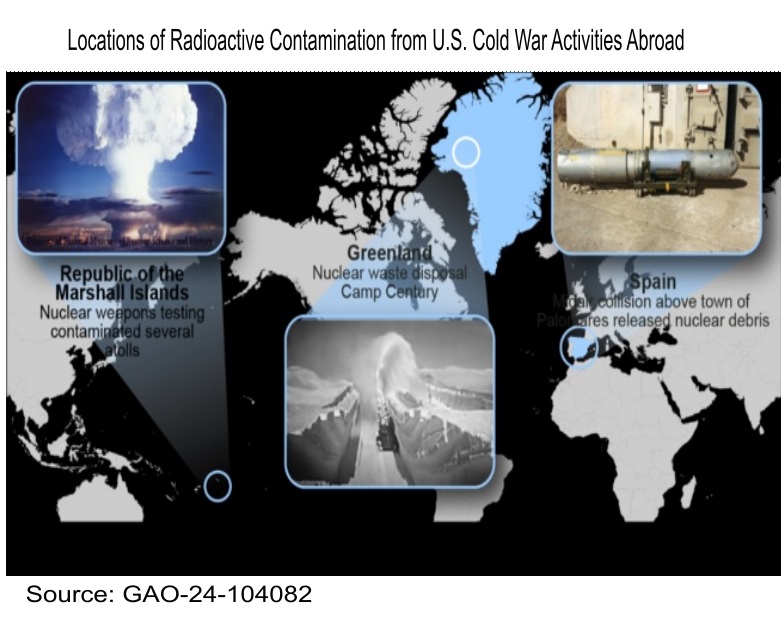
GAO-24-104082 U.S. Government Accountability Office Jan 31, 2024.
U.S. Cold War activities caused radioactive contamination in three other countries.
The contamination in Greenland—from a closed nuclear reactor—and in Spain—from an aircraft accident—is being monitored. But changing climate and economic conditions have raised concerns about future effects on local areas.
In the Marshall Islands—where the U.S. tested nuclear weapons—local officials are worried that rising sea levels may impact contaminated sites. The Department of Energy believes the health risk is low but has struggled to explain this to the community. We recommended DOE develop a communication strategy on the contamination for the islands.
The U.S. built Runit Dome in the 1970s to contain radioactive debris in the Marshall Islands.
Highlights
What GAO Found
U.S. Cold War activities resulted in radioactive contamination in three locations: Greenland (part of the Kingdom of Denmark), Spain, and the Republic of the Marshall Islands (RMI) (see fig.). In Greenland, radioactive liquid—generated by a small nuclear reactor that powered the U.S. Camp Century base—remains entombed under ice. In Spain, a mid-air collision resulted in radioactive contamination around Palomares. The United States and Spain cleaned up much of the radioactive material and have monitored the remaining material since. In RMI, contamination from nuclear weapons tests and the resulting fallout remains measurable on several atolls, some of which are still uninhabitable.
Conditions have changed in all three locations since the original contamination. Most affected are the environment and inhabitants of RMI, where the Department of Energy (DOE) has ongoing responsibilities. Specifically:
- Greenland. At Camp Century, Denmark instituted permanent ice sheet monitoring to address concerns that climate change could release contamination. However, a 2021 study reported that contamination likely would remain immobile through 2100.
- Spain. In Palomares, Spanish officials reevaluated the radioactive contamination in the 1990s and found it exceeded European Union standards. In 2015, U.S. and Spanish authorities signed a statement of intent to further remediate Palomares but have not reached a final agreement.
- RMI. In RMI, people are concerned that climate change could mobilize radiological contamination, posing risks to fresh water and food sources. DOE assesses human radiation exposure and monitors environmental contamination in RMI. DOE considers human health risk to be low, but RMI officials believe DOE has downplayed the risk. This and other disagreements fuel distrust of DOE’s information. By implementing a sustainable communication strategy in RMI, DOE could improve the Marshallese people’s access to, and trust in, information on contamination as environmental conditions change.
Why GAO Did This Study
The United States conducted defense activities in many countries during the Cold War. These activities resulted in radioactive contamination in three countries: Greenland, Spain, and RMI. During the 1960s, the United States buried radioactive liquid in Greenland’s ice while operating the experimental Camp Century base to study the feasibility of installing nuclear missiles there. In 1966, in Spain, two U.S. defense aircraft collided, dispersing radioactive debris over the town of Palomares. From 1946 to 1958, the United States conducted 67 nuclear weapons tests in RMI, and the resulting radioactive fallout contaminated several atolls.
This report examines (1) the amount and type of radioactive contamination in Greenland, Spain, and RMI; and (2) how conditions have changed at these sites, and the extent to which the environment and inhabitants have been affected by these changed conditions. GAO reviewed key literature on the contamination and interviewed U.S. and foreign government officials.
Recommendations
The Secretary of Energy, as a part of the agency’s ongoing efforts to address the legacy of U.S. nuclear testing in RMI, should develop and document a strategy for communications on radioactive contamination that is sustained, understandable, transparent, engages the RMI government, and builds on lessons learned. DOE concurred with GAO’s recommendation.
Recommendations for Executive Action
Agency Affected RecommendationStatus Department of Energy
The Secretary of Energy, as a part of the agency’s ongoing efforts to address the legacy of U.S. nuclear testing in the Republic of the Marshall Islands, should develop and document a strategy for communications on radioactive contamination that is sustained, understandable, and transparent; engages the RMI government; and builds on lessons learned. (Recommendation 1)
When we confirm what actions the agency has taken in response to this recommendation, we will provide updated information.
Full Report…………………………………………………………….. https://www.gao.gov/products/gao-24-104082
1 This Month

of the week – Shut Down Drone Warfare!


Tell the Ukrainian Government to Drop Prosecution of Peace Activist Yurii Sheliazhenko

Petition to revoke the licensing of the Near Surface Nuclear Disposal Facility (NSDF) at Chalk River. https://www.ourcommons.ca/petitions/en/Petition/Details?Petition=e-7247
To see nuclear-related stories in greater depth and intensity – go to https://nuclearinformation.wordpress.com
-
Archives
- April 2026 (91)
- March 2026 (251)
- February 2026 (268)
- January 2026 (308)
- December 2025 (358)
- November 2025 (359)
- October 2025 (376)
- September 2025 (257)
- August 2025 (319)
- July 2025 (230)
- June 2025 (348)
- May 2025 (261)
-
Categories
- 1
- 1 NUCLEAR ISSUES
- business and costs
- climate change
- culture and arts
- ENERGY
- environment
- health
- history
- indigenous issues
- Legal
- marketing of nuclear
- media
- opposition to nuclear
- PERSONAL STORIES
- politics
- politics international
- Religion and ethics
- safety
- secrets,lies and civil liberties
- spinbuster
- technology
- Uranium
- wastes
- weapons and war
- Women
- 2 WORLD
- ACTION
- AFRICA
- Atrocities
- AUSTRALIA
- Christina's notes
- Christina's themes
- culture and arts
- Events
- Fuk 2022
- Fuk 2023
- Fukushima 2017
- Fukushima 2018
- fukushima 2019
- Fukushima 2020
- Fukushima 2021
- general
- global warming
- Humour (God we need it)
- Nuclear
- RARE EARTHS
- Reference
- resources – print
- Resources -audiovicual
- Weekly Newsletter
- World
- World Nuclear
- YouTube
-
RSS
Entries RSS
Comments RSS
 nuclear-news