Barrels Of Radioactive Waste Turn Up Off The Coast Of California

by Trisha Leigh, 27 Apr 24, https://twistedsifter.com/2024/04/barrels-of-radioactive-waste-turn-up-off-the-coast-of-california/
Mysterious radioactive waste showing up anywhere would be cause for concern, but today it’s barrels full of it off the coast of Los Angeles.
There is a notorious “graveyard” of discarded barrels off the coast of Los Angeles. They’re half-sucked into the seafloor and now scientists believe they contain not only toxic chemicals, but low-level radioactive waste as well.
For a long time, people assumed the barrels contained a dangerous pesticide called DDT, but this new study, published in Environmental Science & Technology, suggests they contain radioactive isotopes tritium and carbon-14.
These chemicals were once used in hospitals, labs, and industrial operations in the area.
David Valentine, lead researcher at UC Santa Barbara, says this might not be the worst thing they could have learned.
“This is a classic situation of bad versus worse. It’s bad we have potential low-level radioactive waste just sitting there on the seafloor. It’s worse that we have DDT compounds spread across a wide area of the seafloor at concerning concentrations.”
To be clear, they’re both bad, even if one compound might be a little bit worse.
The barrels were first discovered in 2020, and scientists have been working since to analyze the surrounding sediment and water to understand what could be inside of them.
They also went through hundreds of pages of old records to find evidence for who might have been dumping waste in the area.
One of them, California Salvage, could have been dumping radioactive waste.
They had received a permit for disposing of the stuff, but the US Atomic Energy Commission claims this permit was never activated.
There’s pretty much no accountability and no way to retroactively apply any now, either. Researchers say it’s more than possible that the radioactive material was dumped within 150 miles of shore.
The Atomic Energy Commission has a map that shows that, between 1946 and 1970, more than 56,000 barrels of radioactive waste was dumped on the US end of the Pacific Ocean.
Marine radiochemist Ken Buesseler, who was not involved in the study, says these are grim findings.
“The problem with the oceans as a dumping solution is once it’s there, you can’t go back and get it. These 56,000 barrels, for example, we’re never going to get them back.”
As always, it seems today’s scientists are hamstrung by the actions of the past.
And all of the ways we have to correct them aren’t working fast enough to keep up
Indigenous leaders decry lack of consent for nuclear waste on their homelands
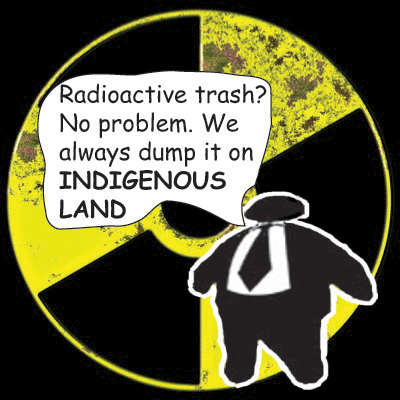
OTTAWA, April 30, 2024 — Today, leaders of Indigenous communities in New Brunswick, Quebec and Ontario express their strong concern about the lack of Indigenous consent for nuclear waste, uranium mining and refining on their homelands.
Article 29(2) of the United Nations Declaration on the Rights of Indigenous Peoples (UNDRIP) states: “States shall take effective measures to ensure that no storage or disposal of hazardous materials shall take place in the lands or territories of Indigenous peoples without their free, prior and informed consent.”
The Government of Canada is promoting an expansion of nuclear energy across the country without the free, prior and informed consent of Indigenous Nations affected. Like the existing reactors, new nuclear reactors will leave a toxic legacy for all living things for thousands of years.
Already, dozens of communities have radioactively contaminated sites on their homelands, and they and others must carefully consider the impacts of proposed permanent repositories for nuclear waste on the next seven generations.
Hugh Akagi is Chief of the Peskotomuhkati Nation in Canada, whose homeland is the unwilling host of the Point Lepreau Nuclear Generating Station on the world-renowned Bay of Fundy in New Brunswick. The reactor was built and later refurbished without the Nation’s consent. Now the federal and New Brunswick governments are spending public funds to develop two new nuclear reactors on the Point Lepreau site.
Chief Akagi has written several times to the Minister of Environment and Climate Change Canada, to express concerns about the proposed projects and ask questions about the high-level used nuclear fuel waste in temporary storage at the Point Lepreau site.
“The nuclear fuel chain – mining uranium, chemically processing the ore, fabricating the fuel, fissioning uranium in a reactor creating toxic radioactive waste remaining hazardous for tens of thousands of years – leaves a legacy of injustices disproportionately felt by Indigenous peoples and all our relations,” says Chief Akagi.
In 2021, the Wolastoq Grand Council in New Brunswick published a resolution on nuclear energy and nuclear waste on traditional Wolastoq homeland.
Grand Council Chief Ron Tremblay, says: “Wolastoqewi-Elders define Nuclear in their language as ‘Askomiw Sanaqak,’ which translates as ‘Forever Dangerous.’ That’s why we called for First Nation alternative energy solutions, including renewables and energy efficiency, as well as no more public funding for nuclear and the phasing out of the Point Lepreau reactor.”
The Blind River uranium refinery owned and operated by Cameco is located on lands which since AD 800 have been the site of vibrant Indigenous occupation and life, including as the ancestral lands of the people of Mississauga First Nation (MFN), and MFN’s access to these lands and waters has been barred by virtue of Cameco’s nuclear operations at the site.
Mississauga First Nation has never consented to the lands being used for nuclear activities nor as disposal grounds for radioactive wastes and there continues to be no equitable redress for this loss of access to their ancestral lands located on the Mississauga Delta.
“The existence of nuclear operations on our ancestral lands has contributed to our loss of culture and spiritual traditions and has been detrimental to our health and well-being of our First Nation, said Mississauga First Nation Councillor Peyton Pitawanakwat. “Cameco has materially benefitted and continues to benefit, from the operations at Blind River, which remains the world’s largest uranium refinery. The proposal to now site radioactive wastes on our lands would perpetuate an existing environmental injustice and amount to environmental racism.”
The Kichi Sibi or Ottawa River, which forms the boundary between Ontario and Quebec, is another site of conflict. The Chiefs of Kebaowek and Kitigan Zibi Anishinabeg First Nations in Quebec last year made public their Indigenous-led assessment of a million-cubic-metre radioactive waste mound to be built at Chalk River Laboratories on the shores of the Kichi Sibi on unceded Algonquin territory. Their assessment covered the project’s impact on their culture, land, water and wildlife. An experimental nuclear reactor is also planned for Chalk River.
“The Kichi Sibi is sacred to our peoples and at the heart of our unceded homeland,” said Chief Lance Haymond, of Kebaowek First Nation. “The Algonquin peoples never consented to the Chalk River site being used for over 75 years for nuclear reactors and research, and now being the site for a permanent radioactive waste dump. Consultation was far too late and inadequate, and we reject the plan.”
In spite of the clear opposition to the project by ten Algonquin First Nations, the Canadian Nuclear Safety Commission approved the Near Surface Disposal Facility in January 2024. Two First Nations have launched a legal challenge to the decision, as have several citizen groups.
The federal government says that reconciliation is a priority. How UNDRIP will be respected by the Government of Canada – which signed it in 2016 and passed the United Nations Declaration on the Rights of Indigenous Peoples Act in 2021 – remains to be seen.
Dounreay & Scottish Nuclear Policy
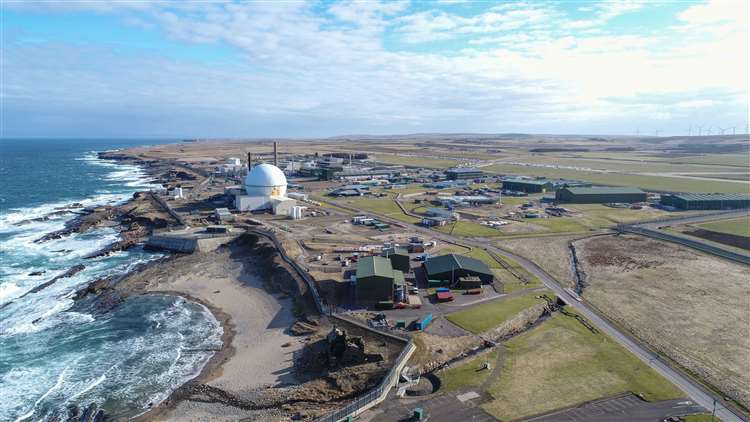
Allan Dorans , SNP MP for Ayr, Carrick and Cumnock:
Workers at the Dounreay nuclear power complex on Scotland’s north coast plan strike action
next month which will further delay the decommissioning of a plant which
started operating in 1955.
The Prospect, Unite and GMB unions are all
involved. The GMB, the main union for nuclear energy workers, champions
alongside Scottish Labour proposals for new nuclear power stations in
Scotland, despite widespread public opposition to them. The union also
helps to fund Labour candidates.
While it is always disturbing to hear of
industrial conflict at a nuclear plant, these strikes will in reality,
relatively speaking, make little difference to the decommissioning process.
Why? Decommissioning began in 2019 and the plan envisages taking 50-60
years to complete.
But “complete” doesn’t mean the same to the company
responsible for the clean-up and demolition of Dounreay, Magnox Ltd, what
it means to most of us, and the site will be under surveillance – ie, not
usable – for at least 300 years. Leaving aside for the moment the appalling
financial costs of nuclear decommissioning, rarely mentioned in Scottish
Labour’s campaign material, what about the costs for the local people and
the environment over the last nearly 70 years?
There have been three
significant accidents and countless smaller ones. On May 10, 1977, a
65-metre (213ft) deep shaft at the plant was packed with radioactive waste
with at least 2 kg of sodium and potassium. Seawater flooded in and
reacted violently with the sodium and potassium, blowing the huge steel and
concrete lids off the shaft. The explosion littered the area with
radioactive particles, with around 150 of these being found on the beach in
the following 20 years.
This was, according to the New Statesman in 1995,
the worst nuclear accident ever in the UK. Dounreay was never prosecuted.
Researchers based at Oxford University, reporting – conveniently for some
political forces – in July 2014 revisited earlier studies of the incidence
of leukaemia around Sellafield and Dounreay and concluded that children,
teenagers and young adults currently living close to the facilities were
not at an increased risk of developing cancers.
The researchers, who were
dependent upon UK Government grants for their survival, downplayed two
earlier studies that found a raised risk of leukaemia among 0 to
14-year-olds and 15- to 24-year-olds living within 12.5km of Dounreay
during the period 1979-84. A subsequent study in 1996 reported an excess of
childhood leukaemia and Non-Hodgkin’s Lymphoma (NHL) within 25 km of
Dounreay for the period 1968-93. The researchers do not tell us just how
many cases, how many more children and young adults than expected, had
developed these often-deadly cancers, but 1287 cases near seven nuclear
sites in Scotland were looked at in the second study.
Around Dounreay,
almost twice as many cases as expected were found. The difference was
greatest around Dounreay. If we share the 1287 cases among the seven sites,
we get around 180 cases near Dounreay, of which half or might not have
occurred if the plant had never been built. To, me that’s “significant”
and I feel sure it was for those young people and their families. With
every passing month, it becomes clearer that Scottish Labour must
reconsider their plans for a nuclear Scotland.
The National 29th April 2024
NNSA Delays Urgent Research on Plutonium “Pit” Aging But Spends Billions on Nuclear Weapons Bomb Cores

Concerned Citizens for Nuclear Safety, 28 Apr 24 http://nuclearactive.org/
This week, CCNS highlights portions of a recent press release by Nuclear Watch New Mexico, Tri-Valley Communities Against a Radioactive Environment (Tri-Valley CARES), and the Savannah River Site Watch about the National Nuclear Security Administration (NNSA). Their piece suggests NNSA does not have its priorities straight in neither producing up-to-date information on the way plutonium appears to age nor providing this information in a timely manner to the public. The entire press release is posted at http://nuclearactive.org/wp-content/uploads/2024/04/240417-NWNM-SRSW-TVC-Plutonium-Aging-PR.pdf
The press release reads: “Nearly three years after filing a Freedom of Information Act request, the public interest group Savannah River Site Watch has finally received [] the congressionally required Research Program Plan for Plutonium and Pit Aging.
However, the document is 40% blacked out, including references and acronyms.
Plutonium ‘pits’ are the radioactive cores of all U.S. nuclear weapons. The NNSA claims that potential aging effects are justification for a ~$60 billion program to expand production. However, the Plan fails to show that aging is a current problem. To the contrary, it demonstrates that NNSA is delaying urgently needed updated plutonium pit aging research.
“In 2006 independent scientific experts known as the JASONs concluded that plutonium pits last at least 85 years without specifying an end date. The average pit age is now around 40 years. A 2012 follow-on study by the Lawrence Livermore nuclear weapons lab concluded:
’This continuing work shows that no unexpected aging issues are appearing in plutonium that has been accelerated to an equivalent of [approximately] 150 years of age. The results of this work are consistent with, and further reinforce, the Department of Energy Record of Decision to pursue a limited pit manufacturing capability in existing and planned facilities at Los Alamos instead of constructing a new, very large pit manufacturing facility…’
“Since then NNSA has reversed itself. In 2018 the agency decided to pursue the simultaneous production of at least 30 pits per year at the Los Alamos National Laboratory (LANL) in northern New Mexico and at least 50 pits per year at the Savannah River Site (SRS) in South Carolina. Upgrades to plutonium facilities at LANL are slated to cost $8 billion over the next five years. The redundant Savannah River Plutonium Processing Facility in South Carolina will cost up to $25 billion, making it the second most expensive building in human history.
“Hundreds of billions of taxpayers’ dollars and future international nuclear weapons policies are at stake. …
Nuclear-waste dams threaten Central Asia heartland
Dams holding large amounts of nuclear waste can be found in Kyrgyzstan’s
scenic hills. However, following a 2017 landslide they have become
unstable, threatening a possible Chernobyl-scale nuclear disaster if they
collapse.
Reuters 24th April 2024
The long path of plutonium: A new map charts contamination at thousands of sites, miles from Los Alamos National Laboratory
Plutonium hotspots appear along tribal lands, hiking trails, city streets and the Rio Grande River, a watchdog group finds

Searchlight New Mexico, by Alicia Inez Guzmán, April 25, 2024
For years, the public had no clear picture of Los Alamos National Laboratory’s plutonium footprint. Had the ubiquitous plutonium at LANL infiltrated the soil? The water? Had it migrated outside the boundary of the laboratory itself?
A series of maps published by Nuclear Watch New Mexico are beginning to answer these questions and chart the troubling extent of plutonium on the hill. One map is included below [on original] , while an interactive version appears on Nuclear Watch New Mexico’s website. The raw data for both comes from Intellus New Mexico, a publicly accessible clearinghouse of some 16 million environmental monitoring records offered in recent decades by LANL, the New Mexico Environment Department and the Department of Energy.
Approximately 58,100 red dots populate each map at 12,730 locations, marking a constellation of points where plutonium — a radioactive element used in nuclear weapons — was found in the groundwater, surface water or soil. What’s alarming is just how far that contamination extends, from Bandelier National Monument to the east and the Santa Fe National Forest to the north, to San Ildefonso tribal lands in the west and the Rio Grande River and Santa Fe County, to the south.
The points, altogether, tell a story about the porous boundary between LANL and its surrounds. So pervasive is the lab’s footprint that plutonium can be found in both trace and notable amounts along hiking trails, near a nursing home, in parks, along major thoroughfares and in the Rio Grande.
Gauging whether or not the levels of plutonium are a health risk is challenging: Many physicians and advocates say no dose of radiation is safe. But when questions about risk arise, one of the few points of reference is the standard used at Rocky Flats in Colorado, where the maximum allowable amount of plutonium in remediated soil was 50 picocuries per gram. Many sites on the Nuclear Watch map have readings below this amount. Colorado’s construction standard, by contrast, is 0.9 picocuries per gram.
Nuclear Watch’s driving question, according to Scott Kovac, its operations and research director, concerned a specific pattern of contamination: Had plutonium migrated from LANL dump sites into regional groundwater? The answer, Kovac believes, is yes.
That conclusion began to form when Nuclear Watch compiled data from between 1992 and 2023 for plutonium contamination below the soil, and plotted each point into the organization’s now-sprawling map. Red dots coalesce at LANL dump sites. They also appear in the finger-like canyons surrounding the Pajarito Plateau, namely in Los Alamos Canyon, “the main contaminant pathway to the Rio Grande,” a Nuclear Watch summary says.
Much of the contamination likely occurred from the 1940s to the 1960s, during the lab’s “Wild West,” in Kovac’s words — a time of little environmental oversight when the surrounding plateaus, canyons and the entire ancestral Pueblo of Tsirege doubled as a dumping ground, laboratory and wasteland………………..
A 1999 environmental impact statement and other documents reveal the extent of that contamination and the many places where LANL buried radioactive waste or dumped effluent, including landfills, canyons, drain lines, firing sites and spill locations.
“Plutonium and uranium have been released into canyons…since the Manhattan Project,” according to another 1999 report, this one focused on the lab’s contribution to radioactive contamination in Cochiti Lake. “In Los Alamos Canyon, these contaminants have been carried by flood flows several tens of kilometers” — more than 12 miles — “downstream into the Rio Grande.”
Airborne plutonium releases were also frequent and largely unchecked until the late 1970s, other reports show. The legacy of contamination has been the subject of some piecemeal remediation efforts on lab property and public lands. But the maps stand as forceful arguments for a “genuine cleanup” that is comprehensive and lasting, said Jay Coghlan, executive director of Nuclear Watch.
“We need to permanently protect precious, irreplaceable groundwater and the Rio Grande while providing high-paying cleanup jobs for decades,” Coghlan wrote Searchlight in an email. Instead, the lab is focusing on a historic expansion to produce plutonium pits for nuclear weapons. “New Mexicans,” he said, “don’t need more nuclear weapons.”
‘A full reckoning’ of detritus
The lab’s campus is undeniably riddled with plutonium, including beneath the deep groundwater aquifer in certain of its technical areas, the map shows. One concentration appears on the campus’s northern flank, around Material Disposal Area C, a 12-acre site that served as the primary dump for plutonium and other radioactive and toxic waste between 1948 and 1973. The unlined dump comprised seven disposal pits and 108 shafts that workers dug directly into the tuff, burying cyanide, mercury, sulfuric acid, beryllium, plutonium and other wastes four to 25 feet deep……………………………………………………………………………………………………….
The lab is juggling this legacy cleanup at the same time that it’s attempting to make 30 plutonium pits per year by 2030, a mission described as the “new Manhattan Project.” Worker shortages and supply-chain bottlenecks have already derailed the timeline; meanwhile, the cleanup of the lab’s Cold War sites is only half complete, the DOE reports. Indeed, as the lab barrels toward a new Cold War, there hasn’t been a full reckoning with the detritus of the last one.
Contamination near Buckman…………………………………………………………………………………………..
Scotland could be hit ‘with £22bn nuclear clean-up bill’.
SCOTLAND could be saddled with a bill of more than £22 billion as part of
Westminster’s clean up of nuclear dumping grounds over the next century,
the SNP have said. Official estimates published by the UK Government last
November estimated total clean-up costs for sites which contained disposed
nuclear material from weapons programmes and energy generation could come
to £263bn over the next 100 years.
This means Scotland, which contributes
8.6% of the UK’s tax revenue, could be made to pay £22,618,000,000 in
total, working out to £22m every year for a century. The SNP’s defence
spokesperson Martin Docherty-Hughes criticised how conventional military
spending had been “recklessly slashed” while the Tories focus cash on
disposing nuclear materials from weapons of mass destruction.
The National 23rd April 2024
https://www.thenational.scot/news/24272520.scotland-hit-with-22bn-nuclear-clean-up-bill
Nuclear waste storage facility told to take action after breach
Federica Bedendo,BBC News North East and Cumbria, 20 Apr 24, https://www.bbc.com/news/articles/c88zjl0l8j9o
A nuclear waste storage facility has been told to take action, after it breached its environmental permit.
The Environment Agency (EA) has written to bosses at the Low Level Waste Repository (LLWR) in Cumbria with concerns about a delay in securing waste at the site.
Nuclear Waste Services (NWS), which manages LLWR, said the delays did not have an impact on the surrounding area and that they had taken the time to ensure the right solutions were created for the safe disposal of nuclear waste.
The EA said it could not comment on the matter due to impartiality rules during election periods.
The letter, written by the EA in January, and obtained by the BBC through a Freedom of Information request, sets out new conditions that LLWR must comply with.
It comes after LLWR failed to make sufficient progress on operations to secure the radioactive waste – known as capping – meaning it breached the terms of its environmental permit.
Missed deadline
Martin Walkingshaw, chief operating officer at NWS, said: “Placing the engineered cap over the legacy radioactive waste disposal facilities at the UK’s LLWR is a first of its kind activity for the UK.”
He said Nuclear Waste Services were engaged with the Environment Agency on a regular basis about progress.
He added: “Capping is a key part of the disposal, and we are currently implementing the required design by procuring, importing and emplacing thousands of tonnes of capping materials in line with our planning conditions and stringent quality requirements.”
In their letter, the Environment Agency also told LLWR it had failed to meet a deadline for a previously imposed improvement condition, regarding a request for a written plan to protect waste in certain areas, including capping one of them.
While the plan was delivered, there were delays in implementing it.
An initial date of completion of 2028 had been agreed with the EA, but discussions are now under way to extend the deadline as LLWR believes more time is needed.
NWS has blamed delays on issues with the design of the engineered cap.
“Throughout the design phase a number of assumptions were tested, as is common practice. Not all of these assumptions held true, and one in particular, caused a significant change in design.”
Japan starts 5th ocean discharge of Fukushima nuclear-tainted wastewater despite opposition

(Xinhua) Web editor: Zhang Kaiwei, Liang Jun, April 19, 2024
TOKYO, April 19 (Xinhua) — Japan on Friday started the fifth-round of release of nuclear-contaminated wastewater from the crippled Fukushima Daiichi Nuclear Power Plant into the Pacific Ocean.
Despite opposition among local fishermen, residents as well as backlash from the international community, Tokyo Electric Power Company (TEPCO), the plant’s operator, started discharging the radioactive wastewater in the morning, the first round in fiscal 2024.
Similar to the previous four rounds, about 7,800 tons of the wastewater, which still contains tritium, a radioactive substance, will be discharged until May 7.
TEPCO analyzed the water stored in the tank scheduled for release, and found that the concentrations of all radioactive substances other than tritium were below the national release standards, while the concentration of tritium that cannot be removed will be diluted with seawater, Japanese newspaper Asahi Shimbun reported.
TEPCO will measure the concentration of radioactive substances such as tritium in the surrounding waters every day during the period to investigate the effects of the release, it added.
The Fukushima nuclear-contaminated water release began in August 2023, and a total of about 31,200 tons of the water was released in four rounds in fiscal 2023, which ended in March.
In fiscal 2024, TEPCO plans to discharge a total of 54,600 tons of contaminated water in seven rounds, which contains approximately 14 trillion becquerels of tritium.
EDF wants public views on plans for Hinkley Point B decommissioning
By John Thorne Wednesday 17th April 2024
ENERGY firm EDF is carrying out a public consultation on its plans for the
decommissioning of Hinkley Point B nuclear power station, a process which
will continue into the 22nd century. The two Hinkley B reactors were shut
down in August, 2022, after 46 years of electricity generation, but will
not be able to be removed until about 2107. EDF has since been removing the
used fuel from the reactors in preparation for the station’s
decommissioning phase, which will involve dismantling and demolishing plant
and buildings on the site. More than half of the spent fuel stringers have
been removed from the first reactor and sent on in flasks for storage in
Sellafield, Cumbria.
West Somerset Free Press 17th April 2024
Nuclear expert fears flooded radioactive dump sites in Siberia can threaten Arctic Ocean
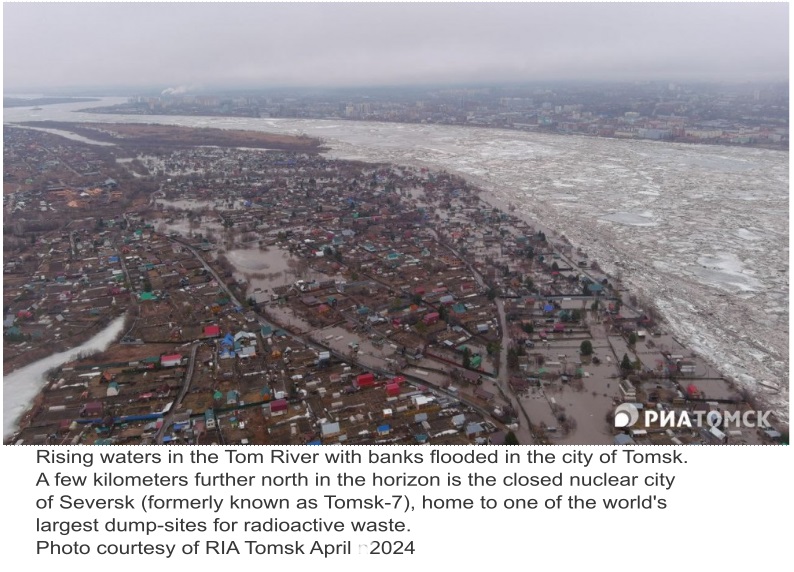
Floodwaters in Tomsk region threatens to submerge the river banks in Seversk where highly radioactive liquid waste from the Soviet Union’s nuclear weapons program for decades were injected into two unprotected underground reservoirs.
Water level on Monday continues to rise in the Tom River in Western Siberia.
The record floods are among the worst ever in the region and local emergency services help in evacuation of people living near tributaries of the Ob river system, including Tobol, Irtysh and Tom rivers.
Thousands of houses and tens of thousands of people live in the emergency zones, according to Kremlin information platform RIA Novosti. High snow falls in winter combined with swiftly rising spring temperatures and heavy rains are the reasons for the current extreme flood, Reuters reports.
Drone photos by RIA Tomsk shows how the swelling Tom River is inundating villages on the westside river banks. According to NEXTA news channel, water in Tom River has risen by nearly a meter over the day.
On the east side, a short 15 kilometers north of the city of Tomsk, is the closed city of Seversk. Until 1992, the secret city was code-named Tomsk-7 and was home to one of three production facilities for weapons-grade plutonium for the Soviet Union’s nuclear weapons program.
“There ain’t one single public message that Rosatom is monitoring the situation, that they have the situation under control,” says Aleksandr Nikitin, an exile nuclear safety expert working for the environmental foundation Bellona.
Nikitin was until the all-out war against Ukraine a member of Rosatom’s Public Council. The Council involved civic organizations and scientists in Russia and was aimed at raising public awareness of Rosatom’s core operations
“It’s surprising that there aren’t even simple statements like we have everything under control,” Nikitin adds.
According to the World Nuclear Association, the Siberian Chemical Combine in Seversk had five plutonium production reactors, an uranium enrichment plant and a processing plant for plutonium warheads. Although shut down, enormous amount of nuclear waste is still on site.
Most challenging are the liquid radioactive waste, both on the surface and pumped down in deep-well injections. The nuclear dump is likely Russia’s largest, by IAEA estimated to be 70 million cubic meters.
Widespread contamination in an area up to 28 kilometers came after a concrete cover blew off a reaction vessel at the plutonium extraction facility in 1993. The International Atomic Energy Agency (IAEA) listed it as a major radiological accident.
In 2000, a joint U.S.-Russian study found dangerous levels of radioactivity flowing into Russia’s Tom River from the Siberian Nuclear Combine.
Critics crumbled
Local environmentalists in Tomsk filed a lawsuit against the company in the late 1990s in an attempt to revoke a dumping permit for highly radioactive liquid waste down under. They feared for the city’s drinking water.
In Putin’s Russia, critical voices are gone. Environmental groups like Greenpeace, World Wide Fund for Nature, and Bellona are all listed as undesirable by law.
TV2 in Tomsk, known for its independent journalism and free debate since the early years after the breakup of the Soviet Union, got its broadcast shut down in 2014. After the start of the full-scale war in 2022, the reporters closed their YouTube producing newsroom and left Russia.
Aleksandr Nikitin is worried radioactivity could leak out to the river system under the current flood, but that information will not come before it is too late.
“Putin doesn’t give a fuck about these floods and other shitty lives of people in Russia.., he has a war and geopolitical goals of fighting the damned West,” Nikitin says.
For Rosatom, he adds, the logic is simple: “.. if you say that everything is under control, and then something happens, then you will have to answer for it.”
Nikitin says Rosatom is sure that in any case it will not bear any responsibility.
“Rosatom is today Putin’s “favorite child,” he explains.
It was Lavrenty Beria, director of Joseph Stalin’s secret police, who lead the establishment of the first plutonium production facilities east of the Ural mountains in the late 1940ties, early 1950ties. KGB and the Soviet nuclear establishment walked hand-in-hand for decades. What nowadays is Ulitsa Pervomayskaya (May 1st Street) in Seversk, was previously named Ulitsa Beria.
Arctic Ocean
A major concern for Aleksandr Nikitin and Bellona is that no one can exclude that leakages from a possible overflowed radioactive waste site could reach the Arctic Ocean.
Tom River is a tributary of the Ob which flows out in the Ob Bay and Kara Sea above the Arctic Circle.
During the years 1948-56, liquid radioactive waste from the Mayak reprocessing plant north of Chelyabinsk was discharged directly into the nearby river Techa which is connected to the river system Iset, Tobol, Irtysh and Ob. Especially Strontium-90, but also other isotopes, were carried by the water more than 2,000 kilometers downstream and measured in the Kara Sea, first time in 1951.
A joint Norwegian-Russian expedition to the Kara Sea in 1994 found traces of the same radionuclides, although in lower levels.
“Everything is now possible,” says Aleksandr Nikitin when seeing the photos of the flooded riverbanks of the Tom River.
“It all depends on the scale of leakages.”
“I’m sure the Siberian Chemical Combine sit quietly and wait. Hoping for it all to go over,” Nikitin says to the Barents Observer.
Spent nuclear fuel mismanagement poses a major threat to the United States. Here’s how.
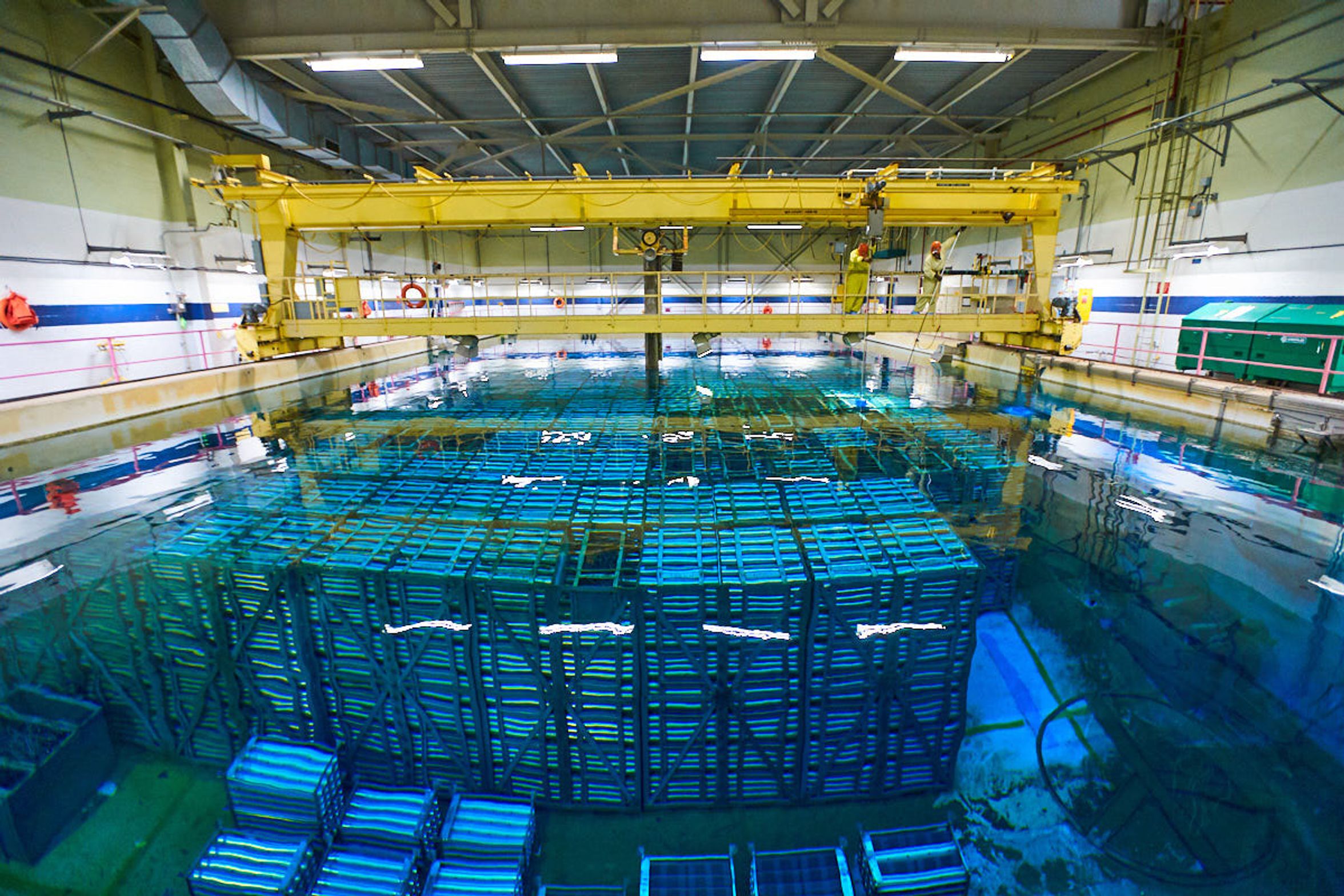
Restricting its analyses to a severe earthquake scenario allowed the NRC to help allay public fears over the dangers of spent fuel pool accidents. There is good reason to question whether severe earthquakes pose the greatest threat to spent fuel pools.
Solar storms, physical attacks, and cyberattacks have the potential to cause a nightmare scenario …….
Bulletin, By Mark Leyse | April 2, 2024
Irradiated fuel assemblies—essentially bundles of fuel rods with zirconium alloy cladding sheathing uranium dioxide fuel pellets—that have been removed from a nuclear reactor (spent fuel) generate a great deal of heat from the radioactive decay of the nuclear fuel’s unstable fission products. This heat source is termed decay heat. Spent fuel is so thermally hot and radioactive that it must be submerged in circulating water and cooled in a storage pool (spent fuel pool) for several years before it can be moved to dry storage.
The dangers of reactor meltdowns are well known. But spent fuel can also overheat and burn in a storage pool if its coolant water is lost, thereby potentially releasing large amounts of radioactive material into the air. This type of accident is known as a spent fuel pool fire or zirconium fire, named after the fuel cladding. All commercial nuclear power plants in the United States—and nearly all in the world—have at least one spent fuel pool on site. A fire at an overloaded pool (which exist at many US nuclear power plants) could release radiation that dwarfs what the Chernobyl nuclear accident emitted.
Many analysts see very rare, severe earthquakes as the greatest threat to spent fuel pools; however, another far more likely event could threaten US nuclear sites: a widespread collapse of the power grid system. Such a collapse could be triggered by a variety of events, including solar storms, physical attacks, and cyberattacks—all of which are known, documented possibilities. Safety experts have warned for decades about the dangers of overloading spent fuel pools, but the Nuclear Regulatory Commission and Congress have refused to act.
The threat of overloaded spent fuel pools. Spent fuel pools at US nuclear plants are almost as densely packed with nuclear fuel as operating reactors—a hazard that has existed for decades and vastly increases the odds of having a major accident.
Spent fuel assemblies could ignite—starting a zirconium fire—if an overloaded pool were to lose a sizable portion or all of its coolant water. In a scenario in which coolant water boils off, uncovered zirconium cladding of fuel assemblies may overheat and chemically react with steam, generating explosive hydrogen gas. A substantial amount of hydrogen would almost certainly detonate, destroying the building that houses the spent fuel pool. (Only a small quantity of energy is required to ignite hydrogen gas, including electric sparks from equipment. It is speculated a ringing telephone initiated a hydrogen explosion that occurred during the Three Mile Island accident in 1979.)
A zirconium fire in an exposed spent fuel pool would have the potential to emit far more radioactive cesium 137 than the Chernobyl accident released. (The US Nuclear Regulatory Commission (NRC) has conducted analyses that found a zirconium fire at a densely packed pool could release as much as 24 megacuries of cesium 137; the Chernobyl accident is estimated to have released 2.3 megacuries of cesium 137.) Such a disaster could contaminate thousands of square miles of land in urban and rural areas, potentially exposing millions of people to large doses of ionizing radiation, many of whom could die from early or latent cancer.
In contrast, if a thinly packed pool were deprived of coolant water, its spent fuel assemblies would likely release about 1 percent of the radioactive material predicted to be released by a zirconium fire at a densely packed pool. A thinly packed pool has a much smaller inventory of radioactive material than a densely packed pool; it also contains much less zirconium. If such a limited amount of zirconium were to react with steam, most likely too little hydrogen would be generated to threaten the integrity of the spent fuel pool building.
After being cooled under water for a minimum of three years, spent fuel assemblies can be transferred from pools to giant, hermetically sealed canisters of reinforced steel and concrete that shield plant workers and the public from ionizing radiation. This liquid-free method of storage, which cools the spent fuel assemblies by passive air convection, is called “dry cask storage.”

A typical US storage pool for a 1,000-megawatt-electric reactor contains from 400 to 500 metric tons of spent fuel assemblies. (Dry casks can store 10 to 15 tons of spent fuel assemblies, so each cask contains a far lower amount of radioactive material than a storage pool.) Reducing the total inventories of spent fuel assemblies stored in US spent fuel pools by roughly 70 to 80 percent reduces their amount of radioactive cesium by about 50 percent. And the heat load in each pool drops by about 25 to 30 percent. With low-density storage, a pool’s spent fuel assemblies are separated from each other to an extent that greatly improves their ability to be cooled by air convection in the event that the pool loses its coolant water. Moreover, a dry cask storage area, which has passive cooling, is less vulnerable to either accidents or sabotage than a spent fuel pool.
In the aftermath of the March 2011 Fukushima Daiichi accident in Japan, in which there was a risk of spent fuel assemblies igniting, the NRC considered forcing US utilities to expedite the transfer of all sufficiently-cooled spent fuel assemblies stored in overloaded pools to dry cask storage. The NRC decided against implementing such a safety measure.
To help justify its decision, the NRC chose to analyze only one scenario that might lead to a zirconium fire: a severe earthquake. In 2014, the NRC claimed that a severe earthquake with a magnitude “expected to occur once in 60,000 years” is the prototypical initiating event that would lead to a zirconium fire in a boiling water reactor’s spent fuel pool.
The NRC’s 2014 study concluded that the type of earthquake it selected for its analyses would cause a zirconium fire and a large radiological release to occur at a densely packed spent fuel pool once every nine million years (or even less frequently). Restricting its analyses to a severe earthquake scenario allowed the NRC to help allay public fears over the dangers of spent fuel pool accidents. (At the time of the Fukushima Daiichi accident, the New York Times and other news outlets warned that a zirconium fire could break out in the plant’s Unit 4 spent fuel pool, causing global public concern.)
There is good reason to question whether severe earthquakes pose the greatest threat to spent fuel pools. A widespread collapse of the US power grid system that would last for a period of months to years—estimated to occur once in a century—may be far more likely to lead to a zirconium fire than a severe earthquake. The prospect that a widespread, long-term blackout will occur within the next 100 years should prompt US utilities to expedite the transfer of spent fuel from pools to dry cask storage. Utilities in other nations, including in Japan, that have overloaded pools should follow suit.
Solar storms, physical attacks, and cyberattacks have the potential to cause a nightmare scenario in which the US power grid collapses, along with other vital infrastructures—leading to reactor meltdowns and spent fuel pool fires, whose radioactive emissions would aggravate the disaster.
Vulnerability to solar storms……………………………………………………………………………………………………………………..
Vulnerability to physical attacks.……………………………………………………………………………………………………….
Vulnerability to cyberattacks. …………………………………………………………………………………………………………….
Insufficient public safety.…………………………………………………………………………………….
Overloading spent fuel pools should be outlawed. Safety analysts have warned about the dangers of overloading spent fuel pools since the 1970s. For decades, experts and organizations have argued that in order to improve safety, sufficiently cooled spent fuel assemblies should be removed from high-density spent fuel pools and transferred to passively cooled dry cask storage. Sadly, the NRC has not heeded their advice.
In the face of the NRC’s inaction, Sen. Edward Markey of Massachusetts introduced The Dry Cask Storage Act in 2014, calling for the thinning out of spent fuel pools. The act, which Senator Markey has reintroduced in subsequent congressional sessions, has not passed into law.
The relatively high probability of a nationwide grid collapse, which would lead to multiple nuclear disasters, emphasizes the need to expedite the transfer of spent fuel to dry cask storage. According to Frank von Hippel, a professor of public and international affairs emeritus at Princeton University, the impact of a single accident at an overstocked spent fuel pool has the potential to be two orders of magnitude more devastating in terms of radiological releases than the three Fukushima Daiichi meltdowns combined. If the US grid collapses for a lengthy period of time, society would likely descend into chaos, as uncooled nuclear fuel burned at multiple sites and spewed radioactive plumes into the environment.
The value of preventing the destruction of US society and untold human suffering is incalculable. So, on the issue of protecting people and the environment from spent fuel pool fires, it is surprising when one learns that promptly transferring the nationwide inventories of spent fuel assemblies that have been cooled for at least five years from US pools to dry cask storage would be “relatively inexpensive”—less than (in 2012 dollars) a total of $4 billion ($5.4 billion in today’s dollars). That is far, far less than the monetary toll of losing vast tracts of urban and rural land for generations to come because of radioactive contamination.
One should also consider that plant owners are required, as part of the decommissioning process, to transfer spent fuel assemblies from storage pools to dry cask storage after nuclear plants are permanently shut down. So, in accordance with industry protocols, all spent fuel assemblies at plant sites are intended to eventually be placed in dry cask storage (before ultimately being transported to a long-term surface storage site or a permanent geologic repository). https://thebulletin.org/2024/04/spent-nuclear-fuel-mismanagement-poses-a-major-threat-to-the-united-states-heres-how/
How much will extra decades of nuclear decommissioning work at Dounreay cost?
By Gordon Calder gordon.calder@hnmedia.co.uk, 28 March 2024
The cost of extending the decommissioning work at Dounreay is expected to
be published in the summer, according to a spokeswoman at the site.
She was responding to questions from the John O’ Groat Journal, following last
week’s announcement that the clean up-operation at the nuclear plant will
continue until the 2070s – almost 40 years longer than the previous date of
2033. The cost of the programme was previously said to be about £2.9
billion.
Asked about the estimated cost of extending the decommissioning,
the spokeswoman said: ” The estimate for delivering the revised lifetime
plan to take the Dounreay site to its interim end point, will form part of
the Nuclear Provision, and be published in the NDA (Nuclear Decommissioning
Authority) 2023/24 annual report in the summer. We are committed to
delivering the Dounreay mission as effectively and efficiently as
possible.”
John O’Groat Journal 28th March 2024
Radioactive nuclear waste burial ground in Pittsburgh area to be cleaned up by federal government

By Andy Sheehan, April 1, 2024 ,
https://www.cbsnews.com/pittsburgh/news/radioactive-nuclear-waste-burial-ground-armstrong-county-parks-township/
KISKIMERE, Pa. (KDKA) — An untold number of 55-gallon drums containing radioactive waste are buried in shallow trenches on a 144-acre site in Armstrong County.
They pose a health and safety danger to those who live nearby. But now after decades of lawsuits and public outcry, the federal government is getting ready to finally clean it up.
Debbie Secreto has lived next to the contaminated field in Parks Township all of her life. She played on it as a kid, unaware of the hidden danger. She was diagnosed with breast cancer at 44 years old.
There are 10 shallow trenches filled with haphazardly disposed of radioactive nuclear waste. Though she and other cancer survivors won a class action settlement years ago, she’s remained in her childhood home.
“It’s hard living like this, but what are you going to do? Move? I don’t want to move. I’m 71 years old,” Secreto of Kiskimere said.
In the 1950s and 1960s, the company MUMEC in nearby Apollo produced nuclear fuels for power plants and nuclear submarines and buried the waste in Parks Township. Now, after decades of fighting for it, neighbors like Secreto have won another major victory.
The United States government is finally taking action, now building the needed infrastructure to commence a six-year, $500-million project to excavate all of that nuclear waste to decontaminate and clean the entire 144-acre site.
Beginning next year, contractors for the U.S. Army Corps of Engineers will begin the slow and methodical process of excavating an estimated 30,000 cubic yards of contaminated waste. They will unearth a little bit at a time, scanning it with X-rays and radiation detectors before encapsulating it in steel containers.
The waste will then be trucked and shipped by rail to a disposal site in Utah, where it will be permanently buried deep underground.
But while happy the waste is going elsewhere, neighbors are concerned the unearthing could spark a nuclear event, releasing toxins into the air and water.
“Everybody up here is worried about it. It’s going to be dangerous,” said Karen Brenner of Kiskimere.
“I can promise that we are committed to protecting the health and welfare of the community and the environment,” said Steven Vriesen, project manager for the U.S. Army Corps of Engineers.
In participating in reports like this, the U.S. Army Corps of Engineers said it is committed to transparency with the public and will be holding meetings to assure the community every safeguard to safely remove the waste will be taken.
“We have multiple layers of safety,” said David Romano, deputy district engineer. “From air monitors on the workers that are right on the site, groundwater monitoring, surface water monitoring, air monitors around the perimeter, all to ensure our actions ensure the health and safety of our environment.”
If all goes well, this six-year project will restore the site and make this Armstrong County community a safe place to live again.
Japan confirms experts met in China to ease concerns over discharge of treated radioactive water
Japan said Sunday its experts have held talks with their Chinese
counterparts to try to assuage Beijing´s concerns over the discharge of
treated radioactive wastewater from the wrecked Fukushima Daiichi nuclear
power plant into the sea. The discharges have been opposed by fishing
groups and neighboring countries especially China, which banned all imports
of Japanese seafood. China´s move has largely affected Japanese scallop
growers and exporters to China. During the talks held Saturday in the
northeastern Chinese city of Dalian, Japanese officials provided
“science-based” explanation of how the discharges have been safely carried
out as planned, according to the Japanese Foreign Ministry.
Daily Mail 31st March 2024
1 This Month

of the week – Shut Down Drone Warfare!


Tell the Ukrainian Government to Drop Prosecution of Peace Activist Yurii Sheliazhenko

Petition to revoke the licensing of the Near Surface Nuclear Disposal Facility (NSDF) at Chalk River. https://www.ourcommons.ca/petitions/en/Petition/Details?Petition=e-7247
To see nuclear-related stories in greater depth and intensity – go to https://nuclearinformation.wordpress.com
-
Archives
- April 2026 (79)
- March 2026 (251)
- February 2026 (268)
- January 2026 (308)
- December 2025 (358)
- November 2025 (359)
- October 2025 (376)
- September 2025 (257)
- August 2025 (319)
- July 2025 (230)
- June 2025 (348)
- May 2025 (261)
-
Categories
- 1
- 1 NUCLEAR ISSUES
- business and costs
- climate change
- culture and arts
- ENERGY
- environment
- health
- history
- indigenous issues
- Legal
- marketing of nuclear
- media
- opposition to nuclear
- PERSONAL STORIES
- politics
- politics international
- Religion and ethics
- safety
- secrets,lies and civil liberties
- spinbuster
- technology
- Uranium
- wastes
- weapons and war
- Women
- 2 WORLD
- ACTION
- AFRICA
- Atrocities
- AUSTRALIA
- Christina's notes
- Christina's themes
- culture and arts
- Events
- Fuk 2022
- Fuk 2023
- Fukushima 2017
- Fukushima 2018
- fukushima 2019
- Fukushima 2020
- Fukushima 2021
- general
- global warming
- Humour (God we need it)
- Nuclear
- RARE EARTHS
- Reference
- resources – print
- Resources -audiovicual
- Weekly Newsletter
- World
- World Nuclear
- YouTube
-
RSS
Entries RSS
Comments RSS
 nuclear-news