St Louis residents have no faith in Planned Barrier Between Fire, Nuclear Waste Dump
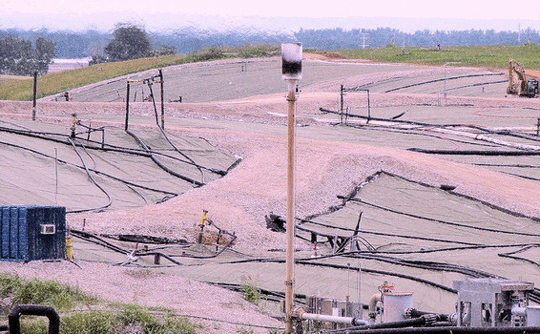 Residents Frustrated With Planned Barrier Between Fire, Nuclear Waste Dump In St. Louis http://www.ibtimes.com/residents-frustrated-planned-barrier-between-fire-nuclear-waste-dump-st-louis-2258034 BY ADAM LIDGETT @ADAMLIDGETT ON 01/09/16 While the U.S. Environmental Protection Agency plans to go ahead with the building of a firebreak between an underground fire and a nuclear-waste site in suburban St. Louis, area residents indicated they are frustrated by the situation, Al Jazeera reported Saturday. A number of them said the plan to construct the wall is not enough and that there should be a more-permanent solution to the problem.
“It’s looking more and more like removal is the only way to guarantee [a safe solution],” Dawn Chapman, who lives close to the waste site, told Al Jazeera. “Life’s over for [people] in this community. They can’t live where they are. They can’t enjoy it.’”
In 2010, an underground fire was detected in a landfill near St. Louis. It posed a pretty big problem in and of itself, but it was compounded by its proximity to another landfill containing Cold War-era nuclear material. The fire at the Bridgeton Landfill is smoldering only about 1,000 feet from tons of radioactive material in the West Lake Landfill, St. Louis Public Radio reported. A firebreak was proposed in 2013, but the EPA wanted then to conduct more tests to determine the amount of radioactive material at the site.
“The only way to guarantee the radioactive content will never come in contact with the subsurface fire in the future is to remove the radioactive material,” Ed Smith, a representative of the Missouri Coalition for the Environment, told Al Jazeera. “We’ve watched the EPA work on the barrier plan now for almost two years whereas they could have been planning for the removal of the radioactive waste.”
It’s unknown how much radioactive waste — dumped there in 1973 as residue of the Manhattan Project — is at the site. Some experts said the contamination could be unprecedented. “We are now working through the highly complex details of implementing our decision and the associated legal steps,” EPA Acting Regional Administrator Mark Hague said in a statement cited by St. Louis Public Radio. “Once the plan is finalized, we are committed to providing this information to the public. EPA will use all available enforcement authorities to ensure implementation of this work.”
Large shipment of plutonium to travel from Japan to South Carolina
 Japan to send huge cache of plutonium to South Carolina under nuclear deal: report RAW STORY AGENCE FRANCE-PRESSE 05 JAN 2016 Japan will send a huge cache of plutonium — enough to produce 50 nuclear bombs — to the United States as part of a deal to return the material that was used for research, reports and officials said Tuesday.
The plutonium stockpile, provided by the US, Britain and France decades ago, has caused some disquiet given that Japan has said it has the ability to produce a nuclear weapon even if it chooses not to.
The shipment, which comes ahead of a nuclear security summit in Washington in March, is meant to underscore both countries’ commitment to nuclear non-proliferation and is part of a deal they made in 2014.
It will be one of Japan’s most significant overseas movements of plutonium since it transported one tonne from France in 1993 to be used in nuclear reactor experiments.
That shipment triggered an outcry at the time from countries citing environmental and security concerns.
A Japanese official confirmed the amount of plutonium to be sent to the US and said that preparations for the shipment are under way. “But we can’t comment on further details, including the departure date and route, for security reasons,” the official in the nuclear technology section at the education ministry told AFP Tuesday.
The material has been stored at the Nuclear Science Research Institute northeast of Tokyo, he added…….https://www.rawstory.com/2016/01/japan-to-send-huge-cache-of-plutonium-to-south-carolina-under-nuclear-deal-report/
Rain-sodium reaction caused fire in nuclear waste dump

 Beatty waste dump fire blamed on rain-sodium reaction By Wesley Juhl Las Vegas Review-Journal, December 31, 2015
 A fire at a low-level radioactive waste dump in Nye County that shut down a 140-mile stretch of Nevada’s main north-south highway for almost 24 hours in October was caused by rainfall that seeped through a compromised cover and reacted with metallic sodium, according to a report released Thursday.
On Oct. 18, during heavy rainfall, the now-closed, state-owned landfill at the US Ecology dump near Beatty roared to life with explosions and fire. Beatty is about 115 miles northwest of Las Vegas, off of U.S. Highway 95.
A state probe of the incident was launched to consider if the fire was related to the wet weather, and if disposal records kept by the state in Carson City and at the site list any materials that could have reacted with water to cause the fire. Monday’s report details how corrosion of the steel drums containing the metallic sodium allowed the packing fluid to seep out, leaving the metallic sodium exposed to underground elements.
The 305-page report released Thursday collects statements from staffers who were there, aerial maps, results of laboratory analyses and a 195-page study on low-level radioactive waste management from 1981 as an attachment……..
Recommendations for long-term fixes from the Nevada Division of Environmental Protection include setting up enhanced monitoring of the waste facility capable of handling remote video surveillance and radioactivity measurement. The agency suggested an evaluation of the various types of wastes placed in the site and a redesign of a more protective cover cap…….. http://www.reviewjournal.com/news/nevada/beatty-waste-dump-fire-blamed-rain-sodium-reaction
Nuclear industry discounts the massive tax-payer future costs of radioactive wastes
Nuclear Energy Dangerous to Your Wallet, Not Only the Environment, CounterPunch, by PETE DOLACK , 1 JAN 16 “………There would at least be a small silver lining in this dark picture if the electricity produced were cheap. But that’s not the case. From the mid-1970s to the mid-1990s, the cost of producing electricity from nuclear power in France tripled and in the United States the cost increased fivefold, according to the Vermont Law School paper [page 46].
 Then there are the costs of nuclear that are not imposed by any other energy source: What to do with all the radioactive waste? Regardless of who ultimately shoulders these costs, the environmental dangers will last for tens of thousands of years. In the United States, there is the fiasco of the Yucca Mountain nuclear waste dump in Nevada. The U.S. government has collected $35 billion from energy companies to finance the dump, which is the subject of fierce local opposition and appears to have no chance of being built.
Presumably, the energy companies have passed on these costs to their consumers but nonetheless are demanding the government take the radioactive waste they are storing at their plants or compensate them. As part of this deal, the U.S. government made itself legally responsible for finding a permanent nuclear-waste storage facility.
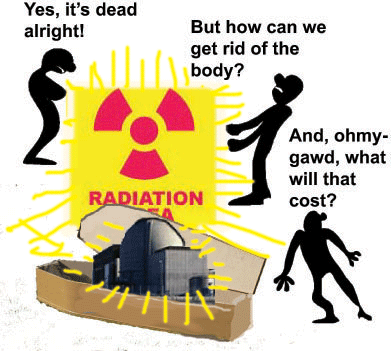
And, eventually, plants come to the end of their lives and must be decommissioned, another big expense that energy companies would like to be borne by someone else. The Heinrich Böll Stiftung studysays:
“[T]here is a significant mismatch between the interests of commercial concerns and society in general. Huge costs that will only be incurred far in the future have little weight in commercial decisions because such costs are “discounted.” This means that waste disposal costs and decommissioning costs, which are at present no more than ill-supported guesses, are of little interest to commercial companies. From a moral point of view, the current generation should be extremely wary of leaving such an uncertain, expensive, and potentially dangerous legacy to a future generation to deal with when there are no ways of reliably ensuring that the current generation can bequeath the funds to deal with them, much less bear the physical risk. Similarly, the accident risk also plays no part in decision-making because the companies are absolved of this risk by international treaties that shift the risk to taxpayers.” [page 17]
The British government, for instance, currently foots more than three-quarters of the bill for radioactive waste management and decommissioning, and for nuclear legacy sites. A report prepared for Parliament estimates that total public liability to date just for this program is around £50 billion, with tens of billions more to come……….http://www.counterpunch.org/2016/01/01/nuclear-energy-dangerous-to-your-wallet-not-only-the-environment/
With UK floods now, a timely call to stop extending Cumbria nuclear waste dump
 LOCK THE GATE ON DRIGG – THE UKS NUCLEAR WASTE SITE https://you.38degrees.org.uk/petitions/lock-the-gate-on-drigg-the-uks-nuclear-waste-site Campaign created by
 TO: CUMBRIA COUNTY COUNCIL

Early in 2016 Cumbria County Council will be considering the plan to extend the lifetime and capacity of Drigg Nuclear Dump on the West Coast of Cumbria. We the undersigned ask that you Lock the Gate on Drigg.
Why is this important?
To describe the UKs nuclear waste site as a “Repository” is putting a spin on the UKs main nuclear dump for “low level” waste. There is “controlled discharge direct to the Irish Sea” not to mention run off to the Drigg Stream and River Irt. Discharges to the air of radioactive gases are ongoing. According to the British Geological Society the Drigg site is above a regional aquifer. It is also “likely to be destroyed by coastal erosion” in 500 to 5000 years (computer modelling can be wrong either way) . Much of the waste is long lived and high risk.
Below are a few of the reasons why it is important that Cumbria County Council Lock the Gate on Drigg:

“Planning Application 4/11/9007 Low Level Waste Repository Site Optimisation and Closure Works.”
1. CLOSURE: The statement “closure works” is hugely misleading. The date for “closure” is set at 2079. So Drigg would continue to accept nuclear waste until that time. The site would be “capped.” Again this is misleading and to “cap” a nuclear dump is akin to putting a cap on a fizzy lemonade bottle while there are holes in the bottom of the bottle. The site will continue to leach aqueous emissions to groundwater and gaseous emissions to air for thousands of years.
2. LOW LEVEL: This suggests that the waste at Drigg is low risk and short lived. Neither is true. As the University of Reading has pointed out: “The Drigg site uses two disposal systems: 1) An original system operated from 1959 to 1988 comprising a series of parallel trenches excavated into glacial clays, back filled with LLW and covered with an interim water resistant cap. 2) Current disposal of compacted waste placed in steel ISO-freight containers, with void space filled with highly fluid cement based grout. These containers are then disposed of in a series of open concrete vaults. Radionuclides with highest activities in the inventory include 3H, 241Pu, 137Cs, 234U and 90Sr, 238U and 232Th.
3. RADIOACTIVE FLY TIPPING: The chemical and nuclear dump site has moved on from the years 1940 to 1988 when chemical and radioactive waste was tumble tipped into trenches. Now the waste is compacted into steel shipping containers filled with cement. Incredibly the containers are stacked high. In 2013 the LLW management wrote: “in containers at the tops of stacks, the external capping grout has undergone extensive physical degradation and settlement; the lids are not full of grout, and the grout is generally heavily cracked. The state of the capping grout in underlying layers is better; most containers only show sparse cracking and typical settlement in the lid is approximately 15 mm. Standing water, sometimes contaminated with low levels of radioactivity, is present in approximately half of the containers at the tops of stacks. ..In containers at the tops of stacks, organic matter (principally leaf mould) has accumulated beneath many open grout ports, with vegetation growing from some grout ports. ..Corrosion, sometimes fully penetrating, is present in some container lids at the tops of stacks…”
4. FLOODWATER AND SEA INUNDATION: “The Environment Agency has given a formal view that “the potential for disruption of the site is an acceptable risk” By “disruption of the site” they mean inundation by sea and flood. This is a far cry from the Environment Agency’s previous criticism in 2005: “BNFL (Now the NDA) has not yet demonstrated that the wider benefits to the UK from continued LLW disposal on this site outweigh the potential future impacts” We would hope that Cumbria County Council agree with the Environment Agency’s 2005 findings that that the real and present threat of inundation of the Drigg site by flood or by sea is not an acceptable risk to the people of Cumbria or to our international neighbours.
5. THE COLLAPSE in 1985 of the largest black-headed gull breeding colony in Europe on the Drigg dunes has never been satisfactorily explained. The official explanation is that a fox did it!
6. CHILDHOOD LEUKEMIA is officially blamed on “population mixing” due to the influx of workers firstly to the 1940 explosives factory (Royal Ordnance Factory) at Drigg and then the ROF at Sellafield. The irony of this incredible argument is that the plan for 3 new nuclear reactors at ‘ Moorside’ a few miles from Drigg (‘Moorside’ is at the village of Beckermet) would involve a boom and bust influx of thousands of workers along with a further tsunami of nuclear wastes and ever more Driggs.
How it will be delivered
By hand to Cumbria County Council
Underground wall ordered by EPA to prevent fire reaching nuclear waste landfill in Bridgestone
EPA orders barrier for nuclear waste landfill in Bridgestone http://www.bignewsnetwork.com/news/239881975/epa-orders-barrier-for-nuclear-waste-landfill-in-bridgestone Big News Network.comThursday 31st December, 2015 LENEXA, Kansas – The US Environmental Protection Agency (EPA) has ordered the installation of a physical isolation barrier separating the radioactively contaminated West Lake Landfill Superfund Site from the smoldering Bridgeton Landfill to make sure that the underground fire does not reach the buried nuclear waste.
The barrier will consist of an underground wall. The decision also calls for the installation of additional engineering controls, such as cooling loops, to prevent potential impacts that could result if the subsurface smoldering were to come into contact with the radioactive materialscontained in the West Lake Landfill, Mark Hague, EPA regional administrator, said Thursday.
For years landfill owner Republic Services and state and federal regulators have considered a subterranean firebreak separating the smoldering Bridgeton Landfill from the adjacent West Lake Landfill, just a few hundred feet away.
But uncertainty over the location and extent of West Lake’s radioactive contamination has prompted more studies of West Lake, contaminated in 1973 with nuclear weapons processing waste from the Manhattan Project .
Now, EPA says those assessments, conducted with assistance from the US Army Corps of Engineers, are nearly complete. “We now have a better understanding of where those materials are located,” EPA spokeswoman Angela Brees said. “We’re at a point now where we had enough data where we needed to make a decision about a wall.”
The latest report on the radioactive contamination’s location is under final review and will be released soon, she said.
The worrying part is that the underground fire is now within 1,200 feet from the West Lake landfill.
“Finding a solution to mitigate the potential impacts of a subsurface smoldering event is a top priority for the community, and a top priority for EPA,” said Hague. “Today’s announcement is the first step in moving forward with the installation of a physical barrier and other engineering controls to address this issue.”
“We are now working through the highly complex details of implementing our decision and the associated legal steps. Once the plan is finalized, we are committed to providing this information to the public.”
The work of creating an underground barrier will be paid for by Republic Services, owner of both landfills. A spokesman for Republic Services said the company is ready to proceed with the barrier installation work. The company insists there is no risk of the fire reaching the nuclear material, but environmentalists disagree.
Ed Smith of the Missouri Coalition for the Environment said the barrier is not enough. “The only way to ensure a smoldering or surface fire doesn’t impact the radioactive wastes is to remove them,” Smith said, reported abc News.
West Lake was declared a Superfund site in 1990. In 2008, the EPA announced a remediation plan to cap the nuclear waste with rock, clay and soil. Opposition from the environmentalists however forced that the EPA to reconsider its decision.
No new plan has been worked out despite criticism from some lawmakers and residents who feel the agency is moving too slowly.
Cancer cases increase in area of radioactive material spreading from St. Louis landfill
Pollution from the landfill has already been blamed for a sharp increase in the number of cancer cases in the surrounding areas.
 Radioactive materials spreading from St. Louis landfill – report https://www.rt.com/usa/327593-nuclear-waste-stlouis-runoff/#.VoWKJnujHaY.twitter 31 Dec, 2015 Dangerous radioactive materials from a nuclear waste dump near St. Louis, Missouri have spread to neighboring areas, a new study shows. Storm water runoff from the site has also raised concerns and is being tested for radioactive pollution.
According to a peer-reviewed study just published in the Journal of Environmental Radioactivity, there is “strong evidence” that radon gas and water emanating from the West Lake Landfill are responsible for the anomalous levels of a lead isotope (210Pb), created by radioactive decay, in the surrounding area.
Just northwest of the St. Louis International Airport, the West Lake Landfill is a repository of nuclear waste from the Manhattan Project, the WW2 effort to create the atomic bomb. The area was declared an Environmental Protection Agency (EPA) Superfund site in 1990, but the federal government is still deciding how to clean up the waste.
After analyzing nearly 300 soil samples from a 200-square-kilometer zone surrounding West Lake, the report’s authors concluded that “offsite migration of radiological contaminants from Manhattan Project-era uranium processing wastes has occurred in this populated area.”
The stuff we’re talking about at West Lake is hotter than what you would find in a typical uranium mill tailings operation,” said Bob Alvarez, one of the authors, in an interview on Tuesday. Continue reading
Resist nuclear trash dumping! – League of Women Voters of South Carolina
Because this waste would be traveling through our state’s ports and on our roads with no option for a final repository, citizens and elected officials can no longer hope that others are thinking about nuclear waste. All South Carolinians must ask their elected leaders why the DOE and the NRC want to fiercely ignore public policies and laws to send commercial waste to SRS.
Don’t let South Carolina become a nuclear dumping ground, Statehouse Report· 12/31/2015 By Julie Hussey and JoAnne Day | Nuclear waste is one of those things most people hope someone else is thinking about. The good news is that for 40 years, members of the League of Women Voters of South Carolina (LWVSC) have been following waste issues at the Savannah River Site (SRS). Recent national and international proposals require all South Carolinians to become informed and take action.
Nuclear waste is usually from commercial power production and weapons facilities. All forms of U.S. nuclear waste are the responsibility of the U.S. government. Although the Department of Energy (DOE) and its predecessor agencies have been generically charged with this responsibility, Congress establishes national policies and appropriates funds……..
Frustrated by the lack of congressional responsibility to take care of commercial spent fuel, nuclear industry leaders have proposed reprocessing of nuclear waste at “temporary” storage sites. While these proposals suggest local jobs, they present other problems and do not solve the issue of a permanent repository. Such plans also fail to acknowledge that “high burnup” spent fuel is about four times as hot, both thermally and radioactively as old spent fuel and comes with unknown technical, environmental and human challenges.
LWVSC and other SRS watchers noted that SRS, a weapons site, was proposed by industry as one of these “temporary” storage sites, despite decades-old U.S. policy of separating commercial and defense activities. We believed this wise policy would keep spent commercial fuels out of the SRS defense waste site. We also know agencies are required by law to provide public notice before moving waste. What we did not know is that DOE has been making secret plans to bring German commercial fuel and NRC has been making secret plans to bring Illinois/Exelon commercial fuel to SRS. This news is disturbing to say the least.
Rather than following the processes and policies established to protect the human and physical environment, DOE is focused on the money it plans to charge Germany for waste treatment. While we recognize that SRS may be the only well-managed site, SRS should not be “rewarded” with the responsibility to accept international commercial waste just because DOE wants the income. Other labs such as Hanford and Los Alamos are not expected to generate income, and neither should SRS. German nuclear waste should stay in Germany.
Industrial nuclear waste should be the responsibility of the company that managed it. According to its website, Exelon operates the largest fleet of nuclear plants in the nation — 23 reactors at 14 locations. Duke Energy keeps its spent fuel at its own sites, and Exelon should do the same.
Because this waste would be traveling through our state’s ports and on our roads with no option for a final repository, citizens and elected officials can no longer hope that others are thinking about nuclear waste. All South Carolinians must ask their elected leaders why the DOE and the NRC want to fiercely ignore public policies and laws to send commercial waste to SRS. SRS should be rewarded for its efforts by sharing our knowledge and experiences with other facilities, not by allowing others to share their waste and problems with us.
Politicians love to make bold statements about not accepting prisoners from Guantanamo or refugees from Syria into our state. Why are they silent about accepting nuclear waste?
- For more information on nuclear waste in South Carolina check out the League of Women Voter’sissue brief, on the subject.
Julie Hussey and JoAnne Day are co-presidents of the League of Women Voters of South Carolina. http://www.statehousereport.com/2015/12/31/my-turn-dont-let-south-carolina-become-a-nuclear-dumping-ground/
The facts: Fukushima today
The herculean cleanup of Fukushima Prefecture involves 105 cities, towns, and villages. Unlike Chernobyl where authorities declared a 1,000 square mile no-habitation zone and resettlement of 350,000 people, thus allowing radiation to dissipate over decades-to-centuries, Japan is attempting to remake Fukushima back into its old self. But, radioactive material collected in millions of black bags is a vexing problem for the ages.
Adding to the lingering problem of transporting and storing radioactive waste, over time, the bags will likely deteriorate and need to be replaced with fresh bags. It is an endless cycle.
Handling radioactive waste in Japan may become generational employment, similar to how second and third generation workers eventually completed the grand cathedrals of Europe, like Notre Dame de Paris with a cornerstone laid in 1163 resulting in major construction completed circa 1250.
 Fukushima Today, Dissident Voice by Robert Hunziker / December 29th, 2015 Throughout the world, the name Fukushima has become synonymous with nuclear disaster and running for the hills. Yet, Fukushima may be one of the least understood disasters in modern times, as nobody knows how to fix either the problem nor the true dimension of the damage. Thus, Fukushima is in uncharted territory, a total nuclear meltdown that dances to its own rhythm. Similar to an overly concerned parent, TEPCO merely monitors but makes big mistakes along the way.
Over time, bits and pieces of information about Fukushima Prefecture come to surface. For example, Arkadiusz Podniesinski, the noted documentary photographer of Chernobyl, recently visited Fukushima. His photos and commentary depict a scenario of ruination and anxiety, a sense of hopelessness for the future.
Ominously, the broken down Fukushima Daiichi Nuclear Power Plant looms in the background of everybody’s life, like the seemingly indestructible iconic image of destruction itself, Godzilla with its signature “atomic breath.”
Podniesinski’s commentary clearly identifies the blame for the nuclear accident, namely:………
Within Fukushima, Orange Zones are designated as less contaminated but still uninhabitable because radiation levels run 20-50 mSv/y, but decontamination work is underway. Residents are allowed to visit homes for short duration only during the daytime. However, as it happens, very few people are seen. Most of the former residents do not want to go back and the wooden houses in many of the towns and villages are severely dilapidated.
The lowest radiation areas are designated the Green Zone (< 20 mSv/y), where decontamination work is complete and evacuation orders are to be lifted.
Enormous black sealed bags filled with radioactive soil and all kinds of sizzling waste are stacked across the countryside, as approximately 20,000 workers thoroughly cleanse soil, rooftops, streets, and gutters. House-by-house, workers scrub rooftops and walls by hand.
The radioactive-contained black bags are trucked outside of towns to the far outskirts where thousands upon thousands upon thousands of big black bags are stacked. An aerial view of these temporary storage sites appears like gigantic quilts of rectangular shapes neatly, geometrically spread across the landscape for as far as the eye can see. The government claims the radioactive-contained black bags will be gone from the countryside within 30 years, but where to?………
The herculean cleanup of Fukushima Prefecture involves 105 cities, towns, and villages. Unlike Chernobyl where authorities declared a 1,000 square mile no-habitation zone and resettlement of 350,000 people, thus allowing radiation to dissipate over decades-to-centuries, Japan is attempting to remake Fukushima back into its old self. But, radioactive material collected in millions of black bags is a vexing problem for the ages.
In that regard, Japanese authorities have commissioned construction of a massive landfill just outside of the Fukushima Daiichi Power Plant, expected to contain 16-to-22 million bags of debris, enough to fill 15 baseball stadiums. Unfortunately, bags filled with radioactivity are more than a mere headache; they are more like a severe migraine. A truck can carry 6-8 of the huge bags at a time, and with so many, it could take decades to move the material. Adding to the lingering problem of transporting and storing radioactive waste, over time, the bags will likely deteriorate and need to be replaced with fresh bags. It is an endless cycle.
Handling radioactive waste in Japan may become generational employment, similar to how second and third generation workers eventually completed the grand cathedrals of Europe, like Notre Dame de Paris with a cornerstone laid in 1163 resulting in major construction completed circa 1250. http://dissidentvoice.org/2015/12/fukushima-today/
St. Louis and the Radiation problem – recommendation – Just get out of town!
 Fukushima Update: “Your Radiation This Week BEFORE IT’S NEWS, Dec 19 to Dec 26, 2015″ By Bob Nichols “………St. Louis and the Rad problem: St. Louis, now and forever more, will be remembered as a Manhattan Project nuclear garbage dump. It was for the most poisonous, flammable elements in the universe that just happen to also be radioactive. What will happen to the pieces of the rocks that incinerated Hiroshima, Japan and turned former people into mere shadows on the concrete? Nagasaki was blown away by Plutonium, manufactured by all reactors.
My recommendation remains the same for healthy,
able-bodied people in St. Louis – Just leave, get out of town……
Russia to dump nuclear waste in melting permafrost in Arkhangelsk Region
 Approves radioactive waste disposal in melting permafrost December 22, 2015 http://thebarentsobserver.com/ecology/2015/12/approves-radioactive-waste-disposal-melting-permafrost
On Monday, the Government of Arkhangelsk Region sent an order to Russia’s national operator for radioactive waste management with the approval to locate a repository for low- and medium level radioactive waste on the south-western part of the southern island of the Novaya Zemlya archipelago.
Novaya Zemlya is geographically part of Arkhangelsk Oblast.
The repository will receive radioactive waste that already are in temporary storages in north-western Russia, including the large quantities stored at the naval yards in Severodvinsk on the coast of the White Sea, reports Nuclear.ru
The repository will be underground, but near the surface. Novaya Zemlya, like most other places in the High Arctic has permafrost in the ground. With climate changes, scientists fears the top layers of the permafrost could melt. That worries nuclear safety experts.
“It is important to consider the melting permafrost when studying risk-assessments for a radioactive waste repository on Novaya Zemlya,” says Nils Bøhmer, Nuclear Physicists with the Bellona Foundation in Norway.
He says the melting permafrost makes it highly uncertain for how long such waste can be protected.
Low- and medium level waste must be kept safe for hundreds of years according to Russian standards, reports Polit.ru that wrote about the Novaya Zemlya plans on Monday.
Bøhmer says it would be a much better alternative to establish a final repository for low- and medium level radioactive waste on the Kola Peninsula where the rocks are way more stable.
“In addition, it is safer to establish a repository where most of the waste already are located. Sea transport across the Barents Sea to Novaya Zemlya is a risky business in itself,” Bøhmer argues.
Novaya Zemlya was one of ten different sites in Northwest-Russia studied over the last couple of years to see if it is suited to be repository. Sites on the coast of the Kola Peninsula were also studied.
Yet more radiation “hot spots” found in St Louis suburb, along with high cancer rates
 7 more nuclear waste “hot spots” found in St. Louis suburb http://www.cbsnews.com/news/seven-more-nuclear-waste-hot-spots-found-in-north-st-louis-county-missouri-suburb/ By VINITA NAIR CBS NEWS December 22, 2015, NORTH ST. LOUIS COUNTY, Mo. — Three-hundred residents of North St. Louis County crowded into a local gym, anxious about what they would hear. Soil near the local creek was contaminated by improperly stored nuclear weapons waste in the 1960’s and 70’s, and people have been getting sick.
The Army Corps of Engineers was there to deliver the latest test results.
Seven additional parcels have been identified,” one official announced.
The seven new “hot spots,” areas of low level nuclear contamination, were discovered as crews tested the creek this summer. The new sites include four commercial properties and three homes. Add in the five sites already slated for clean up, and that’s 12 places in the area with contamination.
- “Hot spot” near nuclear waste has St. Louis residents on edge
- “They found a tumor the size of a golf ball,” said Angela Powers. Last fall, she lost her 9-year-old grandchild Jordan to a brain tumor that is rare in children.
“If it came from this, wow, we want some answers. It’s making me angry. She was my only grandchild.”
It was a variety of rare illnesses that caught the attention of Jenelle Wright and her neighbors.
Four years ago, the group created a Facebook page that has since logged 2,700 cancers and autoimmune conditions around town. They begged federal health authorities to investigate.
“We’ve had to go through many battles, I don’t even know if I can count all of them…literally calling an agency 30 times and not having them return your phone call.”
- This month, they finally got results. The Centers for Disease Control sent a health assessment team to document the residents stories, which could confirm a link between radiation and the illnesses.
Mary Oscko has stage four lung cancer and blames it on the contamination.
“If I shake the table enough, you can’t eat your meal off of it. If I make enough noise, you’ll want to listen to me. And we are now starting to make enough noise. We’re standing up and saying “Hi, I’m Mary. I’m dying of cancer.'”
Residents are hoping the health study might result in compensation for their medical bills and their homes. But the assessment could take two years, and some folks like Oscko are worried they won’t be around to see it concluded.
USA Dept of Energy starting to begin to plan for nuclear waste disposal
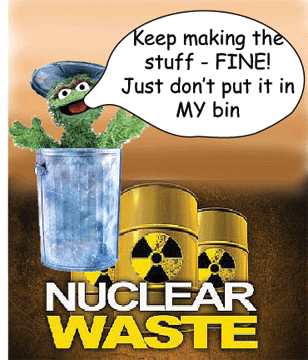 DOE launches nuclear waste disposal initiative http://thehill.com/policy/energy-environment/263959-doe-launches-nuclear-waste-disposal-initiative By Timothy Cama – 12/21/15 The Department of Energy is formally launching its initiative aimed at establishing a disposal site for spent nuclear fuel.
The department said Monday that it is accepting input on the disposal plan, which centers on finding at least one place to store spent fuel, with the consent of the local community.
It’s a key step toward rolling out what the Obama administration thinks is the best way forward for nuclear waste disposal.
It stands in stark contrast to the proposed Yucca Mountain nuclear waste repository in Nevada, which was designated by Congress to be the country’s main waste site, but which the Obama administration canceled amid strong local and state opposition to it.
“The launch of our consent-based siting initiative represents an important step toward addressing this nuclear waste management challenge, so that we can continue to benefit from nuclear technologies,” Lynn Orr, the Energy Department’s deputy secretary for science and energy, wrote in a Monday blog post.
While it will take years before the first pilot storage site is established, the administration’s action nonetheless is a small step toward solving the problem of nuclear waste sitting at dozens of current and former nuclear power plants and defense-related sites around the country.
The administration’s plan is largely informed by a wide-ranging 2013 report from a blue-ribbon commission, which concluded that a “consent-based” waste site is the ideal strategy and alternative to Yucca.
Fukushima Prefecture’s problem of disposal of radioactive trash
Behind the Scenes / Waste disposal site a dilemma for Fukushima, Japan Times 21 Dec 15 By Yuki Inamura and Keita Aimoto / Yomiuri Shimbun Staff Writes
On Dec. 4, the Fukushima prefectural government notified the national government that it would accept a proposal to dispose of the radioactive designated waste [definition below page] stored in the prefecture, where a catastrophic accident struck Tokyo Electric Power Co.’s Fukushima No. 1 nuclear power plant due to the 2011 earthquake. The Fukushima prefectural government’s recent decision signifies a step forward in efforts to rehabilitate the nuclear disaster-hit prefecture. However, the latest move poses a dilemma: In some neighboring prefectures that are home to a large amount of such designated waste, there are persistent calls for their waste to be concentrated in Fukushima Prefecture.

The government’s proposal would entail the use of the Fukushima Eco-tech Clean Center, an existing private-sector disposal plant in the town of Tomioka, to bury a portion of the designated waste stored in the prefecture. The waste subject to this disposal will consist of garbage and other waste material whose radiation levels stand at 100,000 becquerels or less per kilogram.
Two years ago, the national government formally presented the proposal to the Fukushima prefectural government. This coincided with the national government’s move to unveil another plan aimed at building an interim storage facility in the prefecture. This facility would be used to store, for extended periods, garbage whose radioactive levels exceed 100,000 becquerels per kilogram as well as a massive amount of contaminated soil. There has been a constant increase in the amount of contaminated soil as a result of ongoing decontamination work. The interim storage facility is currently being built. Continue reading
Transfer of Vermont Yankee’s dangerous nuclear used fuel trash to dry storage
Vermont Yankee to start moving spent nuclear fuel into dry storage in 2017 http://www.masslive.com/news/index.ssf/2015/12/vermont_yankee_to_start_moving.html By Mary Serreze | Special to The Republican On December 20, 2015 Entergy plans to start moving Vermont Yankee’s spent nuclear fuel into dry cask storage in 2017, two years earlier than originally anticipated, reports the online Vermont Digger.
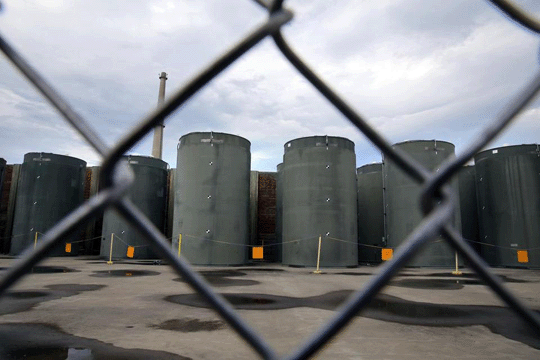
The Louisiana-based Entergy announced the decision Wednesday, but the idea was first introduced in an October filing with the Vermont Public Service Board, as part of the company’s bid for approval to build a second concrete pad for spent fuel storage at the Vernon, Vermont site, located on the banks of the Connecticut River.
The 620-megawatt Vernon plant, which began operations in 1972, stopped producing power Dec. 29, but most of its spent fuel remains in wet storage in a pool inside the plant’s reactor building.
While dry storage is considered safer than wet storage, concerns have been raised about the transfer process, in which fuel is pulled from the pool, placed in casks, loaded onto a large, tracked vehicle nicknamed “Cletus” and moved slowly to the spent fuel pad, Vermont Digger reports.
Entergy remains under a 2020 deadline to move the fuel into dry cask storage. Under the federally-sanctioned SAFSTOR process, full decommissioning could take up to 60 years. Under SAFSTOR, Vermont Yankee would be “mothballed” until its decommissioning fund reaches the level necessary to clean up the entire site.
State and regional officials, as well as critics of the plant, have raised concerns about the overall decommissioning project’s financing, as well as the presence of non-radiological and radiological waste at the site. The dry cask storage plan will be funded with a $145 million line of credit, which Entergy plans to repay by suing the U.S. Department of Energy for breach of its contract to remove spent nuclear fuel from the Vermont Yankee site.
The Nuclear Regulatory Commission has approved the use of the plant’s decommissioning trust fund to pay for long-term fuel storage, although the state has challenged that decision in federal appeals court.
Mary Serreze can be reached at mserreze@gmail.com
1 This Month


31st January – Challenging the War Machine – a DECLASSIFIED UK SUMMIT



Website of the Week
Now until to February 10, 2026 Radioactive waste storage in France: the debate is finally open! How to participate?
-
Archives
- January 2026 (227)
- December 2025 (358)
- November 2025 (359)
- October 2025 (377)
- September 2025 (258)
- August 2025 (319)
- July 2025 (230)
- June 2025 (348)
- May 2025 (261)
- April 2025 (305)
- March 2025 (319)
- February 2025 (234)
-
Categories
- 1
- 1 NUCLEAR ISSUES
- business and costs
- climate change
- culture and arts
- ENERGY
- environment
- health
- history
- indigenous issues
- Legal
- marketing of nuclear
- media
- opposition to nuclear
- PERSONAL STORIES
- politics
- politics international
- Religion and ethics
- safety
- secrets,lies and civil liberties
- spinbuster
- technology
- Uranium
- wastes
- weapons and war
- Women
- 2 WORLD
- ACTION
- AFRICA
- Atrocities
- AUSTRALIA
- Christina's notes
- Christina's themes
- culture and arts
- Events
- Fuk 2022
- Fuk 2023
- Fukushima 2017
- Fukushima 2018
- fukushima 2019
- Fukushima 2020
- Fukushima 2021
- general
- global warming
- Humour (God we need it)
- Nuclear
- RARE EARTHS
- Reference
- resources – print
- Resources -audiovicual
- Weekly Newsletter
- World
- World Nuclear
- YouTube
-
RSS
Entries RSS
Comments RSS
 nuclear-news