Summary of Australia’s Nuclear Fuel Chain Royal Commission Report
the waste-to-fuel fantasies of Senator Edwards and Ben Heard are dead and buried.
 [Wastes storage] timeframes – 150 years in the U.S. report and 120 years in the Royal Commission study – are nothing compared to the lifespan of nuclear waste. It takes 300,000 years for high level waste to decay to the level of the original uranium ore. The Royal Commission report notes that spent nuclear fuel (high level nuclear waste) “requires isolation from the environment for many hundreds of thousands of years.”
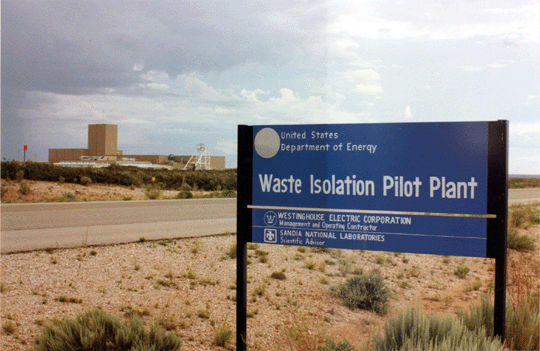 the Waste Isolation Pilot Plant (WIPP) in the U.S. state of New Mexico. WIPP was closed in 2014 because of a chemical explosion which ruptured a nuclear waste barrel and resulted in 23 workers being exposed to radiation. Before WIPP opened, the government estimated one radiation release accident every 200,000 years. But there has been one radiation release accident in the first 15 years of operation of WIPP.
 The Royal Commission’s report is silent about WIPP. It is silent about the Asse repository in Germany, where massive water infiltration has led to the decision to exhume 126,000 barrels of radioactive waste. The report is silent about the fire at a radioactive waste repository in the U.S. state of Nevada last year. And the report is silent about many other problems with the nuclear industry that it should have squarely addressed
Summary of ‘Tentative Findings’ of SA Nuclear Fuel Cycle Royal Commission Friends of the Earth Australia, by Jim Green, national nuclear campaigner, Friends of the Earth 20 Feb 16 What does the report say?
In a nutshell, the Royal Commission is negative about almost all of the proposals it is asked to consider – but positive about the proposal to import high-level nuclear waste from nuclear power plants for disposal in South Australia. Continue reading
Push to not just postpone nuclear waste burial near Great Lakes, but to stop it altogether
Critics want feds to kill nuclear-waste bunker after time extension sought http://www.metronews.ca/news/canada/2016/02/19/critics-want-feds-to-kill-nuclear-waste-bunker-after-time-extension-sought.html By: Colin Perkel The Canadian Press Published on
TORONTO — Groups opposed to the burial of nuclear waste near Lake Huron are calling on the federal government to kill a proposal for an underground storage bunker rather than ask for more information on the project.
In a statement Friday, one group said the environmental credibility of the new Liberal government under Justin Trudeau is at stake.
“It is unfortunate that the government is not listening to what the people and Great Lakes communities are telling them: to reject this plan,” said Beverly Fernandez with Stop the Great Lakes Nuclear Dump.
“No matter what process is followed, burying and abandoning radioactive nuclear waste in the Great Lakes Basin will always be a bad idea.”
The statement comes after the federal government said it needs more information before deciding whether to approve plans to build a giant underground storage bunker for nuclear waste near the Lake Huron shoreline.
That means a decision on the project, decried by scores of communities around or near the Great Lakes, will be delayed well beyond what had been a March 1 deadline.
A notice posted by the Canadian Environmental Assessment Agency says Environment Minister Catherine McKenna wants more details and further environmental studies for the proposed deep geologic repository near Kincardine, Ont.
A review panel last May had given the go-ahead, but a decision rests with the McKenna.
“The minister has requested that the proponent, Ontario Power Generation, provide additional information on three aspects of the environmental assessment: alternate locations for the project, cumulative environmental effects of the project, and an updated list of mitigation commitments for each identified adverse effect,” the notice reads.
“The minister’s request for information from the proponent has paused the timeline for an environmental assessment decision to be issued.”
A decision had been expected in September, but the former Conservative government extended the deadline to March 1 to allow for last fall’s federal election.
McKenna has now given the utility until April 18 to provide the environmental assessment agency with a schedule for fulfilling the information request. When she might make a decision is still to be determined.
Ontario Power Generation proposes to construct and operate the underground facility for the long-term management of radioactive waste at the Bruce nuclear site.
The proposal calls for hundreds of thousands of cubic metres of so-called low- and intermediate-level nuclear waste to be buried 680 metres underground in the bedrock.
Proponents argue the rock is geologically stable and would provide a hermetic seal to prevent any radioactivity reaching the lake about 1.2 kilometres away for tens of thousands of years.
However, almost 200 communities and environmental groups have argued that such a facility, despite OPG’s arguments, would be too risky given the proximity to Lake Huron. Any contamination, they say, could threaten drinking water for millions of people.
St Louis underground fire moves closer to radioactive trash dump
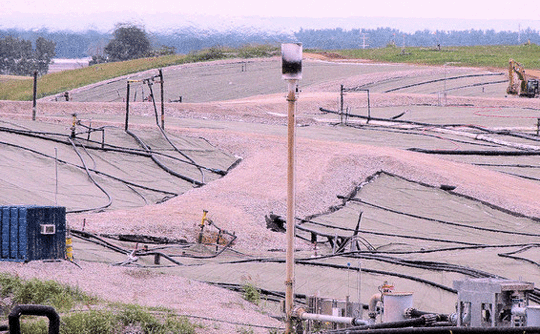 Underground Fire in Mo. Nears Nuclear Waste Dump, Discovery News, FEB 18, 2016 BY PATRICK J. KIGER IN THE ST. LOUIS AREA, A SLOW-BURNING UNDERGROUND FIRE IS CLOSE TO A VAST STORE OF NUCLEAR WASTE BURIED IN A FEDERAL SUPERFUND SITE.
The fire reportedly has been smoldering beneath a nearby landfill since at least 2010. The Washington Post reports that residents are afraid of what may happen if the fire — which is by some accounts as little as 1,500 feet away –reaches the West Lake Landfill in Bridgeton, Mo., a Superfund site filled with decades-old waste from the federal government’s nuclear weapons program. Angry locals also think the U.S. Environmental Protection Agency, which manages the site, hasn’t done enough to stop the fire.
In December, the EPA announced that it would install a physical barrier in an effort to isolate the nuclear waste. The agency also said that it would put cooling loops and other engineering controls to prevent environmental impacts if the “subsurface smoldering event,” as it’s called, were to reach the waste. An EPA administrator told the Post that the barrier would take a year to build.
But residents aren’t comforted by that timetable, and think the government, despite years of warning, has done too little to stave off a possible environmental disaster. A 2014 St. Louis County Emergency Operations Plan, obtained by a local TV station, reveals that local officials feared a “catastrophic event” with “a potential for radioactive fallout to be released in the smoke plume and spread throughout the region.”……
About 8.700 tons of nuclear waste, mixed with 39,000 tons of contaminated soil was moved to the Superfund site from another dump between July and October 1973, according to a U.S. Nuclear Regulatory Commission report. It was covered by a three-foot-deep layer of uncontaminated soil.
EPA may be running out of time to fix the problem. In early February, the U.S. Senate passed a bill introduced by Sens. Claire McCaskill, (D-Mo.), and Roy Blunt (R-Mo.), that would take control over the building remediation measures away from EPA and give it to the U.S. Army Corps of Engineers. The House hasn’t yet taken action on the legislation.
But Congress may bear some responsibility for the agency’s slowness. According to a 2015 Government Accountability Office report , legislators cut EPA’s funding for cleanup of Superfund sites by nearly half since the late 1990s. http://news.discovery.com/earth/underground-fire-in-mo-nears-nuclear-waste-dump-160218.htm
Moapa Band of Paiute Indians fear a nuclear waste dump being imposed at Yucca Mountain
The Battle Continues To Stop Yucca Mountain From Becoming A Nuclear Waste Dump Not far from the site of 40 years of nuclear weapons testing, a proposed long-term nuclear waste dump draws opposition from the Shoshone and Paiute Nations, environmental activists and even Nevada state officials. MintPress News, By Derrick Broze | February 18, 2016 The Moapa River Reservation is downwind of the Nevada Test Site, and locals have long maintained that radiation has harmed the health of the local population.
“We hope that that stuff [radiation] went up in the air and blew over us,” Vernon Lee, a Southern Paiute with the , who has lived on the Moapa River Reservation since 1973, told MintPress News. “We know that we got some because we are just east of the testing, but we hope we got less.”
Areas around the test site, particularly those located “downwind,” saw increases in cancers, including leukemia, lymphoma, thyroid cancer and brain tumors, throughout the entire span of the nuclear weapons testing. A 1984 study by the Journal of the American Medical Association found increased rates of canceramong Mormon families as far away as southwestern Utah, for example.
For Lee, the decades of environmental degradation and risks to human health reflect a much larger issue. The problem, he believes, is that the U.S. government does not recognize the tribal nations as equals. Officially, the U.S. Department of Interior states that the U.S. government operates under a “federal Indian trust responsibility,” a legal obligation that includes “moral obligations of the highest responsibility and trust” toward Native American tribes.
“To me, that doesn’t exist. It’s a word on paper, but I don’t think I have ever seen it put into practice,” Lee said.
“Trust responsibility, to me, is that government-to-government relationship that they are supposed to have with the tribes. It’s ridiculous the way the U.S. government treats the sovereign tribes. It’s very unfair.”
Native communities have a long history of resources discovered beneath the reservations being exploited by the U.S. government and supported industries. These communities have suffered exposure to dangerous substances through uranium mining and milling. In Nevada, the lives of generations of Western Shoshone and Moapa Paiute have become intertwined with the history of nuclear weapons testing and, more recently, the disposal of nuclear waste from faraway power plants.
“There are multiple problems. Moving the waste is a problem. High risk, unnecessary risk. If the company is ever going to benefit from nuclear power they should process it and store it themselves. Stop shipping it across the country and exposing the population to a potential disaster,” Lee said, alluding to the controversial long-term nuclear waste repository planned for Yucca Mountain, about a three hours’ drive from the reservation……….. http://www.mintpressnews.com/the-battle-continues-to-stop-yucca-mountain-from-becoming-a-nuclear-waste-dump/213976/
Europe is more than 118 billion euros short of funds needed to decommission its nuclear reactors
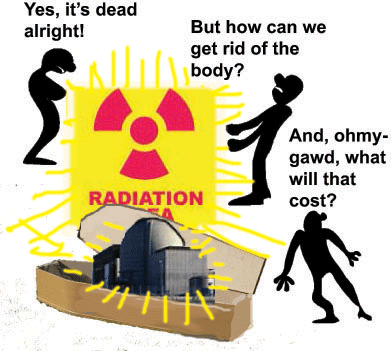 EU lacks 118 billion euros in nuclear decommissioning funds – draft http://www.reuters.com/article/us-europe-nuclear-idUSKCN0VP1S6
Assets covering only 150.1 billion euros in decommissioning costs – which includes the lengthy dismantling of stations as well as the removal and storage of radioactive parts and waste – are available, compared with 268.3 billion euros in expected costs, the paper shows.
The data is part of a broader analysis of Europe’s nuclear capacity, the so-called Nuclear Illustrative Programme of the Commission (PINC), the last of which has been published in 2007, before Japan’s Fukushima nuclear crisis five years ago.
As a result, Europe’s largest economy Germany has decided to fully abandon nuclear power by no later than 2022, relying on solar, wind as well as coal and gas-fired instead to eliminate the risk of a meltdown.
Among 16 EU member states still operating nuclear plants, only Britain’s operators have sufficient dedicated assets to cover the expected costs, 63 billion euros, according to the paper. France, which operates Europe’s largest fleet of nuclear plants, is heavily underfunded, having earmarked assets only worth 23 billion euros, less than a third of 74.1 billion euros in expected costs.
In Germany, an additional 7.7 billion euros in funds are needed on top of the current 38 billion euros.
Decommissioning costs vary according to reactor type and size, location, the proximity and availability of disposal facilities, the intended future use of the site and the condition of the reactor at the time of decommissioning.
Although technology used for decommissioning might gradually become cheaper, the cost of final waste depositories is largely unknown and costs might spiral over time. Reactor lifespans are measured in decades, which means financing costs and provisions depend strongly on unpredictable interest rate levels.
($1 = 0.8952 euros)
(Reporting by Barbara Lewis; Writing by Christoph Steitz; Editing by Tom Heneghan)
Limited liability for Germany’s nuclear operators in nuclear paseout
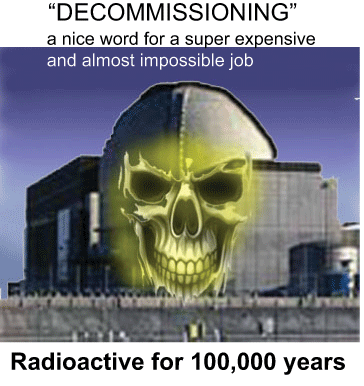
 German commission favours limited liability for nuclear phaseout-document http://www.reuters.com/article/germany-nuclear-idUSB4N11703M Feb 18 Germany’s nuclear operators could face only limited long-term liability for the costs of the country’s nuclear phaseout, according to a paper from a government-appointed commission seen by Reuters on Thursday.
The paper indicates that the commission took on board concerns of the four utilities – E.ON, RWE, EnBW and Vattenfall – which have earmarked nearly 40 billion euros in provisions to pay for the dismantling and storage of waste from their nuclear plants.
The last plant will be closed in 2022.
Worries over their financial health have raised fears that the companies may be unable to turn the provisions – including some illiquid assets – into liquid funds, eventually leaving taxpayers to foot some or much of the bill.
The paper said an unlimited liability would lead to excessive demands being made of the operators and that this would ultimately not be beneficial to society.
The paper said the operators may be asked to set aside additional funds on top of existing provisions for the costs of the nuclear phaseout, and that it favoured a state-controlled fund for the long-term costs.
A spokesman for E.ON said he did not want to comment before the final results of the commission are published. (Additional reporting by Tom Kaeckenhoff in Duesseldorf; Reporting by Markus Wacket; Writing by Madeline Chambers; Editing by Noah Barkin)
The continuing saga of the plan to dump nuclear waste on Yucca Mt – an act of genocide
for Zaparte, the actions taken by the U.S. government so far constitute an act of genocide against the Western Shoshone and other tribal nations who have been subject to the effects of nuclear testing and power. He is determined to fight for his people’s way of life and the land that his ancestors fought for.
“We have a deliberate act by the United States to systematically dismantle my living life ways for the profit of the nuclear industry and the benefit of the United States,” Zaparte said. “At the worst, this is genocide underthe U.N. Convention on the Prevention and Punishment of Genocide
The battle for Yucca Mountain The Battle Continues To Stop Yucca Mountain From Becoming A Nuclear Waste Dump Not far from the site of 40 years of nuclear weapons testing, a proposed long-term nuclear waste dump draws opposition from the Shoshone and Paiute Nations, environmental activists and even Nevada state officials. MintPress News, By Derrick Broze | February 18, 2016
“…………Commercial nuclear power plants produce spent nuclear fuel, a radioactive byproduct. High-level radioactive waste is also produced as spent nuclear fuel is reprocessed into material for nuclear weapons. Disposing of both of these byproducts is a difficult and dangerous task.
In response to growing concerns over nuclear waste storage, Congress passed the federal Nuclear Waste Policy Act in 1982, which charged the Department of Energy with finding a place to build and operate a geologic repository, or underground nuclear waste disposal facility. Operating on the notion that the safest way to dispose of the waste is to bury it in rock deep underground, the DOE studied several sites for a possible geologic repository before settling on Yucca Mountain, located 100 miles northwest of Las Vegas.
The plan for the Yucca Mountain Nuclear Waste Repository had the support of President George W. Bush, but met with opposition from Nevada state officials and environmental and Native activists, who fear that the rock at Yucca Mountain will not be able to contain nuclear waste for long periods of time.
In 2009, environmental and anti-nuclear organizations, including Beyond Nuclear, Greenpeace, Center for Health, Environment & Justice, and the International Society for Ecology, sent a letter to President Barack Obama calling the selection of the Yucca Mountain site “a purely political decision.” They argued that it has been been evident since 1992 that the site “could not meet the EPA’s general radiation protection standard for repositories.”
Obama opted to end funding for the project, setting off an ongoing legal battle. In August 2013, the U.S. Court of Appeals for the District of Columbia ordered the Nuclear Regulatory Commission to approve or reject the DOE application for the proposed waste storage site at Yucca Mountain. The Associated Press reported:
“In a sharply worded opinion, the court said the nuclear agency was ‘simply flouting the law’ when it allowed the Obama administration to continue plans to close the proposed waste site 90 miles northwest of Las Vegas. The action goes against a federal law designating Yucca Mountain as the nation’s nuclear waste repository.”
In January 2015 the NRC concluded that the DOE’s license application for Yucca Mountain satisfies nearly all of the commission’s regulations. The commission must now clear all challenges from the state of Nevada and Native communities, a process which could take several more years.
Then, in August, the NRC released a supplement to the DOE’s 2002 and 2008 environmental impact statements for the planned nuclear waste repository. The NRC’s report evaluates different potential radiological and non-radiological impacts on the environment, soil, and public health, and the potential for disproportionate impacts on minority or low-income populations. The NRC wrote:
“…[T]he NRC staff finds no environmental pathway that would affect minority or low-income populations differently from other segments of the general population. Therefore, the NRC staff concludes that no disproportionately high and adverse health or environmental impacts would occur to minority or low-income segments of the population in the Amargosa Valley area.”
The nonprofit environmental advocacy group Natural Resources Defense Council disagreed, stating that the NRC “still adheres to the flawed assumptions the DOE used to frame the foundation of its analysis of potential environmental impacts of the repository.”
As this process drags on, two companies are providing interim storage sites for the country’s nuclear waste. One is located in Andrews County, Texas, and owned by Waste Control Specialists. The other is anunderground storage site in Southeastern New Mexico, operated by Holtec International and the Eddy-Lea Alliance of New Mexico. Waste Control Specialists are hoping to turn the temporary West Texas facility into a long-term waste storage site.
An act of genocide?
About 90 miles from the money and vices of Las Vegas, Ian Zaparte stands at the base of Yucca Mountain, discussing the history of theft of Shoshone land and the threats posed by the Yucca Mountain Nuclear Waste Repository.
Zaparte represents the Western Shoshone traditional government and has been fighting in defense of his community and the planet for 30 years.
The Western Shoshone are one of 12 Indian nations whose chiefs signed the Treaty of Ruby Valley with the governors of the Nevada and Utah territory in 1863. In addition to recognizing the sovereignty of each of the Indigenous nations, the treaty gave the Indian nations ownership over millions of acres of land in Idaho, Nevada, California and Utah. It also allowed settlers access to the land for gold mining and homesteading, but did not give them title.
However, a history of land grabs through controversial legal means saw that land handed over to various agencies of the U.S. government, including the Bureau of Land Management. In 1979, the U.S. put $26 millionin a fund for the Shoshone for title to 24 million acres, but the tribe declined the money. The Supreme Court ruled six years later that the settlement, whether officially accepted by the tribe or not, extinguished the Shoshones’ claim to the land.
Essentially, the U.S. government has stated that encroachment upon Indian lands by settlers, railroads, telegraphs, ranches and gold mines extinguished the Shoshone claim to the land. In 2006, the United Nations Committee on the Elimination of Racial Discrimination found “credible information alleging that the Western Shoshone indigenous people are being denied their traditional rights to land.”
According to a University of Michigan Environmental Justice Case Study:
“The Western Shoshone argue that the basis of this plenary federal power is rooted in the colonial arrogance of the 17th century, and the laws that gave the United States Government control over the Native Americans are ‘extensions of Christian claims to world supremacy.’”
Since the Western Shoshone have lost claims to their traditional lands, the U.S. government is free to use the land for projects, such as nuclear weapons testing and the Yucca Mountain Nuclear Waste Repository.
Zaparte says the NRC and the DOE are ignoring the possibilities for danger in the area and denying the impact the Yucca Mountain Nuclear Waste Repository would have on local communities, including the Paiute and the Shoshone.
“There are 26 faults, seven cinder cone volcanoes, 90 percent of the mountain is saturated with 10 percent water,” Zaparte told MintPress. “If you heat the rock, it will release that water. If the water comes up and corrodes the canisters, it will take whatever is in storage and bring it into the water and into the valley.”
The DOE is currently accepting public comment from communities, states, tribes and other stakeholders on how to establish a nuclear waste repository with respect to the community. The DOE says it aims “to establish an integrated waste management system to transport, store, and dispose of commercial spent nuclear fuel and high level defense radioactive waste.” The public comment period ends on June 15, and the DOE and Nuclear Regulatory Commission will likely issue statements shortly after.
Although the Yucca Mountain project has stalled during the Obama administration, a new president, especially a nuclear-friendly president, could theoretically rally for funding of the Yucca Mountain Nuclear Waste Repository. The timing of the DOE’s study could potentially make the Yucca Mountain a topic of debate in the 2016 presidential election.
Still, for Zaparte, the actions taken by the U.S. government so far constitute an act of genocide against the Western Shoshone and other tribal nations who have been subject to the effects of nuclear testing and power. He is determined to fight for his people’s way of life and the land that his ancestors fought for.
“We have a deliberate act by the United States to systematically dismantle my living life ways for the profit of the nuclear industry and the benefit of the United States,” Zaparte said. “At the worst, this is genocide underthe U.N. Convention on the Prevention and Punishment of Genocide.”………http://www.mintpressnews.com/the-battle-continues-to-stop-yucca-mountain-from-becoming-a-nuclear-waste-dump/213976/
What is to be done with all Fukushima’s radioactive trash?
 Five years after nuclear meltdown, no one knows what to do with Fukushima, SMH, Anna Fifield February 11, 2016 Futaba: Seen from the road below, the Fukushima Dai-ichi nuclear power station looks much as it may have right after the catastrophic earthquake and tsunami that caused a triple meltdown here almost five years ago.
The No. 3 reactor building, which exploded in a hydrogen fireball during the disaster, remains a tangle of broken concrete and twisted metal. A smashed crane sits exactly where it was on March 11, 2011. To the side of the reactor units, a building that once housed boilers stands open to the shore, its rusted, warped tanks exposed.
The scene is a testament to the chaos that was unleashed when the tsunami engulfed these buildings, triggering the world’s worst nuclear disaster since the one in Chernobyl, in Ukraine, in 1986. Almost 16,000 people were killed along Japan’s northeastern coast in the tsunami, and 160,000 more lost their homes and livelihoods……..
What is to be done with all the radioactive material?
There’s the groundwater that is flowing into the reactor buildings, where it becomes contaminated. It has been treated – Tepco says it can remove 62 nuclides from the water, including strontium, which can burrow into bones and irradiate tissue. It cannot filter out tritium, a radioactive isotope of hydrogen that can be used to make nuclear bombs but is not considered especially harmful to humans.
The water initially was stored in huge bolted tanks in the aftermath of the disaster, but the tanks have leaked highly contaminated radioactive water into the sea on an alarming number of occasions.
Now Tepco is building more secure welded tanks to hold the water, theoretically for up to 20 years. There are now about 1000 tanks holding 750,000 tons of contaminated water, with space for 100,000 tons more. The company says it hopes to increase capacity to 950,000 tons within a year or two, as well as halve the amount of water that needs to be stored from the current 300 tons per day.
As part of those efforts, Tepco has built a 1500-metre-long “ice wall” around the four reactor buildings to freeze the soil and keep groundwater from getting in and becoming radioactive. Company officials hoped to have the just-completed wall working next month; on Wednesday, though, Japan’s nuclear watchdog blocked the plan, saying the risk of leakage was still too high.
The options for getting rid of the contaminated water include trying to remove the tritium from it before letting it run into the sea; evaporating it, as was done at Three Mile Island, the Pennsylvania plant that melted down in 1979; and injecting it deep into the ground, using technology similar to that used to extract shale gas. A government task force is considering which option to choose.
“These all have different advantages and disadvantages; they have different costs and different social acceptance,” said Seiichi Suzuki, manager of tank construction at the plant.
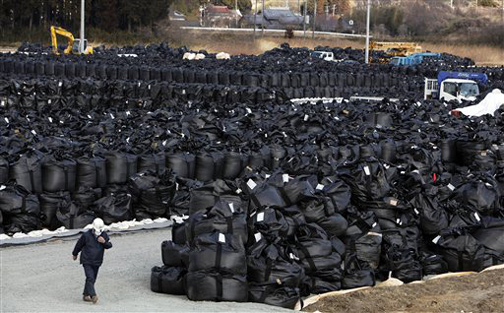
Then there’s the radioactive soil that has been collected from areas around the Fukushima Dai-ichi plant during clean-up efforts. Nearly 20 million cubic metres of soil — enough to fill 8000 Olympic-size swimming pools — has been packed into large black plastic bags and is being stored, row upon row, in local fields.
More than 700 of the bags, which contain radioactive cesium isotopes, were swept away during floods last year, some ending up in rivers 160 kilometres away. The government has said that 99.8 percent of the soil can be recycled.
Finally, and most problematically, there’s the nuclear fuel from the plant itself.
The fuel that melted down remains in containment vessels in its reactors, and this part of the plant is so dangerous to humans that robots are used to work there. Getting to this fuel and removing it safely is a task that will take decades.
Asked about the decommissioning process, Ono of Tepco said the work was about 10 per cent done.
“The biggest challenge is going to be the removal of the nuclear fuel debris,” he said. “We don’t even know what state the debris is in at the moment.”
Japan does not have a nuclear waste dump, and there is vehement resistance to disposing of contaminated material on land.
As a result, one of the options the government is considering is building a nuclear waste dump under the seabed, about 13 kilometres off the Fukushima coast. It would be connected to the land by a tunnel so it would not contravene international regulations on disposing of nuclear waste into the sea. A government study group is set to report on that proposal by the end of the summer.
Many groups, from fishermen to anti-nuclear activists, staunchly oppose the idea of burying the radioactive material at sea in such a seismically active area.
“At some point it would leak and affect the environment,” said Hideyuki Ban, co-director of the Citizens’ Nuclear Information Centre. “Some say it’ll be fine, as it will be diluted in the ocean, but it’s unclear whether it will be diluted well. If it gets into fish, it could end up on someone’s table.”
Aileen Mioko Smith, executive director of Green Action, a Kyoto-based anti-nuclear group, agreed.
“The seabed is just like land. It’s not flat, but has mountains and valleys,” she said. “Japan sits on multiple tectonic plates and is earthquake-prone. It’s too easy to think, ‘If not on land, how about the seabed?’ “http://www.smh.com.au/world/five-years-after-nuclear-meltdown-no-one-knows-what-to-do-with-fukushima-20160211-gmr5sv.html#ixzz3ztnYcrCY
Australian Senator’s Impossible Nuclear Dream – analysis by Australia Institute
The impossible dream Free electricity sounds too good to be true. It is. A plan to produce free electricity for South Australia by embracing nuclear waste sounds like a wonderful idea. But it won’t work. The Australia Institute Briefing paper Dan Gilchrist February 2016

Armed transport ships spotted in Panama Canal, headed for secret mission to later transport plutonium
 UK-Flagged Ships Set to Transport Plutonium from Japan to US Located in Panama Canal http://www.srswatch.org/uploads/2/7/5/8/27584045/srsw_news_on_plutonim_ships_in_canal_feb_6_2016.pdf Ships on Secret Mission to Carry 331 Kilograms of Plutonium to US DOE’s Savannah River Site in South Carolina as Part of Nuclear Security Summit Preparation; Plutonium to be Stranded at SRS
5,300 tons of Fukushima radioactive trash dumped in 5 prefectures
 5,300 tons of radioactive wood waste taken into 5 prefectures besides Shiga http://mainichi.jp/english/articles/20160208/p2a/00m/0na/004000c February 8, 2016 (Mainichi Japan) OTSU — Some 5,300 metric tons of wood chips contaminated with radioactive cesium from the Fukushima nuclear disaster was transported into Tochigi, Ibaraki, Chiba, Yamanashi and Kagoshima prefectures, documents from the Otsu District Public Prosecutors Office in Shiga Prefecture have shown.
The waste had been held by a lumber company in the Fukushima Prefecture city of Motomiya. The president of a consulting firm in Tokyo took on the job of disposing of the waste, but came under suspicion of dumping around 310 cubic meters of it in Takashima. The president was subsequently convicted over violation of a waste disposal law.
According to a lawyer of a citizens group who had access to the information held by the Otsu public prosecutors, two intermediate processing companies in Tokyo and Gunma Prefecture removed the waste from Fukushima between December 2012 and September 2013. Later, other transporters took it into six prefectures including Shiga via 18 different routes. Roughly 3,437 tons was taken into Tochigi Prefecture, 1,214 tons into Yamanashi Prefecture, 344 tons into Kagoshima Prefecture, 280 tons into Chiba Prefecture and 10 tons into Ibaraki Prefecture, the documents reportedly showed.
Huge production of radioactive trash would come from Hinkley point C nuclear reactor

 nuClear News No 82 Feb 16 The Impact of a New Reactor Programme on the UK’s Radioactive Waste Inventory The proposed Hinkley Point C nuclear power station would produce radioactive wastes and spent fuel with a radioactivity inventory equal to roughly 80% of the radioactivity in all of the UK’s existing radioactive wastes put together.
The UK ghost ships with the deadly nuclear cargo
Guarded from terrorists by Royal Navy sub and 50 commandos…the UK ghost ships with enough nuclear fuel for 80 missiles, Daily Mail,
- Pacific Heron and Pacific Egret ships will sail to Japan for plutonium
- Precious 331kg load could make an incredible 80 nuclear warheads
- Vessels are accompanied by military ships and armed with cannons
By MARK NICOL DEFENCE CORRESPONDENT FOR THE MAIL ON SUNDAY 7 February 2016
Two top secret British ‘ghost ships’ carrying enough plutonium for a huge nuclear arsenal wend their way through the world’s oceans –guarded against terrorists by 50 commandos.
It may sound like a tantalising target for a villain in a James Bond film, but what is potentially the most dangerous secret mission in history is deadly reality.
Two vast container ships – the Pacific Heron and the Pacific Egret – left Barrow-in-Furness, Cumbria, last month on the first leg of their incredible journey.
Their mission is to sail to Japan to collect 331kg of plutonium – enough to make 80 nuclear warheads – which was leased by the UK to a Japanese research facility.
The ships are almost certainly shadowed by a Royal Navy submarine and surface vessels and are heavily armed with 20mm cannon.
They are sailing across the Atlantic before passing through the Panama Canal and into the Pacific on their way to Japan.
Their ultimate destination is a US nuclear storage facility in South Carolina, and the return journey to the American eastern seaboard from East Asia would normally again be made via the Panama Canal.
But this would leave the vessels vulnerable to attack – and their terrifying radioactive cargo could in theory devastate much of Central America.
So instead, they are likely to take the long and dangerous journey around the storm-lashed Cape Horn at the tip of South America, one of the most hazardous shipping routes in the world.
The Heron and the Egret, which each weigh about 6,700 tons when fully loaded, belong to the UK’s Nuclear Decommissioning Authority (NDA). It is expected that each ship will be guarded by as many as 25 commandos.
Nuclear expert John Large told The Mail on Sunday last night: ‘The cargo is invaluable and part of a secret trade in fissile materials between the likes of the UK and US. The biggest risk is a fire or an external missile strike.
‘This is bomb-grade nuclear material and a terror group or rogue state would want to intercept it.’…..http://www.dailymail.co.uk/news/article-3435476/Guarded-terrorists-Royal-Navy-sub-50-commandos-UK-ghost-ships-nuclear-fuel-80-missiles.html
French waste group Veolia moving into nuclear clean-up business
 Veolia expands in nuclear waste clean-up with Kurion acquisition http://www.reuters.com/article/us-kurion-m-a-veolia-idUSKCN0VC0V4, 4 Feb 16
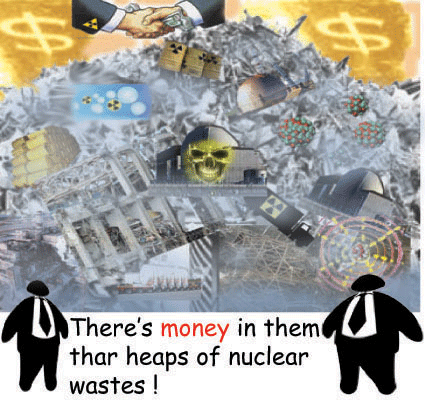
French water and waste group Veolia (VIE.PA) said it bought U.S. nuclear waste clean-up company Kurion for $350 million as it chases a slice of a market seen worth $210 billion over the next 15 years.
Veolia said it expects the new business to contribute annual revenue of $350-400 million by 2020, including about $250 million from waste treatment and $100-150 from decommissioning nuclear installations.
Kurion, which was one of few international firms involved in the early stages of the clean-up of the Fukushima nuclear disaster in Japan in 2011, currently has annual sales of about $100 million. Veolia generates about $20 million from cleaning up nuclear waste.
“Bringing Kurion and its employees into Veolia is going to enable us to develop a world-class integrated offer in nuclear facility clean-up and treatment of low-level radioactive waste around the world,” Veolia Chief Executive Antoine Frerot said.
Veolia plans to target the United States, Britain, France and Japan, which together amount to a market of $118 billion by 2030, and will focus on low-level radioactive waste, which represents 97 percent of the volume but just 0.1 percent of the radioactivity.
There are about 400 nuclear plants in operation worldwide, of which 100 to 150 will be decommissioned by 2030. Another 50 nuclear research centres will also have to be dismantled, Veolia said. Frerot said Veolia would focus on concentrating the waste to reduce its volume so that it can be stored safely, mostly in glass.
Kurion was founded in 2008 and and now employs over 200 people. Veolia had total revenue of 23.88 billion euros ($26.05 billion) in 2014. (Reporting by Geert De Clercq; Editing by James Regan)
New Mexico lawmakers consider hosting radioactive trash – nuclear spent fuel dump
 Measure supports storing spent nuclear fuel in New Mexico, Local News Santa Fe, Associated Press 4 Feb 16 New Mexico lawmakers are considering a pair of non-binding measures that would signal support for the development of a temporary storage facility to house spent nuclear fuel that has been piling up at reactors around the nation.
The Senate Conservation Committee approved one of the memorials on a 6-3 vote during Thursday’s meeting. The other is awaiting consideration by the full House.
environmentalists voiced concerns about New Mexico becoming the nation’s nuclear dumping ground.
“We don’t believe nuclear energy is a bright path into the future. We believe nuclear generation is a ticking time bomb,” said Dan Lorimier with the Sierra Club.
Southeast New Mexico is still rebounding from the closure of the government’s Waste Isolation Pilot Plant, where a chemical reaction inside a drum of waste from Los Alamos National Laboratory resulted in a radiation release in February 2014. Despite contamination of parts of the underground repository, the U.S. Department of Energy is aiming to resume some operations by the end of 2016…….
Federal officials have said the future of nuclear energy in the U.S. depends on the ability to manage and dispose of used nuclear fuel and high-level radioactive waste. The DOE has plans to begin considering locations for interim storage facilities as part of its plan to spur the use of nuclear power and develop the transportation and storage infrastructure needed to manage the waste.
Heaton acknowledged the application and license process could take a few years. http://www.santafenewmexican.com/news/local_news/measure-supports-storing-spent-nuclear-fuel-in-new-mexico/article_511a3cd7-f8d3-5e54-a0a3-db3dbd1d029e.html
1 This Month


31st January – Challenging the War Machine – a DECLASSIFIED UK SUMMIT



Website of the Week
Now until to February 10, 2026 Radioactive waste storage in France: the debate is finally open! How to participate?
-
Archives
- January 2026 (227)
- December 2025 (358)
- November 2025 (359)
- October 2025 (377)
- September 2025 (258)
- August 2025 (319)
- July 2025 (230)
- June 2025 (348)
- May 2025 (261)
- April 2025 (305)
- March 2025 (319)
- February 2025 (234)
-
Categories
- 1
- 1 NUCLEAR ISSUES
- business and costs
- climate change
- culture and arts
- ENERGY
- environment
- health
- history
- indigenous issues
- Legal
- marketing of nuclear
- media
- opposition to nuclear
- PERSONAL STORIES
- politics
- politics international
- Religion and ethics
- safety
- secrets,lies and civil liberties
- spinbuster
- technology
- Uranium
- wastes
- weapons and war
- Women
- 2 WORLD
- ACTION
- AFRICA
- Atrocities
- AUSTRALIA
- Christina's notes
- Christina's themes
- culture and arts
- Events
- Fuk 2022
- Fuk 2023
- Fukushima 2017
- Fukushima 2018
- fukushima 2019
- Fukushima 2020
- Fukushima 2021
- general
- global warming
- Humour (God we need it)
- Nuclear
- RARE EARTHS
- Reference
- resources – print
- Resources -audiovicual
- Weekly Newsletter
- World
- World Nuclear
- YouTube
-
RSS
Entries RSS
Comments RSS
 nuclear-news