Citizens’ Juries (IF FAIR AND TRANSPARENT) could help solve South Australia’s nuclear waste dilemma
 The role of Citizens’ Juries in decision-making on nuclear waste importation, Online opinion, By Noel Wauchope 13 May 2016 On May 10th South Australian Premier Jay Weatherill announced the process by which the state will decide whether or not to host a global nuclear waste import industry, as recommended by the Nuclear Fuel Cycle Royal Commission.
The first step will be to set up a “Citizens’ Jury” of 50 participants randomly selected from 25,000 invitees statewide, to be followed later by another one of 350 participants.
I think that Weatherill might have mistaken his terms here, as a Citizens’ Jury, by definition, means a group of 10 to 12 participants. The Weatherill plan sounds more like a “Deliberative Poll”, which involves a much larger group.
A properly constituted Citizens’ Jury can be a valuable process in participatory democracy. The group of 10 or 12 people serves as microcosm of the public. …… The process depends on having the oversight of a neutral but well informed advisory panel. Questions need to be framed in a way that does not risk influencing the response. Transparency is important, and complete audio or video recordings of all jury hearings should be publicly available, although the actual jury room deliberations should be private.
The citizen jury process can be an empowering one for the participants, and, as long as it is perceived to be fair and transparent, can be a valuable democratic option for assessing public opinion. It also has the advantage of being cost-effective.
The “Deliberative Poll” method is potentially another very useful form of participatory democracy. It is a lot more expensive, and more complicated. The biggest disadvantage of the Deliberative Poll method is probably its cost. Wikipedia notes:
“Imagine how much money is needed to pay for the trips, the hotel and the food for each participant, hiring the research crew and moderators, booking a venue, etc. Additional costs can include paying for participants’ compensation so that people that are randomly selected can put aside their duties to attend the events (i.e. hiring someone to milk a participant’s cow and providing child care”
Some critics insist that funding for either of these processes should not come from on single body.
“Multiple sources of funding help to ensure that the jury’s organisers are not seen as having a financial interest in producing a verdict that supports the interests of a single funding body. To maximise the scrutiny they provide, the two or more funders should have somewhat opposing interests regarding the subject likely to be under discussion.”……
In Japan, in 2012, a Deliberative Poll formed the guide to government decision-making. The Japanese government used the Center for Deliberative Democracy’s Deliberative Polling method to both inform participants and allow them to influence policymakers about the public’s will with regard to energy production issues. As a direct result of the deliberative polling process, Japan’s national government pledged to have zero percent dependency on nuclear energy after 2030. (This decision was overturned by a later government).
The South Australian government’s decision to start with a participatory democracy process is a welcome one, provided that it is done fairly and properly. Neither a Citizens Jury nor a Deliberative Poll can be a substitute for a fully democratic process like a referendum, but either could be a valuable contributor to a wider process of decision making. http://www.onlineopinion.com.au/view.asp?article=18230
Germany’s biggest power utility in financial problem about nuclear wastes costs
 Eon warns on capital raise to cover extra €2bn nuclear waste bill Guy Chazan in Berlin Ft.com 12 May 16 Shares in Eon, Germany’s biggest power producer, fell 5 per cent after it said it might have to raise capital to pay its share of the cost of storing Germany’s nuclear waste.
Eon has provisioned €8bn for waste storage, but under a proposal published by a government commission last month it would have to pay an extra €2bn into a special waste storage fund. Altogether, Germany’s four big utilities have been told they have to contribute a total of €23.3bn into the pool.
Michael Sen, Eon’s chief financial officer, said the company could pay the money, but doing so would reduce its equity capital and could hurt its credit rating.
He said Eon would be forced to postpone investments, cut more costs and potentially sell off marginal assets to cover the €10bn. A company presentation also said it could trigger unspecified “capital measures”.
Eon’s share price was trading down nearly 5 per cent at €8.14 on Wednesday……
The nuclear issue is just one of the problems weighing on Eon’s stock. Like its rival, RWE, Eon has been hit by Germany’s radical shift to renewables, which has squeezed electricity from fossil fuels out of the energy market.
It reported its biggest annual loss last year after writing down the value of its coal and gas-fired power plants by €8.8bn.
The company has responded by splitting itself in two: Eon is grouping its conventional power generation assets and energy trading in a new company, Uniper, while the new-look Eon will focus on renewables, networks and customer solutions. ……http://www.ft.com/cms/s/0/52d0c36e-173d-11e6-b8d5-4c1fcdbe169f.html?siteedition=uk#axzz48VIfeQb0
Continuing nuclear waste leak at Hanford
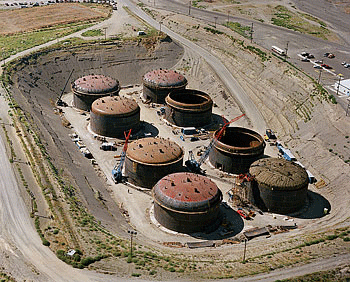 Nuclear Waste Leak Continues at ‘America’s Fukushima“ https://weather.com/news/news/nuclear-waste-leak-continues
The government has requested help from private contractors to construct a new, permanent facility that will have the capacity to hold the waste. However, the project to cover up “America’s Fukushima” will cost an estimated $100 billion and take at least 50 years to complete, according to Newsweek. 33 Left Ill by Radioactive Fumes By Andrew MacFarlane weather.com May 4 2016 A nuclear waste leak at the Hanford Site in Washington state that rapidly intensified last month has left 33 workers ill from possible exposure to chemical vapors, while others scramble to pump the remaining waste out of the storage facility.
Back in 2011, a leak was found on the inner hull of one of the site’s 28 double-wall storage tanks. The previous leak posed an insignificant threat, but workers came across an even larger leak in recent weeks while attempting to clear the inner hull of its remaining waste.
The number of those who have been reported ill as a result of the leak climbed into the 30s after six workers sought medical evaluation Monday, suspecting exposure to radioactive fumes left them unwell, according to the Tri-City Herald. A majority of the affected have been cleared to return to work, but voice a fear of suffering from long-term or neurological sickness.
Crews at the United States Department of Energy’s storage site in Hanford were alerted by leak detection alarms the morning of April 17, and after lowering a camera into the affected area, the staff found 8.4 inches of radioactive and chemically toxic waste had poured between the inner and outer walls of the tank, KING 5 reported.
This is catastrophic,” former site employee Mike Geffre said soon after the leak was found. “This is probably the biggest event to ever happen in tank farm history. The double-shell tanks were supposed to be the saviors of all saviors.”
However, a State Representative in Seattle argued that the of the 56 million gallons of radioactive chemicals stored at the Hanford site, two-thirds of the total substance is radioactive waste being held in unfit tanks made sometime between 1940 and 1970.
The tanks “were not supposed to last more than 10 to 20 years, 20 years was a dream in the first place,” Gerry Pollet told RT.com. “Some of them didn’t last twenty years and we had a small explosion in the 1950s where hot waste boiled, created a steam explosion under the tank, and we were lucky we didn’t have half of Eastern Washington permanently evacuated.”
The large puncture causing the devastating leak is thought to have occurred while the three-week long pumping was taking place. An estimated 20,000 gallons of waste remain in the 800,000-gallon AY-102 tank, Q13 FOX reports.To make matters worse, a second double-shelled tank has been reported with a leak. AY-101, a tank very similar to AY-102, has had “higher-than-expected radioactivity readings” from the tank’s continuous air monitor, according to a recent KING 5 report. The new leak is an unsettling find, considering the 45-year-old AY-101 was built with thicker steel and with advanced construction methods.
“Simply put, Hanford is nearly out of double-shell tank space,” said Hanford Challenge executive director Tom Carpenter. “[There] is no other realistic option but to begin building new tanks immediately.”
Nuclear shipwreck still highly radioactive over 60 years later
Details Emerge from Cold War-Era Nuclear Shipwreck, New Historian, David DeMar May 01, 2016 More details have emerged regarding the wreck of the USS Independence, a US Navy vessel deliberately sacrificed in 1946 at the Bikini Atoll nuclear weapons tests at the very inception of the Cold War…….
NOAA and Boeing used a combination of high-resolution sonar imaging and an unmanned submersible known as “Echo Ranger” to locate and safely survey the still-irradiated wreck of the Independence. The resultant case study, plus newly declassified files on the Navy ship straight from the US National Archives, concerning its time as a nuclear weapons testbed, have been published in theJournal of Maritime Archaeology (JNA)……
merging documentary evidence with a study of the physical remains of a maritime archaeological site is a goal that can and should be pursued…….
The infamous tests at Bikini Atoll, The Bikini tests, conceived and undertaken just one year after dropping not one but two nuclear weapons on Japan, at Hiroshima and Nagasaki, to end the Second World War, was one of the most visible and noteworthy events to signal a fundamental shift in postwar history.
 In one of the newly-declassified reports dating from the era, it was suggested that the awesome power of nuclear weaponry represented a new era where the utter destruction of man had become possible, scouring the Earth of nothing but vestigial traces of humanity. http://www.newhistorian.com/details-emerge-cold-war-era-nuclear-shipwreck/6397/
A second double-shell tank leaking radiation at Hanford?
 Signs emerge of a second double-shell tank leaking at Hanford , Susannah Frame, KING 5.com 27 Apr 16, Radioactive particles have been measured at elevated levels for the first time in the outer safety space of the Hanford double-shell tank known as AY-101. The contractor that manages the tank told employees “we recently discovered higher-than-expected radioactivity readings” from filters that are part of the tank’s continuous air monitor (CAM).
“The filter contained traces of radioactive americium, cesium and plutonium, raising the possibility that the material is from tank waste that has escaped from the primary shell of the double-shell tank,” wrote Rob Gregory, chief operating officer of Washington River Protection Solutions.
Sources tell KING 5 that alarms went off last week to alert staff of the presence of “hot” (radioactive) particles trapped in filters of the tank’s continuous air monitor (CAM). The sources say this is the first time readings of this sort have been detected in AY-101.
The U.S. Department of Energy confirmed to the state that radioactive particles had been detected by filters circulating air from inside AY-101, according to officials with the Washington Department of Ecology.
But DOE’s Office of River Protection, which oversees the tank farms at Hanford, said no alarms went off indicating radioactive particles had been detected………
The citizen watchdog group Hanford Challenge also said sources of its own confirmed the detection of elevated radiation levels outside the primary liner of AY-101. The group’s sources say the by-products confirmed include Cesium-137, plutonium, and a high-beta emitter (most likely Strontium-90) that are all constituents commonly found in Hanford’s underground tanks.
The executive director of Hanford Challenge, Tom Carpenter, said this recent event has “serious implications” for the Hanford Site.
“Simply put, Hanford is nearly out of double-shell tank space, especially after pumping out AY-102 and emptying some of the shakier single-shell tanks…This is no other realistic option but to begin building new tanks immediately,” said Carpenter.
Elevated radiation and radioactive materials found in the CAM filters was the first indication that AY-102 was leaking. This was a red flag for the Department of Energy (DOE), which owns Hanford, 15 years before confirmation of the leak. Those high CAM filter readings in the 1990s were dismissed by DOE and its contractors at the time……..http://www.king5.com/mb/news/local/investigations/signs-emerge-of-a-second-double-shell-tank-leaking-at-hanford/154338445
Idaho in danger from nuclear waste, and must be protected
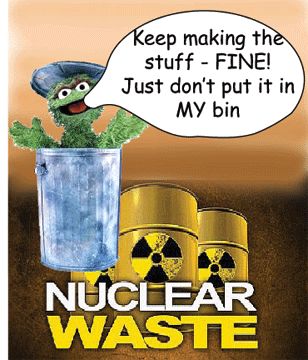 Idaho must be protected from nuclear waste HTTP://WWW.IDAHOSTATESMAN.COM/OPINION/READERS-OPINION/ARTICLE74125087.HTML BY WENDY WILSON, 28 Apr 16, Houston, we have a problem.” Although engineers and workers at the Idaho National Laboratory in Southeast Idaho have always tried to handle nuclear material safely, it doesn’t always work. Since 2005, accidents and inadvertent releases have happened with alarming regularity. In 2012, Department of Energy investigators told the Snake River Alliance that they had significant concerns and that INL was not handling plutonium safely.
Although the DOE has failed to meet countless deadlines to clean up what is already here, new proposals to import spent nuclear fuel from commercial power plants have swept safety concerns under the rug. DOE’s reputation for missed deadlines once led former Gov. Cecil Andrus to compare the agency to the Boise used car dealership “Fairly Reliable Bob’s.”
The most current missed deadline is that the DOE has failed to treat 900,000 gallons of intensely radioactive liquid waste stored at INL. Recent failures at the plant have cost taxpayers hundreds of millions of dollars in cost overruns and the system may never work.
In the meantime, this extremely dangerous waste is stored in buried tanks decades old. INL’s tanks have never leaked, as far as we know, but the pipes and valves connecting them have. The waste from those leaks may never be cleaned up and may always be in our soil and groundwater.
The McClatchy News Agency, parent company of the Idaho Statesman, recently reported that there have been nearly 400 nuclear-related deaths associated with the INL. Far more people have been sickened by their work there.
Twenty-five years ago, a Magic Valley fish farmer raised the alarm about plutonium shipments from Colorado to be buried on top of the Eastern Snake Plain Aquifer. The public was outraged. Former Gov. Andrus stepped up and Gov. Phil Batt forged a nuclear waste agreement with the DOE banning future imports of spent fuel from commercial nuclear power plants until specific timetables for clean up were met.
Today, the Byron nuclear waste proposed to come to INL falls under this ban. It is being stored safely in Indiana and it is unfathomable why Idaho would sign a “waiver” to allow the feds to bring it here and put Idahoans at risk.
Our land and water will continue to be contaminated until our political leaders put the health and safety of Idahoans ahead of DOE’s broken promises. There is still plutonium buried above the Snake River Aquifer, perhaps till the end of time. Let’s not forget.
Idahoans shouldn’t become lab animals for nuclear malfunction. Idaho Attorney General Lawrence Wasden is doing the right thing forcing the DOE to follow its own deadlines. Without a permanent national repository for nuclear waste, what comes to Idaho will stay here for decades, if not forever. Idahoans should stand together and tell the federal government to focus on INL’s existing nuclear experiment — cleaning up what is already here.
Wendy Wilson is interim executive director of the Snake River Alliance, Idaho’s nuclear watchdog and advocate for clean energy, found at www.snakeriveralliance.org.
California State Senate demands removal of stored nuclear waste from San Onofre power plant
 State Senate approves removing stored nuclear waste from San Onofre power plant http://www.cbs8.com/story/31842881/state-senate-approves-removing-stored-nuclear-waste-from-san-onofre-power-plantPosted: Apr 29, 2016 SAN ONOFRE (CNS) – A resolution demanding that the U.S. Department of Energy remove stored nuclear waste at the shuttered San Onofre Nuclear Generating Station was approved by the state Senate Thursday.
The resolution authored by Sen. Patricia Bates, R-Laguna Niguel, urges President Barack Obama and Congress to approve a bill in the House of Representatives that would consolidate the storage of nuclear waste. The bill is in the House Energy and Commerce Committee’s Subcommittee on Environment and the Economy.
“It’s way past time for the federal government to move the nuclear waste stored at San Onofre to a location away from densely populated and environmentally sensitive areas,” Bates said. “I’m pleased that my state Senate colleagues have endorsed my call to Washington D.C. to approve pending legislation that would help make Orange and San Diego County residents safer.”
The San Onofre plant has been shut down since a small, non-injury leak occurred in a steam generator in January 2012. Operator and majority owner Southern California Edison later decided to retire the plant’s two reactors,
rather than follow a costly start-up process.
Closing the facility is expected to take a couple of decades, however, so Edison recently received permission to expand nuclear waste storage tanks at San Onofre, despite opposition from environmental groups and local politicians.
Germany’s compromise plan to make power companies pay for nuclear waste disposal

 German utilities to pay for nuclear waste disposal, DW, 28 Apr 16 In October, Germany set up a high-level commission to decide how to finance the country’s nuclear phase-out. It has now recommended that power companies pay into a multi-billion euro fund managed by the government.
In October, Germany set up a high-level eleven-member commission, KFK, to review the financing of the nuclear phase-out. The government’s goal was to ensure comprehensive safety, decommissioning and waste disposal processes, and see to it that their costs would be borne by nuclear power companies, not by taxpayers.
“The tasks of interim storage of radioactive waste, manufacturing of waste containers, and construction and operation of final repositories, and transfer of waste from interim storage to final repositories should be transferred to the state,” the KFK said in a statement released Wednesday in Berlin.
The estimated costs are to be covered by power companies paying a total of 23.3 billion euro ($26.4 billion) into a state-owned fund, with partial payments to be made in tranches over the next few years. In exchange, the state will take on all the residual financial risks associated with radioactive waste management – so if disposing of radioactive waste ends up costing more than 23.3 billion euro, the government, not the companies, will be on the hook for those cost overruns.
The 23.3 billion euro is composed of the current all-in 4.7 billion euro cost estimate of processing, enclosing and transferring high-level waste to final repositories, plus a 12.4 billion euro estimate for the costs of selecting, building and operating final repositories, plus a 35 percent “risk premium” – which is less than the risk premium of at least 50 percent that environmental groups had proposed, but more than the companies want to pay.
Compromise deal
The deal was characterized by the KFK’s three co-chairs as a compromise aimed at ensuring decommissioning costs wouldn’t lead to the insolvency of the four power companies that own nuclear reactors in Germany. Their balance sheets have been under heavy pressure in recent years due to price competition from solar and wind power suppliers in wholesale electricity markets.
The four large power-generation companies that own Germany’s 17 commercial nuclear reactors are E.ON, RWE, EnBW, and Vattenfall, a company owned by the Swedish state. Eight of the 17 reactors are still in operation, but the last of them is due to be shut down by the end of 2022. Nuclear power accounted for 14 percent of Germany’s total electricity production in 2015.
The 23.3-billion-euro deal only covers interim storage, transport and final disposal of high-level radioactive waste – including the spent fuel rods currently sitting in pools at nuclear reactor sites, as well as low- and medium-level radioactive waste such as machinery and buildings from decommissioned reactors. Packaging the waste for interim storage as well as dismantlement of reactor buildings and equipment and site remediation will remain the technical and financial responsibility of the four power companies.
Until now, the companies had been given the option of either removing reactor equipment and buildings, disposing of waste, and remediating reactor sites, on the one hand, or securely and permanently fencing off the sites and preventing unauthorized access. The KFK has now recommended that fencing-off will no longer be an option: All sites are to be dismantled and remediated. The commission said the government should speed up the permitting process to enable faster site decommissioning……….http://www.dw.com/en/german-utilities-to-pay-for-nuclear-waste-disposal/a-19218042
Germany wrestles with the dilemma of disposing of dead nuclear reactors and thier toxic wastes
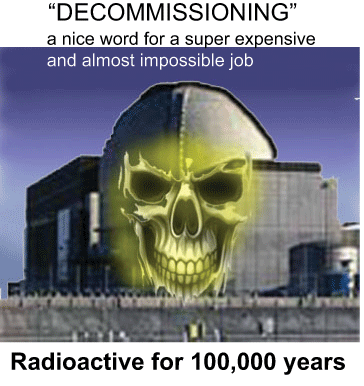 Nuclear reactor sites: Dismantle or fence off? http://www.dw.com/en/nuclear-reactor-sites-dismantle-or-fence-off/a-19111969, 26 Apr 16, Three decades after the Chernobyl disaster, Germany is preparing to go nuclear-free. Industry plans to dismantle and dispose of radioactive waste. But some green campaigners say it’s safer to leave reactor sites as-is.
Thirty years ago, the Chernobyl disaster released radioactivity that spread across much of the northern hemisphere into the atmosphere. It also spurred social movements around the world to demand an end to nuclear power.
In Germany, that end is finally in sight ,as the country prepares to go nuclear-free by 2022. But the task of safely decommissioning and dismantling nuclear power stations promises to be expensive and controversial, and will take many years.
Debate rages over how to dispose of highly radioactive spent fuel rods from commercial nuclear power stations. But there is less awareness around how the dissolving industry and its regulators must also decide what to do with disused reactor sites.
Masses of equipment and a variety of buildings at the sites were exposed to nuclear fission reaction products for years, and have become slightly or moderately radioactive as a result. Therein lies the crux of the disposal problem.
Big money, long time
The consultancy ADL has estimated it will take about two decades to fully dismantle Germany’s 17 nuclear reactor sites, and cost at least 18 billion euros – not including the cost of subsequent radioactive waste disposal.
Why will it take so long and cost so much? DW posed this question to E.ON, Germany’s largest electricity utility and owner of 11 nuclear power stations – most of them already shut down.
An E.ON spokesperson said dismantling of reactor sites must take place in stages. First, spent uranium fuel rods must be transported off-site, to interim storage elsewhere. This can’t happen until four or five years after a reactor is shut down, because the fuel rods’ radioactivity first needs to decrease sufficiently for their safe handling to become possible.
Dismantling equipment is then expected to take 10 to 15 years. Final demolition of remaining buildings and site remediation will take another two to three years after all radioactive materials have been removed from the former reactor site.
Radioactive waste materials can be treated by a variety of means – compression, desiccation, enclosure in cement, or burning to ash – to reduce total volume prior to packing, shipping, and final disposal in an approved secure long-term storage site, E.ON said.
Put it in a deep, dry hole
Schacht Konrad, a disused iron-ore mine shaft near the German town of Salzgitter, is under consideration as the national site for the final disposal of low- to medium-grade radioactive materials.
The mine was chosen because it is particularly dry inside – reducing the risk of radioactive materials dissolving and entering into the groundwater. It’s meant to take in around 90 percent (by volume) of all the radioactive rubble from decontaminated nuclear sites in Germany – but only the mildly radioactive stuff.
German law specifies a threshold of very low radioactivity below which materials are deemed safe. Materials that fall below the threshold can legally be disposed of through the regular waste disposal system. But some anti-nuclear campaigners insist there’s no safe threshold, however low.
In contrast to low-level, mildly radioactive waste from former reactor sites, highly radioactive waste – including spent fuel rods – will be left in cooling ponds on closed-down reactor sites for some decades. Ultimately, they’ll be disposed of in one or more special high-security repositories. The location of those repositories is highly contentious, and has not yet been settled.
Leave them where they’re standing?
While the government and nuclear industry are keen to get on with dismantling and removing reactors soon after they’re shut down, Jörg Schmid and Henrik Paulitz of the German division of the International Physicians for the Prevention of Nuclear War (IPPNW) think perhaps they shouldn’t be dismantled at all.
“Dismantling nuclear reactors is expensive and poses health dangers,” according to an IPPNW report in German published in January of this year.
In the report, Schmid and Paulitz say that serious consideration should be given to the option of securely fencing off old nuclear reactor sites and allowing low-level radioactivity from contaminated buildings and equipment to recede over decades.
The IPPNW’s preferred solution would see heavily contaminated elements such as spent fuel rods be removed immediately, while the less-contaminated buildings and equipment would be left in situ indefinitely.
This would avoid dispersing the radioactive material more widely, and minimize risk to human populations, the study’s authors argue.
E.ON told DW that fencing off sites was neither more nor less safe than dismantling them – but argued that dismantling is a better solution in terms of the labor market consequences.
“IPPNW’s option would mean that 300 to 400 people who work at a nuclear site would abruptly lose their jobs,” the spokesperson said.
But Paulitz countered: “The nuclear industry must answer the question: is the proposed dismantling of the reactor sites a necessary measure, or is it just a new multi-billion-euro industry?”
Radioactive steel in children’s bedrooms?
About 99 percent of the total mass of material at a former nuclear site is radioactive at such a low level that it is deemed safe – so the material is no longer covered by nuclear safety regulations and can be released into the environment, according to IPPNW’s Schmid, who is a medical doctor.
But Schmid said that what matters is total radiation exposure over time. If very large amounts of very weakly radioactive material are dispersed through the environment, for example by being reintroduced into material supply chains, that represents a significant amount of broadcast radiation exposure over time.
Dismantling nuclear power plants, Paulitz said, leads to a problem: “The great majority of the site’s materials won’t be classified as nuclear waste, and will instead be disposed of in ordinary household waste streams, or even recycled into normal supply chains.”
“From a health and safety perspective, we see this as irresponsible.” Paulitz said, as weakly radioactive steel taken from a dismantled nuclear site could end up built into a radiator in a child’s bedroom, for example.
Danger of Chernobyl nuclear reactor wreck will remain for thousands of years
Ruined Chernobyl nuclear plant will remain a threat for 3,000 years @mattschodcnews BY MATTHEW SCHOFIELD mschofield@mcclatchydc.com , Miami Herald, 24 Apr 16,
- 30 years since Chernobyl may seem like a long time, but it’s really just the start
- Below reactor’s ruins is a 2,000-ton radioactive mass that can’t be removed
- How do you protect a site for as long a time as Western civilization has existed?
….It will be 30 years ago on 26 April that Pripyat and the nearby Chernobyl nuclear plant became synonymous with nuclear disaster, that the word Chernobyl came to mean more than just a little village in rural Ukraine, and this place became more than just another spot in the shadowy Soviet Union.
Even 30 years later – 25 years after the country that built it ceased to exist – the full damage of that day is still argued.
Death toll estimates run from hundreds to millions. The area near the reactor is both a teeming wildlife refuge and an irradiated ghost-scape. Much of eastern and central Europe continues to deal with fallout aftermath. The infamous Reactor Number 4 remains a problem that is neither solved nor solvable………..
All told, about 4,000 people would eventually die from the accident, according to a report by the World Health Organization and the International Atomic Energy Agency.
Others say those numbers are wildly low. Alexey Yablokov, a former environment adviser to Russian President Boris Yeltsin, estimated the global death toll to be 1.44 million. Other reports placed the cancer death totals at 30,000 to 60,000. Belarusian physicist Georgiy Lepin, a vice president of the association of liquidators of Chernobyl, the men brought in to fight the fire and clean up, estimated that within a few years, 13,000 rescue workers had died and another 70,000 were left unfit for work. The official number of disabled Chernobyl rescue workers today in Ukraine is 106,000.
A United Nations study says that “5 million people currently live in areas of Belarus, Russia and Ukraine that are contaminated with radionuclides due to the accident; about 100,000 of them live in areas classified in the past by government authorities as areas of ‘strict control.’ ”……….
What they figured out was the worst nuclear-energy disaster in human history, far worse than the explosion at Kyshtym nuclear complex in 1957 in what was then the Soviet Union, which released 70 tons of radioactive material into the air, or the 1957 fire at the Windscale Nuclear Reactor in northwestern England, which forced a ban on milk sales for a month, or the Three Mile Island disaster in Pennsylvania on March 29, 1979, where a cooling malfunction led to a partial meltdown.
All of central and eastern Europe was at risk. Even today, in Bavaria in southern Germany, wildlife officials warn hunters not to eat the meat of wild boars, which continue to show high levels of radiation contamination……..http://www.miamiherald.com/news/nation-world/world/article73405857.html
Idaho nuclear waste treatment plant runs into trouble
the DOE and Idaho Treatment Group have run into recent problems. A New Mexico waste repository where much of the waste needs to be sent remains closed after an accident last year. That means about
20,000 ready-to-ship containers of waste have stacked up, with nowhere to go.

 Looming deadline for nuclear waste plant, future in limbo , WT, By LUKE RAMSETH – Associated Press , April 24, 2016 IDAHO FALLS, Idaho (AP) – A darkened central control room with more than 25 computer screens watches over nearly everything occurring inside this radioactive waste treatment plant west of Idaho Falls.
The room is where employees at the Advanced Mixed Waste Treatment Project, or AMWTP, monitor and manipulate the facility’s dangerous waste treatment process from afar. Decades-old metal boxes and drums filled with radioactive waste travel through a series of conveyor belts and elevators. At various stages the waste is remotely sorted, repackaged, smashed up, and then packaged again. A final product of multiple 55-gallon drums is shipped on trucks to waste repositories located in New Mexico, Nevada and Utah.
The facility – which employs about 700 and has operated for more than a dozen years – is undergoing an approximately $10 million overhaul. Officials hope the new infrastructure will help finish the job of treating some 65,000 cubic meters of Idaho’s transuranic nuclear waste before a looming 2018 deadline.
Meanwhile, U.S. Department of Energy officials are pondering what to do with the specialized plant once its current mission is complete. One tentative post-2018 plan would mean shipping nuclear waste to the Idaho facility from DOE sites spread around the country. The waste would be treated and packaged here, then sent onward to a final resting place outside the state……
The AMWTP was built to treat 65,000 cubic meters of transuranic waste that was buried nearby in the Arco desert in the 1970s and ‘80s. It came from the now-closed Rocky Flats Plant near Denver, where nuclear weapon components were made.
Held in slowly deteriorating metal, wooden and fiberglass boxes and metal drums, the waste includes tools, rags, clothing, sludge and dirt – anything contaminated with a transuranic element, such as plutonium, during the weapon-making process.
Workers at the facility have been chipping away at the massive pile of waste for years. It’s a painfully slow process that since 2011 has been handled by Idaho Treatment Group. This summer a new government contractor, Fluor, will take over management of the job, along with other waste cleanup duties on the desert site.
Richardson said there are about 12,000 cubic meters still to get through. All the waste is supposed to be treated and shipped out of Idaho by the end of 2018 under a state deadline laid out in the 1995 Idaho Settlement Agreement with the DOE.
But the DOE and Idaho Treatment Group have run into recent problems. A New Mexico waste repository where much of the waste needs to be sent remains closed after an accident last year. That means about 20,000 ready-to-ship containers of waste have stacked up, with nowhere to go…….http://www.washingtontimes.com/news/2016/apr/24/looming-deadline-for-nuclear-waste-plant-future-in/
The intractable thousands of years problem of Chernobyl’s radioactive debris
 Ruined Chernobyl nuclear plant will remain a threat for 3,000 years @mattschodcnews BY MATTHEW SCHOFIELD mschofield@mcclatchydc.com , Miami Herald, 24 Apr 16,
 “…………When the steam burst through the roof of Reactor Number 4 in 1986, it took with it 5 percent of the enriched uranium. That means 10 tons vanished. It also means 95 percent, or 190 tons, remained. They’re still there.
After the blasted reactor partially collapsed into the nuclear material, it created a radioactive blob of uranium, concrete, steel and assorted junk weighing about 2,000 tons. Ideally, Ukraine would remove the material. Sergiy Parashyn grabs a pen and paper as he talks about the problems with that.
“We do not know how to do this,” he explains. “We do not have the technology to do this. It must be something new.”……
“One problem is that the material is decaying and is brittle, and when we cut it up to transport it to disposal bins, it will very likely fill the air with radioactive dust,” he explains. So the tractor has to be able to operate in a radioactive environment, it has to be able to control and eliminate any dust and it has to operate in an area that will not be at all safe for humans. “Maybe something like this would work, maybe it wouldn’t. We don’t know. That’s a problem.”
It’s a problem because while 5 percent of the radioactive material caused problems that continue 30 years later and will continue to cause problems for eons to come, the other 95 percent of the material could represent about 20 times the problems.
For instance, if mistakes are made and the brittle material is released into the atmosphere, they’re back to square one. If the material gets into the Pripyat River, it will flow into the Dnieper River. The Dnieper River is the water source for Kiev. The Dnieper is the primary water source for much of Ukraine.
This is why Ukrainian officials are counting on what they call a sarcophagus to contain the site, a massive structure that looks like a Quonset hut being assembled behind a wall that is intended to deflect radiation from the decaying plant from workers.
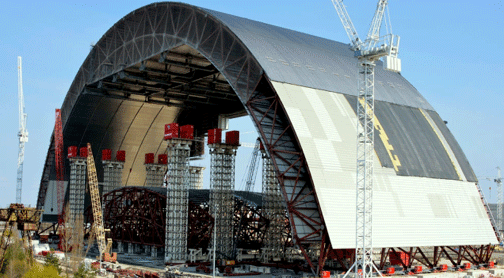
When finished, it will be rolled across the crumbling concrete of the surrounding ground to cover and further seal the dangerous reactor. The work is expected to be completed in 2018, though that is just a guess. It’s expected to last 100 years. It’s not nearly long enough.
Reactor Number 4 today is essentially an unplanned nuclear-waste dump. To serve in that role requires it to last for 3,000 years. That means the area surrounding Chernobyl will be safe to inhabit by people again in the year 4986.
How likely is that? To get an idea of what it means to contain and control a deadly and potentially devastating radioactive pile in Ukraine for 3,000 years, consider what the world looked like 3,000 years ago:……
Detlef Appel, a geologist who runs PanGeo, a Hamburg, Germany, company that consults on such nuclear storage issues, notes that 3,000 years probably isn’t long enough. He suggests that truly safe radioactive waste storage needs to extend a million years into the future. Think back to when man’s earliest relative began to walk the Earth.
“We can trust human endeavor, perhaps, for a few hundred years, though that is doubtful,” he said. “Storage implies a way to retrieve the materials. It requires trained personnel, maintenance, updating and security. Clearly, nothing man made is more than temporary, and therefore it isn’t adequate.”
Even the continents will have moved in a million years.
Tetiana Verbytska, an energy policy expert at the National Ecological Center of Ukraine, worries that people are far too easygoing about Chernobyl. Among government officials right now, mindful of the 30-year anniversary, there is a movement to shrink the radius of the highly contaminated no man’s land from 18 miles to 6.
“The move to reduce the highly contaminated zone has nothing to do with science and everything to do with public relations,” she says. “In Ukraine, each April we make wonderful speeches about our commitment to dealing with this problem, and the rest of each year we hope the problem will just go away.”
There are other reasons to worry. Ukraine is creaking under a civil war against insurgents backed by Russia and scraping by with an economy that in the decades since the collapse of the Soviet Union has been looted by a series of oligarchs. It doesn’t have the money to fund an educational system that can be expected to create legions of top scientists and engineers.
Officials speak very proudly of the new sarcophagus roof that is being put into place. But the finish date on that has been repeatedly backed up, and there’s no guarantee that its 2018 date won’t be moved again.
A variety of disasters could still strike. The site’s existing covering, built in haste after the accident, could collapse, shattering the brittle mix of radioactive materials below and sending nuclear dust into the atmosphere to mix with rain. There could be an earthquake. The entire site is fragile.
Olga Kosharna, the lead scientist at the Ukrainian Department of Energy and Nuclear Safety in Kiev who oversaw safety at Chernobyl in the 1990s, recalls walking the roof above the shattered reactor and being horrified to find holes that had been burned through the concrete.
The shoes she wore that day were highly contaminated and had to be destroyed.
Alexandre Polack, a spokesman for the European Union, notes in an email that the date to begin removing radioactive material from the site is still 20 to 30 years away. “The current shelter covering destroyed Reactor 4 was reinforced in recent years and seems stable,” he writes. “However it was built in haste after the accident and never intended as a long-term solution.”
Verbytska emphasizes that the mass of uranium debris inside Reactor Number 4 is now a mess that goes beyond human ability to clean up. Others dismiss the situation as a problem, but one that technology can fix.
“We don’t have the technology to fix the problem,” she says. “We don’t have the process to develop the technology to fix the problem, and we don’t have the money to support the process to develop the technology to fix the problem. The solutions for our Chernobyl problems are very much ‘seal it for now.’ We will have smart children and smart grandchildren who in 100 years or so will figure out what to do.”
After the disaster, radiation burned off the tops of the trees. Soviet officials ordered the trees cut down and buried deep. But they failed to properly encase the buried wood. As a new forest grew unchecked above the radioactive remains of the old forest, the new wood was also highly radioactive. The whole thing will have to be dug up and encased and buried again, properly. http://www.miamiherald.com/news/nation-world/world/article73405857.html
Disastrous state of Hanford’s nuclear waste farm
We Should Be Very Worried About That Leaky Nuclear Waste Facility in Washington, Gizmodo, Maddie Stone, 21 Apr 16, Earlier this week, we heard alarming reports of a “significant” nuclear waste leak at Hanford, the largest radioactive waste dumpsite in the country. Should we be worried? Absolutely. But mainly because this is a symptom of a much bigger problem that’s been festering for decades.
Located just a few miles north of Richland in eastern Washington, the Hanford site houses 53 million gallons of some of the most toxic material on Earth—radioactive sludge leftover from the world’s first full-scale plutonium reactor. Most of the time, the facility is out of sight and mind, but every few years, news of a mishap at Hanford sparks public hysteria.

“We have 177 of these tanks, containing the bulk of America’s high-level nuclear waste,” Tom Carpenter, executive director of the environmental watchdog group Hanford Challenge, told Gizmodo. “These tanks are in terrible shape, and we know others are subject to failure in the same way.”……….http://gizmodo.com/we-should-be-very-worried-about-that-leaky-nuclear-wast-1771933003
US Dept of Energy tries again to convince South Dakota on deep borehole testing
 Feds: No Nuke Waste to Be Used in Possible South Dakota Test , abc news, By JAMES NORD, ASSOCIATED PRESS 21 Apr 16 Organizers of a federal effort to assess whether nuclear waste can be stored in 3-mile-deep holes are trying to better explain their intentions to South Dakota residents after getting rebuffed in North Dakota over concerns that waste might eventually be stored there.
Battelle, a nonprofit group hired to manage the U.S. Department of Energy project, is considering whether sites in Spink County, South Dakota, would suffice for the study of whether deep rock is suitable for nuclear waste disposal, the contractor said Thursday.
The deep borehole field test will not involve any radioactive waste, officials said. Organizers are planning at least two open meetings in Spink County near the end of April to answer questions from the community about the proposed research, which also could involve geothermal energy……..
Battelle is also considering two sites outside of South Dakota that it declined to name. The contractor hopes to decide if Spink County is viable within a few weeks, and would like to be drilling by the end of the year.
It is touting a multi-million dollar estimated state and local economic impact…….http://abcnews.go.com/US/wireStory/south-dakota-sites-mulled-nuclear-waste-drilling-project-38578525
PIERRE, S.D. — Apr 21, 2016
Nuclear companies’ new bonanza industry – cleaning up the radioactive mess they made
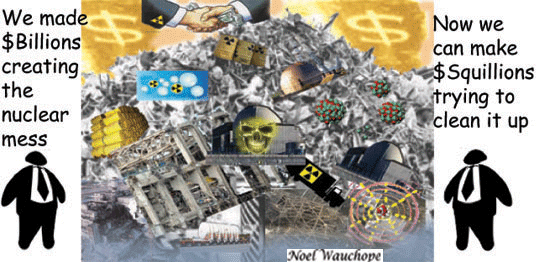
Nuclear costs in uncharted territory http://www.eco-business.com/news/nuclear-costs-in-uncharted-territory/ As some governments press on with new nuclear installations to address climate change, a multi-billion dollar industry will be needed to make safe old power plants and their hazardous waste. Climate News Network 19 April 2016 If you want a job for life, go into the nuclear industry – not building power plants, but taking them down and making them safe, along with highly-radioactive spent fuel and other hazardous waste involved.
The market for decommissioning nuclear sites is unbelievably large. Sixteen nations in Europe alone face a €253 billion waste bill, and the continent has only just begun to tackle the problem.
Among the many difficulties the industry faces is lack of trained people to do the highly-paid work. Anyone who enters the business is likely to be sought after for the rest of their career because the job of decommissioning Europe’s nuclear sites alone will take more than 100 years – even if no new nuclear power stations are ever built.
Add to the European nuclear legacy the dozens of old nuclear power stations in North America, Japan, Russia and central Asia, and nuclear decommissioning could already be classed as one of the biggest industries in the world, and it can only grow.
And this does not count the millions of dollars still being spent annually to contain the damage from the nuclear accidents in Chernobyl, Russia, in 1986, and Fukushima, Japan, in 2011.
Longer-term problem
So far, the nuclear industry has largely avoided drawing too much attention to this legacy, emphasising that its sites are safe, and concentrating instead on claiming that new nuclear stations are the answer to climate change.
But this approach has not solved the longer-term problem of how to safely contain the radioactivity of old sites to avoid damaging future generations.
The UK, one of the countries with the largest nuclear waste problem, is also currently spending most money trying to make it safe. One site alone − Sellafieldin Cumbria, northwest England − is spending £2 billion a year on cleaning up its waste and expects the total bill to be around £50 billion.
But that is almost certain to rise. There are 240 operational nuclear buildings on the site, and 11 major construction projects aimed at containing the waste problem.
Twelve other old nuclear sites in the UK, where reactors have already been shut down, are costing £600 million a year to clean up, a process that will take until 2027.
Even then, the job will not be finished. All that money will have been spent on reducing the hulks to a “care and maintenance basis” so they can be guarded for decades until it is decided to demolish them altogether when it is safe to do so.
It is probably because the UK is spending so much money already that theNuclear Decommissioning Conference for Europe is being held in the northern England city of Manchester on May 31 to June 1. All the major nuclear companies in Europe, and many international businesses hoping to cash in on this new industry, will be attending.
But the UK is only one major market, and France is potentially even larger. Although it has not yet decommissioned its nuclear stations, it is about to start doing so and has 58 reactors to dismantle. Germany, like the UK, has already begun its programme, with nine reactors shut down and another eight to be closed by 2022.
Primary task
In total, there are 200 reactors worldwide due to be shut down by 2025.
But while the primary task of the current decommissioning programme is to make reactors safe by removing their old fuel and storing it, one of the major problems of the industry is nowhere near solved.
All over the world, governments have tried and failed to find sites where they can store the vast quantities of radioactive waste that has arisen from nuclear weapons programmes, nuclear submarine and ship propulsion systems, and the civil nuclear industry. The waste needs to be isolated from human beings for as much as 250,000 years to make it safe.
Only one country, Sweden, has a workable plan for a deep disposal repository. Elsewhere, many plans have been tried and abandoned, either because of political opposition or unfavourable geology.
So nobody knows yet how much this epic problem is going to cost, or how many decades will pass before it is under control. As the brochure for the conference puts it: “Estimating lifetime costs is a journey into uncharted territory.” No wonder executives from many companies are paying up to £1,500 each to attend.
1 This Month


31st January – Challenging the War Machine – a DECLASSIFIED UK SUMMIT


Website of the Week
Now until to February 10, 2026 Radioactive waste storage in France: the debate is finally open! How to participate?
-
Archives
- January 2026 (220)
- December 2025 (358)
- November 2025 (359)
- October 2025 (377)
- September 2025 (258)
- August 2025 (319)
- July 2025 (230)
- June 2025 (348)
- May 2025 (261)
- April 2025 (305)
- March 2025 (319)
- February 2025 (234)
-
Categories
- 1
- 1 NUCLEAR ISSUES
- business and costs
- climate change
- culture and arts
- ENERGY
- environment
- health
- history
- indigenous issues
- Legal
- marketing of nuclear
- media
- opposition to nuclear
- PERSONAL STORIES
- politics
- politics international
- Religion and ethics
- safety
- secrets,lies and civil liberties
- spinbuster
- technology
- Uranium
- wastes
- weapons and war
- Women
- 2 WORLD
- ACTION
- AFRICA
- Atrocities
- AUSTRALIA
- Christina's notes
- Christina's themes
- culture and arts
- Events
- Fuk 2022
- Fuk 2023
- Fukushima 2017
- Fukushima 2018
- fukushima 2019
- Fukushima 2020
- Fukushima 2021
- general
- global warming
- Humour (God we need it)
- Nuclear
- RARE EARTHS
- Reference
- resources – print
- Resources -audiovicual
- Weekly Newsletter
- World
- World Nuclear
- YouTube
-
RSS
Entries RSS
Comments RSS
 nuclear-news