Nuclear Decommissioning Citizens Advisory Panel strategizes with selectmen, Wicked Local, Plymouth By Frank Mand fmand@wickedlocal.com , 9 May 17 – The state’s Nuclear Decommissioning Citizens Advisory Panel will hold its first meeting in Plymouth on May 24, but there is already concern that that Plymouth’s representatives on the panel will have little say in the decommissioning process of the Pilgrim Nuclear Power Plant.
Based on the numbers alone, Plymouth’s interests should be well represented on the panel……..
Their basic mission, Grassie said, was to meet four times a year, advise the governor, general court and the public on the issues, “serve as a conduit of communications and encourage public involvement” and receive and issue reports.
Meanwhile, Grassie said, Entergy would hold its own meetings, including with the NRC, and making decisions including, as happened with the recently closed Entergy-owned Vermont Yankee nuclear plant, selling the decommissioning function to a separate entity altogether……..
The basic priorities that town officials and panelists will take are, however, becoming clear.
Because of safety concerns the town does not want spent fuel to be left in the pool inside the reactor building. Fortunately Entergy likely doesn’t want that either because, when the spent fuel is out of the pool they can dramatically reduce on-site staff and, therefore, reduce their management costs as well.
The town does not want spent fuel stored forever on site permanently. Unfortunately there is neither a temporary or permanent national spent fuel storage facility available at this time.
In the event that spent fuel in dry cask storage remains on site for the foreseeable future the town wants to be fairly compensated.
The town does not want to see the decommissioning fund used to pay for other costs associated with the continued presence of radioactive materials at the site. That has been happening at Vermont Yankee, where the decommissioning fund has been used to pay the tax payments charged by the host community……
The town wants the rights to the so-called “1,500 acres,” the largely pristine buffer around the plant that stretches from the waterfront around the plant, to the top of the Pine Hill.
The town wants a lot but the question on the minds of the panel members right now is simple: How can they influence the process effectively toward those goals?……..http://plymouth.wickedlocal.com/news/20170506/nuclear-decommissioning-citizens-advisory-panel-strategizes-with-selectmen
May 10, 2017
Posted by Christina Macpherson |
decommission reactor, USA |
Leave a comment
 Budgets approved to fight Yucca Mountain, https://www.reviewjournal.com/news/2017-legislature/budgets-approved-to-fight-yucca-mountain/ By Sean Whaley Las Vegas Review-Journal,May 7, 2017 CARSON CITY — The budgets for the state agencies charged with fighting the Yucca Mountain high-level nuclear waste dump were approved Saturday by the Senate Finance and Assembly Ways and Means committees.
The budget for the Agency for Nuclear Projects totals $3.8 million for the next two years, with most of the money going to fight against restarting Yucca Mountain. Of that total, $1.3 million will be spent fighting the expected restart of licensing proceedings.
The attorney general’s office budgets also were approved by the panels, including $3.4 million over two years to fight the project.
Sandoval, state Attorney General Adam Laxalt and most state lawmakers strongly oppose any restart of the Yucca Mountain licensing hearings. A resolution stating the Legislature’s opposition will get a committee hearing Monday.
But some Nevada elected officials, including Nye County Commissioner Dan Schinhofen, argue the licensing proceedings should be allowed to go forward to determine decisively whether Yucca Mountain is a suitable site for the dump. Attorneys for Nevada have raised scores of issues challenging the site’s suitability.
Despite past claims that the project has been long dead, President Donald Trump’s budget blueprint, issued in March, included $120 million in new funds to the Energy Department and the Nuclear Regulatory Commission to restart Yucca Mountain licensing activities.
The omnibus funding bill Congress approved this past week did not include any Yucca Mountain funding. But the funding could be included in the federal fiscal year 2018 budget, which begins Oct. 1.
The House Energy and Commerce Subcommittee on the Environment held a hearing on Yucca on April 26 and is expected to draft legislation for licensing proceedings to commence.
The Agency for Nuclear Projects indicated that the first step in the process is expected to be the reconstituting of the Yucca Mountain Construction Authorization Boards, followed by a case management conference. The restart proceedings could take up to a year, with hearings on challenges to the licensing application lasting three or more years.
Nevada officials estimate that a licensing hearing would require more than 400 days, taking an estimated four to five years at a cost to the Energy Department $1.66 billion.
Yucca Mountain is in Nye County, about 100 miles northwest of Las Vegas.
Contact Sean Whaley at swhaley@reviewjournal.com or 775-461-3820. Follow @seanw801 on Twitter.
May 10, 2017
Posted by Christina Macpherson |
politics, USA, wastes |
Leave a comment
Indian Point lawsuit dead before arrival, Rye City Review, May 5, 2017 by James Pero A lawsuit seeking to halt the shutdown of a long controversial nuclear power plant located at Indian Point in Buchanan is dead on arrival after staunch opposition from Westchester County’s Democratic lawmakers.
Last week, the Board of Legislators’ Democratic caucus voted to kill the lawsuit, proposed by County Executive Rob Astorino, a Republican, earlier this month, before it was even sent to committee, and well short of a vote by the full Legislature, which is required by law.
“Instead of engaging in a wasteful lawsuit where both sides are funded with taxpayer money, the best approach is to work with all of the affected communities on how to mitigate the economic, social, and environmental impacts of Indian Point closing,” said Democratic Majority Leader Catherine Borgia, of Ossining……..
County Democrats say they plan to host community meetings with affected residents and stakeholders in Indian Point as a part of their own initiative.
To lessen the economic impact on workers at the plant, Cuomo has floated a potential transition into the renewable energy sector for workers laid off by the plant’s closure.
Details of what the decommissioning process will look like will continue to be hashed out by a recently formed task force, which consists of both state and local lawmakers as well as various officials from Cuomo’s administration. http://www.ryecityreview.com/lead-stories/indian-point-lawsuit-dead-before-arrival/
May 10, 2017
Posted by Christina Macpherson |
decommission reactor, USA |
Leave a comment

Radioactive Cats and Nuclear Priests: How to Warn the Future About Toxic Waste, Motherboad, DANIEL OBERHAUS, May 7 2017
Nuclear waste can remain toxic for tens of thousands of years. How do you warn the future that they’re standing on nuclear waste when there’s no one around to translate?
This is a series around POWER, a Motherboard 360/VR documentary about nuclear energy. Follow along here.
In 1999, the Waste Isolation Pilot Plant outside of Carlsbad, New Mexico accepted its first deposit of mid-level nuclear waste. A massive network of tunnels extending nearly a quarter of a mile into the Earth, WIPP is tasked with safely storing the United States’ growing stockpile of nuclear waste for the next million years.
Due to the timescales involved when handling nuclear waste, designing deep geological repositories like WIPP is one of the most challenging engineering problems ever faced by our species. But, as it turns out, the main problem has less to do with engineering, and more to do with linguistics: namely, how to design a warning message about the repository that will be intelligible to future generations of humans who might happen across it hundreds of thousands of years from now.
The solution isn’t as simple as it seems. Humans have only been writing for about 5,500 years, and many ancient languages have forever been lost to history. The idea of using a language to write out a warning message that would last 200 times longer than the most ancient languages seems improbable at best. Even conventional warning symbols like the skull and crossbones are far from universal.
As for building giant, foreboding monuments to scare people away? One need only look to the great pyramids to see how well that worked at keeping people out. Another idea was simply to bury the waste and forget about it, which raises a significant ethical issue: Do we have an obligation to warn future generations about our nuclear waste?
In 1981, the US Department of Energy convened an eclectic panel of experts to design a warning message that would last millennia. Known as the Human Interference Task Force, the group was led by the renowned semiotician Thomas Sebeok.
The group’s message was being designed for Yucca Mountain, a controversial high-level waste repository in Nevada that is still not open for business, largely due to the extremely complex nature of designing a million-year nuclear vault.
Following the initial call for ideas, a poll was conducted by the German Journal of Semiotics between 1982 and 1983 that asked for proposals addressing the question of how to communicate the dangers of a nuclear waste repository to people 10,000 years in the future. The most compelling was Sebeok’s plan for a nuclear priesthood, which would pass on information to future generations through myths and rituals. It was based on the idea of the Catholic Church, which has managed to transmit its messages for nearly 2,000 years.
Less formal styles of oral tradition, such as Icelandic family sagas, have also been shown to retain a high degree of accuracy after 1,000 years.
Other ideas were slightly more outlandish. Stanislaw Lem, a Polish sci-fi writer, suggested periodically putting satellites into orbit that would transmit information about the sites to Earth for hundreds of years at a time. A similar proposal was put forth by Philipp Sonntag, who advocated for “an artificial moon in the sky” as the safest place to store information about the repository. Another of his ideas was to encode information about the site into the DNA of plants, which would then be planted around the repository opening.
In a similar vein, the Italian semiotician proposed breeding “
radiation cats” that would change color when they came near radioactive sites. The thinking was that, based on the long history of human-feline cohabitation, there was a good chance that this would continue into the future and our feline friends could warn us of the danger.
After two years of deliberation, the Human Interference Task Force issued a large technical report for the Department of Energy containing their final recommendations. Perhaps unsurprisingly, neither ray cats nor radioactive flowers made the cut. Instead, the task force proposed creating a large monument over the site, consisting of several stone monoliths inscribed with information in all human languages, as well as a subterranean vault with more detailed information, and a number of earthen walls making access to the site intentionally difficult.
Furthermore, the group recommended dispersing detailed information about the site to libraries around the globe, to prevent some sort of cataclysmic, Library of Alexandria-type of information loss should a disaster strike one of the sites……… https://motherboard.vice.com/en_us/article/radioactive-cats-and-nuclear-priests-how-to-warn-the-future-about-toxic-waste
May 8, 2017
Posted by Christina Macpherson |
2 WORLD, wastes |
Leave a comment
SOME PREDICT TROUBLE OVER RUBBLE AT VERMONT YANKEE, VT DIGGER
MAY. 3, 2017, BY MIKE FAHER VERNON – Tearing down Vermont Yankee could produce more than 2.1 million cubic feet of crushed concrete.
And new documents show that more than half of that concrete – 1.1 million cubic feet – might be buried on site as part of a “rubblization” plan developed by NorthStar Group Services, the company that wants to buy the shut-down Vernon nuclear plant.
Both NorthStar and current plant owner Entergy pledge that only clean concrete will be used as fill. And administrators are touting the plan’s benefits, saying it will save millions of dollars and keep thousands of trucks off local roads.
Vermont Yankee has “large quantities of uncontaminated concrete acceptable for reuse as fill that would provide economic benefits, with no health or safety risk due to residual radioactivity, and avoid unnecessary traffic, transportation and disposal offsite,” Steven Scheurich, an Entergy vice president, wrote in documents filed with the state Public Service Board.
But the proposal could prove to be a sticking point for state officials and activists. Ray Shadis, a technical adviser with the watchdog group New England Coalition, argues that NorthStar is planning, “in essence, a capped landfill.”
“It’s a very important issue for us,” Shadis said. “It’s a major issue.”
Entergy is seeking approval from the Vermont Public Service Board and the federal Nuclear Regulatory Commission to sell Vermont Yankee to NorthStar, a New York-based decommissioning company.
May 8, 2017
Posted by Christina Macpherson |
USA, wastes |
Leave a comment
 Japan seeks final resting place for highly radioactive nuclear waste http://www.dw.com/en/japan-seeks-final-resting-place-for-highly-radioactive-nuclear-waste/a-38709488, 5 May 17,
With communities refusing to come forward to host the by-product of Japan’s nuclear energy industry, the Japanese government is drawing up a map of the most suitable locations for underground repositories.
The Japanese government is putting the finishing touches to a map of the country identifying what its experts consider to be the safest location for a repository for 18,000 tons of highly radioactive nuclear waste for the next 100,000 years. The map is expected to be released next month and will coincide with the government holding a series of symposiums across the country designed to explain why the repository is needed and to win support for the project.
Given that the disaster at the Fukushima Dai-ichi nuclear plant in March 2011 is still fresh in the memory of the Japanese public, the government’s plan is not expected to win much understanding or support.
The original proposal for a repository for the waste from the nation’s nuclear energy sector was first put forward in 2002, but even then there were few communities that were willing to be associated with the dump. Fifteen years later, and with a number of Japan’s nuclear reactors closed down for good in the wake of the Fukushima accident, the need for a permanent storage site is more pressing than ever.
Radioactivity release
The disaster, in which a 13-meter tsunami triggered by an off-shore earthquake crippled four reactors at the plant and caused massive amounts of radioactivity to escape into the atmosphere, also underlined just how seismically unstable the Japanese archipelago is and the need for the repository to be completely safe for 100,000 years.
Aileen Mioko-Smith, an anti-nuclear campaigner with Kyoto-based Green Action Japan, does not believe the government can deliver that guarantee.
“You only have to look at what happened in 2011 to realize that nowhere in Japan is safe from this sort of natural disaster and it is crazy to think otherwise,” she told DW.
Given the degree of public hostility, Mioko-Smith believes that the government will fall back on the tried-and-trusted tactic of offering ever-increasing amounts of money until a community gives in.
Government funds
“They have been trying to get this plan of the ground for years and one thing they tried was to offer money to any town or village that agreed to even undergo a survey to see if their location was suitable,” she said.
“There were a number of mayors who accepted the proposal because they wanted the money – even though they had no intention of ever agreeing to host the storage site – but the backlash from their constituents was fast and it was furious,” Smith added.
“In every case, those mayors reversed their decisions and the government has got nowhere,” she said. “But I fear that means that sooner or later they are just going to make a decision on a site and order the community to accept it.”
The security requirements of the facility will be exacting, the government has stated, and the site will need to be at least 300 meters beneath the surface in a part of the country that is not subject to seismic activity from active faults or volcanoes. It must also be safe from the effects of erosion and away from oil and coal fields. Another consideration is access and sites within 20 km of the coast are preferred.
High-level waste
The facility will need to be able to hold 25,000 canisters of vitrified high-level waste, while more waste will be produced as the nation’s nuclear reactors are slowly brought back online after being mothballed since 2011 for extensive assessments of their safety and ability to withstand a natural disaster on the same scale as the magnitude-9 earthquake that struck Fukushima.
Stephen Nagy, a senior associate professor of international relations at Tokyo’s International Christian University, agrees that the government will have to pay to convince any community to host the facility.
“They will probably peddle it as subsidies for rural revitalization, which is a tactic that all governments use, but there are going to be some significant protests because Fukushima has created a nuclear allergy in most people in Japan,” he said.
“I expect that the government would also very much like to be able to phase out nuclear energy, but that is simply not realistic at the moment,” he said.
When it is released, the government’s list is likely to include places in Tohoku and Hokkaido as among the most suitable sites, because both are relatively less populated than central areas of the country and are in need of revitalization efforts. Parts of Tohoku close to the Fukushima plant may eventually be chosen because they are still heavily contaminated with radiation from the accident.
May 6, 2017
Posted by Christina Macpherson |
Japan, wastes |
Leave a comment

Brussels plans to saddle UK with EU nuclear waste Britain’s impending split from Euratom indicative of complexity of Brexit, Ft.com by: Arthur Beesley in Brussels and Andrew Ward in London, 4 May 17 Britain will be on the hook for large volumes of dangerous radioactive waste — some of it imported from the rest of Europe — under proposals by Brussels to transfer ownership of a range of nuclear materials to the UK after it leaves the EU.
Almost 130 tonnes of plutonium stored at Sellafield in Cumbria is among the nuclear material that would formally shift to UK control, according to draft documents issued by Michel Barnier, the EU’s chief Brexit negotiator. All “special fissile material” — forms of uranium and plutonium used in nuclear fuels and some of the resulting waste — within the EU are technically owned by Euratom, the pan-European regulator of civilian nuclear activity.
Mr Barnier’s provisional negotiating position calls for a Brexit agreement to “ensure, where appropriate, the transfer to the United Kingdom” ownership of “special fissile material” currently controlled by Euratom within the UK. Such an agreement would make the UK legally responsible not only for its own nuclear material but also reprocessed spent fuel imported over several decades from Germany, Sweden and elsewhere for recycling at Sellafield. “What was a joint European legacy now becomes a UK home brew, with potentially dire economic consequences for the UK given the sheer expense and weight of this radiological inventory,” said Paul Dorfman, honorary senior researcher at the Energy Institute at University College London……..
Mr Barnier’s proposal for the UK to assume “all rights and obligations associated with the ownership of [fissile] materials or property transferred” is seen in Brussels as a necessary housekeeping exercise to remove Euratom’s claim on nuclear fuel used in UK power stations as well as uranium isotopes used in radiotherapy. But it highlighted the uncertainty facing Britain’s nuclear industry — responsible for about a fifth of domestic electricity generation — in the run-up to Brexit. Euratom is a separate legal entity to the EU but is governed by EU institutions and the UK government says it has no option but to leave both at the same time. A UK government spokeswoman said: “Leaving Euratom is a result of the decision to leave the EU as they are uniquely legally joined.”
As well as nuclear fuel and reprocessed waste, the UK would also take ownership of Euratom property used to safeguard the material, such as inspection and monitoring equipment, according to the EU proposals. The negotiation directives, which are subject to the agreement of the 27 remaining member states, were published on Wednesday as Mr Barnier set out his hardline opening position for talks with London…….
https://www.ft.com/content/4cd8a146-3039-11e7-9555-23ef563ecf9a
May 5, 2017
Posted by Christina Macpherson |
politics international, UK, wastes |
Leave a comment
Government to release map of potential final nuclear disposal sites this summer, Japan Times, 3 May 17 KYODO, STAFF REPORT, The government has set the criteria for a map meant to identify potential final disposal sites for high-level radioactive nuclear waste, paving the way for its release as early as this summer.
The process of finding a host for nuclear waste could face challenges amid public concerns over safety.
Based on the map, the government will approach select municipalities to allow research to be conducted for suitable sites to store waste from nuclear power generation.
For permanent disposal, high-level nuclear waste needs to be stored at a final depository more than 300 meters underground for up to about 100,000 years until radiation levels fall and there is no longer potential harm to humans and the environment.
The government plans to create a permanent underground repository somewhere in stable bedrock so the canisters can be stored for tens of thousands of years.
The map is likely to classify which areas are geologically suitable for such a structure to be built deep enough underground. This would rule out areas near active faults and volcanoes as well as oil and coal fields.
Based on waste transport criteria, the map is likely to show that zones within 20 km of the coastline are favorable to host final disposal sites.
The government hopes other municipalities — not just the ones located near nuclear power plants — may also become interested in hosting the disposal facilities. It also wants to show that a variety of places nationwide are suitable for nuclear waste management.
The map was originally planned for a 2016 release but the publication date was later postponed, as some local governments were wary that disposal sites would be imposed on them.
About 18,000 tons of spent fuel currently exist in Japan. Including spent fuel that has already been reprocessed, the country’s total jumps to about 25,000 canisters of vitrified high-level waste, all of which needs to be managed.
The process to find local governments willing to host final storage started in 2002, but little progress was made due mainly to opposition from local residents.
In May 2015, the central government introduced a plan announcing that final depository site selection would be based on scientific grounds, rather than waiting for municipalities to volunteer.
Before presenting the map, the government will hold symposiums between mid-May and June at nine cities to explain the map criteria to the public. The cities include Tokyo, Nagoya and Fukuoka…….http://www.japantimes.co.jp/news/2017/05/02/national/government-release-map-potential-final-nuclear-disposal-sites-summer/#.WQlFDEWGPGg
May 3, 2017
Posted by Christina Macpherson |
Japan, wastes |
Leave a comment
 The final mission for Cassini, Enformable, 26 Apr 17, Karl Grossman Despite protests around the world, the Cassini space probe—containing more deadly plutonium than had ever been used on a space device—was launched 20 years ago. And this past weekend—on Earth Day—the probe and its plutonium were sent crashing into Saturn.
The $3.27 billion mission constituted a huge risk. Cassini with its 72.3 pounds of Plutonium-238 fuel was launched on a Titan IV rocket on October 17, 1997 despite several Titan IV rockets having earlier blown up on launch.
At a demonstration two weeks before in front of the fence surrounding the pad at Cape Canaveral from which Cassini was to be launched, Dr. Michio Kaku, professor of theoretical physics at the City University of New York, warned of widespread regional damage if this Titan IV lofting Cassini exploded on launch. Winds could carry the plutonium “into Disney World, University City, into the citrus industry and destroy the economy of central Florida,” he declared………
on an Earth “flyby” by Cassini , done on August 18, 1999, it wouldn’t have been a regional disaster but a global catastrophe if an accident happened.
Cassini didn’t have the propulsion power to get directly from Earth to its final destination of Saturn, so NASA figured on having it hurtle back to Earth in a “sling shot maneuver” or “flyby”—to use Earth’s gravity to increase its velocity so it could reach Saturn. The plutonium was only used to generate electricity—745 watts—to run the probe’s instruments. It had nothing to do with propulsion.
So NASA had Cassini come hurtling back at Earth at 42,300 miles per hour and skim over the Earth’s atmosphere at 727 miles high. If there were a rocket misfire or miscalculation and the probe made what NASA in its “Final Environmental Impact Statement for the Cassini Mission” called an “inadvertent reentry,” it could have fallen into Earth’s atmosphere, disintegrating, and releasing plutonium. Then, said NASA in its statement, “Approximately 7 to 8 billion world population at a time … could receive 99 percent or more of the radiation exposure.”
The worst accident involving space nuclear power occurred in 1964 when a satellite powered by a SNAP-9A plutonium system failed to achieve orbit and fell to Earth, breaking apart and releasing its 2.1 pounds of Plutonium-238 fuel, which dispersed all over the planet. According to the late Dr. John Gofman, professor of medical physics at the University of California at Berkeley, that accident contributed substantially to global lung cancer rates……….
the U.S. Department of Energy working with NASA has started up a new production facility at its Oak Ridge National Laboratory in Tennessee to produce Plutonium-238 for space use. Other DOE labs are also to participate.
Says Gagnon of the Maine-based Global Network: “Various DOE labs are rushing back into the plutonium processing business likely to make it possible for the nuclear industry to move their deadly product off-planet in order to ensure that the mining operations envisioned on asteroids, Mars, and the Moon will be fully nuclear-powered. Not only do the DOE labs have a long history of contaminating us on Earth but imagine a series of rocket launches with toxic plutonium on board that blow up from time to time at the Kennedy Space Center. They are playing with fire and the lives of us Earthlings. The space and the nuke guys are in bed together and that is a bad combination—surely terrible news for all of us.”
“The Global Network,” said Gagnon, “remains adamantly opposed to the use of nuclear power in space.” http://enformable.com/2017/04/the-final-mission-for-cassini/?utm_source=feedburner&utm_medium=email&utm_campaign=Feed%3A+Enformable+%28Enformable%29
April 28, 2017
Posted by Christina Macpherson |
- plutonium, safety, technology, USA |
Leave a comment

 NucClear News no 95 May 17 Brexit & Radwaste As Britain heads towards a hard Brexit and Brexatom – quitting Euratom – thanks to a freedom of information request, the Gizmodo website has obtained details of some of the internal worries of the Nuclear Decommissioning Authority (NDA). The document, dated 13th July 2016, runs through some of the biggest strategic challenges created by us leaving the EU.
An NDA subsidiary, Radioactive Waste Management Ltd (RWM) is engaged in research on deep geological disposal. Perhaps unsurprisingly, the EU is fronting a lot of the research cash. For example, one project – DOPAS – The Full-Scale Demonstration of Plugs and Seals, studied how to plug and seal radioactive waste. In this case Europe paid €8,700,000 – half the cost of doing it. It has also recently paid for a number of other similar projects. The document goes on to reveal that RWM is planning to seek European cash for future projects with similarly impenetrable acronyms. The best one is Europe putting an expected contribution of €3-4m into “DISCO” – a project studying the Dissolution of Spent Fuel in Waste Containers. Though it isn’t explicitly spelled out in the document, the implication is obvious: If our relationship with Europe is currently up in the air – so is the ability to pay for these important research projects.
Perhaps the biggest danger though – reading between the lines – is the risks associated with Britain becoming more hostile to immigration. “UK universities have a multinational community”, the document explains, “UK universities have been very successful in attracting the best talent (students and academic staff) from across the world, which in turn leads additional funding, better teaching and higher quality research. An inability to attract non-UK EU nationals would have a negative impact on UK universities and indirectly on the NDA estate R&D programme.”
Ultimately then, it appears that Brexit is going to create headaches when it comes to getting rid of radioactive waste. http://www.no2nuclearpower.org.uk/nuclearnews/NuClearNewsNo95.pdf
April 28, 2017
Posted by Christina Macpherson |
UK, wastes |
Leave a comment
The three-tier disposal scheme for the waste generated by the Tokai Reprocessing Plant is based on radiation level.
Waste with the highest radiation level, which will fill some 30,000 drums, will be buried more than 300 meters underground.
Mid-level waste, which will fill about 24,000 containers, is expected to be buried several dozens of meters underground.
Low-level waste, involving another 81,000 drums, will be buried close to the surface, the JAEA said. In the meantime, the plant’s tainted equipment and facilities will need to be decontaminated and scrapped before being filled with cement and mortar and put in drums for transport to a final disposal site.
The big problem is, there has been little progress in deciding where to bury the drums because they can’t find anyone willing to accept them.
 Closure of Tokai Reprocessing Plant to cost an estimated ¥800 billion: JAEA source http://www.japantimes.co.jp/news/2017/04/23/national/closure-tokai-reprocessing-plant-cost-estimated-%C2%A5800-billion-jaea-source/#.WP_gPUWGPGg The Japan Atomic Energy Agency has revealed that the scrapping of the Tokai Reprocessing Plant, the nation’s first facility for reusing spent nuclear fuel, will cost an estimated ¥800 billion, an official said.
The state-backed JAEA did not reveal the cost to taxpayers in 2014, when it made the decision to shut down the plant in the village of Tokai, Ibaraki Prefecture, over a 70-year period.
The facility started operation in 1977 as part of Japan’s desire to establish a nuclear fuel cycle, in which all spent fuel is reprocessed to extract its plutonium and uranium to make more fuel. The policy is designed to ensure resource-dependent Japan uses its nuclear fuel as efficiently as possible.
The JAEA decided to scrap the sprawling plant after it became too costly to run under the more stringent safety rules introduced following the 2011 Fukushima nuclear crisis. The facility comprises around 30 buildings and has large areas rife with contamination caused by its task of disassembling spent nuclear fuel.
According to the official, the startling decommissioning estimate is based on an estimate the agency made in 2003. The JAEA is finalizing the assessment and on course to submit it for approval by the Nuclear Regulation Authority as early as June.
The three-tier disposal scheme for the waste generated by the Tokai Reprocessing Plant is based on radiation level.
Waste with the highest radiation level, which will fill some 30,000 drums, will be buried more than 300 meters underground.
Mid-level waste, which will fill about 24,000 containers, is expected to be buried several dozens of meters underground.
Low-level waste, involving another 81,000 drums, will be buried close to the surface, the JAEA said. In the meantime, the plant’s tainted equipment and facilities will need to be decontaminated and scrapped before being filled with cement and mortar and put in drums for transport to a final disposal site.
The big problem is, there has been little progress in deciding where to bury the drums because they can’t find anyone willing to accept them.
Despite the Fukushima nuclear disaster, the government is trying to resume nuclear power generation and continue its pursuit of a nuclear fuel cycle.
This policy, however, has experienced setbacks from the recent decision to decommission the Monju fast-breeder reactor, an experimental facility in Fukui Prefecture that was considered key to the nuclear fuel cycle plan.
And the completion of a new fuel reprocessing plant in the village of Rokkasho, Aomori Prefecture, has also been largely behind schedule for years.
In the meantime, public concerns about the safety of atomic power remain strong at a time when the government is aiming to make it account for 20 to 22 percent of Japan’s electricity supply by 2030.
The new estimate for decommissioning the Tokai Reprocessing Plant includes ¥330 billion for storing waste underground, ¥166 billion for decontaminating and dismantling the facility, and ¥87 billion for transportation costs.
The JAEA facility is not to be confused with the private uranium-processing facility in Tokai where a fatal criticality accident occurred in 1999.
April 26, 2017
Posted by Christina Macpherson |
Japan, reprocessing, wastes |
Leave a comment
Area G, perhaps more than any other place at Los Alamos National Laboratory, represents the challenges that the U.S. Department of Energy faces in cleaning up the hundreds of waste sites at the lab while work continues to produce new or modernized nuclear weapons.
A report released this spring by the Energy Department’s Environmental Management Los Alamos Field Office says that out of 2,100 contaminated sites, including Area G, only about half of the cleanup at the lab has been completed after decades of work and billions of dollars spent.
If all goes as planned, it will take Los Alamos almost a century to clean up the remnants of the nation’s first generation of nuclear weapons. All the while, tiny, new nuclear bombs are being made.

LANL’s Area G at center of nuclear cleanup effort, http://www.santafenewmexican.com/news/local_news/lanl-s-area-g-at-center-of-nuclear-cleanup-effort/article_31af6d36-e24c-5d63-b131-7877f813d6be.html By Rebecca Moss The New Mexican, 23 Apr 17 LOS ALAMOS — To stand at one of the largest radioactive dumps in the nation requires a drive through two security checkpoints, a clearance badge and, for outsiders, a three-to-one guard by federal employees.
Visitors cross the final checkpoint on foot. There is just a metal gate, with stop signs and notifications that crossing this threshold means entering a nuclear facility.
The 63-acre Material Disposal Area G at Los Alamos National Laboratory holds radioactive and other hazardous waste generated by nuclear weapons production during the Manhattan Project of World War II and the Cold War that followed.
Just three feet below the dusty ground, there are nearly 40 pits and 200 shafts, containing somewhere between several hundred thousand and 11 million cubic feet of waste. Large, white structures, like joyless wedding tents, dot the mesa’s surface, holding drums of waste that are intended to be shipped to the Waste Isolation Pilot Plant near Carlsbad and disposed of forever.
Many of these drums are especially volatile. They belong to a waste stream that was improperly packaged, causing one drum to explode at WIPP in 2014, leaking radiation and shutting down the facility for nearly three years at a $2 billion cleanup cost.
Area G, perhaps more than any other place at Los Alamos National Laboratory, represents the challenges that the U.S. Department of Energy faces in cleaning up the hundreds of waste sites at the lab while work continues to produce new or modernized nuclear weapons.
The lab recently gave reporters a rare tour of Area G and other sites contaminated by waste generated before 1999, the year the Energy Department opened WIPP. It is the nation’s only permanent disposal site for transuranic waste, which includes soil, tools, gloves and other materials that have come in contact with highly radioactive elements like plutonium, which is used in weapons production. Before WIPP opened, Area G was where the lab disposed of its transuranic waste.
A report released this spring by the Energy Department’s Environmental Management Los Alamos Field Office says that out of 2,100 contaminated sites, including Area G, only about half of the cleanup at the lab has been completed after decades of work and billions of dollars spent.
The report says the initial investigation into the extent of contamination at those sites is 90 percent done, and 93 percent of the above-ground transuranic waste — 4,000 drums — has been removed from the lab since 2011.
But much of the buried waste at Area G is likely to stay there forever.
The lab could dig everything up, but “the federal government and the state don’t require it,” said a senior lab official who took the tour with reporters. Officials on the tour prohibited reporters from quoting them by name.
The circumstances that led to one of the costliest nuclear accidents in U.S. history began at Area G. A drum of waste improperly packaged with organic — rather than inorganic — kitty litter at Area G in 2013 and shipped to the Waste Isolation Pilot Plant overheated and burst underground in February 2014.
At Area G, there are 89 more drums similar to the one that burst. They are kept within the largest tent on the mesa, called the PermaCon.
Inside, the light takes on a yellowish-gray hue and the air is at least 15 degrees cooler than the April day outside. At the center of the space, behind a rope and a sign that reads “combustible restricted area,” the waste drums have been placed inside a refrigerated metal structure, like enormous eggs in an incubator.
They contain some of the most volatile waste at the site, a mix of nitric acids, kerosene, heavy metals, plutonium-239, uranium-238 and nitrate salt.
Sixty of the drums, like the one that burst at WIPP, contain the organic kitty litter. The rest of the 89 drums have the same waste but haven’t yet been mixed with an absorbent.
Before entering the tent, visitors must protect their eyes with plastic glasses and make sure their hands are devoid of wounds. Radiation is more easily absorbed into the body if it can slip through a cut. Visitors are told to avoid touching surfaces and their mouths, and to leave outside anything they don’t want to be surveyed for radioactive contamination.
Area G workers are told to make a habit of wearing gloves at all times, even at home, officials said. “Fight the way you train,” is how one person explained it.
Workers at the PermaCon wore purple gloves and were dressed head to boots in a yellow, plastic material that forms a protective hood and thick goggles.
A sign on a door leading to where the drums are kept informs workers that they will be exposed to 0.1 rem of radiation per hour. The average American receives 0.6 rem per year, according to the U.S. Nuclear Regulatory Commission.
The drums are kept at 57 degrees Fahrenheit and monitored daily to ensure the pressure and heat do not change. If a drum starts to heat, officials can open large vents added to the drums and reduce pressure, but releasing some radiation, too, within the PermaCon.
From Area G it takes just two minutes to walk onto San Ildefonso Pueblo land; The community of White Rock is one mile from the site.
As reporters and officials exited, workers traced radiation detection monitors slowly across palms and the soles of shoes.
By May, a 3-mile stretch of the road between Area G and a waste repackaging facility will be closed off daily as drums are transported uphill to the Waste Characterization, Reduction and Repackaging Facility, which looks like a series of oversized garages.
As reporters entered the facility, one worker whispered, “Hold your breath.”
Over roughly two months, lab workers will repackage the waste in two-hour shifts using a glove box — a large, sealed container. Inserting their hands into gloves attached to the box, the workers will open the drums.
The waste will be combined with water and zeolite — a fine, gray mineral mined in Western states, including New Mexico, and sold as absorbent cat litter — and stirred in an industrial kitchen mixer within the glove box. Once the waste is mixed, it will be funneled into new “daughter” drums and returned to Area G for later shipment to WIPP, officials said.
An official said zeolite was chosen as an absorbent in part because it eliminates any confusion about the type of kitty litter that can be used.
Tacked to the glove box is a printed sheet of paper with numbered instructions for how to mix the waste. It’s pinned just above the radiation detection panel that workers must press their hands against the moment they are removed from the glove box.
Area G is situated on a mesa between two canyons, and wildfire is a threat to the drums waiting for repackaging and shipment to WIPP.
In 2000, the Cerro Grande Fire burned through both canyons simultaneously, creating extremely high temperatures on the mesa. If this happened again, an official said, the lab would cover the drums with fire blankets but could not move them. They could only hope that the flames subside before the drums overheat and begin a reaction like the one that closed WIPP.
The Los Conchas Fire in 2011 burned within four miles of Area G.
The administrations of Govs. Bill Richardson and Susana Martinez have sought to expedite the removal of vulnerable canisters from lab property. But deadlines for the lab to do so, first by 2010 and then by June 2014, went unmet, in part because waste shipments to WIPP stalled following the radiation leak caused by the Los Alamos drum.
Waste disposal at Area G is expected to stop next year when the last open pit is filled. The lab’s newly constructed Transuranic Waste Facility, an outdoor storage site, will temporarily hold newly generated waste before shipment off-site. The lab also is seeking approval from the New Mexico Environment Department for temporary storage at the plutonium processing facility where pits, the triggers for nuclear weapons, are produced. Pits are similar to small atomic bombs.
But the Defense Nuclear Facilities Safety Board, an independent agency, and others have raised concerns about storing radioactive waste at these locations. New waste sites, even those intended to be temporary, increases the potential for dangerous waste to remain on lab property long term.
On the drive to Area G on a winding road within the national laboratory complex, in a lab “taxi” van playing 1980s rock, many buildings appeared more like prison structures than research facilities, with thick, glass windows — or no windows at all — and tall, barbed-wire fences.
One official remarked on the great irony of the work: The first atomic bomb took only 27 months to create, but like the myth of Pandora’s box, it unfurled a seemingly endless stream of deadly waste.
Last September, the Energy Department said the remaining scope of legacy waste cleanup is estimated to cost $3.8 billion, and it will take 24 more years to finish shipping the rest of the waste to permanent storage and decontaminating the land.
If all goes as planned, it will take Los Alamos almost a century to clean up the remnants of the nation’s first generation of nuclear weapons. All the while, tiny, new nuclear bombs are being made.
Kaitlin Martinez, a spokeswoman for the Environmental Management Los Alamos Field Office, said the “biggest priorities right now are the safety of the workers and the public as we execute our mission.”
April 24, 2017
Posted by Christina Macpherson |
USA, wastes |
Leave a comment
“We consider it a major victory,” said Karen Hadden of the Sustainable Energy & Economic Development Coalition, an environmental advocacy group that has opposed Waste Control Specialists’ expansion plans.
While the company’s questionable finances were a factor in its request, Hadden suggested that mounting public opposition might also have played a role.

West Texas nuclear waste project on hold — for now Dallas-based Waste Control
Specialists has asked the U.S. Nuclear Regulatory Commission to temporarily suspend a review of its application to store tens of thousands of metric tons of spent nuclear fuel at its West Texas dump. The Texas Tribune BY JIM MALEWITZ AND KIAH COLLIER APRIL 19, 2017 A proposal to bring the nation’s spent nuclear fuel to West Texas appears to be on the ropes.
Waste Control Specialists, which currently stores low-level radioactive waste in Andrews County, has asked the U.S. Nuclear Regulatory Commission to temporarily suspend a review of its application to store tens of thousands of metric tons of spent nuclear fuel currently scattered at reactor sites throughout the country. The Dallas-based company pitched the massive expansion as a solution to a problem that has bedeviled policymakers for decades.
The reason for the requested freeze? The company, which runs the state’s only radioactive waste dump, is bleeding cash and is struggling to find the estimated $7.5 million needed to continue the licensing process. Waste Control Specialists “is faced with a magnitude of financial burdens that currently make pursuit of licensing unsupportable,” Rod Baltzer, the company’s president and CEO, said in a letter to the federal commission dated Tuesday.
The review’s price tag caught the company off guard, Baltzer wrote.
The Nuclear Regulatory Commission confirmed Wednesday that it would freeze the review.
“Managers are working with the staff to close out their work to prepare for a future resumption, and to reassign them to other casework,” said Maureen Conley, a commission spokeswoman.
The request comes as EnergySolutions, a Salt Lake-city based waste company, is trying to buy Waste Control Specialists. The U.S. Department of Justice is suing to block the merger, arguing it would essentially create a monopoly on radioactive waste disposal.
“WCS expects to go forward with this project at the earliest possible opportunity after completion of the sale,” Baltzer said in a statement.
Experts call this week’s request a setback for a project that the company initially suggested it would start constructing by 2019; opponents of the plan declared the request a win for their side.
“We consider it a major victory,” said Karen Hadden of the Sustainable Energy & Economic Development Coalition, an environmental advocacy group that has opposed Waste Control Specialists’ expansion plans.
While the company’s questionable finances were a factor in its request, Hadden suggested that mounting public opposition might also have played a role. In February, Bexar County commissioners unanimously approved a resolution opposing shipment of high-level nuclear waste through the San Antonio area on its way to the site. Midland-area residents have urged local officials there to back a similar resolution.
And several longtime Andrews residents spoke out against the project in February during a public hearing held by the Nuclear Regulatory Commission.
“I think WCS is becoming aware that this is a bigger battle than they anticipated,” said Hadden…..
Waste Control Specialists has been the only company in the country officially seeking to build a temporary storage facility while the federal government grapples with finding a permanent disposal site. But this month, a New Mexico group submitted an application to the Nuclear Regulatory Commission to build a temporary storage facility, just across the state line from Andrews.
In a 2014 letter to his then-fellow state leaders, Rick Perry — who championed the WCS expansion as Texas governor — cited that competition as reason to move ahead with the project. He now heads the U.S. Department of Energy, which plays a major role in advancing and implementing policy on nuclear waste. https://www.texastribune.org/2017/04/19/west-texas-nuclear-waste-project-hold-now/
April 24, 2017
Posted by Christina Macpherson |
USA, wastes |
Leave a comment
Teardown to begin soon at Hanford’s most contaminated building area http://www.tri-cityherald.com/news/local/hanford/article145749544.html BY ANNETTE CARY acary@tricityherald.com 21 Apr 17, Demolition should start within a few weeks on the most contaminated portion of the Hanford Plutonium Finishing Plant.

The Plutonium Finishing Plant is considered the most hazardous demolition project at the Hanford nuclear reservation.
And the area known as the Plutonium Reclamation Facility was added to one end of the plant and includes a tall section called a canyon, where skinny tanks were hung for use in a process to remove valuable plutonium from scrap material.
Workers are tearing back the building to get to the canyon, which stands 34 feet tall and covers a 30-by-66-foot area.
Because of potential airborne contamination, just a 2-foot-wide slice of the building, top to bottom, will be taken down each day, said Tom Teynor, DOE manager for the Plutonium Finishing Plant.
Pacific Northwest National Laboratory has fed extensive information from sampling in the canyon into a chemical air dispersion model to determine how much work could be done safely daily.
Larger sections of the canyon could be demolished each day, depending on monitoring results for air contamination during initial work.
The Plutonium Reclamation Facility is expected to be demolished before the end of June.
The plant’s main processing facility and the fan house and ventilation stack must also be demolished to meet a legal deadline at the end of September.
A revised schedule calls for the main processing facility to be cleaned out for demolition by the end of May, with demolition completed in August. The fan house also could be ready for demolition next month. Annette Cary: 509-582-1533, @HanfordNews
April 22, 2017
Posted by Christina Macpherson |
- plutonium, USA |
Leave a comment
 MOX injunction delayed until at least July 31 http://www.aikenstandard.com/news/mox-injunction-delayed-until-at-least-july/article_01a4ce3c-25f5-11e7-9f5c-8fd2c77c42e0.html By Michael Smith msmith@aikenstandard.com Apr 20, 2017
An injunctive order that would move plutonium disposition forward in Aiken County will have to wait until at least July.
U.S. District Judge Michelle Childs signed an order giving all parties until July 31 to develop a jointly written statement that will be used to frame the order. The previous deadline was April 21.
Childs previously ruled the U.S. Department of Energy failed to comply with an agreement to dispose of 1 metric ton of weapons grade plutonium by Jan. 1, 2016. South Carolina sued the DOE, the National Nuclear Security Administration, NNSA director Lt. Gen. Frank Klotz and former Secretary of Energy Ernest Moniz in February 2016, saying the defendants reneged on their obligations to dispose of plutonium or make $1 million a day “economic assistance payments.”
Childs ruled the federal government failed to dispose of plutonium as agreed, but refused to issue any financial sanctions. Her order asks all parties to develop a joint statement to determine exactly what the injunction will say.
The April 20 order to delay comes at the request of the DOE and its codefendants.
According to court documents, the DOE’s budget is only funded through April 28.
In addition, the DOE cited difficulty in coordinating with a number of program offices and officials, “a process which is complicated by the fact that a number of leadership positions at DOE are not presently filled.”
The motion goes on to say that settlement negotiations will continue. If an agreement can’t be reached by the deadline, then both parties will submit individual statements, court records state.
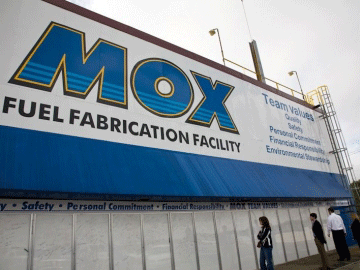
The DOE missed the Jan. 1, 2016 deadline because the mixed oxide, or MOX, fuel fabrication facility at the Savannah River Site in Aiken County isn’t built yet.
Once operational, MOX will convert plutonium stockpiles into fuel for commercial reactors. It’s presently about 73 percent complete, sources familiar with the project say.
The plutonium disposition is part of a nuclear deal with Russia, both nations agreed to dispose of 34 metric tons of defense plutonium. An NNSA news release from 2011 heralding the MOX deal said that’s enough plutonium to make 17,000 nuclear weapons.
Russia suspended, but didn’t withdraw from, the agreement in 2016. While not citing MOX directly, Russian President Vladimir Putin cited “unfriendly” practices by the U.S.
Both nations were supposed to begin disposition in 2018, the NNSA news release said.
April 22, 2017
Posted by Christina Macpherson |
- plutonium, Legal, USA |
Leave a comment














 nuclear-news