Radioactive dump plan near Ottawa River is meeting growing opposition
Opposition mounts to radioactive waste near Ottawa River NEWS Oct 02, 2017 by Derek Dunn Arnprior  Chronicle-Guide The number of groups and individuals opposed to a planned radioactive waste disposal facility near the Ottawa River continues to mount.
A recent letter to Prime Minister Justin Trudeau by 35 scientists, doctors, elected officials, and leaders of public interest groups and First Nations, urges him to “stand up for the health and safety of Canadians” by suspending what opponents call a giant surface mound about a kilometre from the river.
Multinational corporations have formed Canadian National Energy Alliance to build the disposal facility in Chalk River. It would house contaminated materials from more than 100 buildings on the nuclear laboratories site. It would also contain a small volume of mixed waste from offsite sources.
For 90 years there has been nuclear activity on the shores of the Ottawa, with no solution in place for permanently safeguarding the radioactive waste that is continuously generated. The five-storey high mound would contain mostly low-level waste, starting in 2020, taking up to 1 million cubic metres of waste by 2070.
However, groups like Ottawa Riverkeeper and Concerned Citizens of Renfrew County and Area, worry about leachate from the site making its way into the drinking water for 1 million people.
……McNab/Braeside Coun. Mark MacKenzie, a former Green Party of Canada president, has attended several meetings on the topic. He has also looked closely at the issues involved.
“I’ve got a lot of concerns about it,” MacKenzie said. “That it’s not deep underground tops the list.”
He said by calling it a “near surface” facility, the alliance is attempting to deceive.
The project also doesn’t conform to international standards, he added. And that while only one per cent of the waste is considered of medium level, it will persist for hundreds of thousands of years.
“Any percentage above ground that is supposed to be underground is too much.”
The landfill-grade liner proposed is also a concern, he said. It will eventually break down.
Then there are the players involved: SNC-Lavalin is in court for fraud and corruption; others are British and U.S., hence “not here for the long haul,” MacKenzie said. He said nuclear waste is a Government of Canada problem, not for private corporations.
“I’m not convinced these companies have the long-term interest of the Canadian public in mind.” https://www.insideottawavalley.com/news-story/7589403-opposition-mounts-to-radioactive-waste-near-ottawa-river/
Scrutiny on Vermont Yankee’s radioactive clean-up plans
State troubled by Vermont Yankee rubble plan, Vt Digger, By Oct 1 2017 BRATTLEBORO – State regulators and anti-nuclear activists are taking a stand against a proposal to reuse large amounts of Vermont Yankee’s concrete as fill when the plant is decommissioned.
V.C. Summer Nuclear Project Disarray – a $9 Billion Nuclear Scrapyard

$9 Billion Nuclear Scrapyard: New Aerial Photos of SCE&G’s Abandoned V.C. Summer Nuclear Project Reveal Disarray
Reactor Building and Components Left Unprotected; Most Cranes Removed, Friends of the Earth, 27 Sept 17 COLUMBIA, S.C. – Newly obtained aerial photographs of the abandoned V.C. Summer nuclear reactor construction site reveal that there is no protection of installed reactor components from the weather. (See notes on original for links to photos.)
The photos provided to Friends of the Earth are being released in the middle of the political firestorm in South Carolina about the terminated project. It has become clear that South Carolina Electric & Gas (SCE&G) and its partner, Santee Cooper, withheld key information for years about the faltering project and were finally forced to simply walk away from on-going construction with no site shut-down plan in place.
The photos of the debacle, on which $9 billion was wasted, confirm that when work was abruptly halted on July 31, no preparation had been made to protect buildings and key components associated with reactor units 2 and 3. One existing reactor, visible in the photos, has operated at the site since 1982.
The photos, taken on September 18, reveal that nuclear reactor modules installed inside the open containment vessels are exposed to the weather. The partially finished ‘shield buildings,’ in which the reactors are located, lack roofs and sit fully exposed to the elements. Construction was only about 37% complete when the work was halted and had been continuing at a snail’s pace.
“Almost two months after the project was halted the V.C. Summer reactor construction site still looks like it was abruptly abandoned with no shut-down plan,” said Tom Clements, senior adviser to Friends of the Earth. “Not only was SCE&G grossly negligent during construction of the project, but the photos of the site reveal that the company also exhibited imprudent behavior in abandoning the project without proper closure plans. The forlorn site looks like a nuclear ghost town best suited for a Hollywood movie set,” added Clements. (Duke Energy’s abandoned nuclear reactor project in Cherokee County, South Carolina, was used as a set for the science fiction film The Abyss in 1989.)
Years of weathering will ravage the unprotected reactor components and partially constructed shield buildings and turbine buildings, according to Friends of the Earth. The turbine buildings, located adjacent to the reactors, sit without roofs and with open walls. A large number of white tent-like temporary buildings are visible and, according to information provided by site workers to Friends of the Earth, protect unused components. The short lifespan of the shelters will necessitate long-term plans if components are to be retained and not sold off.
The photos were taken by High Flyer, an anonymous pilot who for years has provided photos of V.C. Summer. The photos were taken in compliance with regulations of the Federal Aviation Administration and have been provided to Friends of the Earth for distribution in the public interest, including for regulators and law enforcement investigators. The photos can be used with credit to High Flyer (e.g. Courtesy of High Flyer © 2017). SCE&G has not provided photos of the abandoned site……… https://foe.org/9-billion-nuclear-scrapyard-new-aerial-photos-scegs-abandoned-v-c-summer-nuclear-project-reveal-disarray/
Australian Aborigines move to block shipments of Scottish nuclear waste
 Australian Aborigines move to block shipments of Scottish nuclear waste http://www.heraldscotland.com/news/15554758.Australian_Aborigines_move_to_block_shipments_of_Scottish_nuclear_waste/?ref=fbshr ABORIGINES in South Australia are fighting a plan to ship nuclear waste from Scotland amid fears it will be dumped on land regarded as culturally and spiritually sacred.
Wallerberdina, around 280 miles north of Adelaide, has been earmarked as a possible location for Australia’s first nuclear waste dump despite claims that it is a priceless heritage site rich in archaeological treasures including burial mounds, fossilised bones and stone tools.
Some have claimed the impact would be similar to “building a waste dump at the heart of the Vatican”.
Now campaigners have appealed to the Scottish Government to halt controversial plans to ship nuclear waste processed at Dounreay in Caithness to Australia, amid concerns that it will eventually end up on the culturally sensitive land.
The waste transfer is part of a deal with saw spent fuel from nuclear reactors in Australia, Belgium, Germany and Italy processed at Dounreay – the nuclear facility in Caithness currently being decommissioned – to enable it to be safely stored after being returned to its country of origin.
The UK government has previously confirmed that “a very small quantity of Australian-owned radioactive waste” is currently stored in the country.
Scottish Government policy allows for the substitution of nuclear waste with a “radiologically equivalent” amount of materials from Sellafield in Cumbria.
The Herald understands that a shipment of such material is due to take place by 2020.
While the waste will be initially stored at a facility near Sydney, concern is growing that it could end up at Wallerberdina, one of two areas under consideration as a nuclear waste dump site.
As well as sparking anger over the site’s cultural and sacred connections, the proposed location has angered local people who still recall British atomic bomb tests in the area in the 1950s without permission from the affected Aboriginal groups.
Thousands were adversely affected with many Aboriginal people left suffering from radiological poisoning
Gary Cushway, a dual Australian/British citizen living in Glasgow, has now written to the First Minister asking that the Scottish Government review the agreement to transfer the material “until a satisfactory final destination for the waste is finalised by the Australian Government.”
He argues that doing so would allow the government to “take the lead in mitigating mistakes of the past that the UK government has made in regards to indigenous Australians.”
The proposed dump site is next to an Indigenous Protected Area where Aborigines are still allowed to hunt, and is part of the traditional home of the Adnyamathanha people, one of several hundred indigenous groups in Australia.
The Herald understands that a shipment of such material is due to take place by 2020.
While the waste will be initially stored at a facility near Sydney, concern is growing that it could end up at Wallerberdina, one of two areas under consideration as a nuclear waste dump site.
As well as sparking anger over the site’s cultural and sacred connections, the proposed location has angered local people who still recall British atomic bomb tests in the area in the 1950s without permission from the affected Aboriginal groups.
Thousands were adversely affected with many Aboriginal people left suffering from radiological poisoning
Gary Cushway, a dual Australian/British citizen living in Glasgow, has now written to the First Minister asking that the Scottish Government review the agreement to transfer the material “until a satisfactory final destination for the waste is finalised by the Australian Government.”
He argues that doing so would allow the government to “take the lead in mitigating mistakes of the past that the UK government has made in regards to indigenous Australians.”
The proposed dump site is next to an Indigenous Protected Area where Aborigines are still allowed to hunt, and is part of the traditional home of the Adnyamathanha people, one of several hundred indigenous groups in Australia.
The Herald understands that a shipment of such material is due to take place by 2020.
While the waste will be initially stored at a facility near Sydney, concern is growing that it could end up at Wallerberdina, one of two areas under consideration as a nuclear waste dump site.
As well as sparking anger over the site’s cultural and sacred connections, the proposed location has angered local people who still recall British atomic bomb tests in the area in the 1950s without permission from the affected Aboriginal groups.
Thousands were adversely affected with many Aboriginal people left suffering from radiological poisoning
Gary Cushway, a dual Australian/British citizen living in Glasgow, has now written to the First Minister asking that the Scottish Government review the agreement to transfer the material “until a satisfactory final destination for the waste is finalised by the Australian Government.”
He argues that doing so would allow the government to “take the lead in mitigating mistakes of the past that the UK government has made in regards to indigenous Australians.”
The proposed dump site is next to an Indigenous Protected Area where Aborigines are still allowed to hunt, and is part of the traditional home of the Adnyamathanha people, one of several hundred indigenous groups in Australia.
Petition to National Assembly of Wales to suspend licence for dumping rdaioactive mud into Welsh inshore waters
 National Assembly for Wales (accessed) 28th Sept 2017,
Petition “We call on the National Assembly for Wales to urge the Welsh
Government to direct Natural Resources Wales to suspend the licence it has
granted to NNB Genco, which permits up to 300,000 tonnes of radioactively
contaminated material, dredged from the seabed at the Hinkley Point Nuclear
power station site, to be dumped into Welsh inshore waters.
We further request that the suspension of the licence is used to ensure that a full
Environmental Impact Assessment, complete radiological analysis and core
sampling are carried out under the auspices of Natural Resources Wales, and
that a Public Inquiry, a full hearing of independent evidence and a Public
Consultation take place before any dump of the Hinkley sediments is
permitted.”
https://www.assembly.wales/en/gethome/e-petitions/Pages/petitiondetail.aspx?PetitionID=1243
Britain terminates nuclear decommissioning contract for Cavendish Fluor Partnership (CFP)
 Reuters 29th Sept 2017, Britain’s Nuclear Decommissioning Authority (NDA) has given a notice of
termination to Cavendish Fluor Partnership (CFP) for its management and
decommissioning of the country’s 12 Magnox nuclear power reactors and
research sites, it said on Friday.
The termination notice was effective
from Sept. 1 and allows for a 24-month notice period, ending CFP’s
contract on Aug. 31, 2019.
CFP – a joint venture between British firm
Cavendish Nuclear, a subsidiary of Babcock International, and U.S. company
Fluor Inc. – was awarded the contract in 2014. But earlier this year the
government said there was a “mismatch” between the work specified in
the contract and the work that actually needed to be done.
http://uk.reuters.com/article/britain-nuclear/uk-nuclear-authority-gives-notice-to-end-cfps-magnox-decommissioning-contract-idUKL8N1MA129?rpc=401&
SanOnofre’s unique and dangerous state – of Stranded Nuclear Wastes
 Can $46 billion buy a permanent home for nuclear waste stored at San Onofre, other sites? http://www.ocregister.com/2017/09/27/can-46-billion-buy-a-home-for-nations-nuclear-waste-not-yet/ By TERI SFORZA | tsforza@scng.com | Orange County Register, 27 Sept 17, Congress members shifted on the dais during a meeting this week in Washington, D.C. on the long-term possibility of creating a national spot to store nuclear waste.
“To put it bluntly,” said Anthony O’Donnell, chair of the National Association of Regulatory Utility Commissioners, “the state and local governments have the federal government’s waste, and the federal government has our money.”
O’Donnell joined David Victor, chair of San Onofre’s Community Engagement Panel, and other experts in chiding a U.S. House Oversight and Government Reform subcommittee for the federal government’s failure to find a permanent home for nuclear waste, despite collecting $46 billion from electricity customers to do just that.
San Onofre’s unique and dangerous status – as a shuttered reactor with 3.6 million pounds of “stranded” waste, stored between the ocean and a highway, in a densely populated area, atop earthquake faults – was repeatedly raised as an impetus for action.
“People see the site being dismantled, but the waste remaining,” Victor said. “They think, ‘We paid the government to remove it, and it’s not being removed.’ That’s a palpable anger.”
Victor urged Congress to move swiftly toward licensing temporary storage sites and developing transportation plans and infrastructure for moving the waste, even as it gears up to revive Nevada’s Yucca Mountain as a permanent site.
“It’s really important not to put all our eggs in one basket,” Victor said, conjuring Nevada’s staunch opposition to becoming America’s nuclear waste dump. The state has no nuclear power plants.
Americans have spent billions with nothing to show for it, O’Donnell and others said.
Electricity ratepayers have poured that $46 billion into the Nuclear Waste Fund, and gotten nothing.
Taxpayers have paid out another $6 billion to utilities that have sued the federal government — and won — over the fed’s failure to haul away the waste as promised.
The Department of Energy says the legal bills for breach-of-contract could total $25 billion, but the nuclear industry estimates it could cost as much as $50 billion.
“The cost of inaction is high,” warned Chuck Smith, Aiken County councilmember and chair of the Energy Communities Alliance from South Carolina
Rep. Darrell Issa, R-Vista, stressed the need for swift action, as did Rep. William Lacy Clay, D-St. Louis. San Onofre is not alone in its peril, Clay said: In his district, radioactive waste is buried close to an active underground fire.
“This is a moral imperative,” Clay said. “The U.S. government created a nuclear waste problem 75 years ago. It has a clear and unavoidable responsibility to finally clean it up.”
After the hearing, Victor said that the stars were aligning to advance a nuclear waste disposal bill in the House over the coming weeks. Next, he said, will come the Senate.
Read Victor’s testimony, and that of the other witnesses, here.
Abandoned radioactive generators and other nuclear junk sunk in oceans by Russia
Feisty mayor in Russia’s Far East wants his nuclear trash collected http://bellona.org/news/nuclear-issues/2017-09-feisty-mayor-in-russia-far-east-wants-his-nuclear-trash-collected
While lighthouses run on atomic batteries in Russia have become rare, especially along the coasts of the Baltic and Barents Seas, they still have their adherents in the country’s Far East. by Charles Digges charles@bellona.no While lighthouses run on atomic batteries in Russia have become rare, especially along the coasts of the Baltic and Barents Seas, they still have their adherents in the country’s Far East.
A group of radioactivity tracking sleuths on Sakhalin Island in the Pacific say they have hunted down an abandoned generator that ran on strontium-90 sunk off the shores of one of its premier beach resorts.
But that, they say, is just the tip of the iceberg: The discovery lies in the middle of a radioactive graveyard that includes no fewer than 38 sunken vessels containing nuclear waste, and two nuclear warheads that went down when a Soviet bomber crashed near the island’s southern tip in 1976.
Though the Russian Ministry of Defense recently began acknowledging the lost bomber, tracing the origins of the other nuclear cast offs is not so easy.
But at least, says Nikolai Sidirov, mayor of the coastal town of Makarov on Sakhalin’s Bay of Patience, his town knows what this new discovery is – and they want it raised from the depths with the rest of the glowing junk.
Speaking to Novaya Izvestiya, a popular tabloid that morphed out of the official Soviet-era mouthpiece Izvestiya, Sidirov said satellite photos tracking the location of the crashed bomber have turned up something else lurking under the waves: An RTG.
That’s short for Radioisotope Thermoelectric Generator, a small radioactive energy source that for decades powered thousands of Soviet lighthouses and other navigational beacons along Russia’s Baltic, Arctic and Pacific coasts.
After the fall of the Soviet Union and the crash of the Russian economy, officials lost track of many of the RTGs as bureaucracies collapsed and records went missing. Thieves pillaged them for their valuable metal, exposing their strontium innards. Hikers and shepherds, drawn to their atomic heat, would stagger out of the woods sick with radiation poisoning.
Around Murmansk and on the Pacific coast, frightful reports about strontium elements turning up on beaches proliferated in local media. Some newly independent Soviet republics telegraphed anxieties about their inherited RTGs back to Moscow – along with requests to come take them away.
And then there was the biggest fear of all: What if strontium 90 from these virtually unguarded, remotely radiological sources ended up in the hands of terrorists who wanted to make a dirty bomb?
So far, that hasn’t happened – anybody trying to make off with a strontium battery would likely end up very ill or dead. But when three woodsmen in the former Soviet Republic of Georgia turned up in a hospital with radiation burns and caught the attention of the International Atomic Energy Agency, the dangers of orphaned Soviet RTGs were finally on everyone’s mind.
A colossal effort spearheaded by the Norwegian government entirely rid the coasts of the Barents, Kara and White Seas of more than 180 RTGs. By infusing €20 million into the push, Norway helped Russia replace the strontium 90 batteries on these lighthouses and beacons with solar power over a six year period ending in 2015.
In all, Rosatom, Russia’s state nuclear corporation, says it has decommission more than 1000 RTGs throughout the country, adding that it has mostly eliminated the hazard of these stray radioactive sources from its coastlines.
But some areas have not been so lucky, at least according to the mayor of Makarov out on Sakhalin Island, six times zones east of Moscow. Sidirov, a feisty campaigner who had been publicly heckling the capital about the nuclear trash in the seas near his town for years, says divers have located the RTG, and that he now has the coordinates of where it lies. He told Novaya Izvestiya he will pass on the RTGs location to what he calls “competent authorities” lest it end up in scheming hands.
How the RTG, which lies in 14 meters of water, came to be there is still anyone’s guess. The Russian Navy sent a statement to the newspaper insisting that all RTGs under the purview of the Pacific Fleet have been hunted down and destroyed.
But Russia’s environmental oversight agency confirmed that there were numerous radioactive foundlings in the oceans off Sakhalin Island, though they didn’t identify Sidirov’s RTG specifically.
It certainly wouldn’t be the first time someone screwed up with an RTG in the area, however. Twenty years ago, in 1997, a helicopter from Russia’s Emergency Services Ministry accidentally dropped a strontium-powered RTG into Sakhalin’s waters. It was later retrieved by the navy.
So far, Rosatom has remained mum on the veracity of Sidirov’s claim about the RTG. But since the history of the downed bomber and the other hazards in his area has been confirmed, there’s every reason to believe him about the RTG. And he wants it gone.
“The ecological authorities and the military, they’re being very stubborn about coming to collect it,” Sidorov told Novaya Izvestiya. “It’s there job to collect it – if they’re ever interested, I’ll be here to show them exactly where it is.”
City of Zion stuck with costly, dirty, dangerous nuclear wastes
Zion skyline in for a change with planned razing of nuclear towers, Mary McIntyre, News-Sun, 15 Sept 17, The green-capped concrete towers of Zion’s barren lakefront will be gone soon, but the nuclear waste that has crippled the city economically will remain. Zion Solutions, which is part of Utah-based EnergySolutions, will finish deconstructing and demolishing the former Zion nuclear power plant and its 20-story containment silos in 2018, according to EnergySolutions Vice-President Mark Walker, but 61 casks full of spent nuclear rods will remain on-site indefinitely.

The silos — which were the tallest structures in Lake County when they opened in the early 1970s and are second in overall structural height to the 330-foot Sky Trek Tower at Six Flags Great America — are scheduled to come down during the first quarter of next year.
“The project will be physically completed with (deactivation and decommissioning) in 2018,” Walker said. However, although the federal government designated decades ago that the waste would go to Yucca Mountain in Nevada for permanent storage, the facility has not yet opened, and Zion is stuck with the waste until a solution can be found.
“We’re very concerned with the fact that these casks are visible, and they’re vulnerable,” Kraft said.
Kraft said storing the casks near Lake Michigan is not appropriate in a post-9/11 world.
“They’re lined up like bowling pins,” he said. City officials are also unhappy with the storage of the casks, attributing Zion’s economic troubles to the closed facility.
When ComEd was running the plant, Zion received about $19.5 million annually in taxes from it, according to Zion Finance Director David Knabel. However, with the plant shut down, the 267 lakefront acres owned by the Exelon, which now owns ComEd, generate only $500,000 annually in taxes……
Under a law passed in 1982, energy companies have sued the Department of Energy for billions of dollars because of its failure to provide long-term nuclear storage. However, Knabel said, since Zion’s agreement was not with the federal government, it cannot sue under that law.
Last year, then-U.S. Rep. Bob Dold introduced legislation that would have granted Zion $15 million per year for seven years to compensate for the economic damage caused by storing the nuclear waste. Dold lost re-election last year to Brad Schneider, who is exploring similar legislation with U.S. Sen. Tammy Duckworth that would include a grant to the city and tax incentives for businesses to come there, according to a Schneider spokesman.
Schneider plans to hold a general meeting for constituents Saturday at the Zion City Hall on Sheridan Road at 11 a.m.
City officials are also unhappy with the storage of the casks, attributing Zion’s economic troubles to the closed facility……..
When ComEd was running the plant, Zion received about $19.5 million annually in taxes from it, according to Zion Finance Director David Knabel. However, with the plant shut down, the 267 lakefront acres owned by the Exelon, which now owns ComEd, generate only $500,000 annually in taxes……. http://www.chicagotribune.com/suburbs/lake-county-news-sun/news/ct-lns-zion-nuclear-plant-demolition-st-0916-20170915-story.html
U.S. Department of Energy extends contract for management of Nuclear Waste Isolation Pilot Plant
Contract Extended for Management of US Nuclear Dump https://www.usnews.com/news/best-states/new-mexico/articles/2017-09-15/contract-extended-for-management-of-us-nuclear-dump
The U.S. Department of Energy has extended a contract for the management of the government’s only underground nuclear waste repository.Sept. 15, 2017CARLSBAD, N.M. (AP) — The U.S. Department of Energy has extended a contract for the management of the government’s only underground nuclear waste repository that will allow the Nuclear Waste Partnership to continue operating the Waste Isolation Pilot Plant in Carlsbad through September 2020.
The problem of plutonium: justification for its reprocessing is now dead
Forty years later, Japan’s breeder program, the original justification for its reprocessing program, is virtually dead.
Forty years of impasse: The United States, Japan, and the plutonium problem http://www.tandfonline.com/doi/full/10.1080/00963402.2017.1364007 Masafumi Takubo &Frank von Hippel, 23 Aug 2017, Recently, records have been published from the internal discussions in the Carter administration (1977–80) on the feasibility of convincing Japan to halt its plutonium-separation program as the United States was in the process of doing domestically. Japan was deeply committed to its program, however, and President Carter was not willing to escalate to a point where the alliance relationship could be threatened. Forty years later, the economic, environmental, and nonproliferation arguments against Japan’s program have only been strengthened while Japan’s concern about being dependent on imports of uranium appears vastly overblown. Nevertheless, Japan’s example, as the only non-weapon state that still separates plutonium, continues to legitimize the launch of similar programs in other countries, some of which may be interested in obtaining a nuclear weapon option.
Foreign civilian plutonium programs had become a high-level political issue in the United States after India used plutonium, nominally separated to provide startup fuel for a breeder reactor program in its first nuclear weapon test in 1974 (Perkovich 1999). The United States reversed its policy of encouraging the development of plutonium breeder reactors worldwide to avoid an anticipated shortage of uranium. The breeder reactors would convert abundant non-chain-reacting uranium 238 into chain-reacting plutonium and then use the plutonium as fuel, while conventional reactors are fueled primarily by chain-reacting uranium 235, which makes up only 0.7 percent of natural uranium.
The Ford administration (1974–77) blocked France’s plan to sell spent fuel reprocessing plants to South Korea and Pakistan but did not succeed in persuading Japan to abandon its nearly complete Tokai pilot reprocessing plant. Therefore, when the Carter administration took office in January 1977, it inherited the difficult plutonium discussion with Japan.
The earliest document in the newly released trove is a 19-page memo dated 24 January 1977, in which career State Department official Louis Nosenzo briefs the incoming Carter political appointees on the issue.2 His arguments are strikingly similar to those being made some 40 years later by United States and international nongovernmental organizations such as the International Panel on Fissile Materials (IPFM 2015) and by US government officials – most recently, members of the Obama administration.3
These arguments are, in brief, that the separation and use of plutonium as a fuel is not economically competitive with simply storing the spent fuel until its radioactive heat generation has declined and a deep underground repository has been constructed for its final disposal. In this “once-through” fuel cycle, the plutonium remains mixed with the radioactive fission products in the intact spent fuel and therefore is relatively inaccessible for use in weapons.
The earliest document in the newly released trove is a 19-page memo dated 24 January 1977, in which career State Department official Louis Nosenzo briefs the incoming Carter political appointees on the issue.2 His arguments are strikingly similar to those being made some 40 years later by United States and international nongovernmental organizations such as the International Panel on Fissile Materials (IPFM 2015) and by US government officials – most recently, members of the Obama administration.3
These arguments are, in brief, that the separation and use of plutonium as a fuel is not economically competitive with simply storing the spent fuel until its radioactive heat generation has declined and a deep underground repository has been constructed for its final disposal. In this “once-through” fuel cycle, the plutonium remains mixed with the radioactive fission products in the intact spent fuel and therefore is relatively inaccessible for use in weapons.
Presumably with tongue in cheek, he opined that “[s]pace limitations are a real problem only for countries like Luxemburg.” (Luxemburg, about equal in area to St. Louis, Missouri, did not and still does not have a nuclear program.) Subsequently, it was pointed out that the volume of an underground repository for highly radioactive waste is determined not by the volume of the waste but by its heat output; the waste has to be spread out to limit the temperature increase of the surrounding buffer clay and rock (IPFM 2015). Reprocessing waste would contain all the heat-generating fission products in the original spent fuel, and the heat generated by the plutonium in one ton of spent MOX fuel would be about the same as the heat generated by the plutonium in the approximately seven tons of spent low-enriched uranium fuel from which the plutonium used to manufacture the fresh MOX fuel had been recovered.
With regard to the issue of the need for plutonium to provide startup fuel for breeder reactors, Nosenzo noted that “experimental breeders currently utilize uranium [highly enriched in the chain-reacting isotope uranium 235] rather than plutonium for start-up and this will probably also be true of commercial breeder start-up operations.”4
“[T]here is a strong need for a US position paper presenting the above rationale with supporting analysis,” Nosenzo wrote. “This would be of value, for example, with other governments in the nuclear suppliers context and more generally … for use by sympathetic foreign ministries attempting to cope effectively with their ministries of energy, of technology and of economics.”
The last point reflected the reality that the promotion of breeder reactors was central to the plans of powerful trade ministries around the world, including Japan’s Ministry of International Trade and Industry (now the Ministry of Economy, Trade and Industry), and that foreign ministries sometimes use independent analyses to push back against positions of other ministries that seem extreme to them. A few years ago, an official of South Korea’s Foreign Ministry, for example, privately described the Korea Atomic Energy Research Institute, the driving force behind South Korea’s demand for the same “right” to reprocess as Japan, as “our Taliban.”
Japan planned to start operation of its Tokai reprocessing plant later that spring, and it appeared clear to Nosenzo that it would be impossible to prevent the operation of the almost completed plant. Another memo cited Prime Minister Fukuda as publicly calling reprocessing a matter of “life and death” for Japan.5 Japan’s government had committed itself to achieving what Glenn Seaborg, chairman of the US Atomic Energy Commission from 1961–71, had relentlessly promoted as a “plutonium economy,” in which the world would be powered by the element he had codiscovered.
Why would the Fukuda administration have seen the separation and use of plutonium as so critical? We believe that the Prime Minister had been convinced by Japan’s plutonium advocates that the country’s dependence on imported uranium would create an economic vulnerability such as the country had experienced during the 1973 Arab oil embargo, still a recent and painful memory. Indeed, according to a popular view in Japan, further back, in 1941, it was a US embargo on oil exports to Japan that had triggered Japan’s attack on Pearl Harbor. The plutonium advocates argued that breeder reactors would eliminate resource-poor Japan’s vulnerability to a uranium cutoff by turning already imported uranium into a virtually inexhaustible supply of plutonium fuel for its reactors.
During the past 40 years, however, uranium has been abundant, cheap, and available from a variety of countries. Furthermore, as some foreign observers have suggested, if Japan was really concerned about possible disruptions of supply, it could have acquired a 50-year strategic reserve of uranium at a much lower cost than its plutonium program (Leventhal and Dolley 1994). Indeed, because of the low cost of uranium, globally, utilities have accumulated an inventory sufficient for about seven years. Although it took several years for Congress to accept the Carter administration’s proposal to end the US reprocessing and breeder reactor development programs, Congress did support the administration’s effort to discourage plutonium programs abroad. The Nuclear Nonproliferation Act of 1978 required that nuclear cooperation agreements with other countries be renegotiated so that any spent fuel that had either originally been produced in the United States or had been irradiated in a reactor containing components or design information subject to US export controls could not be reprocessed without prior consent from the US government. Internally, however, the administration was divided over whether the United States could force its allies to accept such US control over their nuclear programs.
One of the final memos in the National Security Archives file, written in May 1980, toward the end of the Carter administration by Jerry Oplinger, a staffer on the National Security Council, criticized a proposal by Gerard Smith, President Carter’s ambassador at large for nuclear nonproliferation. Smith proposed that the administration provide blanket advance consent for spent fuel reprocessing in Western Europe and Japan.7 Oplinger characterized Smith’s proposal as “surrender” and argued that, even though the danger of further proliferation in Europe or by Japan was low, their examples could be used by other countries as a justification for launching their own plutonium programs.
The Carter administration did not surrender to the Japanese and the West European reprocessing lobbies but, in 1988, in exchange for added requirements for safeguards and physical protection of plutonium, the Reagan administration signed a renegotiated US–Japan agreement on nuclear cooperation with full, advance, programmatic consent to reprocessing by Japan for 30 years. In the original 1968 agreement, the United States had been given the right to review each Japanese shipment of spent fuel to the British and French reprocessing plants on a case-by-case basis and to make a joint determination on reprocessing in Japan. This right had allowed the United States to question whether Japan needed more separated plutonium. As a result of the 1988 agreement, by the time of the 2011 Fukushima accident, Japan had built up a stock of some 44 tons of separated plutonium, an amount sufficient for more than 5000 Nagasaki-type bombs (Japan Atomic Energy Commission 2012), and the largest amount of MOX fuel it had loaded in a single year (2010) contained about one ton of plutonium (IPFM 2015).
The initial period of the 1988 agreement will expire in 2018, after which either party may terminate it by giving six months written notice. This provides an opportunity for the US government to reraise the issue of reprocessing with Japan.
Unlike the 1968 agreement with Japan, the 1958 US–EURATOM agreement did not have a requirement of prior US consent for reprocessing of European spent fuel in West Europe. The Europeans refused to renegotiate this agreement, and, starting with President Carter, successive US presidents extended the US–EURATOM agreement by executive order year by year (Bulletin of the Atomic Scientists 1994). Finally, in 1995, the Clinton administration negotiated language in a new agreement that the European reprocessors accepted as a commitment to noninterference (Behrens and Donnelly 1996). By that time, the nonnuclear weapon states in Europe – notably Germany and Italy – had lost interest in breeder reactors and the only reprocessing plants listed in the agreement were those of United Kingdom and France. Reprocessing proponents in Japan often say that Japan is the only non-weapon state trusted by the international community to reprocess. In reality, Japan is the only non-weapon state that has not abandoned reprocessing because of its poor economics.
As Oplinger pointed out, Japan played a central role in sustaining large-scale reprocessing in Europe as well as at home. In addition to planning to build their own large reprocessing plant, Japan’s nuclear utilities provided capital, in the form of prepaid reprocessing contracts, for building large new merchant reprocessing plants in France and the United Kingdom. France also played a leading role in promoting reprocessing and in designing Japan’s reprocessing plant.
Oplinger insisted that the planned reprocessing programs in Europe and Japan would produce huge excesses of separated plutonium beyond the requirements of planned breeder programs: “Any one of these three projected plants would more than swamp the projected plutonium needs of all the breeder R&D programs in the world. Three of them would produce a vast surplus … amounting to several hundred tons by the year 2000.”
He attached a graph projecting that by the year 2000, the three plants would produce a surplus of 370 tons of separated plutonium beyond the requirements of breeder research and development. The actual stock of separated civilian plutonium in Europe and Japan in 2000 was huge – using the IAEA’s metric of 8 kilograms per bomb, enough for 20,000 Nagasaki bombs – but about half the amount projected in Oplinger’s memo (IPFM 2015). This was due in part to operating problems with the UK reprocessing plant and delays in the operation of Japan’s large reprocessing plant. On the demand side, breeder use was much less than had been projected, but, in an attempt to deal with the surplus stocks, quite a bit of plutonium was fabricated into MOX and irradiated in Europe’s conventional reactors.
Forty years later, Japan’s breeder program, the original justification for its reprocessing program, is virtually dead. Japan officially abandoned its Monju prototype breeder reactor in 2016 after two decades of failed efforts to restore it to operation after a 1995 leak of its sodium secondary coolant and a resulting fire. Japan’s government now talks of joining France in building a new Advanced Sodium Technological Reactor for Industrial Demonstration (ASTRID) in France, and France’s nuclear establishment has welcomed the idea of Japan sharing the cost.8
The mission for ASTRID-type fast-neutron reactors would be to fission the plutonium and other long-lived transuranic elements in spent low-enriched uranium fuel and MOX fuel, for which Japan will have to build a new reprocessing plant. According to France’s 2006 radioactive waste law, ASTRID was supposed to be commissioned by the end of 2020.9 Its budget has been secured only for the design period extending to 2019, however. In an October 2016 briefing in Tokyo, the manager of the ASTRID program showed the project’s schedule with a “consolidation phase” beginning in 2020 (Devictor 2016). The next day, the official in charge of nuclear issues at France’s embassy in Tokyo stated that ASTRID would not start up before 2033 (Félix 2016). Thus, in 10 years, the schedule had slipped by 13 years. It has been obvious for four decades that breeder reactors and plutonium use as a reactor fuel will be uneconomic. The latest estimate of the total project cost for Japan’s Rokkasho Reprocessing Plant, including construction, operation for 40 years, and decommissioning, is now 13.9 trillion yen ($125 billion), with the construction cost alone reaching 2.95 trillion yen ($27 billion), including 0.75 trillion yen for upgrades due to new safety regulations introduced after the Fukushima accident. The total project cost of the MOX fuel fabrication facility, including some 42 years of operation and decommissioning, is now estimated at 2.3 trillion yen ($21 billion) (Nuclear Reprocessing Organization of Japan 2017
). In the United States, after it became clear in 1977 that reprocessing and breeder reactors made no economic sense and could create a proliferation nightmare, it took only about five years for the government and utilities to agree to abandon both programs, despite the fact that industry had spent about $1.3 billion in 2017 dollars on construction of a reprocessing plant in South Carolina (GAO 1984), and the government had spent $4.2 billion on the Clinch River Demonstration Breeder Reactor project (Peach How could Japan’s government have allowed reprocessing advocates to drive its electric-power utilities to pursue its hugely costly plutonium program over 40 years?
For context, it must be remembered that the United States, a nuclear superpower, has been much more concerned about nuclear proliferation and terrorism than Japan. Tetsuya Endo, a former diplomat involved in the negotiations of the 1988 agreement, depicted the difference in the attitude of the two governments as follows:
Whereas the criterion of the United States, in particular that of the US government … is security (nuclear proliferation is one aspect of it), that of the Japan side is nuclear energy. … [I]t can be summarized as security vs. energy supply and the direction of interests are rather out of alignment. (Endo 2014)As we have seen, in the United States, after India’s 1974 nuclear test, both the Ford and Carter administrations considered the spread of reprocessing a very serious security issue. Indeed, a ship that entered a Japanese port on 16 October 1976 to transport spent fuel to the United Kingdom could not leave for nine days due to the Ford administration’s objections (Ibara 1984
). In Japan, the US concerns about nuclear proliferation and terrorism have been generally considered interference in Japan’s energy policy by a country that possesses one of the worlds’ largest nuclear arsenals. Even the eyes of parliament members opposed to reprocessing, antinuclear weapon activists and the media sometimes got blurred by this nationalistic sentiment.
Nevertheless, reprocessing is enormously costly and the willingness of Japan’s government to force its nuclear utilities to accept the cost requires explanation.
One explanation, offered by the Japan Atomic Energy Commission (JAEC) (Japan Atomic Energy Commission 2005), involves the political challenge of negotiating arrangements for storing spent fuel indefinitely at reactor sites. The government and utilities had promised the host communities and prefectures that spent fuel would be removed from the sites. The reprocessing policy provided destinations – first Europe and the Tokai pilot plant, and then the Rokkasho Reprocessing Plant. The JAEC argued that, since it would take years to negotiate indefinite onsite storage of spent fuel, nuclear power plants with no place to put spent fuel in the meantime would be shut down one after another, which would result in an economic loss even greater than the cost of reprocessing.
Japan’s nuclear utilities have had to increase on-site storage of spent fuel in any case due to delays in the startup of the Rokkasho Reprocessing Plant, which was originally to start commercial operations in 1997. Indeed, the utilities have adopted the dangerous US practice of dense-packing their spent-fuel cooling pools with used fuel assemblies. Storing spent fuel in dry casks, onsite or offsite, cooled by natural convection of air would be much safer (von Hippel and Schoeppner 2016). In the United States, spent fuel is transferred to onsite dry cask storage after the dense-packed pools become completely full. It’s better to make this transfer as soon as the spent fuel gets cool enough. Such a shift to a policy of accelerated dry cask storage would require stronger nuclear safety regulation in both countries (Lyman, Schoeppner, and von Hippel 2017
Second, there is the bureaucratic explanation. The bureaucracy has more power over policy in Japan than in the United States. In Japan, when a new prime minister is elected in the Diet, only the ministers change whereas, in the United States with a two-party system, policy making is shared by Congress and the executive branch to a greater extent, and a new president routinely replaces more than 4000 officials at the top of the bureaucracy.10 (This works both for the better and worse as can be observed in the current US administration.) Also, in Japan, unlike the United States, the bureaucracy is closed. There are virtually no mixed careers, with people working both inside and outside the bureaucracy (Tanaka 2009).
Third, the provision of electric power has been a heavily regulated regional monopoly in Japan. Utilities therefore have been able to pass the extra costs of reprocessing on to consumers without eroding their own profits. This monopoly structure also has given utilities enormous power both locally and nationally, making it possible for them to influence both election results and the policy-making process. Thus, even if the original reprocessing policy was made by bureaucrats, it is now very difficult to change because of this complicated web of influence.
Japan has been gradually shifting toward deregulation, especially since the Fukushima accident, but a law has been passed to protect reprocessing by requiring the utilities to pay in advance, at the time of irradiation, for reprocessing the spent fuel and fabricating the recovered plutonium into MOX fuel (Suzuki and Takubo 2016). The fact that nuclear utilities didn’t fight openly against this law, which will make them pay extra costs in the deregulated market, suggests that they expect the government to come up with a system of spreading the cost to consumers purchasing electricity generated by nonnuclear power producers, for example with a charge for electricity transmission and distribution, which will continue to be regulated.
Plutonium separation programs also persist in France, India, and Russia. China, too, has had a reprocessing policy for decades, although a small industrial reprocessing plant is only at the site-preparation stage and a site has not yet been found for a proposed large reprocessing plant that is to be bought from France. Central bureaucracies have great power in these countries, as they do in Japan. France’s government-owned utility has made clear that, where it has the choice – as it has had in the United Kingdom, whose nuclear power plants it also operates – it will opt out of reprocessing. This is one of the reasons why reprocessing will end in the United Kingdom over the next few years as the preexisting contracts are fulfilled (IPFM 2015
).
A final explanation put forward from time to time for the persistence of reprocessing in Japan is that Japan’s security establishment wants to keep open a nuclear weapon option. There already are about 10 tons of separated plutonium in Japan, however (with an additional 37 tons of Japanese plutonium in France and the United Kingdom), and the design capacity of the Rokkasho Reprocessing Plant to separate eight tons of plutonium, enough to make 1000 nuclear warheads per year, is far greater than Japan could possibly need for a nuclear weapon option. Also, Japan already has a centrifuge enrichment plant much larger than that planned by Iran. Iran’s program precipitated an international crisis because of proliferation concerns. Japan’s plant, like Iran’s, is designed to produce low-enriched uranium for nuclear power plants, but the cascades could be quickly reorganized to produce enough weapon-grade uranium for 10 bombs per year from natural uranium. Japan plans to expand this enrichment capacity more than 10-fold.11 It is therefore hard to imagine that the hugely costly Rokkasho reprocessing project is continuing because security officials are secretly pushing for it.
The idea that Japan is maintaining a nuclear weapon option has negative effects for Japan’s security, however, raising suspicions among its neighbors and legitimizing arguments in South Korea that it should acquire its own nuclear weapon option. It also undermines nuclear disarmament. According to the New York Times, when President Obama considered adopting a no-first-use policy before leaving office, Secretary of State John Kerry “argued that Japan would be unnerved by any diminution of the American nuclear umbrella, and perhaps be tempted to obtain their own weapon” (Sanger and Broad 2016). It’s about time for both the security officials and antinuclear weapon movements to examine this concern more seriously.
Given the terrible economics of reprocessing, its end in Japan and France should only be a matter of time. As the 40-year-long impasse over Japan’s program demonstrates, however, the inevitable can take a very long time, while the costs and dangers continue to accumulate. The world has been fortunate that the stubborn refusals of Japan and France to abandon their failing reprocessing programs have not resulted in a proliferation of plutonium programs, or the theft and use of their plutonium by terrorists. The South Korean election of President Moon Jae-in – who holds antinuclear-power views – may result in a decrease in pressure from Seoul for the “right” to reprocess.
The combined effects of the “invisible hand” of economics and US policy therefore have thus far been remarkably successful in blocking the spread of reprocessing to non-weapon states other than Japan. China’s growing influence in the international nuclear-energy industry and its planned reprocessing program, including the construction of a large French-designed reprocessing plant, could soon, however, pose a new challenge to this nonproliferation success story. Decisions by France and Japan to take their completely failed reprocessing programs off costly government-provided life support might convince China to rethink its policy.
Danger of nuclear wastes parked on the edge of the Pacific
And unlike in the past, it may have several choices for where to send the waste. Although there still are no federally licensed nuclear waste dumps, despite the billions of dollars ratepayers have paid to fund them, as of this year there are two proposals for temporary storage sites that could conceivably be ready for business by the early 2020s……..
Granted, when it comes to waste that’s going to remain radioactive for tens of thousands of years, there are no great solutions. But there are certainly better ones than continuing to hold more than 70,000 tons of nuclear fuel at about 120 operating and decommissioned nuclear plants across the country in facilities never intended for long-term storage, then hoping for the best.http://www.latimes.com/opinion/editorials/la-ed-nuclear-waste-storage-20170911-story.html
No solution insight for the eternal storage of nuclear radioactive trash
 Nuclear waste: Where to store it for eternity?http://www.dw.com/en/nuclear-waste-where-to-store-it-for-eternity/a-40449893, Ruby Russell, 12 Sept 17
Nuclear power stations have been churning out radioactive waste for decades. At least 10 new reactors came online last year – making the question of long-term storage all the more pressing. There’s no solution in sight.
In 2016, 10 new nuclear reactors went online – and two more are set to go online in the first half of 2017, according to the 2017 World Nuclear Industry Status Report published Tuesday. Six of these new nuclear power plants are based in China, which now ranks third on the list of the “big five” nuclear generating countries after the United States and France.
The big five make up 70 percent of the world’s nuclear energy, while the US and France account for almost half of global nuclear energy generation.
In this time period, only four reactors were shut down.
As nuclear reactors continue to go online, the question of what to do with nuclear waste becomes all the more pressing – and still hasn’t been answered properly.
In September this year, Germany begins the search to find a final storage solution for nuclear waste. A special commission is to scour the country for a suitable geological site to build a deep repository, where it can bury the toxic legacy of decades of nuclear power production – once and for all.
The government aims to find a site by 2031. But critics are skeptical that it will meet the deadline.
There are complex technical questions over whether clay, granite or salt might provide the best protection against leakage or contamination. The site has to be secure for a million years – so scientists have to be sure it will survive eventualities such as future ice ages.
But just the biggest challenge will be to persuade communities to accept a nuclear waste dump on their doorstep.
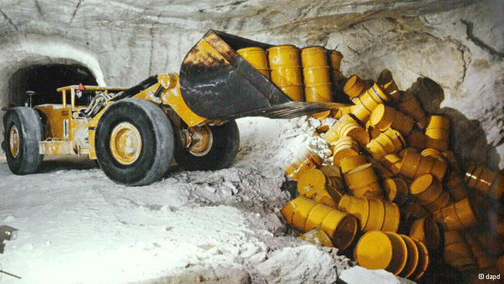 Four decades of resistance at Gorleben
In the late 1970s, West Germany chose a salt site at Gorleben in Lower Saxony for exploration as a possible final nuclear waste repository. A decades-long battle ensued, with locals vehemently protesting against the project.
Protestors long argued that Gorleben, a sparsely populated area close to the East German border, was selected for political rather than scientific grounds.
Technical questions were also raised.
Science vs. politics
US nuclear expert Robert Alvarez say at least Germany has a well-defined set of scientific criteria to select a site that will be geologically stable and protect the waste in barrels from oxidation, and therefore corrosion.
“I think the German government has been paying more attention to the geologists and to the nuclear safety people,” Alavarez, an associate fellow at the US Institute for Policy Studies, told DW.
In the United States, President Donald Trump has been making moves to restart work on a repository at Yucca Mountain, a former nuclear weapons test site in the remote Nevada desert.
Alvarez describes the selection of the site ahead of the 1988 election as the result of a political move by Congress, which scrapped a survey of various locations around the US.
“People went crazy – and it scared all the politicians who were running for election,” Alvarez explains. “So by 1987 when the process was unfolding, Congress just changed the law, and said: ‘We’re going to put it in Yucca Mountain, all you guys are off the hook.'”
He points out that the site was already contaminated from nuclear testing, and that Nevada has just one electoral college vote. But he says geological conditions at Yucca Mountain are far from ideal, and would require large-scale ventilation for at least 100 years to keep the waste cool.
“There is a lot of baloney about it being scientifically the best site,” Alvarez says. A granite site, like those being explored in Finland and Norway, would be far more suitable, he says.
“We have quite a lot of granite geology in our country but it happens to be in populated areas,” Alvarez added.
Scandinavia leading the way
Finland has made headlines with what has been lauded as the world’s first final long-term nuclear waste repository, 400 meters deep in the granite bedrock off the country’s west coast. A similar project is underway in Sweden.
Alvarez says these Scandinavian countries are very much leading the way. But can we really be sure that these deep granite repositories will be safe in hundred of year, as Finland intends?
“To put it mildly, that claim contains strong elements of speculation,” Alvarez says. “How can we predict what the world will be like even 100 years from now?”
And other countries face bigger challenges.
Repository plans collapse around the world
“The problem in Finland and Sweden is dead simple,” says Andy Blowers of independent expert group Nuclear Waste Advisory Associates. “You have one type geology, and lots of it – you’ve got very few power stations, and so a defined amount of waste.”
France, which gets three-quarters of its electricity from nuclear, planned to open a repository at Bure in eastern France by 2030. But, like Yucca Mountain, it has been beset by technical problems and safety concerns, and protestors are campaigning against the project.
In the United Kingdom, plans for a repository located close to its Sellafield decommissioning and reprocessing site were scrapped following public and scientific consultation.
And in Australia this past summer, the government abandoned plans for an international repository that would take nuclear waste from around the world – due to public opposition.
Waiting for a solution
So, with even Finland yet to begin loading its repository, what’s happening to all the waste generated over the more than six decades we’ve been powering out economies with atomic energy?
For the most part, it’s sitting around – above ground, in temporary and interim storage facilities with widely varying levels of security, which were never intended to store so much waste, for so long.
Alvarez says Germany is, again, managing better than most. For one thing, Germany was using casks that are Mercedes models compared the United States’ old Chevys, he said. They are far thicker and can safely contain waste for longer.
Wet storage threatens disaster
There is a big difference between wet and dry storage. Nuclear waste has to be cooled in liquid. But if the liquid evaporates, spent fuel quickly heats up – and could result in fires with consequences experts say would dwarf Chernobyl.
When the Fukushima accident occurred in 2011, a pool containing a spent reactor was badly damaged and such an accident briefly arose as a possibility.
In fact, a leak refilled the pool. Without this happy accident, tens of millions of people – perhaps as much at 27 percent of Japan‘s population, according to some experts – would have had to be evacuated.
And yet, despite the dangers, countries including France, the UK, Korea and the US are storing nuclear waste in pools well after experts say it should have been put into dry cask storage.
Experts say the most pressing problem is not finding sites for final repositories, but ensuring that intermediate storage is safe – and will continue to be safe for as long as it takes to solve the riddle of how to get rid of humankind’s most toxic garbage.
Buying time
“I suspect that what we are going to be looking at over time is that there’s going to have to be a great deal longer period of surface storage,” Alvaraz says.
Mycle Schneider, an independent nuclear policy analyst and lead author of the annual status report, is not convinced geological storage should even be the ultimate goal, and that waste should be retrievable in case we find a better way to deal with it.
For time being, he says, it’s a matter of finding the least-bad solution.
“It’s very clear,” Schneider told DW. “Take spent fuel out of the pools as quickly as possible and into dry storage, even if that storage might not be ideal to begin with. Then you get to next stage, which is an appropriate building, and then into hardened storage, like a bunker.
“And from there, you can begin to think about eternity.”
Closed since 1977, Dounreay Fast Reactor at last being emptied of radioactive fuel elements

 BBC 12th Sept 2017, Work has begun on the “challenging” task of removing radioactive fuel
elements stuck inside the most famous of Dounreay’s reactors. Closed since
1977, the Dounreay Fast Reactor is known for its dome-shaped exterior.
Almost 1,000 fuel elements have been in the reactor for years after the work to remove them was halted because they were swollen and jammed in.
New technology has now been developed to make it possible to remove them. It
could take three years to complete the job at the nuclear power site near
Thurso in Caithness. Once all the elements have been removed work can begin
on dismantling the reactor.
http://www.bbc.co.uk/news/uk-scotland-highlands-islands-41245375
Cold War-era nuclear waste in the path of Hurricane Irma
 Hurricane Irma may plow into a site full of Cold War-era nuclear waste, Business Insider, DAVE MOSHER,
- Hurricane Irma, or what’s left of it, may plow into the continental US over the weekend.
- There’s a chance the damaging winds and heavy rainfall could affect Savannah River Site, a large Cold War-era nuclear reservation in South Carolina.
- The site hosts tens of millions of gallons of liquid nuclear waste in storage tanks, plus burial grounds filled with contaminated objects.
- SRS said its facilities are “able to withstand extreme natural events including hurricanes and floods.”
As Hurricane Irma threatens to ram South Florida, officials have issued warnings and evacuation orders.
Yet National Hurricane Center forecasts suggest the Texas-size storm may penetrate deep into the US mainland after pummelling Florida, blowing down trees, knocking out power, and triggering flooding far away from the sea.
On Friday, one inland area still well within Irma’s threat zone was the Savannah River Site: a sprawling 310-square-mile nuclear reservation in South Carolina that borders northeast Georgia.
During the Cold War, scientists and technicians there produced weapons-grade bomb material for the US military as well as plutonium-238 for NASA’s pluckiest spacecraft. These activities also created millions of gallons of nuclear waste that’s stored in dozens of tanks, plus burial grounds filled with contaminated objects.
With Irma threatening powerful wind and heavy rains across the Savannah River watershed, of which SRS is a part, some experts have expressed concern.
“If Hurricane #Irma track predictions hold, it will pass close to or even directly over DOE’s Savannah River Site. That could be very bad,” Stephen Schwartz, an independent nuclear-weapons policy analyst and author of “Atomic Audit: The Costs and Consequences of US Nuclear Weapons Since 1940,” wrote in a tweet on Thursday. (Irma’s path later shifted west, but the NHC still has the site on the edge of the storm’s “cone of probability.”)
Schwartz went on to sum up the cache of SRS’ waste, which includes about 35 million gallons of liquid radioactive waste, 195 acres of dirt-trench burial grounds filled with contaminated gear, and even thousands of tons’ worth of nuclear contamination from Greenland and Spain.
The most dangerous waste is contained in 51 large storage tanks. Less dangerous “low-level” waste (clothes, tools, equipment, and more laced with radioactive contamination) was dumped into unlined pits and covered with earth over the decades.
A major effort is underway to empty and seal the storage tanks, solidify the waste into glass, and entomb it underground, as well as construct up-to-standard disposal units.
However, there’s still billions of dollars’ and perhaps decades’ worth of work that remains, given current nuclear-cleanup funding levels.
 “The problem with the tanks and flooding isn’t so much that the tanks will leak … it’s more the stuff that has leaked out over the years,” Schwartz told Business Insider. “If there’s severe flooding, it could move that stuff around and into the ground water.”
Schwartz also said the burial grounds may pose a lesser though significant risk. “If you’ve got a contaminated tool or bulldozer, which there are, that’s not going to move,” he said. “But the uranium, plutonium, and other stuff stuck to clothing and dirt and equipment could potentially start migrating very far.”
He added that SRS is situated on top of an aquifer that supplies several states with drinking water……….https://www.businessinsider.com.au/hurricane-irma-cold-war-nuclear-waste-flooding-2017-9?r=UK&IR=T
1 This Month
Chernobyl: The Lost Tapes – A good documentary on Chernobyl on SBS available On Demand for the next 3 weeks– https://www.sbs.com.au/ondemand/tv-program/chernobyl-the-lost-tapes/2352741955560

of the week–London Campaign for Nuclear Disarmament

Tell the Ukrainian Government to Drop Prosecution of Peace Activist Yurii Sheliazhenko
To see nuclear-related stories in greater depth and intensity – go to https://nuclearinformation.wordpress.com
-
Archives
- April 2026 (152)
- March 2026 (251)
- February 2026 (268)
- January 2026 (308)
- December 2025 (358)
- November 2025 (359)
- October 2025 (376)
- September 2025 (257)
- August 2025 (319)
- July 2025 (230)
- June 2025 (348)
- May 2025 (261)
-
Categories
- 1
- 1 NUCLEAR ISSUES
- business and costs
- climate change
- culture and arts
- ENERGY
- environment
- health
- history
- indigenous issues
- Legal
- marketing of nuclear
- media
- opposition to nuclear
- PERSONAL STORIES
- politics
- politics international
- Religion and ethics
- safety
- secrets,lies and civil liberties
- spinbuster
- technology
- Uranium
- wastes
- weapons and war
- Women
- 2 WORLD
- ACTION
- AFRICA
- Atrocities
- AUSTRALIA
- Christina's notes
- Christina's themes
- culture and arts
- Events
- Fuk 2022
- Fuk 2023
- Fukushima 2017
- Fukushima 2018
- fukushima 2019
- Fukushima 2020
- Fukushima 2021
- general
- global warming
- Humour (God we need it)
- Nuclear
- RARE EARTHS
- Reference
- resources – print
- Resources -audiovicual
- Weekly Newsletter
- World
- World Nuclear
- YouTube
-
RSS
Entries RSS
Comments RSS
 nuclear-news