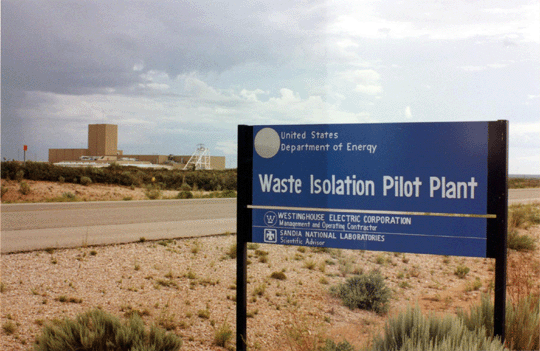
 Official: WIPP deficiencies stem from lack of funds, By Rebecca Moss | The New Mexican, 7 Dec 17
December 9, 2017
Posted by Christina Macpherson |
safety, USA, wastes |
Leave a comment
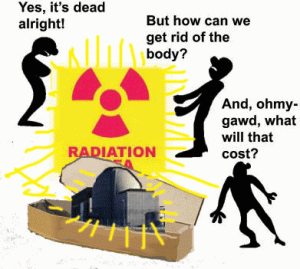 S. Korea strives to build up nuclear decommissioning industry, By Kim Eun-jung SEOUL, Dec. 8 (Yonhap) — South Korea will ramp up efforts to develop technologies related to nuclear decommissioning as the country’s oldest reactor is undergoing the lengthy, costly process of being dismantled, the energy ministry said Friday.
The Ministry of Trade, Industry and Energy launched a consultative body composed of state-run utilities, construction companies and research institutes to put concerted efforts toward developing the nation’s nuclear decommissioning industry,
The ministry said it aims to develop technologies needed to dismantle nuclear reactors by 2021 that will make such sites free of radioactive hazards and establish a research institute to pave the way for entering the global market by 2030…….
A total of 11 reactors will be retired one by one by 2030 as their operational life cycles expire as the government said it won’t extend their operation.
As part of the nuclear phase-out plan, the government is also pushing for an early closure of Wolsong-1, now the nation’s oldest operating reactor, as soon as possible.
According to the International Atomic Energy Agency (IAEA), 34 nations have built 611 reactors and 449 were in operation as of April 2017. Among 160 reactors permanently shut down, the decommissioning process has been completed for 19. ejkim@yna.co.kr http://english.yonhapnews.co.kr/news/2017/12/08/95/0200000000AEN20171208001551320F.html
December 9, 2017
Posted by Christina Macpherson |
decommission reactor, South Korea |
Leave a comment
 Japan Times 6th Dec 2017, The operator of the Monju prototype fast-breeder nuclear reactor submitted
a plan Wednesday to decommission the trouble-plagued facility located in
Fukui Prefecture. The most recent plan presented to the Nuclear Regulation
Authority lays out a 30-year time frame to complete the project despite a
number of problems that remain unresolved, including where to store the
spent nuclear fuel.
The government had originally hoped the Monju reactor
would serve as a linchpin for its nuclear-fuel-recycling efforts as it was
designed to produce more plutonium than it consumed. But it experienced a
series of problems, including a leakage of sodium coolant in 1995 and
equipment failures in 2012. The plant has only operated intermittently over
the past two decades.
https://www.japantimes.co.jp/news/2017/12/06/national/nuclear-reactor-operator-submits-30-year-plan-scrap-trouble-prone-monju-facility/
December 7, 2017
Posted by Christina Macpherson |
Japan, reprocessing, wastes |
Leave a comment
 Radioactive Waste And The Hidden Costs Of The Cold War, Forbes, David Rainbow, Assistant Professor, Honors College, University of Houston, 4 Dec 17, Hanford,
 a dusty decommissioned plutonium production site in eastern Washington state, is one of the most polluted places in the country. The disaster is part of the inheritance of the Cold War.
A few months ago, a 110-meter-long tunnel collapsed at the site, exposing an old rail line and eight rail cars filled with contaminated radioactive equipment. This open wound in the landscape, which was quickly covered over again, is a tiny part of an environmental and human health catastrophe that steadily unfolded there over four decades of plutonium production. Big Cold War fears justified big risks. Big, secretive, nuclear-sized risks.
Hanford and other toxic reminders of the Cold War should serve as a cautionary tale to those who have a say in mitigating geopolitical tensions today, as well as to those who promote nuclear energy as an environmentally sustainable source of electricity. but also the lack of a permanent repository for the still-dangerous spent fuel rods – with the environmental benefits of a source of electricity that produces no greenhouse gases. People on both sides of the issue have a vested interest in how the current geopolitical tussling over nuclear weapons plays out……
Nuclear refinement at Hanford began as a part of the Manhattan Project during World War II, the highly secretive plan to develop a nuclear bomb.
Initially, the drive to mobilize for war justified substantial costs, among them significant damage to human and environmental health in the U.S. resulting from the nuclear program. Hanford was integral to the program: its plutonium fell on Nagasaki. But after the end of the war, the scale of production at the site increased to a fevered pitch thanks to the ensuing competition for global influence between the U.S. and the Soviet Union that became the Cold War.
Our gargantuan stockpiles of nuclear arms demanded gargantuan quantities of plutonium. Forty-five years of work at Hanford – from 1943 to 1987 – yielded 20 million uranium metal plugs used to generate 110,000 tons of fuel. The process also generated 53 million gallons of radioactive waste, now stored in 177 underground tanks at the facility, and created 450 billion gallons of irradiated waste water that was discharged onto “soil disposal sites,” meaning it went into the ground. Some of the irradiated discharge simply ran back to where it had originally been taken from, the nearby Columbia River. The Office of Environmental Management at the Department of Energy is currently overseeing a cleanup project involving 11,000 people. It is expected to take several decades and cost around $100 billion.
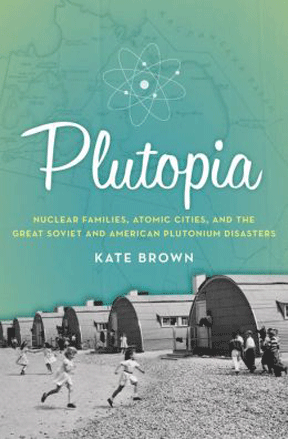
Kate Brown’s award-winning book, “Plutopia: Nuclear Families, Atomic Cities, and the Great Soviet and American Plutonium Disasters,” is a history of the Hanford plant and its Soviet doppelgänger, a plant in the Ural Mountains called Maiak. Brown points out that over the course of a few decades, the two nuclear sites spewed two times the radiation emitted in the Chernobyl explosion. Yet few Americans at the time, even those involved in plutonium production, realized this was going on or how dangerous it was.
Naturally, the hidden nature of the project meant that information was hard to come by. As Brown shows, even the experts, managers and scientists involved directly in overseeing the production process knew little about the seriousness of the risk. Doctors studying the effects of radiation on people didn’t have access to the research related to environmental pollution. Scientists studying fish die-offs had no way of connecting their findings to the deteriorating immune systems of humans in the same areas. Most poignantly, researchers measuring the effectiveness of nuclear bombs on the enemy did not communicate with researchers measuring the threat of nuclear bombs on the workers making them.
Consequences for the workers were grave. Hanford and Maiak’s hidden mega-pollution was collateral damage in the fight to win the Cold War. Russia, like the U.S., is still living with the damage, and trying to bury it, too.
Within two days of the tunnel collapse at the Hanford site this past May, workers filled the breach with 53 truckloads of dirt and narrowly avoided a radiological event. However, these eight railcars are hardly the only waste left behind in the U.S. from our cold conflict with the Soviet Union, in which our willingness to risk human and environmental health was proportionate to our fears. It’s going to be a while before it’s all cleaned up. In the meantime, hopefully our leaders will work to keep the new Cold War from getting any worse. https://www.forbes.com/sites/uhenergy/2017/12/04/the-hidden-costs-of-cold-war/#a3593c1136ff
December 6, 2017
Posted by Christina Macpherson |
- plutonium, Russia, USA, weapons and war |
Leave a comment
 Officials continue fight against nuclear waste dump on shores of Lake Huron, Many local leaders sign opposition letter Voice News By Jim Bloch | For The Voice, 3 Dec 17
Just say no to a nuclear waste dump anywhere near the Great Lakes.
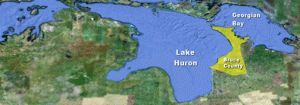
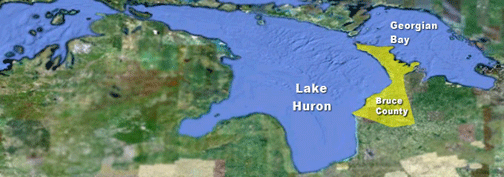
Especially the one proposed for the shores of Lake Huron in Kincardine, Ontario, Canada, about 110 miles uplake from Port Huron.
That’s the message delivered by more than 100 mayors, township supervisors and other elected officials in the region to Catherine McKenna, Canada’s minister of the Environment and Climate Change.
Of the 104 signatories, 14 hail from St. Clair County or nearby communities.
“Madame Minister, we the undersigned request that you act to protect North America’s most precious resource (the Great Lakes) and the health and safety of the millions of people who rely on your leadership by rejecting Ontario Power Generation’s application for its Deep Geological Repository in Kincardine, Ontario,” said the group.
OPG is proposing to excavate huge cavern out of a band of limestone more than 2,200 feet below the earth’s surface, framed by shale on the top and granite below, that has been stable for 450 million years, and store the nuclear waste there.
The site, next to Bruce Energy’s eight nuclear reactors, is about six-10ths of a mile from Lake Huron. The DGR is projected to hold 200,000 cubic meters of waste, some of which will remain toxic for at least 100,000 years, roughly 10 times longer than the Great Lakes have been in existence. Putting so much poisonous waste so close to the lakes amounts to madness, critics contend, especially given that all major underground burial sites for nuclear waste to date have leaked.
McKenna has asked OPG for additional information three times following the decision Joint Review Panel to recommend the project in 2015, which the company supplied — and some of which the mayors challenge in their letter.
McKenna’s delay in making a final decision on the project seems to hinge on getting feedback from the Saugeen Ojibway Nation, which is still undecided about the dump.
The chiefs and councils of SON wrote to McKenna in July reminding her of “OPG’s commitment that it will not move forward with the DGR Project until the SON communities are supportive of it…Through the process, ‘Anishnaabekiing, Anishnaabe Inwewin, Anishnaabe Naaknigewin — Our Territory, Our Voice, Our Decisions,’ members of the SON communities are becoming better acquainted with nuclear waste issues in order to be able to make a well-informed decision on whether they can support the DGR Project or not.”
In her response, McKenna suggested that her final decision may differ from the recommendation of the SON.
“I will make a decision based on science and traditional knowledge, taking into account the Joint Review Panel Report and the report by the Agency on the additional information, including the views of Indigenous Peoples, the public and other stakeholders,” McKenna said in her August response to the SON.
The signatories
Frank Fernandez, who helped organize the letter-writing drive on behalf of the Canadian-based Stop the Great Lakes Nuclear Dump, said the signees represent nearly 16 million residents hailing from Michigan, Indiana, Illinois, Wisconsin, Ohio, Minnesota, New York, Pennsylvania and Ontario, Canada.
“We are deeply concerned that Ontario Power Generation is proposing to bury nuclear waste in close proximity to the Great Lakes,” the letter states. “The Great Lakes are critically important resources to both Canada and the United States and supply drinking water to 40 million people including to the citizens we represent. The Great Lakes support fishing, boating, recreation, tourism, and agriculture and are the life-blood of a $6 trillion Great Lakes region economy.”……… Jim Bloch is a freelance writer. Contact him at bloch.jim@gmail.com. http://www.voicenews.com/news/officials-continue-fight-against-nuclear-waste-dump-on-shores-of/article_1de2f9fa-5605-5688-afdc-bc54ef98c926.html
December 4, 2017
Posted by Christina Macpherson |
Canada, opposition to nuclear, wastes |
Leave a comment
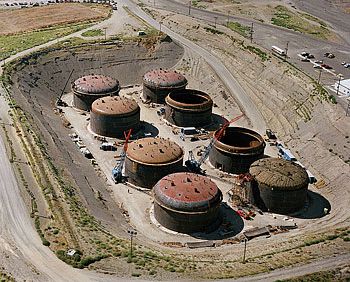 Hanford Tank Waste Among Top Federal Challenges For 2018 http://nwpr.org/post/hanford-tank-waste-among-top-federal-challenges-2018, By ANNA KING , 2 Dec 17, Cleaning up radioactive waste contained in tanks at the Hanford nuclear reservation is one of the top challenges facing the U.S. Department of Energy, according to a new special report by the department’s Inspector General.
The independent oversight arm of the U.S. Department of Energy didn’t mince words.
It said there were about 88 million gallons of radioactive tank waste across the nation that need to be cleaned up. Most is at Hanford.
The report noted that the factory meant to treat all of Hanford’s waste isn’t going so well — it’s behind schedule and will cost billions more than planned.
The report also highlighted problems that Hanford has had with its subcontractors. Specifically, several companies have agreed to pay a $125 million settlement for using substandard materials. Hanford’s tank waste and treatment plant were ranked at the top of the Department of Energy’s concerns along with cyber security and safeguarding the nation’s nuclear stockpile.
December 2, 2017
Posted by Christina Macpherson |
USA, wastes |
Leave a comment
Workers finish cleaning up nuclear burial ground, Star Tribune By NICHOLAS K. GERANIOS Associated Press, NOVEMBER 30, 2017 SPOKANE, Wash. — Workers on the Hanford Nuclear Reservation in Washington state have finished cleaning up one of the nation’s most contaminated radioactive waste sites, the U.S. Department of Energy said Thursday.
The dangerous wastes at the site known as the 618-10 Burial Ground stem from the production of plutonium for nuclear weapons and took eight years to clean up, the agency said………
The 580-square-mile site Hanford site is located in southeast Washington state.
During the cleanup, workers retrieved more than 2,200 55-gallon drums, plus other waste, some of it buried more than 20 feet underground.
In total, workers removed more than 512,000 tons of contaminated soil and waste debris, which was taken to Hanford’s hazardous-waste landfill.
The 7.5-acre burial ground contained highly radioactive waste from Hanford laboratories and fuel development facilities in the 1950s and 1960s. Poor record-keeping at the time meant many of the waste types were unknown, the department said……
Hanford was created by the Manhattan Project during World War II as the nation raced to create an atomic bomb. It produced most of the plutonium for the nation’s nuclear arsenal during the Cold War and contains the nation’s largest volume of nuclear waste.
The cleanup work costs more than $2 billion per year and is expected to take decades. The lawmakers said they will press the federal government to continue funding the work.
Progress is being made.
The Energy Department recently announced that it was essentially finished removing radioactive wastes from 16 of Hanford’s 177 underground storage tanks. http://www.startribune.com/workers-finish-cleaning-up-nuclear-burial-ground/461106933/
December 2, 2017
Posted by Christina Macpherson |
USA, wastes |
Leave a comment

Decommissioning of Candu protoype moves forward, WNN, 01 December 2017
The Canadian Nuclear Safety Commission (CNSC) has extended the deadline for public comments on Canadian Nuclear Laboratories’ (CNL) draft Environmental Impact Statement (EIS) for decommissioning the country’s first ever nuclear power reactor by two weeks to 13 February. The Nuclear Power Demonstration (NPD) reactor was the prototype for the Candu reactor design……
CNL’s NPD Closure Project aims to safely carry out the decommissioning of the NPD facility and complete the closure of the site, using an in-situ approach. This would see the reactor systems and facility structure entombed in place using specially formulated grouts. The structure would then be capped with a reinforced concrete cap and covered with an engineered barrier. The decommissioned facility would be considered to be a licensed disposal facility under Canada’s Nuclear Safety and Control Act.
The CNSC is currently accepting public comments on CNL’s draft EIS for the project, which provides an analysis of potential environmental effects and measures to mitigate those impacts. The public comment period opened on 15 November and had originally been due to end on 29 January…..http://www.world-nuclear-news.org/WR-Decommissioning-of-Candu-protoype-moves-forward-0112177.html
December 2, 2017
Posted by Christina Macpherson |
Canada, decommission reactor |
Leave a comment
Canadian, American civic leaders urge feds to reject nuclear-waste proposal National Post, 30 Nov 17, TORONTO — More than 100 mayors and other elected officials on both sides of the Canada-U.S. border are urging Environment Minister Catherine McKenna to put the kibosh on a proposed nuclear-waste bunker near Lake Huron.

In an open letter to McKenna on Thursday, the officials say they speak for 16 million people who want the Ontario Power Generation proposal shelved as a potential eco hazard.
“We are deeply concerned that Ontario Power Generation (OPG) is proposing to bury nuclear waste in close proximity to the Great Lakes,” the letter states. “We find it irresponsible and deeply troubling that OPG failed, and continues to refuse, to investigate any other actual sites.”
The 104 signatories include mayors, wardens and reeves in Ontario, among them Keith Hobbs, of Thunder Bay, Maureen Cole, of South Huron, Heather Jackson, of St. Thomas, and Pat Darte, from Niagara-on-the-Lake. American signatories include mayors Ron Meer, of Michigan City, Ind., Stephen Hagerty of Evanston, Ill., and Mike Vandersteen, of Sheboygan, Wisc.
A covering note from Mayor Mike Bradley of Sarnia, Ont., says the message in the letter is clear.We oppose the risk to our precious fresh water,” Bradley writes.
The Ontario Power Generation project, estimated to cost $2.4 billion and growing, would see a bunker built at the Bruce nuclear power plant near Kincardine, Ont., close to the Lake Huron shoreline. Hundreds of thousands of cubic metres of low and intermediate radioactive waste — stored for years at the site above ground — would be buried 680 metres deep……. http://nationalpost.com/pmn/news-pmn/canada-news-pmn/canadian-american-civic-leaders-urge-feds-to-reject-nuclear-waste-proposal
December 1, 2017
Posted by Christina Macpherson |
Canada, opposition to nuclear, wastes |
Leave a comment
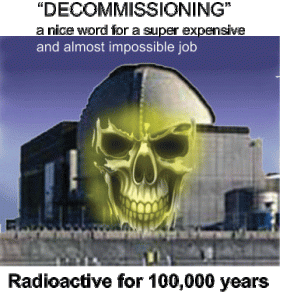 Nuclear Regulatory Commission releases first step in new decommissioning regulations https://dailyenergyinsider.com/news/9290-nuclear-regulatory-commission-releases-first-step-new-decommissioning-regulations/ November 30, 2017 by Chris Galford The Nuclear Regulatory Commission (NRC) recently completed the regulatory basis it will use for the proposal of new decommissioning regulations for commercial nuclear power reactors next year. The NRC staff have determined that new regulations are necessary in a number of areas, including emergency preparedness, physical security, cyber security, drug and alcohol testing, training requirements for certified fuel handlers, decommissioning trust funds, financial protection requirements, indemnity agreements, and how the backfit rule is applied. Many of these revolve around the decommissioning process.
Not all of these require new rules, however. NRC staff has recommended that some are simply in need of updated guidance or inspection procedures. In the case of the management of spent fuel and environmental reporting, though, they have likewise recommended greater clarity among requirements. Staff in requirements, aging management of plant systems, structures, and components, as well as the active role state and local governments are expected to play in decommissioning scenarios, could all be affected.
This process of this new regulatory basis has been underway since November 2015, and the results are now publicly available.
December 1, 2017
Posted by Christina Macpherson |
decommission reactor, USA |
Leave a comment

A poison in our island http://www.abc.net.au/news/2017-11-27/the-dome-runit-island-nuclear-test-leaking-due-to-climate-change/9161442 [Absolutely stunning photography on original] Rising seas caused by climate change are seeping inside a United States nuclear waste dump on a remote and low-lying Pacific atoll, flushing out radioactive substances left behind from some of the world’s largest atomic weapons tests. By Mark Willacy
We call it the tomb,” says Christina Aningi, the head teacher of Enewetak’s only school.
“The children understand that we have a poison in our island.” It’s “Manit Day” on Enewetak Atoll, a celebration of Marshall Islands culture when the Pacific nation’s troubled past seems a distant memory. Schoolchildren sit cross-legged on the coral sands as they sing of the islands and atolls, the sunshine and the breeze; “flowers and moonlight, swaying palm trees”.
They were born decades after the last nuclear explosion ripped through the warm Pacific air with a thunderous roar. But it’s hard to escape the long echo of the bombs.
“Gone are the days when we live in fear, fear of the bombs, guns and nuclear,” they sing.
“This is the time … this is my country, this is my land.”
But those old fears, thought to be long buried, are threatening to reawaken in their island paradise.
In the late 1970s, Runit Island, on the remote Enewetak Atoll, was the scene of the largest nuclear clean-up in United States history. Highly contaminated debris left over from dozens of atomic weapons tests was dumped into a 100-metre wide bomb crater on the tip of the uninhabited island. US Army engineers sealed it up with a half-metre thick concrete cap almost the size of an Australian football ground, then left the island.
Now with sea levels rising, water has begun to penetrate the dome.
A report commissioned by the US Department of Energy in 2013 found that radioactive materials were leeching out, threatening the already tenuous existence of Enewetak locals.
 “That dome is the connection between the nuclear age and the climate change age,” says Marshall Islands climate change activist Alson Kelen.
“It’ll be a very devastating event if it really leaks. We’re not just talking the Marshall Islands, we’re talking the whole Pacific.”
The United States detonated 43 atomic bombs around the island chain in the 1940s and 50s.
Four of Enewetak’s 40 islands were completely vaporised by the tests, with one thermonuclear blast leaving a two-kilometre-wide crater where an island had been just moments before.
Enewetak’s population had been re-located to another island in the Marshalls ahead of the tests. Residents would only be allowed to return home more than three decades later — some on the island today can still recall returning to Enewetak as children.
As part of the clean-up process, Washington set aside funds to build the dome as a temporary storage facility, and initial plans included lining the porous bottom of its crater with concrete.
But in the end, that was deemed too expensive.
“The bottom of the dome is just what was left behind by the nuclear weapons explosion,” says Michael Gerrard, the chair of Columbia University’s Earth Institute in New York.
“It’s permeable soil. There was no effort to line it. And therefore, the seawater is inside the dome.” ocals rarely set foot on Runit Island. They’re fearful of the lingering radiation from the dome and because it’s been ruled off-limits.
To this day, only three islands along Enewetak Atoll’s slender rim are considered safe enough for human habitation. “[The other islands were] too hot, too radioactive to worry about,” says Giff Johnson, publisher of the Marshall Islands Journal, the country’s only newspaper.
“There was no point [cleaning them up].”
After the fall-out from the atomic testing, life for the people of Enewetak went from a traditional existence of fishing and subsistence living to one where the waters that once supported their livelihoods were now polluted.
On the main island, where most of the atoll’s few hundred people now live, concerns about the radioactive contamination of the food chain has seen a shift away from a traditional diet of fish and coconut.
The US Department of Energy has even banned exports of fish and copra from Enewetak because of the ongoing contamination.
The vast bulk of foodstuffs are now brought into the island by barge, and that means islanders are reliant on imported canned and processed goods like Spam that have triggered health problems such as diabetes. The shelves of Enewetak’s only store are largely filled with American brand chocolate bars, lollies and potato chips.
Locals sometimes visit Runit to scavenge from scrap copper left behind by the Americans, selling it for a few dollars to a Chinese merchant.
For 30 years, Jack Niedenthal has helped the people of neighbouring Bikini Atoll fight for compensation for the 23 atomic tests conducted there. “To me, it’s like this big monument to America’s giant f–k up,” says Niedenthal. “This could cause some really big problems for the rest of mankind if all that goes underwater, because it’s plutonium and cement.”
Some of the debris buried beneath the dome includes plutonium-239, a fissile isotope used in nuclear warheads which is one of the most toxic substances on earth.
It has a radioactive half-life of 24,100 years.
Cracks are visible in the dome’s surface and brackish liquid pools around its rim.“Already the sea sometimes washes over [the dome] in a large storm,” says Columbia University’s Michael Gerrard. “The United States Government has acknowledged that a major typhoon could break it apart and cause all of the radiation in it to disperse.”
While Professor Gerrard would like the US to reinforce the dome, a 2014 US Government report says a catastrophic failure of the structure would not necessarily lead to a change in the contamination levels in the waters surrounding it.
“I’m persuaded that the radiation outside the dome is as bad as the radiation inside the dome,” says Professor Gerrard.“And therefore, it is a tragic irony that the US Government may be right, that if this material were to be released that the already bad state of the environment around there wouldn’t get that much worse.”
But that is cold comfort to the people of Enewetak, who fear they may have to be relocated once again if the dome collapses or crumbles.
“If it does [crack] open most of the people here will be no more,” says Ms Aningi.
“This is like a graveyard for us, waiting for it to happen.”
- Reporter: Mark Willacy
- Drone footage and photography: Greg Nelson
- Editor: Tim Leslie
- Producer: Matthew Henry
- Video producers: Johanna McDiarmid and Susan Kim
November 27, 2017
Posted by Christina Macpherson |
climate change, OCEANIA, safety, wastes |
Leave a comment
 Sea level rise factors into nuclear waste discussion Pilgrim advisory panel reviews issues related to dry cask storage. Cape Cod Times, PLYMOUTH , 17 Nov 17, — Entergy Corp.’s plan to store more than 4,000 highly radioactive spent fuel assemblies in massive casks about 25 feet above mean sea level at Pilgrim Nuclear Power Station raised considerable concern among members of the Nuclear Decommissioning Citizens Advisory Panel at a meeting Wednesday.
Concerns ranged from the potential for the metal-lined casks to corrode over time and leak, to the possibility that sea level rise could put them underwater in a storm.
The spent fuel will likely be stored in multipurpose dry casks, manufactured by Holtec, that are 18 feet tall and 11 feet in diameter. Once filled, they weigh 173 tons. The casks will stand on two concrete pads outside the reactor. The first pad is already in place and holds eight loaded dry casks. It can accommodate about 38.
The second pad is yet to be built and its location is still under study. It will likely be close to the first. Highly radioactive metal now in the reactor’s core also will be stored in casks, Entergy representative Joseph Lynch said.
The plant is scheduled to shut down permanently by May 31, 2019. The 21-member advisory panel was appointed to advise the governor on matters related to the plant’s decommissioning.
The reactor’s location on the coast of Plymouth raises issues such as flooding potential and cask corrosion.
Lynch provided data, based on the company’s most recent flood study, that showed a Category 5 hurricane, with waves swelling to 9 feet, could raise the sea level to 22.4 feet.
Although Lynch said the data demonstrated “we have margins,” panel members and members of the public who attended the meeting said those margins were too tight…….
Rising sea levels should be factored into planning, said Duxbury resident James Lampert. “I’m concerned, and this panel should be concerned, that we’re always taking today’s snapshot,” Lampert said. “There’s no plan to move any of this stuff. You have to assume these casks may be on the two pads for 50 or 100 years.”
Lampert asked how much of the fuel was so-called “high burn-up” — a question Lynch could not answer. According to the Nuclear Regulatory Commission website, high burn-up spent fuel is hotter and more radioactive…….
Dry cask storage of lower burn-up spent nuclear fuel has been done since 1986, but dry storage of high burn-up spent fuel is more recent, according to the U.S. Office of Nuclear Energy website. About 200 dry casks have now been loaded with at least some high burn-up fuel, the site says, and almost all spent nuclear fuel being loaded in the United States is now high burn-up.
NRC spokesman Neil Sheehan declined “for security reasons” to say how much spent fuel at Pilgrim is high burn-up.
Lampert also asked the panel to review a study by research scientist Gordon Thompson on weapons capable of penetrating dry casks.
Mary Lampert, president of the citizens group Pilgrim Watch, called projections that plants already closed, such as Vermont Yankee, would be free of stored fuel by 2052 “fantasy,” since there is still no national repository to permanently handle spent fuel.
Gov. Charlie Baker and the decommissioning panel should be looking at the worst-case scenario, she said.
The multipurpose dry casks made by Holtec are not the best choice, she said.
“Holtec casks are designed for the short term,” she said. “Diablo Canyon’s casks are showing early signs of stress corrosion.”
Although the casks are permitted for 20 years by the NRC, they will likely be relicensed for 40 or even 60 years, Lynch said.
Rebecca Chin, co-chairwoman of the Duxbury Nuclear Advisory Committee, lobbied for monitoring wells around the perimeter of the casks. “We need to know what’s running off the pad into the groundwater,” Chin said. http://www.capecodtimes.com/news/20171116/sea-level-rise-factors-into-nuclear-waste-discussion
November 18, 2017
Posted by Christina Macpherson |
safety, USA, wastes |
1 Comment

 BBC 14th Nov 2017, Permission has been sought for major changes to the Dounreay nuclear power
complex, including the demolition of its landmark dome structure. A
planning application has been submitted to Highland Council for the
dismantling of the site’s reactors.
The application covers other work,
including construction of new buildings to store low level radioactive
waste. The waste is currently held in pits that are at risk of being
exposed due to coastal erosion. Dounreay Site Restoration Limited (DSRL)
has estimated that this could take from 800 to 3,000 years to happen, with
the radioactive material then being washed out into the North Atlantic.
Thebuildings to be demolished include the Dounreay Fast Reactor’s exterior
superstructure, also known as the sphere and the golf ball. It is a
landmark feature of the nuclear site on the Caithness coast, near Thurso.
The dome, like many other structures at Dounreay, was built in the 1950s.
http://www.bbc.co.uk/news/uk-scotland-highlands-islands-41982131
November 16, 2017
Posted by Christina Macpherson |
decommission reactor, UK |
Leave a comment
‘Dangerous and destructive.’ That’s how board describes Hanford’s funding trend http://www.tri-cityherald.com/news/local/hanford/article184177936.html, BY ANNETTE CARY acary@tricityherald.com NOVEMBER 11, 2017 \

Plutonium Finishing Plant under demolition
With a projected need for five years of $4 billion annual budgets for the Hanford nuclear reservation, the Hanford Advisory Board is urging the Department of Energy to propose a ramp up in funding to Congress and the White House.
It called the current funding trend “dangerous and destructive” in a letter of advice sent to DOE at the conclusion of a two-day meeting Thursday in Richland. The board is composed of a broad representation of Tri-City and Northwest interests.
Last month, Stacy Charboneau, the DOE headquarters official who oversees Hanford and other environmental cleanup field operations across the nation, warned that Hanford cannot expect significant increases in its budget, which now ranges annually from $2.2 billion to $2.5 billion.
But under current plans, once the vitrification plant starts treating low activity radioactive waste, more money will be needed for waste treatment operations while construction continues on other parts of the plant needed to treat high level radioactive waste. Low activity waste treatment could begin as soon as 2022.
In addition, there will be increased work needed to retrieve radioactive waste from underground storage tanks and feed it to the facilities that will process low activity radioactive waste into glass logs for disposal.
The cost of the vitrification plant and tank farm work, plus $1.2 billion needed to meet legal deadlines for the rest of the nuclear reservation’s cleanup and for general operations, has been estimated at $4 billion for approximately 2022-27.
The advisory board called for a steady ramp up to that amount.
“It is the only way to help avert a major catastrophe, reduce overall costs and risks to workers, the public and the environment,” the board told DOE.
It also asked for more money to establish new storage capacity for the 56 million gallons of radioactive waste held in underground tanks above groundwater that flows toward the Columbia River.
Hanford now has just 27 double shell tanks in service to hold waste emptied from leak-prone single shell tanks until the waste can be treated for disposal.. The oldest double shell tank was taken out of service after it sprang multiple leaks between its shells, and other double shell tanks are at risk, according to the board.
DOE has resisted calls to build more double shell tanks, saying the money could better be spent on advancing environmental cleanup needed after the past production of plutonium at Hanford for the nation’s nuclear weapons program from World War II through the Cold War.
The board said it has become increasingly concerned about inadequate funding for a wide range of Hanford work, leading to the delay of cleanup projects, sometimes for decades.
“Many of Hanford’s hazardous buildings and storage facilities are 50 to 70 years old,” the board said.
Delaying work increases the cost of Hanford cleanup, both because of the large amount of money spent on maintenance and because degrading facilities increase the risk of significant accidents, the board said.
An earthquake could cause underground tanks to fail, resulting in widespread contamination to the groundwater, the board said.
The leak within Hanford’s oldest double shell tank, AY-102, resulted in $100 million being spent to empty the tank, including 500,000 hours of labor over three years and 30,000 worker entries into the tank farms.
In May, a PUREX plant tunnel storing highly radioactive waste was discovered partially collapsed and a second, longer storage tunnel at the plant was determined to be structurally unsound.
The roof of the defunct, 470-foot-long, highly contaminated REDOX processing plant recently had to be replaced to keep the plant from deteriorating until it can be cleaned up.
“These and many other hazards at Hanford will only increase with time as the facilities continue to age and degrade,” the board said.
Important cleanup work is being done, including demolition of the Plutonium Finishing Plant and preparations to move radioactive cesium and strontium capsules out of an underwater pool to safer dry storage, the board said.
“Even as important as these projects are, each took longer than necessary because of serious constraints on funding,” the board said.
It called on DOE to develop an emergency plan with funding in case of a major tank failure. It also should have money available at a national level for incidents like the leaking double shell tank or the PUREX tunnel breach so that future incidents do not reduce money already budgeted for planned cleanup work, the board said.
November 13, 2017
Posted by Christina Macpherson |
- plutonium, USA |
Leave a comment
BBC 10th Nov 2017, A drone is being used at a Scottish nuclear site for work that can involve
a risk of injury and cost thousands of pounds to be done by people. The
camera-equipped unmanned aerial vehicle is being flown on inspections of
Dounreay’s highest structures. Dounreay Site Restoration Limited (DSRL)
said it carries out about 50 such inspections every year. The nuclear power
site on the north Caithness coast near Thurso is in the process of being
decommissioned.
http://www.bbc.co.uk/news/uk-scotland-highlands-islands-41947604
November 13, 2017
Posted by Christina Macpherson |
decommission reactor, UK |
Leave a comment








 nuclear-news