CBS 8 Feb 08, 2018 By David Gotfredson, Investigative Producer SAN ONOFRE, Calif. (NEWS 8) — Millions of pounds of nuclear waste is being moved closer to the ocean at the closed-down San Onofre Nuclear Generating Station.
News 8 recorded video at San Onofre State Beach on the morning of January 31, the first day workers started moving canisters full of spent fuel rods to dry storage at the nuclear power plant.
We were met by armed security guards on the public beach.
“You guys are at your own risk being in this area. It’s your own risk, radiation risk,” one unidentified guard warned.
From the fence line, the video shows a huge crane used to transport stainless steel canisters filled with highly-radioactive waste.
The dry storage area is about 100 feet from the beach.
“What you’re looking at are 73 silos that are going to hold very large cans filled with very heavy nuclear waste,” explained Charles Langley, the executive director of Public Watchdogs.
The group opposes the waste move near the beach.
Once stored in pools of cold water inside the plant, the hot fuel rods will now be kept outside in silos protected by a cement bunker.
“If you look at this, you can see that it’s 108 feet from the water. The one thing you don’t do is put nuclear waste close to the water,” said Langley.
The canisters are welded shut before the move. It will take more than a year to slowly relocate all of them – one by one – into the silos.
Opponents worry the canisters will eventually corrode and crack in the salt air. And, if water gets inside, they say, a meltdown could result.
“These cans are literally a few feet above the salt water table. They’re made of steel. It’s good quality stainless steel but it’s only about the diameter of dime,” Langley said.
A 28 foot high sea wall protects the San Onofre facility from tidal wave action.
Whitehaven News 6th Feb 2018,Hazadous nuclear waste will be taken out of Cumbria’s Sellafield plant in
massive stainless steel containers which have just come off the production line.
The highly-engineered 1.3 tonne boxes are playing a major part in the decommissioning of the West Cumbrian plant as the waste is moved into safe
storage for centuries to come. Darchem Engineering, of Stockton on Tees, and Metalcraft in Cambridgeshire have finished manufacturing the first
batch of containers.
A total of 2,200 of the boxes will be needed to hold legacy waste from one of the world’s oldest nuclear stores,
Sellafield’s Pile Fuel Cladding Silo. Sellafield bosses have described it as the most significant step yet towards getting the waste out of the
facility next year. http://www.whitehavennews.co.uk/news/business/First-batc
GDF Watch 5th Feb 2018, Taiwan has published a report today on their geological disposal plans. The
country has decided to prioritise looking for granite-based locations for
the disposal of high-level radioactive waste, but acknowledged that such
locations were limited to only a small part of Taiwan.
The proposal is the conclusion of an 11-year study to evaluate suitable host rock suitable for
storing spent fuel. Energy company Taipower, which is responsible for
managing radioactive waste, said it will give priority to assessing the
building of a national geological repository in granite because Sweden and
Finland have also chosen granite-based sites for their waste repositories.
But it has not ruled out other host rock choices. http://www.gdfwatch.org.uk/2018/02/05/taiwan-opts-geological-disposal/
Oyster Creek’s Spent Nuclear Fuel Casks Aren’t Going Anywhere, Almost 50 years of spent nuclear fuel dry casks are stored at the Route 9 plant in Lacey Township. Lacey Patch By Patricia A. Miller, Patch Staff| LACEY TOWNSHIP, NJ – The Oyster Creek Nuclear Plant may be closing in October, but the spent nuclear fuel stored at the plant off Route 9 here for nearly 50 years isn’t going anywhere.
Why? There is no place in the United States to store them.
The proposed Yucca Mountain underground storage facility in Nevada never materialized. So nuclear plants around the country have been storing spent nuclear fuel in dry casks onsite for decades. Oyster Creek’s spent fuel is stored in horizontal dry casks in an area located near the entrance checkpoint off Route 9, NRC spokesman Neil Sheehan said.
“It is in the plant’s Protected Area, which is the fenced-in, highly secured area,” he said.
Spent fuel pools were originally designed as a short-term solution. The fuel would then cool enough so it could be shipped offsite to be reprocessed.
“But reprocessing didn’t end up being an option for nuclear power plants and the pools began to fill up,” according to the NRC.
Janet Tauro, chairman of the environmental group Clean Water Action and other environmental groups are calling for Oyster Creek’s dry casks to be “hardened,” meaning additional reinforcement in the future. They also want the capability for instrumentation, with the amount of heat and radiation inside each cask able to be monitored.
“Lacey Township is going to be a mini-Yucca,” Tauro said.
Sheehan says Oyster Creek’s dry casks consist of stainless steel canisters that hold the spent fuel. The canisters are then loaded into a steel-reinforced concrete vault.
“The vaults certainly qualify as “hardened,” as they weigh more than 100 tons when loaded and must be able to withstand hurricanes, tornadoes and more,” Sheehan said.
Oyster Creek is the oldest nuclear plant in the United States. It went online in December of 1969. The plant has a General Electric Mark I boiling water reactor, the same as the ill-fated Fukushima nuclear plant in Japan.
GDF Watch 2nd Feb 2018, A week on from the Environmental Court’s ruling, and it would seem nobody in Sweden is any the wiser about what happens next. The general view seems to be that this is a hiccup, and everything will eventually continue as planned.
But don’t expect that to happen anytime soon, and at least not until after this autumn’s national elections in Sweden. Anders Lillienau, who chaired the Court’s Hearings, is reported as saying that while they had significant concerns about the safety of the copper canisters, the Court did not otherwise see any barriers to the safety of the repository.
The Court has asked SKB, the organisation responsible for the repository, to provide further information on copper canisters to address their concerns. It is understood that SKB are preparing such information, and reportedly told a community meeting in Östhammar earlier this week that they intend to provide that information later this year.
Anders Lillenau has also made clear the ball is now in the Government’s court: “In the
end, it is still the case that the Government may make the overall assessment whether or not this will be allowed.” A Swedish Government spokesman, Magnus Blücher, explained that this was a complex issue and it was too soon to say what the Government might do, or when.
Back in Östhammar, the local referendum planned for 4 March has been postponed. The referendum was advisory, and any final decision on agreeing to host the repository has to be taken by the local council. A spokesman for Östhammar Municipality says that it is too soon to know when the referendum and council vote will now take place.
Local resident Åsa Lindstrand chairs a resident’s group opposed to the repository. She told the local newspaper that she was pleased but surprised by the Court’s decision, but feels little will change:
“Actually, nobody else in Sweden wants this nuclear fuel repository, so the rest of Sweden would probably be lucky if someone takes it. The municipality is so marinated by SKB that it is not easy to
say ‘no’. For us who live here, it’s more about noise and traffic than about the copper capsules, it’s happening before they get there at all.” Her sense of pyrhhic victory is shared by environmentalist Johan
Swahn, who added, “but only if the government stays passive and the copper canister issues raised by the Court become a matter solely for SKB.” His organisation, MKG, has raised concerns about the long-term
safety of copper canisters over many years.
While delighted that the Court accepted the case presented by leading corrosion scientists, he now wants
the Swedish Government to guarantee an open scientific re-evaluation of the issues relating to copper canister corrosion. http://www.gdfwatch.org.uk/2018/02/02/sweden-update/
NDA 1st Feb 2018,Specialist scuba divers are plumbing new depths to haul radioactive waste
out of the nuclear fuel storage pond at Sizewell A. The team of American
underwater experts tackled their first UK ‘nuclear dive’ at Dungeness A
in 2016 where, wearing full protective suits and shielded from radiation by
the water, they were able to cut up empty fuel storage skips and retrieve
other pieces of submerged equipment.
The ponds were used to store thousands
of used nuclear fuel rods, held in metal skips, after they were discharged
from the reactors. After the last of the fuel was transported to Sellafield
for reprocessing, the skips and a range of redundant items, including
sludge, were left behind in the water.
Pond clean-out conventionally takes
place using remotely operated equipment to lift the whole radioactive skips
clear of the water, exposing them to the air, where they are carefully cut
up before decontamination, storage and eventual disposal. This process is
slow with potential radiation dose risks for workers. By doing the work
under water, the divers can cut up the skips more safely, access awkward
areas more easily, making the whole process safer, faster and more
productive. https://www.gov.uk/government/news/diving-into-innovation-at-sizewell
NDA 31st Jan 2018,Robots controlled by smart auto-navigation systems are doing battle in an
£8.5 million competition to find ways to tackle Sellafield radioactive
hotspots. Last year, the Nuclear Decommissioning Authority (NDA) and fellow
government agency Innovate UK launched a search for innovative technologies
that could be combined into a single seamless process for use in facilities
that will soon embark on a major decommissioning journey.
Working closely with Sellafield Ltd, who would use the technology, submissions to a
competitive process were invited from all industrial sectors. Five
promising ideas have now made it through to the final stages after being
whittled down from a shortlist of 15. The newly formed consortia are each
set to receive up to £1.5 million to build prototype demonstrators for
testing in a simulated radioactive environment. https://www.gov.uk/government/news/robots-compete-in-nuclear-decommissioning-challenge
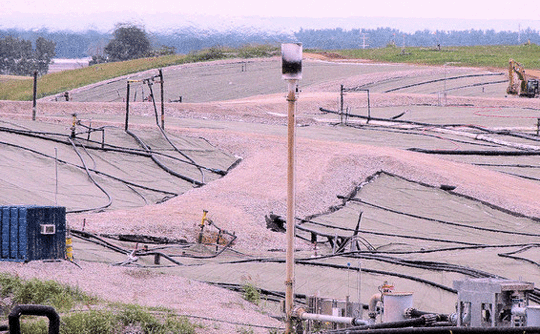
EPA orders cleanup at St. Louis nuclear waste site. What does it mean for the nation’s other toxic messes? WP, By Brady DennisFebruary 1 18, The Environmental Protection Agency on Thursday ordered a long-awaited cleanup of a Superfund site northwest of St. Louis, saying residents living near the landfill contaminated with World War II-era nuclear waste deserve action after waiting 27 years for federal regulators to issue a decision.
EPA Administrator Scott Pruitt’s decision to partially excavate tons of radioactive material from the West Lake Landfill over the next five years — at an expected cost of $236 million to the liable companies — goes beyond a 2008 solution proposed by the George W. Bush administration to cover and monitor the waste…….
Thursday’s announcement also was intended to be Exhibit A in demonstrating Pruitt’s commitment to revitalizing the agency’s Superfund program, which includes the nation’s most polluted sites, by streamlining and accelerating cleanups. But it underscored how few Superfund sites have simple answers, though nearly all of them generate intense emotions.
“We were hoping for full, 100 percent excavation. But we know that would be difficult to accomplish,” said Dawn Chapman, a founder of Just Moms STL, an activist group that has long pushed for an extensive excavation with relocation of families near the landfill.
Chapman said her group views the outcome as a hard-fought victory but one that is far from guaranteed, given the public comment and cleanup process likely to unfold over years. “We have to stay here and watch it and see it through,” she said. “I look ahead, and I see these other big battles coming. We’re not going to blink, because you can’t. … We will continue to fight to get even more [radioactive waste] removed.”
……..While the $236 million price tag of the EPA plan is significantly higher than what the firms hoped to spend, it is well below the cost, projected at nearly $700 million, of a full excavation.In a statement, Republic Services said it was “pleased that the EPA has finally ended decades of study and again is issuing a proposed plan for the site.” But the company cautioned that a final decision could take years.
What remains to be seen is whether the decision on West Lake represents how Pruitt is likely to approach other Superfund sites. In recent months, Pruitt has promised aggressive Superfund cleanups and made a public show of butting heads with corporate interests — something he has rarely done on other issues during his first year at the EPA. Yet aside from creating a list of 21 targets needing “immediate and intense” attention, as well as forming a special task force to recommend ways to expedite cleanups and “reduce the burden” on companies involved, Pruitt has explained very little about how he intends to deal with the hundreds of other toxic waste sites around the country……….
Meanwhile, the Trump administration has proposed cutting the Superfund program’s budget by 30 percent, or about $330 million annually. And while there are responsible companies that the EPA can legally force to pay for cleanups at many of the locations Pruitt has mentioned, many others are “orphan” sites where the polluters have gone bankrupt or are no longer legally liable for remedying the problem. At those, the federal government still shoulders most of the tab — and the pot of available dollars keeps shrinking. ………
Nuclear power in crisis: we are entering the Era of Nuclear Decommissioning, Energy Post, by Jim Green “…………The Era of Nuclear Decommissioning The ageing of the global reactor fleet isn’t yet a crisis for the industry, but it is heading that way. In many countries with nuclear power, the prospects for new reactors are dim and rear-guard battles are being fought to extend the lifespans of ageing reactors that are approaching or past their design date.
Perhaps the best characterisation of the global nuclear industry is that a new era is approaching ‒ the Era of Nuclear Decommissioning ‒ following on from its growth spurt from the 1960s to the ’90s then 20 years of stagnation.
The Era of Nuclear Decommissioning will entail:
A slow decline in the number of operating reactors.
Countless battles over lifespan extensions for ageing reactors.
An internationalisation of anti-nuclear opposition as neighbouring countries object to the continued operation of ageing reactors (international opposition to Belgium’s ageing reactors is a case in point ‒ and there are numerous other examples).
Battles over taxpayer bailout proposals for companies and utilities that haven’t set aside adequate funds for decommissioning and nuclear waste management and disposal. (According to Nuclear Energy Insider, European nuclear utilities face “significant and urgent challenges” with over a third of the continent’s nuclear plants to be shut down by 2025, and utilities facing a €118 billion shortfall in decommissioning and waste management funds.)
Battles over proposals to impose nuclear waste repositories and stores on unwilling or divided communities.
The Era of Nuclear Decommissioning will be characterised by escalating battles (and escalating sticker shock) over lifespan extensions, decommissioning and nuclear waste management. In those circumstances, it will become even more difficult than it currently is for the industry to pursue new reactor projects. A feedback loop could take hold and then the nuclear industry will be well and truly in crisis ‒ if it isn’t already.
Editor’s Note
Dr Jim Green is the editor of the Nuclear Monitor newsletter, where a longer version of this article was originally published.
Arctic Frontiers forum totes up Russia’s northern nuclear hazards, When Norway assesses potential nuclear risks in Northern Russia, it counts among them not just decades of intentionally scuttled radioactive trash – including two entire nuclear submarines – but also vessels transporting spent nuclear fuel throughout the Arctic, specifically from Andreyeva Bay. Bellona by Charles Digges,
When Norway assesses potential nuclear risks in Northern Russia, it counts among them not just decades of intentionally scuttled radioactive trash – including two entire nuclear submarines – but also vessels transporting spent nuclear fuel throughout the Arctic, specifically from Andreyeva Bay.
These considerations were part of a seminar held at the Arctic Frontiers forum last week in Tromsø, Norway, which tallied up ongoing threats of nuclear environmental contamination in Northwest Russia.
For decades, Norway, along with numerous other donor nations, has invested millions of dollars in improving the safety and security of Northwest Russia’s vast Cold War nuclear legacy sites.
According to Øyvind Selnæs, a senior adviser with the Norwegian Radiation Protection Authority, Norway expects to see a spike in the number of ships passing through the Arctic carrying nuclear fuel and materials as Russia seeks to build new nuclear icebreakers to guide traffic along the Northern Sea Route. He also forecasted an increase the number vessels carrying spent nuclear fuel.
Times 28th Jan 2018, Britons could be taking showers and warming homes with hot water piped
directly from a nuclear reactor, under proposals to build small atomic power stations in cities. Urban nuclear reactors, similar in size to those
in nuclear submarines, could generate not only electricity but also hot water, suggests a report by Policy Exchange, a think tank.
The paper reflects government thinking, as the National Nuclear Laboratory hasalready drawn up plans for a first “small modular reactor” at Trawsfynydd in north Wales. The Department for Business, Energy andIndustrial Strategy has also supported the idea. Such reactors could befuelled by plutonium, a waste product of Britain’s existing nuclearindustry. Stockpiles exceed 100 tons. https://www.thetimes.co.uk/edition/news/mini-nuclear-reactors-could-heat-homes-pxk3h8nkl
Nevada raises new concerns about Yucca Mountain licensing plan, Las Vegas Review Journal, By Gary Martin Review-Journal Washington Bureau, January 26, 2018 – WASHINGTON— Nevada has detailed fresh concerns about plans to expedite licensing of Yucca Mountain as a nuclear repository in a report that was delivered Friday by the state’s congressional delegation to key House members.
Rep. Dina Titus, D-Nev., distributed the state’s report to lawmakers on the House Energy and Commerce and the House Appropriation committees asking that they review it before moving forward on the Nuclear Waste Policy Amendments Act.
The amendments bill passed out of the Energy Committee on a 49-4 vote last June, and is largely expected to pass in the full House, which has yet to schedule a vote.
Nevada Gov. Brian Sandoval has led the state’s opposition to storing nuclear waste at Yucca Mountain, noting that “no amount of monetary benefits can compensate for the coerced selection of an unsafe site.”
In the report, the state said the bill does not address the amount of funding that would be needed for expediting the licensing application by the Department of Energy and the participation of federal, state and local governments in the process before the Nuclear Regulatory Commission.
Times 26th Jan 2018, Communities will receive up to £42 million if they agree to consider
hosting an underground nuclear waste dump. They can keep the money even if
they ultimately decide against it, under government plans. The payments,
which will be spread over 20 years, are aimed at persuading communities to
engage in the process of selecting and testing a site that will store
enough radioactive waste to fill the Albert Hall six times.
The Department for Business, Energy and Industrial Strategy said more than one community
could receive the funding, with each being given up to £42 million. The
proposals appear to weaken the power of county councils, making it harder
for them to prevent a community from agreeing to host the £19 billion
“geological disposal facility” (GDF).
A consultation document states
the final decision will be subject to a “test of public support”, which
could be a local referendum. The right to vote in the referendum could be
restricted to a small area around the proposed site.
Cumbria is still viewed as the most suitable location because of the ease of transporting
waste at Sellafield and the willingness of the community. However, other
areas with ageing or decommissioned nuclear plants have been suggested,
including Dungeness, Kent, and Hartlepool, in Co Durham. Doug Parr, of
Greenpeace, said: “Having failed to find a council willing to have
nuclear waste buried under their land, ministers are resorting to the
tactics from the fracking playbook — bribing communities and bypassing
local authorities.” https://www.thetimes.co.uk/edition/news/42m-offer-to-communities-that-take-radioactive-waste-svrjj29nb
The Conversation 25th Jan 2018, Why decommissioning South Africa’s Koeberg nuclear plant won’t be easy.
Koeberg has two units, each generating 930 MW, which contribute about 4% of
South Africa’s power capacity. They were built by French developer
Framatome, now called Areva.
Researchers in France, Germany and the UK have
calculated widely different costs for nuclear cleanups (including waste
disposal) in their countries. The potential cost of decommissioning a site
comparable to Koeberg according to the French costing model would be R8.4
billion. Some analysts say this is unrealistically low. The German model
puts the number at around R39 billion and the UK model at R76 billion. https://theconversation.com/why-decommissioning-south-africas-koeberg-nuclear-plant-wont-be-easy-89888
New search for communities willing to host underground site for thousands of years, Guardian, Adam Vaughan, 25 Jan 18, Local communities around England, Wales and Northern Ireland will be offered £1m a year to volunteer to host an underground nuclear waste disposal facility for thousands of years, as part of a rebooted government programme.
Under new plans published on Thursday, a test of public support will be required for the scheme to go ahead, which could include a local referendum.
The only areas to explore the idea last time round were Copeland and Allerdale borough councils in Cumbria, and Shepway District Council in Kent.
This time, interested communities that explore hosting the facility will also receive £1m a year, which officials say could be spent on developing skills locally or apprenticeships. The payments, which could rise to £2.5m annually as a community considers whether to proceed, are expected to last for around five years.
The geological disposal facility (GDF) is seen by experts as the best long-term solution to storing the estimated 750,000 cubic metres of waste generated by half a century of nuclear power and defence, which would fill three quarters of Wembley Stadium.
It also includes the radioactive material created by potentially five new plants that the government expects to be built, including Hinkley Point C, which EDF Energy is constructing in Somerset.
The Institute of Directors said storing waste deep underground would be cheaper than storing it above ground, as it is at present at around 30 sites.Business, unions and local authority groups welcomed the renewed bid to site a GDF.
“Running costs for a geological disposal facility storing the waste 1,000 metres below the surface would be significantly lower,” the business group said.
Richard Harrington, energy minister, said: “We owe it to future generations to take action now to find a suitable permanent site for the safe disposal of our radioactive waste. And it is right that local communities have a say.”
But Greenpeace criticised the payments, calling them bribes, and said new nuclear power plants should not go ahead without a long-term solution in place for their waste.
Doug Parr, the group’s chief scientist, said: “Having failed to find a council willing to have nuclear waste stored under their land, ministers are resorting to the tactics from the fracking playbook – bribing communities and bypassing local authorities.
“With six new nuclear plants being planned, the waste problem is just going to get much worse. Since there is no permanent solution for the disposal of spent nuclear fuel, the responsible thing to do would be to stop producing more of it instead of just passing the radioactive buck to future generations.”
Nuclear waste is currently stored at about 30 sites, but predominantly at ground level at Sellafield in Cumbria. The GDF project is expected to cost £12bn, spread over a century.








 nuclear-news