NPCIL’s stand on spent fuel riles environmentalists The Hindu, T.K. Rohit,FEBRUARY 27, 2018
‘Asking Supreme Court to grant 5 more years to build ‘Away From Reactor’ facility for Kudankulam plants testifies to lack of technical knowhow’
The Nuclear Power Corporation of India Ltd (NPCIL) has sought another five years’ time from the Supreme Court to set up an ‘Away From Reactor’ (AFR) facility to store the spent nuclear fuel from the operations of Kudankulam units 1 & 2.
Earlier this month, the NPCIL filed an application before the Supreme Court after it failed to meet the five-year time given by court to set up the AFR in its judgment of May 2013. The deadline ends in May 2018.
The State-owned nuclear power corporation submitted in its affidavit that setting up the AFR for the two units “is a challenging task on account of no previous experience with long-term storage requirements of high burn-up, Russian-type PWR fuel”.
As these two units were ‘first-of-its-kind’ facilities, there is a need for considerable intensive interaction with the Atomic Energy Regulatory Board, Bhabha Atomic Research Centre and Russian specialists for technical conceptualisation and detailing of the facility, the NPCIL said.
In May 2013, the Supreme Court gave the go-ahead to the Kudankulam plant to begin operations, rejecting a challenge to it based on environmental concerns and safety.
Mainichi 26th Feb 2018, The transportation of spent nuclear fuel from the site of the Fugen
prototype advanced converter reactor in central Japan will be postponed by
nine years to fiscal 2026 as a reprocessing facility has yet to be
determined, its operator said Monday.
Japan Atomic Energy Agency President Toshio Kodama announced the delay in a meeting with Fukui Gov. Issei
Nishikawa. The state-backed agency had initially aimed to complete
transportation of the fuel from the reactor in Tsuruga, Fukui Prefecture,
by next month. It was originally planned that the reprocessing facility in
Tokaimura, Ibaraki Prefecture, would receive the fuel, but the agency
decided in 2014 to scrap the plant due to the difficulty of satisfying
tighter safety regulations adopted following the 2011 Fukushima nuclear
crisis.
The agency had been looking to transport the fuel overseas for
reprocessing but discussions have not gone smoothly, sources close to the
matter said. The Fugen reactor is currently undergoing decommissioning
after being shut down in March 2003 without the prospect of being put to
commercial use, as a project to build a next-stage experimental reactor was
scrapped due to its high cost. Operation of the reactor started in 1979. https://mainichi.jp/english/articles/20180226/p2g/00m/0dm/071000c
Preparations for a potential reboot of the licensing process for the Yucca Mountain nuclear waste repository will gather steam this week at the Nuclear Regulatory Commission, even though Congress has not funded the storage project.
Cory Bernardi says a nuclear power dump could make us the ‘Saudi Arabia of the south’, news.com.au 26 Feb 18 CORY Bernardi is pushing to reignite a controversial development in South Australia, saying it could make the state the “Saudi Arabia of the south”.
LEADER of the Australian Conservatives party Cori Bernardi is pushing for a nuclear waste dump in South Australia, which he says will transform the state into the economic “Saudi Arabia of the south”.
Speaking at the party’s election launch in South Australia on Sunday, founder and federal Senator Cory Bernardi said he wanted to reopen the debate on an outback nuclear dump.
He called for changes to the law to allow for “all forms of energy production”, including nuclear power, urging authorities to “complete a full rigorous analysis” of the idea.
According to The Advertiser, he claimed the dump would generate up to $6.7 billion in gross state product, allow for $3 billion in annual taxes to be scrapped, and see the state reaping in $445 billion over the next century.
“Imagine that legacy for our children … to draw on in developing this state,” he said. “We would be an economic powerhouse. We would be the strongest state in the Commonwealth.”
Upper House candidate Robert Brokenshire said the party is “committed to looking at all types of energy production including nuclear energy to find the cheapest and most reliable form of energy”.
Labor Premier Jay Weatherill was quick to rule out the suggestion.
“That’s dead,” he said on Sunday. “Labor Party policy has been opposed to a nuclear waste facility in the past and there’s no prospect of changing that in the future.”
Mr Weatherill did not rule out pursuing a High Court case against the Turnbull government if a national nuclear waste dump was to be approved in South Australia, The Australian reported last month.
Diablo Canyon Power Plant is due to shut down in 2025, maybe earlier, but the radioactive waste it has generated will threaten our lives for another 200,000 years.
Society owns this Pandora’s box—but we haven’t owned up to the responsibility.
“For 30 years, the Nuclear Regulatory Commission has kept its head in the sands,” U.S. Rep. Salud Carbajal (D-Santa Barbara) said.
To his credit, Carbajal understands the urgency of the nuclear waste problem and has co-signed a bipartisan bill, HR 3035, that he hopes will provide a temporary solution.
Unfortunately, that legislation is seriously flawed. Without amendments or follow-up legislation, the bill threatens huge population centers in the event of likely unavoidable transportation accidents. It also establishes unsafe consolidated waste dumps without mandating a permanent, geological repository.
Having lived in the shadow of Diablo Canyon since 1985, most of us on the Central Coast have become inured to the dangers that lurk there. But even after decades of decay, it takes just a few minutes of exposure for spent fuel rods to deliver a killing dose of radioactivity. According to the Nuclear Information and Resource Service (NIRS), “Certain radioactive elements (such as plutonium-239) in ‘spent’ fuel will remain hazardous to humans and other living beings for hundreds of thousands of years. Other radioisotopes will remain hazardous for millions of years. Thus, these wastes must be shielded for centuries and isolated from the living environment for hundreds of millenia.”
“Today, there are 100 reactors operating at 59 sites in the U.S., and 35 permanently shut-down reactors at 25 additional sites,” noted Tim Judson, NIRS executive director.
How many tons of highly dangerous waste has accumulated at these sites? “The last reliable estimate was 74,000 tons in 2015—more than the 70,000-ton mandated capacity limit for Yucca Mountain [the stalled U.S. geologic repository located in Nevada],” said Judson.
On average, the industry generates about 2,000 tons of additional irradiated fuel each year, bringing the total tonnage to 80,000 tons.
Just over the hill from San Luis Obispo, approximately 2,200 metric tons of toxic waste is stored onsite at Diablo Canyon. By the time the plant closes, we’ll face a 2,690-metric-ton, 200,000-year-long local problem.
No wonder Carbajal has embraced HR 3035, which would authorize mass transportation of waste to parking lot dumps, supposedly “interim” consolidated storage sites—now proposed in Texas and New Mexico. Under the bill, our mountain of waste would become someone else’s problem.
Or would it? Why does NIRS, the Union of Concerned Scientists, San Onofre Saftey, Beyond Nuclear, and SLO-based Mothers for Peace, among others, oppose the bill?
First, consider transportation of the world’s deadliest waste. Shipments would travel through 45 states, exposing millions of people to murderous radiation in an accident.
And accidents do happen. Amtrak’s latest derailment in December sent train cars plummeting onto the interstate in DuPont, Washington. Meanwhile, in 1999, the American Petroleum Institute reported that heavy truck accidents occur approximately six times per million miles. According to the Federal Motor Carrier Safety Administration, in 2015 alone there were 57,313 fatal and injury crashes involving large trucks on our highways. Of those accidents, at least 154 resulted in the release of hazardous material.
Imagine if that hazardous material was radioactive.
OK, but aren’t the shipment casks built to withstand accidents?
Nope. The Nuclear Regulatory Commission (NRC) allows U.S. nuclear plants to store or transport spent fuel waste in thin walled welded stainless steel canisters designed to withstand a crash at 30 miles per hour. Do you want to bet lives that they would hold up in a calamity at 80 miles per hour?
Before HR 3053 is approved—and before any more thin-walled canisters are stored at earthquake-prone Diablo Canyon—there needs to be legislation mandating upgraded, thick-walled casks such as those used in Europe and Japan. We should also demand continuous, long-term monitoring and inspection of all transportation containers and/or dry storage casks, whether they’re stacked at Diablo Canyon or at consolidated the “interim” sites envisioned in HR 3053.
And let’s be honest: The Nuclear Waste Policy Act currently disallows “interim” nuclear waste storage at consolidated sites unless a permanent U.S. geologic repository is built. HR 3053, however, does away with that mandate. Without that leverage—and in light of the enormous political and scientific challenges to establishing a permanent repository—in all likelihood, “interim” will de facto become “permanent.”
What to do? Carbajal and his congressional colleagues should listen to the Union of Concerned Scientists (UCS), which has testified that “spent fuel can be managed safely at reactor sites for decades, but only if … the security of dry cask storage is enhanced.” UCS told a House committeee last year that interim facilities should not be allowed unless a permanent repository is established. And, finally, the science-based group has called for Congress to fully support the technical work needed to build a safe and secure permanent repository.
Carbajal agrees that HR 3053 is only a temporary fix and that Mothers for Peace and other opponents have legitimate concerns. But we cannot let what he terms a “Sophie’s choice” bill to become a pact with the devil.
Carbajal and Congress must address the problems before this legislation goes forward. Because, as Mothers for Peace spokesperson Linda Seeley said, “Diablo Canyon is our baby—a horrible, poisonous monster—but we have to take care of it. It’s morally wrong to do otherwise.” Δ
Amy Hewes is actively involved in grassroots political action. Send comments through the editor atclanham@newtimesslo.com.
MKG 20th Feb 2018,Translation into English of the Swedish Environmental Court’s opinion on
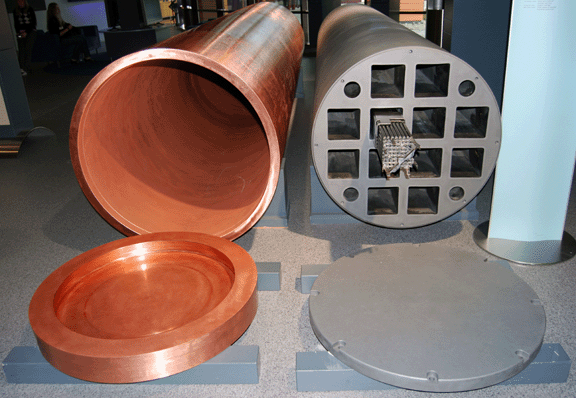
the final repository for spent nuclear fuel – as well as some comments onthe decision and the further process. The court said no to the application because it considered that there were problems with the copper canister that had to be resolved now and not later.
The translation shows the court’s judicial argumentation and why it decided not to accept the regulator
SSM’s opinion that the problems with the integrity of the copper canister were not serious and could likely be solved at a later stage in the decision-making process.
The main difference between the court’s and the regulator’s decision-making was that the court decided to rely on a multitude of scientific sources and information and not only on the material provided by SKB.
Here is a 1997 article by a nuclear fission expert on the health effects of the deadly substance.
Plutonium pellet
By Dr Arjun Makhijani
Institute for Energy and Environmental Research
December 1997
Plutonium-239 is a very hazardous carcinogen which can also be used to make nuclear weapons. This combination of properties makes it one of the most dangerous substances. Plutonium-239, while present in only trace quantities in nature, has been made in large quantities in both military and commercial programs in the last 50 years. Other more radioactive carcinogens do exist, like radium-226, but unlike plutonium-239 cannot be used to make nuclear weapons, or are not available in quantity. Highly enriched uranium (HEU) can also be used to make nuclear weapons, but it is roughly one thousand times less radioactive than plutonium-239. The danger is aggravated by the fact that plutonium-239 is relatively difficult to detect once it is outside of secure, well-instrumented facilities, or once it has been incorporated into the body. This is because its gamma ray emissions, which provide the easiest method of detection of radionuclides, are relatively weak.
The main carcinogenic property of plutonium-239 arises from the energetic alpha radiation it emits. Alpha particles, being heavy, transfer their energy to other atoms and molecules within fewer collisions than the far lighter electrons which are the primary means of radiation damage for both gamma and beta radiation.1 Alpha particles travel only a short distance within living tissue, repeatedly bombarding the cells and tissue nearby. This results in far more biological damage for the same amount of energy deposited in living tissue. The relative effectiveness of various kinds of radiation in causing biological damage is known as “relative biological effectiveness” (RBE). This varies according to the type of radiation, its energy, and the organ of the body being irradiated. A simple factor, called quality factor, is used to indicate the relative danger of alpha, beta, gamma and neutron radiation for regulatory purposes. The International Commission on Radiation Protection currently recommends the use of a quality factor of 20 for alpha radiation relative to gamma radiation.2
Once in the body, plutonium-239 is preferentially deposited in soft tissues, notably the liver, on bone surfaces, in bone marrow and other non-calcified areas of the bone, as well as those areas of the bone that do not contain cartilage. Deposition in bone marrow can have an especially harmful effect on the blood formation which takes place there. By contrast, radium-226, another alpha emitter, is chemically akin to calcium and so becomes deposited in the calcified areas of bones.
When it is outside the body, plutonium-239 is less dangerous than gamma-radiation sources. Since alpha particles transfer their energy within a short distance, plutonium-239 near the body deposits essentially all of its energy in the outer dead layer of the skin, where it does not cause biological damage.
The gamma rays emitted due to plutonium-239 decay penetrate into the body, but as these are relatively few and weak, a considerable quantity of plutonium-239 would be necessary to yield substantial doses from gamma radiation. Thus, plutonium-239 can be transported with minimal shielding, with no danger of immediate serious radiological effects. The greatest health danger from plutonium-239 is from inhalation, especially when it is in the common form of insoluble plutonium-239 oxide. Another danger is absorption of plutonium into the blood stream through cuts and abrasions. The risk from absorption into the body via ingestion is generally much lower than that from inhalation, because plutonium is not easily absorbed by the intestinal walls, and so most of it will be excreted.
The kind of damage that plutonium-239 inflicts and the likelihood with which it produces that damage depend on the mode of incorporation of plutonium into the body, the chemical form of the plutonium and the particle size. The usual modes of incorporation for members of the public are inhalation or ingestion. Plutonium may be ingested by accidental ingestion of plutonium-containing soil, or through eating and drinking contaminated food and water. Incorporation via cuts is a hazard mainly for workers and (in former times) for personnel participating in the atmospheric nuclear testing program.
In general, plutonium in the form of large particles produces a smaller amount of biological damage, and therefore poses a smaller risk of disease, than the same amount of plutonium divided up into smaller particles. When large particles are inhaled, they tend to be trapped in the nasal hair; this prevents their passage into the lungs. Smaller particles get into the bronchial tubes and into the lungs, where they can become lodged, irradiating the surrounding tissue.
Other plutonium isotopes that emit alpha radiation, like plutonium-238, have similar health effects as plutonium-239, when considered per unit of radioactivity. But the radioactivity per unit weight varies according to the isotope. For instance, plutonium-238 is about 270 times more radioactive than plutonium-239 per unit of weight.
Experimental data
The health effects of plutonium have been studied primarily by experiments done on laboratory animals. Some analyses have also been done on workers and non-worker populations exposed to plutonium contamination. Measurements of burdens of plutonium using lung counters or whole-body counters, together with follow-up of exposed individuals, have provided information which is complementary to experimental data and analysis. Experiments injecting human beings with plutonium were also done in the United States. Between 1945 and 1947, 18 people were injected with plutonium in experiments used to get data on plutonium metabolism. They were done without informed consent and have been the object of considerable criticism since information about them became widely known in 1993.
Experiments on beagles have shown that a very small amount of plutonium in insoluble form will produce lung cancer with near-one-hundred-percent probability. When this data is extrapolated to humans, the figure for lethal lung burden of plutonium comes out to about 27 micrograms. Such an extrapolation from animals, of course, has some uncertainties. However, it is safe to assume that several tens of micrograms of plutonium-239 in the lung would greatly increase the risk of lung cancer. Larger quantities of plutonium will produce health problems in the short-term as well.
The precise quantitative effects of considerably lower quantities of plutonium are as yet not well known. This is due to several factors such as: the difficulty of measuring plutonium in the body; uncertainties regarding excretion rates and functions due to the large variation in such rates from one human being to the next (so that the same body burden of plutonium would produce considerably different doses); complicating factors such as smoking; uncertainties in the data (as, for instance, about the time of ingestion or inhalation); differing and largely unknown exposure to other sources of carcinogens (both radioactive and non-radioactive) over the long periods over which studies are conducted; failure to study and follow-up on the health of workers who worked with plutonium in the nuclear weapons industry to the extent possible.
One of the few attempts to analyze the effects of microgram quantities of plutonium on exposed human subjects was a long-term study of 26 “white male subjects” from the Manhattan Project exposed to plutonium at Los Alamos in 1944 and 1945, where the first nuclear weapons were made. These subjects have been followed for a long period of time, with the health status of the subjects periodically published. The most recent results were published in a study in 1991.3
The amounts of plutonium deposited in the bodies of the subjects were estimated to range from “a low of 110 Bq (3 nCi) …up to 6960 Bq (188 nCi),”4 corresponding to a weight range of 0.043 micrograms to 3 micrograms. However, weaknesses in the study resulted in considerable uncertainties about the amount and solubility of plutonium actually incorporated at the time of exposure.5
Of the seven deaths by 1990, one was due to a bone cance (bone sarcoma).6 Bone cancer is rare in humans. The chances of it normally being observed in a group of 26 men over a 40-year timeframe is on the order one in 100. Thus, its existence in a plutonium-exposed man (who received a plutonium dose below that of current radiation protection guidelines) is significant. 7 There are data for plutonium exposure in other countries, notably in Russia. These are still in the process of being evaluated. Collaborative US-Russian studies are now beginning under the Joint Coordinating Committee on Radiation Effects Research (JCCRER) to assess the health effects of the Mayak plant to both workers and neighbors of the facility.
Endnotes
1. Gamma rays consist of high energy photons, which are “packets” or quanta of electromagnetic energy.
2. The energy deposited in a medium (per unit of mass) is measured in units of grays or rads (1 gray = 100 rads), while the biological damage is measured in sieverts or rems (1 sievert = 100 rems).
3. G.L.Voelz and J.N.P. Lawrence, “A 42-year medical follow-up of Manhattan project plutonium workers.” Health Physics, Vol. 37, 1991, pp. 445-485.
4. Ibid., p. 186.
5. These aspects of the study are discussed in some detail in Gofman 1981, pp. 510-520 (based on the status of the Manhattan Project workers study as published in Voelz 1979). See J.W. Gofman, Radiation and Human Health, (San Francisco: Sierra Club Books, 1991), p. 516.
6. Three of these deaths were due to lung cancer. It is difficult to assess the significance of this large percentage, since all three were smokers.
7. Voelz, p. 189.
Arjun Makhijani, President of IEER, holds a Ph.D. in engineering (specialization: nuclear fusion) from the University of California at Berkeley. He has produced many studies and articles on nuclear fuel cycle related issues, including weapons production, testing, and nuclear waste, over the past twenty years. He is the principal author of the first study ever done (completed in 1971) on energy conservation potential in the U.S. economy. Most recently, Dr. Makhijani has authored Carbon-Free and Nuclear-Free: A Roadmap for U.S. Energy Policy (RDR Books and IEER Press, 2007), the first analysis of a transition to a U.S. economy based completely on renewable energy, without any use of fossil fuels or nuclear power. He is the principal editor of Nuclear Wastelands and the principal author of Mending the Ozone Hole, both published by MIT Press.
Also see: Radioactive iodine releases from Japan’s Fukushima Daiichi reactors may exceed those of Three Mile Island by over 100,000 times, March 25, 2011.
Last month Cumbria Trust reported that the Swedish Environmental Court had blocked a licence application to construct a GDF for spent nuclear fuel after serious concerns were raised over the corrosion of the copper canisters used in the KBS-3 method. The same containment method is intended to be used in the UK. This court ruling was a success for MKG, the Swedish environmental organisation which receives government funding to act as a critical friend, scrutinising Sweden’s plan to bury nuclear waste.
MKG have now released some further details which show that the corrosion concerns are shared by experts within the Swedish regulator, SSM. While the nuclear industry, including the UK’s Radioactive Waste Management (RWM) seem keen to minimise the significance of this court ruling, by describing it as a delay and a request for more information, it appears the problem may be more fundamental, and could lead to this method of KBS-3 copper encapsulation being abandoned. This would damage the UK’s search process.
A key assumption with the KBS-3 method is that copper does not corrode in anoxic conditions, that is without the presence of oxygen. While there will be oxygen present at first, once the canisters are placed within the bentonite clay, bacteria and chemical processes consume the oxygen, creating the desired anoxic environment. However, it is becoming increasingly clear that even without oxygen, the copper begins to corrode by pitting. The heat generated by the spent fuel appears to be a significant factor in accelerating this pitting process. These capsules were intended to remain intact for a million years, but tests have suggested that they may well fail much sooner.
The significance of the problem goes well beyond this encapsulation method. There are lessons that should be learned, but the question is whether the nuclear industry will be open enough to do so. One key lesson is that funding a critical friend NGO such as MKG, can help to identify problems and reduce the impact of groupthink which leads to irrational decision-making. Another appears to be that we are prone to over-confidence in engineering. Isolating nuclear waste from the surface for a million years, particularly waste types which produce a great deal of heat, is complex. While we can test potential containment methods for around a generation, we need to be confident that these methods will continue to work for 30,000 generations.
“There is only one form of containment for liquids and gases which has been demonstrated to work for millions of years, even under great pressure, and that is geological formations. We have a vast quantity of evidence from the oil and gas industry of rock formations which have isolated hydrocarbons from the surface for many millions of years. So while Cumbria Trust continues to support the principle of geological disposal, as potentially the least bad solution to an existing problem, the key to its success must be the geology in which it is constructed.”
Any search process for a GDF site must begin with suitable geology and the failed attempts in Cumbria have concluded that the search should move to an area of simple geology and low groundwater flow. Cumbria Trust fears that the selective blindness which has led to the previous failures of the search process, will result in another attempt to target Cumbria despite its complex geology.
Reporterrre 16th Feb 2018, Nuclear waste: the state must stop lying. Pointing out that the situation in which the nuclear industry has led France is particularly complicated.
Why ? Because, while the other countries exploiting nuclear energy have to manage only one type of waste, the spent fuels leaving highly radioactive reactors, France is engaged in the way of reprocessing, which leads to create five types of waste, as we explained in detail this week minor actinides; plutonium, the used MOx, reprocessed uranium, spent uranium
fuel.
The situation is further complicated because there are also graphite-gas fuels, depleted uranium, mine waste rock, and so on. But stay with these five types of waste, the most dangerous. As each has different radioactive and thermal characteristics, each calls for a particular solution.
In other words, while, for example, the United States or Sweden has to manage only one type of nuclear waste – and there is no solution to it – France has five headaches. instead of one. Honesty would be to recognize it, rather than make the public believe that there is ” nuclear waste ” and that it will be enough to bury it to solve the problem. https://reporterre.net/Dechets-nucleaires-il-faut-que-l-Etat-cesse-de-mentir
Reporterre 17th Feb 2018, The La Hague plant in the English Channel sees its nuclear waste storage
ponds approaching saturation. Concern is growing in the French nuclear industry, which is desperate for solutions to the different types of high-level radioactive waste it has accumulated for years. https://reporterre.net/Reporterre-sur-Radio-Suisse-A-La-Hague-rien-ne-va-plus
Reporterre 15th Feb 2018, The storage of radioactive waste in ” swimming pools ” is excessively dangerous: risk of breach, attack, dangerous transport, etc. France is one of the few countries that has not opted for dry storage, which is much safer. https://reporterre.net/Piscine-et-transport-de-dechets-nucleaires-ca-risque-gros
While 14 years seems like a long time to clean up the 44-acre nuclear waste dump in Parks Township, progress seems imminent.
But only after another delay.
The resolution of a bid challenge for the $350 million contract to excavate and remove radioactive contamination from 10 shallow trenches added 1 1⁄2years to the cleanup process, which now could run through 2032.
President Trump’s 2019 budget allotment of $8 million to the Army Corps of Engineers will continue the planning, testing and other preparations for the cleanup.
Excavation stopped at the site in 2011 because a Corps contractor allegedly mishandled and found more complex nuclear material than expected.
‘Atomic Homefront’ unboxes the cruel consequences of Missouri’s radioactive landfill, The Daily Dot Kahron Spearman—Feb 18
The film takes a human look into a St. Louis-area radioactive landfill that dates back to the Manhattan Project. Cammisa runs down the intertwining and harrowing paths of Bridgeton, Missouri, residents, and those living near the Coldwater Creek floodplain, which flows downstream from the nuclear landfill……..
Because there isn’t any official evidence—or any that the government will admit to—supporting a causal relationship between the radiation and the extraordinary rates of various cancers, pulmonary di – wepons before peopleseases, and multiple sclerosis, the residents exist on a shifting plate, tottering white-hot anger and unparalleled astonishment toward the federal authorities. The film is well-researched given that there’s an open, yet silent antagonism toward those seeking purpose by pushing back on the government’s “science” about the radiation exposure. …..
In the end, the critical takeaway remains the government’s dark submission to weapons. The human impact in the film is maddening and undeniable, begging for some exploration into the awful self-evidence of our defense apparatus: We need these weapons, so whatever collateral damage arises is for the good of the country. Yes, even your cancer.
Seven electric power companies that plan to decommission nuclear reactors have yet to secure disposal sites for the low-level radioactive waste produced in the dismantling process, an Asahi Shimbun survey showed on Feb. 16.
It may take years for the utilities to gain approval from local governments to dispose of the waste, some of which must remain buried for 100,000 years, meaning that the decommissioning work could be suspended.
Low-level radioactive waste generated during conventional operations of nuclear reactors can be buried at a disposal site of Japan Nuclear Fuel Ltd. in Rokkasho, Aomori Prefecture.
However, the electric power companies themselves must dispose of the low-level radioactive waste produced during decommissioning work.
The Asahi Shimbun asked 10 electric power companies, including Japan Atomic Power Co., about whether they have secured disposal sites for low-level radioactive waste.
Seven companies–Tokyo Electric Power Co., Chubu Electric Power Co., Kansai Electric Power Co., Chugoku Electric Power Co., Shikoku Electric Power Co., Kyushu Electric Power Co. and Japan Atomic Power–replied that they have not secured sites despite their plans to decommission reactors.
In total, they plan to decommission 17 reactors.
The demolition of a 1.1 gigawatt-class nuclear reactor produces more than 10,000 tons of low-level radioactive waste.
The three other companies–Hokkaido Electric Power Co., Tohoku Electric Power Co. and Hokuriku Electric Power Co.–also have not secured disposal sites, but they have no decommissioning plans at the moment.
“We are not considering decommissioning our nuclear reactors,” a Hokuriku Electric Power official said. “As of now, we have not yet decided on a plan to secure disposal sites.”
There are three categories of nuclear waste–L1, L2 and L3–depending on their radioactivity levels.
L1 waste, which has the highest radioactivity level and includes control rods, must be buried more than 70 meters deep into the ground for 300 to 400 years.
After that, the government manages the waste for 100,000 years.
The government is currently studying regulation standards for such waste.
Electric power companies decided to decommission some of their nuclear reactors after the March 2011 disaster unfolded at the Fukushima No. 1 nuclear power plant.
Full-fledged decommissioning work is expected to start soon, but parts removed from the reactors have high radiation levels and cannot be placed temporarily in the compounds of nuclear power plants.
High-level radioactive waste is also produced as a result of the reprocessing of spent nuclear fuel. The government is looking for a disposal site for such waste.
Electric power companies could heighten their demands that the government get involved in efforts to secure disposal sites for low-level radioactive waste.
WNN 17 Feb 18 US-based GE Hitachi Nuclear Energy (GEH) has been awarded a three-year contract to dismantle the reactor internals of units 1 and 2 at the Oskarshamn nuclear power plant in Sweden
Under a contract signed with plant operator OKG AB on 19 December, Wilmington, North Carolina-based GEH will segment the reactor pressure vessel internals of both units. The work includes dismantling, cutting and packing the reactor internals for final disposal.
Segmentation of the reactor internals of Oskarshamn 2 is scheduled to begin in January 2018, with that of unit 1 set for 2019. The segmentation project is expected to be completed by the beginning of 2020.
Lance Hall, executive vice president of GEH’s nuclear services business, said today: “This is a breakthrough project for us in the decommissioning space in Europe and we look forward to drawing upon the many resources of the ‘GE Store’, including the depth of the global supply chain of GE and the former Alstom power businesses to deliver superior safety and cost efficient performance for our customer.”…….http://www.world-nuclear-news.org/WR-GE-Hitachi-to-dismantle-Oskarshamn-units-0301174.html
On February 13, 2018, the Reporterre site revealed the new EDF project. In view of the prolongation of the operation of nuclear reactors and to unclog the four basins of the La Hague plant where used fuel is stored, the electrical firm wants to build a giant new “pool of deactivation” near the Belleville plant -sur-Loire (Cher). We strongly condemn this imposed, dangerous and expensive project. Rather than create a new trash, EDF must turn off the tap and dry up the production of unmanageable radioactive waste!
In France, spent fuel is stored in “deactivation pools” for the time needed to cool them (between 3 and 5 years). If each nuclear power plant has its own pool adjoining the reactor building, the La Hague plant (Manche) hosts 4 pools in which are immersed more than 10,000 tons of spent fuel, representing a hundred reactor cores waiting for a improbable “reprocessing”. Supposedly temporary, storage in these pools has been going on for 40 years. Consequences: the pools are full and the space is running out. Instead of starting a decline in spent fuel stocks by stopping the production of electricity from nuclear power, EDF is stubborn and plans to build an additional pool in Belleville-sur-Loire. But the experience of La Hague shows that the use of these pools goes hand in hand with disproportionate risks.
Vulnerable pools and potentially dramatic accidents The 4 cooling pools at the La Hague plant concentrate the largest volume of radioactivity in Europe. Belleville-sur-Loire could soon compete with this facility. Oversized, the giant basin that EDF plans to build in Belleville-sur-Loire could accommodate up to 8,000 tons of spent fuel, the equivalent of 93 cores of reactors.
This project is all the more worrying because EDF is never very concerned about the protection of the reactor deactivation pools it operates. Will the centralized Belleville pool be protected as recommended by nuclear safety authorities around the world since Fukushima? Nobody can say it. And the risk increases even if EDF chooses not to bunkerize the building that contains the pool, as is the case at the Orano factory in La Hague, where the basins are protected by a vulgar tin roof
… But even with a concrete hull, in the event of an accident, the amount of radioactivity released into the atmosphere would be incommensurate with the releases resulting from an accident in the core of a reactor: to concentrate in the same place such a quantity of radioactive material has intrinsic risks. And what about the dangers of transporting such large quantities of radioactive waste across France?
The Belleville-sur-Loire swimming pool project poses even more safety problems because it is supposed to house the assemblies of MOX – a mixture of uranium and plutonium oxides – a particular fuel that, when it is used, releases much more radioactivity than “normal” uranium assemblages. And since MOX can not be reprocessed or reused, temporary storage in this pool could well become permanent storage.
Finally, in normal operation, these pools are allowed to reject radioactivity. If a new bin of this kind were built, dangerous radioelements like tritium or krypton 85 would inevitably end up in the environment.
An opaque and expensive project EDF led this project with complete opacity. At the time Greenpeace submitted a report that points to the fragility and dangerousness of the 62 cooling pools scattered over the hex, EDF plans to build a 63rd, size XXL. Discussed on the sly, well protected from democratic choices and far from energy issues, the project was kept secret by EDF.
Once again, citizens and residents of the region are faced with a fait accompli. Still, the idea is in the pipes for a long time. Urged by ASN – which invited it in 2013 to “revise its spent fuel management and storage strategy, by proposing new storage methods” – EDF, to comply with the National Plan management of radioactive materials and waste, once again chose the worst option.For EDF and the promoters of the atom, the construction of such an installation is only one way of guaranteeing new outlets for a declining nuclear industry and of claiming to ensure the management of spent fuel for a new period.
The “Sortir du nucléaire” Network strongly denounces this project and, alongside the associations of the region, will resolutely oppose its implementation. In no case this pool is a “solution” to the problem of the accumulation of radioactive waste. In order not to generate new risks and to put the costs of a disproportionate installation on the citizens, the only solution is to dry up the production of this unmanageable waste. Press contacts: Martial CHATEAU: 06 45 30 74 66 Catherine FUMÉ: 06 62 84 13 88










 nuclear-news