
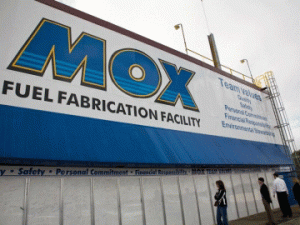
 Trump administration axes project to generate power from plutonium, Timothy Gardner, WASHINGTON (Reuters) 13 May 18 – The Trump administration plans to kill a project it says would have cost tens of billions of dollars to convert plutonium from Cold War-era nuclear bombs and burn it to generate electricity, according to a document it sent to Congress last week.
The Department of Energy submitted a document on May 10 to Senate and House of Representative committees saying that the Mixed Oxide (MOX) project at the Savannah River Site in South Carolina would cost about $48 billion more than $7.6 billion already spent on it. The United States has never built a MOX plant.
Instead of completing MOX, the administration, like the Obama administration before it, wants to blend the 34 tonnes of deadly plutonium – enough to make about 8,000 nuclear weapons – with an inert substance and bury it underground in a New Mexico’s Waste Isolation Pilot Plant (WIPP). Burying the plutonium would cost about $19.9 billion, according to the document, a copy of which was seen by Reuters.
“We are currently processing plutonium in South Carolina for shipment (to WIPP) … and intend to continue to do so,” Energy Secretary Rick Perry said in a letter sent to committee leaders.
Legislation passed in February allows the Energy Department to advance burying the plutonium if it showed that the cost would be less than half of completing MOX……..
Edwin Lyman, a physicist at science advisory group the Union of Concerned Scientists concerned about plutonium getting into the wrong hands, said Perry had made a sensible decision. “MOX was a slow-motion train wreck, and throwing good money after bad simply wasn’t an option.”
Reporting by Timothy Gardner; Editing by Lisa Shumaker https://www.reuters.com/article/us-usa-plutonium-mox/trump-administration-axes-project-to-generate-power-from-plutonium-idUSKCN1IE0LH
May 14, 2018
Posted by Christina Macpherson |
- plutonium, politics, reprocessing, USA |
Leave a comment

 Campaigners slam £1m incentive to store nuclear waste https://www.theguardian.com/environment/2018/may/12/incentive-compensation-nuclear-waste-boreholes-communities
Compensation offered to encourage local communities to allow test boreholes is described as ‘completely inadequate’
MPs from both major parties have attacked the government’s latest incentive to entice communities into volunteering to host Britain’s first deep underground store for nuclear waste as “completely inadequate”.
Ministers have offered up to £1m per community for areas that constructively engage in offering to take part in the scheme, and a further sum of up to £2.5m where deep borehole investigations take place.
The aim is to find a permanent underground geological disposal facility (GDF) that could store for thousands of years the waste from Britain’s nuclear energy and bomb-making programmes. The scheme could involve building stores under the seabed to house highly radioactive material. It is predicted that the UK is likely to have produced 4.9m tonnes of nuclear waste by 2125.
But critics say the inducements offered by the government – part of the consultations it launched this year – to ensure local cooperation are “simply not good enough”, and point to the example of France, which has a similar amount of nuclear waste. It offers around €30m (£26.5m) a year as local support for districts neighbouring the site at Bure, in north-east France, and has also offered €60m in community projects.
“The government’s offer in its consultation is simply not good enough. These communities are being asked to perform an important public service and should be properly recompensed,” said Rebecca Long-Bailey, the shadow business secretary.
However, local campaigners fear that a waste site could affect tourism, on which Cumbria is heavily reliant. “For the sake of a few hundred jobs and a few million pounds, we risk thousands of jobs in the tourism sector, which contributes £2.7bn a year to Cumbria’s economy,” said Geoff Betsworth, chairman of the Cumbria Trust. “Even a 10% dent in tourism would cost £270m a year. The offer of £1m in community benefits, rising to £2.5m when boreholes begin, is absurdly low.”
The government is seeking to dispose of the UK’s nuclear waste underground because current storage facilities are both ineffective and expensive to maintain. A GDF would involve sealing the waste in rock for as long as it remains a hazard.
 The plan was also criticised by the Conservative MP Zac Goldsmith, who said the UK should stop making nuclear waste and stop building new reactors.
“We are still pouring untold billions of taxpayer money into propping up an industry that the free market would have killed off years ago,” he said. “In return, we will be compounding the catastrophe of a nuclear waste build-up, which we are no closer to solving than we were when the industry was born.”
Nina Schrank, energy campaigner at Greenpeace UK, added: “The lack of seriousness with which the UK government treats nuclear legacy issues makes it predictable that their quest for a suitable site has been so unsuccessful that they are looking again at the Irish Sea, which Sellafield turned into one of the most radioactively contaminated seas in the world.”
A government spokesperson said: “The GDF will be a multibillion-pound project that can provide substantial benefits to host communities. This includes skilled employment for hundreds of people for decades to come, spin-off benefits such as infrastructure investment, as well as positive impacts on local service industries that support the facility and its workforce.”
May 14, 2018
Posted by Christina Macpherson |
politics, UK, wastes |
Leave a comment
Dallas, Midland and San Antonio city councils have already made resolutions prohibiting railcars from coming through their towns and exposing the citizens of their towns to this deadly radioactive waste.
The site can be seen from the air and is a beautiful target for terrorists during transit and after arrival at the site.
 Nukes are no good for this area http://www.oaoa.com/editorial/letters_to_editor/article_d3427d86-5637-11e8-aca7-6712110b6bed.html, May 13, 2018 Karen Howard-Winters Odessa Online,
I believe our livelihood is in great danger of becoming destroyed by a company named Holtec International. They have applied to the Nuclear Regulatory Commission (NRC) for a 40-year license for an interim High-Level Radioactive Nuclear Waste Facility to be built between Carlsbad and Hobbs, New Mexico.
This is not the facility in Andrews. Although, now that Holtec has applied for their license, Waste Management Specialists (WCS) had placed their license request for the High-Level Radioactive Nuclear Waste on hold due to issues regarding the pending sale of their facility to Orano. However, now that the sale is complete and things have settled down, and they are watching what is going on with Holtec. Then, we fear, Orano is going to revise and reapply for a license requesting for the same as Holtec – high-level radioactive nuclear waste to be disposed of in the Andrews site, claiming it to be interim as well.
Why are we concerned and people in Midland and Odessa should be, too?
1. This is the first time anything of this gravity has ever been attempted in this country!
a. Radioactive waste has been moved around, but nothing remotely on this level of danger, nothing on this scope of magnitude and nothing on this level or for this interim duration.
b. Our deep concern is that no permanent site has even been discussed yet!!
c. By the time a “permanent” repository is found (which will probably be never) the canisters/casks will be too fragile to be moved due to deterioration from sun exposure/weathering or just time in general and the site will become a de facto permanent disposal site and another Super Fund site that New Mexico will have to try to maintain forever.
2. The Holtec site is on top of our Permian Basin oil reserves sitting directly on top of the Delaware Basin and our Olgalla Aquifer and don’t let any tell you they’re not as the old maps tell you they are.
3. This deadly waste is responsible for cancers, genetic birth defects and deaths as witnessed in the Tulrosa Basin Downwinders Claims after the atomic bomb experiments at the Los Alamos experimental site prior to the dropping of the bombs in Hiroshima and Nagasaki that ended WWII. The town of Trinity was never advised of these trials and the fallout affected the towns’ people with all kinds of different cancers that no one had ever had before.
4. This radioactive waste (even though they tell you it is in solid form and is more easily handled), is to be sent here by rail coming through Odessa. If that train wrecks on Faudree and Hwy 80 would have contained nuclear waste, it would have taken out the Odessa Country Club Golf Course and some of the richest real estate in Odessa as the land will become unusable for 25,000 years or more.
5. What’s going to happen if an accident leaves the land unable to be used for drilling for oil? The Fasken Oil Company came to Roswell to testify in front of the NRC to say that this is a bad idea and vowed to do everything they can to round up all the people in the Permian Basin Oil Industry to fight this licensing.
6. One of the Midland commissioners flew in to Roswell and brought not only Fasken Oil, but a rancher from one of the big area ranches who have been in Midland County for over 102 years who has vowed to fight this with fellow ranchers.
7. One railcar contains the same amount of plutonium as was dropped on Nagasaki.
8. The land on which they have proposed to build this site is geologically unstable and there is a study out by Southern Methodist University (SMU) that, like Winkler County, has a danger of the random occurrence sinkholes at anytime, anywhere. http://blog.smu.edu/research/2018/03/20/radar-images-show-large-swath-of-texas-oil-patch-is-heaving-and-sinking-at-alarming-rates/
9. Holtec wants to bring 100,000 metric tons of this high-level radioactive nuclear waste through Odessa over 20 years after they are licensed. Dallas, Midland and San Antonio city councils have already made resolutions prohibiting railcars from coming through their towns and exposing the citizens of their towns to this deadly radioactive waste. Every time a railcar passes by an area, it releases radiation. Cumulative effects could result in birth defects to a fetus as a pregnant woman is exposed to this waste by sitting on a railcar platform waiting to go to work every day as these railcars pass by.
10. The site can be seen from the air and is a beautiful target for terrorists during transit and after arrival at the site. All it would take is a suicide plane to hit this site and it would be worse than Hiroshima or Nagasaki. Holtec is talking about bringing 100,000 metric tons of spent plutonium to the site for a total of 10,000 partially buried canisters of spent fuel rods.
11. If radiation sullies our water or our oil, we might as well, just throw in the towel and move out as our property will have no value at all.
If we lose our oil or water, we lose our city.
If you do not consent to NRC licensing Holtec for this project, please voice your dissent!
The NRC Scoping Period for this Project ends May 29! You may request, no, demand that they extend the Scoping Period to more cities so more people may voice their opinions. The people along the train routes, Midland, Odessa, Albuquerque, El Paso, Dallas, etc. You may demand they extend the Scoping Period time for an additional three to six months.
This is too important for only two months of scoping and only three public hearings in only three towns!
Moving High-Level Nuclear radioactive waste across the nation to a temporary site when no permanent site has been found is unnecessary and irresponsible. The only winner in this is a private company named Holtec. The people of Eddy and Lea Counties who want this project and are being paid a pittance are not winners as they will be stuck with a Super Fund site forever.
If you would like to voice your opinion, you have until May 29 to write to the NRC at:
May Ma Office of Administration , Mail Stop: TWNF-7-A60M , U.S. Nuclear Regulatory Commission, Washington, DC 2055-0001
May 14, 2018
Posted by Christina Macpherson |
USA, wastes |
2 Comments

 What’s Not in NNSA’s Plutonium Pit Production Decision, Santa Fe, NM –May 10, 2018 Contact Jay Coghlan, Nuclear Watch NM, 505.989.7342, c. 505.470.3154, jay@nukewatch.org Scott Kovac, Nuclear Watch NM, 505.989.7342, scott@nukewatch.org
Today the National Nuclear Security Administration (NNSA) announced: To achieve DoD’s [the Defense Department] 80 pits per year requirement by 2030, NNSA’s recommended alternative repurposes the Mixed Oxide Fuel Fabrication Facility at the Savannah River Site in South Carolina to produce plutonium pits while also maximizing pit production activities at Los Alamos National Laboratory in New Mexico. This two-prong approach – with at least 50 pits per year produced at Savannah River and at least 30 pits per year at Los Alamos – is the best way to manage the cost, schedule, and risk of such a vital undertaking.
First, in Nuclear Watch’s view, this decision is in large part a political decision, designed to keep the congressional delegations of both New Mexico and South Carolina happy. New Mexico Senators Tom Udall and Martin Heinrich are adamantly against relocating plutonium pit production to South Carolina. On the other hand, South Carolina Senator Lindsay Graham was keeping the boondoggle Mixed Oxide (MOX) program on life support, and this pit production decision may help to mollify him. This could also perhaps help assuage the State of South Carolina, which is suing the Department of Energy for failing to remove plutonium from the Savannah River Site as promised.
But as important is what is NOT in NNSA’s plutonium pit production decision:
: • There is no explanation why the Department of Defense requires at least 80 pits per year, and no justification to the American taxpayer why the enormous expense of expanded production is necessary.
• NNSA avoided pointing out that expanded plutonium pit production is NOT needed to maintain the safety and reliability of the existing nuclear weapons stockpile. In fact, no production of plutonium pits for the existing stockpile has been scheduled since 2011, and none is scheduled for the future.
• NNSA did not mention that in 2006 independent experts found that pits last a least a century. Plutonium pits in the existing stockpile now average around 40 years old. The independent expert study did not find any end date for reliable pit lifetimes, indicating that plutonium pits could last far beyond just a century.
• NNSA did not mention that up to 15,000 “excess” pits are already stored at the Pantex Plant near Amarillo, TX, with up to another 5,000 in “strategic reserve.” The agency did not explain why new production is needed given that immense inventory of already existing plutonium pits.
• Related, NNSA did not explain how to dispose of all of that plutonium, given that the MOX program is an abysmal failure. Nor is it made clear where future plutonium wastes from expanded pit production will go since operations at the troubled Waste Isolation Pilot Plant are already constrained from a ruptured radioactive waste barrel, and its capacity is already overcommitted to existing radioactive wastes.
• NNSA did not make clear that expanded plutonium pit production is for a series of speculative future “Interoperable Warheads.” The first IW is meant to replace nuclear warheads for both the Air Force’s land-based and the Navy’s sub-launched ballistic missiles. The Obama Administration delayed “IW-1” because the Navy does not support it. However, the Trump Administration is restarting it, with annual funding ballooning to $448 million by 2023, and “IW-2” starting in that same year. Altogether the three planned Interoperable Warheads will cost at least $40 billion, despite the fact that the Navy doesn’t support them. 1
• NNSA’s expanded plutonium pit production decision did not mention that exact replicas of existing pits will NOT be produced. The agency has selected the W87 pit for the Interoperable Warhead, but its FY 2019 budget request repeatedly states that the pits will actually be “W87- like.” This could have serious potential consequences because any major modifications to plutonium pits cannot be full-scale tested, or alternatively could prompt the U.S. to return to nuclear weapons testing, which would have severe international proliferation consequences.
• The State of South Carolina is already suing the Department of Energy for its failure to begin removing the many tons of plutonium at the Savannah River Site (SRS). NNSA’s pit production decision will not solve that problem, even as it will likely bring more plutonium to SRS.
• The independent Defense Nuclear Facilities Safety Board has expressed strong concerns about the safety of plutonium operations at both the Los Alamos National Laboratory (LANL) LANL and SRS, particularly regarding potential nuclear criticality incidents. 2 NNSA did not address those safety concerns in its plutonium pit production decision.
• Politicians in both New Mexico and South Carolina trumpet how many jobs expanded plutonium pit production will create. Yet NNSA’s expanded plutonium pit production decision does not have any solid data on jobs produced. One indicator that job creation will be limited is that the environmental impact statement for a canceled $6 billion plutonium facility at LANL stated that it would not produce a single new Lab job because it would merely relocate existing jobs. Concerning SRS, it is doubtful that pit production could fully replace the jobs lost as the MOX program dies a slow death. In any event, there certainly won’t be any data on the greater job creation that cleanup and renewable energy programs would create. Funding for those programs is being cut or held flat, in part to help pay for nuclear weapons programs.
• Finally, the National Environmental Policy Act (NEPA) requires that major federal proposals be subject to public review and comment before a formal decision is made. NNSA’s decision does not mention its NEPA obligations at all. In 1996 plutonium pit production was capped at 20 pits per year in a nation-wide Stockpile Stewardship and Management Programmatic Environmental Impact Statement (PEIS). NNSA failed to raise that production limit in any subsequent NEPA process, despite repeated attempts. Arguably a decision to produce 80 pits or more per year requires a new or supplemental nation-wide programmatic environmental impact statement to raise the production limit, which the new dual-site decision would strongly augment. This then should be followed by whatever site-specific NEPA documents might be necessary.
Jay Coghlan, Nuclear Watch Director, commented, “NNSA has already tried four times to expand plutonium pit production, only to be defeated by citizen opposition and its own cost overruns and incompetence. But we realize that this fifth attempt is the most serious. However, we remain confident it too will fall apart, because of its enormous financial and environmental costs and the fact that expanded plutonium pit production is simply not needed for the existing nuclear weapons stockpile. We think the American public will reject new-design nuclear weapons, which is what this expanded pit production decision is really all about.
” # # #
May 12, 2018
Posted by Christina Macpherson |
- plutonium, politics, USA, weapons and war |
Leave a comment
NNSA announces decision on pit production, L A Monitor, May 11, 2018, Los Alamos National Laboratory will share production of plutonium pits with the Savannah River Site in South Carolina, the Nuclear Weapons Council and National Nuclear Security Administration announced Thursday.
LANL will maintain production of 30 plutonium pits per year, while the Savannah River Site will produce 50 pits per year.
“To achieve DoD’s 80 pits per year requirement by 2030, NNSA’s recommended alternative repurposes the Mixed Oxide Fuel Fabrication Facility at the Savannah River Site in South Carolina to produce plutonium pits while also maximizing pit production activities at Los Alamos National Laboratory in New Mexico,” according to Thursday’s release.
……. Plutonium pits are the size of a softball and are used as trigger mechanisms for nuclear weapons…..
The NNSA was given a mandate by Congress to manufacture 80 plutonium pits per year by 2030 as part of a nuclear weapons modernization plan. The NNSA has been studying which site would best be able to accommodate the manufacture of plutonium pits. ……
Nuclear Watch New Mexico criticized the decision as purely political.
“First, in Nuclear Watch’s view, this decision is in large part a political decision, designed to keep the congressional delegations of both New Mexico and South Carolina happy,” said Nuclear Watch Executive Director Jay Coghlan. “New Mexico Senators Tom Udall and Martin Heinrich are adamantly against relocating plutonium pit production to South Carolina. On the other hand, South Carolina Senator Lindsay Graham was keeping the boondoggle Mixed Oxide (MOX) program on life support, and this pit production decision may help to mollify him.
Coghlan said he believes the split plan will ultimately fail.
“NNSA has already tried four times to expand plutonium pit production, only to be defeated by citizen opposition and its own cost overruns and incompetence,” Coghlan said. “But we realize that this fifth attempt is the most serious.
“However, we remain confident it too will fall apart, because of its enormous financial and environmental costs and the fact that expanded plutonium pit production is simply not needed for the existing nuclear weapons stockpile. We think the American public will reject new-design nuclear weapons, which is what this expanded pit production decision is really all about.”
Greg Mello, executive director of the Los Alamos Study Group, took a more pragmatic view. ……
“Pit production isn’t needed for decades, even for a large arsenal, but Congress has demanded it, so the bulk of the work will leave LANL. The R and D (research and development) work will stay behind. This transition is many years down the road. Pit production will always be difficult, expensive and dangerous wherever it’s done.”
A fact sheet about the decision can be found here. http://www.lamonitor.com/content/nnsa-announces-decision-pit-production
May 12, 2018
Posted by Christina Macpherson |
- plutonium, USA, weapons and war |
Leave a comment
One of the six toes, on one of the feet, of the Yucca Dump Mutant Zombie (see image, right on original), twitched yesterday. By a lopsided vote of 340 to 72, the U.S. House of Representatives voted in favor of “Screw Nevada 2.0,” a reprise of the 1987 “Screw Nevada” bill, that singled out Yucca Mountain for the country’s highly radioactive waste dump-site in the first place
This was the biggest vote on nuclear waste in the U.S. House in 16 years, and seeks to overturn the Obama administration’s wise 2010 cancellation of the unsuitable Yucca Mountain Project. In addition to approving H.R. 3053, the Nuclear Waste Policy Amendments Act of 2018, the House, “in its wisdom” (or lack thereof!), similarly voted down an amendment offered by Dina Titus (Democrat-NV), that would have required consent-based siting for a dump like Yucca, per the 2012 recommendations by the Blue Ribbon Commission on America’s Nuclear Future.
Thank you to everyone who contacted their U.S. Rep. urging opposition to H.R. 3053. Please
check this link for more info., including to see how your U.S. Rep. voted on the Titus amendment, and the overall bill. Then
please thank or “spank” (express your disappointment to) your U.S. Rep., accordingly, and point out:
the high-risk “Mobile Chernobyl” impacts of shipping 110,000 metric tons (an increase from the current legal limit of 70,000) of highly radioactive waste, by truck, train, and/or barge, through
44 states, dozens of major cities, and 330 of 435 U.S. congressional districts, if H.R. 3053 becomes law. In addition to expediting the opening of the Yucca dump, by gutting due process and environmental and safety regulations, H.R. 3053 would authorize centralized interim storage facilities (CISFs, or de facto permanent, surface storage, “parking lot dumps”), as targeted at Holtec/ELEA, NM and WCS, TX. Re: Holtec/ELEA
please continue submitting environmental scoping public comments to the U.S. Nuclear Regulatory Commission by the
May 29th deadline —
see how, and for more info., at this link. And please also contact both your U.S. Senators, urging them to oppose bad, dangerous nuke waste dumps targeted at NM, NV, and/or TX, and the inevitable Mobile Chernobyls they would launch:
call your U.S. Senators via the Capitol Switchboard at (202) 224-3121, and fill out and submit Food & Water Watch’s webform! To learn more about the
Yucca dump scheme,
CISF proposals, and
nuclear waste transport risks, please see the corresponding Beyond Nuclear website sub-sections.
May 12, 2018
Posted by Christina Macpherson |
politics, USA, wastes |
1 Comment

 Zion’s effort to shed lakefront nuclear waste backed by U.S. House vote, Chicago Tribune, Frank Abderholden Contact Reporter, News-Sun , 10 May 18
A bill on nuclear waste policy that would restart the Yucca Mountain depository in Nevada was approved by the the U.S. House of Representatives Thursday, including an amendment introduced by U.S. Rep. Brad Schneider that also calls for a task force to be created to help communities like Zion that have stranded nuclear waste.
The 10th District Democrat said the amendment requires the secretary of energy to assemble a stranded nuclear waste task force that would identify existing resources and funding opportunities throughout the federal government to assist communities in the decommissioning process.
“For too long, communities like Zion have been saddled with housing our nation’s stranded nuclear waste while the federal government has failed to meet its legal obligation to find a permanent repository,” Schneider said in a statement following Thursday morning’s vote on Capitol Hill.
His amendment calls for the Department of Energy to complete the study in 180 days and report back to Congress with its findings.
“The project will be physically completed with (deactivation and decommissioning) in 2018,” Walker said last year. Although the federal government designated decades ago that the waste would go to Yucca Mountain in Nevada for permanent storage, the facility has not yet opened, and Zion is stuck with the waste until a solution can be found.
“I am very pleased this amendment passed the House, appreciate the bipartisan support from my colleagues and urge the Senate to take up this matter urgently,” Schneider said.
H.R. 3053, the Nuclear Waste Policy Amendments Act of 2018, was described by Schneider as “an important step forward,” but he added that more needs to be done for communities forced to store nuclear waste.
“I will continue to work with Mayor Al Hill, the city of Zion and my colleagues in Congress to get communities shouldering this burden the federal help they are owed,” Schneider said.
He added that the spent fuel stored in dry casks along the lakefront — an amount estimated last year at 1,025 metric tons — presents both “an extreme environmental hazard, and a severe burden on the quality of life of the residents of Zion — deterring economic investment, depressing home values and driving up property taxes to fill the local revenue void.”
……… “We just want them to get (the waste) out of here,” Hill said. “We are pleased with any program that will give us an opportunity to get the spent fuel rods out of our community.”
Adding that “we are pushing a large stone up a steep hill,” Hill said he believes “the federal government has not lived up to its contract with the utilities” on having a place to put the spent fuel rods.
“We lived up to our end of the contract,” he said.
While the power plant operated, ratepayers paid into a trust fund set up for the plant’s decommissioning. The $820 million fund was turned over to EnergySolutions when it took over the work in Zion following the plant’s 1998 deactivation. At the end of the project, any remaining funds are designed to be turned back over to Exelon.
According to the Associated Press, the House voted 340-72 Thursday morning to revive the mothballed nuclear waste dump at Nevada’s Yucca Mountain despite opposition from home-state lawmakers…… http://www.chicagotribune.com/suburbs/lake-county-news-sun/news/ct-lns-zion-nuclear-waste-yucca-mountain-st-0511-story.html
May 12, 2018
Posted by Christina Macpherson |
USA, wastes |
Leave a comment
 House hands off nuclear waste storage bill to Senate, https://www.utilitydive.com/news/house-hands-off-nuclear-waste-storage-bill-to-senate/523291/, Iulia Gheorghiu, 11 May 18
Dive Brief:
- The House of Representatives on Thursday passed 340-72 H.R. 3053, sponsored by Rep. John Shimkus, R-Ill., which seeks to restart the process to build a permanent repository for commercial nuclear waste at Yucca Mountain, Nev.
- The bill would also allow the Department of Energy (DOE) to consolidate and store nuclear waste temporarily, as the agency is currently unable to consider interim storage before the development of a permanent repository.
- The legislation has been strongly opposed by the Nevada delegation — Sen. Harry Reid, D-Nev., once referred to the policy to permanently store nuclear waste at Yucca Mountain as the “Screw Nevada bill.” Sen. Dean Heller, R-Nev., called H.R. 3053 “dead on arrival in the Senate” in a statement last June.
Dive Insight:
Opposition in the House came mainly from states that would be most impacted by the transportation of nuclear waste to the permanent storage site, led by Nevada representatives. Earlier this month, Rep. Dina Titus, D-Nev., called the bill “Screw Nevada 2.0” when speaking on the House floor.
On Tuesday, the Rules Committee arranged for only one of the amendments from Nevada’s representatives to be considered on the floor, from Titus. Her substitute amendment, which was rejected 80-332, sought to establish a consent-based siting process to determine a permanent repository. Consent-based siting would have placed an almost-insurmountable barrier to selecting Yucca Mountain as a permanent storage site.
The House bill had bipartisan backing and supported the buildout of interim nuclear storage, a policy that the Obama administration had also supported. Legislative efforts to reach a conclusion on permanent storage at Yucca Mountain have been stalled time and time again. But the bill has also gained momentum as more nuclear reactors near retirement and commercial nuclear waste accumulates.
The biggest challenge for the bill will be Sen. Heller’s block, confirmed Matthew Wald, senior communications adviser for the Nuclear Energy Institute, a trade group. Heller is currently blocking consideration of two Nuclear Regulatory Commission nominees who support Yucca Mountain as a permanent waste repository, according to Roll Call.
As it stands, the DOE is on the hook for a solution to permanent nuclear waste storage. The agency was supposed to begin collecting spent nuclear fuel rods in 1998 and remains responsible for storing them. Nuclear companies had been paying the agency through the Nuclear Waste Fund for the development of a permanent storage site, but the legislative stalls regarding Yucca Mountain have immobilized the DOE.
As a result, the agency is an easy legal target for the nuclear waste storing duties it has failed to perform under contract. Taxpayers pay about $800 million in damages to nuclear companies every year the government does not act, according to an estimate of legal judgments done by NEI.
When looking for the smartest, easiest, most productive solutions, there are better answers than what DOE is currently doing with nuclear waste: “babysitting this stuff in more than 100 different locations,” as NEI’s Wald put it.
A preferable alternative, according to NEI, would be centralizing interim storage for the spent nuclear fuel, much of which is housed on-site at retired nuclear plants. Interest exists among corporate groups to reprocess the spent nuclear fuel or store it temporarily.
The NRC issued a license in 2006 to Private Fuel Storage, LLC, a nuclear power utility consortium, to build temporary above-ground storage for spent nuclear fuel rods in Utah. The consortium needed approval from additional agencies and the operation never took off, although the NRC license is valid until 2026. Utah regulations ultimately made it very difficult to get fuel to the interim storage site, Wald told Utility Dive.
NRC has received other similar licensing requests, including a 2017 proposal for temporary storage in New Mexico from Holtec International.
Holtec sees the passage of H.R. 3050 as a good step towards interim and long-term solutions for nuclear waste storage.
“We believe this is a critical step for the future of nuclear power, including for innovative new reactors such as our SMR-160,” Joy Russell, Holtec’s vice president of corporate business development, wrote Utility Dive in an email.
May 12, 2018
Posted by Christina Macpherson |
politics, USA, wastes |
Leave a comment
 House approves bill to revive Nevada nuclear waste dump WP, By Matthew Daly | AP May 10 WASHINGTON — The House on Thursday approved an election-year bill to revive the mothballed nuclear waste dump at Nevada’s Yucca Mountain despite opposition from home-state lawmakers.
Supporters say the bill would help solve a nuclear-waste storage problem that has festered for more than three decades. More than 80,000 metric tons of spent fuel from commercial nuclear power plants sit idle in 121 communities across 39 states.
The bill would direct the Energy Department to continue a licensing process for Yucca Mountain while also moving forward with a separate plan for a temporary storage site in New Mexico or Texas.
The House approved the bill, 340-72, sending the measure to the Senate, where Nevada’s two senators have vowed to block it.
“The House can vote all they want to revive #YuccaMountain, but let’s be clear – any bill that would turn Nevadans’ backyards into a nuclear waste dump is dead on arrival,” Democratic Sen. Catherine Cortez Masto tweeted. “Yucca will never be anything more than a hole in the ground.”
……. “The House can vote all they want to revive #YuccaMountain, but let’s be clear – any bill that would turn Nevadans’ backyards into a nuclear waste dump is dead on arrival,” Democratic Sen. Catherine Cortez Masto tweeted. “Yucca will never be anything more than a hole in the ground.”
……..While the fight over Yucca resumes, lawmakers say they hope to make progress on a plan to temporarily house tons of spent fuel that have been piling up at nuclear reactors around the country. Private companies have proposed state-of-the-art, underground facilities in remote areas of west Texas and southeastern New Mexico to store nuclear waste for up to 40 years.
The nuclear industry has said temporary storage must be addressed since the licensing process for Yucca Mountain would take years under a best-case scenario. https://www.washingtonpost.com/politics/federal_government/house-takes-up-bill-to-revive-nevada-nuclear-waste-dump/2018/05/10/87ec7cac-540b-11e8-a6d4-ca1d035642ce_story.html?noredirect=on&utm_term=.68
May 11, 2018
Posted by Christina Macpherson |
politics, USA, wastes |
Leave a comment
 bipartisan negotiations produced “a separate path to interim storage, decoupling it from a permanent repository.”
Sacramento Municipal Utility District (SMUD) SMUD estimates that it spends roughly $5 million each year to essentially “babysit” the waste, which requires tight security and a small crew to oversee its proper storage.
Tons of nuclear waste sitting near Sacramento finally might move http://www.sacbee.com/latest-news/article210858009.html BY EMILY CADEI ecadei@mcclatchydc.com WASHINGTON 10 May 18,
May 11, 2018
Posted by Christina Macpherson |
USA, wastes |
Leave a comment

No nuclear waste near Great Lakes, Detroit News Debbie Dingell and Fred Upton May 9, 2018
In Michigan, we know the value of our precious and finite natural resources. The Great Lakes account for more than 20 percent of the word’s freshwater supply — providing drinking water for millions of people and supporting our economy, jobs and our way of life. It is our responsibility to be good stewards of this vital resource for our children and grandchildren, which is why the Great Lakes delegation has been consistent in our strong opposition to efforts to store nuclear waste in or near the Great Lakes.
This should never be a consideration. Yet, a Canadian utility company, Ontario Power Generation, continues to seek approval to construct a deep geologic repository for nuclear waste less than one mile from Lake Huron in Kincardine, Ontario. This misguided proposal would mean radioactive waste would be buried less than a mile from the water source that 40 million people — Americans and Canadians — depend upon.
This is unacceptable. That’s why we worked closely with our colleagues on the House Energy and Commerce Committee to include an amendment to protect the Great Lakes in legislation being considered by the House of Representatives this week on nuclear waste policy.
Our amendment sends a strong, powerful, bipartisan message to our friends and neighbors in Canada that the U.S. Congress is united against storing nuclear waste in or near the Great Lakes.
By expressing the sense of the Congress that the governments of the United States and Canada should not allow storage of nuclear waste in or around the Great Lakes, we are sending a strong signal that we will not sit idly by and allow spent nuclear fuel or other radioactive waste near this precious water source.
While this amendment is critical to Michigan and the Great Lakes, the broader bill we will consider, the Nuclear Waste Policy Amendments Act of 2018, is also important because we in the United States need to find a place to dispose of our commercial spent nuclear fuel.
……….This bipartisan legislation would help solve this long-standing issue once and for all by providing for the construction of a permanent nuclear waste storage facility far from the Great Lakes. It also maintains interim storage facilities to hold nuclear waste in the meantime.
This legislation is good for Michigan because we are keeping nuclear waste out of the Great Lakes, and it is good for the United States because it finally provides a pathway to dispose of this nuclear waste.
We remain committed to working with our colleagues in the Michigan delegation to ensure we never see nuclear waste in the Great Lakes. Storing spent nuclear fuel and other radioactive material in the Great Lakes basin bears a great risk. All of our lakes are connected, and the potential of an accident contaminating this precious resource is too great.
Protecting the Great Lakes and the drinking water of 40 million people should be the No. 1 priority. We’re glad that today, we can take a bipartisan step forward to preserve these waters for future generations.
U.S. Rep. Debbie Dingell represents Michigan’s 12th Congressional district. U.S. Rep. Fred Upton represents its 6th Congressional district.
This bipartisan legislation would help solve this long-standing issue once and for all by providing for the construction of a permanent nuclear waste storage facility far from the Great Lakes. It also maintains interim storage facilities to hold nuclear waste in the meantime.
This legislation is good for Michigan because we are keeping nuclear waste out of the Great Lakes, and it is good for the United States because it finally provides a pathway to dispose of this nuclear waste.
We remain committed to working with our colleagues in the Michigan delegation to ensure we never see nuclear waste in the Great Lakes. Storing spent nuclear fuel and other radioactive material in the Great Lakes basin bears a great risk. All of our lakes are connected, and the potential of an accident contaminating this precious resource is too great.
Protecting the Great Lakes and the drinking water of 40 million people should be the No. 1 priority. We’re glad that today, we can take a bipartisan step forward to preserve these waters for future generations.
U.S. Rep. Debbie Dingell represents Michigan’s 12th Congressional district. U.S. Rep. Fred Upton represents its 6th Congressional district. https://www.detroitnews.com/story/opinion/2018/05/09/nuclear-waste-great-lakes/34747143/
May 11, 2018
Posted by Christina Macpherson |
Canada, USA, wastes |
Leave a comment
Mirror 9th May 2018 , Tory ministers were slammed after they refused to rule out burying nuclear
waste under national parks. The government’s statement was branded
“absolutely shocking” by Green Party co-leader Caroline Lucas. It comes
more than five years after Cumbria County Council rejected a bid for an
underground storage unit under the Lake District.
Since then ministers have continued their search for a home for the Geological Disposal Facility.
Labour peer Lord Judd asked ministers to promise national parks, protected
areas and areas of outstanding natural beauty will be excluded from the
search.
But energy minister Lord Henley said he was “not excluding”
those areas yet while a National Policy Statement is finalised. He
insisted: “Development for a Geological Disposal Facility should only be
consented in nationally designated areas in exceptional circumstances and
where it would be in the public interest to do so. “Even if such
development were consented, the developer would be required to take a
number of measures to protect and where possible improve the
environment.” https://www.mirror.co.uk/news/politics/tory-ministers-refuse-rule-out-12508389
May 11, 2018
Posted by Christina Macpherson |
politics, UK, wastes |
Leave a comment
 Motherboard 8th May 2018.On Friday, the Nuclear Regulatory Commission announced that Idaho
State University may face an $8,500 fine after losing one gram of
weapons-grade plutonium. Although this quarter-sized amount of plutonium is
nowhere near enough to make a nuclear weapon, it is enough to make a dirty
bomb that spreads radiation, according to the Associated Press.
https://motherboard.vice.com/en_us/article/evqjp4/idaho-state-university-lost-enough-weapons-grade-plutonium-to-make-a-dirty-bomb
May 9, 2018
Posted by Christina Macpherson |
- plutonium, secrets,lies and civil liberties, USA |
Leave a comment
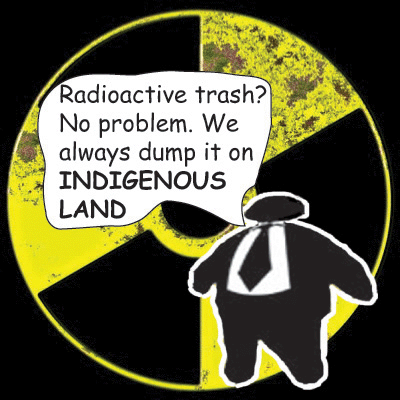
Proposed nuclear storage site in southeast New Mexico accused of ‘nuclear colonialism’ Adrian C Hedden, Carlsbad Current-Argus May 4, 2018
Fears of a proposed nuclear waste repository between Carlsbad and Hobbs extended beyond the two cities, stirring anxiety from residents across New Mexico and west Texas.
Leona Morgan, co-coordinator of the Albuquerque-based Nuclear Issues Study Group and a Diné activist, said the potential horrors of nuclear exposure were already felt by Native American residents in the Four Corners Region of New Mexico, where uranium was mined until the late 1990s.
Morgan said the concerns of Native Americans, such as the Navajo Nation, are often ignored by the federal government.
“I’ve heard a lot of warm sentiments about how this part of the state knows about nuclear science, and how much you all welcome it,” she said.
“In our part of the state, we know about the cancers, and the contamination of our lands and our water. We know this will impact us for generations to come.”
Holtec International, a New Jersey-based company specializing in nuclear storage, applied to the U.S. Nuclear Regulatory Commission in March 2017 for the first phase of an interim storage facility for spent nuclear fuel rods.
The application was accepted by the NRC in March, and the NRC moved forward with the application process by holding “scoping meetings” to solicit public comments in Roswell and Hobbs Monday and Tuesday respectively, and then in Carlsbad on Thursday at the Eddy County Fire Service.
The first phase would include 500 canisters of spent nuclear fuel rods, brought in by rail cars from nuclear power plants across the country, and stored at the property about 35 miles east of Carlsbad.
In total, 10,000 canisters could be stored at the site, totaling up to 120,000 metric tons of spent nuclear fuel.
The Holtec project is intended as a temporary storage facility, until a permanent repository is developed. [i.e. stranded wastes – just as is planned for Kimba, South Australia]
The concept of interim storage was first devised as a proposal for a permanent disposal facility in Yucca Mountain, Nevada, recently stalled.
Opponents of Holtec’s proposal contended the waste should be stored at the generator sites on an interim basis, and only moved when a permanent repository is available.
…. Morgan said the project was an example of “nuclear colonialism,” forcing low-income and minority-majority regions to unfairly bear the risk of storing nuclear waste.
“The contamination that was left by the United States government is an atrocity. It is a sin,” she said. “It is a violation of our human rights, and it is a form of genocide. New Mexico should not be proud of its nuclear legacy. It is the birth place of nuclear colonialism.”
Myriad activists, scientists, local leaders and business owners spoke for and against the project at Thursday’s meeting.
The debate centered around a potential canister leak, and contamination of nearby soil and natural resources.
…….. Karen Hadden, executive director for the Sustainable Energy and Economic Development Coalition said even with monitoring, the risk of radiation exposure was too high to support the project.
A similar, smaller interim storage facility was proposed near Andrews, Texas – about 40 miles across the eastern state line, by Waste Control Specialists (WCS) and French nuclear company Orano.
The project was re-docketed by the NRC earlier this year, after it stalled.
“They’re both a risk to our communities,” Hadden said of the facilities. “This is a project of huge magnitude that could impact this entire country. It cannot be taken lightly.”
She said the consequence of Holtec’s proposal could be felt across the nation, and residents from outside Carlsbad, and along the transport paths, deserve a place at the table.
“I am unhappy about some of the statements made earlier that some who do not favor bringing the nation’s waste here are uninformed, or fear mongering,” she said. “This site (Holtec) poses more risk to the people of Texas than WCS. All the trains would come through our state. It’s a shared concern.” ……. Adrian Hedden can be reached at 575-628-5516,achedden@currentargus.com or @AdrianHedden on Twitter. https://www.currentargus.com/story/news/local/2018/05/04/nuclear-storage-site-southeast-new-mexico-navajo-nation-nuclear-colonialism/581529002/
May 7, 2018
Posted by Christina Macpherson |
indigenous issues, wastes |
1 Comment

The ballot will be held less than a week after findings of a Senate Inquiry into the site-selection process are to be released, on August 14. …… a nuclear waste facility would not be imposed on an unwilling community and it would need “broad community support”
Anti-nuclear protesters increase fight against radioactive dump being established in SA
The Advertiser Erin Jones, Regional Reporter, Sunday Mail (SA) May 5, 2018
http://www.adelaidenow.com.au/news/south-australia/antinuclear-protesters-increase-fight-against-radioactive-dump-being-established-in-sa/news-story/55f7c369b17f03c747c1de824428b4df
ANTI-NUCLEAR campaigners will increase their fight to stop South Australia from becoming the nation’s radioactive waste ground, ahead of a final vote by the community.
Hundreds of postcards will be sent to Federal Resources Minister Matt Canavan demanding cultural heritage sites, agricultural land and the environment be protected from nuclear waste.
The Federal Government is expected to decide in the coming months whether to build a low-level and intermediate-level waste facility at Kimba or Barndioota, in the Flinders Ranges.
The two-year site selection process has divided both communities, those in favour believed it would create economic opportunities, while those opposed said it would jeopardise industries.
Conservation SA nuclear waste campaigner Mara Bonacci said the government needed to be more transparent about the facility ahead of an August 20 community ballot.
“There is division in both communities, whether it’s people who are pro-nuclear waste or anti-nuclear, they both want what’s best for the community,” Ms Bonacci said.
“But the pro-waste people are saying it will create lots of jobs, but we haven’t got any clarity around the numbers or if they’re full-time.
“We also want to know what number the Minister wants in a community vote to show ‘broad community support’ for the facility.”
Before the government decides on the successful site, residents from both communities will be given a final chance to accept or reject the proposal.
The ballot will be held less than a week after findings of a Senate Inquiry into the site-selection process are to be released, on August 14.
Mr Canavan told the Sunday Mail the government would provide more detailed information on the project’s design, job creation, cost, community benefits and safety, ahead of the ballot.
He said a nuclear waste facility would not be imposed on an unwilling community and it would need “broad community support” – although no arbitrary figure was provided.
“As we have always said, a range of factors will be used to determine broad community support, including the results of a public ballot, public and private submissions, and feedback from stakeholders during community discussions, including neighbours, councils and local groups,” Mr Canavan said. “The consultation process is engaging people on all sides of the discussion, and all views – supportive, neutral and opposed – are taken into account.”
The ballot will include residents of the Flinders Ranges Council and within a 50km radius of the Barnidoota site, and the Kimba District Council.
May 7, 2018
Posted by Christina Macpherson |
AUSTRALIA, opposition to nuclear, politics, wastes |
Leave a comment










 nuclear-news