Proposed nuclear storage site in southeast New Mexico accused of ‘nuclear colonialism’Adrian C Hedden, Carlsbad Current-Argus May 4, 2018
Fears of a proposed nuclear waste repository between Carlsbad and Hobbs extended beyond the two cities, stirring anxiety from residents across New Mexico and west Texas.
Leona Morgan, co-coordinator of the Albuquerque-based Nuclear Issues Study Group and a Diné activist, said the potential horrors of nuclear exposure were already felt by Native American residents in the Four Corners Region of New Mexico, where uranium was mined until the late 1990s.
Morgan said the concerns of Native Americans, such as the Navajo Nation, are often ignored by the federal government.
“I’ve heard a lot of warm sentiments about how this part of the state knows about nuclear science, and how much you all welcome it,” she said.
“In our part of the state, we know about the cancers, and the contamination of our lands and our water. We know this will impact us for generations to come.”
Holtec International, a New Jersey-based company specializing in nuclear storage, applied to the U.S. Nuclear Regulatory Commission in March 2017 for the first phase of an interim storage facility for spent nuclear fuel rods.
The application was accepted by the NRC in March, and the NRC moved forward with the application process by holding “scoping meetings” to solicit public comments in Roswell and Hobbs Monday and Tuesday respectively, and then in Carlsbad on Thursday at the Eddy County Fire Service.
The first phase would include 500 canisters of spent nuclear fuel rods, brought in by rail cars from nuclear power plants across the country, and stored at the property about 35 miles east of Carlsbad.
In total, 10,000 canisters could be stored at the site, totaling up to 120,000 metric tons of spent nuclear fuel.
The Holtec project is intended as a temporary storage facility, until a permanent repository is developed. [i.e. stranded wastes – just as is planned for Kimba, South Australia]
The concept of interim storage was first devised as a proposal for a permanent disposal facility in Yucca Mountain, Nevada, recently stalled.
Opponents of Holtec’s proposal contended the waste should be stored at the generator sites on an interim basis, and only moved when a permanent repository is available.
…. Morgan said the project was an example of “nuclear colonialism,” forcing low-income and minority-majority regions to unfairly bear the risk of storing nuclear waste.
“The contamination that was left by the United States government is an atrocity. It is a sin,” she said. “It is a violation of our human rights, and it is a form of genocide. New Mexico should not be proud of its nuclear legacy. It is the birth place of nuclear colonialism.”
Myriad activists, scientists, local leaders and business owners spoke for and against the project at Thursday’s meeting.
The debate centered around a potential canister leak, and contamination of nearby soil and natural resources.
…….. Karen Hadden, executive director for the Sustainable Energy and Economic Development Coalition said even with monitoring, the risk of radiation exposure was too high to support the project.
A similar, smaller interim storage facility was proposed near Andrews, Texas – about 40 miles across the eastern state line, by Waste Control Specialists (WCS) and French nuclear company Orano.
The project was re-docketed by the NRC earlier this year, after it stalled.
“They’re both a risk to our communities,” Hadden said of the facilities. “This is a project of huge magnitude that could impact this entire country. It cannot be taken lightly.”
She said the consequence of Holtec’s proposal could be felt across the nation, and residents from outside Carlsbad, and along the transport paths, deserve a place at the table.
The ballot will be held less than a week after findings of a Senate Inquiry into the site-selection process are to be released, on August 14. …… a nuclear waste facility would not be imposed on an unwilling community and it would need “broad community support”
ANTI-NUCLEAR campaigners will increase their fight to stop South Australia from becoming the nation’s radioactive waste ground, ahead of a final vote by the community.
Hundreds of postcards will be sent to Federal Resources Minister Matt Canavan demanding cultural heritage sites, agricultural land and the environment be protected from nuclear waste.
The Federal Government is expected to decide in the coming months whether to build a low-level and intermediate-level waste facility at Kimba or Barndioota, in the Flinders Ranges.
The two-year site selection process has divided both communities, those in favour believed it would create economic opportunities, while those opposed said it would jeopardise industries.
Conservation SA nuclear waste campaigner Mara Bonacci said the government needed to be more transparent about the facility ahead of an August 20 community ballot.
“There is division in both communities, whether it’s people who are pro-nuclear waste or anti-nuclear, they both want what’s best for the community,” Ms Bonacci said.
“But the pro-waste people are saying it will create lots of jobs, but we haven’t got any clarity around the numbers or if they’re full-time.
“We also want to know what number the Minister wants in a community vote to show ‘broad community support’ for the facility.”
Before the government decides on the successful site, residents from both communities will be given a final chance to accept or reject the proposal.
The ballot will be held less than a week after findings of a Senate Inquiry into the site-selection process are to be released, on August 14.
Mr Canavan told the Sunday Mail the government would provide more detailed information on the project’s design, job creation, cost, community benefits and safety, ahead of the ballot.
He said a nuclear waste facility would not be imposed on an unwilling community and it would need “broad community support” – although no arbitrary figure was provided.
“As we have always said, a range of factors will be used to determine broad community support, including the results of a public ballot, public and private submissions, and feedback from stakeholders during community discussions, including neighbours, councils and local groups,” Mr Canavan said. “The consultation process is engaging people on all sides of the discussion, and all views – supportive, neutral and opposed – are taken into account.”
The ballot will include residents of the Flinders Ranges Council and within a 50km radius of the Barnidoota site, and the Kimba District Council.
Lincoln University 4th May 2018 , Researchers have secured £1.1 million in grant funding to develop
artificial intelligence systems to enable self-learning robots to be
deployed in place of humans to hazardous nuclear sites.
It is estimated that up to £200 billion will be spent on the clean-up and decommissioning
of nuclear waste over the next 100 years.
Now, a team of computer scientists from the University of Lincoln will create machine learning
algorithms to increase capabilities in several crucial areas of nuclear
robotics, including waste handling, cell decommissioning and site
monitoring with mobile robots.
Machine learning is an application of artificial intelligence (AI) which enables systems to collect data and use
it to inform automated decision-making and make improvements based on
experience without being explicitly programmed.
The Lincoln team will create algorithms for vision-guided robot grasping, manipulation and
cutting, mobile robot navigation, and outdoor mapping and navigation. The
aim is to build systems which can use machine learning to adapt to the
unique conditions of nuclear sites, including locations contaminated by
radiation.
The Lincoln project is part of the National Centre for Nuclear
Robotics (NCNR), a multi-disciplinary EPSRC RAI (Robotics and Artificial
Intelligence) Hub led by the University of Birmingham, and also involves
Queen Mary University of London, the University of West England, University
of Bristol, University of Edinburgh, and Lancaster University.
Welcome to Israeli Nuclear Weapons 101 The National Interest, Daniel R. DePetris, September 20, 2015
1.The Number is in Doubt:
While everyone believes that the Israelis possess a sizable nuclear arsenal, no one really knows how big that arsenal is. In 2008, President Jimmy Carterestimated that Israel probably had a minimum of 150 weapons in stock ready to use if the most dire circumstances warrant. Six years later, the former President revised that estimate and put the figure in the 300 range, which—based on Carter’s calculations—would mean that Israel doubled its arsenal from the 2008-2014 time-period. Iranian foreign minister Mohammad JavadZarif told reporters at the United Nations at the height of the P5+1-Iran nuclear talks that Israel is “sitting on 400 nuclear warheads.” The Bulletin of Atomic Scientists believes Zarif’s figure is far too large and unrealistic given the fact that Israel’s weapons are designed for deterrence purposes rather than actual hire-trigger use. A better figure, the board writes, is “sixty-five to eighty-five warheads” as cited in a Rand Corporation study.
To put it bluntly, the world doesn’t have a clue about how many nukes Israel possesses. And that’s precisely the point for the Israelis: the guessing game swirling over the proliferation community keeps Israel’s enemies in the region on their toes.
2. Israel Fooled the U.S. to Get Its Program Off the Ground:
The Iranian Government has been caught building enrichment facilities by western intelligence agencies twice before. In 2002, a dissident Iranian group provided information to the United States pointing to a large-scale enrichment facility at Natanz. In 2009, U.S. and European intelligence uncovered another enrichment facility at Fordow buried deep into a mountain. But Iran isn’t the only country that has deliberately deceived the United States and the international community in order to provide time for a full-on nuclear program; the Israelis, as Walter Pincus wrote in a Washington Poststoryearlier this year, “blazed [the] trail decades ago.”
In the 1950s and early 1960s, the Israeli Government repeatedly stonewalled U.S. requests for information on possible weapons development and at times purposely lied to their U.S. allies in the hope of giving the nuclear program more room to breath. In 1960, Israel referred to its Dimona reactor both as a “textile plant” and as a “metallurgic research installation” to the U.S. State Department. Foreign minister Shimon Peres assured President John F. Kennedy in a 1963 meeting in the Oval Office that Israel would “not introduce nuclear weapons to the region.”
President Kennedy was so concerned about a possible Israeli nuclear weapons program that he demanded Israel admit American inspectors into Dimona to snoop around. The Israelis agreed to those requests, but made sure that those visits would not lead to anything incriminating: U.S. inspectors, according to a long-read investigative report in The Guardian, were not permitted to bring their own equipment or collect samples at the site.
3.Why Israel Wanted a Bomb in The First Place:….
4. The World Has Long Wanted Israel to Join the NPT:
Ever since 1995, when signatories of the Nuclear Non-Proliferation Treaty officially called for the “establishment by regional parties of a Middle East zone free of weapons of nuclear and all other related weapons of mass destruction,” the United Nations has attempted to convince Israel that signing the NPT and allowing IAEA inspectors into its facilities is the best way to accomplish that objective. Israel, however, has refused to grant those requests and has long argued that Israel’s nuclear weapons program (which the country continues to neither confirm nor deny) is not nearly the biggest threat to the Middle East’s security.
Nuclear panel chair: ‘I remain adamantly opposed’ to Yucca Mountain Las Vegas Sun, By Sun Staff (contact) May 3, 2018
The chairman of the state interim legislative Committee on High-Level Radioactive Waste says he’ll continue to support a 2017 legislative resolution stating opposition to the proposed national nuclear waste repository at Yucca Mountain.
“I remain adamantly opposed to the development of Yucca Mountain as a repository for spent nuclear fuel and high-level radioactive waste, as well as the storage or disposal of spent nuclear fuel and high-level radioactive waste anywhere in the state of Nevada,” the chairman, Assemblyman Edgar Flores, D-Las Vegas, said in a statement. “I will continue to monitor the actions taken on the federal level to ensure that Nevadans’ voices are heard.” …..
Funding for the project was cut off during the Obama administration, but President Donald Trump signaled support for restarting the licensing process by including funding for it in his proposed budget last year. Congress rejected the funding, opting not to include it in the omnibus spending bill, so the project remains in limbo. However, opponents remain concerned that Trump and congressional delegates from other states that support Yucca Mountain will continue trying to revive it. https://lasvegassun.com/news/2018/may/03/nuclear-panel-chair-i-remain-adamantly-opposed-to/
Vote likely next week on bill to resume Yucca Mountain licensing process , By Gary Martin/Las Vegas Review-Journal, May 4, 2018, PAHRUMP— Legislation that would allow the Department of Energy to resume its license application process to store nuclear waste at Yucca Mountain could see a House vote this week — a prospect that was met Thursday with mixed reaction in Nevada.
A bill approved last year by the House Energy and Commerce Committee to jump-start the licensing process is being reviewed by the Rules Committee, and the legislation will move to the floor next week when Congress returns from a weeklong recess.
The legislation would streamline the process to open Yucca Mountain to store nuclear waste and address the stockpile of spent fuel being stored at power plants across the country……..
The legislation authorizes spending to restart the licensing process. The Senate blocked the spending last year.
Federal plans to store spent fuel rods and other nuclear waste have been met with stiff opposition in Nevada from most elected officials, except those from rural counties, including Nye County, where Yucca Mountain is located……
Gov. Brian Sandoval, a Republican, has vowed to spend millions in state money to stop the nuclear repository from opening. He is backed by most lawmakers in the state’s congressional delegation.
Rep. Dina Titus, D-Nev., said nothing has changed since the delegation testified against the bill last year.
“Bringing this legislation to the floor is nothing more than a show for the nuclear industry and its campaign cash recipients in Congress,” Titus said.
Rep. Jacky Rosen, D-Nev., has filed legislation that would prohibit the DOE from taking any action to license Yucca Mountain as a nuclear repository until the federal government studies alternative uses for the Nevada site.
……..Sens. Dean Heller, R-Nev., and Catherine Cortez Masto, D-Nev., have worked through the committee process to halt licensing of Yucca Mountain.
We Now Have A Working Nuclear Reactor for Other Planets — But No Plan For Its Waste,
Futurism, Claudia Geib, 23 May 18 If the power goes out in your home, you can usually settle in with some candles, a flashlight, and a good book. You wait it out, because the lights will probably be back on soon.
But if you’re on Mars, your electricity isn’t just keeping the lights on — it’s literally keeping you alive. In that case, a power outage becomes a much bigger problem.
NASA scientists think they’ve found a way to avoid that possibility altogether: creating a nuclear reactor. This nuclear reactor, known as Kilopower, is about the size of a refrigerator and can be safely launched into space alongside any celestial voyagers; astronauts can start it up either while they’re still in space, or after landing on an extraterrestrial body.
The Kilopower prototype just aced a series of major tests in Nevada that simulated an actual mission, including failures that could have compromised its safety (but didn’t).
………. Nuclear reactors are not an unusual feature in space; the Voyager 1 and 2 spacecraft, now whizzing through deep space after departing our solar system, have been running on nuclear energy since they launched in the 1970s. The same is true for the Mars rover Curiosity since it landed on the Red Planet in 2012.
But we’d need a lot more reactors to colonize planets. And that could pose a problem of what to do with the waste.
If the power goes out in your home, you can usually settle in with some candles, a flashlight, and a good book. You wait it out, because the lights will probably be back on soon.
But if you’re on Mars, your electricity isn’t just keeping the lights on — it’s literally keeping you alive. In that case, a power outage becomes a much bigger problem.
NASA scientists think they’ve found a way to avoid that possibility altogether: creating a nuclear reactor. This nuclear reactor, known as Kilopower, is about the size of a refrigerator and can be safely launched into space alongside any celestial voyagers; astronauts can start it up either while they’re still in space, or after landing on an extraterrestrial body.
The Kilopower prototype just aced a series of major tests in Nevada that simulated an actual mission, including failures that could have compromised its safety (but didn’t)
But we’d need a lot more reactors to colonize planets. And that could pose a problem of what to do with the waste. According to Popular Mechanics, Kilopower reactors create electricity through active nuclear fission — in which atoms are cleaved apart to release energy. You need solid uranium-235 to do it, which is housed in a reactor core about the size of a roll of paper towels. Eventually, that uranium-235 is going to be “spent,” just like fuel rods in Earth-based reactors, and put nearby humans at risk.
When that happens, the uranium core will have to be stored somewhere safe; spent reactor fuel is still dangerously radioactive, and releases lots of heat. On Earth, most spent fuel rods stored in pools of water that keep the rods cool, preventing them from catching fire and blocking radiating radioactivity. But on another planet, we’d need any available water to, you know, keep humans alive.
…….Right now, all we can do is speculate — as far as we know, NASA doesn’t have any publicly available plan for what to do with spent nuclear fuel on extraterrestrial missions. That could be because the Kilopower prototype just proved itself actually feasible. But not knowing what to do with the waste from it seems like an unusual oversight, since NASA is planning to go back to the Moon, and then to Mars, by the early 2030s.
Safety concerns plague key sites proposed for nuclear bomb production, USA Today , Patrick Malone, Center for Public Integrity . ET May 3, 2018
Decision due soon on where plutonium parts for the next generation of nuclear weapons are to be made
The Department of Energy is scheduled to decide within days where plutonium parts for the next generation of nuclear weapons are to be made, but recent internal government reports indicate serious and persistent safety issues plague both of the two candidate sites.
Some experts are worried about the safety records of either choice: Los Alamos National Laboratory in New Mexico, where plutonium parts have historically been assembled, and the Savannah River Site in South Carolina, where other nuclear materials for America’s bombs have been made since in the 1950s.
An announcement by the Trump administration about the location is expected by May 11 in preparation for the ramped-up production of nuclear warheads called for by the Defense Department’s recent review of America’s nuclear weapons policy.
Recent internal government reports obtained by the Center for Public Integrity have warned that workers at these plants have been handling nuclear materials sloppily or have failed to monitor safety issues aggressively.
……….The continued mistakes at Los Alamos follow a three-year period of stasis in the U.S. plutonium production program forced by the lab’s inability to meet safety standards for plutonium operations. Los Alamos’ plutonium facility shelved all the nation’s high-hazard plutonium work, including the production of nuclear weapons cores or “pits,” in the summer of 2013, and has recently resumed most but not all of the wor
The prolonged shutdown at Los Alamos — the birthplace of the nuclear bomb — provoked National Nuclear Security Administration’s principal assistant deputy administrator for defense, Philip Calbos, to remark during a panel discussion at National Defense University in February that nuclear rivals are noticing America’s missteps.
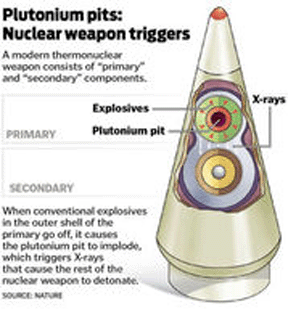
………..Plutonium pits are the shiny metallic, softball-size orbs that hold the most potent destructive force man has ever harnessed in a weapon. During the Cold War, the Rocky Flats production site in Colorado made as many as 2,000 a year. Decades of poor disposal of nuclear wastes and other dangerous environmental practices culminated in a dramatic FBI raid in 1989 that led to the site’s closure in 1992.
Meeting on Holtec proposal fills conference room; Opinions polarized on plan to store nuclear waste in southeast New Mexico, Roswell Daily Record By Vistas
These two words demonstrate how polarized opinions were at a public meeting Monday night at ENMU-Roswell hosted by the Nuclear Regulatory Commission to hear comments on a proposed interim storage facility for spent nuclear fuel: “Benign” and “genocide.”
A conference room in the Campus Union Building was filled to its capacity of 95. There were around 50 people who requested to speak, each given four minutes to offer their support for the project or say why they want the NRC to deny the application by Holtec International, the private corporation requesting a 40-year license to store solid nuclear waste on a site in Lea County about halfway between Carlsbad and Hobbs.
According to the Nuclear Regulatory Commission, the initial request is for storage of up to 8,680 metric tons of waste.
But according to a Holtec official, the “ultimate target” is for up to 100,000 metric tons of spent rods. If the company’s application is approved, the high-level nuclear waste would be stored at the interim facility “until a permanent storage option is available”…
Both sides of the issue were represented at the open house.
Bobbi Riedel, a doctoral student in nuclear physics attending the University of New Mexico in Albuquerque, was there with five other UNM students to speak in favor of the proposed storage site. “We’ve come down here from Albuquerque to inform people about nuclear safety,” she said. “I think this is a perfectly safe project.” She said storing nuclear facility at the site would save taxpayers about $30 billion a year.
Wearing a blue T-shirt that said, “No Holtec International,” Melanie Deason of Roswell said she is against the project.
“I can sum up Holtec in one word — ‘genocide,’” she said.
Deason said that among her concerns were transportation, geology, water issues and the Rio Grande Compact, an interstate compact to equitably portion the waters of the Rio Grande Basin between New Mexico, Colorado and Texas.
“I don’t think Texas wants radioactivity in their food chain,” she said. Deason also was on the list of speakers…
John Heaton, a spokesperson for the pro nuclear from the Eddy-Lea Energy Alliance, said while Holtec’s proposal is not a permanent solution to nuclear waste storage, when a permanent site is built in will most likely be in the western U.S., possibly Nevada, and not in the east …
“It is going to be benign,” Heaton said. “It just sits there and gets cooler.”…
Al Squire, a member of the Dairy Producers of New Mexico who said he was attending as a private citizen, had a much different opinion on the self-ventilating cooling system. He said the temperature of the fuel rods stored at the site would be between 200 to 700 degrees.
“What happens if it plugs up?” he said. “Murphy’s Law says it will happen. We could have another Chernobyl or Fukushima (a nuclear disaster that occurred in Japan in 2011..
Helen Henderson, a rancher from Chaves County, stressed the impact the facility could have agriculture and gas and oil, which are the stalwarts of the economy in southeast New Mexico.
She said while the Holtec facility would only provide 55 permanent jobs in New Mexico, ranching, farming, gas and oil combined provide 23,000. If an accident occurred, Henderson said, “It would destroy New Mexico.”….
The first speaker was Sister Joan Brown, a Franciscan nun from Albuquerque.
She said in the Christian tradition the desert is a place where people find God and not a wasteland.
She then spoke of “environmental justice,” not just for humans but for all living things.
“A life is a life and it is not dispensable,” she said. “In this state we have a history of not respecting that.”
Brown referred to a group who call themselves the “Downwinders,” who say that they, along with their preceding generations, have been contaminated by the radioactive fallout from the 1945 test explosion at the Trinity Site near Alamogordo. She added that uranium workers in New Mexico also have been harmed by radiation and that Holtec’s proposed facility is located in an area with predominantly low incomes and a majority Hispanic population.
Founded in 1986, Holtec provides solutions for managing the backend of the nuclear power cycle for commercial nuclear power plants.
The company is headquartered in New Jersey and has locations throughout the world, including Pennsylvania and Florida.
Another public meeting will be held today in Hobbs tonight and third meeting will be held Thursday in Carlsbad.
The public also can mail comments to the NRC at One White Flint North Building, 11555 Rockville Pike, Rockville, Maryland 20852–2738, or post comments online at regulations.gov. The deadline for public comments is May 29.
NRC officials said a transcript of the meetings should be posted on their website within two or three weeks.
Science Recorder 27th April 2018 , The U.S. Energy Department has 54 metric tons of surplus plutonium at sites
across the country and cannot decide what to do with it, according to department officials. Nuclear researchers warn that many of these sites are
storing more of the radioactive substance than is safe and that a mishap at any one of them could lead to full-blown disaster. https://sciencerecorder.com/article.php?n=united-states-has-too-much-deadly-plutonium-on-its-hands&id=144178
Homeland Preparedness News 27th April 2018, A new paper from the Nuclear Threat Initiative (NTI) provided
recommendations for mitigating risks related to separated plutonium. As compared to highly enriched uranium (HEU), separated plutonium has not
received enough attention as a security risk, NTI Counselor John Carlson said in the paper, titled “Mitigating Security Risks from Separated Plutonium: Some Near-Term Steps.”
Eight countries currently hold more than 375 metric tons of separated plutonium, which is produced by reprocessing irradiated nuclear fuel. The paper recommends minimizing stocks and specific actions in production, storage and use of the material. “Even small quantities [of plutonium] could be of interest to terrorists if they see opportunities for acquiring plutonium in a number of locations or for use in a radiological dispersal device,” Carlson said. https://homelandprepnews.com/stories/28131-nuclear-threat-initiative-highlights-separated-plutonium-security-risks/
Cumbria County Council (CCC) have recognised the fundamental flaws within the latest process to find a location to bury the nation’s nuclear waste. The CCC response to the government consultation echos many of the points which Cumbria Trust has made. In particular the failure to address the need for secure interim storage, despite the most dangerous elements within waste being too hot to bury for well over a century. They also highlight the lack of clarity over the community’s right of withdrawal, something of particular concern to Cumbria Trust. As we have previously stated this is a process which has been designed to be very simple to enter and very difficult to leave.
Five years ago it was CCC which called a halt to the search process, and their concerns have not gone away.
The News & Star has reported this week:
A NEW search to find a community willing to host an underground nuclear waste storage bunker is based on ‘fundamentally flawed’ government policy, council officials in Cumbria have said.
The nationwide scheme to identify a location for a £12 billion geological disposal facility buried at least 200 metres below the surface was relaunched by the government in January and is expected to take 20 years to secure.
It promises incentives including £1m per year for five years for the five communities that volunteer to be on the shortlist – with £2.5m a year for the two that go forward to the testing stage, which would see deep boreholes dug underground.
But experts within Cumbria County Council have instead called for more clarity on how the high level waste – the majority of which is currently kept in storage vessels in west Cumbria – will be kept safe if a suitable location is not identified within the time frame.
They also state the right of willing communities to withdraw from the process is not clear enough within the proposal, while there is no detail about how the waste could be retrieved at a later date if new technology to dispose of it more efficiently is developed.
Whitehaven News 26th April 2018 , Search to find nuclear waste storage site is ‘flawed’, Cumbria council chiefs claim. Cash incentives are being offered to communities that step forward to host an underground waste bunker.
A NEW search to find a community willing to host an underground nuclear waste storage bunker is based on ‘fundamentally flawed’ government policy, council officials in Cumbria have said.
The nationwide scheme to identify a location for a £12 billion geological disposal facility buried at least 200 metres below the surface was relaunched by the government in January and is expected to take
20 years to secure. It promises incentives including £1m per year for five
years for the five communities that volunteer to be on the shortlist – with
£2.5m a year for the two that go forward to the testing stage, which would
see deep boreholes dug underground.
But experts within Cumbria County Council have instead called for more clarity on how the high level waste -the majority of which is currently kept in storage vessels in west Cumbria
– will be kept safe if a suitable location is not identified within the time frame.
They also state the right of willing communities to withdraw from the process is not clear enough within the proposal.
The authority’s official response, expected to be adopted by members of its cabinet
committee in Carlisle today, states: “The county council believes the
policy on which this consultation is based is fundamentally flawed.
Bulletin of Atomic Scientists 24th April 2018 , During the Cold War, the United States and the Soviet Union manufactured
enormous quantities of plutonium for use in nuclear weapons. When that era
ended, the United States and the newly formed Russian Federation began to
reduce their nuclear arsenals. Both nations possessed large stockpiles of
plutonium—a problem that posed both a sustained threat to the environment
and a risk of future nuclear weapons proliferation.
In 2000, the United States and Russia pledged to dispose of their excess plutonium in order to
mitigate the security concerns, safety risks, and storage costs. They
signed the Plutonium Management and Disposition Agreement, which requires
each country to dispose of at least 34 metric tons of weapons plutonium.
Unfortunately, the agreement failed to solve the excess plutonium problem. Eighteen years later, the United States has been unable to develop a
successful strategy to safely, affordably, and permanently dispose of
plutonium from dismantled nuclear weapons, despite a high degree of
industrial capability and technical expertise. Why has the United States
been unable to either implement its obligations under the disposition
agreement or execute its own policy? And how can the Plutonium Disposition
Program finally become effective? https://thebulletin.org/what-went-wrong-us-plutonium-disposition11733
‘We’re here today to guarantee further security for Ukrainians and all Europeans to turn their attention to important projects, which we will gradually implement day by day – along with our partners. We plan to put the new safe confinement into service in December’, the president said.
The head of the state added that the mounting works on the object are almost over.
As it was reported earlier, the construction works began in Chornobyl exclusion zone in Nobvemner 2017; the nuclear waste repository will be built in the restricted area of Kyiv region. According to UNN news agency, the opening ceremony took place on November 9; Ukrainian company Energoatom will be the one supervising the construction process.
According to the Minister of Energy and Coal Production Ihor Nasalyk, by building its own nuclear waste repository, Ukraine will be able to refuse the service offered by Russia, which costs Kyiv more than 7 million dollars annually.








 nuclear-news