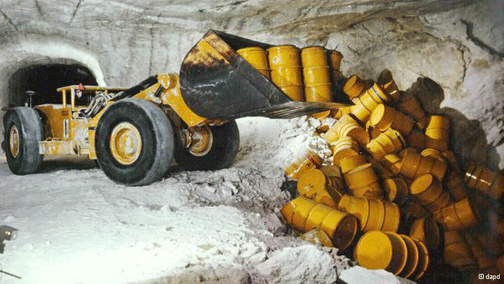
Fluor Idaho resumes waste retrievalhttps://www.localnews8.com/news/fluor-idaho-resumes-waste-retrieval/793522258, IDAHO FALLS, Idaho (KIFI/KIDK) 13 Sept 18, – After revising its safety procedures, Fluor Idaho has resumed the removal of buried Cold War weapons waste at its Idaho facility.
The Department of Energy’s Idaho National Laboratory cleanup contractor suspended buried waste exhumation at the Accelerated Retrieval Project VIII facility after an April 11 breach of storage drums. The contractor revised its exhumation and repackaging process with additional controls to avoid the risk of a similar event.
Those controls include raking and thermal monitoring of exhumed sludge waste prior to repackaging. Meanwhile, cleanup of the facility continues.
To date, crews have removed buried waste containing plutonium, solidified solvents, and uranium from a combined area of 1.54 acres of ARP VII. The facility is 89.5 percent complete.
Waste generated during the development of atomic weapons was sent from the Rocky Flats Plant near Denver, to Idaho for buried disposal from 1954 until 1970. In 2008, the DOE, Environmental Protection Agency and state of Idaho agreed to remediate a total of 5.69 acres of buried waste and ship the material out of Idaho for permanent disposal. The overall buried waste exhumation effort remains ahead of schedule.
Once exhumation is complete in ARP VIII, work will begin in the nearby ARP IX facility to remove the last of the waste required by the 2008 agreement.
The Idaho Cleanup Project is a 5-year, $1.4 billion project funded by the U.S. Department of Energy’s Office of Environmental Management.
September 14, 2018
Posted by Christina Macpherson |
wastes |
Leave a comment
 A Texas waste storage plan is back. So is the opposition, Edward Klump, E&E News reporter, Energywire: Tuesday, September 11, 2018 A proposal to send used nuclear fuel to West Texas didn’t end last year, but it did stall during a trip to corporate purgatory.
Now a joint venture called Interim Storage Partners LLC has the plan moving forward again. The Nuclear Regulatory Commission recently restarted its review of a consolidated interim storage application for a site in Andrews County, Texas. And the NRC staff’s safety, security and environmental reviews could be finished in summer 2020.
Critics are worried about what’s brewing. They’re asking questions and hoping for more public meetings. Some would like to halt the project. One of the chief opponents knows the proposal won’t be easy to stop, but she’s working to rally Texans and others against the plan.
“Most people don’t even know this is happening,” said Karen Hadden, executive director of the Texas-based Sustainable Energy and Economic Development Coalition. “The public is unaware, and they’re unaware of the risks that they are about to be exposed to.”
The project is another flashpoint in a long-running debate over nuclear energy and associated waste after a number of U.S. nuclear plants stopped producing power or announced plans to close. Congress has considered legislation that could help pave the way for interim storage facilities in Texas and New Mexico as well as a longer-term site at Yucca Mountain in Nevada. Hadden has voiced concern about those three sites and potential plans to transport nuclear waste across the country.
The spent fuel storage plan for West Texas is tied to Waste Control Specialists (WCS), which has endured financial issues and houses low-level radioactive waste in the region. A plan by Valhi Inc. to unload WCS to EnergySolutions collapsed in 2017. Early this year, J.F. Lehman & Co. announced that an investment affiliate had acquired WCS. That was followed in March by news of a planned venture involving Orano USA and WCS (Energywire, March 19).
The new Orano-WCS entity — now called Interim Storage Partners, or ISP — later sought a restart of the NRC review that was halted in 2017. In August of this year, the NRC said the revised application was acceptable but that additional information would be sought.
“The NRC staff has reviewed your request and concludes that the revised license application provides information sufficient to resume its detailed review,” the NRC said in a letter.
Jeff Isakson, chief executive of ISP, said in a recent statement that ISP looked forward “to an energized and timely process.”
‘Snickering and giggling’
ISP said its venture initially is intended to store used nuclear fuel from shutdown reactor locations. That would lower the burden on U.S. taxpayers and allow sites to be redeveloped, it said. The application is for 40 years, though it could be extended by decades…….
A license application with the NRC said Orano USA ultimately is majority owned and controlled by an entity of the French government. But ISP has said its governing officers and management board members are U.S. citizens……..
Much of nuclear waste critics’ focus had turned to an interim storage proposal from Holtec International for New Mexico. That plan is also under review at the NRC (Greenwire, May 9).
While Hadden said there was “a nice reprieve” on the West Texas proposal, she said “the threat is ever-present and on the burner now.”
Instead of using the proposed interim sites or Yucca Mountain, Hadden would like to see the United States pursue a new location for a permanent repository that’s geologically sound and uses improved storage technology.
A public step in the process for the West Texas site was evident in late August: a meeting about the emergency response plan. Representatives of the NRC, ISP and other interested parties attended in person in Maryland or on the phone.
The meeting covered aspects of the response plan and gave people a chance to interact. At one point, a speaker said that “nobody lives anywhere near us.” That was followed by a description of the location as “in the middle of stinking nowhere.” The remarks drew laughter as well as an unhappy response from a listener on the phone who wasn’t sure who made them.
“There was a statement made about this site being in the middle of nowhere, and there was some snickering and giggling,” said Monica Perales, an attorney. “I live in the middle of nowhere, and that’s not appreciated.”
In an interview last week, Perales said the attitude during the meeting “made me feel as though we in West Texas are expendable.”
………Critics remain concerned about transportation, including the potential effects on cities and the potential for terrorists to target waste.
Hadden has called for public meetings in places such as Dallas, Houston, San Antonio, Midland, El Paso and Andrews County to discuss issues related to possible interim nuclear waste storage in Texas. She’s working on a public awareness campaign that’s expected to take place later this month and run into October, featuring a full-scale mock radioactive waste transport cask.
Hadden argued future NRC requests for additional information could bring up new issues the public should be able to examine, so NRC deadlines should be extended. Critics say there is already a new financial situation to analyze in terms of ISP’s involvement.……….https://www.eenews.net/stories/1060096457
September 12, 2018
Posted by Christina Macpherson |
USA, wastes |
Leave a comment

Eureka 10th Sept 2018 , The cover story of Eureka’s September issue looks at the programme to
decommission the UK’s legacy nuclear power plant, with particular
emphasis on the opportunities this creates for engineering innovation. The
reasons for this are clear: radioactive environments represent some of the
most challenging engineering scenarios possible, with extended human
presence in them simply not feasible. This means that robotics have a
massive role to play and it is these solutions that are attracting much
investment.
What many may not understand is just how massive an undertaking
this decommissioning programme is. Decommissioning across 17 nuclear sites
will take more than a century and involve the expenditure of an estimated
£118 billion pounds over that period. Clearly this offers considerable
scope for investment in and applications of new technologies. The Nuclear
Decommissioning Authority currently offers significant funding for the
right solutions. With that in mind, it would seem a good time for the
UK’s design engineers to step up.
http://www.eurekamagazine.co.uk/design-engineering-blogs/the-decommissioning-dividend-1/182843/
September 12, 2018
Posted by Christina Macpherson |
decommission reactor, UK |
Leave a comment
Radiation Free Lakeland 10th Sept 2018 , Springfields** This is from the 1990s. “You and Yours” BBC Radio 4 programme
describing the “biggest in the UK” radioactive discharges The
Springfields plant discharges directly into the River Ribble and has done
so since 1948. What has changed? Nothing, apart from the fact that any
mention of cancer and radioactive discharge by eminent doctors is now a
taboo subject.
https://mariannewildart.wordpress.com/2018/09/10/6th-installment-of-the-springfields-archive-prestons-radioactive-river/
September 12, 2018
Posted by Christina Macpherson |
UK, wastes |
Leave a comment
 radioactive waste from one of the UK’s most important nuclear
decommissioning projects. Businesses in Lancashire, Cumbria and West
Yorkshire are joining forces to produce self-shielded boxes which will
store legacy waste from the First Generation Magnox Storage Pond (FGMSP) at
Sellafield. The 66-year old open air pond was originally used to store
nuclear fuel from the UK’s first generation of nuclear power stations. It
has been prioritised for clean-up by the Nuclear Decommissioning Authority.
The clean-up work requires the manufacture of hundreds of boxes to store
material taken out of the facility.
http://www.thebusinessdesk.com/yorkshire/news/2025845-northern-collaboration-sellafield-n-plant-clear
September 10, 2018
Posted by Christina Macpherson |
UK, wastes |
Leave a comment
by Jeff Gillan , 9 Sept 18, LAS VEGAS (KSNV) — Nevada’s elected officials reacted with alarm Thursday to a Department of Energy proposal to send a ton or more of weapons-grade plutonium to the Nevada National Security Site.
The security site, formerly known as the test site, has seen small amounts of plutonium before but that was for weapons testing.
This proposal, from the Department of Energy, would be the first time, according to Nevada officials, that plutonium would be stored here, potentially indefinitely.I have been made aware that @Energy intends to store plutonium in Nevada with no timeline for removal. I will fight this at every level,” Governor Brian Sandoval, R-Nevada, tweeted.
The plutonium up to a ton would be sent here by 2020 from South Carolina because a facility there has not been finished that would re-purpose the material. Another ton would be scheduled to be sent here in 2021.
“Doe is addressing South Carolina’s concerns by screwing Nevada,” tweets Congresswoman Dina Titus…….
Plutonium, at the security site, is a separate issue [from Yucca nuclear waste dump plan] . However, conservationists see another agenda by sending plutonium here.
“This is about a test run to see what storage and transportation of nuclear material looks like to Nevada,” says Andy Maggi, the Executive Director of the Nevada Conservation League.
State officials reacted to the proposal with alarm.
“Not only does shipping up to one metric ton of plutonium across the country likely present risks to those living along the proposed transportation routes, storing this material just a few miles from #LasVegas could threaten the health and safety of Nevadans and our tourism economy,” tweets Sen. Dean Heller, R-Nevada.
“I have serious concerns with (Department of Energy) Secretary Perry recklessly pushing this proposal forward without properly assessing the impact that transporting and storing up to one metric ton of weapons-grade plutonium would have on Nevadans’ health and safety. I urge DOE to conduct a full environmental analysis,” said Rep. Jacky Rosen, D-Nevada, in a statement.
Yucca Mountain will take years – if ever – to become operational. One worry is also that DOE could reclassify the plutonium as nuclear waste and send it to Yucca when it’s ready.
“That’s not an inconceivable scenario,” says Greg Lovato, the Administrator of Nevada’s Division of Environmental Protection.
In the meantime, Nevada plans to fight plutonium coming here.
“We’re looking at all legal options because we believe that the supplemental analysis issued by the department is insufficient for this type of activity,” says Bradley Crowell. https://news3lv.com/news/local/department-of-energy-introduces-plan-to-store-plutonium-in-nevada
September 10, 2018
Posted by Christina Macpherson |
- plutonium, USA |
Leave a comment
There’s renewed anger in Chatsworth, Simi Valley, over Santa Susana Field Lab clean-up By SARAH FAVOT |September 2, 2018 Frustrated with the pace of cleanup of a former rocket engine test site on the border of San Fernando and Simi valleys, area residents have stepped up their call for the safe disposal of hazardous and radioactive materials.
Criticism of the massive, long-planned clean-up is not new. But tension re-emerged Thursday night, as the state’s Department of Toxic Substances Control (DTSC) held a public hearing at El Camino Real Charter High School in Woodland Hills. DTSC officials, who are overseeing the cleanup, wanted to hear comments about the U.S. Department of Energy’s proposed plans to decontaminate and demolish the former Hazardous Waste Management Facility and Radioactive Materials Handling Facility at the site of the Santa Susana Field Laboratory.
Nestled between Simi Valley and Chatsworth, the land was developed in the 1940s to test rocket engines and conduct nuclear research. Boeing now owns most of the site, which has been the focus of residents’ ire over stalled clean-up and the management of those clean-up.
“This is a crime against humanity,” said Melissa Bumstead, who led a protest before the hearing, referring to what she said has been the mishandling of the clean-up of radioactive materials at the site.
Bumstead believes that her daughter’s cancer was caused by the release of radiation from the site. She said during hospital visits she met other parents who live within a few miles of the site whose children also had cancer. Some others who spoke at the meeting said they have cancer or have fought cancer.
In 1989, the Department of Energy released a report admitting that a partial meltdown of a sodium reactor had occurred in 1959 in Area IV of the land, where the two facilities set to be closed are located.
The Radioactive Materials Handling Facility, one of the buildings set for closure and demolition, was used to treat and store radioactive and mixed waste. Mixed waste has both chemical and radiological constituents. Radioactive waste included uranium and plutonium. The facility’s permit expired in 2003.
The Hazardous Waste Management Facility was used for storage and treatment of non-radiological alkaline metal wastes. The building ceased operation in 1997……….
Some of the residents who gave public comments Thursday night have attended many other DTSC meetings. Many echoed sentiments of frustration and mistrust with the agency. Some held up yellow signs during the meeting that read “DTSC lied, Our kids died” and “Broken Promises.”
“It’s the same old stuff,” Dorri Raskin, of Northridge, said. “It’s very frustrating. It’s disappointing with the lies.”
Another public hearing on the plan will be held Sept. 8 at the Simi Valley Senior Center, 3900 Avenida Simi, Simi Valley at 10:30 a.m.
Public comment on the plans has been extended to Oct. 12. Comments can be emailed or sent to Laura Rainey, DTSC senior engineering and project manager, 5796 Corporate Ave., Cypress, CA 90630, laura.rainey@dtsc.ca.gov.
Correspondent Marianne Love contributed to this report.
September 10, 2018
Posted by Christina Macpherson |
USA, wastes |
Leave a comment
Three shiploads with spent nuclear fuel are to be sent from site this year and the whole cleanup is to be completed in year 2024, representatives of nuclear power company Rosatom said in this week’s meeting in the Joint Russian-Norwegian Commission Nuclear Safety.
The cleanup of the Andreeva Bay is one of the biggest ongoing bilateral cooperation projects between Norway and Russia and Norwegian tax payers have over the years covered project expenses worth hundreds of millions of kroner.
The nuclear waste storage, which is located only about 55 km from the border to Norway, holds about 22,000 spent nuclear fuel elements, and was long considered a ticking environmental bomb.
Shipments to Mayak
The cooperation on site marked a milestone in late June 2017, when the first batch with 470 spent fuel elements left Andreeva Bay. Present were a number of dignitaries, among them Norway’s then foreign minister Berge Brende. They all waved as special purpose vessel «Rossita» set course for Murmansk, where the deadly materials will be reloaded onto special trains and sent to reprocessing plant Mayak.
«It is a big day for the environment, for Russian-Norwegian cooperation, for people in Finnmark and the Kola Peninsula and all the ones who care about the Barents Sea,» Brende told the Barents Observer at a press briefing following the event.
However, far from everything is smooth and easy in cooperation over the complex and highly sensitive nuclear wastes. Access to site by independent controllers is strictly regulated and information sparse. The Norwegian journalists that have been invited to take part in official visits have not been allowed to bring cameras.
Growing concern
The situation might have become ever more complicated this week, after two leading Norwegian officials on nuclear safety were held back on the Russian border.
One of the two people is Per-Einar Fiskebeck, the long-serving special adviser at the Finnmark County Governor’s office, who for decades have closely followed up the Andreeva Bay project.
The Norwegian Ministry of Foreign Affairs describes the incident as «serious» and confirms that it is concerned about the situation.
«It is worrying if this would affect the further progress in the nuclear safety cooperation, which otherwise has been a success story in the Norwegian-Russian relationship in the north,» a comment from the ministry reads. Continue reading →
September 6, 2018
Posted by Christina Macpherson |
Russia, wastes |
Leave a comment
Plans Move Forward for Privately Funded Storage of Nuclear Waste, Power 09/05/2018 | Darrell Proctor The Trump administration has revived the discussion of using Yucca Mountain in Nevada as a repository for the nation’s nuclear waste. Nevada officials remain opposed to the idea of putting spent nuclear fuel in long-term storage at a site about 100 miles from Las Vegas.But while a bill to resurrect Yucca Mountain as a storage site moves through Congress, other groups have stepped forward with plans to site, build, and operate nuclear waste storage and disposal facilities in areas including Texas and New Mexico. Those plans have reignited the debate about what the U.S. should do with its nuclear waste, along with the discussion of whether the federal government or the individual states should take the lead in developing long-term storage plans.
The Nuclear Regulatory Commission (NRC) says at least 12 U.S. reactors are committed to closing over the next five years, joining the more than 20 reactors shuttered over the past 10 years across the country. That’s lot of spent nuclear fuel, in multiple locations, in need of safe storage, whether at an interim site or at a facility designed for long-term storage……….
Interim Storage Sites in Development
 Two members of Wednesday’s panel represented companies developing interim storage sites. Interim Storage Partners (ISP), a joint venture of Orano USA [Orano – formerly AREVA] and Waste Control Specialists (WCS), is pursuing a license for a consolidated interim storage facility (CISF) for used nuclear fuel at an existing WCS disposal site in Andrews County, Texas. Holtec International, which has been acquiring nuclear plants that have closed or are scheduled to close in order to carry out their decommissioning, is developing a CISF in southeastern New Mexico, in a remote area between Carlsbad and Hobbs……..
Joy Russell, vice president of corporate business development and chief communications officer for Holtec,  said her company formed a business unit—Comprehensive Decommissioning International—in a 2018 joint venture with SNC-Lavalin after SNC-Lavalin in 2017 acquired Atkins, a nuclear waste solutions company. Russell said the New Mexico site encompasses about 1,000 acres, with “about 500 acres being used to build the facility.” Russell said the site, known as HI-STORE CIS, would use the company’s HI-STORM UMAX technology, which stores loaded canisters of nuclear waste in a subterranean configuration.
Russell said her group has a public-private partnership with the Eddy Lee Energy Alliance, representing Eddy and Lee counties in New Mexico, for the project, which she said has support from both local and state officials.
“We’re doing educational outreach in New Mexico,” said Russell. “We do township meetings, where we testify before the mayor and town council. We meet one-on-one with candidates. We had to start with the basics. What people think of when they hear nuclear fuel, they think of the fuel you put in your car, and how that could leak into the ground. We have to educate people on what [nuclear] fuel is. We focus on safety, security, and technology.”
Russell agreed that public concerns centers on the transport of nuclear waste. “The number-one thing I hear, all the time, about consolidated interim storage is transportation.” Holtec also has its license application before the NRC for review; Russell said it expect the agency will complete its review in July 2020, putting the New Mexico site on a timeline to receive its first shipment of spent fuel in 2023.
Revisiting Yucca Mountain
Congress first chose Yucca Mountain as a storage site for nuclear waste in 1987. Years of research into the site followed; estimates are that $15 billion was spent on the project. Sproat noted his efforts on licensing for Yucca Mountain before his retirement from the DOE, with a license application submitted to the NRC in 2008. The Obama administration ended funding for the project and halted the licensing process in 2009.
Meanwhile, the Nuclear Waste Fund (NWF), which collected money from the states to finance waste storage projects, was ordered by a federal court in late 2013 to stop collecting that money until the federal government made provisions for collecting that waste………….. https://www.powermag.com/plans-move-forward-for-privately-funded-storage-of-nuclear-waste/?pagenum=1
September 6, 2018
Posted by Christina Macpherson |
business and costs, USA, wastes |
Leave a comment
 EDITORIAL: All options need to be weighed for Fukushima plant tainted water http://www.asahi.com/ajw/articles/AJ201809060020.html September 6, 2018
 The government has held public hearings on plans to deal with growing amounts of radioactive water from the ruined Fukushima No. 1 nuclear power plant.
The hearings, held in Tomioka and Koriyama in Fukushima Prefecture as well as in Tokyo, underscored the enormous difficulty government policymakers are having in grappling with the complicated policy challenge.
The crippled reactors at the plant are still generating huge amounts of water contaminated with radiation every day. Tons of groundwater percolating into the damaged reactor buildings as well as water being injected into the reactors to cool the melted fuel are constantly becoming contaminated.
Almost all the radioactive elements are removed from the water with a filtering system. But the system cannot catch tritium, a mildly radioactive isotope of hydrogen.
The tritium-contaminated water is stored on-site in hundreds of large tanks. As the number of tanks has reached 900, the remaining space for them is shrinking and expected to run out by around 2020, according to the government.
Clearly, time is growing short on deciding what to do about the problem.
A task force of the Ministry of Economy, Trade and Industry has considered five options, including release into the Pacific Ocean after dilution, injection into deep underground strata and release into the air after vaporization. The group has concluded that dumping the water into the ocean would be the quickest and least costly way to get rid of it.
This is seen as the best option within the government.
Tritium is a common radioactive element in the environment that is formed naturally by atmospheric processes. Nuclear power plants across the nation release tritium produced in their operations into the sea according to legal safety standards.
But these facts do not automatically mean that releasing the tritium-laced water into the sea off Fukushima is a good approach to the problem.
Local communities in areas affected by the 2011 nuclear disaster are making strenuous efforts to rebuild the local fishing and agricultural industries that have been battered by the radiation scare. There are still countries that ban imports of foodstuffs produced in Fukushima Prefecture.
Local fishermen and other community members have every reason to oppose the idea of releasing tritium into the ocean. They are naturally concerned that the discharge would produce new bad rumors that deliver an additional blow to the reputation and sales of Fukushima food products.
Unsurprisingly, most of the citizens who spoke at the hearings voiced their opposition to the idea.
Moreover, it was reported last month that high levels of radioactive strontium and iodine surpassing safety standards had been detected in the treated water.
The revelation has made local communities even more distrustful of what they have been told about operations to deal with the radioactive water.
It is obvious that the hearings at only three locations are not enough to sell any plan to cope with the sticky problem to skeptical local residents. The government needs to create more opportunities for communication with them.
In doing so, the government should show a flexible stance without adamantly making the case for the idea of releasing the water into the sea. Otherwise, there can be no constructive debate on the issue.
It can only hope to win the trust of the local communities if it gives serious consideration to other options as well.
During the hearings, many speakers suggested that the water should be kept in large tanks until the radioactivity level falls to a very low level.
The pros and cons of all possible options, including this proposal, should be weighed carefully through cool-headed debate before the decision is made.
Repeated discussions with fruitful exchanges of views among experts and citizens including local residents are crucial for ensuring that the final decision on the plan will win broad public support.
The government and Tokyo Electric Power Co., the operator of the Fukushima plant, should disclose sufficient information for such discussions and give thoughtful and scrupulous explanations about relevant issues and details.
The government, which has been promoting nuclear power generation as a national policy priority, has the responsibility of building a broad and solid consensus on this problem.
September 6, 2018
Posted by Christina Macpherson |
Japan, wastes |
Leave a comment
 Radiation Free Lakeland 2nd Sept 2018 , Will These Lords Leap to Cumbria’s Defence? Will They Shout About the
“Implementation” of Geological Dumping of Nuclear Wastes. On the 6th
September the House of Lords will be debating the Government’s cunning
plan to implement Geological Disposal of Nuclear Wastes. Radiation Free
Lakeland have sent a letter to all of the Cumbrian Lords to urge them to
tear up this policy which seeks to force a geological nuclear dump on
Cumbria and instead to scrap the whole “Implementation” plan. Our
letter is below [on original] and we urge all those who love Cumbria to write a similar
letter to any or all of the Cumbrian members of the House of Lords.
https://mariannewildart.wordpress.com/2018/09/02/will-these-lords-leap-to-cumbrias-defence-will-they-shout-about-the-implementation-of-geological-dumping-of-nuclear-wastes/
September 4, 2018
Posted by Christina Macpherson |
politics, UK, wastes |
Leave a comment
 Saudi Official Pushes Plans to Make Qatar an Island, Dump Nuclear Waste There, Sputnik News, 30 Sep 18 No man is an island – but the peninsular nation of Qatar just might become one, as it looks increasingly likely that Saudi Arabia will move ahead with plans to build a canal across the peninsula, cutting the nation off from the mainland.
Reports have steadily emerged since April that the Saudi government was considering a canal across the Qatari peninsula roughly half a mile from the border. A Friday tweet by a prominent government official seems to further signal that the plans could be legitimate and not simply a public relations stunt or attempt at intimidation.
As a citizen, I am impatiently waiting for the details of the implementation of the East Salwa island project. This great and historic project will change the region’s geography,” Saud al-Qahtani, a senior adviser to Saudi Crown Prince Mohammed bin Salman, tweeted on Friday, according to Reuters. The news agency noted that Qahtani has mentioned the canal several times on Twitter over the past few months.
And if that wasn’t petty enough, the half-mile gap between the canal and the Qatar border would be turned into a nuclear waste dump, Press TV reported Friday. The waste would come from the 16 nuclear reactors the monarchy plans to open in the next 25 years.
The South China Morning Post noted in April that the United Arab Emirates would be building a nuclear waste dump at the part of its country closest to Qatar, too.
The Salwa Marine Canal Project would be roughly 37 miles long, 650 feet wide and 65 feet deep and would service a military base and tourist resort in addition to the nuclear waste dump, exiting to the Persian Gulf at the Saudi cities of Salwa and Khor al-Adeed, Gulf News reported in June when the Saudi government closed construction applications by interested companies.
The proposed canal would cost roughly 2.8 billion Saudi riyals ($745 million)……..https://sputniknews.com/middleeast/201808311067651290-Saudi-Official-Pushes-Canal-Qatar-Island/
August 31, 2018
Posted by Christina Macpherson |
Saudi Arabia, wastes |
Leave a comment
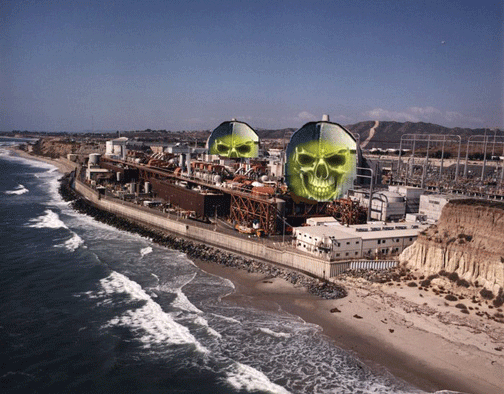
Environmental Group Wants Immediate Removal of Nuclear Waste From San Onofre Area, https://www.theinertia.com/environment/an-environmental-group-is-pushing-for-the-transport-of-nuclear-waste-away-from-san-o-stat/ Dylan Heyden, 30 Aug 18,
The ever-evolving situation at the San Onofre Nuclear Generation Station and its nuclear waste problem has become a hot-button issue for residents of San Clemente, Oceanside, and beyond. It’s immensely complex, but allow me, if you will, to oversimplify.
Spent nuclear fuel goes through a years-long cooling process in pools before it can be moved to dry storage where it further cools until it is safe for transport to long-term storage. “Long-term” storage facility, though, is a misnomer. It’s essentially the permanent resting place for nuclear waste stored in extremely thick metal canisters. The problem at San Onofre and many decommissioned nuclear generation stations across the country, though, is there is no long-term storage facility. Or rather, one was planned for an area called Yucca Mountain in Nevada, but in 2011 the Feds pulled the plug. As a result, short-term solutions have become defacto long-term solutions, which is where we are today at San Onofre.
Back in February, Southern California Edison and contractors involved in the SONGS decommissioning process began transferring spent nuclear fuel from pools to dry storage – or dry cask storage. Tens of thick metal canisters of spent nuclear fuel have since been stored on site adjacent to the generators beneath a concrete pad called the Independent Spent Fuel Storage Installation (ISFSI).
When I toured the facility back in May (more on that later), SoCal Edison employees were adamant that public safety was of the utmost importance, and that these thick metal casks were not “buried in the sand” but rather safely stored in concrete for the interim. Employees also emphasized that Southern California Edison’s goal is to move the spent fuel as expeditiously and safely as possible. “Don’t forget, our families go in the ocean nearby, too,” many said.
But Congressional gridlock and an inability to designate a feasible long-term storage site means what was once thought to be a safer short-term solution (dry storage is passive and doesn’t require energy to cool as in cooling pools) may need re-thinking.
That’s why a group of activists, called the Physicians for Social Responsibility Los Angeles recently launched a letter-writing campaign urging the California State Lands Commission to authorize the local transfer of spent nuclear fuel to an area further east in Camp Pendleton.
“3.6 million pounds of highly radioactive nuclear waste at San Onofre Nuclear Generating Station near San Diego is currently in the process of being buried on the beach, just 100 feet from the ocean and a mere few feet above the water table,” their website reads. “Send in a comment on the Draft Environmental Impact Report (EIR) and demand a better solution: the nuclear waste should be moved off the beach to a new, above-ground concrete-reinforced temporary storage facility located further east in Camp Pendleton—where it can be protected from sea level rise and potential terrorist attack.”
A sub-group of PSRLA called the Committee to Bridge the Gap has created a petition page, urging concerned citizens to put their name on a letter voicing their discontent.
According to their website, the group claims this revised plan has garnered the support of former Nuclear Regulatory Commission Chief Greg Jaczko, U.S. government advisor on nuclear waste Tom English, and retired Navy Admiral Len Herring.
The campaign explains that the failure to even consider the idea of moving the fuel east of the primary ISFSI site is a serious oversight on the part of those involved in the decommissioning process.
The letter PSRLA is urging residents to sign implores the State Lands Commission to step in. “As public servants and members of the CSLC you have a moral duty to protect our safety. Please do not take that responsibility lightly,” it says.
August 31, 2018
Posted by Christina Macpherson |
opposition to nuclear, USA, wastes |
Leave a comment
Nucnet 28th Aug 2018 , BGE, Germany’s state-owned radioactive waste disposal company, is to
cooperate with the Federal Institute for Geosciences and Natural Resources
(BGR) on the selection process for a national deep geologic repository
site, BGE said. According to a statement, BGE and BGR, which provides
scientific advice to the government, will also cooperate on the management
of existing waste repositories, including the Asse, Konrad and Morsleben
sites. The agreement will remain valid until the final repository site
selection process is complete, BGE said.
Under the agreement BGR will carry
out R&D on behalf of BGE, the statement said. The Gorleben salt mine in
Lower Saxony, northern Germany, has been under investigation as a potential
final repository site.
A moratorium on the evaluation of Gorleben was
introduced in 2000 by a former Social Democrat and Green Party
administration, but ended in 2010 and exploration at the site was
restarted. However, work was discontinued again at the end of 2012 to allow
for a political compromise on site selection and then ended in July 2013.
August 31, 2018
Posted by Christina Macpherson |
Germany, wastes |
Leave a comment
 Assemblies make moves to reject playing host to nuclear waste http://www.asahi.com/ajw/articles/AJ201808280029.html By CHIAKI OGIHARA/ Staff WriterAugust 28, 2018 More local assemblies are taking measures to send a strong message to the central government not to bother asking them to host storage facilities for nuclear waste.The moves, in the form of ordinances, were accelerated after the Ministry of Economy, Trade and Industry in July 2017 released its Nationwide Map of Scientific Features for Geological Disposal that classified areas around Japan into four colors denoting their suitability as storage sites for nuclear waste.
Electric power companies are looking for land plots to construct an interim storage facility for spent nuclear fuel. The central government is planning a final storage facility where high-level radioactive waste would be mixed with glass and vitrified before being buried more than 300 meters underground.
Twenty-two municipal assemblies now have ordinances that limit the entry of highly radioactive waste into their communities.
About half of the ordinances were adopted by 2005, followed by an extended period when concerns decreased about being chosen as a site for nuclear waste storage facilities.
But the release of the geological disposal map prompted five municipal assemblies to quickly adopt ordinances limiting the introduction of nuclear waste to their communities.
Dark green areas on the map show places deemed appropriate for hosting the final storage facility. They are all within 20 kilometers from the coast, have favorable geological features and are considered adequate for the transportation of waste.
About 900 municipalities fall into the dark green areas.
Light green areas on the map have favorable geological features but face problems in transporting the waste.
Orange areas are considered inappropriate from a geological standpoint, while silver areas are also deemed inappropriate because they have reserves of natural resources that could be mined in the future.
Between autumn 2017 and spring 2018, the village of Yamato and the towns of Higashi-Kushira and Kimotsuki–all in dark green areas in Kagoshima Prefecture–adopted ordinances to reject the acceptance of nuclear waste.
Two towns in Hokkaido passed similar ordinances. Biei, located in a light green area, took the action in April, while Urakawa, which lies mostly in a dark green area, adopted the ordinance in June.
Kagoshima Prefecture has the most municipalities–11–with such ordinances. In 2000 and 2001, six municipalities adopted the ordinances amid rising concerns that an interim spent fuel storage facility would be brought in. Between 2005 and 2015, four other municipalities followed suit.
The town of Yaku was among the first group, but its ordinance became invalid after it merged with Kami-Yaku to form the new town of Yakushima.
The Yakushima town assembly is now planning to submit an ordinance in its September session to reiterate its opposition to serving as a site for nuclear waste storage.
However, the law for nuclear waste storage would take legal precedence over any municipal ordinance, meaning that the local governments could still be asked to accept the nuclear waste.
The Nuclear Waste Management Organization of Japan (NUMO) is in charge of the final nuclear waste storage project, and it has held explanatory meetings around Japan about the geological disposal map.
At those meetings, NUMO officials have stressed that it would not force a locality to accept nuclear waste if the prefectural governor or municipal mayor was opposed.
Still, Kohei Katsuyama, chairman of the Yamato village assembly in Kagoshima Prefecture, said the ordinance serves as a strong sign of the municipality’s stance of rejecting any idea of serving as host of a nuclear waste storage facility.
August 29, 2018
Posted by Christina Macpherson |
Japan, politics, wastes |
Leave a comment