Public Accounts Committee 29th June 2018, A new report by the National Audit Office into the NDA found that work at
Sellafield accounted for 61% of the NDA’s total £3.3 billion expenditure
in 2017–18. 8 of NDA’s 10 most hazardous sites are at Sellafield,
whilst NAO expected current major projects at Sellafield will cost £6
billion total.
The NAO found that the NDA had made significant progress in
reducing delays and meeting significant milestones, but expects major NDA
projects to cost more than originally estimated in 2015.
Evaluating performance at Sellafield remained difficult due to the complexity and
scale of the site, but more could be done to explain progress, and to
provide assurance of major projects. The Committee will take evidence from
the Department of Business, Energy and Industrial Strategy, the Nuclear
Decommissioning Authority, and Sellafield to explore NDA and Sellafield’s
progress and performance. If you wish to submit written evidence to this
inquiry, the deadline to do so is midday on Tuesday 10 July. https://www.parliament.uk/business/committees/committees-a-z/commons-select/public-accounts-committee/inquiries/parliament-2017/nuclear-decommissioning-authority-17-19/
,In order to remove 1 metric ton of defense plutonium from South Carolina within two years, as a federal court has required, the U.S. Department of Energy is considering the plutonium’s nuclear weapon uses.
According to a June 13 progress report, the DOE and its National Nuclear Security Administration are re-examining the possibility of repurposing some Savannah River Site plutonium for “future defense programs.”
“Approximately 1 metric ton was identified for possible use by the weapons production program,” the report reads. “The amount of candidate programmatic material at SRS is limited; most of the surplus material is not suitable for weapons program use.”
The DOE’s prospective plan would shift the plutonium from SRS to another site, either for interim storage or plutonium pit production.
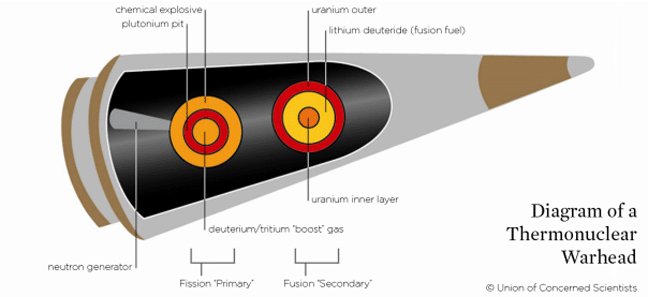
Plutonium pits are nuclear weapon cores, often referred to as triggers.
Potential out-of-state relocation sites for the 1 metric ton of plutonium have been identified, according to the DOE.
The June report did not specify where. Site studies concluded in April.
Environmental impact assessments for moving the plutonium, required by the National Environmental Policy Act, are already underway and could be completed by the end of 2018, the report notes.
In 2017, a U.S. District Court judge ordered the DOE to remove 1 metric ton of plutonium from the state within two years, the result of a lawsuit launched by S.C. Attorney General Alan Wilson. At the time, Wilson celebrated the ruling as a major win.
The DOE has stated disposing 1 ton of plutonium via downblending, also known as dilute-and-dispose, would take until fiscal year 2025 to complete at current funding and operation levels. A court-received declaration made by Henry Allen Gunter, then a plutonium program manager and technical adviser at SRS, reinforced the DOE’s claim.
More funding and more trained personnel, according to the June report, would speed things up.
But planning related to dilute-and-dispose – mixing plutonium with inert material for burial at the Waste Isolation Pilot Plant in New Mexico – ceased in June due to another court order that protected the Mixed Oxide Fuel Fabrication Facility.
The defense- and weapons-use option, according to the DOE’s report, vastly undercuts the 2025 estimate: “Indeed, the department believes that it is possible that, if successful, this option might allow the department to meet the current two-year timeline imposed by the district court,” the report reads.
According to the DOE, the plutonium is “safe and secure in its present location.” Moving it costs money and poses radiological, safety and security concerns, all of which are listed at the end of the report.
Eventually, the plutonium would have to be moved to Los Alamos National Laboratory or back to SRS for pit production.
On May 10, the DOE and the U.S. Department of Defense recommended a pit production mission for SRS, which muddies the waters a bit. Those plans have not yet been finalized.
Los Alamos currently does not have enough room for the 1 metric ton, the DOE report states. Holding it at an interim location incurs additional costs.
More information and detail, including timing, will be made available in December, the June report states.
Nucnet 25th June 2018, A full-scale in-situ system test for spent nuclear fuel disposal is
expected to begin this week at Posiva’s planned final deep geologic
disposal facility at Olkiluoto, Finland. Posiva’s owner Teollisuuden
Voima Oyj (TVO) said the test will be the first of its kind and means that
Posiva is making progress towards the operational test phase of its final
disposal system and technology.
According to TVO, the test will last for
several years. It aims to prove that the prototype processes for geological
storage at Posiva’s repository are “all working concepts”. The test
has been in preparation since December 2017, TVO said. The processes
include placing fuel assemblies packed in copper-steel canisters inside
holes drilled in the bedrock tunnels. This is followed by backfilling the
tunnels with bentonite clay and sealing them with a cast plug. Two test
canisters will be equipped with thermal resistors simulating the residual
temperature of spent nuclear fuel, TVO said. A TVO official said the
temperature and pressure in the canisters, test holes and the surrounding
bedrock, and the behaviour of the backfill of the tunnels, will be
monitored by some 500 sensors over several years. https://www.nucnet.org/all-the-news/2018/06/25/finland-s-posiva-to-begin-world-s-first-in-situ-system-test-at-final-repository-site
EDF and VEOLIA Conclude a Partnership Agreement on Nuclear Plant Decommissioning and Radioactive Waste Processing, Business Wire June 26, 2018
“We are proud to have signed this agreement with VEOLIA, which underscores EDF’s determination to become a key player in decommissioning and radioactive waste management. This partnership is also tangible evidence of EDF and VEOLIA’s desire to pool their know-how in the interest of developing successful industrial sectors.”
On 26 June 2018, EDF and VEOLIA (Paris:VIE) entered a partnership agreement to co-develop remote control solutions for dismantling gas-cooled reactors (natural uranium graphite gas or UNGG in French) and for vitrifying radioactive waste, in France and worldwide.
EDF is currently decommissioning 6 gas-cooled reactors reactors at Bugey (Ain department in France), Chinon (Indre-et-Loire department) and Saint-Laurent-des-Eaux (Loir-et-Cher). Key milestones have already been secured on all these complex projects, and EDF confirms its objective to dismantle these nuclear facilities in the shortest timeframe possible. Veolia will thus provide EDF with its experience in remote handling technologies (robotics) with a view to designing and delivering innovative solutions to access the cores of gas-cooled reactors and to cut up and extract components under optimum safety and security conditions……..https://www.businesswire.com/news/home/20180626005932/en/EDF-VEOLIA-Conclude-Partnership-Agreement-Nuclear-Plant
The U.S. Senate approved a Hanford spending bill for the next fiscal year that would provide $315 million more for the nuclear reservation than proposed by the Trump administration.
The vote was 86-5 for a package of funding bills.Earlier this month, the U.S. House passed a spending bill for fiscal 2019 that would provide $247 million more for the Hanford Site than the administration’s funding request.
The two bills next must be reconciled. A final version then could be sent to President Donald Trump for his signature.
The Senate bill would restore all but $25 million of the cuts to current spending that were proposed by the administration.
The total Hanford budget under the Senate plan would be $2.4 billion, plus some additional money for security at the site.
“Once again, I’m proud that Democrats and Republicans have come together to reject President Trump’s senseless budget cuts and instead craft a budget that honors the sacrifices of central Washington families,” said Sen. Patty Murray, D-Wash.
Murray, a senior member of the Senate Appropriations Committee, worked to secure money for Hanford as the appropriations bill was being written.
Bellona 18th June 2018 , The pace of cleanup at a major Cold War dump for spent nuclear submarine
fuel in Northwest Russia is going faster than planned, officials with
Russia’s state nuclear corporation Rosatom have said, with efforts racing
ahead twice as rapidly as initially thought possible.
Still, Rosatom has elected not to revise its deadline for removing decades of piled up nuclear
fuel assemblies at Andreyeva Bay, a Soviet era submarine maintenance base,
whose proximity to Europe made it a lighting rod for international
environmental concern. On Thursday, Anatoly Grigoryev, who heads up
Rostom’s international technical programs, told the Interfax newswire
that technicians had shipped away a load of fuel that was expected to take
a year to remove in only six months. http://bellona.org/news/nuclear-issues/2018-06-andreyeva-bay-nuclear-fuel-removal-going-faster-than-planned-rosatom-says
Keith Matheny, Detroit Free Press June 22, 2018 Up to 124,000 tons of low-level radioactive soil and other materials from a contaminated former military supplier in Ohio will begin arriving at a Wayne County landfill next week, the U.S. Army Corps of Engineers has announced.
The soil and materials are headed for Wayne Disposal Inc., U.S. Ecology’s hazardous waste landfill off I-94 near Willow Run Airport in Van Buren Township. Once the soil disposal operation is fully underway, up to 11 tractor-trailers per day, each carrying about 15 tons of contaminated soil, are expected to head north on local freeways from the village south of Toledo to the Wayne County landfill, Army Corps officials said Thursday. There’s no indication the shipments would be every day. A U.S. Ecology spokesman said the remediation project could take 8 to 10 years.
It’s part of a major cleanup of what’s known as the Luckey site, a long-shuttered beryllium plant in Luckey, Ohio. The plant supplied the strong, light but highly toxic metal to the U.S. military and Atomic Energy Commission in the 1940s and 1950s.
NBC26 ,Alan Campbell, Jun 22, 2018 VAN BUREN TOWNSHIP, Mich.— There are questions about radioactive soil and materials coming from out of state to the Wayne County landfill in Michigan.
The landfill is off I-94 near Willow Run airport. Up to 124,000 tons will be dumped.
We’re told this is low level radioactive soil and materials that isn’t harmful to the environment or people, but people who live nearby say they don’t feel it should be dumped here.
“It does make me concerned about the children around here,” said 70-year-old Debra Polak, a resident who lives a few blocks from the landfill site.
Decommissioning NO2Nuclear Power. Safe Energy Journal 78 The UK government has launched a consultation on the future regulation of nuclear sites in the final stages of decommissioning and clean-up. The Department for Business, Energy and Industrial Strategy (BEIS) said the consultation seeks to enable a “more flexible approach that can optimise waste management, thereby realising environmental benefits and reducing costs”.
Of the 36 nuclear sites located across England, Wales and Scotland, the Nuclear Decommissioning Authority (NDA) is responsible for the decommissioning and clean-up of 17. Other sites to be decommissioned in the future include the operational nuclear power stations owned by EDF Energy, and other nuclear sites in the nuclear fuel cycle, reprocessing, waste management, pharmaceutical and research sectors.
In the UK, the Nuclear Installations Act 1965 (NIA65) provides the legal framework for nuclear safety and nuclear third-party liability and sets out a system of regulatory control based on a robust licensing process administered by the Office for Nuclear Regulation (ONR). Under this regime, a site operator is required to have a licence to use a site for specified activities such as the operation of nuclear power stations. In addition to the nuclear site licensing regime, the NIA65 requires that financial provision is in place to meet claims in the event of a nuclear incident, as required under international law on nuclear third-party liability.
The consultation proposals include changing the NIA65 to allow licensees to exit the licensing regime once the site has reached internationally agreed standards and nuclear safety and security matters have been fully resolved. After the licence has been ended, the site would be regulated by the relevant environment agency and the Health and Safety Executive, in the same way that non-nuclear industrial sites undergoing clean-up for radioactive or other contamination are regulated.
Proposals for further clean-up would be assessed by the relevant environment agency under the Radioactive Substances Regulations. BEIS said this process would enable the site operator to work with the community to establish the “most appropriate” end-state for the site and would result in improved waste management and other environmental benefits.
BEIS proposes to implement two recent decisions by the OECD Steering Committee for Nuclear Energy concerning the exclusion of certain sites from the nuclear third-party regime when the main nuclear hazards have been removed and the risks to the public are small. It also proposes to tighten the licence surrender process to require a licensee to apply to ONR to surrender the licence, and to strengthen requirements for ONR to consult with HSE when the licence is surrendered or varied. (1)
The Government says the main reasons for change are:
nuclear third party liability currently continues beyond the point at which it is no longer required. The UK has not yet implemented the decisions of the OECD Steering Committee for Nuclear Energy concerning the exclusion of certain sites from the nuclear liability regime;
site operators wishing to exit the NIA65 licensing regime are required to clean-up the site in a way that does not allow them to balance the overall safety and environmental risks and this may result in unnecessary costs; and
· disposal facilities for radioactive waste located on nuclear licensed sites remain subject to nuclear licensing. Such sites are also regulated by the environment agencies. This is considered dual regulation which is unnecessary after nuclear safety matters have been resolved.
The UK Government Department for Business, Energy and Industrial Strategy (BEIS) published a discussion paper on the regulation of nuclear sites in the final stages of decommissioning and cleanup in November 2016. The NFLA responded here:
There is a danger that what is being proposed will simply be seen as turning nuclear sites into nuclear dumps as a way of saving money.
The concept of “optimisation” which is decided by the operator and regulators making value judgements needs to be replaced with the concept of the Best Practicable Environmental Option which uses a systematic consultative and decision making procedure.
Any part of a nuclear site upon which it is proposed to allow unrestricted use must be able to show that doses to members of the public will be of the order of 0.01mSv or less per year. Using a risk factor in conjunction with probability of receiving a dose is too flexible and unacceptable.
Any waste left on-site much be concentrated and contained in a monitorable, retrievable store.
Former nuclear operators should remain liable for any future unexpected events and should also be liable to pay for any regulatory effort in perpetuity.
These earlier proposals appear to allow for the unrestricted use of sites which may have nuclear waste buried and which could be capable of administering doses of up to 20mSv/yr if human intrusion occurs.
The HSE Criterion for De-Licensing Nuclear Sites (2005) says the Basic Safety Standards Directive (Euratom 96/29) allows member states to exempt a practice where appropriate and without further consideration if doses to members of the public are of the order of 0.01mSv or less per year. HSE is of the view that this dose limit broadly equates to a risk of 10-6 ‘as well as being consistent with other legislation and international advice relating to the radiological protection of the public. The environment agencies Guidance on Requirements for Authorisation (GRA) on Near Surface Disposal Facilities for Solid Radioactive Waste (Near Surface GRA) says that a risk level of 10-6 per year is equivalent to a calculated dose of around 0.02mSv/yr, where the probability of receiving the dose is one.
The consultation is open until 3rd July, and is available here:
Power Technology 21st June 2018, NDA to spend billions stabilising plutonium canisters. The National Audit Office (NAO) has released a report detailing the unstable condition of highly dangerous plutonium canisters at the Sellafield nuclear plant, said to be “decaying faster than anticipated”.
The report, titled ‘Progress with reducing risk at Sellafield’ warns that if these canisters were to leak it would prove an “intolerable risk” – a label defined by the Nuclear Decommissioning Authority (NDA) as a situation where reducing the risk “becomes the overriding factor”, taking precedence over matters of cost and requiring immediate action.
The NDA has refused to comment on the number of canisters affected, though it has said it is only a “small proportion” of their total number. The UK houses 40% of global civil plutonium, the majority of which is stored at the Sellafield site in Cumbria, itself overseen by the NDA. The substance is a by-product of nuclear fuel reprocessing and the site’s abundant stock has led the NDA to label Sellafield its most hazardous facility.
The new report shows Sellafield, which opened in 2012, to have ‘unsuitable’ containers for storing plutonium. The NAO has proposed the canisters be repackaged through the store retreatment plant (SRP) facility, though until this facility is ready the NDA is recommended to place the more unstable canisters in extra layers of packaging. In response to these measures, the NDA has announced its decision to pledge a further £1bn on these packaging canisters, and £1.5bn on building a new facility to house the plutonium. https://www.power-technology.com/news/nda-spend-billions-stabilising-plutonium-canisters/
June 18, 2018 The U.S. Senate today passed its annual defense authorization bill with three key provisions championed by U.S. Senator Dean Heller (R-NV) to support Nevada’s disabled veterans and veterans struggling with mental illness and to remove the $30 million to store defense nuclear waste at Yucca Mountain that was included in the version approved by the U.S. House of Representatives. The legislation, formally named the John S. McCain National Defense Authorization Act (NDAA) for Fiscal Year 2019, increases funding for training across all service branches and authorizes a 2.6 percent pay raise for troops – the largest increase in nine years for U.S. service members. Moving forward, both chambers will need to convene a joint conference committee in which representatives, who are appointed by leadership in the U.S. House of Representatives and U.S. Senate, reconcile the two versions of the defense bill and must produce a final report.
Heller worked with the U.S. Senate Armed Services Committee and the U.S. Senate Appropriations Committee to keep funding and an authorization of funding to revive Yucca Mountain out of the U.S. Senate’s version of the NDAA. Earlier this year, Heller urged U.S. Senate Armed Services Committee Chairman John McCain (R-AZ) to honor the will of the U.S. Senate appropriators and to exclude any language that authorizes funding for Yucca Mountain in the NDAA. Heller’s letter to Chairman McCain can be found HERE.
“Congress has an obligation to support our men and women in uniform, and that’s why I welcome the U.S. Senate’s passage of legislation that will give Nevada’s service members the largest pay raise in nearly a decade, provide our military with the resources it needs to keep America safe, and support Nevada’s 300,000 veterans. I’m proud that this legislation includes my provisions to support Nevada’s disabled veterans and help our veterans who may be struggling with mental illness and having difficulty finding work,” said Heller. “Furthermore, unlike the U.S. House of Representatives-passed version of the bill that contains $30 million to revive Yucca Mountain, I’m pleased I was able to work with Chairman McCain and U.S. Senate appropriators to successfully ensure that our bill did not include a single dollar authorized for Yucca Mountain. So once again, while the U.S. House of Representatives charges forward with shipping nuclear waste to Nevada, I kill their efforts in the U.S. Senate. While this is progress, we still have more work to do to stop the U.S. House of Representatives from turning Nevada into a nuclear waste dump. I remain committed to doing everything that I can to make sure that Yucca Mountain remains dead.”…….https://www.heller.senate.gov/public/index.cfm/pressreleases?ID=89EE1BBB-BB73-42D9-A192-038B549AADC4
Herald 20th June 2018 , Decommissioning the nuclear site at Sellafield faces continued delays and an overspend of up to £913 million, according to an official report. The National Audit Office (NAO) said the Nuclear Decommissioning Authority (NDA) had improved its performance in delivering major projects at the site in Cumbria. But work is still predicted to be late and to cost more than originally expected, said the spending watchdog. The NDA’s nine major projects were expected to cost an additional 60% of their budget at the design stage in 2015, but this has been reduced to 29%, said the NAO. While this was a substantial improvement, it was still a forecast overspend of
£913 million.
The NAO reported that three projects were cancelled when £586 million had already been spent on them after the NDA said it had
found a better way of delivering the work. It said Sellafield Limited has achieved £470 million in efficiency savings, but added that neither the NDA nor the company knows their make-up and admit that a proportion does not represent genuine efficiency savings.
“The strategic decisions the NDA takes around prioritising activity at Sellafield could be profoundly changed and improved by a better, more evidence-based assessment of these constraints. “The NAO has found that the role of the NDA is unclear and this could put at risk the progress we are now seeing at Sellafield,” the report said. “The Department for Business, Energy & Industrial Strategy’s
governance of the NDA is complex and not working as well as it should to support improvements at Sellafield. http://www.heraldscotland.com/news/16301638.Watchdog_warns_of_delays_and___900m_overspend_in_Sellafield_decommissioning/
Australian mining companies have a poor track record operating in Africa. Australian uranium company Paladin Energy has now put two of its mines into ‘care-and-maintenance’ and bankruptcy looms. But who cleans up the company’s mess in Namibia and Malawi, asks JIM GREEN
Many Australian mining projects in Africa are outposts of good governance – this is what Julie Bishop, the country’s Foreign Minister, told the Africa Down Under mining conference in Western Australia in September 2017. The Australian government “encourages the people of Africa to see us as an open-cut mine for lessons-learned, for skills, for innovation and, I would like to think, inspiration,” the minister said.
But such claims sit uneasily with the highly critical findings arising from a detailed investigation by the International Consortium of Independent Journalists (ICIJ). The ICIJ noted in a 2015 report that since 2004, more than 380 people have died in mining accidents or in off-site skirmishes connected to Australian mining companies in Africa.
The ICIJ report further stated: “Multiple Australian mining companies are accused of negligence, unfair dismissal, violence and environmental law-breaking across Africa, according to legal filings and community petitions gathered from South Africa, Botswana, Tanzania, Zambia, Madagascar, Malawi, Mali, Cote d’Ivoire, Senegal and Ghana.”
Paladin Energy’s Kayelekera uranium mine in Malawi provides a case study of the problems with Australian mining companies in Africa. Western Australia-based Paladin exploited Malawi’s poverty to secure numerous reductions and exemptions from payments normally required by foreign investors.
United Nations’ Special Rapporteur Olivier De Schutter noted in a 2013 report that “revenue losses from special incentives given to Australian mining company Paladin Energy, which manages the Kayelekera uranium mine, are estimated to amount to at least US$205 million (MWK 67 billion) and could be up to US$281 million (MWK 92 billion) over the 13-year lifespan of the mine.”
Standards at Kayelekera fall a long way short of Australian standards ‒ and efforts to force Australian mining companies to meet Australian standards when operating abroad have been strongly resisted. The Kayelekera project would not be approved in Australia due to major flaws in the assessment and design proposals, independent consultants concluded.
Care-and-maintenance
Kayelekera was put into care-and-maintenance in May 2014, another victim of the uranium industry’s post-Fukushima meltdown. And just last month, Paladin announced that its only other operating mine ‒ the Langer Heinrich mine (LHM) in Namibia ‒ will be put into care-and-maintenance.
Perhaps the most striking aspect of the decision to mothball LHM is that Paladin claims it is the lowest cost open-pit uranium mine in the world. Moreover, the company wasn’t even paying to mine ore ‒ mining ceased in November 2016 and since then ore stockpiles have been processed. Thus a low-cost mine can’t even turn a profit processing mined stockpiles.
The cost of production was US$23.11 / lb uranium oxide in December 2017, and the average realised sale price in the second half of 2017 was $21.82.
Anticipating the decision to mothball LHM, Paladin Energy CEO Alex Molyneux said in late-April: “The uranium market has failed to recover since the Fukushima incident in 2011, with the average spot price so far in 2018 the lowest in 15 years. It’s deeply distressing to have to consider suspending operations at LHM because of the consequences for our employees, and the broader community. However, as there has yet to be a sustainable recovery in the uranium market, and with the aim of preserving maximum long-term value for all stakeholders, it is clearly prudent to consider these difficult actions.”
Paladin hopes to resume mining at LHM and Kayelekera following “normalization” of the uranium market, which it anticipates in the next few years. But with no operating mines, Paladin may not survive for long enough to witness a market upswing.
Paladin was placed into the hands of administrators in July 2017 as it was unable to pay French utility EDF a US$277 million debt.
In January 2018, Paladin’s administrator KPMG noted that an Independent Expert’s Report found that the company’s net debt materially exceeds the value of its assets, its shares have nil value, and if Paladin was placed into liquidation there would be no return to shareholders.
The company was restructured, with Deutsche Bank now the largest shareholder, and relisted on the Australian Securities Exchange in February 2018.
Perhaps LHM will be sold for a song, either before or after Paladin goes bankrupt. A subsidiary of China National Nuclear Corporation (CNNC) has held a 25 percent stake in LHM since January 2014. Last year, the CNNC subsidiary considered exercising its contractual right to buy Paladin’s 75 percent stake in LHM, but chose not to exercise that right following an independent valuation of US$162 million for Paladin’s stake.
Mine-site rehabilitation
Paladin hopes to resume mining following “normalization” of the uranium market ‒ but low prices could be the new normal. Former World Nuclear Association executive Steve Kidd said in May 2014 that the industry is set for “a long period of relatively low prices”. Prices were far higher in 2014 than over the past twelve months. Paladin’s CEO Alexander Molyneux said that “it has never been a worse time for uranium miners” in 2016 and the situation has worsened since then for the industry ‒ prices have fallen further still.
Sooner or later ‒ probably sooner ‒ both the LHM and Kayelekera mine-sites will need to be rehabilitated. Yet it is extremely doubtful whether Paladin has set aside adequate funds for rehabilitation. Paladin’s 2017 Annual Report lists a ‘rehabilitation provision‘ of US$86.93 million to cover both LHM and Kayelekera.
One problem is that the funds might not be available for rehabilitation if Paladin goes bankrupt. A second problem is that even if the funds are available, they are unlikely to be sufficient.
For comparison, Energy Resources of Australia’s provision for rehabilitation of the Ranger uranium mine in Australia ‒ also an open-pit uranium mine, like LHM and Kayelekera ‒ is US$403 million (A$526 million). That figure is additional to US$346 million (A$452 million) already spent on water and rehabilitation activities since 2012 ‒ thus total rehabilitation costs could amount to US$749 million (A$978 million) … and the current cost estimates could easily increase as they have in the past.
Rehabilitation of LHM and Kayelekera could be cheaper than rehabilitation of Ranger for several reasons, such as the relative size of the mine-sites. However it stretches credulity to believe that the cost of rehabilitating both LHM and Kayelekera would be an order of magnitude lower than the cost of rehabilitating one mine in Australia.
Paladin was required to lodge a US$10 million Environmental Performance Bond with Malawian banks and presumably that money can be tapped to rehabilitate Kayelekera. But US$10 million won’t scratch the surface. According to a Malawian NGO, the Kayelekera rehabilitation cost is estimated at US$100 million.
Paladin has ignored repeated requests to provide information on the estimated cost of rehabilitating Kayelekera (and also ignored an invitation to comment on a draft of this article), but the figure will be multiples of the US$10 million bond and it is extremely unlikely that Paladin’s provision of US$86.93 million for the rehabilitation of both LHM and Kayelekera is adequate.
If Paladin goes bankrupt, it seems likely that most of the costs associated with the rehabilitation of LHM and Kayelekera will be borne by the Namibian and Malawian governments (with a small fraction of the cost for Kayelekera coming from the bond) ‒ or the mine-sites will not be rehabilitated at all.
Even if Paladin is able to honour its US$86.93 million provision, additional costs necessary for rehabilitation will likely come from the Malawian and Namibian governments, or rehabilitation will be sub-standard.
Problems most acute for Kayelekera
The problem of inadequate provisioning for rehabilitation is most acute for Kayelekera ‒ it is a smaller deposit than LHM and more expensive to mine (Paladin has said that a uranium price of about US$75 per pound would be required for Kayelekera to become economically viable ‒well over twice the current long-term contract price). Thus the prospects for a restart of Kayelekera (and the accumulation of funds for rehabilitation) are especially grim.
Is it reasonable for Australia, a relatively wealthy country, to leave it to the overstretched, under-resourced government of an impoverished nation to clean up the mess left behind by an Australian mining company? Malawi is one of the poorest countries in the world. According to a 2013 UN report, more than half of the population live below the poverty line.
Australia’s Foreign Minister Julie Bishop should intervene to sort out the situation at Kayelekera and to prevent a repetition of this looming fiasco. The conservative Minister’s eyes might glaze over in response to a moral argument about the importance of Australia being a good global citizen. But there is also a hard-headed commercial argument for intervention to ensure that the Kayelekera mine-site is rehabilitated.
It does Australian companies investing in mining ventures abroad no good whatsoever to leave Kayelekera unrehabilitated, a permanent reminder of the untrustworthiness and unfulfilled promises of an Australian miner and the indifference of the Australian government.
Australia is set to become the biggest international miner on the African continent according to the Australia-Africa Minerals & Energy Group. But Australian companies can’t expect to be welcomed if problems such as Kayelekera remain unresolved.
Dr Jim Green is the national nuclear campaigner with Friends of the Earth Australia and editor of the Nuclear Monitor newsletter, where a version of this article was originally published. He is co-author of a new report titled ‘Undermining Africa: Paladin Energy’s Kayelekera Uranium Mine in Malawi’.
FES nuclear decommissioning funds inadequate, consumer groups tell NRC, Cleveland Business, When FirstEnergy Solutions closes the Perry nuclear power plant east of Cleveland, the Davis-Besse nuclear plant near Toledo and the Beaver Valley nuclear plant near Pittsburgh it will have up to 60 years to decommission the reactors and clean up the land at a cost of billions of dollars. A coalition of consumer and environment groups is arguing that the decommissioning trust funds are inadequate, that FES will not be able to begin decommissioning for years after the plants are closed and that parent company FirstEnergy Cop. must be held responsible to make up the funding deficit.(Plain Dealer file)
CLEVELAND, Ohio — The trust funds that FirstEnergy created years ago to pay for the demolition of its nuclear power plants and clean-up are no longer adequate, a coalition of consumer and environmental groups is arguing today at the Nuclear Regulatory Commission.
Japan to cap plutonium stockpile to allay U.S. concerns, THE ASAHI SHIMBUN, June 17, 2018
Japan plans to boost measures to curb surplus plutonium extracted from the reprocessing of spent fuel at nuclear power plants, including capping the country’s stockpile of the highly toxic material.
The move followed the U.S. and other countries’ calls for Japan to reduce excess plutonium in light of nuclear nonproliferation and the threat of terrorist attacks involving nuclear materials.
The Cabinet Office’s Japan Atomic Energy Commission will incorporate the measures in the five-point basic nuclear policy expected at the end of this month, the first revision in 15 years.
A reduction in the volume of plutonium held by Japan will also be specified in the government’s basic energy plan, which will be revised next month.
Japan possesses about 10 tons of plutonium inside the country and about 37 tons in Britain and France, the two countries contracted to reprocess spent nuclear fuel. The total amount is equivalent to 6,000 of the atomic bomb that devastated Nagasaki in 1945.
In the policy, announced in 2003, the government vowed not to possess plutonium that has no useful purpose. The government has pledged not to have surplus plutonium to the International Atomic Energy Agency………
Japan can reprocess spent nuclear fuel under the Japan-U.S. Nuclear Cooperation Agreement.
The 30-year pact is expected to be automatically extended beyond its expiration on July 16.
After the expiration, however, the pact will be scrapped six months after either Japan or the United States notifies the other side of its intention to do so.
Foreign Minister Taro Kono has expressed concern about the “unstable” future of the agreement after July, and Japan has worked to meet a request from Washington to clearly spell out steps to reduce Japan’s plutonium stocks.
The government’s draft policy calls for allowing retrieval of plutonium strictly based on the projected amount to be used at conventional nuclear reactors as mixed plutonium-uranium oxide fuel, commonly known as MOX fuel.
It will also step up oversight on utilities with the aim of reducing the amount of plutonium to a level allowing the nuclear reprocessing plant under construction in Rokkasho, Aomori Prefecture, and other facilities to operate properly.
In addition, electric power companies will cooperate with each other in the use of MOX fuel, so that the amount of Japan’s surplus plutonium that is now overseas will be reduced.
For example, Kyushu Electric Power Co. and Kansai Electric Power Co., two utilities that began using MOX fuel ahead of other utilities, will consider using more MOX fuel at their nuclear plants for the benefit of Tokyo Electric Power Co., whose prospect of bringing its Kashiwazaki-Kariwa nuclear power plant in Niigata Prefecture back on line remains uncertain.
When the 2.9 trillion yen ($26.37 billion) reprocessing plant in Rokkasho goes into full operation, about eight tons of new plutonium will be added annually as Japan’s surplus plutonium…..
of nine reactors that have resumed operations following the introduction of more stringent safety standards after the Fukushima No. 1 nuclear disaster in 2011, only four can use MOX fuel.
The operation of the Rokkasho plant will likely be significantly curtailed even if it is completed amid that environment.






 nuclear-news