But even as reactors shut down and communities eye former nuclear sites for redevelopment, a big problem remains: Despite more than 50 years of laws, regulations, lawsuits, and debates, the U.S. has no long-term repository for nuclear waste—nor even much of a plan for one.
Companies Orano – formerly AREVA, and Holtec aim for private-public partnerships on USA’s nuclear wastes
 Plans Move Forward for Privately Funded Storage of Nuclear Waste, Power 09/05/2018 | Darrell Proctor The Trump administration has revived the discussion of using Yucca Mountain in Nevada as a repository for the nation’s nuclear waste. Nevada officials remain opposed to the idea of putting spent nuclear fuel in long-term storage at a site about 100 miles from Las Vegas.But while a bill to resurrect Yucca Mountain as a storage site moves through Congress, other groups have stepped forward with plans to site, build, and operate nuclear waste storage and disposal facilities in areas including Texas and New Mexico. Those plans have reignited the debate about what the U.S. should do with its nuclear waste, along with the discussion of whether the federal government or the individual states should take the lead in developing long-term storage plans.
The Nuclear Regulatory Commission (NRC) says at least 12 U.S. reactors are committed to closing over the next five years, joining the more than 20 reactors shuttered over the past 10 years across the country. That’s lot of spent nuclear fuel, in multiple locations, in need of safe storage, whether at an interim site or at a facility designed for long-term storage……….
Interim Storage Sites in Development
 Two members of Wednesday’s panel represented companies developing interim storage sites. Interim Storage Partners (ISP), a joint venture of Orano USA [Orano – formerly AREVA] and Waste Control Specialists (WCS), is pursuing a license for a consolidated interim storage facility (CISF) for used nuclear fuel at an existing WCS disposal site in Andrews County, Texas. Holtec International, which has been acquiring nuclear plants that have closed or are scheduled to close in order to carry out their decommissioning, is developing a CISF in southeastern New Mexico, in a remote area between Carlsbad and Hobbs……..
Joy Russell, vice president of corporate business development and chief communications officer for Holtec,  said her company formed a business unit—Comprehensive Decommissioning International—in a 2018 joint venture with SNC-Lavalin after SNC-Lavalin in 2017 acquired Atkins, a nuclear waste solutions company. Russell said the New Mexico site encompasses about 1,000 acres, with “about 500 acres being used to build the facility.” Russell said the site, known as HI-STORE CIS, would use the company’s HI-STORM UMAX technology, which stores loaded canisters of nuclear waste in a subterranean configuration.
Russell said her group has a public-private partnership with the Eddy Lee Energy Alliance, representing Eddy and Lee counties in New Mexico, for the project, which she said has support from both local and state officials.
“We’re doing educational outreach in New Mexico,” said Russell. “We do township meetings, where we testify before the mayor and town council. We meet one-on-one with candidates. We had to start with the basics. What people think of when they hear nuclear fuel, they think of the fuel you put in your car, and how that could leak into the ground. We have to educate people on what [nuclear] fuel is. We focus on safety, security, and technology.”
Russell agreed that public concerns centers on the transport of nuclear waste. “The number-one thing I hear, all the time, about consolidated interim storage is transportation.” Holtec also has its license application before the NRC for review; Russell said it expect the agency will complete its review in July 2020, putting the New Mexico site on a timeline to receive its first shipment of spent fuel in 2023.
Revisiting Yucca Mountain
Congress first chose Yucca Mountain as a storage site for nuclear waste in 1987. Years of research into the site followed; estimates are that $15 billion was spent on the project. Sproat noted his efforts on licensing for Yucca Mountain before his retirement from the DOE, with a license application submitted to the NRC in 2008. The Obama administration ended funding for the project and halted the licensing process in 2009.
Meanwhile, the Nuclear Waste Fund (NWF), which collected money from the states to finance waste storage projects, was ordered by a federal court in late 2013 to stop collecting that money until the federal government made provisions for collecting that waste………….. https://www.powermag.com/plans-move-forward-for-privately-funded-storage-of-nuclear-waste/?pagenum=1
Japan holds public hearings on what to do with growing amounts of radioactive water from the ruined Fukushima No. 1 nuclear power plant.
 EDITORIAL: All options need to be weighed for Fukushima plant tainted water http://www.asahi.com/ajw/articles/AJ201809060020.html September 6, 2018 The government has held public hearings on plans to deal with growing amounts of radioactive water from the ruined Fukushima No. 1 nuclear power plant.
The hearings, held in Tomioka and Koriyama in Fukushima Prefecture as well as in Tokyo, underscored the enormous difficulty government policymakers are having in grappling with the complicated policy challenge.
The crippled reactors at the plant are still generating huge amounts of water contaminated with radiation every day. Tons of groundwater percolating into the damaged reactor buildings as well as water being injected into the reactors to cool the melted fuel are constantly becoming contaminated.
Almost all the radioactive elements are removed from the water with a filtering system. But the system cannot catch tritium, a mildly radioactive isotope of hydrogen.
The tritium-contaminated water is stored on-site in hundreds of large tanks. As the number of tanks has reached 900, the remaining space for them is shrinking and expected to run out by around 2020, according to the government.
Clearly, time is growing short on deciding what to do about the problem.
A task force of the Ministry of Economy, Trade and Industry has considered five options, including release into the Pacific Ocean after dilution, injection into deep underground strata and release into the air after vaporization. The group has concluded that dumping the water into the ocean would be the quickest and least costly way to get rid of it.
This is seen as the best option within the government.
Tritium is a common radioactive element in the environment that is formed naturally by atmospheric processes. Nuclear power plants across the nation release tritium produced in their operations into the sea according to legal safety standards.
But these facts do not automatically mean that releasing the tritium-laced water into the sea off Fukushima is a good approach to the problem.
Local communities in areas affected by the 2011 nuclear disaster are making strenuous efforts to rebuild the local fishing and agricultural industries that have been battered by the radiation scare. There are still countries that ban imports of foodstuffs produced in Fukushima Prefecture.
Local fishermen and other community members have every reason to oppose the idea of releasing tritium into the ocean. They are naturally concerned that the discharge would produce new bad rumors that deliver an additional blow to the reputation and sales of Fukushima food products.
Unsurprisingly, most of the citizens who spoke at the hearings voiced their opposition to the idea.
Moreover, it was reported last month that high levels of radioactive strontium and iodine surpassing safety standards had been detected in the treated water.
The revelation has made local communities even more distrustful of what they have been told about operations to deal with the radioactive water.
It is obvious that the hearings at only three locations are not enough to sell any plan to cope with the sticky problem to skeptical local residents. The government needs to create more opportunities for communication with them.
In doing so, the government should show a flexible stance without adamantly making the case for the idea of releasing the water into the sea. Otherwise, there can be no constructive debate on the issue.
It can only hope to win the trust of the local communities if it gives serious consideration to other options as well.
During the hearings, many speakers suggested that the water should be kept in large tanks until the radioactivity level falls to a very low level.
The pros and cons of all possible options, including this proposal, should be weighed carefully through cool-headed debate before the decision is made.
Repeated discussions with fruitful exchanges of views among experts and citizens including local residents are crucial for ensuring that the final decision on the plan will win broad public support.
The government and Tokyo Electric Power Co., the operator of the Fukushima plant, should disclose sufficient information for such discussions and give thoughtful and scrupulous explanations about relevant issues and details.
The government, which has been promoting nuclear power generation as a national policy priority, has the responsibility of building a broad and solid consensus on this problem.
Will UK’s House of Lords agree to force a geological nuclear dump on Cumbria
 Radiation Free Lakeland 2nd Sept 2018 , Will These Lords Leap to Cumbria’s Defence? Will They Shout About the
“Implementation” of Geological Dumping of Nuclear Wastes. On the 6th
September the House of Lords will be debating the Government’s cunning
plan to implement Geological Disposal of Nuclear Wastes. Radiation Free
Lakeland have sent a letter to all of the Cumbrian Lords to urge them to
tear up this policy which seeks to force a geological nuclear dump on
Cumbria and instead to scrap the whole “Implementation” plan. Our
letter is below [on original] and we urge all those who love Cumbria to write a similar
letter to any or all of the Cumbrian members of the House of Lords.
https://mariannewildart.wordpress.com/2018/09/02/will-these-lords-leap-to-cumbrias-defence-will-they-shout-about-the-implementation-of-geological-dumping-of-nuclear-wastes/
Saudi Arabia’s plans to make Qatar a nuclear waste dump island

 Saudi Official Pushes Plans to Make Qatar an Island, Dump Nuclear Waste There, Sputnik News, 30 Sep 18 No man is an island – but the peninsular nation of Qatar just might become one, as it looks increasingly likely that Saudi Arabia will move ahead with plans to build a canal across the peninsula, cutting the nation off from the mainland.
Reports have steadily emerged since April that the Saudi government was considering a canal across the Qatari peninsula roughly half a mile from the border. A Friday tweet by a prominent government official seems to further signal that the plans could be legitimate and not simply a public relations stunt or attempt at intimidation.
As a citizen, I am impatiently waiting for the details of the implementation of the East Salwa island project. This great and historic project will change the region’s geography,” Saud al-Qahtani, a senior adviser to Saudi Crown Prince Mohammed bin Salman, tweeted on Friday, according to Reuters. The news agency noted that Qahtani has mentioned the canal several times on Twitter over the past few months.
And if that wasn’t petty enough, the half-mile gap between the canal and the Qatar border would be turned into a nuclear waste dump, Press TV reported Friday. The waste would come from the 16 nuclear reactors the monarchy plans to open in the next 25 years.
The South China Morning Post noted in April that the United Arab Emirates would be building a nuclear waste dump at the part of its country closest to Qatar, too.
The Salwa Marine Canal Project would be roughly 37 miles long, 650 feet wide and 65 feet deep and would service a military base and tourist resort in addition to the nuclear waste dump, exiting to the Persian Gulf at the Saudi cities of Salwa and Khor al-Adeed, Gulf News reported in June when the Saudi government closed construction applications by interested companies.
The proposed canal would cost roughly 2.8 billion Saudi riyals ($745 million)……..https://sputniknews.com/middleeast/201808311067651290-Saudi-Official-Pushes-Canal-Qatar-Island/
Call for immediate removal of nuclear waste from San Onofre area

Environmental Group Wants Immediate Removal of Nuclear Waste From San Onofre Area, https://www.theinertia.com/environment/an-environmental-group-is-pushing-for-the-transport-of-nuclear-waste-away-from-san-o-stat/ Dylan Heyden, 30 Aug 18,
The ever-evolving situation at the San Onofre Nuclear Generation Station and its nuclear waste problem has become a hot-button issue for residents of San Clemente, Oceanside, and beyond. It’s immensely complex, but allow me, if you will, to oversimplify.
Spent nuclear fuel goes through a years-long cooling process in pools before it can be moved to dry storage where it further cools until it is safe for transport to long-term storage. “Long-term” storage facility, though, is a misnomer. It’s essentially the permanent resting place for nuclear waste stored in extremely thick metal canisters. The problem at San Onofre and many decommissioned nuclear generation stations across the country, though, is there is no long-term storage facility. Or rather, one was planned for an area called Yucca Mountain in Nevada, but in 2011 the Feds pulled the plug. As a result, short-term solutions have become defacto long-term solutions, which is where we are today at San Onofre.
Back in February, Southern California Edison and contractors involved in the SONGS decommissioning process began transferring spent nuclear fuel from pools to dry storage – or dry cask storage. Tens of thick metal canisters of spent nuclear fuel have since been stored on site adjacent to the generators beneath a concrete pad called the Independent Spent Fuel Storage Installation (ISFSI).
When I toured the facility back in May (more on that later), SoCal Edison employees were adamant that public safety was of the utmost importance, and that these thick metal casks were not “buried in the sand” but rather safely stored in concrete for the interim. Employees also emphasized that Southern California Edison’s goal is to move the spent fuel as expeditiously and safely as possible. “Don’t forget, our families go in the ocean nearby, too,” many said.
But Congressional gridlock and an inability to designate a feasible long-term storage site means what was once thought to be a safer short-term solution (dry storage is passive and doesn’t require energy to cool as in cooling pools) may need re-thinking.
That’s why a group of activists, called the Physicians for Social Responsibility Los Angeles recently launched a letter-writing campaign urging the California State Lands Commission to authorize the local transfer of spent nuclear fuel to an area further east in Camp Pendleton.
“3.6 million pounds of highly radioactive nuclear waste at San Onofre Nuclear Generating Station near San Diego is currently in the process of being buried on the beach, just 100 feet from the ocean and a mere few feet above the water table,” their website reads. “Send in a comment on the Draft Environmental Impact Report (EIR) and demand a better solution: the nuclear waste should be moved off the beach to a new, above-ground concrete-reinforced temporary storage facility located further east in Camp Pendleton—where it can be protected from sea level rise and potential terrorist attack.”
A sub-group of PSRLA called the Committee to Bridge the Gap has created a petition page, urging concerned citizens to put their name on a letter voicing their discontent.
According to their website, the group claims this revised plan has garnered the support of former Nuclear Regulatory Commission Chief Greg Jaczko, U.S. government advisor on nuclear waste Tom English, and retired Navy Admiral Len Herring.
The campaign explains that the failure to even consider the idea of moving the fuel east of the primary ISFSI site is a serious oversight on the part of those involved in the decommissioning process.
The letter PSRLA is urging residents to sign implores the State Lands Commission to step in. “As public servants and members of the CSLC you have a moral duty to protect our safety. Please do not take that responsibility lightly,” it says.
German nuclear waste and Geoscience authorities in selection process for nuclear waste dump
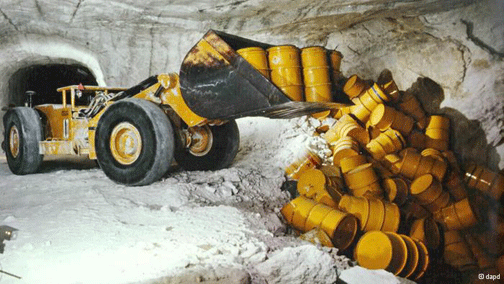
Nucnet 28th Aug 2018 , BGE, Germany’s state-owned radioactive waste disposal company, is to
cooperate with the Federal Institute for Geosciences and Natural Resources
(BGR) on the selection process for a national deep geologic repository
site, BGE said. According to a statement, BGE and BGR, which provides
scientific advice to the government, will also cooperate on the management
of existing waste repositories, including the Asse, Konrad and Morsleben
sites. The agreement will remain valid until the final repository site
selection process is complete, BGE said.
cooperate with the Federal Institute for Geosciences and Natural Resources
(BGR) on the selection process for a national deep geologic repository
site, BGE said. According to a statement, BGE and BGR, which provides
scientific advice to the government, will also cooperate on the management
of existing waste repositories, including the Asse, Konrad and Morsleben
sites. The agreement will remain valid until the final repository site
selection process is complete, BGE said.
Under the agreement BGR will carry
out R&D on behalf of BGE, the statement said. The Gorleben salt mine in
Lower Saxony, northern Germany, has been under investigation as a potential
final repository site.
out R&D on behalf of BGE, the statement said. The Gorleben salt mine in
Lower Saxony, northern Germany, has been under investigation as a potential
final repository site.
A moratorium on the evaluation of Gorleben was
introduced in 2000 by a former Social Democrat and Green Party
administration, but ended in 2010 and exploration at the site was
restarted. However, work was discontinued again at the end of 2012 to allow
for a political compromise on site selection and then ended in July 2013.
introduced in 2000 by a former Social Democrat and Green Party
administration, but ended in 2010 and exploration at the site was
restarted. However, work was discontinued again at the end of 2012 to allow
for a political compromise on site selection and then ended in July 2013.
The site is being kept open, but secured, and Gorleben will not be excluded
from any new site selection process. BGE was set up in 2016 and is
responsible for finding possible radioactive waste disposal sites in
addition to the existing interim facility at Gorleben.
https://www.nucnet.org/all-the-news/2018/08/28/germany-s-radwaste-disposal-company-to-cooperate-with-federal-institute-on-repository-selection
from any new site selection process. BGE was set up in 2016 and is
responsible for finding possible radioactive waste disposal sites in
addition to the existing interim facility at Gorleben.
https://www.nucnet.org/all-the-news/2018/08/28/germany-s-radwaste-disposal-company-to-cooperate-with-federal-institute-on-repository-selection
Japan’s municipalities in growing rejection to hosting nuclear waste dumps
Assemblies make moves to reject playing host to nuclear waste http://www.asahi.com/ajw/articles/AJ201808280029.html By CHIAKI OGIHARA/ Staff WriterAugust 28, 2018 More local assemblies are taking measures to send a strong message to the central government not to bother asking them to host storage facilities for nuclear waste.The moves, in the form of ordinances, were accelerated after the Ministry of Economy, Trade and Industry in July 2017 released its Nationwide Map of Scientific Features for Geological Disposal that classified areas around Japan into four colors denoting their suitability as storage sites for nuclear waste.
Electric power companies are looking for land plots to construct an interim storage facility for spent nuclear fuel. The central government is planning a final storage facility where high-level radioactive waste would be mixed with glass and vitrified before being buried more than 300 meters underground.
Twenty-two municipal assemblies now have ordinances that limit the entry of highly radioactive waste into their communities.
About half of the ordinances were adopted by 2005, followed by an extended period when concerns decreased about being chosen as a site for nuclear waste storage facilities.
But the release of the geological disposal map prompted five municipal assemblies to quickly adopt ordinances limiting the introduction of nuclear waste to their communities.
Dark green areas on the map show places deemed appropriate for hosting the final storage facility. They are all within 20 kilometers from the coast, have favorable geological features and are considered adequate for the transportation of waste.
About 900 municipalities fall into the dark green areas.
Light green areas on the map have favorable geological features but face problems in transporting the waste.
Orange areas are considered inappropriate from a geological standpoint, while silver areas are also deemed inappropriate because they have reserves of natural resources that could be mined in the future.
Between autumn 2017 and spring 2018, the village of Yamato and the towns of Higashi-Kushira and Kimotsuki–all in dark green areas in Kagoshima Prefecture–adopted ordinances to reject the acceptance of nuclear waste.
Two towns in Hokkaido passed similar ordinances. Biei, located in a light green area, took the action in April, while Urakawa, which lies mostly in a dark green area, adopted the ordinance in June.
Kagoshima Prefecture has the most municipalities–11–with such ordinances. In 2000 and 2001, six municipalities adopted the ordinances amid rising concerns that an interim spent fuel storage facility would be brought in. Between 2005 and 2015, four other municipalities followed suit.
The town of Yaku was among the first group, but its ordinance became invalid after it merged with Kami-Yaku to form the new town of Yakushima.
The Yakushima town assembly is now planning to submit an ordinance in its September session to reiterate its opposition to serving as a site for nuclear waste storage.
However, the law for nuclear waste storage would take legal precedence over any municipal ordinance, meaning that the local governments could still be asked to accept the nuclear waste.
The Nuclear Waste Management Organization of Japan (NUMO) is in charge of the final nuclear waste storage project, and it has held explanatory meetings around Japan about the geological disposal map.
At those meetings, NUMO officials have stressed that it would not force a locality to accept nuclear waste if the prefectural governor or municipal mayor was opposed.
Still, Kohei Katsuyama, chairman of the Yamato village assembly in Kagoshima Prefecture, said the ordinance serves as a strong sign of the municipality’s stance of rejecting any idea of serving as host of a nuclear waste storage facility.
Slow death of nuclear power, leaving stranded radioactive trash

 Radioactive waste stranded as U.S. shifts from nuclear energy, Lack of a long-term repository leaves communities as de facto storage sites, Chemical and Engineering News, by Jeff Johnson, special to C&EN, AUGUST 28, 2018
The U.S. appears to be witnessing the slow death of nuclear power. Plants are aging out and retiring, and their place in the electricity marketplace is being captured by cheaper, simpler, and less controversial sources—particularly natural gas plants and renewable energy sources such as wind and solar.
A decade ago, more than 120 reactors generated electricity in the U.S., and the nuclear power industry and federal regulators were heralding a nuclear power renaissance. Today, however, operating reactors have dropped to 98. Twelve more reactors have committed to shutting down by 2024, according to Nuclear Regulatory Commission (NRC), which regulates nuclear power generators.
The rest of the current reactors will also likely close over the next two decades as they reach their expected lifetimes. Two power plants remain under some level of construction, half of the number planned a year ago.
As reactors shut down, radioactive spent fuel from decades of electricity production remains in pools and casks on the plant sites, much to the chagrin of nearby residents and civic leaders. They want the waste gone and the land put to productive use.
Al Hill is the mayor of Zion, Ill., a 25,000-resident community on the shore of Lake Michigan, 45 miles north of Chicago. In 1973, two reactors at Zion Nuclear Power Station began generating power for the region and operated until 1998. Since then, the plant has been successfully decommissioned, and by the end of this year, most concrete structures and the reactor cores will be hauled to low-level radioactive disposal sites, Hill says. However, 64 5-meter-tall, 150-metric-ton waste canisters will remain, lined up like giant bowling pins on a concrete slab 90 m from the lakeshore……….
It wasn’t supposed to be this way. Under the 1982 Nuclear Waste Policy Act, a U.S. geologic repository was to be operating by 1998. That act called for the creation of two waste repositories, one each in the eastern and western parts of the U.S. It also laid out a process to examine and select potential waste sites from several candidates. In 1987, however, Congress amended the law, modifying it in such a way that only Yucca Mountain in Nevada could qualify as a geological waste repository. The law was nicknamed the “screw Nevada bill.”
The state has opposed hosting a radioactive waste repository at Yucca Mountain from the start, notes geologist Allison Macfarlane, who served as NRC head from 2012–14 and before that was a member of a special blue-ribbon committee that examined the site-selection process. Some geologists, Native American tribes, and environmental organizations have also opposed a Yucca Mountain repository. Nevertheless, geologic site studies, pilot plant construction, and policy planning slowly advanced.
But while campaigning for president in Nevada in 2008, Barack Obama promised to cancel the site. When elected, he followed through and killed Yucca, then created the 15-member commission that included Macfarlane. The commission did not reconsider the geological suitability of Yucca Mountain as a waste repository. Rather, it spent two years examining the site selection process. It ultimately recommended a total overhaul of the site assessment and selection process, including having the process led by a “single-purpose federal corporation” instead of the Department of Energy. The commission also recommended a “consent-based” process with incentives offered to encourage communities and states to accept the waste.
Commission members pointedly said the Yucca Mountain approach had been a “top-down, federally mandated solution” that was forced onto a community and eventually would fail. …….
“I don’t get the sense that nuclear waste is a high priority for the Trump administration,” former NRC head Macfarlane says. “There is no real group to put pressure to resolve the waste issue, except the people living near the shutdown sites. The nuclear industry is struggling right now, and they aren’t likely to pour money into this, and Congress appears willing to let it be.” Macfarlane still supports a consent-based approach for repository selection and would not comment on the suitability of Yucca Mountain as a repository
Meanwhile, NRC spokesperson McIntyre notes that two companies, Holtec International and Interim Storage Partners, are pursuing consolidated interim storage facilities and have applied for NRC licenses. The two sites are near one another in the southwest on both sides of the border between Texas and New Mexico.
Operations would be years away, McIntyre adds, and would require a complex—and also controversial—transportation plan to move the huge casks of radioactive material through much of the U.S.
Also, NRC is nearly ready to publicly release a proposed regulation to speed the decommissioning process. The regulation is needed, McIntyre says, because decommissioning is likely to become much more common and does not hold the same risks as an operating plant. Communities are watching closely for changes that might threaten safety, Hill says.
The regulation will have far-reaching impact, McIntyre notes, since the decommissioning process can legally take up to 60 years and will affect some 80 communities. But spent fuel removal will remain on hold, stored in casks or pools, until transportation and long-term repository issues are addressed. https://cen.acs.org/energy/nuclear-power/Radioactive-waste-stranded-US-shifts/96/web/2018/08
Nuclear waste stuck on California beach with nowhere to go
HOW A NUCLEAR STALEMATE LEFT RADIOACTIVE WASTE STRANDED ON A CALIFORNIA BEACH, Nuclear waste is all dressed up with nowhere to go, The Verge By hen I got to the San Onofre State Beach about 60 miles north of San Diego, the red sun of fire season was sandwiched on the horizon between a layer of fog and the sea. Surfers floated in a line off the shore. It looked like any other California beach — except for the row of signs that warned “Nuclear Power Plant Exclusion Area,” and the twin reactor domes rising above the bluffs.On the beach, perspectives on the plant ranged from resignation to frustration. “It’s part of the landscape now,” said one man walking his dog. A woman who was roasting marshmallows in the sand with her family said it’s eerie to see the plant when she’s out surfing: “You turn around and take a wave, and you just see these nuclear boobs staring out at you.” Her husband wondered what will happen with the spent nuclear fuel now that the plant is no longer operating. “No citizen wants it here permanently, but nobody wants to take it,” he said. “So we’re just in a really hard spot. What are you supposed to do with it?”
All those containers of fuel left behind mean that no one can use the land for anything else. And the problem is widespread: spent fuel from commercial reactors is scattered across roughly 80 sites in 35 different states, according to the Government Accountability Office. It wasn’t supposed to be like this: for decades, the plan has been to bury highly radioactive nuclear waste underground. (There were also proposals to bury the waste in the ocean or shoot it into the sun — but those weren’t as practical, according to a report by the Blue Ribbon Commission on America’s Nuclear Future.)
Nuclear fuel soon to be removed from Japan’s failed Monju fast breeder reactor
Nuclear fuel removal to start at Monju reactor NHK, 28 Aug 18 The operator of Japan’s Monju prototype fast-breeder reactor plans to soon start removing its nuclear fuel from a storage container as part of the plant’s decommissioning.
The Japan Atomic Energy Agency plans to scrap the reactor in Tsuruga City in Fukui Prefecture, central Japan, over 30 years.
Work to move the fuel to a detached storage pool was to start in late July. But it was postponed due to equipment trouble including fogging up of monitoring camera lenses during trials.
The work is now to start on Thursday……..https://www3.nhk.or.jp/nhkworld/en/news/20180828_33/
Japan – Nuclear waste briefings in coastal areas
Nuclear waste briefings in coastal areas https://www3.nhk.or.jp/nhkworld/en/news/20180827_27/ Japanese energy agency officials say they will continue to hold public briefing sessions on the disposal of highly radioactive nuclear waste.
The government last year released a map showing which parts of the country may be scientifically suited to hosting an underground disposal site.
The Agency for Natural Resources and Energy has so far invited residents to 55 briefing sessions. Most have taken place in prefectural capitals.
On Monday, the agency held a meeting in Tokyo to explain the sessions to regional officials.
Agency officials said participants tend to question whether highly contaminated nuclear waste can safely be stored in earthquake-prone Japan. They also express concerns over how local people’s opinions may be reflected.
The agency plans to hold further briefings, mainly in coastal areas that are considered to be relatively suitable for underground waste storage.
The districts cover about 900 municipalities.
The officials say they will decide on where to hold the briefing sessions after discussions with the municipalities.
Plutonium remains in the ground below proposed Rocky Flats national wildlife refuge
 Guardian 22nd Aug 2018 The nation’s newest national wildlife refuge, filled with swaying prairie
grass and home to a herd of elk, is slated to open next month just outside
Colorado’s largest city.
But seven Denver metro area school districts
have already barred school-sanctioned field trips to the preserve. A top
local health official says he would probably never hike there.
And a town is suing over what the soil might contain. “The threat posed by
contamination at Rocky Flats and its effect on visiting children appears to
be an issue of dispute amongst experts,” Lisa Flores, a Denver public
schools board of education member, told the Guardian.
“Until we have definitive assurances of child safety, we will exercise an abundance of
caution.” The 2,119-hectare (5,237-acre) Rocky Flats national wildlife
refuge, due to open this autumn, sits on land surrounding what once was a
nuclear weapons production facility. From 1951 to 1989, the Rocky Flats
Plant manufactured plutonium triggers – grapefruit-size spheres that,
when compressed by explosives, catalyze a nuclear reaction. Though the
area, about 20 miles north-west of Denver, has been cleaned up and declared
safe by the government, plutonium remains in the ground where the facility
once stood.
https://www.theguardian.com/environment/2018/aug/22/new-us-refuge-rocky-flats-plutonium-toxic
Minnesota community concerned about nuclear waste storage dangers
Cautious optimism surrounds nuclear waste storage progress in Minnesota, Duluth News Tribune, RED WING, Minn. 24 Aug 18 — Federal lawmakers voiced optimism Thursday, Aug. 23, about progress toward relocating the country’s radioactive waste to a permanent repository, though the community living closest to spent nuclear fuel in Minnesota has its doubts.
“Until we actually see it start moving, we won’t be 100 percent optimistic,” Prairie Island Tribal Council President Shelley Buck said about the more than two dozen dry storage casks holding spent nuclear fuel at Xcel Energy’s Prairie Island nuclear plant. The waste has been building up for years a few hundred yards away from the Prairie Island Indian Community.
The proximity of the storage casks, combined with the potential for flooding on the Mississippi River and derailment of an oil train that could block the only evacuation route off the island, puts the existence of the tribal community at risk, Buck said.
She made the comments during a roundtable discussion at the nuclear plant attended by U.S. Reps. Jason Lewis, R-Minnesota, and John Shimkus, R-Illinois, as well as representatives from the city of Red Wing, Prairie Island Indian Community and Xcel Energy.
Shimkus, who sits on the House Energy and Commerce Committee, sponsored a bill directing the Department of Energy to begin a program to consolidate and temporarily store the country’s spent nuclear fuel while a permanent storage facility is developed at Yucca Mountain, about 90 miles northwest of Las Vegas in the Nevada desert.
The bill, H.R. 3053, passed in the House by a vote of 340-72 in May. It has been referred to the U.S. Senate Committee on Environment and Public Works.
Shimkus said he believes the bill would pass by the same ratio or better as it did in the House if it goes before the Senate for a vote.
Another hurdle is budget appropriations to fund Yucca Mountain licensing work.
Local storage, national issue.……..
Nevada lawmakers and residents have long opposed the Yucca Mountain plan, along with conservation groups, groups opposed to nuclear energy and those concerned about the safety of transporting nuclear waste across the country.
Lewis, who represents Minnesota’s 2nd Congressional District which is home to Prairie Island nuclear plant, said the issue extends beyond his constituents.
“This is a national issue,” Lewis said, noting nuclear waste is being stored at 121 locations across 39 states.
Xcel Energy also owns a nuclear plant in Monticello.
Ratepayers who benefited from nuclear energy had been paying into a government fund to finance the repository project to the tune of about $40 billion over 35 years, according to a House Energy and Commerce Committee report. Legal proceedings have since ceased the collection of funds. The federal government also is on the hook for lawsuits over the failure to dispose of nuclear waste.“We don’t have a choice but to get something done,” Lewis said. “And we are as close as we have ever been.” http://duluthnewstribune.com/business/energy-and-mining/4490010-cautious-optimism-surrounds-nuclear-waste-storage-progress
Director of Cumbria Trust calls on Cumbria County Council to reject nuclear waste dumping in National Parks
 Eddie Martin’s letter to the county’s peers https://cumbriatrust.wordpress.com/2018/08/23/eddie-martins-letter-to-the-cumbrian-county-peers/ August 23, 2018
CONSERVATION OF THE NATIONAL PARKS
As the former Leader of Cumbria County Council, it was my Cabinet and I who rejected the last search process for a radioactive waste, Geological Disposal Facility in West Cumbria, orchestrated by the MRWS process, for a substantial number of reasons. including:
-
No statutory, enshrined Right of Withdrawal from the process.
-
No Sovereign Wealth Fund for Cumbria – in perpetuity.
-
Plethora of expert opinion against the geology – NOT rebutted by the NDA
-
No proposals for a Strategic Environmental Assessment
-
Allerdale ruled out nem con. by all Cabinet Members.
-
Copeland too small without infringing designated and protected areas.
-
Significant democratic deficit. No credible local or Cumbria-wide support.
-
Huge potential for planning blight/property devaluation
-
Received no commitment to invest in international standards of safe surface or sub surface storage (e.g. Sweden); the ‘twin-track’ approach, in effect.
-
The adverse findings of the NAO and the highly critical comments by the Public Accounts Committee (Margaret Hodge et al)
-
But, nonetheless, emphasising the County Council’s total commitment to urgent alternative investment in Sellafield and West Cumbria – not least, the infrastructure, but with no forthcoming guarantees from the government.
Nothing has changed, except for yet another rebranding exercise and a White Paper which seeks to sideline county councils.
I am now writing to you – ahead of the House of Lords debate on 6th September on the “Draft NPS for Geological Disposal Infrastructure” – as a Director of Cumbria Trust(cumbriatrust.org)
The conclusions reached by the House of Commons BEIS Committee on the Draft NPS for Geological Disposal Infrastructure should be a matter of great concern for those who value and respect the National Parks, and for Cumbrians in particular. The failure to exclude designated areas, including AONBs and National Parks, from the search process for geological disposal is both alarming and irrational, in that it demonstrates a clear lack of understanding of the protection in law given to these areas.
Major developments can only be permitted in exceptional circumstances where it can be demonstrated that there are no alternative sites available outside the National Park (LDNPA Core Strategy CS12). The fact that other UK sites outside a National Park may not have volunteered is of no relevance. Voluntarism is not a concept recognised by planning law, and as such, should a site within a designated area be selected, there would be a requirement to survey the entire non-designated land area (around 91% of the UK) to demonstrate that no alternative exists. This highlights the absurdity of the failure to exclude designated areas, something which even Nirex understood three decades ago. This is not simply a matter of failing to learn from past mistakes, but of introducing new and significant mistakes as they go along, and Cumbria Trust believes it simply must not go unchallenged.
I would also refer you to the Sandford Principle – Section 62 of the Environment Act 1995 –enjoyment of the National Parks ‘shall be in a manner and by such means as will leave their natural beauty unimpaired for the enjoyment of this and future generations’. You will also be aware that as a World Heritage Site, the Lake District has adopted a Statement of Outstanding Universal Value, and that its inclusion in a search area will undoubtedly threaten that status, requiring notification to the World Heritage Centre and ICOMOS.
We would encourage you to speak up strongly for the protection of our designated areas and for Cumbria in particular.
We know from the last process that Ennerdale (specifically the Ennerdale granite intrusion which runs from the shore of Buttermere in the north to Nether Wasdale in the south) was identified by the MRWS geologist, Dr Dearlove, as a potential site for geological disposal, as was a second site (in the Mercia Mudstone Group rocks) near Silloth. If we allow this Draft NPS to proceed unchallenged these areas are likely to find themselves back in the spotlight. If an area such as Copeland volunteers, no test of public support is required until around 20 years into the process, during which time 20-30 deep boreholes will be drilled over the course of a decade. LDNPA planning permission would not be required since they now come under NSIP (Planning Act 2008) legislation.
For all of these reasons, designated areas must be protected and any new search process should exclude them from the beginning. My colleagues and I would urge you to use the debate on 6th September to push for that exclusion. Thank you.
Yours sincerely
Eddie Martin
Nevada residents strongly opposing proposed Yucca Mountain dump scheme
Nevadans come out swinging in opposition to proposed Yucca Mountain dump scheme! http://myemail.constantcontact.com/Nevadans-come-out-swinging-in-opposition-to-proposed-nuke-dump-.html?soid=1117799148730&aid=WT_3LNRkVg0#fblike
As reported by the Las Vegas Review-Journal, Nevada’s Republican governor, Brian Sandoval, his State Agency for Nuclear Project’s executive director, Robert Halstead, and other Silver State officials, have recommitted to yet another round of resistance in 2019 to the high-level radioactive waste dump targeted at them since the enactment of the “Screw Nevada bill” of 1987.
With election day 2018 a couple months away, Nevada’s U.S. Senate candidates, Dean Heller (Republican incumbent) and Jacky Rosen (Democratic challenger, currently a U.S. House member from southern Nevada), vie to prove they are the most opposed — and most effectively opposed — to Yucca, in a state where the vast majority of voters oppose the dump. As Judy Treichel of the environmental non-profit Nevada Nuclear Waste Task Force wrote in an op-ed to the Las Vegas Suna year and a half ago, “Nevada is the Battle Born state and after 30 years we still say ‘No.'”
Ian Zabarte Principal Man of the Western Bands of Shoshone Indians, and secretary of the Native Community Action Council (NCAC), has achieved hard won legal standing, in opposition to the U.S. Nuclear Regulatory Commission’s licensing of the Yucca dump, in the biggest proceeding in the agency’s history. (NCAC has also been appointed to the NRC’s Yucca Licensing Support Network Advisory Review Panel.) The 1863 “peace and friendship” Treaty of Ruby Valley, signed by the U.S. government with the Western Shoshone, is clear evidence that the U.S. Department of Energy lacks title to the land and water at the site, so cannot legally proceed with construction and operation of the $100 billion+ dump.
More than a thousand environmental, and environmental justice, organizations across the U.S., including Beyond Nuclear, have joined the “we do NOT consent!” coalition opposed to the Yucca dump over the past 32 years. Please take action to help block this environmental injustice, targeted at a scientifically unsuitable site, by urging your U.S. Representative, and both your U.S. Senators, to oppose H.R. 3053, the Nuclear Waste Policy Amendments Act of 2018, and any other legislation that would speed the dump’s opening, increase how much waste could be buried there, launch unprecedented numbers of Mobile Chernobyl shipments through most states, etc. You can phone your Congress Members’ D.C. offices via the U.S. Capitol Switchboard at (202) 224-3121. To learn more, see our Yucca Mountain website section.
1 This Month
Chernobyl: The Lost Tapes – A good documentary on Chernobyl on SBS available On Demand for the next 3 weeks– https://www.sbs.com.au/ondemand/tv-program/chernobyl-the-lost-tapes/2352741955560

of the week–London Campaign for Nuclear Disarmament

Tell the Ukrainian Government to Drop Prosecution of Peace Activist Yurii Sheliazhenko
To see nuclear-related stories in greater depth and intensity – go to https://nuclearinformation.wordpress.com
-
Archives
- April 2026 (139)
- March 2026 (251)
- February 2026 (268)
- January 2026 (308)
- December 2025 (358)
- November 2025 (359)
- October 2025 (376)
- September 2025 (257)
- August 2025 (319)
- July 2025 (230)
- June 2025 (348)
- May 2025 (261)
-
Categories
- 1
- 1 NUCLEAR ISSUES
- business and costs
- climate change
- culture and arts
- ENERGY
- environment
- health
- history
- indigenous issues
- Legal
- marketing of nuclear
- media
- opposition to nuclear
- PERSONAL STORIES
- politics
- politics international
- Religion and ethics
- safety
- secrets,lies and civil liberties
- spinbuster
- technology
- Uranium
- wastes
- weapons and war
- Women
- 2 WORLD
- ACTION
- AFRICA
- Atrocities
- AUSTRALIA
- Christina's notes
- Christina's themes
- culture and arts
- Events
- Fuk 2022
- Fuk 2023
- Fukushima 2017
- Fukushima 2018
- fukushima 2019
- Fukushima 2020
- Fukushima 2021
- general
- global warming
- Humour (God we need it)
- Nuclear
- RARE EARTHS
- Reference
- resources – print
- Resources -audiovicual
- Weekly Newsletter
- World
- World Nuclear
- YouTube
-
RSS
Entries RSS
Comments RSS
 nuclear-news