Cumbria Trust questions the independence of the Committee on Radioactive Waste Management (CoRWM)
Cumbria Trust 11th Nov 2018 , The Committee on Radioactive Waste Management (CoRWM) which advises BEIS on dealing with nuclear waste, has recently published a paper which Cumbria
Trust believes calls into question their independence. They are supposed to
act as an independent body, but some of their recent actions suggest to us
that they are too close to BEIS and failing to adequately perform their
advisory function and to challenge poor decision-making. A government
department which surrounds itself, and only listens to people who agree
with it, is at significant risk of repeating past mistakes. Cumbria Trust
have written the letter (below) to CoRWM expressing our concerns.
https://cumbriatrust.wordpress.com/2018/11/11/has-corwm-lost-its-independence/
Holtec nuclear waste dry storage system (Hi-STORM UMAX) is a lemon and must be recalled
San Onofre: Defective Holtec Nuclear Waste Storage System Must Be Recalled. SanOnofreSafety November 8, 2018 (Holtec Board Member Norcross is a member of Trump’s Mar a Lago club.)The NRC is investigating numerous Holtec failures at San Onofre, but has yet to issue a final investigation of these engineering failures. If it wasn’t for whistleblowers, we would not know about any of these serious safety problems that are still unresolved — and likely cannot be solved with this defective Holtec system.
Instead of requiring Holtec take their defective system back, as they likely can do under their limited manufacturing defect warranty, Edison plans to continue loading canisters in order to destroy the spent fuel pools as soon as possible. The pools cost them millions in overhead costs every year.
Instead, Holtec and Edison are advocating for H.R. 3053 (pending in the US Senate) and other bills that would remove critical safety requirements for both storage and transport and remove a number of federal and state rights, including transparency, input and oversight. The House already approved this bill, under the misguided assumption they can trust the NRC to protect our safety. The bill would allow the DOE to take title to the waste at the current San Onofre site, eliminating Edison’s liability and responsibility for this mess they created. All funding for waste management is currently mandatory. This unfunded bill makes funding discretionary with Congress.
The Holtec dry storage system is a lemon and must be recalled. Edison finally admitted their replacement steam generators were lemons, but waited until after they leaked radiation into Southern California. They need to declare this Holtec system a lemon before these containers leak and explode in Southern California.
- The NRC should revoke the license of this and other Holtec nuclear waste storage and transport systems. Holtec has repeatedly demonstrated they are not a qualified vendor. More Holtec Nuclear Waste issues here.
- Edison should stop loading canisters with fuel and return this system to Holtec. They should issue Requests for Proposals (RFPs) that meet NWTRB and NWPA safety requirements for both storage and transport. The RFP should include a system for replacing all existing thin-wall canisters at San Onofre with thick-wall transportable casks. This must be done before these canisters start leaking and exploding.
- The Governor should declare a state of emergency. The State of California should revoke San Onofre state permits until this is done. They should create a multi-agency committee to address these issues and facilitate the development of an expedited solution to this critical problem before Holtec and Edison destroy our economy, security, safety and future.
- The CPUC should stop funding this Holtec lemon and any further activities at San Onofre until this is done.
Congress and the President should mandate the NRC enforce safety standards as outlined above and force the NRC to stop misleading them about the safety of the systems they approve. Transporting these thin-wall cracking canisters to another location will no more solve our nuclear waste problems than rearranging the deck chairs on the Titanic would stop it from sinking. https://sanonofresafety.org/2018/11/08/san-onofre-defective-holtec-nuclear-waste-storage-system-must-be-recalled/
For USA the cost of not funding a nuclear waste solution is becoming greater than the cost of funding it.
Failure to Fund National Spent Nuclear Fuel Repository Leaves Decommissioning Funds Partially Unsupervised https://thesandpaper.villagesoup.com/p/failure-to-fund-national-spent-nuclear-fuel-repository-leaves-decommissioning-funds-partiall/1787983, Gina G. Scala, ggscala@thesandpaper.net Nov 07, 2018
As a result, the only option for U.S. nuclear power plants is to store spent fuel from the reactor vessels onsite. That includes decommissioned or decommissioning power plants, like the Oyster Creek Nuclear Generating Station. Just last month, the Nuclear Regulatory Commission approved an exemption request from Exelon Generation, which owns the Lacey Township-based nuclear plant, to withdrawal monies from the plant’s decommissioning trust fund for spent fuel management and site restorations costs without first obtaining NRC approval.
“We approved these changes after reviewing the fund and projected cash flow,” said Neil Sheehan, public information officer for the NRC’s Region 1 office, noting the federal agency has approved similar requests before.
Oyster Creek, once the nation’s oldest operating commercial nuclear power plant, was taken permanently offline in September. It was licensed to operate until April 2029, but under an agreement with the state of New Jersey to forgo building cooling towers, company officials agreed to close the plant by Dec. 31, 2019. Earlier this year, citing financial costs and better opportunities for employees, the decision was made to shut down plant operations in September.
In July, Exelon Generation announced it had reached a deal with Holtec International, a New Jersey-based energy technology company, to purchase the plant and take over its decommissioning duties.
“An important note is that this exemption was based on Exelon’s earlier plan to place the plant into SAFSTOR, or long-term storage, before dismantlement work begins,” Sheehan said. “Holtec will need to submit an exemption request for the same uses of the fund based on its proposed DECON, or immediate dismantlement, approach. We anticipate receiving that request in November.”
The timeline for the NRC to review Holtec’s request to use decommissioning trust funds would be similar to what it was for Exelon’s request, which was submitted on March 22, 2018, and approved on Oct. 19, 2018, according to Sheehan.
“Holtec would not be able to withdraw any money until the NRC determines if it qualifies to take over the Oyster Creek license,” he said. “If it gets the go-ahead, Holtec would be free to begin withdrawals if and when it receives approval for the exemption.”
On Aug. 31, Exelon and Holtec filed a joint application to begin the license transfer application, asking for a decision by May 1, 2019. The public has until Nov. 8 to file a request for a public hearing on the federal agency’s review of the transfer. Written comments are being accepted until Nov. 19.
From the beginning, Holtec officials have said they would like to immediately begin decommissioning Oyster Creek. It’s their intention to expedite the dismantling of the nuclear plant and return the site, located on 779 acres of land in the Forked River section of the township, to unrestricted use in less than a decade, with the exclusion of the Independent Spent Fuel Storage Installation, or spent fuel pad, on site. Exelon’s post-shutdown activity plans included taking the full 60 years permitted under federal law.
“We do track how decommissioning funds are used and where they stand,” Sheehan said. “The owners of permanently shut-down nuclear power plants must submit updates to us on an annual basis.”
While the NRC is currently reviewing applications for two potential interim sites to house spent nuclear fuel, one in Texas and the other in New Mexico, the House of Representatives earlier this year voted to revive the Yucca Mountain project to store radioactive nuclear waste.
“Electricity consumers have contributed $40 billion into the nuclear waste fund,” according to the Nuclear Energy Institute, the policy organization for nuclear technologies. “Meanwhile, taxpayers have been saddled with more than $6 billion in damages for the federal government’s inaction – an amount that grows by $800 million for every additional year the government does not act. The cost of not funding a solution is rapidly becoming greater than the cost of funding it.”
Swedish Environmental Court has concerns about speed of corrosion of copper nuclear waste canisters

corrosion to international peer review in the new year. SKB believe this is
the most transparent and open way in which to address concerns about the
contentious issue, which has held up final decision-making on the Swedish
national repository for higher activity radioactive waste.
geological disposal facility in Osthammar. However, the Court had concerns
about the speed at which copper canisters corrode and the potential
consequential environmental impact. Conflicting scientific evidence was
presented to the Court. The Court decided that this was something the
Swedish Government needed to consider further before any approval was given
to the planned radioactive waste disposal facility. The Swedish Government
asked SKB to provide additional information by 31 March 2019.
http://www.gdfwatch.org.uk/2018/11/04/sweden-copper-corrosion-update/
USA’s National Nuclear Security Administration under scrutiny, over plutonium pits
Watchdog groups seek review of plutonium plan http://www.santafenewmexican.com/news/local_news/watchdog-groups-seek-review-of-plutonium-plan/article_52eb4d8b-05bf-5715-9c8f-233132157ca0.html, By Andy Stiny | astiny@sfnewmexican.com,– 2 Nov 18
UK’s Sellafield nuclear decommisioning ‘a misuse of public funds’
CORE 31st Oct 2018 The findings of the spending watchdog’s latest report on the status ofSellafield’s clean-up projects and costs makes yet more dreary reading
for the UK taxpayer – the costs described as ‘a misuse of public
funds’ by a spokesman for the report’s authors the Government’s
Public Accounts Committee (PAC).
criticism of the way the Nuclear Decommissioning Authority (NDA) is
managing many of the major projects needed to clean up Sellafield. The site
currently receives some £2Bn of public money every year and, over the next
100+ years of decommissioning is expected to cost a total of £91Bn.
raises the spectre of the UK’s plutonium stockpile (40% of the world’s
global stock) and the latest thinking by Government on its long-term
plutonium management options. [An NDA FoI response to CORE (29.10.18)
suggests an update on its plutonium plans is currently being finalised by
the NDA and could be published in the next month or so]
http://corecumbria.co.uk/briefings/spendthrift-sellafield-wayward-governance-and-the-latest-plutonium-view/?doing_wp_cron=1541014253.9727599620819091796875
UK Law changed so nuclear waste dumps can be forced on local communities
Law changed so nuclear waste dumps can be forced on local communities https://www.theguardian.com/environment/2015/apr/05/law-changed-so-nuclear-waste-dumps-can-be-forced-on-local-communities?fbclid=IwAR19RWY6_PDJsDLIDLGhunei
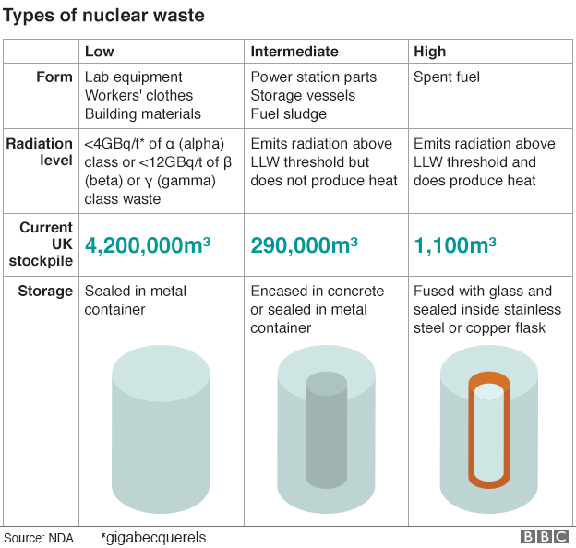
Legislation rushed through in the final hours of parliament allows local planning laws to be bypassed, seriously alarming anti-nuclear campaigners, Juliette Jowit, Mon 6 Apr 2015, Last modified on Thu 15 Feb 2018 Objectors worry that ministers are desperate to find a solution to the current radioactive waste problem to win Nuclear waste dumps can be imposed on local communities without their support under a new law rushed through in the final hours of parliament.Under the latest rules, the long search for a place to store Britain’s stockpileof 50 years’ worth of the most radioactive waste from power stations, weapons and medical use can be ended by bypassing local planning. Since last week, the sites are now officially considered “nationally significant infrastructure projects” and so will be chosen by the secretary of state for energy. He or she would get advice from the planning inspectorate, but would not be bound by the recommendation. Local councils and communities can object to details of the development but cannot stop it altogether. The move went barely noticed as it was passed late on the day before parliament was prorogued for the general election, but has alarmed local objectors and anti-nuclear campaigners. Friends of the Earth’s planning advisor, Naomi Luhde-Thompson, said: “Communities will be rightly concerned about any attempts to foist a radioactive waste dump on them. We urgently need a long-term management plan for the radioactive waste we’ve already created, but decisions mustn’t be taken away from local people who have to live with the impacts.” Objectors worry that ministers are desperate to find a solution to the current radioactive waste problem to win public support to build a new generation of nuclear power stations. Zac Goldsmith, one of the few government MPs who broke ranks to vote against the move, criticised the lack of public debate about such a “big” change. “Effectively it strips local authorities of the ability to stop waste being dumped in their communities,” he said. “If there had been a debate, there could have been a different outcome: most of the MPs who voted probably didn’t know what they were voting for.” Labour abstained in the vote, indicating that a future government will not want to reverse the change of rules. However, the shadow energy minister, Julie Elliott, has warned that the project is expected to take 27 years to build even after a preferred site was identified and would cost £4bn-5.6bn a year to build, plus the cost of running it for 40 years. Since the Royal Commission on Environmental Pollution found in 1976 that it was “morally wrong” to keep generating nuclear waste without a demonstrably safe way of storing the waste, there have been at least four attempts to find the right site, all of them shelved after strong protest. There are now 4.5m cubic metres of accumulated radioactive waste kept in secure containers at sites across Britain, though only 1,100m3 of this is the most controversial high-level waste, and 290,000m3 is intermediate-level waste. It costs £3bn a year to manage the nuclear waste mountain, of which £2bn comes from taxpayers. The most recent proposal for a more permanent solution was to ask local authorities to volunteer to examine whether they could host the development. Initially, a coalition of Cumbria county council and Copeland and Allerdale borough councils put their names forward, but the policy stalled in 2013 when the county council pulled out. Last year, the Department for Energy and Climate Change (DECC) published a white paper which said ministers would prefer to work with public support, but reserved the right to take more aggressive action on planning if “at some point in the future such an approach does not look likely to work”. The day before parliament rose, MPs voted in an unusual paper ballot to implement a two-page statutory instrument which adds nuclear waste storage to the list of nationally significant infrastructure projects in England, via the 2008 Planning Act. Officials have said approval depends on a “test of public support” and any site would undergo extensive geological safety tests. Copeland borough council, one of the two areas most affected by any such development at Sellafield, said it was pleased with the government’s change to planning rules. Radiation-Free Lakeland – set up to block the Sellafield proposal because they claim there is no evidence deep storage is safe or that the geology of Cumbria is suitable – claimed, however, “the test of public support is a fig leaf: the government hast’t said what the public support will be”. The only existing high-level radioactive underground waste storage, in New Mexico, USA, has been closed since last year following two accidents. Germany has put similar plans for burying high-level waste on hold and four other countries, including France and Japan, are examining the idea. |
|
Energy Secretary Rick Perry and Donald Trump saying different things about Yucca nuclear waste dump plan
| Energy Secretary Says White House Still Backs Nevada Nuke Dump, Financial Express, By: Bloomberg October 27, 2018
Energy Secretary Rick Perry said the White House still supports construction of a planned repository for nuclear waste in Nevada, despite President Donald Trump’s suggestion over the weekend that he was reconsidering. When asked if the Trump administration still supports Yucca Mountain, Perry swiftly said “Yes.” “I’m making this presumption by looking at a budgeting process and there was money in the president’s budget to manage Yucca,” Perry said, after giving remarks at the department’s Brookhaven National Laboratory in Upton, New York. Trump requested $120 million in his budget proposal for the geologic repository 90 miles north of Las Vegas. ……….Trump told a Nevada television station he was reconsidering his support after campaigning last weekend with Senator Dean Heller, an embattled Republican senator who opposes the project and is in a tight re-election battle. “I think you should do things where people want them to happen, so I would be very inclined to be against it,” Trump said in Oct. 20 interview with KRNV-News 4. “We will be looking at it very seriously over the next few weeks, and I agree with the people of Nevada.”…….. https://www.financialexpress.com/world-news/energy-secretary-says-white-house-still-backs-nevada-nuke-dump/1363704/
|
Energy Secretary Rick Perry and decisions on nuclear waste dumping
Energy Department ready to approve nuclear waste
dumping https://www.salon.com/2018/10/26/energy-department-ready-to-approve-nuclear-waste-dumping_partner/The Texas facility is operated by a major donor to Energy Secretary Rick Perry’s political campaigns SARAH OKESON OCTOBER 26, 2018
Our Energy secretary could ship treated nuclear waste from our nation’s most polluted nuclear weapons production site to a Texas nuclear dump near an aquifer suppling water from northern Texas to South Dakota. The dump was opened by one of Secretary Rick Perry’s largest campaign donors.
The Nuclear Waste Policy Act of 1982, signed by former President Ronald Reagan, was written to prevent potential disasters and mandates that the Department of Energy must send high-level waste to a network of underground tunnels and rooms where it can safely decay over millions of years.
Republicans and Trump’s new assistant secretary for environmental management, Anne Marie White,who did consulting work for the company that operates the dump, want to rewrite federal regulationsto say that some high-level nuclear waste isn’t really high-level nuclear waste so it can be stored elsewhere.
“It certainly raises questions about potential conflicts of interest,” said Tom Carpenter, the executive director of Hanford Challenge, a Seattle watchdog group.
Dallas billionaire Harold Simmons, who died in 2013 at age 82, owned Waste Control Specialists. Simmons and his wife, Annette, gave Perry’s campaigns more than $1.3 million.
Waste Control Specialists got state licenses in Texas in 2008 and 2009 to dispose of radioactive waste in a dump in Andrews County on the Texas-New Mexico border, adjacent to the giant URENCO USA nuclear enrichment facility at Eunice, N.M. Perry, then Texas governor, appointed the three commissioners of the Texas Commission on Environmental Quality who approved the licenses.
The dump is over or near the Ogallala Aquifer, depending on whether you believe the water table boundaries of the company or others. The dump is also in an earthquake hazard zone.
Waste Control Specialists wants to take radioactive waste from the Hanford nuclear weapons complex in southeast Washington state, one of the most contaminated places on earth. About 56 million gallons of radioactive and chemical waste produced during World War II and the Cold War is stored in 177 underground tanks.
Hanford was created during the Manhattan Project in World War II and made the plutonium for the atomic bomb dropped on Nagasaki, Japan.
Waste Control Specialists says it could save the federal government up to $16.5 million. The dump would take waste after cesium is removed and It is encased in grout. In December, 3 gallons of waste, or about 0.0000053% of the waste in the underground tanks, was encapsulated in grout as a test.
Republicans have previously reclassified nuclear waste as less dangerous. In 2004, Sen. Lindsey Graham (R-S.C.) attached a rider to the defense authorization bill so the Department of Energy didn’t have to remove radioactive sludge from underground storage tanks in South Carolina and Idaho.
Closing down France’s nuclear power plants
L’express 24th Oct 2018 , Sooner or later, EDF will have to close power plants. In front of thecompany is a vast building site with many unknowns. And in the middle
flows the Meuse. Nestled in one of its loops, a few kilometers from the
Belgian border, the two cooling towers of the Chooz nuclear power plant
spew their plumes of white smoke.
wooded hillside that has taken the colors of autumn, EDF is leading the
dismantling site of Chooz A. Shut down since 1991this reactor, installed in
an artificial cavern, saw its installations gradually dismantled and
evacuated. Still to settle the fate of the tank. Perched on a metal bridge
over a deep pool where she was diving, a handful of Swedish engineers from
the American company Westinghouse remotely maneuver the articulated arms of
a robot that cut it. A long work, which must occupy until 2022. After
which, the cave Chooz A will be filled with sand, for eternity.
https://lexpansion.lexpress.fr/actualite-economique/les-travaux-d-hercule-du-demantelement-nucleaire_2040298.html
Concerns about aging nuclear plants in USA Democratic areas
|
Nuclear Plants Go Belly Up in Democratic Districts. Then What?, ROLL CALL, Jeremy Dillon, 22 Oct 18 Most declining plants are in blue areas, and Congress is taking notice In Vermont, the relationship between the town of Vernon and its nuclear power plant, known as the Vermont Yankee Nuclear Power Station, had always been contentious.From 1970s-era antinuclear protests to more recent legal battles over a proposal to extend the plant’s license, Vermont residents and their state legislature kept a skeptical eye on the power source, which at one point provided some 70 percent of the state’s electricity.
Still, when New Orleans-based Entergy announced in 2014 that it would close the plant by the end of the year and ahead of its intended closure in the 2030s, there wasn’t much celebration. Instead the community’s focus turned almost immediately to ensuring the plant was decommissioned as quickly and as safely as possible. But as folks in Vernon and other communities across the country have learned as more nuclear plants reach the end of their operating lives, state and local governments have little legal or regulatory say over how companies approach the cleanup and radioactive legacy of their local nuclear power plants. Adding to the tensions, federal regulators at the Nuclear Regulatory Commission are perceived in some of these communities as overly deferential to plant operators, though those decisions are backed by risk analysis. “You have no control,” said Chris Campany, executive director of the Windham Regional Commission in Brattleboro, Vermont. “There’s an illusion of engagement, but it’s really only between the operator and the NRC.” In the case of Vermont, which passed a state law requiring a citizen’s advisory panel, Entergy and citizens engaged in a public dialogue that did introduce more transparency into the process but ultimately resulted in little say for the community, according to the former chairwoman of the panel, Brattleboro resident Kate O’Connor. “It was really frustrating,” O’Connor said. “You come to the realization that there really are no rules for decommissioning.” Those complaints have registered with Vermont’s congressional delegation. “The people of Vernon, Vermont, have been knocking on the NRC’s doors trying to make sure they have a seat at the table,” said Rep. Peter Welch, a Democrat from the state. Communities should have a right to that input, he said. “Every community going through this is facing these concerns.” The concerns — including how quickly plants are required to be torn down, how the owners pay for the cleanup and even enforcement of safety regulations — have lawmakers in Congress increasingly paying attention to the decommissioning process and the NRC’s role in it as the number of communities hosting shuttered or shuttering plants grows…….. The act of decommissioning a nuclear plant carries its own issues, such as the fact that almost every part of the plant has some level of radiological exposure that can harm humans. That means materials like cement and steel must be handled cautiously and go to landfills set aside for radioactive waste. “Decommissioning is a gigantic industrial cleanup of huge industrial facilities that have a singular item, nuclear waste, that makes it more complicated and challenging than almost any other industrial cleanup,” said Geoffrey Fettus, a senior attorney with the Natural Resources Defense Council, at a congressional briefing this summer. But radiation in concrete or worker clothing has a shorter half-life than the spent nuclear fuel sitting in pools on the site. For some of the isotopes in steel and concrete, the radioactivity decreases significantly after 50 years compared to the tens of thousands of years for the spent fuel……. https://www.rollcall.com/news/policy/nuclear-plants-democratic-districts-then-what |
|
Hanford given more time to empty leak-prone radioactive waste tank
Hanford wants more time to empty leak-prone radioactive waste tank. Here’s the new deadline, Tri City Herald, BY ANNETTE CARY, acary@tricityherald.com, 18, 2018 , RICHLAND, WA
The Department of Energy will have more time to empty some of Hanford’s leak-prone underground waste storage tanks under an order issued in federal court.
Judge Rosanna Malouf Peterson agreed to a request by the state of Washington and DOE to give DOE until the end of 2026 to empty radioactive and hazardous chemical waste from nine more single-shell tanks.
It is an extension from March 31, 2024. A second deadline to keep work on pace to meet that milestone also has been extended.
DOE has another six months — until June 2021 — to have the first two tanks of the nine emptied. New court-enforced consent decree deadlines for retrieving the waste from tanks and treating it at the $17 billion vitrification plant under construction were set by Malouf Peterson in 2016………https://www.tri-cityherald.com/news/local/hanford/article220235380.html
The dangerous radioactive trash – 60,000 tons on the shores of the Great Lakes
60,000 tons of dangerous radioactive waste sits on Great Lakes shores, THE EFFECTS OF A WORST-CASE SCENARIO — FROM A NATURAL DISASTER TO TERRORISM — COULD CAUSE UNTHINKABLE CONSEQUENCES FOR THE GREAT LAKES REGION, Keith Matheny, Detroit Free Press, Oct. 19, 2018 More than 60,000 tons of highly radioactive spent nuclear fuel is stored on the shores of four of the five Great Lakes — in some cases, mere yards from the waterline — in still-growing stockpiles.
“It’s actually the most dangerous waste produced by any industry in the history of the Earth,” said Gordon Edwards, president of the nonprofit Canadian Coalition for Nuclear Responsibility.
The spent nuclear fuel is partly from 15 current or former U.S. nuclear power plants, including four in Michigan, that have generated it over the past 50 years or more. But most of the volume stored along the Great Lakes, more than 50,000 tons, comes from Canadian nuclear facilities, where nuclear power is far more prevalent.
It remains on the shorelines because there’s still nowhere else to put it. The U.S. government broke a promise to provide the nuclear power industry with a central, underground repository for the material by 1998. Canada, while farther along than the U.S. in the process of trying to find a place for the waste, also doesn’t have one yet.
The nuclear power industry and its federal regulator, the U.S. Nuclear Regulatory Commission, point to spent nuclear fuel’s safe on-site storage over decades. But the remote possibility of a worst-case scenario release — from a natural disaster, a major accident, or an act of terrorism — could cause unthinkable consequences for the Great Lakes region.
Scientific research has shown a radioactive cloud from a spent fuel pool fire would span hundreds of miles, and force the evacuation of millions of residents in Detroit, Chicago, Cleveland, Toronto or other population centers, depending on where the accident occurred and wind patterns.
It would release multiple times the radiation that emanated from the Fukushima disaster in Japan in 2011 — a disaster that led to mass evacuations, no-go zones that exist to this day, and a government ban on fishing in a large, offshore area of the Pacific Ocean because of high levels of radioactive cesium in the water and in fish. The fishing industry there has yet to recover, more than seven years later.
“The Mississippi and the Great Lakes — that would be really bad,” said Frank von Hippel, senior research physicist and professor of public and international affairs emeritus at Princeton University.
Added Jim Olson, environmental attorney and founder of the Traverse City-based nonprofit For Love of Water, or FLOW: “The fact that it’s on the shorelines of the Great Lakes takes that high consequence that would be anywhere and paints it red and puts exclamation marks around it.”
Spent nuclear fuel is so dangerous that, a decade removed from a nuclear reactor, its radioactivity would still be 20 times the level that would kill a person exposed to it. Some radioactive byproducts of nuclear power generation remain a health or environmental hazard for tens of thousands of years. And even typically harmless radioactive isotopes that are easily blocked by skin or clothing can become extremely toxic if even small amounts are breathed in, eaten or drank, making their potential contamination of the Great Lakes — the drinking water supply to 40 million people — the connected Mississippi River and the prime agricultural areas of the U.S. a potentially frightening prospect. ……….
For five years, Michigan residents, lawmakers, environmental groups and others around the Midwest have, loudly and nearly unanimously, opposed a planned Canadian underground repository for low-to-medium radioactive waste at Kincardine, Ontario, near the shores of Lake Huron.
Meanwhile, spent nuclear fuel, vastly more radioactive, sits not far from the shores of four Great Lakes — Michigan, Huron, Erie and Ontario — at 15 currently operating or former nuclear power plant sites on the U.S. side. In Michigan, that includes Fermi 2; the Donald C. Cook nuclear plant in Berrien County; the Palisades nuclear plant in Van Buren County, and the former Big Rock Point nuclear plant in Charlevoix County, which ceased operation in 1997 and where now only casks of spent nuclear fuel remain.
Neither the U.S. nor the Canadian government has constructed a central collection site for the spent nuclear fuel. It’s not just a problem in the Great Lakes region — more than 88,000 tons of spent nuclear fuel, an amount that is rising, is stored at 121 U.S. locations across 39 states…….
Spent nuclear fuel isn’t only radioactive, it continues to generate heat. It requires storage in pools with circulating water for typically five years before it can be moved into so-called dry-cask storage — concrete-and-steel obelisks where spent fuel rods receive continued cooling by circulating air.
In practice, however, because of the high costs associated with transferring waste from wet pools to dry casks, nuclear plants have kept decades worth of spent fuel in wet storage. Plant officials instead “re-rack” the pools, reconfiguring them to add more and more spent fuel, well beyond the capacities for which the pools were originally designed.
“The prevailing practice in the United States is you re-rack the pools until they are just about as dense-packed as the nuclear core,” von Hippel said.
Only in recent years have nuclear plants stepped up the transition to dry cask storage because there’s no room left in the wet pools. Still, about two-thirds of on-site spent nuclear fuel remains in wet pools in the U.S.
That’s a safety concern, critics contend. A catastrophe or act of terrorism that drains a spent fuel pool could cause rising temperatures that could eventually cause zirconium cladding — special brackets that hold the spent fuel rods in bundles — to catch fire.
Such a disaster could be worse than a meltdown in a nuclear reactor, as spent nuclear fuel is typically stored with nowhere near the fortified containment of a reactor core.
“The long-term land-contamination consequences of such an event could be significantly worse than those from Chernobyl,” a 2003 research paper by von Hippel and seven other nuclear experts stated.
The reference is to the worst nuclear power disaster in world history, the April 1986 reactor explosion at the Chernobyl Nuclear Power Plant in the former Soviet Union, now a part of the Ukraine, where 4,000 to 90,000 are estimated to have died as a result of the radiation released. A study by the University of Exeter in Great Britain, released this June, found that cow’s milk from farms about 125 miles from the Chernobyl accident site still — more than 30 years later —- contains the radioactive element cesium at levels considered unsafe for adults and at more than seven times the limit unsafe for children.
Allison Macfarlane, a professor of public policy and international affairs at George Washington University, served as chairman of the NRC during the Obama administration from July 2012 until December 2014.
“What I think needs more examination is the practice of densely packing the fuel in the pool,” she said.
The NRC does not regulate how much fuel can be in a pool, in what configuration it’s placed, and how old the fuel is, Macfarlane said. ……….
In a Great Lakes region where magnitude-9.0 earthquakes and tsunamis aren’t a potential threat to stockpiles of spent nuclear fuel, terrorism remains possible………
In a Great Lakes region where magnitude-9.0 earthquakes and tsunamis aren’t a potential threat to stockpiles of spent nuclear fuel, terrorism remains possible.
“The NRC’s position on beyond design basis threats is essentially that this is a matter for the national security apparatus — it’s not our job, so somebody else will take care of it,” he said. “But if you look at the Pentagon, Homeland Security, I think you will look in vain to find any part of that apparatus that is addressing that area that the NRC says is not its job.”……….
Welcome to Zion, nuclear waste dump ………..
Shikoku Electric Power Company submits plans for dismantling nuclear reactor

According to the plan, decommissioning of Ikata 2 will take about 40 years and will be carried out in four stages. The first stage, lasting about ten years, will involve preparing the reactor for dismantling (including the removal of all fuel and surveying radioactive contamination), while the second, lasting 15 years, will be to dismantle peripheral equipment from the reactor and other major equipment. The third stage, taking about eight years, will involve the demolition of the reactor itself, while the fourth stage, taking about seven years, will see the demolition of all remaining buildings and the release of land for other uses.
During the first stage, all fuel is to be removed from the unit. This includes 316 used fuel assemblies that will be sent for reprocessing and 102 fresh fuel assemblies that will be returned to the fuel fabricator.
Ikata 2 became the ninth operable Japanese reactor to be declared for decommissioning since the Fukushima Daiichi accident.
In mid-March 2015, the Ministry of Economy, Trade and Industry’s Agency for Natural Resources and Energy revised the accounting provisions in the Electricity Business Act, whereby electric power companies can now calculate decommissioning costs in instalments of up to ten years, instead of one-time as previously. This enhanced cost recovery provision was to encourage the decommissioning of older and smaller units.
Shikoku decided in March 2016 to decommission unit 1 of the Ikata plant, also a 538 MWe PWR, which began commercial operation in September 1977. That unit had been taken offline in September 2011 for periodic inspections. Upgrades costing more than JPY170 billion (USD1.5 billion) would have been needed at the unit in order for it to operate beyond 40 years.
The NRA approved Shikoku’s decommissioning plan for Ikata 1 in June 2017. That plan also sees the unit being decommissioned in four stages over a 40-year period.
Unit 3 at the Ikata plant was given approval by the NRA to resume operation in April 2016, having been idle since being taken offline for a periodic inspection in April 2011. Shikoku declared the 846 MWe pressurised water reactor back in commercial operation on 7 September 2016. However, in December 2017, a Japanese high court ordered the suspension of the unit’s operation. The injunction was effective until the end of last month. The Hiroshima High Court in late September accepted Shikoku’s appeal and cancelled the injunction, allowing the utility to begin the process of restarting the reactor. http://world-nuclear-news.org/Articles/Shikoku-outlines-plans-for-decommissioning-Ikata-2
U.S. govt wants more information on Holtec’s proposed nuclear waste storage project
U.S. seeks more info on proposed nuclear waste storage project http://www.santafenewmexican.com/news/briefs/u-s-seeks-more-info-on-proposed-nuclear-waste-storage/article_9b914fe8-cc5c-5d84-beb3-3da44571ad30.html Associated Press , 16 Oct 18 HOBBS — Federal regulators are seeking more information from developers who have proposed building a storage facility at a site in southeastern New Mexico for spent fuel from commercial reactors around the United States.
-
Archives
- January 2026 (183)
- December 2025 (358)
- November 2025 (359)
- October 2025 (377)
- September 2025 (258)
- August 2025 (319)
- July 2025 (230)
- June 2025 (348)
- May 2025 (261)
- April 2025 (305)
- March 2025 (319)
- February 2025 (234)
-
Categories
- 1
- 1 NUCLEAR ISSUES
- business and costs
- climate change
- culture and arts
- ENERGY
- environment
- health
- history
- indigenous issues
- Legal
- marketing of nuclear
- media
- opposition to nuclear
- PERSONAL STORIES
- politics
- politics international
- Religion and ethics
- safety
- secrets,lies and civil liberties
- spinbuster
- technology
- Uranium
- wastes
- weapons and war
- Women
- 2 WORLD
- ACTION
- AFRICA
- Atrocities
- AUSTRALIA
- Christina's notes
- Christina's themes
- culture and arts
- Events
- Fuk 2022
- Fuk 2023
- Fukushima 2017
- Fukushima 2018
- fukushima 2019
- Fukushima 2020
- Fukushima 2021
- general
- global warming
- Humour (God we need it)
- Nuclear
- RARE EARTHS
- Reference
- resources – print
- Resources -audiovicual
- Weekly Newsletter
- World
- World Nuclear
- YouTube
-
RSS
Entries RSS
Comments RSS