Governor urges contaminated soil be disposed of outside Fukushima by 2045

Soil from radiation decontamination work after the 2011 nuclear reactor
meltdowns in Fukushima Prefecture should be disposed of outside the
prefecture by the deadline set by law, Fukushima Gov. Masao Uchibori said
in a recent interview. A law stipulates that all such soil must be disposed
of outside Fukushima by March 2045.
“The final disposal must be completed
within 20 years, no matter whether the soil is reused (within Fukushima) or
not,” the governor said. However, Shiro Izawa, the mayor of Futaba — one
of the towns hosting Tokyo Electric Power Company Holdings’ crippled
Fukushima No. 1 plant — said lasts month that soil from radiation
decontamination work should be reused in Fukushima. The mayor said this was
his personal opinion. Uchibori pointed out the heavy burden placed on
Futaba and the neighboring town of Okuma for accepting interim storage
facilities for soil from decontamination work.
Japan Times 11th March 2025. https://www.japantimes.co.jp/news/2025/03/11/japan/fukushima-gov-soil-disposal/
At Haverigg Today – the Nuclear LIE of a “Safe” and “Secure” Sub-Sea Nuclear Dump.
The sub-sea area involved would be 26 to 50 km square. The “smaller” area proposed would be the size of Tuvalu at 26 km square. There are hundreds (if not thousands) of ongoing research projects into, for example, the release of radioactive gases, how the heat generated would impact the geology, the steel containments and the bentonite backfill.
These ongoing research projects throw up more questions regarding the safety of long term containment. Nuclear Waste Services are asking locals who are now in reciept of nuclear dump community funds, to express support for an experiment. An experiment which will impact their health and the environment for generations to come. Those who are not “local” who would also be impacted are deliberately excluded from “having a say.”
Councillors oppose nuclear dump site near Louth
‘Six more communities are now facing this devastation
By Peter Craig, Reporter, 10 Mar 25
Councillors have voted to oppose a nuclear dump site near Louth. East
Lindsey District Council want to persuade Lincolnshire County Council to do
the same and say NO to the proposed 1,000 acre site at Great Carlton.
Grimsby Telegraph 11th March 2025, https://www.grimsbytelegraph.co.uk/news/grimsby-news/councillors-oppose-nuclear-dump-site-10001353
American companies profit from Canada’s radioactive waste

Toxic radioactive waste is expensive to clean up. Canada’s contract to clean up itslegacy waste is worth billions for a three-company consortium: Canada’s AtkinsRéalisand Texas-based Fluor and Jacobs. The two American companies run nuclear weaponsfacilities in the U.S. and U.K. in addition to their Canadian nuclear interests.
Parliament’s payment to the consortium last year was $1.3 billion. The annual payments have risen each year of the 10-year contract that will end in September 2025.
The consortium operates “Canadian Nuclear Laboratories” (CNL) in a “Government-owned, Contractor-operated” (GoCo) arrangement with Atomic Energy of Canada Limited (AECL).
The U.K. abandoned GoCo contracts because of exorbitant costs and poor value for money. Under Canada’s GoCo contract, AECL owns lands, buildings, and radioactive waste, and the three-company consortium operates AECL’s sites.
When the Harper government issued the 10-year GoCo contract during the 2015 federal election period, they said AECL lacked the ability to clean up Canada’s multi-billion radioactive waste liability dating to World War II and needed “private sector rigour. From their billion-dollar annual payout, the three partner corporations take $237 million for “contractual expenses.” The salaries of 44 senior CNL managers, mostly Americans, average over $500,000 each.
Canada’s liability includes radioactive contamination in Port Hope, Ontario where uranium was refined for the U.S. nuclear weapons industry, radioactive contamination at the Chalk River nuclear laboratory site from producing plutonium for U.S. nuclear weapons, and radioactive contamination from AECL’s shutdown “prototype” CANDU reactors and its Whiteshell research lab in Manitoba.
The radioactive clean-up cost has grown each contract year, as have the consortium’s ambitions. The focus has shifted to “revitalizing” the Chalk River facility, where Parliament has allocated additional funds to build an “Advanced Nuclear Materials Research Centre.”
The Centre will conduct SMR research including research on plutonium fuels. Both American companies have interests in SMRs. The new Centre did not undergo a licensing process or environmental assessment under the Canadian Nuclear Safety.
AECL is expected to soon announce the awarding of a new 10-year Go-Co contract. Before the contract is signed, MPs should consider whether the arrangement benefits Canada, and whether these billions should be in the hands of American managers and corporations.
Commission.
Supreme Court wrestles with nation’s frustrating search for nuclear waste storage

Justice Sonia Sotomayor, looking ahead to the United States’ 250th anniversary next year, said, “I hope that we make it another 250, but if it takes 40 or 80 years for a solution to come, it would still be temporary, correct?”
By ASSOCIATED PRESS, 6 March 2025 ,
https://www.dailymail.co.uk/wires/ap/article-14464455/The-Supreme-Court-confronts-national-headache-What-growing-pile-nuclear-waste.html
WASHINGTON (AP) – The Supreme Court on Wednesday wrestled with whether to restart plans to temporarily store nuclear waste at sites in rural Texas and New Mexico even as some justices worried about safety issues and the lack of progress toward a permanent solution.
The justices heard arguments in a case that reflects the complicated politics of the nation´s so far futile quest for a permanent underground storage facility. A plan to build a national storage facility northwest of Las Vegas at Yucca Mountain has been mothballed because of staunch opposition from most Nevada residents and officials.
The court took up a challenge by the Nuclear Regulatory Commission and a private company with a license for the Texas facility to an appellate ruling that found the commission had no authority to grant the license. The outcome of the case will affect plans for a similar facility in New Mexico roughly 40 miles (65 kilometers) away.
The licenses would allow the companies to operate the facilities for 40 years, with the possibility of a 40-year renewal.
“That doesn’t sound very interim to me,” Justice Neil Gorsuch said, while also questioning the advisability of storing spent nuclear fuel “on a concrete platform in the Permian Basis, where we get all our oil and gas from.”
Justices Samuel Alito and Clarence Thomas joined Gorsuch in asking questions suggesting they were the most likely to uphold the ruling from the 5th U.S. Circuit Court of Appeals.
Roughly 100,000 tons (90,000 metric tons) of spent fuel, some of it dating from the 1980s, is piling up at current and former nuclear plant sites nationwide and growing by more than 2,000 tons (1,800 metric tons) a year. The waste was meant to be kept there temporarily before being deposited deep underground.
The NRC has said that the temporary storage sites are needed because existing nuclear plants are running out of room. The presence of the spent fuel also complicates plans to decommission some plants, the Justice Department said in court papers.
Justice Sonia Sotomayor, looking ahead to the United States’ 250th anniversary next year, said, “I hope that we make it another 250, but if it takes 40 or 80 years for a solution to come, it would still be temporary, correct?”
Justice Department lawyer Malcolm Stewart agreed, noting that the spent fuel has to be kept somewhere, whether at operating and decommissioned plants or elsewhere.
Security also is cheaper with the waste in one or two locations, Stewart said, relying on arguments made by Interim Storage Partners LLC, the company with the Texas license.
Sotomayor, along with Justices Ketanji Brown Jackson, Elena Kagan and Brett Kavanaugh, seemed most inclined to reverse the 5th circuit. Chief Justice John Roberts and Justice Amy Coney Barrett said little or nothing to reveal where they stand.
The NRC’s appeal was filed by the Biden administration and maintained by the new Trump administration. Texas Gov. Greg Abbott,. a Republican, and New Mexico Gov. Michelle Lujan Grisham, a Democrat, are leading bipartisan opposition to the facilities in their states.
The justices will consider whether, as the NRC and Interim Storage Partners argues, the states and a private energy company forfeited their right to object to the licensing decisions because they declined to join in the commission´s proceedings.
Two other federal appeals courts, in Denver and Washington, that weighed the same issue ruled for the agency. Only the 5th Circuit allowed the cases to proceed.
The second issue is whether federal law allows the commission to license temporary storage sites. Opponents are relying on a 2022 Supreme Court decision that held that Congress must act with specificity when it wants to give an agency the authority to regulate on an issue of major national significance. In ruling for Texas, the 5th Circuit agreed that what to do with the nation´s nuclear waste is the sort of “major question” that Congress must speak to directly.
But the Justice Department has argued that the commission has long-standing authority to deal with nuclear waste reaching back to the 1954 Atomic Energy Act.
The NRC granted the Texas license to Interim Storage for a facility that could take up to 5,000 metric tons of spent nuclear fuel rods from power plants and 231 million tons of other radioactive waste. The facility would be built next to an existing dump site in Andrews County for low-level waste such as protective clothing and other material that has been exposed to radioactivity. The Andrews County site is about 350 miles (560 kilometers) west of Dallas, near the Texas-New Mexico state line.
The New Mexico facility would be in Lea County, in the southeastern part of the state near Carlsbad. The NRC gave a license for the site to Holtec International.
Alito, who said the interim sites could remove the incentive to find a permanent solution, asked Brad Fagg, a lawyer for Interim Storage Partners, for a prediction of when a permanent site would open.
“I’ve been in this stew for a lot of years,” Fagg said. “I would be kidding myself and this court if I said I had a date.”
A decision is expected by late June.
East Lindsey overwhelmingly backs GDF withdrawal call to Lincolnshire County Council
At their March meeting, East Lindsey District Councillors backed a motion calling on their colleagues at County Hall to join them in withdrawing from the nuke dump plan.
Leader Councillor Craig Leyland confirmed that he shall recommend to his Executive that East Lindsey District Council withdraws from the process when it next meets on 23 April.
Were Lincolnshire to follow suit that would draw a line upon the issue; Nuclear Waste Services would no longer be able to investigate potential sites for the Geological Disposal Facility within the Theddlethorpe Search Area, or indeed any area within the East Lindsey District, as there would no longer be any Relevant Principal Local Authority backing the plan…………………….
NFLA 6th March 2025,
https://www.nuclearpolicy.info/news/east-lindsey-overwhelmingly-backs-gdf-withdrawal-call-to-lincolnshire-county-council/
‘Vote out!’: Protestors win motion at ELDC full council to urge county council to withdraw from nuclear dump talks
East Lindsey District Council
is to urge Lincolnshire County Council to follow the authority’s lead and
withdraw from the process exploring proposals for a nuclear dump site in
the district.
This follows a debate lasting more than one hour on a motion
presented to full council by Coun Travis Hesketh – a district councillor
representing communities that would be affected. Ahead of the meeting,
‘Vote Out’ protestors gathered outside the offices in Horncastle to
show their opposition to the dump and support the councillors fighting for
them.
Coun Hesketh’s motion urged the Executive and Leader of East
Lindsey District Council “to issue a statement opposing the Geological
Disposal Facility for nuclear waste in Lincolnshire and urge Lincolnshire
County Council to withdraw from the project.
Lincolnshire World 5th March 2025, https://www.lincolnshireworld.com/news/people/vote-out-protestors-win-motion-at-eldc-full-council-to-urge-county-council-to-withdraw-from-nuclear-dump-talks-5019541
Bank Head Estate residents attend public meeting over nuke dump blight
The UK/Ireland Nuclear Free Local Authorities wish to congratulate our
friends in Millom and District Against the GDF for organising a successful
meeting last month at which the residents of the Bank Head Estate, Millom
met with local Councillors to raise their concerns that in the future a
nuclear waste dump might become their unwanted neighbour.
Although for
several years, Nuclear Waste Services has been working, first with a local
Working Group and then through a Community Partnership, on plans to bring a
Geological Disposal Facility, or GDF, to the South Copeland Search Area it
was at the end of January that NWS revealed the Area of Focus in which more
detailed investigations will be conducted to determine its potential as the
eventual site for a waste receiving centre. Nuclear Waste Services have
previously revealed that the surface site will approximately one kilometre
square; once built the facility would from the 2050s, receive regular
shipments of radioactive waste which would be transported underground and
through access tunnels out under the seabed.
NFLA 5th March 2025 https://www.nuclearpolicy.info/news/bank-head-estate-residents-attend-public-meeting-over-nuke-dump-blight/
Most Contaminated U.S. Nuclear Site Is Set to Be the Largest Solar Farm.
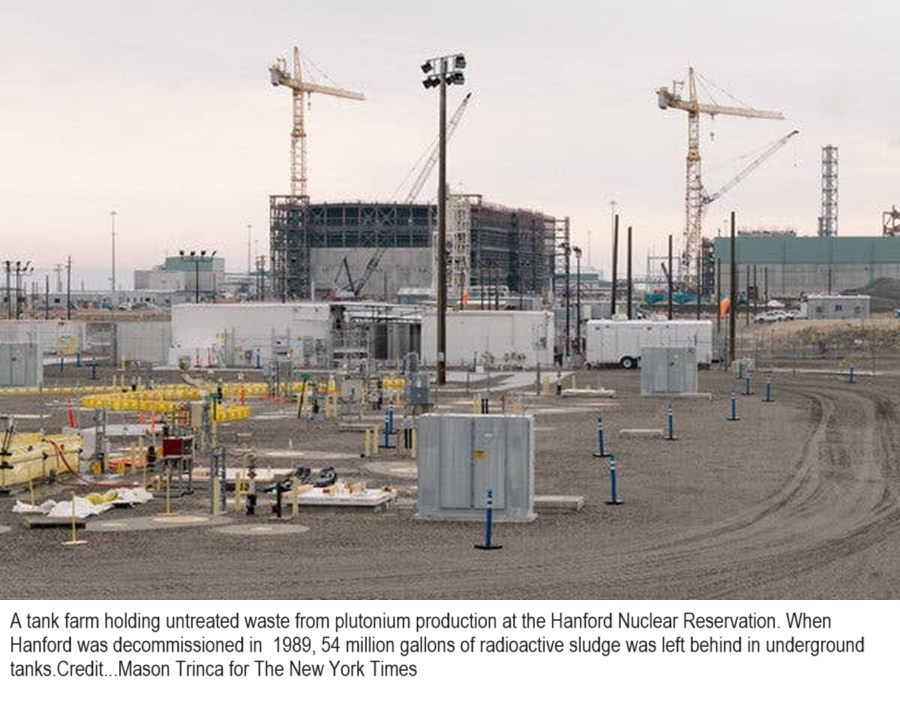
Plans to transform Hanford, which was integral to the nation’s nuclear arsenal after World War II, had just begun inching forward when President Trump started his second term.
New York Times, By Keith Schneider, Reporting from Richland, Wash, March 5, 2025,
In the weeks since President Trump has taken office, he has pushed to unleash oil and gas production and has signed executive orders halting the country’s transition to renewable energy.
But in Washington State, a government-led effort has just started to build what is expected to be the country’s largest solar generating station. The project is finally inching forward, after decades of cleaning up radioactive and chemical waste in fits and starts, at the Hanford Nuclear Reservation, a sweep of desert that was pivotal to the nation’s weapons arsenal from 1943 until it was shut down in 1989. A developer, Hecate, was brought on last year to turn big stretches of the site into solar farms.
Hecate will have access to 10,300 acres that the government has determined sufficiently safe to redevelop. The company has already started site evaluation on 8,000 acres, an area nearly 10 times the size of Central Park in New York and enough space for 3.45 million photovoltaic panels. (Hanford’s site is nearly 400,000 acres.)
If all goes according to plan, the Hecate project, which is expected to be completed in 2030, will be by far the largest site the government has cleaned up and converted from land that had been used for nuclear research, weapons and waste storage. It is expected to generate up to 2,000 megawatts of electricity — enough roughly to supply all the homes in Seattle, San Francisco, and Denver — and store 2,000 more in a large battery installation at a total cost of $4 billion. The photovoltaic panels and batteries will provide twice as much energy as a conventional nuclear power plant. The nation’s current biggest solar plant, the Copper Mountain Solar Facility in Nevada, can generate up to 802 megawatts of energy.
The big unknown still hanging over the plan is whether the Trump administration will thwart efforts that the Biden administration put in place to develop more clean electricity generation………………………………………….
While a clean energy project may clash with Mr. Trump’s policies, there’s a reason the administration may allow Hecate’s solar development to move forward: the revenue the government will get for the land lease. Hecate and the Energy Department declined to discuss the land’s market value, but private solar developers in the region said such easements typically paid landowners $300 an acre annually.
Two officials at the Energy Department, who asked not to be named for fear of retaliation, said that neither the president nor the leaders of the administration’s effort to reshape federal agencies had yet to intervene in the solar project, but that the future of the initiative was uncertain. One of the officials said the new energy secretary, Chris Wright, a former oil executive, had not yet reviewed the project as of late February.
Alex Pugh, Hecate’s director of development, said the company was moving ahead despite shifting political winds. “The fundamentals of the project are strong regardless of policy direction,” he said. “The region needs the project. There is a huge demand for electricity here.”
…………………….Hecate identified the large expanse of open ground alongside high-voltage transmission lines at Hanford as a potential site for its plant several years ago, Mr. Pugh said — long before the Energy Department solicited proposals. The potential benefits, he said, were plainly apparent.
………………….What they also have, however, is risk. The site where Hecate plans to build its photovoltaic panels is near an area where groundwater and soil were decontaminated and alongside an experimental 400-megawatt nuclear reactor complex that was decommissioned in 2001. It’s also about 20 miles south of B Reactor, the world’s first full-scale nuclear reactor, which produced the plutonium for the atomic
First shipment of 280,000 tons Aggregate arrives by rail at Cumbria low-level nuclear waste site for final capping
The first shipments via rail of 280,000t of aggregate by Nuclear Transport
Solutions (NTS) have been delivered to the Low Level Waste Repository
(LLWR) site in Cumbria, which will form a 100-year barrier for nuclear
wastes.
Nuclear Waste Services (NWS) is responsible for managing the
disposal of the UK’s low-level radioactive waste including at the LLWR
site. NTS is a transport and logistics provider which operated Direct Rail
Services (DRS) which transports nuclear and radioactive materials via rail.
Both NWS and NTS are part of the Nuclear Decommissioning Authority, which
itself is an executive non-departmental public body, sponsored by the
Department for Energy Security and Net Zero (DESNZ). The LLWR is the only
facility in the UK permitted to receive all categories of radioactive and
nuclear low level waste (LLW) and NWS describes it as “the nation’s
principal disposal facility for LLW”.
New Civil Engineer 26th Feb 2025, https://www.newcivilengineer.com/latest/aggregate-arrives-by-rail-at-cumbria-low-level-nuclear-waste-site-for-final-capping-26-02-2025/
The Supreme Court faces the absurdly difficult problem of where to put nuclear waste
And so it now falls to the Supreme Court to decide whether this latest attempt to find a place to store some of the most undesirable trash on the planet must falter on the shores of NIMBYism.
America’s worst NIMBY problem comes to the Supreme Court.
by Ian Millhiser, Vox , 26th Feb 2025,
https://www.vox.com/scotus/399304/supreme-court-nuclear-waste-texas-nrc-nimby
On March 5, the Supreme Court will hear a case that may involve one of the most toxic examples of NIMBYism in American history. The issue at the heart of Nuclear Regulatory Commission v. Texas arises out of a predictable problem: Absolutely no one wants radioactive waste anywhere near where they live or work, but that waste has to go somewhere.
Texas, as the case name suggests, involves an effort by the federal government to store nuclear waste in Texas, and at the same time, solve a problem it’s struggled with for nearly 40 years.
To fully understand what’s before the Supreme Court in Texas, we need to go back to 1982, when Congress passed a law that was supposed to establish a permanent repository for all of the radioactive waste produced by America’s nuclear power plants. This waste remains dangerous for thousands or even tens of thousands of years after it is produced, so it made sense to find a spot far from human civilization where it can be buried.
But then NIMBY — that’s “not in my backyard” — politics set in.
The US Department of Energy identified several possible sites for the waste, and eventually culled those sites down to three — one in Texas, one in Washington state, and Yucca Mountain in Nevada. But, in 1987, before these officials could complete the selection process, Congress stepped in and chose the Nevada site for them.
According to a Slate article on the eventual collapse of the Yucca Mountain plan, this choice is easy to explain when you look at who ran Congress at the time. The House speaker was Jim Wright, a representative from Texas. The House majority leader was Tom Foley, from Washington. So Nevada, which had the weakest congressional delegation at the time, lost out.
Indeed, according to Rod McCullum of the Nuclear Energy Institute, “the 1987 Amendment is now commonly referred to as the ‘screw Nevada’ bill.”
By the time President Barack Obama took office, however, the balance of power in Congress had changed. Sen. Harry Reid, of Nevada, was the majority leader. He set out, with the Obama administration’s support, to kill the Yucca Mountain project. Congress, at Obama’s urging, zeroed out funding for Yucca Mountain. Then, just in case the project wasn’t already dead enough, a 2013 court decision ordered the government to stop collecting taxes that would have funded the permanent storage facility until it could figure out where that facility would be located.
And that brings us to the present date, and to the issue before the Supreme Court in the Texas case. Without a permanent storage facility on the horizon, the federal Nuclear Regulatory Commission turned to an older statute which has been understood to allow it to authorize temporary storage facilities for nuclear waste since the 1970s, licensing a private facility to handle storage in Andrews County, Texas.
Texas eventually sued to block this facility, as did a nearby landowner. Their case wound up before a three-judge panel of the United States Court of Appeals for the Fifth Circuit. Two of these judges are from Texas. It’s not hard to guess what happened next.
And so it now falls to the Supreme Court to decide whether this latest attempt to find a place to store some of the most undesirable trash on the planet must falter on the shores of NIMBYism.
Indeed, the 1954 law’s language allowing the NRC to license possession of these three kinds of material is quite broad. The NRC may license possession of special nuclear material for reasons that it “determines to be appropriate to carry out the purposes” of the law. It may license possession of source material for any “use approved by the Commission as an aid to science or industry.” And it may license possession of byproduct material for “industrial uses” or for “such other useful applications as may be developed.”
Though both Texas and the landowner claim that this language should not be read to permit the kind of license at issue in the Texas case, they are swimming against at least a half-century of precedent. The landowner’s brief concedes that the NRC first claimed the authority to license facilities under the 1954 law in 1975 (it claims that this fact cuts against the government’s case, because the NRC waited two decades to claim this power, but the fact remains that this question has been settled for 50 years). The landowner’s brief also concedes that the NRC finalized regulations governing licenses for such facilities in 1980.
That said, the landowner’s brief does make a plausible — if not, exactly, airtight — argument that the 1982 law overrides the 1954 law’s provisions concerning private storage facilities. (Texas’s brief, by contrast, is heavy on overwrought rhetoric claiming that nuclear waste must be stored at Yucca Mountain, and light on the kind of statutory analysis that a responsible judge would rely upon in deciding this case.)
Among other things, the landowner’s legal team points to three provisions of the 1982 law which say that the NRC shall “encourage” storage of nuclear waste “at the site of each civilian nuclear power reactor,” and take other steps to promote such onsite storage. They also point to a provision calling for a federal storage facility. And, they highlight a provision stating that the 1982 law should not be read to “encourage” or “authorize” private storage facilities away from a reactor.
As the landowner’s legal team writes, allowing the Texas facility to exist would “discourage” creating new storage capacity at reactor sites, the opposite of what the 1982 law was supposed to accomplish.
It’s safe to say that, when Congress wrote the 1982 law, they imagined a world where nuclear waste would be stored either at reactor sites or at a federal facility, and not at a private facility like the one at issue in Texas. But the 1982 law also does not explicitly repeal the 1954 law’s provisions governing the three kinds of nuclear material. So the government has a very strong argument that it can still rely on those provisions to license the facility in Texas.
There is a possibility that the Supreme Court will simply make this case go away
There’s a real possibility that the Supreme Court will get rid of this case on procedural grounds, effectively handing a victory to the government.
Briefly, the federal law that both Texas and the landowner relied upon to bring their case to the Fifth Circuit permits “any party aggrieved by the final order” of the NRC to challenge that decision in a federal appeals court. The government argues that, to qualify as a “party,” Texas or the landowner must have participated “as a litigant” in the NRC’s internal proceeding governing the Andrews County license.
While both the state and the landowner took some steps to make their views known to the NRC during that proceeding, neither ever officially became litigants. Thus, the government argues, they do not count as a “party” to that proceeding which can appeal the NRC’s decision, and the Court should toss the case out. The key thing to know about this legal argument is that it may be enough to prevent the justices from reaching the merits of this particular case.
If the Court does reach the merits, however, it faces a difficult decision. Allowing the Andrews County project to move forward will undoubtedly trigger the same kind of political backlash that has accompanied every other attempt to pick a site to store nuclear waste. But, if this project is not allowed, it’s far from clear where the waste would go.
Tonnes of nuclear waste to be sent back to Europe
Federica Bedendo, BBC News, North East and Cumbria, 27th Feb 2025,
https://www.bbc.co.uk/news/articles/cpwddyg7e4do
More than 700 tonnes of nuclear waste is due to be shipped to Europe as part of a project to send back spent fuel to the countries that produced it.
The Sellafield nuclear plant in West Cumbria was tasked with reprocessing the nuclear material used to produce electricity in Germany.
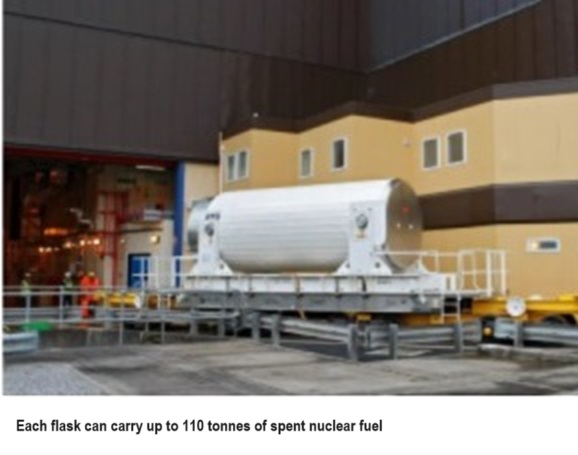
Seven cylindric containers, each carrying up to 110 tonnes of recycled nuclear waste, are due to make the journey to the Isar Federal storage facility by sea on a specialist vessel.
A Sellafield spokesman said the move was a “key component” of the strategy to “repatriate high level waste from the UK”.
This will be the second of three shipments from the UK to the European country.
The first shipment of six containers – known as flasks – to Biblis, was completed in 2020.
Each flask is about 20ft (6m) long, with a 8ft (2.5m) diameter.
The waste will be transported by sea on a specialist vessel to a German port, then onwards by rail to its final destination.
Letter: Hinkley Point C will be a Sellafield waste dump
By Jo Smoldon,
Burnham & Highbridge Weekly News 25th Feb 2025, https://www.burnhamandhighbridgeweeklynews.co.uk/news/24957412.letter-hinkley-point-c-will-sellafield-waste-dump/
In response to your Hinkley article around all the jobs created at Hinkley Point C, yes, of course it is good that the nuclear industry is training people to understand the nuclear sites and maybe later the nuclear process.
Nuclear, due to its very, very long-term footprint, has to be understood for thousands of years to come when the radioactive waste will need managing at high costs and high risk on this Hinkley location.
Trying to attract young people into a subject that is very antiquated in its science has been something that government and business will have to invest in forever.
Nuclear power for electricity is made by the last century science of steam driving turbines to condense to hot water.
Two-thirds of the energy produced from the reactors is thrown out in the form of hot water to be discharged into the Severn Estuary, hardly a ‘low-carbon energy’ if looked at in real terms!
What hasn’t been mentioned with all this bigging up the Hinkley site is that it will be the big Sellafield waste dump of the south, as after B station waste has been transferred to Sellafield, no more nuclear waste will move from Somerset.
Radioactive waste will remain on the North Somerset coast forever, how does that fit with the predicted sea level rise, extreme coastal events and Somerset’s regular flooding events?
Nuclear Decommissioning Authority budget raises Sellafield safety concerns
Wednesday 26 February 2025,
https://www.unitetheunion.org/news-events/news/2025/february/nuclear-decommissioning-authority-budget-raises-sellafield-safety-concerns
Safety could also be impacted at 16 other Nuclear Decommissioning Authority sites
Safety concerns over the Nuclear Decommissioning Authority (NDA) budget, which includes Sellafield as well as UK-wide services for nuclear waste and restoration, have been raised by Unite, the UK’s leading union.
The NDA group is responsible for decommissioning and cleaning up 17 nuclear sites. The group’s key operating companies include Sellafield, Nuclear Restoration Services (NRS) and Nuclear Waste Services (NWS).
The CEOs of all the operating companies have all stated that their current budgets are not enough to provide full services.
Unite general secretary Sharon Graham said: “Unite is extremely concerned that UK’s workers at Sellafield, NRS and NWS could be put at risk through efforts to cut costs. If the NDA budget isn’t fit for purpose, the government needs to increase it. Unite will not tolerate attacks on our members’ jobs or any changes that could jeopardise their health and safety.”
Unite national officer Simon Coop said: “Sellafield, NRS and NWS must fully consult with Unite before taking any steps that could endanger workers or impact their jobs, pay or conditions. We will not hesitate to defend our members if actions are taken that put them at risk.”
Election candidates should face nuclear waste questions: group

THE CHRONICLE-JOURNAL, Feb 25, 2025, https://www.chroniclejournal.com/news/local/election-candidates-should-face-nuclear-waste-questions-group/article_e5e12318-f322-11ef-aede-0bca88dc7589.htm
With just two days to go before the provincial election, two citizen watchdog groups are urging voters to grill candidates over where they stand regarding alternatives to nuclear power, and what to do with the nuclear waste that exists now.
In particular, the We The Nuclear Free North and Northwatch groups want candidates to commit to giving first responders notice before nuclear waste is transported through areas in which they provide emergency services.
The groups maintain that question is crucial in the Thunder Bay district, since the Nuclear Waste Management Organization is proposing to build an underground storage site for spent nuclear fuel rods at a remote location between Ignace and Dryden.
The two groups have set up an online tool that can be used to put questions to provincial-election candidates about the project and request a response. The link to the tool is: tinyurl.com/2x9uct7a.
Radioactive fuel rods are to be shipped to the storage site by truck or rail in specialized containers designed to withstand fiery crashes, hard impacts and immersion in water, according to the Nuclear Waste Management Organization.
The storage site is expected to take 20 years to build once all approvals have been obtained.
1 This Month


18 March Webinar @ 1 PM EST: An Assessment of SMR Projects: The Case of Canada
register for the zoom:
https://us02web.zoom.us/webinar/register/WN_o8BIIOUvQ2ONJR1nta65DQ#/registration


of the week – STOP SMALL MODULAR REACTORS IN CANADA
To see nuclear-related stories in greater depth and intensity – go to https://nuclearinformation.wordpress.com
-
Archives
- March 2026 (138)
- February 2026 (268)
- January 2026 (308)
- December 2025 (358)
- November 2025 (359)
- October 2025 (376)
- September 2025 (258)
- August 2025 (319)
- July 2025 (230)
- June 2025 (348)
- May 2025 (261)
- April 2025 (305)
-
Categories
- 1
- 1 NUCLEAR ISSUES
- business and costs
- climate change
- culture and arts
- ENERGY
- environment
- health
- history
- indigenous issues
- Legal
- marketing of nuclear
- media
- opposition to nuclear
- PERSONAL STORIES
- politics
- politics international
- Religion and ethics
- safety
- secrets,lies and civil liberties
- spinbuster
- technology
- Uranium
- wastes
- weapons and war
- Women
- 2 WORLD
- ACTION
- AFRICA
- Atrocities
- AUSTRALIA
- Christina's notes
- Christina's themes
- culture and arts
- Events
- Fuk 2022
- Fuk 2023
- Fukushima 2017
- Fukushima 2018
- fukushima 2019
- Fukushima 2020
- Fukushima 2021
- general
- global warming
- Humour (God we need it)
- Nuclear
- RARE EARTHS
- Reference
- resources – print
- Resources -audiovicual
- Weekly Newsletter
- World
- World Nuclear
- YouTube
-
RSS
Entries RSS
Comments RSS
 nuclear-news