Moscow puts money on the table to raise nuclear subs from Arctic seabed
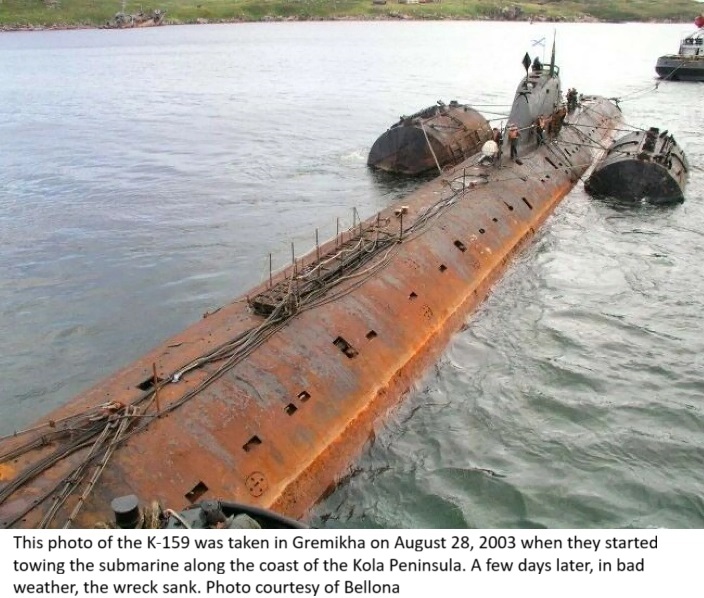
Both the K-27 and the K-159 represent ticking radioactive time-bombs for the Arctic marine environment.
The Government’s draft budget for 2026, and the planned budget for 2027-2028, include funding to lift the K-27 and K-159, two wrecked submarines that are resting on the seabed in the Barents Sea and Kara Sea.
Thomas Nilsen, 20 October 2025 –https://www.thebarentsobserver.com/news/moscow-puts-money-on-the-table-to-raise-nuclear-subs-from-arctic-seabed/439056
It is the state nuclear corporation Rosatom that told news outlet RBK about the plans to finally do something about the ticking radioactive time-bombs.
“The draft federal budget for 2026 and the 2027-2028 planning period includes funding for the rehabilitation of Arctic seas from sunken and dumped radiation-hazardous objects, beginning in 2027. Preparations for the planned work will begin in 2026,” the press service of Rosatom said.
An explanatory note to Rosatom’s budget post for disposal of nuclear and radiation-hazardous nuclear legacy sites details how 30 billion rubles for the three-year period are earmarked for planning and lifting of the Cold War era submarines left on the Arctic seabed.
The K-27 and the K-159 are the most urgent to raise and bring to shore for safe scrapping.
While the K-27 was dumped on purpose in 1982 in the Stepovoy Bay on the Kara Sea side of Novaya Zemlya, the sinking of the K-159 in the Barents Sea was an accident.
Lifting a nuclear submarine from the seabed is nothing new. It is difficult, but doable.
In 2002, the Dutch salvage company Mammoet managed to raise the ill-fated Kursk submarine from the Barents Sea. A special barge was built with wires attached underneath. The wreck of the Kursk was safely brought in and placed in a floating dock where the decommissioning took place.
Aleksandr Nikitin, a nuclear safety expert with the Bellona Foundation in Oslo, said to the Barents Observer that it is too early to conclude that the lifting actually will happen, or whether this is a preliminary plan that needs to be developed before concluding.
“As far as I understand, there’s no concrete plan,” Nikitin said.
Before Russia’s full-scale war against Ukraine, Aleksandr Nikitin was member of Rosatom’s Public Chamber, a body that worked with non-governmental organisations to foster transparency and civic engagement on nuclear safety related issues in Russia.
Nikitin believes there still is infrastructure on the Kola Peninsula to deal with the two submarines if they are lifted from the seabed.
“Rosatom is currently trying not to destroy what the French built in Gremikha, hoping to dismantle the K-27 there if it’s raised. This is a special facility where this nuclear submarine with a liquid metal coolant reactor can be dismantled,” he explained.
“As for the K-159, it could be dismantled, for example, at Nerpa.”
Nerpa is a shipyard north of Murmansk that decommissioned several Cold War submarines at the time when Russia maintained cooperation with European partners, including Norway.
Ticking radioactive time-bombs
Both the K-27 and the K-159 represent ticking radioactive time-bombs for the Arctic marine environment.
The K-159 is a November-class submarine that sank in late August 2003 while being towed in bad weather from the closed naval base of Gremikha on the eastern shores of the Kola Peninsula towards the Nerpa shipyard north of Murmansk.
Researchers have since then monitored the wreck, fearing leakages of radioactivity from the two old nuclear reactors onboard could contaminate the important fishing grounds in the Barents Sea. A joint Norwegian-Russian expedition examined the site in 2014 and concluded that no leakage has so far occurred from the reactors to the surrounding marine environment.
However, the bad shape of the hull could eventually lead to radionuclides leaking out.
The two onboard reactors contain about 800 kilograms of spent nuclear fuel, with an estimated 5,3 GBq of radionuclides.
A modelling study by the Norwegian Institute of Marine Research said that a pulse discharge of the entire Cesium-137 inventory from the two reactors could increase concentrations in cod in the eastern part of the Barents Sea up to 100 times current levels for a two-year period after the discharge. While a Cs-137 increase of 100 times in cod sounds dramatic, the levels would still be below international guidelines. But that increase could still make it difficult to market the affected fish.
The K-27, the other submarine that it is urgent to lift, was on purpose dumped in the Kara Sea in 1982. In September 2021, divers from the Centre for Underwater Research of the Russian Geographical Society conducted a survey of the submarine’s hull. Metal pieces were cut free, the thickness of the hull was measured, along with other inspections of the submarine that has been corroding on the seabed for more than 40 years.
In aditionl to the K-27 and K-159, there are also the other dumped reactors in the Kara Sea, including from the K-11, K-19 and K-140, as well as spent nuclear fuel from an older reactor serving the icebreaker Lenin.
In Soviet times, thousands of containers with solid radioactive waste from both the civilian icebreaker fleet and the military Navy were dumped at different locations in the Kara Sea.
The Bloc Québécois is calling for an immediate halt to the transfer of radioactive waste to Chalk River, on the shores of the drinking water source for millions of Quebecers

Anne Caroline Desplanques, Journal de Montréal, October 20, 2025, https://www.journaldemontreal.com/auteur/anne-caroline-desplanques
- The Gentilly-1 Cemetery: A Radioactive Dump
- David vs. Goliath: A small local Indigenous community’s fight against a federal radioactive dump
The request sent to the Minister of Energy and Natural Resources, Tim Hodgson, follows a series of reports by our Investigative Bureau, which had rare access to the Canadian Nuclear Laboratories (CNL) site where the waste is stored.
In the past year, the laboratories received 62.8 tonnes of irradiated uranium fuel from the Gentilly-1 nuclear generating station in Bécancour. This high-risk material is stored in a dozen gigantic reinforced concrete silos in the middle of the forest, along the Ottawa River.
The least contaminated materials are stored nearby, in containers stacked on top of each other.
More silos and containers need to be added as CNL also wants to dismantle two other federal nuclear power plants, in Ontario and Manitoba, and bring the waste back to Chalk River, they told us.
Risk of environmental disaster
“This is probably one of the worst possible and worst imaginable places to decide to store nuclear waste,” says the Bloc Québécois, which fears “an ecological and environmental disaster.”
CNL says the storage is only temporary: the high-level radioactive waste is ultimately to be placed in a geological repository more than 650 metres deep, supposed to open by 2050 in northwestern Ontario.
But for Lance Haymond, chief of the Kebaowek First Nation, whose traditional territory includes CNL, the opening of the geological repository remains hypothetical, as construction has not even begun yet.
The repository project is expected to cost $26 billion. Chief Haymond is concerned that the federal government will not be able to afford such a bill in these times of budget restraint and therefore may abandon the silos in Chalk River.
Long legal battle ahead
As for less contaminated waste accumulated in other containers, CNL wants to bury it directly on site one kilometre from the river. But the Kebaoweks has blocked the project in court.
They won the battle in the first instance, but the war continues since Ottawa has taken the case to the Court of Appeal. The hearings began in early October. Lance Haymond, supported by the Assembly of First Nations Quebec-Labrador and the Assembly of First Nations of Canada, promises to go all the way to the Supreme Court if necessary.
The conflict is therefore likely to drag on for years. In the meantime, and whatever the courts ultimately decide, the accumulation of garbage in Chalk River must stop, argues the Bloc Québécois.
The astronomic costs of decommissioning Sellafield

First Annual Report of the Chair of the Committee of Public Accounts.
(Paras 55&56) We were informed that the estimated cost of decommissioning the site was £136 billion, an increase of 18.8% since March 2019.
When the previous Committee last took evidence on Sellafield in 2018, the nine major projects that were underway then were between them delayed by 165 months and expected to cost £913 million more than originally budgeted.
However, the Committee heard that the combined costs of four of these projects are now expected to cost £1.15 billion more than when the previous Committee reported. Each of these four projects will also be delayed further by between 58 and 129 months each.
Sellafield Ltd has begun retrieving
hazardous waste from the site, and in the longer term, this waste will be
stored in an underground offsite Geological Disposal Facility (GDF) capable
of storing the waste for thousands of years. However, the Committee found
that the opening date of the GDF has slipped from 2040 to the late 2050s.
For every decade of delay, additional buildings could need to be
constructed to accommodate short-term storage of the waste at a cost of
£500–760 million.
As well as the serious implications for the value for
money of the project, this delay makes the ambition to completely
decommission the Sellafield site in the next hundred years even more
challenging.
In addition to this, in August the GDF project was rated red
in its Delivery Confidence Assessment by NISTA, meaning “successful
delivery of the project appears to be unachievable.” DESNZ has since
acknowledged that the NDA is “undertaking some replanning to mitigate
risks and support ongoing progress” across all of its programmes,
including the GDF. We will be following any further developments closely
over the coming months.
House of Commons 15th Oct 2025,
https://publications.parliament.uk/pa/cm5901/cmselect/cmpubacc/1300/report.html#heading-5
Holtec Backs Down, Reveals Achilles’ Heel For U.S. Nuclear Resurgence
Forbes, ByIan Dexter Palmer, Ph.D, 14 Oct, 2025
Highlights.
- Holtec International has shuttered their plans to store nuclear waste in the Permian basin of south-east New Mexico.
- President Trump, by executive order, has decided nuclear energy will be a big part of the U.S. energy future.
- Next-gen nuclear reactors, SMRs, have been spotlighted by the Secretary of Energy to help solve the electrical power surge needed for data centers and AI.
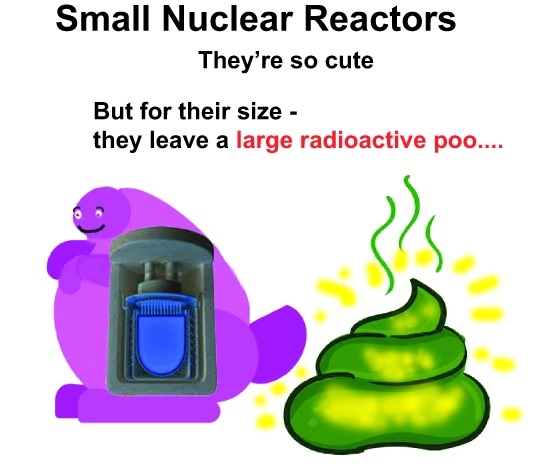
- But research has shown that SMRs create 2 to 30 times greater volumes of nuclear waste.
- The cost of new nuclear reactors, whether traditional reactors or SMRs, is substantially higher than renewable energies.
- Oklo is a front-runner in the SMR race, and its stock has skyrocketed. In August, it was selected for three projects under DOE’s Reactor Pilot Program.
Holtec International has shuttered their plans to store nuclear waste in the Permian basin of south-east New Mexico. The planned site would have contained 50 canisters of spent nuclear fuel for 40 years, as a temporary storage site, which is laughable as Holtec planned to scale up to 10,000 canisters eventually.
President Trump, by executive order, has decided nuclear energy will be a big part of the U.S. energy future. After languishing for decades, President Biden assigned substantial funds to nuclear, as part of his push toward carbon-free sources. But there is an Achilles’ heel to nuclear—the waste is radioactive, and has to be disposed of very carefully. This is not just waste from traditional nuclear reactors, like Three-Mile Island, but also from small nuclear reactors (SMRs), that can be as small as a three-story building, and which can be made in a factory, and stacked to scale up energy supply. There is an ubiquitous threat in the U.S., real or perceived, of being exposed to nuclear radiation, either from nuclear accidents or from storage of nuclear waste.
Holtec Project Canceled.
In 2023, the governor of NM, Michelle Lujan Grisham, signed a state bill into law that banned state agencies from signing nuclear storage permits. There are reasons for this. NM has a history of debilitating health effects from nuclear radiation, from the first atom bomb explosion south of Albuquerque, to workers who mined uranium in western parts of the state.
But there are other liabilities. A second is earthquakes in the Permian basin induced by injection of waste water from oil well operations. These are increasing in numbers and there have been several magnitude 5 quakes. Planning to build a storage facility for nuclear waster in the middle of hundreds of oil wells and their earthquakes should be a no-brainer.
A third liability is the promise the Holtec facility would be temporary, until the U.S. finds a permanent site. ………………………………………………………………………………………………………………….. https://www.forbes.com/sites/ianpalmer/2025/10/14/holtec-backs-down-reveals-achilles-heel-for-us-nuclear-resurgence/
1000s of nuclear bombs? Russia exits US nuke pact to reclaim 34 tons of plutonium

The pact required both nations to dispose of 34 metric tons of weapons-grade plutonium.
Kapil Kajal Oct 09, 2025 , https://interestingengineering.com/military/russia-dumps-us-nuclear-deal
ussia has officially pulled out of an important agreement with the United States regarding how to dispose of weapons-grade plutonium.
According to Russia’s state news agency TASS, the lower house of the Parliament passed a legislation on October 8 to officially denounce the 2000 Plutonium Management and Disposition Agreement (PMDA).
The pact required both nations to dispose of 34 metric tons of weapons-grade plutonium, enough for thousands of nuclear warheads, by converting it into fuel for civilian power reactors.
Terminating nuclear pact
The deal, signed in 2000 and ratified in 2011, was designed to ensure that plutonium declared surplus for defense needs could never again be used for weapons.
However, Russia is no longer willing to follow its agreements with the United States regarding plutonium.
Deputy Foreign Minister Sergey Ryabkov told lawmakers that the current situation makes it unacceptable to keep these obligations.
Ryabkov pointed out that Russia’s demands for restoring the deal have not been met. These demands include lifting US sanctions, reversing the Magnitsky Act, and reducing NATO’s military presence near Russia’s borders.
The Russian government explained to parliament that it is withdrawing from the deal due to “fundamental changes in circumstances,” including NATO expansion, US sanctions, and military support from Washington for Ukraine.
Although the agreement was technically in place, Russia stopped participating in 2016. It accused the US of not meeting its obligations and using the agreement for political gain.
The Kremlin at the time demanded concessions unrelated to the agreement, such as restrictions on NATO activities in Eastern Europe and the lifting of sanctions imposed after Moscow’s 2014 annexation of Crimea.
34 tons of plutonium
The termination of the PMDA means that the 34 tons of plutonium Russia had pledged to render unusable for weapons could now be reclassified as part of its strategic reserves.
The State Duma’s official statement described further commitments on the material as “inexpedient.”
The decision adds to the growing list of suspended or terminated arms control agreements between Moscow and Washington.
Russia has already withdrawn from the Conventional Armed Forces in Europe (CFE) treaty, suspended its participation in New START, and halted cooperation under the Open Skies treaty.
The plutonium agreement was among the few remaining technical measures of nuclear risk reduction from the early 2000s.
While smaller in scale than New START, the PMDA was seen as a pragmatic step toward reducing stockpiles of weapons-usable material in both nations.
Tomahawk cruise missiles
The move comes as geopolitical tensions between the US and Russia continue to escalate over the war in Ukraine.
On the same day the withdrawal was announced, the Kremlin condemned Washington’s reported deliberations over providing Tomahawk cruise missiles to Kyiv.
“If the U.S. administration ultimately makes that decision, it will not only risk escalating the spiral of confrontation, but also inflict irreparable damage on Russian-US relations,” Foreign Ministry spokeswoman Maria Zakharova said, according to TASS.
She added that Moscow was “closely monitoring” the situation and urged the US to exercise restraint
The United States has not yet commented on Russia’s decision to terminate the plutonium deal.
However, the move underscores the growing collapse of bilateral nuclear cooperation amid the deepest rift between Washington and Moscow in decades.
The developments also come as Bloomberg reported on September 30 that Russia remained the largest supplier of enriched uranium to the United States in 2024, providing about 20 percent of the fuel used in American nuclear reactors despite formal import restrictions.
US waivers still permit deliveries through 2028 for national energy security reasons.
As both countries move further away from long-standing nuclear agreements, experts warn that ending the PMDA shows a growing risk to global nuclear safety and a widening rift in US-Russia relations.
U.S. Dept. of Energy steps up plutonium pit manufacturing at Savannah River Site

The site is part of the nation’s effort of “re-establishing capabilities retired after the Cold War,” the national nuclear stockpile plan stated. And also, provide a home for another data center.
Jillian Magtoto, Savannah Morning News, 9 Oct 25,
Key Points
ENVIRONMENT
U.S. Dept. of Energy steps up plutonium pit manufacturing at Savannah River Site
The site is part of the nation’s effort of “re-establishing capabilities retired after the Cold War,” the national nuclear stockpile plan stated. And also, provide a home for another data center.
Jillian Magtoto, Savannah Morning News
- The Department of Energy is accelerating construction of the new facility, aiming to produce 50 plutonium pits annually by 2030.
- While production ramps up, concerns remain about existing radioactive waste and the diversion of funds from cleanup efforts.
More than two hours up the river from Savannah is a nuclear Superfund site, about the size of Augusta just across the border. Despite decades of cleanup, radionuclides still trickle from nearby streams to cow udders, and lurk in the tissues and bones of alligators, hogs, and deer, and the flesh of tadpoles and fish. In July, workers discovered a radioactive wasp hive at one of its hazardous waste tank farms. The site spanning three South Carolina counties is still active as the country’s only plant extracting and purifying tritium, a radioactive isotope that boosts the efficiency and explosivity of nuclear weapons.
But the Savannah River Site (SRS) is about to be re-awakened to produce plutonium pits, hollow bowling-ball sized spheres of plutonium at the core of warheads that causes the nuclear blast. Plutonium is a heavier metal that, according the Environmental Protection Agency (EPA), can enter the bloodstream upon inhalation, resulting in lung scarring, disease, and cancer. It carries a half-life of about 24,000 years.
Last October, the Department of Energy’s (DOE) National Nuclear Security Administration (NNSA) assumed primary responsibility of the SRS to produce 50 of the country’s 80 annual plutonium pits by 2030. The remaining 30 will be made in the Los Alamos National Laboratory in New Mexico, where plutonium pits were first created in the 1940s.
Over 80 years later, “NNSA is being asked to do more than at any time since the Manhattan Project,” stated NNSA Administrator Jill Hruby at the 2024 Nuclear Deterrence Summit. For SRS, the goal “is aggressive, complete construction by 2032 so that rate production can support the W93 schedule.” W93 is the newest and 93rd nuclear weapon design the U.S. has considered after a 30-year hiatus, planned for deployment by U.S. Navy submarines…………………………………………………………………………………………………
While plans are accelerating, “most of the public doesn’t even know what’s going on out there,” said Tom Clements, founder of his one-man watchdog website, Savannah River Site Watch, who has monitored the plant since the 1970s. “They don’t know they’re building the pit plant.” And likely, also a data center…………………………………………………………………………………………..
Plutonium’s pitfall
It’s one thing to stop plutonium production, but it’s an entire other affair to dispose it.
Because weapons-grade plutonium cannot be blended with other materials to render it unusable for weapons, Russia and the U.S. agreed it would instead be made into mixed oxide (MOX) fuel and irradiated in civil nuclear power reactors for electricity. For the U.S., that MOX facility would be housed at the SRS, which began construction in 2007.
But the promise was a far cry from what the DOE was able to do.
Technical issues, delays, and mismanagement reported by outlets like the Post & Courier ended its operations in 2018. In 2022, the MOX building contractor paid $10 million to the DOE for fraudulent invoices for nonexistent materials. If completed, SRS’ MOX facility would have been 32 years behind schedule and $13 billion over budget, according to the DOE.
Meanwhile, the state of South Carolina was growing wary of the tanks sitting on its soils. In 2014, the state sued the U.S. government and six years later, won the state’s largest single settlement of $600 million and the DOE’s commitment to remove all 9.5 metric tons of plutonium from the state by 2037. Until then, South Carolina has waived its right to bring any lawsuit against DOE for plutonium disposal.
So the DOE went with a cheaper and quicker alternative: diluting the plutonium with a plutonium powder into a “more secure” and less weapon-usable form—though the potential of reversibility led Russia to back out of the deal. SRS has undergone a flurry of expansion, automation, tank transport, and construction of mega-sized disposal units all to dilute the plutonium into a Superfund smoothie that gets vitrified into obsidian-like glass and shipped to a waste isolation pilot plant 2,000 feet underground in a New Mexico salt mine, according to SRS. It completed the first shipment in December 2023.
Still, radioactive byproduct remains in 35 million gallons of waste stored in roughly 43 of the original 51 underground carbon steel containers according to most recently published updates this January.
“These tanks have outlived their design lives, posing a threat to the environment,” stated a Savannah River National Laboratory webpage. “Some of the tanks have known leaks.”
A new mission swipes cleanup funds
From aging plutonium pits housed at the Pantex facility in Texas, the SRS will generate new plutonium pits at the SRS unit originally intended to retire weapons-grade plutonium…………………………………..
But as the site shoulders the new plan, remediation funds get pulled. When the DOE EM handed over primary responsibility of the site to the NNSA last year, $173 million were reallocated from cleanup to weapons activities and transition costs. And it seems some environmental processes fell though the cracks.
“They basically named SRS as the second [plutonium pit] plant site without doing an environmental analysis,” said Clements. “And that’s we got them for, violating the National Environmental Policy Act.”
In 2021, Clements, the Savannah River Site Watch and a few other plaintiffs sued the DOE and NNSA, resulting in a settlement that will play out over the next couple of years. Until the DOE conducts a Programmatic Environmental Impact Statement (PEIS) examining the environmental impact of other approaches to pit production and reach a Record of Decision filed by July 17, 2027, the DOE will not introduce nuclear material into the SRPPF’s main processing building…………………………………. https://www.savannahnow.com/story/news/environment/2025/10/09/savannah-river-site-takes-on-an-enduring-mission-to-make-plutonium-pits-and-also-take-a-data-center/86442685007/
Holtec abandons nuclear waste project in New Mexico

by Energy News updated October 9, 2025, https://energynews.oedigital.com/energy-markets/2025/10/09/holtec-abandons-nuclear-waste-project-in-new-mexico
Holtec, a private nuclear power company, announced this week that it was abandoning a plan to store radioactive waste in New Mexico despite a U.S. Supreme Court decision in June which gave some hope for projects aiming at storing the material. The Supreme Court threw away a legal challenge in June by Texas, New Mexico, and some oil companies against the U.S. Nuclear Regulatory Commission’s licensing of nuclear storage projects in the drilling country. Some believed that this opened the door to temporary storage for these states.
New Mexico lawmakers and the Governor Michelle Lujan Grisham are opposed to storing nuclear waste on the site, even temporarily. They fear that without a permanent U.S. facility for nuclear waste, it will become a permanent solution.
Holtec announced in a Wednesday statement that it is leaving the HISTORE project in the Permian basin, near the oil hub Carlsbad. The statement said that the Eddy-Lea Energy Alliance and Holtec had mutually agreed to cancel the agreement due to the unsustainable path for used fuel storage. This was reported first by Axios.
It’s been obvious for years that New Mexicans are opposed to spent fuel storage and disposition in the state. “We’re happy that Holtec finally acknowledged that reality,” Don Hancock, director at the Southwest Research and Information Center of Albuquerque for the nuclear waste safety programs.
Holtec’s Pat O’Brien, a spokesperson for the company, said that the company hoped to work with states that were willing to store the waste following outreach efforts by the U.S. Department of Energy which began during former President Joe Biden’s Administration.
O’Brien stated that Holtec believes communities in 15 to 20 different states are interested in hosting a potential storage facility.
The danger to human health makes it necessary to store nuclear waste for a long time. Nuclear power plants, both active and closed, store the waste.
After state legislators raised objections, the former Obama administration halted funding in 2010. (Reporting and editing by Paul Simao; Timothy Gardner)
German Nuclear Operator’s Insolvency Could Shift Dismantling Costs to Taxpayers
October 6, 2025, Full Story: Clean Energy Wire, Author: Benjamin Wehrmann, https://www.theenergymix.com/german-nuclear-operators-insolvency-could-shift-dismantling-costs-to-taxpayers/
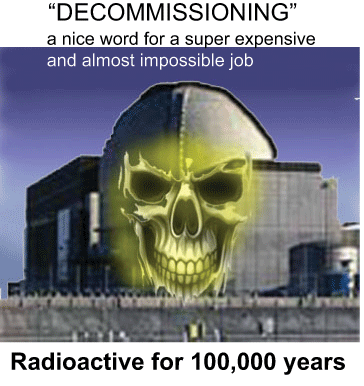
The insolvency of an operator of a decommissioned nuclear power plant in Germany raises questions about the financial responsibilities for deconstructing the reactor and disposing of its radioactive materials.
HKG, the owner of the nuclear plant Hamm-Uentrop that was opened in 1983 and taken out of service only six years later, filed for insolvency at a court in western state North Rhine-Westphalia, reports Clean Energy Wire, citing the German business weekly WirtschaftsWoche.
The operating company, owned jointly by major energy company RWE and several local utilities, initially had demanded about 350 million euros from the federal and the state government to cover the costs for deconstruction and disposal, but failed to win a lawsuit it filed in 2024. A court in the city of Düsseldorf rejected HKG’s claim in June this year, which led the company to declare itself insolvent. “HKG faces an unchanged situation with unclear financing of the remaining deconstruction work,” said the company’s CEO, Volker Dannert. According to WirtschaftsWoche, the actual costs for dismantling the plant and storing the nuclear waste initially were gauged at 750 to one billion euros.
Co-owner company RWE said the HKG shareholders bear no legal responsibility to fund deconstruction works beyond payments they made in the past. HKG manager Dannert said that talks with the federal and the state government had remained inconclusive, which meant that “it is now a task for the responsible authorities at the federal level and in North Rhine-Westphalia to organize the further dismantling.”
The prototype Thorium-Cycle-High-Temperature-Reactor (THTR) in Hamm-Uentrop was decommissioned due to technical challenges after serving for about 16,500 hours. It was sealed in 1997 and will remain so until at least 2030 to let radioactive contamination diminish before deconstruction works can begin. The process of dismantling is expected to take about one decade.
Germany is in the process of dismantling its nuclear power plants after shutting down the remaining three reactors in 2023 as part of the country’s nuclear phase-out. Dismantling nuclear power stations and safely storing radioactive waste will cost Germany dozens of billions of euros, and take many decades.
In 2017, Germany’s four major nuclear plant operators—E.ON, EnBW, RWE and Vattenfall—handed money earmarked for nuclear waste disposal over to the country’s fund for nuclear waste management, passing all responsibilities to the state. In 2025, over half of the German environment ministry’s budget is spent on managing the country’s nuclear waste, including finding a location for a final nuclear repository.
This post was originally published by Berlin-based Clean Energy Wire.
45K gallons of radioactive water to be dumped into Hudson River from Indian Point nuclear plant

Shane Galvin Oct. New York Post, 2, 2025,
Roughly 45,000 gallons of radioactive water from a defunct plant north of New York City will be discharged into the Hudson River after a federal court ruling struck down a state environmental law.
US District Judge Kenneth Karas sided with company Holtec International over New York State in a ruling issued last week that reversed the 2023 “Save The Hudson” law which sought to prevent the company from muddying the Hudson’s waters.
Holtec sued the Empire State last year, arguing that only the federal government had the right to regulate discharge of the Indian Point plant’s nuclear waste, which amounted to the 45,000-gallon sum, The New York Times reported……………………………………..
Indian Point, which sits on the Hudson River about 35 miles north of Manhattan, was closed in 2021 after years of public outcry from the local community over environmental concerns…………………… https://nypost.com/2025/10/02/us-news/45k-gallons-of-radioactive-water-to-be-dumped-into-hudson-river-from-indian-point-nuclear-plant/
U.S. to gift Plutonium-239 to private nuclear industry
The Trump Administration’s trafficking of nuclear weapons-grade usable plutonium would significantly increase the global proliferation of nation state-sponsored nuclear weapon programs as well as the nuclear weapons material acquisition by thief and purchase for acts of nuclear terrorism.
The Trump Administration’s trafficking of nuclear weapons-grade usable plutonium would significantly increase the global proliferation of nation state-sponsored nuclear weapon programs as well as the nuclear weapons material acquisition by thief and purchase for acts of nuclear terrorism.
October 2, 2025, https://beyondnuclear.org/u-s-to-gift-pu-239-to-private-nuclear-utilities/
Trump Administration’s give away of 20 MT of US plutonium weapons stockpile to private companies threatens nuclear proliferation
According to previously unreleased government documents obtained and reviewed by Politico and addressed in a letter from three Democrat members of Congress to President Donald Trump, The White House is preparing to give away 20 metric tons of weapons-usable plutonium to new nuclear start companies. The Trump deal calls for the equivalent of 2000 nuclear bombs previously slated for permanent disposal as nuclear waste) from the nation’s Cold War era nuclear weapons stockpile to be freed up to help jump start privately-owned U.S. commercial nuclear startup companies. The fledgling nuclear companies would instead use the plutonium fuel in a still unproven and unlicensed new generation of nuclear power plants for domestic power production. The plan includes U.S. startups to reprocess plutonium used in nuclear fuel for international export. The Trump Administration’s trafficking of nuclear weapons-grade usable plutonium would significantly increase the global proliferation of nation state-sponsored nuclear weapon programs as well as the nuclear weapons material acquisition by thief and purchase for acts of nuclear terrorism.
The White House proposal calls for the U.S. Department of Energy (DOE), currently charged with the nation’s nuclear weapons development and nuclear power promotion, to “alter” the military-grade plutonium so it can be used as fuel by civilian startup power companies in new reactor designs. Theses unfinished and yet to be approved designs (such as the sodium cooled metal fuel fast reactors “Aurora” by the Santa Clara, CA start-up Oklo, Inc.’s and Bill Gates’ TerraPower’s “Natrium”) are already being privately marketed for the domestic and international export of fast reactors by companies such as Oklo.
The White House Executive Orders originally issued in May 2025 as part of the President Trump’s national call to “Unleash Nuclear Energy” had directed that the US Department of Energy draw down the from the nation’s plutonium surplus. The current White House plan now additionally includes the military to civilian utility transfer of reserve warhead parts known as “plutonium pits.
The Politico article quotes Oklo’s CEO Jacob DeWitte, “Oklo, wants to take advantage of the plutonium fuel program. Unlike its competitors, Oklo’s fast-neutron reactors can use plutonium as a ‘bridge’ fuel to get around the bottlenecks that exist in obtaining the more desirable grades of uranium.” Those “desirable grades of uranium” fuel are currently only commercially available from the Russia global monopoly on High Assay Low Enriched Uranium (HALEU) which is just less than 20% enriched U-235.
Oklo’s prestigious former board member, Chris Wright, stepped down from the company when he was confirmed to be President Trump’s new Secretary of Energy. Oklo’s Aurora reactor design now under review by the U.S. Nuclear Regulatory Commission is a controversial liquid sodium-cooled metal fueled fast reactor. The fast reactor design is controversial chiefly because it can be retrofitted as a “dual purpose” (military and commercial) reactor to breed more plutonium for nuclear weapons and commercial power generation.
The concept for Oklo’s plan was opposed in a July 25, 2025 letter to Congress signed by 17 scientific experts on global non-proliferation of nuclear weapons. First and foremost, nothing has fundamentally changed to break with the five decades that the United States has opposed from using plutonium fuel in commercial power plants due to security and economic concerns. Their letter further pronounces that authorizing funds for the proposed civilian use of nuclear weapons-usable plutonium as fuel in nuclear power plants will only accelerate the global spread of nuclear weapons in two obvious ways; 1) US companies plan to internationally export plutonium fuel and the plutonium extraction technology, and; 2) the US cannot discourage other countries from further trafficking of weapons-usable plutonium as civilian nuclear fuel if the US is doing it ourselves.
Moreover, pyro-processing or “recycling” to extract plutonium and uranium for reuse as reactor fuel has already proven to be unsustainable economically and will only deepen the already bad economics of nuclear power. The processing is acknowledged as “very costly, due to safety and security concerns, both to extract from nuclear waste and to fabricate into fuel.”
Leah McGrath Goodman, Tony Blair and issues on torture (with added radiation)


Published by arclight2011- date 15 Sep 2012 -nuclear-news.net
[…]
Accusations: Despite the mockery of the film Borat, leaked U.S. cables suggest the country was undemocratic and used torture in detention
Other dignitaries at the meeting included former Italian Prime Minister and ex-EU Commission President
Romano Prodi. Mr Mittal’s employees in Kazakhstan have accused him of ‘slave labour’ conditions after a series of coal mining accidents between 2004 and 2007 which led to 91 deaths.
[…]
Last week a senior adviser to the Kazakh president said that Mr Blair had opened an office in the capital.Presidential adviser Yermukhamet Yertysbayev said: ‘A large working group is here and, to my knowledge, it has already opened Tony Blair’s permanent office in Astana.’
It was reported last week that Mr Blair had secured an £8 million deal to clean up the image of Kazakhstan.
[…]
Mr Blair also visited Kazakhstan in 2008, and in 2003 Lord Levy went there to help UK firms win contracts.
[…]
Max Keiser talks to investigative journalist and author, Leah McGrath Goodman about her being banned from the UK for reporting on the Jersey sex and murder scandal. They discuss the $5 billion per square mile in laundered money that means Jersey rises, while Switzerland sinks.
http://www.youtube.com/watch?v=gA_aVZrR5NI&feature=player_detailpage#t=749s
And as well as protecting the guilty child sex/torturers/murderers of the island of Jersey I believe that they are also protecting the tax dodgers from any association.. its just good PR!
FORMER Prime Minister Tony Blair was reportedly involved in helping to keep alive the world’s biggest takeover by Jersey-incorporated commodities trader Glencore of mining company Xstrata.
11/September/2012
[…]
Mr Blair was said to have attended a meeting at Claridge’s Hotel in London towards the end of last week which led to the Qatari Sovereign wealth fund supporting a final revised bid from Glencore for its shareholding. Continue reading
Democrats alarmed as Trump eyes weapons material to fuel nuclear reactors
The scramble to build new reactors to supply power to AI data centers may include plutonium from the nation’s nuclear deterrent.
Politico, By Zack Colman, 09/29/2025
The Trump administration is considering a proposal to divert plutonium that plays a central role in the U.S. nuclear weapons stockpile to fuel a new generation of power plants, according to an Energy Department official and previously undisclosed department documents.
The proposal calls for the department to alter the plutonium so it can be used by civilian power companies, including startups pitching advanced reactor designs. It’s part of a broader push by President Donald Trump to convert tons of the Energy Department’s plutonium to civilian use, a notion that some lawmakers argue would undermine the U.S. weapons program for the benefit of untested private companies.
The initiative would involve harvesting plutonium on a large scale: According to a department official and a July 31 DOE memo seen by POLITICO, more than a fifth of the plutonium needed to meet Trump’s mandates would come from the highly radioactive spheres manufactured for the cores of nuclear weapons. DOE already faces a crunch to make more of those spheres, known as plutonium pits — it’s lagging behind Congress’ demands that it boost pit production to modernize the country’s nuclear deterrence.
The department is “not meeting the current pit manufacturing schedule,” said a former DOE official who is familiar with the department’s plutonium reserves. “So to make pit plutonium available would be a huge shift, and I’d be shocked.”
Both the current and former officials were granted anonymity to share sensitive details about national security matters.
Trump didn’t mention the pits in a May executive order in which he directed DOE to draw from another source — its stores of surplus plutonium — to help revive the nuclear power industry and meet the soaring electricity demands of data centers used in artificial intelligence. The U.S. officially halted its program that made weapons-grade plutonium in 1992.
The department declined to confirm or deny any details of its plutonium plans in response to questions from POLITICO.
“The Department of Energy is evaluating a variety of strategies to build and strengthen domestic supply chains for nuclear fuel, including plutonium, as directed by President Trump’s Executive Orders,” the department said in a statement. “We have no announcements to share at this time.”
The White House referred POLITICO’s questions about the plutonium plans to DOE. The Defense Department referred questions to the White House.
Government watchdogs and congressional Democrats have spent weeks objecting to the entire notion of transferring government-owned plutonium to the power sector. Such a move “goes against long-standing, bipartisan U.S. nuclear security policy,” Democratic Sen. Ed Markey and Reps. Don Beyer and John Garamendi wrote in a Sept. 10 letter to Trump. “It raises serious weapons proliferation concerns, makes little economic sense, and may adversely affect the nation’s defense posture.”
In a separate Sept. 23 letter to Trump, Markey said he was concerned that Energy Secretary Chris Wright was pushing the plutonium proposals to help a Californian nuclear power startup named Oklo, on whose board Wright once sat………….
Oklo spokesperson Paul Day declined to comment on Markey’s concerns of a possible conflict of interest. He also declined to comment on how much plutonium the company intends or has agreed to acquire from DOE. He said DOE “has not, as far as we know, established a plutonium fuel program.”
One nuclear safety watchdog echoed many of the Democrats’ concerns in an interview, saying DOE’s proposal could hollow out the nation’s nuclear defenses and compromise the Pentagon’s long-term deterrence strategy. And it appears to be happening without coordination with the Defense Department, said Hans Kristensen, director of the nuclear information project at the Federation of American Scientists, a nonprofit group that focuses on global security.
…………………………………………..U.S. civilian reactors now use only uranium for their nuclear fuel, but some reactors under development are planning to use plutonium. Spent plutonium from reactors is far more radioactive than uranium — and could pose a greater security risk than uranium if it were to fall into the hands of hostile nations or terrorist groups.
………………………………………… The DOE memo called for delivering 18.5 metric tons of the government’s surplus plutonium and an additional 6.5 metric tons pulled from “material in classified form once it has been declassified.” That latter term, the current DOE official who spoke to POLITICO said, refers to the plutonium pits, whose shape and characteristics can reveal information about nuclear weapons.
The company where Wright was once a board member, Oklo, wants to take advantage of the plutonium fuel program. Unlike its competitors, Oklo’s fast-neutron reactors can use plutonium as a “bridge” fuel to get around the bottlenecks that exist in obtaining the more desirable grades of uranium, CEO Jacob DeWitte told POLITICO in an interview.
DeWitte said Oklo has not publicly revealed how much plutonium the company is seeking to run its new reactors, or from where precisely it plans to obtain that plutonium. He also said the Trump administration has not detailed exactly how much plutonium it will make available, noting that “there is disagreement” over how much surplus plutonium the federal government can hand off before harming nuclear deterrence……………………………………………………………………………………………………………………………………… https://www.politico.com/news/2025/09/29/trumps-nuclear-power-push-stirs-worries-about-us-weapons-stockpile-00583424
UK Government names six decommissioning sites being considered for new nuclear
30 Sep, 2025 By Tom Pashby New Civil Engineer
The government has named UK six nuclear sites currently being decommissioned where there is interest in establishing new nuclear developments.
The SMR ambitions, revealed as part of the US-UK nuclear
deal, named Hartlepool in County Durham, Cottam in Nottinghamshire and
London Gateway port in Kent as potential locations for hosting new small
reactors. The new regulation for nuclear developments, including siting –
National Policy Statement for nuclear energy generation (EN-7) – was
published in draft form in February 2025.
This new policy will open up more
potential locations for new nuclear developments beyond the eight sites
stipulated in the former statement. In April, the government said it
planned to publish the final EN-7 policy by the end of 2025.
Great British Energy – Nuclear is already assessing Wylfa on the Isle of Anglesey in
North Wales and Oldbury-on-Severn in Gloucestershire, as potential sites
for hosting three 470MW Rolls-Royce SMR reactors. Both Wylfa and Oldbury
have historic nuclear power plants, which are undergoing decommissioning.
Now the government has named four additional sites where nuclear reactors
are being decommissioned that are being considered for new nuclear
developments. It named them in response to a parliamentary question. “The
government is also aware of developer or community interest in nuclear
projects at several other sites, including those being decommissioned.
These include Pioneer Park (Moorside), Trawsfynydd (via Cwmni Egino),
Hartlepool, and Dungeness.”
Pioneer Park at Moorside in Cumbria is a
project led by Energy Coast West Cumbria (BEC) which is a joint venture
(JV) between the Nuclear Decommissioning Authority (NDA) and Cumberland
Council. BEC’s website makes reference to the government having announced
in June 2025 that part of the Moorside site was designated as suitable for
nuclear generation. The JV says Pioneer Park “will be a transformative
project designed to diversify and strengthen the local economy in West
Cumbria, reducing reliance on the Sellafield site while creating new
opportunities in the clean energy sector”.
Kent County Council pursuing
one or more SMR at Dungeness. In June 2023, a report from Kent County
Council updated cabinet members “on the opportunity to secure a nuclear
future for Dungeness and seeks support for a coordinated campaign of
action”. The report from Kent County Council cabinet member for economic
development Derek Murphy said: “We believe Dungeness is a perfect
location for one (or more) of the new breed of SMRs safely producing green,
low carbon energy and retaining high-quality jobs and skills in the area
while helping to power local growth.”
It went on to say that the council
would continue to conduct discussions about potential reactors which could
be deployed at the site with vendors, and committed to undertake “soft
market testing to develop a small number of high-level proposals for the
site”.
Cwmni Egino was set up by the Welsh Government in 2021 to explore
opportunities to develop new nuclear projects in Wales at Wylfa and
Trawsfynydd – both of which host nuclear power stations that are being
decommissioned. The organisation says it has confirmed the “viability of
small scale nuclear at Trawsfynydd”. Small scale nuclear could mean small
modular reactors (SMRs), advanced modular reactors (AMRs) or micro-modular
reactors (MMRs). The Trawsfynydd, however, also appears to be being
considered as a potential host for a medical research reactor, under the
Welsh Government’s Project Arthur, according to Cwmni Egino.
New Civil Engineer 30th Sept 2025, https://www.newcivilengineer.com/latest/government-names-six-decommissioning-sites-being-considered-for-new-nuclear-30-09-2025/
DOE can’t pin down costs, schedules for nuclear cleanups — audit
The Government Accountability Office found that cleanups at just eight waste sites could cost roughly $15 billion.
Politico, By: Brian Dabbs | 09/29/2025
ENERGYWIRE | The Department of Energy is unable to outline the precise costs and schedules for waste cleanups at a dozen federal sites that produced nuclear weapons materials during World War II and the Cold War, the Government Accountability Office said in a report published Friday.
At just eight of the 12 sites, cleanup could cost roughly $15 billion over the next 60 years, GAO said.
DOE’s Office of Environmental Management cannot “readily identify the scope, schedule, and cost of soil and legacy landfill cleanup,” the report said, adding that “having information available that is specific to soil and legacy landfill cleanup at EM sites would improve headquarters’ ability to track resources needed to implement remedy decisions.”
The eight sites investigated by GAO include the Hanford Site in Washington state, Los Alamos in New Mexico, Oak Ridge in Tennessee and the Savannah River Site in South Carolina. GAO said 12 total sites have “remaining soil or legacy landfill cleanup.”………………………………….(Subscribers only) https://subscriber.politicopro.com/article/eenews/2025/09/29/doe-cant-pin-down-costs-schedules-for-nuclear-cleanups-gao-00582626
Secrets of the deep, deep tunnels where nuclear waste is buried.
Almost half a kilometre underground, engineers in Finland are about to seal
radioactive material safely for ever. Britain wants to do the same. If all
goes to plan, spent nuclear fuel will be transported early next year down
dedicated lift shafts before robotic machines bury the 24-tonne copper and
iron canisters in the rock where they will remain for the rest of time.
This is the world’s first deep geological disposal facility for nuclear
fuel, a concept that has been discussed by engineers and politicians for
half a century. More than 20 other countries including the UK, US, France
and Sweden have plans to follow suit. But the Finns have got there first.
Fiona McEvoy, 50, the head of site characterisation and research and
development at the British government agency Nuclear Waste Services, is
here as part of a fact-finding mission to see how a similar feat could be
achieved in the UK. She says: “It’s a watershed moment for the nuclear
sector. Long-lived, dangerous waste will be locked away, safe for eternity.
That is amazing.”
Martin Walsh, 51, head of engineering at Nuclear Waste
Services, also on the visit, says: “Nobody disagrees that for the legacy
for nuclear waste in the UK, geological disposal is necessary.” The most
radioactive nuclear waste produced by Britain’s nuclear power stations will
remain hazardous, Walsh says, “beyond our lifetime, and beyond the
lifetime of our children and our children’s children”.
Burying it deep in
the earth is considered a “final disposal”, a solution that has been
calculated to enable the radioactive waste to remain undisturbed for a
nominal 500,000 years, surviving ice ages, tectonic shifts, earthquakes and
sea level rise.
The two private companies that run these facilities, TVO
and Fortum, jointly founded Posiva in 1995, developing this repository to
dispose of their waste. Every week, for the next 100 years, one canister of
spent nuclear fuel will be transported 433m down into the earth.
In the UK,
plans for a similar geological disposal scheme have experienced false
starts because no council has yet agreed to host a site. In June, the newly
elected Reform leadership of Lincolnshire county council pulled the plug on
long-running discussions to site a geological disposal site near the
coastal village of Theddlethorpe.
The most likely location for a site is
now off the Cumbrian coast, close to Sellafield. Nuclear Waste Services is
in discussions with Mid Copeland and South Copeland community partnerships
for a proposal for an access tunnel to be sunk onshore, and then run ten
miles out below the seabed, where 250 miles of disposal tunnels would be
dug, nearly ten times the size of the Finnish scheme.
Subject to local
approval and the go-ahead of whichever government is then in power,
construction is expected to start in the 2040s and start being filled in
the 2050s. It will be filled with waste for 150 years before it is sealed
in 2200.
The lifetime cost of the UK project is estimated at up to £53
billion, compared with about £5 billion for the Finnish scheme, which at
roughly a tenth of the size, serving a nation with a tenth of the
population, is roughly comparable. The speed at which progress has been
made, however, is not comparable. But Walsh defends the cautious pace the
British experts have taken. “The thought process, particularly around
nuclear, has to be robust. You have to make sure your relationship with
safety and security and the environment is sound.”
Times 28th Sept 2025,
https://www.thetimes.com/uk/environment/article/nuclear-power-waste-finland-bkq8sq0lj
-
Archives
- October 2026 (112)
- September 2026 (339)
- August 2026 (330)
- July 2026 (355)
- June 2026 (287)
- May 2026 (306)
- April 2026 (356)
- March 2026 (251)
- February 2026 (267)
- January 2026 (308)
- December 2025 (358)
- November 2025 (359)
-
Categories
- 1
- 1 NUCLEAR ISSUES
- business and costs
- climate change
- culture and arts
- ENERGY
- environment
- health
- history
- indigenous issues
- Legal
- marketing of nuclear
- media
- opposition to nuclear
- PERSONAL STORIES
- politics
- politics international
- Religion and ethics
- safety
- secrets,lies and civil liberties
- spinbuster
- technology
- Uranium
- wastes
- weapons and war
- Women
- 2 WORLD
- ACTION
- AFRICA
- Atrocities
- AUSTRALIA
- Christina's notes
- Christina's themes
- culture and arts
- Events
- Fuk 2022
- Fuk 2023
- Fukushima 2017
- Fukushima 2018
- fukushima 2019
- Fukushima 2020
- Fukushima 2021
- general
- global warming
- Humour (God we need it)
- Nuclear
- RARE EARTHS
- Reference
- resources – print
- Resources -audiovicual
- Weekly Newsletter
- World
- World Nuclear
- YouTube
-
RSS
Entries RSS
Comments RSS

