nuclear-news

The News That Matters about the Nuclear Industry Fukushima Chernobyl Mayak Three Mile Island Atomic Testing Radiation Isotope

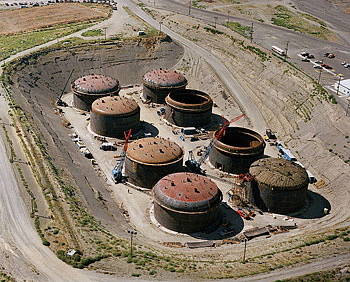
U.S. Energy Dept plans to reclassify Hanford nuclear sludge – from “high level”to “low level”

Stripes 29th Nov 2018 After spending billions of dollars over several decades to remove
radioactive waste leaking from a plant where nuclear bombs were made, the
Energy Department has come up with a new plan: leave it in the ground.
The shuttered Hanford Nuclear Reservation, which produced plutonium for U.S.
atomic weapons from World War II through the Cold War, is the nation’s
largest nuclear cleanup site with about 56 million gallons of waste stored
in leak-prone underground tanks in south-central Washington State.
The Energy Department has proposed to effectively reclassify the sludge left in
16 nearly empty underground tanks from “high-level” to “low-level”
radioactive waste. The re-classification would allow the department to fill
the tanks with grout, cover them with an unspecified “surface barrier,” and
leave them in place.
But environmental groups and others say the plan
amounts to a semantic sleight of hand that will leave as much as 70,000
gallons of remaining nuclear sludge — some of which could be radioactive
for millions of years — in the ground.
https://www.stripes.com/news/us/plan-to-leave-buried-nuclear-bomb-waste-underground-draws-fire-1.558527

December 1, 2018 Posted by | USA, wastes | Leave a comment

San Onofre plant aims to resume transfers of nuclear waste in January 

 San Diego Tribune,  Rob NikolewskiContact Reporter, 30 Nov 18

The restart would mark the first transfers since a “near-miss” incident in August in which a 50-ton canister containing nuclear waste was accidentally left suspended on a metal flange, nearly 20 feet from the floor of a storage cavity for as much as one hour.

A specific date for the restart has not been set, and Edison officials emphasized it will only begin after roughly 60 workers have gone through “more detailed and improved training” that includes practice runs and employing an independent assessment team.

“We have not rushed to resume this,” said Tom Palmisano, vice president of external engagement at the plant, or SONGS. “We’re going to be very slow and deliberate so that we fully understand this and fully correct the underlying deficiencies that got us here.”

The company also said transfers will resume only after the Nuclear Regulatory Commission has completed on-site inspections next month.

All canister transfers have been suspended since the Aug. 3 incident came to light………

“The NRC is concerned about apparent weaknesses in management oversight” of the operations connected to the transfers, the agency’s report said.

Holtec International is the contractor responsible for transferring the canisters at SONGS, with Edison providing oversight. Based in New Jersey, Holtec also designed the canisters and the new storage facility where they are placed……….

San Onofre has not produced electricity since the plant shut down following a leak in a steam generator tube in 2012. The following year the plant officially closed. It is now in the process of being decommissioned.

SONGS is located on an 85-acre chunk of Marine Corps Base Camp Pendleton, owned by the Department of the Navy. The plant sits between the Pacific and one of the busiest freeways in the country — Interstate 5. About 8.4 million people live in a 50-mile radius of the plant in an area with a history of seismic activity.

The dry cask storage facilities are about 100 feet from the ocean, protected by a seawall 28 feet high.https://www.sandiegouniontribune.com/business/energy-green/sd-fi-nrc-songs-inspection-20181129-story.html

December 1, 2018 Posted by | USA, wastes | Leave a comment

Nuclear waste finally removed from Sequoyah Fuels site

Nuclear waste removed from Sequoyah Fuels site   Cherokee Nation, GORE, Okla. 30 Nov 18— A semitrailer quietly left the former Sequoyah Fuels Corporation site near Gore this week, hauling away the last of 511 loads of nuclear waste that has plagued Sequoyah County and its citizens for decades.

The Cherokee Nation and Oklahoma attorney general’s office worked for 18 months to ensure the off-site disposal of 10,000 tons of radioactive material were removed from the Sequoyah Fuels site. The waste was transported to a disposal site in Utah where the uranium will be recycled and reused, leaving the area near the Arkansas River free of this nuclear waste for the first time in nearly 50 years.

“It is a historic day for the Cherokee Nation and the state of Oklahoma. Our lands are safe again, now that we have removed a risk that would have threatened our communities forever,” Cherokee Nation Secretary of State Chuck Hoskin Jr. said. “This would not have been possible if the tribe and state had not worked tirelessly together in court to ensure removal of this material.”

The uranium processing plant was opened by Kerr-McGee in 1970. It converted yellowcake uranium into fuel for nuclear reactors. The plant changed ownership more than once and was eventually sold to General Atomics under the name Sequoyah Fuels Corporation.

An accident at the plant killed one worker and injured dozens of others in 1986. Another accident in 1992 injured about three dozen workers. Following that accident and years of violating numerous environmental rules and nuclear safety standards, the plant was closed in 1993.

Tons of radioactive waste remained at the facility when it closed, so in 2004 the Cherokee Nation and state of Oklahoma entered into a settlement agreement that required the highest-risk waste be removed from the site. The owners of Sequoyah Fuels Corporation announced in 2016 their intention to bury the waste on site, but a judge forced the company to comply with the original agreement. Removal of the material is now complete.
“The Cherokee Nation has been in and out of court with Sequoyah Fuels since 2004, and now this material is no longer a ticking time bomb on the banks of the Arkansas River, one of our most precious natural resources,” Cherokee Nation Secretary of Natural Resources Sara Hill said. “Decommissioning this plant was never enough to satisfy our goals for a clean and safe environment. Removal of this highly contaminated waste was our goal, and we’re pleased that goal has finally been achieved.”

The plant is located where the Arkansas River and Illinois River meet.

“Today’s announcement is another example of the strength behind the continued partnership between the state of Oklahoma and the Cherokee Nation,” said Attorney General Mike Hunter. “The successful outcome is also affirmation of my office’s commitment to finding avenues of collaboration with tribal governments to ensure our state’s natural resources remain protected and our citizens and communities remain safe.”

Sequoyah County is home to 41,000 residents. Many of those residents are Cherokee and were once employed at the plant, where dozens of workers were injured over the years…….http://webtest2.cherokee.org/News/Stories/20181130_Cherokee-Nation-state-of-Oklahoma-city-of-Gore-announce-nuclear-waste-removed-from-Sequoyah-Fuels-site

December 1, 2018 Posted by | indigenous issues, USA, wastes | Leave a comment

Robots in effort to clean highly radioactive Thorp nuclear reprocessing plant

Sellafield: Europe’s most radioactively contaminated site

Inside Sellafield’s death zone with the nuclear clean-up robots, 27 November 2018

The Thorp nuclear reprocessing plant at Sellafield, Cumbria, has recycled its final batch of reactor fuel. But it leaves behind a hugely toxic legacy for future generations to deal with. So how will it be made safe?

Thorp still looks almost new; a giant structure of cavernous halls, deep blue-tinged cooling ponds and giant lifting cranes, imposing in fresh yellow paint.

But now the complex process of decontaminating and dismantling begins.

It is a dangerous job that will take decades to complete and require a great deal of engineering ingenuity and state-of-the-art technology – some of which hasn’t even been invented yet.

This is why.

Five sieverts of radiation is considered a lethal dose for humans. Inside the Head End Shear Cave, where nuclear fuel rods were extracted from their casings and cut into pieces before being dissolved in heated nitric acid, the radiation level is 280 sieverts per hour.

We can only peer through leaded glass more than a metre thick at the inside of the steel-lined cell, which gleams under eerie, yellow-tinged lighting.

This is a place only robots can go.

They will begin the first stage of decommissioning – the post-operative clean-out – removing machinery and debris……….. Cleaning up other parts of the plant will also need robots and remotely operated vehicles (ROVs).

Some will need to be developed from scratch, while others can be adapted from systems already used in other industries, such as oil and gas, car manufacturing and even the space sector……..

The site in Cumbria contains a number of other redundant facilities, some dating back to the 1950s and many of them heavily contaminated, which are currently being decommissioned………

Remote submarines have explored and begun cleaning up old storage ponds. Other remote machines are being used to take cameras deep inside decaying bunkers, filled with radioactive debris.

The job of developing machines like these is shared with a large network of specialist companies, many of them based in Cumbria itself. They form part of a growing decommissioning industry within the UK, as the country grapples with the legacy of its first era of nuclear power.

The NDA believes that these companies can use what they learn at Sellafield, and other plants, to attract further business from overseas……..https://www.bbc.com/news/business-46301596

November 29, 2018 Posted by | reprocessing, UK, wastes | Leave a comment

Uncertainty and delay, as UK struggles with plans for dealing with radioactive trash

November 24, 2018 Posted by | UK, wastes | Leave a comment

Japan’s Nuclear Regulation Authority concerned about risks of radioactive leaks from facility near Tokyo

Low-level radioactive waste stored at Tokai research facility near Tokyo may leak, agency says, Japan Times, 
KYODO, 23 Nov 18 
The Japan Atomic Energy Agency said Wednesday that some of the low-level radioactive waste stored underground at a facility near Tokyo may leak from its containers due to inadequate disposal procedures.

The government-backed agency keeps 53,000 drums of low-level radioactive waste, or about 10,600 kiloliters, in a concrete pit in the basement of a building of the Nuclear Research and Science Institute in the village of Tokai, Ibaraki Prefecture.

Some of the waste did not undergo the proper water removal process when placed in the pit, and leakage and corroded containers in the pit were found during inspections between 1987 and 1991, according to the agency.

The nuclear research body planned to inspect the drums over the next 50 years to check for leakage. But the Nuclear Regulation Authority said at a meeting Wednesday that the agency needs to check them more quickly……..https://www.japantimes.co.jp/news/2018/11/22/national/low-level-radioactive-waste-stored-tokai-research-facility-near-tokyo-may-leak-agency-says/#.W_hm2IczbGg

November 24, 2018 Posted by | Japan, safety, wastes | Leave a comment

U.S.senator joins call from 75 organisations to scrutinise plan to reclassify some High Level Nuclear Wastes


November 22, 2018 Posted by | USA, wastes | Leave a comment

Call to Texans to oppose nuclear waste transport and dumping

Public Citizen, SEED ask for input on nuclear waste site https://www.oaoa.com/news/business/article_85d89190-e9f6-11e8-a78f-fbf0d8a1b844.html N ovember 16, 2018  By Royal McGregor rmcgregor@oaoa.com    Members of Public Citizen and Sustainable Energy and Economic Development have encouraged the public to voice their opinion on nuclear waste traveling through the state of Texas and being dumped in Andrews County.

In 2017, the Nuclear Regulatory Commission accepted Waste Control Specialists’ application to begin an interim storage facility for nuclear waste at an Andrews County dump.

The public can submit their opinion to the NRC at nonuclearwaste.org. The deadline for comments is midnight on Monday.

WCS initially hoped to break ground in 2020, but that timeline has been pushed back due to a change in ownership. The license decision from the NRC could be made as early as 2020 and according to NRC spokesperson David McIntyre, the NRC is currently working on an environmental safety and security reviews that won’t be completed until the fall of 2019.

In March, Orano, a French company specializing in nuclear power and renewable energy, and WCS formed a joint venture to license the interim storage facility.

Public Citizen and SEED have intervened in that license application citing a variety of hazards in transporting and storing that nuclear waste. Seven of the eight radioactive waste sites that have been proposed over the last 40 years in Texas have been stopped — the only one to pass is in Andrews County.

“There’s no benefit to Texas taking the nation’s high-level radioactive waste,” said Tom “Smitty” Smith, who was the former director of Public Citizen. “This is waste that nobody else wants that other states have said, ‘We don’t want it in our borders.’ It’s waste that people who live around nuclear reactors have organized to politically to send it somewhere else.

“Here in Texas it’s believed because of former governor (Rick) Perry and because Andrews County said, ‘we would like bring this waste to us,’ that somehow we have expressed consent. More than five million people that live in cities have expressed their opposition.”

SEED Director Karen Hadden said one of the reasons behind submitting opinions online is due to the lack of public meetings by the NRC. There was one meeting in Andrews that took place in 2017, one public meeting in Hobbs, N.M. and two meetings were in Rockville, Md.

McIntyre said after the environmental safety and security reviews is completed in 2019, the NRC will return to Texas for the public to voice opinions and concerns.

The interim storage facility could hold up to 40,000 tons of irradiated nuclear reaction fuel over the life of the 40-year permit. There are no restrictions on how many times WCS could renew its permit.

Hadden is concerned the interim nuclear waste site could stay permanently.

“We risk the waste could stay forever,” Hadden said.

The current application states the nuclear waste would be transported by railroads.

Yet, Dallas, San Antonio and Midland have already opposed the transport of nuclear waste in and around the city

Activist attorney Terry Lodge, who resides in Toledo, Ohio, said over the phone there’s an interim storage already in place — onsite storage.

Lodge continued to explain on a daily basis, it’s overseen by the NRC. It means there’s an alternative that’s taking place instead of the plan to ship everything to the middle of the desert — in some instances thousands of miles — through cities and risk accident, sabotage or terrorism.

“A lengthy petition has been filed to intervene rising 14 various technical points including objections to the legality and odd financing scheme that’s being proposed by WCS when there’s no federal law even allows it,” Lodge said.

The concern also arises when the nuclear waste is transported through neighbors.

Adrian Shelley, current Public Citizen director, said over last several weeks the company used EJSCREEN to look at communities along Class I rail routes across Texas. EJSCREEN can see age, race, education level, income level and language along rail routes.

Shelley said some of the urban areas along those routes have as high as 90 percent of minority residents and in other areas that number is closer to 70 percent. A majority of the people that live along these rail routes don’t speak English, Spanish being the most common.

Lodge said there are also safety concerns for thousands of trips — 3,000 minimum — and there are some Department of Energy policies under consideration that would double, triple or quadruple the number of shipments because of the need to reload the fuel rods into smaller canisters, so they could ultimately be disposed in a geological repository.

“It’s a massive transportation campaign, increasing risk with the number of trips and potential for a serious accident in transit that could have effects according to federal agencies as far as 50 miles downwind,” Lodge said.

Smith added that a 10-year survey from the U.S. Department of Transportation website discovered there have been more than 10,000 railroad accidents in Texas. Many of those involved hazardous cargos. During that 10-year period of time, 25 of the cars carrying hazardous materials had some sort of rupture or leak.

Smith said a report submitted that’s part of the Yucca Mountain licensing process stated an accident could cost $3.5 to $45 billion if the casks were penetrated, but not perforated. If there was a sabotage event and the casks were fully perforated, the cleanup costs could be somewhere between $300 and $648 billion dollars.

“The risk of a train accident is not insignificant,” he said.

November 19, 2018 Posted by | USA, wastes | 2 Comments

Rocky Flats still radioactively polluted

CNN Planet Earth: Poisoned Earth – Rocky Mountain Arsenal


The Dangers of Rocky Flats Are Forgotten but Not Gone, Westword,  | NOVEMBER 17, 2018 “……..After nearly forty years of producing plutonium triggers for nuclear bombs, Rocky Flats was closed in 1992 after an endless series of fires, leaking storage containers and other accidents. At that time, it was said that Rocky Flats was likely to become a “national sacrifice zone” — a place so toxic it would never be fit for human habitation.

November 19, 2018 Posted by | environment, USA, wastes, weapons and war | Leave a comment

U.S. Appeals Court upholds order for Federal Government to remove plutonium from South Carolina

U.S. government ordered to remove deadly nuclear substance from South Carolina, BY EMILY BOHATCH  ebohatch@thestate.com, October 26, 2018

November 17, 2018 Posted by | - plutonium, Legal, USA | Leave a comment

Army Corps of Engineers to resume clean-up of n uclear site at Parks Township.

Army Corps of Engineers: $500 million Parks Township nuclear waste removal project is a ‘go’, TRIB LIVE, 

  | WednesdayNov. 14, 2018The Army Corps of Engineers released test results and announced to residents Wednesday it is ready to resume the $500 million cleanup of the nuclear waste dump in Parks Township.

The 44-acre dump, officially known as the Shallow Land Disposal Area, is off Route 66 near Kiskimere Street. It was owned in the 1960s by the Nuclear Materials and Equipment Corp. (NUMEC) which had plants in Apollo and Parks Township that produced nuclear fuels for Navy submarines, power plants and other government programs.

About 80 people attended the public meeting Wednesday at the Parks Township volunteer fire hall.

It featured a review of the project, which stalled seven years ago amid environmental test results.

The recent slowdown was an almost 18-month delay over a contract bid protest from the four bidders that didn’t win the $350 million contract to excavate the nuclear waste dump.

But the Army Corps reviewed the bids and recently lifted a stop-order on the federal contract that had been awarded to Jacobs Field Services to clean up the nuclear waste dump. …….

the recent groundwater tests show that beryllium, a metal used by the nuclear plants and buried on site found its way into the underground coal mines, which lie beneath the site.

The catacomb of mines has been a longtime concern as a pathway for the dump site’s contamination. https://triblive.com/local/valleynewsdispatch/14294779-74/army-corps-of-engineers-says-500-million-parks-twp-nuclear-waste-removal

November 17, 2018 Posted by | USA, wastes | Leave a comment

Oil industry worried about safety risks of New Mexoco’s high level nuclear storage

Fasken executive: High level nuclear storage could threaten area’s oil industry mrt, By Mella McEwen, MRT.com/Midland Reporter-Telegram, November 14, 2018 Two applications for sites to serve as interim storage locations for high level nuclear waste in Andrews County and in Lea and Eddy counties, New Mexico, are drawing concern about the risks they pose.

“There is as much nuclear radiation in one cask as was released in Chernobyl in 1986, and they want to eventually bring 20,000 casks here,” said Tommy Taylor, director of oil and gas development for Fasken Oil and Ranch. “One cask has as much radiation as the nuclear bomb dropped on Nagasaki.”

Taylor addressed the Midland chapter, Society of Independent Professional Earth Scientists Wednesday in an effort to raise

awareness of the impact the sites could have, not just on Permian Basin communities but on the region’s oil and gas industry.

The Permian Basin is the No. 1 oil producing region in the U.S. It has changed the geopolitical environment around the world,” he said. “This region is too important to U.S. security to allow this.”

SIPES member Stephen Robichaud agreed, pointing out that a serious leak from one of the casks could shut in 100 percent of the nation’s oil and gas production as well as the Ogallala Aquifer, a main source of water for the middle of the country.

Beyond the environmental impact, “we’re talking about monetary damages in the many trillions of dollars. The impact could be enormous,” Robichaud said……..

The applications are for interim storage sites, which Taylor said is between 40 and 100 years.

“What we’re worried about is, it could be stored here permanently,” he said. “The government has been looking for a permanent site for 40 years and hasn’t found one yet. This waste could be for our lifetime, our children’s lifetimes, maybe even our grandchildren’s lifetimes.”……https://www.mrt.com/business/oil/article/Fasken-executive-High-level-nuclear-storage-13393012.php

November 15, 2018 Posted by | USA, wastes | Leave a comment

Strong ctiticism of plan to close initial group of Hanford nuclear wastetanks.

2,000 people agree: DOE plan for Hanford tank waste is not good, Tri City Herald, BY ANNETTE CARY, acary@tricityherald.com – 14 Nov 18, RICHLAND, WA 

More than 2,000 people submitted comments or signed petitions critical of a proposal for closing Hanford’s underground radioactive waste storage tanks, according to a coalition of environmental and Hanford watchdog groups.

The Department of Energy sought comments on a draft evaluation that concluded no significant threat to the environment would be posed by its plan to close an initial group of Hanford tanks.

The 16 single-shell tanks that make up the group called the C Tank Farm have been emptiedof about 96 percent of the radioactive and hazardous chemical waste they once held. The waste was left from the past processing of irradiated uranium fuel to remove plutonium for the nation’s nuclear weapons program.

DOE has proposed stabilizing the tanks, which still hold about 64,000 gallons of nuclear waste, by filling them with concrete-like grout and leaving them in the ground in central Hanford…….

Hanford Challenge, Columbia Riverkeeper and the Nuclear Resources Defense Council submitted comments jointly, challenging the legality of reclassifying the waste as low level waste and calling the proposal not protective of human health and the environment.

The proposal must be withdrawn, they said.

DOE has said it is committed to an open, transparent process and will consider comments from states, tribal nations and the public before making a final determination.
The public comment period on the draft evaluation closed last week, but there will be other chances for public comment before a final decision is made.

DOE has asked the Nuclear Regulatory Commission to do a technical review and a public meeting will be held with DOE and NRC, likely in early 2019.

DOE could issue a final evaluation and determination, including a response to the NRC

review and public comments, in the spring.

Additional regulatory steps would be needed before grouting the C Farm Tanks would be allowed to proceed. A separate public comment period would be required to modify DOE’s dangerous waste permit issued by the Department of Ecology.

November 15, 2018 Posted by | USA, wastes | Leave a comment

Massive fans being built to ventilate underground nuclear waste dump in new Mexico

Work underway on massive fans for nuclear waste repository https://apnews.com/2cefc1ad7dd34f22a8dd7e1ee86aaabc  CARLSBAD, N.M. (AP) 14 Nov 18— The U.S. Energy Department says a New York-based company is building several massive fans to be used in a new multimillion-dollar ventilation system for the federal government’s only underground nuclear waste repository.

Officials say the six fans being made by the Encorus Group will significantly increase the amount of air in the underground portion of the Waste Isolation Pilot Plant in southern New Mexico.

Each fan will stand 20 feet tall and weigh 44,000 pounds.

Construction of the ventilation system is expected to wrap up in early 2021.  he ventilation overhaul was prompted by a radiation release in 2014 that contaminated portions of the repository and forced its closure for nearly three years. The release resulted from an inappropriately packed drum of waste that came from Los Alamos National Laboratory.

November 15, 2018 Posted by | USA, wastes | Leave a comment

Russia now offering to help Norway to deal with the inappropriate storage of radioactive waste.

Barents Observer 9th ~Nov 2018 , On Thursday, Russia’s Ministry of Foreign Affairs in a surprise move said
it was ready to assist Norway in dealing with the inappropriate storage of  radioactive waste. Norway’s nuclear and radiation watchdog, the NRPA, now tells the Barents Observer that a cooperation with Russia is possible, but no formal inquiry has yet come from Moscow to the radiation authority in Norway.
https://thebarentsobserver.com/en/ecology/2018/11/norway-keeps-door-open-russian-assistance-secure-spent-nuclear-fuel-research

November 12, 2018 Posted by | EUROPE, Russia, wastes | Leave a comment