nuclear-news

The News That Matters about the Nuclear Industry Fukushima Chernobyl Mayak Three Mile Island Atomic Testing Radiation Isotope

$Billions spent on attempt to clean up USA’s most dangerously toxic nuclear sites, but it’s no getting very far

Soaring costs but limited progress in cleanup of “scariest” nuclear sites    https://www.salon.com/2019/05/18/soaring-costs-but-limited-progress-in-cleanup-of-scariest-nuclear-sites_partner/

The progress to clean up nuclear waste sites appears to be slowing down though still devouring billions of dollars,  PHIL ZAHODIAKIN, MAY 18, 2019   THE PROGRESS OF A DEPARTMENT OF ENERGY PROGRAM TO CLEAN UP THE NATION’S MOST DANGEROUS NUCLEAR WASTE SITES APPEARS TO BE SLOWING DOWN EVEN THOUGH IT’S STILL DEVOURING BILLIONS OF DOLLARS.

That discouraging picture emerges in the latest report by the federal Government Accountability Office on the long-running cleanup effort. Launched in 1989, it was designed to clean up 107 sites engaged in research or production of enriched uranium or plutonium for making nuclear weapons.

Cleanup work at 91 of the Cold War-era sites is finished. But the remaining 16 pose the greatest health risks — especially those with underground storage tanks leaking highly radioactive waste.

Testifying last week before the House Subcommittee on Oversight and Investigations, a GAO official said that for reasons that are unclear, estimated cleanup costs at the 16 ”biggest and scariest sites” have increased by $214 billion despite the Department of Energy (DOE) spending $48 billion since 2011.

David C. Trimble, the GAO’s director for natural resources and the environment, said the soaring costs ”are getting worse as the growth in cleanup liabilities vastly outpaces [the DOE’s] ability to reduce them.”

DOE officials are trying to pin down the reasons for delays and cost overruns,  Trimble said,  “but they haven’t finished their ‘root cause’ analysis.”

Rep. Jan Schakowsky (D-Ill.) asked Trimble and Ann Marie White, director of the DOE’s Office of Environmental Management how they would “explain to the taxpayers this astonishing cost increase when the number of cleanup sites hasn’t changed.” White replied that the 56 million gallons of radioactive liquids and sludge in the underground tanks at the immense Hanford Nuclear Reservation in southeastern Washington are driving “much of the increase.”

But the GAO has cited other problems, too,  including DOE providing Congress with inconsistent and misleading information. For example, Trimble said, legislation passed in 2011 required DOE to annually report on its funding needs, but the reports have been submitted in only two of the years since.

“So, what are [the taxpayers] buying for all this money?” Rep. Joseph P. Kennedy (D-Mass.) asked, observing that the latest estimate to complete the work at all 16 sites has reached $377 billion.

Rep. Ann M. Kuster (D-N.H.) pointed out that, besides costs, the risk of accidents or sabotage at the 16 sites  only increases with time. And Trimble drew an analogy to a type of mortgage popular during the housing bubble of the early 2000s.

By spending billions to contain radioactive soil, water, and nuclear materials at their sites of origin without a path to completing cleanups, “There’s a danger that, at some point, the dynamic starts to look like an interest-only loan that doesn’t require you to pay down the principal amount of the loan,” Trimble said.

Trimble said he was encouraged by DOE’s willingness to accept management improvements recommended by GAO

But Ed Lyman, acting director of the nuclear safety project for the Union of Concerned Scientists, told Fair Warning that “GAO issues one report after another about DOE’s mismanagement of the nuclear cleanup program but the reports don’t seem to move the ball.”

Pointing out that the experiments to condense and vitrify (or turn into glass) the liquid wastes at Hanford and Savannah River, S.C., “have not been going well,” Lyman added that the long disposal delays leave the safety of the sites in a nether world of “borrowed time.”

Besides Hanford, where cleanup activities are expected to continue at least until 2070,  and the Savannah River Nuclear Reservation, which will keep producing radioactive tritium during its cleanup, some of the other, major sites among the 16 left to clean up include the World War 2-era facility in Oak Ridge, Tenn.; and the gaseous diffusion plants in Piketon, Ohio and Paducah, Ky.: formerly principal source of enriched uranium.

May 20, 2019 Posted by | USA, wastes | Leave a comment

Warning on leakage of radiation from Pacific island’s “nuclear coffin”

UN chief warns nuclear waste could be leaking into the Pacific   https://www.engadget.com/2019/05/17/un-warns-nuclear-waste-leaking-pacific/

Cracks in a 40-year-old nuclear ‘coffin’ are raising concern. Christine Fisher@cfisherwrites  A UN chief is concerned that a Cold War-era nuclear ‘coffin’ could be leaking radioactive material into the Pacific. The concerns are both alarming and oddly similar to the plot of Shin Godzilla — including the part about it being the US’s fault.

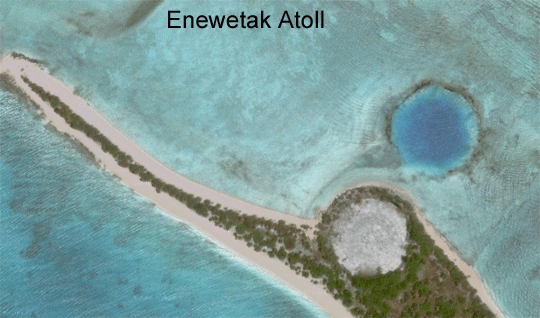
According to Phys.org, the structure in question is on Enewetak atoll in the Marshall Islands — where the US conducted 67 nuclear weapons tests between 1946 and 1958. The tests included the Castle Bravo hydrogen bomb, which was reportedly about 1,000 times bigger than the atomic bomb dropped on Hiroshima. In the late 70s, waste from those tests was dumped into a crater and capped with a concrete dome 18 inches thick. That was intended to be a temporary solution, so the bottom of the crater was never lined.

Now, UN Secretary General António Guterres and Marshall Islands President Hilda Heine fear nuclear waste could be leaking from the pit. They’re also concerned about cracks in the concrete, which they worry could break apart if hit by a tropical cyclone. Guterres says the Pacific’s

nuclear history needs to be addressed — hopefully he’ll be taken more seriously than Shin Godzilla‘s Goro Maki, who warned of impending trouble but went unheard.

May 18, 2019 Posted by | OCEANIA, wastes | Leave a comment

USA government gives Piketon community no chance to resist hosting a radioactive waste dump

This Town Didn’t Want to Be a Radioactive Waste Dump. The Government Is Giving Them No Choice. Earther,  Yessenia Funes , 17 May 19,PIKETON, OHIO—David and Pam Mills have grown tomatoes, peppers, cucumbers, and okra on their secluded Appalachian property for about 18 years now. This will be the first year the retired couple doesn’t. They just can’t trust their soil anymore. Not with what’s being built barely a five-minute walk away.
Past the shed and through the gray, bare trees that grow in the backyard, bulldozers and dump trucks are busy scooping tan-colored dirt atop an overlooking hill on a brisk January afternoon. They’re constructing a 100-acre landfill for radioactive waste. …..On a short metal fence marking where the Mills property ends, a sign reads, “U.S. PROPERTY, NO TRESPASSING,” in big, bold letters with red, white, and blue borders.

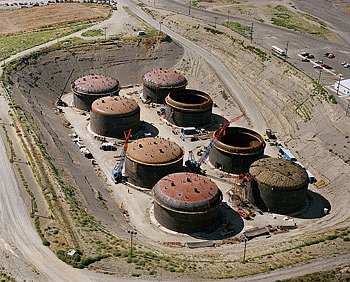
The Department of Energy (DOE) owns what sits on the other side: the Portsmouth Gaseous Diffusion Plant. The DOE built the 1,200-acre facility, located just outside town of Piketon about an hour’s drive south of Columbus in southcentral Ohio, in 1954, as one of three plants it was using to enrich uranium and develop the country’s nuclear weapons arsenal. Now, the agency is trying to clean it up.

The landfill—or “on-site waste disposal cell,” as the department calls it—would extend about 60-feet down and house 2 million tons of low-level radioactive waste comprised of soil, asbestos, concrete, and debris. It’ll be outfitted with a clay liner, a plastic cover layer, and a treatment system for any water that leaches through it. When finished, it will be one of the largest nuclear waste dumps east of the Mississippi.

Waste could begin entering it as soon as this fall…….

“It’s gonna contaminate everything,” David says, after he shows me how close the landfill sits to his property. “It’s just a matter of time.”

The couple is far from alone in their fears. The 2,000-strong Village of Piketon passed a resolution in August 2017 opposing the landfill. So did the local school district and the Pike County General Health District, where Piketon resides. The rural, low income, and largely white county is home to more than 28,000 people across a number of small towns and cities, some of which have passed their own resolutions against this project. Driving through neighborhoods behind Piketon’s main highway, lawn signs covered in red stating “NO RADIOACTIVE WASTE DUMP in Pike County” can be seen everywhere……
The Zahn’s Corner Middle School, which sits barely a 10-minute drive away from the plant, closed on May 13 after university researchers detected enriched uranium inside the building, and traces of neptunium appeared in readings from an air quality monitor right outside the school. While the DOE believes everything’s fine, the Pike County General Health District has been calling for the department to halt work while it investigates the matter. Townspeople worry this contamination is a direct result of recent activity at the plant.
All of this highlights deep public distrust over the nuclear facility’s cleanup plan. And after reviewing thousands of pages of documents—including independent studies, the project’s record of decision, and the remedial investigation and feasibility studies that went into writing it—to understand the risks, it’s clear the public isn’t worried for nothing.
Here’s the thing: Nothing is technically illegal about the landfill. The DOE, though the polluter, is taking the lead on cleaning up the facility, and the Ohio EPA supports its plan. Whether their decision is morally right given local opposition is another matter. But this is what often happens when a corporation or governmental entity needs to dispose of toxic waste: It gets left in an overlooked town no one’s heard of……..
What they, and everyone really, didn’t understand at the outset of the Cold War was the lasting impacts uranium enrichment could have. Sure, scientists understood radioactive material could cause cancer, but they thought that it’d take a lot of radiation, explained Edwin Lyman, a senior scientist and acting director of the Union of Concerned Scientists’ Nuclear Safety Project. Now, we know any exposure poses a risk……
Now,  the DOE is left with the task of cleaning up the more than 2 million tons of low-level radioactive waste and thousands more tons of hazardous waste the plant’s operations left behind. Completing the landfill is estimated to take another 10 to 12 years, with the entire clean-up projected to go on until 2035. ……
Money aside, shipping radioactive waste off-site has other benefits. Some 24 wetlands and 38 streams sit near the landfill. To bury the waste on-site, the DOE must waive a requirement that prevents it from constructing the landfill within 200 feet of these kinds of water bodies. The department can do so because even though it’s not technically a Superfund, it’s being regulated as one, a common practice for such DOE facilities. ……
the local hydrology is a key point of concern among community members. The region has a rainy climate, and it’s been seeing above-average levels of precipitation in recent years. More than anything, it’s the idea of rainfall causing the landfill’s contents to leak into the groundwater that makes people so nervous…….
Despite the fancy cut-outs put together by DOE contractor Fluor-BWXT, Chillicothe city council members passed a resolution that day against the waste cell. And it wouldn’t be the last: at least 11 counties, townships, city councils, and school boards in southcentral Ohio have come out against the project. Unfortunately, the plan was set by the time these resolutions passed.
Here’s the thing: Many residents didn’t even know about the landfill until after the DOE had already decided on it. The public had between November 2014 and March 2015 to comment on the project. The department published its record of decision in favor of the landfill on June 30, 2015. Then, the backlash hit……..

A lot of community members worry that the town will continue to be impoverished and devoid of business opportunities so long as it’s home to the landfill. Who’s going to want to invest in a place that’s a nuclear dumpsite?

And Piketon officials don’t trust the DOE at all. Neither does the plant’s former chief scientist, David Manuta, who worked there for nearly 11 years and has seen firsthand the operations that went on.

“DOE has a history in this community of not listening,” Manuta told Earther. “DOE is not a popular government agency in this community.”……

As the Ferguson Group points out in its analysis, fractures deeper than 20 feet exist throughout the entirety of where the landfill will be built, with some reaching as deep as 70 feet.

“This is the craziness of it all. They go out there and investigate this what we call ‘ideal site,’ right?” Karl Kalbacher, the Ferguson Group consultant Piketon hired for this analysis, told me. “There’s groundwater just oozing out of the ground, which tells you there’s a very shallow water table. They document that there are streams that are flowing through the proposed site area.”……..
To opponents of the landfill, all these fractures and discrepancies raise concerns about the DOE’s commitment to keeping the region contaminant-free. So does the recent independent analysis from Northern Arizona University that prompted the closure of Piketon’s Zahn’s Corner Middle School this week. That analysis found that the Scioto River and village creeks, as well as dust and soils from the school and private homes, are currently contaminated with enriched uranium, neptunium, and plutonium—all radioactive carcinogens. While the analysis did not measure concentrations, it found that much of this contamination could, indeed, be traced back to the plant……..

Regardless of whether the DOE is concerned, the evidence suggests demolition of the plant and construction of the landfill may already be spreading some contaminants via the air. Add in the threat of the landfill impacting groundwater, and opponents see several additional health risks in a regional already overburdened by cancer.

Pike County’s cancer rate of 487.9 per 100,000 incidences is higher than the state average of 459.8 per 100,000 incidences. In fact, all the counties surrounding Portsmouth—Vinton, Ross, Highland, Adams, Scioto—have some of the highest rates in the state.

Jeanie Williams, a 63-year-old who’s lived in a spacious trailer home since 1972 right alongside the plant—not far from where the Mills live—knows that statistic all too personally. Cancer took Williams’ brother in 1999. Her dad worked at the plant and died of lung disease about 10 years ago. Her stepfather worked there and died last year from cancer. Her daughter is battling colon cancer.  https://earther.gizmodo.com/this-town-didnt-want-to-be-a-radioactive-waste-dump-th-1834789264?IR=T
May 18, 2019 Posted by | USA, wastes | Leave a comment

USA’s federal government is not likely ever to secure local consent for disposal of spent fuel from commercial nuclear reactors

Former DOE Nuclear Waste Chief Critical of Consent-Based Siting    https://www.exchangemonitor.com/former-doe-nuclear-waste-chief-critical-consent-based-siting/

BY EXCHANGEMONITOR   13 May 19, The federal government is not likely ever to secure local consent for disposal of spent fuel from commercial nuclear reactors, but that approach could nonetheless be tested in a plan for temporary storage of the radioactive material, according to a former head of the Energy Department’s Office of Civilian Radioactive Waste Management (OCRWM).

“Consent-based siting does sound very appealing. I just don’t see it leading to a successful leading to a successful conclusion. Of course, I may be wrong,” Ward Sproat, who managed OCRWM from June 2006 to January 2009 before it was dismantled by the Obama administration, wrote in a May 2 letter to Sens. John Barrasso (R-Wy.) and Tom Carper (D-Del.), the top members of the Senate Environment and Public Works Committee.

Among the obstacles to consent, Sproat wrote: history, as illustrated by failed Private Spent Fuel storage project in Utah; politics, including the potential for elected officials who support a facility to be replaced by opponents; and the need for at least two layers of local approval to analyze a selected location and then to begin licensing.

Still, Sproat indicated support for assessing the viability of a consent-based approach for interim storage discussed before the committee by an attorney with the Natural Resources Defense Council (NRDC).

Geoff Fettus, senior attorney for the NRDC’s nuclear program, was among the witnesses for a May 1 hearing on a draft bill from Barrasso that is intended to advance interim storage and permanent disposal of U.S. spent fuel and high-level radioactive waste. Among the measures, the legislation would authorize the secretary of energy to site, build, and operate at least one monitored retrievable storage facility and to store DOE-held waste in a privately operated facility.

In his prepared testimony, Fettus said the NRDC supports changing existing federal laws to give states more authority for regulating radioactive waste as part of a consent-based approach. A pilot program for interim storage should specifically involve a hardened structure at an operational nuclear power plant, Fettus said.

May 14, 2019 Posted by | USA, wastes | 2 Comments

USA preparing Hanford vitrification plant to deal with 56 million gallons of radioactive waste

May 14, 2019 Posted by | - plutonium, USA | Leave a comment

Chernobyl nuclear accident: how it happened, and the aftermath

In the immediate aftermath of Chernobyl, a total of 31 firemen and plant workers died. Some of their bodies were so radioactive, they had to be buried in lead coffins. A report by the World Health Organization estimated that 600,000 people within the Soviet Union were exposed to high levels of radiation, and of those, 4,000 would die. Those who lived near the Chernobyl site have reported increased instances of thyroid cancer, and they have an increased risk of developing leukemia.

700 Million Years

The Chernobyl accident is one of only two nuclear energy accidents that is classified as a “Level 7 Event,” the highest classification. The other is 2011’s Fukushima disaster in Japan. At the lowest level of Reactor 4 lies the famous “elephant’s foot”, a several-meter wide mass of corium that is still giving off lethal amounts of radiation. The half-life of radioactive elements is defined as the amount of time it takes for the radioactivity to fall to half its original value. The half life of U-235 is 700 million years. 

May 13, 2019 Posted by | incidents, Ukraine, wastes | Leave a comment

US Dept of Energy plans changes to definition of “High Level” nuclear wastes: Rick Perry keen, environmentalists not

Perry Supports DOE Reconsideration of High-Level Waste Definition, Exchange Monitor,   BY CHRIS SCHNEIDMILLER, MAY 10, 2019

Energy Secretary Rick Perry on Thursday voiced support for his agency’s potential reinterpretation of the definition of high-level radioactive waste.

The Department of Energy proposed the reinterpretation in October and is now reviewing public comments submitted through Jan. 9 on the matter.

Ultimately, DOE could determine the definition should emphasize the radiological threat waste poses to human health, rather than where or how it was generated. That could open the door to disposal methods now prohibited for high-level waste.

The department has not given a timeline for a decision……

Subcommittee Vice Chairman Jerry McNerney (D-Calif.)  suggested the reinterpretation could lead to high-level waste being dispoosed of “in less secure sites.” He asked Perry to specify the amount of material DOE is considering reclassifying. The DOE chief did not provide a specific figure.

The Nuclear Waste Policy Act of 1982 and the Atomic Energy Act of 1954 define HLW as highly radioactive material that comes from spent nuclear fuel. That generally involves separating contents in irradiated nuclear fuel and target materials, such as plutonium.

There is roughly 90 million gallons of solids, liquids, and sludge left over from decades of nuclear weapons production, the Blue Ribbon Commission on America’s Nuclear Future said in 2012. By law, that material must go into a geologic repository – which the United States does not yet have, after decades of efforts to bring the Yucca Mountain disposal site into existence.

Some high-level waste that is redesignated as another waste type could be shipped to the Nevada National Security Site, the Waste Isolation Pilot Plant in New Mexico, and the privately held Waste Control Specialists facility in West Texas, the nongovernmental Energy Communities Alliance has said. The Washington, D.C.-based group, which represents communities near DOE sites, has said it does not expect any decision from the department until late 2019. https://www.exchangemonitor.com/perry-supports-doe-reconsideration-high-level-waste-definition/

May 11, 2019 Posted by | USA, wastes | Leave a comment

Environmentalists astounded that panel rules in favour of Holtec’s nuclear waste storage plan for New Mexico

May 11, 2019 Posted by | USA, wastes | 1 Comment

Long delay before Savannah River Plutonium Disposal can start

May 9, 2019 Posted by | - plutonium, USA | Leave a comment

America’s accumulating nuclear trash: new Bill threatens Nevada

May 9, 2019 Posted by | USA, wastes | Leave a comment

A national political conflict over USA’s nuclear waste dump plan for Yucca Mt, Nevada

War over nuclear waste at Yucca Mountain spreads to nation’s capital, by John Treanor, May 6th 2019

https://news3lv.com/news/local/war-over-nuclear-waste-at-yucca-mountain-spreads-to-nations-capital LAS VEGAS (KSNV) — It’s becoming a familiar scene in Carson City.

Many believe Yucca Mountain is settled science. That Yucca was selected, or that it’s ready to receive nuclear waste. Well, they are wrong,” said Senator Cortez Masto.

The war over Yucca Mountain continues, and the latest battleground was a committee meeting in Washington D.C. where senators debated the plan to open funding to study the site.

Right now, sites across the country have nuclear waste sitting in danger of contaminating waterways or nearby communities.

The federal government has long wanted to bury it deep in Yucca, but Nevada politicians are united against that plan.

Saying that storing it could be dangerous, transporting it here a matter of national security.

Senator Jacky Rosen said, “Severe risks in transportation threaten the health and costs billions in cleanup costs. I ask the members here today, is this a risk you’re willing to take?”

Nevada Senators Jacky Rosen and Catherine Cortez Masto want states to sign off on any nuclear plan before the waste is shipped to them, giving Nevada the opportunity to turn those shipments away. https://news3lv.com/news/local/war-over-nuclear-waste-at-yucca-mountain-spreads-to-nations-capital

May 7, 2019 Posted by | politics, USA, wastes | Leave a comment

Cheaper and permanent, not temporary, disposal of nuclear waste.

We will provide an option for people not satisfied with existing options,” said Deep Isolation’s co-founder and CEO Elizabeth Muller. She pointed out the interim sites were not “deep geologic storage.”

They’re looking at being safe for decades,” Muller said. “They’re looking at temporary storage. We’re looking at disposal.”

David Lochbaum, former director of the Nuclear Safety Program for the Union of Concerned Scientists, has taken a seat on Deep Isolation’s advisory board.

“There are technical, legal and political challenges facing Deep Isolation, to be sure,” Lochbaum said via email. “I think their proposal could very well meet all these challenges.

“The spent fuel storage status quo is only worsening with time,” he said. “We need to find a solution before we run out of time to do so without harm.” 

Startup promotes permanent nuclear waste storage via miles-long drilling, South Coast Today, By Christine Legere / Cape Cod Times, 4 May 19, A small startup company in Berkeley, California, with connections to scientists, university professors, industry experts and Silicon Valley entrepreneurs is marketing a method to permanently store nuclear waste, tapping advanced drilling technology used for years by the gas and oil industries.

Storage of the highly radioactive waste would be permanent — unlike the options currently available around the world — and the method is being pitched as far less expensive than development of a deep geologic repository such as Yucca Mountain in Nevada. In New England, spent nuclear fuel is being stored on-site at the Maine Yankee, Seabrook, Vermont Yankee, Yankee Rowe, Pilgrim and Millstone nuclear plants.

Although the Department of Energy was required under the Waste Policy Act to remove spent fuel from sites nationwide for storage in a permanent repository by 1998, its plan for a Yucca Mountain repository in Nevada has languished for several years.

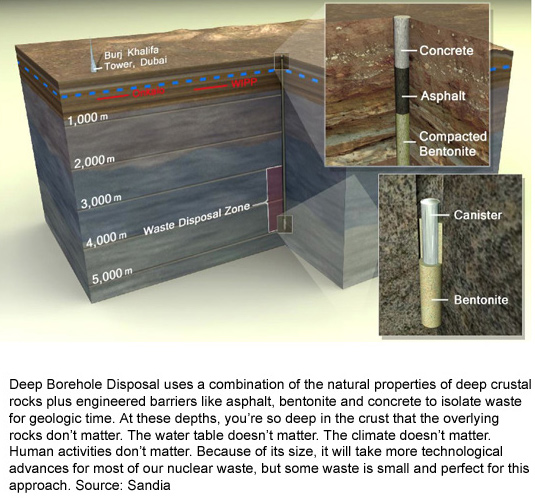
The proposal from Deep Isolation calls for drilling a 14-inch-wide vertical access channel up to a mile or more down, depending on geologic conditions, then gradually making the drill hole run horizontally along the line of the rock formation.

The horizontal bed, which could be as long as 2 miles, would serve as the nuclear waste storage area, deep in the subsurface where the rock has been stable and out of contact with the surface for millions of years and would remain out of contact for millions more, unaffected by surface impacts such as sea level rise.

Hundreds of corrosion-resistant canisters, each holding a spent fuel assembly, could be stored in a line inside a single drill hole, and since the technology already exists, the company could be placing fuel in the ground within two to three years, according to Sophie McCallum, Deep Isolation’s chief of staff.

And more than one drill hole can be made on a site.

We are in active discussions with potential customers in the U.S. and internationally to move forward disposal programs of stalled nuclear waste inventories,” McCallum said in an email .

Deep Isolation tested its system, installing a drill hole in Cameron, Texas, where it successfully placed a 5-foot-long canister — the kind used to store military waste such as cesium and strontium — in the horizontal storage area, deep underground. It then retrieved the canister, which Deep Isolation experts say could be done for up to about 50 years.

The company plans to begin with storage of defense waste in the U.S. and commercial waste in other countries, since the federal Waste Policy Act must be amended to allow for permanent storage of the nation’s commercial waste in places other than Yucca Mountain.

Currently about 80,000 metric tons of spent nuclear fuel produced by commercial reactors and another 14,000 metric tons from the nation’s weapons program is being temporarily stored at 80 sites in 35 states, in spent fuel pools or hulking dry casks.

Commercial reactor owners have sued the department for failing to provide promised permanent storage, and damages to date have cost the agency more than $6 billion.

In 2016, the department was investigating a method of storage that called for deep, vertical boreholes into crystalline basement rock, but the program was broken off in 2017 with Yucca Mountain once again taking over as the sole focus for permanent, high-level nuclear waste storage.

Holtec International and Waste Control Services have submitted applications to operate interim storage facilities in New Mexico and West Texas that are under review by the Nuclear Regulatory Commission. Spent fuel would be stored at those locations until a national repository is ready.

“We will provide an option for people not satisfied with existing options,” said Deep Isolation’s co-founder and CEO Elizabeth Muller. She pointed out the interim sites were not “deep geologic storage.”

They’re looking at being safe for decades,” Muller said. “They’re looking at temporary storage. We’re looking at disposal.”

……..Several nuclear watchdog groups have advocated for keeping waste at sites where it has been generated rather than transporting it across the country to other locations. Deep Isolation’s storage method can be done at or near the generation sites, depending on the geology.

…….Deep Isolation was established about three years ago and has operated to date without government or institutional funding but hopes that will change.

……The government estimates it will cost $100 billion to dispose of existing nuclear waste at Yucca. “We project that the cost of Deep Isolation disposal is about one-third of a mined repository,” McCallum said.

David Lochbaum, former director of the Nuclear Safety Program for the Union of Concerned Scientists, has taken a seat on Deep Isolation’s advisory board.

“There are technical, legal and political challenges facing Deep Isolation, to be sure,” Lochbaum said via email. “I think their proposal could very well meet all these challenges.

“The spent fuel storage status quo is only worsening with time,” he said. “We need to find a solution before we run out of time to do so without harm.” https://www.southcoasttoday.com/news/20190504/startup-promotes-permanent-nuclear-waste-storage-via-miles-long-drilling

May 6, 2019 Posted by | USA, wastes | Leave a comment

Renewed political turmoil over plan for Yucca Mountain as nuclear waste dump

May 6, 2019 Posted by | politics, wastes | Leave a comment

The Blue Pacific and the legacies of nuclear testing 

The Strategist 1 May 2019| Patrick Kaiku States in the Pacific islands are small in landmass and population. Their limited terrestrial resources and lack of comparative advantage are compounded by their remoteness from global centres of commerce. This obviously has impacts on the costs of doing business and integration into global trade relations. Their invisibility in international relations means that small states must creatively frame their presence in the global community.It’s against this backdrop that the ‘Blue Pacific’, which is touted as an empowering worldview, should be understood. The core principles of the Blue Pacific must be read together with recent developments in the region. In 2017, Pacific Islands Forum leaders endorsed the concept as a ‘driving force’ connecting Pacific peoples ‘with their natural resources, environment, culture and livelihoods’. The Boe Declaration of 2018 formally recognised Pacific islanders’ stewardship over the Pacific Ocean.

While big states such as the US and China are competing for influence in the region, the Boe Declaration makes a case for prioritising the concerns of Pacific island communities. The strategic confrontations of big powers do not feature in the daily lives of Pacific peoples. What’s important to the survival of island states is their environment and the capacity of their resources to meet present needs and the needs of future generations. This logic is seen with the proposed Pacific Resilience Facility, which is a regional pool of resources to manage or mitigate the adverse effects of environmental challenges in the region.

….. a  sticky issue in the region is the potential effects of nuclear contamination of the Pacific Ocean. The legacies of nuclear tests in the Pacific islands include highly radioactive waste materials stored on vulnerable atolls.

In the 1950s, the Pacific Ocean was considered an empty space by the Euro-American powers. With the onset of the arms race during the Cold War, some of the colonial powers used the Pacific as a testing ground for their nuclear weapons. More than 300 nuclear tests were conducted in the Pacific Ocean. Atolls in the Marshall Islands, Johnston Island, Christmas Island and French Polynesia were used as nuclear test sites, casting long shadows into the present.

On one low-lying Pacific island atoll, the toxic legacy of the nuclear tests remains. In 2017, Mark Willacy from the Australian Broadcasting Corporation investigated the nuclear-waste storage facility on the remote atoll of Enewetak in the Marshall Islands. It was there that the US conducted its series of tests of nuclear weapons, including the first full-scale hydrogen bomb. Before it abandoned its nuclear testing program in the 1970s, the US buried contaminated material on Runit Island.

An estimated 85,000 cubic metres of radioactive waste is buried on Runit Island, including some of the world’s most toxic materials. It will take more than 24,000 years for the waste to disintegrate. It’s buried in porous coral and sand and capped by a concrete dome. Marshallese and international non-government organisations are concerned that sea-level rise and major typhoons will destroy the dome, resulting in the contamination of not only the Marshall Islands but the wider Pacific Ocean. Since the sea is a free-flowing matrix of currents and borderless movements of water, a Pacific-wide disaster is a plausible scenario…….

The Pacific island states have an illustrious record in employing collective diplomacy to tackle difficult issues. Since the 1980s, the high-water marks of collective diplomacy have been the UN Convention on the Law of the Sea in 1982, the 1985 Rarotonga Treaty and the global moratorium on drift-net fishing. Currently, small states in the Pacific islands are actively engaged in framing the narrative on global cooperation to deal with climate change challenges.

The Blue Pacific is a timely framework, emphasising a Pacific islands worldview, and is an alternative to the zero-sum confrontations of big powers in the region. More importantly, it stresses the importance of cooperation on Pacific terms in dealing with transnational challenges. The various major powers embroiled in their great-power confrontations in the Pacific ought to be educated about the significance of the Blue Pacific and their participation in advancing the goals of that paradigm. After all, the Pacific Ocean connects all the large landmasses on the Pacific Rim. The state of affairs in the islands is a microcosm of the planet’s chances of surviving global environmental challenges.

Patrick Kaiku is a teaching fellow in the political science department at the University of Papua New Guinea.  https://www.aspistrategist.org.au/the-blue-pacific-and-the-legacies-of-nuclear-testing/

May 4, 2019 Posted by | OCEANIA, wastes, weapons and war | Leave a comment

Particles From Cold War Nuclear Bomb Tests Found in Deepest Parts of the Ocean

Particles From Cold War Nuclear Bomb Tests Found in Deepest Parts of the Ocean

Crustaceans in the Mariana Trench and other underwater canyons feed on food from the surface laced with carbon-14 from Cold War bomb tests, By Christopher Crockett, smithsonian.com , May 1, 2019 

Crustaceans in the Mariana Trench and other underwater canyons feed on food from the surface laced with carbon-14 from Cold War bomb tests
The first test of a thermonuclear weapon, or a hydrogen bomb, codenamed Ivy Mike and conducted by the United States in 1952 over the island of Elugelab in Enewetak Atoll in the Pacific Ocean. (Public Domain)……… Crustaceans in the Mariana Trench and other underwater canyons feed on food from the surface laced with carbon-14 from Cold War bomb tests

No place on Earth is free from human influence—not even the bottom of the deepest trenches in the ocean.

Shrimp-like critters from three West Pacific ocean trenches were found to munch on food that sinks down from the surface, leaving a unique chemical signature from decades-old nuclear bomb tests in the bodies of the deep-sea crustaceans. The findings, published recently in Geophysical Research Letters, not only help marine scientists figure out how these bottom dwellers survive, but also underscore the depths to which humanity’s influence can penetrate………

In those dark depths, one of the most common critters is the shrimp-like amphipod, a family of crustaceans that scavenge the ocean floor for food. Where that food comes from is a matter of debate. Potential sources include morsels that percolate up from Earth’s interior, nutrient-rich sediment that slides down steep trench walls, or tasty detritus that wafts down from the surface.

A recent haul of deep-sea amphipods offered Sun and colleagues a chance to solve this marine mystery. Using baited traps, two Chinese research vessels in 2017 harvested amphipods from three trenches in the West Pacific, including the famous Mariana Trench. Sun’s team chemically analyzed the amphipods’ muscle tissue and gut contents and found elevated levels of carbon-14, a heavy variant of carbon. The levels closely matched abundances found near the surface of the ocean, where the amount of carbon-14 is higher than usual thanks to nuclear bomb tests conducted more than half a century ago.

Carbon comes in a few different varieties based on how many neutrons are stuffed into its atomic nucleus. About one out of every trillion carbon atoms on Earth has two extra neutrons. This form, known as carbon-14, occurs naturally thanks to high-speed atomic particles from deep space whacking into nitrogen atoms. But in the middle of the 20th century, humans doubled the amount of carbon-14 in the atmosphere.

According to the International Atomic Energy Agency, from 1945 to 1963 the United States and the Soviet Union (with a little help from the United Kingdom and France) detonated nearly 500 nuclear bombs, 379 of which exploded in the atmosphere. These tests dramatically increased the amount of carbon-14 on our planet. The Test Ban Treaty of 1963 put a stop to most atmospheric and underwater tests, and carbon-14 levels in the atmosphere started a slow return to normal—though they are still higher than pre-nuclear levels—as ocean waters and land-based life absorbed carbon from the air.

………While the nuclear bomb signature has been recorded a couple miles down in the West Atlantic, no one has seen it as these depths before. “This is just interesting as all get out,” says Robert Key, a Princeton oceanographer who was not involved with this study. He points out that starting about a mile below the surface of the North Pacific, carbon-14 levels closely match what the atmosphere looked like before the bomb tests. “The high carbon-14 [in the amphipods] could only come from food that’s come down from the top,” he says.

The abundance of material created in nuclear bomb tests high in the sky found in the bodies of deep-dwelling amphipods underscores a very intimate connection between human activity and the most isolated reaches of the sea…………. https://www.smithsonianmag.com/science-nature/particles-cold-war-nuclear-bomb-testing-found-amphipods-mariana-trench-180972078/

May 2, 2019 Posted by | oceans, wastes, weapons and war | Leave a comment