Andra updates French repository cost estimate
Tuesday, 13 May 2025,
https://www.world-nuclear-news.org/articles/andra-updates-french-repository-cost-estimate
French radioactive waste management agency Andra has estimated the overall cost of constructing, operating and closing France’s planned deep geological repository for the disposal of high- and intermediate-level radioactive waste at between EUR26.1 billion (USD29.1 billion) and EUR37.5 billion (at 2012 prices).
France plans to construct the Centre Industriel de Stockage Géologique (Cigéo) repository – an underground system of disposal tunnels – in a natural layer of clay near Bure, to the east of Paris in the Meuse/Haute Marne area. The facility is to be financed by radioactive waste generators – EDF, Orano and the French Alternative Energies and Atomic Energy Commission – and managed by Andra.
Andra said the costing file is one of the key inputs for determining the cost of Cigéo, which will be finalised by the Minister of Industry and Energy by the end of 2025, after gathering comments from the main waste producers and the opinion of the French Nuclear Safety and Radiation Protection Authority (ASNR).
“This decree provides waste producers with a reference allowing them to establish the provisions they are required to make for the management of their waste,” Andra said. “The overall cost estimate for Cigéo is an iterative process carried out by Andra. This assessment will be revised at key stages of the project.”
In 2005, Andra estimated the cost of the facility at between EUR13.5 and EUR16.5 billion. However, in 2009 it re-estimated the cost at around EUR36 billion. In October 2014, Andra gave a revised cost estimate for Cigéo of EUR34.4 billion, based on 2012 prices. This estimate included EUR19.8 billion for the facility’s construction, EUR8.8 billion for operational costs over 100 years, EUR4.1 billion in taxes and EUR1.7 billion in miscellaneous expenses.
Andra has now issued an updated estimate for the cost of Cigéo. It says the cost of constructing and commissioning the repository will be between EUR7.9 billion and EUR9.6 billion, which includes design (excluding R&D), construction of surface infrastructure and the first storage areas, taxes, and insurance. From its commissioning in 2050, the average annual cost of Cigéo is estimated at between EUR140 million and EUR220 million per year, including operation, progressive construction, maintenance, and refurbishment over a period of about a century, followed by decommissioning and closure over about 20 years, or between EUR16.5 billion and EUR25.9 billion in total, including taxes and insurance. The R&D cost identified to date, including the operation and closure of the underground laboratory, is estimated at between EUR1.7 billion and EUR2 billion.
Andra said the 2025 costing file is consistent with Cigéo’s updated provisional schedule. “This schedule takes into account the additional time required to complete the detailed preliminary design studies (including the optimisations identified in 2016 following the first cost decision), the preparation of the support file for Cigéo’s creation permit application, and its review.”
Subject to the issuance of the creation authorisation decree in late 2027/early 2028, the receipt of the first waste packages is currently planned for 2050.
The cost decree to be set by the Minister of Industry and Energy – expected by the end of 2025 – “will serve as a reference for the project’s continuation until its next assessment,” Andra said. It also “provides waste producers with a reference allowing them to establish the provisions they are required to make for the management of their waste.”
Lawsuit Compels Nationwide Public Review of Plutonium Bomb Core Production

9 May 25, https://nukewatch.org/lawsuit-compels-nationwide-public-review-of-plutonium-bomb-core-production

AIKEN, S.C. — Today the National Nuclear Security Administration (NNSA), the semi-autonomous nuclear weapons agency within the Department of Energy, published a formal Notice of Intent in the Federal Register to complete a nationwide “programmatic environmental impact statement” on the expanded production of plutonium “pit” bomb cores. Pits are the essential radioactive triggers of modern nuclear weapons. The NNSA is aggressively seeking their expanded production for new-design nuclear weapons for the new nuclear arms race.
The South Carolina Environmental Law Project (SCELP) successfully represented the Gullah/Geechee Sea Island Coalition and Nuclear Watch New Mexico, Savannah River Site Watch and Tri-Valley Communities Against a Radioactive Environment in a legal challenge to NNSA’s attempt to improperly jump start dual site pit production. On September 30, 2024, United States District Court Judge Mary Geiger Lewis ruled that the NNSA had violated the National Environmental Policy Act (NEPA) by failing to properly consider alternatives before proceeding with its plan to produce at least 30 pits per year at the Los Alamos National Laboratory (LANL) in New Mexico and at least 50 pits per year at the Savannah River Site (SRS) in South Carolina.
The Court found that NNSA’s plans for pit production had fundamentally changed from its earlier analyses which had not considered simultaneous pit production at two sites. Co-plaintiffs argued that these changes required a reevaluation of alternatives under NEPA, which Defendants failed to undertake prior to moving forward and spending tens of billions of taxpayers’ dollars.
As a result of this ruling and a subsequent settlement, the Defendants are now required to newly analyze pit production at a nationwide programmatic level. This means undertaking a thorough analysis of the impacts of pit production at NNSA sites throughout the United States, including the generation of new radioactive wastes and their uncertain future disposal. Under NEPA, this will provide the opportunity for public scrutiny on NNSA’s aggressive production plans. In addition, NNSA is enjoined from building certain facilities and introducing nuclear materials to the plutonium pit plant at SRS until it completes the PEIS.
Virtual public hearings to determine the needed scope of the programmatic environmental impact statement are scheduled for May 27 and 28. The public comment period for scoping ends July 14 and can be emailed to PitPEIS@nnsa.doe.gov. NNSA expects to complete its draft PEIS within a year, after which in-person public hearings will be held in Livermore, CA; Santa Fe, NM; Kansas City, MO; Aiken, SC; and Washington, DC.
As an indicator of the potential importance of this PEIS process, SCELP and co-plaintiffs have been asked by the Nobel Peace Prize Center in Oslo, Norway, to present (by video) on “how it is possible to do activism inside the court room” on August 6, the 80th anniversary of the Hiroshima atomic bombing. Also, in recognition of its astute legal strategy, SCELP will be receiving an award from the Alliance for Nuclear Accountability comprised of some three dozen public interest organizations (including three of the lawsuit’s co-plaintiff) at a ceremony in Washington, DC, on June 10th.
As background, plutonium pits are the fissile cores of nuclear weapons. The Los Alamos Lab was assigned a mission of limited pit production after a 1989 FBI raid investigating environmental crimes abruptly stopped production at the notorious Rocky Flats Plant near Denver, CO. In 2018 the NNSA decided to pursue pit production at both LANL and SRS. The agency erroneously claimed that an outdated 2008 programmatic environmental impact statement that did not consider simultaneous production was sufficient legal justification under the National Environmental Policy Act.
No future pit production is to maintain the safety and reliability of the existing, extensively tested nuclear weapons stockpile. Instead, future production is only for speculative new-design nuclear weapons that can’t be tested because of an international testing moratorium, thereby perhaps eroding confidence in stockpile reliability. Or, instead, the first new design nuclear weapons since the end of the Cold War could prompt the U.S. to return to full-scale testing, which would have severe national and international consequences.
Independent experts have found that plutonium pits have reliable lifetimes of at least 100 years (their average age is now around 42). Moreover, at least 15,000 pits are already stored at the NNSA’s Pantex Plant near Amarillo, TX. Expanded plutonium pit production will cost taxpayers more than $60 billion over the next thirty years.
The independent Government Accountability Office (GAO) has repeatedly pointed that the NNSA has no credible cost estimates for its largest and most complex program ever, nor an “Integrated Master Schedule” between the two production sites. Further, the Department of Energy and the NNSA have been on the GAO’s “High Risk List” for project mismanagement and waste of taxpayers’ money since 1991. All of these issues and the basic need or not for expanded plutonium pit production are ripe for analysis and public comment in the now required programmatic environmental impact statement.
Ben Cunningham, SCELP’s lead attorney in this case, declared the following: “We implore the public to participate fully in the PEIS process—from attending the scoping hearings to commenting on the draft PEIS. The vast expansion of the nuclear arsenal that is facilitated by the increase in pit production will be exorbitantly expensive, will create radioactive wastes that can last for thousands of years, and the new weapons produced by this expansion could ultimately endanger hundreds of millions of lives. Please weigh in and express your concerns to the decisionmakers.”
Queen Quet, elected Chieftess of the Gullah/Geechee Nation, said: “I am thankful to SCELP and the rest of our national team that stood together to ensure that we protect our communities not only today but also for future generations. The type of compliance that we have fought for is even more crucial given the current environmental and political climate. I am looking forward to us being able to engage in the next phase of this process so that we can ensure that the waters that reach the Sea Islands will be safe.”
Tom Clements, director of Savannah River Site Watch, noted, “Given that we are armed with a decisive federal court ruling that requires the preparation of the PEIS by NNSA, we expect a thorough examination of all environmental and health impacts of pit production at all impacted sites. The draft PEIS must include an analysis of plutonium aging and pit reuse, the proliferation risks of new U.S. warheads, plans for plutonium transportation and the uncertain future disposal of plutonium wastes in the Waste Isolation Pilot Plant in southern New Mexico.”
“Prior to our lawsuit, the agency failed to include other sites involved in future plutonium pit production in its required analyses, chief among them the Lawrence Livermore Lab in California, the Kansas City Plant in Missouri, and the Waste Isolation Pilot Plant. The judge clearly saw these violations and ordered the NNSA to complete the programmatic nationwide analysis which should have been done from the outset. This is a victory for public involvement. It will hopefully result in credible alternatives that are more protective of the environment and the impacted communities,” said Scott Yundt, Executive Director at Tri-Valley CAREs, in Livermore, CA.
Jay Coghlan of Nuclear Watch New Mexico commented, “This programmatic environmental impact statement that we fought long and hard for empowers citizens to tell policy makers what they think about decisions being made in their name. Let them know what you think about the $2 trillion ‘modernization’ program to keep nuclear weapons forever while domestic programs are gutted to pay for tax cuts for the rich. We should demand that this required process under the National Environmental Policy Act becomes a public referendum on the new nuclear arms race and the hollowing out of our society.”
Kingston Fossil Plant and Oakridge Nuclear Facility – an unholy alliance of radioactive pollution,
While no one was killed by the 2008 coal ash spill itself, dozens of workers have died from illnesses that emerged during or after the cleanup. Hundreds of other workers are sick from respiratory, cardiac, neurological, and blood disorders, as well as cancers.
The apparent mixing of fossil fuel and nuclear waste streams underscores the long relationship between the Kingston and Oak Ridge facilities.
Between the 1950s and 1980s, so much cesium-137 and mercury was released into the Clinch from Oak Ridge that the Department of Energy, or DOE, said that the river and its feeder stream “served as pipelines for contaminants.” Yet TVA and its contractors, with the blessing of both state and federal regulators, classified all 4 million tons of material they recovered from the Emory as “non-hazardous.”
A U.S. Environmental Protection Agency analysis confirms that the ash that was left in the river was “found to be commingled with contamination from the Department of Energy (DOE) Oak Ridge Reservation site.
For nearly a century, both Oak Ridge and TVA treated their waste with less care than most families treat household garbage. It was often dumped into unlined, and sometimes unmarked, pits that continue to leak into waterways. For decades, Oak Ridge served as the Southeast’s burial ground for nuclear waste. It was stored within watersheds and floodplains that fed the Clinch River. But exactly where and how this waste was buried has been notoriously hard to track.
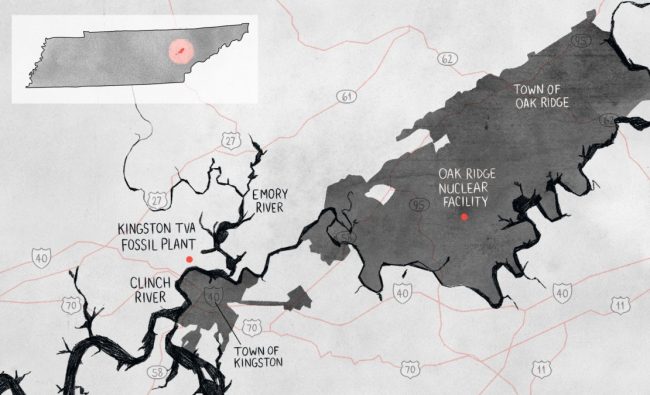
A Legacy of Contamination, How the Kingston coal ash spill unearthed a nuclear nightmare, Grist By Austyn Gaffney on Dec  15, 2020 This story was published in partnership with the Daily Yonder.
In 2009, App Thacker was hired to run a dredge along the Emory River in eastern Tennessee. Picture an industrialized fleet modeled after Huck Finn’s raft: Nicknamed Adelyn, Kylee, and Shirley, the blue, flat-bottomed boats used mechanical arms called cutterheads to dig up riverbeds and siphon the excavated sediment into shoreline canals. The largest dredge, a two-story behemoth called the Sandpiper, had pipes wide enough to swallow a push lawnmower. Smaller dredges like Thacker’s scuttled behind it, scooping up excess muck like fish skimming a whale’s corpse. They all had the same directive: Remove the thick grey sludge that clogged the Emory.
The sludge was coal ash, the waste leftover when coal is burned to generate electricity. Twelve years ago this month, more than a billion gallons of wet ash burst from a holding pond monitored by the region’s major utility, the Tennessee Valley Authority, or TVA. Thacker, a heavy machinery operator with Knoxville’s 917 union, became one of hundreds of people that TVA contractors hired to clean up the spill. For about four years, Thacker spent every afternoon driving 35 miles from his home to arrive in time for his 5 p.m. shift, just as the makeshift overhead lights illuminating the canals of ash flicked on.
Dredging at night was hard work. The pump inside the dredge clogged repeatedly, so Thacker took off his shirt and entered water up to his armpits to remove rocks, tree limbs, tires, and other debris, sometimes in below-freezing temperatures. Soon, ringworm-like sores crested along his arms, interwoven with his fading red and blue tattoos. Thacker’s supervisors gave him a cream for the skin lesions, and he began wearing long black cow-birthing gloves while he unclogged pumps. While Thacker knew that the water was contaminated — that was the point of the dredging — he felt relatively safe. After all, TVA was one of the oldest and most respected employers in the state, with a sterling reputation for worker safety.
Then, one night, the dredging stopped.
Sometime between December 2009 and January 2010, roughly halfway through the final, 500-foot-wide section of the Emory designated for cleanup, operators turned off the pumps that sucked the ash from the river. For a multi-billion dollar remediation project, this order was unprecedented. The dredges had been operating 24/7 in an effort to clean up the disaster area as quickly as possible, removing roughly 3,000 cubic yards of material — almost enough to fill an Olympic-sized swimming pool — each day. But official reports from TVA show that the dredging of the Emory encountered unusually high levels of contamination: Sediment samples showed that mercury levels were three times higher in the river than they were in coal ash from the holding pond that caused the disaster.
Then there was the nuclear waste. Continue reading
May Day – How Hot is Too Hot for a Ferociously Hot Nuclear Dump Under the Irish Sea-Bed?

The Developer, Nuclear Waste Services is a Government body and also a limited liability company.
Marianne Birkby, May 01, 2025
Received this today – it is not at all reassuring and underlines why we must RESIST THE NUCLEAR DUMP PLANS.
Nuclear Waste Services (The Developer) says the seabed will have “no significant temperature rise” once atomic wastes are placed in the geology beneath. What Nuclear Waste Services mean by “significant” is not stated. Any temperature rise AT ALL on the seabed would be hugely damaging.
Regarding uplift of the sea-bed from radioactive gases and thermal heating the reply is: “GDF design and other controls on management of the thermal output of waste, as noted above, will prevent disruptive uplift of the seabed from the heat output of waste.”
These inevitable impacts due to the thermal heating of abandoned atomic wastes (currently cooled by freshwater at Sellafield) are not mentioned by Nuclear Waste Services in their propaganda literature. The already vulnerable seabed and ocean gets no say in the matter of a deep sub-sea nuclear dump. Propaganda of “safe, permanent disposal” is aimed at the deliberately narrowed down “Areas of Focus” for the above ground mine shafts and nuclear sprawl facilitating a “geological disposal facility. ” Nuclear Waste Services are ignoring/playing down all impacts in their public disinformation campaign, including the thermal impacts of A GDF/deep hot nuclear dump up to the size of Bermuda in the geology beneath the Irish Sea-bed. From their point of view why would they bring to people’s attention the ferocious heat of the atomic wastes or the likely impacts on the sea-bed and ocean?
Email received today -1st May
OFFICIAL
…………………. The reports and summary below provide information on the specification, evolution and illustrative disposal concepts for heat generating wastes:
High Heat Generating Waste (HHGW) Specifications – GOV.UK
Technical Background to the generic Disposal System Safety Case
NDA Report no DSSC/451/01 – Geological Disposal – Waste Package Evolution Status Report
https://midcopeland.workinginpartnership.org.uk/news-from-nws-high-heat-generating-waste-qa
1. How hot would be too hot?
The design of the Geological Disposal Facility (GDF) will take account of the thermal output of heat generating waste such that it does not adversely impact the engineered barriers (backfill, plugs, seals) and containment function of the host geology (its ability to limit the migration of radioactivity). This is achieved by passive means, for example, by appropriate design of the container, disposal tunnels or vaults, and spacing of containers. Nuclear Waste Services will set a limit on the peak temperature of the GDF system and waste packages to assure the integrity of the waste, waste container, engineered barriers and host rock. The limits adopted by international programmes are typically in the range of 100oC – 200oC. Heat generating waste, such as spent nuclear fuel and high-level waste glass, will have been cooled over several decades during interim storage, so as to meet the temperature limit set for acceptance to a GDF. This storage practice is already underway at Sellafield.
2. How long would it take for thermal heating to reach the seabed
At the depth of GDF construction (200 – 1000 m) heat will diffuse slowly into the engineered barriers and host rock. Peak temperatures will occur in the centuries immediately following closure as the GDF system equilibrates. However, the thermal output and temperature of waste packages decreases slowly and predictably with time. Combined with the approach described above, there will be no significant temperature rise at the seabed.
3. How long would it take for uplift of the seabed due to thermal heating/gas pressure?
The GDF will be designed to prevent over pressurisation by gas leading to uplift of the seabed by enabling very slow diffusion of gas through plugs and seals. GDF design and other controls on management of the thermal output of waste, as noted above, will prevent disruptive uplift of the seabed from the heat output of waste.
Sellafield plan for new building to store radioactive waste
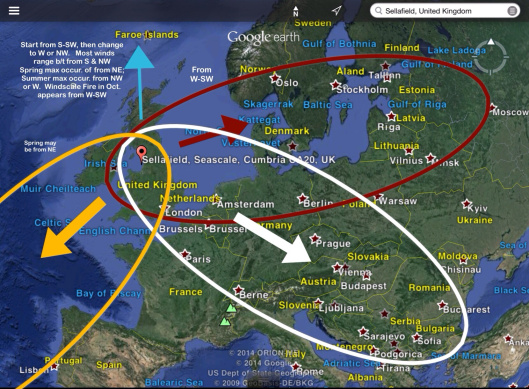
Federica Bedendo, BBC News, North East and Cumbria, 2 May 25, https://www.bbc.com/news/articles/cg724n91gp4o?fbclid=IwY2xjawKA7DdleHRuA2FlbQIxMQBicmlkETFISGV5ZEdSZW16a2ZnQzh3AR5Wx_HKBbiK0umY8fOSOzw2Hzv5_AeeAjFPGDgbc4VxAi7joZ7-0jA4qr0Bzg_aem_nd6f3waC2WX_bFb_0pWkhw
Work to build a storage facility to keep radioactive waste for up to 100 years is set to take a step forward.
Sellafield, in Cumbria, wants to build the second of four new units to store intermediate level waste, as the company works to decommission ageing buildings at its Seascale plant.
The site manages more radioactive waste in one place than any other nuclear facility in the world, according to planning documents.
The project was approved in 2023 and an application has now been submitted to the Environment Agency (EA) seeking permission to abstract water from the site.
The water would have to be extracted as the ground is dug up to build the new facility, a Sellafield spokesman said.
It was needed as part of the building phase, they said, adding there were no risks of contamination from radioactive waste.
Documents show the building storing the nuclear waste would be about the size of a football pitch and as tall as about six double-decker buses.
The walls of the store which has already been built are about 5ft (1.5m) thick, with a 6.5ft (2m) thick floor.
Sellafield said it planned to start building work this year, with the second store becoming operational in 2032.
The waste would be kept there for up to 100 years, papers show, and then moved to a Geological Disposal Facility (GDF) – an underground storage facility which could be built in Cumbria.
A consultation on the plans to abstract water from the Sellafield site by the EA closes on 2 May.
Robotic arm struggles to take fuel sample from Fukushima plant

By KEITARO FUKUCHI/ Staff Writer, April 28, 2025, https://www.asahi.com/ajw/articles/15704793
A narrow, attic-like space lies directly below the No. 5 reactor at the Fukushima No. 1 nuclear power plant, showing the difficult route a robotic arm must take to collect samples of melted fuel debris in a sister reactor.
The robotic arm is 22 meters long, weighs 4.6 tons and has 18 articulatable joints.
It has been developed to retrieve samples from the No. 2 reactor of Tokyo Electric Power Co.’s Fukushima No. 1 plant—which was crippled when the 2011 Great East Japan Earthquake and tsunami triggered a nuclear disaster at the facility.
To this day, an estimated 880 tons of melted fuel debris remain in the No. 1 through No. 3 reactors, and recovering this material is considered the most challenging phase in the long decommissioning process.
After more than six years of development using taxpayer money and undergoing numerous setbacks, the robotic arm may go on its first real debris retrieval mission later this fiscal year—or face being scrapped.
“The latest attempt may prove a failure since numerous trials have produced no successful outcomes so far,” said a nuclear industry insider. “The robot arm might be left to gather dust without ever being used.”
News reporters were given a tour in January of the crippled power plant’s No. 5 reactor, which is the same model and reportedly has the same dimensions as the No. 2 reactor, to see the route the arm must take if it is to succeed.
THE MISSION
To reach the debris, the arm will have to be navigated—by remote control—through the same narrow route at the No. 2 reactor that the reporters traversed at its twin.
The first step will be to carefully insert the arm, which is 40 centimeters tall, through an opening with an inner diameter of just 55 cm.
Once inside the 1.5-meter-tall space directly under the reactor, the approximately 4-meter-long tip of the arm will be slowly rotated and lowered to reach the fuel debris at the bottom of the containment vessel.
“Adjusting the joints’ angles is particularly difficult,” said a TEPCO public relations representative. “Even a single error can cause the device to hit its surroundings.”
TRIAL AND ERROR
The robotic arm has been under development since fall 2018 by Mitsubishi Heavy Industries Ltd. and a British company from the nuclear power industry. As much as 7.8 billion yen ($53.1 million) in taxpayers’ money has been invested in the arm and related projects.
However, the project has faced numerous setbacks.
The government and TEPCO initially planned to debut the arm in a debris retrieval test in 2021, but the device was unable to move with the necessary precision, causing delays.
When the first retrieval test was finally undertaken in November 2024, a simpler device with a solid track record in past applications was used instead. The same device was used in the second retrieval test earlier this month—while revisions on the robotic arm continued.
Because the arm’s weight is supported at its base, the device tends to bend and move unsteadily when extended.
“They are working hard to carry out this difficult procedure under particularly challenging conditions,” said Hajimu Yamana, president of the Nuclear Damage Compensation and Decommissioning Facilitation Corp. (NDF), which serves as an adviser on the decommissioning work.
As the arm’s development dragged on for more than half a decade, new problems arose in and after August 2024.
Disconnection of motor cables that had deteriorated over time was detected, as was a failure in the arm’s obstacle removal mechanism.
In December that year, the robotic arm came into contact with a model of the containment vessel during a test. However, it later safely passed through the opening without encountering any obstructions after its operators fine-tuned the insertion point.
“New issues arise each time a test is conducted,” lamented Yusuke Nakagawa, a TEPCO group manager involved in the project. “We just have to address them one by one again and again.”
TEPCO began dismantling part of the robotic arm in February to examine the deteriorated cable. The inspection is expected to take three to four months, and the arm will likely undergo additional operational tests after that.
THE FUTURE
For now, TEPCO plans to put the robotic arm to practical use at the site in the latter half of fiscal 2025.
“The final decision (on whether to actually use the arm on site) will be made after taking into account the results of the envisioned operational tests,” said Akira Ono, president of TEPCO’s Fukushima Daiichi Decontamination and Decommissioning Engineering Co.
The future of the robotic arm is still unclear given that its official introduction has already been delayed four times.
Officials involved are expressing a growing sense of alarm.
Toyoshi Fuketa, an ex-chairman of the Nuclear Regulation Authority, calls for reviewing the current plan.
“Never changing a plan once it has been decided upon, even if it does not work properly, is a bad habit of Japan,” he noted. “People should have the courage to back down at times (by giving up on the robotic arm).”
Plutonium’s Hidden Legacy at Piketon

Plutonium was here. It was processed, mishandled, released, and denied. It contaminated water, soil, fish, and workers. It spread to schools. And it killed.
Investigative Team April 24, 2025, https://appareport.com/2025/04/24/plutoniums-hidden-legacy-at-piketon/?utm_source=facebook&utm_medium=jetpack_social&fbclid=IwY2xjawJ5XrBleHRuA2FlbQIxMQBicmlkETE3b0JDR3JZZ0xqRkNqVU1oAR5YM8gN60lbVkb21XEno8JBYLC_Rnqv7LD993TwfBersmNr-c-SsZuL1J_1mA_aem_sCNRay627WxIPPEuu7DVsA [ample illustrations]
For decades, the U.S. Department of Energy (DOE) claimed that plutonium had no place at the Portsmouth Gaseous Diffusion Plant (PORTS). But government documents, congressional testimony, and radiological data spanning more than 40 years tell a different story — one of systemic exposure, buried secrets, and radioactive contamination that continues to haunt the soil, water, and people of southern Ohio.
The truth has been revealed in pieces. Some of it was made public as early as the 1990s. Some surfaced only recently. Together, it paints an undeniable picture: plutonium was present at PORTS, it was mishandled, and it left a toxic legacy that federal agencies have failed to clean up — or fully acknowledge.
The Paper Trail: Plutonium Officially Confirmed
The denial cracked in 1999, when The Portsmouth Daily Times published a front-page bombshell: “Plutonium Confirmed in Piketon.” The article cited admissions by federal officials that plutonium-contaminated uranium had been shipped to the site from Paducah, Kentucky, as part of a Cold War-era uranium recycling program.
In a formal letter to DOE Secretary Bill Richardson, U.S. Senators Mike DeWine and George Voinovich confirmed that at least 570 tons of contaminated feed material had been sent to Piketon, beginning as early as 1983. DOE had known. The public had not.
The Incinerator and the Burned Truth
Records show the X-705A incinerator, which operated from the 1970s until 1986, was used to burn approximately 50,000 pounds of uranium-contaminated solid waste annually. But it didn’t stop there.
ccording to on-site Ohio EPA coordinator Maria Galanti, uranium-contaminated solvents — materials never meant for incineration — were also burned in the unit. The result? Soil surrounding the incinerator is now radioactive to a depth of at least 12 feet.
Until the late 1980s, operators even tilled radioactive oils into unlined soil, assuming it would degrade over time. It didn’t. And it won’t — the plutonium isotopes involved have half-lives exceeding 24,000 years.
Radiation in the Waterways — and the Food Chain
A 2006 Ohio EPA report confirmed what residents feared: plutonium had migrated offsite and into the public environment.
Testing in Little Beaver Creek, Big Beaver Creek, Big Run, and the Scioto River revealed the presence of:
- Plutonium-238
- Plutonium-239
- Americium-241
- Neptunium-237
- Alongside technetium-99 and uranium isotopes
All these elements were detected well above background levels, confirming they originated from the plant, not nature.
The Hazard Index (HI) — a risk threshold used by federal agencies — was exceeded across all tested water bodies, with Big Run scoring more than 20 times the EPA’s risk cutoff.
Separate DOE assessments show Pu-238 in fish as a significant dietary exposure source, second only to Tc-99 in produce. Plutonium has entered the food chain.
Offsite Spread: Plutonium Detected Near Schools and Homes
Monitoring data confirmed the presence of plutonium-239/240, neptunium-237, and americium-241 at offsite stations including:
- Station A41A near Zahn’s Corner Middle School
- Station A6 in northwest Piketon
- Station A23 near local residential zones
DOE contends that any plutonium found in air monitors comes from 1950s nuclear weapons testing fallout and not PORTS.
Workers Testify to Deception and Disease
At a 2000 Senate hearing, former worker Sam Ray described his fight with chondrosarcoma, a rare bone cancer he linked directly to his work at PORTS. He spoke of no health monitoring, no protective equipment, and no transparency.
Jeffrey Walburn, a plant whistleblower, testified to a 1994 chemical exposure that permanently damaged his lungs. He alleged a criminal cover-up by Lockheed Martin, including the alteration and destruction of radiation dose records.
He warned that widows of deceased workers may never receive compensation because exposure data had been falsified.
DOE’s Own Admissions: Plutonium in the Cascade System
According to a 2024 DOE report, plutonium-238 and plutonium-239 were present in enrichment equipment, having entered the cascade system through contaminated uranium hexafluoride cylinders. The isotopes were found in the X-326 Process Building and throughout the cascade.
DOE also confirmed that residual technetium-99 remained embedded in internal pipe surfaces, requiring special disposal decades after operations ended.
From Russian Warheads to Pike County: The Megatons to Megawatts Program
Between 1993 and 2013, the U.S. and Russia dismantled over 20,000 nuclear warheads under the Megatons to Megawatts Program — converting highly enriched uranium (HEU) into low-enriched uranium (LEU) for use in American power plants.
But that uranium didn’t just vanish. It came through U.S. enrichment sites — including the Portsmouth Gaseous Diffusion Plant in Piketon.
Contractor and DOE records confirm that Russian-origin uranium — some of it likely carrying residual contaminants from dismantled warheads — was introduced into the U.S. enrichment stream at PORTS.
Whether plutonium from these shipments contributed to PORTS contamination is still under question. What’s undeniable is this: the U.S. government sent Russian bomb-grade material through an Appalachian processing plant with a history of unsafe handling, minimal oversight, and deliberate secrecy.
They took Soviet nukes and ran them through Appalachian lungs. Without warning. Without consent.
While the legacy of plutonium contamination at PORTS stretches back to the Cold War, the threat isn’t just historical — it’s current, legal, and active.
Centrus Energy: HALEU, the NRC license, and legal plutonium storage at PORTS
In 2021, the Nuclear Regulatory Commission (NRC) granted Centrus Energy Corp. a license to operate a first-of-its-kind High-Assay Low-Enriched Uranium (HALEU) facility inside the old enrichment footprint at PORTS. HALEU is a higher-enriched form of uranium (5–20% U-235), specifically produced for next-generation small modular nuclear reactors (SMRs).
But buried in the licensing documents is something the public was never told:
The HALEU license explicitly authorizes Centrus to store an undisclosed amount of plutonium-bearing material at the site.
That’s not speculation — that’s federal licensing language. In plain English: Centrus is legally allowed to store plutonium compounds at a facility that already has a catastrophic contamination legacy.
A Legacy Buried in Contamination and Lies
Plutonium was here. It was processed, mishandled, released, and denied. It contaminated water, soil, fish, and workers. It spread to schools. And it killed.
Some of the evidence has been buried. Some altered. But most of it has been in plain sight — ignored by federal agencies and omitted from cleanup plans.
This is not an old story. This is an ongoing disaster.
The time for quiet compliance is over. The reckoning for Piketon — and for the people poisoned by its secrets — has come.
Weatherwatch: sage advice 50-odd years ago on UK nuclear power still relevant
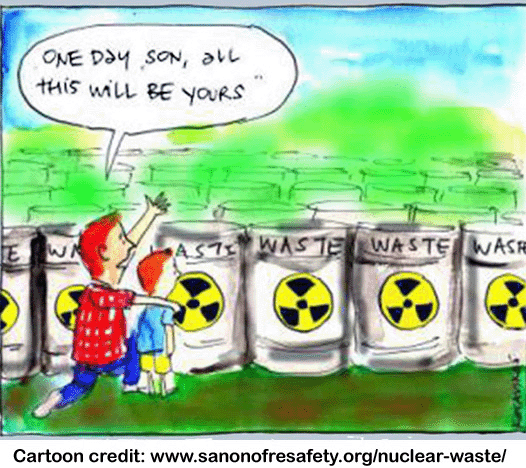
Ministers might care to heed conclusions of 1976 Flowers report before they go ahead with latest energy policy plans
Paul Brown, 25 Apr 25, https://www.theguardian.com/news/2025/apr/25/weatherwatch-sage-advice-50-odd-years-ago-on-uk-nuclear-power-still-relevant
Gathering dust somewhere in Whitehall is the 1976 royal commission’s sixth report on environmental pollution, known afterwards as the Flowers report after its chair, Sir Brian Flowers. It dealt with the future of the nuclear industry, warning about the dangers of producing large quantities of plutonium amid fears of potential threats from terrorists. The report particularly emphasised the pressing need to find a way of disposing of nuclear waste and recommended there should be no great expansion of nuclear power until a satisfactory way had been found of disposing of it.
The report was written before climate change and the current extremes of weather were of public concern, but the commission was exercised by the pressing need to increase the electricity supply. The report did not rule out the expansion of nuclear power but urged the government to look at wave power and other renewables as much more desirable alternatives.
Fast-forward almost half a century and the UK is still no nearer to dealing with its ever increasing pile of nuclear waste, costing billions every year just to keep safe. However, the Flowers commission would be delighted that wind, solar and other renewables have largely replaced nuclear power, and be puzzled that the government seems poised to ignore sage advice and expand nuclear energy again.
Scottish nuclear plant emptied of fuel as UK winds down ageing gas-cooled reactors.
the cost of decommissioning should be taken into
account when the government decided on new nuclear plants as “no scheme can be guaranteed to meet a cost more than a century into the future”.
The first of the UK’s seven advanced gas-cooled reactor nuclear power
stations has been emptied of fuel, kick-starting a decommissioning process
that will cost at least £27bn in total and take almost a century.
EDF said on Thursday it had defuelled Hunterston B, on the west coast of Scotland,
paving the way for the transfer of the site and 250 staff from the French
power company to the UK Nuclear Decommissioning Authority next April. The
site provided most of Scotland’s energy for more than 40 years from its
launch in 1976 until its final closure in 2022.
EDF owns seven advanced gas-cooled reactors (AGRs) plants in the UK, which were built between the 1960s and 1980s and differ from newer nuclear plants that use water for
cooling. Just four are still operating.
The uranium fuel has been packaged
into 350 large flasks, which will be stored by the NDA at the Sellafield
nuclear site in Cumbria for at least 50 years until a longer-term
underground facility has been built.
Although the process took just three
years and £400mn, it will take almost a century to eradicate the radiation
from the land and buildings, EDF has said. The decommissioning of the seven
AGRs is separate to a much wider £105bn decommissioning programme, which
will cover an additional 17 closed nuclear sites over the next 120 years,
according to the NDA.
The closures will leave the UK with just one nuclear
power plant still running by 2030 — Sizewell B in Suffolk, which is also
managed by EDF and uses a pressurised water reactor. The NDA said it was
“acutely aware of the costs associated with delivering our mission”.
The cost of decommissioning nuclear power plants is under scrutiny as the
UK presses ahead with new nuclear projects, including the £40bn Sizewell
C, which is expected to get government go-ahead this spring, and the £46bn
Hinkley Point C, which is still under construction and will open by 2030 at
the earliest.
Steve Thomas, emeritus professor of energy policy at
Greenwich university, said the cost of decommissioning should be taken into
account when the government decided on new nuclear plants as “no scheme
can be guaranteed to meet a cost more than a century into the future”.
Although EDF has owned Hunterston B and the seven other AGR nuclear plants
since 2009, the cost of decommissioning is being paid for through the
ringfenced Nuclear Liabilities Fund (NLF), which was set up in 1996 after
privatisation and is valued at £20.6bn. Decommissioning costs have soared
over the past three decades, with the fund requiring cash injections from
the Treasury, including £5bn in July 2020 and a further £5.6bn in March
2022, according to the NLF.
FT 24th April 2025, https://www.ft.com/content/c31af2d6-eeaa-4a3d-a2c0-81c63b29cb1d
Miliband explores cut-price clean-up of Britain’s deadliest nuclear waste.

The UK’s massive nuclear waste stockpile includes 110,000 tonnes of uranium, 6,000 tonnes of spent nuclear fuels and about 120 tonnes of plutonium – mostly stored at the Sellafield nuclear site in Cumbria in decaying containers and ageing buildings.
Space equivalent to eight Royal Albert Halls is required to dispose of highly toxic substances.
Ed Miliband is backing a cut-price clean-up of
the UK’s growing nuclear waste mountain. The Energy Secretary’s plans
involve highly radioactive used fuel rods being dropped into holes drilled
deep into the Earth’s crust.
The experimental approach, pioneered by Deep
Isolation, an American company, is being funded by the Department for
Energy Security and Net Zero (Desnz), which is helping develop the
toughened canisters needed to contain the deadly waste. If it works, the
method could offer a faster and cheaper way of dealing with the hundreds of
tonnes of high-level radioactive waste accumulated by the UK over the last
seven decades and the new waste generated by future reactors like Hinkley
Point C, under construction in Somerset.
The solution will see used fuel
rods from nuclear reactors placed into steel cylinders designed to fit into
boreholes drilled thousands of feet into deep rock formations. The UK’s
massive nuclear waste stockpile includes 110,000 tonnes of uranium, 6,000
tonnes of spent nuclear fuels and about 120 tonnes of plutonium – mostly
stored at the Sellafield nuclear site in Cumbria in decaying containers and
ageing buildings. UK Government Investments warned in its annual report
that the cost of “nuclear decommissioning threatens the Government’s
finances due to its inherent uncertainty.” The Office for Budget
Responsibility has issued similar warnings. A key problem for the UK is
that, despite decades of trying, it still has no way of permanently storing
nuclear waste. The current plan is to excavate a network of caverns under
the sea, filling them with nuclear waste and then sealing them with cement.
However, work is not expected to start till at least 2050 and will take
decades to complete. Deep boreholes could offer a faster and cheaper
solution for at least some of the waste. Under the Deep Isolation scheme,
boreholes would be drilled into rock using technology first developed by
the oil and gas industry for “fracking”.
Telegraph 21st April 2025,
https://www.telegraph.co.uk/business/2025/04/21/miliband-cut-price-clean-up-deadliest-nuclear-waste/
DOE report: Cost to finish cleaning up Hanford site could exceed $589 billion
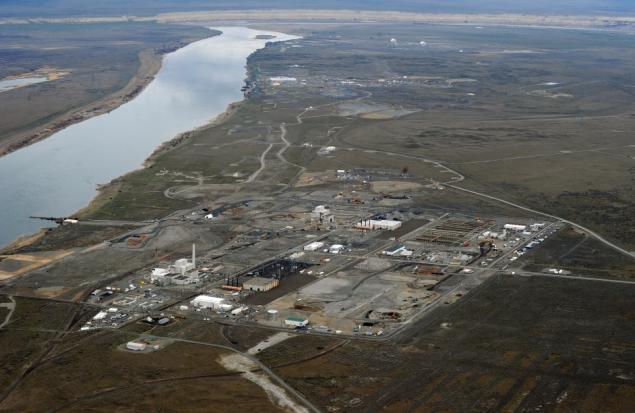
The cost to complete the cleanup of the Department of Energy’s Hanford Site in Washington state could cost as much as $589.4 billion, according to the 2025 Hanford Lifecycle Scope, Schedule, and Cost Report, which was released by the DOE on April 15. While that estimate is $44.2 billion lower than the DOE’s 2022 estimate of $640.6 billion, a separate, low-end estimate has since grown by more than 21 percent, to $364 billion.
The life cycle report, which the DOE is legally required to issue every three years under agreement with the U.S. Environmental Protection Agency and Washington State Department of Ecology (Ecology), summarizes the remaining work scope, schedule, and cost estimates for the nuclear site. For more than 40 years, Hanford’s reactors produced plutonium for America’s defense program.
The DOE’s cost estimates assume an active site cleanup schedule lasting until 2086, with long-term site stewardship until 2100. The DOE, however, said the federal government plans to have a presence at Hanford well beyond 2100.
The details: The report provides both a baseline (low-range) and a high-range cost estimate for completing the Hanford cleanup work. For this latest report, the DOE estimates a baseline cost of approximately $364 billion and a high-range cost estimate of approximately $589.4 billion. In 2022, the DOE reported an estimated cost range of $300.2 billion to $640.6 billion. The estimates include active cleanup, decommissioning, and remediation work, along with the final disposition of Hanford’s remaining reactors and long-term stewardship of the site.
According to the DOE, the cost range reflects the high degree of technical complexity and uncertainty associated with the large volume of work to be completed at the site, which includes the treatment and disposal of Hanford’s radioactive and chemical tank waste, Hanford’s largest liability. The estimates also include risk reduction work along with mission and site infrastructure costs.
According to the DOE, the high-range estimate reflects an 80 percent confidence level and is intended to ensure transparency among Hanford stakeholders of the inherent risks in achieving the agreed-upon cleanup goals.
While the Hanford life cycle report is not a decision-making document on the actions the DOE will take to meet its cleanup obligations, it does act as a foundation for preparing budget requests and for informational briefings with stakeholders. It also supports the DOE’s discussions with the EPA and Ecology on the progress it is making in cleaning up the site.
Feedback: The DOE is collecting public feedback on the report in writing until June 16. Received feedback will be considered when the department drafts its 2028 life cycle report.
Comments can be emailed to lifecyclereport@rl.gov (preferred) or mailed to:
Dana Gribble, Hanford Mission Integration Solutions
U.S. Department of Energy
P.O. Box 450, H5-20
Richland, WA 99354
Robot starts 2nd mission to retrieve debris at Fukushima nuclear plant
Apr. 16 , By Mari Yamaguchi, TOKYO, https://japantoday.com/category/national/robot-starts-2nd-mission-to-retrieve-debris-at-fukushima-nuclear-plant
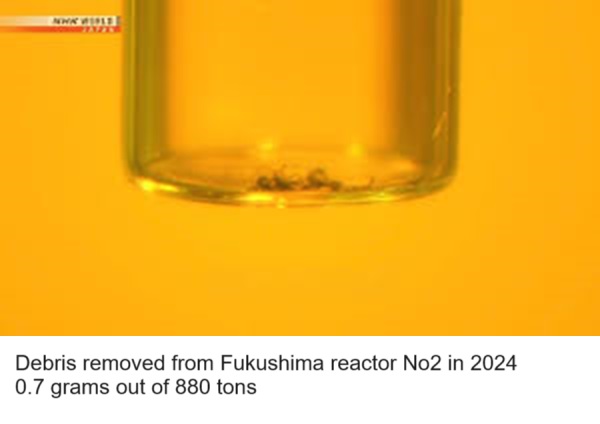
A remote-controlled robot on Tuesday embarked on its second mission to retrieve tiny bits of melted fuel debris from inside a damaged reactor at the Fukushima nuclear plant that was wrecked by a tsunami 14 years ago.
The mission, which follows the first such debris retrieval in November, is aimed at eventually developing the technology and robots needed for a larger scale cleanup of the plant, destroyed by the earthquake and tsunami in March 2011.
The extendable “Telesco” robot carries cameras and a tong to grip tiny nuggets of radioactive debris. It entered the No. 2 reactor’s primary containment vessel Tuesday, according to Tokyo Electric Power Company.
This time, the company aims to send the robot further into the containment vessel to get a sample from an area closer to the center where more melted fuel is believed to have fallen.
It is expected to take several days before the front tip of the robot reaches the targeted area, where it will lower a device carrying a tong and camera in a fishing-rod style.
That first sample retrieval in November, despite a number of mishaps, was a crucial step in what will be a daunting, decades-long decommissioning that must deal with at least 880 tons of melted nuclear fuel that has mixed with broken parts of internal structures and other debris inside the three reactors ruined in 2011.
After a series of small missions by robots to gather samples, experts will determine a larger-scale method for removing melted fuel, first at the No. 3 reactor, beginning in the 2030s.
Experts say the huge challenge of decommissioning the plant is just beginning, and that the work could take more than a century.
Nuclear waste returns to Germany amid protests.
Matt Ford with dpa, NDR, 04/01/2025April 1, 2025, Edited by: Sean Sinico
https://www.dw.com/en/nuclear-waste-returns-to-germany-amid-protests/a-72108958
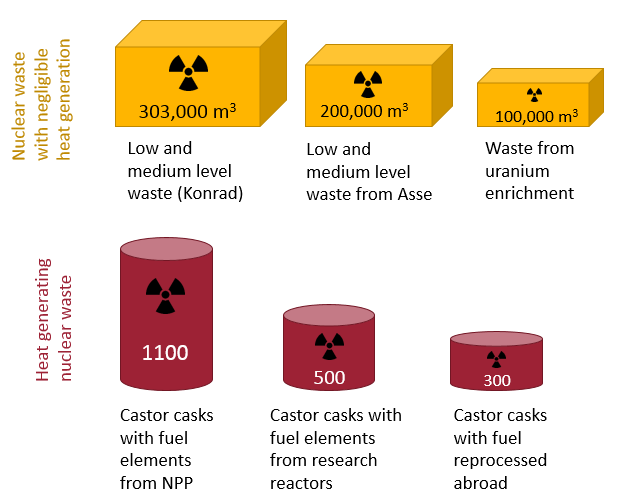
Seven containers filled with nuclear waste were transferred from ship to train in northern Germany for transport to Bavaria. But Germany still has no permanent storage solution for its radioactive material.
A ship carrying castor seven containers filled with highly radioactive nuclear waste docked in the northern German port of Nordenham, Lower Saxony, on Tuesday morning, amid protests and a heightened police presence.
The nuclear waste is being transported from Sellafield in northwest England to a temporary storage unit in Niederaichbach in the southern German state of Bavaria. The waste left the northwestern English port of Barrow-in-Furness last Wednesday and is being transferred from ship to train in Nordenham before continuing southwards. The nuclear waste was what remained after the reprocessing of fuel elements from decommissioned German nuclear power plants.
The first of the containers, which are four meters (13 feet) long and weigh over 100 tons, was lifted off the special “Pacific Grebe” transport ship by a large crane on Tuesday morning and underwent inspection to measure radiation levels and ensure they matched those taken in Sellafield.
The port in Nordenham remains sealed off and guarded by heavily armed police, who have thus far reported no incidents, despite a number of protests by anti-atomic energy groups.
Nuclear waste: Why are people protesting?
“Every castor container carries enormous risk,” said Helge Bauer from the protest group Ausgestrahlt, which means “radiated.” “Nuclear waste should, therefore, only be transported once — to a permanent storage site.”
Further protests are planned along the presumed route of the train carrying the waste over the coming days, including in the cities of Bremen and Göttingen.
“Every castor transport is one too many because it only postpones the problem and does not solve it,” Kerstin Rudek, a spokesperson for the group Castor-Stoppen, said in a statement, adding that nuclear waste should not be moved until a safe, final storage location is determined.
Where is the waste from if Germany phased out nuclear energy?
Germany began phasing out the use of nuclear power in 2003, a process which was accelerated following the Fukushima disaster in Japan in 2011. Germany’s final remaining nuclear power plants were shut down in 2023.
But Germany is still obligated to take back nuclear waste produced by used elements from its plants which, up until 2005, were regularly transported to reprocessing plants in Sellafield and La Hague, France. The transport of processed German nuclear waste back to the country has often been subject to protests.
According to the Society for Nuclear Service (GNS), over 100 castor containers were transported from La Hague to Gorleben, Lower Saxony, between 1995 and 2011. The final four were transported to Philippsburg, Baden-Württemberg, in 2024. Six containers were reportedly transported from Sellafield to Biblis, Hesse, in 2020, with seven more still to come.
Where does Germany store nuclear waste?
Germany’s Federal Company for Radioactive Waste Disposal (BGE) is still in the process of identifying a suitable location for the permanent underground storage of 27,000 cubic meters of nuclear waste produced over the course of 60 years of German nuclear energy production.
Nuclear waste, which can remain radioactive and, therefore, highly dangerous for hundreds of thousands of years, is currently stored in 16 temporary locations above ground, but it can’t stay there forever.
“We are using an empiric process to identify a location which offers the best possible security,” the BGE’s Lisa Seidel told public broadcaster NDR in November 2024.
How and where is nuclear waste stored in the US?

Gerald Frankel , Distinguished Professor of Materials Science and Engineering, The Ohio State University, April 14, 2025, https://theconversation.com/how-and-where-is-nuclear-waste-stored-in-the-us-252475
Around the U.S., about 90,000 tons of nuclear waste is stored at over 100 sites in 39 states, in a range of different structures and containers.
For decades, the nation has been trying to send it all to one secure location.
A 1987 federal law named Yucca Mountain, in Nevada, as a permanent disposal site for nuclear waste – but political and legal challenges led to construction delays. Work on the site had barely started before Congress ended the project’s funding altogether in 2011.
The 94 nuclear reactors currently operating at 54 power plants continue to generate more radioactive waste. Public and commercial interest in nuclear power is rising because of concerns regarding emissions from fossil fuel power plants and the possibility of new applications for smaller-scale nuclear plants to power data centers and manufacturing. This renewed interest gives new urgency to the effort to find a place to put the waste.
In March 2025, the U.S. Supreme Court heard arguments related to the effort to find a temporary storage location for the nation’s nuclear waste – a ruling is expected by late June. No matter the outcome, the decades-long struggle to find a permanent place to dispose of nuclear waste will probably continue for many years to come.
I am a scholar who specializes in corrosion; one focus of my work has been containing nuclear waste during temporary storage and permanent disposal. There are generally two forms of significantly radioactive waste in the U.S.: waste from making nuclear weapons during the Cold War, and waste from generating electricity at nuclear power plants. There are also small amounts of other radioactive waste, such as that associated with medical treatments.
Waste from weapons manufacturing
Remnants of the chemical processing of radioactive material needed to manufacture nuclear weapons, often called “defense waste,” will eventually be melted along with glass, with the resulting material poured into stainless steel containers. These canisters are 10 feet tall and 2 feet in diameter, weighing approximately 5,000 pounds when filled.
For now, though, most of it is stored in underground steel tanks, primarily at Hanford, Washington, and Savannah River, South Carolina, key sites in U.S. nuclear weapons development. At Savannah River, some of the waste has already been processed with glass, but much of it remains untreated.
At both of those locations, some of the radioactive waste has already leaked into the soil beneath the tanks, though officials have said there is no danger to human health. Most of the current efforts to contain the waste focus on protecting the tanks from corrosion and cracking to prevent further leakage.
Waste from electricity generation
The vast majority of nuclear waste in the U.S. is spent nuclear fuel from commercial nuclear power plants.
Before it is used, nuclear fuel exists as uranium oxide pellets that are sealed within zirconium tubes, which are themselves bundled together. These bundles of fuel rods are about 12 to 16 feet long and about 5 to 8 inches in diameter. In a nuclear reactor, the fission reactions fueled by the uranium in those rods emit heat that is used to create hot water or steam to drive turbines and generate electricity.
After about three to five years, the fission reactions in a given bundle of fuel slow down significantly, even though the material remains highly radioactive. The spent fuel bundles are removed from the reactor and moved elsewhere on the power plant’s property, where they are placed into a massive pool of water to cool them down.
After about five years, the fuel bundles are removed, dried and sealed in welded stainless steel canisters. These canisters are still radioactive and thermally hot, so they are stored outdoors in concrete vaults that sit on concrete pads, also on the power plant’s property. These vaults have vents to ensure air flows past the canisters to continue cooling them.
As of December 2024, there were over 315,000 bundles of spent nuclear fuel rods in the U.S., and over 3,800 dry storage casks in concrete vaults above ground, located at current and former power plants across the country.
Even reactors that have been decommissioned and demolished still have concrete vaults storing radioactive waste, which must be secured and maintained by the power company that owned the nuclear plant.
The threat of water
One threat to these storage methods is corrosion.
Because they need water to both transfer nuclear energy into electricity and to cool the reactor, nuclear power plants are always located alongside sources of water.
In the U.S., nine are within two miles of the ocean, which poses a particular threat to the waste containers. As waves break on the coastline, saltwater is sprayed into the air as particles. When those salt and water particles settle on metal surfaces, they can cause corrosion, which is why it’s common to see heavily corroded structures near the ocean.
At nuclear waste storage locations near the ocean, that salt spray can settle on the steel canisters. Generally, stainless steel is resistant to corrosion, which you can see in the shiny pots and pans in many Americans’ kitchens. But in certain circumstances, localized pits and cracks can form on stainless steel surfaces.
In recent years, the U.S. Department of Energy has funded research, including my own, into the potential dangers of this type of corrosion. The general findings are that stainless steel canisters could pit or crack when stored near a seashore. But a radioactive leak would require not only corrosion of the container but also of the zirconium rods and of the fuel inside them. So it is unlikely that this type of corrosion would result in the release of radioactivity.
A long way off
A more permanent solution is likely years, or decades, away.
Not only must a long-term site be geologically suitable to store nuclear waste for thousands of years, but it must also be politically palatable to the American people. In addition, there will be many challenges associated with transporting the waste, in its containers, by road or rail, from reactors across the country to wherever that permanent site ultimately is.
Perhaps there will be a temporary site whose location passes muster with the Supreme Court. But in the meantime, the waste will stay where it is.
Nuclear waste sparks fury in Germany
Staff Writer April 4, 2025,
https://www.neimagazine.com/news/nuclear-waste-returned-to-germany-amid-protests/
The Pacific Grebe, a specialist nuclear transport vessel carrying radioactive nuclear waste from the UK, was met by anti-nuclear activists when it arrived at Nordenham port in north-western Germany. The nuclear waste was the result of reprocessing fuel elements from decommissioned German NPPs at the UK’s Sellafield site.
This was the second of three planned shipments. Seven flasks containing high level waste (HLW) were transported by rail from the Sellafield site in West Cumbria to the port of Barrow-in-Furness, where they were then loaded onto the Pacific Grebe, operated by Nuclear Transport Solutions (NTS).
Vitrified Residue Returns (VRR) are a key component of the UK’s strategy to repatriate HLW from the Sellafield site, fulfilling overseas contracts. The first shipment of six flasks each with 28 containers of HLW to Biblis took place in 2020.
he Pacific Grebe, a specialist nuclear transport vessel carrying radioactive nuclear waste from the UK, was met by anti-nuclear activists when it arrived at Nordenham port in north-western Germany. The nuclear waste was the result of reprocessing fuel elements from decommissioned German NPPs at the UK’s Sellafield site.
This was the second of three planned shipments. Seven flasks containing high level waste (HLW) were transported by rail from the Sellafield site in West Cumbria to the port of Barrow-in-Furness, where they were then loaded onto the Pacific Grebe, operated by Nuclear Transport Solutions (NTS).
Vitrified Residue Returns (VRR) are a key component of the UK’s strategy to repatriate HLW from the Sellafield site, fulfilling overseas contracts. The first shipment of six flasks each with 28 containers of HLW to Biblis took place in 2020.
According to Germany’s Federal Office for the Safety of Nuclear Waste Management (BASE – Bundesamt für die Sicherheit der nuklearen Entsorgung)) the transport licence for the latest shipment was approved in December. Until 2005 German utilities shipped used fuel from NPPs to La Hague in France and Sellafield in the UK for reprocessing: “The resulting liquid waste was then melted down into glass and has since been gradually returned to Germany,” BASE noted. “The last shipment of this waste from France was returned in November 2024.” There is one more shipment planned, after the current one, from the UK to complete the repatriation.”
BASE issued a licence in April 2023 for the storage of the vitrified waste at the Isar interim storage facility, which is licensed to hold a maximum of 152 casks of high-level radioactive waste and “according to current plans, there will be 28 fewer high-level waste casks there than originally intended, including the casks containing the vitrified waste”.
According to Germany’s Society for Nuclear Service (GNS – Gesellschaft für Nuklear‑Service), “The waste is massively shielded from external radiation. In the reprocessing plant, the waste is mixed with liquid silicate glass and poured into cylindrical stainless-steel containers, which are then sealed tightly after hardening. These containers, filled with the hardened glass mixture, are called “glass moulds”. For transport and storage, the moulds are placed in … massive, more than 100-tonne cast iron and stainless-steel containers, which have been proven in extensive tests to provide both strong shielding and to be safe under extreme conditions.”
Until 2011 reprocessed waste was sent to the Gorleben interim storage facility in Lower Saxony, where 108 casks of vitrified radioactive waste have been stored, which was “already a large proportion of the total waste to be returned from reprocessing”. BASE said, as part of the Site Selection Act of 2013 to seek a repository for high-level radioactive waste, the remaining vitrified waste abroad was to be stored in interim storage facilities at nuclear power plant sites.
“The aim was to avoid giving the impression that Gorleben had already been chosen as the site for a final storage facility during the open-ended search for a repository site. In 2015, the federal government, the federal states and the utility companies agreed to store the remaining radioactive waste in Biblis, Brokdorf, Niederaichbach (Isar NPP) and Philippsburg,” BASE noted.
France’s Orano completed the 13th and final rail shipment from France of vitrified high-level nuclear waste, to Philippsburg, in Germany in November 2024. In total 5,310 tonnes of German used fuel was processed at Orano’s La Hague plant up to 2008.
The latest shipment of waste from Sellafield is due to be transported to the interim storage facility at the site of the former Niederaichbach NPP in southern Bavaria. The Niederaichbach heavy water gas cooled reactor operated for only 18 months from 1972-1973. From 1975 to 1995 the plant was demolished and the site returned to greenfield condition. A monument marks its former location near the closed Isar NPP.
Germany’s Federal Company for Radioactive Waste Disposal (BGE – Bundesgesellschaft für Endlagerung) is in the process of identifying a suitable location for the permanent underground storage for 27,000 cubic metres of nuclear waste produced over the course of 60 years of German nuclear energy production.
On arrival at Nordenham port, the seven castor containers were transferred by crane from the Pacific Grebe to a train in the harbour, where tests were carried out to ensure legal radiation limits were not exceeded. The containers each measure four metres in length and weigh over 100 tonnes.
The train’s route to the Isar storage facility is not being publicised for security reasons.
Further protests are planned along the presumed route of the train over the coming days, including in the cities of Bremen and Göttingen. “Every castor transport is one too many because it only postpones the problem and does not solve it,” Kerstin Rudek, a spokesperson for the group Castor-Stoppen, said in a statement, adding that nuclear waste should not be moved until a safe, final storage location is determined.
1 This Month

of the week – Shut Down Drone Warfare!


Tell the Ukrainian Government to Drop Prosecution of Peace Activist Yurii Sheliazhenko

Petition to revoke the licensing of the Near Surface Nuclear Disposal Facility (NSDF) at Chalk River. https://www.ourcommons.ca/petitions/en/Petition/Details?Petition=e-7247
To see nuclear-related stories in greater depth and intensity – go to https://nuclearinformation.wordpress.com
-
Archives
- April 2026 (79)
- March 2026 (251)
- February 2026 (268)
- January 2026 (308)
- December 2025 (358)
- November 2025 (359)
- October 2025 (376)
- September 2025 (257)
- August 2025 (319)
- July 2025 (230)
- June 2025 (348)
- May 2025 (261)
-
Categories
- 1
- 1 NUCLEAR ISSUES
- business and costs
- climate change
- culture and arts
- ENERGY
- environment
- health
- history
- indigenous issues
- Legal
- marketing of nuclear
- media
- opposition to nuclear
- PERSONAL STORIES
- politics
- politics international
- Religion and ethics
- safety
- secrets,lies and civil liberties
- spinbuster
- technology
- Uranium
- wastes
- weapons and war
- Women
- 2 WORLD
- ACTION
- AFRICA
- Atrocities
- AUSTRALIA
- Christina's notes
- Christina's themes
- culture and arts
- Events
- Fuk 2022
- Fuk 2023
- Fukushima 2017
- Fukushima 2018
- fukushima 2019
- Fukushima 2020
- Fukushima 2021
- general
- global warming
- Humour (God we need it)
- Nuclear
- RARE EARTHS
- Reference
- resources – print
- Resources -audiovicual
- Weekly Newsletter
- World
- World Nuclear
- YouTube
-
RSS
Entries RSS
Comments RSS
 nuclear-news
