Cost of maintaining decommissioned nuclear submarines

UK Defence Journal 29th Oct 2024
Graeme Downie, Labour MP for Dunfermline and Dollar, recently raised a question regarding the financial burden of maintaining decommissioned nuclear submarines at two key UK facilities: Rosyth and Devonport. Specifically, he inquired about the annual costs associated with these sites.
In response, Defence Minister Maria Eagle provided the figures for the financial year 2023-24, explaining that “the annual cost for maintaining decommissioned submarines varies each year depending on the respective maintenance requirements.”
For the last financial year, £1.7 million was spent at Rosyth, while the maintenance costs at Devonport were significantly higher, totalling £7.1 million.
These figures highlight the ongoing financial commitment required to manage the UK’s decommissioned nuclear submarines, a task dependent on the maintenance needs of each vessel and the infrastructure of the respective facilities.
Additionally, during a recent exchange in the House of Lords, Lord Coaker expressed the urgency for the UK to expedite its nuclear submarine dismantling programme, addressing the slow progress in decommissioning and dismantling outdated submarines.
Responding to a question from Baroness Bryan of Partick, he outlined the current challenges and ongoing efforts to dismantle the aging fleet, currently spread across Scotland and Devonport, and acknowledged that, without significant changes, the timeline could stretch into decades.
Baroness Bryan highlighted widespread concerns, pointing out that many submarines have been out of service for years or even decades without being dismantled. She cited, for example, the case of a Dreadnought-class submarine stationed at Rosyth since 1980, a delay emblematic of the broader issue. “There remains real concern that not one of these submarines has yet been dismantled,” she noted, adding that with the rate of dismantling, “it will take decades to dismantle the boats remaining in both Scotland and Devonport.”……………………………………………………..
https://ukdefencejournal.org.uk/cost-of-maintaining-decommissioned-nuclear-submarines
MP seeks answers on Submarine Dismantling Project in Rosyth
26th October, By Ally McRoberts
THE UK Government have been asked what steps they’re taking to keep West Fife safe and mitigate the “potential risks” posed by the Submarine Dismantling Project.
Radioactive waste is being removed from old nuclear subs at Rosyth Dockyard and Babcock have just applied for permission for more hazardous material to be taken out in the next stage.
Christine Jardine, Lib Dem MP for Edinburgh West, submitted a question at Westminster: “To ask the Secretary of State for Defence (John Healey), what steps his department is taking to (a) ensure the safety of and (b) mitigate potential risks posed by the decommissioning of nuclear submarines at Rosyth Royal Dockyard for surrounding residential areas.”
On Mr Healey’s
behalf, Maria Eagle, Minister for Defence Procurement, replied: “All the
submarines currently stored at Rosyth have already been de-fuelled, which
has significantly reduced overall potential risk. “Further, steps include
contractual requirements with Babcock International around safety and
environmental factors. “These include regular sampling of surrounding
waters and beaches, and dismantling one boat as a demonstrator to determine
the safest methods before starting on other boats.
Dunfermline Press 26th Oct 2024, https://www.dunfermlinepress.com/news/24679595.mp-seeks-answers-submarine-dismantling-project-rosyth/
Last German nuclear power plant to receives decommissioning and dismantling permit
WNN Thursday, 24 October 2024
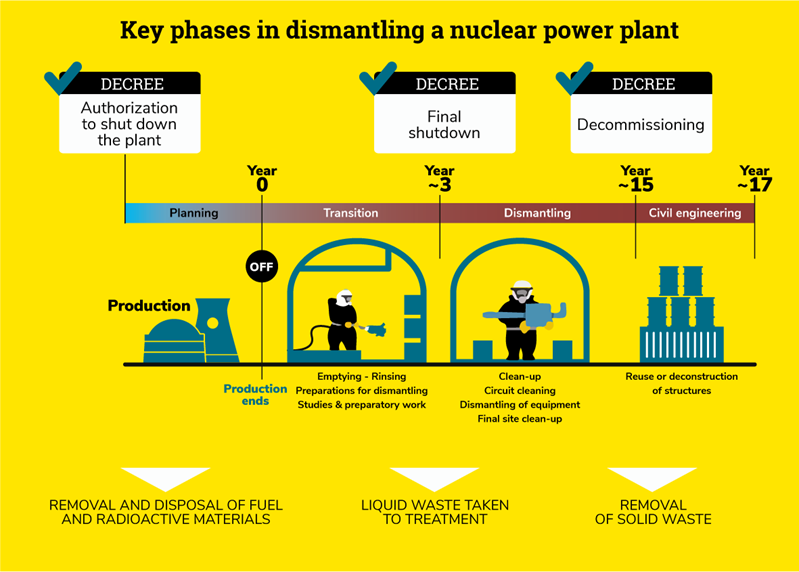
The Schleswig-Holstein Ministry for Energy Transition, Climate Protection, Environment and Nature has issued the first decommissioning and dismantling permit to PreussenElektra for the Brokdorf nuclear power plant. Brokdorf is the last German nuclear power plant to receive this approval and begin dismantling.
PreussenElektra – a subsidiary of EOn Group – applied for approval to decommission and dismantle the 1410 MWe pressurised water reactor in December 2017. The plant was shut down on 31 December 2021.
Phase 1 of the plant’s decommissioning and dismantling has now been approved. This includes the decommissioning and dismantling of the plant components that are no longer required and subject to nuclear regulatory supervision, with the exception of the reactor pressure vessel and the biological shield.
Since Brokdorf’s closure, the conditions for dismantling the plant have been created in close coordination with the authorities. These include the decontamination of the primary cooling circuit, systems and plant components that are no longer required have been taken out of service, and the workforce has been adjusted. A large proportion of the fuel elements still present in the plant have already been moved to the interim storage facility on site and replacement systems for the plant’s energy supply have been installed.
…………….. The next steps will be to create new logistics routes within the control area and set up a waste processing centre for the dismantled masses. In addition, systems and plant components that are no longer required will be prepared for dismantling.
A second dismantling permit is required to dismantle the reactor pressure vessel and the biological shield. This requires the removal of all fuel elements and special fuel rods, which are expected to be transported to the interim storage facility at the site in 2025. PreussenElektra submitted the application for the second dismantling permit on 30 August this year. This is currently being examined by independent experts.
………………………………. In December last year, PreussenElektra, together with EOn group companies, announced plans for the construction at the Brokdorf site of the largest battery storage facility in the EU to date. The facility – to store electricity from renewable sources – is to be expanded in two stages to up to 800 MW of power and a storage capacity of up to 1600 MWh. Commissioning could begin as early as 2026. https://www.world-nuclear-news.org/articles/decommissioning-permit-granted-for-brokdorf-plant
First ex-Royal Navy nuclear submarine to be disposed of enters final dismantling phase.
Navy Lookout 15th Oct 2024 https://www.navylookout.com/first-ex-royal-navy-nuclear-submarine-to-be-disposed-of-enters-final-dismantling-phase/
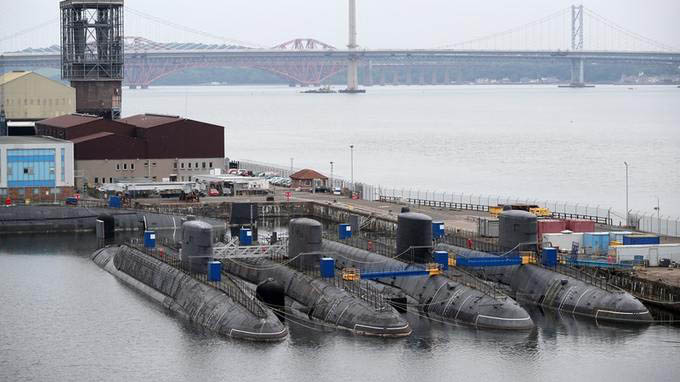
Work has started on the third and final phase of the project to dismantle ex-HMS Swiftsure. As the demonstrator project for the dismantling programme, she will be the first former RN SSN to be fully disposed of.
The glacial project to safely scrap the growing fleet of decommissioned boats has finally begun to make some progress at Rosyth in the last few years. Each submarine will undergo a three-step process which involves Low Level Radioactive Waste (LLW) being removed first. The second and most demanding stage involves the removal of the Reactor Pressure Vessel that holds the reactor core and is classed as Intermediate Level Radioactive Waste (ILW).
Work has started on the third and final phase of the project to dismantle ex-HMS Swiftsure. As the demonstrator project for the dismantling programme, she will be the first former RN SSN to be fully disposed of.
The glacial project to safely scrap the growing fleet of decommissioned boats has finally begun to make some progress at Rosyth in the last few years. Each submarine will undergo a three-step process which involves Low Level Radioactive Waste (LLW) being removed first. The second and most demanding stage involves the removal of the Reactor Pressure Vessel that holds the reactor core and is classed as Intermediate Level Radioactive Waste (ILW).
Swiftsure’s disposal is a notable achievement as the first Pressurised Water Reactor (PWR) anywhere in the world to be dismantled. Other nations use a much simpler process and cut the entire reactor compartment out of the submarine and transport it structurally complete for burial in land storage facilities. The US has successfully disposed of over 130 nuclear ships and submarines since the 1980s. The Russians have disposed of over 190 Soviet-era boats (with some international assistance) since the 1990s while France has already disposed of 3 boats from their much smaller numbers.
Besides the progress with Swifsure, LLW has been safely removed from ex-HMS Resolution, Revenge and Repulse. As experience has been gained working on successive boats techniques have been refined and more waste has been managed to final disposal at reduced cost. The optimisation of the process allowed 50% greater tonnage of waste to be removed in 75% of the time it took for Swiftsure. So far the work has been completed safely on budget and on time. Work has yet to begin on ex-HMS Dreadnought, Churchill and Renown still afloat in the basin at Rosyth.
While there is positive progress at Rosyth, 14 Dock at Devonport is still not ready to accept the first boat to begin defuelling and dismantling. There are now 15 decommissioned submarines filling up the basins in Plymouth (soon to be 16 when HMS Triumph goes in 2025). Work to get rid of this legacy cannot start soon enough. At least the lessons learned in Rosyth should give the teams at Devonport an advantage although the majority of these boats still have their nuclear fuel on board and will have to undergo a 4-stage process.
First civil nuclear site decommissioned in the UK
It took 10 years for Veolia and Imperial College London to complete the
decommissioning of the first civil nuclear site in the UK. The Reactor
Centre at Imperial’s Silwood Park eco-campus in Ascot housed the UK’s
last civilian nuclear reactor for almost 50 years until it closed in 2012.
The long and complex project required demolition of the reactor, safely
managing hazardous materials, and restoring the site to its original state
to make it safe for public use. Veolia’s specialist decommissioning team,
KDC, supported Imperial in planning the complex project, which included the
cutting operations to reduce the reactor concrete shielding, removal and
demolition of the facility. The operation required the design and use of
new equipment to safely deconstruct the facility.
Construction Management 1st Oct 2024,
https://constructionmanagement.co.uk/first-civil-nuclear-site-decommissioned-in-the-uk/
Nuclear plant’s decommissioning could take 95 years
Daniel Mumby, Local Democracy Reporting Service, 19 Sept 24, https://www.bbc.com/news/articles/c8699v4dvexo
Residents are being asked for their views on how a former nuclear power station should be safely decommissioned.
The Hinkley Point B facility, which lies on the Somerset coast north of Stogursey, ceased operations in August 2022, after cracks developed in the plant’s graphite cores, creating potential safety concerns.
EDF Energy, which owns the facility, has applied to the Office for Nuclear Regulation (ONR) for formal permission to decommission the site, which could take about 95 years.
Somerset residents now have three months to voice their views.
Under the proposals, Hinkley Point B, which opened in 1976, could be decommissioned in three phases.
The first phase, which will last until 2038, includes the dismantling of all buildings and plant materials except for the site’s safestore structure. This facility will be used to store and manage the residential nuclear waste from the power station.
The second phase will see “a period of relative inactivity” of up to 70 years from 2039, to allow for the radioactive materials within the safestore to safely decay, according to the Local Democracy Reporting Service.
While physical activity within the site will be minimal during this phase, the former power station will remain under close surveillance with “periodic maintenance interventions” to prevent any risk to health or national security.
The third and final phase will see the former reactor and debris vaults being dismantled and removed and any final landscaping work being completed – with EDF estimating that this will be finished by 2118.
The consultation is running until 9 December, with the ONR expected to publish its formal response in early 2025.
Hinkley Point C
EDF is currently building Hinkley Point C, which has a target completion date of June 2027.
Costing about £46bn, it is expected to generate enough electricity to supply some six million homes for the next 60 years.
More than 200 Russian nuclear submarines have been dismantled.
Rosatom has said that its work to resolve nuclear legacy issues in
Russia’s Far East has been successful, including the dismantling of dozens
of decommissioned nuclear-powered submarines. In total, the state nuclear
corporation said, 202 Russian nuclear-powered submarines decommissioned
before 2022 have been dismantled, including 82 from the country’s Far East.
It added that all used nuclear fuel has been removed from the region. The
reactor compartments of the dismantled nuclear submarines have been placed
in specially constructed containers in a secure site on land, and are
subject to radiation monitoring and maintenance, such as checking the
condition of the anti-corrosion protective coating, the company said.
World Nuclear News 11th Sept 2024
Hinkley Point B: What happens after a nuclear power station stops making electricity?
After shutting down in 2022, the job now is to carefully
remove tonnes of nuclear waste to be transported for storage at Sellafield
in Cumbria. The team is halfway through that task with one reactor empty
and one more to go.
I was given exclusive access to the power station,
getting the chance to travel deep within the bowels of the building and see
something few people outside EDF Energy get to – the cooling ponds, where
spent fuel is cooled down before being sealed for transport and storage.
there will be another couple of years to finish defuelling operations, then
EDF hands this place over to the Nuclear Decommissioning Authority as the
painstaking job of decommissioning will continue for many years.
ITV 13th Aug 2024
Germany may take another 50 years to find final repository for waste from shuttered nuclear power
Sören Amelang, Aug 9, 2024, https://reneweconomy.com.au/germany-may-take-another-50-years-to-find-final-repository-for-waste-from-shuttered-nuclear-power/
Germany’s ongoing hunt for a final repository for highly radioactive nuclear waste could last until the 2070s, a report has warned.
The report by the Institute for Applied Ecology (Öko-Institut), which was commissioned by the country’s Federal Office for the Safety of Nuclear Waste Management (BASE), said a decision on a location can be expected in 2074 at the earliest under ideal conditions, reports Zeit Online.
This would be more than 40 years later than the original 2031 target, which the government already gave up almost two years ago. The environment ministry said the report did not take into consideration significant progress in efforts to shorten the search, for example by saving time on long exploration periods.
The ministry declared in November 2022 that the search won’t be completed in 2031, following a paper by the Federal Company for Radioactive Waste Disposal (BGE) that estimated the search could take until 2046 or, in another scenario, until 2068.
The next step will be for the BGE to propose shortlisted siting regions at the end of 2027, the ministry said. “This is the right time to discuss and regulate further acceleration in a transparent manner. A great deal of time can be saved, particularly in the surface and underground exploration,” it added.
But Journalist Bernward Janzing wrote in a commentary it was questionable how much the “scientifically well designed” process can be accelerated without compromising high safety standards.
Germany completed its nuclear phase-out last year and will now have to store 1,900 large containers, or around 28,100 cubic metres (m3), of high-level radioactive waste by 2080, when all its nuclear power stations and many research facilities will have been finally decommissioned and the fuel elements treated at other facilities.
Highly radioactive, heat-generating waste accounts for only five percent of Germany’s radioactive refuse, but is responsible for 99 percent of the radiation. It is currently held at temporary storage facilities near decommissioned nuclear power stations and in central interim repositories.
Construction of a repository following a location decision is scheduled to take about 20 years, according to current plans. The process of transporting and storing thousands of casks in the final repository will then take decades more.
Experts from a parliamentary storage commission said that loading and sealing the repository could be expected to last “well into the next century”.
Radiation levels assessed for on-site burial plan at old nuclear power station
Demolition and disposal is due to start in 2030
Andrew Forgrave, 14 July 2024 https://www.dailypost.co.uk/news/north-wales-news/radiation-levels-assessed-site-burial-29523489
Potential radiation levels arising from the next-stage decommissioning of a former nuclear power station have been assessed as within safety thresholds. Magnox, owner of the Trawsfynydd site in Gwynedd, is aiming to demolish and infill the site’s ponds complex before capping it with concrete.
In two scenarios – for future site occupiers and for some local wildlife – the UK’s Nuclear Restoration Services (NRS) said dosages could exceed safe levels. But the company said its own assessments were cautious and under criteria set by Natural Resources Wales (NRW) all safety thresholds were met.
Trawsfynydd stopped generating electricity in 1991 after operating for 26 years. Years of demolition and on-site disposal are planned. The reactor buildings are scheduled for completion by 2055 with final site clearance activities ending by 2070. The site will then be released from radioactive substances regulation “some time after that”.
First to be tackled will be the ponds complex – a set of buildings running alongside the site’s two reactor buildings. This is due for demolition in 2030 and this could take up to two years.
For this Magnox needs to amend its environmental permit and has applied to NRW for permission. A four-week public consultation was launched this week.
Martin Cox, NRW’s head of operations for northwest Wales, said: “We understand this permit variation is of particular interest to the public and local community. As the regulator for this application we are committed to keeping the community and environment healthy.
We must be satisfied the proposed demolition, disposal, and capping is done in ways that are safe and meet our standards for the protection of people and the environment while allowing the site to be released from radioactive substances regulation in the future.”
The ponds complex contains concrete pools formerly used to cool and store used nuclear fuel before it was sent to Sellafield in Cumbria for reprocessing. This process ended in 1997 and 99.9% of all radioactive waste has been removed from the site.
Below the ponds and storage vaults are box-like structures capable of storing about 5,000 cubic metres of material, which is twice the volume of an Olympic-sized swimming pool. The plan is to fill these with “slightly radioactive” broken concrete from the demolished structures above them.
Magnox has submitted a “site-wide environmental safety case”, supported by more than 30 technical reports, to NRW. One includes radioactivity estimates by NRS for the ponds complex spanning four scenarios: natural evolution, human intrusion, site occupancy, and environmental impact.
Dosage levels for “inadvertent” human intrusion were found to meet safety thresholds “in all credible scenarios”. Screening criteria was also met for wildlife and plants in the surrounding area apart from the uppermost stretch of Afon Tafarn-helyg, a tributary of the Afon Dwyryd. Magnox noted its criteria was stricter that NRW’s under which the threshold would be met.
For site occupiers Magnox said a few features, just below ground, might breach its safety guidelines but not NRW’s. It added: “This exceedance is for a configuration that cautiously assumes a 0.15 m (minimum) cap thickness. Moreover such worst-case dose rates would be expected to drop below 0.017 mSv/year after around 100 years beyond the assumed end-state date (2083) and the probability of receiving such a dose is expected to be low.”
In any case radioactivity estimates are expected to decrease prior to demolition as further decommissioning continues. Additional borehole investigations are being conducted this year beneath the ponds complex to get a better understanding of groundwater flows. NRS added: “In short, the proposed disposals will be safe while they are being implemented, for the decades while the site remains under regulatory control, and then afterwards into the indefinite future.”
When considering Magnox’s bid for a permit variation to allow on-site disposal at Trawsfynydd NRW will be consulting with experts in Public Health Wales and the Office of Nuclear Regulation. The process is expected to be “lengthy”.
You can take part in the consultation, and view related documents, here.
No nuke waste down under: Nuclear Free Local Authorities spokesperson receives assurance MOD still committed to decommissioning British nuclear subs at home
Nuclear Free Local Authorities, 4 June 24
Defence chiefs have written to the NFLA Spokesperson on Nuclear Submarine Decommissioning reassuring him that ‘the Ministry of Defence remains committed to disposing its decommissioned submarines, including the waste they produce, within the UK’.
Councillor Brian Goodall, who represents the Rosyth Ward in Scotland where decommissioning is currently taking place, wrote to the outgoing Defence and Foreign Secretaries on 17 May seeking their assurance that redundant British nuclear submarines will not be sent to Australia for disposal.
In Australia, in relation to the AUKUS defence pact, legislators have proposed a new Naval Nuclear Power Safety Bill 2024, which appears to provide under Clauses 7 and 12 of the Bill for the disposal of high level radioactive waste from British and American submarines on Australian soil, and also for the storage of such materials in Australia from ‘a submarine that is not complete (for example, because it is being constructed or disposed of)’.
Councillor Goodall is concerned that this could theoretically mean the British Government ‘permitting towing redundant UK boats from Rosyth and Devonport down under for disposal’. Councillor Goodall fears that, were this to become practice and not just theory, local expertise and the jobs of his constituents could be lost.
In their response, defence officials say they continue to work on completing the decommissioning of the submarine Swiftsure at Rosyth by 2026 ‘by adopting a unique approach that will maximise the amount of the submarine that can be recycled and minimise the amount of waste that needs to be disposed of’. Radioactive waste will be taken to Capenhurst, Cheshire for interim storage until a Geological Disposal Facility is completed for its eventual disposal. This includes the reactor from each dismantled submarine.
Knowledge acquired as a result of the submarine decommissioning work will be shared by the MOD with Australia.
The letter sent to Lord Cameron and Grant Shapps on 17 May read:……………………………………………………… more https://www.nuclearpolicy.info/news/no-nuke-waste-down-under-nflas-spokesperson-receives-assurance-mod-still-committed-to-decommissioning-british-nuclear-subs-at-home/
Dounreay & Scottish Nuclear Policy
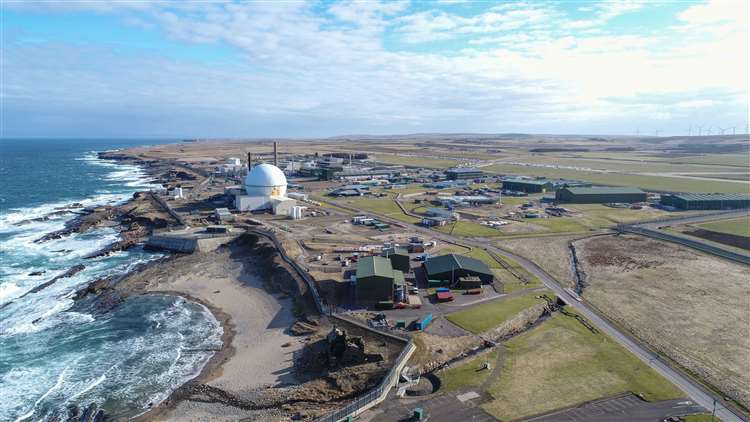
Allan Dorans , SNP MP for Ayr, Carrick and Cumnock:
Workers at the Dounreay nuclear power complex on Scotland’s north coast plan strike action
next month which will further delay the decommissioning of a plant which
started operating in 1955.
The Prospect, Unite and GMB unions are all
involved. The GMB, the main union for nuclear energy workers, champions
alongside Scottish Labour proposals for new nuclear power stations in
Scotland, despite widespread public opposition to them. The union also
helps to fund Labour candidates.
While it is always disturbing to hear of
industrial conflict at a nuclear plant, these strikes will in reality,
relatively speaking, make little difference to the decommissioning process.
Why? Decommissioning began in 2019 and the plan envisages taking 50-60
years to complete.
But “complete” doesn’t mean the same to the company
responsible for the clean-up and demolition of Dounreay, Magnox Ltd, what
it means to most of us, and the site will be under surveillance – ie, not
usable – for at least 300 years. Leaving aside for the moment the appalling
financial costs of nuclear decommissioning, rarely mentioned in Scottish
Labour’s campaign material, what about the costs for the local people and
the environment over the last nearly 70 years?
There have been three
significant accidents and countless smaller ones. On May 10, 1977, a
65-metre (213ft) deep shaft at the plant was packed with radioactive waste
with at least 2 kg of sodium and potassium. Seawater flooded in and
reacted violently with the sodium and potassium, blowing the huge steel and
concrete lids off the shaft. The explosion littered the area with
radioactive particles, with around 150 of these being found on the beach in
the following 20 years.
This was, according to the New Statesman in 1995,
the worst nuclear accident ever in the UK. Dounreay was never prosecuted.
Researchers based at Oxford University, reporting – conveniently for some
political forces – in July 2014 revisited earlier studies of the incidence
of leukaemia around Sellafield and Dounreay and concluded that children,
teenagers and young adults currently living close to the facilities were
not at an increased risk of developing cancers.
The researchers, who were
dependent upon UK Government grants for their survival, downplayed two
earlier studies that found a raised risk of leukaemia among 0 to
14-year-olds and 15- to 24-year-olds living within 12.5km of Dounreay
during the period 1979-84. A subsequent study in 1996 reported an excess of
childhood leukaemia and Non-Hodgkin’s Lymphoma (NHL) within 25 km of
Dounreay for the period 1968-93. The researchers do not tell us just how
many cases, how many more children and young adults than expected, had
developed these often-deadly cancers, but 1287 cases near seven nuclear
sites in Scotland were looked at in the second study.
Around Dounreay,
almost twice as many cases as expected were found. The difference was
greatest around Dounreay. If we share the 1287 cases among the seven sites,
we get around 180 cases near Dounreay, of which half or might not have
occurred if the plant had never been built. To, me that’s “significant”
and I feel sure it was for those young people and their families. With
every passing month, it becomes clearer that Scottish Labour must
reconsider their plans for a nuclear Scotland.
The National 29th April 2024
EDF wants public views on plans for Hinkley Point B decommissioning
By John Thorne Wednesday 17th April 2024
ENERGY firm EDF is carrying out a public consultation on its plans for the
decommissioning of Hinkley Point B nuclear power station, a process which
will continue into the 22nd century. The two Hinkley B reactors were shut
down in August, 2022, after 46 years of electricity generation, but will
not be able to be removed until about 2107. EDF has since been removing the
used fuel from the reactors in preparation for the station’s
decommissioning phase, which will involve dismantling and demolishing plant
and buildings on the site. More than half of the spent fuel stringers have
been removed from the first reactor and sent on in flasks for storage in
Sellafield, Cumbria.
West Somerset Free Press 17th April 2024
How much will extra decades of nuclear decommissioning work at Dounreay cost?
By Gordon Calder gordon.calder@hnmedia.co.uk, 28 March 2024
The cost of extending the decommissioning work at Dounreay is expected to
be published in the summer, according to a spokeswoman at the site.
She was responding to questions from the John O’ Groat Journal, following last
week’s announcement that the clean up-operation at the nuclear plant will
continue until the 2070s – almost 40 years longer than the previous date of
2033. The cost of the programme was previously said to be about £2.9
billion.
Asked about the estimated cost of extending the decommissioning,
the spokeswoman said: ” The estimate for delivering the revised lifetime
plan to take the Dounreay site to its interim end point, will form part of
the Nuclear Provision, and be published in the NDA (Nuclear Decommissioning
Authority) 2023/24 annual report in the summer. We are committed to
delivering the Dounreay mission as effectively and efficiently as
possible.”
John O’Groat Journal 28th March 2024
Dounreay decommissioning date ‘never achievable’ says Caithness councillor
CAITHNESS has been misled for the past 20 years over the
timescale for the decommissioning of Dounreay. The work was due to be
completed by 2033 but that target was “never technically practicable” and
“never achievable”, according to Struan Mackie, the chairman of the
Dounreay Stakeholder Group (DSG).
Mr Mackie, a Thurso and Northwest
Caithness Highland councillor, said: “We all know that the publicised
dates, the milestones communicated to our community, to our politicians and
to our supply chain for the last two decades have not been founded in
reality.
John O’Groat Journal 28th March 2024
1 This Month

of the week – Shut Down Drone Warfare!


Tell the Ukrainian Government to Drop Prosecution of Peace Activist Yurii Sheliazhenko

Petition to revoke the licensing of the Near Surface Nuclear Disposal Facility (NSDF) at Chalk River. https://www.ourcommons.ca/petitions/en/Petition/Details?Petition=e-7247
To see nuclear-related stories in greater depth and intensity – go to https://nuclearinformation.wordpress.com
-
Archives
- March 2026 (237)
- February 2026 (268)
- January 2026 (308)
- December 2025 (358)
- November 2025 (359)
- October 2025 (376)
- September 2025 (257)
- August 2025 (319)
- July 2025 (230)
- June 2025 (348)
- May 2025 (261)
- April 2025 (305)
-
Categories
- 1
- 1 NUCLEAR ISSUES
- business and costs
- climate change
- culture and arts
- ENERGY
- environment
- health
- history
- indigenous issues
- Legal
- marketing of nuclear
- media
- opposition to nuclear
- PERSONAL STORIES
- politics
- politics international
- Religion and ethics
- safety
- secrets,lies and civil liberties
- spinbuster
- technology
- Uranium
- wastes
- weapons and war
- Women
- 2 WORLD
- ACTION
- AFRICA
- Atrocities
- AUSTRALIA
- Christina's notes
- Christina's themes
- culture and arts
- Events
- Fuk 2022
- Fuk 2023
- Fukushima 2017
- Fukushima 2018
- fukushima 2019
- Fukushima 2020
- Fukushima 2021
- general
- global warming
- Humour (God we need it)
- Nuclear
- RARE EARTHS
- Reference
- resources – print
- Resources -audiovicual
- Weekly Newsletter
- World
- World Nuclear
- YouTube
-
RSS
Entries RSS
Comments RSS
 nuclear-news