There’s money in them thar nuclear wastes
Veolia Draws Upon Fukushima to Move Into Nuclear Dismantling, Bloomberg, By Tara Patel – Jan 15, 2013 Veolia Environnement SA (VIE), which treated radioactive water from Japan’s nuclear meltdown at Fukushima, plans to use the experience to move into decontamination and power plant dismantling.
The water utility and the nuclear research group known as CEA plan to earn as much as 400 million euros ($534 million) in revenue within about four years by cleaning radioactive sites and taking apart installations, they said today.
“The market is developing very quickly,” Veolia Chief Executive Officer Antoine Frerot told a press conference today in Paris. About 300 nuclear reactors will have to be halted worldwide within two decades including in France, Germany, Japan and the U.S., he said.
The shift into the atomic market comes after President Francois Hollande pledged to lower France’s dependence on the energy and shut the country’s oldest plant at Fessenheim. It’s also the first new market Veolia has publicly announced it will enter into since Frerot pledged to pull out of some countries and businesses in a bid to boost profit…… http://www.bloomberg.com/news/2013-01-15/veolia-draws-upon-fukushima-to-move-into-nuclear-dismantling-1-.html
$2 billion to shut down Quebec’s nuclear plant, but $4 billion to keep it open
The Parti Quebecois also announced it will set aside another $200 million in a
“diversification fund” to help the surrounding communities retrain
their workforces and spur alternative development opportunities.
Shutdown of Que. nuclear plant to cost $2B, Ifp
QMI Agency
December 28, 2012 MONTREAL – The licence for Quebec’s only
operational nuclear power plant expired Friday, and the provincial
government said it will spend hundreds of millions of dollars over the
next 50 years to dismantle the reactor.
The Parti Quebecois campaigned against refurbishing the plant,
claiming that the $4-billion price tag was financially unjustifiable, Continue reading
Lithuanian nuclear plant: decommissioning stalled due to company disputes
EU freezes Lithuanian nuclear plant decommissioning funds, EurActive 14 Dec 12 The European Commission announced yesterday (13 December) that international donors, among which the largest is the EU, have decided to suspend the funding of one specific decommissioning project in the Ignalina Nuclear Power Plant in Lithuania. The project covers the construction of the storage area for the leftover spent fuel and the supply of storage casks for defueling the central’s two reactors.
The decision was taken on the grounds that the operator of the power plant (INPP) and the consortium delivering the project (GNS/NUKEM) have not managed to settle their dispute, now on-going for more than two years, on how to implement the project concretely. Nukem is a “dual national” company based in Germany (NUKEM GmbH) and the United States (NUKEM, Inc.) focused on the civil nuclear fuel market. Continue reading
Britain’s taxpayers up for more than 100 billion pounds in nuclear cleanup
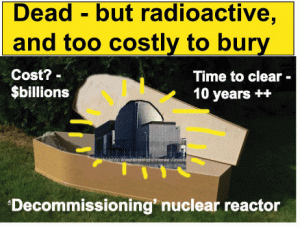 Nuclear clean-up to cost £100bn and take 120 years. Decommissioning, no2nuclearpower, 9 December 2012 BRITAIN’S taxpayers will be landed with a bill of more than £100bn for cleaning up radioactive waste from sites such as Sellafield and Dounreay, according to the chief executive of the Nuclear Decommissioning Authority (NDA).
The amount represents a near-doubling of the £56bn cleanup cost announced when the NDA began operating in 2005, and could rise still more. The warning comes as NDA  engineers start work on some of the biggest and most expensive engineering projects seen in Britain — building giant robotic grabs to lift deadly nuclear waste from Sellafield’s decaying 1950s repositories.
The buildings being targeted include Sellafield’s B29 and B30 cooling ponds, where decaying 1950s fuel rods are stored. This weekend John Clarke, chief executive of the NDA, said he was spending £3bn a year on the cleanup, with about £1.6bn of that going on Sellafield alone. Such sums are similar to those spent on the London Olympic site at the peak of construction.
Figures released by the Department of Energy and Climate Change show that, since Britain’s first nuclear power station opened in 1956, they have generated 2.5 billion megawatt hours of electricity — worth £125 billion at today’s prices. If the cost of building Britain’s 20-odd nuclear power stations (around £10bn-£12bn each in today’s money), is included, it would far exceed the value of the power produced, say experts.
Such figures show why power companies, which would be responsible for the waste, are refusing to build new nuclear power stations without government guarantees of a consumer subsidy that will almost double the market price for their power.
Sunday Times 9th Dec 2012 more >> http://www.no2nuclearpower.org.uk/news/daily12/daily.php?dailynewsid=343
Despite the hype, the nuclear industry is nervous about its future
 Nuclear industry faces up to reality of ‘interesting times’ The
  Engineer, 7 December 2012 | ByStuart Nathan ”………Part of the problem is that the nuclear landscape is so complicated, especially in the UK, with its history as a nuclear
pioneer and the legagcy of experiment that has left behind. John Clarke of the Nuclear Decommissioning Authority, again reflecting the mood of realism, put it in a way which pretty much everyone would understand. ‘It’s like telling children to put their toys away before getting out new ones. Clearing up the mess is a key enabler to new build.’
…… .it’s relatively easy to put toys away. Nuclear is different. ‘At Sellafield, we’re dealing with structures which were put up in the 1940s in great haste to support military programmes, where the only concern was “is it safe for today”,’ he said. ‘They were neverdesigned to have waste taken out of them, and the waste is poorly categorised — we often don’t really know what it is.’
The situation isn’t much better even at industrial-scale power stations, said Peter Walkden, commercial director of Magnox. ‘It was never going to be easy to decommission a 50 year old plant that was never designed to be decommissioned, under a regime that was designed for operation,’ he said. Decommissioning a Magnox plant takes the best part of a century — three years to defuel, then ten years of preparation for care and maintenance while radioactivity subsides (the stage that current decommissioning projects are in), followed by 85 years of care and maintenance, then about ten years to clear the site.
A bit more than just putting the toys away, and something that can’t be done before building new plants’. ….”
Lucrative business for nuclear companies in the complex cleanup of UK’s Sellafield site
 multinationals are aligning themselves into strategic relationships to attract the highly lucrative subcontracts coming on stream. Multi-disciplinary consultant Atkins recently formed a joint venture with French-based nuclear specialist Areva to bid for tier two work on decommissioning and fuel management projects in the UK.
Nuclear Legacy, The Construction Index, 23 Nov 12“…….To speed up the process, Sellafield Ltd, the site licence company owned by PBO Nuclear Management Partners (NMP), has started to implement a series of strategic alliances with a combined value of £9bn.
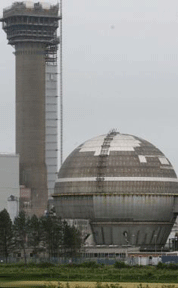 The first framework agreement – The Design Services Alliance – was awarded in February: a £1.5bn contract to The Progressive Alliance (led by Babcock and URS) and AXIOM (a consortium of Amec, Jacobs, Mott McDonald and Assystem). It is expected to extend to 15 years. Continue reading
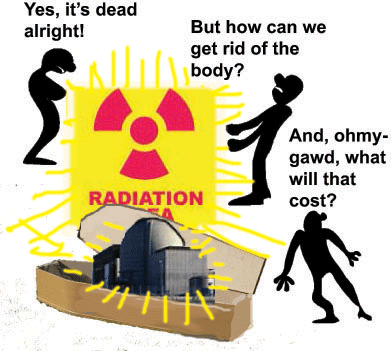
The costly problem Europe now faces – burying dead nuclear reactors
Only a handful of reactors worldwide have been fully dismantled, meaning the process is largely uncharted territory. Tearing apart reactor cores, for instance, creates unknown challenges and potential risks given the level of radiation inside them.
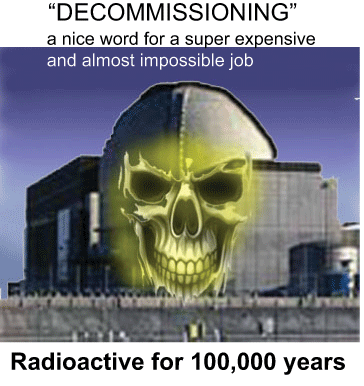
Aging Nuke Plants Add to Europe’s Economic Woes , Washingtpn Examiner, By GARY PEACH Associated Press VISAGINAS, Lithuania November 17, 2012 (AP) The parking lot outside the atomic power plant is weedy and potholed. Bus stops that once teemed with hundreds of workers are eerily empty.
Yet the stillness at Ignalina, a Lithuanian nuclear plant built in the 1980s Soviet era, belies an unsettling fact: There is still nuclear fuel inside one of its two reactors, three years after it was shut due to safety concerns.
A temporary storage facility for spent fuel and radioactive waste is four years behind schedule, creating a money drain at a time when the 27-nation European Union grapples with a crippling economic crisis. States don’t need EU permission to build nuclear plants, but they need to abide by its safety rules and the problems at Ignalina have provoked threats from the EU to cut the funding promised for dismantling it. That raises concerns that the facility will be around for years, possibly decades, longer than planned.
Ignalina is turning out to be a hard lesson for Europe: It’s one thing to kill a nuclear power station; getting rid of the remains is another headache entirely. Continue reading
No real planning for burying Europe’s aging nuclear reactors
Aging Nuke Plants Add to Europe’s Economic Woes, By GARY PEACH Washington Examiner, Associated Press VISAGINAS, Lithuania November 17, 2012“…….Other EU countries will have to foot the bill for closing their own plants, adding to taxpayers’ woes. In Germany, it will be in addition to energy price increases as the government scrambles to finance an ambitious switch from nuclear to renewables, which should account for 60 percent of total energy consumption by 2030.
Just last month Germany’s main utilities announced that households could see their
electricity bill jump up to 50 percent in order to finance this transition from nuclear power.
Experts say that disassembling atomic plants promises to be far costlier than previously estimated, given the lack of experience worldwide and nuclear operators’ propensity to underestimate decommissioning costs to make new projects look more attractive.
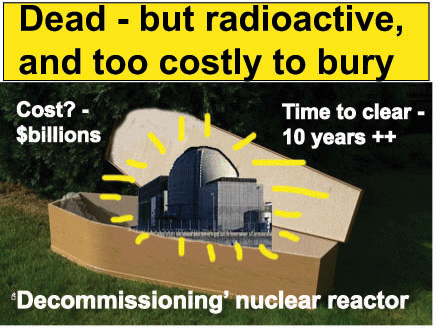
Thomas of Greenwich University said in Britain nuclear operators were supposed to pay for the decommissioning, but over the decades the cost was passed to the government, which will have to come up with €120 billion ($153 billion) over the next century to dismantle the
country’s existing nuclear power plants.
Just abandoning the facilities with radioactivity trapped inside is not an option. But given the enormous expenditures, some governments are opting to drag out the decommissioning over many decades…… http://washingtonexaminer.com/aging-nuke-plants-add-to-europes-economic-woes/article/2513836
UK’s nuclear decommissioning problems
What’s the future of nuclear decommissioning? Building.co.uk, 16 November 2012 | By Will Hurst Last week’s devastating National Audit Office report on decommissioning facilities at Sellafield has led many to question whether the UK has the skills needed to deal with nuclear waste. But does the problem really lie with a Nuclear Decommissioning Authority overly occupied with cutting costs? Will Hurst investigates. Continue reading
Germany’s lengthy process of dismantling nuclear power plants
Fears of low nuclear radiation run high, DW, 08.11.2012 Wolfgang Dick Decommissioned German nuclear power plants will be dismantled over the long term. Though no incidents have occurred in Germany, some citizen initiatives say legal safety measures are too lax.
Vattenfall, the company that runs the Brunsbüttel nuclear plant, recently applied to the Environment Ministry in the state of Schleswig Holstein for a permit to tear down the facility. The whole unit is supposed to be completely dismantled, rather than sealed over with a
concrete sarcophagus in the style of the Chernobyl reactor.
Since the German government decided to phase out nuclear power last year, the country has been gathering some experience dismantling nuclear power plants: Continue reading
Quebec to close down its nuclear reactor
 Quebec will close, rather than refurbish, its only nuclear reactor. Montreal Gazette, 12 Set 12, Nearly 30 years after it went into operation, it appears the days are numbered for Quebec’s only operating nuclear power plant.
A spokesperson for the Parti Québécois said the newly-elected government will go ahead with a plan to close Gentilly-2 in Bécancour. The party has wanted to do it since December 2009, Éric Gamache said….
. Gordon Edwards, a mathematician and president of the Canadian Coalition for Nuclear Responsibility, said after it is closed, Gentilly-2 could be transformed into a centre of expertise on dismantling nuclear power plants. Nearly 100 nuclear power plants in
the U.S. will soon come to the end of their natural life, creating a “great” opportunity for Trois-Rivières, he said. http://blogs.montrealgazette.com/2012/09/12/parti-quebecois-says-it-will-keep-promise-to-close-gentilly-2-nuclear-power-plant/
Veil of secrecy over France’s unaffordable nuclear power decommissioning
 “What is not tolerable is that the funds are managed by the operators”
Over the past six years there has been a veritable veil pulled over this subject.”
 French Nuclear Dismantling Funds May Fall Short, Report Says http://www.bloomberg.com/news/2012-07-24/french-nuclear-dismantling-funds-may-fall-short-report-says.html By Tara Patel – Jul 24, 2012 Electricite de France SA and Areva SA (AREVA), along with other French nuclear operators, may not be setting aside enough funds to pay for future dismantling of reactors and treatment and storage of atomic waste, according to a parliamentary report. Continue reading
There’s money to be made in nuclear decommissioning
 Olympic Park builder eyes nuclear wind-down deal http://www.independent.co.uk/news/business/news/olympic-park-builder-eyes-nuclear-winddown-deal-7965171.html MARK LEFTLY MONDAY 23 JULY 2012 The US group that led construction of the Olympic Park and a New York-listed rival are the latest companies considering bids to oversee the UK’s £5bn nuclear decommissioning programme. Continue reading
“Waste Confidence Rule” allows nuclear waste keep growing, with no solution!
the NRC also stated that it ‘retains confidence that spent fuel can be safely stored with no significant environmental impact until a repository can reasonably be expected to be available and that the Commission has a target date for the availability of the repository in that circumstance’”
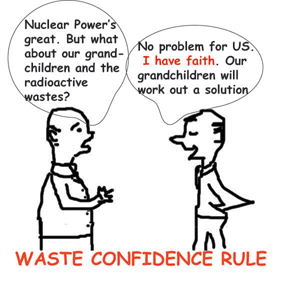
As a result of its confidence in the safety of spent fuel storage, NRC rules note that “no discussion of any environmental impact of spent fuel storage in reactor facility storage pools or independent spent fuel storage installations for the period following the term of the reactor operating license . . . is required in any environmental report, environmental impact statement, environmental assessment or other analysis prepared in connection with the issuance or amendment of an operating license for a nuclear reactor,”

 Group seeks to have spent fuel a factor in re-licensing Limerick plant The Mercury By Evan Brandt 07/17/12 LIMERICK “…….Spent fuel rods are what remains after the uranium pellets inside the fuel rods in a reactor no longer generate enough heat to create the steam that turns the turbines and generates electricity at a nuclear power plant.
Although cooler, this spent fuel remains radioactive to some extent for hundreds of years. For years, spent fuel was kept in concrete “spent fuel pools” located inside a nuclear plant and filled with water to keep it from overheating.
According to the NRDC filing, in 2008 NRC proposed “‘remov(ing) its expectation that a repository (for spent fuel) will be available by 2025’ and acknowledged that its previous finding that sufficient disposal capacity would be available within 30 years after any
reactor’s licensed life ‘is not supportable.’” Continue reading
For relicensing nuclear plants, Nuclear Regulatory Commission does not consider costs of spent fuel disposal
Paradoxically, while the NRC allows potential earnings from a re-licensed plant to be considered as a way to cover the costs of plant shut-down, it does not consider the potential for those added years of operation to generate additional spent fuel when calculating the cost of shutting the plant down.
Group seeks to have spent fuel a factor in re-licensing Limerick plant The Mercury By Evan Brandt 07/17/12 LIMERICK — Despite a recent federal court ruling invalidating a rule that would allow storage of radioactive spent nuclear fuel rods at nuclear power plants for 60 years after they’ve closed, the Nuclear Regulatory Commission has no plans to consider the issue when deciding on whether to re-license Exelon Nuclear’s Limerick Generating Station for an additional 20 years.
The National Resources Defense Council disagrees with that position and filed papers July 9 seeking to amend its challenge to Exelon’s re-licensing application Continue reading
1 This Month

of the week – Shut Down Drone Warfare!


Tell the Ukrainian Government to Drop Prosecution of Peace Activist Yurii Sheliazhenko

Petition to revoke the licensing of the Near Surface Nuclear Disposal Facility (NSDF) at Chalk River. https://www.ourcommons.ca/petitions/en/Petition/Details?Petition=e-7247
To see nuclear-related stories in greater depth and intensity – go to https://nuclearinformation.wordpress.com
-
Archives
- April 2026 (103)
- March 2026 (251)
- February 2026 (268)
- January 2026 (308)
- December 2025 (358)
- November 2025 (359)
- October 2025 (376)
- September 2025 (257)
- August 2025 (319)
- July 2025 (230)
- June 2025 (348)
- May 2025 (261)
-
Categories
- 1
- 1 NUCLEAR ISSUES
- business and costs
- climate change
- culture and arts
- ENERGY
- environment
- health
- history
- indigenous issues
- Legal
- marketing of nuclear
- media
- opposition to nuclear
- PERSONAL STORIES
- politics
- politics international
- Religion and ethics
- safety
- secrets,lies and civil liberties
- spinbuster
- technology
- Uranium
- wastes
- weapons and war
- Women
- 2 WORLD
- ACTION
- AFRICA
- Atrocities
- AUSTRALIA
- Christina's notes
- Christina's themes
- culture and arts
- Events
- Fuk 2022
- Fuk 2023
- Fukushima 2017
- Fukushima 2018
- fukushima 2019
- Fukushima 2020
- Fukushima 2021
- general
- global warming
- Humour (God we need it)
- Nuclear
- RARE EARTHS
- Reference
- resources – print
- Resources -audiovicual
- Weekly Newsletter
- World
- World Nuclear
- YouTube
-
RSS
Entries RSS
Comments RSS
 nuclear-news