America’s Nuclear Regulatory Commission set to exempt nuclear corporations from safety costs and liabilities

 US nuclear industry’s plan thanks to NRC: let taxpayers carry the can for closed power plants, Ecologist Linda Pentz Gunter13th May 2016 With five reactors closed in the last three years, the US nuclear industry is in shutdown mode, writes Linda Pentz Gunter – and that means big spending on decommissioning. But now the nuclear regulator is set to exempt owners from safety and emergency costs at their closed plants – allowing them to walk away from the costs and liabilities, and palm them onto taxpayers.
Aging and dangerous nuclear power plants are closing. This should be cause for celebration. We will all be safer now, right? Well, not exactly.
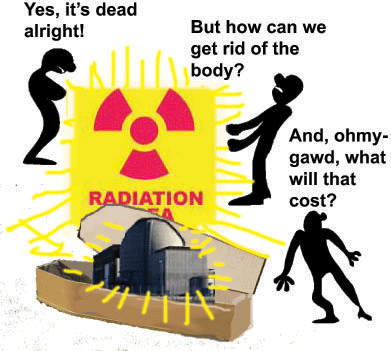 US nuclear power plant owners are currently pouring resources into efforts to circumvent the already virtually non-existent regulations for the dismantlement and decommissioning of permanently closed nuclear reactors.
And sad to say, many on the US Nuclear Regulatory Commission (NRC), the industry’s ever compliant lapdog, are trotting happily by their side.
There is an occasional lone critic. NRC Commissioner Jeff Baran, observed that the“NRC does not currently have regulations specifically tailored for this transition from operations to decommissioning. As a result, licensees with reactors transitioning to decommissioning routinely seek exemptions from many of the regulations applicable to operating reactors.”
The inevitable result is that reactor owners will successfully avoid spending money now on decommissioning as they seek to delay beginning the actual cleanup work for the next half century and maybe longer. Later, when it comes time to finish the job, the owners – and the money – could well be long gone.
US reactor owners rely on ‘decommissioning trust fund’ investments to pay for decommissioning activities. But these are failing to accrue adequate funds to do the job. Many of the trusts are incurring annual losses on their investments.
In fact, the US Government Accountability Office (GAO) has found the NRC’s financing formula for decommissioning trust funds to be fundamentally flawed, resulting in the utilities ability to accrue only 57% to 75% of the needed funds……..http://www.theecologist.org/News/news_analysis/2987679/us_nuclear_industrys_plan_thanks_to_nrc_let_taxpayers_carry_the_can_for_closed_power_plants.html
The options for decommissioning a nuclear plant
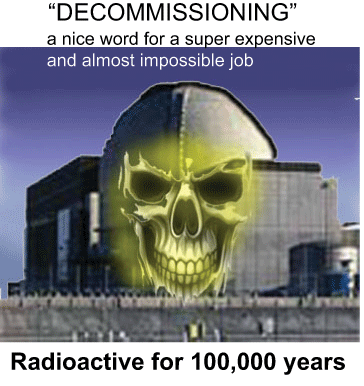 US nuclear industry’s plan thanks to NRC: let taxpayers carry the can for closed power plants, Ecologist Linda Pentz Gunter13th May 2016 “…….There are currently three decommissioning options when a reactor closes. They are known by apparent acronyms that are really just capitalized slogans, masking the flaws behind all three.
DECON refers to prompt dismantlement. This sounds promising for all sides, dispensing with the whole decommissioning process and its attendant costs, headaches and liabilities in about 10 years.
In principle DECON is supported by environmental and anti-nuclear groups, but with one giant caveat: the radioactive waste that remains on site after decommissioning of the reactor, must be adequately safeguarded.
Under the current regulatory scheme, the NRC allows the licensee to offload the irradiated nuclear fuel from the spent fuel storage pools into dry storage casks. These are not adequately protected from security threats. Nor is there any contingency to re-contain nuclear waste should it begin leaking from one of these casks.
Current casks designs are qualified for on-site nuclear waste storage for only 20 years and re-certified for four additional cycles. Some of these cask designs have already experienced degradation of protective seals and concrete shielding after less than a decade of use.
Of greatest concern, the casks are situated outside, closely congregated, on open tarmacs raising security concerns for their vulnerability to attack.
Consequently, the anti-nuclear and environmental groups that support DECON insist on the implementation of enhanced security called ‘Hardened On-Site Storage’, or HOSS to minimize these risks.
Rather than storing dozens of vulnerable dry-casks right next to each other in the open air, HOSS better secures the nuclear waste in above-ground individualized casks. These casks are fortified within modules of concentric capped silos of concrete and steel surrounded by earthen mounds.
The HOSS canisters would be dispersed over a wider area than traditional cask storage and would be better positioned to withstand a range and combination of weapons, explosives, and attacks, including anti-tank missiles, aircraft impacts, and car bombs.
Currently, reactor owners are not permitted to spend decommissioning funds on nuclear waste management as part of the DECON process. Nor do utilities want to go to the added expense of HOSS, which is not currently being considered by federal agencies, despite hundreds of petitioning groups and thousands of signatories to make HOSS a nuclear security priority at operating reactors as well as decommissioned sites.
A small number of reactors across the world have already used DECON (but without HOSS.) According to the Paris-based Organization of Economic Cooperation and Development, of the nearly 150 nuclear power reactors that have ceased operation worldwide to date, only 16 units have completed the ‘DECON’ decommissioning process with 10 of those units in the United States taking on average 10 years to complete.
What ‘SAFSTOR’ really means: ‘mothball’ and walk away
The second option, euphemistically-named SAFSTOR, or ‘safe store’, allows owners to take up to 60 years from the day the reactor closes to complete decommissioning. This would effectively enable owners to delay the start of decommissioning for 50 years, leaving the reactor and fuel pools mothballed until then and the local communities at risk.
Unsurprisingly, this is the option that is increasingly favored by reactor owners, who are petitioning the NRC for across-the-board cost cutting under SAFSTOR, regardless of the specific conditions of the individual reactor sites.
Entergy Vice President, Michael Twomey, even told Vermont state legislators in reference to the decommissioning of its Vermont Yankee nuclear reactor, that if the process is not complete in 60 years the company is fully within its rights to simply walk away, and if challenged, would litigate. Vermont Yankee closed on December 29, 2014.
The third option is ENTOMB. Without any regulatory guidance or legal framework, it allows utilities to essentially avoid decommissioning altogether. It is the option when no other options exist, as is the case at Chernobyl.
The exploded Chernobyl containment was eventually shrouded in a giant concrete sarcophagus at great expense and resulting in radiological exposure to hundreds of thousands of laborers. That structure is now being encased with a new, high-tech “Arch”, again at vast expense. However, for regular decommissioning activities, ENTOMB should be viewed as a last resort and not as a strategy for escaping liability.
Waste management is nuclear power’s most painful Achilles’ heel
The waste management aspect of the decommissioning process remains the industry’s most painful Achilles’ heel. Despite successfully suing the Department of Energy for failure to remove the waste, as promised, to a final repository site, utilities are seeking to avoid using those funds for waste management.
Instead, utilities are seeking to siphon off decommissioning trust funds to build and manage the necessary on-site Independent Spent Fuel Storage Installation (ISFSI) to house irradiated fuel from a closed reactor. An ISFSI is not currently considered part of a legitimate decommissioning process covered by the trust fund.
The delays wrought by such wrangling means that irradiated fuel sits in densely packed storage pools inside the reactor – and in the case of the 30 remaining GE Mark I and II reactors in the US, on the roof. (The GE designs are the same as those that melted down and exploded at Fukushima.)
The fuel pools are over-packed because of inadequate existing on-site storage facilities. But delays in offloading them, even while the reactor is still running, never mind when it closes, represent one of the greatest risks to public health, safety and security. A catastrophic fire, aircraft impact or other disaster that released vast amounts of radioactive fallout from the high-density storage pools could contaminate entire regions potentially indefinitely.
“The four ongoing disasters at Fukushima Daiichi have clearly shown the vulnerability of nuclear power plants that have spent nuclear fuel stored in these overcrowded and unprotected spent fuel pools”, Gundersen wrote in his comments to the NRC.
Fuel pools at closed US nuclear plants are a Fukushima waiting to happen
This is the principle reason to oppose SAFSTOR, safety experts say. Not only will the fuel remain in the pools, and in poorly protected waste casks, but protections and safety measures will be reduced. This is already exemplified in Vermont where the NRC has allowed Entergy to dismantle its emergency plan around Vermont Yankee and reduce inspections on the ventilation system near the spent fuel pool.
As Gundersen points out, the Vermont Yankee fuel pool still “contains more highly radioactive waste than was held in any of the fuel pools at Fukushima Daiichi.”
With a Fukushima-scale disaster is a real possibility even at closed reactors, critics are urging the NRC not to rubber stamp exemption requests. In the event of a nuclear catastrophe, evacuations downwind and downstream cannot be assumed to go well if emergency preparedness was discontinued months, years, or even decades earlier.
Even plans for site cleanup and decontamination are inadequate and have been watered down by the NRC itself. Site release criteria currently mandate clearing away surface soil down to three feet. But strontium-90 has been found far deeper on the Vermont Yankee site already. The NRC limit would open the way for strontium and potentially other isotopes resting deeper than three feet to migrate down into groundwater and potentially later to drinking water.
Instead, there should be more thorough post-decommissioning environmental analyses of where and how much residual radioactivity has been left behind in soil and water before power companies are allowed to walk away from accountability and liability.
To do decommissioning right, Gundersen argues that the state ratepayers should control decommissioning funds not the utility, because it is their money.
And, he says, decommissioning should be undertaken in such a way that operators “assure that those plants are promptly and safely decommissioned without unwarranted radiological contamination of the environment and extended cleanup and mitigation costs passed on to ratepayers or taxpayers.”
Linda Pentz Gunter is the international specialist at Beyond Nuclear, a Takoma Park, MD environmental advocacy group. http://www.theecologist.org/News/news_analysis/2987679/us_nuclear_industrys_plan_thanks_to_nrc_let_taxpayers_carry_the_can_for_closed_power_plants.html
Germany wrestles with the dilemma of disposing of dead nuclear reactors and thier toxic wastes
Nuclear reactor sites: Dismantle or fence off? http://www.dw.com/en/nuclear-reactor-sites-dismantle-or-fence-off/a-19111969, 26 Apr 16, Three decades after the Chernobyl disaster, Germany is preparing to go nuclear-free. Industry plans to dismantle and dispose of radioactive waste. But some green campaigners say it’s safer to leave reactor sites as-is.
Thirty years ago, the Chernobyl disaster released radioactivity that spread across much of the northern hemisphere into the atmosphere. It also spurred social movements around the world to demand an end to nuclear power.
In Germany, that end is finally in sight ,as the country prepares to go nuclear-free by 2022. But the task of safely decommissioning and dismantling nuclear power stations promises to be expensive and controversial, and will take many years.
Debate rages over how to dispose of highly radioactive spent fuel rods from commercial nuclear power stations. But there is less awareness around how the dissolving industry and its regulators must also decide what to do with disused reactor sites.
Masses of equipment and a variety of buildings at the sites were exposed to nuclear fission reaction products for years, and have become slightly or moderately radioactive as a result. Therein lies the crux of the disposal problem.
Big money, long time
The consultancy ADL has estimated it will take about two decades to fully dismantle Germany’s 17 nuclear reactor sites, and cost at least 18 billion euros – not including the cost of subsequent radioactive waste disposal.
Why will it take so long and cost so much? DW posed this question to E.ON, Germany’s largest electricity utility and owner of 11 nuclear power stations – most of them already shut down.
An E.ON spokesperson said dismantling of reactor sites must take place in stages. First, spent uranium fuel rods must be transported off-site, to interim storage elsewhere. This can’t happen until four or five years after a reactor is shut down, because the fuel rods’ radioactivity first needs to decrease sufficiently for their safe handling to become possible.
Dismantling equipment is then expected to take 10 to 15 years. Final demolition of remaining buildings and site remediation will take another two to three years after all radioactive materials have been removed from the former reactor site.
Radioactive waste materials can be treated by a variety of means – compression, desiccation, enclosure in cement, or burning to ash – to reduce total volume prior to packing, shipping, and final disposal in an approved secure long-term storage site, E.ON said.
Put it in a deep, dry hole
Schacht Konrad, a disused iron-ore mine shaft near the German town of Salzgitter, is under consideration as the national site for the final disposal of low- to medium-grade radioactive materials.
The mine was chosen because it is particularly dry inside – reducing the risk of radioactive materials dissolving and entering into the groundwater. It’s meant to take in around 90 percent (by volume) of all the radioactive rubble from decontaminated nuclear sites in Germany – but only the mildly radioactive stuff.
German law specifies a threshold of very low radioactivity below which materials are deemed safe. Materials that fall below the threshold can legally be disposed of through the regular waste disposal system. But some anti-nuclear campaigners insist there’s no safe threshold, however low.
In contrast to low-level, mildly radioactive waste from former reactor sites, highly radioactive waste – including spent fuel rods – will be left in cooling ponds on closed-down reactor sites for some decades. Ultimately, they’ll be disposed of in one or more special high-security repositories. The location of those repositories is highly contentious, and has not yet been settled.
Leave them where they’re standing?
While the government and nuclear industry are keen to get on with dismantling and removing reactors soon after they’re shut down, Jörg Schmid and Henrik Paulitz of the German division of the International Physicians for the Prevention of Nuclear War (IPPNW) think perhaps they shouldn’t be dismantled at all.
“Dismantling nuclear reactors is expensive and poses health dangers,” according to an IPPNW report in German published in January of this year.
In the report, Schmid and Paulitz say that serious consideration should be given to the option of securely fencing off old nuclear reactor sites and allowing low-level radioactivity from contaminated buildings and equipment to recede over decades.
The IPPNW’s preferred solution would see heavily contaminated elements such as spent fuel rods be removed immediately, while the less-contaminated buildings and equipment would be left in situ indefinitely.
This would avoid dispersing the radioactive material more widely, and minimize risk to human populations, the study’s authors argue.
E.ON told DW that fencing off sites was neither more nor less safe than dismantling them – but argued that dismantling is a better solution in terms of the labor market consequences.
“IPPNW’s option would mean that 300 to 400 people who work at a nuclear site would abruptly lose their jobs,” the spokesperson said.
But Paulitz countered: “The nuclear industry must answer the question: is the proposed dismantling of the reactor sites a necessary measure, or is it just a new multi-billion-euro industry?”
Radioactive steel in children’s bedrooms?
About 99 percent of the total mass of material at a former nuclear site is radioactive at such a low level that it is deemed safe – so the material is no longer covered by nuclear safety regulations and can be released into the environment, according to IPPNW’s Schmid, who is a medical doctor.
But Schmid said that what matters is total radiation exposure over time. If very large amounts of very weakly radioactive material are dispersed through the environment, for example by being reintroduced into material supply chains, that represents a significant amount of broadcast radiation exposure over time.
Dismantling nuclear power plants, Paulitz said, leads to a problem: “The great majority of the site’s materials won’t be classified as nuclear waste, and will instead be disposed of in ordinary household waste streams, or even recycled into normal supply chains.”
“From a health and safety perspective, we see this as irresponsible.” Paulitz said, as weakly radioactive steel taken from a dismantled nuclear site could end up built into a radiator in a child’s bedroom, for example.
Nuclear companies’ new bonanza industry – cleaning up the radioactive mess they made
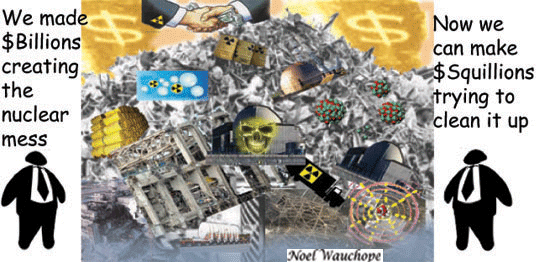
Nuclear costs in uncharted territory http://www.eco-business.com/news/nuclear-costs-in-uncharted-territory/ As some governments press on with new nuclear installations to address climate change, a multi-billion dollar industry will be needed to make safe old power plants and their hazardous waste. Climate News Network 19 April 2016 If you want a job for life, go into the nuclear industry – not building power plants, but taking them down and making them safe, along with highly-radioactive spent fuel and other hazardous waste involved.
The market for decommissioning nuclear sites is unbelievably large. Sixteen nations in Europe alone face a €253 billion waste bill, and the continent has only just begun to tackle the problem.
Among the many difficulties the industry faces is lack of trained people to do the highly-paid work. Anyone who enters the business is likely to be sought after for the rest of their career because the job of decommissioning Europe’s nuclear sites alone will take more than 100 years – even if no new nuclear power stations are ever built.
Add to the European nuclear legacy the dozens of old nuclear power stations in North America, Japan, Russia and central Asia, and nuclear decommissioning could already be classed as one of the biggest industries in the world, and it can only grow.
And this does not count the millions of dollars still being spent annually to contain the damage from the nuclear accidents in Chernobyl, Russia, in 1986, and Fukushima, Japan, in 2011.
Longer-term problem
So far, the nuclear industry has largely avoided drawing too much attention to this legacy, emphasising that its sites are safe, and concentrating instead on claiming that new nuclear stations are the answer to climate change.
But this approach has not solved the longer-term problem of how to safely contain the radioactivity of old sites to avoid damaging future generations.
The UK, one of the countries with the largest nuclear waste problem, is also currently spending most money trying to make it safe. One site alone − Sellafieldin Cumbria, northwest England − is spending £2 billion a year on cleaning up its waste and expects the total bill to be around £50 billion.
But that is almost certain to rise. There are 240 operational nuclear buildings on the site, and 11 major construction projects aimed at containing the waste problem.
Twelve other old nuclear sites in the UK, where reactors have already been shut down, are costing £600 million a year to clean up, a process that will take until 2027.
Even then, the job will not be finished. All that money will have been spent on reducing the hulks to a “care and maintenance basis” so they can be guarded for decades until it is decided to demolish them altogether when it is safe to do so.
It is probably because the UK is spending so much money already that theNuclear Decommissioning Conference for Europe is being held in the northern England city of Manchester on May 31 to June 1. All the major nuclear companies in Europe, and many international businesses hoping to cash in on this new industry, will be attending.
But the UK is only one major market, and France is potentially even larger. Although it has not yet decommissioned its nuclear stations, it is about to start doing so and has 58 reactors to dismantle. Germany, like the UK, has already begun its programme, with nine reactors shut down and another eight to be closed by 2022.
Primary task
In total, there are 200 reactors worldwide due to be shut down by 2025.
But while the primary task of the current decommissioning programme is to make reactors safe by removing their old fuel and storing it, one of the major problems of the industry is nowhere near solved.
All over the world, governments have tried and failed to find sites where they can store the vast quantities of radioactive waste that has arisen from nuclear weapons programmes, nuclear submarine and ship propulsion systems, and the civil nuclear industry. The waste needs to be isolated from human beings for as much as 250,000 years to make it safe.
Only one country, Sweden, has a workable plan for a deep disposal repository. Elsewhere, many plans have been tried and abandoned, either because of political opposition or unfavourable geology.
So nobody knows yet how much this epic problem is going to cost, or how many decades will pass before it is under control. As the brochure for the conference puts it: “Estimating lifetime costs is a journey into uncharted territory.” No wonder executives from many companies are paying up to £1,500 each to attend.
France’s nuclear corporation faces massive costs for decommissioning nuclear reactors
Nuclear reactor clean-up weighs on EDF, FT.com, 19 Apr 16, Michael Stothard in Paris French utility faces questions about whether it has set aside enough to decommission power plants
In 1997 French utility EDF started to dismantle its first nuclear power plant, a 30-year-old heavy water reactor in Brennilis, north-western France. It was expected to cost €250m.
The bill is now set to be at least half as much again, and the decommissioning is still not done. In fact, there has never been a full dismantling of a reactor in France, the only European country to get three-quarters of its electricity from nuclear power.
EDF, the operator of all 58 of France’s reactors, is preparing to build a new £18bn plant at Hinkley Point in the UK that some at the Paris-based company have warned is too dangerous given its stretched balance sheet. EDF’s other big reactor project, at Flamanville in France, is already six years behind schedule and €7.2bn over budget.
Hinkley and Flamanville have focused attention on another looming challenge for EDF: has the company set aside enough money to cover the huge cost of dismantling and cleaning up its existing nuclear power stations in France?
Unlike the UK, where the state has assumed much of the financial risk of taking apart nuclear reactors, in France it all falls on EDF, which has established a €23bn special fund for this purpose.
The €23bn — much of it invested in equities and bonds — has been set aside to cover what EDF estimates will be the €54bn cost of decommissioning the 58 reactors and safely storing their radioactive waste. This includes €23bn for dismantling the power stations, and €26bn for managing spent fuel………..
EDF faces several major investments. As well as the £18bn Hinkley Point project, EDF is involved in bailing out reactor designer Areva by buying a controlling stake in its reactor business for €2.5bn. It is also extending the life of France’s existing nuclear power stations until 2025, at a cost of €55bn.
And it is not just the decommissioning of the 58 reactors that is of concern. The estimated cost of storing radioactive waste — potentially for thousands of years — has been steadily rising………..http://www.ft.com/cms/s/0/c82ae2c4-0582-11e6-9b51-0fb5e65703ce.html#axzz46IzsG72i
Amusement Park built from failed $5.3 billion nuclear reprocessing plant
This failed $5.3 billion nuclear power plant in Germany is now an amusement park that gets hundreds of thousands of visitors each year (great photos) http://www.businessinsider.com/nuclear-power-plant-into-amusement-park-2016-4/?r=AU&IR=TCourtney Verrill
The SNR-300 was supposed to be Germany’s first fast breeder nuclear reactor when construction began in 1972. The reactor was made to use plutonium as fuel, and it would output 327 megawatts of energy.
Built in Kalkar, the government had some concerns about the safety of the nuclear reactor, which delayed construction. The power plant was finished in 1985 — $5.3 billion later.
But after the Chernobyl disaster in 1986, the SNR-300 never got a chance to fully operate, and by 1991 the project was officially canceled.
This left the power plant completely unused, and it was eventually sold to a Dutch investor who decided to turn it into an amusement park: Wunderland Kalkar.
Scepticism on San Onofre nuclear station cleanup plan
 O.C. Watchdog: Could there be an ‘early’ nuclear cleanup at San Onofre? Orange County Register, By TERI SFORZA / March 23, 2016 Federal efforts to speed up the removal of spent radioactive fuel from power plants like the mothballed San Onofre Nuclear Generating Station are gaining momentum and inspiring guarded optimism among local officials.
Critics, however, remain deeply skeptical.
In January, the U.S. Department of Energy launched a new push to create temporary nuclear waste storage sites in regions eager for the business, currently in West Texas and New Mexico.
Several such sites could be up and running while the prickly question of finding a location for a permanent repository – the root of the present paralysis in nuclear waste disposal – is hashed out.
“That could mean moving the fuel from San Onofre a decade earlier than is envisioned now, maybe more,” said David Victor, who chairs the San Onofre Community Engagement Panel. The volunteer group of academic, industry, environmental and local government representatives advises the plant’s owner, Southern California Edison.
“I am cautiously optimistic,” he said. Victor, director of the Laboratory on International Law and Regulation at UC San Diego, met with officials in Washington this month to convey populous Southern California’s eagerness to solve the nuclear waste storage problem. An update on those efforts, as well as the latest on plans to dismantle the shuttered twin reactors, will be presented at 6 p.m. today at the San Onofre Community Engagement Panel’s quarterly meeting in Oceanside.
Decommissioning the plant south of San Clemente is expected to cost $4.1 billion and be mostly completed by 2030. But spent nuclear fuel is expected to remain on the beachside bluff much longer………… http://www.ocregister.com/articles/fuel-709466-nuclear-san.html
Problems of decommissioning nuclear reactors
Commentary on report: The Nationwide Failures of Decommissioning Regulation: Decommissioning Trust Funds or Slush Funds?
Fairewinds Energy Education DOWNLOAD THE REPORT
MiningAwareness, 24 Mar 16 After so many years rats can set up and spread contamination. However, where will they be decommissioned to? While the rats are a problem, letting the reactors sit up does actually allow some of it to become less radioactive. Some period of letting it sit up also allows time for a real solution, if there is any outside of a 24/7 monitored bunker.
A few years would allow construction of such a facility. Certainly Vermont is happy to send its large nuclear parts to sit outside and be buried at the Clive facility in Utah or West Texas.
Who wouldn’t be happy to get shot of this lethal waste? Eventually it’s going to come back up from its burial ground and land on the eastern states too. To be fair I haven’t read this document. However, I think that Vermont’s “waste pact” is with west Texas, WCS (Waste Control Specialists).
Although Vermont may not be suitable for radioactive waste due to rain, west Texas is unsuitable due to heat and alternating rain and dry spells, in conjunction with burial in concrete lined clay. Plus it’s hard to see the fairness in this, except there is a good chance that the rain out following the inevitable explosion at WCS will be over Vermont. Burial of waste is unacceptable everywhere. And, that’s what they do at WCS and Clive.
It’s easy to see people in the eastern US think that what happens out west has nothing to do with them, but weapons testing proved otherwise. Interestingly, if German nuclear waste is buried in South Carolina, rather than further west, Germany may be more impacted by the inevitable explosion than the US. Certainly Europe may be. But, like Europe’s unwanted people, the movement of the waste will be gradually westward.
USA’s failure of f Decommissioning Regulation: are these trust funds really slush funds?
The Nationwide Failures of Decommissioning Regulation: Decommissioning Trust Funds or Slush Funds? http://www.fairewinds.org/nuclear-energy-education//03tj9289ut746v9sb3cbkrhfzqgtdzFairewinds Energy Education has submitted a new decommissioning report entitled: The Nationwide Failures of Decommissioning Regulation: Decommissioning Trust Funds or Slush Funds? to the Nuclear Regulatory Commission (NRC). Research was funded by a Lintilhac Foundation Grant. First submitted a year ago, the report evaluates utility owner Entergy’s plan to use the NRC sanctioned SAFSTOR process to decommission Vermont Yankee.
Developed by the NRC, SAFSTOR is a subsidy that benefits nuclear power plant owners like Entergy by providing them with a 60-year window to decommission nuclear plants. With an increasing number of aging atomic power plants shutting down in the United States, Fairewinds’ report is an ongoing case study of the decommissioning process at Vermont Yankee where nuclear energy corporations have been allowed by the NRC to raid decommissioning funds procured by ratepayers like you and me. From unregulated withdrawals of funds, a 60-year timeline with no basis in science, to zero responsibility in regards to emergency planning, it’s clear that NRC regulations are benefitting corporations and not the public.
The Nationwide Failures of Decommisioning Regulation: Decommisioning Trust Funds or Slush Funds?, Comments Submitted to the Nuclear Regulatory Commission
March 17, 2016, Fairewinds Energy Education
Germany’s nuclear utilities will have to transfer nuclear clean-up cash by 2022
Nuclear commission proposes firms transfer cash by 2022 to pay for clean-up http://af.reuters.com/article/commoditiesNews/idAFB4N10000F
Mon Feb 22, 2016BERLIN Feb 22 (Reuters) – Germany’s utilities will have to transfer provisions set aside to pay for the interim and final storage of nuclear waste to a fund in cash by 2022, according to a draft report from a government-appointed committee seen by Reuters on Monday.
The report recommends that Germany’s “big four” utilities — E.ON, RWE, EnBW and Vattenfall — remain liable for the cost of up to double the 18 billion euros ($19.8 billion) allocated so far to pay for interim and final storage.
The companies will also have to set aside a further 1.3 billion euros in provisions, according to the report which is due to be presented at the end of the month. ($1 = 0.9084 euros) (Reporting by Markus Wacket; Writing by Caroline Copley; Editing by Christoph Steitz)
Nuclear industry AND tax-payer funds both may be needed to cover nuclear shutdown costs
SHUTDOWN COSTS Picking Up the Nuclear Tab, Handelsblatt BY KLAUS STRATMANN 23 Feb 16, A leaked draft report on Germany’s exit from nuclear power recommends the nation’s four big utilities foot the €19.7 billion bill for decommissioning their power plants – but any costs above that may be carried by taxpayers.
FACTS In 2011, Germany announced a complete phase-out of nuclear power by 2022, with a target of 80 percent renewable energy by 2050.
The four major power firms in Germany, E.ON, RWE, EnBW and Vattenfall, and plant operator Krümmel have set aside €39.6 billion for their share of the phase-out costs.
A government financial commission has now devised a structure for dividing the responsibilities and clarifying the financial liabilities of industry and government. Germany moved a step closer this week to deciding how to pay for its forced exit from nuclear power. The government is moving toward requiring four nuclear plant operators pay the first €19.7 billion ($22 billion). Any costs above that — including hard-to-estimate expenses for storing nuclear fuel — would be paid for by taxpayers.
The recommendations are included in a draft of a government report on the issue obtained by Handelsblatt. The document was described as a preliminary recommendation and could have been leaked as a trial balloon.
The draft recommends making E.ON, RWE EnBW and Vattenfall, the four utilities, pay for “decommissioning and demolition” of their nuclear power plants. The government would then step in assume the costs of the trickier task of removing and storing radioactive waste.
The utilities together have set aside about €39.6 billion ($43.6 billion) to cover their costs of decommissioning. But there is a strong possibility that final costs may rise well beyond that.
The cost of waste disposal and storage, in particular, is seen as particularly difficult to gauge, promting fears among consumer advocates that the utilities could end up saddling taxpayers with the majority of costs.
The report recommends that a state fund be set up to pay for the waste disposal, financed in part by the four utilities, which would transfer in about half of their total reserves. But the report stops short of saying how costs would be divided between industry and taxpayers if disposal costs are greater than expected…… https://global.handelsblatt.com/edition/374/ressort/politics/article/utilities-wont-escape-nuclear-clean-up-costs
Germany’s “big four” utilities liable for nearly 40 billion euros for nuclear waste storage
Nuclear commission proposes firms transfer cash by 2022 to pay for clean-up http://af.reuters.com/article/commoditiesNews/idAFB4N10000F Feb 22, 2016 BERLIN (Reuters) – Germany’s utilities will have to transfer provisions set aside to pay for the interim and final storage of nuclear waste to a fund in cash by 2022, according to a draft report from a government-appointed committee seen by Reuters on Monday.
The report recommends that Germany’s— E.ON, RWE, EnBW and Vattenfall — remain liable for the cost of up to double the 18 billion euros ($19.8 billion) allocated so far to pay for interim and final storage.
The companies will also have to set aside a further 1.3 billion euros in provisions, according to the report which is due to be presented at the end of the month. ($1 = 0.9084 euros) (Reporting by Markus Wacket; Writing by Caroline Copley; Editing by Christoph Steitz)
Europe is more than 118 billion euros short of funds needed to decommission its nuclear reactors
EU lacks 118 billion euros in nuclear decommissioning funds – draft http://www.reuters.com/article/us-europe-nuclear-idUSKCN0VP1S6
Assets covering only 150.1 billion euros in decommissioning costs – which includes the lengthy dismantling of stations as well as the removal and storage of radioactive parts and waste – are available, compared with 268.3 billion euros in expected costs, the paper shows.
The data is part of a broader analysis of Europe’s nuclear capacity, the so-called Nuclear Illustrative Programme of the Commission (PINC), the last of which has been published in 2007, before Japan’s Fukushima nuclear crisis five years ago.
As a result, Europe’s largest economy Germany has decided to fully abandon nuclear power by no later than 2022, relying on solar, wind as well as coal and gas-fired instead to eliminate the risk of a meltdown.
Among 16 EU member states still operating nuclear plants, only Britain’s operators have sufficient dedicated assets to cover the expected costs, 63 billion euros, according to the paper. France, which operates Europe’s largest fleet of nuclear plants, is heavily underfunded, having earmarked assets only worth 23 billion euros, less than a third of 74.1 billion euros in expected costs.
In Germany, an additional 7.7 billion euros in funds are needed on top of the current 38 billion euros.
Decommissioning costs vary according to reactor type and size, location, the proximity and availability of disposal facilities, the intended future use of the site and the condition of the reactor at the time of decommissioning.
Although technology used for decommissioning might gradually become cheaper, the cost of final waste depositories is largely unknown and costs might spiral over time. Reactor lifespans are measured in decades, which means financing costs and provisions depend strongly on unpredictable interest rate levels.
($1 = 0.8952 euros)
(Reporting by Barbara Lewis; Writing by Christoph Steitz; Editing by Tom Heneghan)
Limited liability for Germany’s nuclear operators in nuclear paseout
 German commission favours limited liability for nuclear phaseout-document http://www.reuters.com/article/germany-nuclear-idUSB4N11703M Feb 18 Germany’s nuclear operators could face only limited long-term liability for the costs of the country’s nuclear phaseout, according to a paper from a government-appointed commission seen by Reuters on Thursday.
The paper indicates that the commission took on board concerns of the four utilities – E.ON, RWE, EnBW and Vattenfall – which have earmarked nearly 40 billion euros in provisions to pay for the dismantling and storage of waste from their nuclear plants.
The last plant will be closed in 2022.
Worries over their financial health have raised fears that the companies may be unable to turn the provisions – including some illiquid assets – into liquid funds, eventually leaving taxpayers to foot some or much of the bill.
The paper said an unlimited liability would lead to excessive demands being made of the operators and that this would ultimately not be beneficial to society.
The paper said the operators may be asked to set aside additional funds on top of existing provisions for the costs of the nuclear phaseout, and that it favoured a state-controlled fund for the long-term costs.
A spokesman for E.ON said he did not want to comment before the final results of the commission are published. (Additional reporting by Tom Kaeckenhoff in Duesseldorf; Reporting by Markus Wacket; Writing by Madeline Chambers; Editing by Noah Barkin)
Nuclear industry discounts the massive tax-payer future costs of radioactive wastes
Nuclear Energy Dangerous to Your Wallet, Not Only the Environment, CounterPunch, by PETE DOLACK , 1 JAN 16 “………There would at least be a small silver lining in this dark picture if the electricity produced were cheap. But that’s not the case. From the mid-1970s to the mid-1990s, the cost of producing electricity from nuclear power in France tripled and in the United States the cost increased fivefold, according to the Vermont Law School paper [page 46].
 Then there are the costs of nuclear that are not imposed by any other energy source: What to do with all the radioactive waste? Regardless of who ultimately shoulders these costs, the environmental dangers will last for tens of thousands of years. In the United States, there is the fiasco of the Yucca Mountain nuclear waste dump in Nevada. The U.S. government has collected $35 billion from energy companies to finance the dump, which is the subject of fierce local opposition and appears to have no chance of being built.
Presumably, the energy companies have passed on these costs to their consumers but nonetheless are demanding the government take the radioactive waste they are storing at their plants or compensate them. As part of this deal, the U.S. government made itself legally responsible for finding a permanent nuclear-waste storage facility.
And, eventually, plants come to the end of their lives and must be decommissioned, another big expense that energy companies would like to be borne by someone else. The Heinrich Böll Stiftung studysays:
“[T]here is a significant mismatch between the interests of commercial concerns and society in general. Huge costs that will only be incurred far in the future have little weight in commercial decisions because such costs are “discounted.” This means that waste disposal costs and decommissioning costs, which are at present no more than ill-supported guesses, are of little interest to commercial companies. From a moral point of view, the current generation should be extremely wary of leaving such an uncertain, expensive, and potentially dangerous legacy to a future generation to deal with when there are no ways of reliably ensuring that the current generation can bequeath the funds to deal with them, much less bear the physical risk. Similarly, the accident risk also plays no part in decision-making because the companies are absolved of this risk by international treaties that shift the risk to taxpayers.” [page 17]
The British government, for instance, currently foots more than three-quarters of the bill for radioactive waste management and decommissioning, and for nuclear legacy sites. A report prepared for Parliament estimates that total public liability to date just for this program is around £50 billion, with tens of billions more to come……….http://www.counterpunch.org/2016/01/01/nuclear-energy-dangerous-to-your-wallet-not-only-the-environment/
1 This Month



Shut down the radiation-damaged Heysham nuclear reactors now
To see nuclear-related stories in greater depth and intensity – go to https://nuclearinformation.wordpress.com

Say No to NASA’s Reckless Nuclear Reactor on the Moon
Say No to NASA’s Reckless Nuclear Reactor on the Moon
-
Archives
- October 2026 (256)
- September 2026 (339)
- August 2026 (330)
- July 2026 (355)
- June 2026 (287)
- May 2026 (306)
- April 2026 (356)
- March 2026 (251)
- February 2026 (267)
- January 2026 (308)
- December 2025 (358)
- November 2025 (359)
-
Categories
- 1
- 1 NUCLEAR ISSUES
- business and costs
- climate change
- culture and arts
- ENERGY
- environment
- health
- history
- indigenous issues
- Legal
- marketing of nuclear
- media
- opposition to nuclear
- PERSONAL STORIES
- politics
- politics international
- Religion and ethics
- safety
- secrets,lies and civil liberties
- spinbuster
- technology
- Uranium
- wastes
- weapons and war
- Women
- 2 WORLD
- ACTION
- AFRICA
- Atrocities
- AUSTRALIA
- Christina's notes
- Christina's themes
- culture and arts
- Events
- Fuk 2022
- Fuk 2023
- Fukushima 2017
- Fukushima 2018
- fukushima 2019
- Fukushima 2020
- Fukushima 2021
- general
- global warming
- Humour (God we need it)
- Nuclear
- RARE EARTHS
- Reference
- resources – print
- Resources -audiovicual
- Weekly Newsletter
- World
- World Nuclear
- YouTube
-
RSS
Entries RSS
Comments RSS

