Sizewell C Funded Decommissioning Programme: Contingent Liability (Public on the hook)
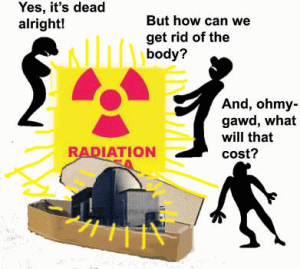
I am pleased to have laid a departmental minute describing the contingent
liabilities arising from the signing of the funded decommissioning
programme and Government support package for Sizewell C. The funded
decommissioning programme at Sizewell C will be funded via the regulated
asset base. The regulated asset base contains a series of protections that
aim to minimise the risk that public funds will be required to meet
decommissioning costs.
However, in certain remote circumstances whereby all
the protections afforded by Sizewell C’s economic licence fall away or a
shortfall in the fund materialises, public funds could be used to
contribute towards decommissioning costs and this liability would
crystalise. Based on best estimates by the Government Actuary Department,
the maximum potential exposure from the liability is £12 billion—in 2022
terms. This has been estimated on a worse-case scenario whereby the
Government were required to meet the full costs of decommissioning the
Sizewell C power plant.
Hansard 1st Sept 2025, https://hansard.parliament.uk/commons/2025-09-01/debates/25090137000015/SizewellCFundedDecommissioningProgrammeContingentLiability
Scottish nuclear plant emptied of fuel as UK winds down ageing gas-cooled reactors.
the cost of decommissioning should be taken into
account when the government decided on new nuclear plants as “no scheme can be guaranteed to meet a cost more than a century into the future”.
The first of the UK’s seven advanced gas-cooled reactor nuclear power
stations has been emptied of fuel, kick-starting a decommissioning process
that will cost at least £27bn in total and take almost a century.
EDF said on Thursday it had defuelled Hunterston B, on the west coast of Scotland,
paving the way for the transfer of the site and 250 staff from the French
power company to the UK Nuclear Decommissioning Authority next April. The
site provided most of Scotland’s energy for more than 40 years from its
launch in 1976 until its final closure in 2022.
EDF owns seven advanced gas-cooled reactors (AGRs) plants in the UK, which were built between the 1960s and 1980s and differ from newer nuclear plants that use water for
cooling. Just four are still operating.
The uranium fuel has been packaged
into 350 large flasks, which will be stored by the NDA at the Sellafield
nuclear site in Cumbria for at least 50 years until a longer-term
underground facility has been built.
Although the process took just three
years and £400mn, it will take almost a century to eradicate the radiation
from the land and buildings, EDF has said. The decommissioning of the seven
AGRs is separate to a much wider £105bn decommissioning programme, which
will cover an additional 17 closed nuclear sites over the next 120 years,
according to the NDA.
The closures will leave the UK with just one nuclear
power plant still running by 2030 — Sizewell B in Suffolk, which is also
managed by EDF and uses a pressurised water reactor. The NDA said it was
“acutely aware of the costs associated with delivering our mission”.
The cost of decommissioning nuclear power plants is under scrutiny as the
UK presses ahead with new nuclear projects, including the £40bn Sizewell
C, which is expected to get government go-ahead this spring, and the £46bn
Hinkley Point C, which is still under construction and will open by 2030 at
the earliest.
Steve Thomas, emeritus professor of energy policy at
Greenwich university, said the cost of decommissioning should be taken into
account when the government decided on new nuclear plants as “no scheme
can be guaranteed to meet a cost more than a century into the future”.
Although EDF has owned Hunterston B and the seven other AGR nuclear plants
since 2009, the cost of decommissioning is being paid for through the
ringfenced Nuclear Liabilities Fund (NLF), which was set up in 1996 after
privatisation and is valued at £20.6bn. Decommissioning costs have soared
over the past three decades, with the fund requiring cash injections from
the Treasury, including £5bn in July 2020 and a further £5.6bn in March
2022, according to the NLF.
FT 24th April 2025, https://www.ft.com/content/c31af2d6-eeaa-4a3d-a2c0-81c63b29cb1d
Dounreay more likely to build up than knock down.

By Iain Grant, 26 March 2025
People are being warned not to expect any of Dounreay’s former fuel or
waste buildings to be levelled any time soon. NRS Dounreay managing
director Dave Wilson was responding to a query posed at the latest meeting
of Dounreay Stakeholder Group (DSG). Mr Wilson said none of the cluster of
buildings deployed in the former fast reactor complex is slated for
demolition in the next couple of years. He added: “Skyline changes in the
short term might be a building going up to store material.
John O Groat Journal 26th March 2025, https://www.johnogroat-journal.co.uk/news/dounreay-more-likely-to-build-up-than-knock-down-377882/
**Plutonium**
Sellafield decommissioning to continue for at least a century – robot dogs play a part
Robot dogs could help decommission Sellafield nuclear plant after successful trials.
Operators working from the Westlakes Science Park in Whitehaven, around
eight miles from Sellafield, remotely operated “safely and securely” a
custom Boston Dynamics Spot Quadrupedal Robot ‘dog’ that could carry
out tasks such as remote inspections, data gathering and clean-up work.
Energy generation at the plant stopped in 2003, but the painstaking
decommissioning process typically takes decades and presents radioactive
hazards to workers. Sellafield is unusual in that the decommissioning
challenge also encompasses early nuclear research and nuclear weapons
programmes that took place on the site.
The Nuclear Decommissioning Authority (NDA) is not expecting full site remediation to be completed until 2125.
Engineering & Technology 20th March 2025
Dismantling work begins at Hamaoka nuclear plant
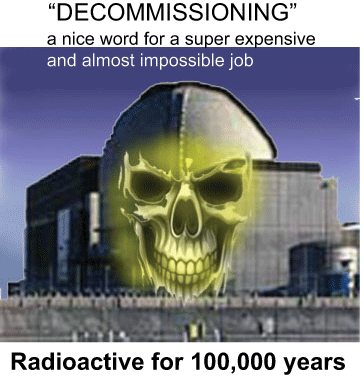
The start of the dismantling work signifies that the so-called “great era of decommissioning” has begun in earnest in Japan.
While Japan has entered an era of decommissioning, decommissioning plans continue to be postponed due to the lack of a finalized waste disposal site.
By FUMI YADA/ Staff Writer, March 17, 2025, https://www.asahi.com/ajw/articles/15671904?fbclid=IwY2xjawJHQ-9leHRuA2FlbQIxMQABHcLLRpjB5amZOZL-8qR613ATPjVA-r1TzUbw_ezeLkSwaBkwhCZVpLnMlw_aem_9niHHKoB8JXLoduuhcoh2Q
Dismantling work has begun at Chubu Electric Power Co.’s Hamaoka nuclear power plant in Omaezaki, Shizuoka Prefecture, the first time a commercial reactor in Japan is being dismantled.
On March 17, a crane was used to lift and remove the top lid of the No. 2 reactor pressure vessel, which contained nuclear fuel during its operation.
The start of the dismantling work signifies that the so-called “great era of decommissioning” has begun in earnest in Japan.
The No. 1 and No. 2 reactors at the Hamaoka plant are both boiling water reactors.
The No. 1 reactor began operation in 1976 with an output of 540,000 kW, and the No. 2 reactor went online in 1978 with an output of 840,000 kW.
After the earthquake resistance guidelines for nuclear power plants were revised in 2006, Chubu Electric Power Co. decided to decommission both reactors in 2008 due to the high cost of seismic reinforcement and other necessary measures.
Work began in 2009.
So far, spent nuclear fuel in the building has been removed to the fuel pools of No. 4 and No. 5 reactors, which are located on the same site, and unused fuel has been taken off site.
Decontamination of equipment has been carried out, and since fiscal 2015, dismantling of the turbines, generators and part of the reactor building has also been under way.
The dismantling of the reactor, which began on March 17, is considered the main part of the decommissioning work.
The reactor pressure vessel and internal reactor structures have high radiation levels that make them inaccessible to humans.
The work will be carried out by remote control using specialized robots, which requires advanced technology.
Chubu Electric Power Co. will dismantle the No. 1 and No. 2 reactors over a period of about 12 years, starting with the No. 2 reactor first.
The decommissioning of the two reactors is expected to be completed in fiscal 2042 after the buildings are finally dismantled.
Chubu Electric estimates that the decommissioning of No. 1 reactor will cost about 37.9 billion yen ($254.4 million) and about 46.2 billion yen for the No. 2 reactor.
However, the company has not yet decided where to dispose of the large amount of metal, concrete and other waste materials generated by the decommissioning work.
In Japan, the Japan Atomic Energy Agency has decommissioned a small experimental reactor, but no commercial reactors have been decommissioned yet.
At present, 18 nuclear power plants, excluding Tokyo Electric Power Co.’s Fukushima No. 1 nuclear power plant, are scheduled to be decommissioned.
Many other reactors in Japan have been in operation for a long time.
While Japan has entered an era of decommissioning, decommissioning plans continue to be postponed due to the lack of a finalized waste disposal site.
Belgium’s oldest nuclear reactor shut down for good after 50 years
15 February 2025, https://www.belganewsagency.eu/oldest-nuclear-reactor-shut-down-for-good-after-50-years
The Doel 1 nuclear reactor was definitively shut down safely on Friday night, the Federal Agency for Nuclear Control (FANC) has confirmed. After 50 years of electricity production, Belgium’s oldest nuclear reactor, with a capacity of 445 megawatts, was disconnected from the high-voltage grid at 21.37.
The FANC said the operation was carried out in complete safety. “Technically, there is no difference from a temporary maintenance shutdown, except that the reactor will not be restarted to produce electricity,” it said in a press release.
A shutdown phase lasting approximately five years is now beginning, during which the fuel will be cooled in order to “significantly reduce the radiological risk to the environment”. The waste will also be removed and the pipes emptied and rinsed. Then the actual dismantling will begin, which could last up to 15 more years.
Lifespan extended
Doel 1 is the third reactor to be definitively decommissioned, after Doel 3 in 2022 and Tihange 2 in 2023. Tihange 1 will also be shut down in the autumn.
The shutdown phase for Doel 1 will be slightly different to that for the other reactors, as Doel 1 and 2 are “twin” reactors that share certain systems, such as the control room and the engine room. These parts will only be shut down when Doel 2 is definitively decommissioned on 30 November.
Belgium will then have only two active nuclear reactors: Doel 4 and Tihange 3. Their operating period has been extended by 10 years until 2035 and the new federal government hopes to extend them for another decade.
There really ARE necessary nuclear industry jobs – IN DEMOLISHING NUCLEAR REACTORS!
Dounreay to take on 23 new apprentices
One of Britain’s most complex environmental restoration projects is taking on 23 new apprentices.
Nuclear Restoration Services and Nuclear Decommissioning Authority 13 February 2025,
https://www.gov.uk/government/news/dounreay-to-take-on-23-new-apprentices
The decommissioning of the former centre of fast reactor research and development at Dounreay is continuing to create long-term opportunities for young people.
Applications are open for the next intake of apprentices, with 23 places in total available.
The apprenticeships are in engineering trades, engineering design, construction scaffolding, construction painting, business administration and project management, and vary in length from two years to four years.
The closing date for applications is 14 to 21 February, with start dates in August.
Dounreay’s operator, Nuclear Restoration Services, is also in the process of recruiting 9 health physics surveyor trainees.
Their 2-year training programme equips them with an NVQ Level 2 Diploma in Radiological Protection.
Dounreay also has 15 places this year for graduate recruitment. Applications for these posts closed on 6 January.
More information about the opportunities at Dounreay can be found at the site’s careers website at www.dounreaycareers.com.
Dounreay has a long and proud history of high-quality training for young people across a wide range of disciplines and I’m delighted we are able to continue this during the decommissioning phase of the site,
said Dave Wilson, managing director of NRS Dounreay.
The site is complex, its decommissioning is challenging and we can offer superb training and development opportunities at the cutting edge of science and engineering.
Pickering A nuclear power plant bites the dust!
Twitter: https://x.com/NoNukeBailouts/status/1874916809050357787
Good riddance! This dawg of a nuke station – 4 reactors at Pickering A – has been finally put to rest. The 2.2 million people that live within 30 km of the station can breathe a sigh of relief (though Pickering B is still open), though taxpayers will now be saddled with billions of dollars of decommissioning and waste expenses into eternity.
The Pickering Nuclear Station is one of the oldest and largest nuclear plants in the world. Designed to last 30 years, it’s now over 50. In 1998, Pickering A was completely shuttered due to safety concerns. Units 1 and 4 were rebuilt at such high public expense that they mothballed units 2 and 3.
The Pickering nuke station has a long history of accidents and safety concerns – learn more here:
https://www.cleanairalliance.org/pickering-safety/
Good by nukes – hello renewables!
https://www.world-nuclear-news.org/articles/opg-says-goodbye-to-pickering-4
Complex plan for dismantling UK’s 27 dead, rusting, radioactive nuclear submarines.

Fife Council approve Babcock plans for Rosyth Dockyard
28th December, By Ally McRoberts
A NEW secure compound for the Submarine Dismantling Project at Rosyth Dockyard has been given the green light by Fife Council.
Babcock International had sought a certificate of lawfulness to change the use of a car park on Keith Road – with the loss of 86 spaces – and build a storage facility on it.
The much-delayed project aims to dismantle seven old nuclear subs at Rosyth, remove the radioactive waste and recycle as much of the metal as they can into “tin cans and razors”.
The new facility is needed for phases three and four and will be enclosed by three metres high walls, with new gates and drainage infrastructure.
In the application it was described as a laydown area and contractors’ compound that will be roughly 45 metres by 35 metres in size, and take up around half an acre of
land close to dry dock number three.
Swiftsure is the first vessel being disposed of at Rosyth and it’s scheduled to be recycled by 2026. In total, the project will dispose of 27 nuclear subs. Seven have been laid up at
Rosyth for decades – Dreadnought has been there so long, since 1980, that
most of the low-level radiation has “disappeared naturally” – and there are
15 at Devonport in Plymouth. Five are still in service with the Royal Navy.
The UK Government said earlier this year that the project has already
invested more than £200 million into the dockyard and the wider UK supply
chain and sustains more than 500 jobs.
Dunfermline Press 27th Dec 2024
https://www.dunfermlinepress.com/news/24820505.fife-council-approve-babcock-plans-rosyth-dockyard/
Final German nuclear power plant enters dismantling phase
World Nuclear News, 20 December 2024
Dismantling work at the shut down Brokdorf nuclear power plant has officially begun, PreussenElektra announced.
PreussenElektra – a subsidiary of EOn Group – applied for approval to decommission and dismantle the 1410 MWe pressurised water reactor in December 2017. The plant was shut down on 31 December 2021.
On 23 October this year, the Schleswig-Holstein Ministry for Energy Transition, Climate Protection, Environment and Nature issued the first decommissioning and dismantling permit to PreussenElektra for the Brokdorf plant. Phase 1 of the plant’s decommissioning and dismantling includes the decommissioning and dismantling of the plant components that are no longer required and subject to nuclear regulatory supervision, with the exception of the reactor pressure vessel and the biological shield. The plant was the last nuclear power plant in Germany that was not yet being dismantled.
On 13 December, all the requirements for using the permit were met when the last documents requiring approval came into force. On the same day, PreussenElektra notified the authorities that it was using the permit, meaning the plant’s post-operation phase had ended and it had entered the dismantling phase.
“We expect that we will now be able to quickly implement the first shutdown of a system in the power plant and thus be able to physically begin dismantling this year,” said Brokdorf plant manager and dismantling programme manager Tammo Kammrath……………………………………………………………………
In December last year, PreussenElektra, together with EOn group companies, announced plans for the construction at the Brokdorf site of the largest battery storage facility in the EU to date. The facility – to store electricity from renewable sources – is to be expanded in two stages to up to 800 MW of power and a storage capacity of up to 1600 MWh. Commissioning could begin as early as 2026. https://www.world-nuclear-news.org/articles/Final-German-nuclear-power-plant-enters-dismantling-phase
‘Long journey ahead’ for nuclear plant clean-up
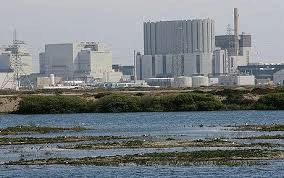
Piers Hopkirk, BBC News, Dungeness, 16 Dec 24
It took about 16 years to build Dungeness B nuclear power station, but to return the site to its original state will take nearly a century.
This is the scale of the task facing EDF as the company continues the process of removing the uranium from this decades-old facility that sits on a remote headland on the Kent coast.
The turbines stopped turning at Dungeness in 2018 and, with the decision taken to cease electricity production, the process of defueling the plant has begun.
In the giant reactor hall the scale of the task becomes apparent.
Buried under the floor are the uranium-filled fuel assemblies that powered the station’s two nuclear reactors.
There are more than 400 rod-filled assemblies in each reactor and it will take six years to safely remove them all.
It is done with the help of a giant 2,000 tonne crane that will carefully lift each one out before moving them into another part of the plant to cool.
Plant Manager, Paul Windle, said: “So far we have removed around 25% of the fuel from one reactor.
“We have got a long journey ahead.”
From the reactor hall the fuel ends up in an area called the ponds.
The fuel, still hot, is stored under water here for 90 days before it is deemed safe enough to be placed into steel flasks which will be moved on to lorries to begin the journey to a nuclear waste facility at Sellafield in Cumbria.
Dungeness B was the first advanced gas cooled nuclear reactor to start construction in the UK.
It was at the vanguard of 20th Century nuclear power generation.
However, in the face of technical challenges that were seen to be too expensive and complicated to address, the decision was taken by EDF to halt energy production………………………………………………………….. https://www.bbc.co.uk/news/articles/cz7qvderej9o
Explosives speed Sizewell A turbine hall decommissioning
WNN, Friday, 6 December 2024
More than 1200 holes were drilled and 700 kilogrammes of explosive used for the demolition of large concrete plinths in the turbine hall of Sizewell A nuclear power plant in the UK.
Nuclear Restoration Services said it was the largest use of explosives on a nuclear site for conventional demolition purposes in decades.
After the holes were drilled into the plinths, the charges were set and covered for the detonation, which was all planned and carried out with Office for Nuclear Regulation (ONR) oversight.
A series of test blasts had to take place and special detonator timings designed to meet nuclear site regulations for air overpressure and ground vibration, with Offive for Nuclear Regulation (ONR) having placed a hold point on the work until they were sure any risks from the novel operation had been minimised.
The ONR said that following the blasts, the huge turbine supporting concrete bases can be removed using heavy machinery within two weeks, rather than “deploying older and slower methods of drilling the structure apart which would have taken several months”.
Sizewell A’s twin reactors shut down in 2006 after 40 years of operation. Planning consent was given to demolish the turbine hall and electrical annexe in August and more than 35 miles of cabling and 8000 scaffolding boards, clips and pipes have been taken out………………………….. https://www.world-nuclear-news.org/articles/explosives-used-in-sizewell-a-turbine-hall-decommissioning
Decommissioning old nuclear sites to cost £130bn in blow to Miliband
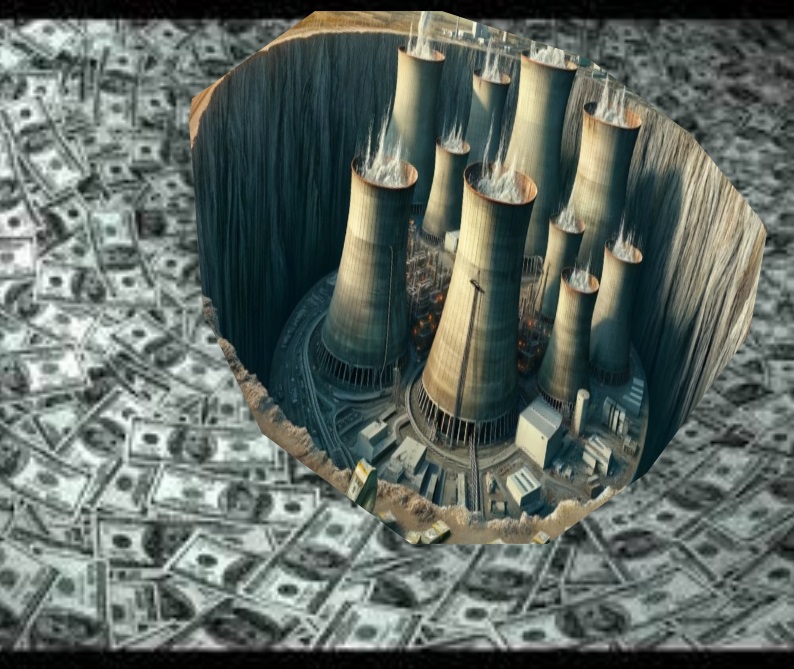
The figures mean the cost of the UK’s nuclear clean-up alone is close to the total value of electricity produced by atomic power stations since the 1950s.
If the cost of building Britain’s 20-odd past and present nuclear power stations were included – around £30bn each in today’s money – the total cost of several hundred billion pounds would far exceed the value of the power produced, say experts.
Expense to taxpayer of cleaning up former power plants is higher than previously estimated, say auditors
Jonathan Leake, Telegraph, 29 Nov 24
Ed Miliband faces a bill of almost £130bn to clean up Britain’s old nuclear sites after estimated costs jumped.
It will cost £128.8bn to safely wind down old facilities, according to an investigation by the National Audit Office (NAO) – £23.5bn more than previously expected, after factoring in the cost of shutting eight power stations that are currently operational.
Seven nuclear stations are due to shut down in 2028 at which point operator EDF, France’s state-owned energy firm, will hand them back to the British Government for decommissioning.
Another station, Sizewell B, is expected to keep operating into the 2030s when it too will be decommissioned at taxpayer expense.
The NAO report, which looked at the overall operation of Mr Miliband’s Department for Energy Security and Net Zero (Desnz), said: “The current best estimate is that the eight existing sites will each cost £23.5bn to defuel and decommission.”
This is in addition to £105.3bn already set aside for dealing with other legacy projects, chiefly waste stockpiled at Sellafield in Cumbria.
Desnz oversees a Nuclear Liabilities Fund set up to save the money needed for decommissioning the eight stations, but the NAO said this had proven woefully inadequate.
It also warned that the final costs and taxpayer contributions could rise even higher.
The NAO said: “Costs could rise further, particularly if defuelling takes longer than planned … There is a risk that further taxpayer contributions may be required.”
However, the cost of decommissioning the UK’s remaining working nuclear stations is dwarfed by the amount which the NAO found was needed for dealing with legacy waste since the 1950s.
About 70pc of the costs relate to the Sellafield site in Cumbria, where thousands of tonnes of highly radioactive waste are stored in buildings and cooling ponds that are up to 70 years old – many considered extremely hazardous.
The figures mean the cost of the UK’s nuclear clean-up alone is close to the total value of electricity produced by atomic power stations since the 1950s.
Figures released by the Department of Energy and Climate Change show that since Britain’s first nuclear power station opened in 1956, they have generated 2.6bn megawatt hours (MWh) of electricity with a wholesale value of about £200bn at today’s prices.
If the cost of building Britain’s 20-odd past and present nuclear power stations were included – around £30bn each in today’s money – the total cost of several hundred billion pounds would far exceed the value of the power produced, say experts.
The NAO report also looked at the system of Contracts for Difference (CfD) – a financing method created by the UK to guarantee investors in wind farms, solar farms and nuclear power stations sufficient income.
Such schemes, it warned, were already set to cost consumers £89bn by the 2030s – but the final sums could be far higher because of unreliable estimates for the amount of power likely to be produced……………………… https://www.telegraph.co.uk/business/2024/11/29/decommissioning-old-nuclear-sites-to-cost-130bn-in-blow/
Hunterston B decommissioning approved
The UK Office for Nuclear Regulation (ONR) has granted consent to EDF
Energy’s application to start decommissioning the Hunterston B nuclear
power station. This follows a public consultation and a detailed assessment
by ONR specialist inspectors of EDF’s environmental statement.
The
statement included a detailed environmental impact assessment (EIA) for the
proposed decommissioning project at the North Ayrshire site in Scotland,
along with mitigation measures designed to prevent or reduce any
significant adverse environmental impacts.
The EIA identified two
significant impacts during decommissioning: temporary adverse visual impact
of dismantling activities of the power station for local residents and the
socioeconomic effects on the regional employment market and workers at
Hunterston B released from their roles during phases of the project. ONR
said it is satisfied that the environmental statement proposes adequate
mitigation measures to address these factors and considers the statement to
be complete, of the right quality, and in line with relevant good
practices.
Nuclear Engineering International 19th Nov 2024 https://www.neimagazine.com/news/hunterston-b-decommissioning-approved/
Nuclear Decommissioning Services Market Expected to Reach $11.79 Billion by 2034 – BIS Research
Industry Today 12th Nov 2024
As nuclear facilities worldwide reach the end of their operational lives, the nuclear decommissioning services market is witnessing substantial growth. The Nuclear Decommissioning Services Market is projected to grow from $6.70 billion in 2024 to $11.79 billion by 2034, fueled by the rising number of decommissioned nuclear facilities and the increasing emphasis on sustainable practices.
Published 12 November 2024
Market Overview
Market Size and Growth Rate
The Nuclear Decommissioning Services Market is projected to grow from $6.70 billion in 2024 to $11.79 billion by 2034, at a CAGR of 5.81% during the forecast period. This growth is driven by the escalating number of decommissioned reactors and a shift toward stringent regulatory frameworks prioritizing safe and sustainable decommissioning processes. …………………………………………………..
Demand Drivers
The market is significantly driven by the retirement of aging nuclear facilities, increased regulatory scrutiny, and advancements in decommissioning technology. Environmental sustainability mandates are pushing the demand for efficient and compliant decommissioning solutions.
Challenges
Complex regulatory requirements and high costs remain key challenges. Additionally, the intricate nature of nuclear waste disposal raises concerns over potential delays and budget overruns in large-scale decommissioning projects. …………………………………………………………………………………………………….
The successful [whaaa-aa-aat!] decommissioning of Japan’s Fukushima Daiichi nuclear power plant highlights the potential for advanced decommissioning technology to manage complex sites safely and efficiently. ……………………………………………..https://industrytoday.co.uk/energy_and_environment/nuclear-decommissioning-services-market-expected-to-reach-1179-billion-by-2034-bis-research
1 This Month

of the week – Shut Down Drone Warfare!


Tell the Ukrainian Government to Drop Prosecution of Peace Activist Yurii Sheliazhenko

Petition to revoke the licensing of the Near Surface Nuclear Disposal Facility (NSDF) at Chalk River. https://www.ourcommons.ca/petitions/en/Petition/Details?Petition=e-7247
To see nuclear-related stories in greater depth and intensity – go to https://nuclearinformation.wordpress.com
-
Archives
- March 2026 (237)
- February 2026 (268)
- January 2026 (308)
- December 2025 (358)
- November 2025 (359)
- October 2025 (376)
- September 2025 (257)
- August 2025 (319)
- July 2025 (230)
- June 2025 (348)
- May 2025 (261)
- April 2025 (305)
-
Categories
- 1
- 1 NUCLEAR ISSUES
- business and costs
- climate change
- culture and arts
- ENERGY
- environment
- health
- history
- indigenous issues
- Legal
- marketing of nuclear
- media
- opposition to nuclear
- PERSONAL STORIES
- politics
- politics international
- Religion and ethics
- safety
- secrets,lies and civil liberties
- spinbuster
- technology
- Uranium
- wastes
- weapons and war
- Women
- 2 WORLD
- ACTION
- AFRICA
- Atrocities
- AUSTRALIA
- Christina's notes
- Christina's themes
- culture and arts
- Events
- Fuk 2022
- Fuk 2023
- Fukushima 2017
- Fukushima 2018
- fukushima 2019
- Fukushima 2020
- Fukushima 2021
- general
- global warming
- Humour (God we need it)
- Nuclear
- RARE EARTHS
- Reference
- resources – print
- Resources -audiovicual
- Weekly Newsletter
- World
- World Nuclear
- YouTube
-
RSS
Entries RSS
Comments RSS
 nuclear-news